Posts Tagged ‘plants’
harvesting herbs
The colder nights have arrived and I have decided it is time to harvest my herbs.
~
I have a lot of parsley in my deck garden. All summer, I have snacked every day on the leaves, loving the taste, the fresh air feeling that is the result.
~

~
I enjoyed the harvest as well. With scissors, I cut the parsley leaves just below the branching of stems.
~

~
I checked each set of leaves for bugs but the parsley is remarkably bug-free.
~
~
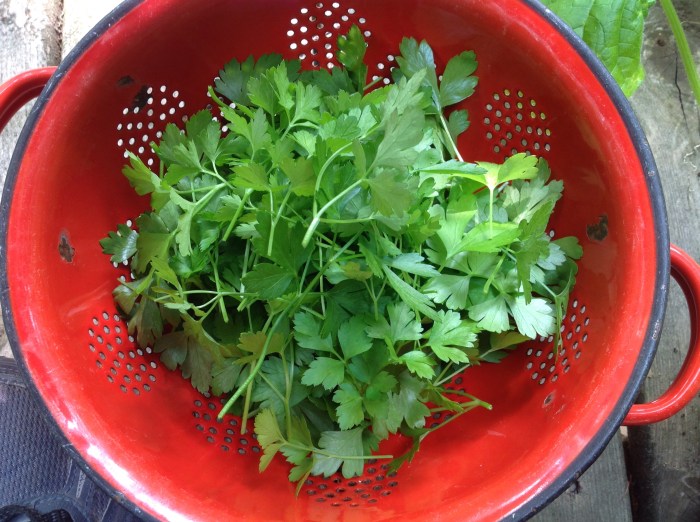
I harvested into my colander, washed the leaves and set them to air-dry. Once the leaves are dry, I will load them into my drier, a Salton VitaPro. In a drying time of about three hours, I will have enough parsley for winter cooking.
~
I have followed a similar process with my basil. Everything around me smells really good!!
~
Hope you are enjoying your own produce if you are lucky enough to have a garden.
Enjoy your day.
Stay safe.
Do. Not. Get. Covid. Fatigue!
All my best,
Jane
revising poetry
After a full month of working on my artsnb project ‘garden escapes,’ I am conscious of the passage of time. My deadline is November 1, 2020, and meeting this deadline requires completing the poems and other deliverables.
~
At this point (I began on July 1, 2020), I have completed my field work (visits to various abandoned communities), done drafts of 70 poems, placed these poems in seven tentative subject groups, and considered how I will approach revisions. I know I will also write a few more poems based on material collected.
~
The subject groups (not in order) are:
- all that remains
- my mother’s garden
- invaders and volunteers
- the gardener
- whispered stories
- a glimpse of history
- the shape of a garden
~

~
I meet regularly with a writing group known as Wolf Tree Writers. I have read a few of the poems at these meetings and received lots of suggestions. I think the most important suggestion has been: ‘ask yourself, where is the metaphor in this poem?‘ I have taken this idea seriously. I do want these to be poems about communities and garden plants. But each poem has to work harder – it has to comment on some social truth addressed (the metaphor).
~
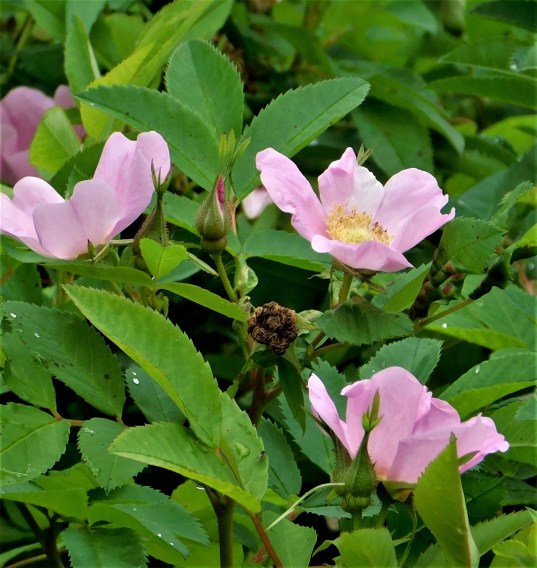
When I began this work, I spent a full day on metaphor, considering how garden escapes would relate to issues or problems we face as humans. The fundamental requirement for a garden to escape is – it must be left alone to decide its own fate. In our lives this could be a metaphor for:
- accomplishment – you can write a song, but you have to let it go to see if it will flourish. This applies to the results of various endeavors: paintings, quilts, stories. Collections are a particular type of accomplishment; people often belittle ‘stuff,’ but I think particularly of things passed on from one generation to another (jewellery, books, souvenirs). Like the plants in a garden, accomplishments must make it into the right hands, the right conditions of soil and sun.
- influence – you can talk to people and try to nurture them, but only time will tell if influences take hold. Some of our influence is directed and purposeful; you can try to be a good teacher to your children but eventually they must leave home and only then will lessons take hold or wither. Gardeners will plant a scarlet runner bean and end up with a lupin; parents can plant a ‘carpenter’ and end up with a ‘financier.’ So much of influence is accidental, transferred by chance. Think of influencers like ‘kindnesses,’ ‘chance encounter,’ ‘place’ and ‘accident.’ Also, ‘influence’ must be abandoned for a while and then re-discovered and the value found.
- abandonment – the abandonment of children/family can occur in so many ways: adult children lose their parents, children are orphaned or abandoned, parents are left to fend for themselves as they age. Each of these situations can be examined using the metaphor of the abandoned garden.
~
~
So my first duty in revision will be to examine each poem for the embedding of metaphor. Sometimes the metaphor will already be there. Sometimes I will need to add a phrase or line for clarity. Sometimes the whole poem will have to be reconfigured to include a clear idea of metaphor.
~
When more substantive revisions are done, I have a revision checklist aimed at detailed revision.
~
revision checklist
- take out ‘which’ and ‘that’
- remove weak verbs (‘to be’)
- consider removing small words (‘the,’ ‘a,’ ‘so,’ ‘etc.’)
- try alternative words – words to contribute more
- exchange words used more than once with synonyms
- remove adverbs (many are ‘ly’ words) and gerunds (‘ing’ words)
- read aloud – watch for phrases or ideas that ring bells – may make it better/worse
- be truthful – when it isn’t right, return to truth
- check if singular or plural is correct
- consider passive voice – does it drag it down?
- check voice (child, scientist); don’t switch within poem
- consider end and embedded rhyme – select better words
- consider rhythm; count beats/syllables and read aloud to identify cadence errors
- for poems written in a particular form, check conformity to form
~

~
All of this is a continuing process. Even when I submit those ‘final’ poems with all their revisions, I may continue to work at poems for years!!!!
~
This work is accomplished as part of an artsnb Creations Grant.
~
All my best.
Stay Safe.
Don’t get COVID fatigue.
Jane
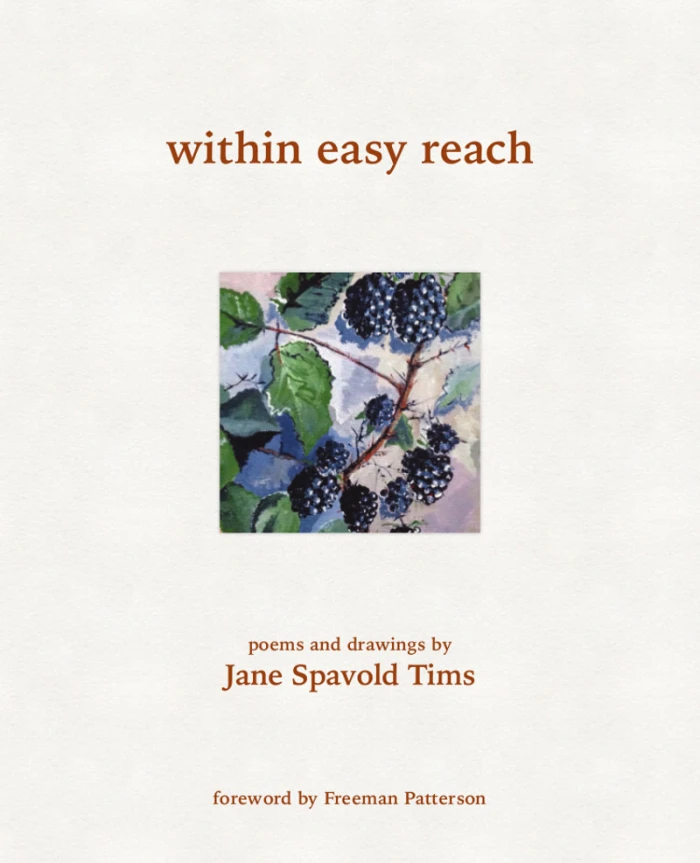
Do you love picking berries, herbs, other plants from the garden? I think you’d like my book of poetry ‘within easy reach’ (Chapel street Editions, 2016). It is illustrated with my drawings and contains notes on various example of the edible ‘wild.’ Order it here.
~

~
where we step
~
my brother and I explore
the old home place, overgrown
and unused, the house fallen
into the cellar, a sock
tossed into the dresser drawer
but, barefoot not an option
~
even shod, we are careful
of our feet – nails, glass, bricks
from the chimney, unease creeps
beneath the grass – we watch for
the water well, covered but
with rotted boards
~
hard not to love where we step –
the mint enfolds our ankles,
rose and rosemary, our minds
chives lace our sneakers, fold
flowers from purple papers
lavender leans on the walls
~
silver, graceful and wise,
the sage surveys our ruin,
thyme is bruised,
everywhere we step
~
~
Stay safe.
All my best!
Jane
garden escapes: having fun
I have been working at my garden escapes project for almost a month now. Many of the poems are simple free verse, usually evenly divided in stanzas of four to seven lines, often consisting of regular numbers of syllables. I have also tried some other forms, the pantoum and the ghazal. And most fun of all, for a few poems, I have tried shape poems, using the lines of the poem to create shapes reflective of the subject matter.
~
~

~
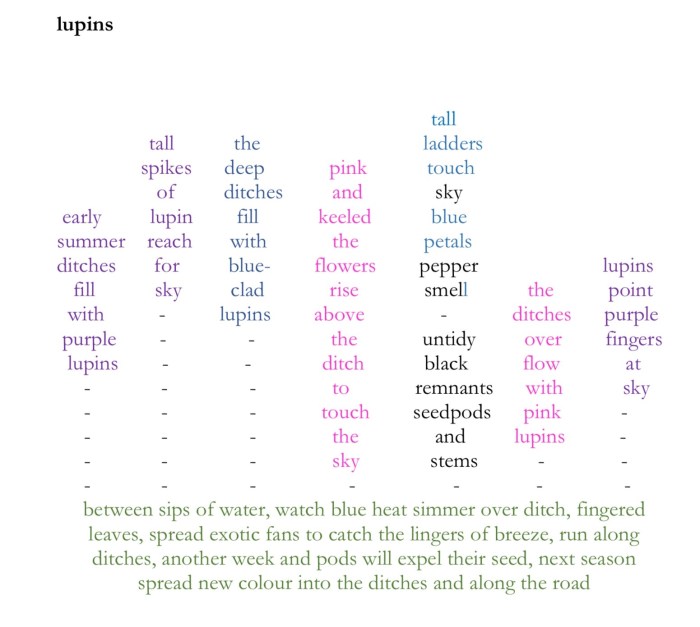
Here is a poem that goes a step further. The shape shows the shape of lupins growing in the ditch; the colours are the colours of the flowers.
~

~
~
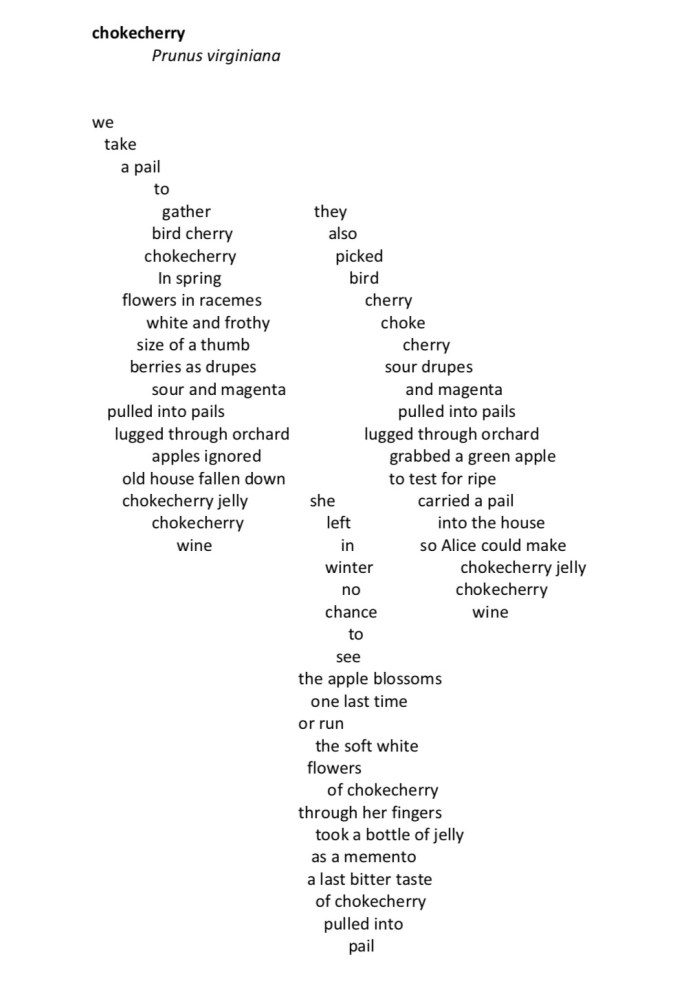
And, a poem about chokecherries, in the shape of the hanging blossoms or berries.
~
~

~
I will continue to work with these, perhaps aiming to make the poem read sensibly no matter which way you approach it.
I’d appreciate any comments, positive or negative!
~
This work was made possible by a Creations Grant from artsnb!
~
All my best,
doing my best to stay in my shape,
Jane
abandoned gardens: a pantoum about lilacs
Over the years, faced by change, some communities continue to thrive. Others, once vigorous, may decline and disappear. Sometimes, communities may hang on but individual homes may be abandoned. Abandonment can occur if the owner moves away or dies, or if aspects of the home become unsustainable (for example, a water source dries up).
~

~
When a home is abandoned, what becomes of the vegetable garden, so carefully tended, or the flower gardens, each plant chosen with love and care?
~
Annuals are usually the first to go, although biennials may continue to grow for a year and some plants, like sweet William or pansies, may reseed. Perennials may thrive, sometimes for years. Rhubarb, chives and berry crops often continue to grow in a vegetable garden. In the flower garden, peonies, day-lilies and phlox may bloom year after year. Trees and shrubs often persist.
~

rhubarb persisting in an old garden
~
In my poetry project about abandoned gardens, I want to learn more about various poetry forms. The poem below is written as a pantoum. A pantoum consists of four line stanzas. The second and forth lines of the preceding stanza are used as the first and third lines of the next. The first line of the poem may also be used as the last.
~
The poem below is written about an abandoned house in central New Brunswick. Keep in mind, these properties are still owed by someone and the owners may care a great deal about them and perhaps use the property if not the house.
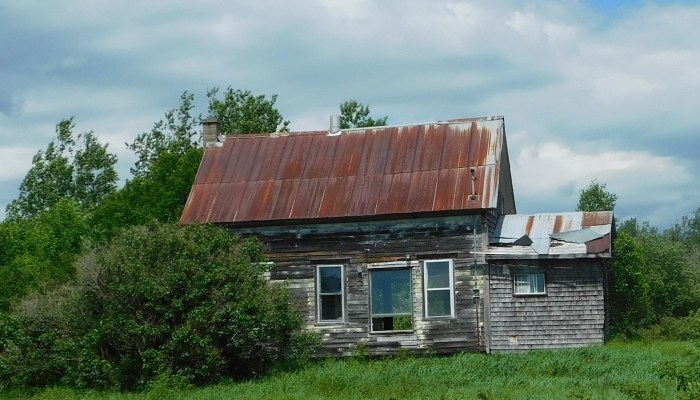
lilac bush next to an old house
~
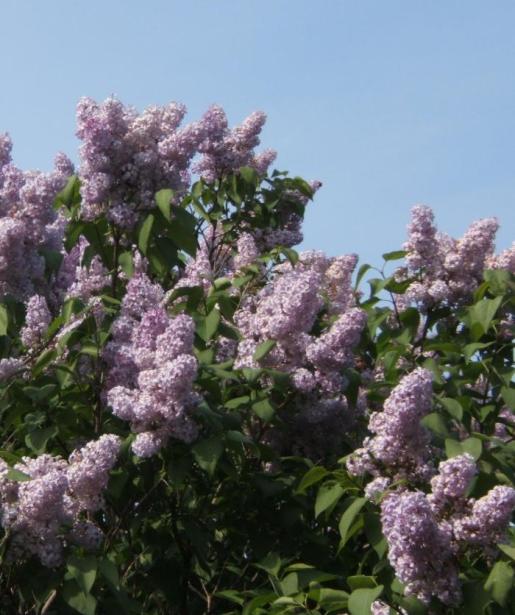
lilacs persist
~
delicate scribble of winter wren
lilac, a cushion of shadow and green
props the abandoned house
roof rusted, clapboards and shingles grey
~
lilac, a cushion of shadow and green
at night leaves peer in windows
roof rusted, clapboards and shingles grey
features sculpted by overlapping leaves
~
at night they peer in windows
stare, front windows to back yard
features sculpted by overlapping leaves
scented panicles of purple bloom
~
stare, front windows to back yard
noses tuned to lilac sweet
scented panicles of purple bloom
lilacs persist and thrive
~
noses tuned to lilac sweet
roof rusted, clapboards and shingles grey
lilacs persist and thrive
delicate scribble of winter wren
~
~
 ~
~
This work is supported by a Creation Grant from artsnb (the New Brunswick Arts Board)!
~
Perhaps we can learn from the lilac …
persist and thrive.
All my best,
Jane
spring flowers
Our dominant ground greenery at this time of year is from the leaves of lily-of-the-valley (Convalleria majalis). Like emerald flames they light up the yard. And now they are in bloom. The fragrance is amazing!

All my best
and please stay safe at home.
Jane
Small, small garden
Arthritis means my days of the big garden are over. But I can still enjoy digging in the earth, planting seeds, pulling weeds and harvesting, just on a smaller scale.
~
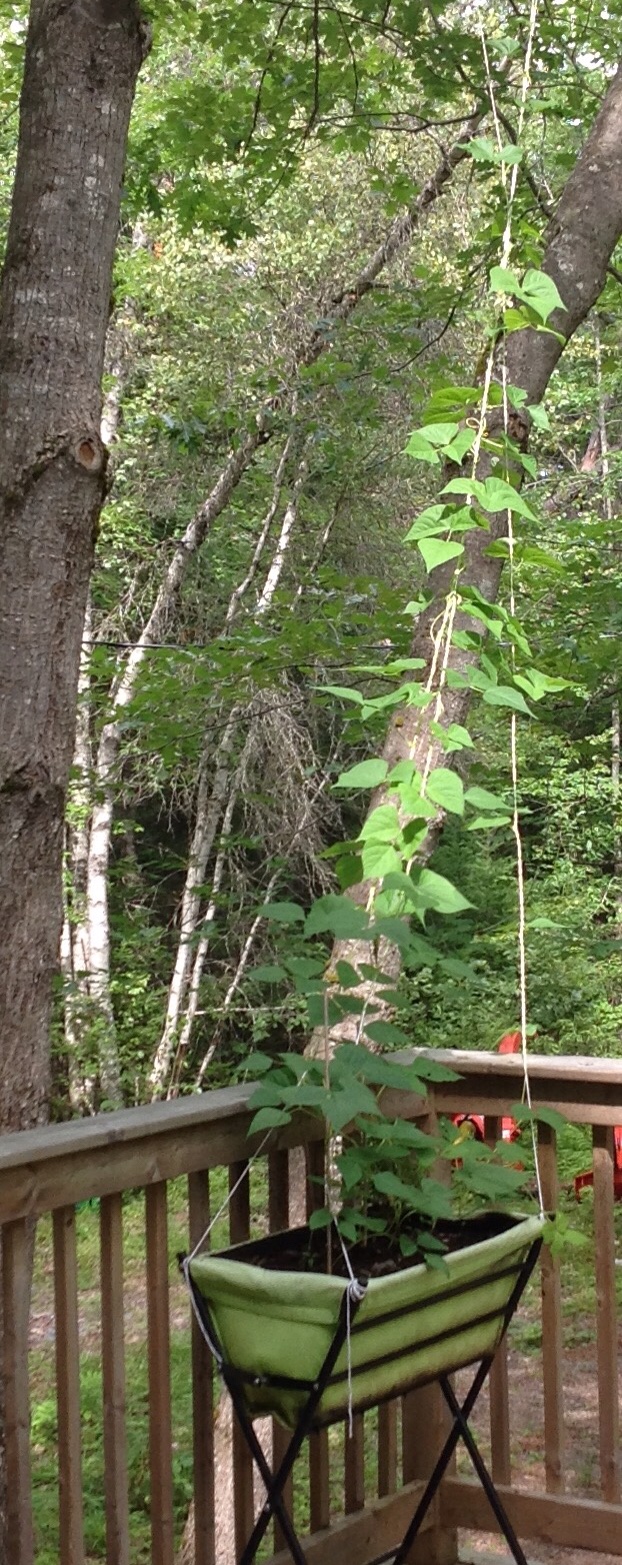
On our deck are two Veg Trugs (Lee Valley Tools used to sell them) and one bag of soil, slit open and supported on a metal frame. In the ‘gardens’ I have two snow pea plants, three yellow wax bean plants, three parsley plants and one cucumber plant.
~

~
Each day for the last month, I sit on the deck and nibble on my ‘harvest for the day.’ Sometimes it’s one bean pod and a snow pea pod, sometimes two beans, sometimes a cucumber sandwich. Seems small, but I think I enjoy these little sessions more than the buckets of produce I once harvested from my garden.
~


How high can I climb?
Not that high. But I will have to figure out how to get those beans. I planted what I thought were yellow-wax beans on my deck. And they turned out to be yellow pole beans. I threw a couple of weighted strings into the maple and of course the beans climbed.
~
~

~
All my best, Jane
Indoor garden
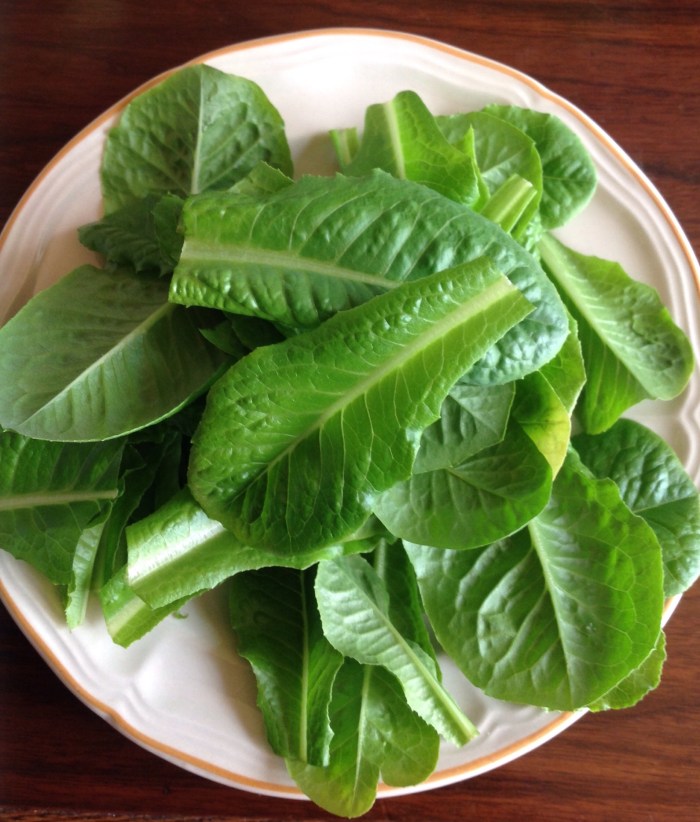
My harvest of romaine lettuce from my AeroGarden today. Poppy seed dressing and lunch is served!
~
~
All my best
Jane




 nichepoetryandprose