Posts Tagged ‘writing process’
words from the woodland – bird song
I have a lot of projects underway, mostly on the ‘administrative’ side of writing. I have been ordering and revising a manuscript of poems on abandoned aspects of our landscape ( see https://nichepoetryandprose.wordpress.com/2015/01/19/first-and-last-and-in-between/ ). Now, I have reached the point where I really need to set the manuscript aside so I can approach it with a fresh eye in a couple of weeks. So I will use the days between to order another manuscript of poems about sounds from the woodland. The poems mostly use animal and bird sounds and songs as metaphors for human communication.
~
Some of these poems have been around a while, packaged in another form. In the last weeks, I have been thinking about the bird song metaphor and now I am ready to consider the poems in relation to one-another. Perhaps I am responding to the Black-capped Chickadees, chattering in the Tamarack. Or the Hairy Woodpecker who comes every few days to beat his head against our telephone pole. Perhaps I am thinking more than usual about human communication (having just learned to ‘Twitter’).
~

January 8, 2012 ‘two Mourning Doves’ Jane Tims
~
drawing doves
~
‘… cease to mourn …’
Virgil, Eclogue I
~
grey sighs beneath graphite
or where eraser softens
troubled feathers
~
doves lament, disturb
fine detail, mourn
the fingers’ tremble
~
pencil strokes beak
and fingernails, kernels
of corn, husks of sunflower
~
~
Copyright 2015 Jane Tims
take flight, metal wings, take flight
A fellow blogger recently suggested a different way to present poetry in a post – to give a little background on the poem’s origins and perhaps show the evolution of the poem from draft to ‘final’ stage.
~
Sounds like fun!
~
The poem below began with a watchful eye. I am always on the lookout for an image to inspire a poem. Walking the path to the door of our house, my mind was on the rain, the warmish day and the forecast, an expected return to freezing temperatures.
~
I spotted the bird bath, full of leaves and melted water. And perched on the edge of the bird bath, a moulded metal bird. This bird is bolted to the edge of the bird bath’s copper rim. Presumably he is there to attract the real birds. But since no real birds use the bath, he is the only one ever there. My relationship with this metal bird is mixed. I like its quiet perching on the edge of the bath. I like its rusty patina. I don’t like its occasional disappearance when its metal bolt lets go. Then, I have a struggle to find its little metal body in the thick layer of leaves under the bird bath.
~
So this is the set-up for the poem – a day of January thaw, melt water everywhere and knowledge the metal bird will not stay put.
~
First, a photo of the metal bird. The words ‘take flight’ were bumping around in my brain and I knew I would have a poem from this. I want this poem to be about opportunity, about taking change and turning it into possibilities for an altered future.
~

I’m a poet, not a photographer …
~
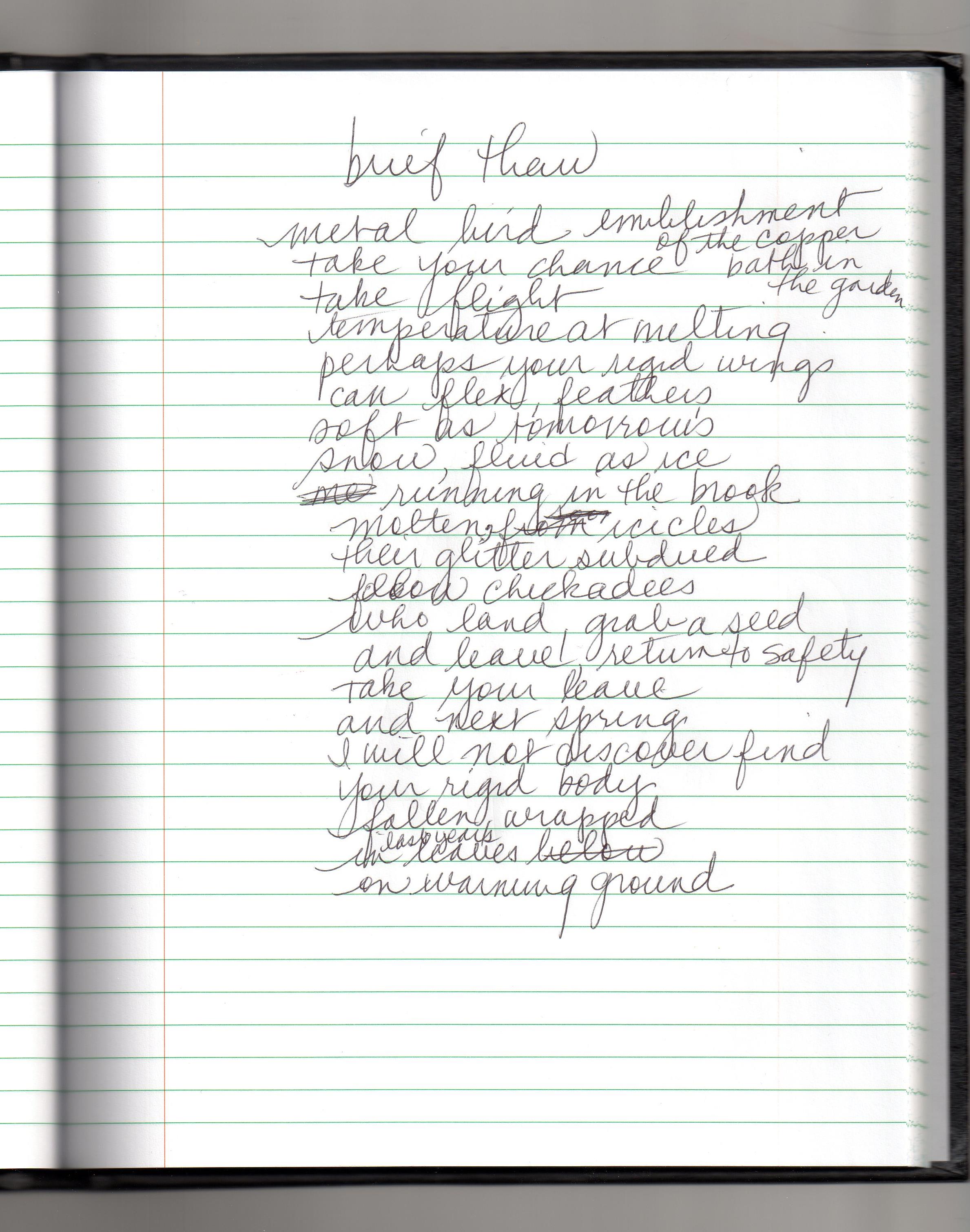
Then, I grabbed my ‘rough book’, the place where every poem I ever write begins. Sometimes, I hand-write several drafts, but in this instance, I felt like typing, so I copied the rough draft into the computer, almost word for word, but not quite.
~
~
brief thaw
2nd draft
~
metal bird, embellishment
of the copper bird bath in the garden
take your chance, your flight
temperature at melting
perhaps your rigid wings
can flex, find feathers soft
as tomorrow’s snow
fluid as ice now running
in the brook, molten icicles
their glitter subdued
follow chickadees who land
grab a seed and return to the
woods for safety, take your leave
and next spring I will not
find your rigid body fallen
wrapped in last year’s rotting
leaves on warming ground
~
So that is the rough poem. I like it. It flows, it contains some interesting metaphors, and it captures the possible flight and altered future of the metal bird. It needs editing.
~
For the next draft, I ‘press’ on words, getting rid of some, replacing others. I annotate the earlier draft, finding places where I like the flow, where I find internal rhyme or alliteration. In this poem, there are lots of words about metal, and I hope to include others. I change ‘ing’ words and the past tense to verbs in the present when possible.
~
brief thaw
3rd draft
~
metal (iron) bird, (silver-plated ?) embellishment
of the copper bird bath in the garden (doesn’t matter if it is in the garden)
take your chance, your (take ?) flight
temperature at melt (title says this)
perhaps your (rusted?) rigid wings
can flex, find feathers soft (fine?)
as tomorrow’s snow (when, last week ? next week ?)
fluid as ice, now running runs
in the brook, molten icicles
their glitter subdued
(take flight ?)
follow chickadees, who land
grab a seed (from the bird bath ????) and return fly to the
woods for (woods for ?) safety (of the trees ?) , take your leave (take flight ?)
and (and or/ore) next spring I will not (not ?)
find your rigid (rigid ?) body fallen (fallen ?), wrapped
in last year’s rotting muck rot of
leaves on warming (new-warmed?) ground
~
Well, I made a complete mess. Perhaps the fourth draft will be an improvement.
~
In the fourth draft, I incorporated the above ideas, and made a lot of changes. For example, I tried some different approaches to stanza … some of my poems are very irregular in their stanza breaks. I think this poem needs stanza breaks to help the reader. I also wanted to repeat ‘take flight‘ at intervals in the poem. Although I considered stanzas of three and five lines, my final decision, four stanzas of four lines, was based on the syllable counts of the lines and the sloping shape of each stanza. I am a rabid syllable-counter. I find it helps me decide what words are not needed at all and makes me consider alternatives.
~
brief thaw
4th and (for now) final draft
~
iron bird, embellishment
of the copper bird bath
take your chance
take flight
~
perhaps your rusted wings can
flex, find feathers, fine as
next week’s snow
take flight
~
molten as icicles from
the feeder where chickadees
seize a seed
take flight
~
or next spring find your metal
body rigid, wrapped in
last year’s rot
of leaves
~
take flight
~
~
Before I make further changes to the poem, I will read it aloud several times. The repetition of ‘take flight’ may have to go. Notice, I have not changed the title of the poem … that could change, although I like not mentioning the actual thaw in the poem. The title is a great place to add other information for the reader and I often forget this opportunity.
Do you have suggestions for other changes I could make to the poem? I welcome your comments!
~
Copyright 2015 Jane Tims
first and last and in between

~
This past Saturday, I worked to create a manuscript of some poems I have written on the theme of discarded and abandoned elements of life and landscape.
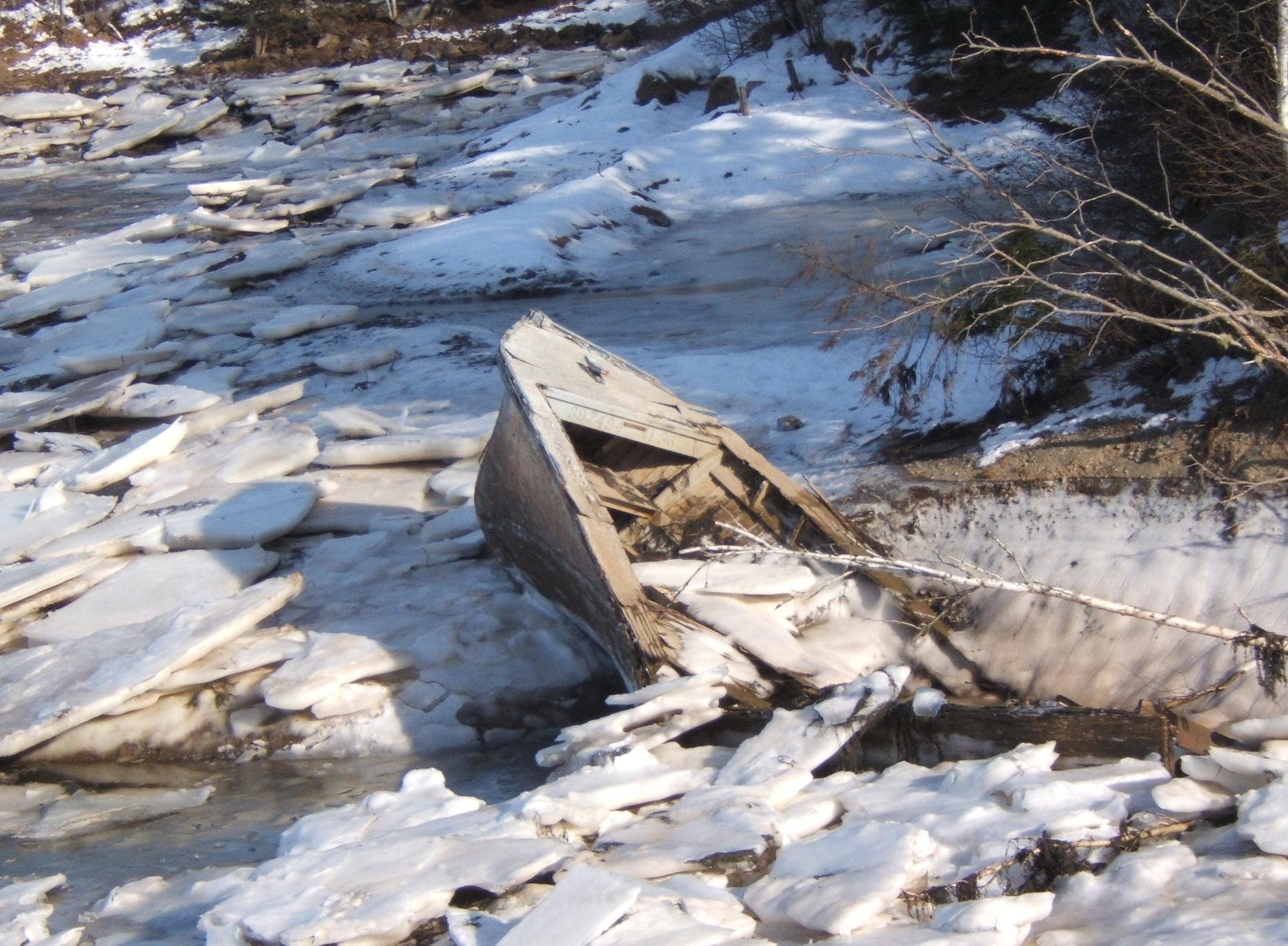
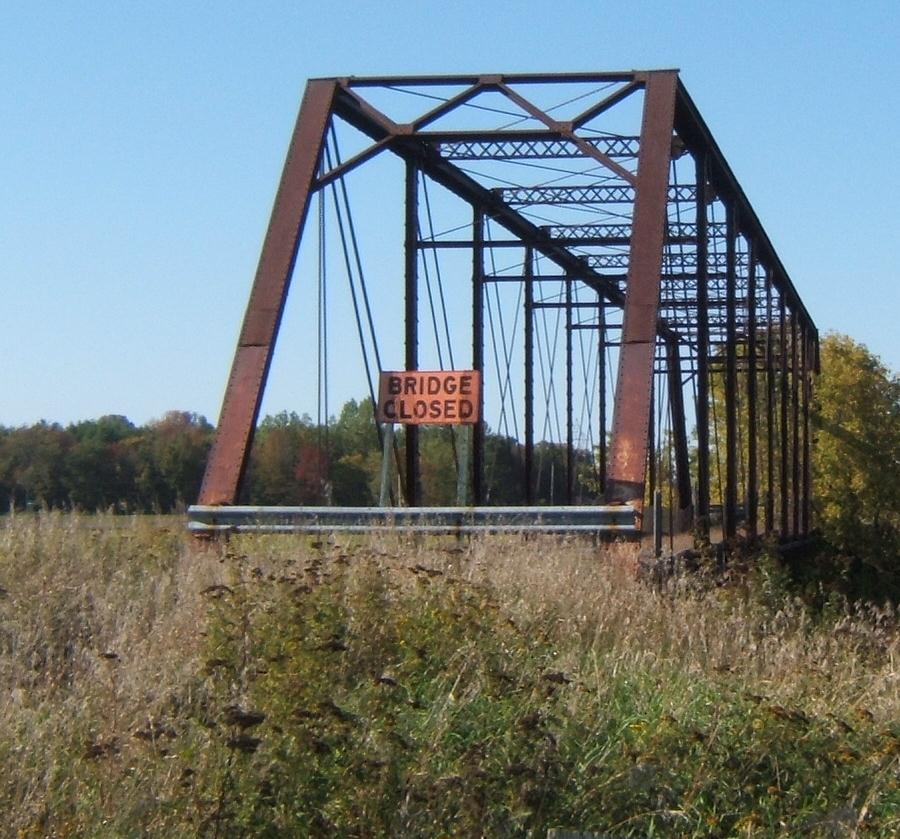
There are 38 poems in the rough manuscript, making up about 50 pages. The poems are a study of change. They include poems about abandoned boats, roads, churches, toolboxes, sheds, trucks, bridges and so on.
I have published a few of these on this blog … for an example, see ‘Foggy Molly’, a poem about an abandoned boat (https://nichepoetryandprose.wordpress.com/2013/01/30/abandoned-boat/ ).
~
~
Part of creating this manuscript is to put the poems in order. I find it hard to decide how to arrange 38 poems so they flow, one into the other, and so they tell a story.
~

~
1. My first step is to print a table of contents of the rough manuscript. I read each poem through and assign a couple of key words to describe it, jotting these into the table of contents. For my 38 poems on abandonment, I obtained 27 key words. Many of these are shared by various poems, but a few are unique to one or two poems. My key words are, in no particular order:
lost ways, regret, grown over, barriers, evidence, sadness, history, haunted, adaptation, voice, intention, anger, change, memory, denial, improvement, new life, lost function, buildings, items, understanding, cruel, resistance, life/death, shock, keeping past, lost/misplaced, broken
~
~
2. Next, I put everything into a table, with Xs to show which key words fit each poem. This does not take too long to do and helps me consider the meaning of each poem. Below is just a small section of my table:
| Poem Title | lost ways | regret | grown over | barriers | evidence | sadness | history | haunted | adaptation |
| Recovery | X | X | X | X | |||||
| Reason for Leaving | X | X | X | X | X | ||||
| South Nation Bridge | X | X | X | ||||||
| Outfield | X | X | |||||||
| Diverted road | X | X | |||||||
| Invitation to tea | X | X | X | X | X | ||||
| Lane | X | X | |||||||
| Abandoned church | X | X |
~
3. Once I have the table created, I tally the Xs in the columns and decide which key words are most common. Key words occurring in more than 10 poems are shown in bold:
lost ways, regret, Grown over, barriers, evidence, sadness, history, haunted, adaptation, decay, intention, anger, change, memory, denial, improvement, new life, lost function, buildings, items, understanding, cruel, resistance, life/death, shock, keeping past, lost/misplaced, broken
The words that apply to almost every poem usually speak to the theme of the poetry collection: in this case, the words ‘change’, ‘memory’ and ‘lost function’ were very common, no surprise in a collection about things abandoned. Other key words, common to a few poems, suggest possible themes for the sub-sections.
~

~
4. My next step is to look at the key words and see what themes ‘speak’ to me. I also want to have a progression of ideas through the manuscript. In this case, some of the poems are sad and rather hopeless, while some show how abandonment leads to understanding, and, in some cases, to new purpose and new life. From the key words, I selected six sub-sections: ‘lost ways’, ‘decay’, ‘haunted’, ‘broken’, ‘understanding’ and ‘new life’.
~
5. Now comes the long work of re-ordering the manuscript. I create a new document and, one at a time, transfer the poems into their new sections.
~
6. I like to name each section, taking the name from a line in one of the poems in the section. These may change later, but for now, they give me a reference within each group of poems:
lost ways – ‘overgrown …’
decay – ‘left to rust …’
haunted – ‘ghosts are lonely here …’
broken – ‘dry putty, broken glass …’
understanding – ‘the rock to stand on …’
new life – ‘a turn towards horizon …’
~

February 11. 2014 ‘old shed near Charlo’ Jane Tims
~
Today, I will begin a read of the manuscript to see how the poems flow within their sections. Many revisions are ahead, but this is my favorite part of the work!
~
Have you ever gathered poems into a manuscript and did you use any particular method to decide the order of the poems?
~
Copyright 2015 Jane Tims
newfall of snow
~

~
newfall: words escape me
~
the white ephemeral
perhaps frost
the fir boughs divided
the sculptured steel
of a flake of snow
~
try again
~
paper stencil
on chocolate cake
powdered sugar
sifted on the rills
of the new plowed field
~
again
~
sweet in my mouth
the bitter melted in morning sun
white hot on my cheek
the writing lamp
~
a lamp to the left
casts no shadow
(the shadow of a pen
or a hand)
~
(unless you are wrong-handed)
~
chimney shadow
on a fresh-snowed roof
or trees on the eastern edge of the road
where the sun cannot warm
~
the morning
dusting of ice
~
try again
~
~

~
Published as ‘newfall: words escape me’, The Fiddlehead 196, Summer 1998.
Copyright 2014 Jane Tims
beet pink
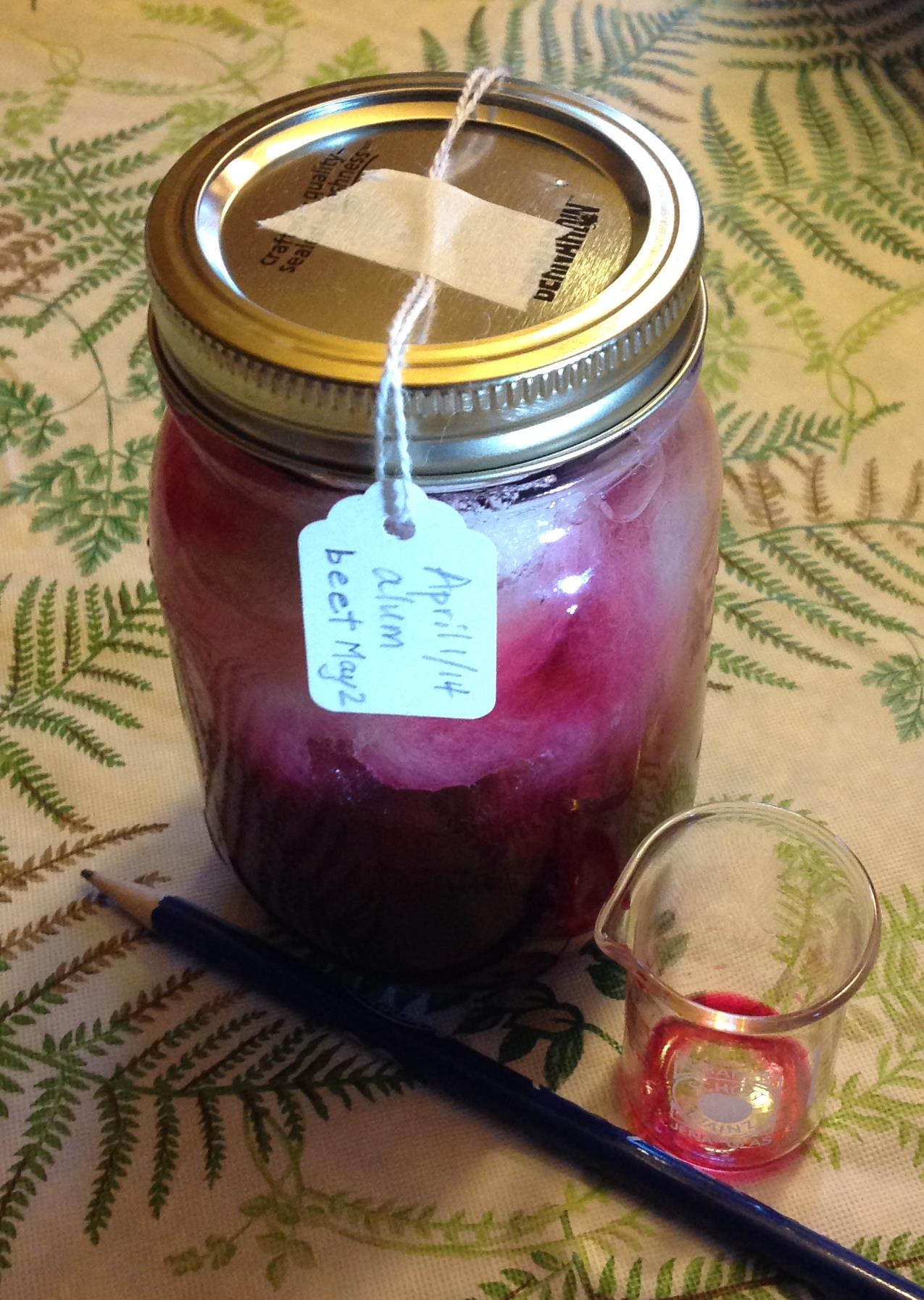
Last week, I tried dyeing some wool roving with the juice of pickled beets …
~
~
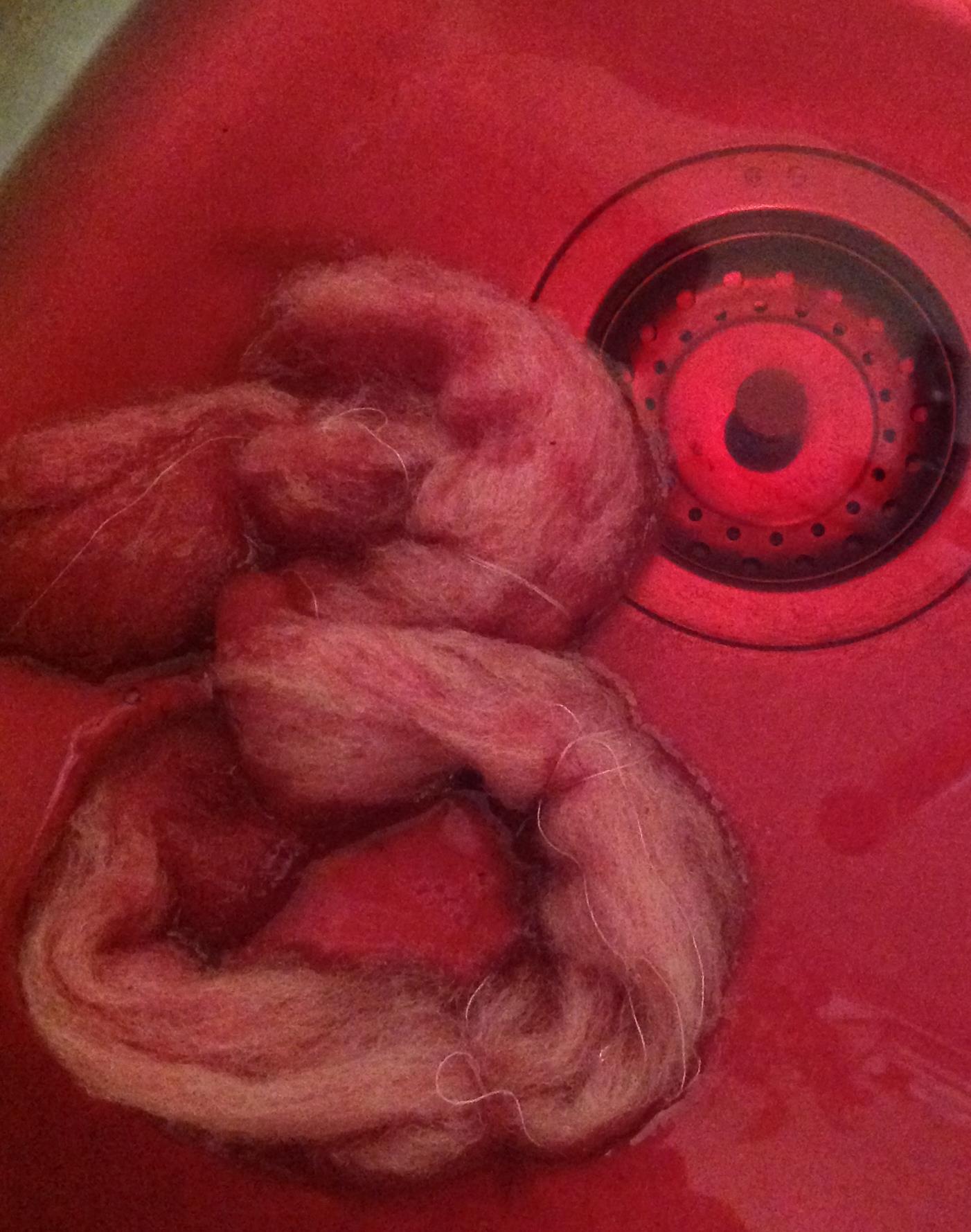
Yesterday I opened the jar and rinsed the wool in cool water. Looks like a lot of the colour still went down the drain …
~
~
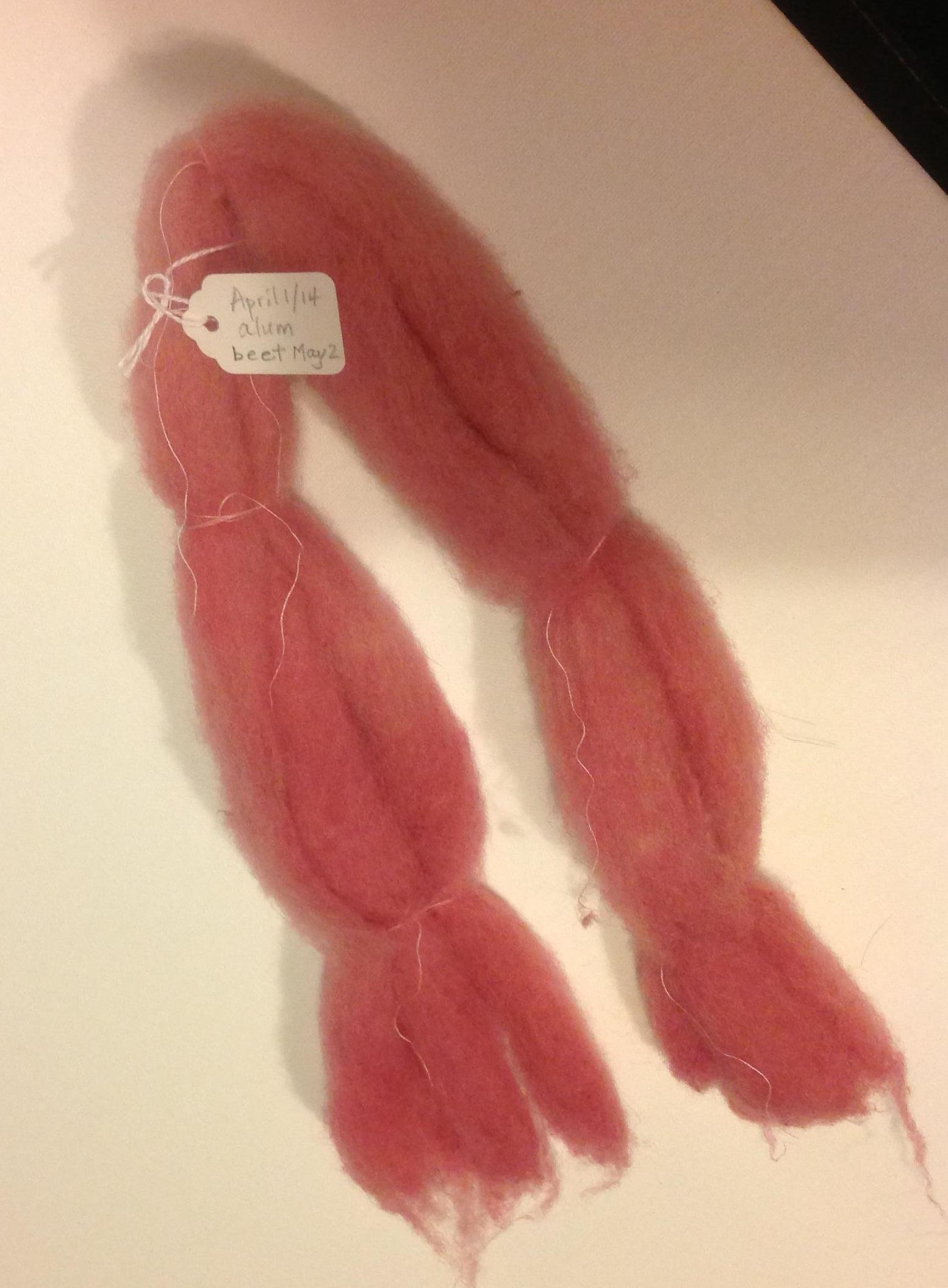
And the final result? A pretty pink. Reminds me of the pink batts of insulation we installed in our walls! The wool is not scratchy at all, but soft and fragrant.
~
~
Gradually I am building a rainbow of colour on my drying rack …
~

from right to left: wool roving prepared with alum as a mordant; wool dyed with Tansy; wool dyed with Old Man’s Beard lichen; and wool dyed with pickled beet juice
~
I am still working on the poem to capture this experience … it’s not quite ready to share.
~
Copyright 2014 Jane Tims
beet red
For my next dyeing project, I want to use beets as dyestuff. Although my writing project is called ‘harvesting colour’, there no beets in my garden and none in the store where I shop. So I have decided to see what commercially available pickled beets will contribute to my experience of dyeing.
~
My eagerness to use beets for dyeing is due to the encouragement of a friend of mine. When I asked her to do an evaluation of my project for artsnb she wrote about how she loves the colour of the water after she cooks beets. She also said how much fun it would be to keep the ‘ruby red water’ on the windowsill in a jar. I hope to be able to capture an experience like this in my poetry.
~

~
First, I bought a jar of pickled beets. I read the label carefully, just to make sure there is no artificial colour added to the jar.
~

~
Eating the beets is a side-benefit of this project. The taste reminds me of my Mom’s pickled beets. I remember her showing me how to boil the beets and how easy it was to slip the skins from the boiled roots.
~
~
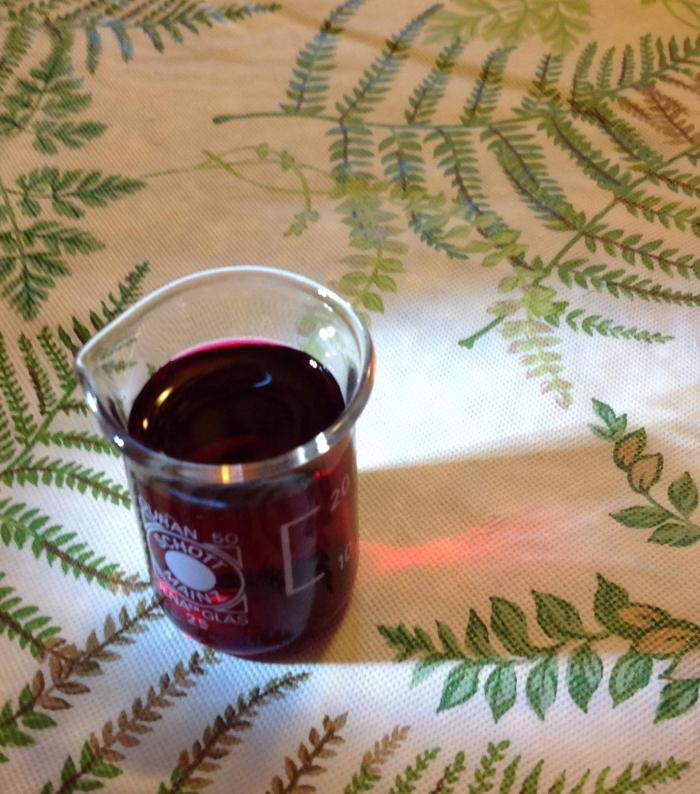
The beet juice is a bright rosy-red, clear and jewel-like …
~
~
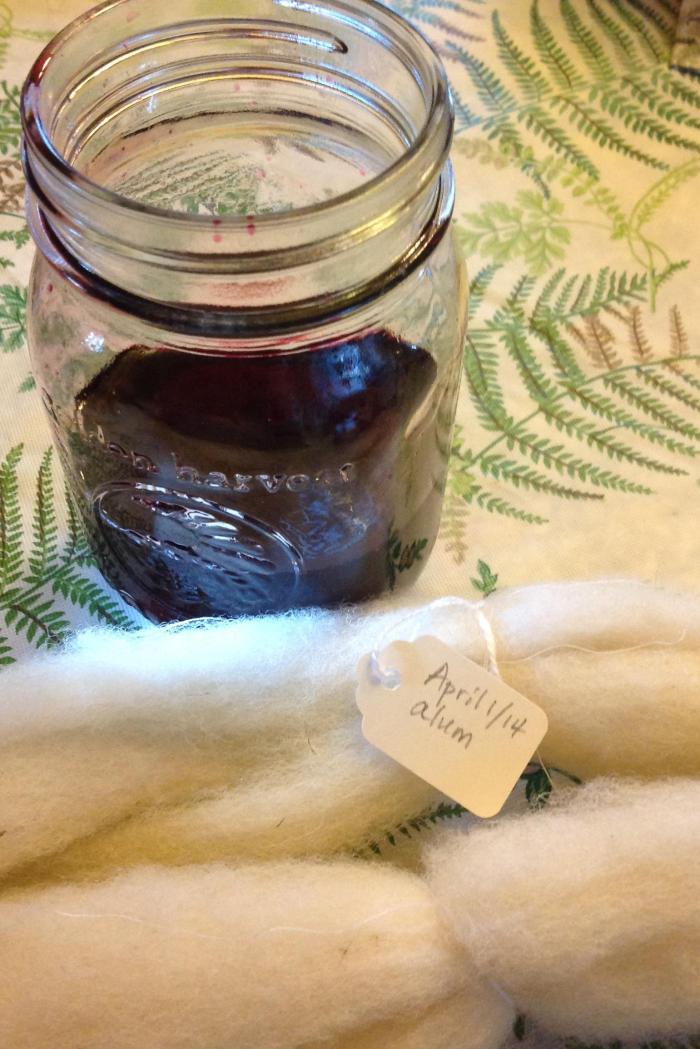
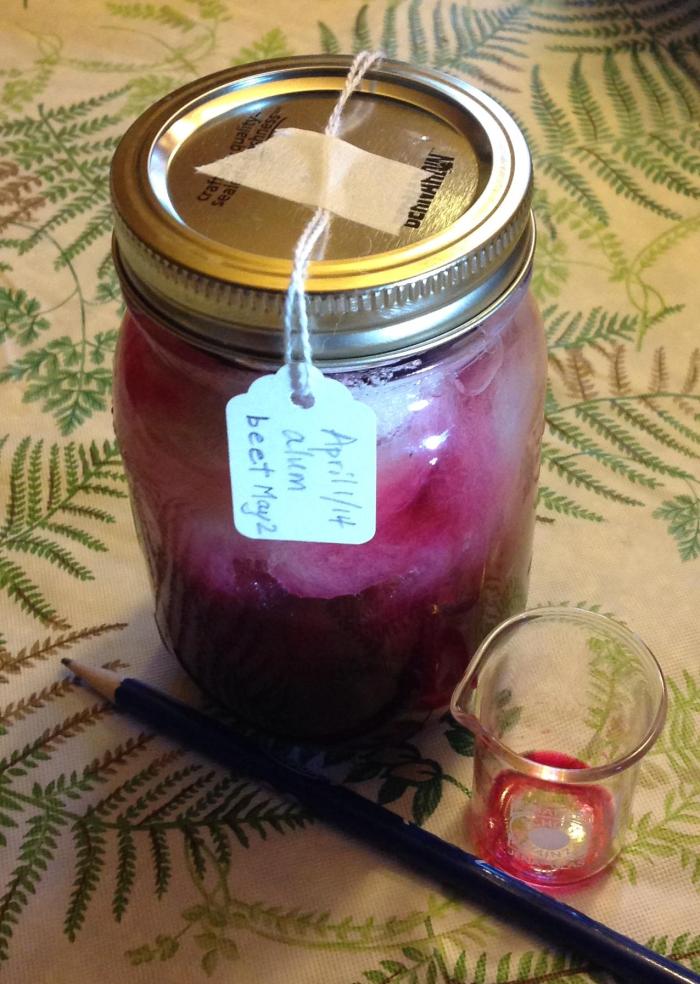
For this project, I used a length of my alum-treated wool … I have learned these mechanically-carded lengths of wool are called ‘roving’ …
~

~
I had a scary moment when I realised adding the wool to the juice was not the best idea – danger of overflow!!! Fortunately, the wool absorbed the juice and I had to top it up with water.
~
~
Now, again, I have to wait to see the results. I expect the beet juice to turn the wool red or even pink. But who knows what colour will emerge? I will show you the results in about one week’s time.
~
I spent a while today working on drafts of a poem to accompany my beet-dyed wool. First, I thought about my friend’s comment about how wasteful it seems to pour the beautiful beet colour down the drain. Then, I focused on identifying a real-life experience to fit the metaphor.
~
Since I have been working on my family history lately, I know about lost and wasted memories … I wish so much I had paid better attention when my Mom told me stories about her family. Sometimes I can remember a snippet, or a name, but the story never seems complete. Because I didn’t listen carefully to her stories, I wasted her words the way the colour is wasted as it pours down the drain.
~
Once I think about what I want to express in the poem, I explore the ideas in a rapid-write. With this first step, I often find the poem begins to take form. I hand-write several drafts (usually six or seven), refining the poem’s structure and ideas. After the third or fourth draft, I begin to vary my word choices and ‘press’ on certain words to make them work harder in the poem. At some point, the form and words of the poem have become clear to me and at that time, I type the draft into the computer. Once the keyboard takes over from the pen, I concentrate on line length and punctuation.
~
If this all sounds very mechanical, I will say that I believe the poem found its life in my head, before it ever reached the pen and paper stage.
~
It will be while before I finish the poem and feel like it is ready to publish. Like the chemistry occurring in the mason jar of beet juice and wool, my poem will take time and patience.
~
Copyright 2014 Jane Tims
The Light Never Lies – A Guest Post from Francis Guenette
I am so pleased to welcome a guest in this post. Francis Guenette is a Canadian writer, the author of two books, ‘Disappearing in Plain Sight’ ( FriesenPress, 2013) and ‘The Light Never Lies’ (Huckleberry Haven Publishing, 2014). When I read ‘Disappearing in Plain Sight’, I was drawn to the setting – Crater Lake, the cabins and the garden. In this post, Frances writes about the setting, its origins and how the setting influences the story. Welcome Frances! And thank you so much for your Crater Lake Series of books!
~
 To begin – a synopsis of The Light Never Lies:
As circumstances spiral out of control, Lisa-Marie is desperate to return to Crater Lake. The young girl’s resolve is strengthened when she learns that Justin Roberts is headed there for a summer job at the local sawmill. Her sudden appearance causes turmoil. The mere sight of Lisa-Marie upsets the relationship Liam Collins has with trauma counsellor, Izzy Montgomery. All he wants to do is love Izzy, putter in the garden and mind the chickens. Bethany struggles with her own issues as Beulah hits a brick wall in her efforts to keep the organic bakery and her own life running smoothly. A native elder and a young boy who possesses a rare gift show up seeking family. A mystery writer arrives to rent the guest cabin and a former client returns looking for Izzy’s help. Life is never dull for those who live on the secluded shores of Crater Lake. Set against the backdrop of Northern Vancouver Island, The Light Never Lies is a story of heartbreaking need and desperate measures. People grapple with the loss of cherished ideals to discover that love comes through the unique family ties they create as they go.
~
My first order of business is to extend many thanks to Jane for inviting me over to her blog. Jane thought it would be interesting to hear how architectural and garden elements of the setting for Disappearing in Plain Sight and The Light Never Lies contributed to the story.
~
Write what you know. It’s a common sense piece of advice. After all, fiction writers have enough work in the making-things-up department. When I first envisioned writing a novel, it was because a group of characters had made a sudden appearance in my imagination. I always knew they would live in a rural setting, on the shores of a lake, some in elaborate cabins with expansive gardens and some in more rustic dwellings. Fiction mirroring reality – where I live is somewhere in the grandiose middle.
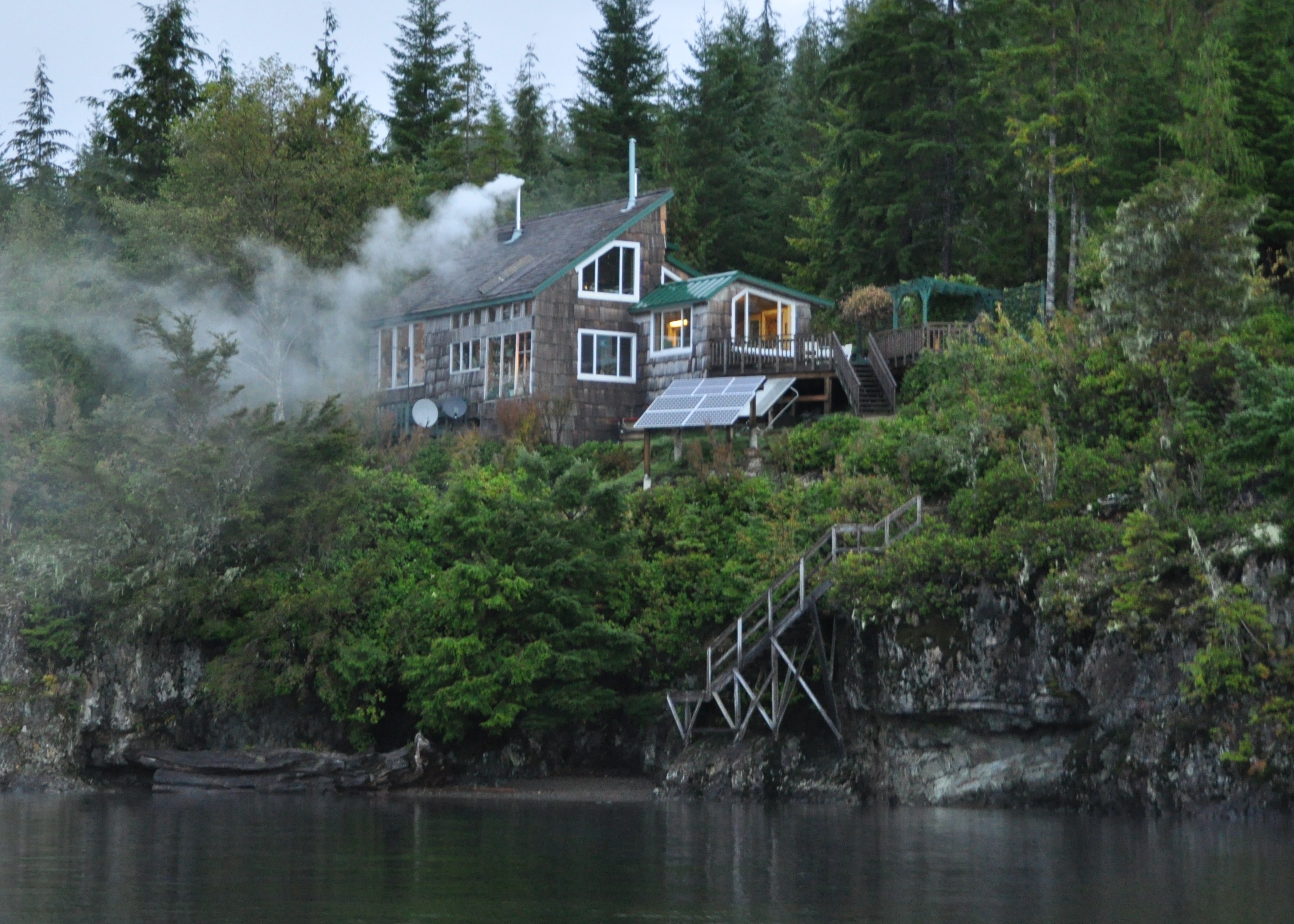
I thought about my own home and a few cabins in the vicinity and from there I embellished, stretched and massaged the reality of these settings into a small community on the shores of a fictional place called Crater Lake.
I have lived on the shores of a lake, in a cabin, with a garden in the wilderness for over twenty years. I’ve walked the trails around this place so many times my feet have worn smooth my route. In many ways, it’s hard for me to separate my own environment from that of the books – except to stress that Crater Lake is fictional, Micah Camp is a product of my imagination, the characters likewise. The cabins and gardens described are all altered, sometimes to a grander scale, sometimes to include elements not present anywhere but in my imagination. I suspect many writers have gone through a similar process.

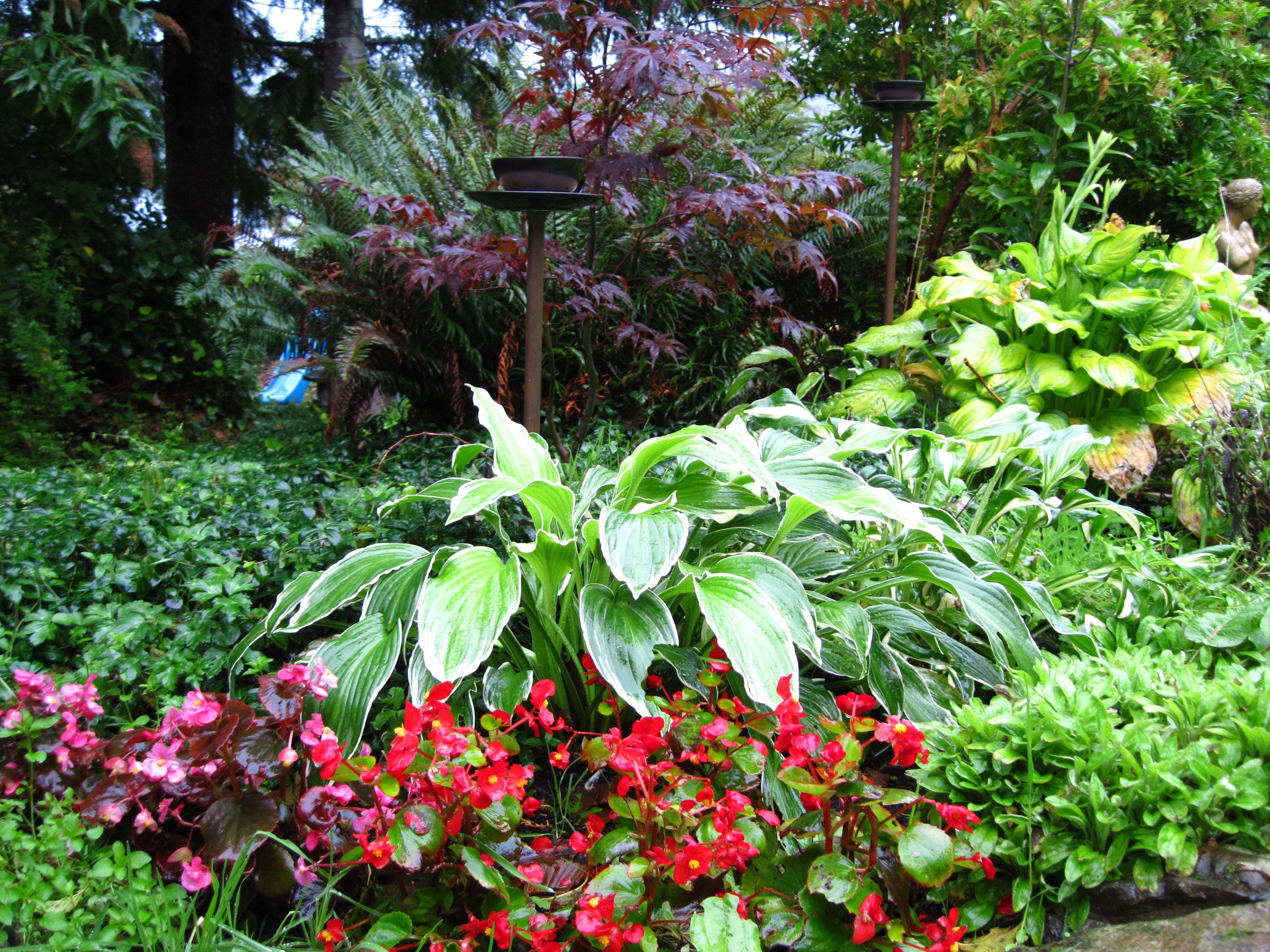
Living in a particular place shapes people. A rural, semi-isolated setting, homes that reflect local materials open to multiple views of lake, mountains and trees, gardens and small businesses carved out of wild landscapes – all of these factors make the characters in my books the people they are and dictate (to a degree) the situations they find themselves in.
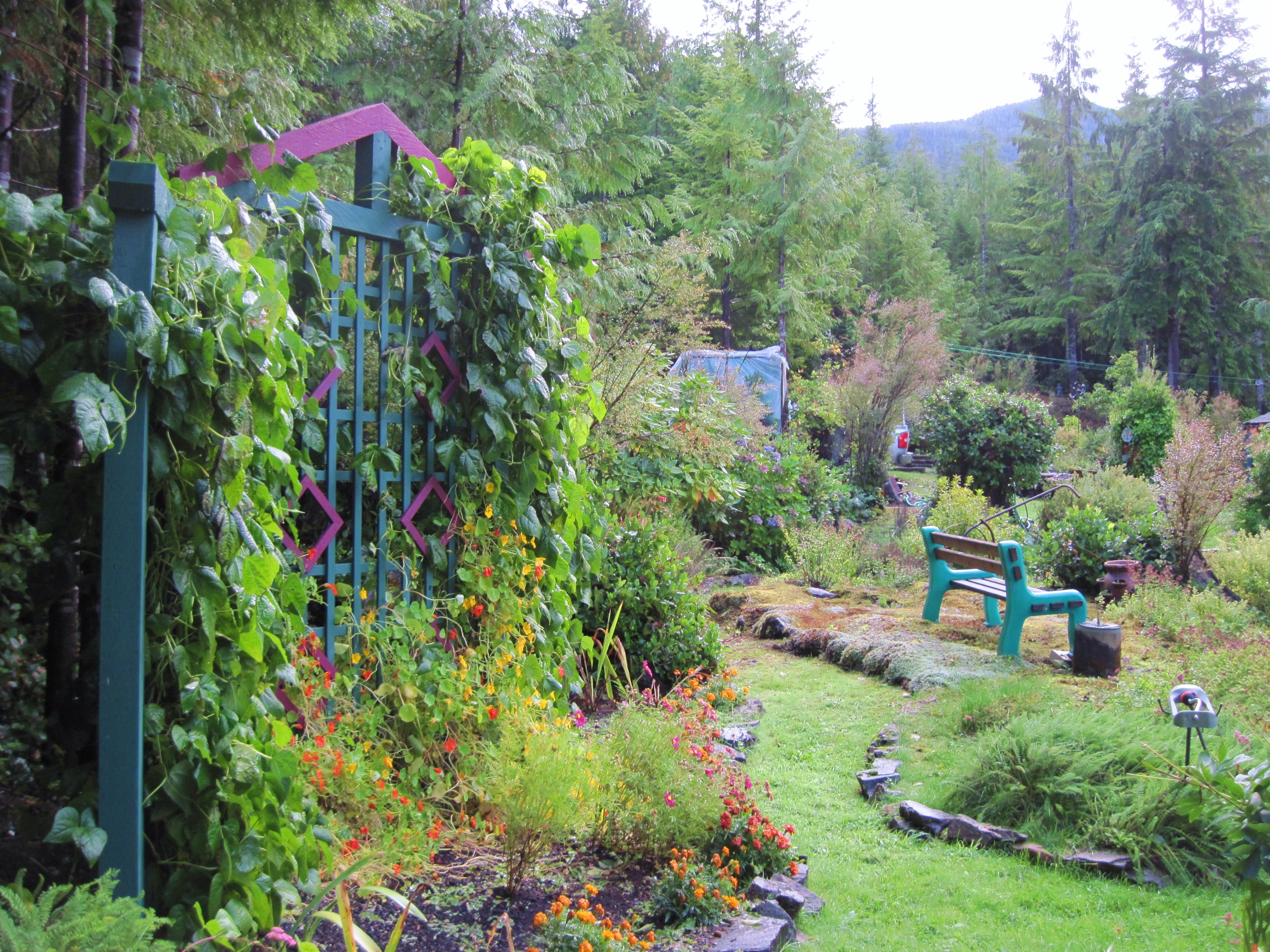
I have a couple of anecdotes that illustrate well a juxtaposition of fiction and reality. A close friend who has never visited our lakeside home, read Disappearing in Plain Sight and she loved it. When her husband managed a quick visit last summer, he told me he would tell his wife that our cabin and the view were just like walking into the book. The view perhaps – the cabin not so close, but close enough to resonate.
I recently ran into a woman who borrowed one of my books from her daughter. She and her husband had bought some land out in the wild and were getting ready to build. She asked me it the architect Caleb used to design his cabin in Disappearing in Plain Sight was based on a real person. She shrugged and said, “Oh, I suppose that would be too much to ask, but I want a place like the one you described in that book.”

Here is a dichotomy, for sure. If you come and visit me, at first glance you will recognize, in broad brush strokes, the setting of Disappearing in Plain Sight and The Light Never Lies. But don’t go looking for more. You’ll only end up disappointed. It is in the fine details that fiction has taken off to soar away from the landing strip of reality.
~
~

Francis Guenette has spent most of her life on the west coast of British Columbia. She lives with her husband and finds inspiration for writing in the beauty and drama of their lakeshore cabin and garden. She has a graduate degree in Counselling Psychology from the University of Victoria, British Columbia, Canada. She has worked as an educator, trauma counsellor and researcher. The Light Never Lies is her second novel. Francis blogs over at http://disappearinginplainsight.com and maintains a Facebook author page. Please stop by and say hello.

http://www.amazon.com/dp/B00I8XKIDK
harvesting colour – more colour from the pickle jar
One more dyeing project with the pickle jar! I am growing impatient, waiting for the growing season to begin so I can collect plants for my dyeing projects. So, I looked around my house and decided to use some of the various jars of rose petals and other flowers I have dried over the years.
~

a jar of rose petals and other flowers from a saved bouquet (the fabric is the silk I intend to dye)
~
For fabric, I decided to use the square of silk I purchased for the project back in February. From my reading, I know that silk accepts dye very well and responds well to an acidic dye bath.
First I soaked the silk in tepid water to prepare the fibres to accept the dye. I decided this fabric has already been prepared with mordant. If not, I can always add the mordant later.
Then I spread the petals on the fabric, spraying as I went with a weak solution of cider vinegar.
~
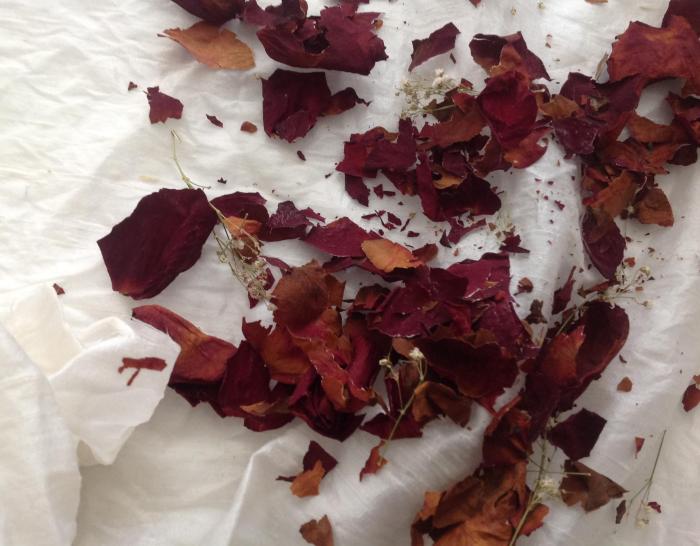
rose petals, scattered on the silk
~
I added some other dried flower petals from another bouquet. Then I rolled the fabric and petals very tightly.
~
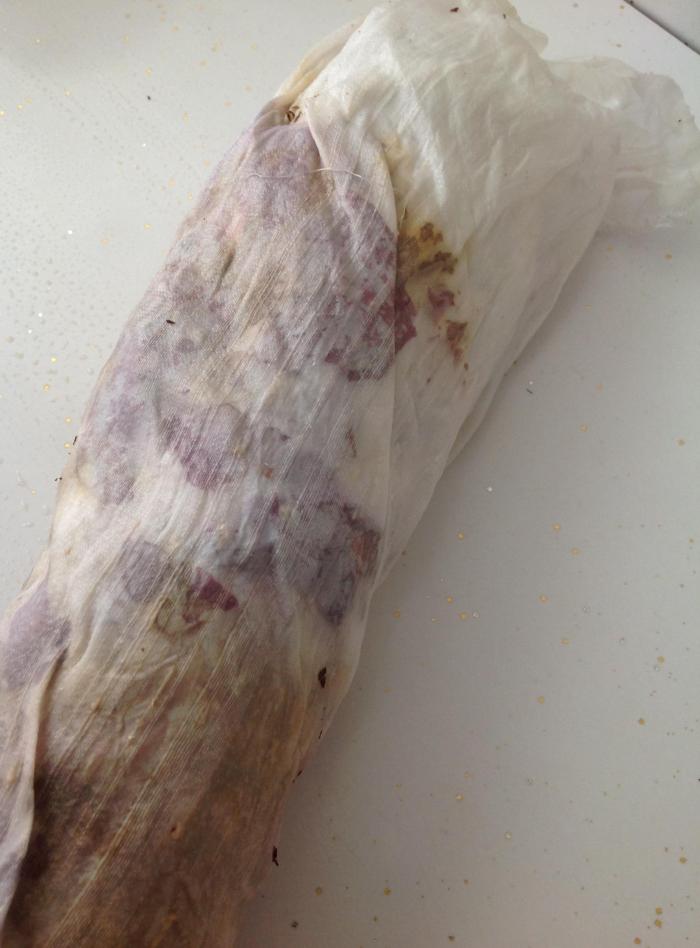
a roll of silk and flower petals, sprayed with vinegar and ready for the pickle jar
~
As with my last project ( https://nichepoetryandprose.wordpress.com/2014/04/02/harvesting-colour-onion-yellow/ ), I had trouble stuffing the roll into the jar. Once I had the silk crammed into the jar, I added more vinegar solution to the jar and closed it.
~
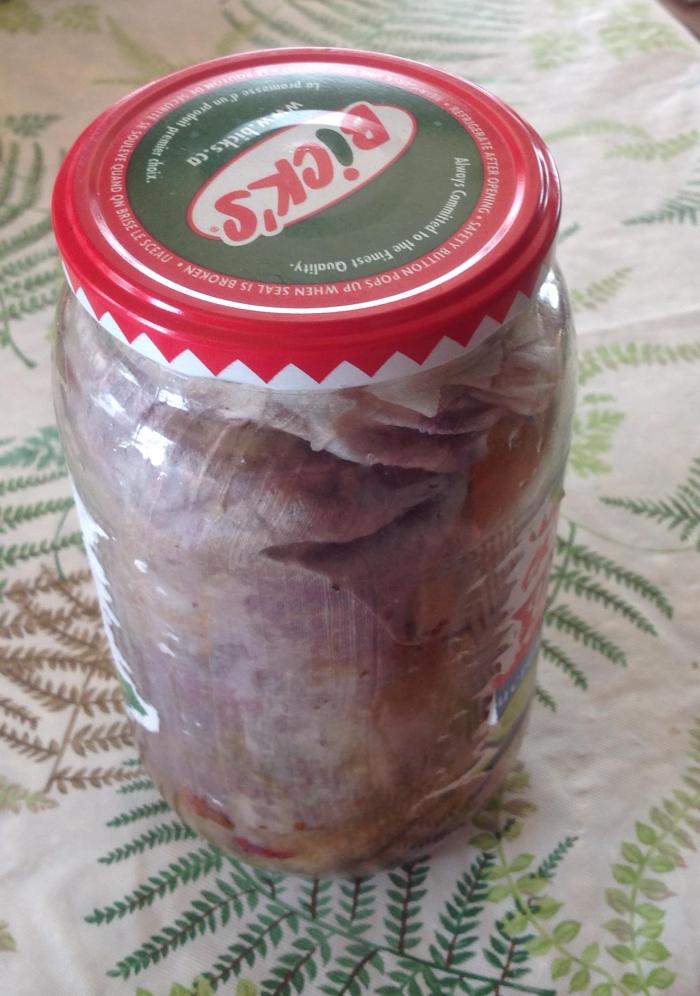
pickle jar stuffed with silk, rose petals and other dried flowers
~
And now we wait …
~
~
Copyright 2014 Jane Tims
harvesting colour – the yellow of tansy
Since last September, a small bunch of Tansy (Tanacetum vulgare L.) has hung on the line in my kitchen. Now, with a small batch of alum-treated wool, I am able to see what colour will come from the dried and lifeless flowers.
~

dried Tansy, collected in 2013
~
To extract the dye, I crumbled the flowers and leaves and soaked them in water overnight. Then I added more water and brought them slowly to a boil in my big, well-marked dyepot (marked so I will not use it for food by mistake). After an hour’s boil, I let the dye cool and strained the liquid. The result was a clear, amber-yellow dye.
~

dye from Tansy and water, simmered
~
To dye the wool, I added water, immersed a shank of alum-treated wool and slowly brought the dye to a simmer – one hour and then the long process of cooling (I am realising that dyeing is more about waiting than doing!!!!!!!!!!!). The result is a green-yellow, almost exactly the colour shown for Tansy-dyed fibre in Jenny Dean’s book (Wild Color) !!! My photo is not clear because the drying line insists on vibrating but you can clearly see the colours – left to right – the brown of the lichen-dyed wool from a few days ago), the green-yellow of the Tansy-dyed wool and the tan of the undyed wool.
~

three shanks of wool, dyed with the lichen Usnea (left), dyed with Tansy (center) and raw wool (treated with alum)
~
I wrote my poem to the heady yet sleepy smells of the Tansy boiling in its dye pot. I remembered the living Tansy, growing in the ditch last summer, each flower cluster hiding a sleepy bumblebee that had to be shaken from its resting. I was also reminded in my reading that Tansy was used so often at funerals in New England in the 19th century that people associated its smell with death.
~
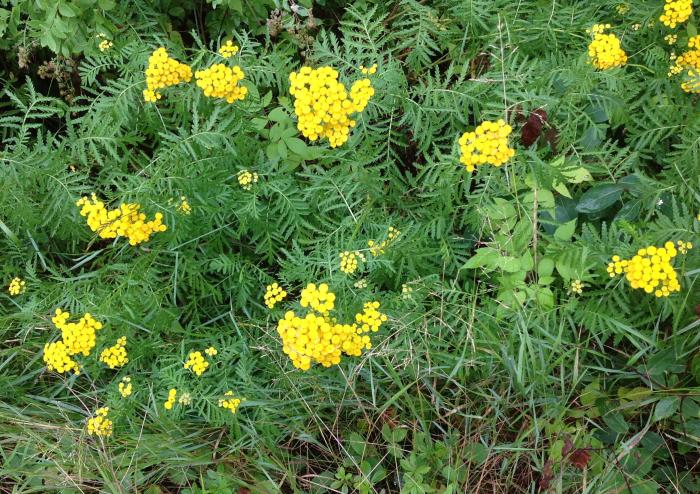
Tansy in the ditch
~
sleep before dyeing
~
Tanacetum vulgare L. – Common Tansy, Mugwort, Bitter Buttons
~
Bitter Buttons hover in the dye pot
simmering on the kitchen stove
drowsy scent of camomile
camphor and rosemary
liquid amber, saffron sallow
jaundiced pale of Tansy
reclines in the roadside ditch
each flat-topped cluster
hibernaculum
for a furred and yellow
unconcerned
and mellow
bumblebee
~
~
Copyright 2014 Jane Tims
harvesting colour – the formula for colour
My first effort towards my project is to understand what materials I will need. From my early reading, I have learned the end colour for any project using natural dyes is much more than just adding plant material to water. A final colour is the result of so many factors.
~
My simple formula for this complex symphony is:
final colour = source water + utensils + plant material (dyestuff) + mordent + colour modifier + textile fibre
~
No doubt, I will discover I have omitted some important element.
~
In my next posts, I will consider each of these elements and talk about the specific items I intend to use.
~
For example, I will need some textile fibre to dye. My intention is to dye small amounts of material for use in various weaving projects. In my weaving, I use both thread and strips of textiles.
At this early stage, I have three materials I want to dye. I have a small quantity of unspun fleece obtained a couple of years ago during our trip to Upper Canada Village in Ontario. I also have three old cotton shirts – I loved to wear these before they became stained – perhaps I will wear them again, repurposed in rainbow colour! And I have just purchased a meter of white silk (at $37 per meter, it is a splurge!). I will have to do some preparatory cleaning to each of these materials before I use them in my dyeing projects.
~

some materials for dyeing … a meter of silk, three shirts, and a bundle of unspun wool … the shirts have already seen their share of accidental dyeing !!!
~
Behind the scenes, I am finding poetic inspiration as I learn this craft of dyeing. Eventually I will be brave enough to show my poems to you.
~
Copyright 2014 Jane Tims




 nichepoetryandprose