Posts Tagged ‘poetry’
garden escapes: land use changes
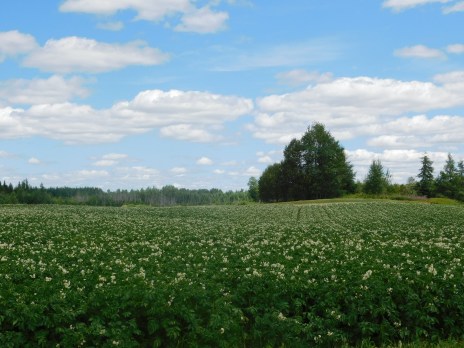
Last weekend, we explored the area north-west of Woodstock, New Brunswick. The area is very agricultural and rural, well populated and prosperous.
~
There were many gaps in the landscape where small farms may have been located decades ago. Today, the area is populated by large farms. Huge fields of potatoes, soybeans, corn and Christmas trees continue all the way to horizon in some communities.
~

~
~
What tells me a small farming family may have lived in a particular location if there are no ruins of habitation?
1. older trees planted in a regular pattern
2. presence of trees and shrubs not found in adjacent woodland, for example scarlet maple, willow, elm, mountain ash
3. presence of garden flowers on the property or in nearby ditches; for example, musk mallow, yellow loosestrife, creeping bellflower, lupines
4. presence of hawthorns along a roadway; John Erskine (‘The French Period in Nova Scotia A.D. 1500 to 1758 and Present Remains.’ Wolfville, 1975) interpreted the presence of hawthorn to settlers who used the thorny shrubs as a means of fencing
5. presence of apple trees, raspberries or grapevines (sometimes spread by cattle or other natural means)
6. local care of a property, indicating a continuing family interest in a property where an ancestor may have lived.
~

creeping bellflower
~

hawthorn
~
We found all of these types of evidence. All may be subject to debate, and local knowledge would fill in many gaps.
~
homestead
~
sugar maple—
nine trees, in three rows
a block of lupin, flowering past
~
wind sorts
through leaves, launches seed
and a fox presses through
~
sweet clover
heady perfume, landscape changes
even as we watch
~
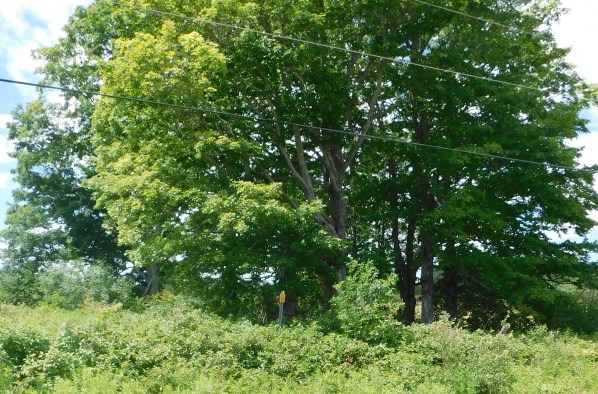
a regular planting of maple trees, perhaps evidence of a former homestead
~
This work was made possible by a Creations Grant from artsnb!
~
All my best,
Jane
abandoned gardens: how they escape
“… some plants will
persist, some will languish
and die, some will escape into forest,
or edges of hayfields,
roads and ditches.”
~
~
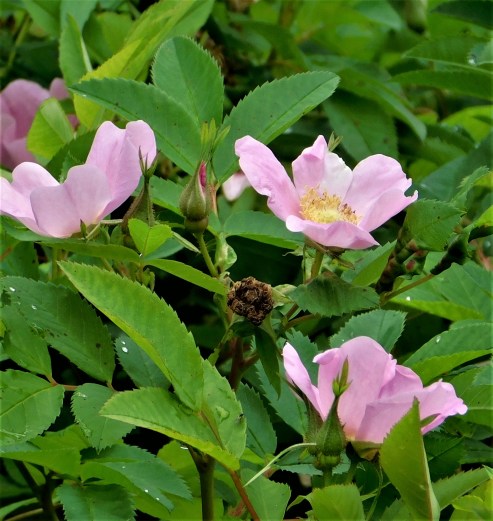
Escape artists. How do those plants we see in ditches and fields get there?
Some move by seed. Some by vegetative reproduction (by horizontal roots or by rooting of a part of the plant).
~
~
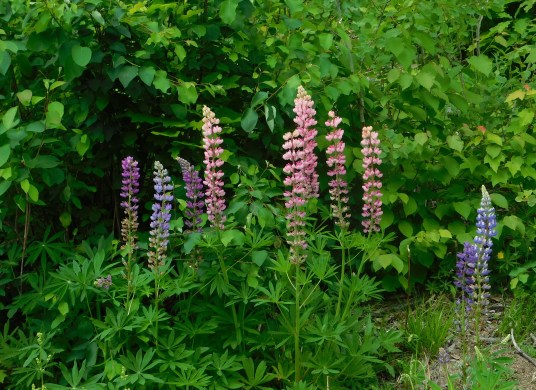
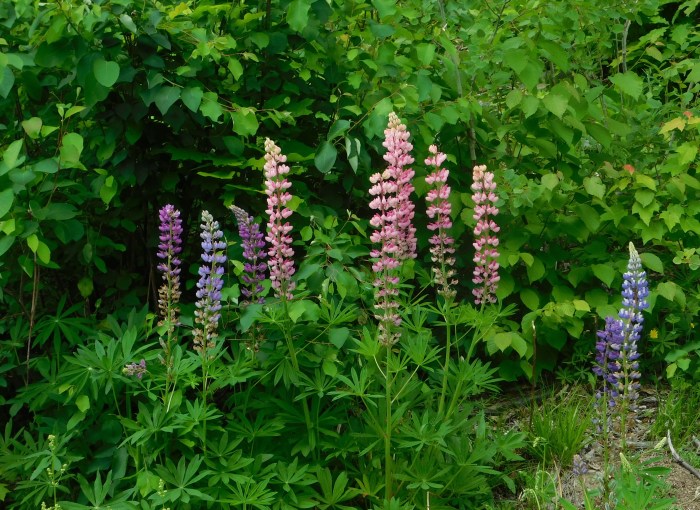
A good example of ‘escape by seed’ is the lupin. The lupin sets its seed in pods. When they dry, the seeds are launched as projectiles and so can travel quite far in a single generation.
~

~
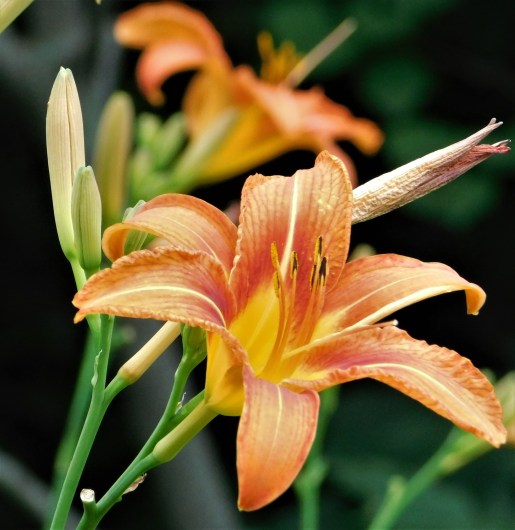
A good example of ‘escape by vegetative reproduction’ is the orange day-lily. It only rarely sets seed. It moves along ditches or into other locations by rhizomes (horizontal roots).
~
” … its names describe
where orange finds a home:
ditch lily, railroad lily
roadside lily, wash-house lily
~
outhouse lily.”
~
~
In New Brunswick, you don’t have to drive far to see an orange day-lily or a lupin.
~
This work was made possible by a Creations Grant from artsnb!
~
All my best.
Staying home,
wearing a mask when I escape.
Jane
garden escapes: lupins
In late June and early July, the ditches of some roads in New Brunswick are filled with colour as lupins become the dominant flower.
~
Lupins are legumes and enrich the soil with nitrogen. In spite of this, there is an old tale that lupins impoverish the soil, hence the name derived from ‘lupe,’ the word for wolf.
~
Lupins make pretty bouquets but, in my experience, have an unpleasant, peppery smell that keeps me from ever bringing them into the house.
~
Lupin has been grown as an ornamental and, in earlier times, as a food source. They are great escape artists and spread easily into the countryside. Some species are considered invasive in Europe, New Zealand and places in North America.
~

~
Lupins do not occur along all roads, but when they do, they may have originated in the gardens of early communities. For example, lupins line the ditches of the road to Giants Glen, north of Stanley, New Brunswick. Giants Glen was settled by the Irish in 1850.
~
~
The Giants of the Glen
~
lupins escape The Glen
scramble to roadsides
fix nitrogen
repair poor soil
~
fingered leaves like hands
collect the river wind
lean together
work as one
~
stand tall in spikes
pink, purple and blue
grey as summer wears
rattles their seeds
~
~
This work was made possible by a Creations Grant from artsnb!
~
All my best!
Stay safe.
Jane
garden escapes: mallow
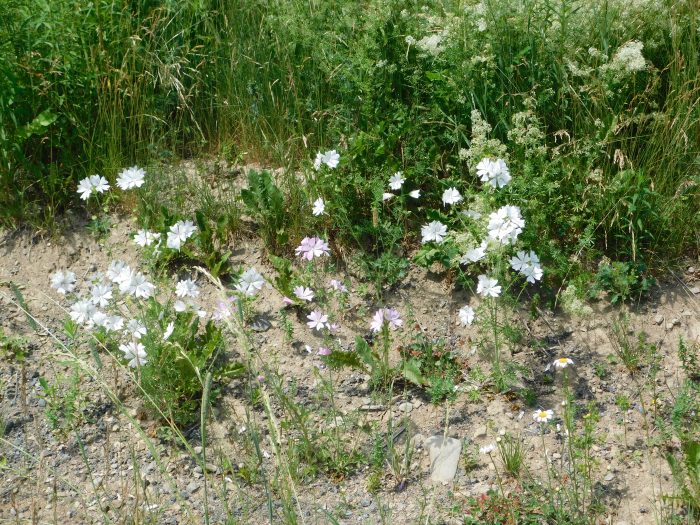
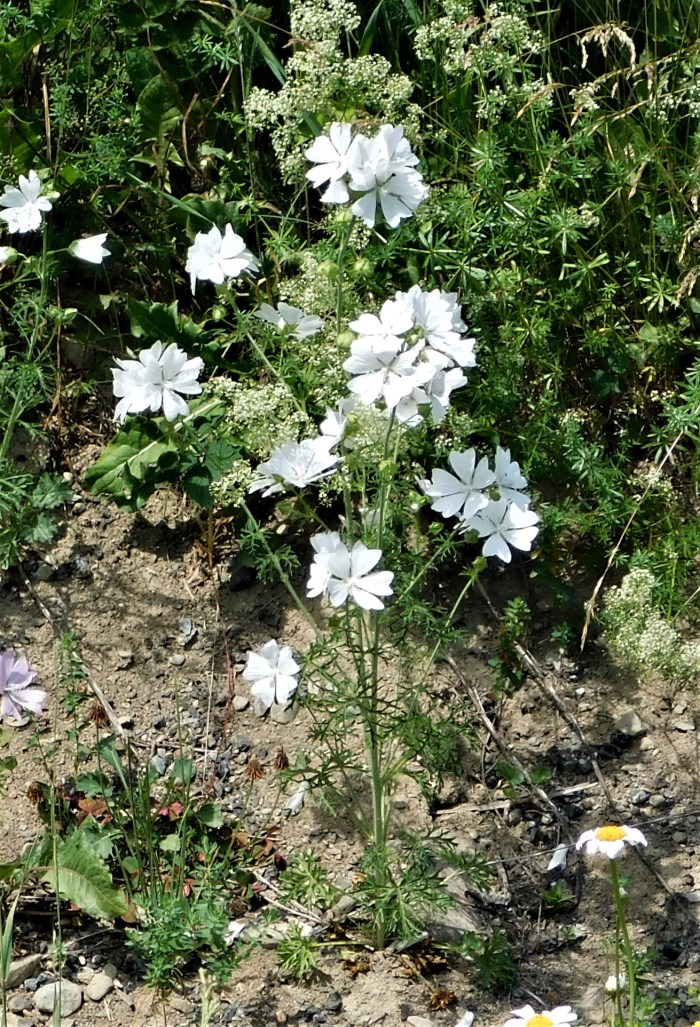
Mallow was one of the first flowers I had in my garden back in 1980 when we started our own home. Musk mallow (Malva moschata) has deeply divided leaves, papery pink or white petals and a pleasant scent. I loved it so much, I included it in my bridesmaid’s bouquet when I was married.
~
Mallow often escapes the garden to live in ditches and in fields. In his Flora of New Brunswick, Hal Hinds says vervain mallow (Malva alcea) has escaped to the borders of fields in the Woodstock area of New Brunswick. So, I was on the lookout for the flower when we drove west of Woodstock to look at abandoned properties. And mallow was one of the first plants we found, growing in the ditch.
~
~
~
We also found mallow growing at the edge of cultivated fields.
~
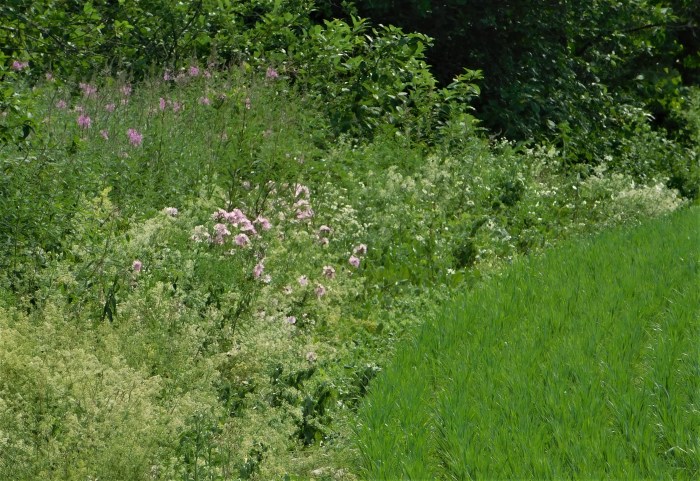
~
mallow
Malva moschata
~
wind-blown and paper
petals transparent
veined, flutter
in wind
the leaves
frayed and notched
~
petals, perfumed in musk
pale pink and white
roadside edged
in field-flowers, bedstraw
day-lilies, yarrow and vetch
and musk mallow, garden escape
~
to the edge of the field
to the edge of the road
~

~
Stay home,
wear your mask.
You don’t have to escape.
~
This work was made possible by a Creations Grant from artsnb!
~
All my best
Jane
abandoned gardens: flowers, out of place
A flower common in flower gardens is the yellow loosestrife (Lysimachia punctata). It is prized for its perennial nature and its whorls of bright yellow flowers. A closely related species, garden loosestrife (Lysimachia vulgaris), differs a little in the arrangement of its flowers and in other characteristics.
~
These flowers occasionally persist at abandoned home sites, or spread by the roots. As escapes, they look out of place, a bright spot in the green landscape.
~
We went for a drive in the countryside west of Woodstock in Carleton County last Friday and found two escaped patches of yellow loosestrife, one on the edge of a field along Green Road and one in the ditches in Watson Settlement.
~
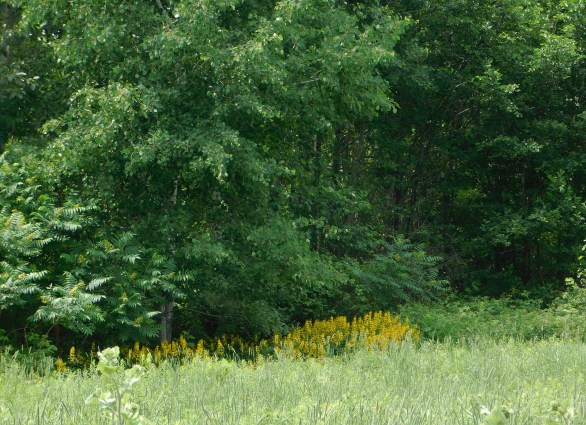
a patch of yellow loosestrife in a field on the Green Road
~
large yellow loosestrife
Lysimachia punctata
~
slash of yellow
blooms in the crease
between sumac and hayfield
campion, Timothy, bedstraw and vetch
ladders of golden flowers escaped
from a garden now gone
~
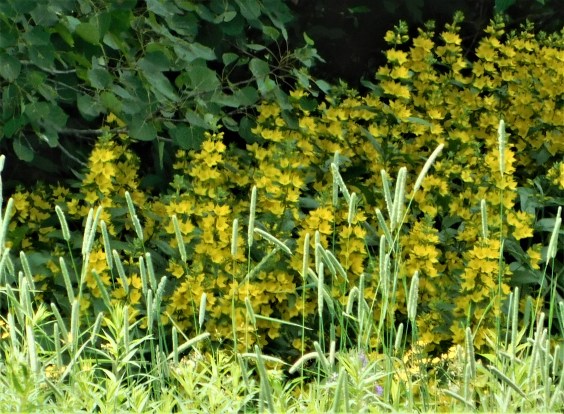
closeup of the patch of yellow loosestrife
~
At Watson Settlement, while I was photographing the flowers, a truck stopped to make certain we were OK. In the back of my mind, I was thinking about COVID-19 and social distancing, so although I chatted a bit, I didn’t ask the woman any questions. I could have talked to her about the history of the community and asked her about other garden escapes.
~

a patch of yellow loosestrife in a ditch in Watson Settlement
~
yellow loosestrife escape
~
In the ditch,
in the angle of two roads,
armloads of yellow loosestrife.
~
“Are you broken down?” she says.
“Hardly picked a cup
of wild strawberries this year.
But the Devil’s paint brush
is blooming again.”
~
I am afraid to ask,
in these days of social distancing,
about the yellow loosestrife,
about the community,
about garden escapes.
~
She smiles and drives on.
Unasked questions
unanswered.
~
~

yellow loosestrife in the ditch at Watson Settlement
~
This work is supported by a Creation Grant from artsnb (the New Brunswick Arts Board)!
~
All my best,
please stay safe,
Jane
abandoned gardens: a pantoum about lilacs
Over the years, faced by change, some communities continue to thrive. Others, once vigorous, may decline and disappear. Sometimes, communities may hang on but individual homes may be abandoned. Abandonment can occur if the owner moves away or dies, or if aspects of the home become unsustainable (for example, a water source dries up).
~

~
When a home is abandoned, what becomes of the vegetable garden, so carefully tended, or the flower gardens, each plant chosen with love and care?
~
Annuals are usually the first to go, although biennials may continue to grow for a year and some plants, like sweet William or pansies, may reseed. Perennials may thrive, sometimes for years. Rhubarb, chives and berry crops often continue to grow in a vegetable garden. In the flower garden, peonies, day-lilies and phlox may bloom year after year. Trees and shrubs often persist.
~

rhubarb persisting in an old garden
~
In my poetry project about abandoned gardens, I want to learn more about various poetry forms. The poem below is written as a pantoum. A pantoum consists of four line stanzas. The second and forth lines of the preceding stanza are used as the first and third lines of the next. The first line of the poem may also be used as the last.
~
The poem below is written about an abandoned house in central New Brunswick. Keep in mind, these properties are still owed by someone and the owners may care a great deal about them and perhaps use the property if not the house.
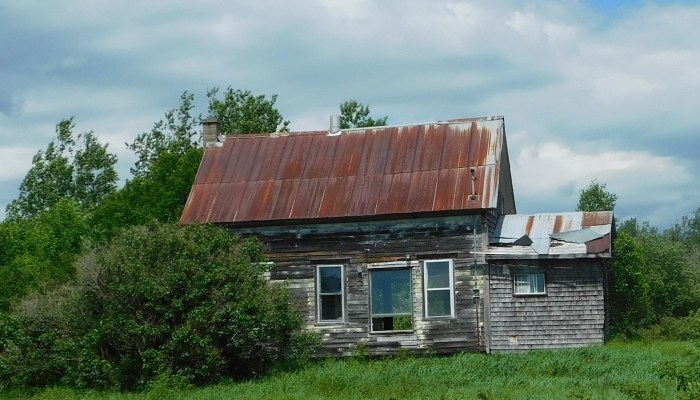
lilac bush next to an old house
~
lilacs persist
~
delicate scribble of winter wren
lilac, a cushion of shadow and green
props the abandoned house
roof rusted, clapboards and shingles grey
~
lilac, a cushion of shadow and green
at night leaves peer in windows
roof rusted, clapboards and shingles grey
features sculpted by overlapping leaves
~
at night they peer in windows
stare, front windows to back yard
features sculpted by overlapping leaves
scented panicles of purple bloom
~
stare, front windows to back yard
noses tuned to lilac sweet
scented panicles of purple bloom
lilacs persist and thrive
~
noses tuned to lilac sweet
roof rusted, clapboards and shingles grey
lilacs persist and thrive
delicate scribble of winter wren
~
~
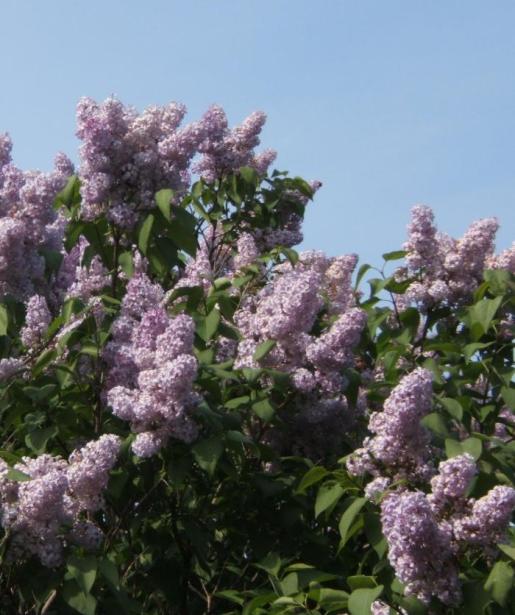 ~
~
This work is supported by a Creation Grant from artsnb (the New Brunswick Arts Board)!
~
Perhaps we can learn from the lilac …
persist and thrive.
All my best,
Jane
garden escapes: starting a project
This summer, one of my main occupations will be to work on a collection of poems about garden escapes. Specifically, this means abandoned gardens, plants left behind when homes or communities are abandoned. This work is being supported by a Creations Grant from artsnb.
~
I have a short mantra to refer to these abandoned plants: “die, thrive or escape.” In a way, the project theme can be used as a metaphor for any abandonment. For example, when someone abandons a relationship, the one left behind can languish, or pick up and start over, or just leave, find a place to start over. I will be watching for these metaphors throughout my project.
~
For today, I have to arrange my materials and get started with a plan for my project.
- To start I have my grant application (outlines what I intend to do), a bit of reconnaissance work I did in 2018 to develop some ideas for the project, six blog posts from that time and eight older poems that fit the theme.
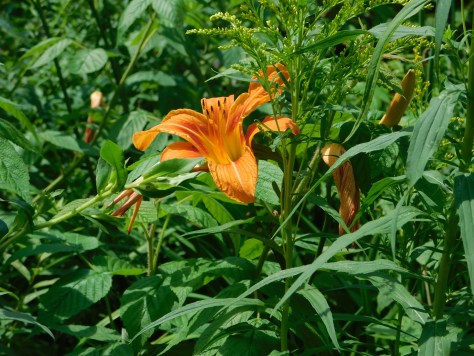
orange day-lilies, found in many of new Brunswick’s ditches, are escapes from older gardens
- To identify abandoned communities, I can refer to information sources and databases developed by others: the Facebook pages Abandoned New Brunswick and New Brunswick Upon Days Faded where interested people post photos and short anecdotes about abandoned houses and buildings; the Provincial Archives of New Brunswick website called Place Names of New Brunswick: Where is Home? New Brunswick Communities Past and Present https://archives.gnb.ca/Exhibits/Communities/Home.aspx?culture=en-CA; additional information on communities will be available in Census Records at https://www.ancestry.ca/; various maps including the New Brunswick Atlas (Second Edition); Google Earth and the associated Street View; maps posted in the Facebook page New Brunswick Upon Days Faded; the Walling Map of 1862 which I have used in other projects, F. Walling, Topographical Map of the Counties of St. John and Kings New Brunswick: From Actual Surveys under the direction of H. F. Walling (Publishers W.E. and A.A. Baker, New York, 1862); and, the Monograph about place-names in New Brunswick, Ganong, William F. A Monograph of the Place-Nomenclature of the Province of New Brunswick. Transactions of the Royal Society of Canada: Second Series 1896-97, Volume II, Section II. 1896.

a sample of the Walling Map for an area in Kings County, New Brunswick. The map shows individual buildings and houses from 1862.
- For anecdotal stories about the gardeners and their gardens, I plan to use the resources of the Provincial Archives of New Brunswick since often diaries and other documents contain amazing bits of information about New Brunswick history. Obtaining anecdotal information about abandoned gardens is tricky during the time of COVID-19 since social distancing means ordinary interviewing is not easy. I will use the websites above to obtain some information and, where possible, talk to people I encounter. I will create a Facebook Page called Abandoned New Brunswick Gardens to obtain some of these stories.
- For plant identification, I have my own skills as a botanist and my trusty guides: Harold R. Hinds, Flora of New Brunswick, Second Edition: A Manual for Identification of the Vascular Plants of New Brunswick, University of New Brunswick, 2000; A. E. Roland and E. C. Smith, The Flora of Nova Scotia, Nova Scotia Museum, 1969; Roger Tory Peterson and Margaret McKenny, A Field Guide to Flowers of Northeastern and North-central North America, 1968; and the website The Plant List: A Working List of all Plant Species (this is to verify plants names since I use older plant guides). http://www.theplantlist.org/
~
My methodology is simple:
- identify possible abandoned homes and communities and create an efficient plan to visit these places
- drive to these locations and look for plant species that may be garden remnants
- photograph the sites and plants
- make notes about the sites, the plants encountered and various sensations encountered (sight, smell, taste, touch and sound)
- do pencil drawings of some plants and locations
- obtain any anecdotal or archived information about the former communities, their gardens and their gardeners
- write the poems using all the information collected
I am going to write mostly free verse but I will also use some poetic forms, for example the ghazal and the pantoum.
~
Sounds like fun!

Viper’s bugloss (Echium vulgare) is an introduced plant in New Brunswick. These are plants found on the New Ireland Road in Albert County, New Brunswick. In 1866, there were 68 families in the community (Source: NB Archives); today all the houses are gone.
~
I will keep you up to date on my adventures and show you some of the plants I find. If you know of any abandoned gardens in New Brunswick, or abandoned communities, please let me know! I will acknowledge you in my book!
~
This work is supported by a Creation Grant from artsnb (the New Brunswick Arts Board)!
~
All my best,
stay safe,
Jane
garden escapes: abandoned gardens and what becomes of them
I am so happy! I have just won a Creations Grant from artsnb (the New Brunswick Arts Board). The project is to write a book-length poetry manuscript on the subject of garden escapes from abandoned New Brunswick houses and communities.
~
The landscape of New Brunswick is changing. As demographics shift towards populated areas, communities are abandoned. When gardens are left behind, some species die out, some thrive and some migrate, finding favorable conditions in adjacent properties.
~

For example, in Fredericksburg, an abandoned community near Stanley, foxglove crowds the ditches; and near Carroll’s Ridge south of Canterbury, no homes remain, but forget-me-nots turn the woods blue. Although local people are aware of these escapes, the stories of the gardens and gardeners are mostly lost.

~
The subject of abandoned flower garden escapes is the matter of poetry. The names of abandoned communities and of plants, common and scientific, provide a lexicon of poetic words. Abandoned and escaped gardens involve all of the senses: sight (pink of the foxglove flowers), sound (calls of birds who find new habitat), smell (scent of flowers), taste (sour stem of an abandoned rhubarb plant) and touch (the thorniness of escaped raspberry).
~
I am looking forward to taking you on my adventures this summer as I search out abandoned houses and communities, look for remnants of the gardens left behind and capture these remnants in poems and images.
~
So, I won’t be staying home as much,
but I am still going to be staying safe!
All my best!
Jane
creating my niche
create: 1: to bring into existence;
2a: to invest with a new form, office or rank;
2b: to produce or bring about by a course of action or behavior;
3: cause or occasion;
4a: to produce through imaginative skill;
4b: design.
– Webster’s Dictionary
I am very interested in creative endeavors and I like being creative. I am happiest when I am writing, painting, drawing, sewing, weaving, knitting, and so on.
Although I best like to write, I find creative activities substitute for one another. For example, when I am not writing for an extended period of time, I am often embedded in some other activity, such as painting.

Weaving exemplifies the lure of my various creative undertakings. The producing requires knowledge and skill, and builds confidence. The process is enjoyable and time is made available for thought and concentration. The threads and fabrics are luxurious to the touch and the colors are bright and joyful. When I am finished a project, I am so proud of the resulting textile, I want to show the world.
My loom is a simple floor loom, 24 inch wide. I bought it at a country auction, about 20 years ago. My sister and I were among the stragglers at the auction, trying to outlast a heavy rain. In the corner we saw a bundle of varnished wood and some metal parts. “I think that’s a loom”, whispered my savvy sister. When the item came up for auction, there were few bidders remaining, and no one know just what ‘it’ was. At $25, it was a huge bargain.

My loom and I have not been steady company. It takes forever to install the warp threads, and sometimes weaving is hard on my back. But the fabrics we make together, my loom and I, are beautiful and comfortable and good for the soul.
What creative endeavors shape your niche space? What materials do you use and what do you love about them?
~
~
yellow line
~
the road is fabric
weave of asphalt
ditch and yellow line
warp of guard rail
fence and heddle
~
trees in plantations
lines on the hayfield
shadows on road
hip and curve of the earth
weft as she turns in her sleep
~
shuttle piloted
through landscape
and watershed
textile in folds
texture the yearn of the loom
~
faults in the granite
potholes in pavement
rifts in the fabric
where weavers might falter
revisit work of earlier times
~
learning the lesson
taught by the loom
~
choose your weft wisely
balance color and texture
maintain your tension
fix mistakes as you go
~
rest when your back hurts
~
listen
to the whisper
of weave
of yellow line
~
~
All my best,
staying at home, staying safe,
Jane Tims
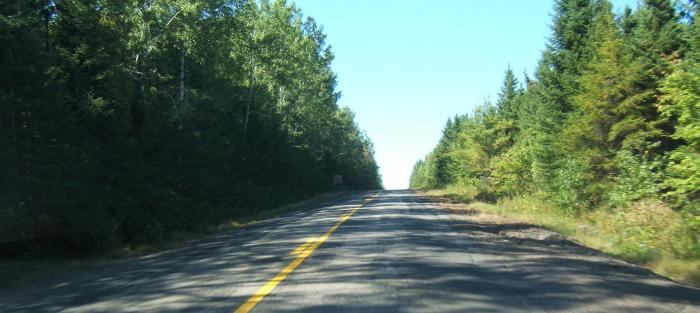
the yellow line
Rebecca

Rebecca
~
in black
Gothic
advances
down the middle
of the street
oblivious to traffic
~
dark mists
and Avalon
the perfect rupture of sky
~
from her fingers
black threads
spin skirt
and widow’s weeds
~
black painted nails
blackened sockets of eye
her lips black also
from a feast of berries
~
~
All my best.
Jane




 nichepoetryandprose