Posts Tagged ‘plants’
heathland and heather (day 57)
~
~
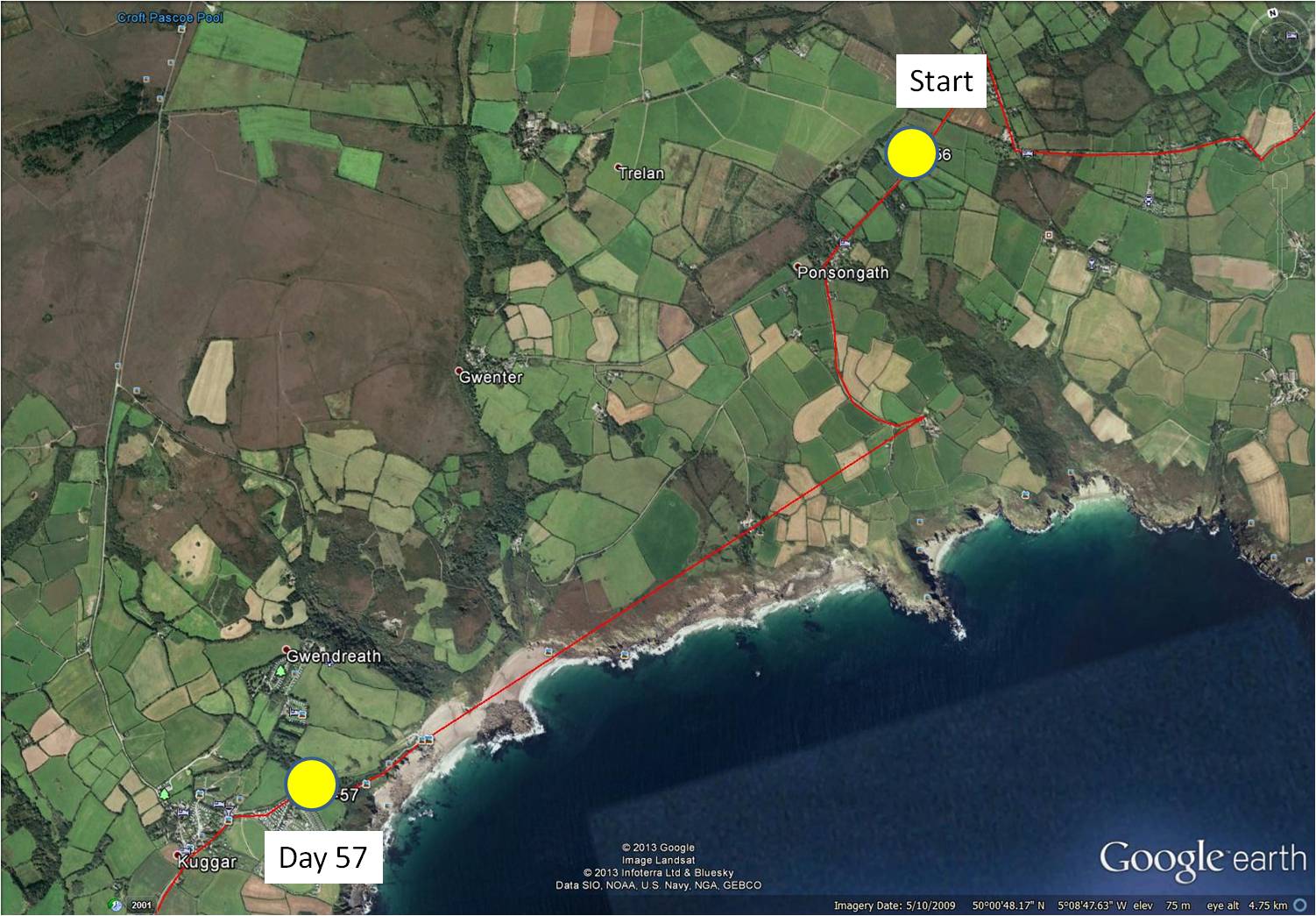
7-57 December 12, 2013 30 minutes 3.0 km (from Ponsongath to Kuggar)
~
Something different has appeared in the maps of the area where I am ‘travelling’. Today’s virtual bike trip took me just south of a large ‘brown’ area of topography (seen in the aerial photo above). To find out about this area, I turned my stationary cycle for a side trip in the direction of Gwenter, just to the north of my planned path.
~
The area I found is anything but brown (Street View images were done in July). These are the Goonhilly Downs, a raised plateau of heathlands above serpentinite rock. Besides being a Site of Special Scientific Interest and the home of many rare plants, the heathlands are the location of a large windfarm (I could just see the turbines in the distance) and the Goonhilly Satellite Earth Station (the largest in the world).
~

Goonhilly Downs … wind turbines and satellite dishes are just visible along the horizon (image from Street View)
~
From the road I could see expanses of grass, tufts of fern, and ericaceous shrubs. Patches of purple reminded me of the Rhodora that blooms here in spring. From my reading about the Cornwall heathlands, I am certain this plant must be Cornish heath (Erica vagans), a species of heather common in Cornwall. I have a small patch of heather growing in my own garden, so this plant has a spot in my heart. I first learned about heathers in our history club in high school – we took a field trip to see the heathers growing abundantly in Point Pleasant Park in Halifax. They grow there in a 3300 square meter patch, called the ‘Heather Patch’, south of the Cambridge Battery. The heathers are not native but grow there as an escape – from the stuffing in the bedrolls of British soldiers in the 1700s!
~
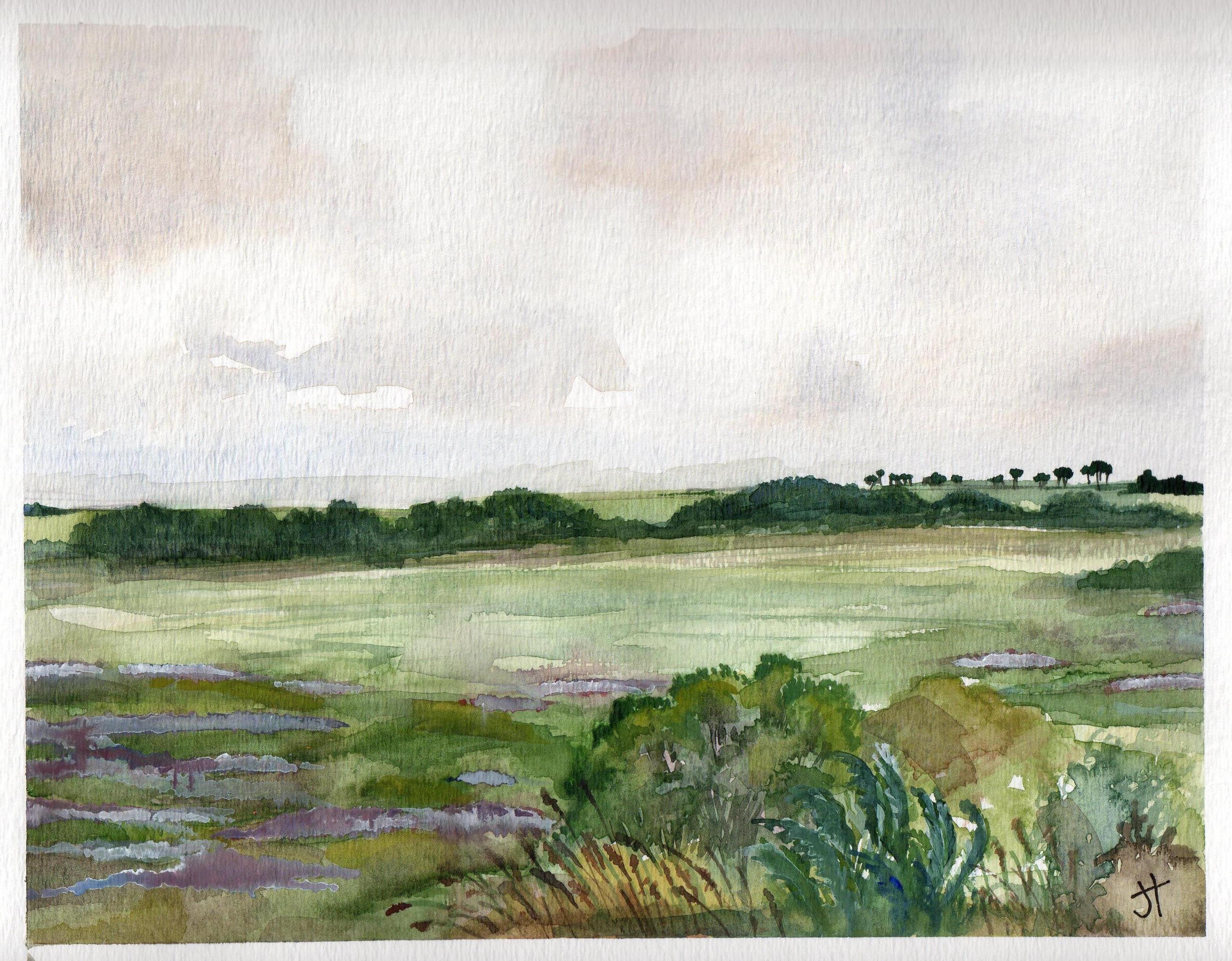
December 17, 2013 ‘Goonhilly Down’ Jane Tims
~
Copyright 2013 Jane Tims
a moment of beautiful – an ice lantern
the space: our living room on a winter evening
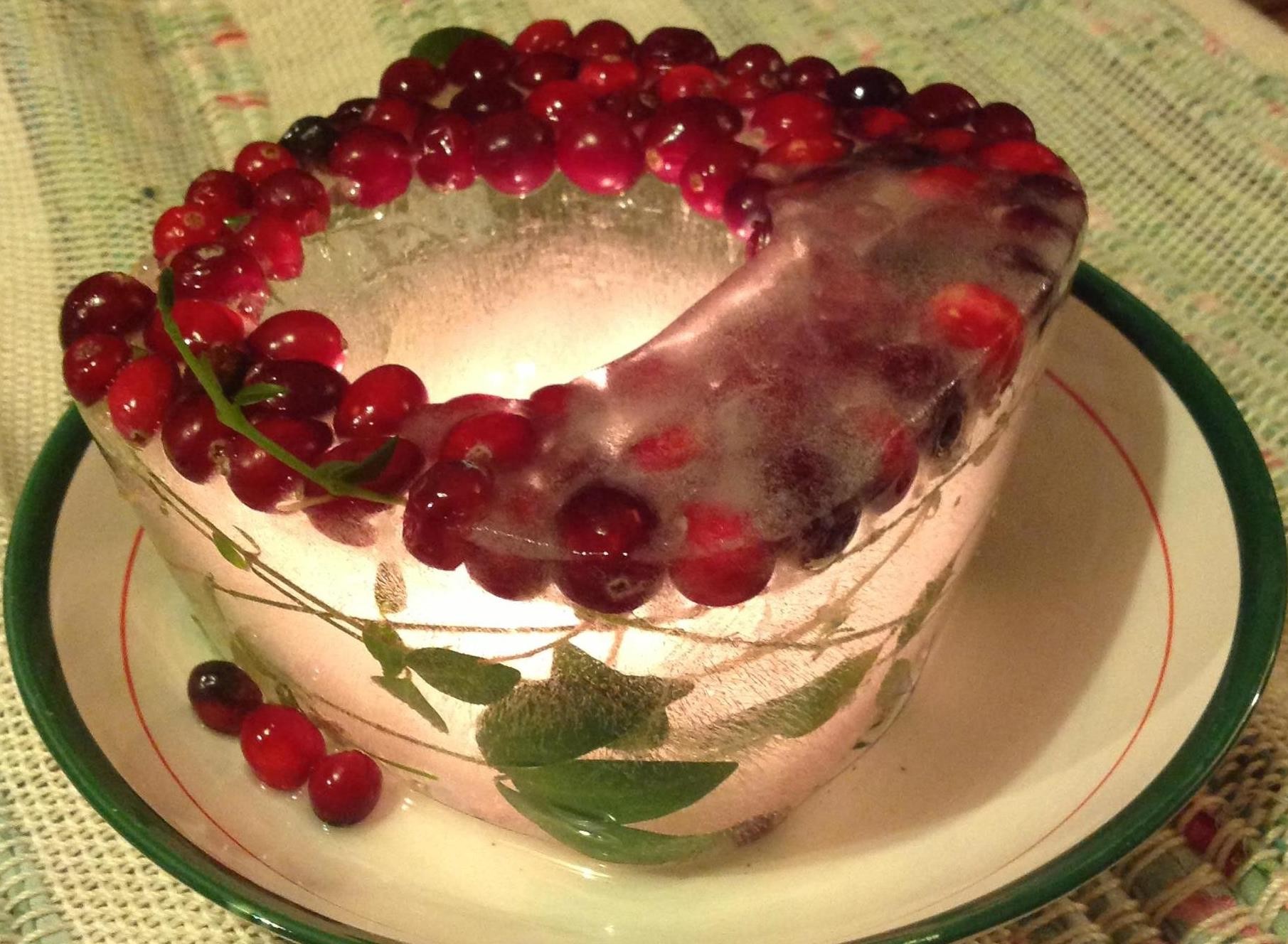
the beautiful: an ice lantern with cranberries and periwinkle vine
~
As Christmas approaches, candles are among my favorite decorations. For the past few years, I have made ice lanterns (also called ice candles).
I use a square plastic container that freezes well. In the center, I place a paper cup weighed down with rocks. Then I fill the outer ring with cranberries and greenery (this year I used the green vines of Periwinkle, Vinca minor, from our garden). Then I fill the ring with water.
This goes in the freezer, or in colder weather, out on the porch. Once the water has frozen, I put hot water in the paper cup, to free it from the ice. Then I run cold water over the outside of the bigger container to free the ice lantern. I light a tealight or flat candle and put it in the center space.
The shimmering ice lantern will last several hours. These lanterns will also last a long time outside in cold weather.
~
~
Jane Tims 2013
a closer look at trees (days 48, 49 and 50)
~
One of the natural history lessons learned during my trip to California concerned the oak. On a trip to ‘Safari West’ near Santa Rosa, our guide pointed out the scarred trunks of various trees. The bark was embedded with acorns! The Acorn Woodpecker places the acorns in holes in the bark of these trees, storing them for a later source of food. The storage trees or ‘granaries’ are used over and over through the years!
~
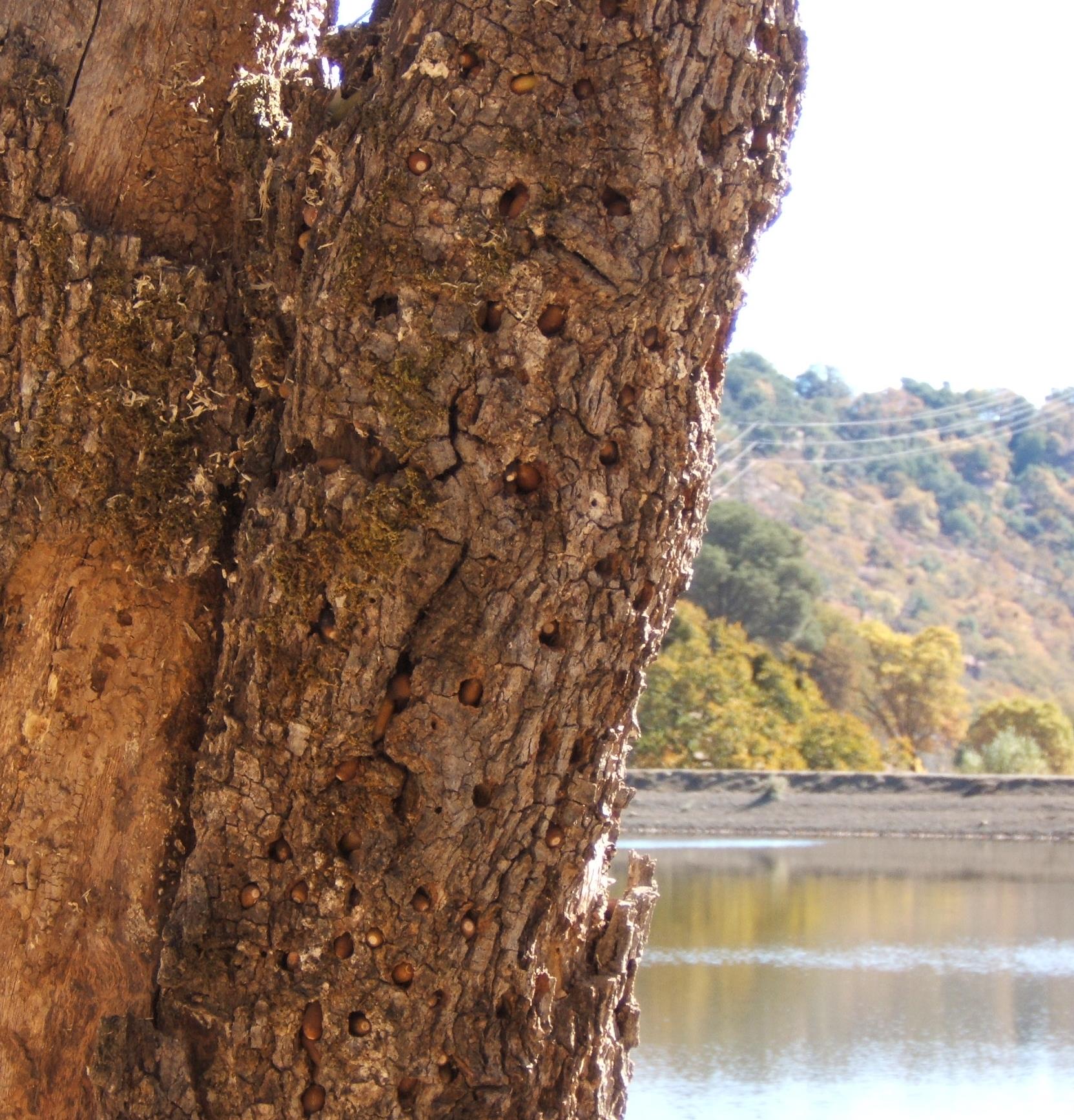
acorns planted in a ‘granary’ tree by the Acorn Woodpecker
~
Perhaps as a result of seeing so many new tree species in California, I have looked more closely at the trees I see in Street View as I cycle ‘virtually’ along the Cornwall coast. Identification is usually difficult since the images do not show details. However, occasionally a leafy branch is close enough to see the leaves clearly. So far, I have seen the Common Ash, the Field Maple, and the English Oak. In the image below, you can see the lobed leaves of the English Oak.
~
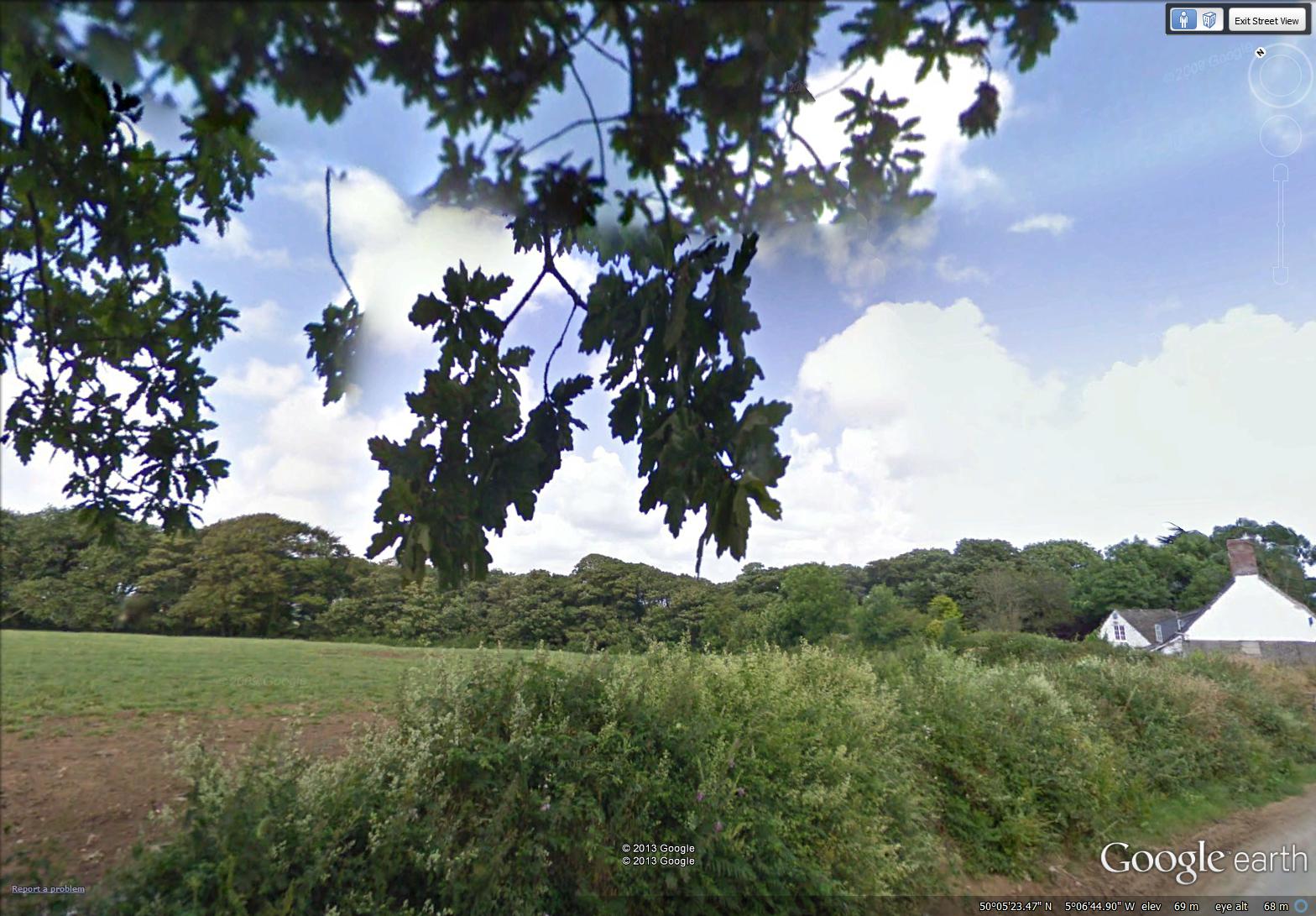
lobed leaves of an English Oak along the road to St. Anthony (image from Street View)
~

map showing distance travelled (map from Google Earth)
~
7-48 November 21, 2013 30 minutes 3.0 km (from Mawgan to St. Martin)
~

November 26, 2013 ‘oak on Fords Hill’ Jane Tims
~
7-49 November 23, 2013 35 minutes 3.0 km (from St. Martin to Helford)
~
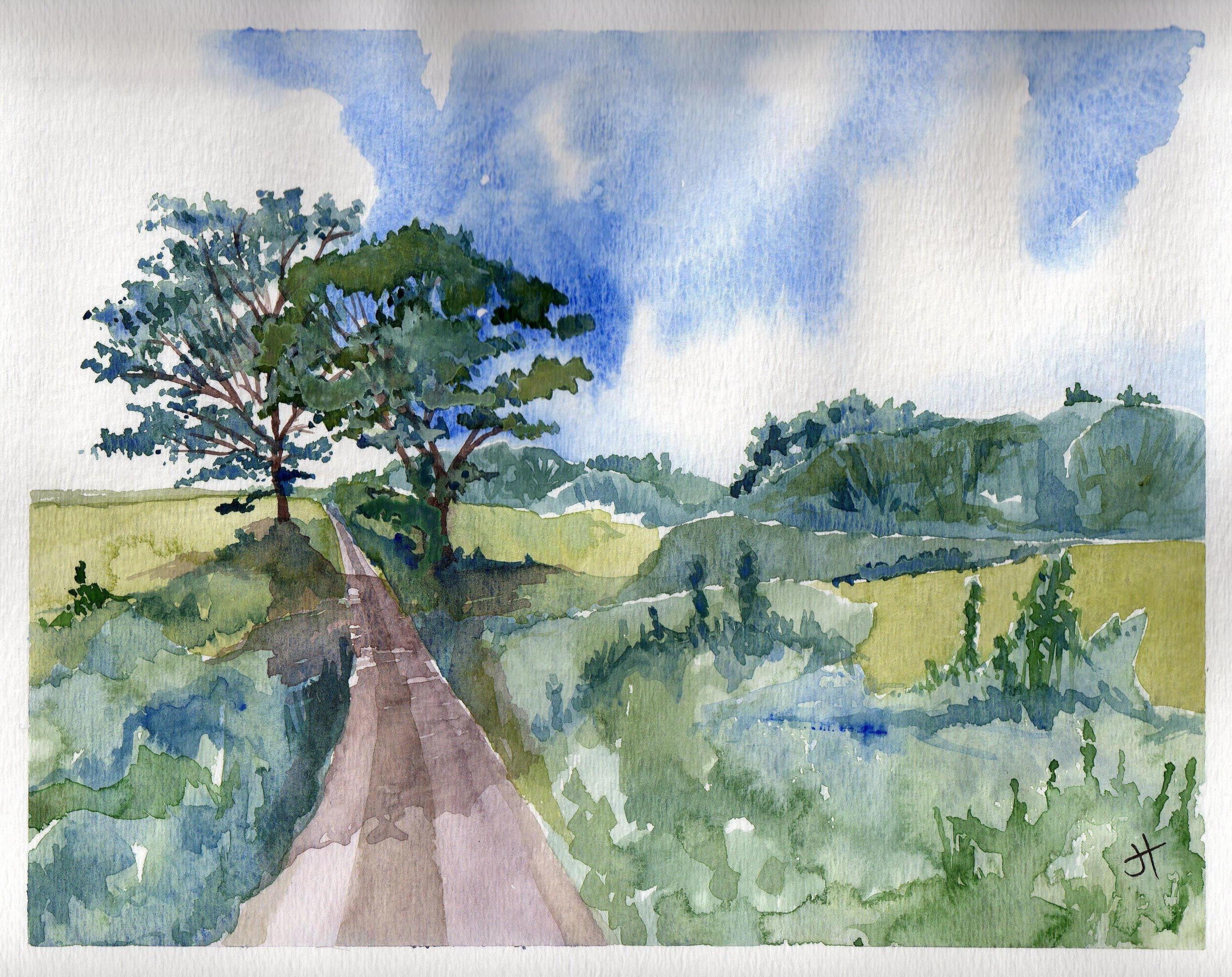
November 26, 2013 ‘maple and oak near Helford’ Jane Tims
~
7-50 November 25, 2013 30 minutes 3.0 km (from Helford to St. Anthony-in-Meneage)
~
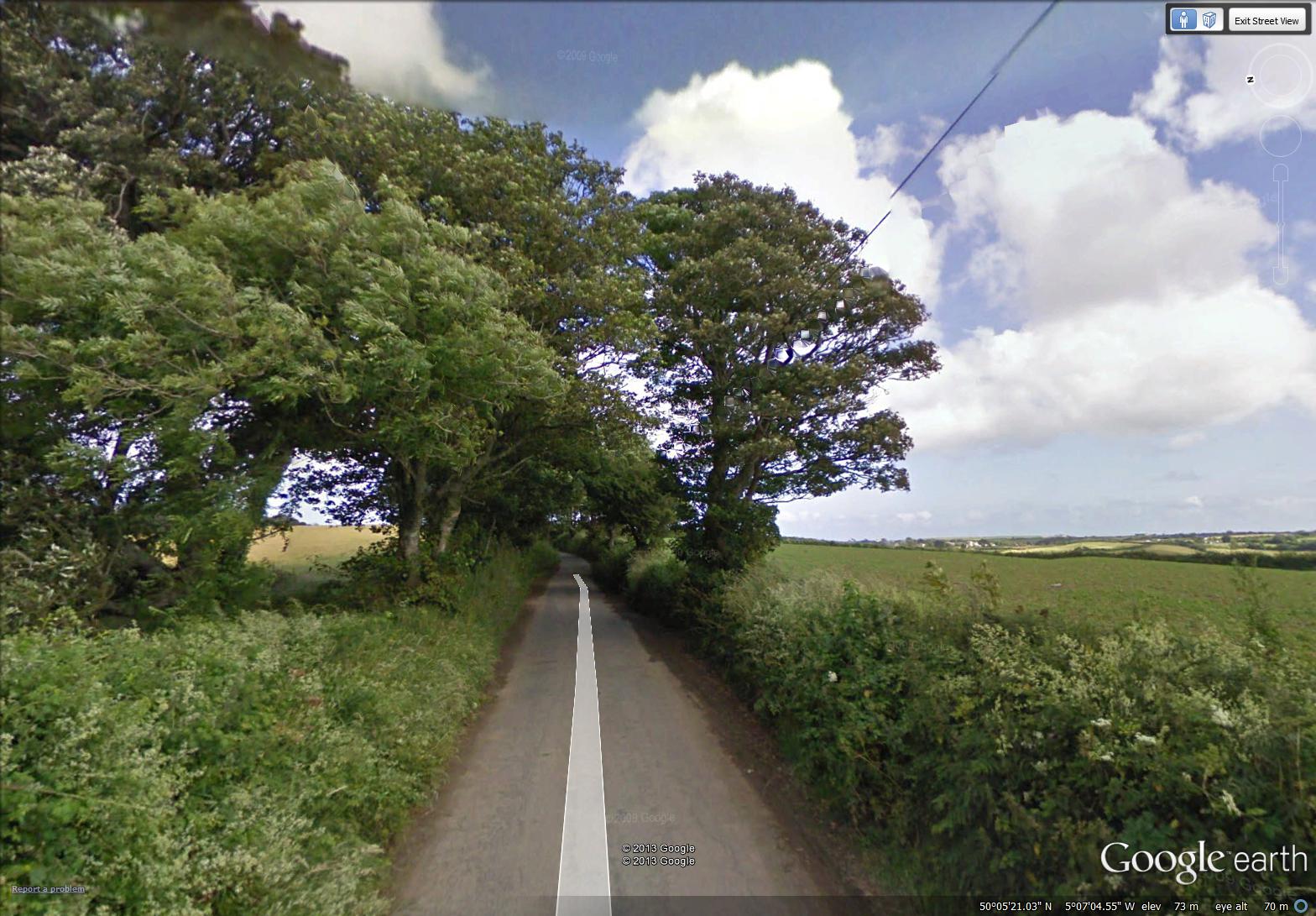
Oak and Ash along the road to St. Anthony (image from Street View)
~
Copyright 2013 Jane Tims
California #2 – loving limes
Since I am a botanist, it is no surprise – one of my favorite experiences in California was seeing the vegetation. Lime, orange and lemon trees were everywhere. One of the best lime trees was in my brother’s yard. It had more limes than leaves! It was en route to their new restaurant, 1226 Washington, opening soon in Calistoga.
~

~
Copyright 2013 Jane Tims
autumn corn
~
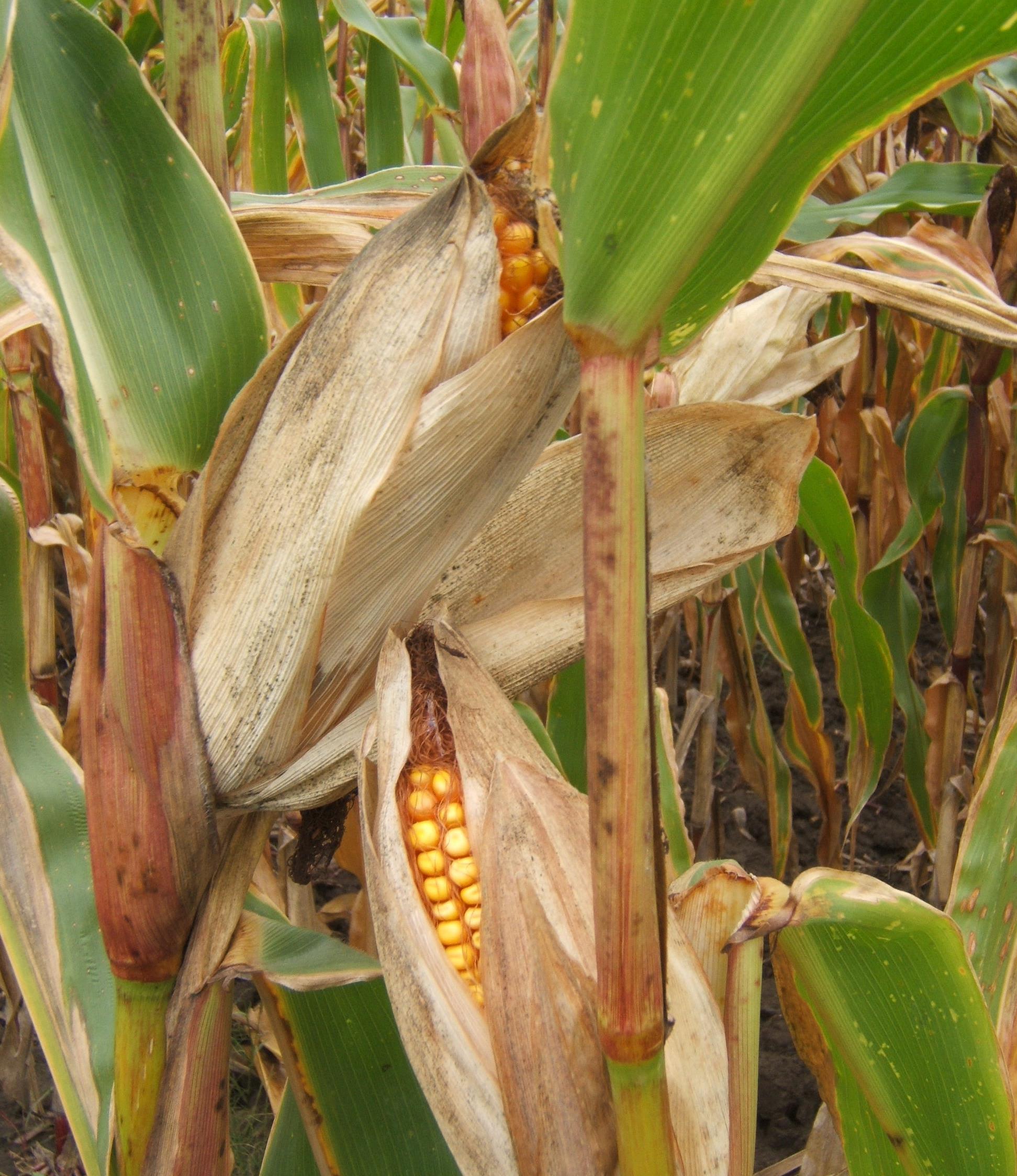
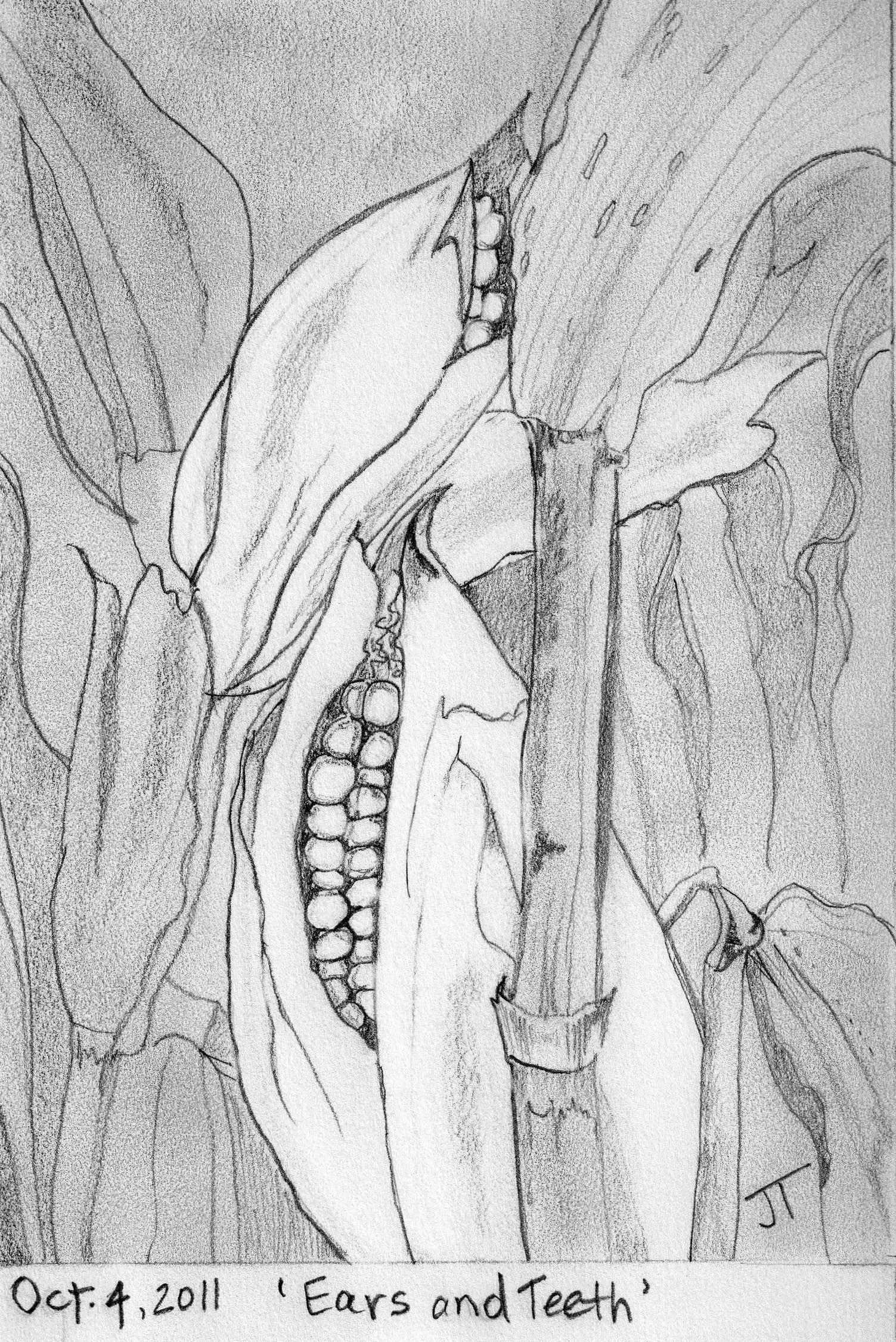
When I think of the fall, I always think about corn – the rustling of the cornstalks in the fields, shucking corn for a corn-boil, eating corn-on-the-cob. In New Brunswick, the corn has been harvested by now, but I thought I’d try a watercolour.
~
On a trip a couple of years ago, we were very impressed by the huge cornfields. I took many photos, including this one …
~
~
At the time, I was doing pencil sketches for my Blog and I did this sketch from the photo …
~
~
This is my watercolour, done a few days ago from the same photo …
~

October 28, 2013 ‘September corn’ Jane Tims
~
Copyright 2013 Jane Tims
the colour of November #1 (Winterberry red)
~
Last week, we went out to our cabin to do some reading and cutting of the ever-growing vegetation. In spite of the mower and the thinning saw and regular prunings, the field seems to grow vegetation behind your back. When you turn around, an alder or a birch tree has filled in a patch you thought was only grass.
~
As we planned a new path across the field, we considered each sapling before we cut. To our surprise, we found another bush of Winterberry Holly (Canada Holly, Ilex verticillata (L.) Gray). Many grow down by the lake, but up in the field by our cabin, we know only of one other.
~
This time of year their leaves are bronzed and brown and their berries are orange-red. The berries will persist on the leafless branches all through the winter.
~

~
The berries of the Winterberry Holly are so much fun to paint. I started with a layer of red, added orange and then layers of white, yellow and red in turn. I finished with a dot of black and a dot of white on the majority of the berries.
~
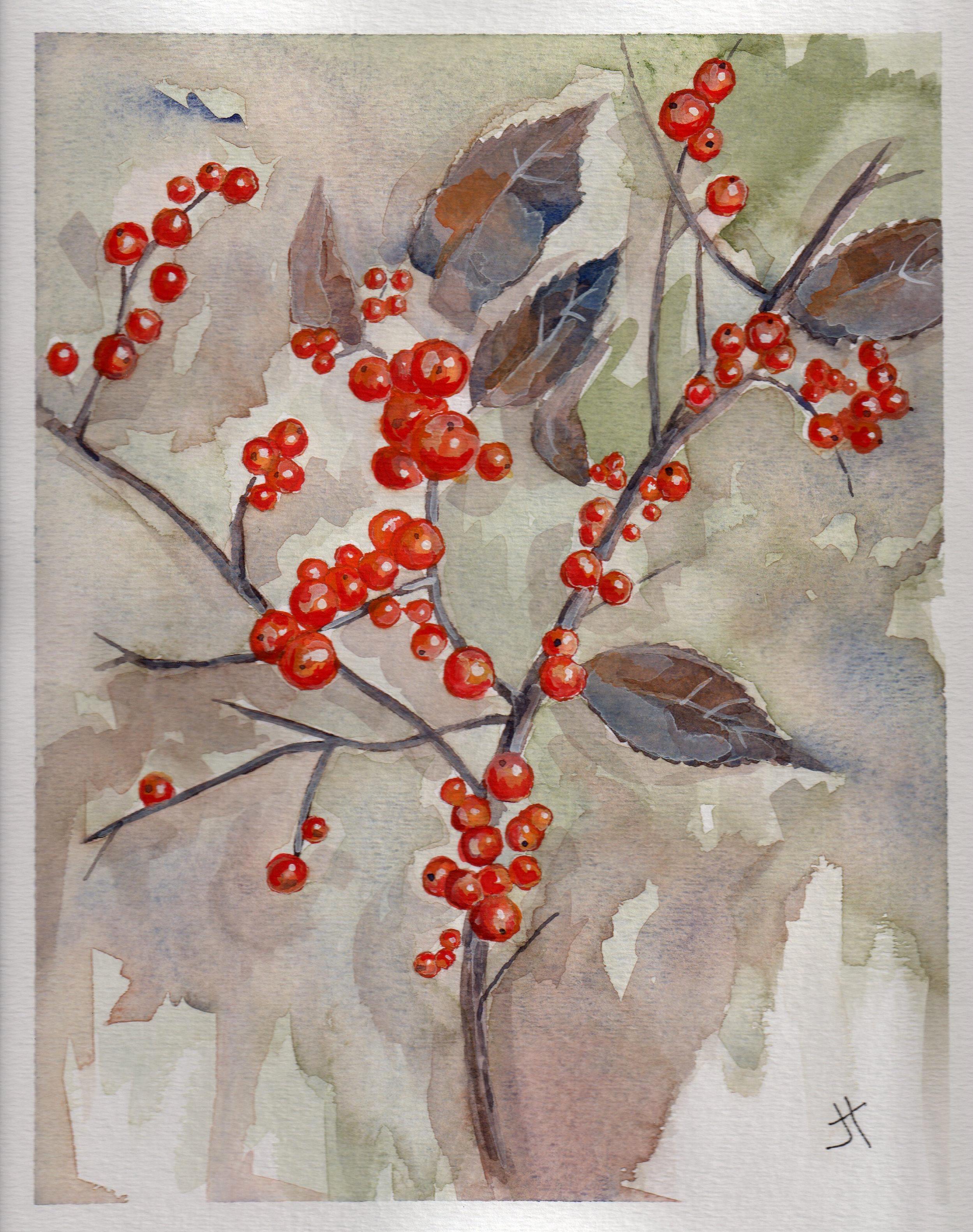
October 27, 2013 ‘Winterberry red’ Jane Tims
~
Copyright 2013 Jane Tims
the colour of October #1- Virginia Creeper
~
Our Virginia Creeper comes from a shoot I collected along the banks of the St. John River over 30 years ago. It grows on our power pole. Some years it makes great progress and gets to the top of the pole to grow along the wires. Other years it struggles to gain any hold at all after damaging winds, or if the power company decides it needs cutting back. The last few years it has grown into the neighboring bushes. As a result, my lilacs seem to have mutant leaves and turn scarlet when the other lilacs are a sickly yellow.
~
This year the Virginia Creeper leaves are shot with holes from the same insect infestation plaguing them last year.
~
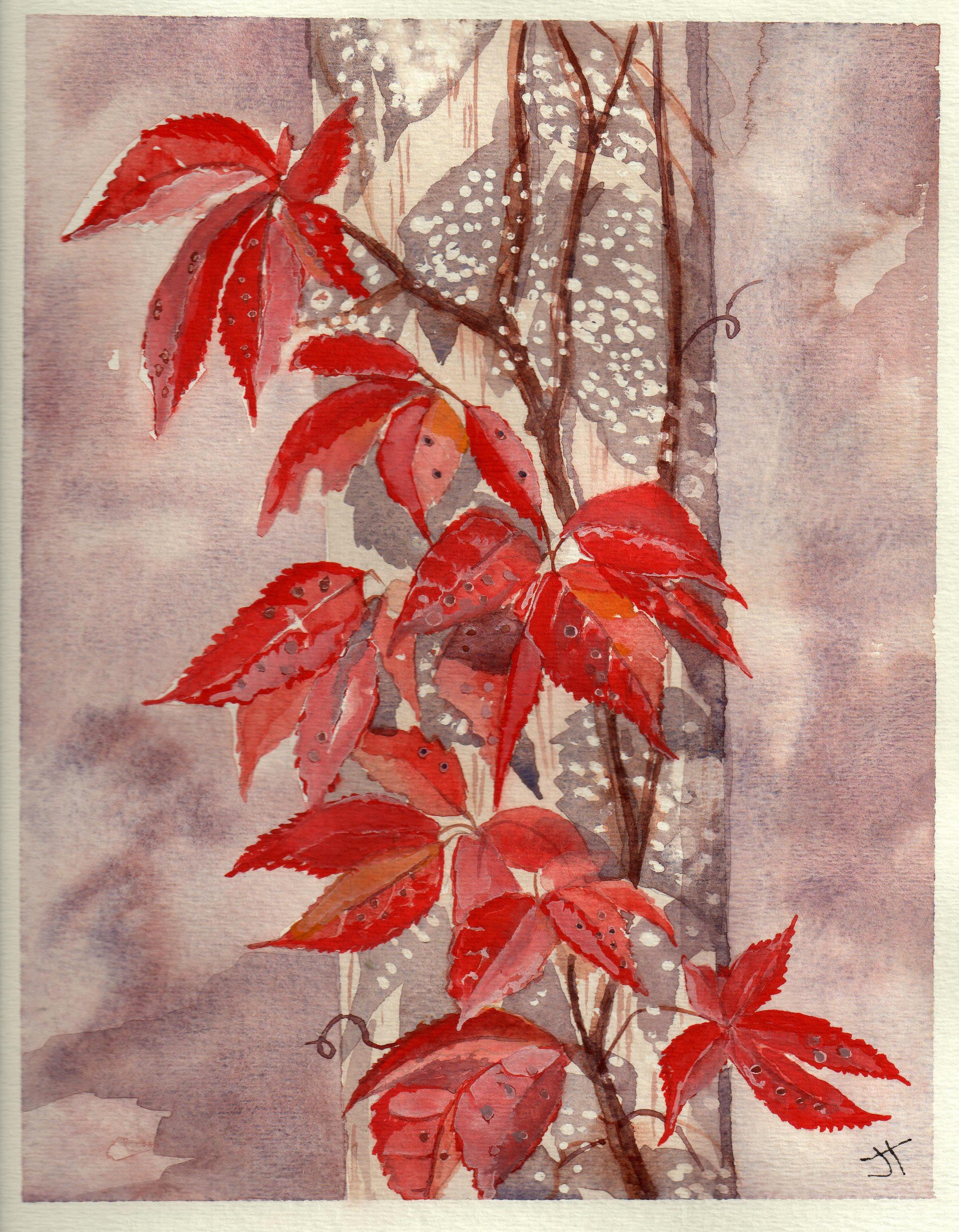
October 7, 2013 ‘Virginia Creeper’ Jane Tims
~
Copyright 2013 Jane Tims
the colour of September #5 – red rose hips from pink roses
I have the funniest rose bush in my front yard.
~
It bore double yellow roses for the first few years of its life. Then, in recent years it has become a pink rose, with the frailest pink petals.
~
I know how this happened – not ‘alchemy’ at all, but an example of survival of the fittest. The original yellow rose must have been grafted to the root stock of a common rose. When the yellow rose stem died for some reason, the pink rose stock flourished. I love my frail pink roses , especially at this time of year when they produce bright red, elliptical rose hips.
~

September 22, 2013 ‘red rose hips from pink roses’ Jane Tims
~
Copyright 2013 Jane Tims
the color of September #4 – a toasted tomato sandwich
~
Of all the produce of September, I think I enjoy tomatoes the most. I like fried green tomatoes, tomatoes in chili con carne and toasted tomato sandwiches. If you have never eaten a toasted tomato sandwich, you should try one. Toast two pieces of whole wheat bread, slice the tomatoes very thin and add mayo, salt and pepper.
~
Now that I have finished my watercolor of tomatoes, and they are no longer needed for the still life, I think I’ll have another sandwich …
~

September 14, 2013 ‘tomato red’ Jane Tims
~
Copyright 2013 Jane Tims
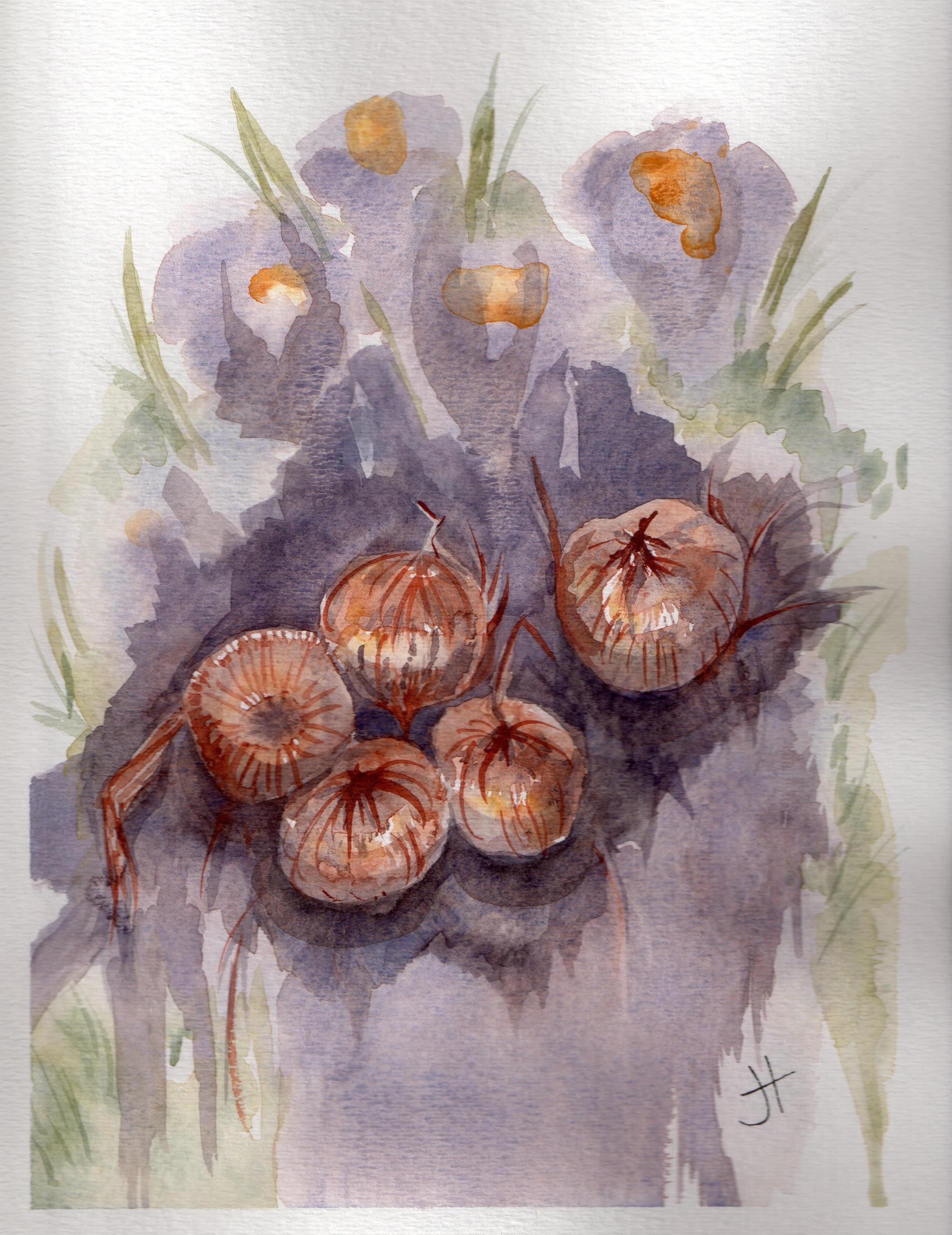
the color of September #3 – a purple crocus from a brown bulb
~
This morning, thinking of the long winter, I planted a dozen crocus bulbs. The package promises large, dark purple blooms in early spring.
~
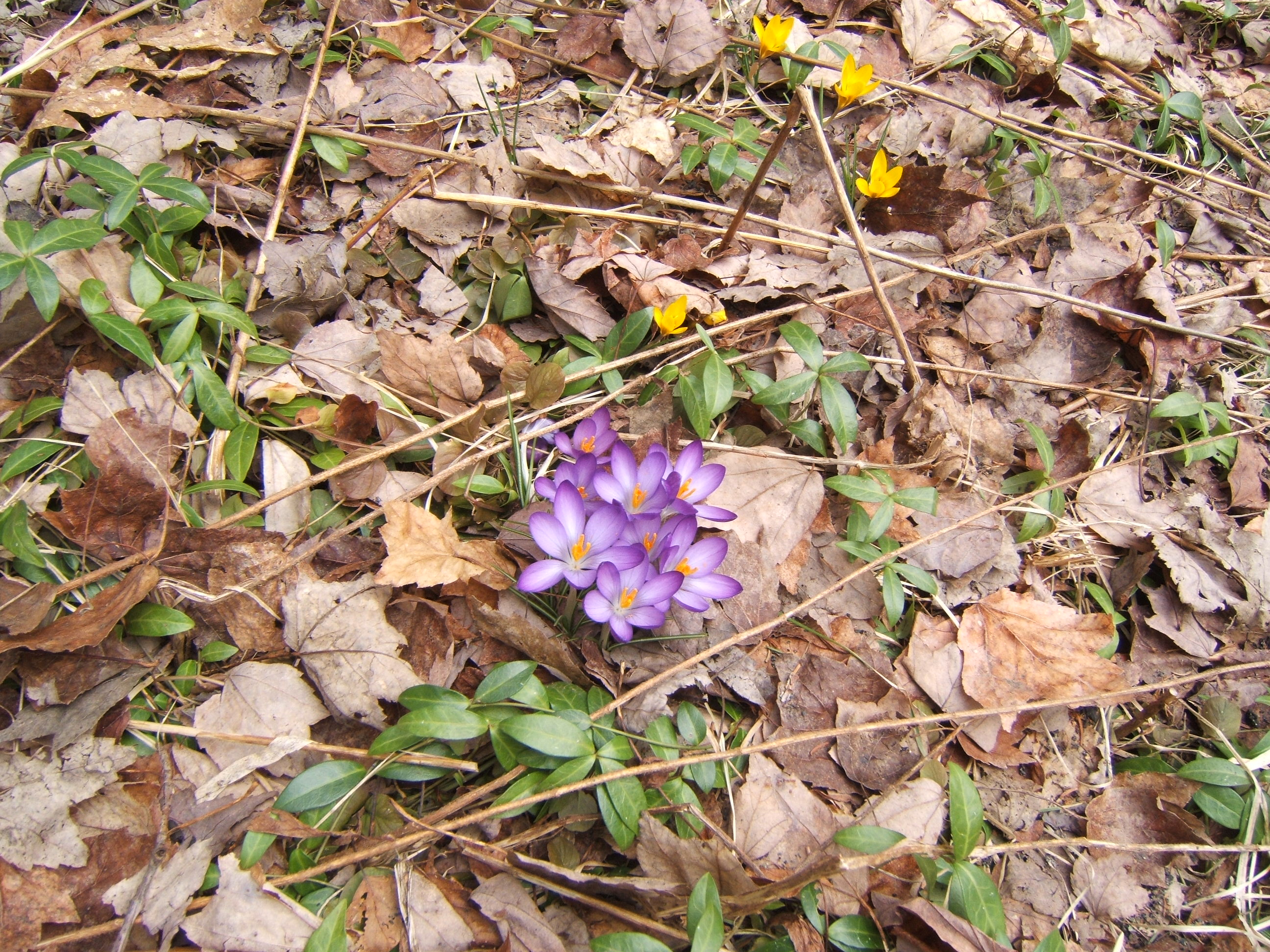
I planted them in small groups, in front of my concrete bench. When they bloom in spring, I will be able to see them from my library window. After a long winter, a glimpse of those brave petals poking above the dry leaves will be so joyful.
~
~
The crocuses we have now are bright purple and yellow. I planted them years ago, when my son was young. They have endured all these years and have even spread to other, distant parts of our property. I think the squirrels must dig them up, rebury them and forget where they have stashed their treasure.
~

~
So, deep within the sienna brown of the bulbs is the makings of those purple petals. Wow!
~
~
Copyright 2013 Jane Tims




 nichepoetryandprose