Posts Tagged ‘pencil drawing’
small scale economy – picking berries
~

~
small-scale economy
~
my box of berries spilled
on the footpath,
between leaves
of Kalmia and wintergreen
hawkweed and cow pies
~
the cousins, their boxes brimming,
stood gawking, dismayed,
I was certain they were thinking
dumb city girl, spilled her berries
box only half full anyway
~
instead, they gathered around me
sympathy in every hand
scooped most of the berries
into the box
added a few from nearby bushes
~
seventeen cents he paid me
half the value of a box at full
the cousins had picked a crate or more,
remembered the wasted berries, left on the trail
and wept at the loss
~
~
Published as: ‘small scale economy’, Canadian Stories 16 (94), December 2013/ January 2014
Copyright 2014 Jane Tims
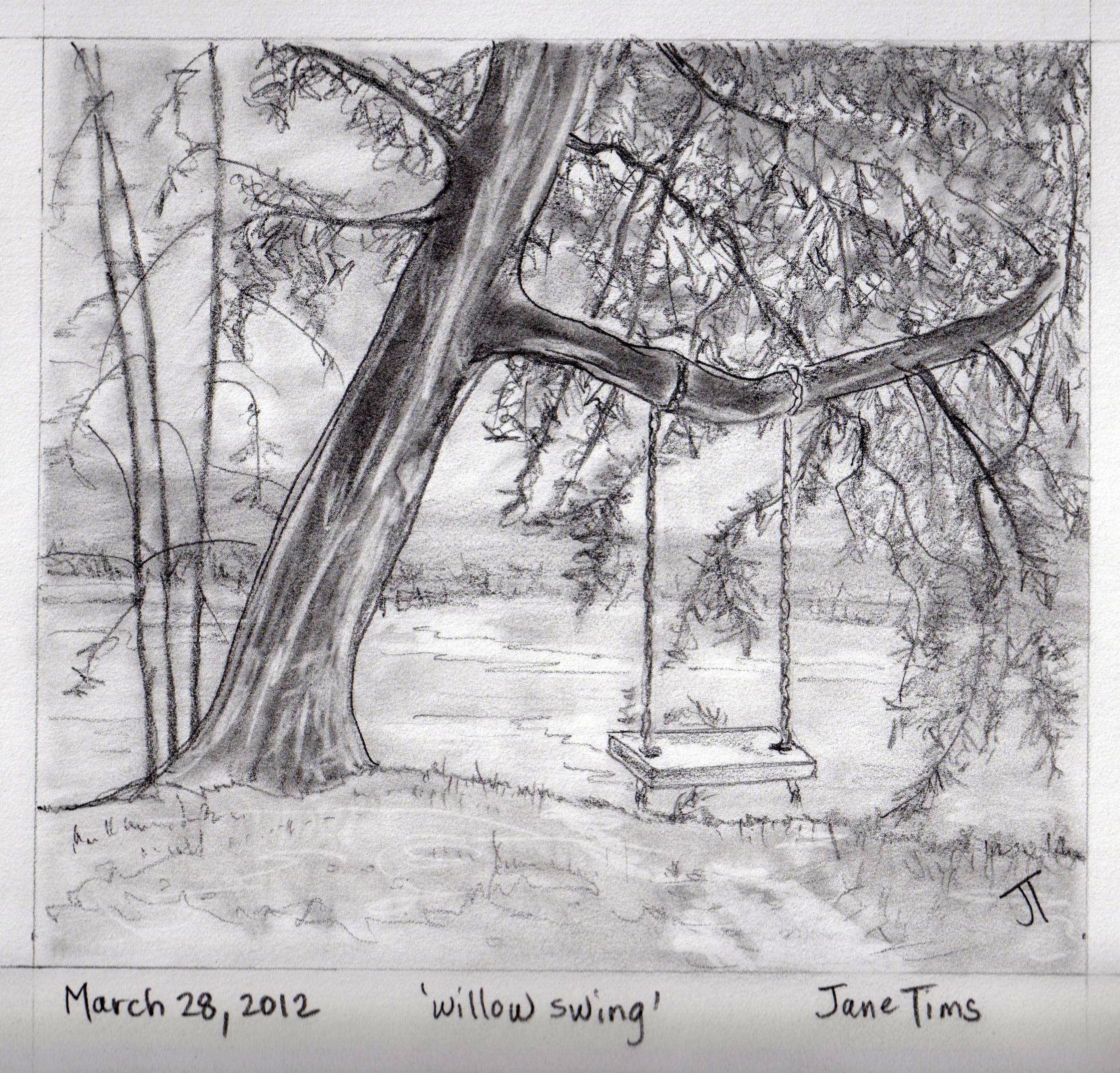
swing in the orchard
On this cold and snowy day …
~
~
in the orchard
~
the old swing
soothes its child
its ropes fray
squeak with laughter
~
if you hang around under apple trees
you understand the patchy shade
the reason the grass grows only so high
~
in summer, the boy ties the swing high in the tree
and the mower moves under
brings Timothy to its knees
~
spares field mice and bedstraw
makes mounds of hay to land on
~
~
Copyright 2014 Jane Tims
autumn corn
~
When I think of the fall, I always think about corn – the rustling of the cornstalks in the fields, shucking corn for a corn-boil, eating corn-on-the-cob. In New Brunswick, the corn has been harvested by now, but I thought I’d try a watercolour.
~
On a trip a couple of years ago, we were very impressed by the huge cornfields. I took many photos, including this one …
~

~
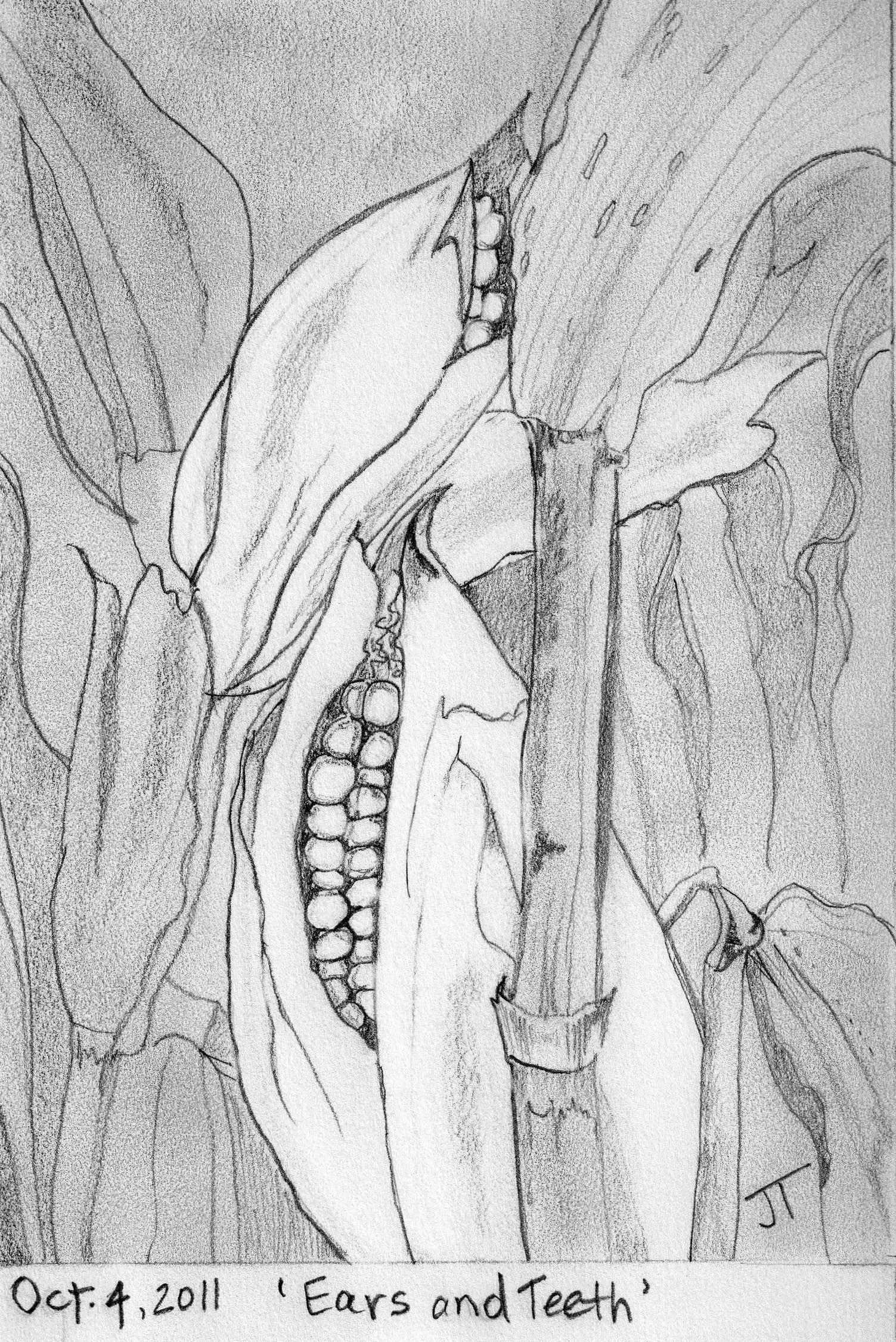
At the time, I was doing pencil sketches for my Blog and I did this sketch from the photo …
~
~
This is my watercolour, done a few days ago from the same photo …
~

October 28, 2013 ‘September corn’ Jane Tims
~
Copyright 2013 Jane Tims
writing a novel – objects and symbols
~
Title: unknown
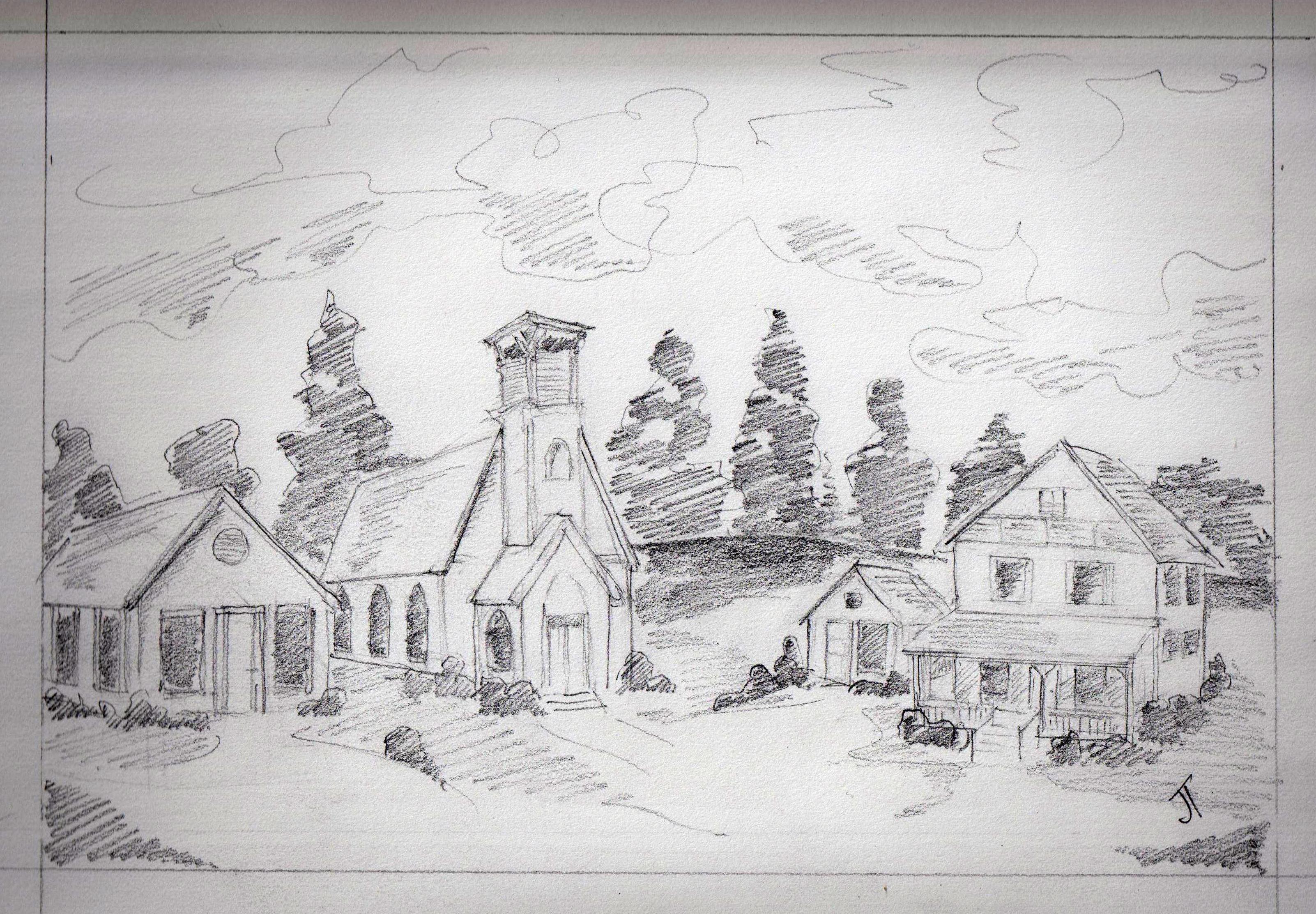
Working Title: Saving the Landing Church
Setting: a writers’ retreat, including an abandoned church
Characters: main character Sadie, a writer; her husband Tom; people from the community
Plot: the story of how Sadie tries to win over a community in order to preserve an abandoned church
~
If you are new to following my Blog, you may not know I have been writing a novel since last November. If you have followed my Blog for some time, you may be wondering if I have abandoned my novel for the world of watercolor painting – not so.
~
~
I am on Draft Six. I have taken the comments of my readers and members of my writing groups to heart, considered them carefully and made many revisions in the Fifth and Sixth Drafts. I have also paid careful attention to three workshops I attended on writing fiction.
~
One of these workshops was exceptionally thought provoking, teaching me to look at elements of my book in a new way.
~
Our instructor at this course suggested we pay particular attention to the objects mentioned in our writing. Mentioned once, an object, such as a table, is just a table. Mentioned twice, it becomes a symbol, and the reader remembers the first mention of the object and draws understanding from the symbolism. So a table may be remembered for the people siting at it and the subject of their conversation. Perhaps it becomes a symbol for family, for example. If, in the second mention, someone breaks the table by putting too much weight on it, this may make a comment on the idea of family in the story. By breaking the table, the family may be damaged or broken. The use of symbols deepens meanings and helps the plot reverberate throughout the writing.
~
The instructor also said that symbols operate like mini sub-plots throughout the story. These mini-plots echo the main plot, and the objects change in a way that illuminates the main plot. The mini-plots also tend to occur in three ‘beats’, providing a beginning, middle and end. For example, the table is bought at an auction, broken and finally mended.
~
In this round of edits, I have tried to examine the use of symbols in my novel. To do this, I built a list of the objects I have used as symbols. Then I looked for their occurrence in the novel to see if I could identify three ‘beats’ and a mini sub-plot. In some cases, I identified gaps – fixing these has helped me to solidify my overall plot and improve the understanding of my readers.
~

a lych gate is one of the objects I use as a symbol in my novel
~
This is a short version of my list of some of the objects/symbols in my book. When I assembled the list, the items in red were missing and I had to fill out the story accordingly. Perhaps you can use this method to help strengthen the narrative in your own fiction.
~
| Object | Symbolism | Occurrence (Chapter Numbers) | Mini-plot | ||
| long bench | togetherness | 11 | 21 | 23 | bench moves from private to communal space; people start working together |
| stained glass | relationship between sacred and secular | 1 | 9 | 23 | stained glass window breaks and is repurposed; the sacred becomes the secular |
| lych gate | death | 1 | 9 | 20 | lych gate falls into decay; fear of death is no longer the driving factor in a family |
| red shoes | respect | 1 | 9 | 21 | community’s view of main character is altered |
| minister’s collar | mentorship | 1 | 15 | 21 | although he leaves the church, a minister grows as mentor to a family and the community |
| blue plastic truck | secular within the sacred | 3 | 11 | 21 | a plastic toy becomes an object worthy of protection; the secular becomes the sacred |
| Jasper the dog | companionship | 8 | 16 | 19 | a new dog helps build a family |
| air fern in a swan vase | ability to change (a sea-creature poses as a fern) | 3 | 8 | 23 | something unwanted becomes valuable |
~
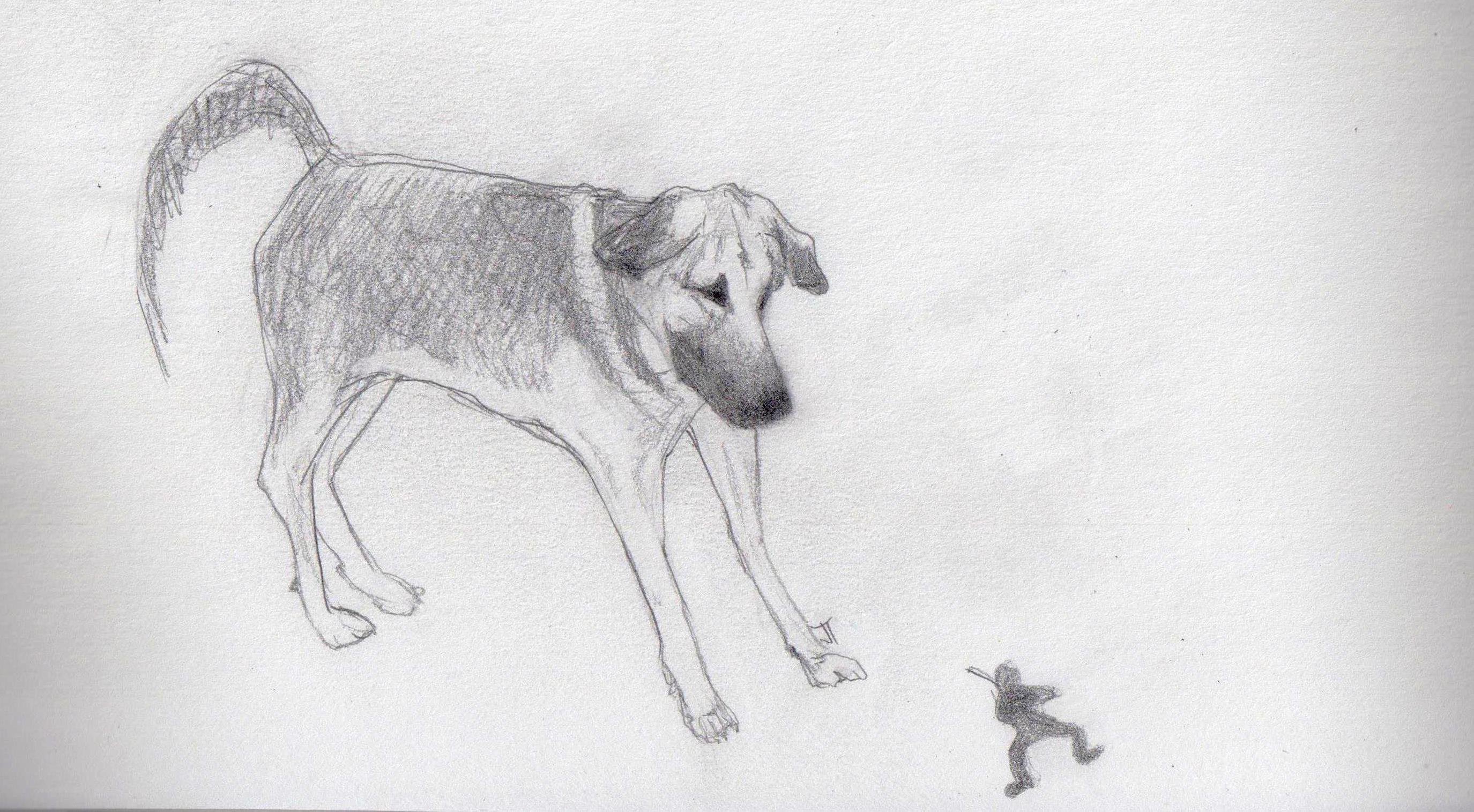
Jasper the dog was a late addition to my novel, but he opened up so many story possibilities, I’m glad he came to be one of the characters
~
Each time I add something new to the narrative, I have to make other edits in consequence. However, I find these changes are worth the effort since they contribute to building the story.
~
Have you considered the use of objects as symbols in your writing?
~
Copyright 2013 Jane Tims
looking out to sea 6-4
~
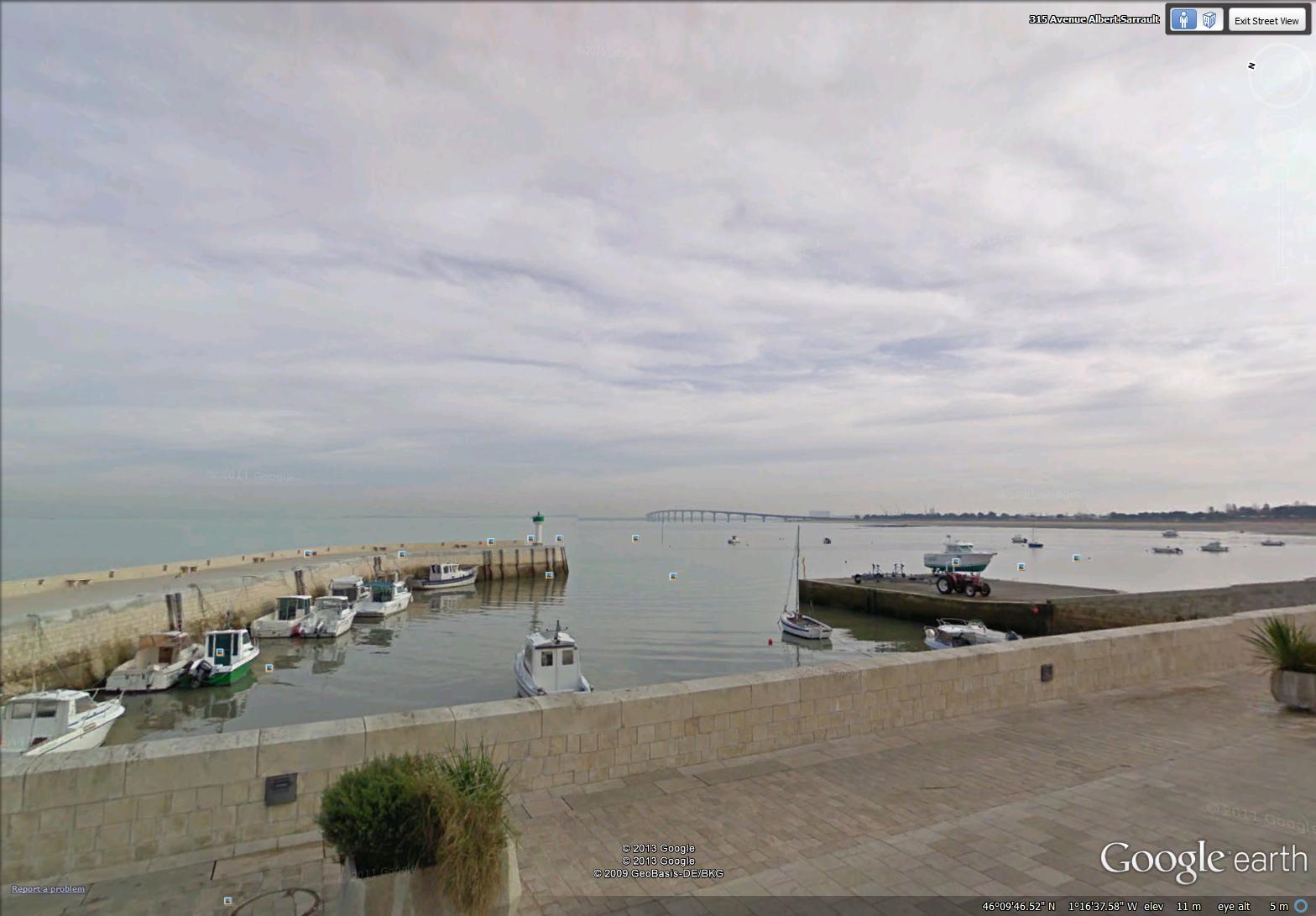
view from Ile de Ré with the bridge in the distance (image from Street View)
~

~

map showing distance travelled (map from Google Earth)
~
I am enjoying my glimpse into the way of life on Ile de Ré. The houses include the now-familiar two-story dwellings on narrow streets. Most of the houses have painted shutters …
~
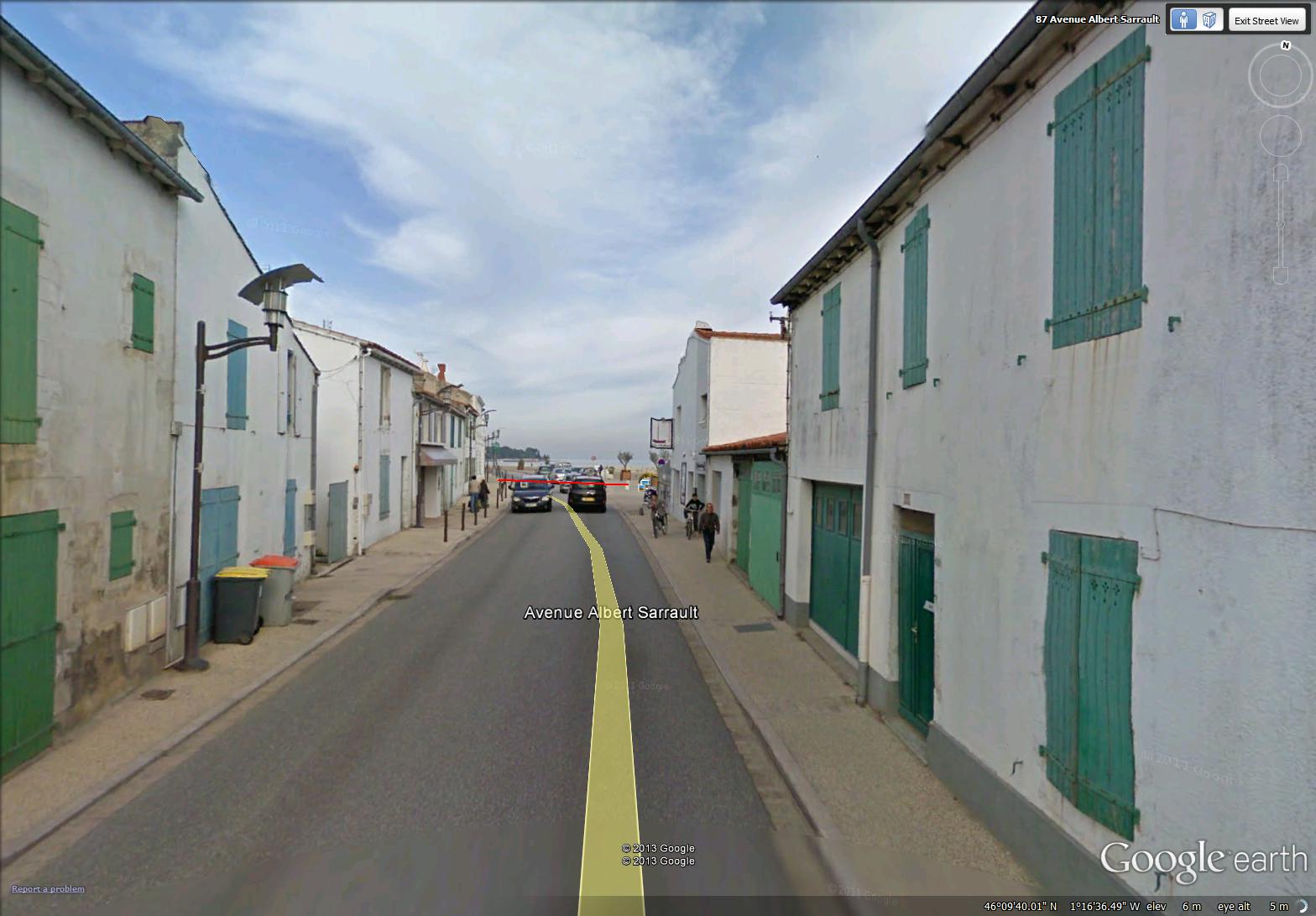
narrow street in Rivedoux-Plage (image from Street View)
~
I also see more modern houses tucked away behind fences and walls …
~
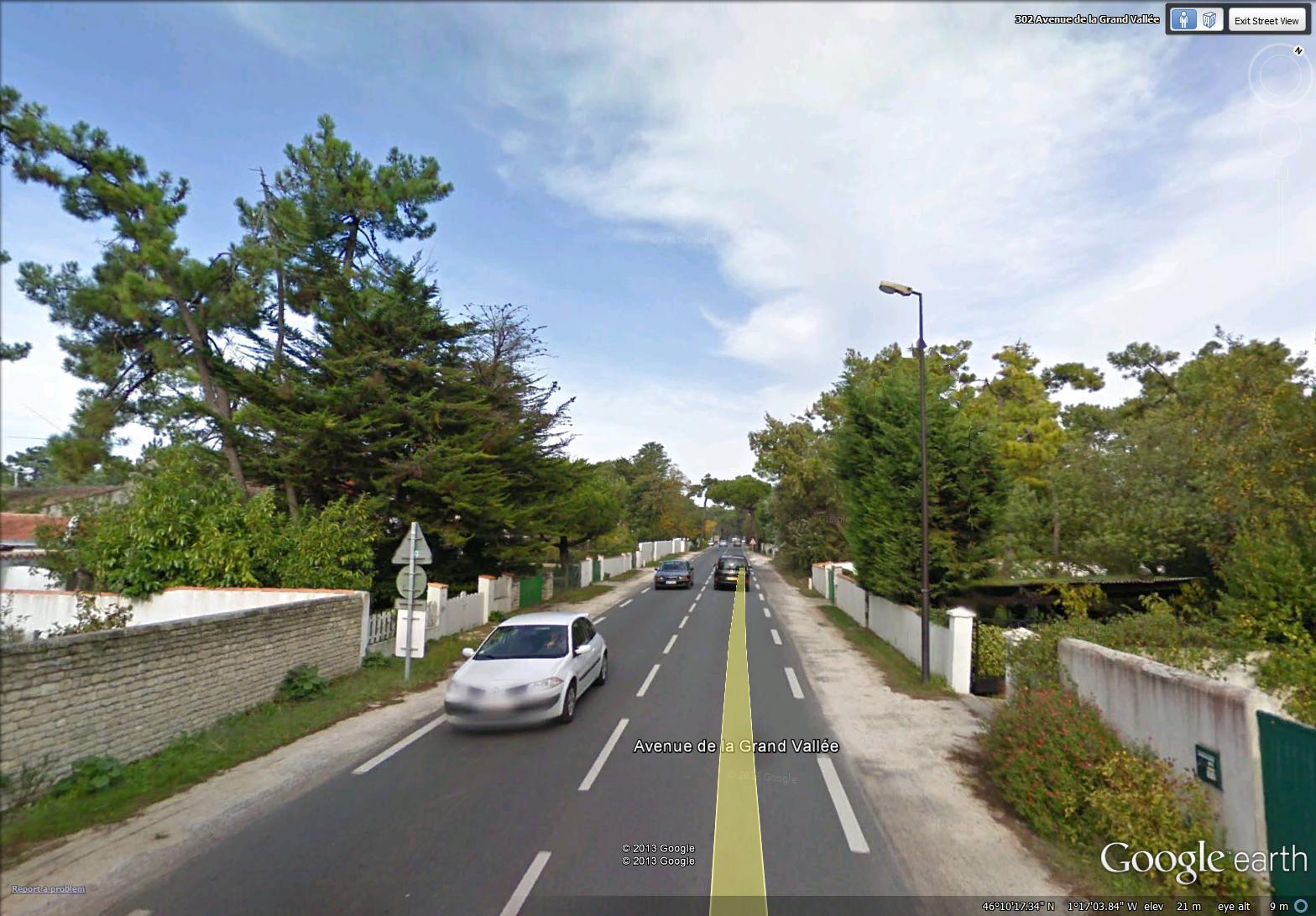
street on Ile de Ré (image from Street View)
~
Where the route runs along the ocean, there are pleasant walkways and marinas for boaters …
~

houses along Rivedoux-Plage (image from Street View)
~
There are lots of places to sit and watch the ocean. Some views overlook extensive oyster farms in the zone of the low tide …
~

~
A closer look at my route map shows the rectangular oyster-growing areas just off-shore …
~

~
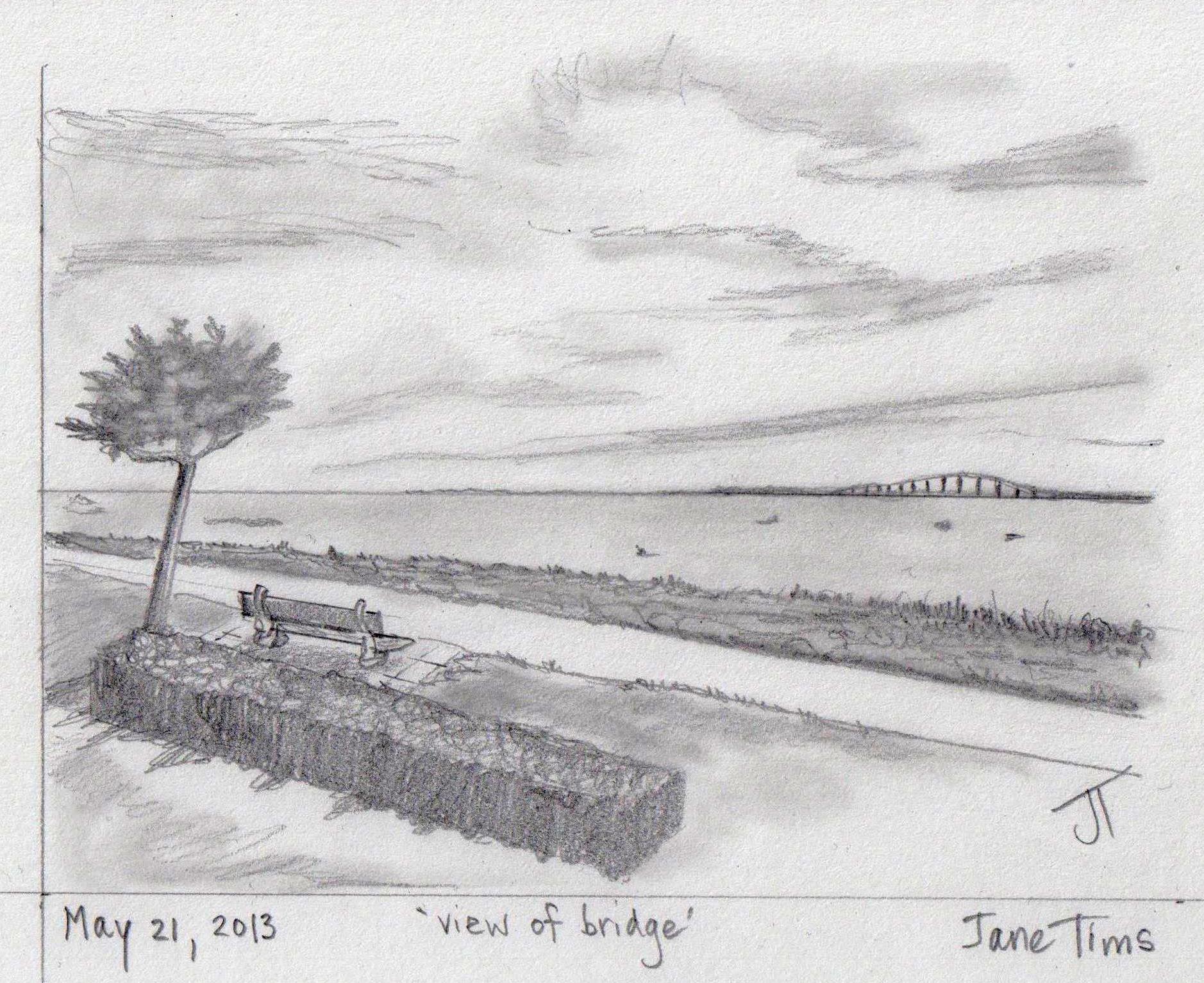
Best View: view across the Bay of Biscay toward the Ile de Ré Bridge – a place to sit and watch the ocean …
~
~
Copyright Jane Tims 2013
beaches and dunes 6-3
~
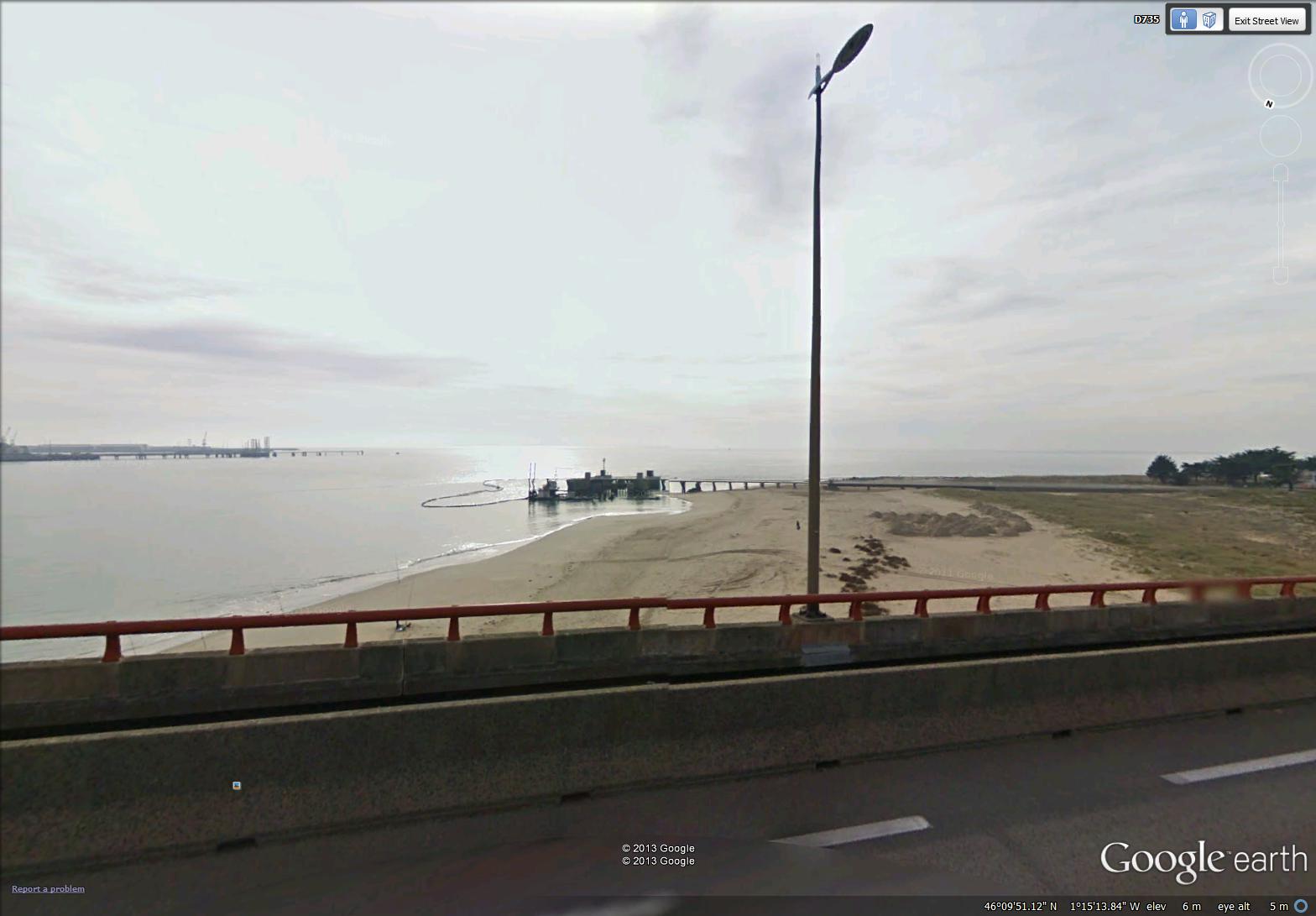
view of Ile de Ré from Bridge (image from Street View)
~

~
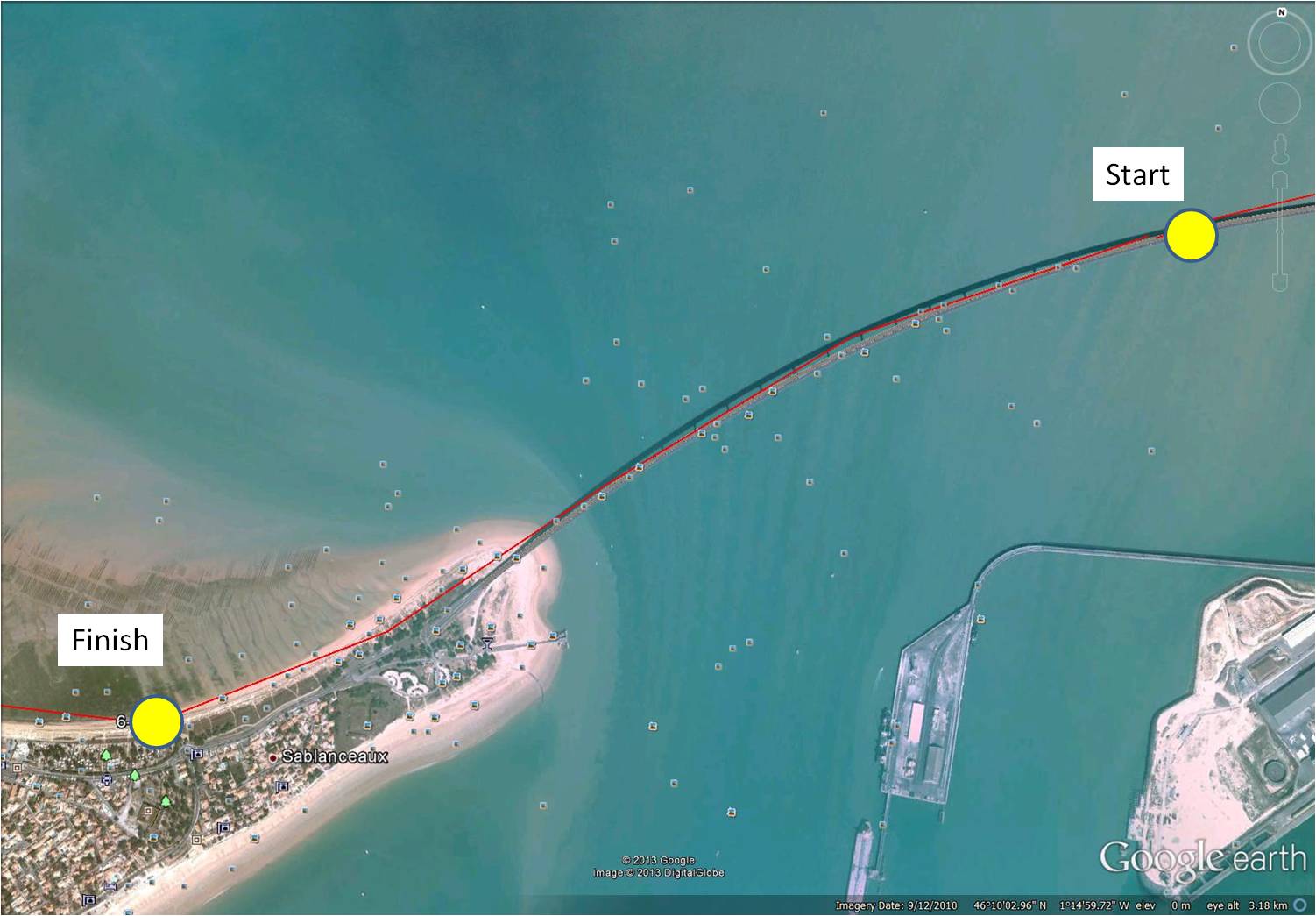
map showing distance travelled (map from Google Earth)
~
At last, I have arrived on Ile de Ré! I love the name Sablanceau, the first community I reached on the island … it seems to be a name made from the words ‘sand’ (le sable), ‘white’ (blanc) and ‘water’ (l’eau) …
~
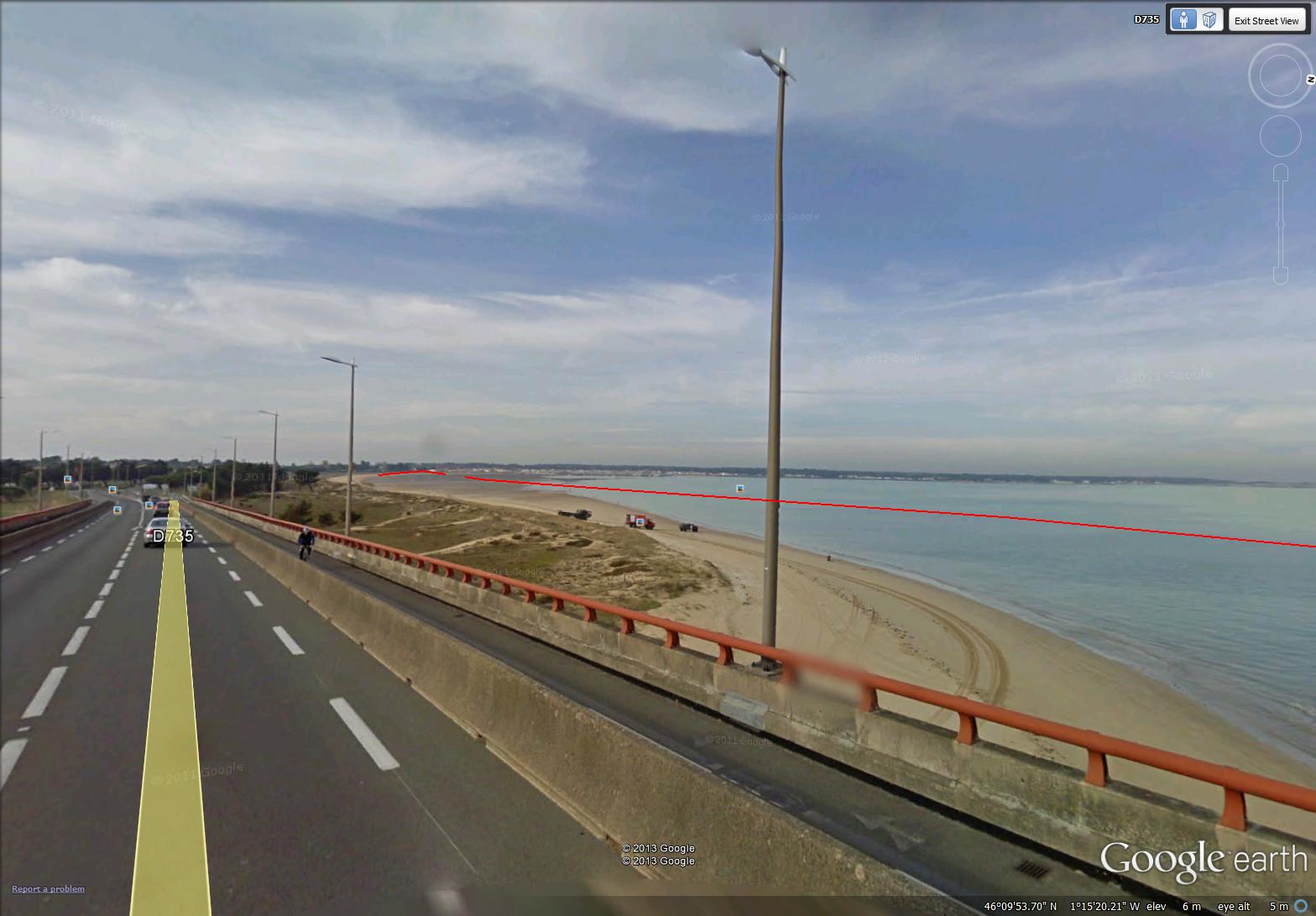
beach to east of bridge (image from Street View)
~
It looks like the beaches of the island are accessible to vehicle traffic, making them vulnerable to erosion. I was glad to see boardwalks have been to constructed to reduce the impacts of foot traffic across the dunes …
~

walk way across the dune (image from Street View)
~
The island is flat and there are bike routes everywhere …
~

bike route along the beach (image from Street View)
~
It must be nice to live directly across the road from such a beautiful beach, but the traffic must be annoying …
~

houses along the Sablanceau beach (image from Street View)
~
Best View: dunes of Sablanceau …
~

~
Copyright Jane Tims 2013
on the Bridge to Ile de Ré 6-2
~
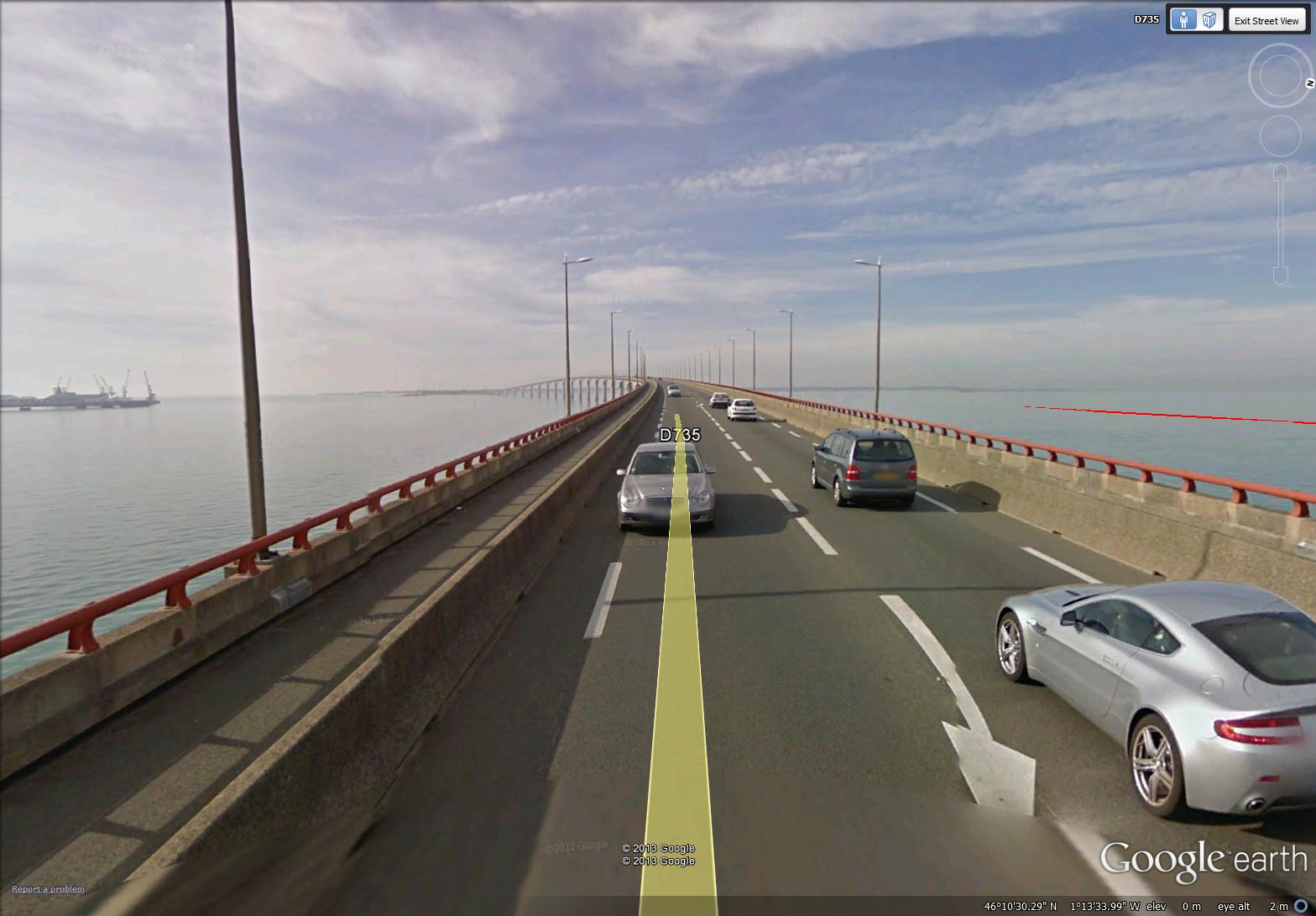
on the bridge to Ile de Ré – lots of traffic (image from Street View)
~
~

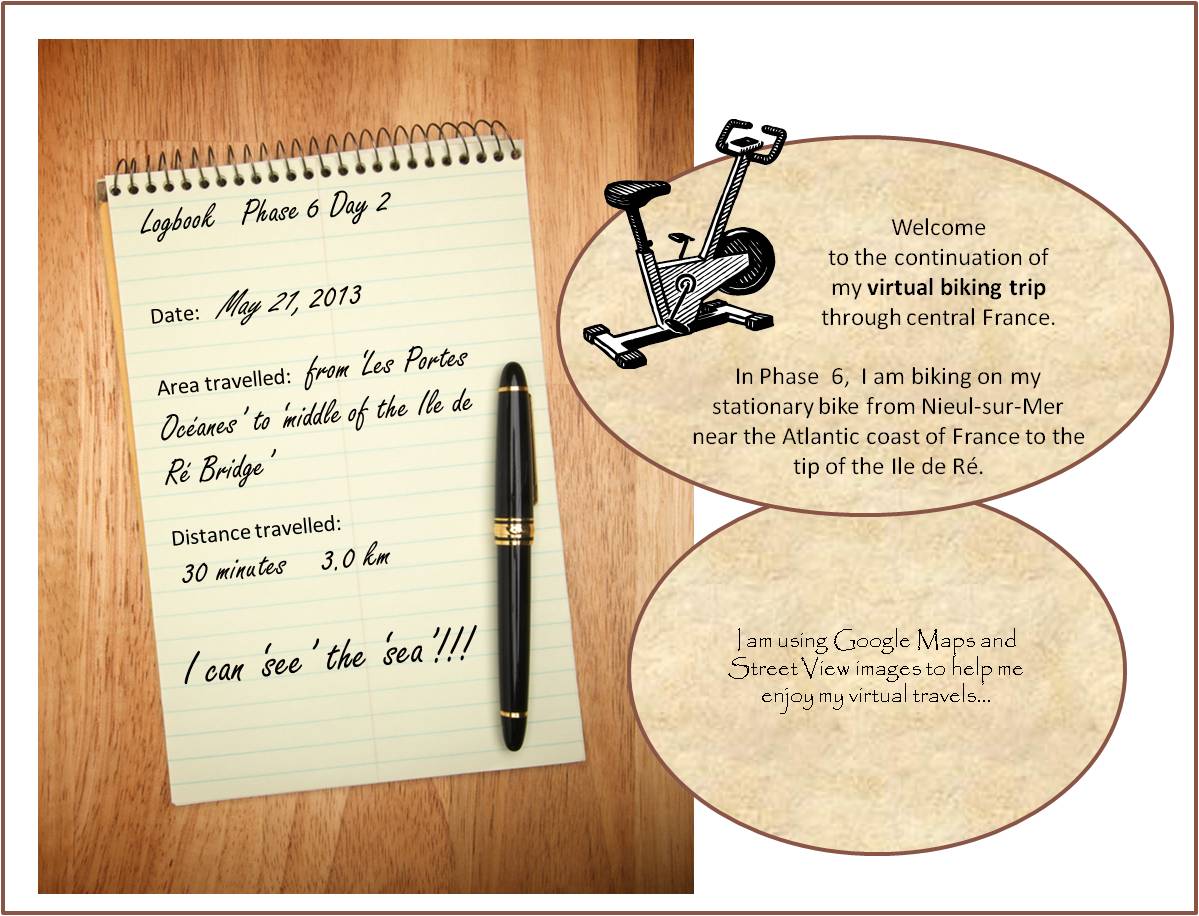
map showing distance travelled (map from Google Earth)
~
On May 21, I continued my virtual ‘bike ride’, so excited to finally see the big bridge to Ile de Ré. I began with another view of the ocean. It makes me happy to know I share the Atlantic Coast with this part of France – I am just the width of the ocean and a continent away!
~
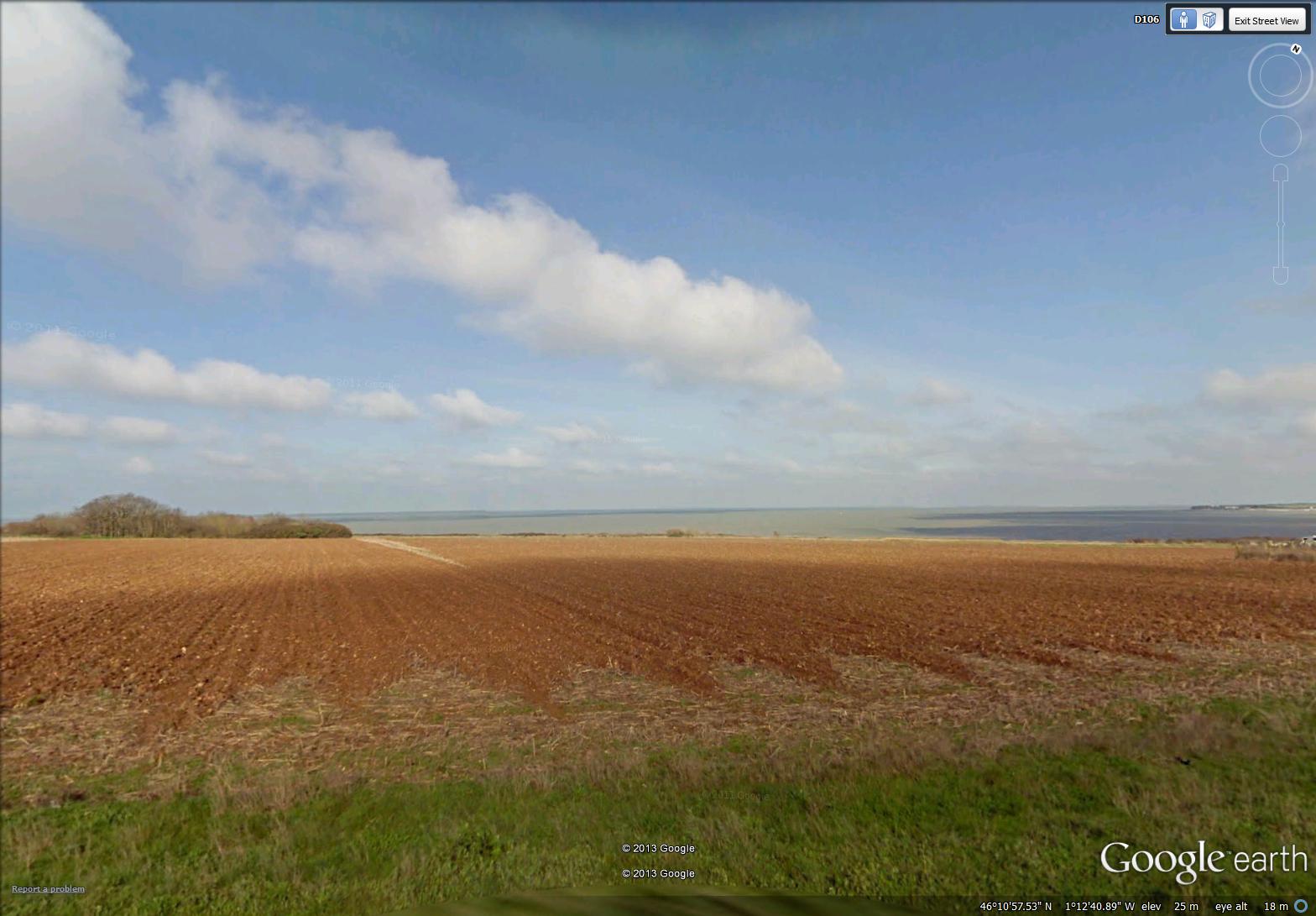
another view of that Bay of Biscay (image from Street View)
~
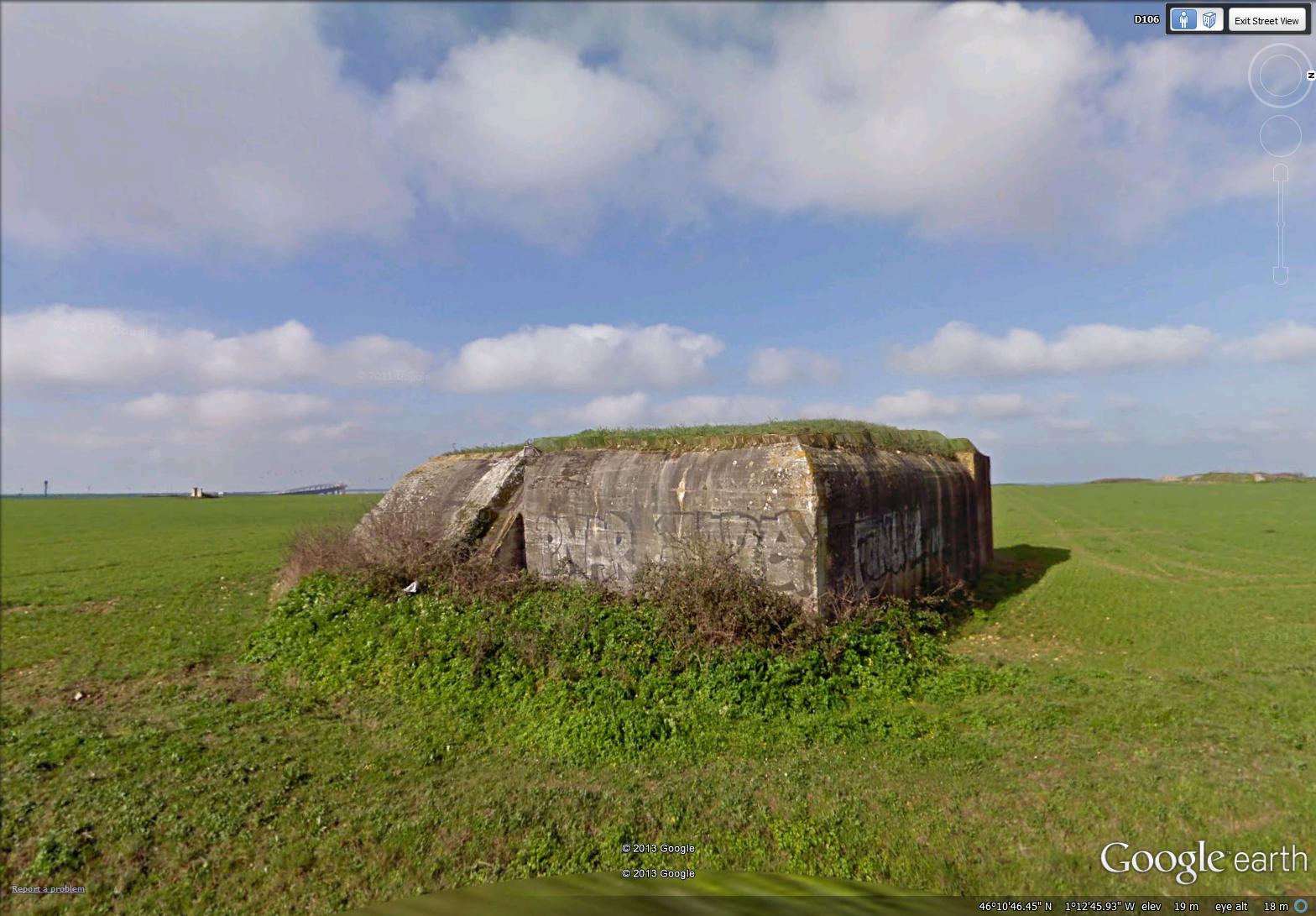
It was interesting to see World War II fortifications on this part of the coast. I usually associate these with northern France. I wouldn’t make much of a military strategist …
~
~
My first glimpse of the bridge was a small tilted structure on the horizon. This bridge reminds me of the big Confederation Bridge between New Brunswick and Prince Edward Island. The Confederation Bridge was opened in 1997 and is 13 km across. It replaces a ferry that ran there for years. The Ile de Ré Bridge is only about 3 km long, but the big curve in the structure makes it look magnificent. It was built in 1987 to replace a car ferry ( a bac) …
~
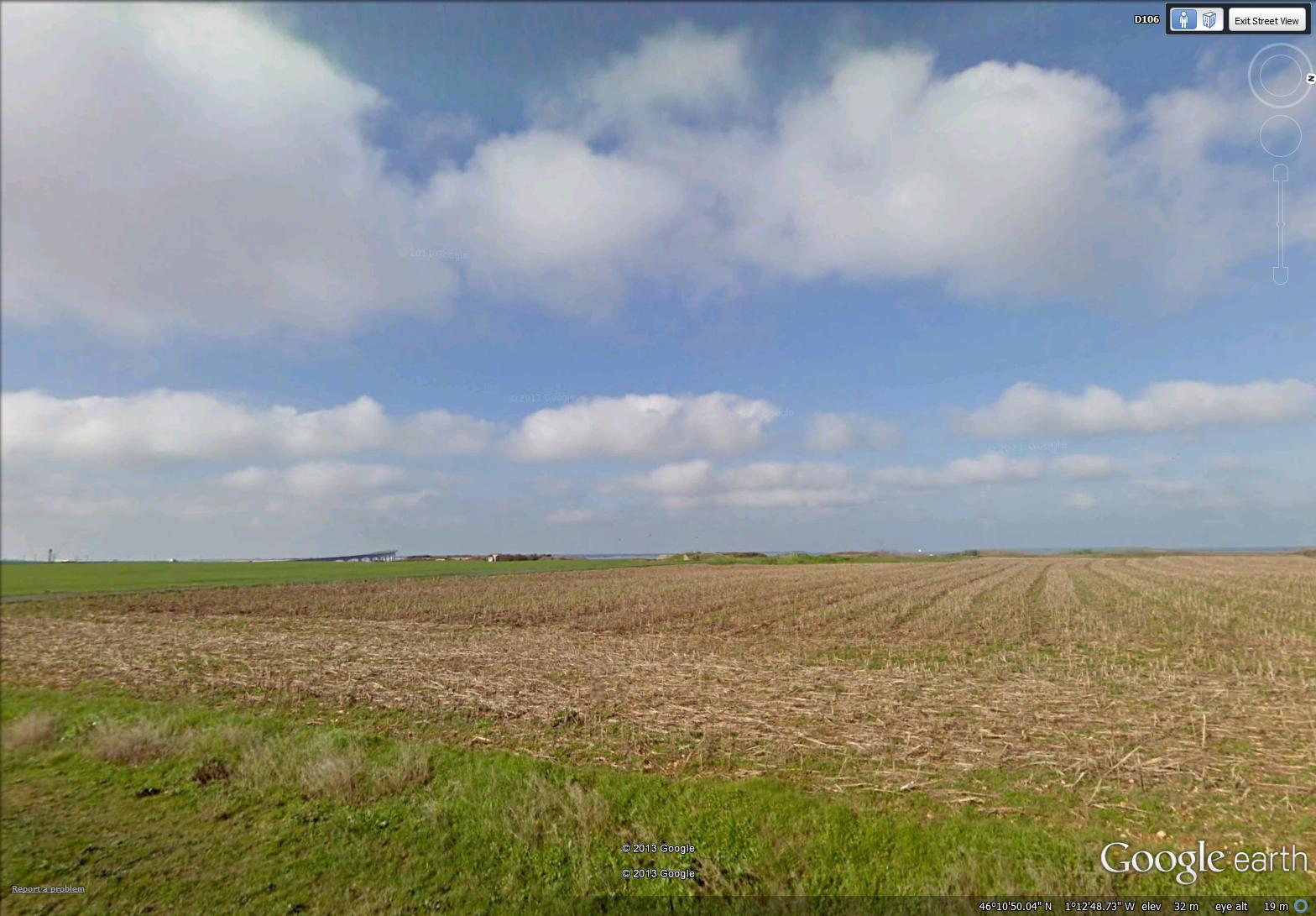
in the distance, at about 8 o’clock, you can see the Ile de Ré bridge, a small tilted bit of the horizon (image from Street View)
~
It was exciting to approach the bridge on my bike, particularly since I think bikes are free (a car paid a toll of 16 € in early 2012). The toll booth is called the Belvedere …
~
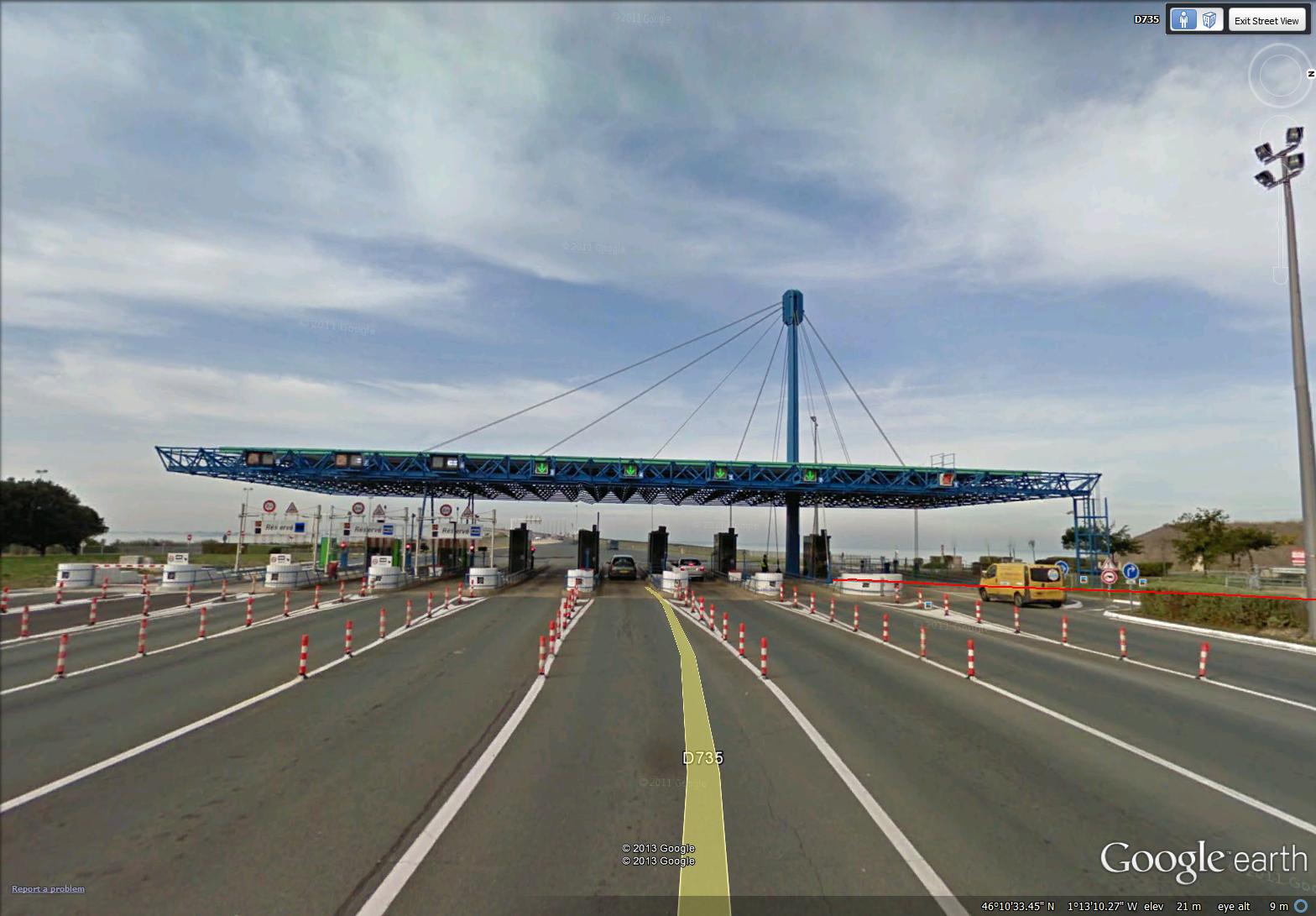
the toll booth for the Ile de Ré bridge (image from Street View)
~
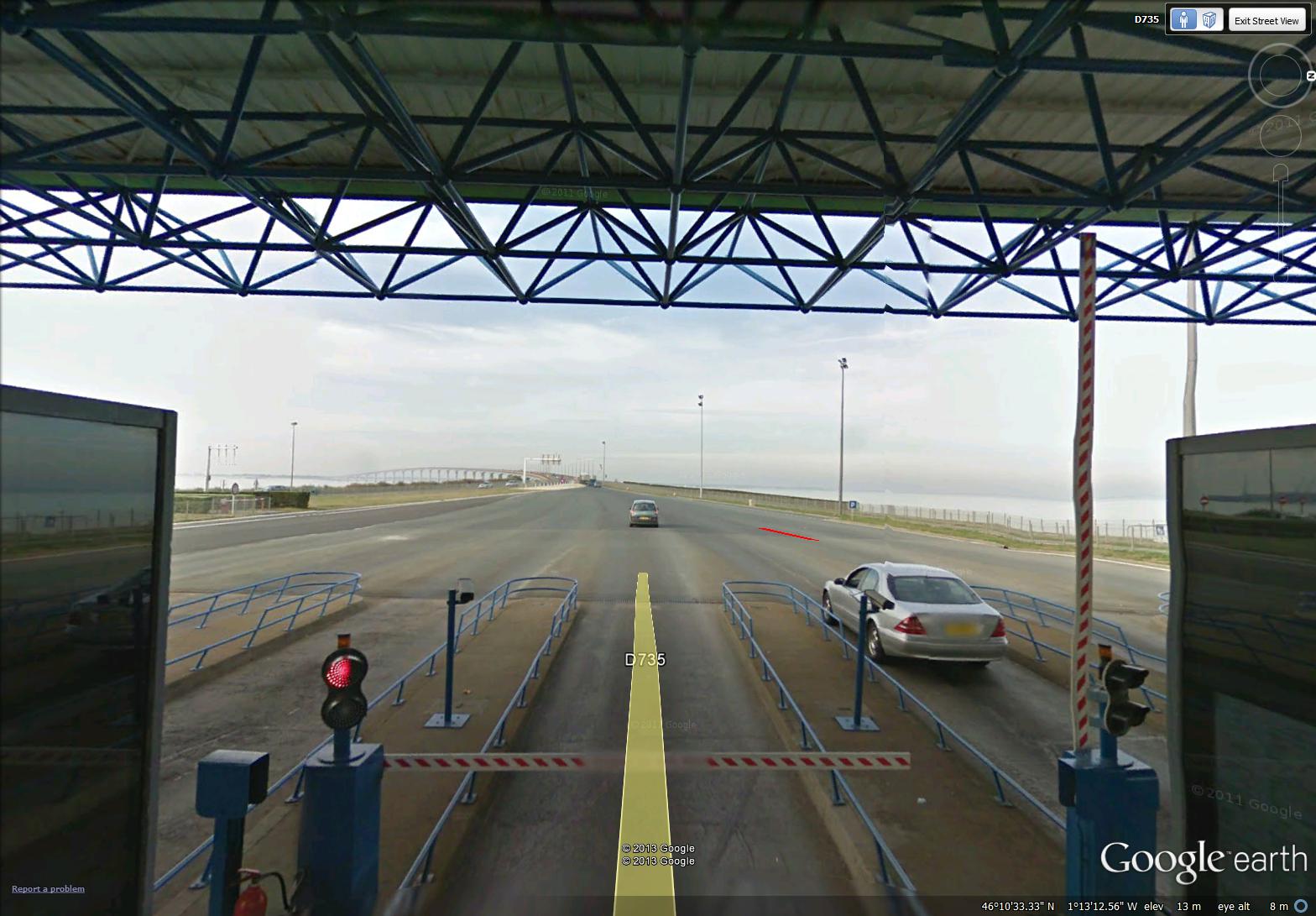
I whizzed right through without paying (don’t know if I was free) …
~
~
Glad to see there were bike lanes on the bridge, coming and going …
~

bike lanes on the bridge (image from Street View)
~
I could also look back and see the cliffs along the coast of France …
~
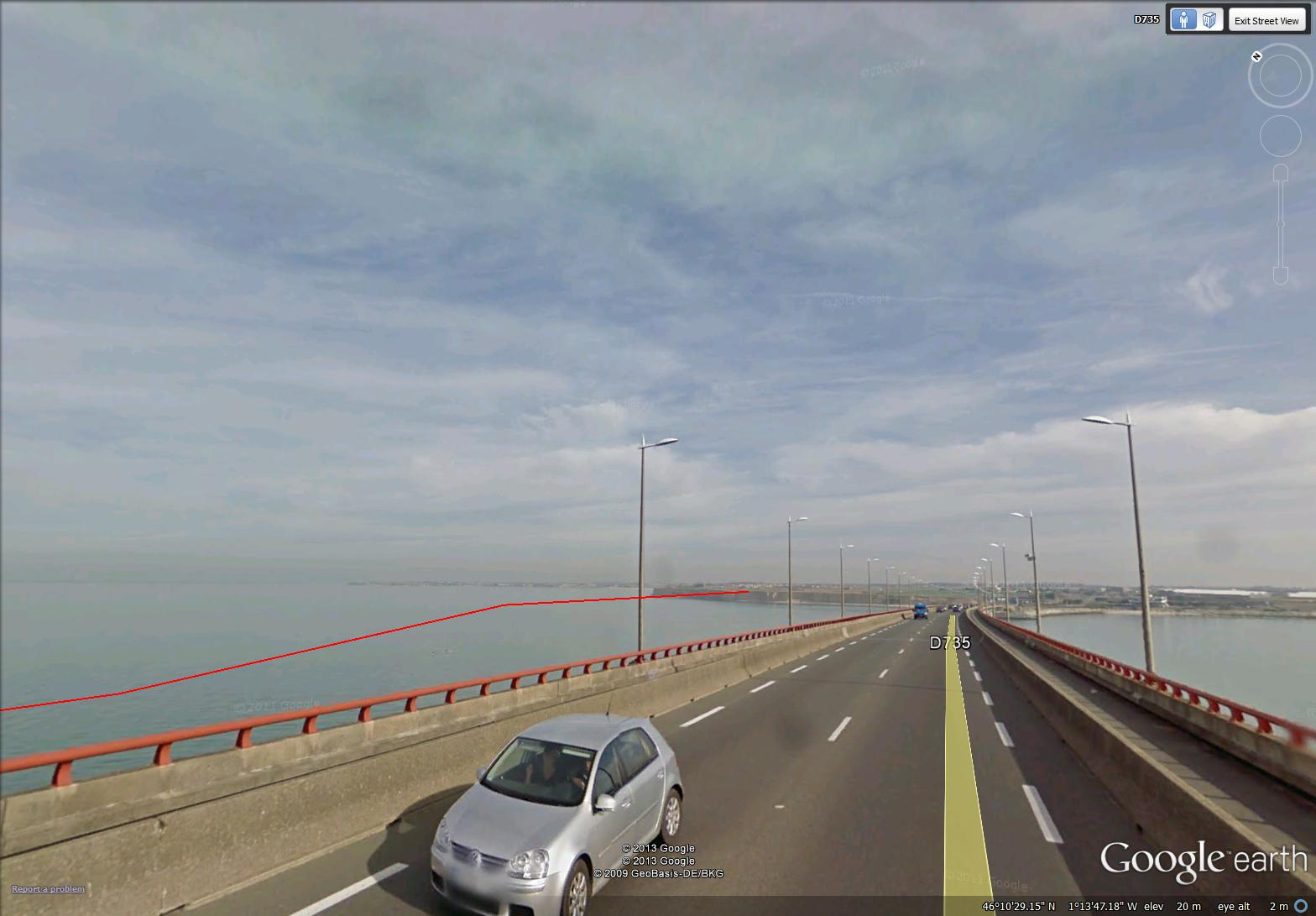
looking back at the coast of continental France (image from Street View)
~
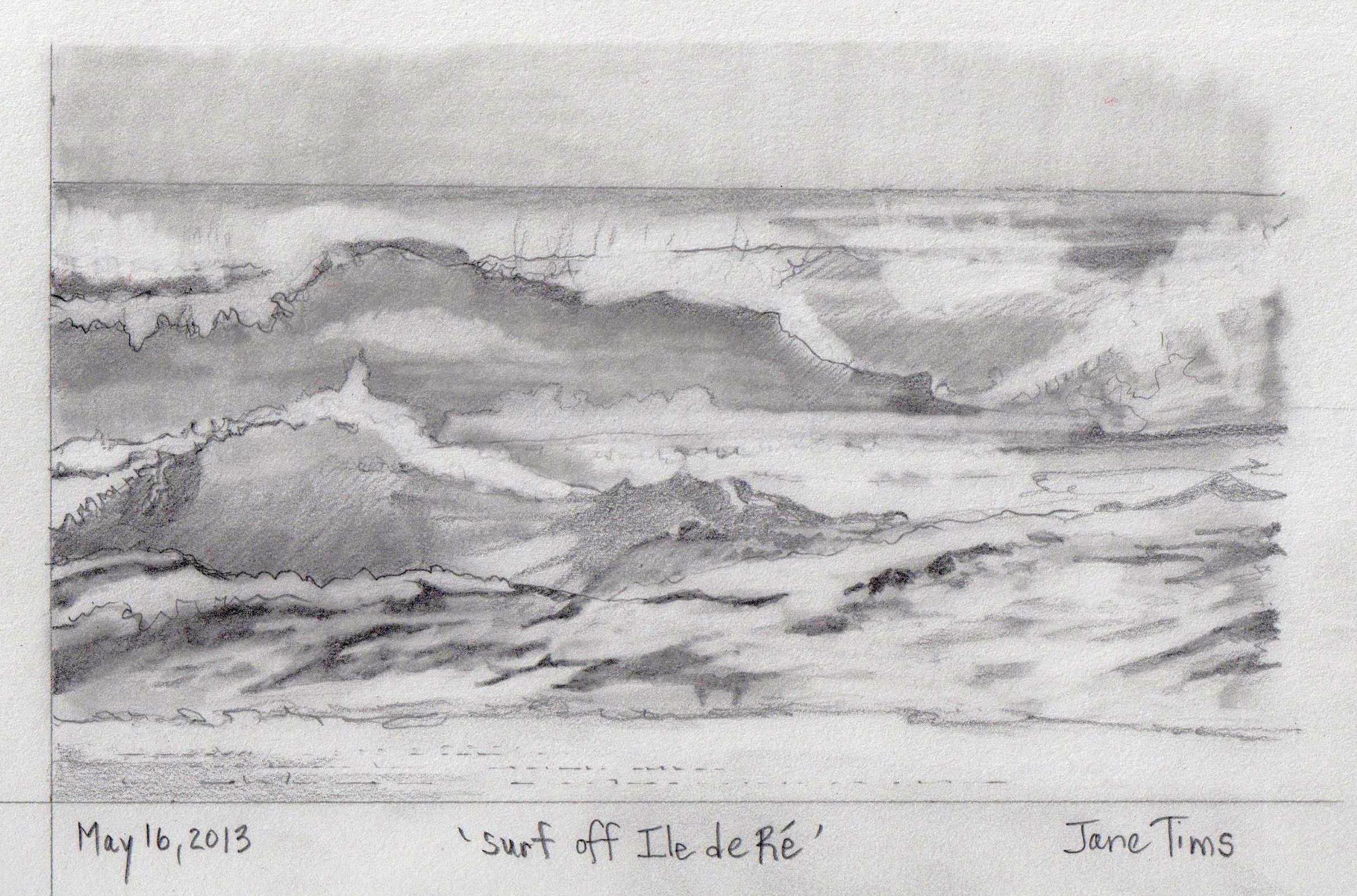
Best View: beaches of Ile de Ré …
~
~
Copyright Jane Tims 2013
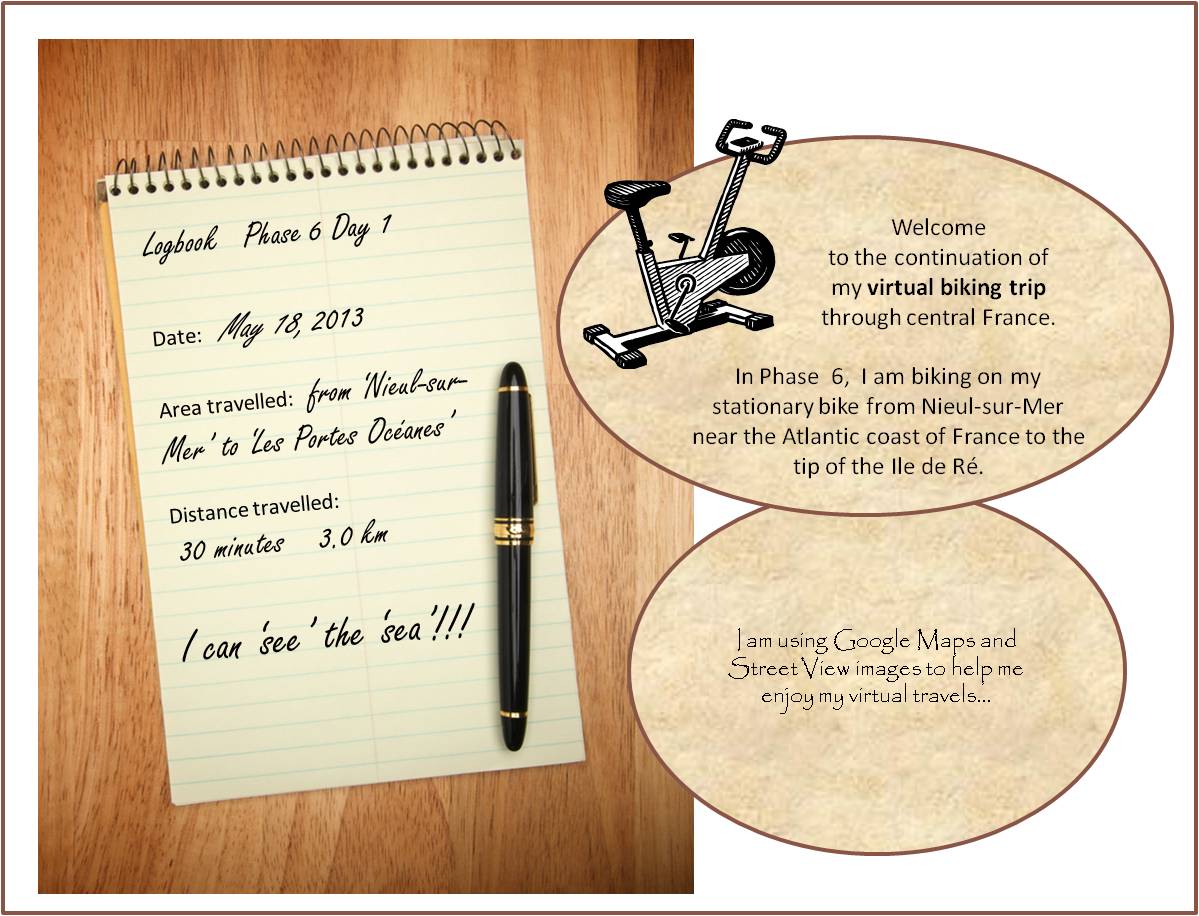
on the way to Ile de Ré 6-1
~
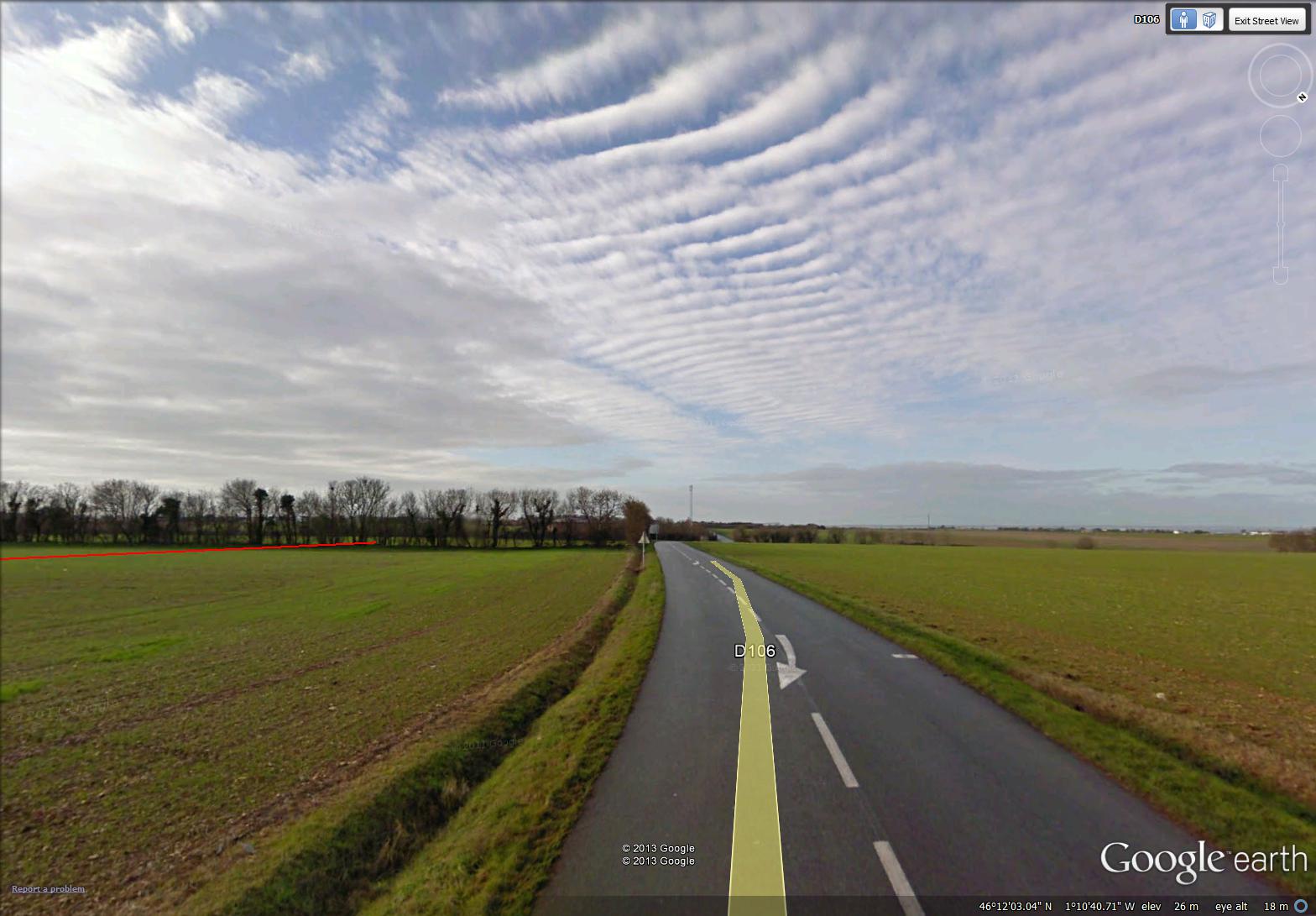
biking towards the coast (image from Street View)
~
~

map showing distance travelled (map from Google Maps)
~
On my first day of Phase 6 of my virtual bike trip across central France, I was preoccupied with seeing the ocean (Bay of Biscay) and the coastline of France.
I stopped for a cup of tea at a small roadside bistro …
~

a small bistro in L’Houmeau (image from Street View)
~
I started to think about the vistas I have seen in France – both the old and the new …
~

Bricomarche – a chain store selling building and decorating supplies – similar to Home Depot in Canada (image from Street View)
~
I have seen the new (big grocery stores and building supply stores) as well as the old (stone houses and shops) …
~

street in L’Houmeau (image from Street View)
~
On some corners, I see a mix of the new and the soon to be obsolete. This scene from France reminds me – in Canada, in the last ten years, we have also seen the introduction of recycling facilities in every public parking lot, and the loss of telephone booths from almost every outside public location …

recycling bins and telephone booths in L’Houmeau (image from Street View)
~
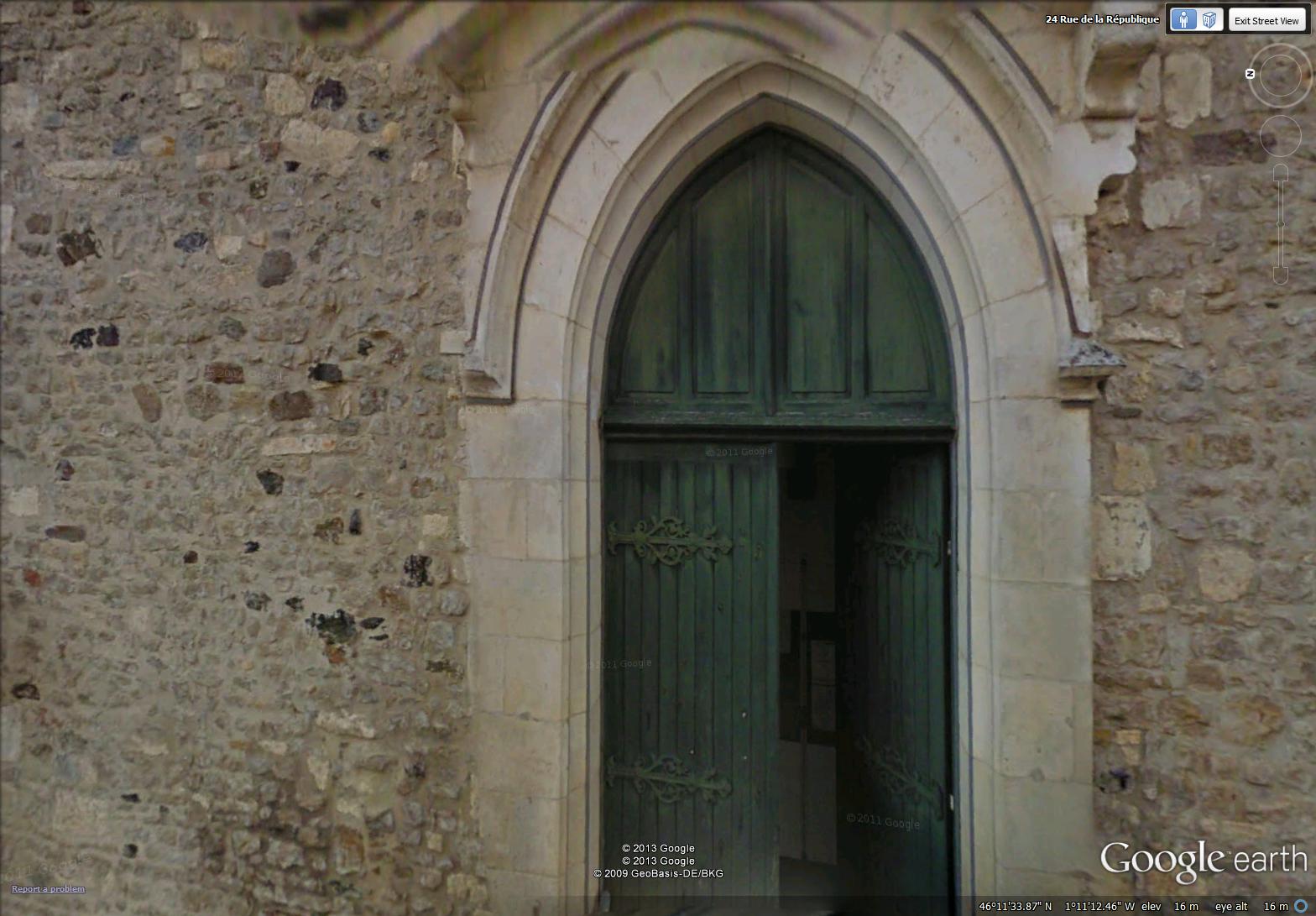
Of all the old things I saw today, I loved this old green door with its elaborate hinges, the door to a church in L’Houmeau …
~
~
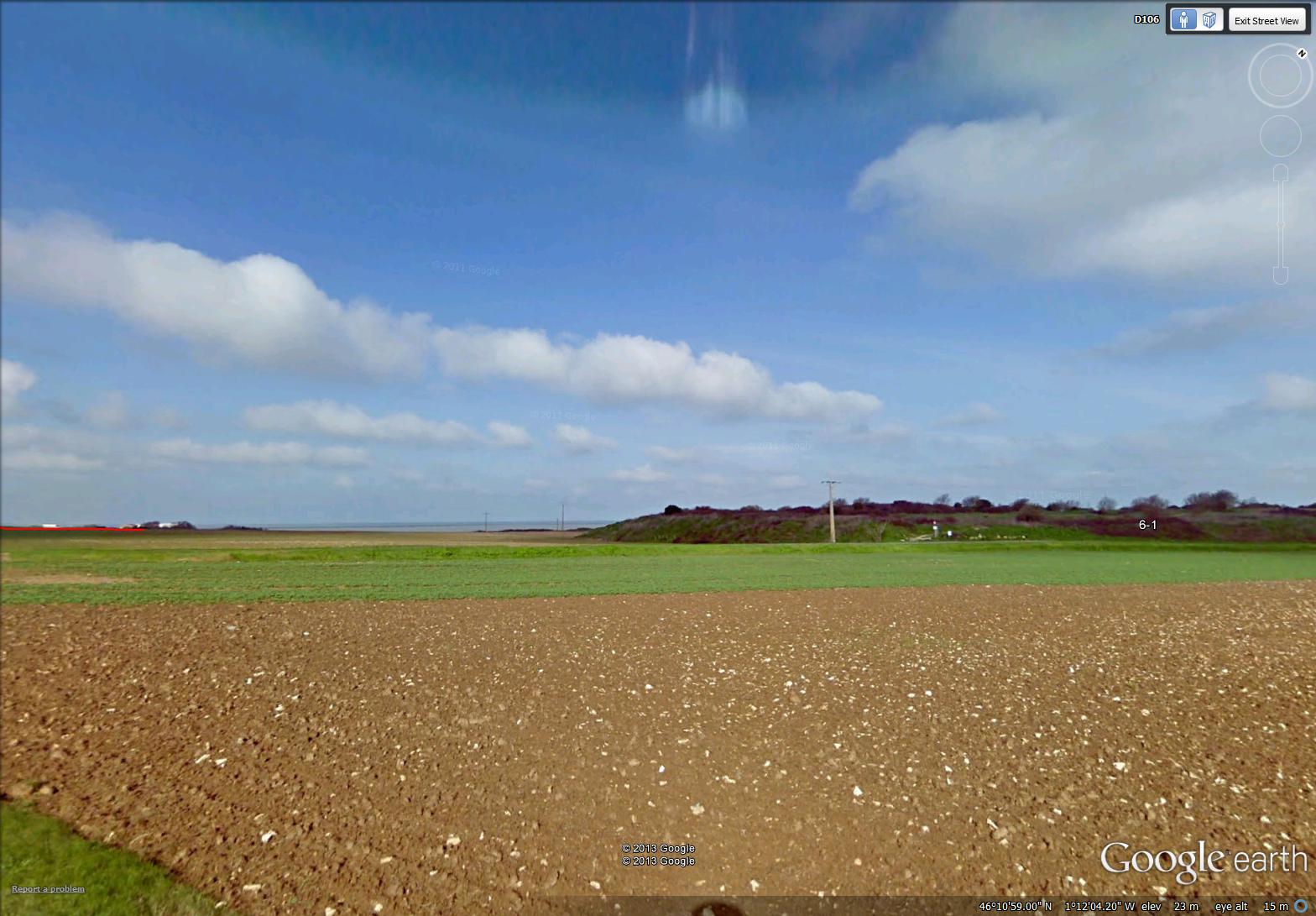
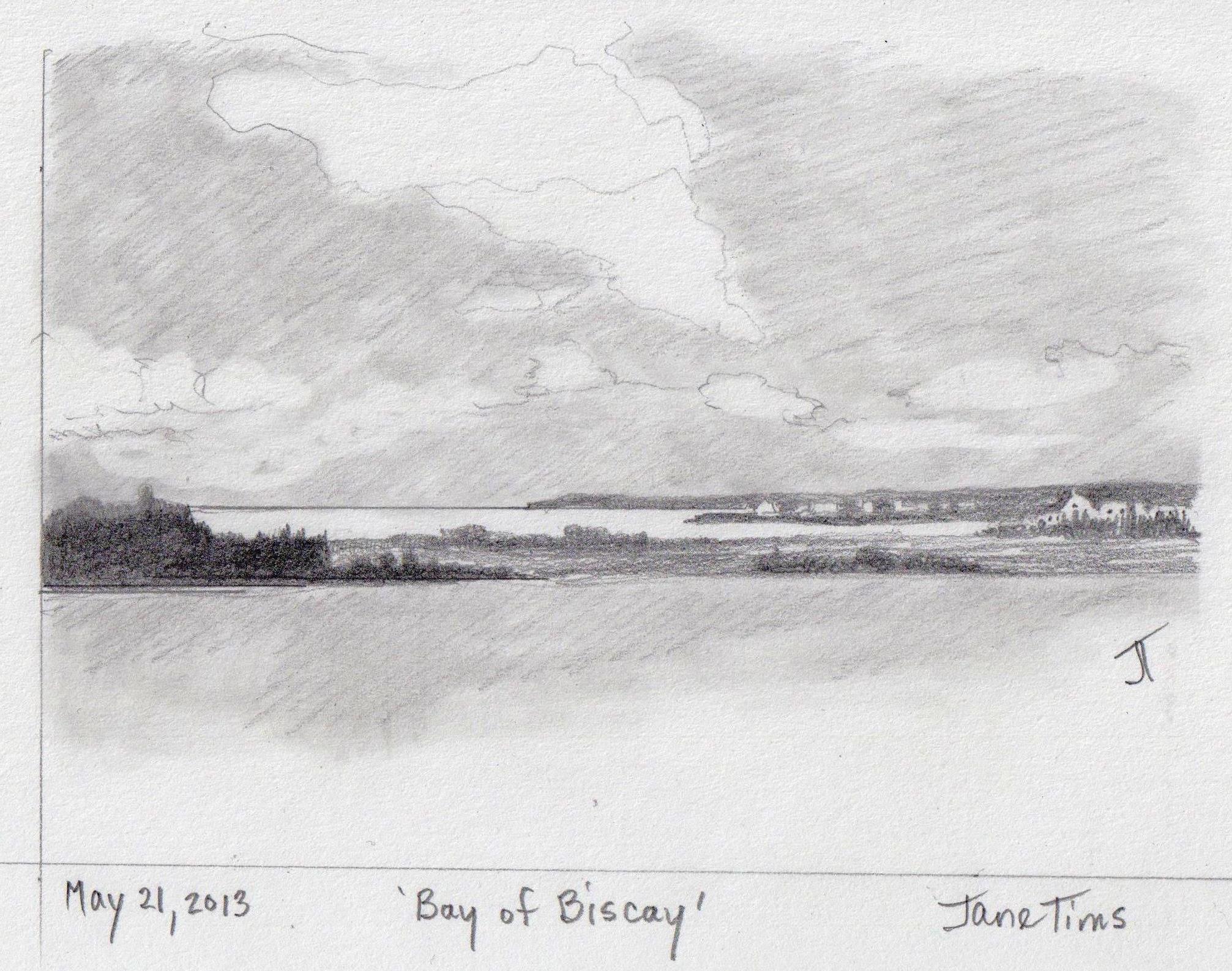
At last, I saw the ocean, a strip of blue on the horizon just outside Les Portes Océanes …
~
~
Best View: my first glimpse of the coastline and the Bay of Biscay …
~
~
Copyright Jane Tims 2013
asking for directions 5-12
~
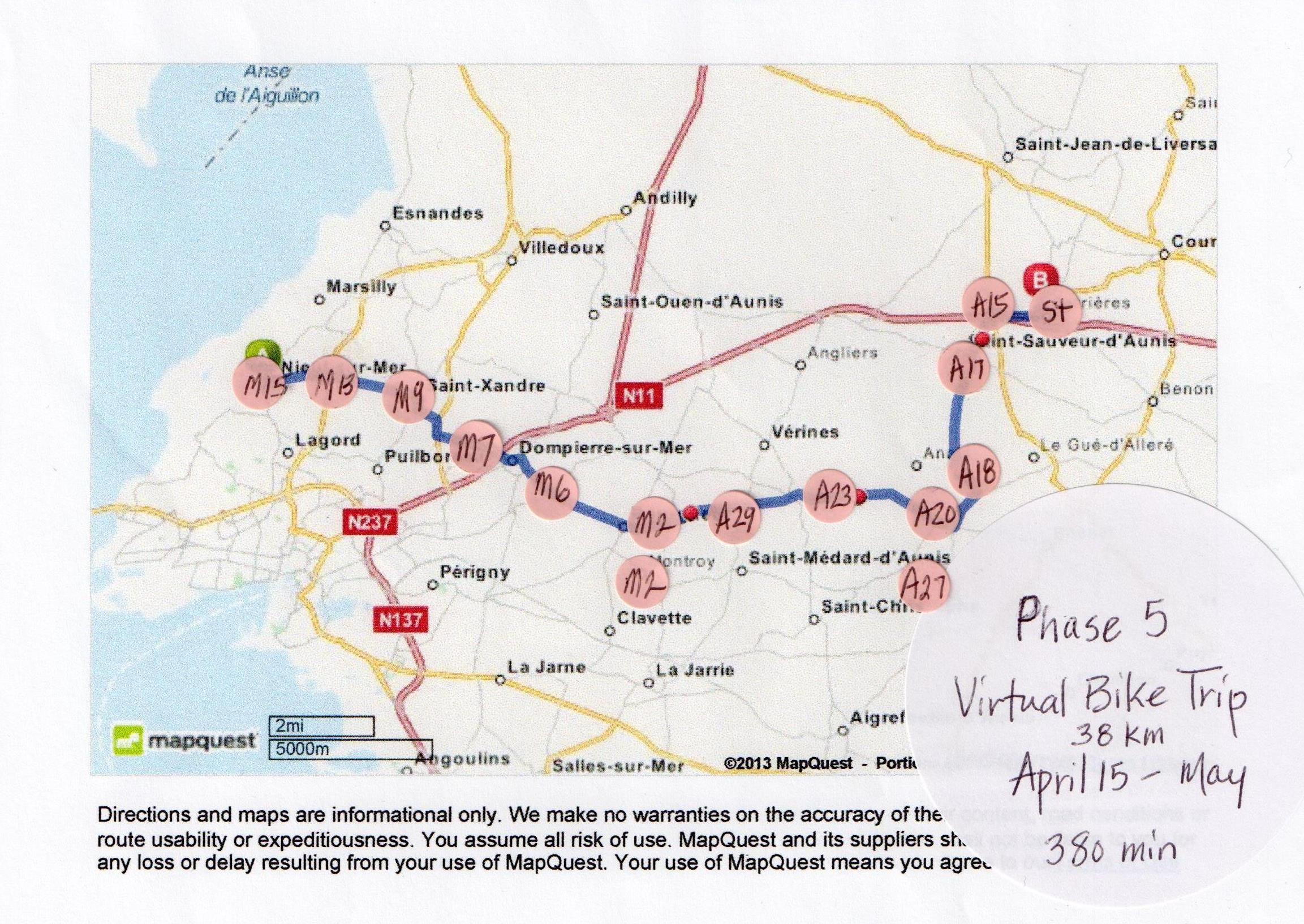
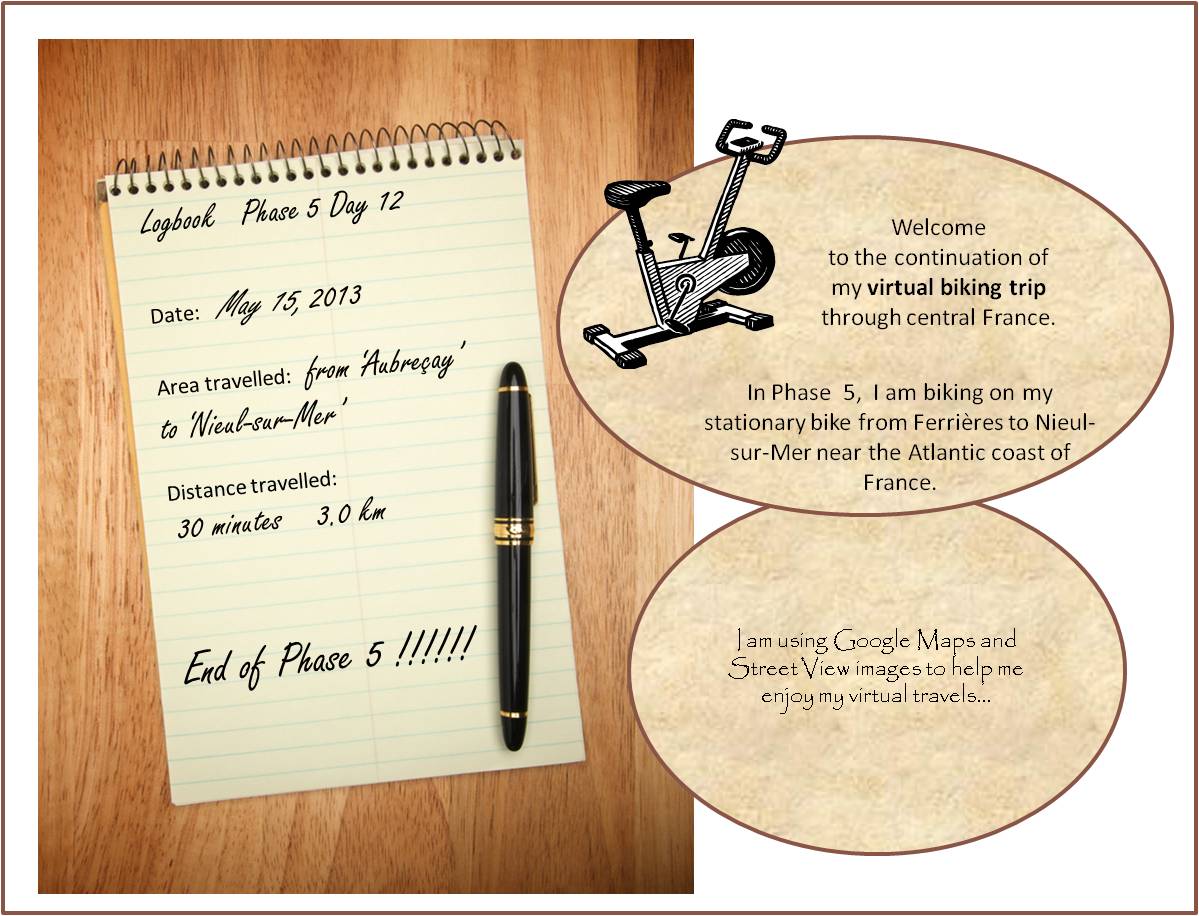
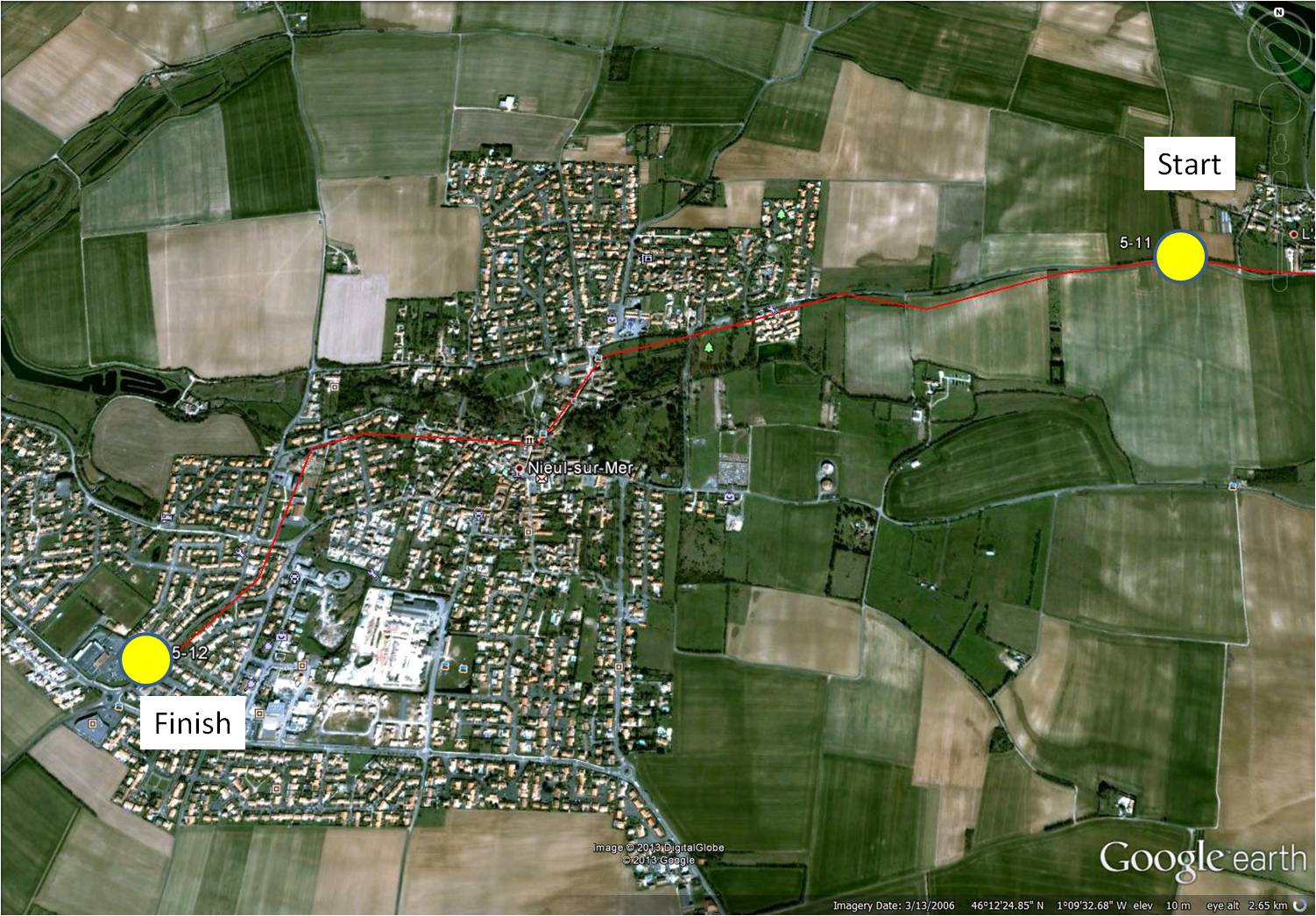
On May 15, I completed Phase 5 of my virtual bike trip through central France!
~
~
As a life-long avoider of exercise, it is hard for me to believe I have kept this up for almost 4 months. I have cycled a total of 155 km on my stationary bike. And, although I have never been to France, I feel like I have explored the landscape of part of central France.
~

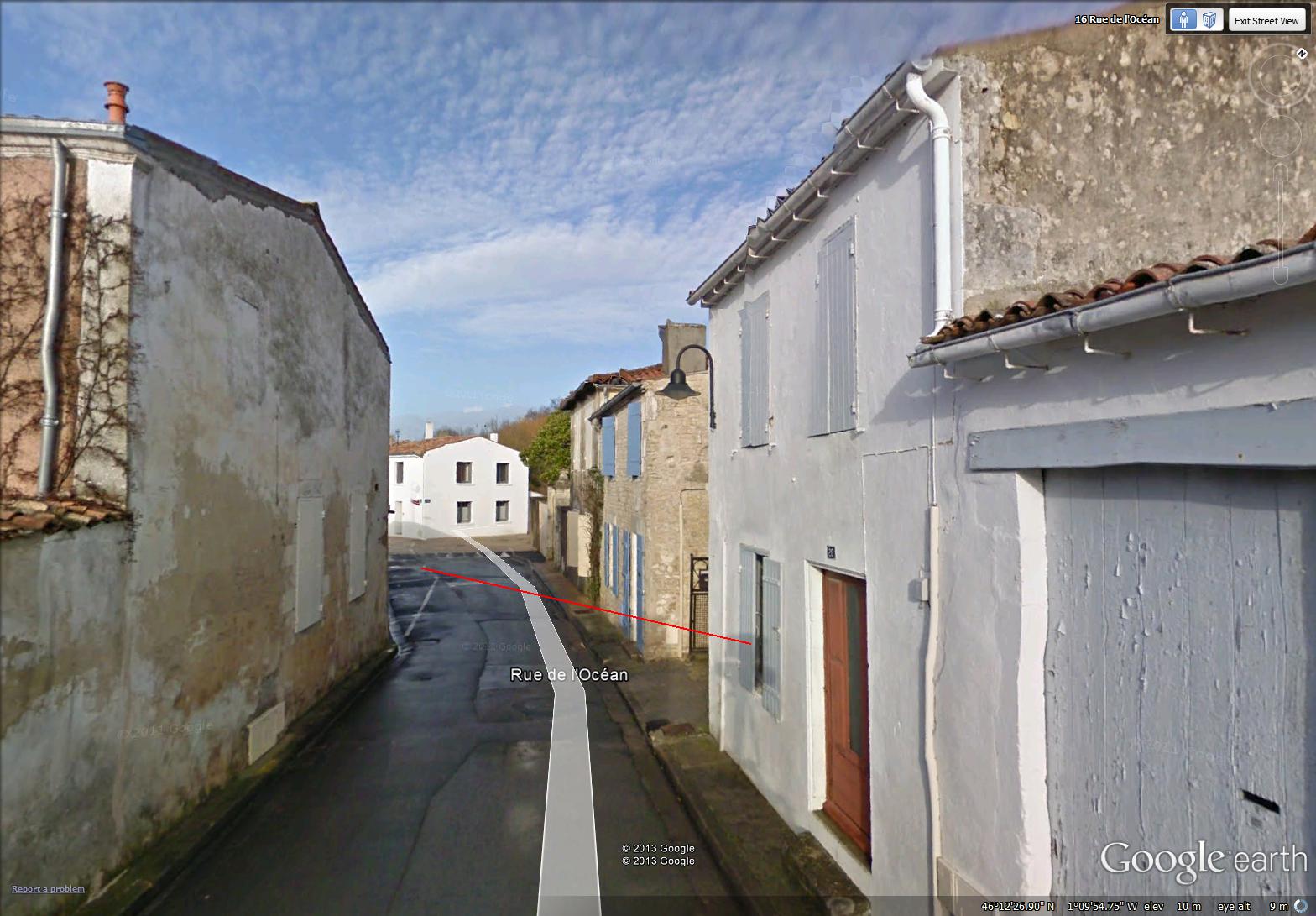
Rue de l’Ocean (image from Street View)
~
~
~
Believe it or not, this was the first time I actually got lost on my virtual bike trip. The Rue de l’Océan in Nieul-sur-Mer is narrow and seems to go forever, taking twists and turns. It is easy to take the wrong turn when you are moving along in Street View …
~
~
Part of my difficulty – I asked these chickens for directions. They did their best, clucking at me. I don’t speak chicken, so I must have misunderstood, and zigged when I should have zagged …
~

~
I also asked a fellow cyclist for directions, but he was late for his work (he carried his work tools behind him in a little cart), and in a bit of a hurry. Although he tried to point me in the right direction, I didn’t really understand his local accent …
~

~
In the end, I found my way by following the direction of the clouds in the mackerel sky …
~
 ~
~
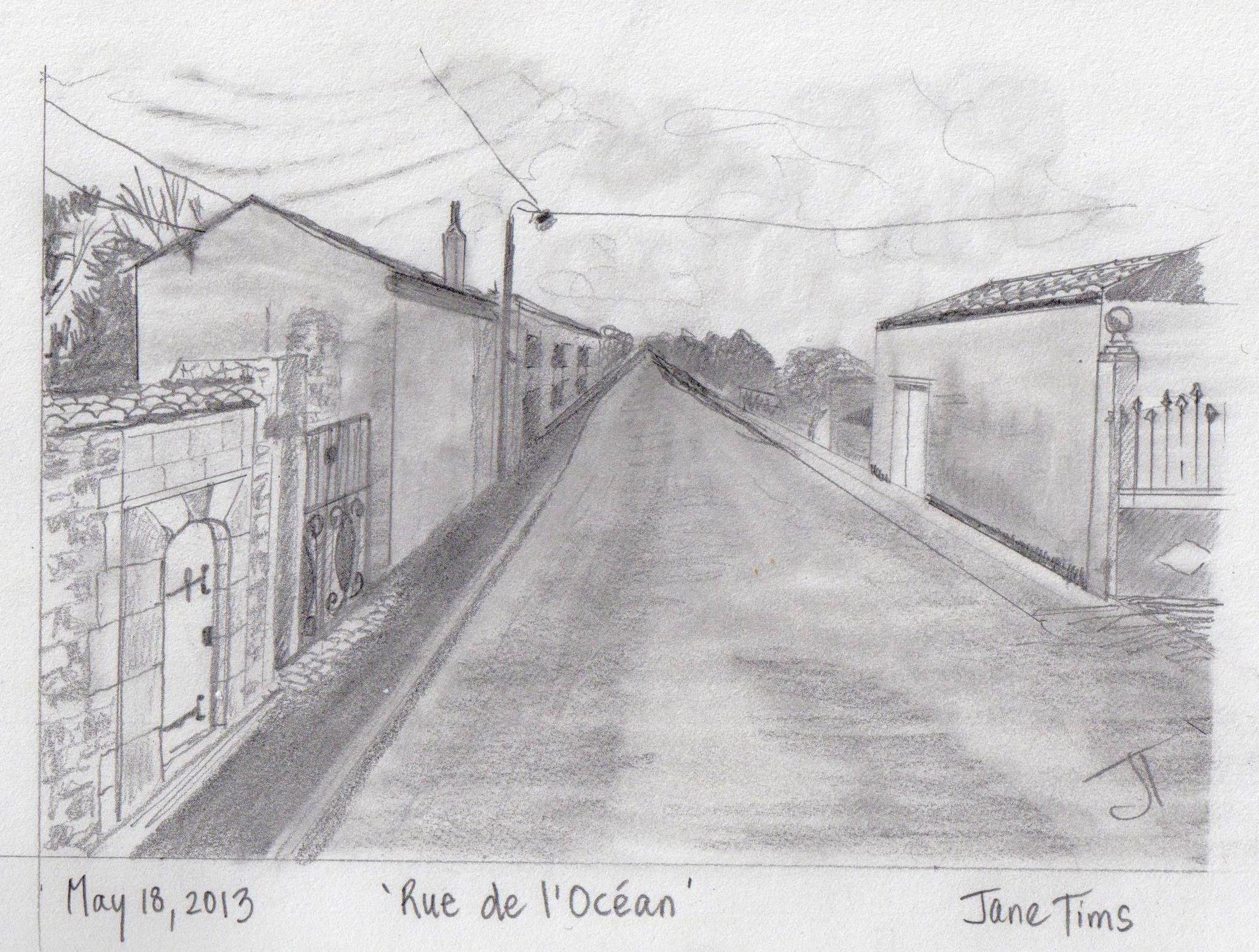
Best View: Rue de l’Océan …
~
~
This completes Phase 5 of my journey. In Phase 6, I will reach the Atlantic Ocean (Bay of Biscay) and travel across a huge bridge to the island of Ré. If you love the ocean as much as I do, stay with me and follow along on your own virtual bike!!!!
~

~
Copyright Jane Tims 2013
gates 5-11
~
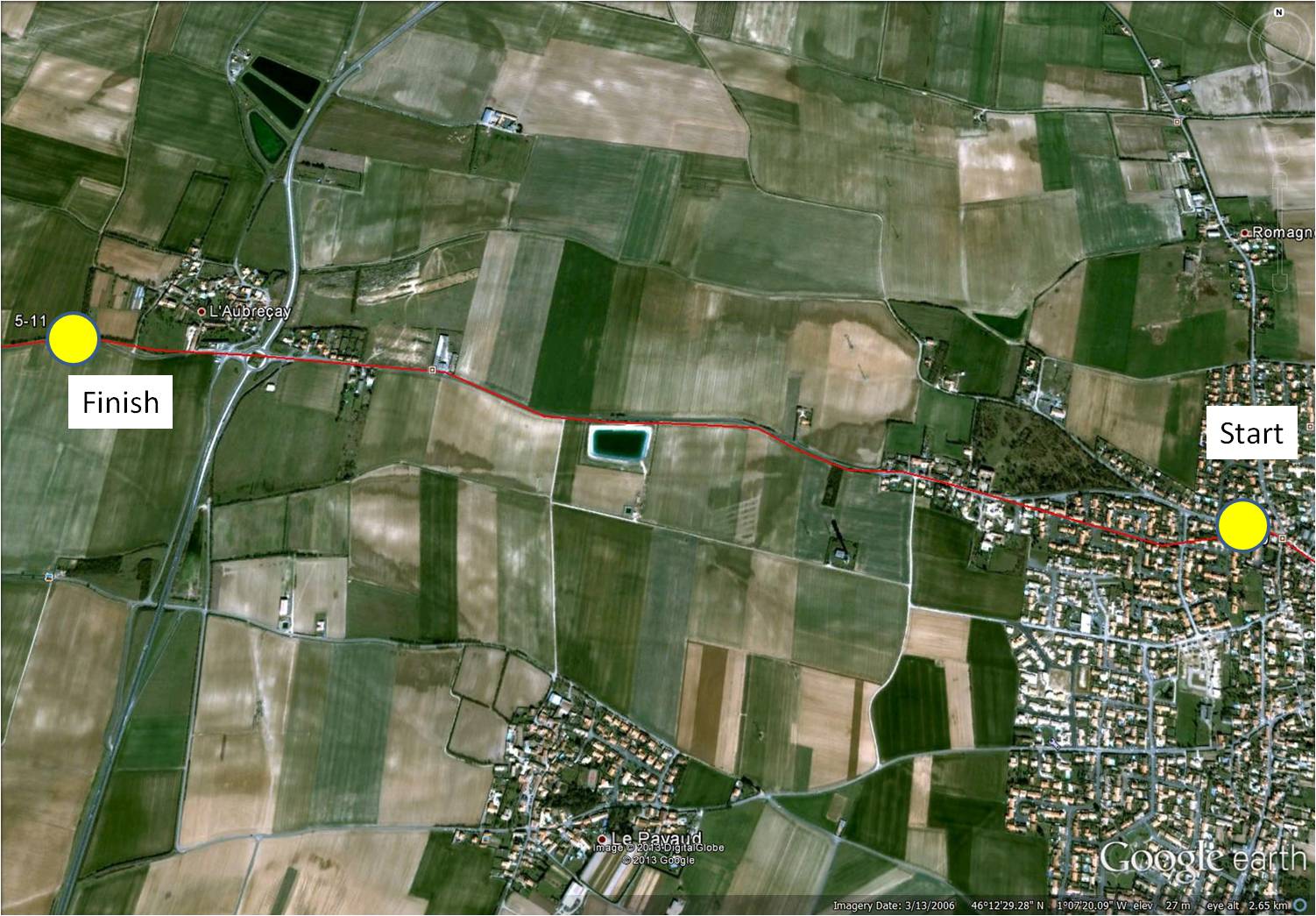
On my virtual bike journey of May 13, with only one more day to go before I complete Phase 5, I seemed to notice the ‘gates’ more than any other landscape feature. Sometimes, as in Saint-Xandré, three gates occur in a very short distance …
~

three gates in Saint-Xandre (image from Street View)
~

~
~
Some gates seem so mysterious. This gate, also in Saint-Xandré, must lead to the narrow end of a property …
~
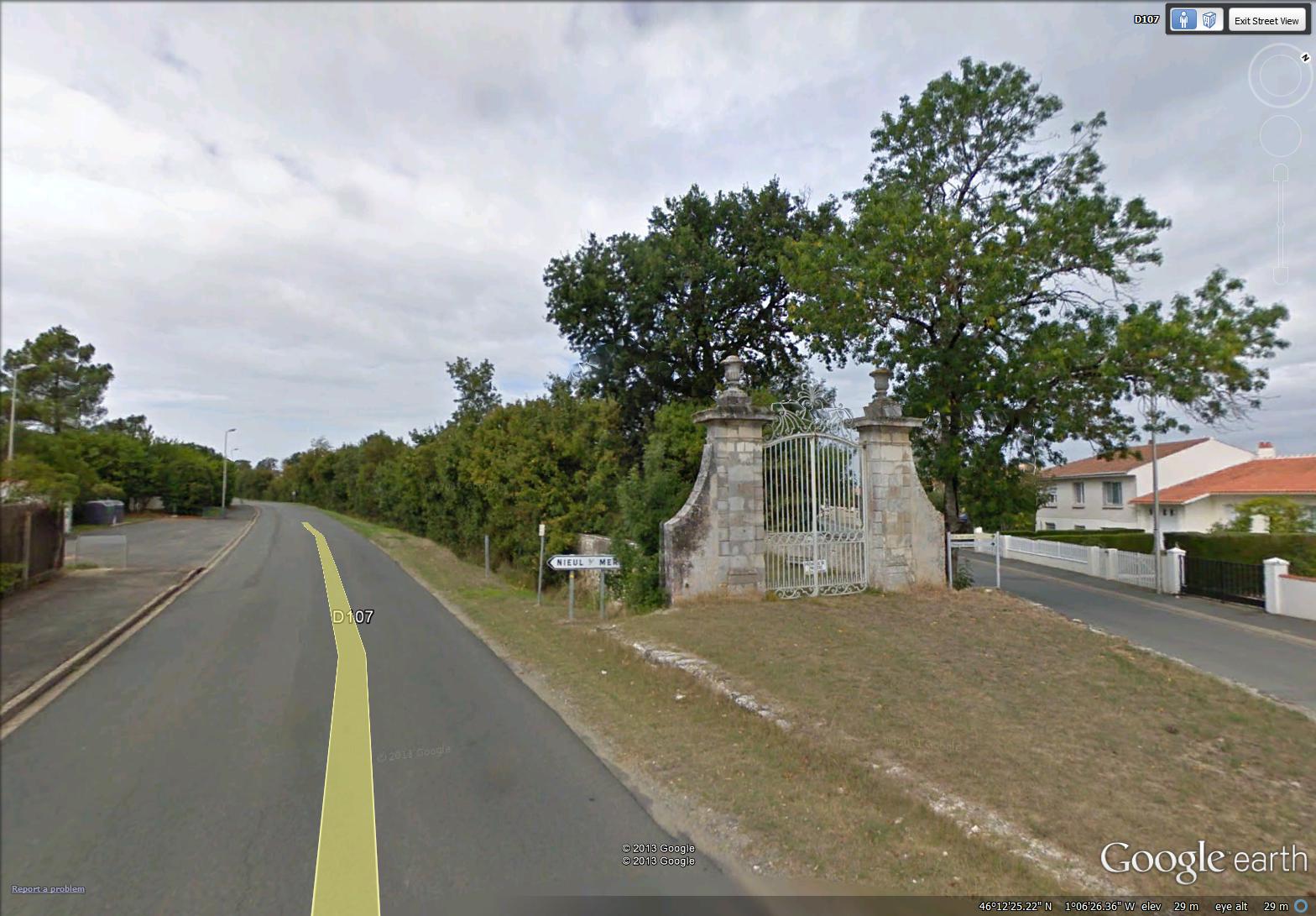
gate on the narrow edge of a property (image from Street View)
~
A quick look at the map shows how the gate leads to a substantial park-like area …
~
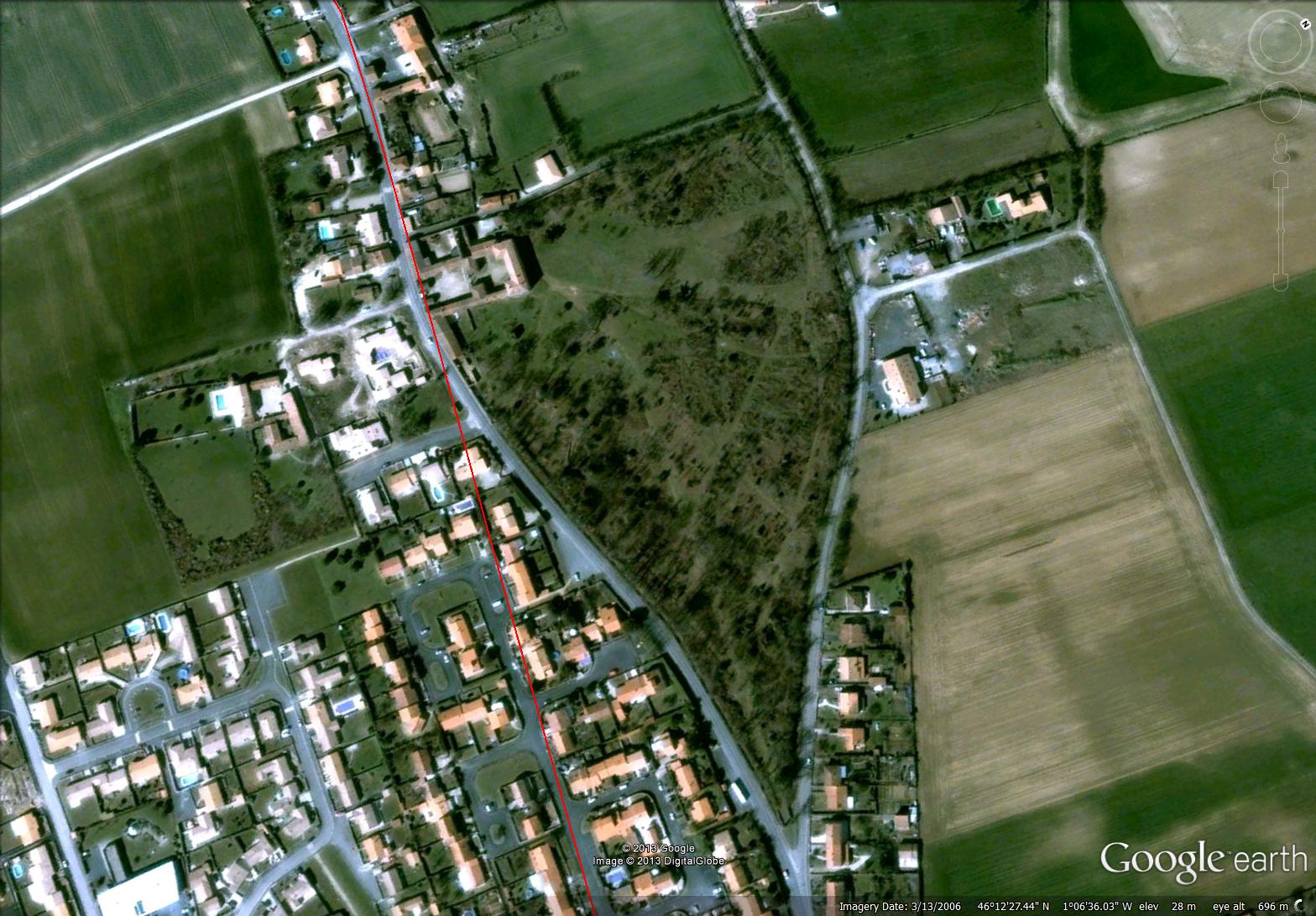
map of park-like area beyond gate – the gate is at the very tip of the property, toward the lower part of the photo (map from Google Maps)
~
Some gates are very elegant and lead to beautiful homes with large courtyards …
~

elegant gate (image from Street View)
~
This gate was also quite grand and was paired with a charming gate for people …
~

gates for cars and humans (image from Street View)
~
My favorite gate was in a wall along a country road. There is no evidence this gate is used. The map shows there is no road, not even a cart track beyond the gate …
~
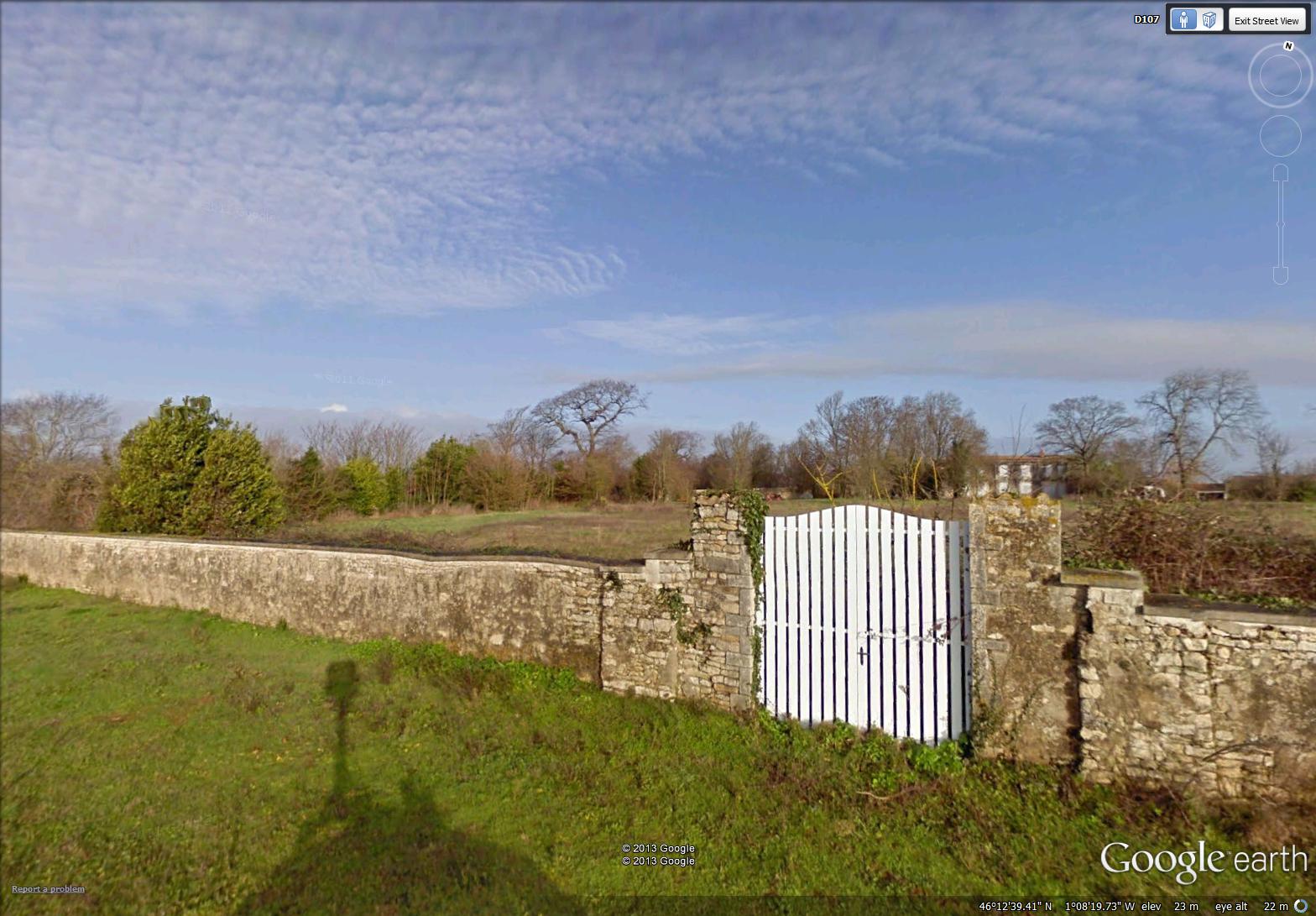
unused gate (image from Street View)
~
Best View: memory of a gate in Lusignan, at the very start of my virtual bike journey, back in January …
~

~
Copyright Jane Tims 2013




 nichepoetryandprose