Growing and gathering – Spring salad
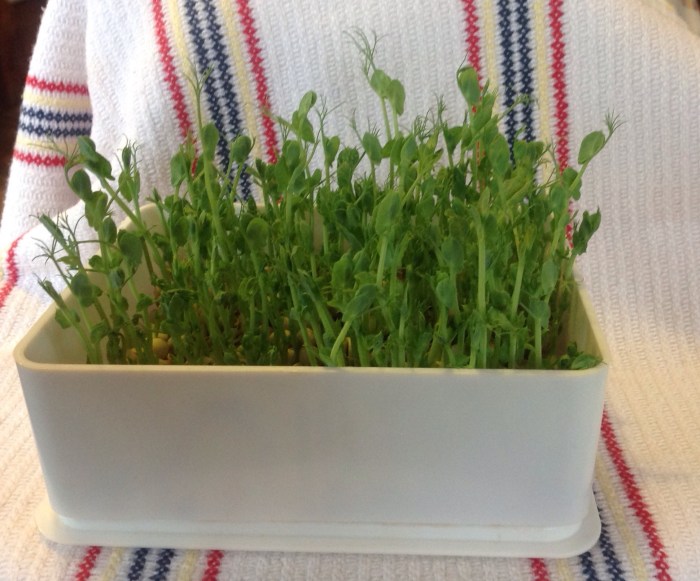
I make a new batch of sprouts weekly. This week’s crop was something I haven’t tried to grow before … pea shoots. I sprouted the peas in my 8 X 10 Sproutmaster from Sprout People.
https://sproutpeople.org/sproutmaster-8×10-tray-sprouter/
~
Pea shoots sprout sooner if they are soaked in water first. I let mine sprout with just the rinse water.
~
For me, a twice daily water rinse and careful draining is key to growing the best sprouts. I know pea shoots can grow quite tall with a vermiculite base and some propping at the sides but I was content to just let them peak above the sides of my sprouter.
~
~
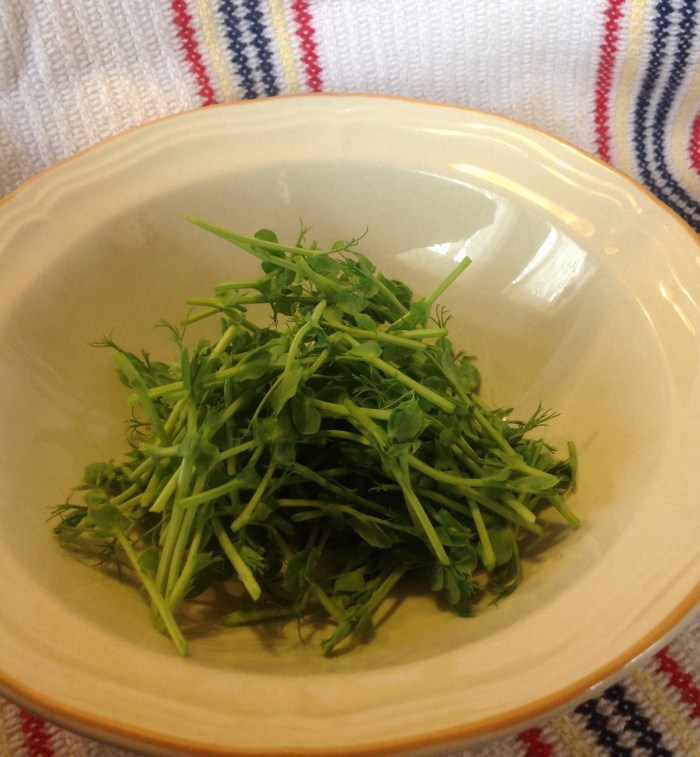
To prepare the pea shoots, I washed them well and harvested them with scissors.
~
~
Then I added a chopped onion, chopped celery, chives from the garden and a sprig of mint. Just plain mayonnaise for a dressing. Yum!
~

~
My husband shook his head and said (as a joke) I would have to survive the Apocalypse all by myself.
~
Copyright 2016 Jane Tims
songs in the grey woods – northern parula
A friend, a knowledgeable wetland biologist, has been helping me learn some new bird songs. Last week, I identified the song of the Northern Parula. This is a bird I have never seen, though I scan those tree tops with the binoculars until my arms ache. I have heard its song so many times and always wondered what it was. The song is a long whirrrrr, flowed by a short, upward flip. Whirrrr -flip. Whirrrr- flip. This morning it was the first song of the morning bird chorus!
~
~
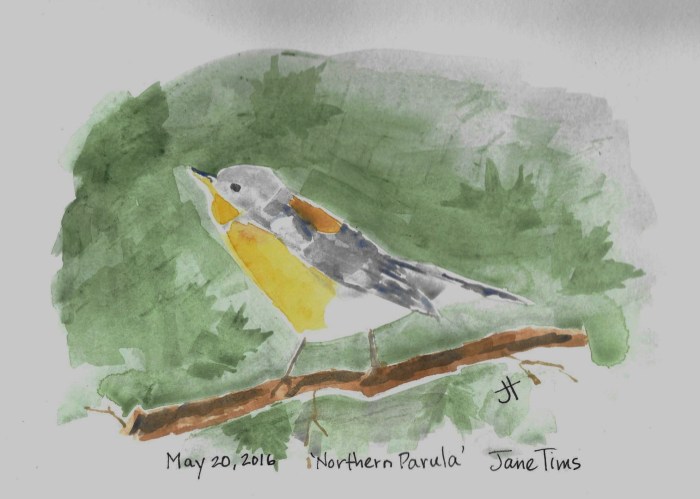
It drives me crazy to hear him sing, be able to find the tree he is perched in, but not see him. My painting is how I think he must look, based on descriptions on the net.
The Parula is a blue-grey bird with a yellow throat, and a yellow and white breast. He has a white crescent above and below his eye and two white wing bars. A bright and beautiful bird! He has an association with a lichen I love, Usnea subfloridana, Old Man’s Beard. He uses the lichen to build his hanging nest.
~

Usnea subfloridana on the snow – usually found hanging in our maple, spruce and fir trees
~
Copyright 2016 Jane Tims
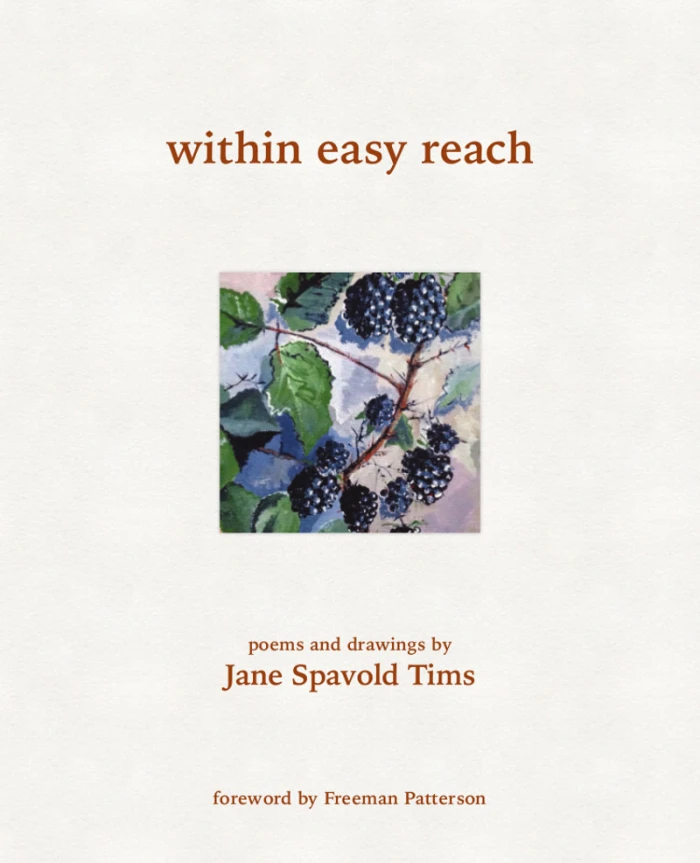
update: my book ‘within easy reach’
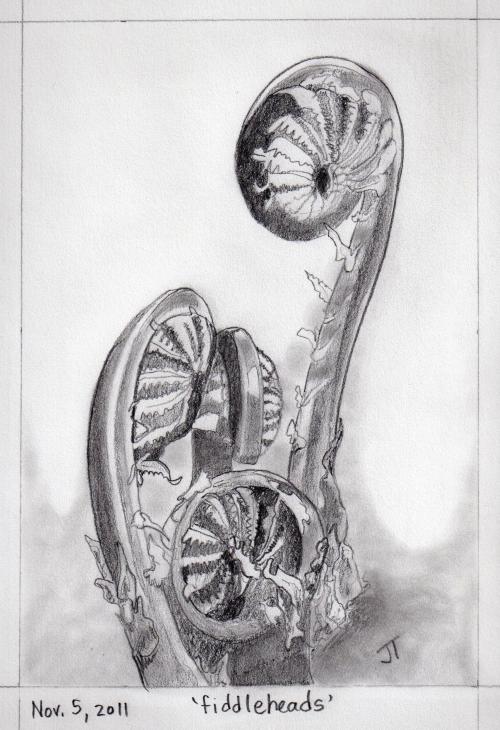
Now that my book is available, I am lined up for some readings. It’s the perfect time of year since people in New Brunswick are turning their attention to gathering fiddleheads, to gardening and to their preparations for strawberry season.
~
My book is available through my publisher Chapel Street Editions (www.chapelstreeteditions.com), at Westminster Books in Fredericton and at my readings.
Location, date and time of the readings:
- Miramichi, Rodd Miramichi Hotel, Writer’s Federation of New Brunswick, WordSpring, book sale and readings May 27, 2016 (Friday) at 7:30.
- Woodstock, L.P. Fisher Library, June 2, 2016 (Thursday) at 6:30.
- Fredericton, Westminster Books, book launch with fellow poet Edith Miller, June 9, 2016 (Thursday) at 7:00.
- Fredericton, York Regional Library, reading, last week in June, to be announced.
~
Remember, if you would like to be included in a draw for the painting on the cover of my book, you have until June 7, 2016 to enter.
To get your name in the draw, you have to do three things:
- Purchase my book through my publisher’s website (www.chapelstreeteditions.com)
- Leave a comment on any of my Blogs (www.nichepoetryandprose.wordpress.com or www.janetims.com or www.janetimsdotcom.wordpress.com) with the words ‘within easy reach’ somewhere in the comment
- Be ready to send me, via email, a scan of your purchase receipt.
~
The cover painting ‘brambles’ is done in acrylics, size 10″ by 10″, with gallery edges.
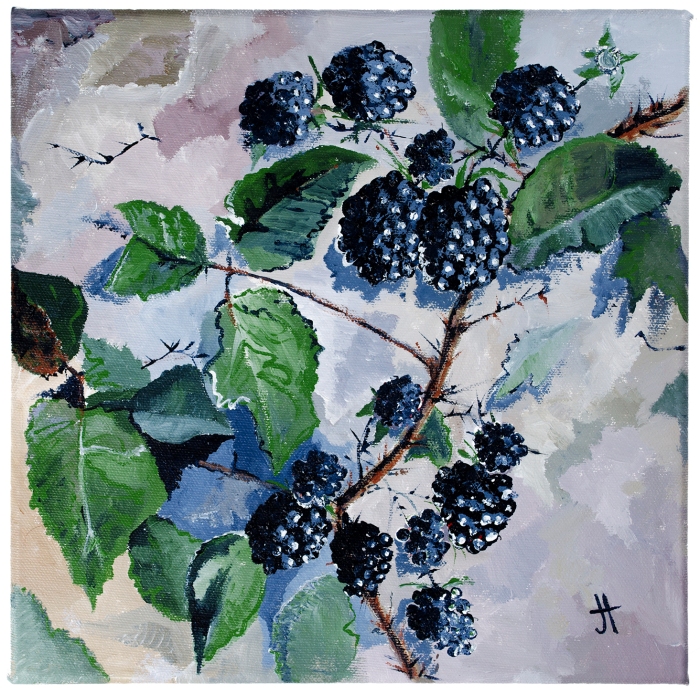
February 29, 2016 ‘brambles’ Jane Tims
~
I hope you will love my book, as much as I loved creating the poems and drawings!
~
Copyright 2016 Jane Tims
early schooling – finding the one room schools
I am continuing to find interesting information in the Annual Report of the Schools of New Brunswick 1888 (Fredericton, 1889). This report includes information on the number of one room school houses in the late 1800s. Although the numbers are for all schools, you can see, by comparing the numbers of teachers to the numbers of schools, most schools had only one room.
~
Statistics on Schools in Four Counties of New Brunswick as of December 31, 1887
| County | Number of Schools | Number of Teachers | Number of Students | Number of Boys | Number of Girls |
| York | 167 | 178 | 5558 | 2811 | 2746 |
| Sunbury | 46 | 48 | 1050 | 553 | 497 |
| Queens | 85 | 87 | 2196 | 1088 | 1108 |
| Kings | 155 | 161 | 4552 | 2303 | 2249 |
| All Counties | 1542 | 1613 | 55492 | 27888 | 27604 |
~
One of the things I want to do in my new project is visit a number of the schools still standing in four counties in the lower Saint John River watershed (Kings, Queens, Sunbury and York Counties). I’ll also visit some locations where schools once stood but are now gone.
~
Finding these schools by driving the roads is a rather inefficient approach. So how do I find the whereabouts of over 400 one room schools? To start, the location of every school in Kings County in 1862 is known from the Walling Map. For more information on this map, see http://www.rubycusack.com/issue34.html
~
I have also found a valuable resource in a book I found for sale at Amazon.com : Diana Moore and Andrea Schwenke. New Brunswick Schools: A Guide to Archival Sources. Acadiensis Press: Fredericton, 1992. The Guide provides information on where to find various sources for early schooling in New Brunswick. I will be consulting some of these:
- a scrapbook by Marion Johnston Dunphy who photographed 150 schools from 1974 to 1984 (The One Room Schools of New Brunswick and What Became of Them).
- a list of one room schools in Kings County in 1983 prepared by The Kings County Retired Teachers Association
- old school records in the Provincial Archives and the Archives of the Saint John Museum
- diaries of people who taught school, for example C. Gordon Lawrence (Tracy School, Sunbury County, 1903 – 1962)
- various exercise books, workbooks and school registers from the 1800s
~
~
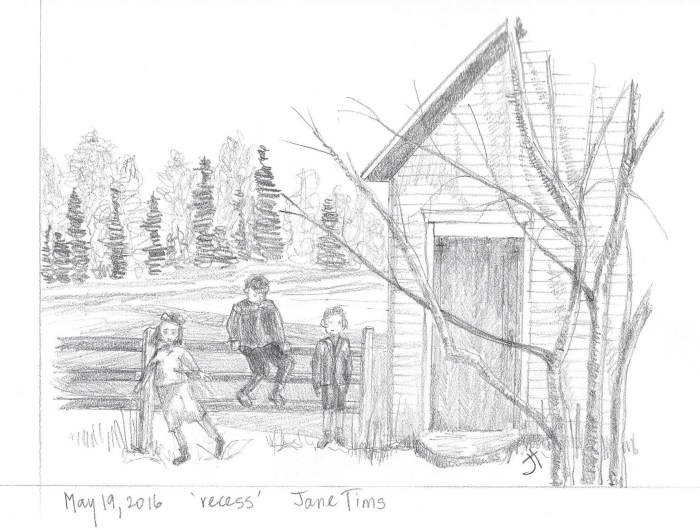
The first of many drawings about days at the one room school. I think I should take a course on drawing people. They look a little bored.
~
Copyright Jane Tims 2016
‘within easy reach’ … a poetry book about wild edibles and local foods
all about my new book:
within easy reach by Jane Spavold Tims
(with a foreword by Freeman Patterson)
Chapel Street Editions, Woodstock
May 2016
~

~
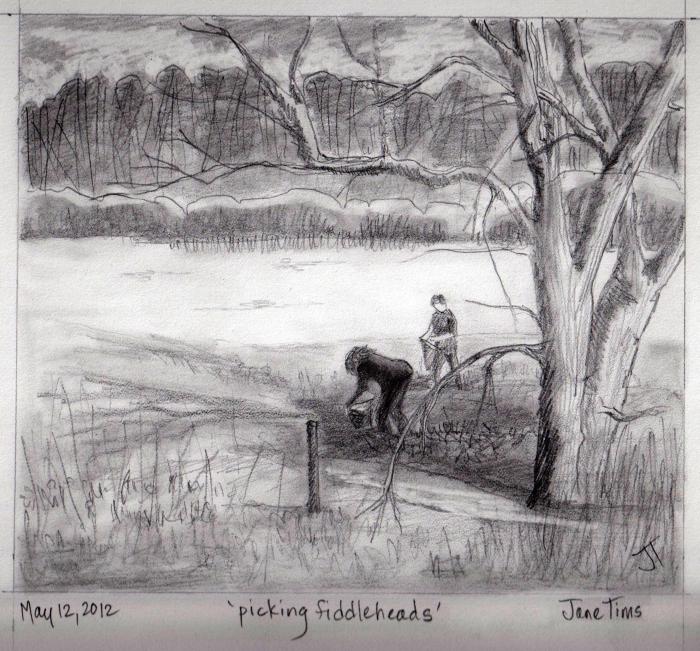
includes poems and pencil drawings about
eating local foods and gathering wild edible plants
~
~
poetry about picking berries, gathering herbs and roots, gardening, fishing
local markets, beekeeping and salad greens
explores how easy it is to bring local foods into your diet
and
considers the barriers to eating local and gathering wild foods
explores abandoned gardens
poisonous berries and berries in bottles
includes poems about our history of eating wild foods
and about New Brunswick’s special local foods:
maple syrup and fiddleheads
coastal plants like goosetongue greens and samphire
land-locked salmon
notes on each plant – characteristics and uses
seventeen pencil drawings
~
~
this book will remind you of your own experiences picking berries
a tribute to every age of our lives – dancing in the school gym and picking berries with arthritic hands
it will recall the habits of your ancestors
a beautiful book – rests open in your hands as you read
a font so easy on the eyes
I hope you will love within easy reach
~
Jane Tims
2016
~
songs in the grey woods – ovenbird
He can be a bit monotonous. A bit of a scold. He reminds me of a rusty hinge. He says teacher-teacher-teacher, repeating his song through the woodland. He is the Ovenbird.
~
His scientific name is Seiurus aurocapilla. Seiurus (which I remember as ‘serious’) is from the Greek meaning ‘tail shake’, a reference to the characteristic upward flip of his tail. The name aurocapilla means golden-haired referring to his crest of orangy feathers. The Ovenbird is olive-brown, with a streaked white breast. He has a white ring around his eye, a white throat and a dark line below his cheek. He looks a bit like a thrush, but is a large warbler.
~
His serious nature and his call of ‘teacher, teacher, teacher’ make me think I’ll include a poem about his ways in my project about one room school houses in New Brunswick. This is how my poems usually begin, with a whisper from nature.
~

~
Copyright 2016 Jane Tims
songs in the grey woods – black-throated green
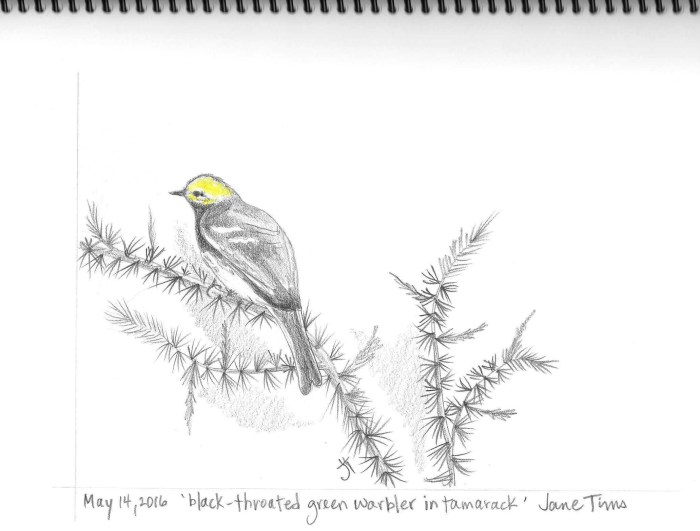
Our grey woods are noisy this week. White-throated sparrows, nuthatches, ovenbirds and chickadees. Loudest of all is a black-throated green warbler. He says, in his raspy voice, at intervals of about ten seconds: zee-zee-zee-zee- whee-zee, also a more musical dee-dee, dee-dee, doo-dee (the doo a note lower than the dee). He perches near the tops of the tamarack and red maple trees.
~
~
I sat on our deck a long while, and finally caught him as he paused in a red maple. He had a bright yellow head and looked back at me over his white wing stripe before he flew away. I also get an occasional glimpse of him as he flies from tree to tree. His best features are his yellow head, the two white stripes on each wing, and his black throat.
~

~
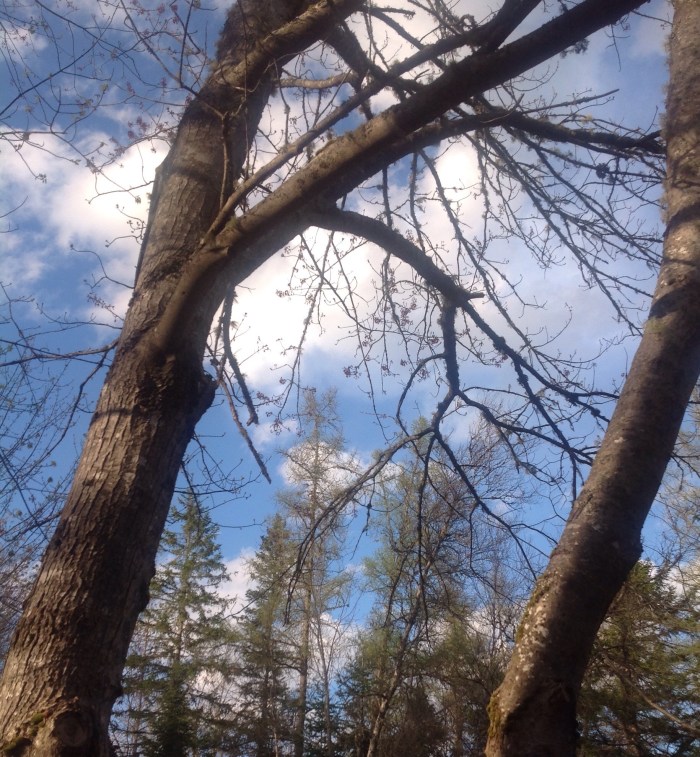
a view of the tamarack trees and spruce where the black-throated green warbler is singing – the red maple is just starting to leaf-out
~
Copyright Jane Tims 2016
Norman Families Living in Missouri in 1860
In my search for my Great-Grandfather Frank Norman, I became interested in where Norman families were living in Missouri in 1860. Frank was born around 1855, so it is likely his family was still in Missouri for the 1860 Census. Locating all the Normans in Missouri also helped me be certain I have not missed any possible Frank Normans in my search.
~
To do this, I searched the 1860 US Census for the name Norman and located each family on an 1856 map of Missouri. Each black dot represents one or more households living at that location in 1860. I have included the table of households at the end of this post, in case this information would help other Norman families in their genealogy searches. I have double-checked the information but please be aware, there may be households missing or incorrect. My next genealogy project is to map the Norman families in Missouri in 1870.
~

~
In 1860, there were 92 households in Missouri with people having the surname Norman. Some of these were families, some with more than one generation in the household, some with as many as eight children. Some were young men or women living or working as servants or laborers with other families. Some were young children, living with foster families.
~
Four of Norman families had sons named Francis. As I have explained in earlier posts, I have eliminated three of these as possible candidates for my Great-Grandfather. I think my ancestor was Francis M. Norman, son of Moses and Betsy Norman, living in Hooker, Laclede County.
~
Copyright 2016 Jane Tims
Norman Families in Missouri in 1860 in order of County (from US Census)
| Household Number (for my own reference) | Male (usually husband but also father or son) | Age | Female (usually wife but also mother or daughter) | Age | Number Other Normans in House-hold
(* son Francis) |
Township | County | Family name if living with another family |
| 14 | Jas | 37 | Margaret | 35 | 4 | Jefferson | Andrew | |
| 34 | Lewis | 47 | Martha | 26 | 4 | Liberty | Barry | |
| 35 | Joseph | 35 | Mahala | 33 | 7 | Liberty | Barry | |
| 47 | Joel | 39 | Mary Ann | 26 | 3 | Shoal Creek | Barry | |
| 73 | George | 68 | Rachel | 68 | Liberty | Barry | ||
| 24 | Mary | 31 | 3 | Cedar | Boone | |||
| 74 | Jas T. | 32 | Cedar | Boone | Senor | |||
| 65 | Charlotte | 60 | Center | Buchanan | Smith | |||
| 29 | William | 43 | Eliz | 27 | 4 | Williamsburg | Callaway | |
| 8 | Jas | 22 | Eliz N. | 24 | Wakenda | Carroll | ||
| 54 | C.P. | 26 | Josephine | 18 | 2 | Dolan | Cass | |
| 12 | Louisa | 15 | Jackson | Clark | McMillan | |||
| 31 | Charles | 9 | St. Francisville | Clark | Wayland | |||
| 75 | Jos | 23 | Moniteau | Cooper | Jones | |||
| 53 | Samuel | 34 | America | 38 | 4 | Benton | Dallas | |
| 25 | Joseph | 36 | Phoebe | 32 | 4 | Jefferson | Davies | |
| 66 | Elizabeth | 60 | Jefferson | Davies | Downs | |||
| 30 | William | 9 | Clay | Dunklin | Smith | |||
| 76 | John | 40 | Angeline | 20 | Union | Dunklin | ||
| 9 | James | 14 | 1* (F.) | Boone | Franklin | Brauley | ||
| 44 | William A. | 36 | Mary A. | 30 | 4* (Wm.F.) | Wilson | Greene | |
| 57 | James C. | 42 | Sarah | 30 | 2 | Pond Creek | Greene | |
| 77 | Robert P. | 25 | Mary L. | 19 | Wilson | Greene | ||
| 61 | Aaron (Vanarman) | 39 | Sarah | 34 | 4 | Center | Knox | |
| 38 | Moses | 65 | Lucinda | 35 | 8 | Hooker | Laclede | |
| 39 | Moses | 29 | Betsy | 30 | 2 * (Francis M.) | Hooker | Laclede | |
| 60 | William | 14 | Buck Prairie | Lawrence | Grammar | |||
| 78 | J.B. | 30 | Unknown | 25 | 1 | Twnshp 57 | Linn | |
| 18 | B.F. | 27 | Malinda | 24 | 4 | Chillicothe | Livingston | |
| 79 | Elias | 30 | Lefy | 20 | 1 | Chillicothe | Livingston | |
| 13 | B. | 46 | Caroline | 45 | 7 | Warren | Marion | |
| 80 | Giles | 27 | Ohio | Mississippi | Knowles | |||
| 20 | A.R. | 32 | C.A. | 29 | 2 | Twnshp 44 | Moniteau | |
| 21 | John | 34 | Rosanna | 29 | 5* (S.F.) | Twnshp 44 | Moniteau | |
| 22 | Alfred | 60 | Ann | 56 | 3 | Twnshp 44 | Moniteau | |
| 63 | Ann | 56 | Twnshp 44 | Moniteau | ||||
| 81 | George | 21 | Twnshp 44 | Moniteau | ||||
| 82 | Jacob F. | 24 | Twnshp 44 | Moniteau | ||||
| 10 | Thomas | 14 | C.C. | 16 | Jefferson | Monroe | Scobee | |
| 11 | Handkerson | 30 | Nannie | 36 | 3 | Jefferson | Monroe | |
| 68 | Clarissa | 45 | Marion | Monroe | Irons | |||
| 27 | Allen | 40 | Catherine | 30 | 5 | Danville | Montgomery | |
| 28 | Barry | 35 | Dulcina | 34 | 4 | Danville | Montgomery | |
| 64 | Susan | 69 | Danville | Montgomery | Whitesides/Armstrong | |||
| 45 | Samuel | 7 | New Madrid | New Madrid | Fluty | |||
| 83 | William | 28 | New Madrid | New Madrid | White | |||
| 26 | Oliver | 26 | Arraminta | 18 | 2 | Nodaway | Nodaway | |
| 5 | Thomas N. | 40 | Julia A. | 25 | 5 | Oak Grove | Oregon | |
| 6 | Benjamin | 52 | Hester | 39 | 1 | Oak Grove | Oregon | |
| 23 | M.G. | 30 | Mary A. | 29 | 3 | Piney | Oregon | |
| 7 | John B. | 17 | Chlany | 32 | 4 | Clarkesville | Pike | |
| 84 | William | 45 | Eliza | 32 | 4 | Pettis | Platte | |
| 40 | Thomas J. | 49 | Lucina | 43 | 8 | Johnson | Polk | |
| 41 | G.W. | 43 | Eliza | 36 | 6 | Johnson | Polk | |
| 19 | L.M. | 29 | Susannah | 26 | 3 | York | Putnam | |
| 85 | Henry | 32 | Spencer | Ralls | ||||
| 1 | Samuel | 22 | Fabius | Schuyler | ||||
| 2 | Hannah | 53 | 3 | Fabius | Schuyler | |||
| 3 | A. | 36 | Mary | 28 | 4 | Fabius | Schuyler | |
| 86 | James | 29 | Anna | 19 | Fabius | Schuyler | ||
| 87 | Minor | 26 | Ellen | 18 | 1 | Liberty | Schuyler | |
| 49 | John | 30 | Mary | 30 | 4 | Mount Pleasant | Scotland | |
| 59 | Hankerson | 59 | Eliz | 50 | 1 | Harrison | Scotland | |
| 15 | Charles W. | 37 | Ally | 72 | 4 | Moreland | Scott | |
| 16 | John | 50 | Diana | 36 | 5 | Moreland | Scott | |
| 48 | Louis | 43 | Permelia | 43 | 3 | Kelso | Scott | |
| 58 | Washington | 23 | Bennetta | 42 | 2 | Kelso | Scott | |
| 69 | Bethia | 43 | 1 | Rickland | Scott | Archer | ||
| 70 | James | 50 | Kelso | Scott | ||||
| 71 | Henry | 35 | Eliza | 30 | 3 | Jackson | Shelby | |
| 88 | James | 26 | Tiger | Shelby | Graham | |||
| 33 | John | 42 | Mary | 30 | 1 | St. Louis | St. Louis | |
| 56 | Robert | 20 | St. Louis | St. Louis | ||||
| 72 | Dan | 45 | St. Louis | St. Louis | ||||
| 89 | Betson | 63 | St. Louis | St. Louis | ||||
| 90 | John | 30 | St. Louis | St. Louis | ||||
| 91 | William | 30 | Anna | 30 | 1 | St. Louis | St. Louis | |
| 36 | W.W. | 53 | Belinda | 40 | 6 | Castor | Stoddard | |
| 37 | William F. | 37 | Sarah | 28 | 6 | Castor | Stoddard | |
| 42 | Eli | 32 | Eliz | 34 | 6 | Liberty | Stoddard | |
| 43 | Elija | 32 | Elizabeth | 32 | 3 | Liberty | Stoddard | |
| 92 | Mathew J. | 30 | Christian | 22 | 3 | Castor | Stoddard | |
| 46 | Thomas | 7 | Mary | 8 | North Salem | Sullivan | Harris | |
| 50 | Joseph | 34 | Virginia | 34 | 5 | West Locust | Sullivan | |
| 51 | George | 35 | Alcinda | 35 | 8 | West Locust | Sullivan | |
| 52 | Stephen | 54 | Frances | 60 | 3 | West Locust | Sullivan | |
| 55 | James | 22 | Mary | 18 | Ozark | Texas | ||
| 32 | John | 38 | Deborah | 38 | 6 | Ozark | Webster | |
| 67 | Martha | 49 | Marshfield | Webster | ||||
| 62 | Peter | 25 | Jackson | Westport | Thoes |
fiddlehead season in New Brunswick
This time of year in New Brunswick, the fields and riversides are turning green. The leaves of the alders are the size of a mouse’s ear and that means fishing in the streams. The small leaves of the red maples are like green stars against a blue sky. And bouquets of fiddlehead ferns are unfolding in the wet meadows and along the shores.
~
Fiddleheads, the young coiled leaf fronds of the Ostrich fern (Matteuccia Struthiopteris (L.) Tod.), are a local delicacy in New Brunswick. Steamed, with a pat of butter, they are the perfect vegetable for a spring meal. Fiddleheads are one of the edible wild plants featured in my book ‘within easy reach’ (Chapel Street Editions). I will be launching my book at 7 pm on June 9, 2016 at Westminster Books in Fredericton. If you live in the Fredericton area, I would be so happy to see you there!
~
For more information on the fiddlehead, see https://janetims.com/2012/05/19/making-friends-with-the-ferns-2/

Fiddleheads along the Saint John River in the Grand Lake Meadows
a drawing of a covered bridge
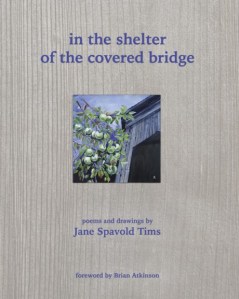
Another drawing for my manuscript ‘in the shelter of the covered bridge’: Hammond River #2 French Village Covered Bridge

~
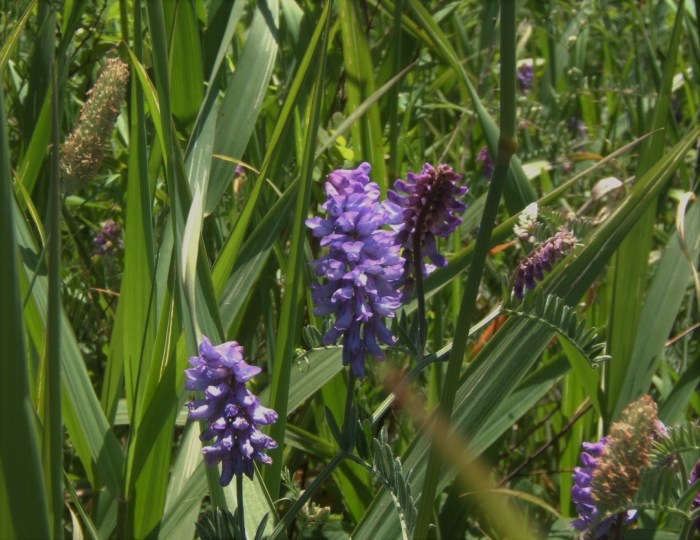
Cow vetch and Timothy at the entry to the covered bridge:
~
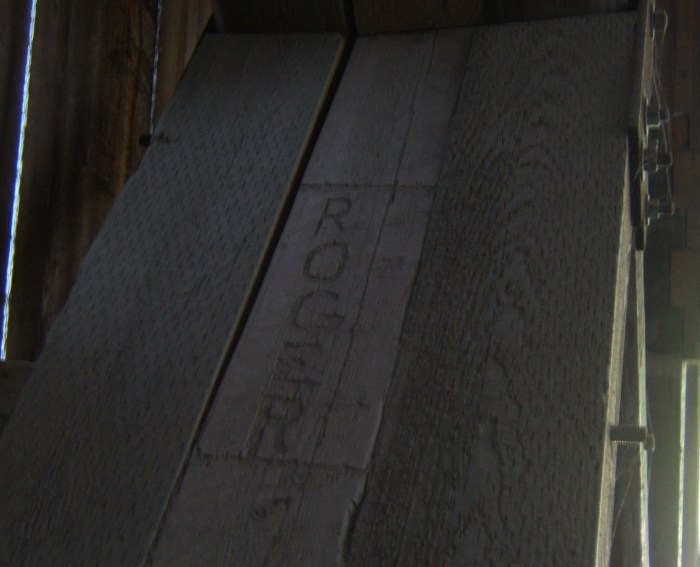
Who were ‘B’ and ‘E’? Who was ‘Roger’?

~
~

Hammond River #2 – packed in green
~
Copyright 2016 Jane Tims





 nichepoetryandprose