a moment of beautiful – ice in the ditch
the space: a ditch along the road
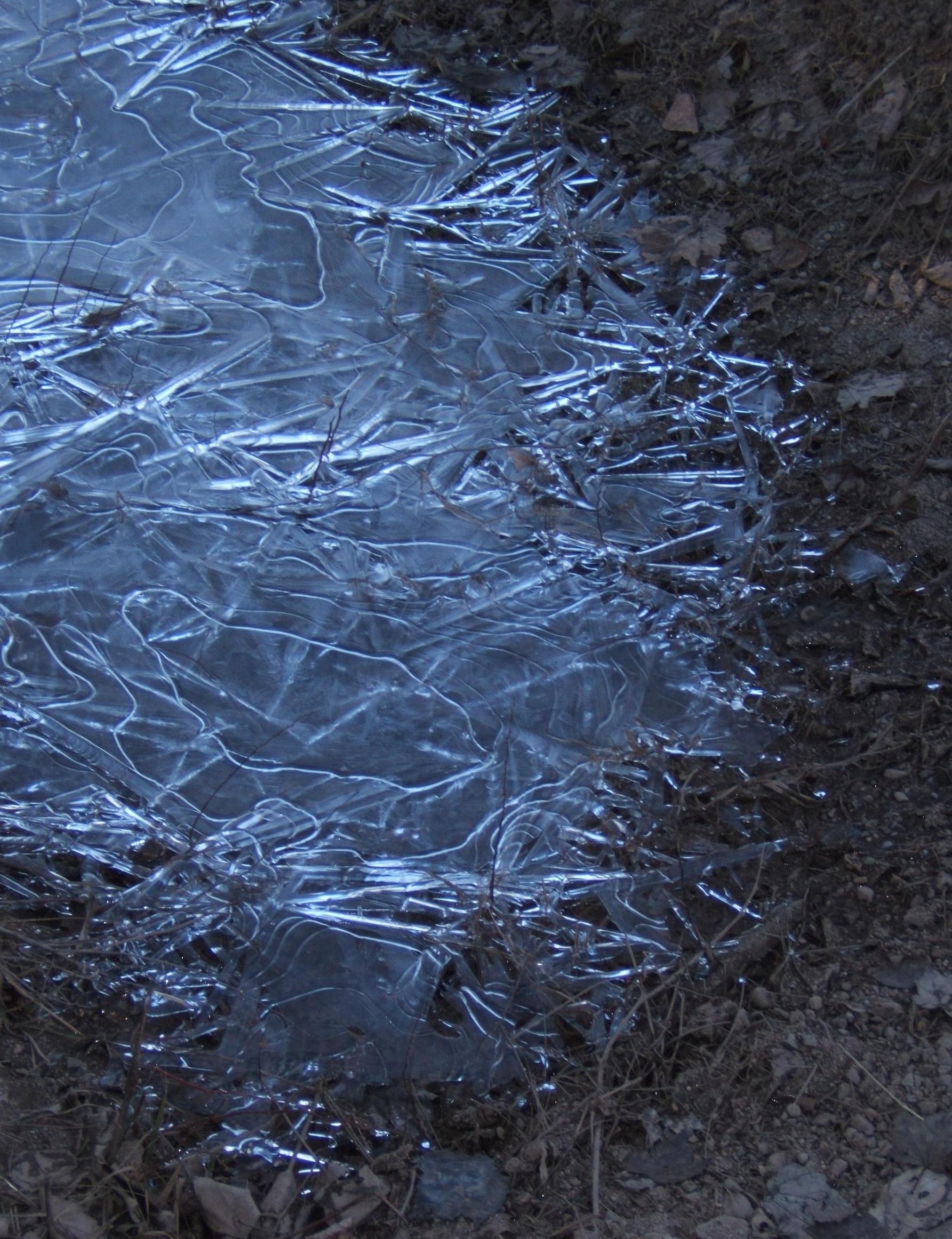
the beautiful: a skim of new ice
~
When nights are icy cold after a day of spring warmth, water freezes in the ditches. Ephemeral, this skim of new ice will be gone as soon as the morning sun overtops the trees.

The ice is frail, but if you are careful, you can lift a pane of this natural glass and see the world through a different window.
~
~
ditch ice
~
on the last sub-zero night in March
we forge swords and slivers
cast a lens, a barrier to warm
~
below ditch ice are sinuous
arrangements of water and breath
nostrils grope for airways
peer through frozen skim
as though through windows
learn the underside of pane
~
~
© Jane Tims 2012
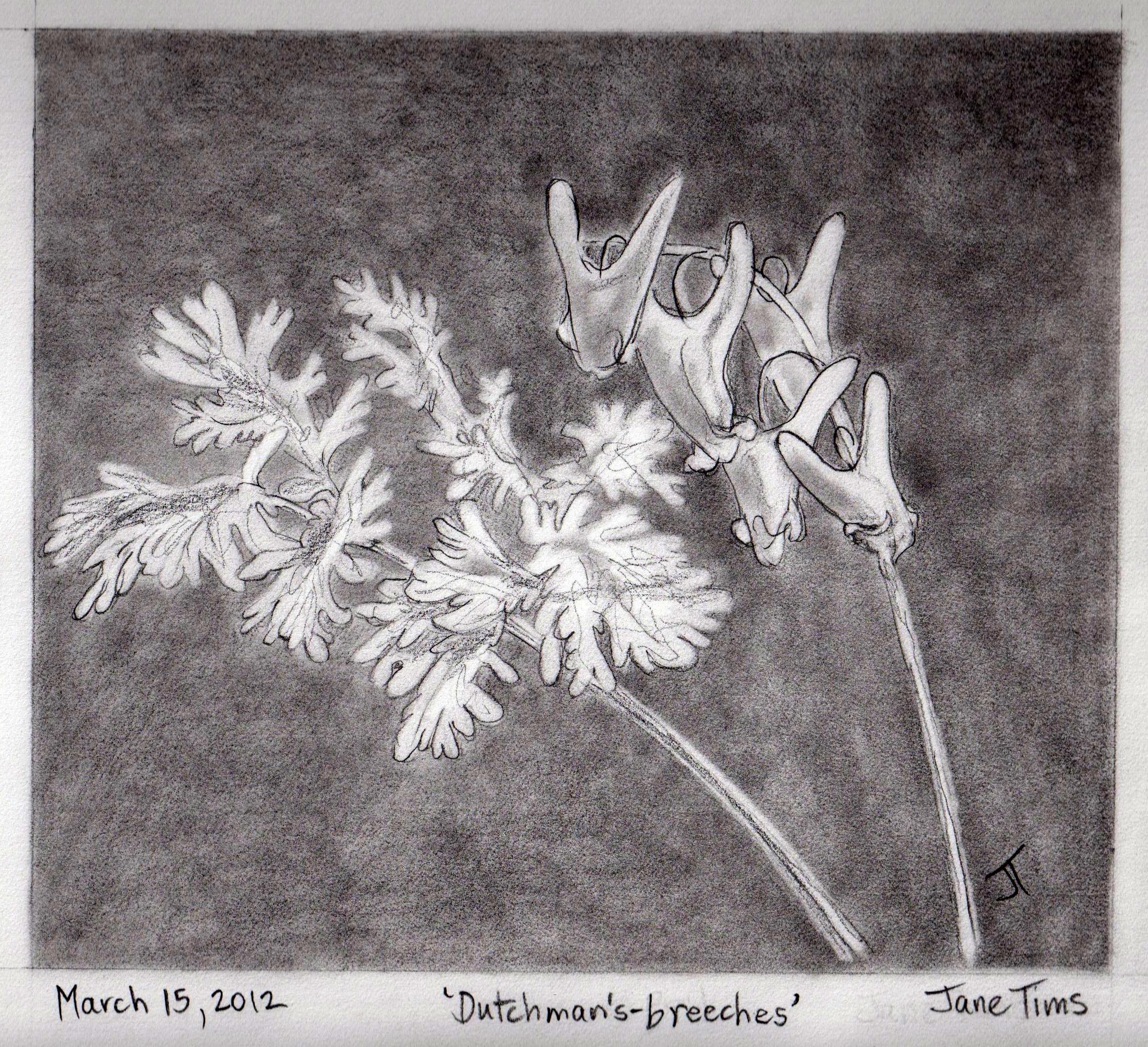
Dutchman’s-breeches (Dicentra Cucullaria (L.) Bernh.)
Our first summer home was located in a rich hardwood of Sugar-Maple (Acer saccharum Marsh.), Beech (Fagus grandifolia Ehrh.) and White Ash (Fraxinus Americana L. ). In these woods, in early spring, as the snow melted, wildflowers found ideal habitat. Many plants take advantage of the few days when the leaves of the overstory trees are still developing, and there is bright light in the understory of the woods.
One of these wildflowers is Dutchman’s-breeches (Dicentra Cucullaria (L.) Bernh.). This charming little plant blooms early in spring, in rich, rocky hardwoods. The white flowers are two-spurred, in groups of four to ten along a stem held just above finely divided, feathery leaves.
The plants is also known as breeches-flower, cullottes de Hollandais, and dicentre à capuchon. The generic name is from the Greek di meaning twice and centron meaning a spur. Cucullaria is the old generic name meaning hoodlike. The plant was named by Johann Jacob Bernhardi.
The flowers of Dutchman’s-breeches are an example of plant adaptation for pollination. The flower has a clever mechanism, in the form of fused flower parts, to ensure only certain insects (such as the bumblebee) can access the nectar and pollen.
In my copy of Roland and Smith (The Flora of Nova Scotia), I recorded my first encounter with this little plant – April 28, 1985, during one of our first visits to our property before we purchased it. We called our cabin Whisperwood, in part because of the subtle breezes in those wildflower-dotted spring woods.
~
~
Dutchman’s Breeches
Dicentra Cucullaria (L.) Bernh.
~
~
Dutchman’s breeches
brighten in sun
woodland washdays
have begun
~
spring-clean trousers
hung in rows
inflated with breath
the May wind blows
~
sprites are playing
tossing their hoods
above the damp
in the spring-fed woods
~
little fairy laundry
trembles on the line
before greening trees
block spring sunshine
~
~
© Jane Tims 1993
burrballs, weedballs and manganese concretions
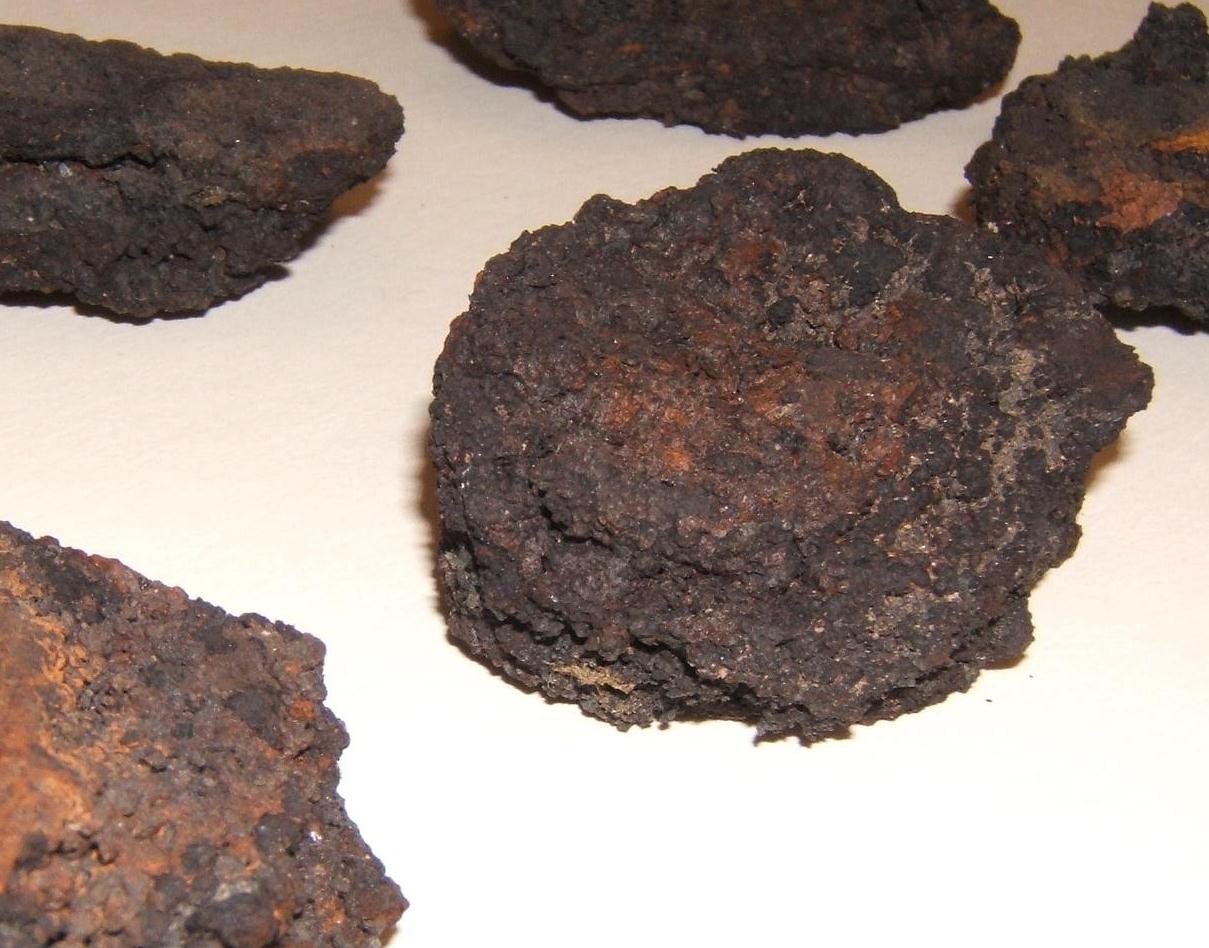
As I slowly clean out my office in preparation for my retirement, I am encountering the collected mementoes of 33 years of work. One of the oddest items I kept through the years is a plastic case filled with six hard black gobs, about 4 to 6 centimetres in diameter. They look like burnt chocolate chip cookies, but I assure you, even my baking is not that bad!
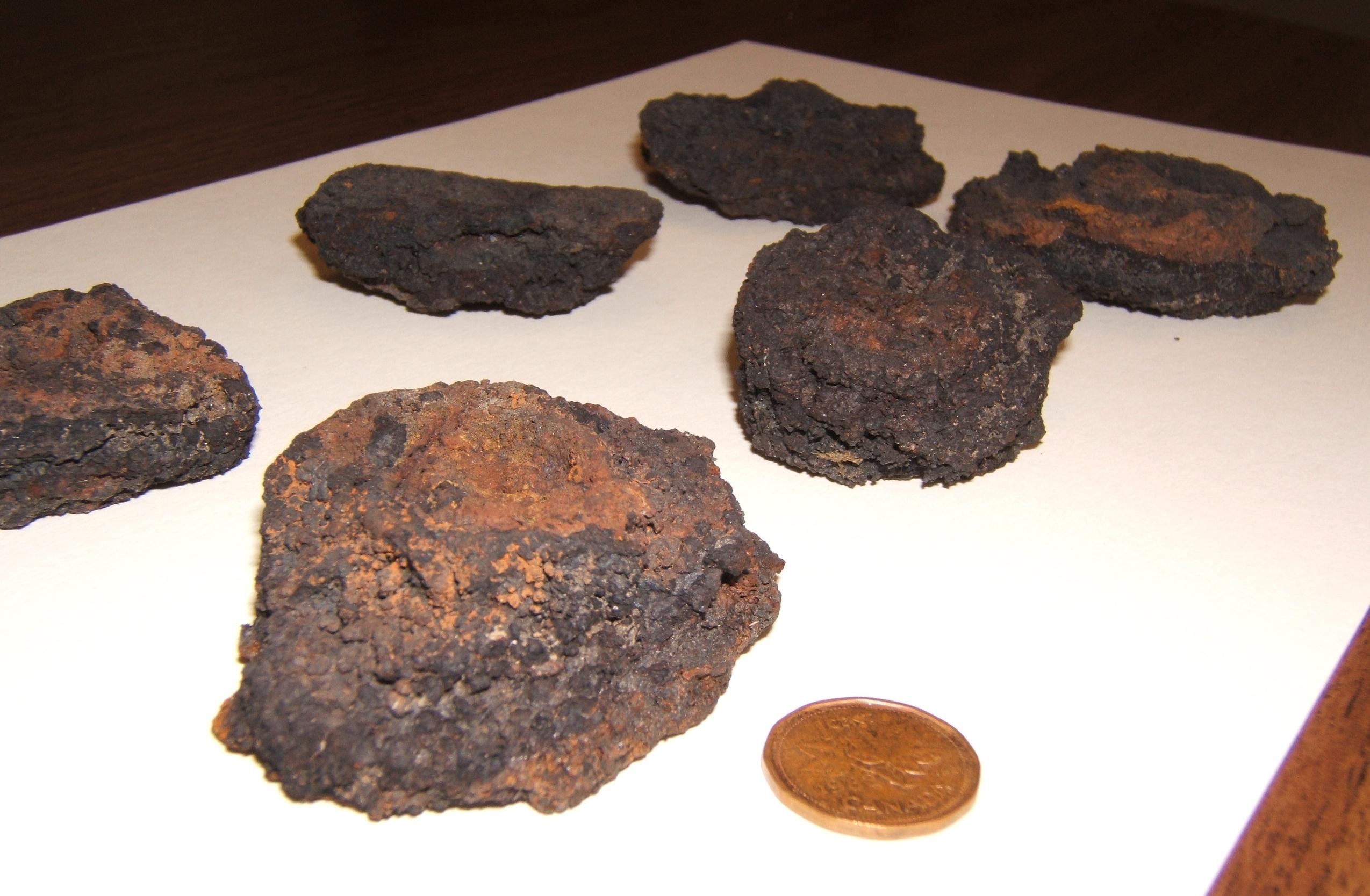
These are called iron-manganese concretions. They were found in the late 1990’s on the bottom of a lake in New Brunswick.
The occurrence of ‘balls’ in lakes and other bodies of water has been an interest of mine. In my experience, and in the reading I have done, I have encountered three different natural spherical formations in the Maritime Provinces. One of these is found along the ocean shore. The other two are found on the bottoms of lakes.
These are:
Water-rolled Weed Balls:
This was A.H. MacKay’s suggested name for ‘sea-balls’, compact balls of seaweeds and other materials found on a beach near Lunenburg, Nova Scotia. MacKay wrote a paper about these balls for the Transactions of the Nova Scotia Institute of Science in 1906. These strange formations were first reported by a teacher, Mary Bowers, who wrote to MacKay about their occurrence on a beach at Upper Kingsburg, along the mouth of the LaHave River. She wrote: “I have seen up to 200 balls on a short strip of beach…” MacKay described them as 1 ½ to 5 inches in diameter, composed of rolled-up remains of brown algae. The balls also incorporated red seaweeds, sea sponges, and small sea shells. MacKay wrote: “…Their structure in the different forms examined suggest their formation from light ridges of algae left by the retreating tide on flat sandy shallows. Under the sun, the weeds curl and lock into masses which, when moved over the sand by alternate tides and winds, occasionally produce very round balls.”
Kedron Balls:
These spherical balls of organic matter, a natural formation on the bottom of Little Kedron Lake, near Oromocto Lake in York County, New Brunswick, were described in 1904 by the naturalist William Ganong. Needles of fir and spruce from the forest surrounding the lake roll together with twigs, sandy silt and other vegetable matter on the lake bottom, gradually forming these soft compact spheres.
In his book Walden, Thoreau describes similar balls of organic matter from Sandy Pond in Lincoln, Massachusetts: “… I have found, in considerable quantities, curious balls, composed apparently of fine grass or roots, of pipewort, perhaps, from half an inch to four inches in diameter, and perfectly spherical. These wash back and forth in shallow water on a sandy bottom, and are sometimes cast on the shore.”
Iron-Manganese Concretions:
The examples I have were given to me by a friend who collected them at Balls Lake, a small lake near Cape Spencer in Saint John County, New Brunswick. These are natural formations, known as polymetallic or manganese nodules, built in successive layers of iron and manganese hydroxides around a core. The result is a spherical formation, rough and knobby on the surface. The concretions range in size, but most, like the specimens I have, are the size of a small potato. Manganese concretions form in both lakes and salt-water.
~
~
~
water-rolled weeds
~
begin with
a pinch of sand
a thread
a gesture, word
a fir leans
over the lake edge
drops a single leaf
~
layers spool
from chemistry of water
sediment
or a fluff of needles
quilting, quilting
soft balls wind
forward and back
~
gather, gather
while sunreels
ravel scene by scene
a bobbin
accepts the thread
and first line
builds to story
~
~
© Jane Tims 2012
~
~
Some reading about burrballs and weedballs:
W.F. Ganong. 1904. ‘On Vegetable-, or Burr-, Balls from Little Kedron Lake, New Brunswick’. Bulletin of the Natural History Society of New Brunswick v: 304.
A.H. MacKay. 1906. ‘Water-Rolled Weed Balls’. Transactions of the Nova Scotia Institute of Science XI: 667-670. Available on-line at: http://dalspace.library.dal.ca/bitstream/handle/10222/12593/v11_p4_a8_MacKay_water-rolled_weed-balls.pdf?sequence=1 Accessed February 28, 2012.
Henry David Thoreau. 1954. ‘Ponds’, Walden or Life in the Woods. Pennsylvania State University, 154.
floodwaters
This time of year, along the St. John River, we watch for floodwaters. For some, whose homes may be threatened by the flood, this means worry. For others, it means a road along the river may be closed until the waters recede. For me, it is a time to watch for the return of the Canada Geese. It is also a time to see what interesting cargo the floodwaters carry.
All along the river, there will be huge wheels of root… the remains of trees ripped from the river’s banks and carried along with the floodwaters. These ‘root wheels’ come to rest on the river’s edges, stranded by the falling waters. Washed clean of the soil, the roots show us the underpinnings of the trees and reveal what goes on beneath the ground, where we ordinarily cannot see.


~
~
Windthrow
~
another scar
in the clearcut
~
one crooked pine
left sentinel
to watch shoots and brambles
scramble for sun
~
wind thrown in silence
(no ears to hear)
seedlings
patted in by Boy Scouts
crushed
~
roots and fibre, exposed
clots of clay
dripping rock, wounded
rootlets, oozing sap
~
overturned war wagon
mighty axle, broken
wheel of matted roots, still
spinning, earth upended
~
a crater dug in regolith
~
a new shelter
from the wind, rain
sprouting seeds
in mineral
and fallen leaves
~
~
Published as: ‘Windthrow’, The Cormorant XI (1): 100 (Fall 94)
© Jane Tims 1994
a moment of beautiful – a swing in the orchard
the space: in the shade of a tree
the beautiful: an old wooden swing
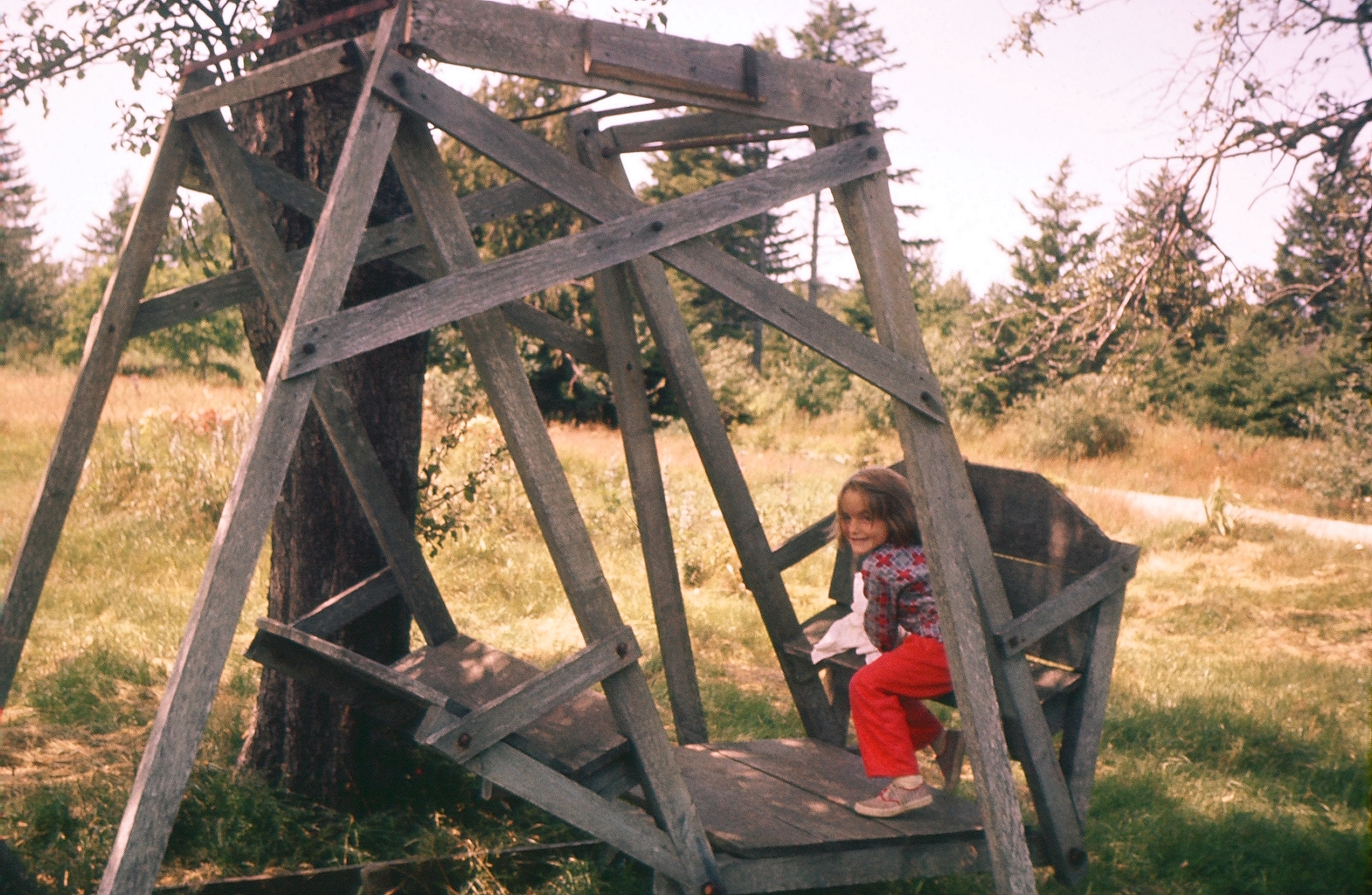
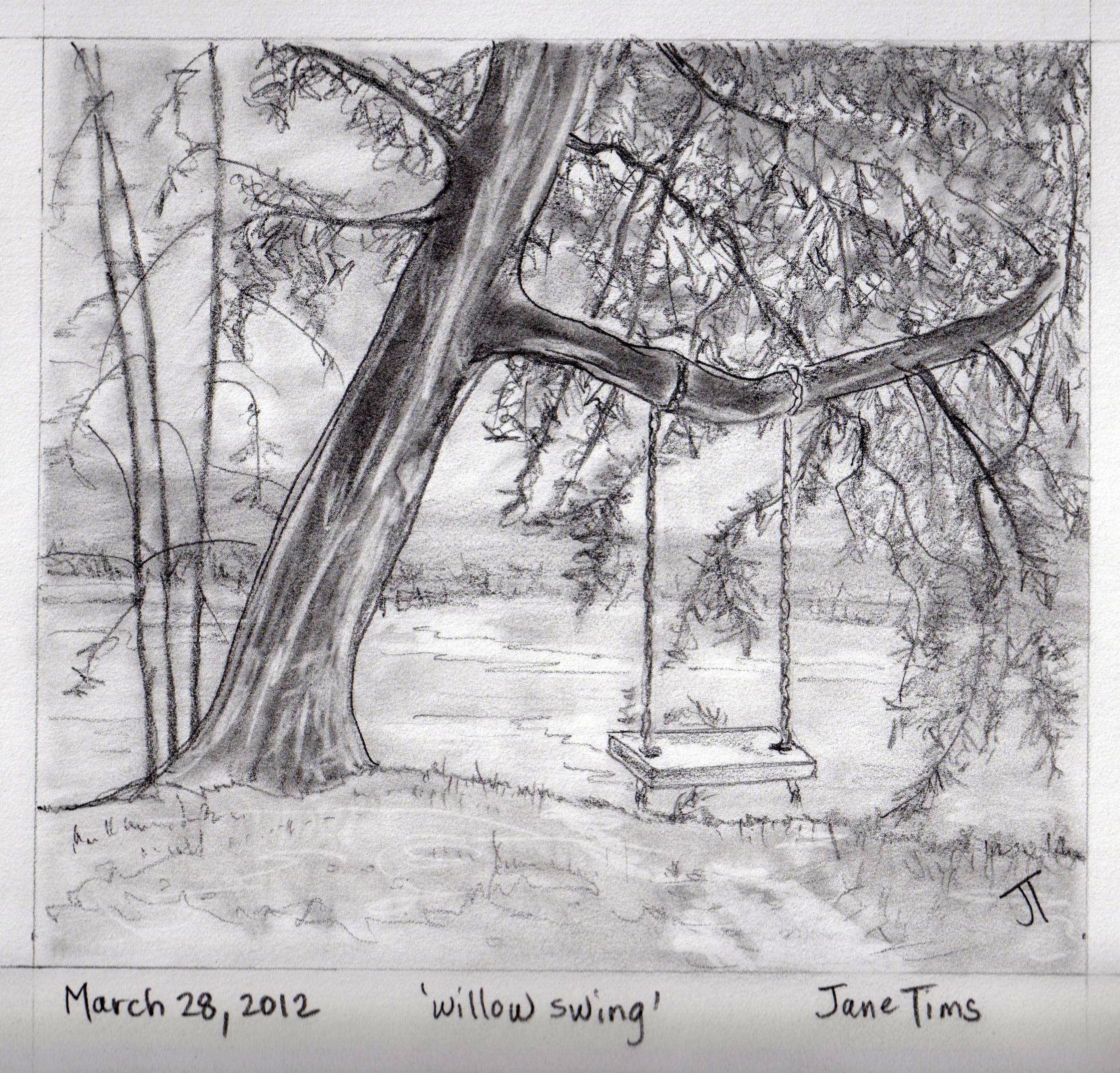
The sight of a swing hanging from the solid limb of an old tree recalls happy hours of swinging when I was a child.
On my grandfather’s farm, the swing was a swing-chair, and I spent hours pushing the old swing to its limits (see ‘in the apple orchard’ the post for August 9, 2011, under the category ‘my grandfather’s farm’). At home in Ralston, Alberta, the community playground had an adult-sized swing set, strong enough to withstand our approach of ‘stand on the seat and pump’. And, when my son was little, we had an old-fashioned board and rope swing – it was a little off-kilter and seemed to go side-to-side rather than forward-and-backward but I remember he and I had lots of fun.
My own childhood story about board and rope swings is bitter-sweet. My Dad built me a swing and hung it from the rafters in the basement of our house in Medicine Hat. I loved it, but … one day I let go of the ropes and fell backwards, hitting my head on the concrete floor. I can still remember the intense pain and the big black star that dominated my vision for a moment. People who know me will say this explains a lot.
~
~
swing sway
~
the old swing
hangs frayed from a limb
of the apple tree
sways
hips as she waits
for the downtown bus
rocking learned
in baby years
when rhythm brought peace
and a quiet evening
~
~
© Jane Tims 2012
maple sap soda fountain
For the last two days, the maple sap has been running again. The nights have been below freezing and the days are sunny and warm. Yesterday, we had 12 liters of sap from our 10 trees. The day before, we collected about 5 liters.
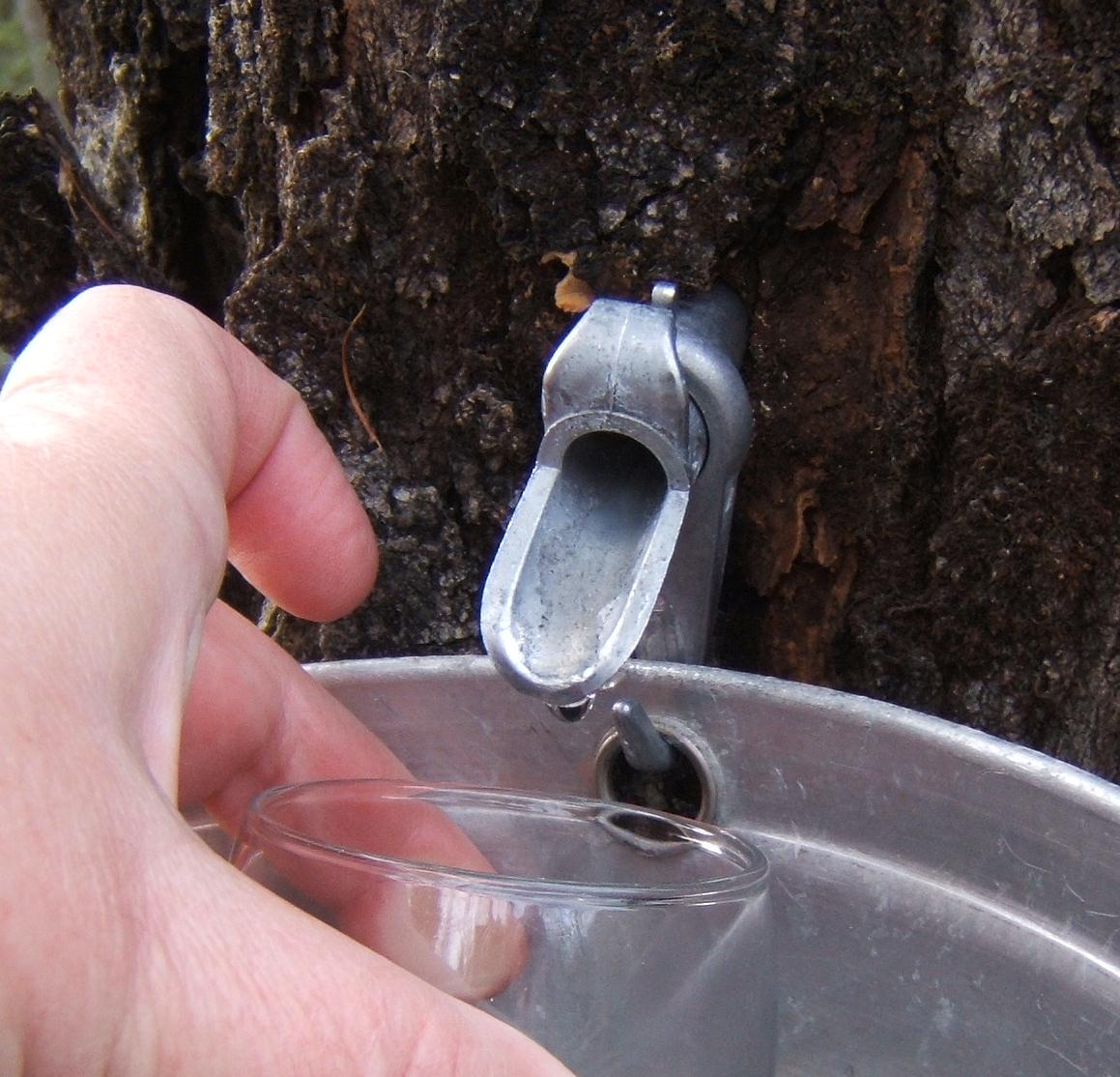
Each tree has its own rhythm of drips. Our best producer today drips at a rate of about 9 drops every 5 seconds, or 108 drops per minute.
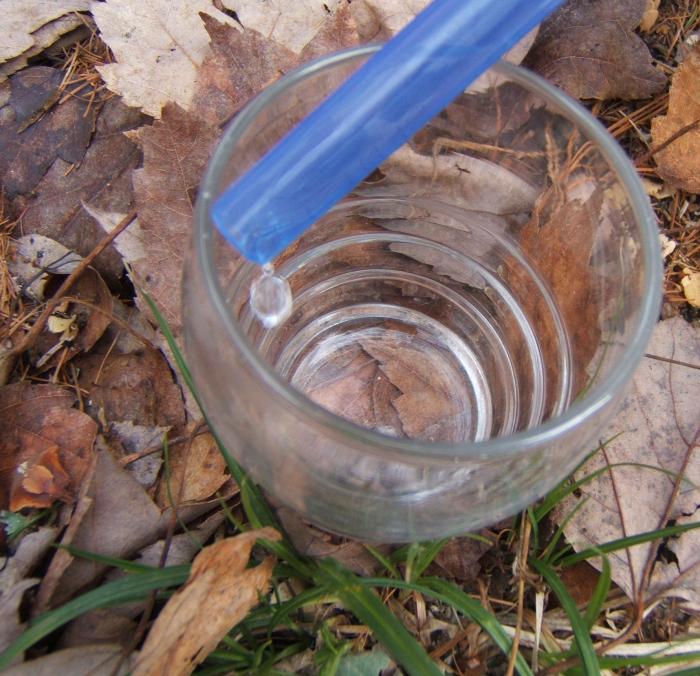
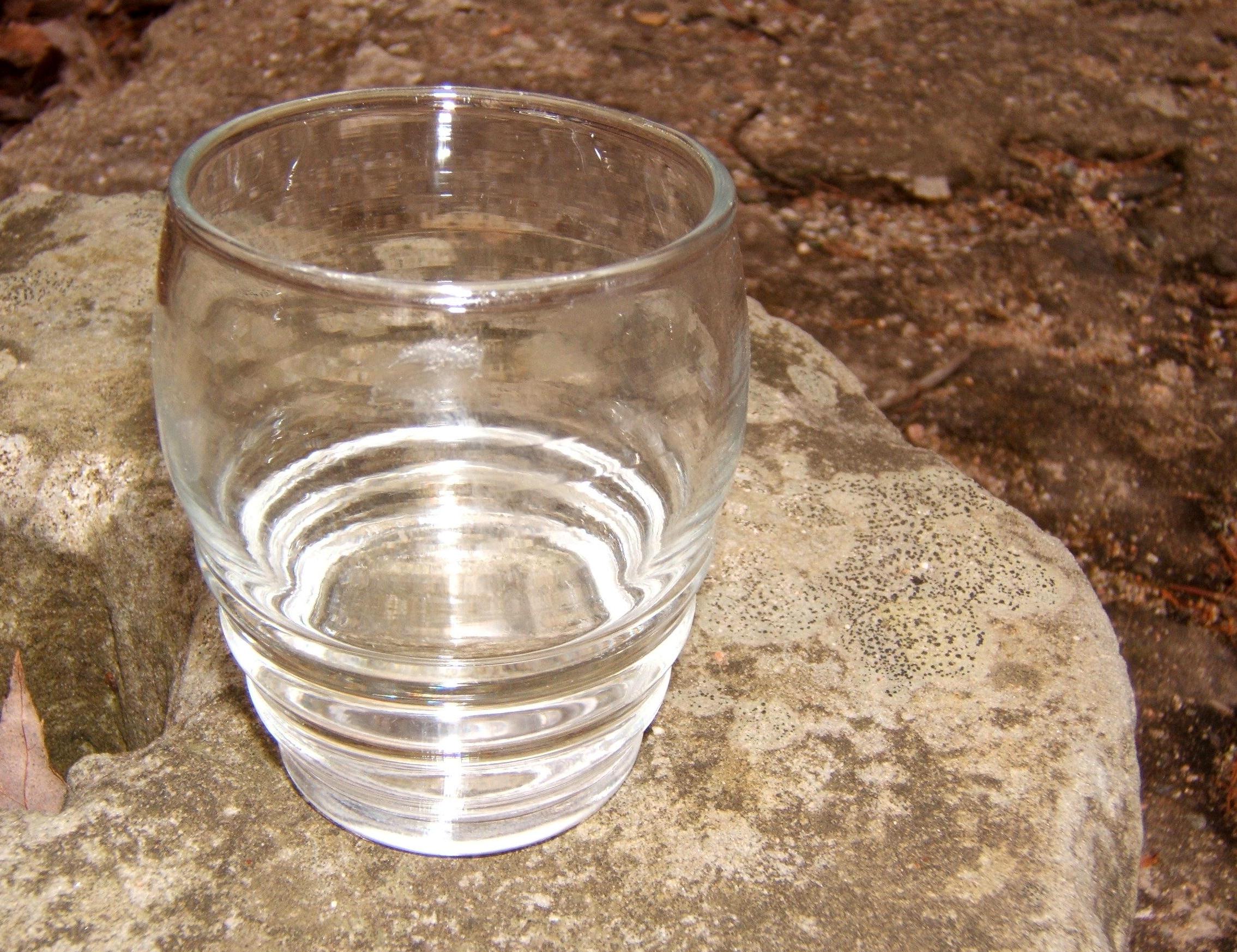
This evening, I had my ‘drink the sap from the tree’ experience. I took a small glass and caught the drips for a couple of ounces of the sweetest water ever. To me, the sap of each tree has its own taste. The sap from the big maple tree by our front door tastes a lot like cream soda without the fizz!
The maple sap is crystal clear, although it will turn dark amber (No. 2 Amber, according to our grading in Canada) once we boil it down to syrup.
~
~
droplet
~
one drop of maple sap
from the spile
~
a seep from slate
at the waterfall edge
~
in rain, a tear
from the margin of a leaf
~
a pause in the envelope
between rough bark and aluminum
~
~
© Jane Tims 2012
keeping watch for dragons #4 – a dragon overhead
Have you ever had a raven fly directly over your head? If so, you have heard the rhythmic compression of air, too intense to have been made by feathers…

~
~
a dragon overhead
~
a raven flies over
thrashes the air
percussion of dragon wing
~
~
© Jane Tims 2012
maple syrup ups and downs
It may be a short maple syrup season this year. The weather has not been cooperative. In order for the sap to run, warm days are great, but the nights need to be cold. When the temperatures fall below zero, the sap in the tree runs from the crown to the roots. When the day is warm and sunny, the sap runs back up to the canopy. If there is no cold night, no sap.
So far we have collected about 40 liters of sap from our 10 trees and I have 3 bottles (each 500 ml or two cups) of lovely dark syrup! This compares to 136 liters of sap last year on the same date, from 12 trees.
~
~
Cold night, warm day
~
Icicles build
from the spile
sweet sickles of sap
~
~
© Jane Tims 2012

keeping watch for dragons #3 – beechwood dragon
This time of year, the only leaves still clinging in the forest are the dry, golden leaves of young beech trees. Every drop of moisture has been withdrawn and the leaves rustle and whisper in the woodland. Something about the way the wind moves through the leaves, and catches the sound of their tremble, makes you wonder…

~
~
beechwood dragon
~
scales rattle
as he tiptoes through the thicket
peeks between the trees
wingwebs transparent
armoured in gold
~
~
© Jane Tims 2012

Coltsfoot (Tussilago Farfara L.)
Although it has been snowing sporadically this month, our recent days of very, very warm weather tell me spring has arrived. As a result, I am watching the roadsides for the first flowers of spring. Even before the snow is out of the woods, it begins to melt along the roadsides as they warm in the lengthening hours of sun. And the cycle of bloom begins again.
Coltsfoot (Tussilago Farfara L.) is one of the first plants seen in early spring. It forms large patches in waste areas, beside brooks and roads, and on damp hillsides. People often mistake Tussilago for Dandelion, but it is quite different. Its yellow flowers are borne on scaly, leafless stems. The large, woolly leaves don’t appear until later in the season. In spite of its early appearance in spring, Tussilago actually has late flowers. The flower buds are formed in autumn at the base of the plant, and pass winter underground, flowering in the first spring sunlight.
Other names for the plant are Son-before-the-Father, which refers to the appearance of flowers before the leaves, and pas-d’âne (literally donkey-steps). The scientific names are from the Latin tussis, meaning a cough, referring to the use of the plant as a remedy for such ailments, and the Latin word for coltsfoot, farfarus. The plant was named by Linnaeus, the Swedish botanist who established the present day system of naming plants.
Although the plant was used by pioneers for its medicinal effects, it is now known that Tussilago contains harmful alkaloids. Tea made from Coltsfoot has caused health problems in infants and pregnant women, so its use as a cough remedy is not recommended. In some States, Coltsfoot is considered a noxious weed.
~
~
Coltsfoot
Tussilago Farfara L.
~
Gold-
splashed beside the road
like prints
of a frisky colt’s feet
~
at first glance-
an early dandelion!
but-
too early
stem scaly
no leaves below the bloom
no perfume.
~
Coltsfoot,
Son-before-the-Father
(flowers before the leaves).
Introduced from
far, far away.
Old wives say
boiled greens
will ease
a cough.
~
Long ago
Tussilago
sprang from where
a burro trod
among the palms
(pas-d’ane)
~
~
Published as: ‘Coltsfoot’, Winter 1993, The Antigonish Review 92:76-77.
Revised
© Jane Tims 1993
~





 nichepoetryandprose