Archive for the ‘strategies for winter’ Category
red berries red
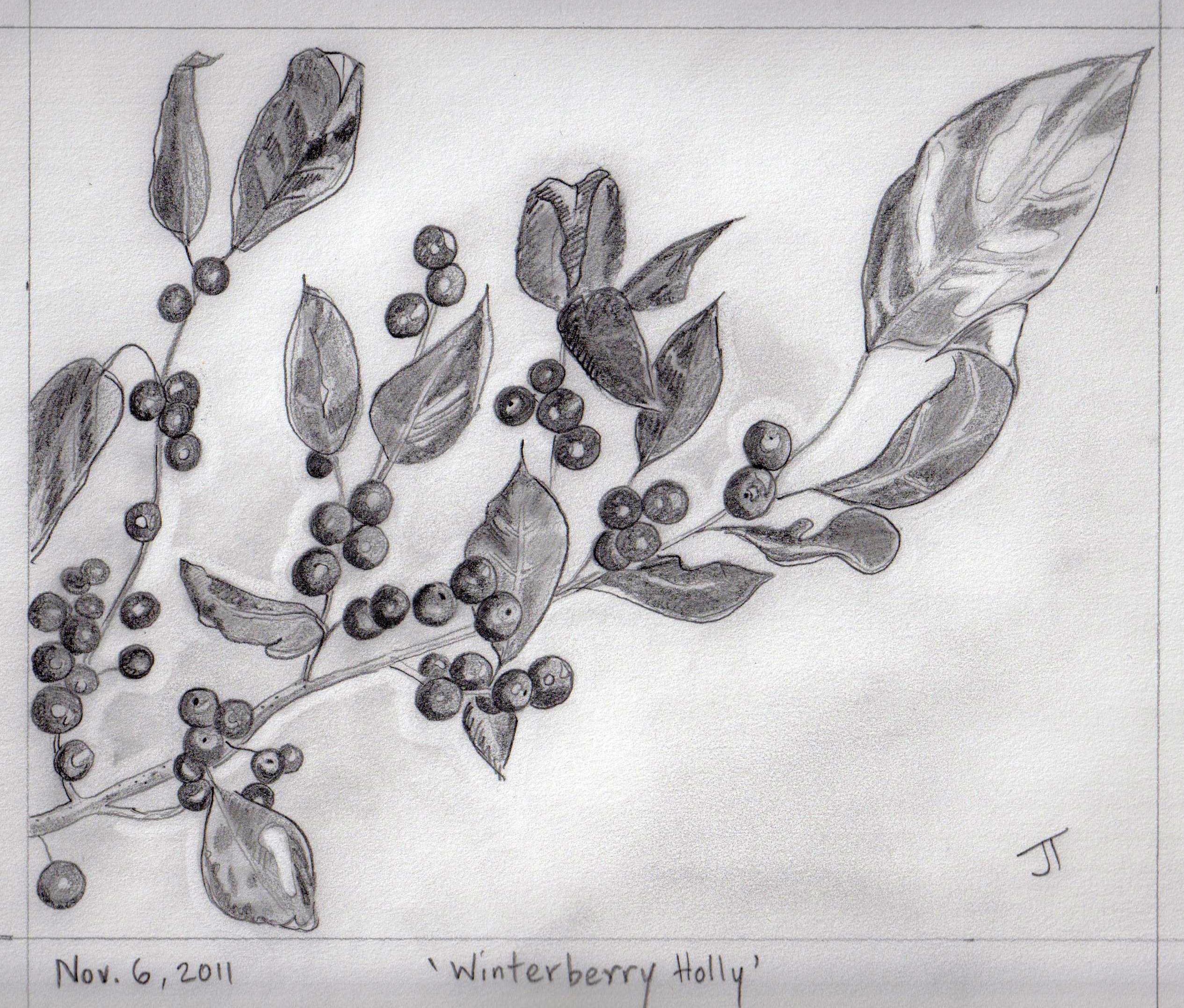
Red Berries Red
Jane Tims
2011
~~
~~
Hawthorn
(Crataegus)
~
between ruby glass
and hard wood floor
a slide of light and three
~
extinguished candles
smoke lifts from smoulder
each mote a particle
~
of spectral light, mosaic
shard, image
reassembled in three
~
dimensions
shepherd, hawthorn
pitiful lamb
~~
~~
Canadian Holly
(Ilex verticillata (L.) Gray)
~
drab November
and lexicon
expires
umber leaves
grey verticals
dull stubble
~
winterberries
astound the wetland
red ink on page
words explode
from exile
~
fever flush and holly
above December snow
icicles vermillion
~~
~~
© Jane Tims, 2011

'red berries' Bunchberry (Cornus canadensis L.)
villages and vignettes
I love to view bits of the world in miniature. Especially at Christmas, small replicas of human space make me feel comfortable. Perhaps seeing a world fit neatly into a small space is a version of the safety and calm an animal feels in its den. Perhaps looking over a diorama gives me powerful feelings of omniscience and omnipresence. Perhaps I like the impression of a story being told, from beginning to end, confined in space and time.
Our Christmas decorations are predominantly miniaturized vignettes:
our nativity scene, complete with a stable and its donkey, and a star-spangled hillside of angels and sheep…

my collection of Buyers Choice skaters, including a fellow roasting a marshmallow at a fire beside the frozen pond…

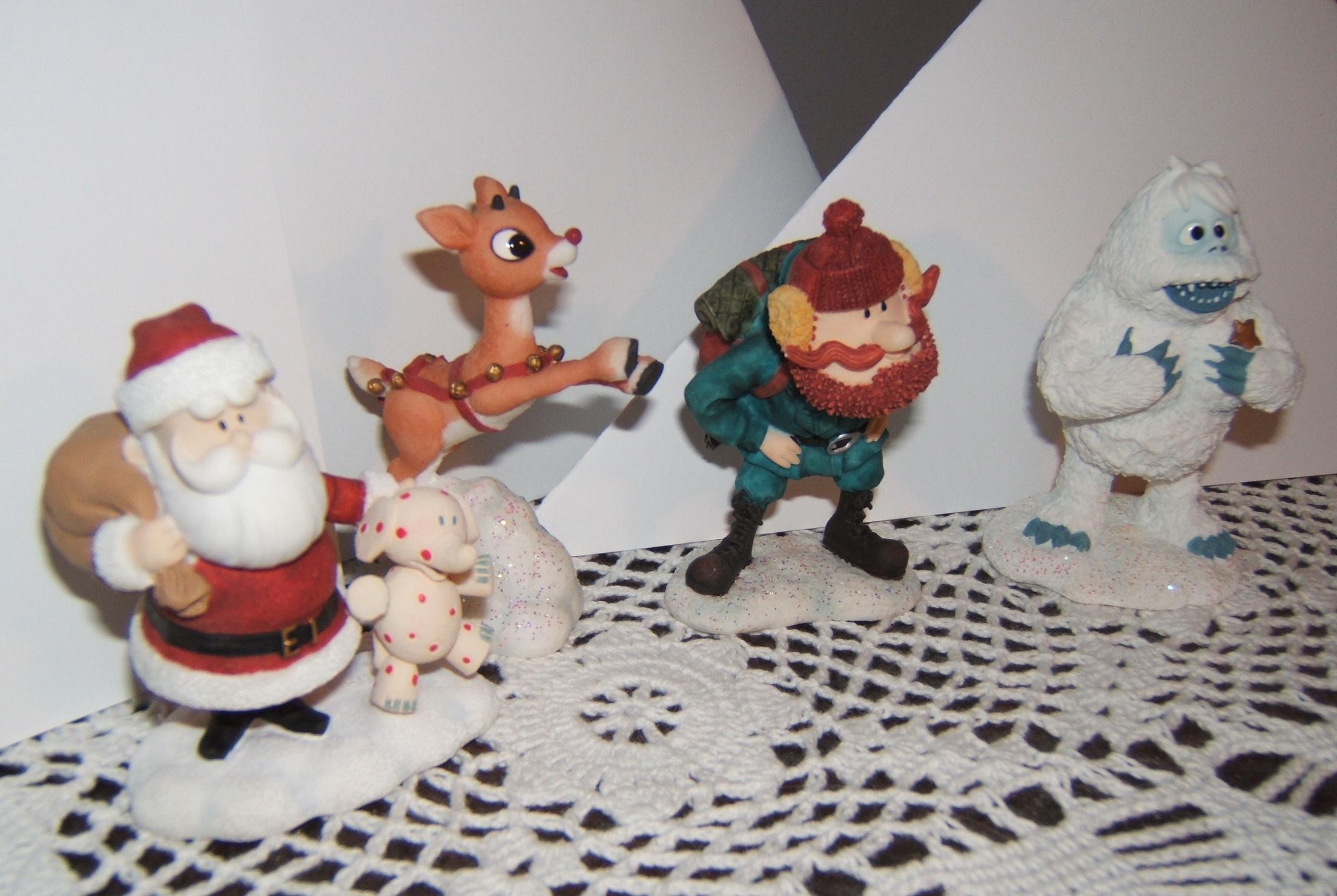
Rudolf and Bumbles from the Island of Misfit Toys…
children gathering around a pitiful Charlie Brown Christmas tree…

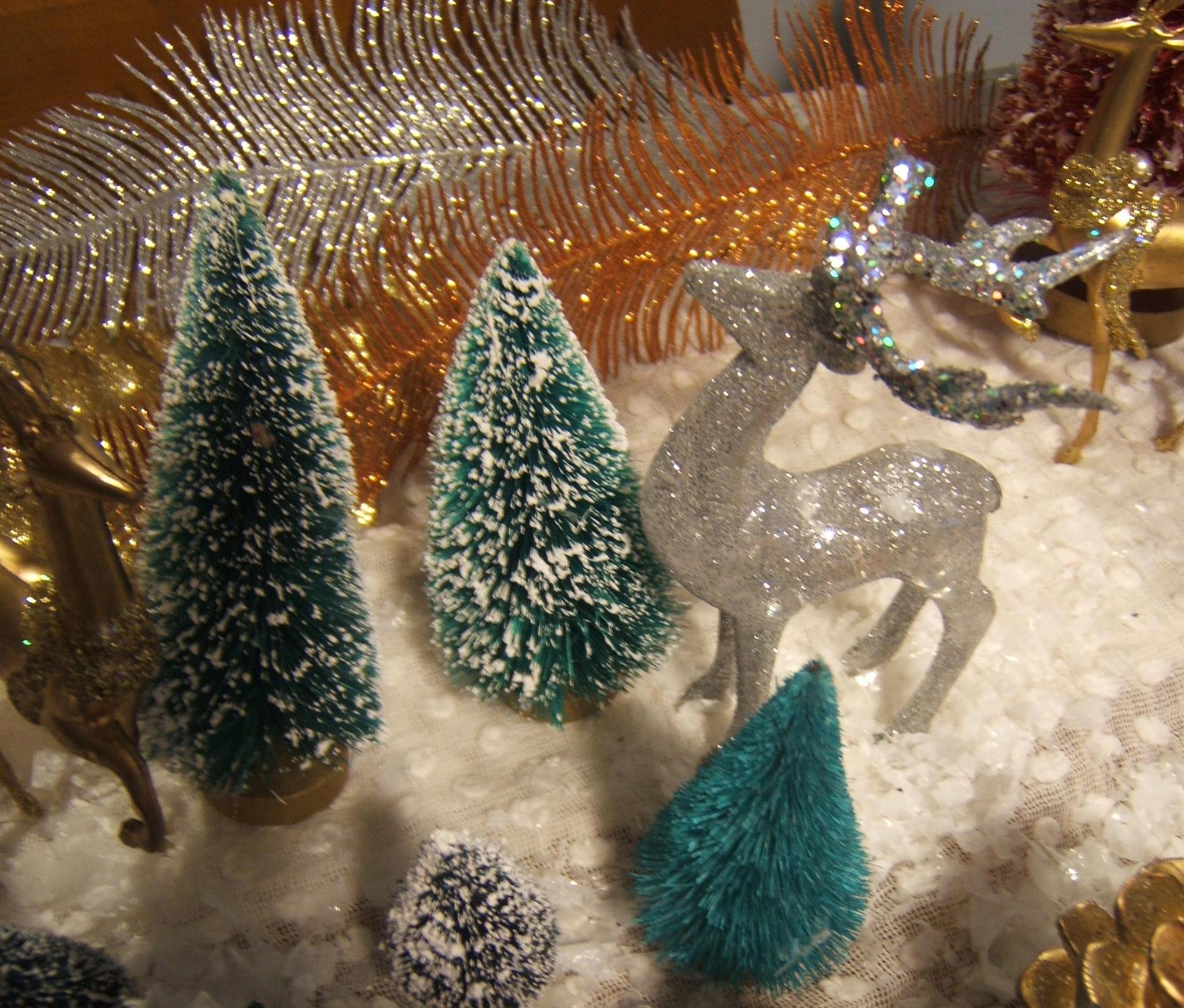
a frosty forest of bottle-brush trees and silver reindeer …
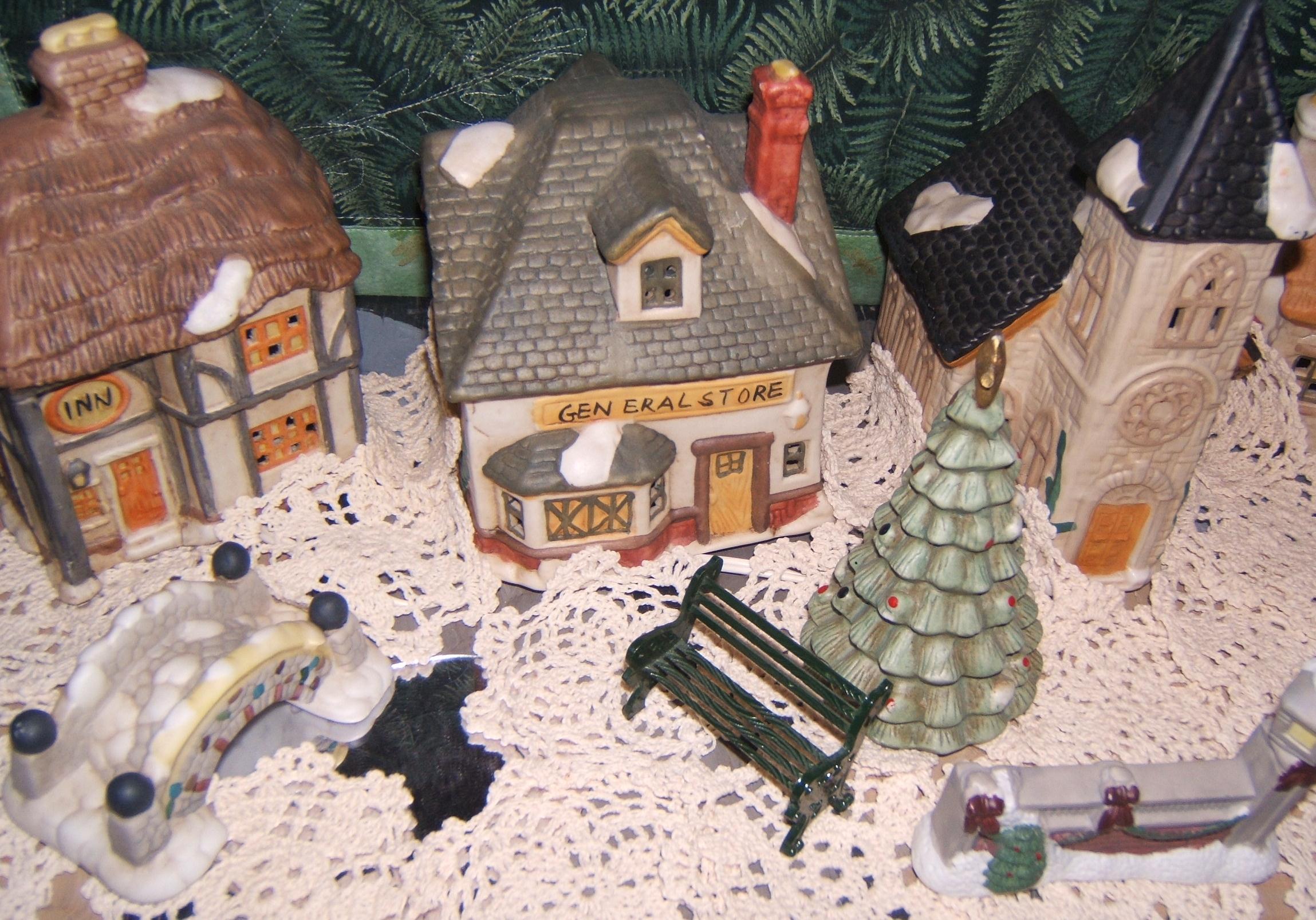
and a village with an inn, a church, and a park with a pond, a stone bridge and a park bench…
All very cute, but there is something missing.
The best scenes are those with real people. A scene of us sitting by our Christmas tree, talking and laughing. A scene of people in the bookstore, looking for a special book to give someone they love. The scene of a colleague at work, leaving a Christmas card on each desk. A scene of friends walking along a downtown street while the snow falls and the church bells mark the hour.
Merry Christmas everyone!
~
~
still street
~
the stillness of this street
its gentle curve
the steady glow of lamps
lighted windows, sturdy gates
a frozen pond, stone bridge reflected
soft snow, unmarked
and a park bench
where no one ever sits
~
~
© Jane Tims 2011

spacemen in our feeder
Our feeder has attracted some little space aliens!
In one of my recent posts, I talked about the Grey Squirrel and its marauding ways. Now I have two more mammals to add to my list of bird-feeder pirates.
During the weekend, we went to the Co-Op and puchased a new squirrel-proof feeder. It consists of a slim tube enclosed within a cage with the squares too small for the squirrels to squeeze through. Raccoons can’t fit through those small holes either, but they can take the new feeder off its hook and just toss it off the deck! Once they had cleaned out the spilled food, they began an assault on the older wooden feeder with its hoard of black sunflower seeds.

Just before I went to bed, I switched on the outer lights to see if the raccoons had returned and got a wild surprise. Two little spacemen were cleaning the rest of the sunflower seeds from the feeder! They looked like Red Squirrels, but were golden-brown in color, and had white undersides, a lot of extra folds of skin and big black ‘wombat’ eyes.
Flying Squirrels!!
We know the Northern Flying Squirrel (Glaucomys sabrinus) lives in our grey woods, but we haven’t seen them for a while. They not only look different, but move very differently from the Red Squirrels. They are very, very fast and sort of flow and fold themselves across the surfaces they are on, a little like those ‘parkour’ urban acrobats who move fluidly over obstacles.
The two Flying Squirrels argued and bickered with one another and paid no attention to me as I opened the door to snap their photo.
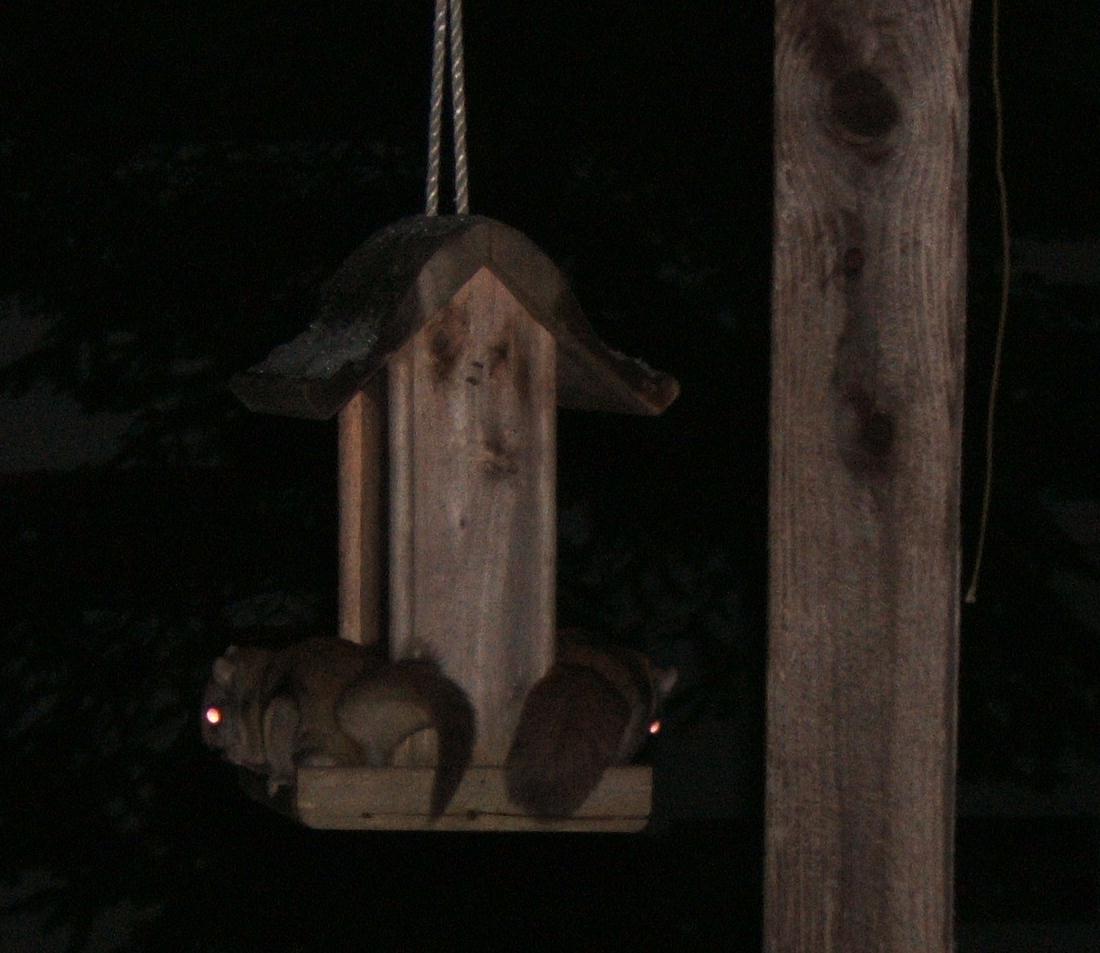
~
~
spacemen in the bird feeder
~
I missed the flash
the revolving light show
and high-pitched whine
just before the spacemen
(the Flying Squirrel Squadron)
set their coordinates on the feeder
~
bickered and folded over landscape
fired lasers from their eyes
took a moment for a black stare
at the earthling watching
and turned to complete the harvest
the sunflower seeds
craved by their planet
~
~
© Jane Tims 2011

one of the usual visitors to our feeder ... the Black-capped Chickadee (Parus atricapillus)
ice is nice
Our snow is slow in coming this year. We have had three snowfalls, but each, in its turn, has been rained or warmed away. If our ups and downs of temperature continue, the scant layer of snow on the ground this morning will be gone by Saturday.
However, winter is manifesting itself in other ways. I am wearing another sweater-layer this week. Our grey woods are muttering with chill cracking sounds. And ice is forming on the river and along the lake edge, gradually covering the surfaces with white and grey.
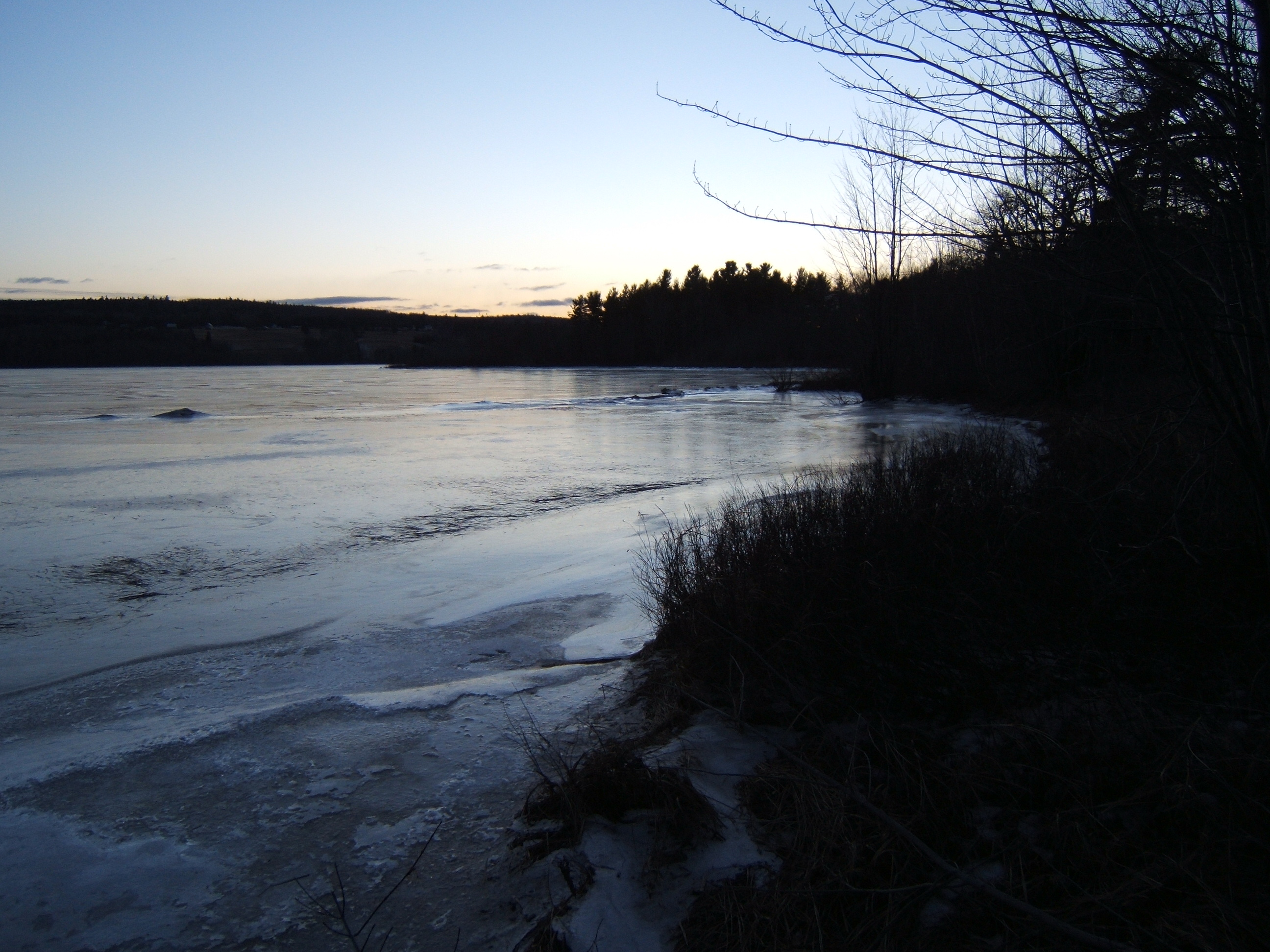
Ice – the frozen state of water… water is critical because it is a key component of our ecosystem and we need water to drink. Also, an unusual property of ice is responsible for keeping our ecosystem healthy.
Frozen water is about 8% less dense than liquid water. This means ice floats. As a result, bodies of water such as rivers, ponds and lakes, do not freeze from the bottom up. Instead, when water freezes at the surface, critical habitat is left under the ice for living things to survive and thrive. This is especially important for the bacterial and algal colonies at the base of the food chain.
Ice, therefore, is nice.
~
~
river ice
~
ice builds in shallows
at the rim of river, incremental
embellishment to glass, surrounds
willow stem and reed, thickness
increased as frost penetrates, sharp
edges cauterized by cold
~
© Jane Tims 2011

feeding the neighborhood
I have started up the bird feeder and already the mammals are nudging out the birds.
Our first visitor to the feeder was a fat grey squirrel who performed some amusing acrobatics to enjoy ‘his’ sunflower seeds.
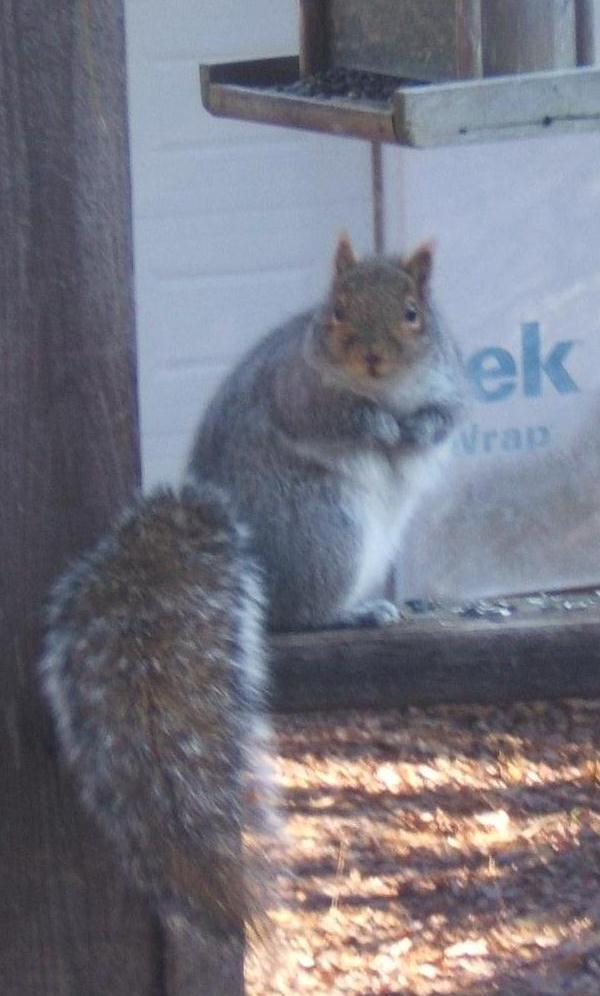

This year, I think I’ll keep a list of the marauders, who may outnumber the birds.
~
apples in the snow
~
she pauses, one foot poised
a lever beneath her, one hoof ready
to push off and fly
tail to flag her departure
tucked, ears up
~
everything still
the snow, the trees, the feeder
not caught in chickadee momentum, land
and shove away
~
three apples
at the edge of deep-freeze
draw her forward
~
© Jane Tims 2011

bringing the outside inside
Mindful of how busy I am at this time of year, my Mom always said to take Christmas where I found it. She meant to enjoy every moment of the season and glean Christmas from the smallest experience. So, on my drive home from Halifax, I was on the lookout for what I call “Christmassy things”.
One of these was a big truck, well-packed with Christmas trees, bound for markets in the United States. I thought of how these simple natural fir trees from New Brunswick would be the center of Christmas decorations far away.

We are lucky in New Brunswick to be able to buy a freshly-cut tree. In years past, we often went with my brother’s family to cut our own Balsam Fir at a U-Cut. It was fun, watching the kids running through the snow, so excited to choose a tree. Some years, we had a tree from my Dad’s property, one of the many he and my Mom planted and tended. I have also cut a Christmas tree from our own woods, although sometimes they are a bit lopsided. Today, we usually buy our tree from a local grower, in a lot where the trees lean against the fence, categorized by height.
It is so hard to decide on the perfect tree. We have high ceilings, so the taller the better. And I want a tree without a bird’s nest (some people think it is lucky to have a bird’s nest in the tree), so I check between every branch! I also usually want a relatively thin tree, to let the decorations hang easily.
Today or tomorrow, my husband and I will go out to get this year’s tree. We will wrap the tree in a red bedspread, set aside for this purpose, and tie the tree securely to the top of our car. We will take it home to settle for a day or so, and then bring it inside. And the fresh smell of cold air and balsam will expand from the tree into our living room. And, as in other years, it will be the best tree ever.
~
evergreen
~
*
under
snow prismatic
white distils to green
wintergreen and woodfern
clubmoss and conifer, chlorophyll
wedged into slim space between
earth
and
ice
~
© Jane Tims 2011
a place in the marsh
For the last few weeks, as I drive by the ditches and wetlands on my way home from work, I am charmed by the way the bulrushes have burst and made their bountiful seed available to the winds.
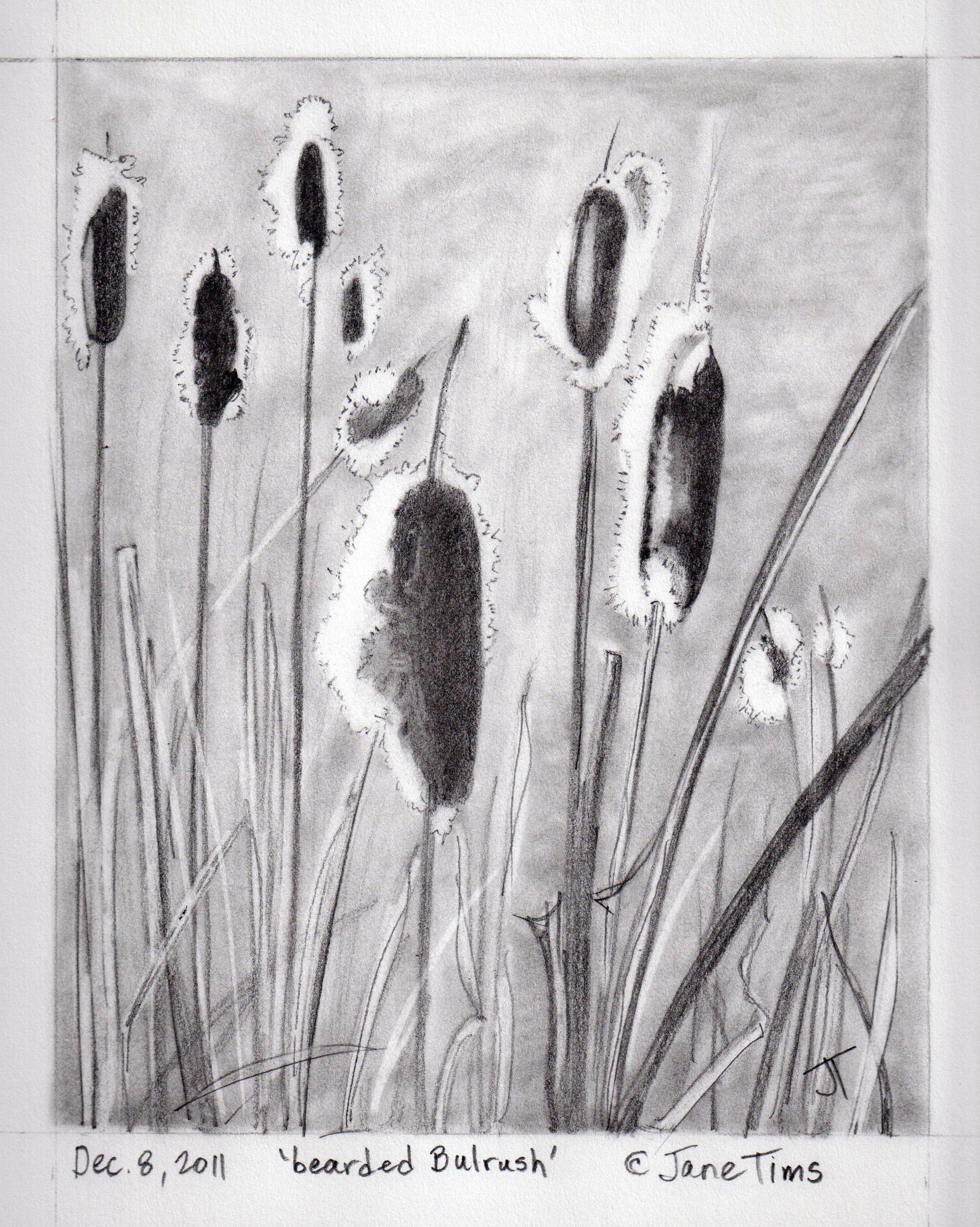
The heads of the bulrush (Typha latifolia L., also known as common cat-tail or masette in French) are usually neat and tidy cylinders of dark brown, held high on a sturdy stem. At this time of the year, the seeds emerge in a copious fluff clinging to the brown seed-head like a beard, a lion’s mane or a furry hat.
When I was a child, we always called these plants ‘busby rushes’, presumably after the tall bearskin hats worn by the Queen’s Foot Guards in front of Buckingham Palace. Actually a busby is not the correct name for the bearskin, but is a hat worn by Hungarian hussars, or the Royal Horse Artillary, a ceremonial unit of the British Army.
Our two usual species of Typha are distinguishable by their leaves. Typha latifolia (broad-leaved cat-tail) has flat leaves. Typha angustifolia (narrow-leaved cat-tail) has narrower leaves, convex on the back.
~
bulrush in December
(Typha latifolia L.)
~
4:45 PM rush, the Marshlands
bus expels tired folk to familiar sidewalks
exhausts them in diesel cloud
a bulrush pushing its seed
to the wind in cold December
bearded and wise, fur hats and
ear flaps against the cold
breath expressed as icicles and rime
~
© Jane Tims 2011
jane 9 squirrels 1
Again, I am in competition with the squirrels (see ‘competing with the squirrels #1 and #2’, in the Category ‘competing for niche space’).
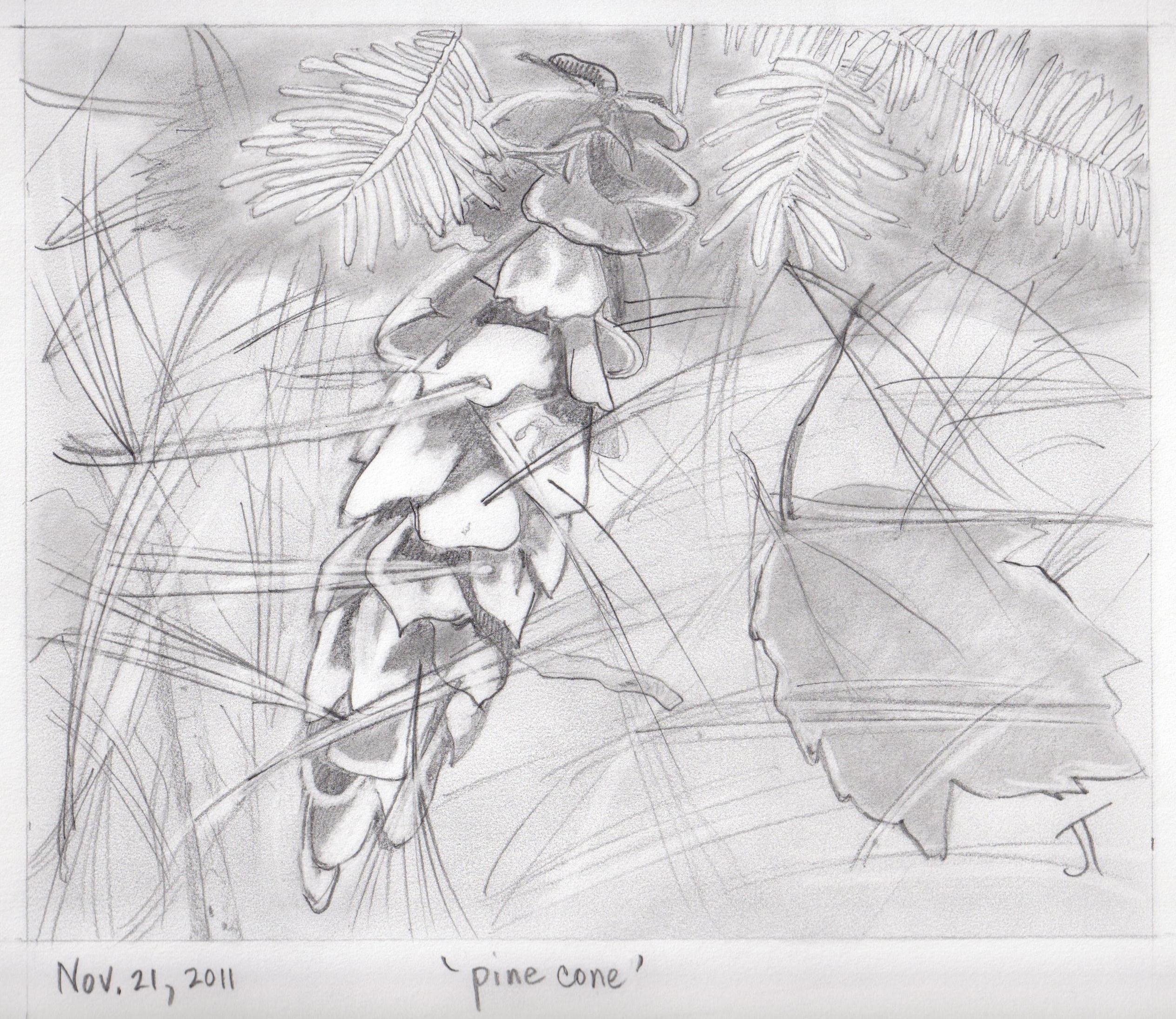
Christmas is coming and this year, I am decorating with natural elements. One of these is a ceramic bowl of large pine cones.
We have several large White Pine (Pinus Strobus L.) on our property and from time to time, they produce masses of beautiful pine cones, perfect for my decorations. White Pine are easy to remember in this area, since they have their needles in bundles of five. The cones are between 10 and 15 cm long and are a favourite food for squirrels.
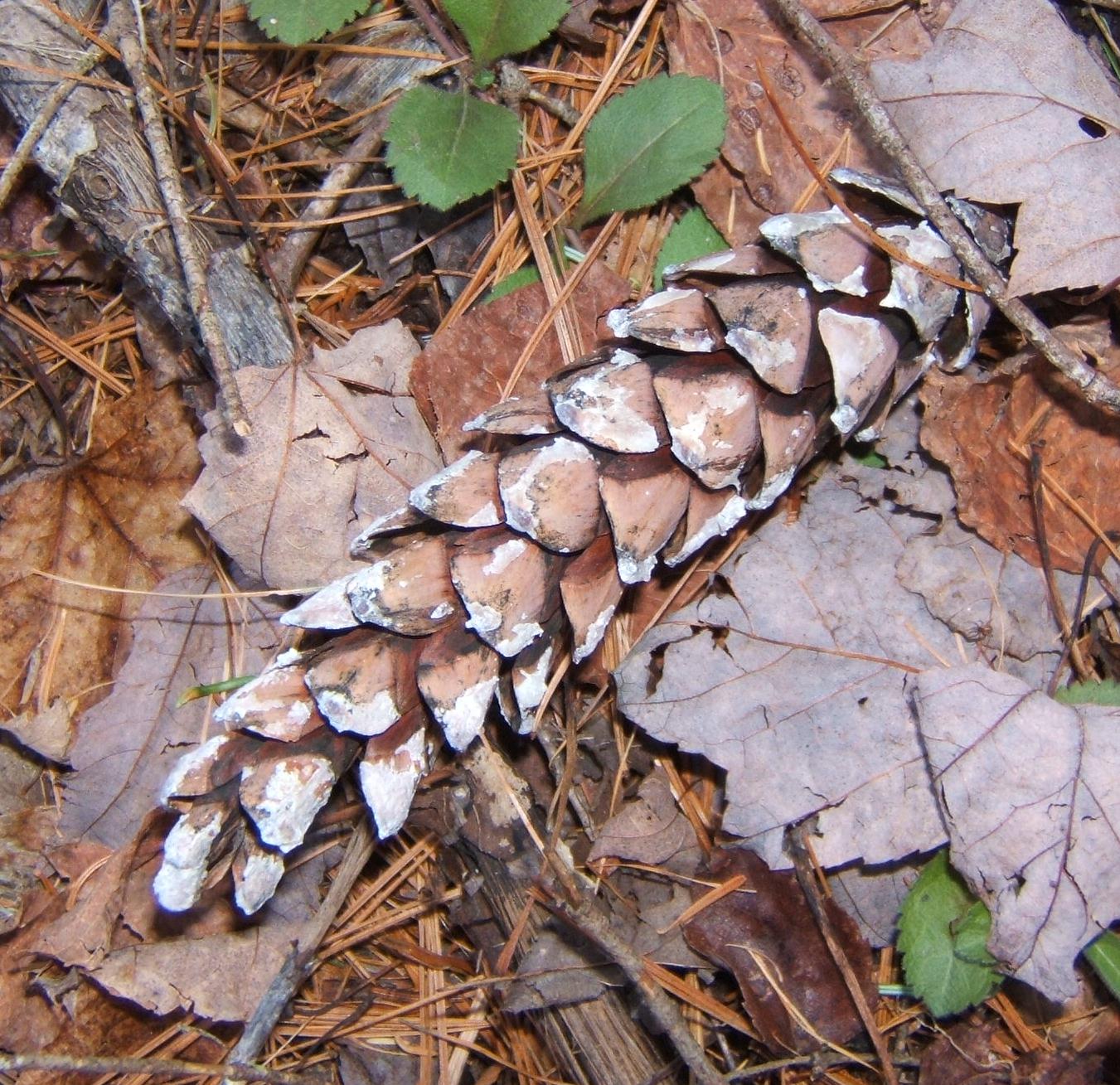
My husband came in last weekend and announced there were lots of the big cones in the pine tree next to our lawn. “Watch for them to fall, and then you should hurry to collect them,” said my savvy husband (he remembers the sad tale of the ripening hazelnuts).
I waited a couple of days and then went scavenging. And now, I am supreme. I have gathered enough cones for our Christmas. I saw a few cones with the lower scales and seeds nibbled away, but I found plenty for me. My hands were sticky, true, but I was so happy. All I can say is, with an emphasis approaching smug, “CH-CH-Ch-chchchchch-ch.”

- just to show that the squirrels do have lots of pine nuts… these cones are about half eaten

in November
~
we gather pine cones
snakes of lion’s paw
hawthorn
cedar boughs
and holly
~
we walk the wild ways
pruners and scissors
baskets and stout cord
bind bunches
of branches
~
balsam and cedar
blood berries
and evergreen
garlands of fir
rosehips and acorns, gilded
needles
and prickles
and thorns
~
© Jane Tims 2011
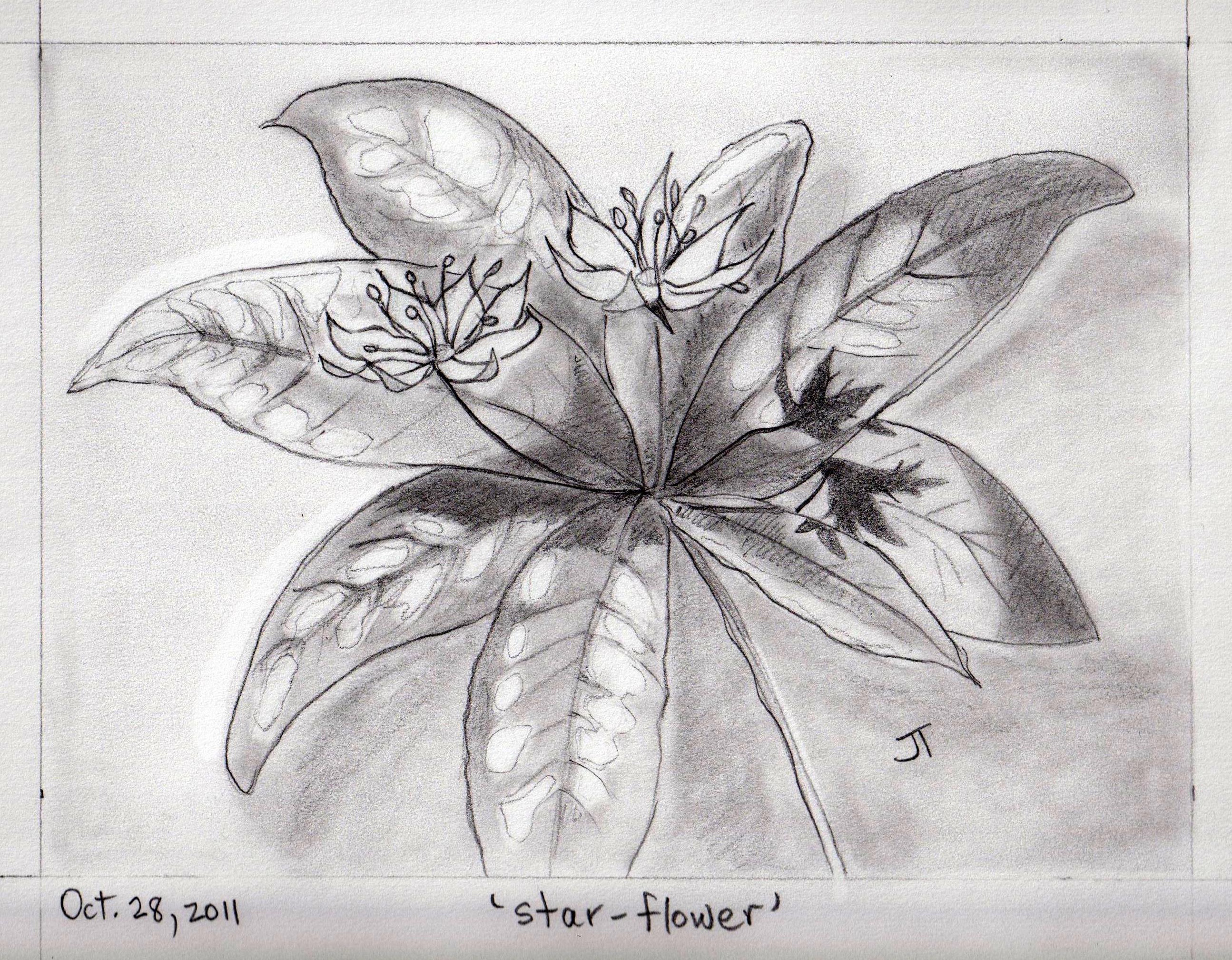
American Star-flower (Trientalis borealis Raf.)
Crisp November nights are a perfect time for a quick look up at the stars. I’ll be including some posts about our star-gazing, but for now, my thoughts are still turning back to summer. Stars in the sky? There are also stars in the dark summer woods.
The American Star-flower, Trientalis borealis Raf., is a plant with a delicate white, star-shaped flower, found in late spring in woodlands and on peaty slopes. Its scientific name comes from the Latin word for the third part of a foot, a reference to the height of the plant, and the Latin borealis, meaning northern. It is a common little plant, described by Fernald as a “forest pioneer”.
Some will wonder what the ‘Raf.’ refers to, at the end of the scientific name. This is an attribution to the botanist who first named the plant. In many cases, the attribution is ‘L.’, meaning the plant was first named by Carolus Linnaeus (the biologist who first introduced the ‘binomial’ naming system for plants).
‘Raf.’ stands for Constantine Samuel Rafinesque-Schmaltz who first assigned the genus and species names to the plant – Trientalis borealis. He was an eccentric polymath (knowledgeable in many fields and disciplines) who lived from 1783 to 1840. In his lifetime he published 6,700 binomial names for plants.
Star-flower
Trientalis borealis Raf.
~
Trientalis
borealis
star-flower
lost from the sky
four inches high
(the Latin name
makes claim)
petals white
boreal light
fallen down
first found
by Constantine
now often seen
it’s little lamp
above the damp
a forest pioneer
final frontier
up above
twinkling of
stamen and star
who you are
I wonder
and wander
down a trail blazed
by a frail flower
one candle power
~
Published as: ‘Star Flower’, Winter 1993, The Antigonish Review 92.
revised
© Jane Tims
monuments in stone
inuksuk n. (plural inuksuit) a stone landmark or cairn used by Arctic and northern peoples to mark a point of reference or a place of significance; an Inuit cultural symbol.
inunnguaq n. (plural inunnguat) a stone cairn in the shape of a human figure, meant to represent a human figure, and distinguished from an inuksuk.
Wikipedia.org
Our rock project is progressing slowly. We are collecting rocks for a stone monument. Since I want this to be a sculptural piece, I am sure the rocks we select will play a role in the final look of the monument.
One possibiity is to build an inuksuk. These stone landmarks are a part of the culture of the north, but they have caught the general imagination and are now encountered throughout Canada. On our trip out west, the inuksuk built along the Trans-Canada highway in Manitoba were particularly memorable.
For a few years, the inuksuk (plural inuksuit) and inunnguaq were common along the New Maryland highway in New Brunswick. On the stretch of road between New Maryland and Fredericton, the highway is carved through rock and outcrops are part of the roadscape. A women who walked along the road every morning for a few years was responsible for building many of the inuksuit. The local newspaper did a story on her, explaining that she walked and built the monuments as exercise following by-pass surgery. She wore a white jogging outfit with black splotches and was fondly referred to as the ‘Cow Lady’.
The ‘Cow Lady’ no longer walks the road and her inuksuit and inunnguat have fallen into disrepair. I remember her fondly and dedicate the poem below to her.
Inunnguaq 101
~
these are the hill people
sometimes without arms and legs
sometimes with other, alien parts
but proud
honor the woman who walks here
~
sometimes toppled
often reassembled
constructed one day at a time
optimism of increment
a community on the hillside
~
© Jane Tims 2004




 nichepoetryandprose