Archive for the ‘our summer place’ Category
Paper Birch
In the last five months, I have been learning how to paint with watercolors. I’ve painted with acrylics for some time, and I love to draw with pencil, but watercolors always seemed daunting to me.
If you are a follower of my Blog, you will know my early attempts at watercolor have been of views from my virtual cycling trip in central France and on the Ile de Ré. I have also done some studies of New Brunswick wildflowers.
Among the subjects I found fun to paint on Ile de Ré were the vine-covered trees that grow along the road.
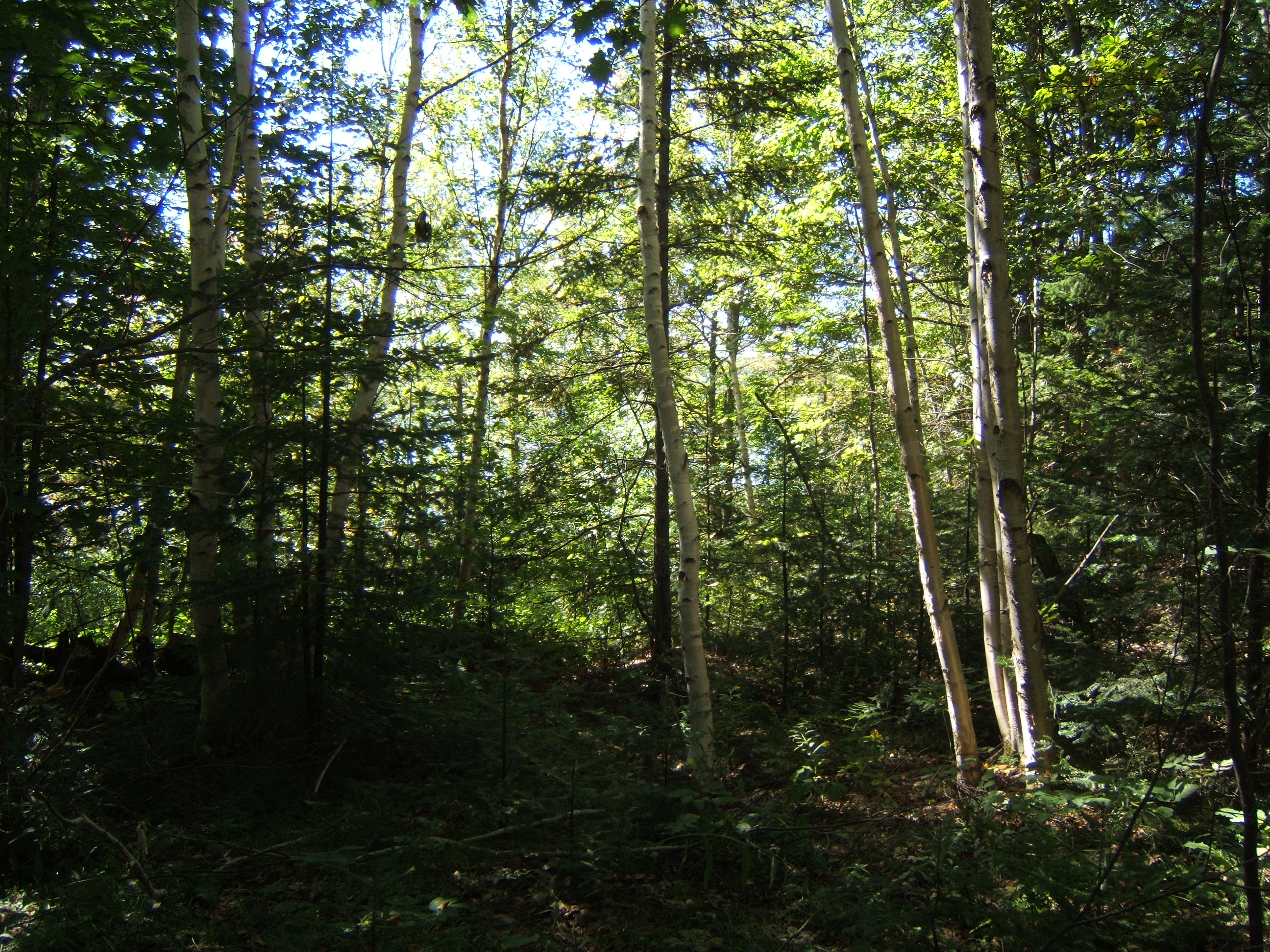
This week, on a trip to see our camp, I studied some of the characteristics of Paper Birch (Betula papyrifera Marsh.), a tree growing everywhere on our property by the lake …
~
~
Some of these trees are actually Mountain Birch (Betula papyrifera Marsh. var. cordifolia (Reg.) Reg.), a variety of the Paper Birch. This variety is quite common in eastern Canada. Its distinguishing characteristic is the heart-shape of its leaves, especially at the base of the leaf.
~
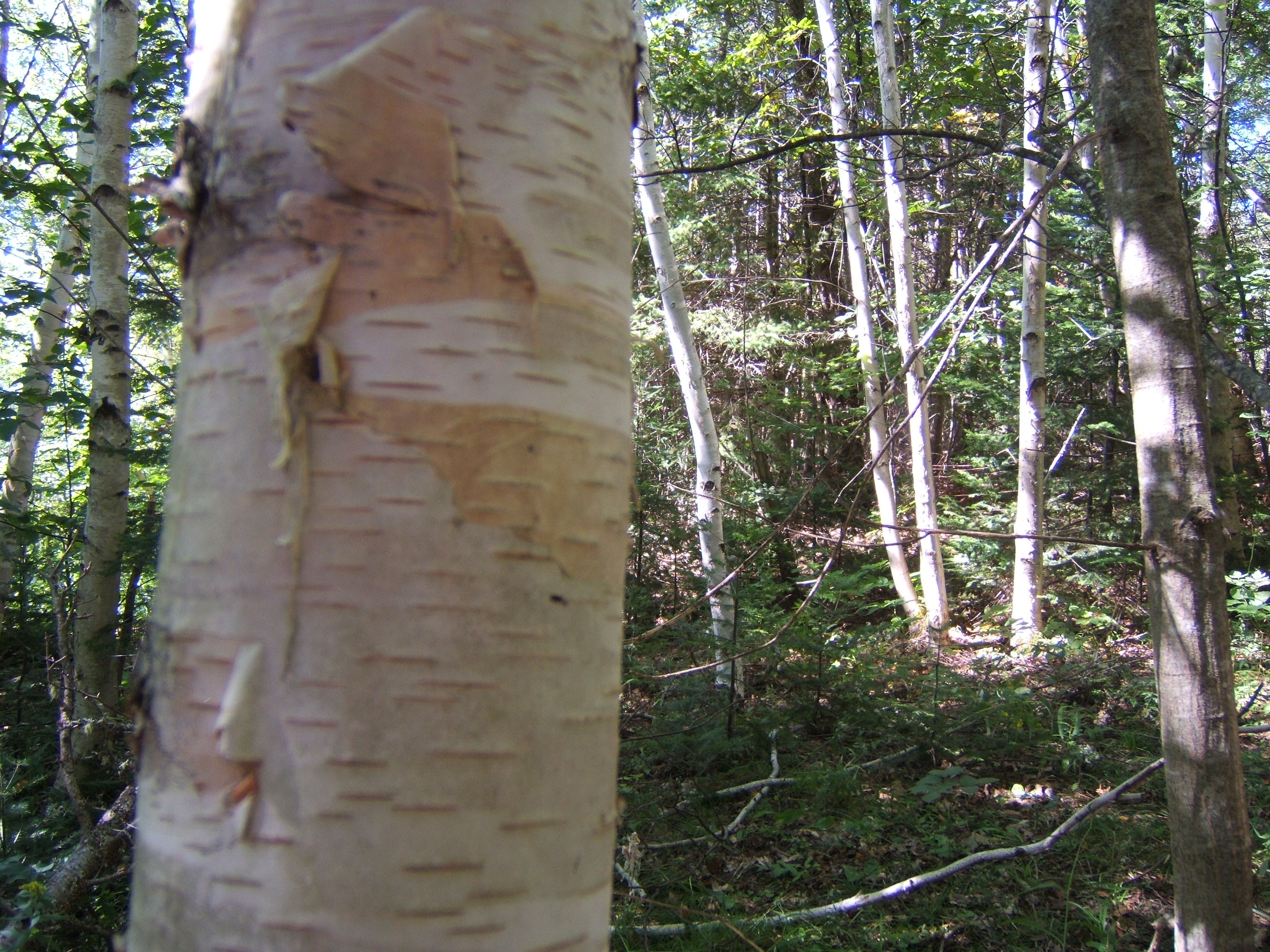
The bark of the Paper Birch and Mountain Birch is predominantly white, although parts of the tree can be yellowish or quite black. Its bark strips readily from the tree, in sheets, leaving a reddish-orange inner bark which turns black with age …
~
~
To paint the birch, I used Painter’s Tape to mask the trunks of the trees. Then I painted the background. Once the background was dry, I stripped the Painter’s Tape away and added the bark details in the white space left behind. Here are three paintings of Mountain Birch …
~
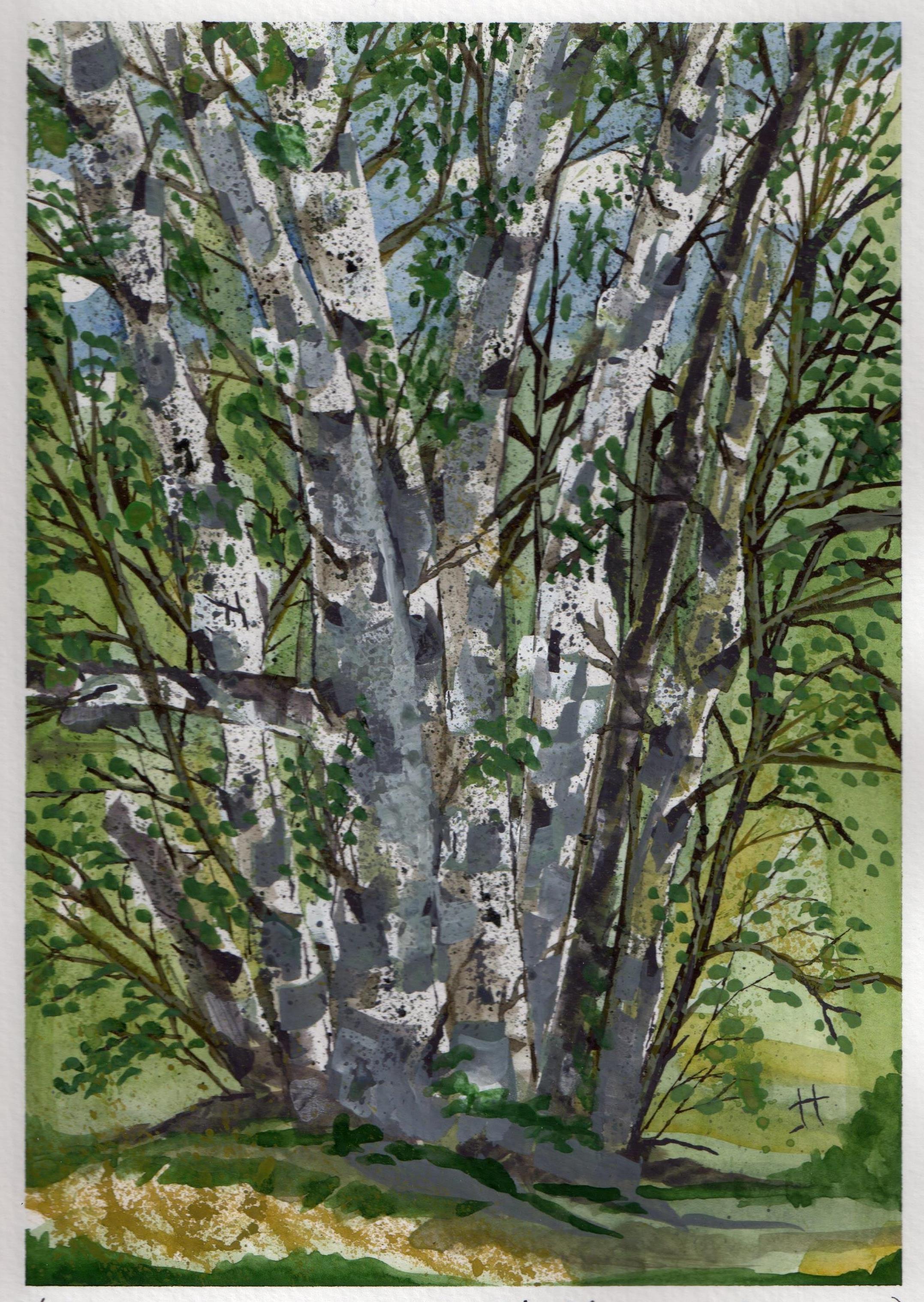
June 21, 2013 ‘Mountain Birch’ Jane Tims
~
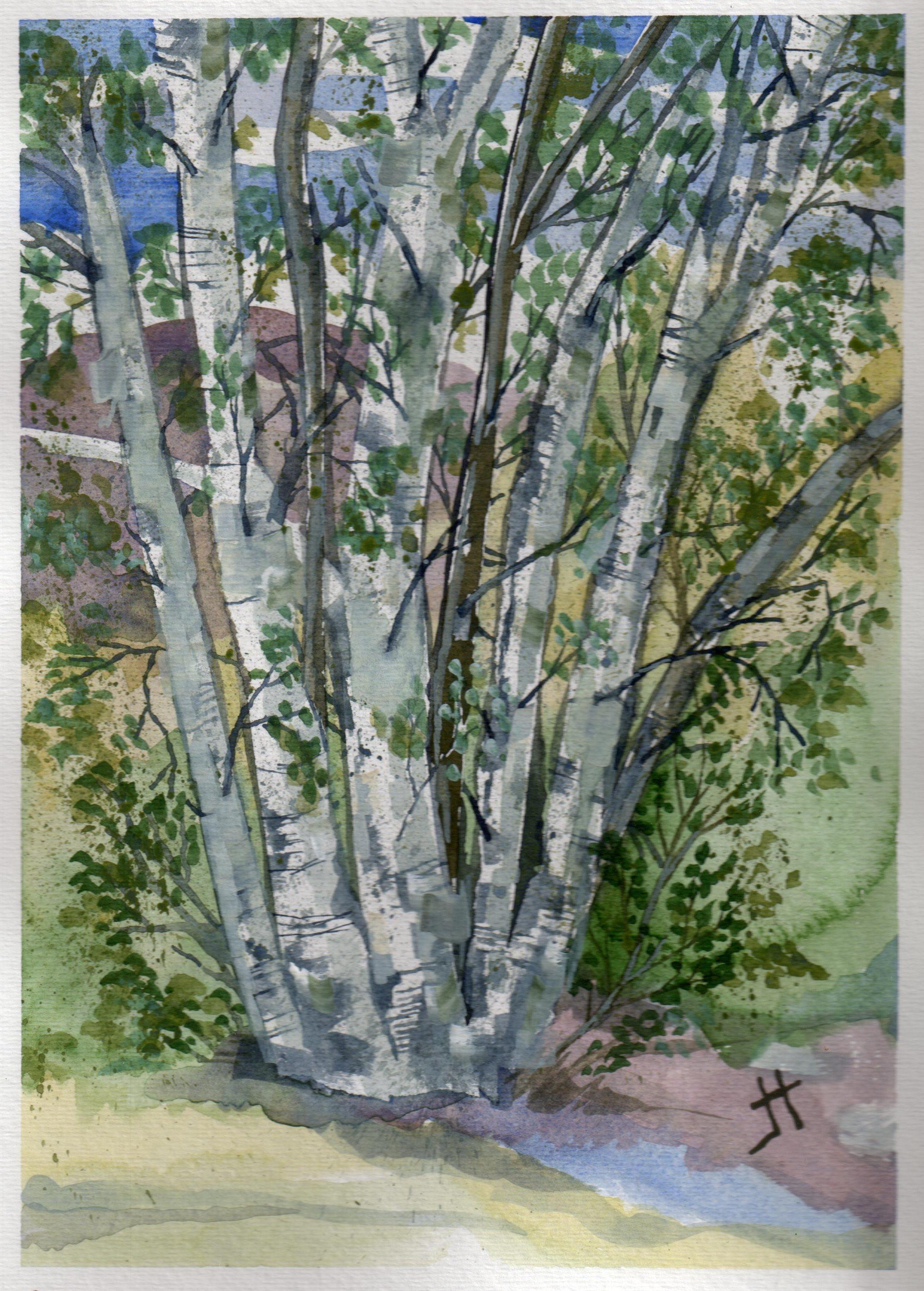
June 22, 2013 ‘Mountain Birch #2’ Jane Tims
~

June 23, 2013 ‘Mountain Birch #3’ Jane Tims
~
Copyright Jane Tims 2013
flowers along the sidewalk 5-10
~
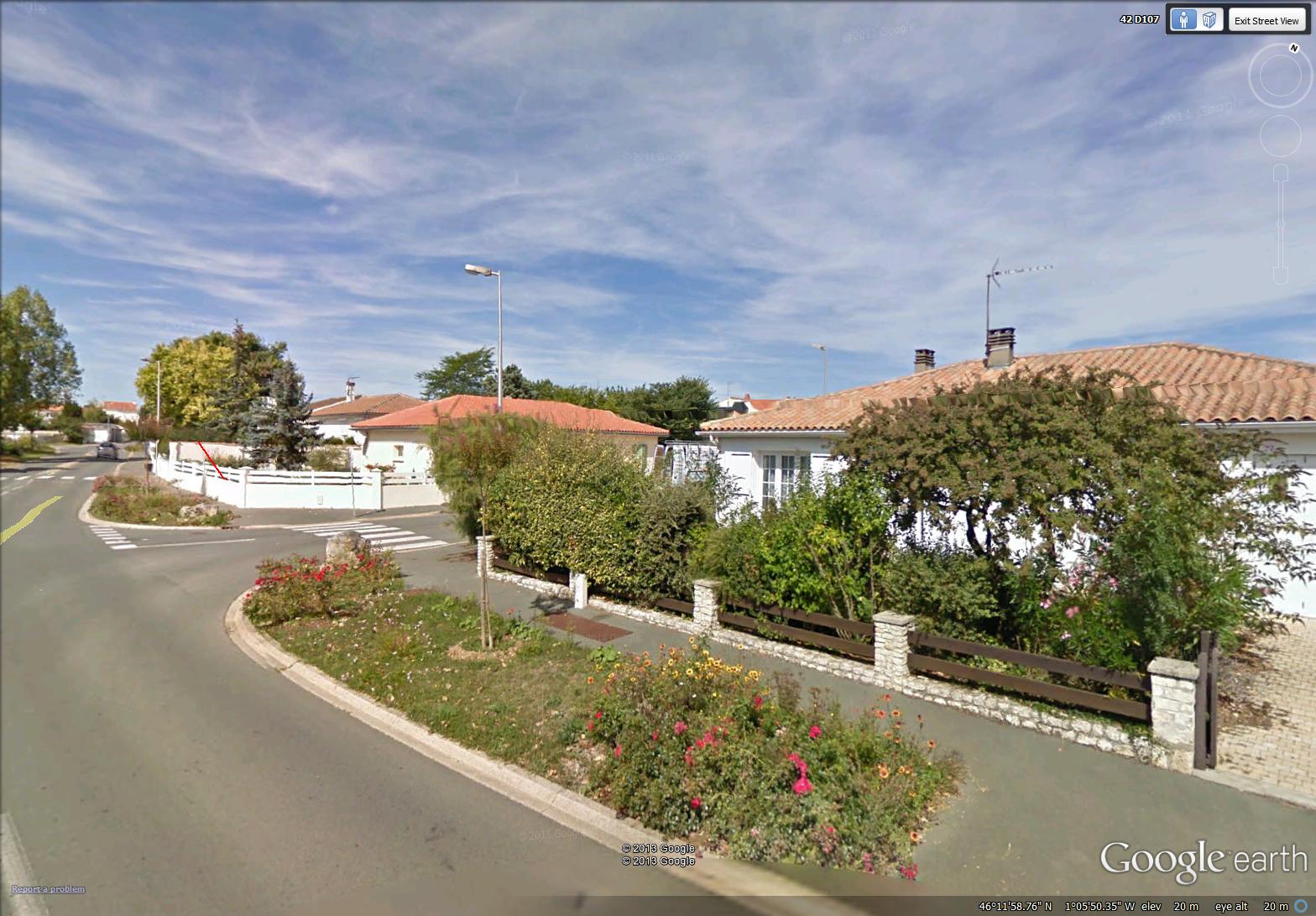
flowers along the sidewalk in Saint-Xandré (image from Street View)
~

~
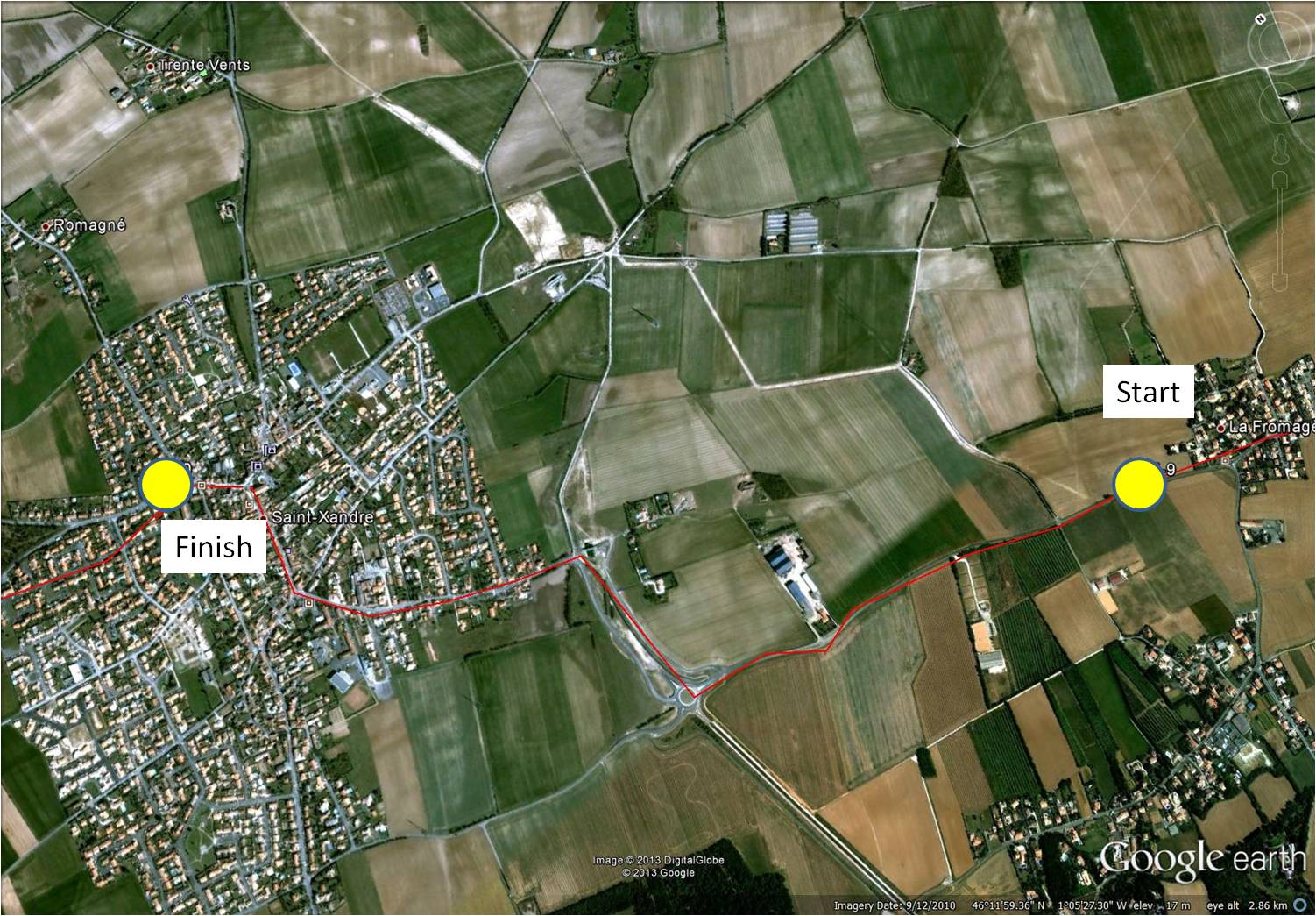
map showing distance travelled (map from Google Maps)
~
On May 9, I took my virtual bike along the streets of a town called Saint-Xandré. The sidewalks were planted with roses and flowers the color of petunias. I could ‘smell’ their spicy scent as I peddled by …
~
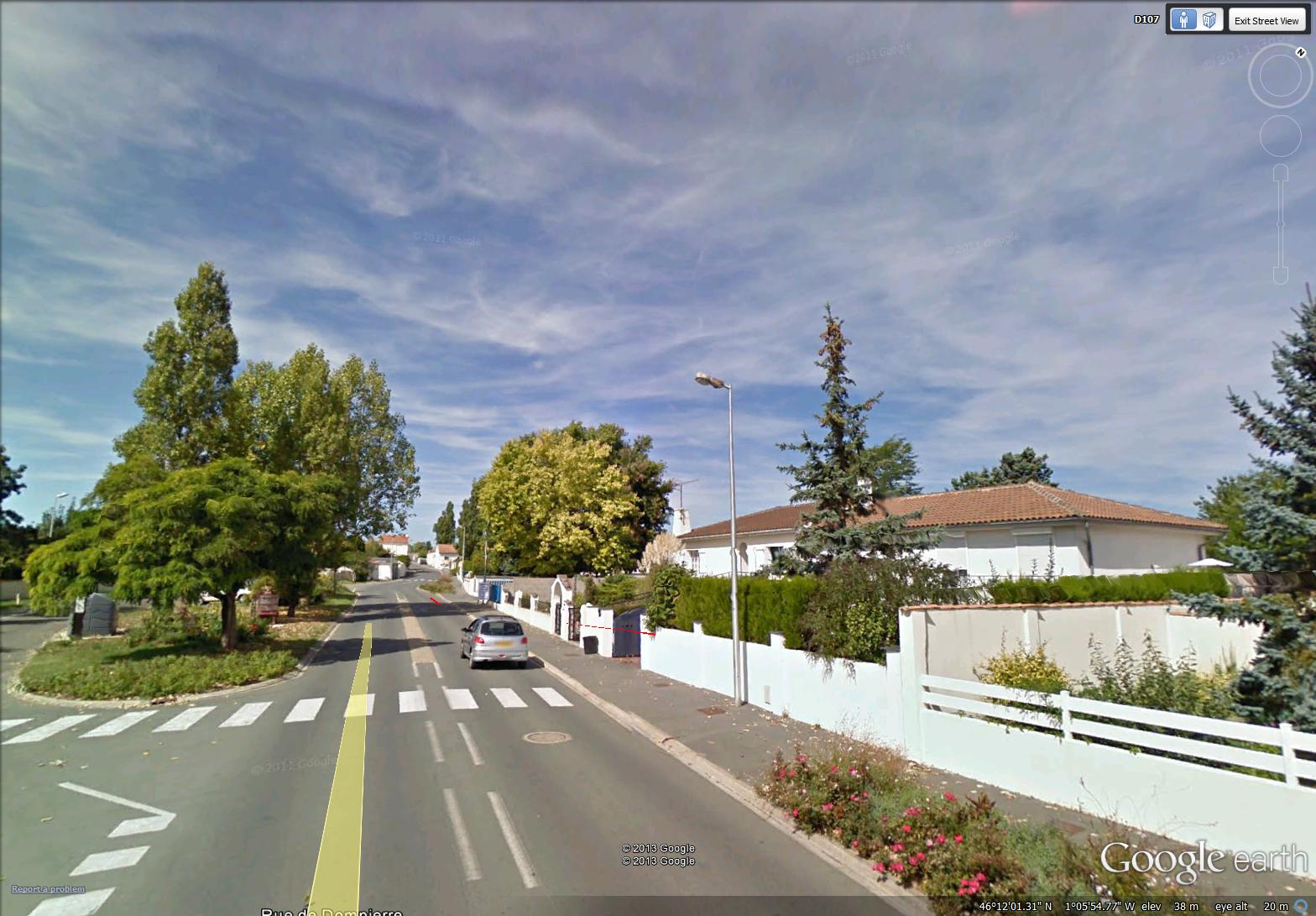
flowers and greenery line the main streets of Saint-Xandré (image from Street View)
~
Since I can never get close enough to identify the flowers, I just imagine they are similar to flowers found here at home. As I passed one yard, the heady smell of white lilacs filled the air …
~
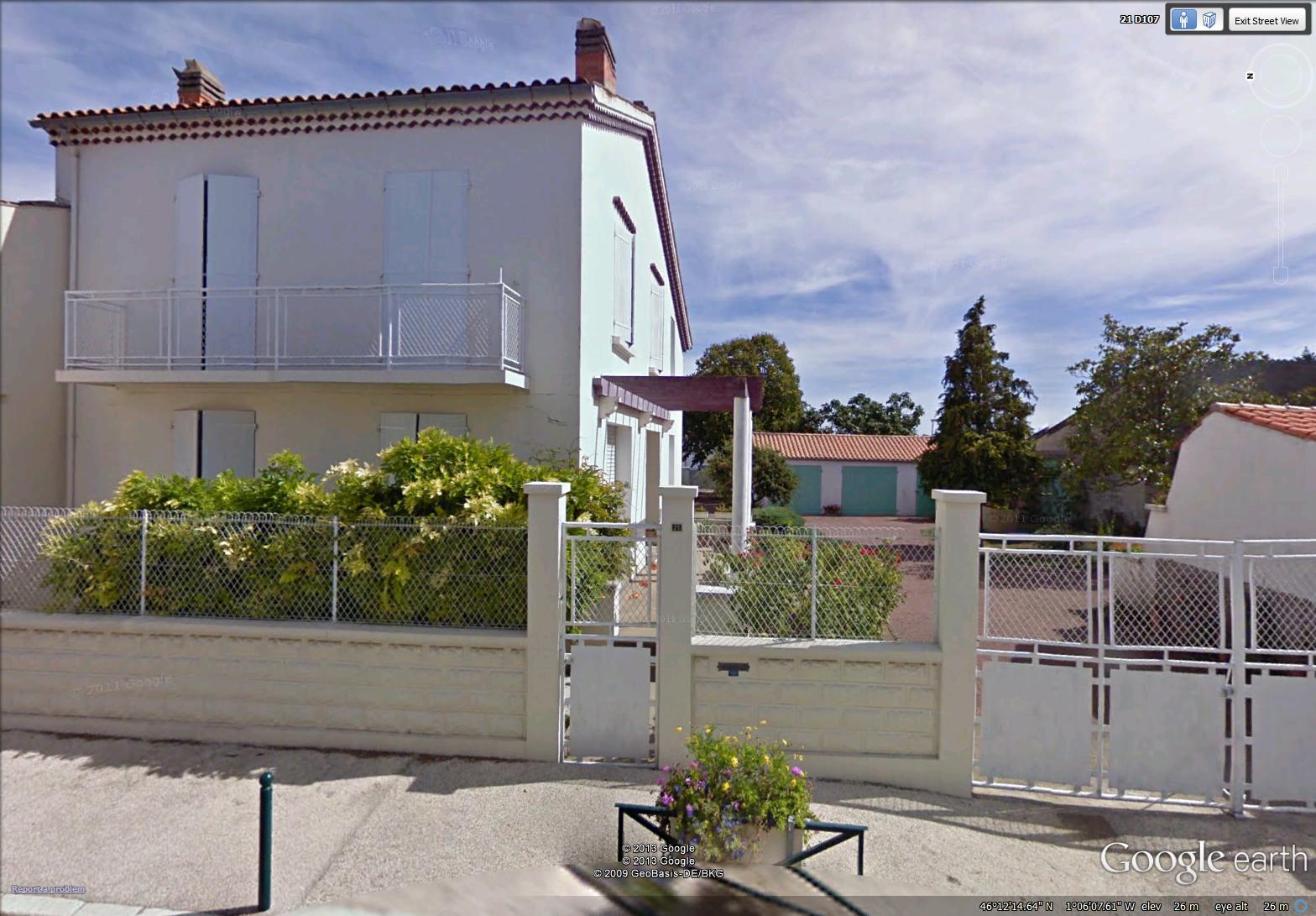
these flowers remind me of the white lilacs in our yard at home (image from Street View)
~
One of the houses reminded me of how I would like our cottage to look. I love the calmness of the greens on the shutters of this house …
~

a charming house with cottage appeal (image from Street View)
~
We have a way to go before our cottage looks like the one above. We have just installed our big front window and will finish the siding later this spring. Our cottage started its life as a shed. We intended to build something bigger, but as time went by, we realised – it is the perfect size for us …
~
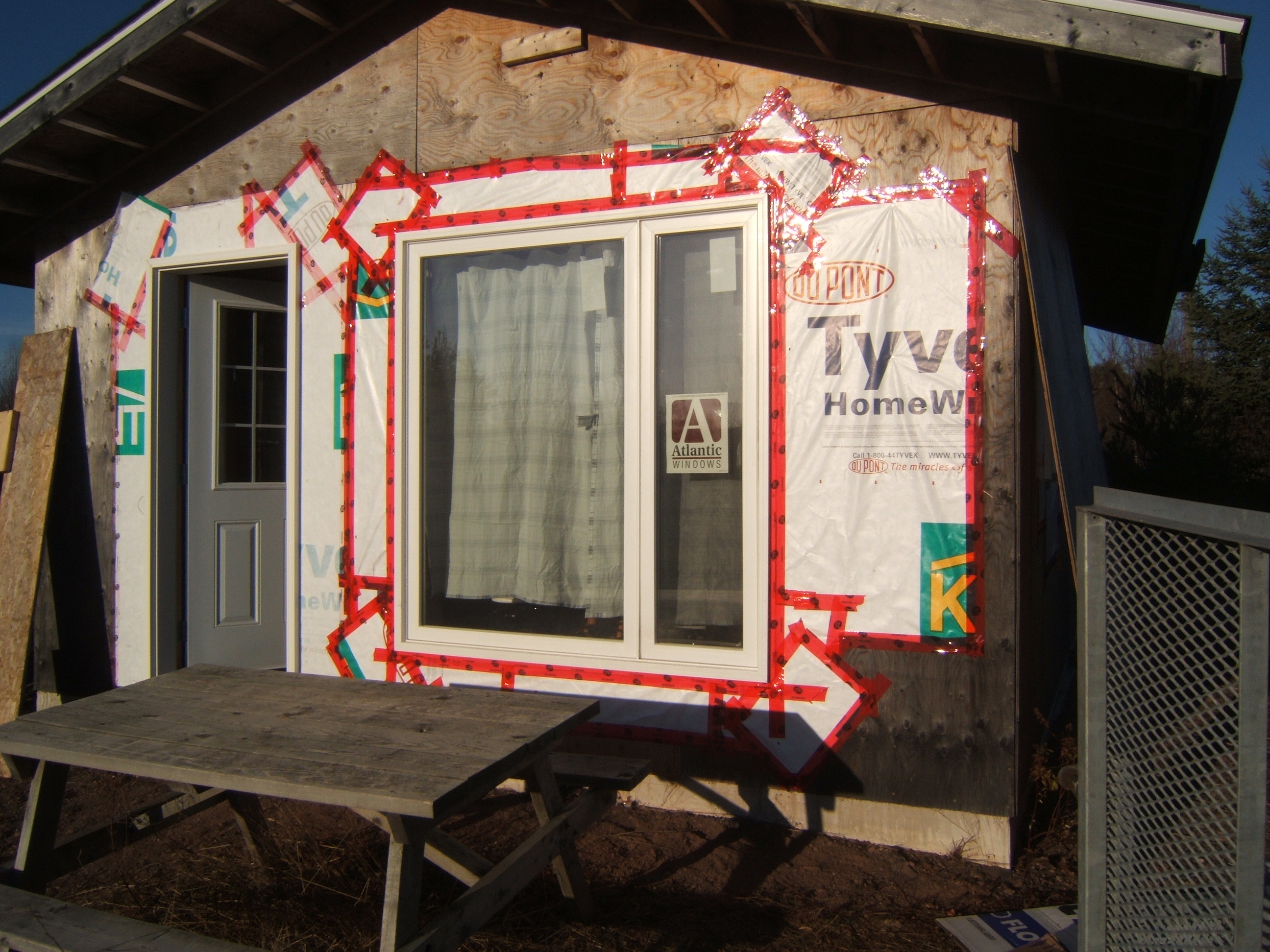
our cottage/camp/cabin at the lake is under construction
~
Best View: pots of flowers along a street in Saint-Xandré …
~

~
Copyright Jane Tims 2013
writing a novel – the first reads
So, I have completed the second draft of my novel. This stage follows the pages of edits I had after reading my book on my e-reader. It took two long days to make the changes. I emerged from the experience feeling that I needed a few other eyes on my work before I start another draft.
I am lucky to have two people in my family who have volunteered to look at the draft, my son and my niece. I am also fortunate to belong to a couple of writer’s groups and some of these brave folk have agreed to give the draft a critical read. I don’t know what to expect, but it will be so helpful to see their comments, both good and bad. I am so grateful to them all.
My husband is also listening to the draft. Just before we watch Coronation Street each evening, I read a chapter from my novel to him. He is no book-worm, but he listens carefully and gives me his impressions. He is especially helpful on some of the technical issues. For example, my main character’s husband, Tom, is a welder, and my husband explained to me that you can’t weld copper to steel. Also, I find errors as I read. So, I make a few changes each evening.
~

Tom, my main character’s husband, is a welder… in the novel, he makes a series of wind sculptures for the writers’ retreat… this wind sculpture is one we have at our real property by the lake
~
I am rapidly coming to a time when I will leave the draft untouched for about three weeks. This is Stephen King’s advice (On Writing, 2000). It will give me a chance to return to my poetry and meet some upcoming deadlines. Then I will pick up the draft of my novel, to read it as if brand new! Who knows what idiosyncrasies I will find!!!
~
For you to read, here is an excerpt from the book, about Tom’s wind sculpture:
~
‘You shouldn’t be welding, you know,’ I said. ‘The doctor said you might improve if you stayed away.’
‘The doctor said I’d already done all the damage I could do,’ said Tom.
I was silent. It was an old argument. Tom didn’t want to hear about possibilities. He believed in the frozen-cold facts.
‘Hey, girl, have a look.’
He lifted part of his project from the bench. The main element was a long cylinder of steel. In a coil around the cylinder, he had welded a thick, inflexible steel wire. To the flat end of this wire, Tom had screwed a broad triangle of copper sheeting. The triangle was shaped like an oak leaf, cupped and angled to catch the wind. Tom stood the cylinder on its end and it became a tree with a single clinging leaf. He reached for another piece of formed metal and threaded the two together. With his hands, he moved the unit, giving me a glimpse of the way it would move in the wind.
‘It’s wonderful,’ I said, always awed by the mellow gleam of the copper and his ingenious designs. ‘How many leaves will there be?’
‘Nine, in three layers,’ he said. ‘It’ll be taller and quicker than the others.’ He had already finished the first three in a series of these wind mobiles. Eventually, they would be part of a sort of garden he had planned for the property. ‘Writers,’ he said, ‘will visit the wind garden and be inspired.’
The whisper of the wind and the mobile joinery of the sculpture, the exchange of light between the burnished metal and the shimmering lake, together these would create a magical, rhythmic experience of light, movement and sound, perfect for meditation and contemplation.
~
Copyright Jane Tims 2013
in the circle of the evergreen wreath
Every year, during Advent, I either purchase or make a wreath of evergreens to celebrate the coming of Christmas. Last year, making the wreath, I had a little help. Zoë decided the perfect place to perch herself was within the circle of the wreath.
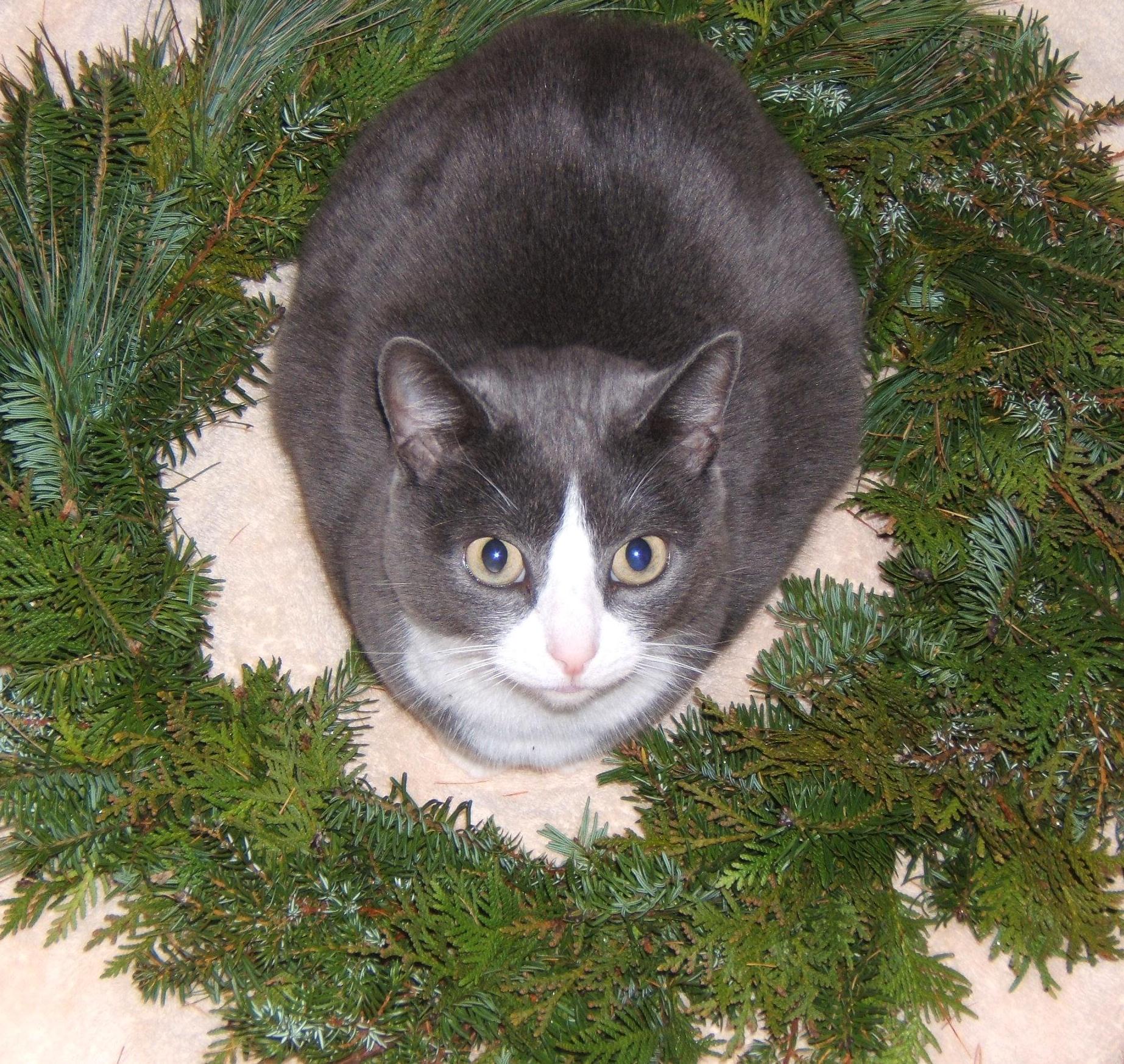
Our wreath materials were all obtained on our lake property. The species we used for our wreath were:
- White Pine (Pinus Strobus L.)
- White Cedar (Thuja occidentalis L.) also known as Arbor Vitae
- Balsam Fir (Abies balsamea (L.) Mill.)
- Common Juniper (Juniperus communis L.) -the variety we used was too prickly and I won’t use it again.
~
At this time of Advent, we wait in the darkest days of the year for Christmas. The wreath is one of the most endearing symbols of this wait. Made of evergreens, it speaks to the concept of everlasting love. To count down the Sundays before Christmas, we light purple and pink candles to symbolize ideas of Hope, Peace, Joy and Love. The lighted candles also represent bringing light into the world.
The wreath is another of those symbols borrowed from pagan times, when the circle represented the ever-changing seasons and the circle of life. The evergreen stood for the part of life that survives the winter season and candles symbolized light shining through darkness.
~
~
gathering green
~
in the space between solstice
and the whisper of stars
in a herded sky
daylight shrinks, always one hour
short of rested
~
in the thicket we gather
armloads, garlands of green
fragrances of cedar and pine
red dogwood twigs
stems of red berry, alder cones
curved boughs of fir
~
flexible as mattress coils, piled on ground
to rest, await brief
overlap, longest night
and feathering of angel down
~
watch, through the trees
the struggle
planet light
and pagan fire
~
~
© Jane Tims 2012
how high the snow?
Last week, we had our first substantial snow. My husband is happy because he plows driveways with his tractor. I am happy too because the snow makes everything clean and white.
Both of us wish we knew how much snow will fall this winter. Even the weather station does not make any attempts to guess the snowfall in the coming months.
However, I enjoy the old ways of prediction … my Dad used to say the snow would be as high as the wasps built their nests. Last week, while walking one of our trails, my husband found a wasp nest at chest height. Last year, in 2011, there was a wasp nest in our arbour, at a point just above our heads. Therefore, we have concluded… this year we will have less snow than last.
By April, I should know if this method works!!!!

~
~
prediction
~
had a lengthy meeting
before the Queen OK’d the plan
and started the nest – concise, globular,
paper contract with winter
~
she ordered us to work,
to strip wood from
the human house next door,
chew the pulp, publish the bulletin
~
takes stacks and layers of paperwork
to predict with certainty
where home will be safe and above
the snows of December
~
the secret in fine print,
on paper walls –
light grey from the patio fence
dark grey from the shingles
~
~
Copyright Jane Tims 2012
competition for space
One of the discouraging aspects of our lake property is how fast everything grows. In 2005, we bought 7 1/2 acres of field…
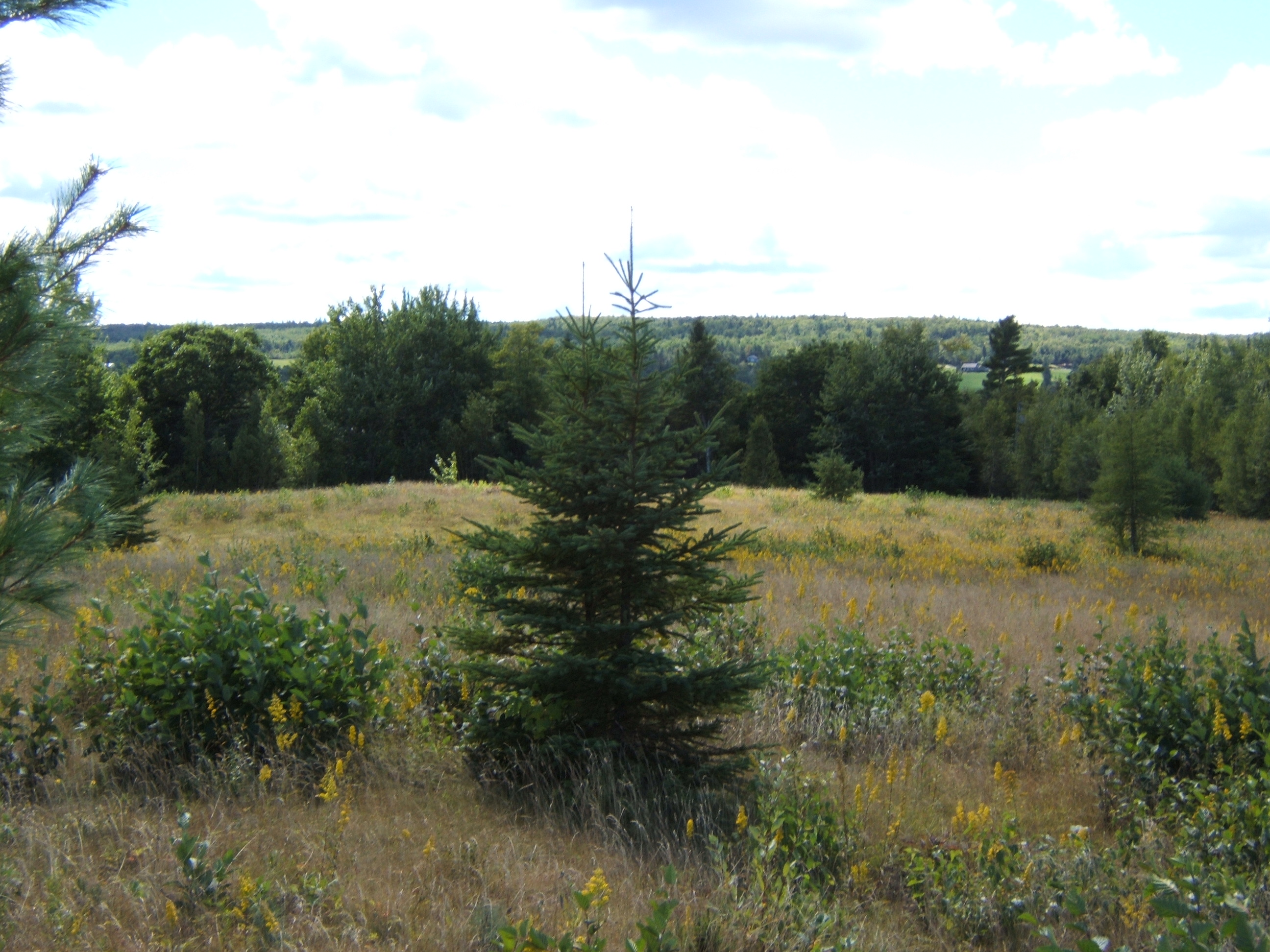
in 2012, we have 7 1/2 acres of alders and young trees…
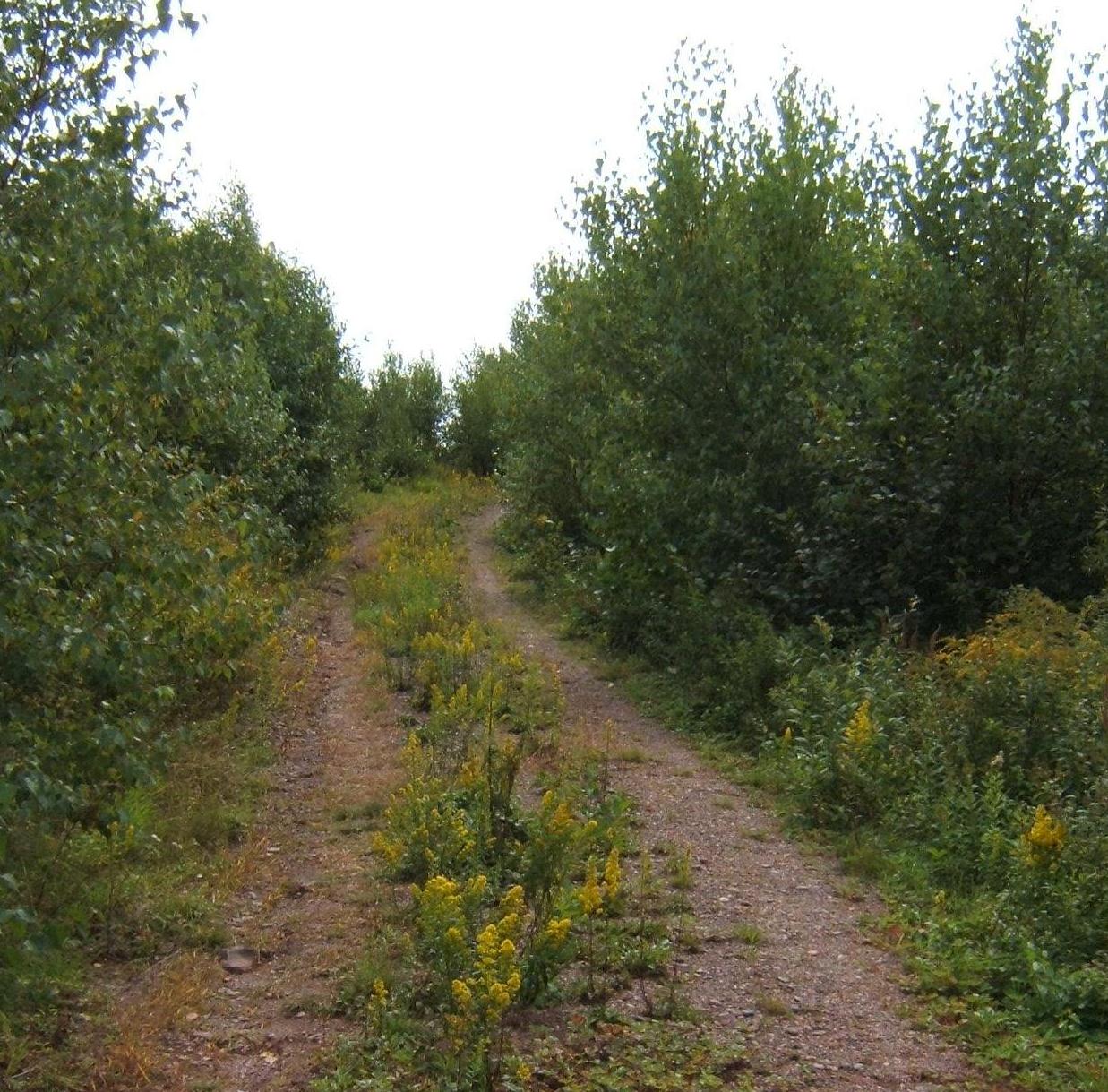
I actually like the lush vegetation and we intend to always keep the forest of trees down by the lake, to help protect the lake environment. But we humans need a little room to move!!! Although we knew we would eventually have more trees than field, we always thought we’d be able to:
- keep the road and turning area at the lake end of the property clear of weeds and wide enough for a vehicle
- keep the area around the camp clear
- have some trails for walking and access to the various parts of the property
- keep our blueberries – they have trouble competing with the taller vegetation
- begin to groom some specific groves of maple and birch
- keep a small area of field so I can watch the grasses blowing in the wind.
The farmer next door was willing, for a price, to continue bush-hogging the area, just as he had done for years. But there were trees and various herbaceous species we wanted to keep, so we bravely set out to manage things on our own.
For me, that means snipping away with my shears. I get tired/bored very easily, so I am not much help. I mostly spend my time discovering new plants to protect and putting wooden stakes up to mark their position!
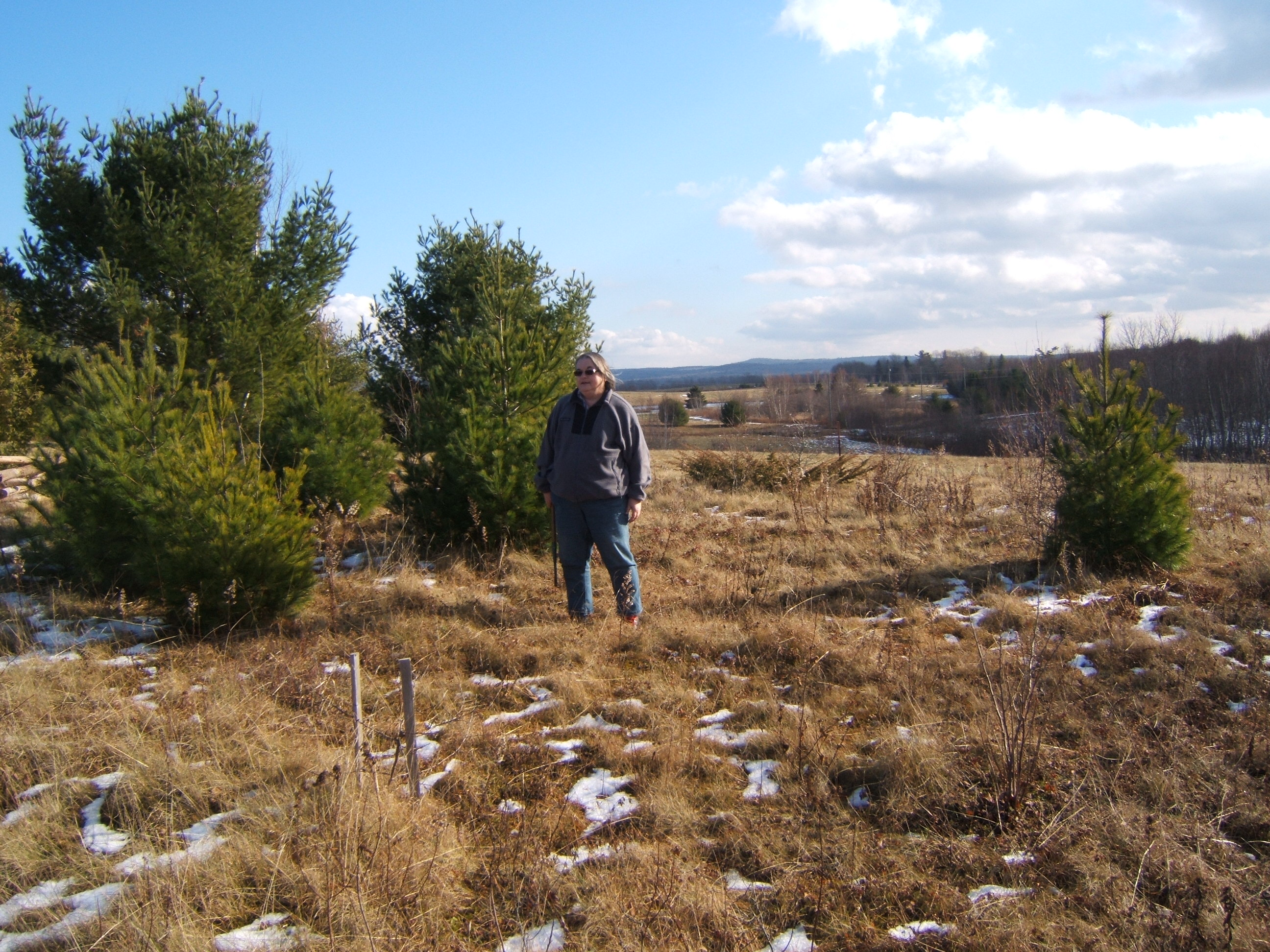
me with trimmers and marking plants with stakes
My husband has tried to keep back the growth with his bush-saw, and last year he was able to keep the road clear and even cut a new trail to access our blackberries. But progress is slow and within a few weeks, the alders, saplings and weeds have all grown back!

Finally, we became so discouraged, we began to think of alternatives. In the last two years, we have tried pulling the alders and I planted beans in the holes left all over the place. The deer really enjoyed my bean plants!
Now, we have the solution. We bought a rough mower that pulls behind the ATV. It is awesome! My husband has fun and is able to make huge progress. In just a couple of days, we have our road clear, there is a labyrinth of trails where we can walk, we have trimmed a selection of blueberry patches and we have our turning area restored at the lake end of the property. Notice the use of the word ‘we’, although my husband does all the work!
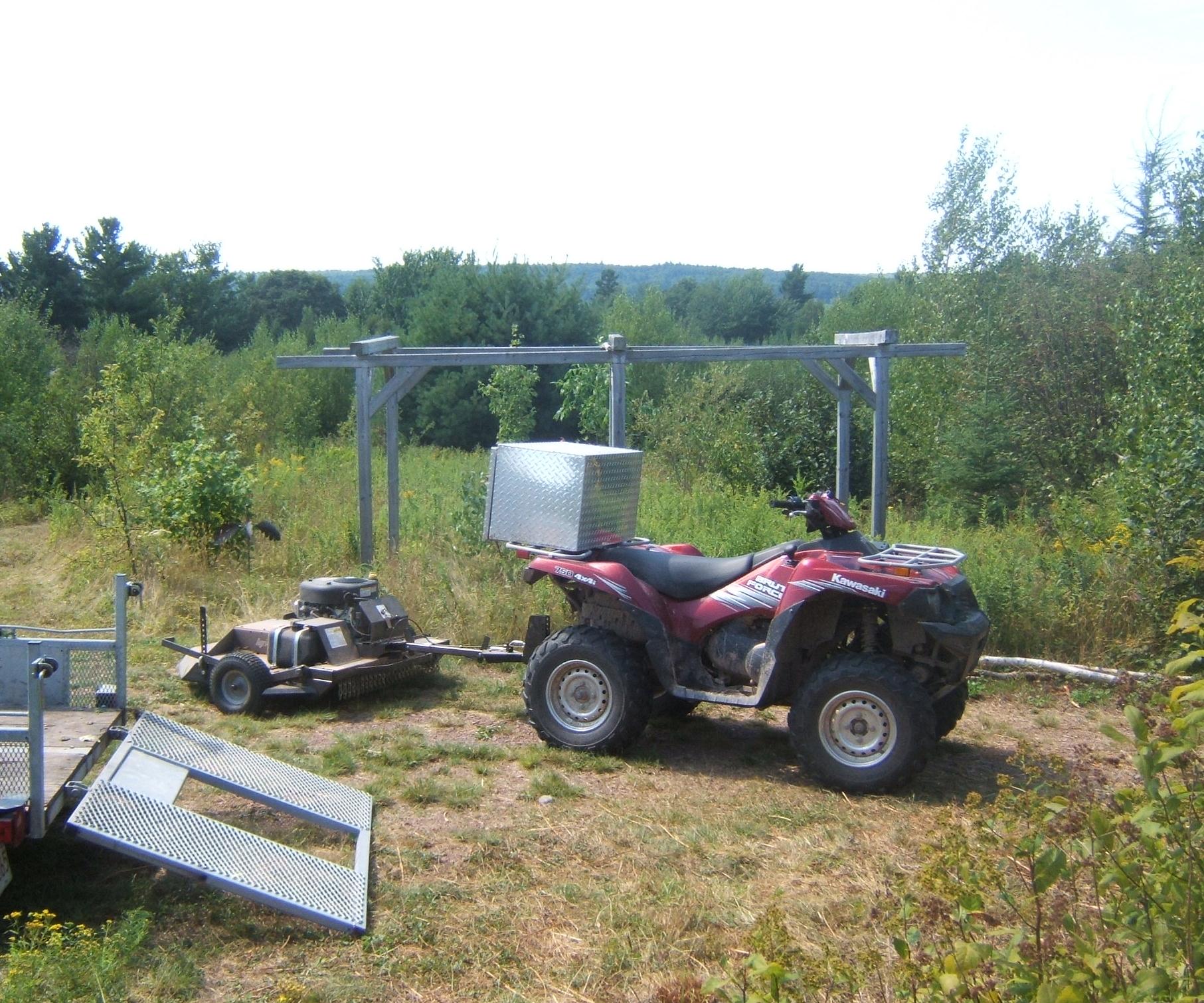
our new Agri-Fab Rough Cut Mower, designed for use behind an ATV
You can see the before and after shots of the road trimming in the three photos below. What you can’t see in the middle photo is the smile on my husband’s face as he mows! He was able to trim, in a few minutes, the trail it took him days to cut with the bush-saw last year.


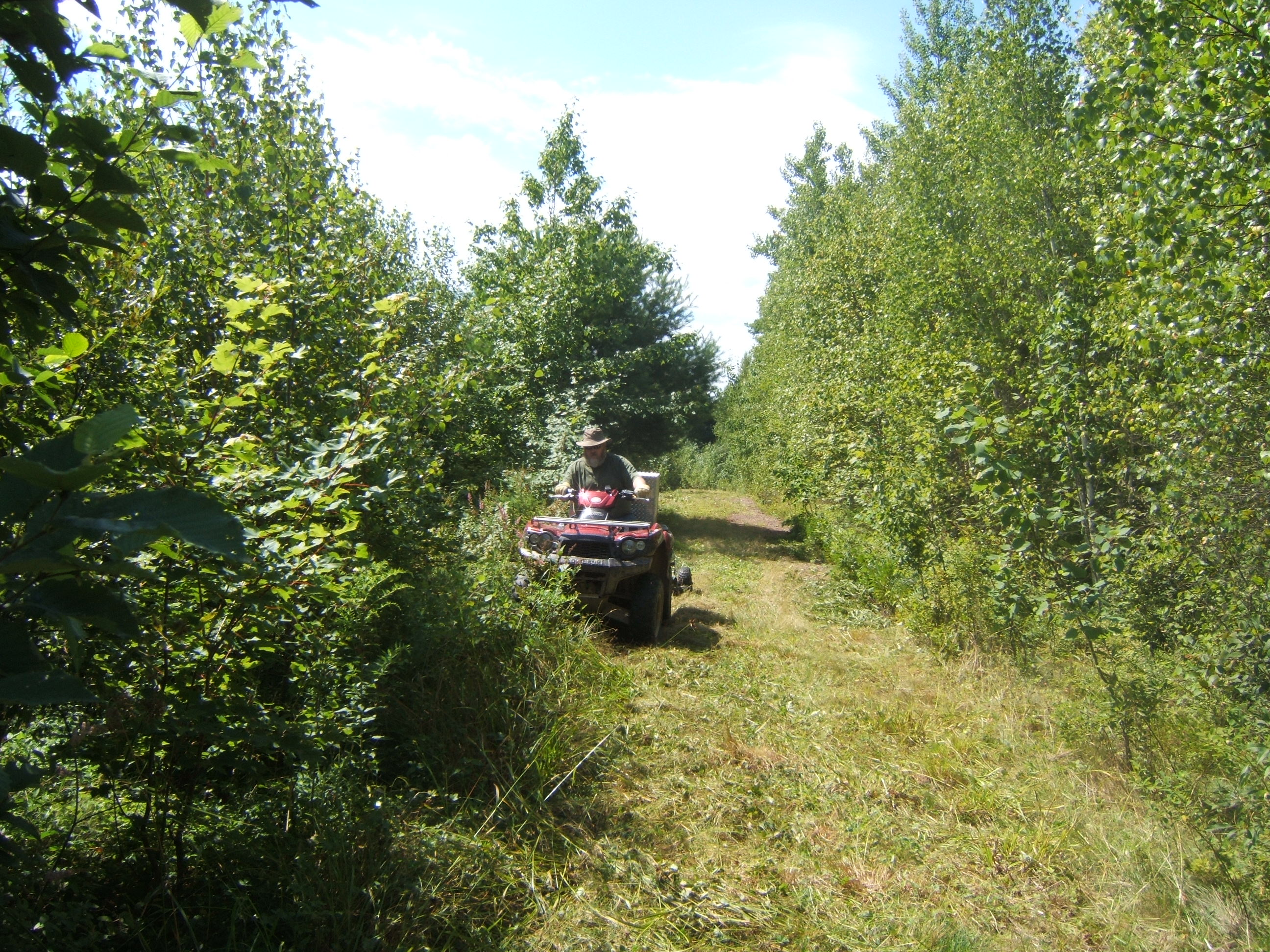
Now, my husband can use his bush-saw time to work on his groves of maple and birch.
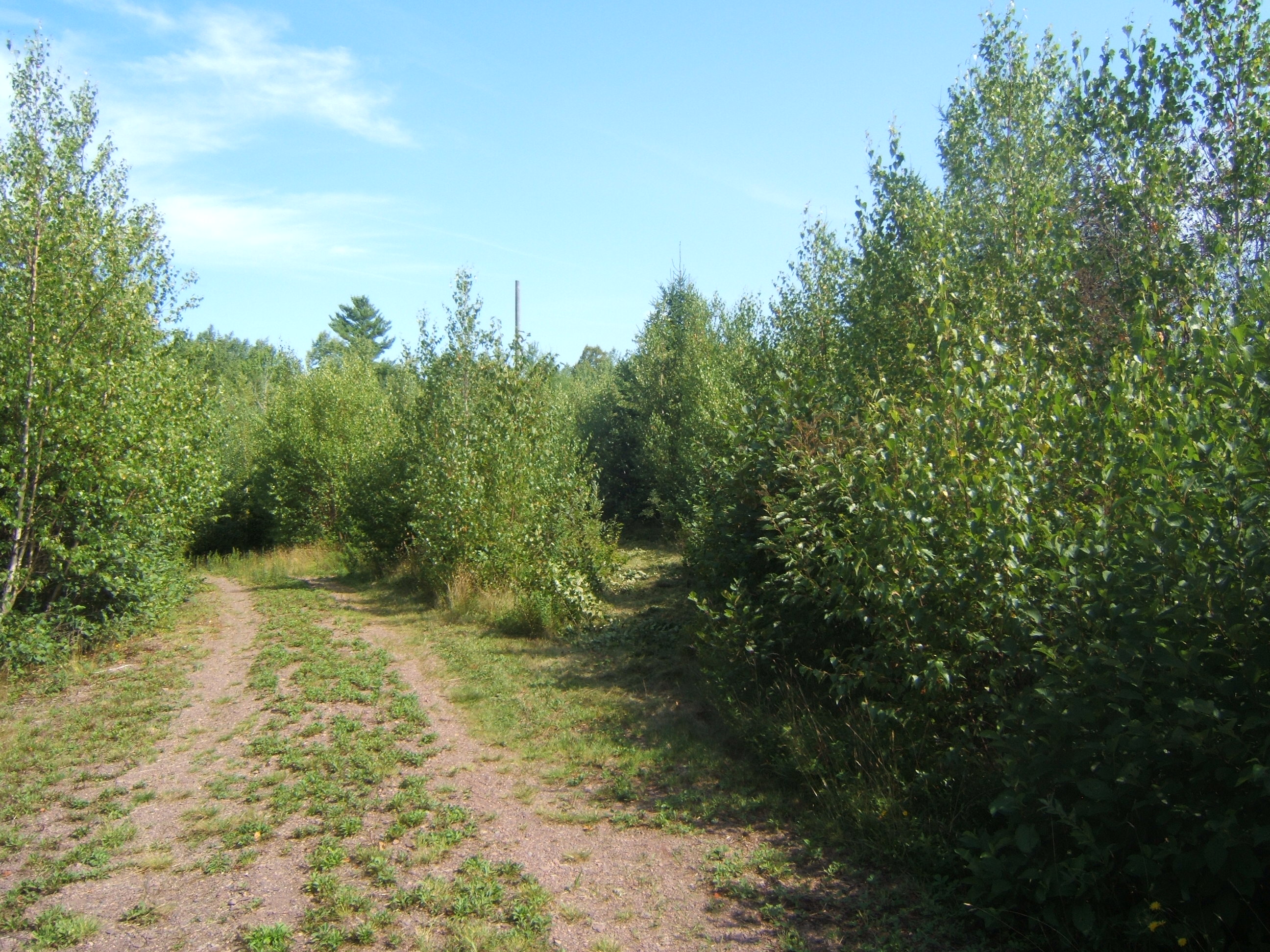
the first path cut by the new mower, to the right of the road
The only problem so far has been the hawthorns. We had a very flat tire on the mower after the first day. The man who fixed it said it looked like a porcupine on the inside, it had been punctured by so many thorns! Now, we are having each tire filled with foam!

5 cm thorns on the Hawthorn easily punctured the mower tires

© Jane Tims 2012
oldfield
In my posts this summer, the space I expect to feature prominently is our summer property.
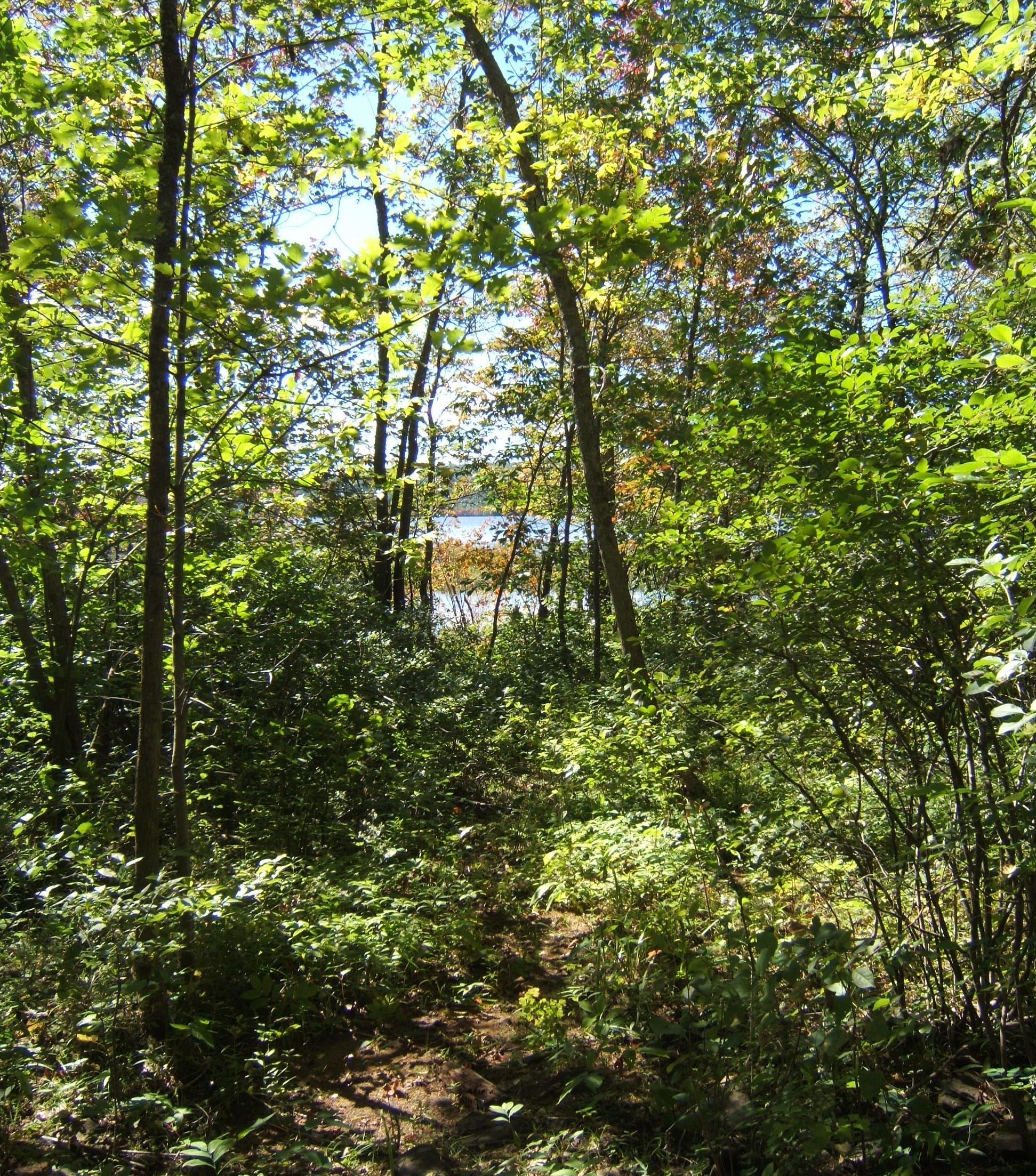
I’ve talked about this place before. One end of the property is along a lake (see ‘course of the creek’, September 12, 2012, and ‘ice is nice’, December 21, 2011, both under the category ‘waterways’). The lake edge is a bright forest of cedar, hemlock, birch and oak, and includes a beautiful marsh. We sit on our bench in the woods and look out at the lake, watching loons and deer and ducks. Once I saw an eagle plummet from the sky and dive into the water with a huge splash, to emerge with a good-sized fish in his talons.

Most of the property was/is an oldfield. When we bought the property in 2004, we bought an open field, thick with blueberry bushes and grass that rippled in the ever-present wind. There were a few trees, mostly bushy pine, spared year after year by the farmer’s bushhog. The field had been home to a herd of buffalo (bison) and we still find the dry, dusty evidence of their wallows.
The keyword in the last paragraph is ‘bushhog’! The farmer offered to keep the field mowed, but we are very independent. We were certain we could keep ahead of the various trees and alders sprouting everywhere.

The result has been the usual progress of an oldfield in the process of succession. Today our pines still punctuate the property, and there are enough blueberries to keep us satisfied, but other spaces have emerged… the alder swale, the maple grove, the path through the birches, the blackberry barrens, and, of course, our tiny cottage. There is a bit of grassy field still remaining and we struggle to keep it intact.

east boundary of our property, with our cedar rail fence, looking toward our neighbor's mowed field
When we go to the property I like to think about how it is changing, right before our eyes. Those buffalo would have a hard time recognising the place.
~
~
evidence of buffalo
~
“…in this field, years ago, I kept buffalo….”
beef farmer, selling his land
~
massive posts brace a page fence
woven with wire birch
dusty wallows where soil is crushed
and only lichen will grow
~
three apple trees trodden
parallel to ground
grey feed trough
strung together with nails
~
cedar waxwings search the fence
coarse hairs for their nests
winds nuzzle and whisper
through the brush of pine
~
~
© Jane Tims 2012
ice is nice
Our snow is slow in coming this year. We have had three snowfalls, but each, in its turn, has been rained or warmed away. If our ups and downs of temperature continue, the scant layer of snow on the ground this morning will be gone by Saturday.
However, winter is manifesting itself in other ways. I am wearing another sweater-layer this week. Our grey woods are muttering with chill cracking sounds. And ice is forming on the river and along the lake edge, gradually covering the surfaces with white and grey.
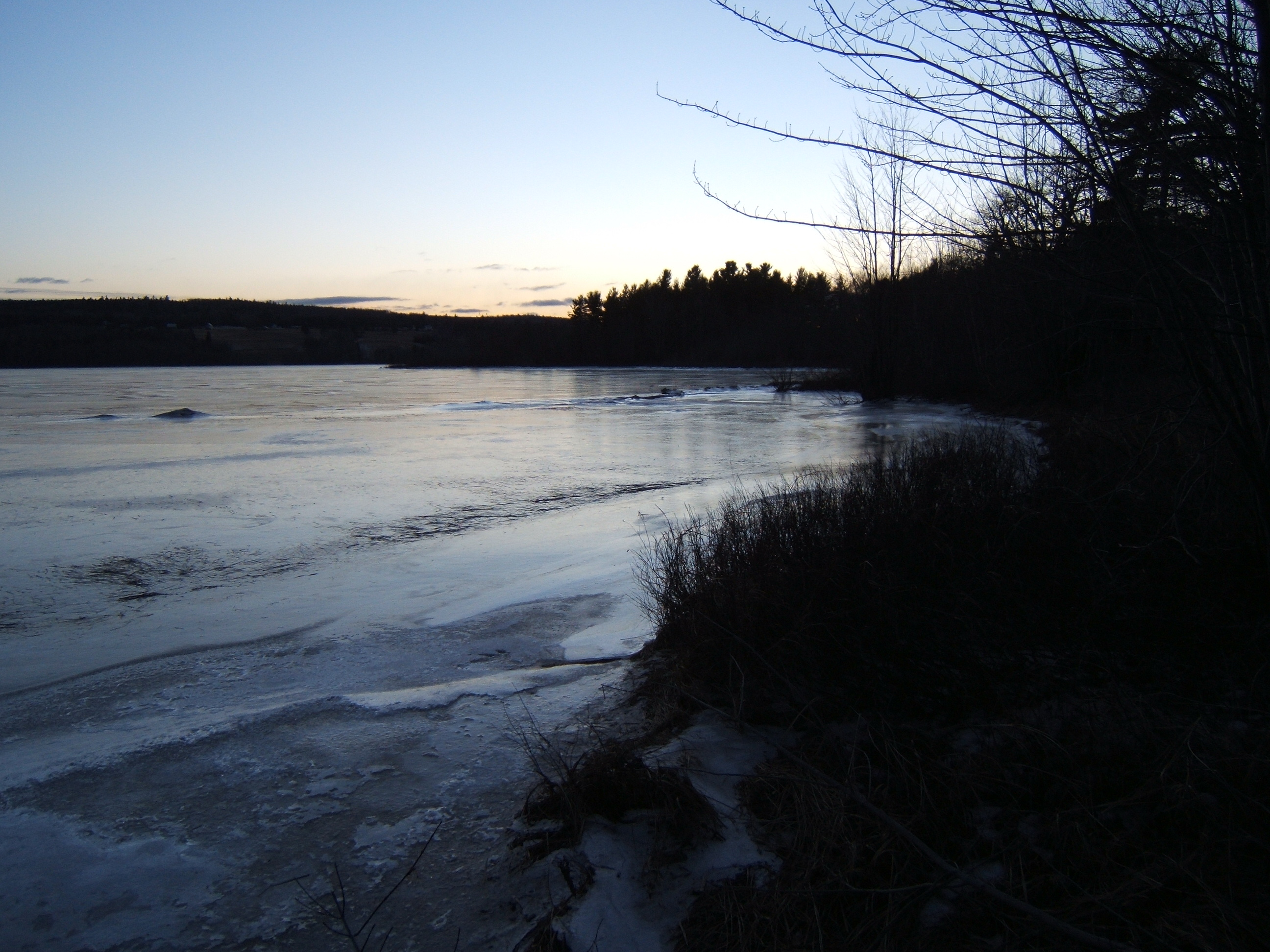
Ice – the frozen state of water… water is critical because it is a key component of our ecosystem and we need water to drink. Also, an unusual property of ice is responsible for keeping our ecosystem healthy.
Frozen water is about 8% less dense than liquid water. This means ice floats. As a result, bodies of water such as rivers, ponds and lakes, do not freeze from the bottom up. Instead, when water freezes at the surface, critical habitat is left under the ice for living things to survive and thrive. This is especially important for the bacterial and algal colonies at the base of the food chain.
Ice, therefore, is nice.
~
~
river ice
~
ice builds in shallows
at the rim of river, incremental
embellishment to glass, surrounds
willow stem and reed, thickness
increased as frost penetrates, sharp
edges cauterized by cold
~
© Jane Tims 2011

a nest in November
On Saturday, we drove to the lake to gather boughs of fir and pine for our Christmas decorations. While we were there, we poked around in the thicket. We found a few bird nests, still intact, easily seen now the trees and alders are free of leaves.
The first nest was cup-shaped, made of tightly woven grasses and weeds. Nests of songbirds are not easy to identify since they are similar in size and construction materials. If this little nest survives the winter, perhaps I can watch who uses it next spring.
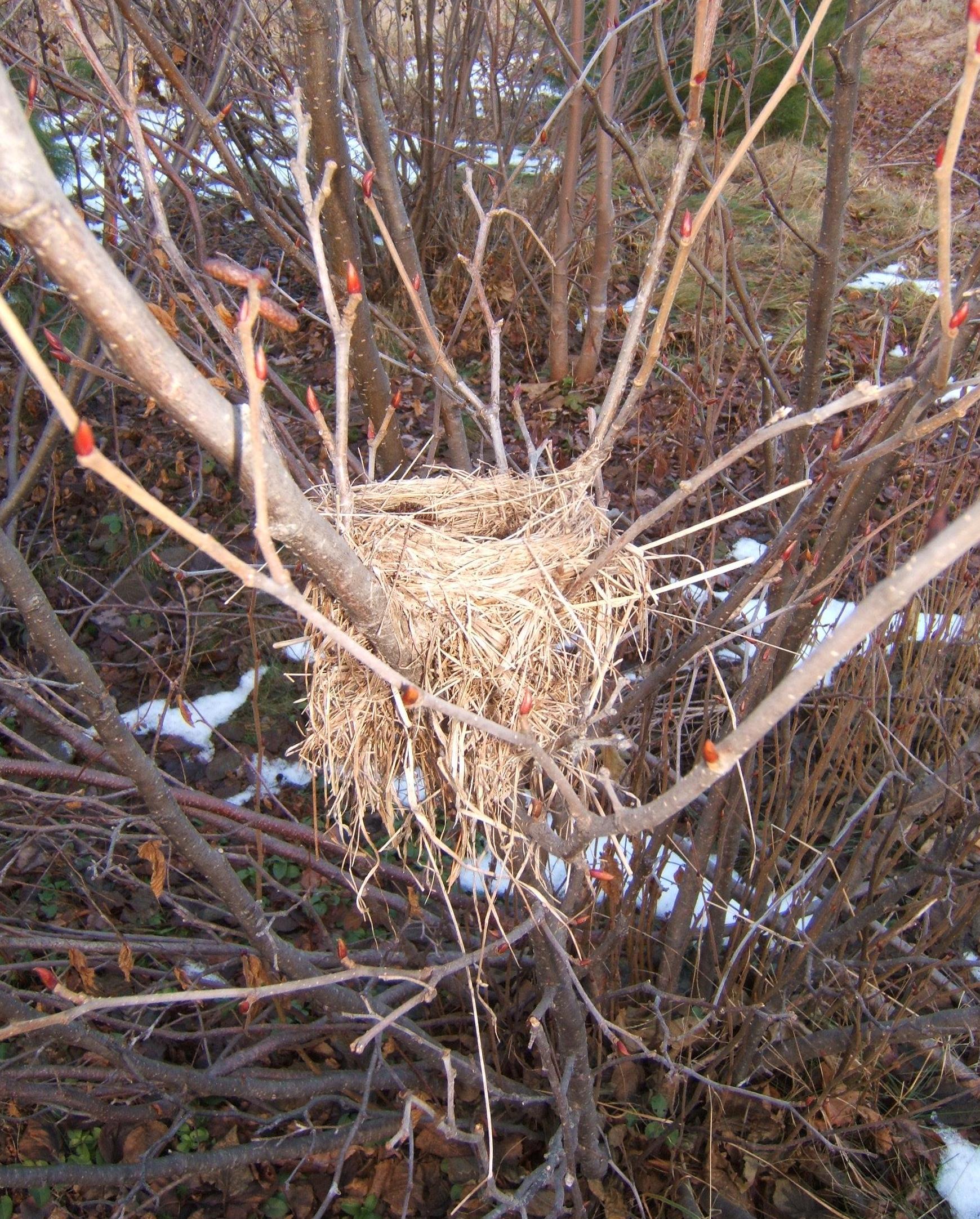
The second nest probably belonged to a Robin. It was high in a tamarack tree, welded firmly to the branches. Robins often return to the same area and sometimes use the nest of the previous summer, so I’ll be watching this nest too.

The last nest we saw was a beautiful little hanging basket covered with birch bark and woven with grasses. It appeared to be frail but it was very sturdy and stubbornly clung to the bough in spite of its exposure in the November wind. I think it is the most delightful sight I have ever seen.
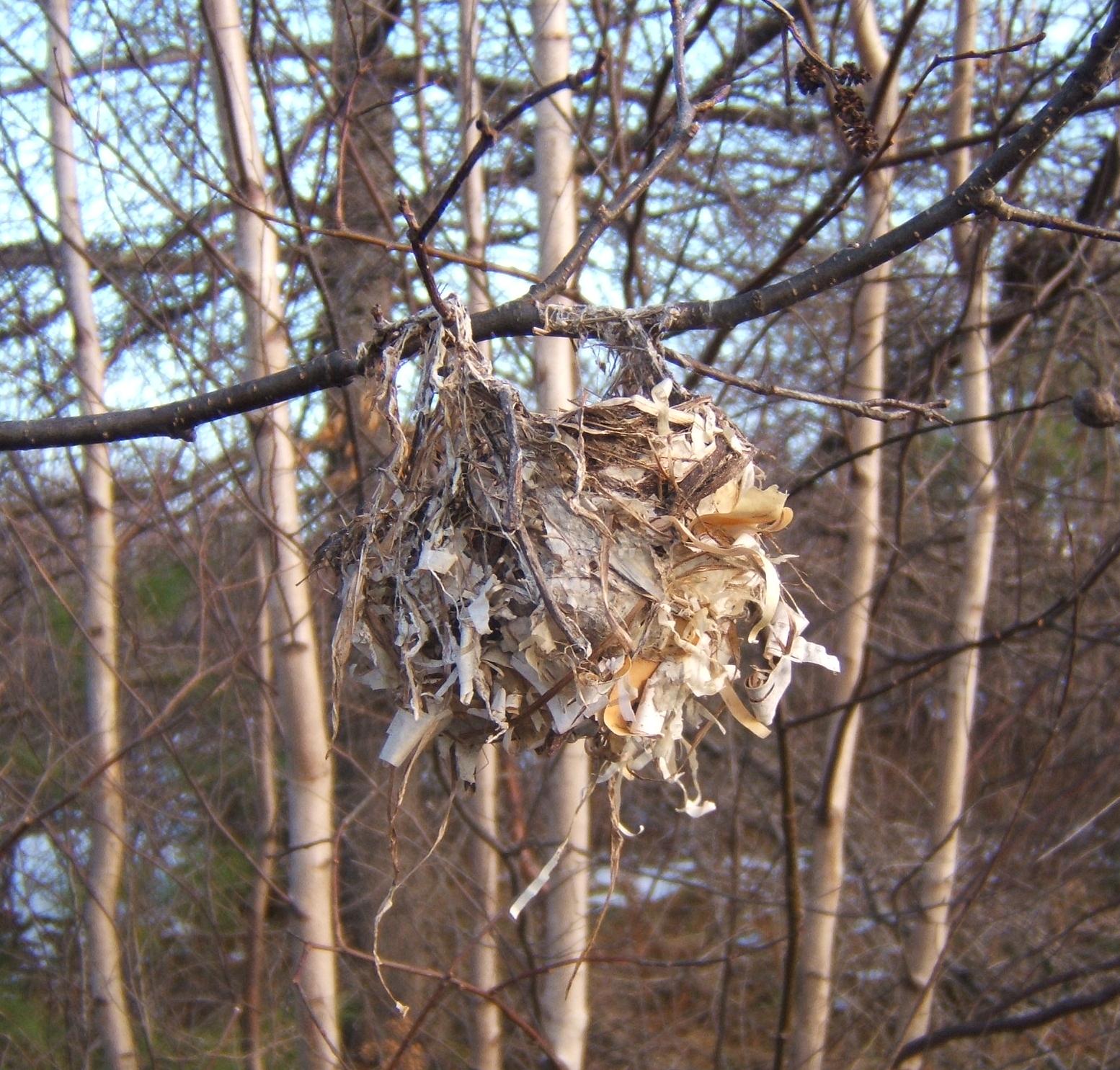
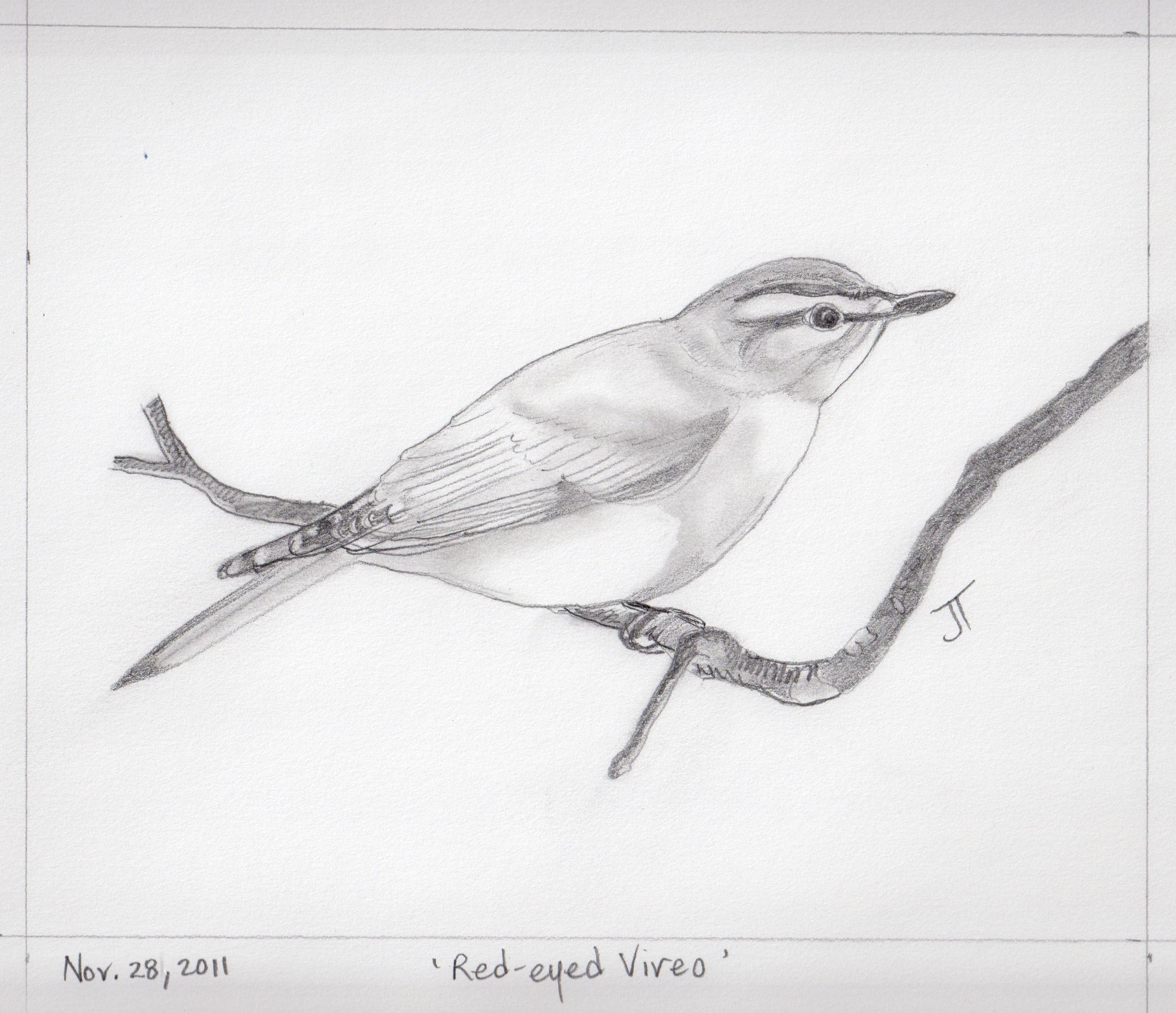
A biologist with the New Brunswick Department of Natural Resources was able to identify this nest from my photo. The nest probably belonged to a red-eyed vireo, one of our common songbirds. I have never seen this bird at our lake property, but we hear it all summer, endlessly asking its question and giving an answer.
~
~
Red-eyed Vireo
(Vireo olivaceous)
~
drab little
olivaceous outlaw
black masked
red eye
~
can’t see you
can’t find you
can hear you
where’re you?
over there
where’re you?
nowhere
~
in November
ghost-self flutters
in birch bark tatters
a basket in the alder
remnant of summer
~
gone now
what’d ya do?
did an answer finally
come to you?
~
© Jane Tims 2011
course of the creek
Our small cabin is near a lake, an offshoot of the Saint John River. We have what some would consider poor access to the lake, since there is a marsh between us and the lake shore edge. But that marsh is a very special place, ever changing and always interesting.
One way it changes, almost daily and certainly seasonally, is with respect to water level. You could say we are downstream of the entire Saint John River, meaning we are receiver of every fluctuation of the water level in the system. The situation is made complex by the influence of a major hydroelectric dam at Mactaquac.
In spring, the river floods, and the marsh is covered by water…
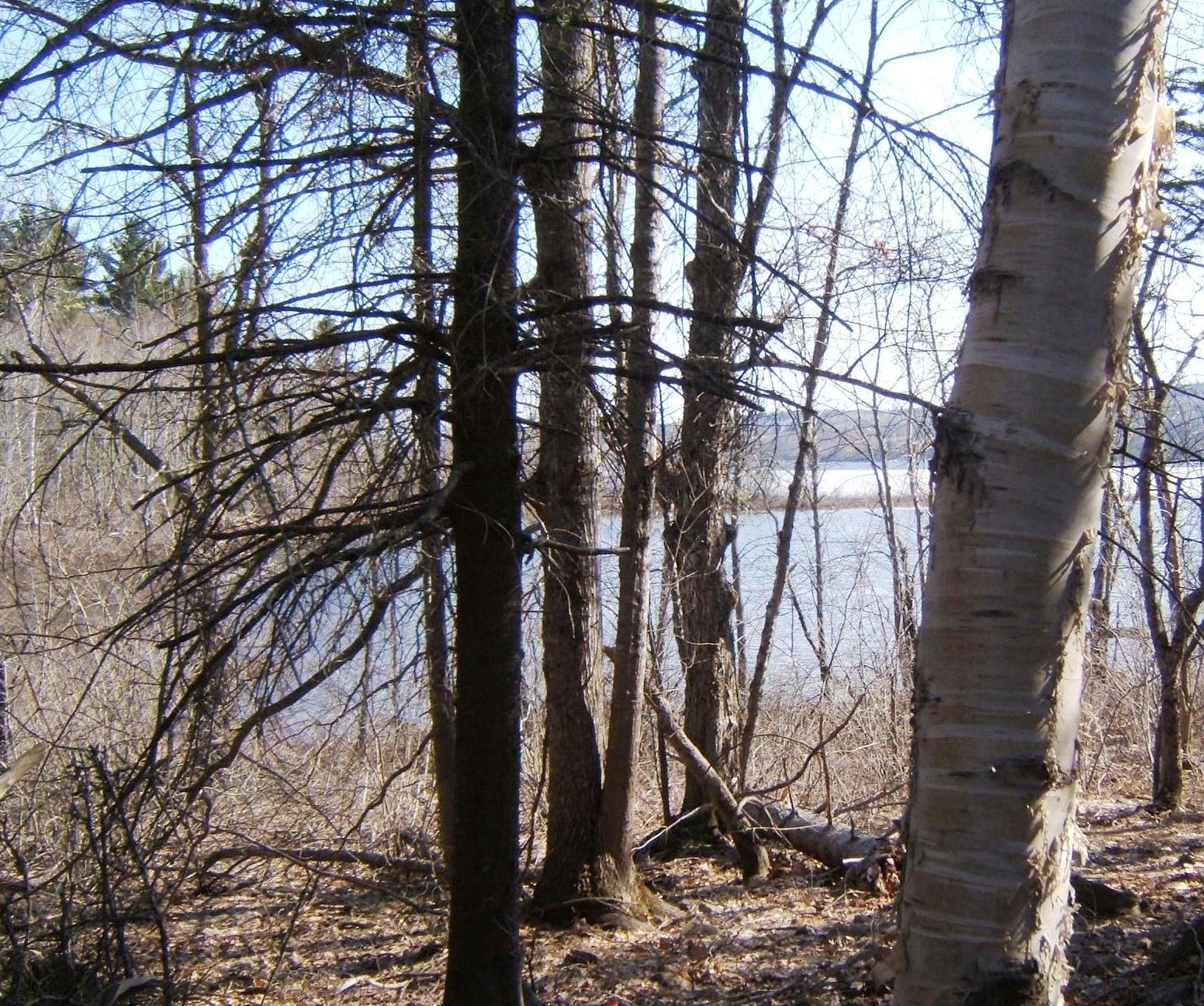
In normal years, the water levels become quite low, and our marsh is high and dry. We can walk on it, to reach the outer shore of the lake…

the green in the foreground is the marsh
In wet years, like this has been, the water stays high and there is a pond between us and the main lake…
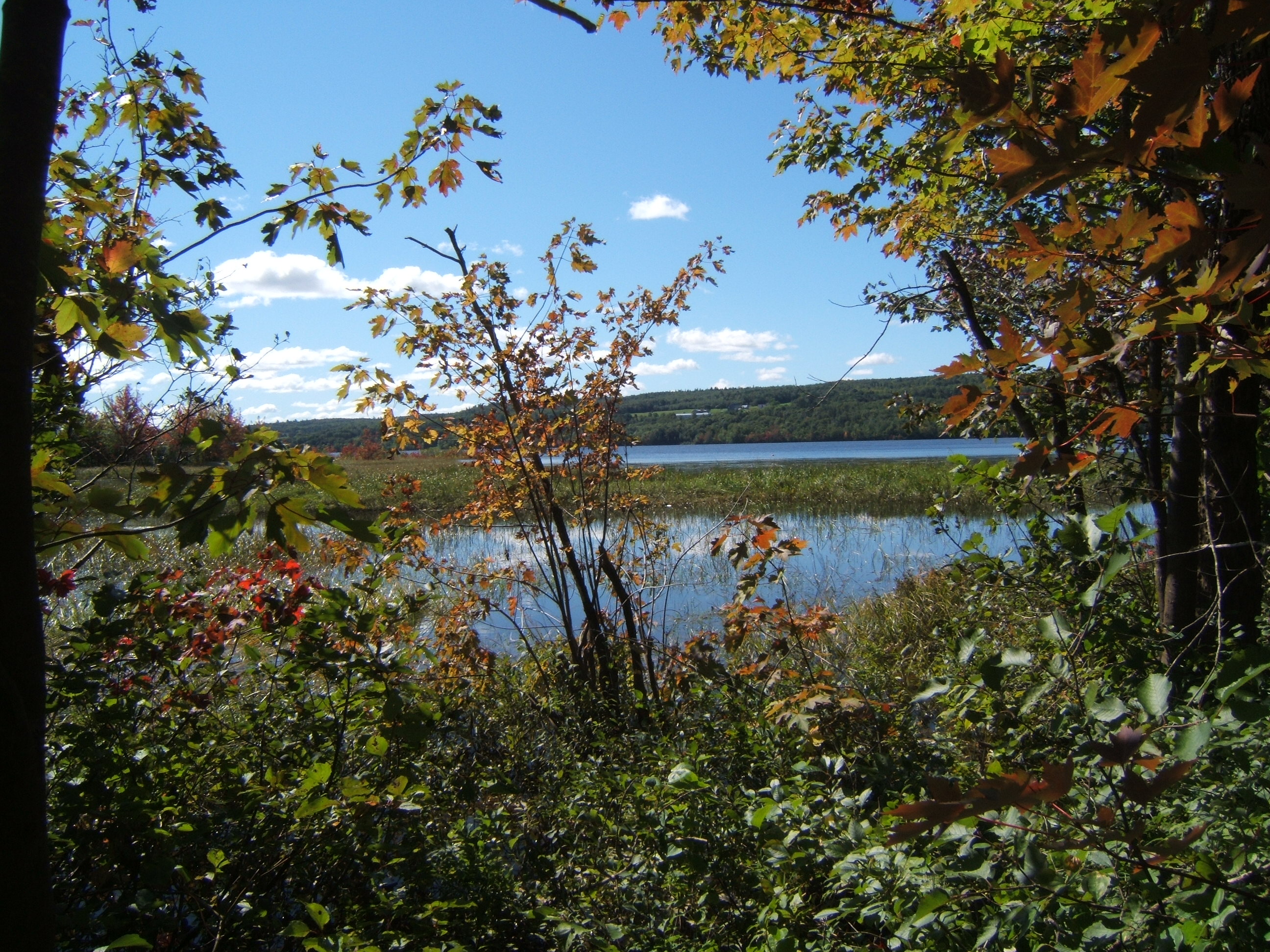
On Saturday, I went rowing on the pond in my small red rowboat. I rowed out to the edge of the lake and then followed the deeper waters of the small winding creek back into the marsh as far as I could go without grounding the boat. Last year I could see pumpkinseed sunfish in the creek water, but not this time.
Most of the grasses in the marsh are Spartina pectinata Link., broad-leaf cord-grass, ordinarily associated with salt marshes. Actually, salt water is characteristic of the lower parts of the Saint John River – the salt water wedge extends as high as Washademoak Lake, and the tidal influence is measurable to above Fredericton!
At the outer shore of the pond, where the creek enters the lake, I was surprised and delighted to find a few stems of wild rice (Zizania aquatica L.). This is not native to New Brunswick, but is often planted along shores to attract waterfowl and is now found all along the Saint John River and in many lakes. The grass is distinctive because the pistillate (female) flowers are in a group near the top of the plant while the staminate (male) flowers are on horizontal banches below.
I am an awkward rower. Usually, to improve my control and reduce my speed, I row the boat backward, stern first! In spite of my lack of speed, it is an adventure to be on the water, to become a bit of an explorer. My need to know the ways of the pond reminds me of my attempts to understand the path my life has taken.
characteristics of creek
~
clumsy row in the marsh pond
to seek the course of the creek
the strand of water’s flow
to nourish pond define
its shape conduit
to the lake
~
a slender S through grass emergent
pondweed and cord-grass vague
deviation from clarity hyaline the interface
of freshwater and salt and pumpkinseed
turn their flat bodies to intercept
the flow find the break in the mat of sedge
narrow simplicity of weed-free bottom
~
search
and find
the inevitable
thread in flow of
story the theme to bind
the words and water into one
~
© Jane Tims 2011




 nichepoetryandprose