Archive for the ‘growing and gathering’ Category
‘within easy reach’ – why did I write these poems?
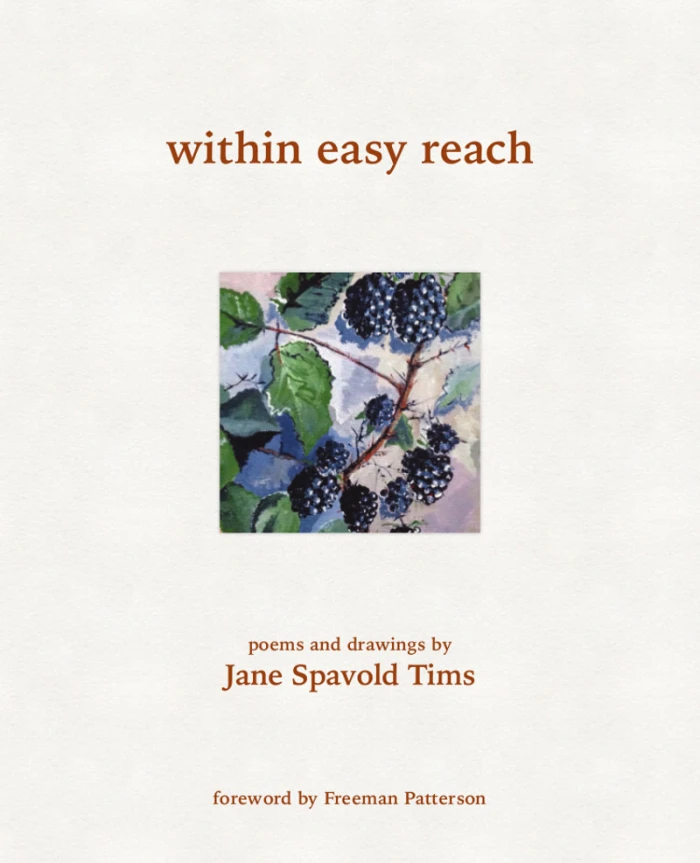
Later this spring I will have a book of poems and drawings in publication – ‘within easy reach’. The poems and art in the book are about gathering local, mostly wild, foods. I have been fortunate to work with a wonderful publisher, Chapel Street Editions, interested in books about the natural history, human history, and cultural life of the St. John River Region of New Brunswick, Canada. http://www.chapelstreeteditions.com/about_chapel_street_editions.html
~
As a botanist, I loved making this book. Identifying plants is a skill learned in university and during years of enjoying the out-of-doors. Many of the plants are found on my own property, but my husband and I travelled throughout the region to find some species. We found edible trout lily along the banks of the Dunbar Stream, salty orach on the beaches of Saint Andrews, and dangerous-to-eat water dragon in a wetland on the Renous highway. On our own property we tried to out-smart the squirrels for hazelnuts, tapped twelve trees for maple syrup and discovered partridge berries growing in the woods behind our house. As you can see, part of my enthusiasm for the subject is about spending time with my husband!
~

~
I also did a little time-travelling to write these poems. Although most of the plants I write about are found in the St. John River Region, I looked into my own past to remember some edible plants in other parts of Canada. This included eating cactus berries on the Alberta prairie, buying cloud berries from children along the Trans-Canada in Newfoundland, and picking blueberries with my Mom and Dad in Nova Scotia. I also looked to the diaries of my Great-Aunt to get a glimpse of the growing and gathering habits of an earlier generation.
~
I am sure many of my poems will echo memories of your own experiences with local foods.
~
Eating near to home has so many benefits – these foods are often free and have not travelled far to your table. Many wild foods go unharvested although they are ‘within easy reach’. Just think of those apples in the abandoned orchard at the edge of town, the dandelion greens on your brother’s lawn, or the choke-cherries growing along the fence down the road. Although you should use care when eating wild foods, many are easy to harvest and can add variety and taste to your meals.
~

~
In my next post, I’ll say more about why you might enjoy reading my book. And very soon, I’ll be starting a count-down on my blog to let you know how many days you have to wait until publication. I’ll have a contest and a give-away. Shameless self-promotion!
~
Copyright Jane Tims 2016
‘within easy reach’
This spring, I will celebrate the publication of my first book of poetry!
~
‘within easy reach’ is a result of my 2012 project ‘growing and gathering’ supported by artsnb (the New Brunswick Arts Board). The poems focus on harvesting and eating local foods, especially wild foods. My book will be published by Chapel Street Editions, Woodstock, New Brunswick.
~
The book will include about sixty poems as well as some of my black and white pencil drawings. These are poems about picking blackberries and blueberries, eating coastal favorites like goose tongue greens and samphire, buying smelts from a truck at the roadside and fishing for landlocked salmon. Every poem is based on a personal experience of harvesting and using local foods.
~
During the next few posts, I will tell you more about my book and its poems and drawings. I can’t wait to show it to you!
~

‘fiddleheads’ – a wild food eaten every spring in New Brunswick
~
Copyright 2016 Jane Tims
local eating … sprout sandwich
Winter in New Brunswick – snow, frozen ground, temperatures far below zero. Not a time to be thinking about growing your own food? Not quite true!
~
Anyone can grow sprouts. I have a great sprouter, the 8 X 10 Sproutmaster from Sprout People.
https://sproutpeople.org/sproutmaster-8×10-tray-sprouter/
~
I have also used a one pint mason jar for growing sprouts. For me, a twice daily water rinse and careful draining is key to growing the best sprouts.
~
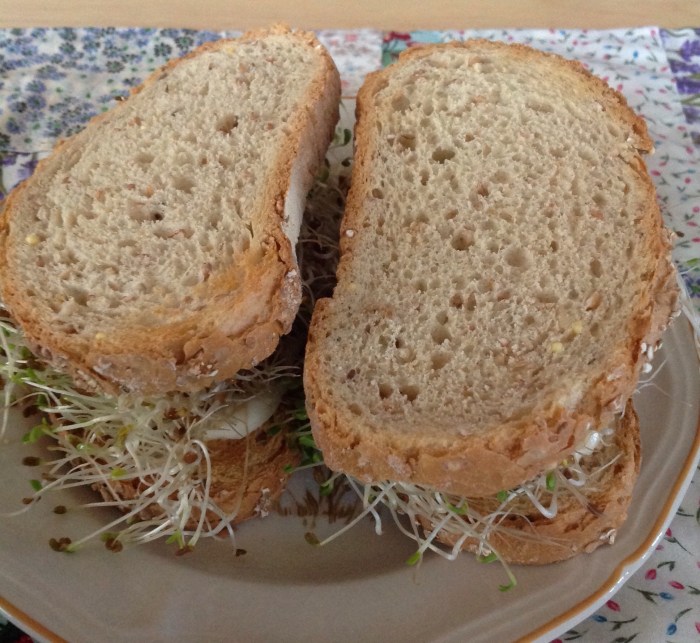
Today, I had a couple of sprout sandwiches for breakfast. Sprouted alfalfa, multi-grain bread from Real Food Connections in Fredericton, and mayo. Yum!
~
~
sprout sandwich
~
sprouts peek
between sheets
of whole wheat
green baby beaks
~
stems tickle lips
as though I kissed
a man with a mobile
mustache
~
satisfying crunch
crisp bunch
of alfalfa
delight
~
green and white
and mayo
daub of mustard
sprig of thyme
~
a sprinkle
from my stash of seed
a little time
sprouts did all the work
~
swell, burst seed coat, grow
rinse, dry , fluff
pluck and toss
and wow! what a kiss!
~
~
Copyright 2016 Jane Tims
local foods
Yesterday we made our second visit to Real Food Connections in Fredericton. Real Food Connections sells locally grown and produced food. On their wall is a huge map of New Brunswick and surroundings, showing all the growers and producers who supply foods to the store. https://www.realfoodconnections.ca/
~
~
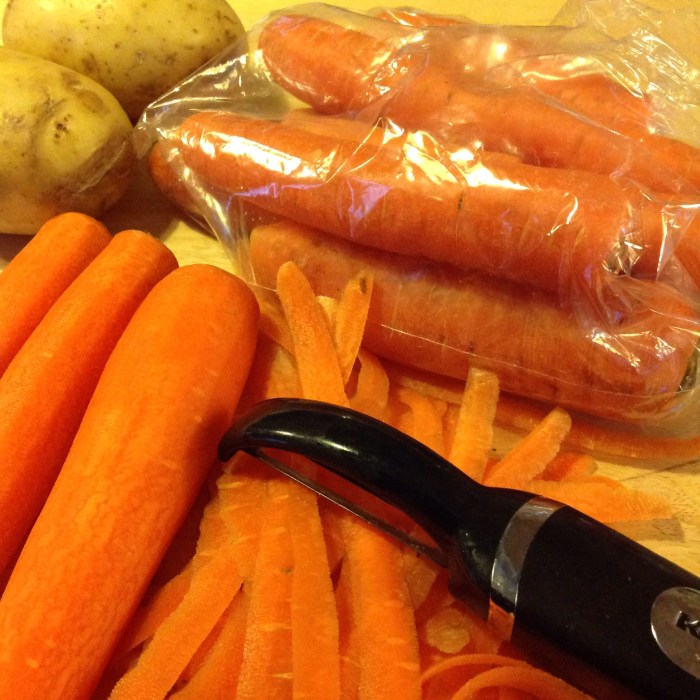
On our first trip we bought the most flavourful carrots! We also bought a beautiful head of garlic, alfalfa seeds for my sprouter, Gouda cheese, big red onions and a bottle of canola oil.
~
~
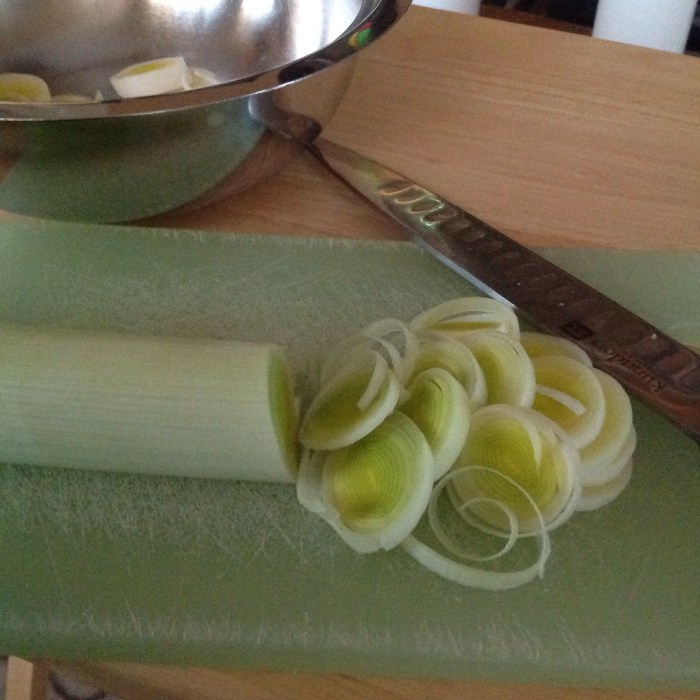
This week we signed up online for Real Food Connections’ $25 produce box. In our box we had potatoes, white onions, carrots, sweet potatoes, garlic, a squash, a head of garlic, a beautiful leek, a bag of cranberries, a bag of apples and frozen cauliflower. I can hardly wait to plan this week’s meals around our items.
~
Last night, for supper, we had a first-class Leek and Potato Soup. I used leeks, onions, garlic and potatoes from our box and added chicken stock, spices and 2% milk. It was quick to prepare and delicious!
~
If you are lucky enough to have a store specializing in local foods, try it out! Buying food this way supports local producers and takes a step towards food security. I try to buy local products whenever possible by shopping at farmers’ markets and local food stands, and by choosing carefully at the grocery store. I am so happy to be able to go into Real Food Connections and see what a full range of foods are available to us!
~
Do you have a store where you can buy local products in season?
~

~
Copyright 2016 Jane Tims
A tree for the corner!
It’s inside! Our Christmas tree for 2015.
~

our tree for 2015, a balsam fir
~
We are lucky here in New Brunswick – we can buy locally-grown Christmas trees. We buy our tree at a lot where they cultivate their own trees, so usually the tree has been cut only a few days before, and will last well past Christmas. I usually take our tree down on January 6th.
~
When my son was young, we often cut our tree at a Christmas tree farm with my brother’s family. I can still see the paths the kids made as they ran in the rows, trying to find the perfect tree.
~
I am happy to know that many trees sold in communities across America come from New Brunswick. We have seen the loads of trees on the highways for weeks.
~

~
OK, I am officially in the Christmas spirit! Now the lights for the tree. And then our box of ornaments. Results to follow!
~
Copyright Jane Tims 2015
taking the goodness into winter
I love carrots. Give me a bunch of local carrots and a bag of onions and there is always something for supper.
~
Keeping the goodness of our local produce into the winter months is a challenge. But this past weekend, I found dilled carrots still for sale at Cameron’s roadside stand just outside of Gagetown, New Brunswick. We also bought apples and a frozen apple pie.
~
Mom used to make these and they make a crunchy addition to a meal. Just carrots, vinegar, dill seed, garlic and salt.
~

~
Copyright 2015 Jane Tims
Buying Local
The weekend before last, I attended WordsFall (a yearly event of the Writers’ Federation of New Brunswick) in Sackville, a town in eastern New Brunswick. I read at the open mic session, enjoyed listening to the work of the other readers at the session, and attended two Saturday workshops.
~
When I visit Sackville, I am always encouraged by the atmosphere of community that prevails. For a small town, they have a lot to offer. My favorite places are the campus of Mount Allison University, the Sackville Waterfowl Park especially its birdlife and boardwalks, the Cackling Goose Market with its delicious sandwiches and gluten-free products, and the landscape of the salt marsh.
~
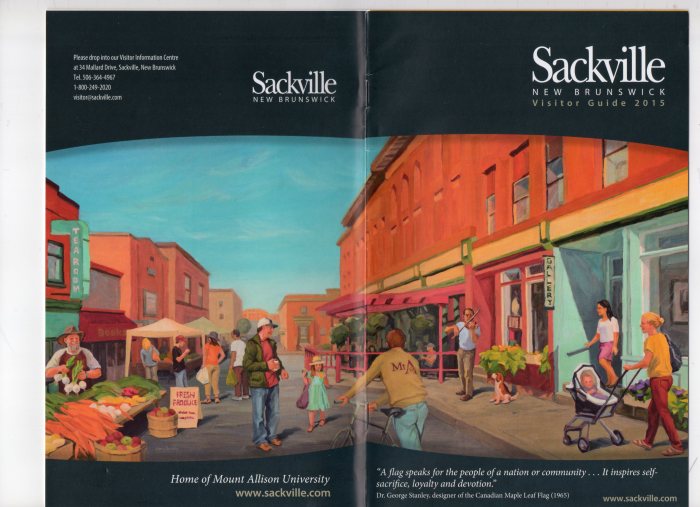
Brochure for the Town of Sackville, New Brunswick
~
While I was at the workshop, I picked up a brochure about Sackville. The painting on the front of the pamphlet is by Mary Scobie, ‘Sackville Market Day’ (Oil on canvas, 24″ by 48″) http://www.maryscobie.com . As our winter approaches, it is great to remember the fresh and local produce available in summer.
~
The Sackville Farmers Market is one of the oldest in the province and operates year-round.
~
Do you attend a farmers’ market and is it open during the winter months?
~
Copyright 2015 Jane Tims
Wolf River apple

Wolf River Apple
~
branch broken
tree lacking proper
care and pruning
~
bee burdened
pink with blossoming
pollination
~
apple swells
the skin smooth, palest
lime and rosy
~
picked unripe
to escape worms, deer
and apple fall
~
~
Copyright Jane Tims 2015
a preface for a poetry manuscript
~
As followers of my Blog will know, I am working during these first months of 2015 to finalise, for eventual publication, a manuscript of the poetry I wrote for my ‘growing and gathering’ project (see the Category ‘growing and gathering’ for more information).
Now that the poetry is ordered within the manuscript, I have to pay attention to the ‘Front Matter’. This includes:
title: ‘within easy reach’
dedication: the manuscript is dedicated to my husband
table of contents: a listing of the poems
acknowledgements: all the people I want to thank and the support of artsnb and the Creations Grant
~
The above four items are straightforward. I needed some information about the next three:
~
foreword
preface
introduction
~
Foreword: written by someone other than the author of the book, usually an authority – celebrates the work and provides credibility.
Preface: written by the author of the book – includes the purpose and scope of the work, explains the origins of the central idea in the book, and may acknowledge those the author wants to thank.
Introduction: written by the author or an editor – includes information on the contents of the book, the author, and the audience.
Source: http://www.quickanddirtytips.com/education/grammar/foreword-versus-forward#sthash.No5DaWpu.dpuf
~
Many of the poetry books I have in my library do not include a Foreword or Preface, and Acknowledgements are often placed in the back of the book. I find this is true of collections where the theme of the poems is not immediately obvious. But collections about a particular subject, such as those about history, often have a Preface or Introduction.
~

~
For example, Jack’s Letters Home (Cynthia Fuller (2006) Stable Cottage, U.K., Flambard Press) includes an Introduction. The book is a collection of gritty poems based on real letters written by a British soldier in the First World War. The Introduction tells the soldier’s history, the story of how the letters were found and a little about the characters in the poems.
~

~
I have two poetry collections by Shari Andrews. Both focus on history. Crucible (Shari Andrews (2004) Canada, Oberon Press) is an insightful collection of poems depicting characters and events in the life of Saint Catherine of Sienna. It includes a Foreword by the poet. The Foreword includes background on Saint Catherine of Sienna, information about the inspiration for the book, and acknowledgements.
~
The Stone Cloak (Shari Andrews (1999) Canada, Oberon Press) is a collection of tactile, sometimes fierce, poems about the lives of settlers of New Denmark in New Brunswick. The Foreword includes information about the poet’s connection to the community and briefly describes the history of New Denmark. It includes acknowledgements.
~

~
Although it is not a book of poetry, in an 1843 edition of A Christmas Carol Charles Dickens includes a brief Preface, consistent with the spirit (!) of his story:
I have endeavoured, in this Ghostly little book, to raise the Ghost of an Idea, which shall not put my readers out of humour with themselves, with each
other, with the season, or with me. May it haunt their houses pleasantly, and no one wish to lay it!Their faithful friend and Servant,
CD.
December 1843.(Source: http://www.themorgan.org/collections/works/dickens/ChristmasCarol/3, accessed February 23, 2015)
~

a ‘grown and gathered’ salad – leaves and flowers of violet, leaves of mint and dandelion, bean sprouts and green onions
~
My poetry manuscript has a very specific theme – the ‘growing and gathering’ of local foods. Since all of the poems are about a particular topic, I think including a Preface is appropriate. I want the Preface for my manuscript to:
- be short (less than a page)
- inspire my audience
- include the purpose of my poems
- provide an overview of the contents
~
When I was young, I always skipped the Preface of any book I read. Now, I read the Preface first, eager to find information about the process the author followed in conceiving of or writing the book.
~
Copyright 2015 Jane Tims
December garlands

~
in December
~
we gather pine cones
wreaths of lion’s paw
hawthorn, cedar boughs
and juniper
~
we walk the wild ways
pruners and scissors
baskets and stout cord
to bind bunches of
branches
~
balsam and holly
berries and garlands
of evergreen, red
rosehips and acorns,
gilded, needles and
thorns
~

~
~
© Jane Tims 2014




 nichepoetryandprose