Archive for the ‘along the roadside’ Category
the colour of October #2 (Tansy yellow)
So many colours! The orange of the big pumpkin on our doorstep. The reds and yellows of the Red Maple leaves in piles under our feet. The bright white of the moon this month. The golden colour of the needles of the Tamarack now falling with every breath of wind.
~
The colour that has inspired me this week is the yellow of Tansy (Tansy vulgare L.) still bright along the road in Fredericton. The flowers are like brilliant yellow buttons.
~

~
I couldn’t duplicate the colour with the yellows in my watercolour palette, but after layers of alternating yellow and white, I have realised how wonderful the yellows of nature really are!
~

October 27, 2013 ‘Tansy’ Jane Tims
~
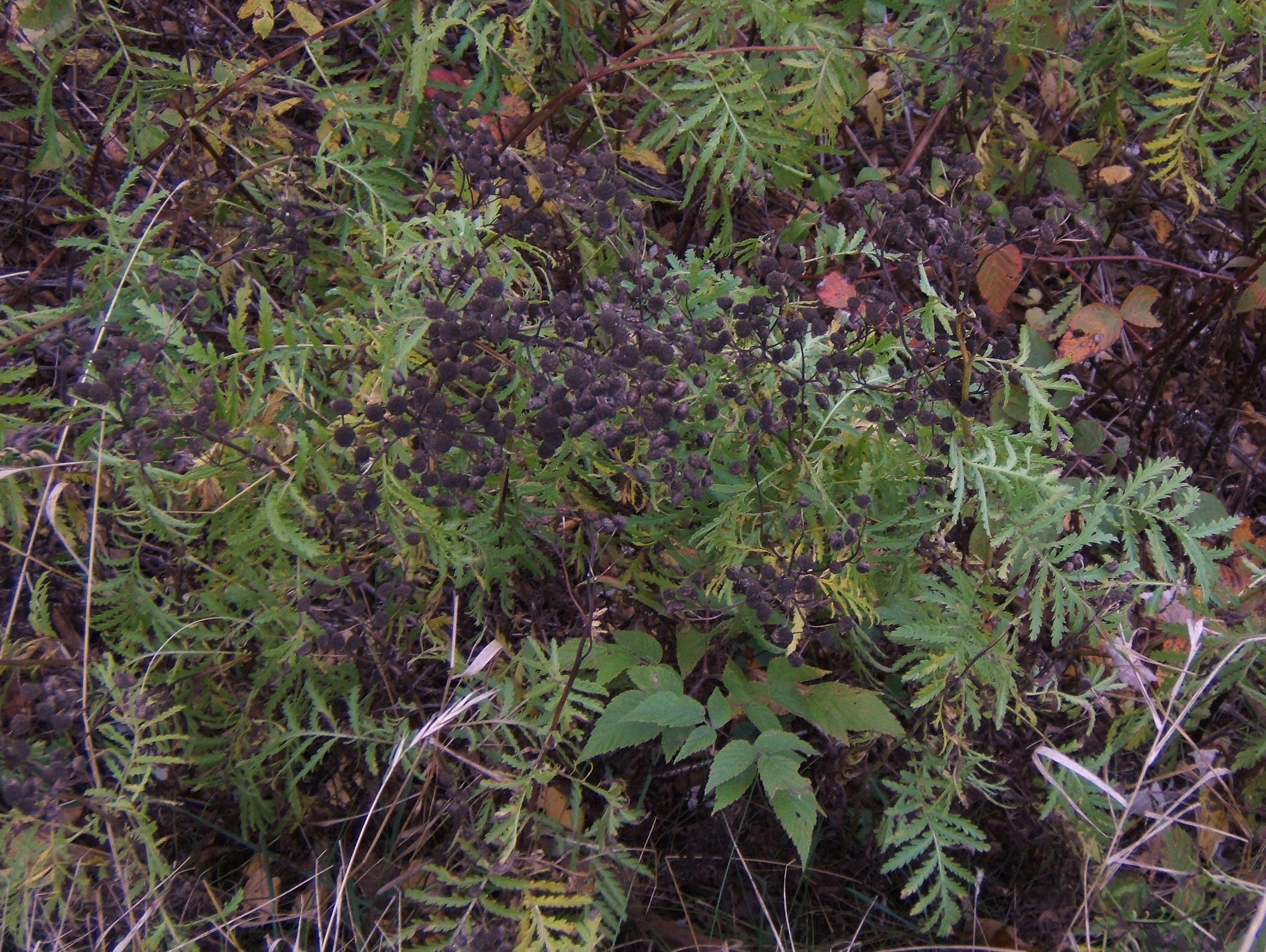
In a month’s time, the bright yellow heads of the Tansy will be black!
~
~
Copyright 2013 Jane Tims
a quest for poppies 5-5 a
~
On April 27, I took a short detour on my virtual bike tour, to find a field of poppies. I love poppies and I’d like to find a field of them on my virtual visit to central France.
~

~

map showing red field … could it be a field of blooming poppies? (map from Google Maps)
~
I started by scanning the maps to the south of the area I have been visiting. And I found what looked like a red field just south of my bike path. Side trip!!!!
~
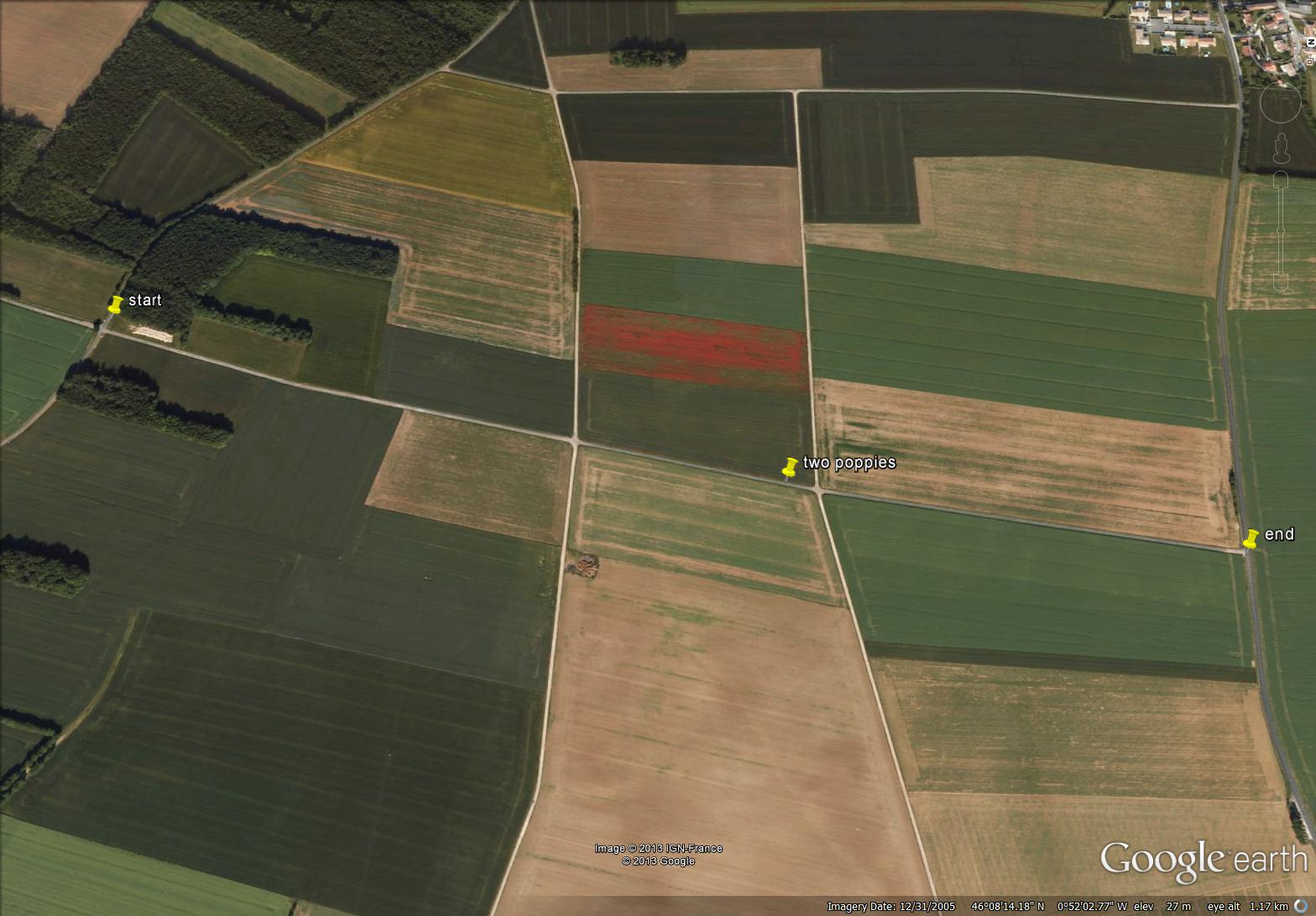
map showing my quest to find a field of poppies (map from Google maps)
~
At the first of my side trip, I saw a lady, picking flowers along the roadside …
~

looks like she is picking daisies … (image from Street View)
~
I stopped to ask her if she knew any poppy fields in the area …
~
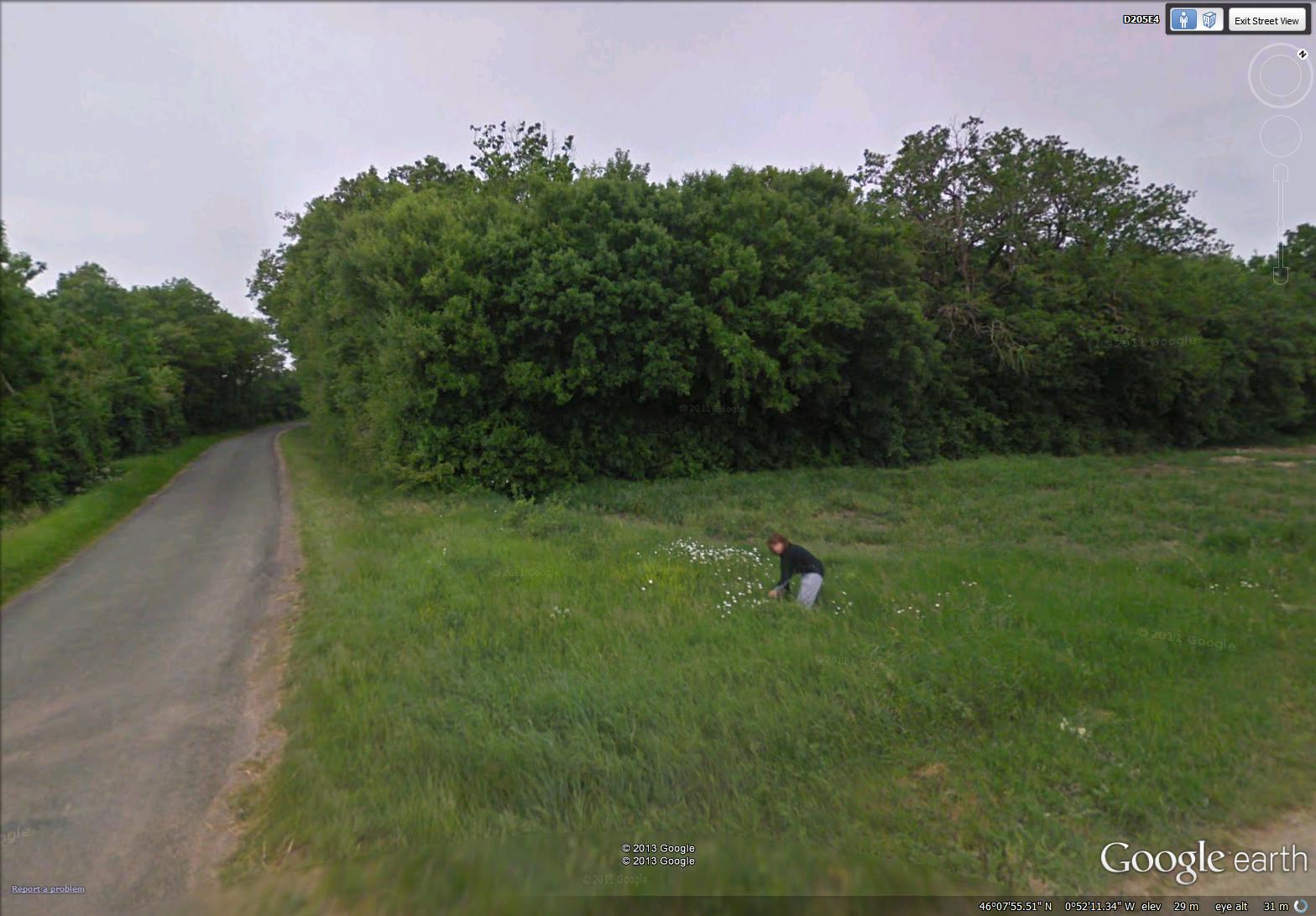
the lady stops to talk (image from Street View)
~
Jane to Lady-picking-flowers: Bonjour Madame! (Hello Madame.)
Lady-picking-flowers: Bonjour! (Hello!)
Jane: Je pense que vous aimez les fleurs! (I think you must like flowers!)
Lady: Oui. Je trouve un bouquet pour la table! (Yes. I am getting a bouquet for the table.)
Jane: Est-ce que vous connaissez s’il y a un champ des coquelicots dans cet territoire? (Do you know if there are any fields of poppies in this area?)
Lady: Oui. Dans le printemps, il y a un grand champ des coquelicots just à côté de cette route. Il n’est que deux kilomètres vers l’est. (Yes. In the spring, there is a big field of poppies just beside this road. It’s only two kilometers to the east.)
Jane: Bon! Merci! Bonjour! (Great! Thanks! Have a good day!)
~
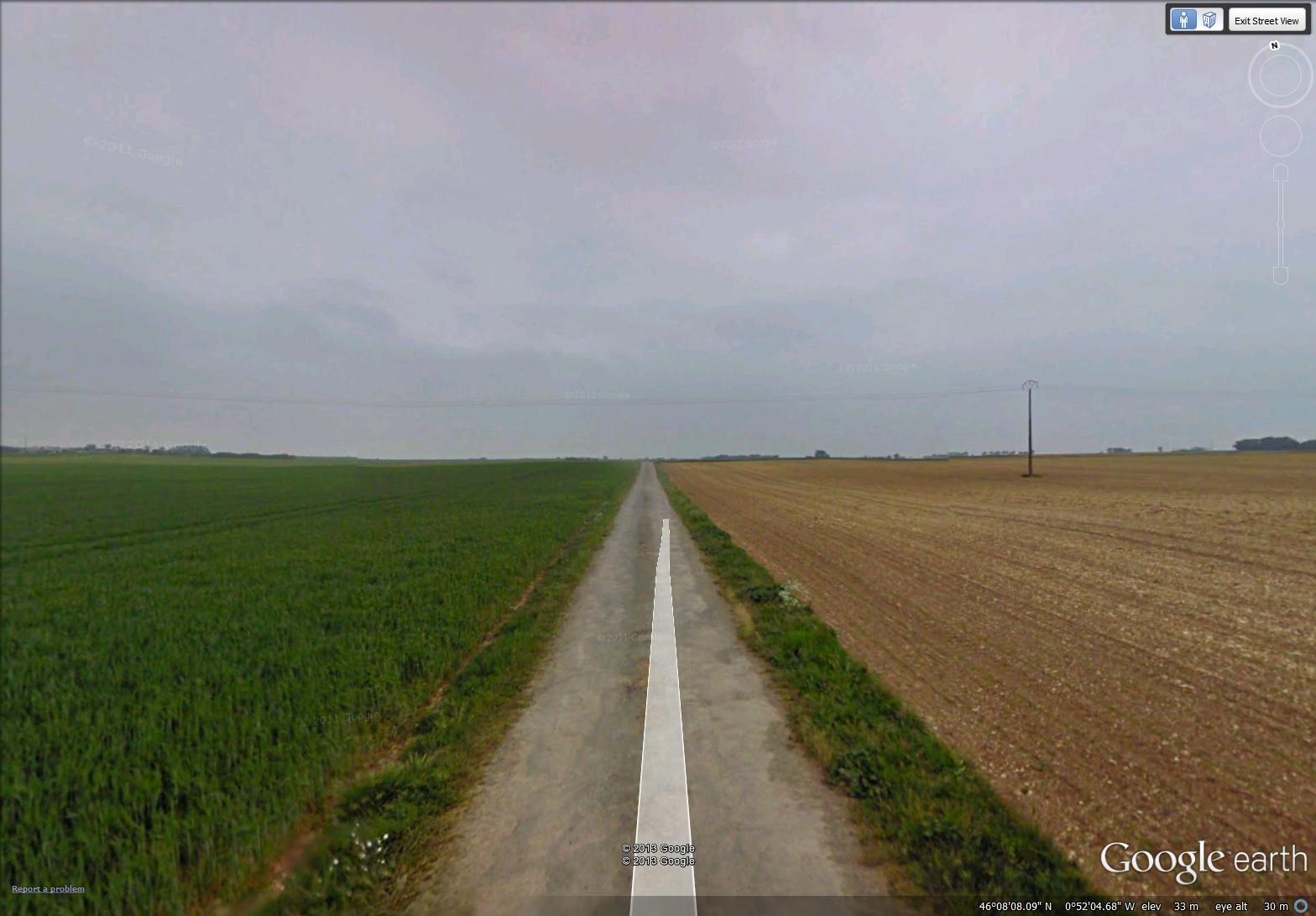
So off I went, peddling madly between fields of grain and plowed soil on a very narrow dirt road …
~
the poppy field must be just up ahead (image from street View)
~
It was boring, but I was watching for that gorgeous field of poppies …
~

it should be just off to the left … (image from Street View)
~
When I got to the area on the map where I was sure there was a poppy field, I saw only plowed field …
~
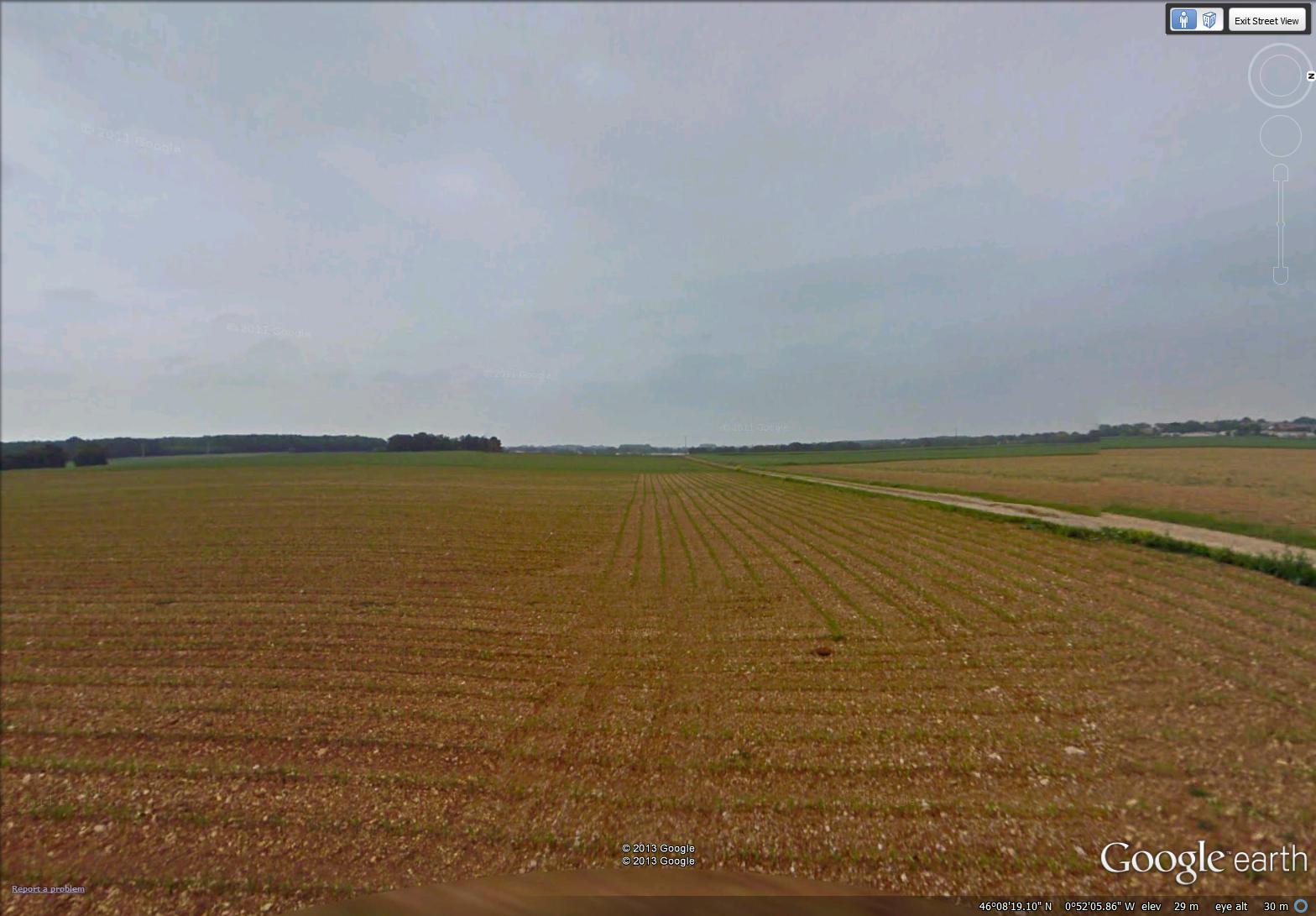
I’m sure they should be just over there (image from Street View)
~
As a reward for my search, I saw two poppy blooms in the grass beside the road …
~
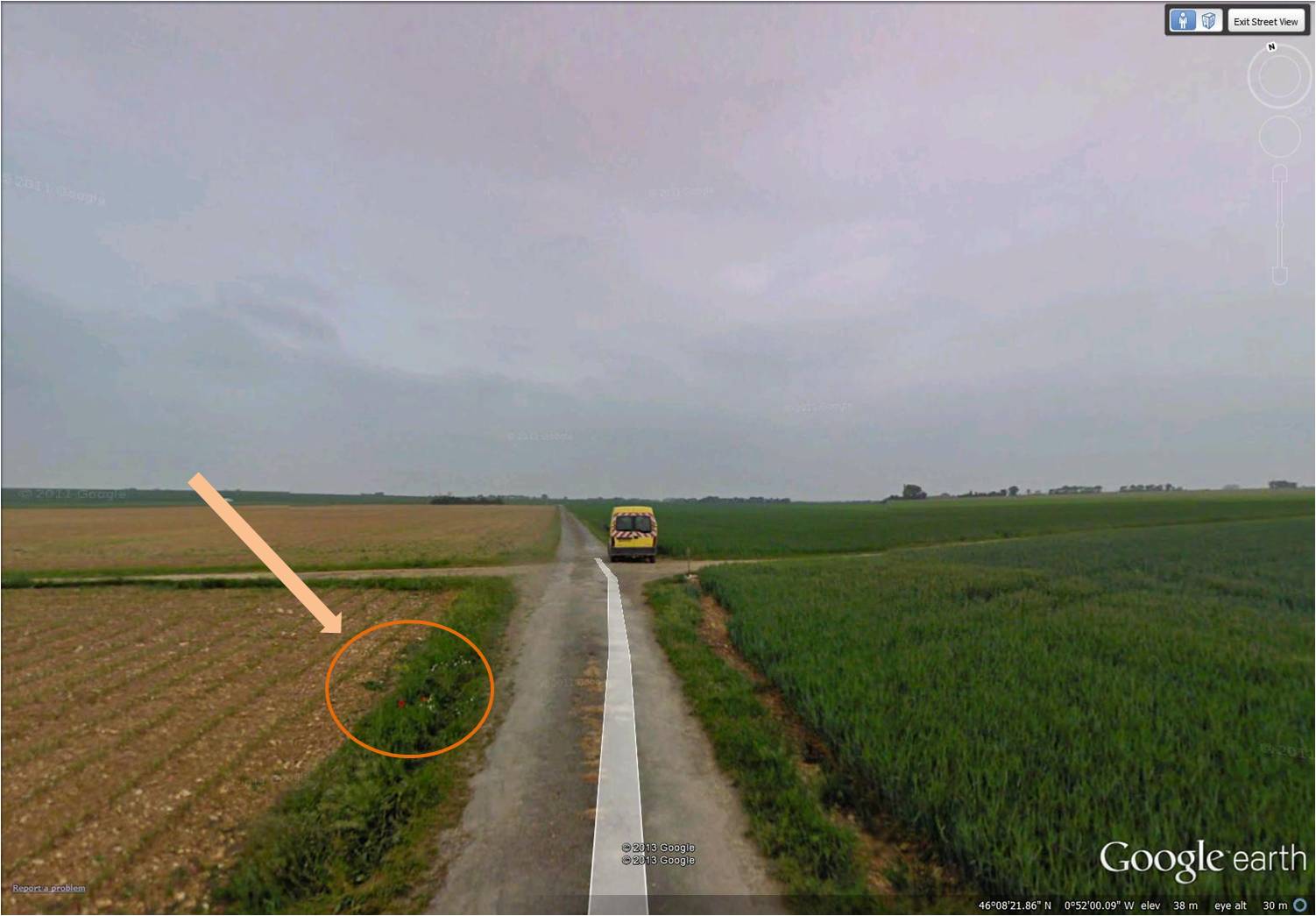
two poppies beside the road (image from Street View)
~
I realised then, the Google Map and the Street View images were taken at different times of the year. So sad.
~
Best View: imaginary poppies …
~
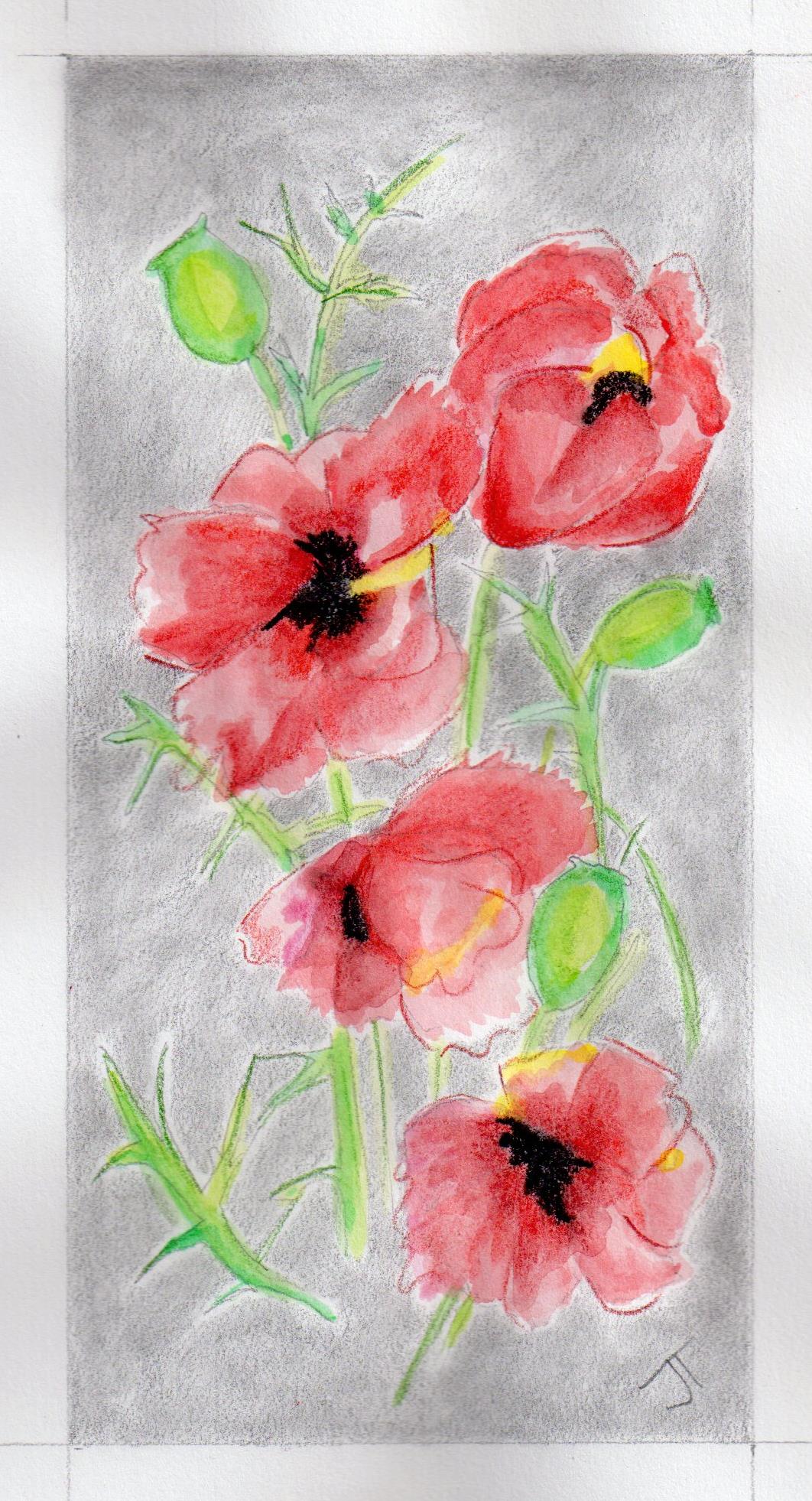
~
Copyright Jane Tims 2013
wildflowers along the road
~

~
I have completed Phase 4 of my virtual bike ride through France! My entire ride (Phase 1, 2, 3 and 4) since January 30, 2013 has taken me from Lusignan to Ferrières for a total of 116 km or 1155 minutes (19.2 hours).
~

~
The last bike ride of Phase 4 took me through the countryside east of Ferrièrres …
~

~

~
The theme seemed to be one of wildflowers. I saw Queen Anne’s Lace, Fireweed, and, best of all, Poppies, along the edge of the fields …
~
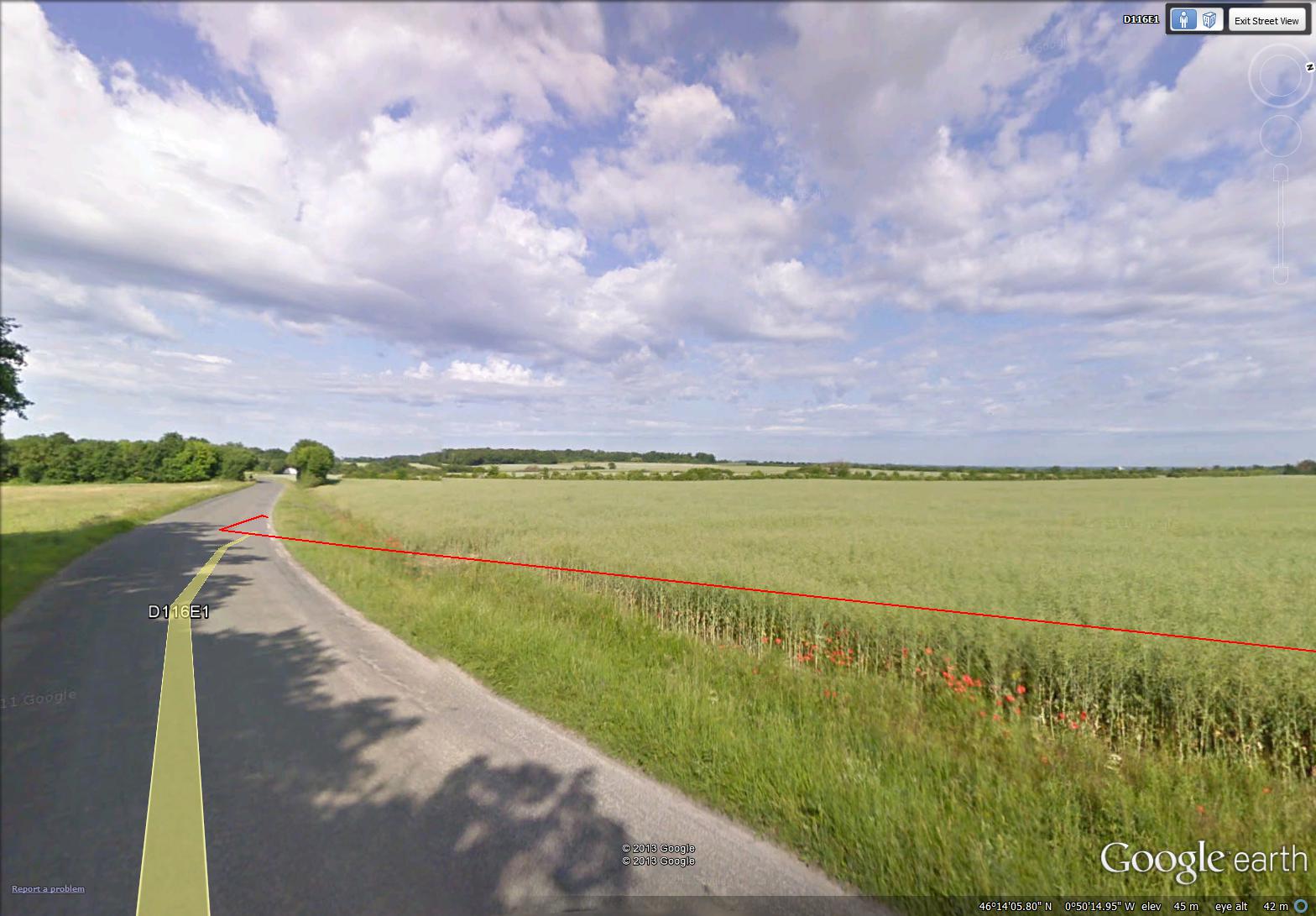
~
I also saw a roadside shrub in yellow bloom. Since the images were taken in May, I think these flowers were Gorse …
~
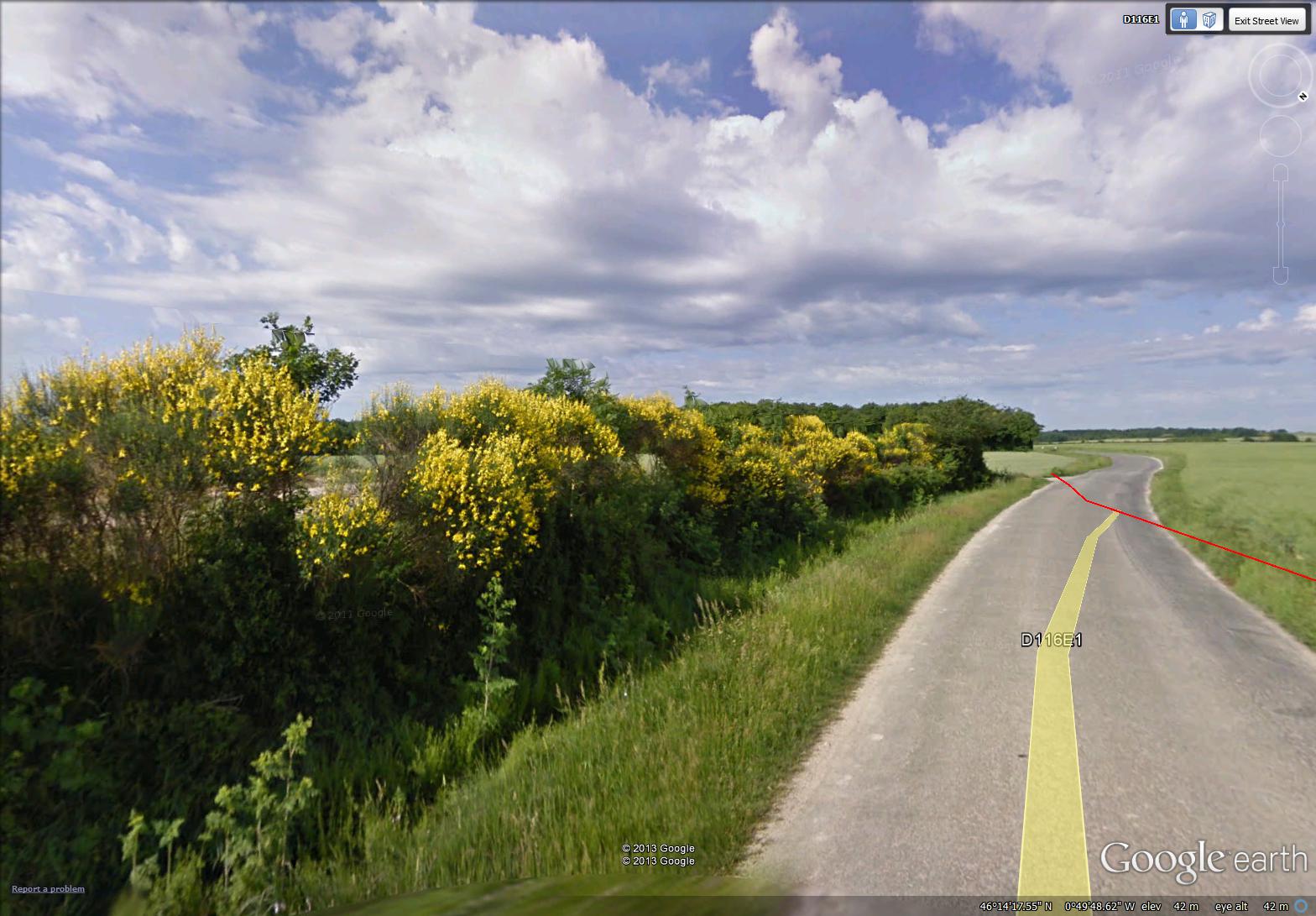
~
I also saw a flock of sheep grazing in a pasture …
~

~
Best View: a flower garden in Courçon …
~
 ~
~
For Phase 5 of my trip, I plan to cycle from Ferrières to Nieul-sur-Mer, near the Atlantic Coast of France. Hope you will stay with me on my journey!
~

~
Copyright Jane Tims 2013
windy October drive
On Monday, I went on a drive to Cambridge Narrows, to visit an antique store and a roadside market. My goal: to buy some Nancy Drew mystery books for my collection and some pumpkins for Halloween.
It was a blustery day, windy enough to put some whitecaps on the St. John River…
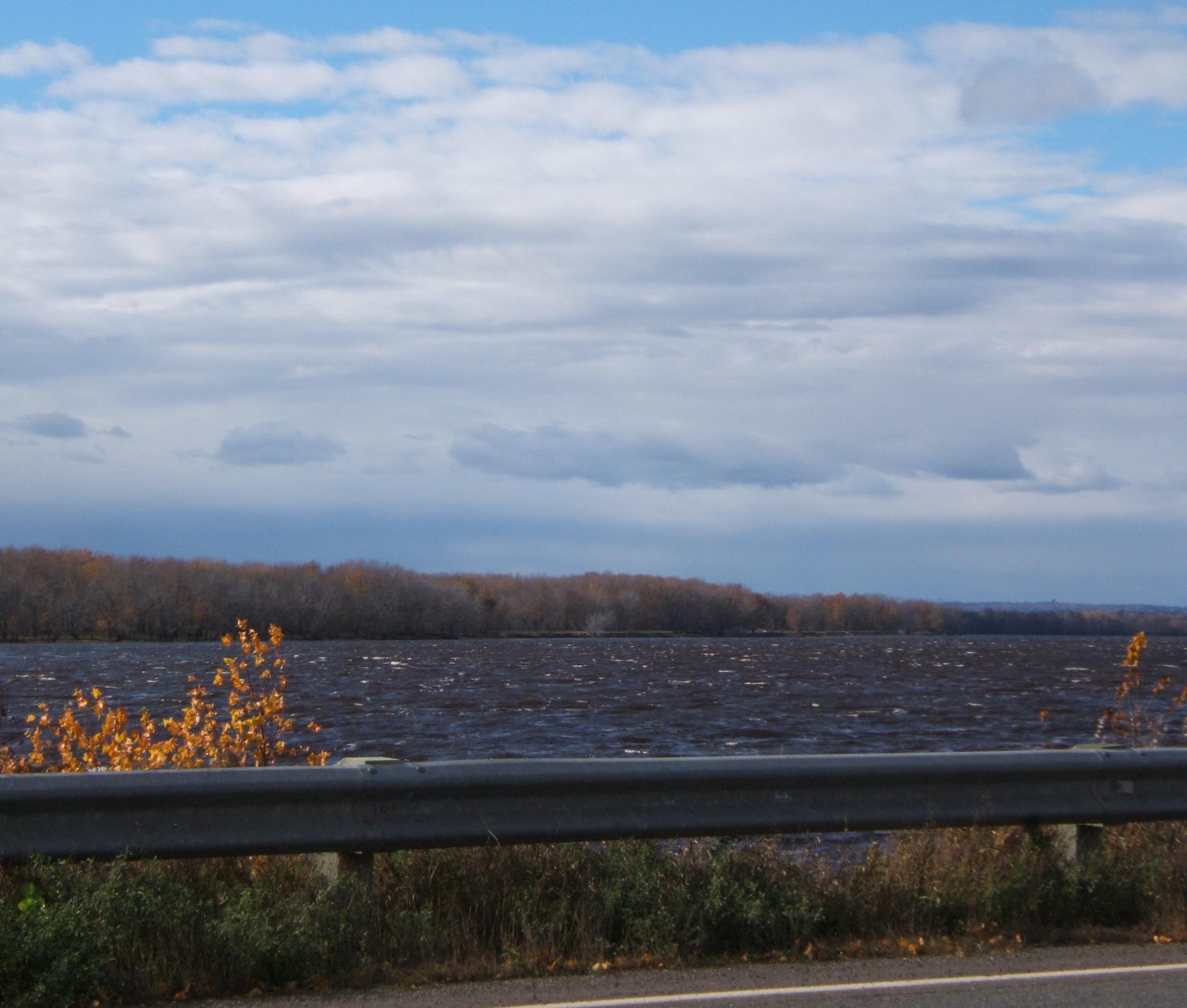
The wind was especially evident along the former Trans-Canada Highway, where dry leaves have gathered in all the ditches. Since only a few vehicles use this older highway, the leaves blow into the roadway…

The day had a luminous quality, in spite of the wind. Most of the reds are gone from the trees, leaving the yellows of the poplars, the rusty-orange of the oaks and the gold of the tamaracks…
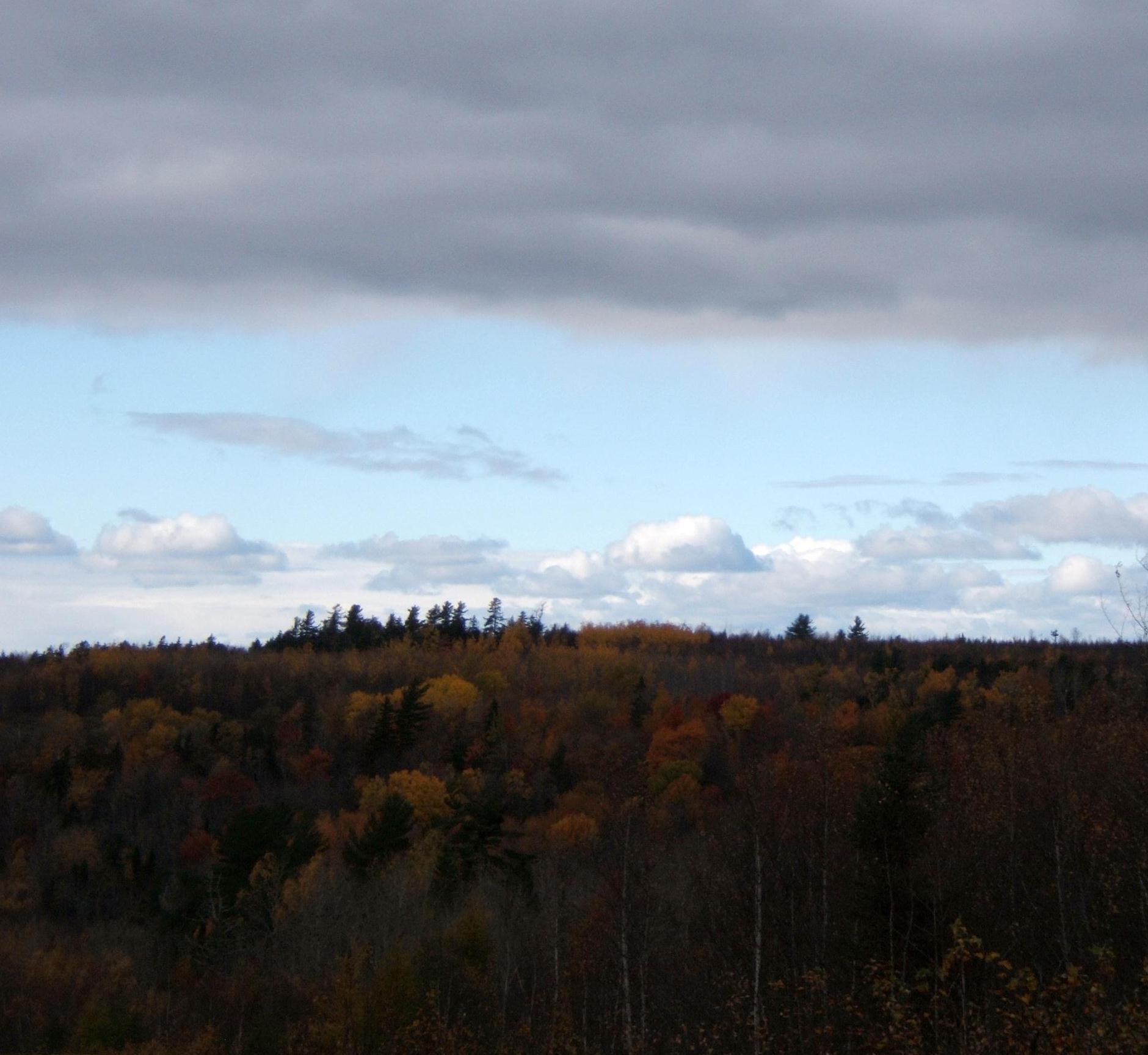
I had a successful day. I bought some small pumpkins at a roadside stand…

three little pumpkins from the roadside vegetable stand (the faint eyes in the background are the amber eyes of our owl-andirons)
I also added five books to my collection of Nancy Drew mysteries…
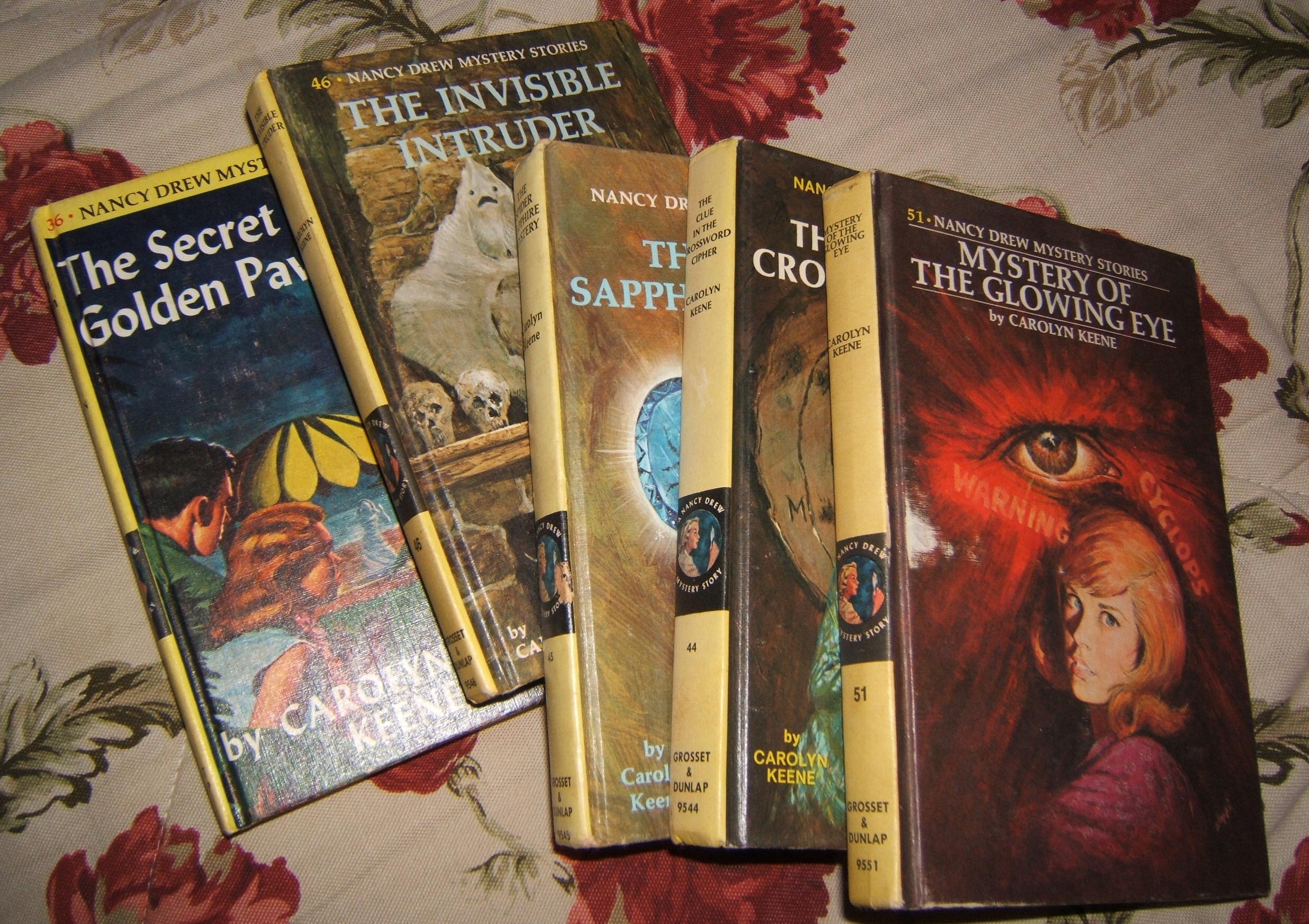
five new mysteries for my collection… enough ghosts and glowing eyes for a spooky Halloween
~
~
andiron
~
wrought owl with amber eyes
perches on the hearth
hears a call in the forest
six syllables and silence
~
Great-horned Owl, light gathered
at the back of his eyes,
and the oscillating branch
after wings expand and beat
~
iron owl longs for a glimpse
of the sickle moon
the shadow of a mouse
sorting through dry leaves
~
in this cramped space
night woods are brought to their essence
fibre and bark, sparks and fire
luminous eyes
~
~

Copyright Jane Tims 2012
apple picking time
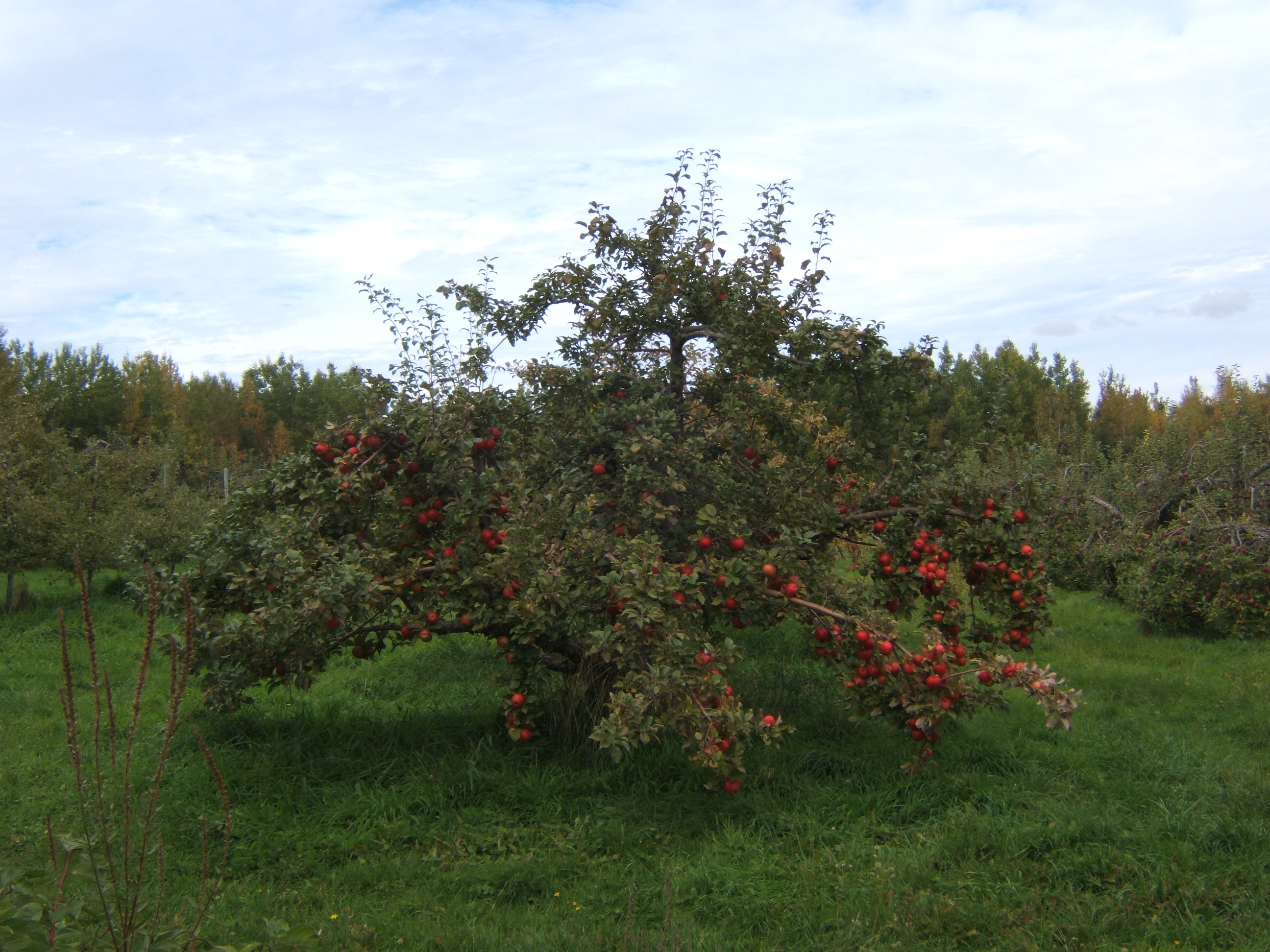
October has taken hold and now signs of autumn are everywhere. Color seems to be the theme… the orange of pumpkins and gourds, the yellows and reds of the maple leaves, and the red of ripe apples.
On our way to the lake, we drive past orchards of apples. Most of the apples have been picked, but some trees are still laden with fruit. For me, the orchards are full of memories, of picking apples with my family when we were younger. I remember how much fun we had, my son and niece and nephew excited to be able to run free and pick the apples, and the adults thinking about the apple pie possibilities from those loaded trees.
~
~
orchard outing
~
wooden bushel baskets
of laughter, the delirious tumble
down the avenue of trees, shadows ripple
among the dapples, Cortlands tied
with scarlet ribbons and boughs burdened
to reach for us, my son grown tall
on his father’s shoulders,
stretches to pick the McIntosh
with the reddest shine,
small hand barely able
to grip the apple
~
~
Copyright Jane Tims 2012
a moment of beautiful – old-fashioned flowers
the space: the side of a cottage in the late summer sun
the beautiful: a riot of Golden Glow, leaning against the wall
~
Last week, on a drive along the South Branch of the Oromocto River, I noticed the fall flowers have taken over from the summer species. The fields are filled with Goldenrod (Solidago spp.) and the ditches with Pearly Everlasting (Anaphalis margaritacea (L.) C.B. Clarke). In some of the yards were three flowers I think of as ‘old fashioned’ – French Marigolds (Tagetes patula L.), Hollyhock (Alcea spp.), and Golden Glow (Rudbeckia laciniata (L.) var. Hortensia). I love the orange of the Marigolds, the papery pinks and purples of the Hollyhock, and how the Golden Glow leans!

These plants were my first introduction to the concepts of ‘annual’, ‘biennial’ and ‘perennial’. The French Marigold was an annual, and grew only for a single year. The Hollyhock was a biennial (although some are weak perennials), living a year without flowers and then blooming in the second year. The Golden Glow came up year after year without benefit of seeds or fuss, a perennial.
I remember helping my Mom collect seeds so she would always have the Hollyhocks and French Marigolds. If I close my eyes, I can see my hand holding the pointy black French Marigold seeds and the flat Hollyhock seeds with their furry edges.
When we first built our house, I was anxious to have these plants in my garden, but after blooming for a few years at the edge of the house, the Golden Glow died out, and I could never get Hollyhocks to flower. Both need lots of sun and we have only shade to offer. I often grow French Marigolds. I still have the seeds I collected from our first garden here, stuffed in an old metal seed box. I doubt they are still viable, but when I open the box, I see the seeds of the Marigolds that bloomed here 32 years ago!
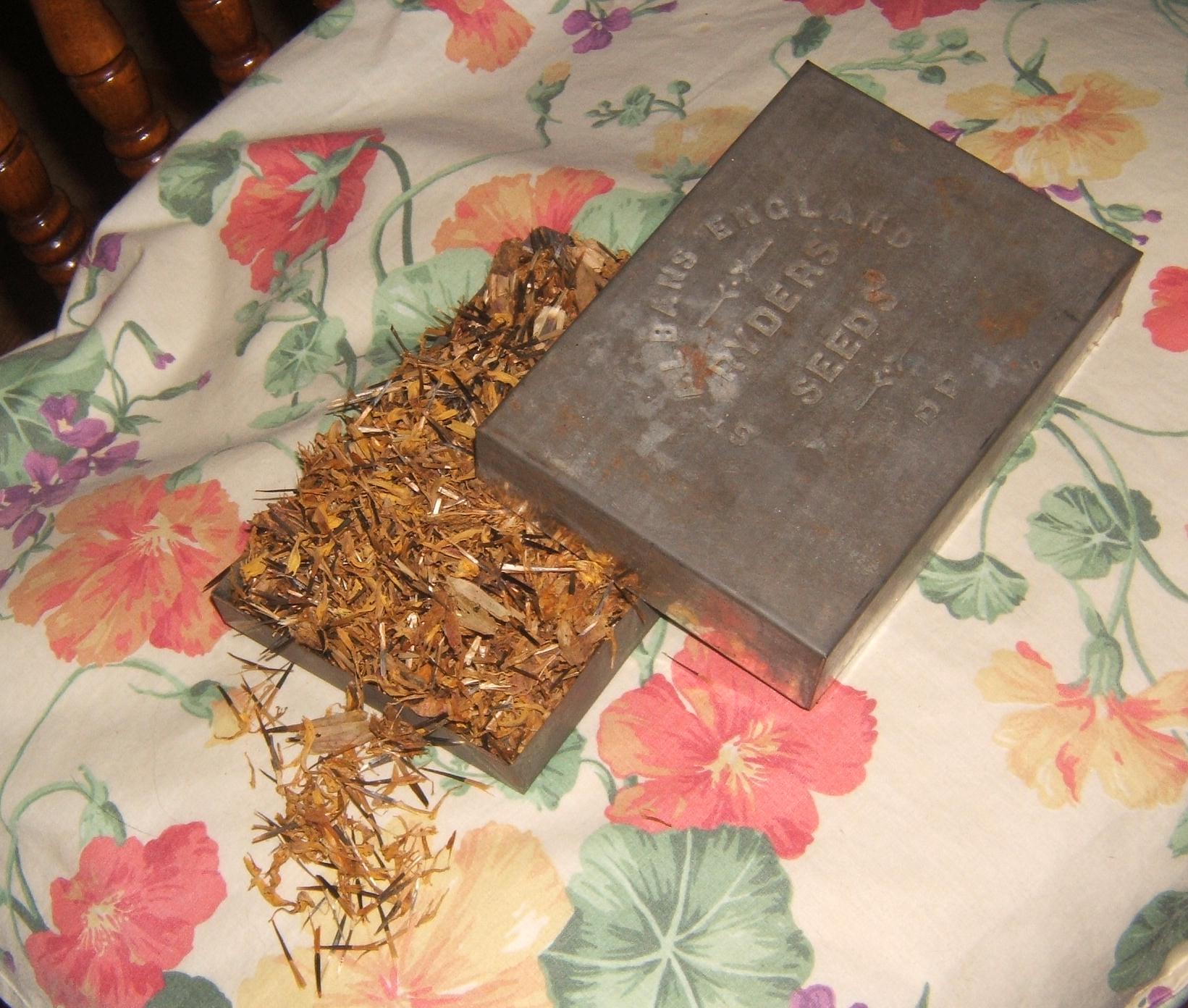
The seeds I collected from our first garden of Marigolds in 1980… they are kept in an antique box marked ‘St. Albans England – Ryders Seed – D.P.’ Ryders was a seed company operated in England beginning in the 1890s. It sold seed in ‘penny packets’ to be affordable for everyone.
What are your favorite ‘old-fashioned’ flowers and do you see them much anymore?
~
~
Pearly Everlasting
Anaphalis margaritacea L.
~
Pearly Everlasting
sign of summer’s passing
yet – immortelle
picked by the road
by the armload
hung from rafters
children’s laughter
runs beneath
~
downy leaf, wooly stem
white diadem
perfectly matched flowers
thatched in gold
dry and old
~
Linnaeus named
for Marguarite
memory sweet
paper petals keep
pale perfume
summer grace
in a winter room
~
~
Published as: ‘Pearly Everlasting’, The Antingonish Review 92, 1993
Copyright Jane Tims 2012
a snippet of landscape – moose habitat
Not far from Gagetown, on Route 102 in New Brunswick, is an interesting bit of wetland. Sometimes there is water in this small area but more often it is just wet mud. During periods of little rain, the mud becomes cracked and dry. The area never seems to grow any of the grasses or other wetland plants typical of wet areas.

The reason can be discovered through two pieces of evidence. The first thing you notice about the area is… the mud is carved with the tracks of a large animal. The second thing you notice is the Moose Crossing sign not far away, along the highway.
I have seen a moose in this muddy place. It is a dangerous place for a moose to be hanging out, because it is so near the road.
Moose visit these muddy areas for several reasons. They need water, of course. Also, salts from the road accumulate and moose use the wet areas as ‘licks’ to replenish their body salts. Sometimes these waters are naturally high in salt content.
We have seen moose quite often this summer. We watched a moose and her calf for about a half an hour during our trip to the Cranberry Lake area in July.

a moose and her calf
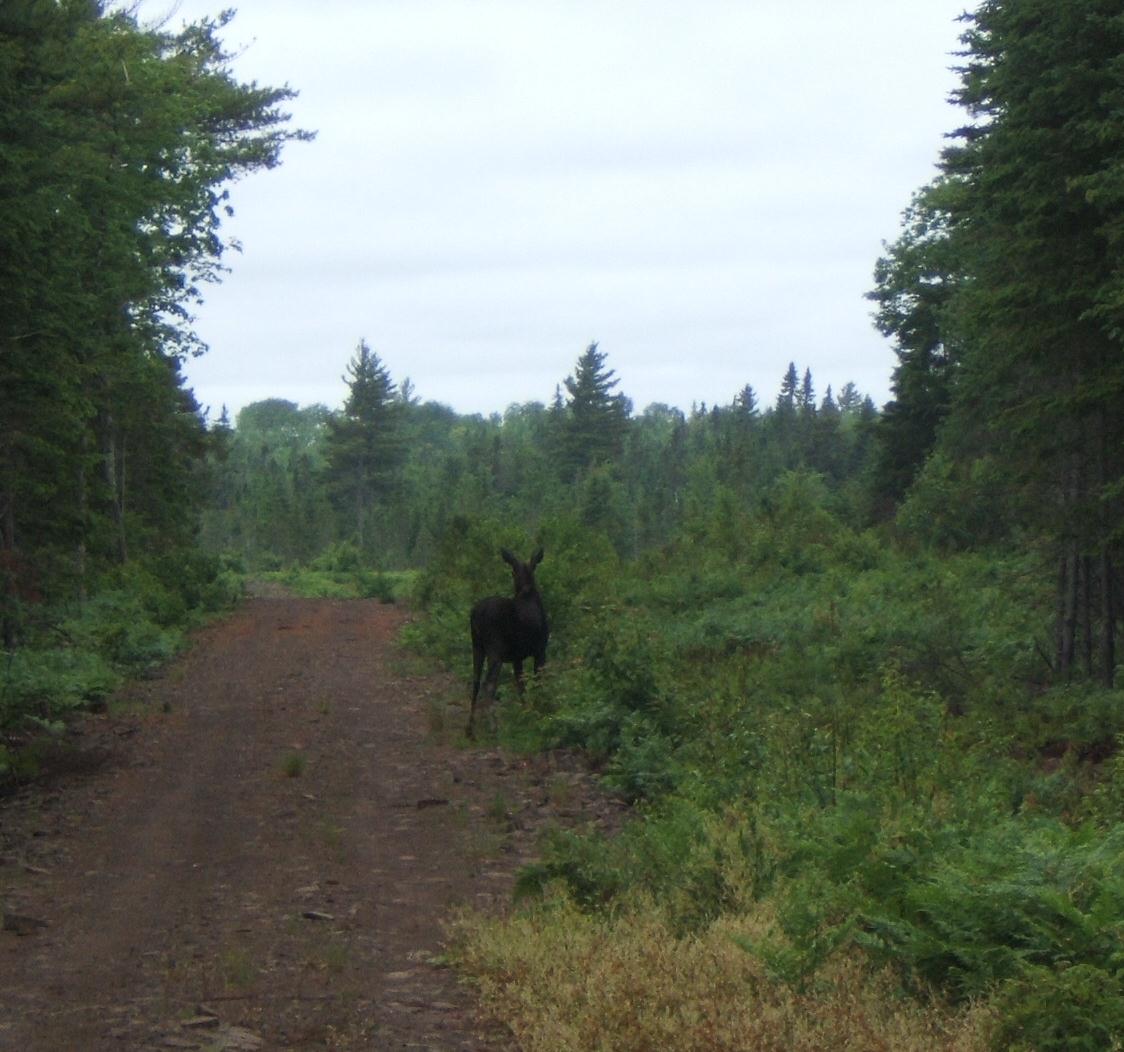
the moose sent her calf into the woods to hide and grazed quite a while, only a little concerned by us
Do you see moose where you are?
© Jane Tims 2012
Chicory – (Cichorium intybus L.)
Along the Trans-Canada near Jemseg, one colony of Chicory has taken hold. Its bright sky-blue flowers catch the eye as the usual roadside vegetation rolls by.
~

~
Also known as Blue Sailors and, in French, chicoreé, Chicory (Cichorium intybus L.) is a tall plant, found along roadsides and in other waste places.
Chicory has basal leaves resembling those of the Dandelion. When broken, the stem exudes a white milky fluid.
The bright blue flowers of Chicory occur along the length of the almost leafless and somewhat zig-zag stem. Each flower is formed of a central involucre of tiny blue flowers and a disc of larger ray flowers. The rays are square-cut and fringed. The flowers follow the sun, closing by noon, or on overcast days.
~

~
Chicory is a useful plant. Its young leaves are edible as salad greens or as a pot-herb. The roots can be dried and ground to make a coffee substitute or supplement. The root of Chicory has soothing properties to balance the edginess caused by caffeine. The roots of Chicory are large and very deep. I tried to pull them by hand, but a shovel will be needed to harvest the roots in the compact soil of the roadside.
~ When I see these flowers, I am reminded of my grandfather, my mother’s father. I never knew him, but I have a couple of photographs of him as a young man. I have made a small study of his mother, my great-grandmother, so I know quite a lot about him. ~
~
The flowers of Chicory remind me of his eyes, since they were the same startling blue. He was also a tall man, another feature of the plant.
The other name for Chicory, Blue Sailors, also reminds me of my grandfather. He was a sailor, entering the navy when he was only fifteen. I know from various records that he served on at least two naval vessels, the USS Nebraska and the USS Pensacola. As so often happens when I see photographs of ancestors, there is a familiarity about his features.
~

~
Blue Sailors
Chicory (Cichorium intybus L.)
~
at the roadside
weeds surge as waves
~
on the sameness of ocean,
a buoy lifted,
a sudden swell of Chicory
~
tall, like my grandfather,
the blue ice of his eyes
its blunt petals, the square-cut of his jaw
~
joined the navy at fifteen
dressed as a sailor, headed for sea
USS Pensacola, USS Nebraska
~
his tie, a sapphire ribbon
toothed or frayed
~
~
© Jane Tims 2012
Warning: 1. never eat any plant if you are not absolutely certain of the identification; 2. never eat any plant if you have personal sensitivities, including allergies, to certain plants or their derivatives; 3. never eat any plant unless you have checked several sources to verify the edibility of the plant.rescuing a turtle
On a recent drive to St. Stephen, we took the cross-country Route 785, a haul-road, recently upgraded and chip-sealed (this creates a hard, smooth pavement-like surface). For us, it is the perfect short-cut to the Bay of Fundy coast.

Since it is so far from ‘civilization’, cars travel a little fast on this road. Sometimes this is a peril for wild life.
Along the way, we helped a Painted Turtle (Chrysemys picta) in its desperate attempt to cross the road.

He was certainly suspicious of my help and my camera angle, and retreated into his shell rather than be properly photographed.

In the end, I helped him over a steep bank of gravel left by a grader, and he was on his way to the pond on his preferred side of the road.
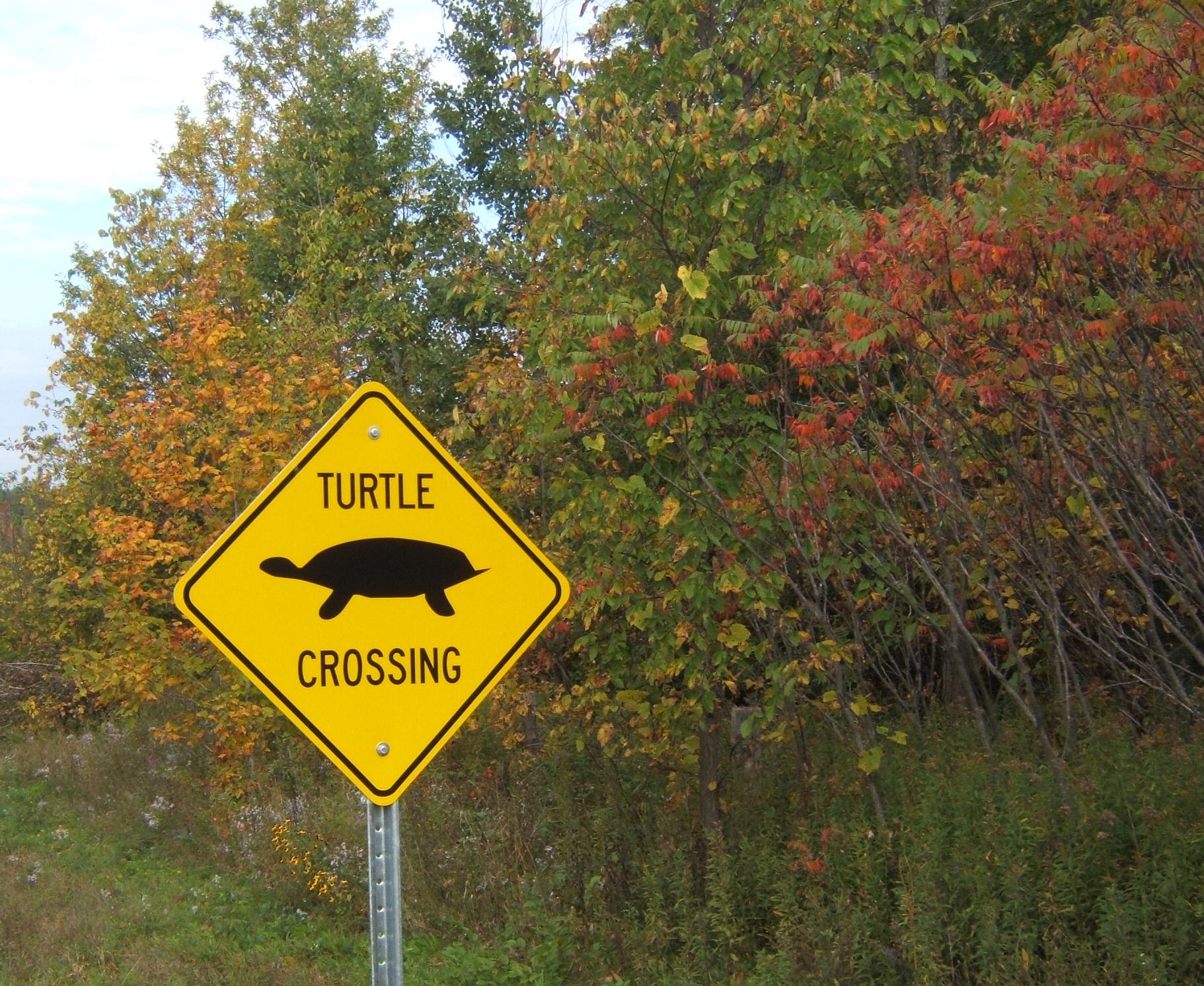
‘Turtle-Crossing’ sign in southern Ontario
© Jane Tims 2012
Coltsfoot (Tussilago Farfara L.)
Although it has been snowing sporadically this month, our recent days of very, very warm weather tell me spring has arrived. As a result, I am watching the roadsides for the first flowers of spring. Even before the snow is out of the woods, it begins to melt along the roadsides as they warm in the lengthening hours of sun. And the cycle of bloom begins again.
Coltsfoot (Tussilago Farfara L.) is one of the first plants seen in early spring. It forms large patches in waste areas, beside brooks and roads, and on damp hillsides. People often mistake Tussilago for Dandelion, but it is quite different. Its yellow flowers are borne on scaly, leafless stems. The large, woolly leaves don’t appear until later in the season. In spite of its early appearance in spring, Tussilago actually has late flowers. The flower buds are formed in autumn at the base of the plant, and pass winter underground, flowering in the first spring sunlight.
Other names for the plant are Son-before-the-Father, which refers to the appearance of flowers before the leaves, and pas-d’âne (literally donkey-steps). The scientific names are from the Latin tussis, meaning a cough, referring to the use of the plant as a remedy for such ailments, and the Latin word for coltsfoot, farfarus. The plant was named by Linnaeus, the Swedish botanist who established the present day system of naming plants.
Although the plant was used by pioneers for its medicinal effects, it is now known that Tussilago contains harmful alkaloids. Tea made from Coltsfoot has caused health problems in infants and pregnant women, so its use as a cough remedy is not recommended. In some States, Coltsfoot is considered a noxious weed.
~
~
Coltsfoot
Tussilago Farfara L.
~
Gold-
splashed beside the road
like prints
of a frisky colt’s feet
~
at first glance-
an early dandelion!
but-
too early
stem scaly
no leaves below the bloom
no perfume.
~
Coltsfoot,
Son-before-the-Father
(flowers before the leaves).
Introduced from
far, far away.
Old wives say
boiled greens
will ease
a cough.
~
Long ago
Tussilago
sprang from where
a burro trod
among the palms
(pas-d’ane)
~
~
Published as: ‘Coltsfoot’, Winter 1993, The Antigonish Review 92:76-77.
Revised
© Jane Tims 1993
~