Posts Tagged ‘roadside’
featuring a 1941 International truck
I have had a few poems accepted for publication recently. These include ‘abandoned resort hotel, Devil’s Head’; ‘Berries in Cellophane’; and ‘1941 International K-4’. They appear in Issue 10 (Spring, 2013) of The Lion’s Head Magazine (online). You can have a look at these three poems at http://lionsheadpress.blogspot.ca/
~
‘Berries in Cellophane’ is from my manuscript on growing and gathering local foods.
The poems ‘abandoned resort hotel, Devil’s Head’ and ‘ ‘1941 International K-4’ are both part of a series, not yet completed, on abandonment. This series began my interest in abandoned churches, and lead to the novel I am now working on – ‘Saving the Landing Church’.
~
The poem ‘1941 International K-4’ was inspired by an old International truck, seen in a wood lot in southern New Brunswick in the fall of 2011. It was set up on steel drums and looked like it was no longer used. Rusted and out-of-commission, she was still elegant to behold. The poem came easily, written in the ‘voice’ of the truck, recalling its various adventures.
Have a look at the poem in Lion’s Head Magazine and let me know what you think.

~

Copyright Jane Tims 2013
writing a novel – stories about abandoned churches
My husband and I were married in an older local church. I remember its lovely flower garden, the church bell, the woodwork, the organ, and the beautiful stained glass windows. Our wedding day began an extremely successful marriage… so far we have been married almost 33 years!
The church was deconsecrated in 1995 and torn down. The congregation moved to a new church not far away. The new church incorporated the furniture, hanging lights and stained glass windows from the old church.
Even today, almost twenty years after the demolition, I drive past the empty space and I always feel badly. Sometimes there is a car parked on the very spot where we said our vows.

Once I took my son to the now-empty site of the old church and showed him where it once stood. He asked, as a joke, ‘Does that mean you and Dad aren’t married any more?’
His question seemed funny at the time, but now I think about how closely our lives are linked with the spaces where we celebrate. If a space disappears or changes, it may seem profoundly sad. But it doesn’t negate the actions taken there. The best things in our lives supersede the physicality of their associations.
~
Copyright Jane Tims 2012
apple tree shadow
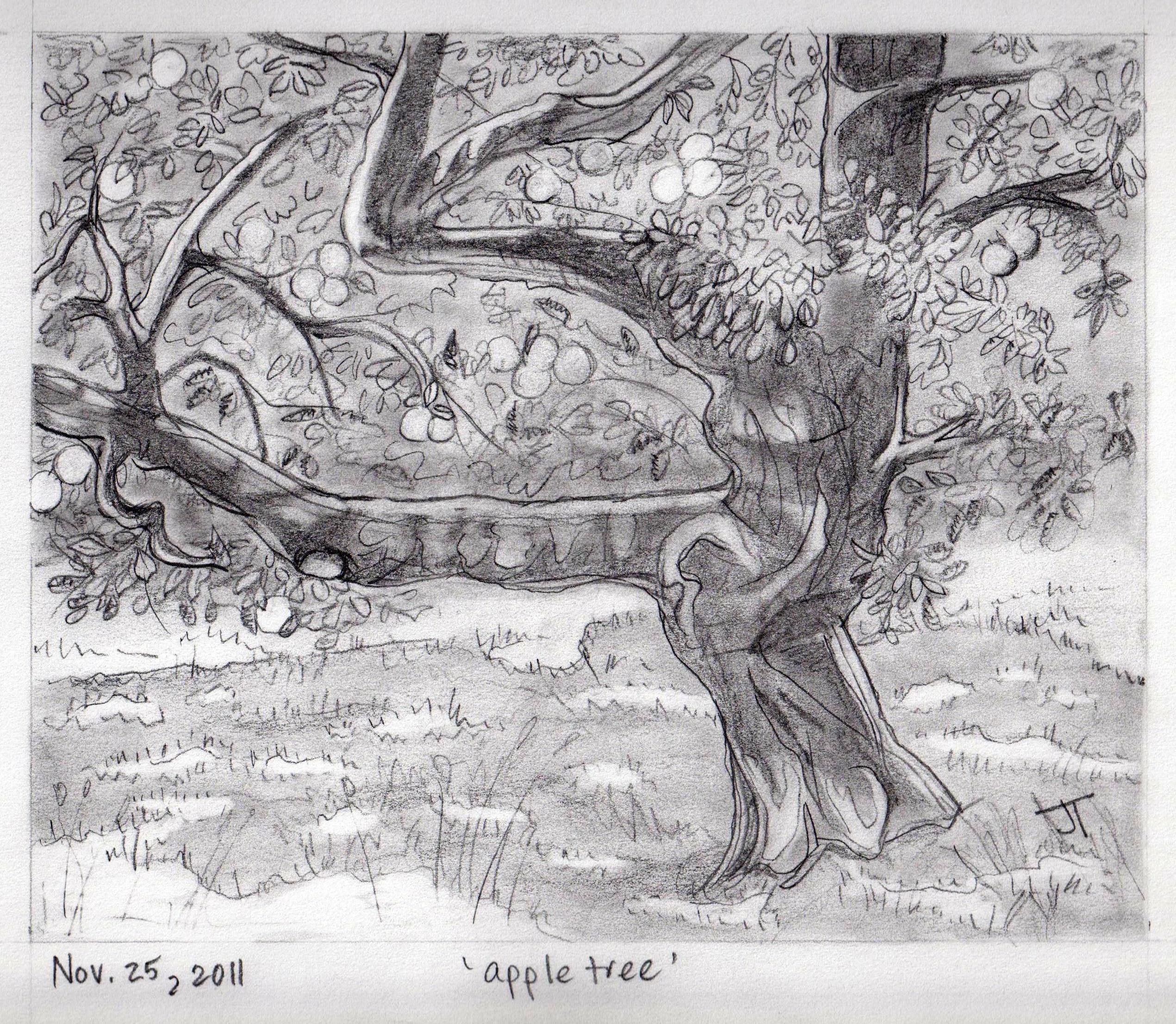
This time of year, I watch for the old apple trees along the road. Most are neglected, and the fruit remains unpicked, even for cider. When the apples fall, they lie beneath the tree in a circle of red or yellow, mimicking the shadow of the tree at noon.
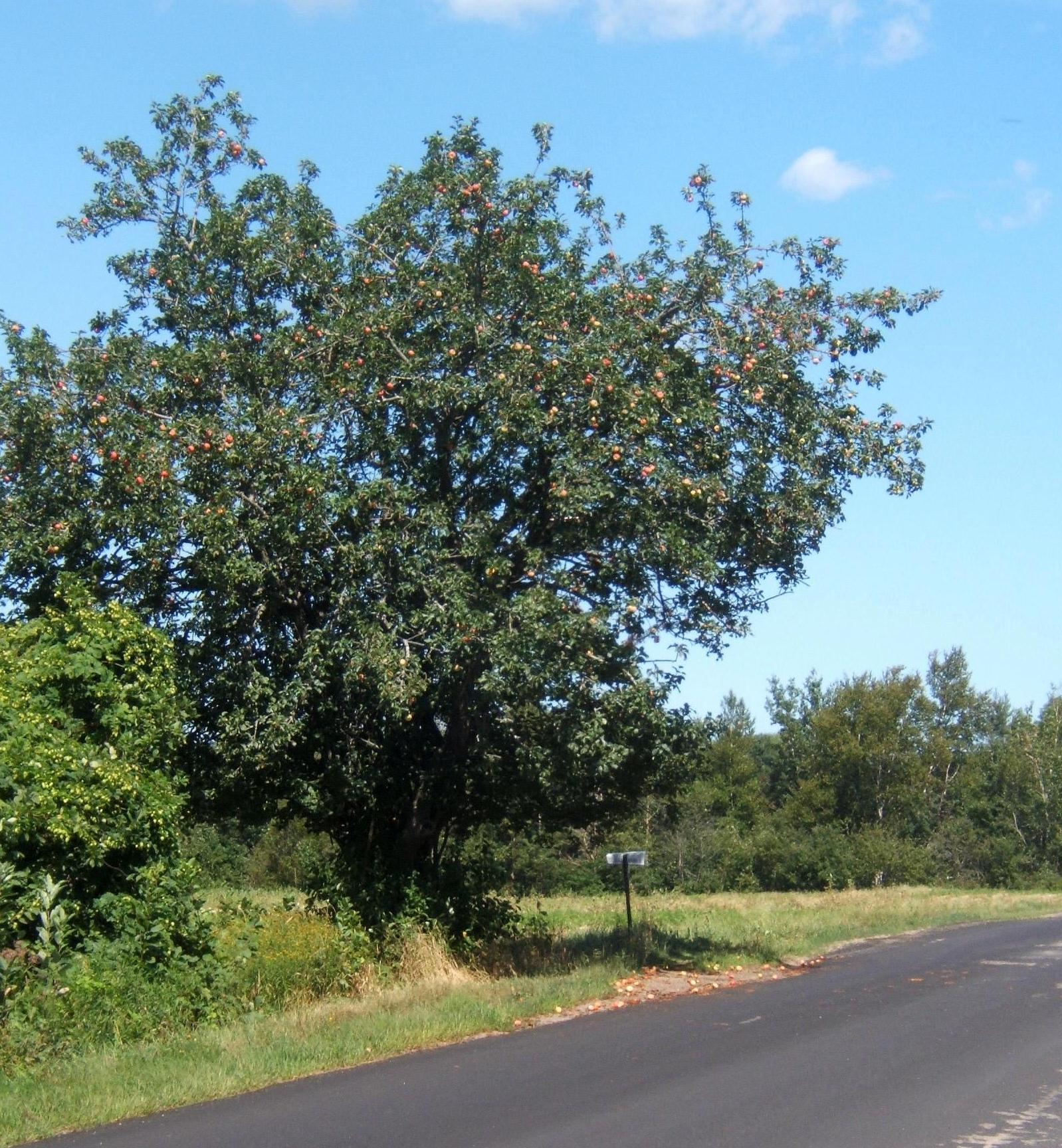
~
~
apple shadow
~
days follow days
and the apples
fall to the ditch,
claim the gravel
edge the asphalt
~
ripe shadow space
at the base of
the leaning tree
~
passing cars play
polo and wasps
worry in the
rotting remains
~
~
Copyright Jane Tims 2012
a snippet of landscape – moose habitat
Not far from Gagetown, on Route 102 in New Brunswick, is an interesting bit of wetland. Sometimes there is water in this small area but more often it is just wet mud. During periods of little rain, the mud becomes cracked and dry. The area never seems to grow any of the grasses or other wetland plants typical of wet areas.

The reason can be discovered through two pieces of evidence. The first thing you notice about the area is… the mud is carved with the tracks of a large animal. The second thing you notice is the Moose Crossing sign not far away, along the highway.
I have seen a moose in this muddy place. It is a dangerous place for a moose to be hanging out, because it is so near the road.
Moose visit these muddy areas for several reasons. They need water, of course. Also, salts from the road accumulate and moose use the wet areas as ‘licks’ to replenish their body salts. Sometimes these waters are naturally high in salt content.
We have seen moose quite often this summer. We watched a moose and her calf for about a half an hour during our trip to the Cranberry Lake area in July.

a moose and her calf
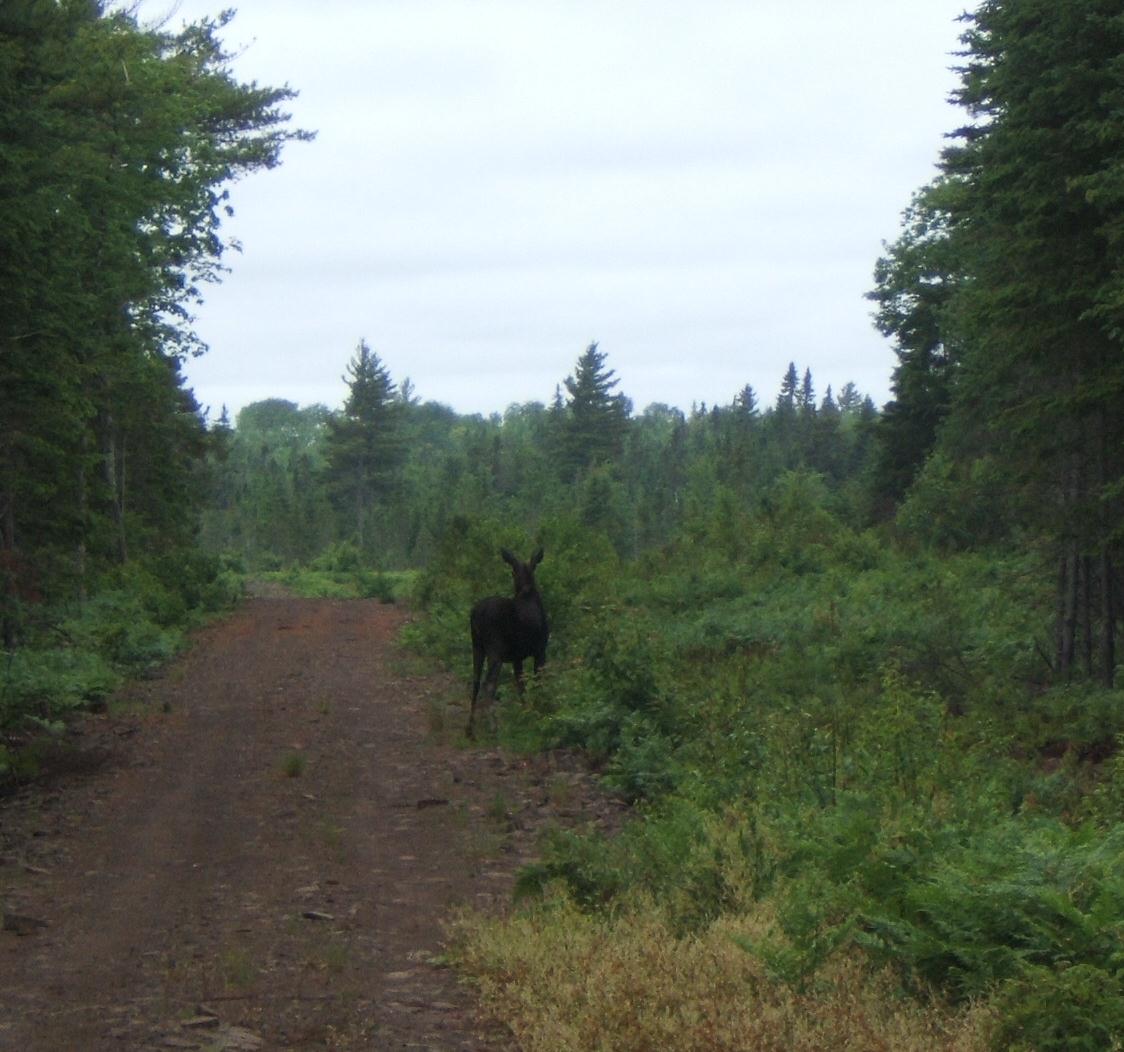
the moose sent her calf into the woods to hide and grazed quite a while, only a little concerned by us
Do you see moose where you are?
© Jane Tims 2012
Chicory – (Cichorium intybus L.)
Along the Trans-Canada near Jemseg, one colony of Chicory has taken hold. Its bright sky-blue flowers catch the eye as the usual roadside vegetation rolls by.
~

~
Also known as Blue Sailors and, in French, chicoreé, Chicory (Cichorium intybus L.) is a tall plant, found along roadsides and in other waste places.
Chicory has basal leaves resembling those of the Dandelion. When broken, the stem exudes a white milky fluid.
The bright blue flowers of Chicory occur along the length of the almost leafless and somewhat zig-zag stem. Each flower is formed of a central involucre of tiny blue flowers and a disc of larger ray flowers. The rays are square-cut and fringed. The flowers follow the sun, closing by noon, or on overcast days.
~

~
Chicory is a useful plant. Its young leaves are edible as salad greens or as a pot-herb. The roots can be dried and ground to make a coffee substitute or supplement. The root of Chicory has soothing properties to balance the edginess caused by caffeine. The roots of Chicory are large and very deep. I tried to pull them by hand, but a shovel will be needed to harvest the roots in the compact soil of the roadside.
~ When I see these flowers, I am reminded of my grandfather, my mother’s father. I never knew him, but I have a couple of photographs of him as a young man. I have made a small study of his mother, my great-grandmother, so I know quite a lot about him. ~
~
The flowers of Chicory remind me of his eyes, since they were the same startling blue. He was also a tall man, another feature of the plant.
The other name for Chicory, Blue Sailors, also reminds me of my grandfather. He was a sailor, entering the navy when he was only fifteen. I know from various records that he served on at least two naval vessels, the USS Nebraska and the USS Pensacola. As so often happens when I see photographs of ancestors, there is a familiarity about his features.
~

~
Blue Sailors
Chicory (Cichorium intybus L.)
~
at the roadside
weeds surge as waves
~
on the sameness of ocean,
a buoy lifted,
a sudden swell of Chicory
~
tall, like my grandfather,
the blue ice of his eyes
its blunt petals, the square-cut of his jaw
~
joined the navy at fifteen
dressed as a sailor, headed for sea
USS Pensacola, USS Nebraska
~
his tie, a sapphire ribbon
toothed or frayed
~
~
© Jane Tims 2012
Warning: 1. never eat any plant if you are not absolutely certain of the identification; 2. never eat any plant if you have personal sensitivities, including allergies, to certain plants or their derivatives; 3. never eat any plant unless you have checked several sources to verify the edibility of the plant.a moment of beautiful – mustard fields in bloom
the space: a field along the St. John River
the beautiful: mustard in bloom
In some of the cultivated fields along the St. John River, acres of mustard are in bloom. Mustard is common here, in both coastal and inland areas, along roads and in fields. In the last weeks, I have found two species, Black Mustard (Brassica nigra (L.) Koch) and Field Mustard (Brassica rapa L.) also known as Rape, or Bird’s Rape.
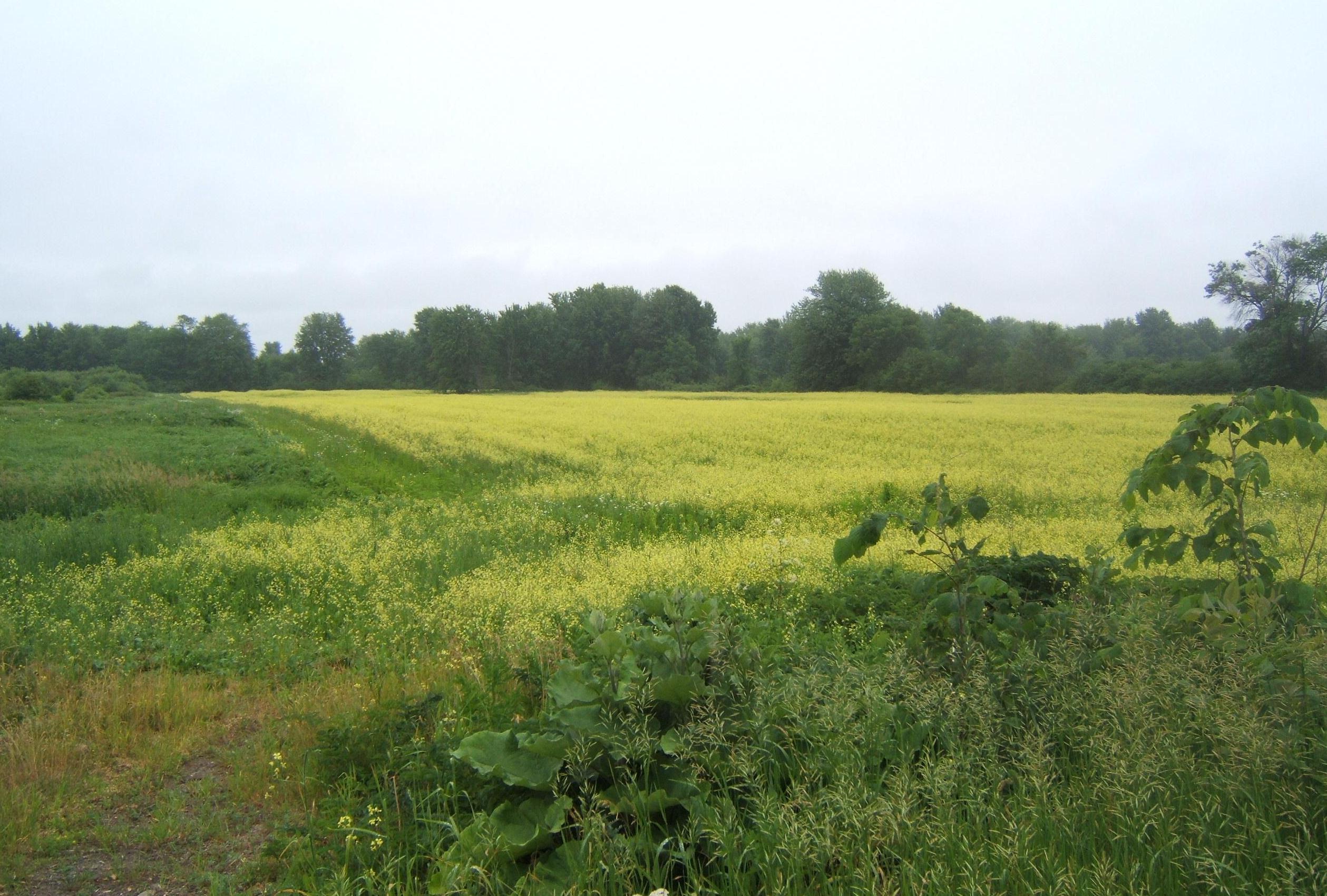
Mustard is an herb of medium size, with pale yellow, four-petalled flowers in terminal clusters, and large lobed leaves. The seeds are contained in pods; each pod ends in an elongated beak.

Mustard is well-known for its uses. The young, basal leaves may be cooked as greens or used in salads. Clusters of unopened flower buds can be cooked like brocolli. The tender seed pods are pickled, or used in salads.
Mustard’s best-known use is as a spice – the seeds are collected, dried and ground to make hot yellow mustard. I have a spot staked out to collect the seeds as they ripen in August, since I want to dry and grind some seeds for my own mustard.
~
~
sandwich
~
green leaves
between brown earth
and summer sky,
finished with
a generous smear
of mustard
~
~
© Jane Tims 2012
Warning: 1. never eat any plant if you are not absolutely certain of the identification; 2. never eat any plant if you have personal sensitivities, including allergies, to certain plants or their derivatives; 3. never eat any plant unless you have checked several sources to verify the edibility of the plant.Coltsfoot (Tussilago Farfara L.)
Although it has been snowing sporadically this month, our recent days of very, very warm weather tell me spring has arrived. As a result, I am watching the roadsides for the first flowers of spring. Even before the snow is out of the woods, it begins to melt along the roadsides as they warm in the lengthening hours of sun. And the cycle of bloom begins again.
Coltsfoot (Tussilago Farfara L.) is one of the first plants seen in early spring. It forms large patches in waste areas, beside brooks and roads, and on damp hillsides. People often mistake Tussilago for Dandelion, but it is quite different. Its yellow flowers are borne on scaly, leafless stems. The large, woolly leaves don’t appear until later in the season. In spite of its early appearance in spring, Tussilago actually has late flowers. The flower buds are formed in autumn at the base of the plant, and pass winter underground, flowering in the first spring sunlight.
Other names for the plant are Son-before-the-Father, which refers to the appearance of flowers before the leaves, and pas-d’âne (literally donkey-steps). The scientific names are from the Latin tussis, meaning a cough, referring to the use of the plant as a remedy for such ailments, and the Latin word for coltsfoot, farfarus. The plant was named by Linnaeus, the Swedish botanist who established the present day system of naming plants.
Although the plant was used by pioneers for its medicinal effects, it is now known that Tussilago contains harmful alkaloids. Tea made from Coltsfoot has caused health problems in infants and pregnant women, so its use as a cough remedy is not recommended. In some States, Coltsfoot is considered a noxious weed.
~
~
Coltsfoot
Tussilago Farfara L.
~
Gold-
splashed beside the road
like prints
of a frisky colt’s feet
~
at first glance-
an early dandelion!
but-
too early
stem scaly
no leaves below the bloom
no perfume.
~
Coltsfoot,
Son-before-the-Father
(flowers before the leaves).
Introduced from
far, far away.
Old wives say
boiled greens
will ease
a cough.
~
Long ago
Tussilago
sprang from where
a burro trod
among the palms
(pas-d’ane)
~
~
Published as: ‘Coltsfoot’, Winter 1993, The Antigonish Review 92:76-77.
Revised
© Jane Tims 1993
~

snippets of landscape – ice falls on rock walls
When highways are built, they often cut through the bedrock, leaving rock walls along the margins of the road. If these intersect a brook or seep of water, the result is a waterfall on the face of the rock. In spring or summer, rains can create wild cataracts. In winter the water freezes, building frozen walls of blue-shadowed ice. In sunlight, especially when they begin to melt, these ice falls are dazzling.

~
~
one warm hand
~
icicles seep between
layers of rock frozen
curtains separate
inner room from winter storm
glass barrier between blue
light and sheltered eyes
memory of water flows
along the face of the rock
one warm hand melts ice
consolation, condensation
on the inward glass
~
~
© Jane Tims 2012

a place in the marsh
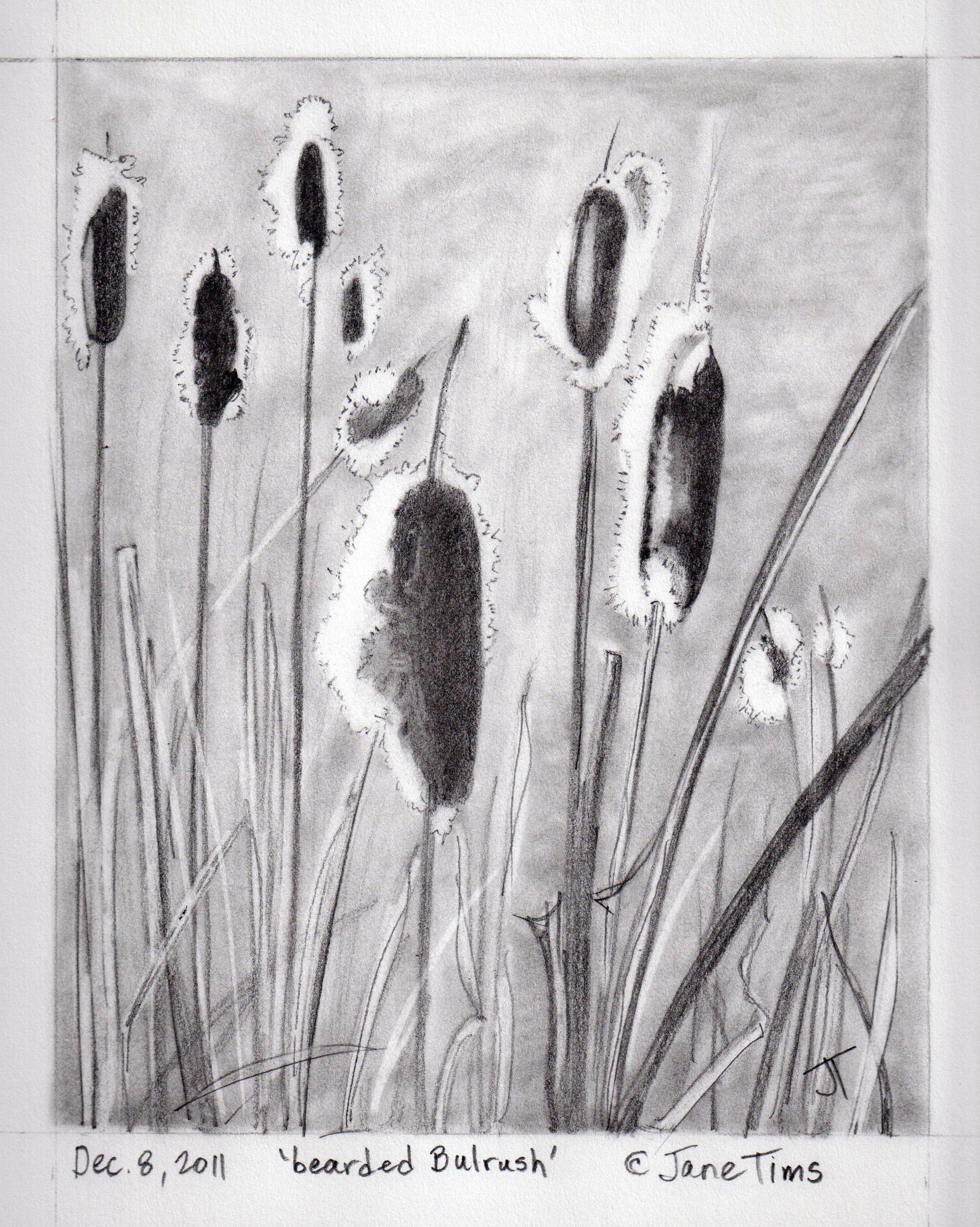
For the last few weeks, as I drive by the ditches and wetlands on my way home from work, I am charmed by the way the bulrushes have burst and made their bountiful seed available to the winds.
The heads of the bulrush (Typha latifolia L., also known as common cat-tail or masette in French) are usually neat and tidy cylinders of dark brown, held high on a sturdy stem. At this time of the year, the seeds emerge in a copious fluff clinging to the brown seed-head like a beard, a lion’s mane or a furry hat.
When I was a child, we always called these plants ‘busby rushes’, presumably after the tall bearskin hats worn by the Queen’s Foot Guards in front of Buckingham Palace. Actually a busby is not the correct name for the bearskin, but is a hat worn by Hungarian hussars, or the Royal Horse Artillary, a ceremonial unit of the British Army.
Our two usual species of Typha are distinguishable by their leaves. Typha latifolia (broad-leaved cat-tail) has flat leaves. Typha angustifolia (narrow-leaved cat-tail) has narrower leaves, convex on the back.
~
bulrush in December
(Typha latifolia L.)
~
4:45 PM rush, the Marshlands
bus expels tired folk to familiar sidewalks
exhausts them in diesel cloud
a bulrush pushing its seed
to the wind in cold December
bearded and wise, fur hats and
ear flaps against the cold
breath expressed as icicles and rime
~
© Jane Tims 2011
autumn black and white
Roaming around the countryside, the weekend before last, deluged by color from orange and yellow trees and crimson fields of blueberry, I was interested by the contrast in the ditches. A month ago, they were a riot of yellow or purple as the goldenrods, tansies and asters presented themselves, species by species. Now, they are done with blooming and are in the business of releasing their seeds.
To attract pollinators for setting their seeds, flowers put on a competitive display of color and form. But dispersing their seeds is a different process altogether. Many depend on the wind to carry their seeds to ideal sites for next year’s bloom and the wind is color-blind. Grey, white and even black are the dominant colors in the ditches.

Seeds dispersed by wind either flutter to the ground, or float in the air. Often, they are assisted by a special seed form. For example, maple keys are flattened and aerodynamic so they spin and travel some distance as they fall. Seeds of goldenrod and aster have feathery white bristles (called the pappus, a modified sepal) to help them float through the air. The term pappus comes from the Latin pappus meaning ‘old man’, an apt description of the white heads of the flowers, gone to seed.

Another species in the ditch, Common Tansy (Tanacetum vulgare L.), also known as Golden-buttons, ordinarily has bright yellow flowers in a flat head. Now, it has joined the black and white revue, showing black seed-heads against feathery leaves.

The seeds of Tansy, in a form called an achene, have no special adaptation for flight. This time of year, these seeds are dry and ready for dispersal by gravity.
autumn black
~
dry leaves
silent
colorless
wonder withdrawn, into the vortex of
no hue, no delight
cones suppressed, rods perceive
absence, black seed in heads of Tansy
absorb all light, feathered foliage
darkest green, approaching black
~
© Jane Tims 2011




 nichepoetryandprose