Posts Tagged ‘poetry’
a pair of eagles
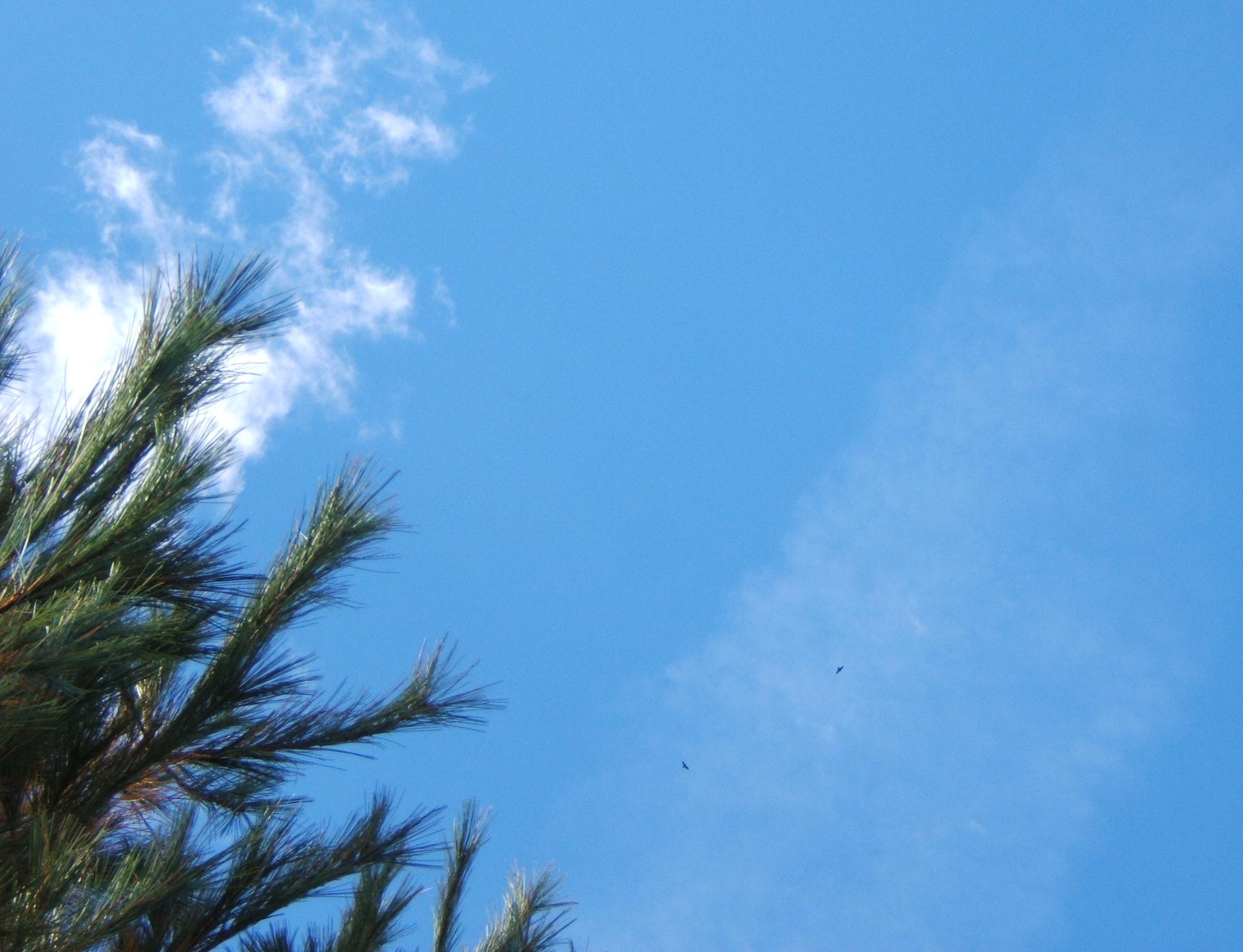
When we spend time at our lake property, we often see Bald Eagles. They nest in the large White Pines along the edge of the lake and I sometimes find their feathers near our arbour, suggesting they visit our place when we are not at home.
Today we watched a pair of them circle high in the sky, soaring effortlessly on the updrafts. They flew in sync with one another, so coordinated in their movements, they could have been dancing.
~
~
fragments about wind
~
the trees move as though branches flow from a bottle
~
this morning I found
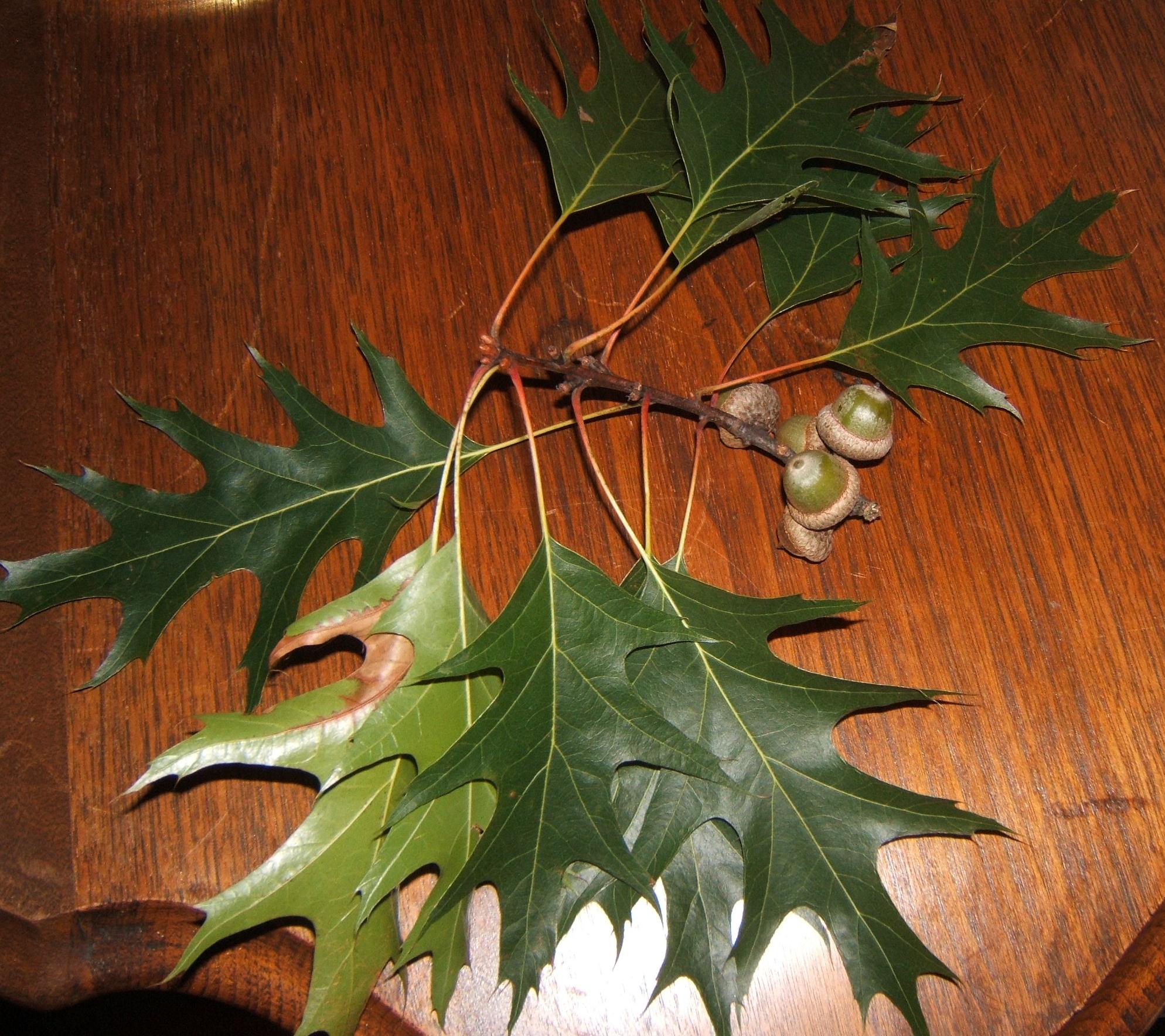
oak leaves on the sidewalk
and a young acorn with the nut missing
~
a pair of eagles soars
wings lifted on
scant molecules of air
~
~
Copyright Jane Tims 2012
a moment of beautiful – sunset over the St. John River
the space: the St. John River at dusk
the beautiful: sunset over the river
Last evening as we drove home after a visit to my sister’s home, orange was on my mind. I was thinking of the bright orange pumpkins in the gardens, the orange of Japanese Lanterns, the orange of the turning leaves, and the orange of the running lights on the trucks on the highway. Then, as the sun went down, we were treated to the most beautiful orange, the color of the sunset over the St. John River.

A lovely introduction to the month of October……………..

~
~
hauling sun
~
eighteen-wheeled tractor pulls,
hauls the loaded b-train
~
gears down for the grade, snags
light from the sunset, wanes
~
and leaks from the headlamps
pushed forward into night
~
ahead, on the dark road,
a cone of borrowed light
~
~
Copyright Jane Tims 2012
transitions
Now, as I am finishing my manuscript of poetry on local foods, I am aware of the change this means for me. I know there will be a new project but I am not yet certain what it will be. I have many things to choose from… perhaps I’ll begin a new series of poems… perhaps I’ll write some non-fiction on an environmental theme… perhaps I’ll finish some of the paintings I have begun.
Although I like best to write, I find creative activities substitute for one another. For example, when I am not writing for an extended period of time, I am often embedded in some other creative work such as painting or sewing. Now, as I finish my manuscript, I have begun to weave on my loom. It gives me thinking time as I approach the end of my writing project, to work through the final steps in my mind. It also creates some certainty for me and provides a transition to my next project.
To me, weaving exemplifies the lure of creative endeavor. The producing requires knowledge and skill, and builds confidence. The process is relaxing and time is made available for thought and concentration. The threads and fabrics are luxurious to touch and the colors are bright and joyful. When I am finished a project, I am so proud of the resulting textile, I want to show the world.

My loom is a simple floor loom, 24 inches wide. I bought it at a country auction, about 15 years ago. My sister and I were among the stragglers at the auction, trying to outlast a heavy rain. In the corner, we saw a bundle of varnished wood and some metal parts. “I think that’s a loom,” whispered my savvy sister. When the item came up for bid, there were few left in the audience, and no one knew just what ‘it’ was. I can’t remember what I paid for it, but I know it was a bargain.
My loom and I have not been steady company. It takes forever to install the warp (I began to install my current warp in May!), and weaving is hard on my back. But the fabrics we have made together, my loom and I, are beautiful and comfortable and good for the soul.

~
~
yellow line
~
the road is fabric
weave of asphalt
ditch and yellow line
warp of guard rail
fence and heddle
~
trees in plantations
lines on the hayfield
hip and curve of the earth
weft as she turns in her sleep
~
shuttle, piloted
through landscape
and watershed
textile in folds
texture the yearn of the loom
~
faults in the granite
potholes in pavement
rifts in the fabric
where weavers might falter
revisit the work
of earlier times
~
learn the lessons
taught by the loom –
choose the weft wisely
balance the color, the texture
maintain the tension
fix mistakes as you go
~
when your back hurts,
rest
~
listen to the whisper
of weave
of yellow line
~
~
Copyright Jane Tims 2012

apple tree shadow
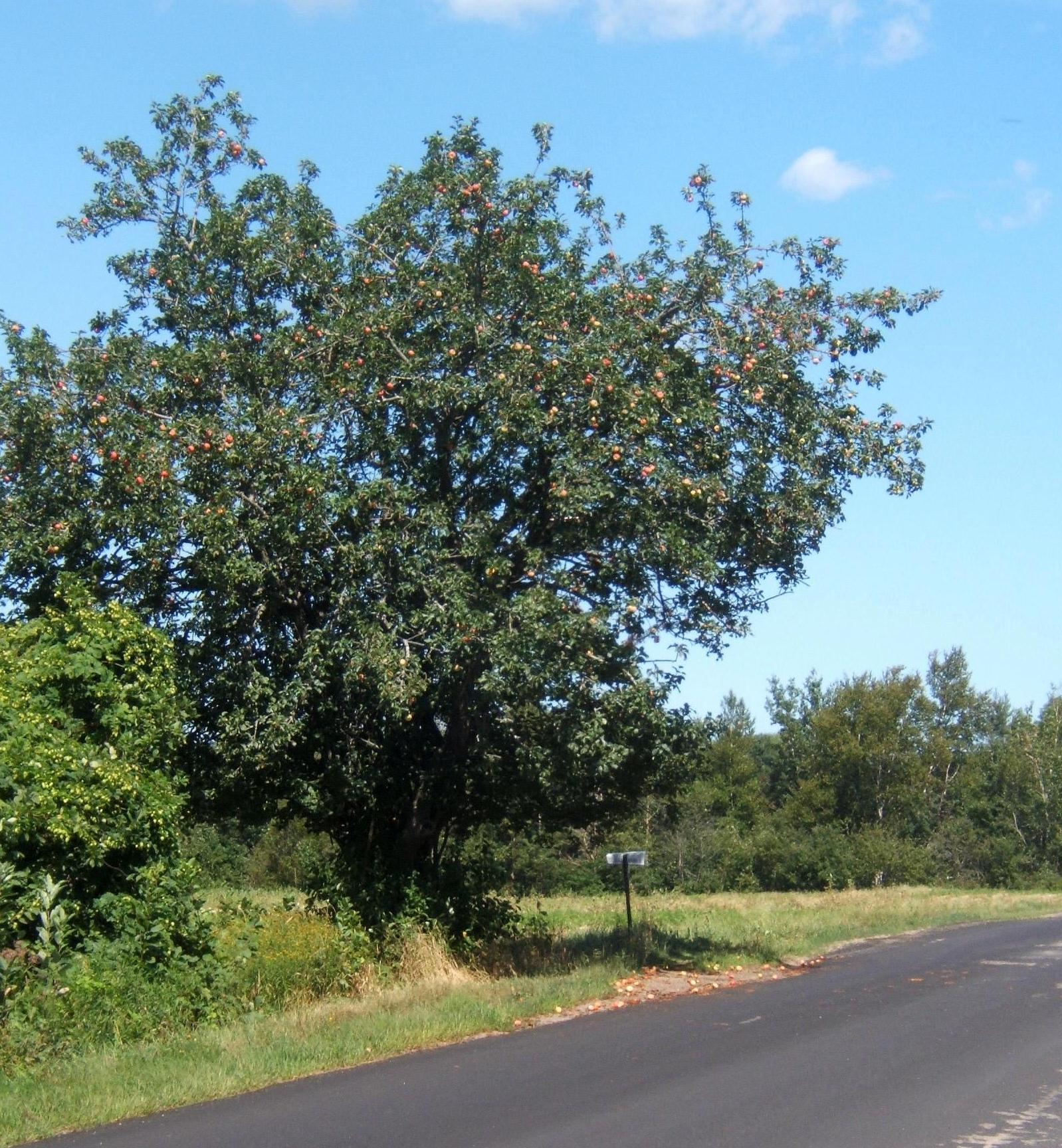
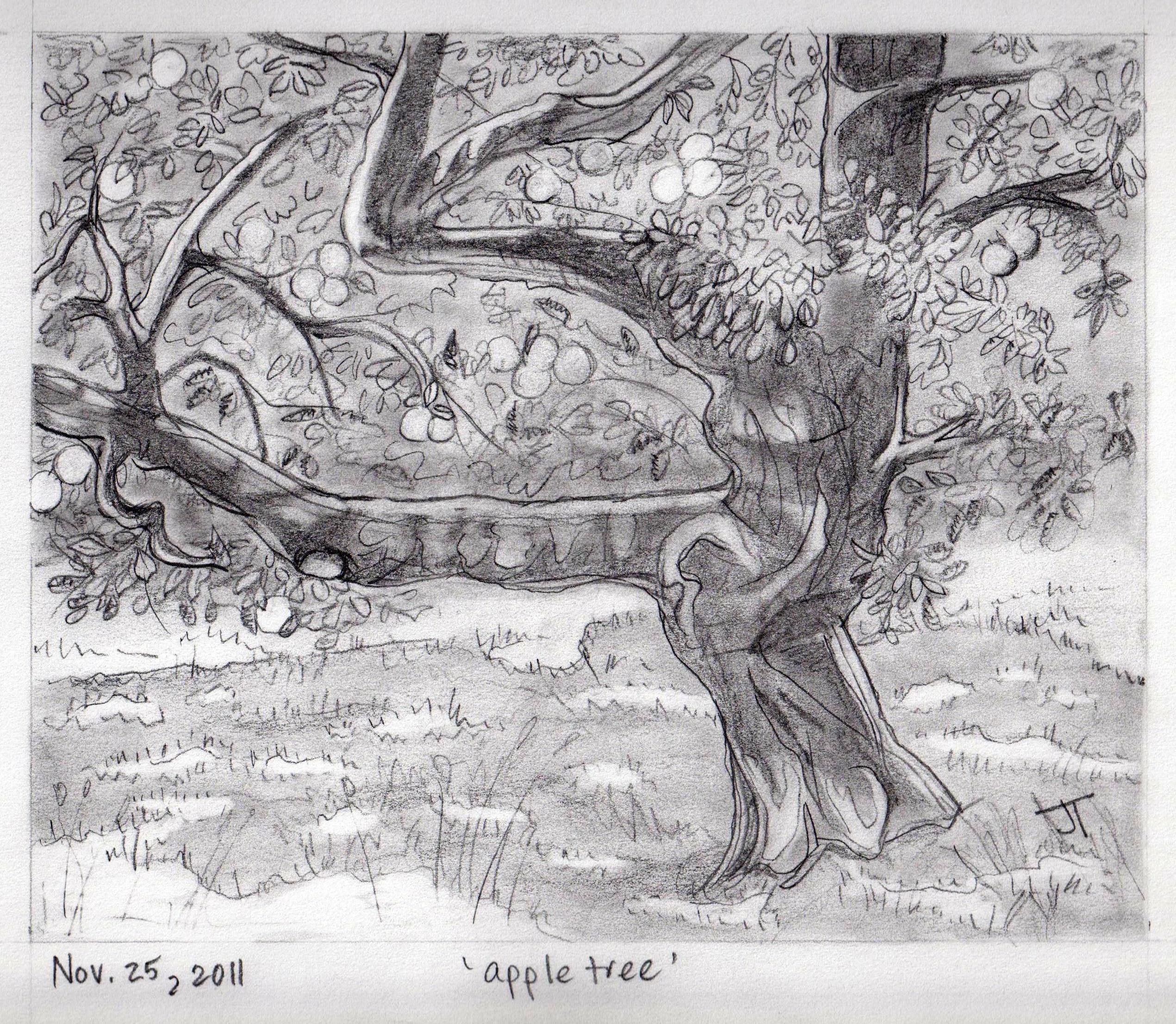
This time of year, I watch for the old apple trees along the road. Most are neglected, and the fruit remains unpicked, even for cider. When the apples fall, they lie beneath the tree in a circle of red or yellow, mimicking the shadow of the tree at noon.
~
~
apple shadow
~
days follow days
and the apples
fall to the ditch,
claim the gravel
edge the asphalt
~
ripe shadow space
at the base of
the leaning tree
~
passing cars play
polo and wasps
worry in the
rotting remains
~
~
Copyright Jane Tims 2012
Highbush Cranberry (Viburnum trilobum Marsh.)
Like miniature fireworks, bright bunches of the berries of Highbush Cranberry (Viburnum trilobum Marsh.) burst along our roadsides in late summer. Highbush Cranberry is also called Cranberry, Pimbina, and in Quebec, quatres-saisons des bois.
The Highbush Cranberry is a large deciduous shrub, found in cool woods, thickets, shores and slopes. It has grey bark and dense reddish-brown twigs. The large lobed leaves are very similar to red maple.

In spring and summer, the white flowers bloom in a cyme or corymb (a flat-topped or convex open flower-cluster). Most flowers in the cluster are small, but the outermost flowers are large and showy, making the plant attractive for insect pollinators.
The fruit is a drupe, ellipsoid and brightly colored red or orange. The juicy, acidic fruit has a very similar flavour to cranberry (Vaccinium spp. L.) and is used for jams and jellies. The preserves are rich in Vitamin C.

~
~
fireworks, quatres-saisons
(Viburnum trilobum Marsh.)
~
~
against a drawing paper sky
some liberated hand
has sketched fireworks
~
remember precursors in spring?
blowsy cymes, white sputter
of a Catherine wheel
~
now these berries, ready to pick
bold, spherical outburst
of vermillion sparks
~
a pyrotechnic flash of red
strontium detonates
in receptive dark
~
a four-season celebration
spring confetti, berries,
fireworks in fall
~
cranberry preserves – acidic,
tart blaze of summer sky
winter ignition
~
~
© Jane Tims 2012

© Jane Tims 2012
a moment of beautiful – Blue-eyed Grass
the space: the meadow above the lake
the beautiful: a bright blue flower – Blue-eyed Grass
All grass is not grass. In spring, some of those green blades reveal their true identity. You look down, and a blue eye stares back at you. You have found Blue-eyed Grass, Sisyrinchium montanum Greene.
Blue-eyed grass is not a grass at all, but a member of the iris family. It inhabits moist, open ground in fields and meadows, and blooms in late spring and early summer. The plant is low and slender, with a deep blue flower and a bright yellow center, borne at the top of a straight, usually unbranched, stem. The stem is two-edged, flattened on the margins. The flowers are borne in the axil of a sharp, upheld bract called a spathe. In French, the plant is called Bermudienne. Montanum means ‘of the mountains’.

~
~
Blue-eyed Grass
Sisyrinchium montanum Greene
~
I walk in grass,
but it isn’t grass –
Sisyrinchium
it winks at me
with azure eyes,
and I blink brown at them
~
Blue-eyed Grass
stands straight and still,
staunch Bermudienne
simple maid
with a watchful eye,
and a sword above her head
~
~
© Jane Tims 2012
growing and gathering – names of edible wild plants
As I have worked on my poetry project about eating local foods, I have researched each wild plant, found it in its natural environment, and then written about it. With all this, I am exposed to the words and characteristics of a particular plant and it is never certain which way the ‘muse’ will take me when I write the poem. Sometimes, I end up creating a poem about eating local food, and sometimes, I get a poem about something else. Usually these stray poems are, in some way, about the name of the plant.
I find the names of plants are very inspiring. First is the Latin or scientific name, familiar to me after years of botanizing, but mysterious to most people. I love to find out about the origins of the name and I usually discover the name is descriptive of the plant. An example is the scientific name for Yellow Wood-sorrel (Oxalis stricta L.), a small yellow-flowered, three-leaved plant of waste areas. The name stricta means ‘erect’, referring to the way the plant grows when young or the way its seed pods are held. The word oxalis is from the Greek oxys meaning ‘sour’, a reference to the taste of the leaves.
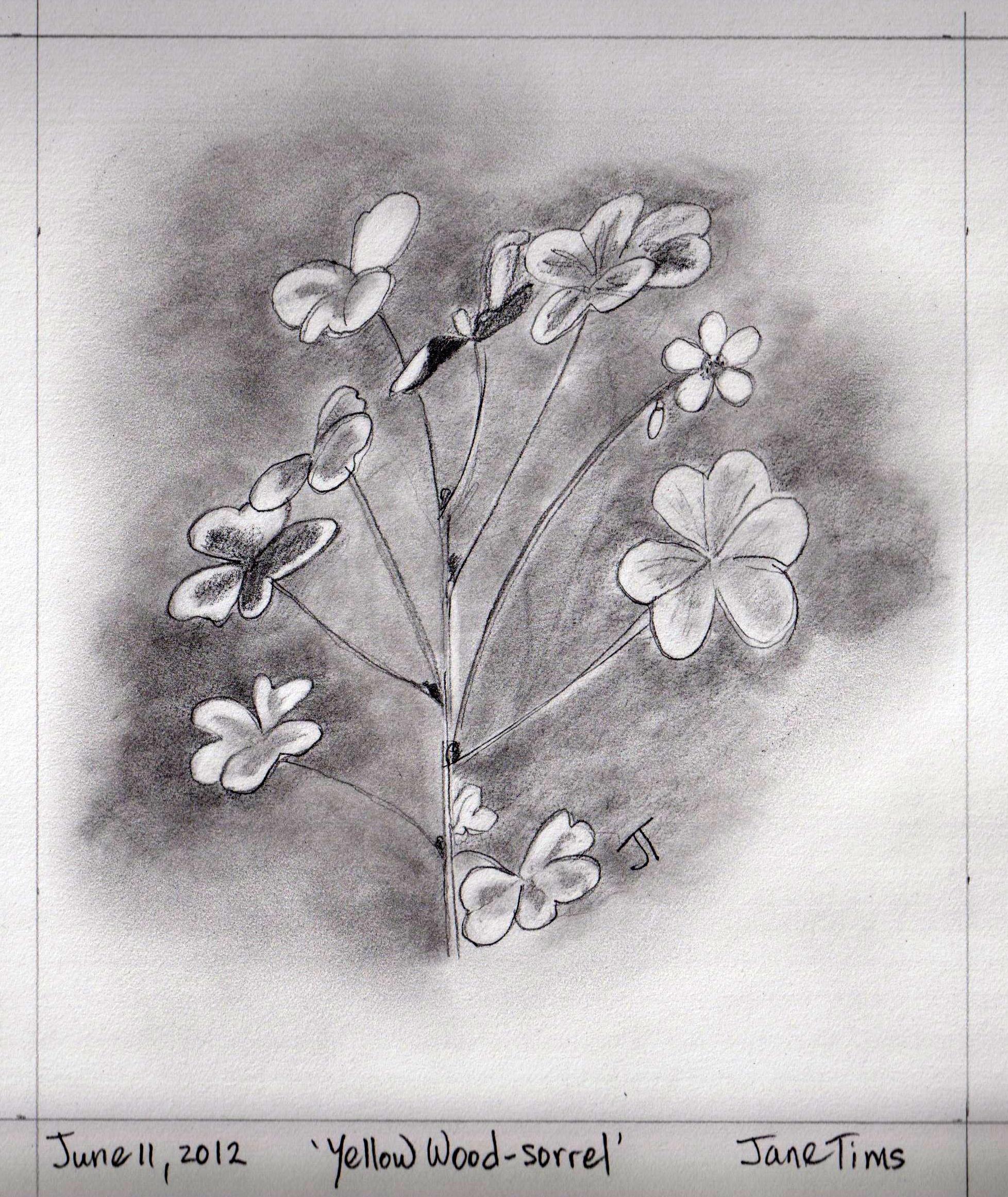
The common names of plants are also intriguing. Sometimes these are different for each area where the plant is found. For example, the Cloudberry (Rubus Chamaemorus L.), a small relative of Blackberry with a peach-colored fruit, is known locally (and particularly in Newfoundland) as Bakeapple. Plant names may also refer to a characteristic of the plant. A good example is Heal-all (Prunella vulgaris L.), a small purple flower. It inhabits waste areas and lawns, becoming small and compact if mowed. One of its common names, ‘Carpenter Weed’, comes from this characteristic… Carpenter Weed mends holes in lawns! The name Heal-all comes from the old belief that the plant has medicinal properties.

‘heal-all’ Copyright Jane Tims 2011
So, among my collection of poems about edible plants, I have a group of poems about the plants and their names, but not about their use as local foods. I have to decide whether or not to include them in my collection, or to set them free!
~
~
Heal-all
(Prunella vulgaris L.)
~
snug Prunella, neat little weed
prim and proper, gone to seed
~
first called Brunella: gatherers found
Prunella purple fades to brown
~
a carpenter weed, busy, strong
mends bare patches on the lawn
~
heal-all, self-heal – your name suggests
an herbal secret you possess
~
~
© Jane Tims 2012
one red tree
On a drive to see some covered bridges in York County, we took a logging road along the Pokiok and Little Pokiok Streams.
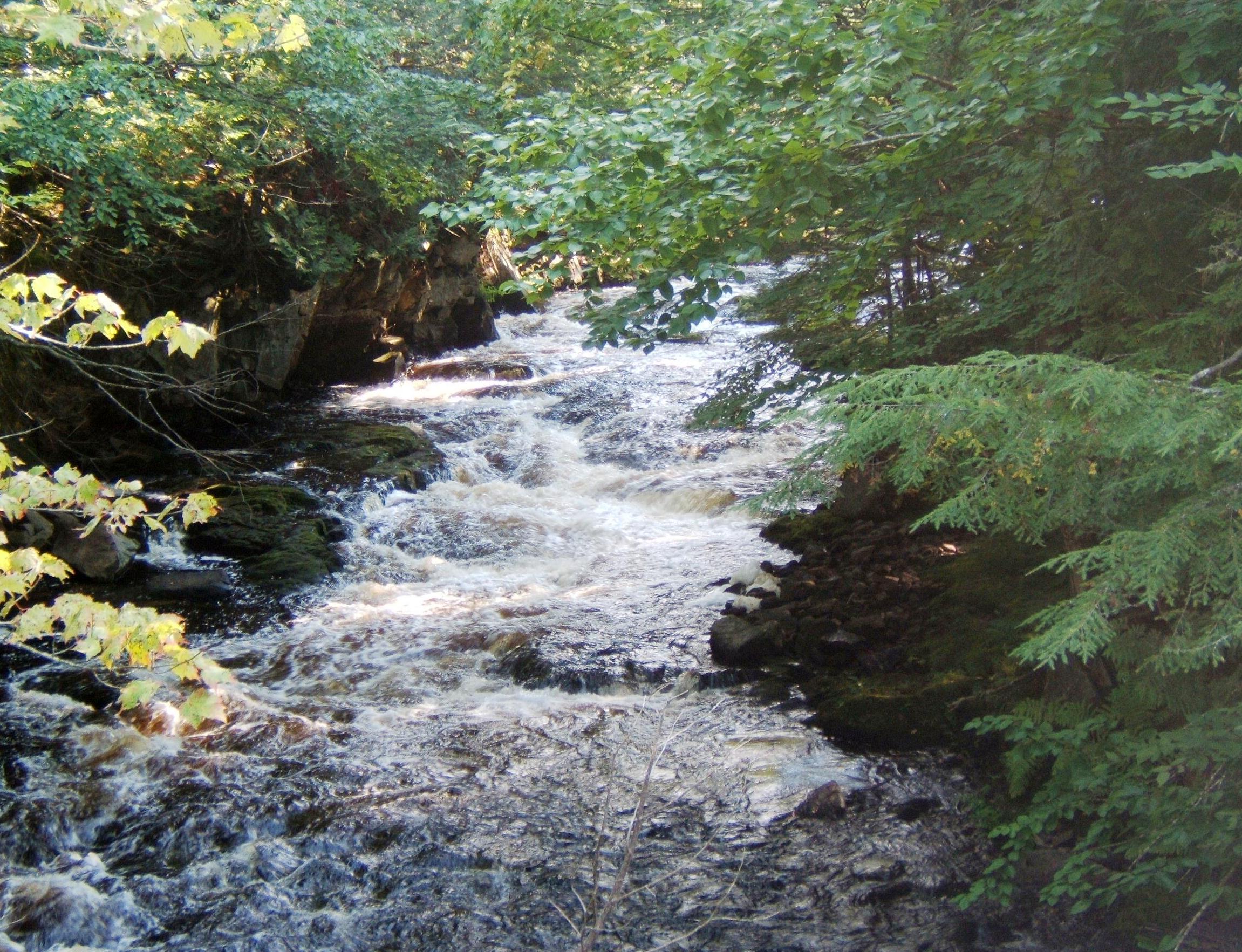
Years ago, on this road, we saw an albino deer. On this recent trip however, the only wildlife we saw were the Flickers. As we drove along the road, a Flicker would fly up and lead us a ways before veering into the woods on the roadside.
It was a good road, maintained by a local forest company. Along the way, we crossed a small metal bridge and I stopped to take a photo of a small stream winding its way through a bog.
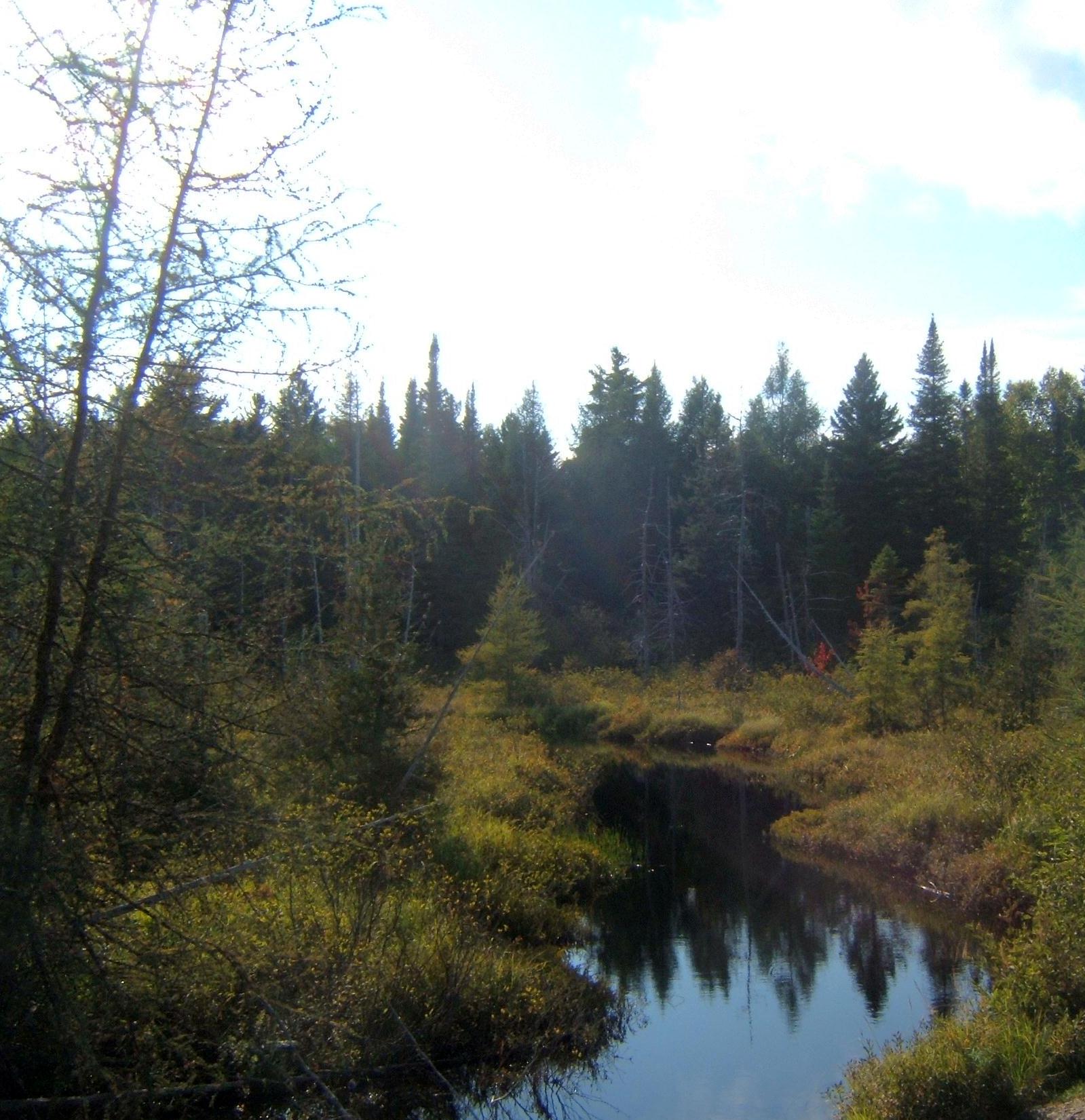
It was a lovely stream, deep and tea-colored. Over in the corner of the bog was one red tree, reminding me that our summer is fading quickly.
~
~
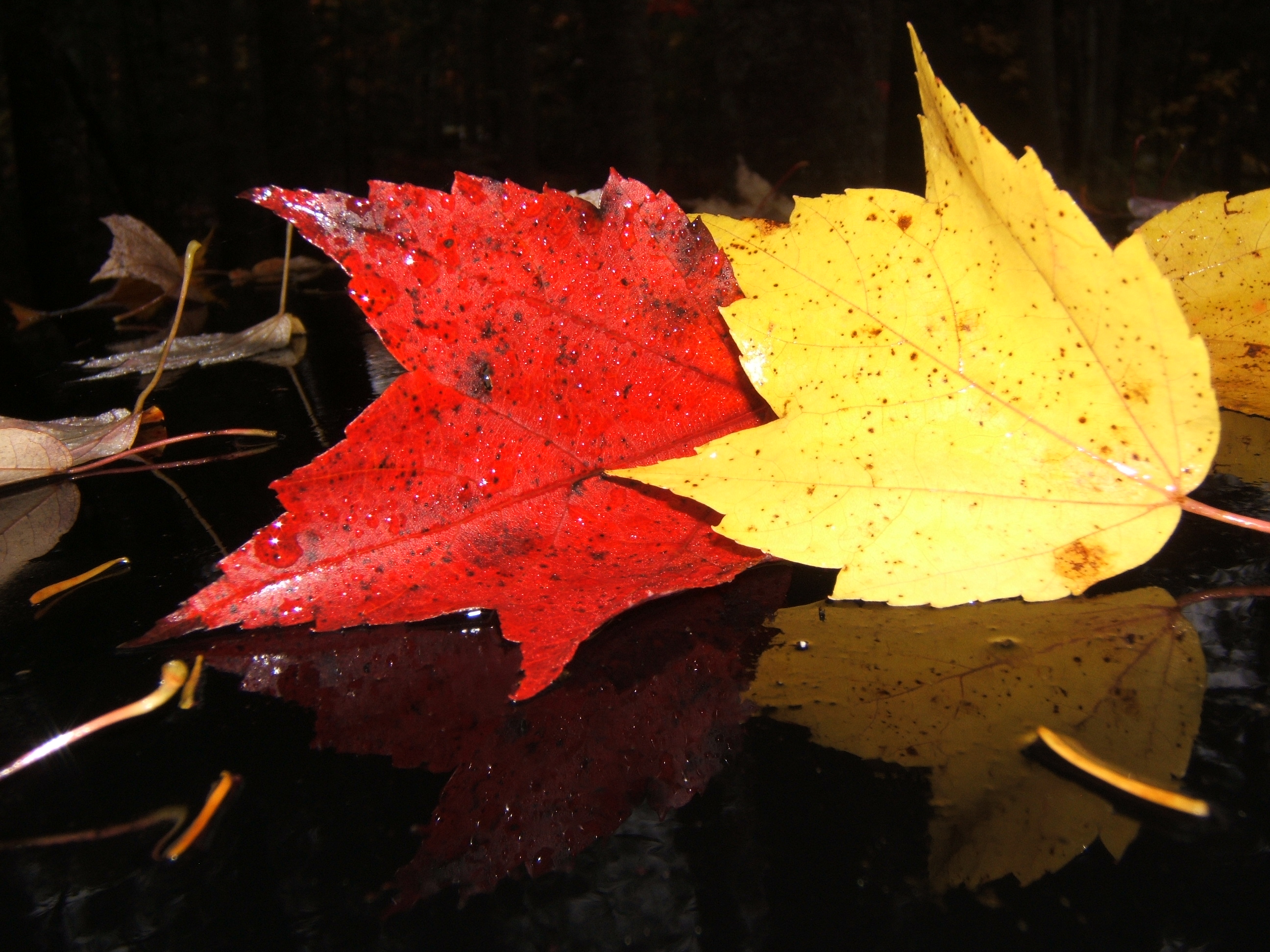
end of summer
~
on the path along the brook
one leaf bleeds into water
in town the walks are stony
chaff of linden, seeds
dry ditches overflow with flowers
~
I shrug
(no matter
summer is ended)
~
yellow rattle
pods and grasses
rehearse an incantation
wind sulks in corners of the shed
warmth and sun
paint the orange of pumpkins
knit winter mittens
~
I gather signs of autumn
asters, windfalls, flocks of red wings
frantic in the alders
acorns, hollow galls from oak
~
Orion peeks above the trees
time forgotten, found
and summer with rain never ends
~
I ask for rain
(arms loaded with everlasting)
~
~
Previously published as ‘end of summer’, Sept. 19, 2011, http://www.nichepoetryandprose.wordpress.com
~
© Jane Tims 2012
a walk through the covered bridge – Bell Bridge, South Branch of the Oromocto River
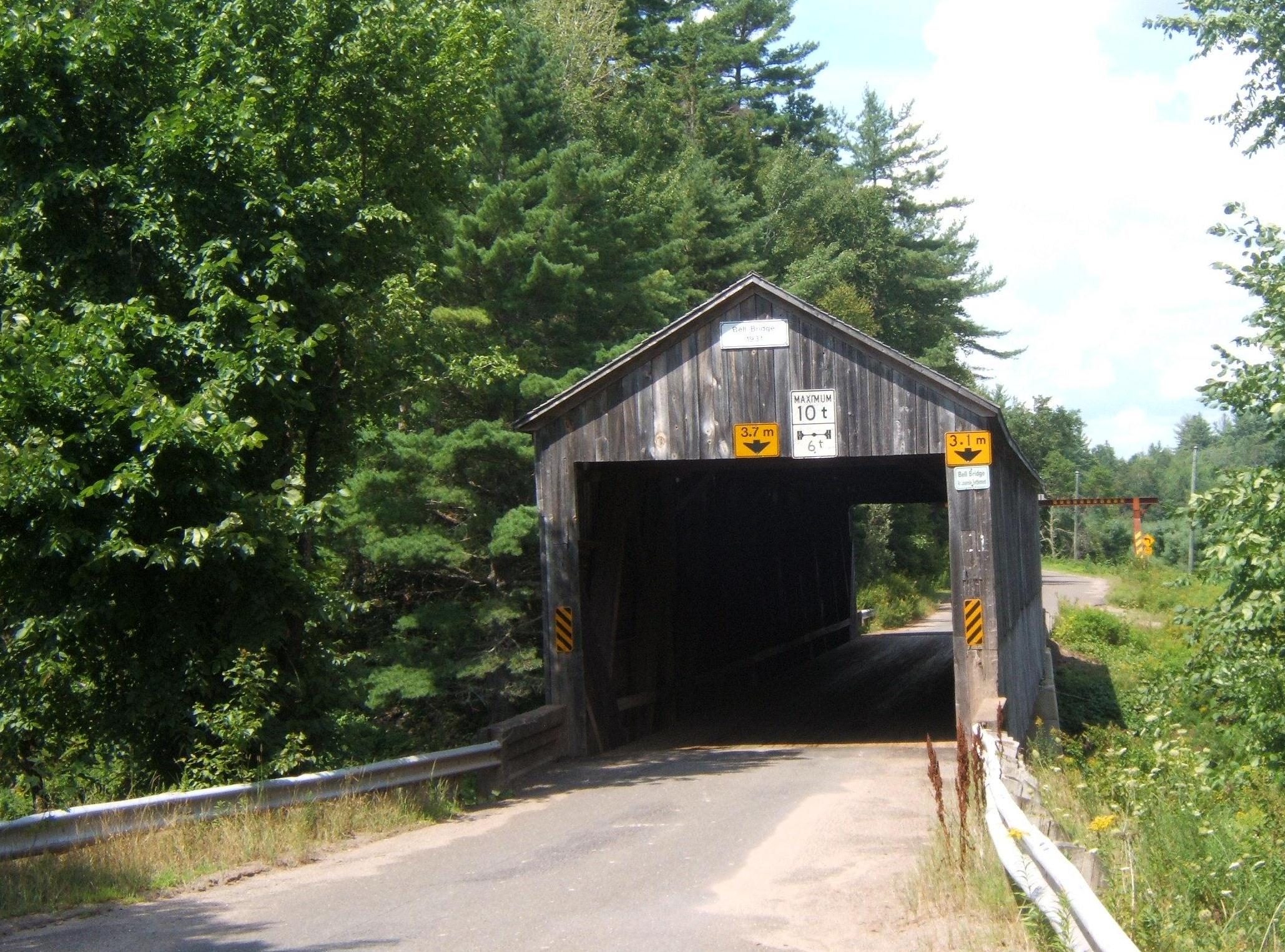
Another covered bridge crossing the South Branch of the Oromocto River is the Bell Bridge near Juvenile Settlement, Sunbury County (listed as South Oromocto Rover #3 in the April 1992 pamphlet ‘Covered Bridges in New Brunswick’, no author indicated). This bridge was built in 1931. It is 126′ 4″ long with a span of 123′ 4″. The roadway width is 15′ 5″, and the load limit is 10 t (6 t for double axle vehicles). The maximum clearance is 3.7 meters and a metal height barrier has been installed to ensure trucks exceeding the clearance cannot proceed through the bridge since this can do significant damage to the bridge structure.
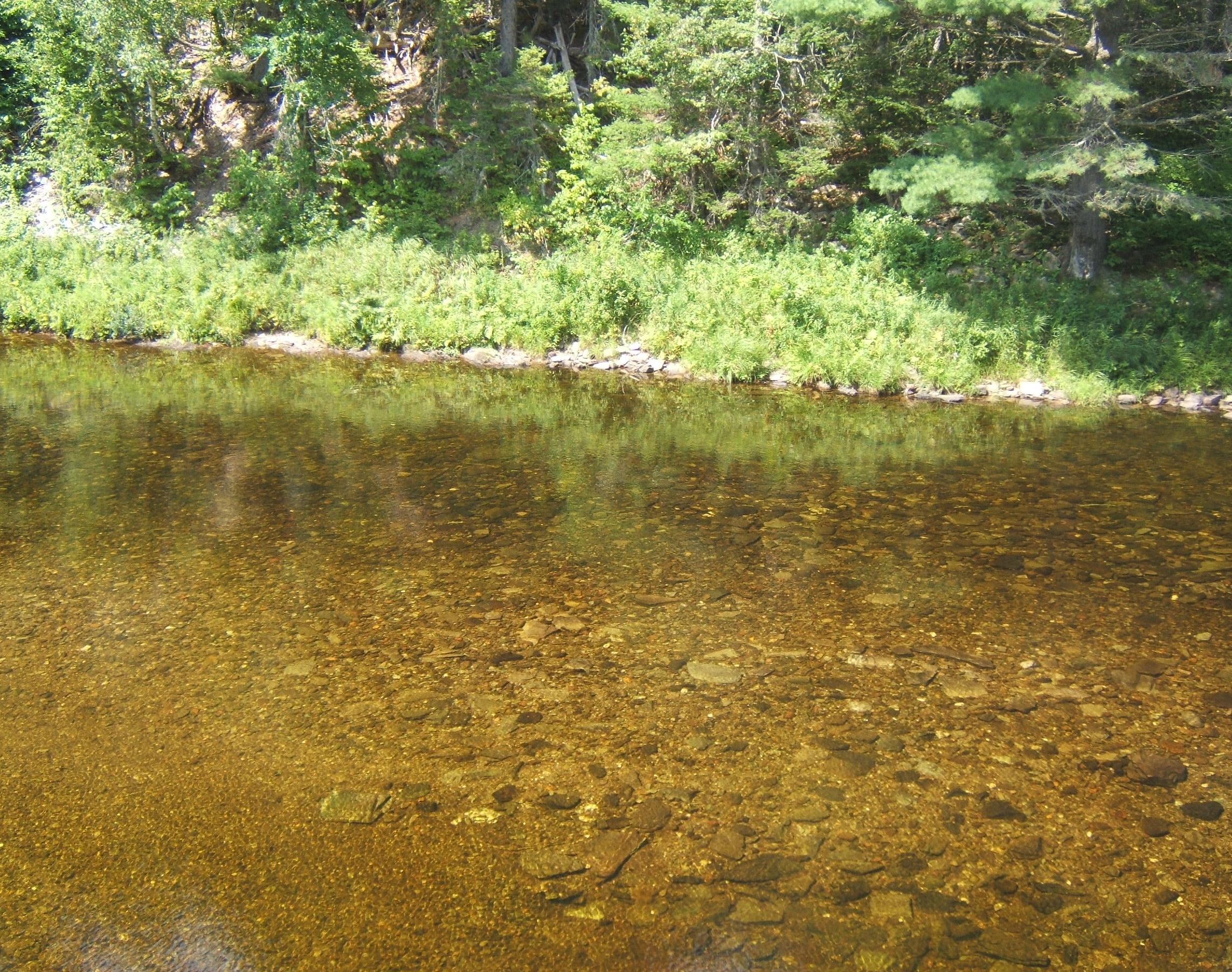
The water at this point in the river is shallow and clear. I watched for a long time to see a fish, but they will be hiding in the cooler waters of the deeper pools.
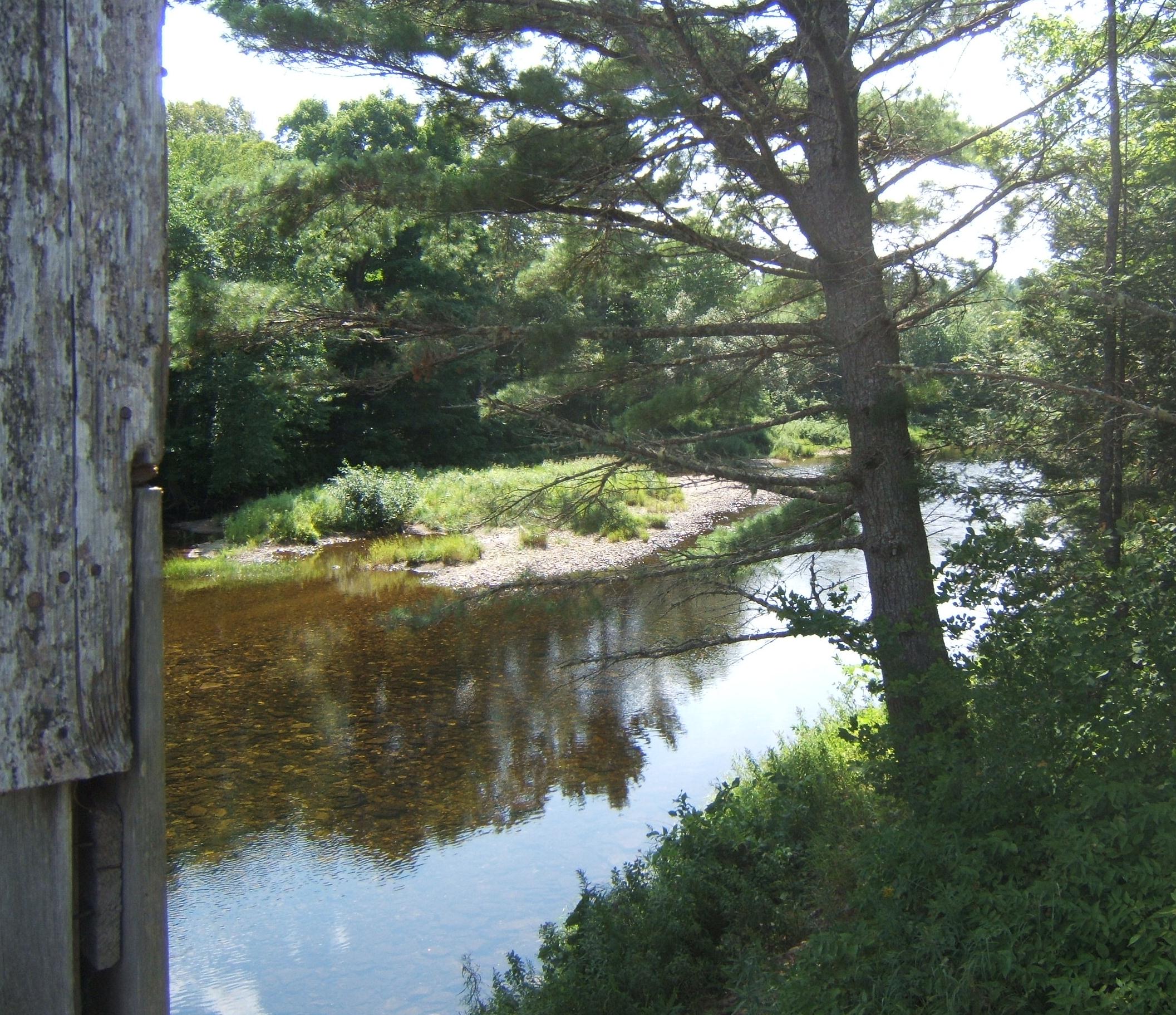
We visited this bridge on April 26, 1992 as part of our Covered Bridge Project for Canada’s 125th anniversary.
In 1992, we found many carved initials inside the bridge, on the various timbers. The oldest date we found was ‘April 3, 1932’. Some of the other initials included ‘LYL May 1, 1932′, RPC [perhaps PRC] June 6 /32’, ‘RS ’77 ‘, ‘ RT MAY 49’, ‘RM AUG 38’, ‘EK’, and ‘AE Mc APR 3/32’. We also found the initials ‘A.K.O.G. APPI 35.’ with the ‘O’ written as a diamond.
On our August drive, I noticed two unrecorded inscriptions: ‘ALIE 69’ and ‘M.O. L R.A.’
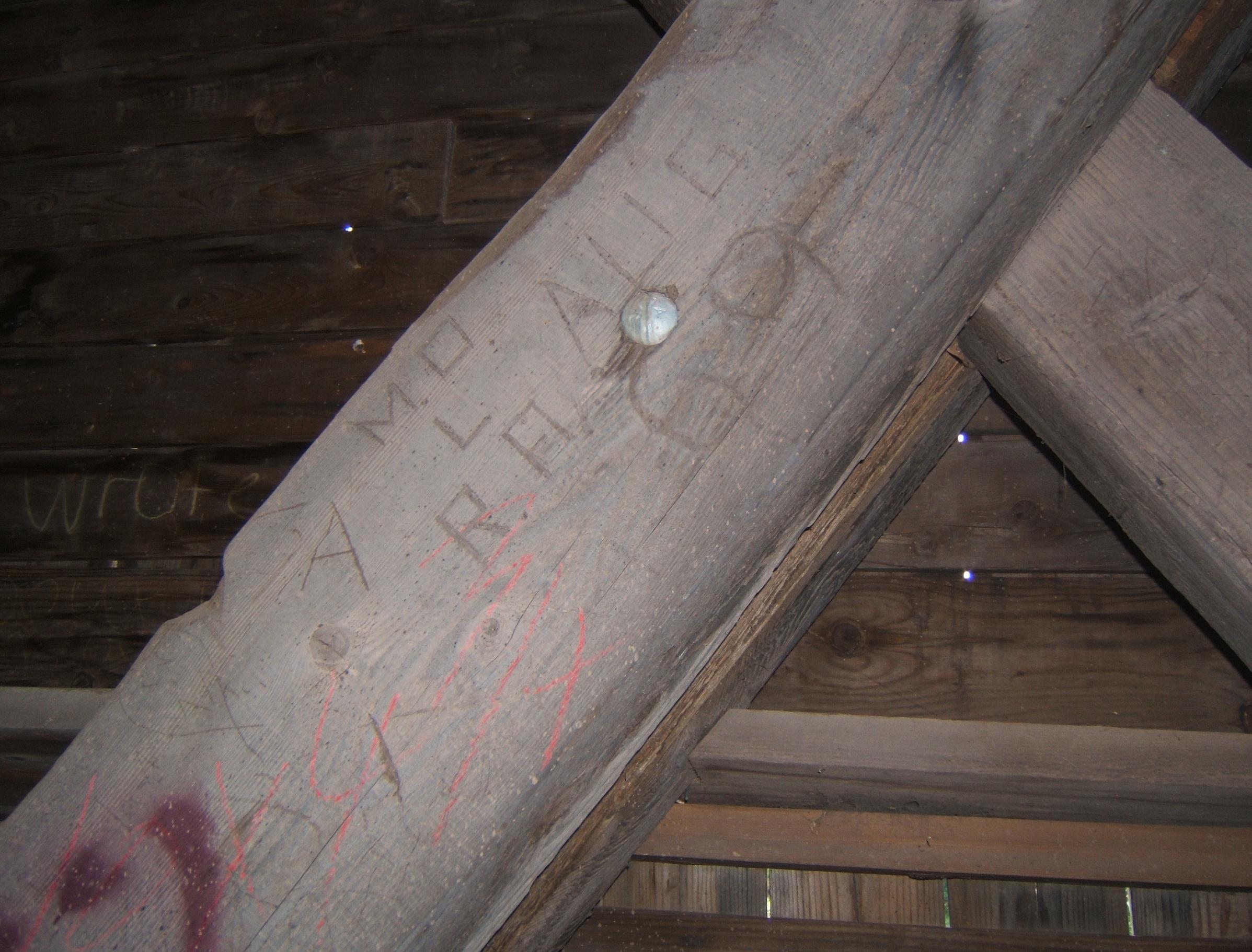
I also found a large carved ‘S’, very hard to see…

the ‘S’ is hard to see, just above the knot and about three times the length
Do you suppose ‘M.O.’ still loves ‘R.A.’ ?
~
~
forever
~
we carve our initials
in the beams of the covered bridge
pledge our love to endure
~
but these words may
outlast the love
even the people
~
~
Copyright Jane Tims 2012
a walk through the covered bridge – Smyth Bridge, South Branch of the Oromocto River
On our August drive along the South Branch of the Oromocto River, we crossed two covered bridges. I love these bridges… they are picturesque and so pleasant to walk through. They are also part of the local history of many communities in New Brunswick. I’ve talked a little about covered bridges before in my Blog – please have a look at https://nichepoetryandprose.wordpress.com/2011/09/05/inside-the-covered-bridge/
One of the bridges we saw on this drive was the Smyth Bridge. It crosses the South Branch of the Oromocto River, near Mill Settlement in Sunbury County (listed as South Oromocto Rover #2 in the April 1992 pamphlet ‘Covered Bridges in New Brunswick’, no author indicated).

Inside the bridge, it is cool and dark. When a car drives through, you hug the side, hoping the driver will see you and slow down. I love the sound of the tires on the timbers making up the floor of the bridge.

Down-river, the shallow water of the river glows in the sun. Most of our local rivers are the color of tea, a consequence of their origins in wetland areas.
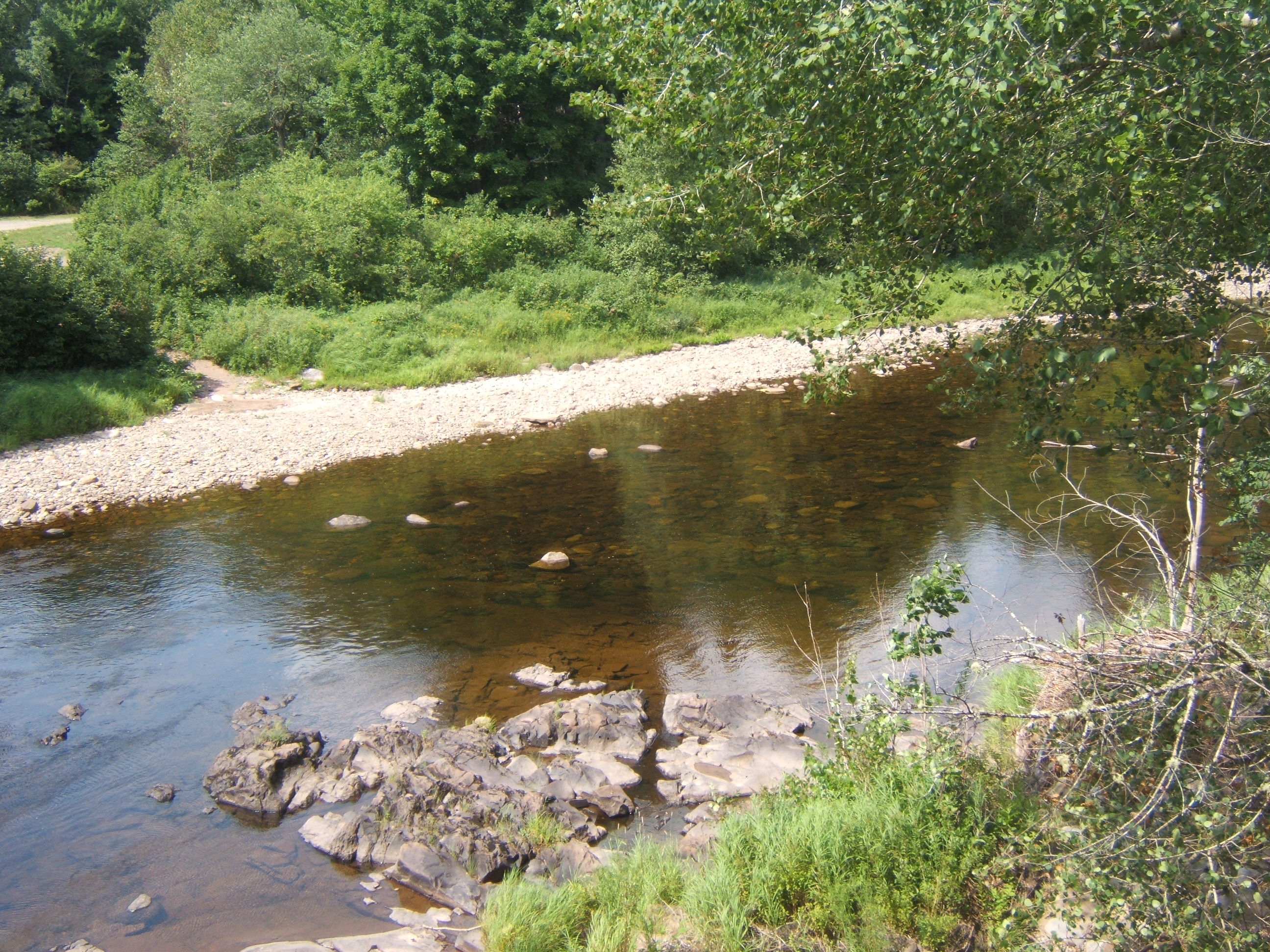
Up-river of the Smyth Bridge is a gravel beach and water for wading and swimming.
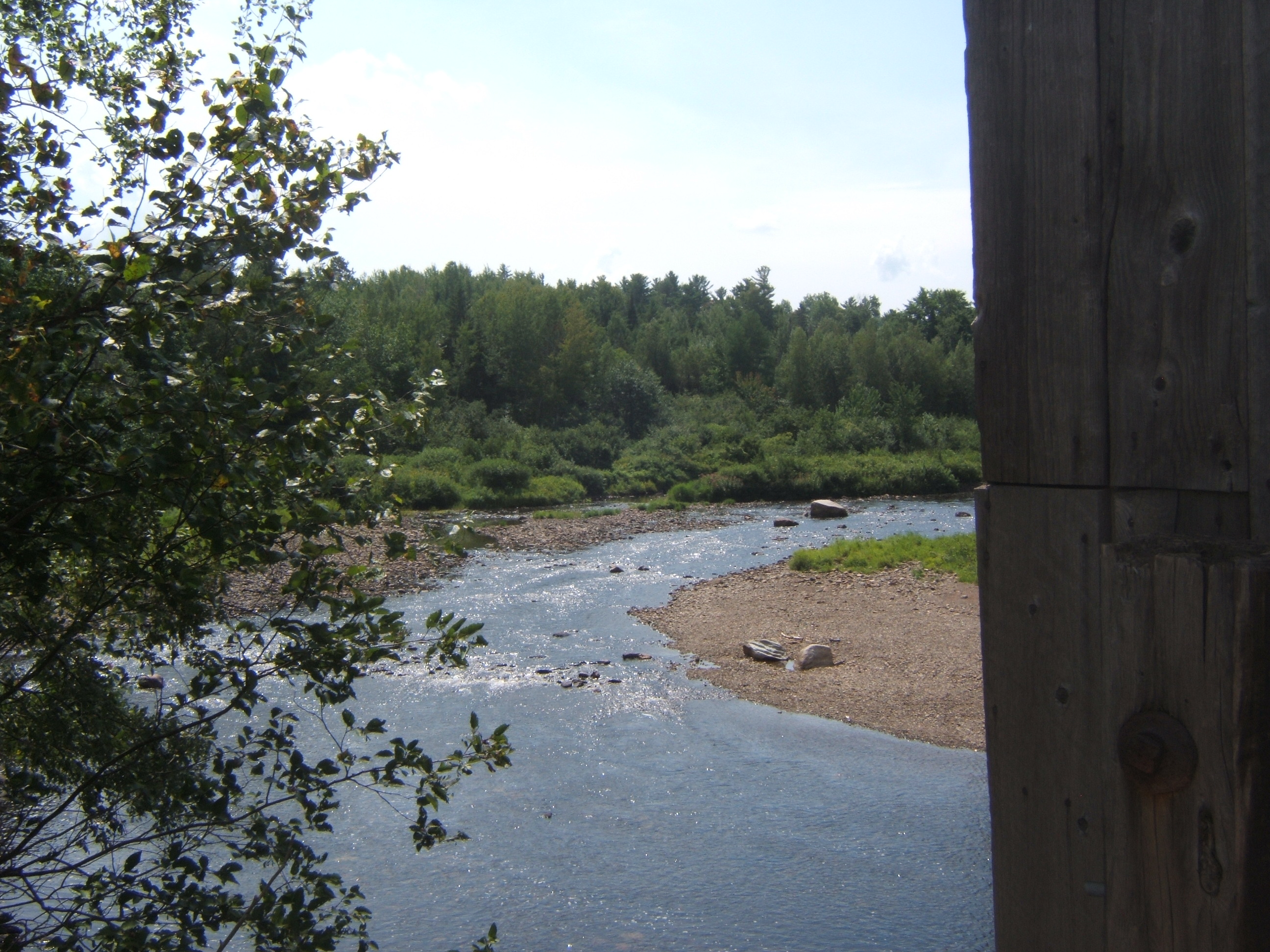
The Smyth Bridge was built in 1912 and has a total length of 139′ 1/2 “, and a span of 136′ 1/2 “. Its roadway width is 14′ 9”. Its Maximum Load is 10 t (6 t for double axle vehicles) and its center clearance height is 3.7 m.
During our Covered Bridge Project for Canada’s 125th anniversary, we visited the Smyth Bridge on April 16, 1992.
In 1992, the oldest dates we could find carved into the bridge were ‘Oct 3, 1915 Sunday’ under the initials ‘R K’ (in pen or pencil) and ‘Feb 1931’ beside the initials ‘LTF’ and ‘LEIK’ to the right of three simple crosses. There was also the totem of a face carved into the south side of the bridge, on the outside corner post. We also found a few other initials, deeply carved: ‘M B’, ‘R H’, ‘C B’, and ‘CED ER May 63’.
Finding these carvings requires patience, a good flashlight and about an hour per bridge, so I didn’t check to see if any of the carvings were still there on our recent visit. Sometimes they are lost when boards are replaced in the bridge during renovations.
I wonder if these people remember leaving their initials in the bridge so long ago?
~
~
‘LEIK’
– initials carved on the boards of the Smyth Covered Bridge, 1931
~
dark
silent
sequestered
~
light leaks between gable
boards, window squares cut high
river water below
sparkles in August sun
~
carved initials announce
the focused presence of
ghosts with knives
~
the clatter of tires
on timbers, as a car
rattles across the bridge
~
~
Copyright Jane Tims 2012




 nichepoetryandprose