Posts Tagged ‘plants and animals’
in the shelter of the covered bridge – update
Although my blog has been a bit silent this fall, I have been working! Among other projects, I am making great progress on my poetry manuscript ‘in the shelter of the covered bridge’.
~

~
To provide experiences and inventory the plants and animals living in and around covered bridges in the province, my husband and I have visited 28 covered bridges in the drainage basin of the Saint John River and 5 covered bridges in Charlotte and Westmorland Counties. I have a few more bridges to visit, but to give a little seasonal diversity to my project, I’ll travel to these in early winter.
~

Reading at WordsFall 2015, an annual event of the New Brunswick Writers’ Federation (photo by WFNB)
~
As a result of these bridge visits, I’ve written 60 poems. I read five of these last weekend at two writers’ events: WordsFall (Writers’ Federation of New Brunswick http://wfnb.ca/ ) and Odd Sundays (a monthly Fredericton reading event). The poems include the results of my work on different poetic forms – in the manuscript I have examples of the sonnet, ghazal, haiku, tanka and villanelle.
~
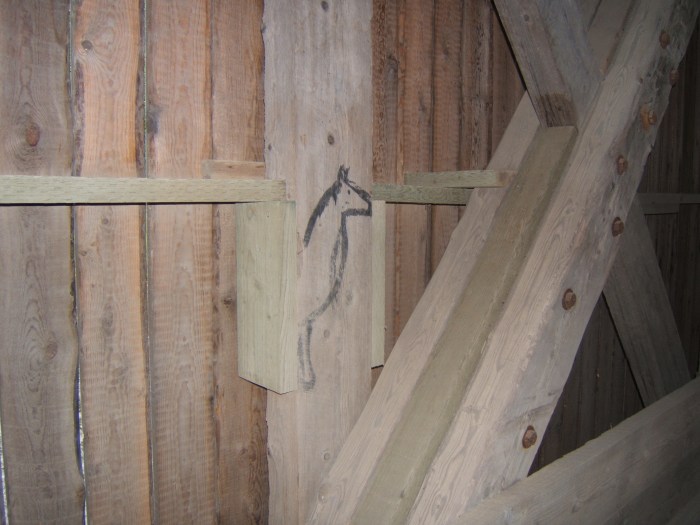
black horse painted in the Quisibis River Covered Bridge (Pont Lavoie)
~
As I develop the manuscript, and to help organize the poems, I have sorted them into categories:
- gaps between boards (deterioration and loss)
- liminal, shore to shore (transitions)
- grit of a blade (carvings and history)
- notch of a lily pad (habitat)
- a blade of grass between thumbs (mystery)
- heads of timothy (miscellaneous)
- a loose board rattles (sounds)
~
Writing these poems has given me a glimpse into the living world of the covered bridge. We may cross a bridge daily but it takes a little time to know a bridge and discover the life there. Most of the animals living in or around a covered bridge are timid or hidden, and avoid human contact. The plants provide the setting for the bridge but there is a pattern to the places they grow and some will only be seen if visitors to the bridge slow down. And carved in the beams are the stories of the humans who have been part of the history of the covered bridge.
~

Baker Brook #2 Covered Bridge – a deer and a crow are watching us from the hay field
~
Copyright 2015 Jane Tims
in the shelter of the covered bridge – a narrow bridge
On our drive last weekend, we visited three covered bridges.
Usually our visits last at least an hour. At each bridge, we:
- get a good look at the abutments beneath the bridge
- watch and listen for birds
- identify the trees near the bridge and any wild plants in the vicinity
- photograph the covered bridge and any interesting architectural elements
- take notes about the state of the bridge, any new construction and the condition and covering of the roof
- look for animal tracks, holes made by woodpeckers, birds nests, spider webs and feathers
- record any notations in the bridge – carvings, chalk, felt marker, pencil, pen and paint
- make a list of the sounds I hear and try to absorb the ‘feeling’ each bridge evokes.
~
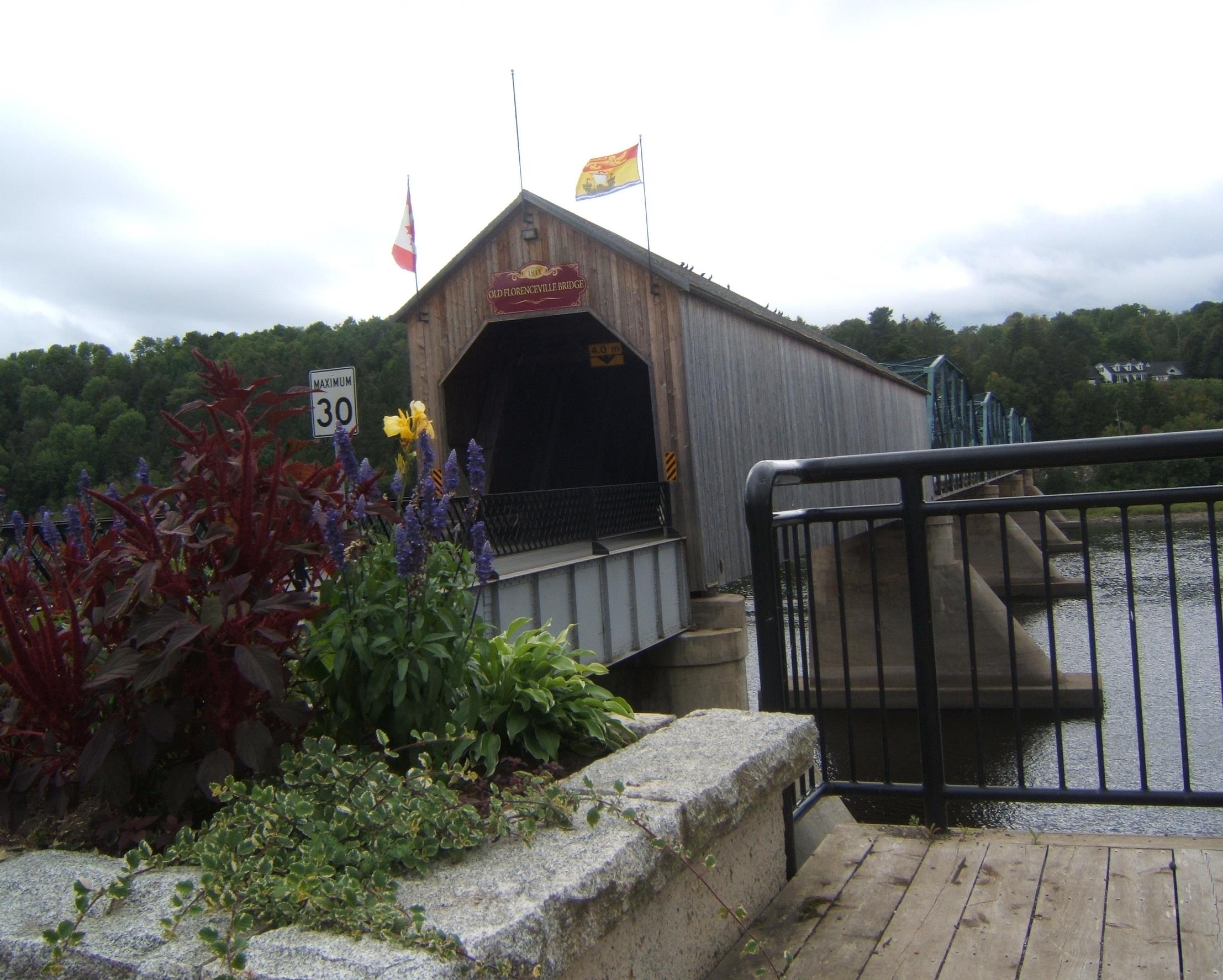
Florenceville Bridge, New Brunswick
~
I knew ahead of time, the Florenceville Bridge across the St. John River would be a different experience. Walking the bridge would be unlikely – there is no pedestrian walkway, the traffic is quite heavy and the bridge is narrow. I did cross the bridge in our truck, a harrowing adventure since the bridge traffic is two-way. Cars slow down when they meet, but the locals are seasoned to the width and scary-brave.
~

a red truck and a white truck meet and pass on the narrow bridge
~
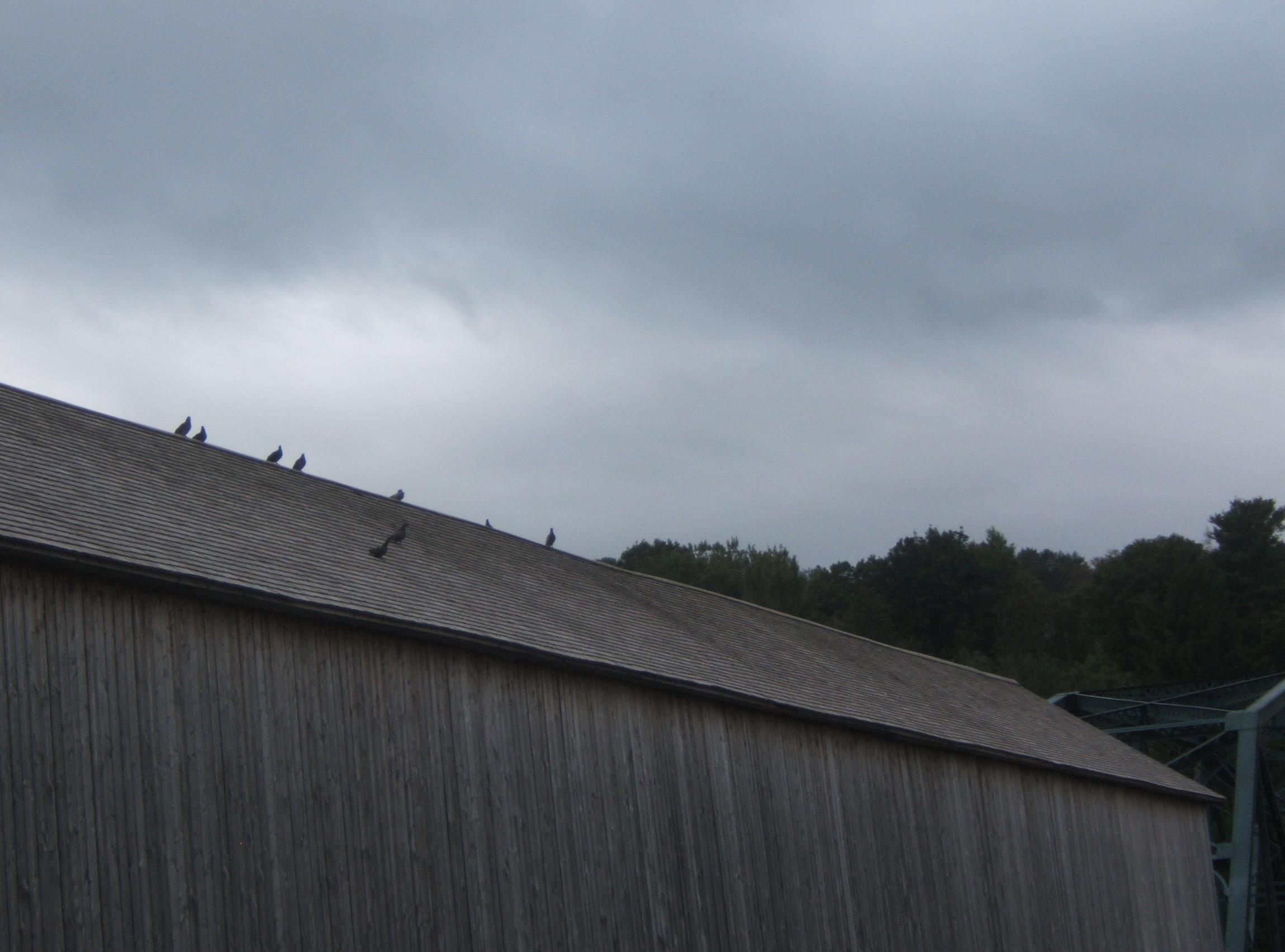
Only one span of the Florenceville Bridge is covered (built in 1907) and this is very well maintained. The other four spans are steel trusses. The pigeons perching on the roof of the bridge are its most obvious wild life.
~
~
~
keeping watch
(Florenceville Bridge)
~
fifteen pigeons swim through air
fill gaps on the ridge line
~
perch on the shingled roof
scrutinize the traffic
the squeeze of half-tons
on the bridge
the kiss of mirrors
~
pigeons quit the ridge, glide
to the shingled shore
~
river winds shiver
hawkweed and sumac, displace
blankets of wild cucumber, billow
the skirts and Tilley
hats of tourists
~

~
Copyright 2015 Jane Tims
in the shelter of the covered bridge – a villanelle
I have been working at my series of poems on the plants and animals living around covered bridges in New Brunswick. I decided to try a new form (for me) – the villanelle.
~
The villanelle is a structured poem with 19 lines and a prescribed rhyming scheme – A1 b A2 / a b A1 / a b A2/ a b A1/ a b A2 / a b A1 A2 . A famous villanelle is by Dylan Thomas – ‘Do not go gentle into that good night’.
~
The poem below is based on my observations at the Marven Bridge (Belleisle Creek #2) in Kings County, New Brunswick. I have taken liberties with the form, most obviously in using words beginning with the same letter in place of rhyming. I would appreciate any comments, including for improvement of the poem.
~

Marven Bridge, Belleisle Creek #2, in New Brunswick
~
~
wobble
~
Belleisle Creek #2 (Marven Covered Bridge)
~
bridge shudders as we walk
spaces between boards cast light on the floor
photos out of focus, faint tremble
~
cribwork and rafters, new wood
old nails work loose, grey walls frail
bridge shakes as we walk
~
in the rafters, the paper nest of a wasp
in the mud, ephemeral, the tracks of a fox
photos out of focus, faint tremble
~
a blue jay calls thief across brown water
at the shoreline, sensitive fern
bridge shivers as we walk
~
on the ledge, bones, bleached white
skeleton of a bear, backbone and fingers
photos out of focus, faint tremble
~
orange graffiti, letters round and wide
initials carved on the beams are faded
bridge quivers as we walk
photos out of focus, faint tremble
~
~
Copyright Jane Tims 2015
beaver slap – Bloomfield Creek Covered Bridge
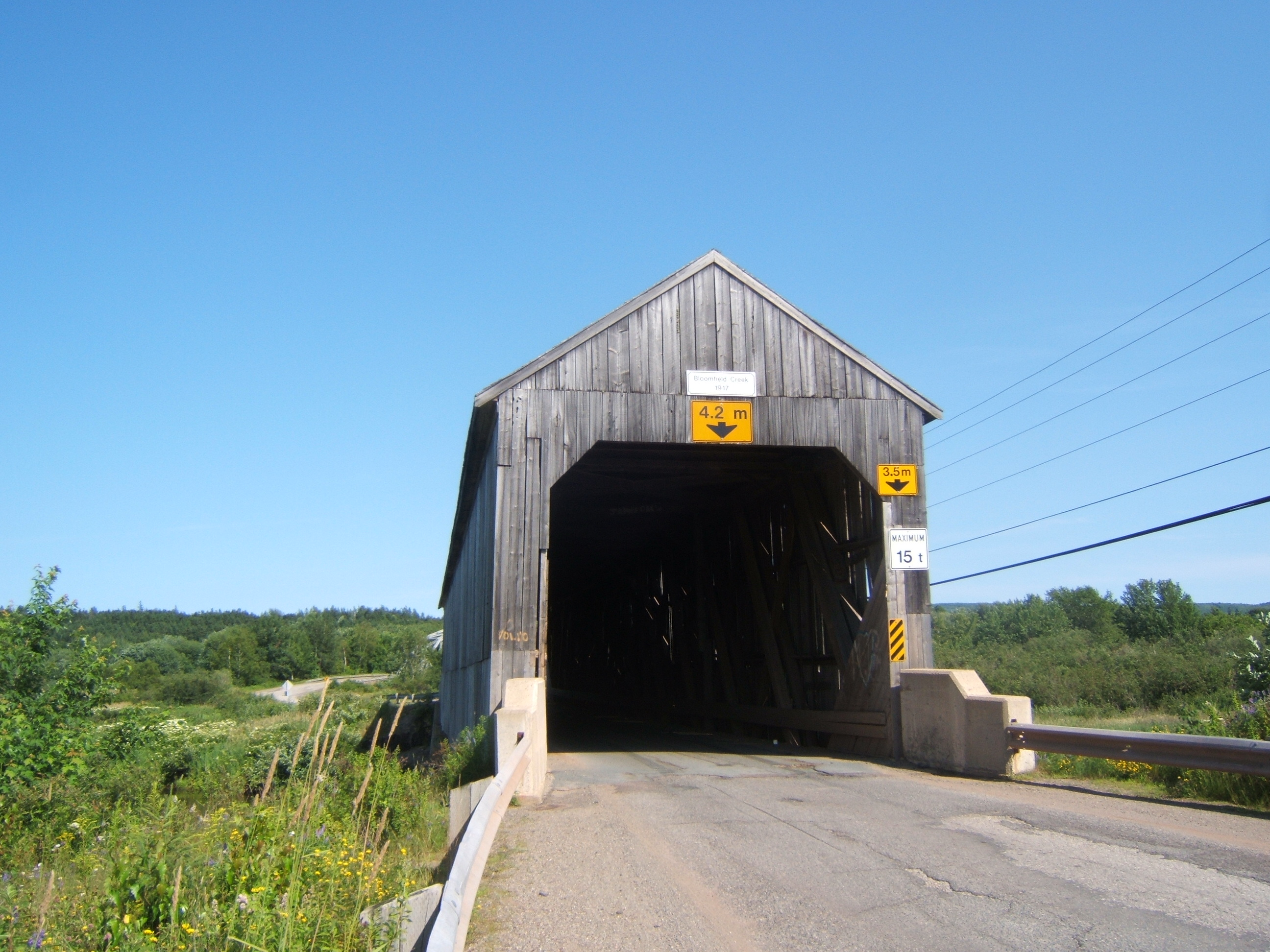
On a recent weekend tour of four covered bridges in southern Kings County in New Brunswick, we stopped at Bloomfield Creek. Built in 1917, this bridge is busy and well-used. It crosses a broad creek, very pond-like with its growth of lily pads (the yellow pond-lily Nuphar) and pickerel weed (Pontederia).

~
Along the grassy banks of the creek is a beaver lodge.
~
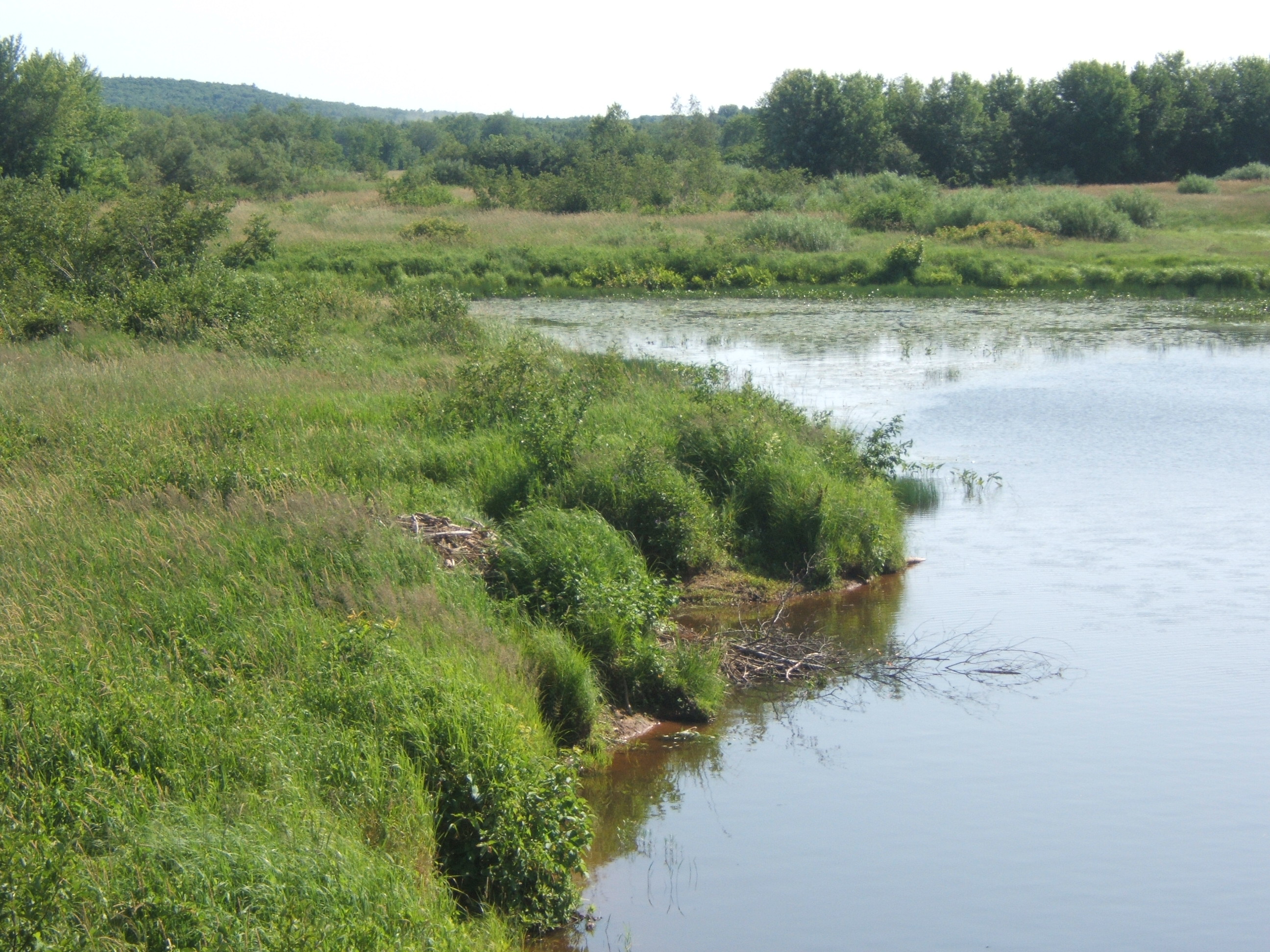
beaver lodge on the bank of the creek – the beaver has dragged lots of extra branches to keep near the underwater opening of his home
~
A large beaver kept us company while we visited the bridge. He swam back and forth along the river, in a course we were certain was designed to confuse and hide the location of his lodge. Most of the time he stayed on the surface – so soothing to watch his smooth brown body ‘towing’ a ‘V’ across the water. Every few minutes he would pause in his swim, arch his body, scissor his tail and lift it perpendicular to the water surface. Then he would slap the water and produce a loud ‘k-thud’ before he dove beneath the surface. In a minute or so, he would reappear to swim as calmly as before.
~
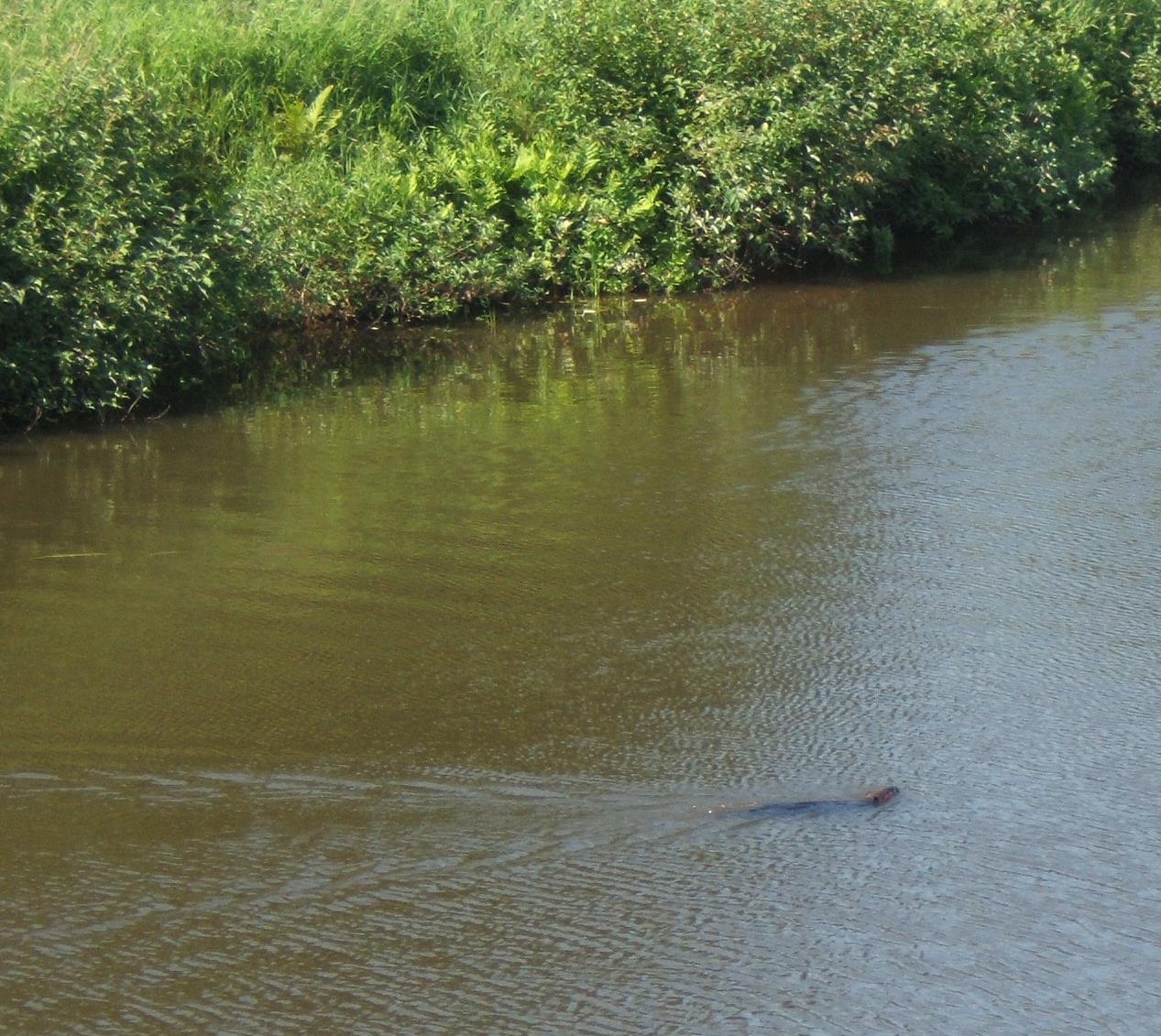
close-up of the beaver towing the ‘V’

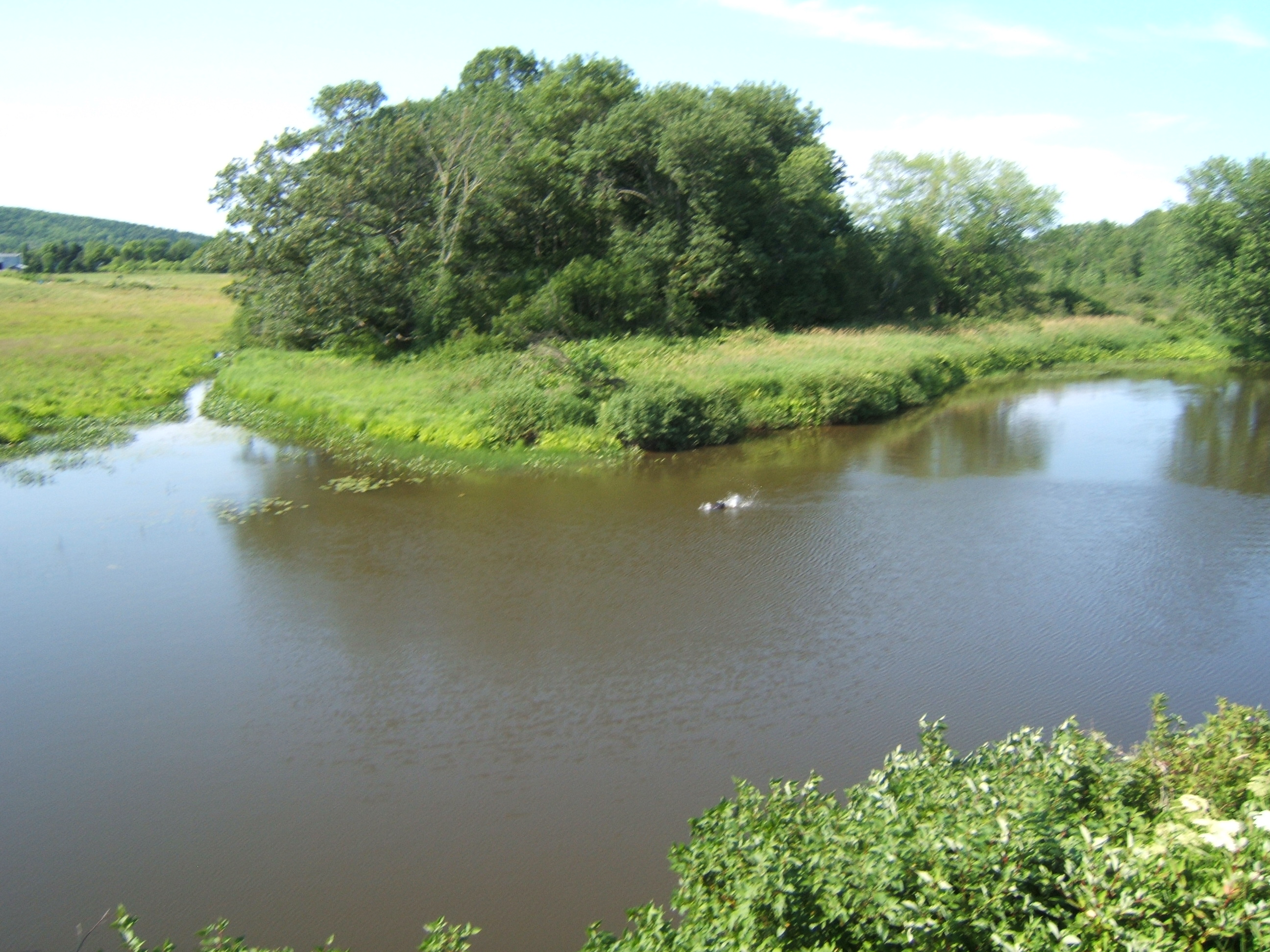
big splash as the beaver slaps its tail on the water
~
Copyright 2015 Jane Tims
in the shelter of the covered bridge – hummingbird hawkmoths
At one end of the Benton Covered Bridge (Eel River #3) is a large Lilac bush.
~

Lilac by the Benton Bridge
~
Since I was looking for wild life in the vicinity of the bridge, I was delighted to see what appeared to be bumblebees or hummingbirds busy gathering nectar from the Lilac blossoms.
~

moth getting nectar from the flowers – you can see his orangy body and dark antennae
~
As we approached, we realised these were not bumblebees or hummingbirds, but a type of ‘hummingbird hawkmoth’. They behaved like hummingbirds, darting among the flowers, backing up and slipping sideways. Their transparent wings were a blur, they moved so fast. Their bodies were striped in gold and black and their bodies were very hairy.
~

hummingbird hawkmoth, his wings a blur, gathering nectar
~
Although my photographs are not very clear, with help from the New Brunswick Museum staff, I now know these are Hummingbird Clearwing moths (Hemaris thysbe). Although I listened carefully, I could not hear the sound their wings made, since the rippling of the water in the river was so loud!
~
There were hundreds of moths in the Lilac bush. The hummingbird hawkmoths shared their feast with a group of very nervous Canadian Tiger Swallowtail butterflies (Papilio canadensis).
~
The Lilac scent was overwhelming, thick and sweet. If that scent was a room, it would be a Victorian parlour. If it was a textile it would be deep-purple satin. If it was weather, it would be a sultry August evening. If it was a light, it would be a Moroccan lantern … and so on.
~

~
Copyright 2015 Jane Tims
in the shelter of the covered bridge – through a spider’s web
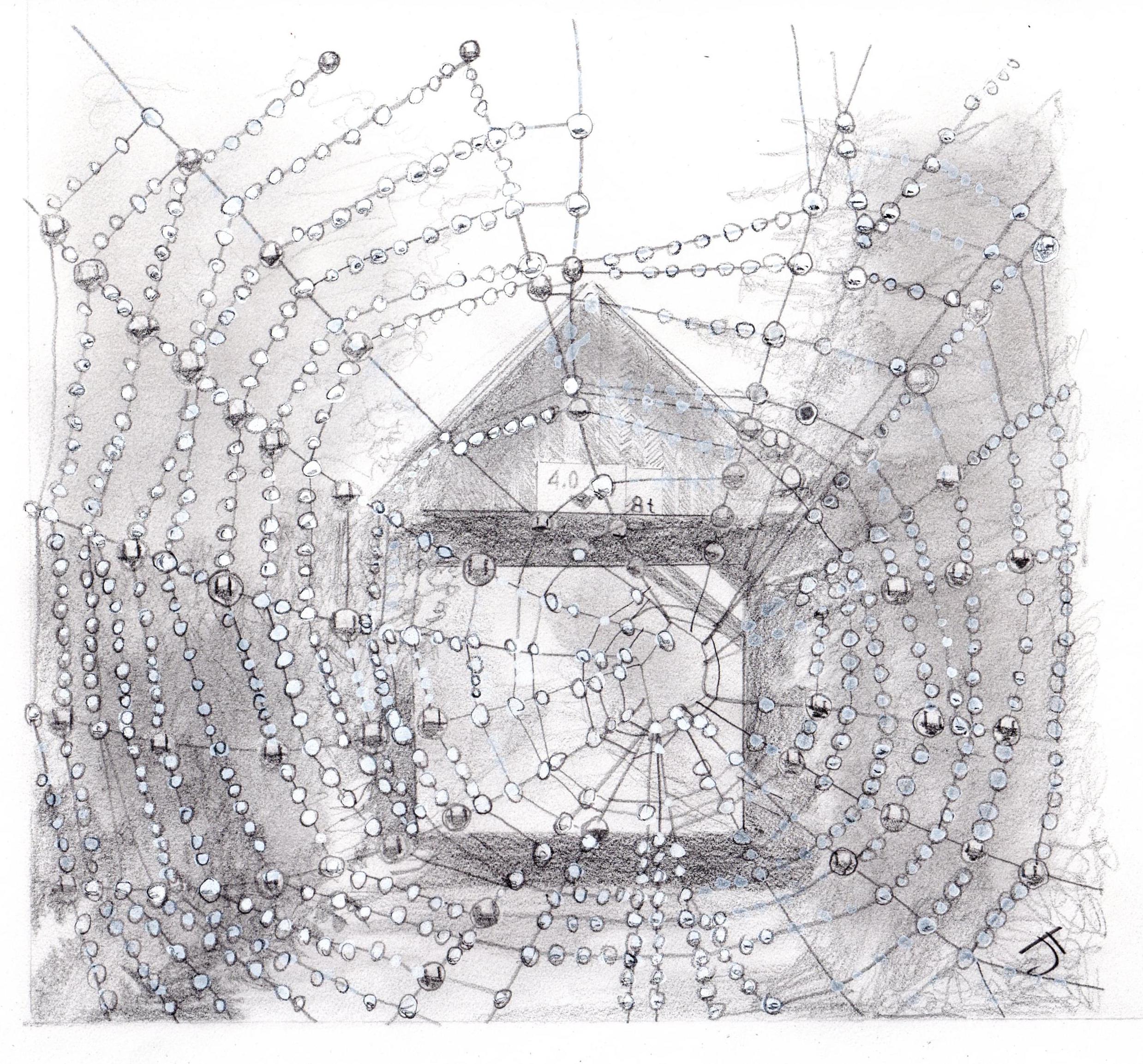
April 4, 2015 ‘web’ Jane Tims
~
web
~
after the rain,
says the spider,
I am purveyor of worlds
~
peer through my web
800 raindrops
inverse images
~
each a replica
of roof, walls and passageway
joists and beams
~
loops of lenses
strands of crossing
binocular bracelets
~
built a web to catch
the rain? I don’t think so
but insects never came to call
~
so I am content
with captured
covered bridges
~
swimmers, girls gone fishing
and the occasional
Chevrolet
~
~
Copyright 2015 Jane Tims
sharing the grey woods

a poor photo of a ruffed grouse in one of the trees behind our house
~
We share our grey woods with so many plants and animals. Sadly, our interactions do not always benefit the wild life.
The big panes of glass in our picture windows have brought disaster to so many birds. If the sun shines just right, the glass is like a mirror. When a bird sees the reflection of trees and sky, it must think it is flying deeper into the woods. I find keeping the window curtains closed removes the mirror illusion and prevents some collisions.
Sometimes, we will hear a thump and by the time we investigate, the bird will have recovered. Sometimes the bird is not so lucky.
~
~
Heartbeat
~
alive in morning birdsong thud thud thudding in my ears
slow as a pulse then faster final beats too quick to count
a spruce grouse in the thicket on a mound of leaves
drumming for a mate
~
all day
I thought of him
and smiled
~
buried in evening birdsong a thud on the window
the partridge sighing in the grass
tail narrowed feathers ruffled at his neck oddly bent
fingers on his throat
faint flutter
blood from his beak
~
I smoothed him into a mound of dead leaves
inspected the window
a feather stuck to the glass
moved as though nostrils drew faint breath
~
nothing broken
~
~
Copyright 2014 Jane Tims
abandoned railroad siding
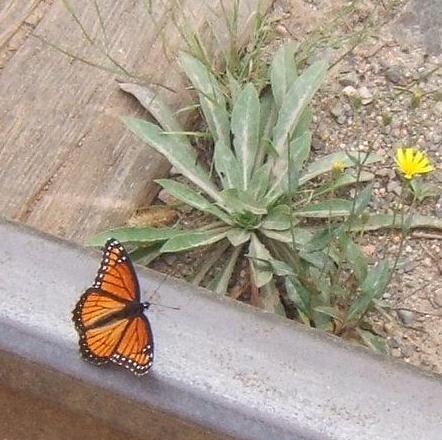
Viceroy on rail
~
abandoned railroad siding
~
a viceroy butterfly, orange
leaded glass
and rows of wary eyes
naturally suspicious
settles on the slate-grey rail
flexes its wings, nonchalant
~
as the black bear who
ambled the track
left a dump
of blackberry seed
undigested pulp
or the enthusiastic jumble of clovers
blooming between the ties
~
rails are held between the trill
of insect and the quaver
of goldenrod, caught in the crossfire of sun
light focused through
signal lenses
and glass insulators
on unstrung
telephone poles
~
turn toward horizon
rails merge and vanish
altered stride of railroad
walking made confident
by the absence of train
~
~
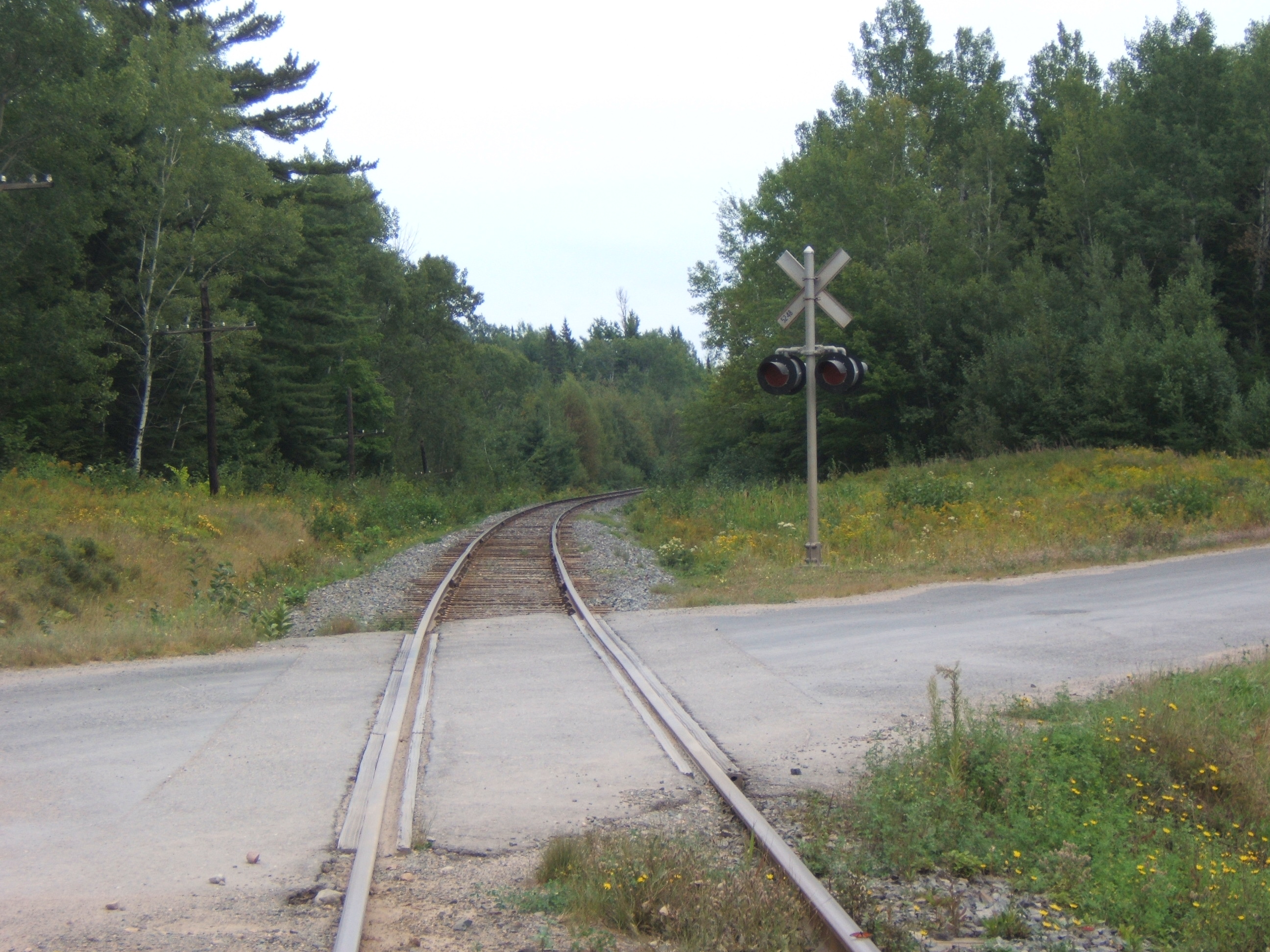
railway crossing
~
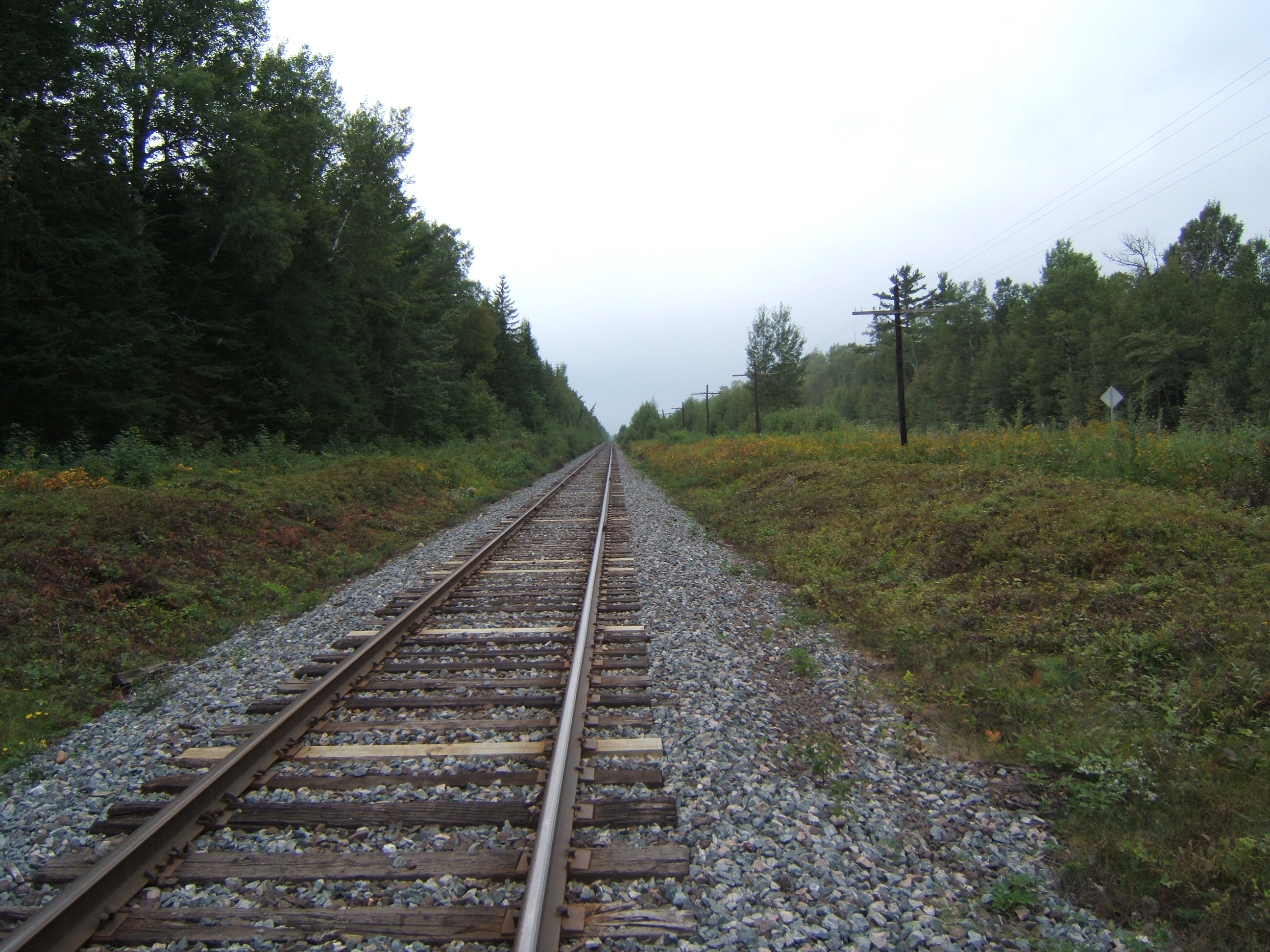
railway near Rooth, New Brunswick
~
Copyright 2014 Jane Tims
aromatic spring
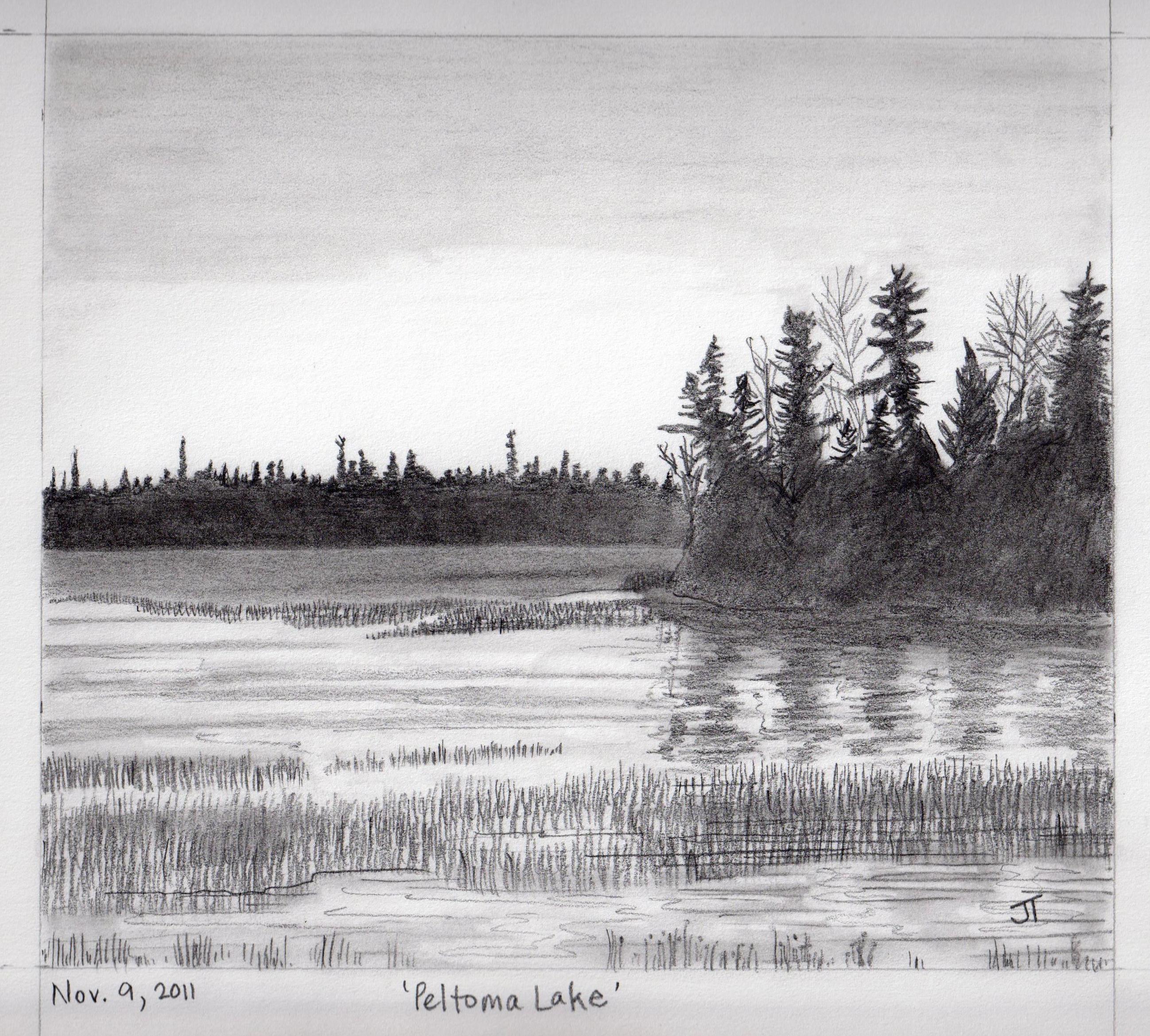
November 9, 2011 ‘Peltoma Lake’ Jane Tims
~
meadow aromatic
~
ozone lightning, late
waters cede, shoots
of cattail merge
end of day, end of June
fireflies, mosquito nights
~
lake-land meadow seeps
wetland meets nostril
marsh musk percolates
half sour, half sweet
methane ooze, decay
~
damp fiddleheads unfurl
bird beaks simmer
in duckweed soup
skin of salamander, frog
steeplebush, meadowsweet
~
angels crave human years, allow
their pores release, scent imitates
reek of sweat, of work
tears mingle with perfume
aftershave and powder
~
~
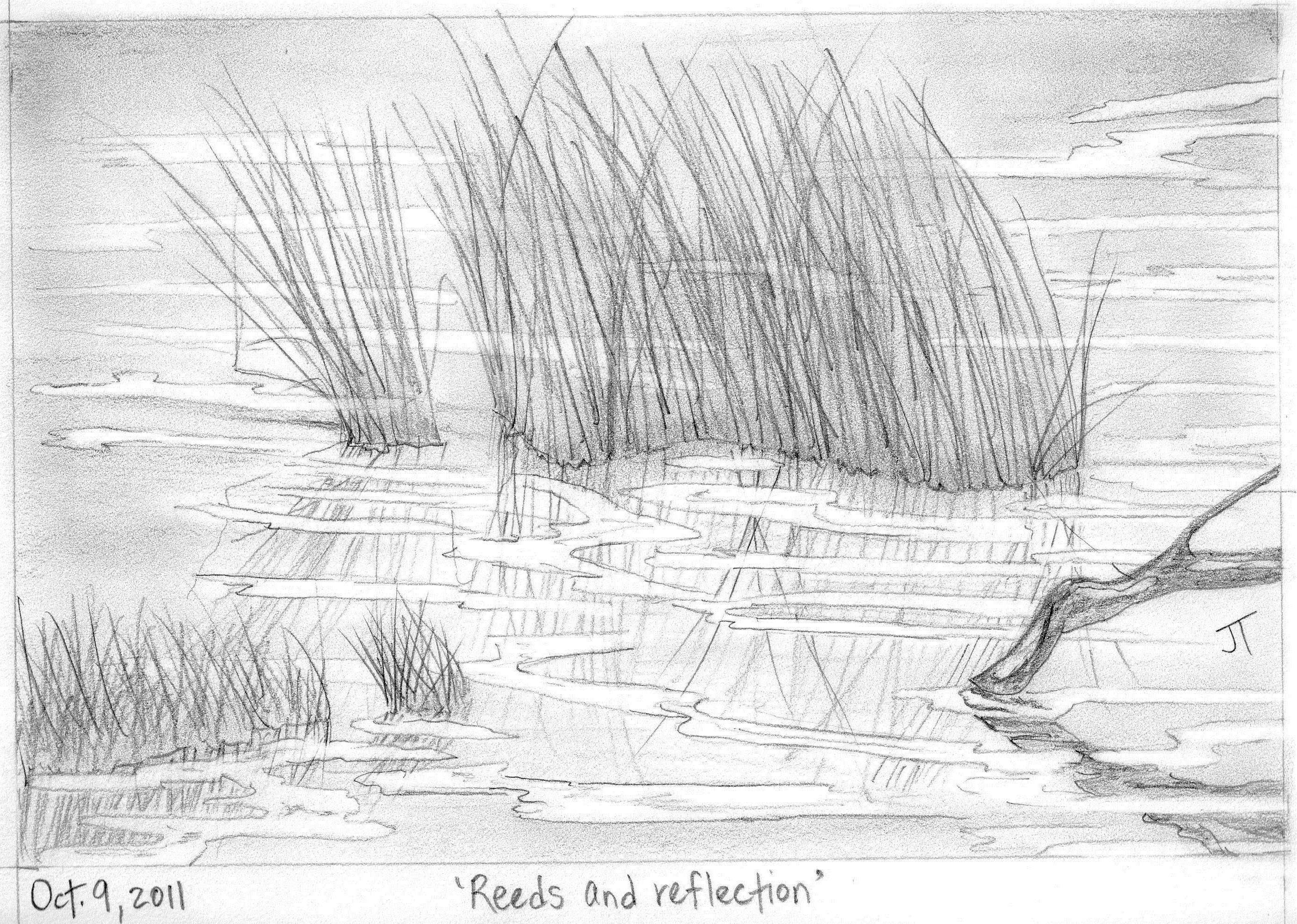
Oct. 9, 2011 ‘Reeds and reflection’ Jane Tims
~
Copyright 2014 Jane Tims
preserving coastal marsh (day 24 and 25)
The last few days of my virtual biking have reminded me of the need to preserve coastal areas, including barrier beaches and coastal salt marsh. Day 24 and 25 of my virtual travels took me along Youghall Beach near Bathurst. This barrier beach has been almost entirely developed with seasonal and year-round residences.
~

map showing distance travelled (map from Google Maps)
~
8-24 March 24, 2014 35 minutes (south of Youghall Beach to Youghall)
8-25 March 25, 2014 30 minutes ( Youghall to south of Youghall)
~

aerial view of Peters River salt marsh (right) and Youghall Beach (left) (image from Street View)
~

Peters River salt marsh (image from Street View)
~
One of the reasons to protect barrier beaches from development is the close association with coastal marshes and their sensitive wild life. For example, the coastal marshes in the Bathurst area, including the coastal salt marshes of the Peters River near Youghall Beach, are home to the Maritime Ringlet Butterfly. The Maritime Ringlet (Coenonympha nipisiquit McDunnough) is a small butterfly with a wing-span of four centimeters. It is buff-and-rusty-coloured, with a dark eyespot.
~
This butterfly is endangered, because it faces extinction. It is ‘endemic’ to the salt marshes of the Baie-des-Chaleurs – this is the only place in the world where this butterfly lives. The butterfly can only live in the salt marsh – the Maritime Ringlet caterpillar lives on salt marsh grasses (Spartina patens) and the adult uses Sea Lavender (Limonium nashii) as its nectar source.
~
Government and conservation groups in New Brunswick have worked together to educate homeowners about protecting the Maritime Ringlet Butterfly. They list practical steps people can take to ensure the habitat of this endangered butterfly is protected. These include: not filling in the marsh, not burning marsh grasses, not using vehicles in the marsh, not picking marsh wildflowers such as Sea Lavender, and not going into the marsh. For more information on the Maritime Ringlet Butterfly and its protection, see http://www.bathurstsustainabledevelopment.com/userfiles/file/HSP%20Final%20MR%20ENGLISH%20brochure.pdf
~

March 27, 2014 ‘Maritime Ringlet Butterfly’ Jane Tims
~
Copyright 2014 Jane Tims




 nichepoetryandprose