Posts Tagged ‘pencil drawing’
in the shelter of the covered bridge – not a hummingbird

~
not a humming bird
~
Benton Covered Bridge
Eel River #3
~
wing blur in the lilac
threshold of the bridge
scent-thick and purple
invisible
~
hawkmoth
hummingbird clearwing
Hemaris thysbe
~
lilac thryse to lilac thryse
side-slip, hover
nectar thirst
fierce harvest
~
~
For more information on the hummingbird hawkmoth at the Benton Covered Bridge, see https://janetims.com/2015/06/10/in-the-shelter-of-the-covered-bridge-hummingbird-moths/
~
Copyright 2016 Jane Tims
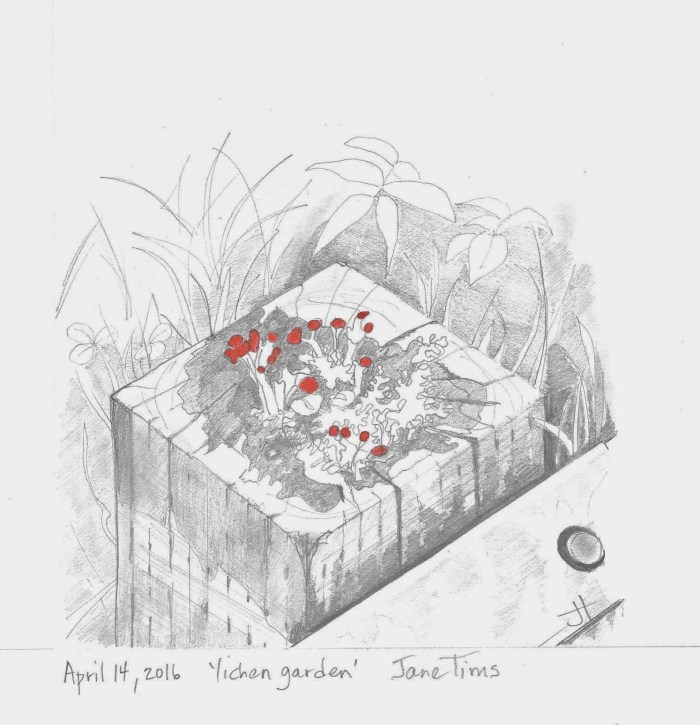
in the shelter of the covered bridge – lichen garden
~
time-stamped
~
Pont Lavoie (Lavoie Covered Bridge)
Quisibis River #2
~
~
when the end-post
of the guard rail
splits and rots
the broken space
makes room
for rain and pollen
dust and autumn
leaves
other detritus
~
spores find encouragement
and lichens grow
Cladonia cristatella
uniformed in red
Cladina, blue-grey
reindeer lichen
and pyxie cups
~
lichens ageless
bridge not meant
to last forever
~
~
Copyright Jane Tims 2016
in the shelter of the covered bridge – manuscript completed!!

~
Last year, in the competition of April 1, 2015, I was awarded a Creation Grant from artsnb (The New Brunswick Arts Board). The award was to create a manuscript of poems about plants and animals living in the shelter of covered bridges in New Brunswick.
I have now completed the manuscript and am ready to submit my final report. During the project I visited 28 covered bridges in the drainage basin of the Saint John River and 5 in Charlotte and Westmorland Counties. I was also able to use the notes and records from my visits to some covered bridges in 1992.
~
The final manuscript includes 81 pages, 8 new drawings, and 63 poems, organised into five themes:
liminal spaces – 8 poems about bridges as places of transition and change
notch of a lily pad – 10 poems about the covered bridge as habitat
grit of a blade – 9 poems about engravings and graffiti produced by human visitors to the covered bridge
a blade of grass between thumbs -10 poems about mysterious discoveries in covered bridges
heads of timothy – 6 poems about encounters at the bridge
gaps between boards – 10 poems about deterioration and loss due to vandalism, fire and flood
a loose board rattles – 10 poems about the sounds resonating in a covered bridge
~
Many thanks to artsnb for helping me in the making of the manuscript and for the chance to undertake such an enjoyable project!
~

Copyright 2016 Jane Tims
‘within easy reach’ – why did I write these poems?
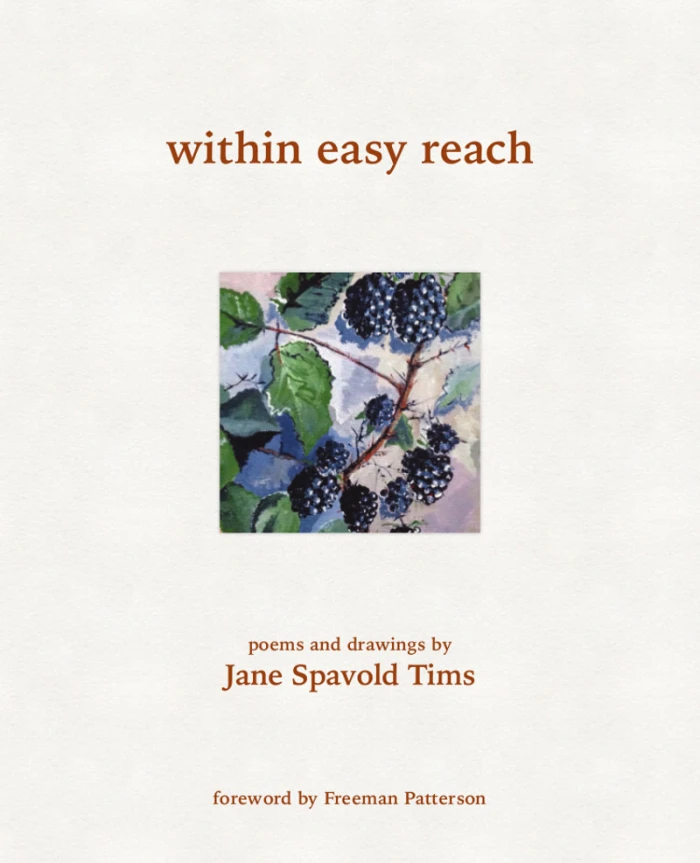
Later this spring I will have a book of poems and drawings in publication – ‘within easy reach’. The poems and art in the book are about gathering local, mostly wild, foods. I have been fortunate to work with a wonderful publisher, Chapel Street Editions, interested in books about the natural history, human history, and cultural life of the St. John River Region of New Brunswick, Canada. http://www.chapelstreeteditions.com/about_chapel_street_editions.html
~
As a botanist, I loved making this book. Identifying plants is a skill learned in university and during years of enjoying the out-of-doors. Many of the plants are found on my own property, but my husband and I travelled throughout the region to find some species. We found edible trout lily along the banks of the Dunbar Stream, salty orach on the beaches of Saint Andrews, and dangerous-to-eat water dragon in a wetland on the Renous highway. On our own property we tried to out-smart the squirrels for hazelnuts, tapped twelve trees for maple syrup and discovered partridge berries growing in the woods behind our house. As you can see, part of my enthusiasm for the subject is about spending time with my husband!
~

~
I also did a little time-travelling to write these poems. Although most of the plants I write about are found in the St. John River Region, I looked into my own past to remember some edible plants in other parts of Canada. This included eating cactus berries on the Alberta prairie, buying cloud berries from children along the Trans-Canada in Newfoundland, and picking blueberries with my Mom and Dad in Nova Scotia. I also looked to the diaries of my Great-Aunt to get a glimpse of the growing and gathering habits of an earlier generation.
~
I am sure many of my poems will echo memories of your own experiences with local foods.
~
Eating near to home has so many benefits – these foods are often free and have not travelled far to your table. Many wild foods go unharvested although they are ‘within easy reach’. Just think of those apples in the abandoned orchard at the edge of town, the dandelion greens on your brother’s lawn, or the choke-cherries growing along the fence down the road. Although you should use care when eating wild foods, many are easy to harvest and can add variety and taste to your meals.
~

~
In my next post, I’ll say more about why you might enjoy reading my book. And very soon, I’ll be starting a count-down on my blog to let you know how many days you have to wait until publication. I’ll have a contest and a give-away. Shameless self-promotion!
~
Copyright Jane Tims 2016
‘within easy reach’
This spring, I will celebrate the publication of my first book of poetry!
~
‘within easy reach’ is a result of my 2012 project ‘growing and gathering’ supported by artsnb (the New Brunswick Arts Board). The poems focus on harvesting and eating local foods, especially wild foods. My book will be published by Chapel Street Editions, Woodstock, New Brunswick.
~
The book will include about sixty poems as well as some of my black and white pencil drawings. These are poems about picking blackberries and blueberries, eating coastal favorites like goose tongue greens and samphire, buying smelts from a truck at the roadside and fishing for landlocked salmon. Every poem is based on a personal experience of harvesting and using local foods.
~
During the next few posts, I will tell you more about my book and its poems and drawings. I can’t wait to show it to you!
~

‘fiddleheads’ – a wild food eaten every spring in New Brunswick
~
Copyright 2016 Jane Tims
in the shelter of the covered bridge – a line of pigeons
~

~
keeping watch
~
Florenceville Bridge
~
~
pigeons swim through air
fill gaps on the ridge line
~
perch on the shingled roof
scrutinize the traffic
the squeeze of half-tons
on the bridge
the kissing of mirrors
~
pigeons quit the ridge, glide
to the shingled shore
~
river winds shiver
hawkweed and sumac, displace
blankets of wild cucumber, billow
the skirts and Tilley
hats of tourists
~
~
published previously in a post on September 11, 2015
~
Copyright Jane Tims 2016
in the shelter of the covered bridge – vantage point for planets
If there are clear pre-sunrise morning skies this week, we will be able to see a rare view of several planets in the morning sky – Mercury, Venus, Saturn, Mars and Jupiter. For a description of the event, see http://earthsky.org/astronomy-essentials/visible-planets-tonight-mars-jupiter-venus-saturn-mercury
~
Last year, on February 21st, we saw the conjunction of Mars, Venus and the Moon. On that evening, as my husband and I drove through our local covered bridge, we startled a hare. I will never forget its long-eared shadow as it fled the bridge. The conjunction of planets and moon, and snowshoe hare and truck, were inspiration for a drawing and poem …
~
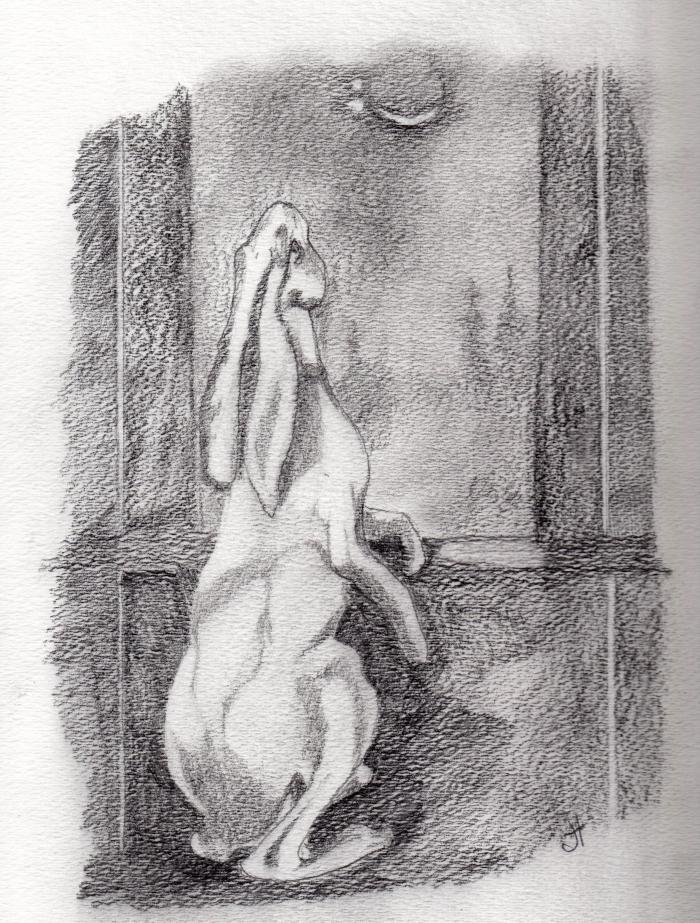
March 1, 2015 ‘conjunction’ Jane Tims
~
~
conjunction – February 21, 2015
~
Patrick Owens Covered Bridge
Rusagonis River #2
~
~
planet and moon light scamper
into crevasses in the covered bridge
Venus and Mars, chin velvet
and sickle of mid-winter moon
~
headlights of the half-ton enter
overwhelm planet shadow
startle a winter hare
erect on haunches, paw lifted
~
frosted by sky-gaze, worshiping
the sliver of moon, dismayed
at desecration, round glare
of the truck’s predatory eyes
~
fright to stop a heart
or flight to mobilize
hind- legs straighten
before fore-legs turn
~
and long ear shadows
quit the length of the bridge
ahead of whiskers, nose
and rabbit wisdom
~
~
previously published in a post March 2, 2015
~
Copyright Jane Tims 2016
in the shelter of the covered bridge – drawings
As I complete my manuscript of poems ‘in the shelter of the covered bridge’, I am also working on the drawings to accompany the text. I have made a list of the visuals presented in the poems, so I have a specific idea of what drawings I need. Many are completed since I have a large portfolio of bird drawings, for example …
~

~
Others are still to be done. This morning I completed a rather delicate drawing of the two kinds of roses growing beside the Darlings Island Covered Bridge and captured in my poem ‘tangle’.
~

~
I love to draw. For me, it is like watching a movie as I see my hand lay pencil marks on paper. It is not a calm activity. Perhaps because my hand and arm are moving, I get quite agitated when I draw and I imagine my blood pressure rising as the work progresses.
~
In order to have a body of work to choose from for the final manuscript, I aim to have more than forty drawings. I have completed nineteen. Lots to do !
~
Copyright Jane Tims 2016
along the lake shore

along the lake shore
~
shore verbs
~
water simmers at the edge
waves lounge on the shore
discuss the scudding clouds
~
red pine
catches wind
with sticky fingers
~
violets nod
trout lilies tire
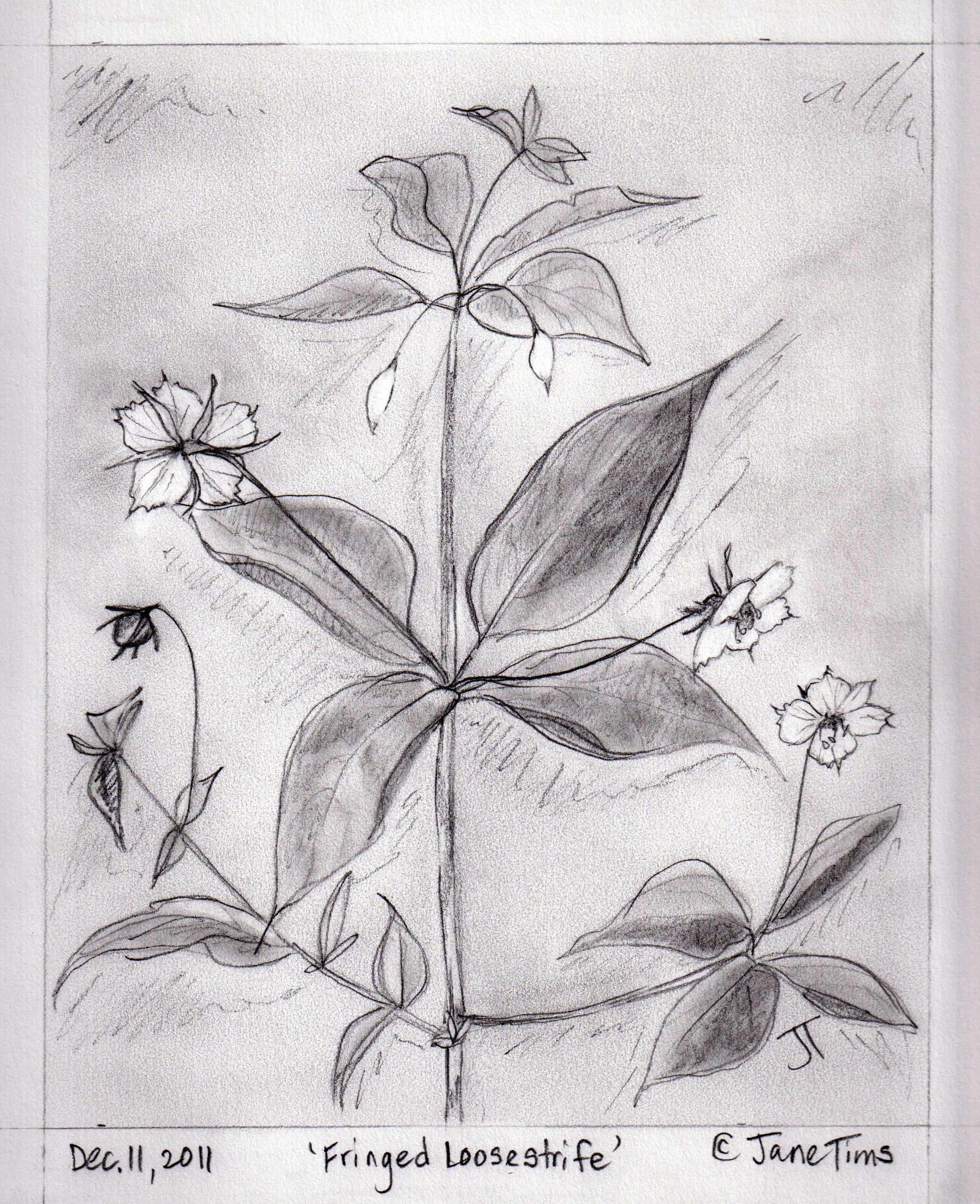
fringed loosestrife
hangs its yellow head
~
a spring leaps from the hillside
~
~
~
Copyright Jane Tims 2015
morning chorus
Each morning I have a short quiet time after rising. I spend this time in my guest bedroom. I do some stretching. I watch the sun rise among the trees. And I try to sort out the morning bird chorus.
~

~
The morning bird chorus is known to be a complex social interaction among birds of various species – a communication we humans can listen to with wonder, but little understanding.
~
We have lots of birds in our area and the woods are thick with birdsong. Although ours is a residential area, we have many hundred acres of woodland behind us and no houses between us and the river. Our back woods are mixed conifer and hardwood, mostly balsalm fir, spruce, red maple and white birch. We have nearby wetlands and, of course, the river.
~

~
I now regret not learning to identify the birds from their songs earlier in my life. Although I can name many birds by sight, I have a feeling I know many more by their sounds. This summer I have tuned up my ears and spent lots of hours trying to learn to recognise the birds by their songs. Perhaps because of their variety and complexity, learning the songs is more difficult than just listening and comparing. Once I have heard a few birds, my memory becomes jumbled trying to distinguish between them.
~
I use three main tools to help me identify and remember bird sounds.
- mnemonics – short phrases to describe and remember various bird songs. These phrases help narrow down the possibilities when I hear a bird sing. Many lists of bird song mnemonics exist, but I like the simple listing from the Fernbank Science Center in Georgia http://www.fernbank.edu/Birding/mnemonics.htm
- recorded songs – although there are many sites with bird song recordings, the one I like the best is Dendroica- NatureInstruct http://www.natureinstruct.org/dendroica/spec.php/Dendroica+Canada#sp_select . Once you select a bird, you can hear calls recorded by birders in various parts of the range.
- a list of the calls I know and new songs I hear, described in my own words and with a diagram of the way the song progresses, in a shorthand of my own. I use words like: trill, flute, scratch, liquid, repetitive, bored, delirious …
~
The Cornell Lab of Ornithology has some excellent tips for those who would like to learn the songs of local birds.
http://www.allaboutbirds.org/Page.aspx?pid=1189#_ga=1.202457239.768663648.1437046200
They suggest listening for rhythm, tone, pitch and repetition of a bird song. By listening for these qualities, one at a time, you can start to make sense of the variability and help your memory.
~
Here is a list of the participants in this morning’s bird chorus outside my window:
- odd high-pitched sound at the first grey light of morning, probably not a bird
- immediately, an American Robin – ‘chirrup, cheerup, cheery cheer-up’ – we have a nest of robins at the start of our woods road
- a Mourning Dove, intermittent – ‘oo-oo-hoooo’ – very sad sound – a pair perches on the wires along our main road
- a White-throated Sparrow – ‘I love dear Canada-Canada-Canada’
- a Hermit Thrush – an ethereal, flute-like phrase, repeated over and over, each time at a new pitch – close at first and then gradually moving further away
- an Eastern Phoebe – a nasal ‘fee-bee’, repeated – a nest in the eaves of our shed
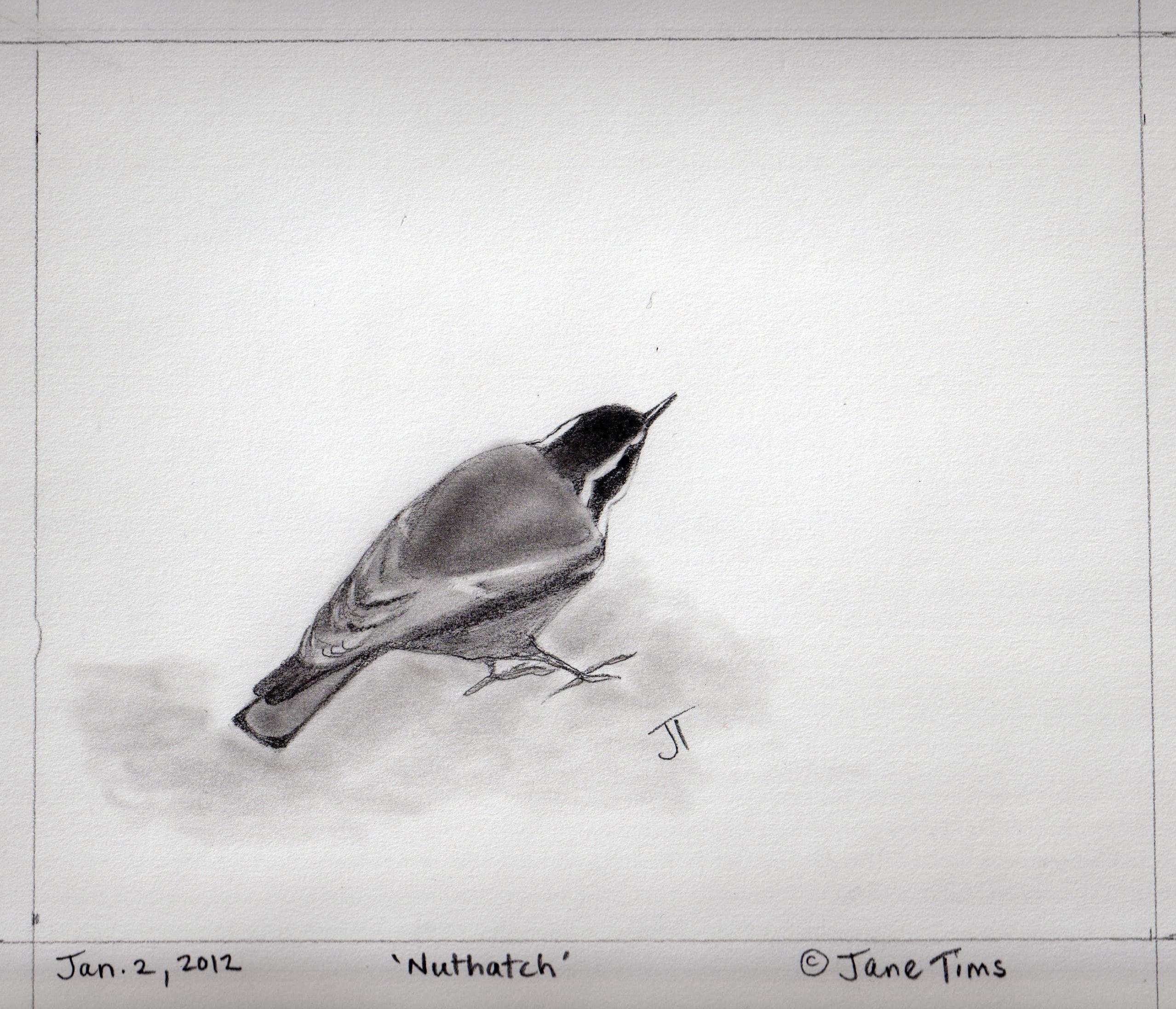
- a Red-breasted Nuthatch – a monotonous low-key ‘yank yank yank yank’, like a cross between a bored duck and a bullfrog
- the ‘caw caw caw’ of a Crow
~
I wonder if you ever listen to the morning bird chorus. What birds do you hear?
~
~
Copyright 2015 Jane Tims




 nichepoetryandprose