Posts Tagged ‘nature’
feeding the neighborhood
I have started up the bird feeder and already the mammals are nudging out the birds.
Our first visitor to the feeder was a fat grey squirrel who performed some amusing acrobatics to enjoy ‘his’ sunflower seeds.
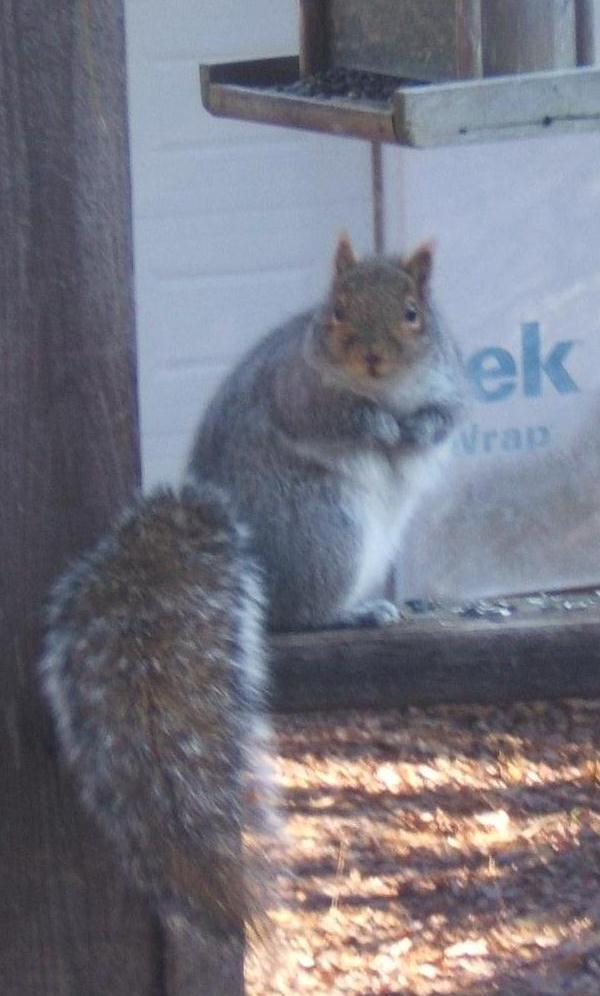

This year, I think I’ll keep a list of the marauders, who may outnumber the birds.
~
apples in the snow
~
she pauses, one foot poised
a lever beneath her, one hoof ready
to push off and fly
tail to flag her departure
tucked, ears up
~
everything still
the snow, the trees, the feeder
not caught in chickadee momentum, land
and shove away
~
three apples
at the edge of deep-freeze
draw her forward
~
© Jane Tims 2011

a safe space in the bridge
This past week I have been in Halifax for a conference. A part of my morning commute was the slow moving traffic on the ‘old bridge’ across Halifax Harbour, the Angus L. Macdonald Bridge. The second day, I was more familiar with the traffic and the correct lane to be in, so I had a chance to experience the architecture and some of the wild life of the bridge (by this I do not mean that the commuters are holding wild parties).
The Angus L. Macdonald is an amazing structure, built the year I was born and opened in 1955. It is a long-span suspension bridge, supported by cables between two vertical towers. The bridge is 1.3 km long, with a supported length of 762.1 meters.
The bridge is usable by pedestrians and cyclists. Because of its reputation as a suicide bridge, it is equipped with various barriers to potential suicides, including high inward-facing bars on the pedway and nets suspended in the open area between the traffic deck and the pedway.
In these areas, hordes of starlings (Stumus vulgaris) gather, creating a din and an occasional cloud of startled starlings. Starlings are known for their synchronized group flights – the birds move as one in a shifting horde of birds. To hear the birds, I had my car windows open, but I quickly rolled them up since the birds were flowing very near to my car!
Starlings are an invasive species, introduced by Eugene Schieffelin to Central Park in 1890 as part of a project of the American Acclimatization Society. Their goal was to introduce all the birds mentioned in Shakespeare’s writings into North America. All of the birds I saw in the bridge are descendants of the 60 to 100 birds released in 1890!
A group of starlings is known as a ‘murmuration’.
For those of you familiar with the excellent series of made-for-TV Jesse Stone movies (starring Tom Selleck), The Angus L. Macdonald Bridge is the bridge featured in the movies (although the setting for the movie is a small town in Massachusetts).
~
morning, Angus L. Macdonald Bridge
~
traffic huddles and a thousand Shakespearian
starlings squabble one another
yellow beaks and feathers packed
soft slate bodies rolled into the safety
of the suicide net and pedway bars
porous barriers: a cyclist whips by
and starlings sift through wire
a mumuration between orange
cables and green girders
impossible way, red and blue
pulse of bridge security
weaves the path materialized
within three tangled
lanes of traffic
~
© Jane Tims 2011

in the branches of the White Pine

- the White Pine is the larger tree to the left of the road

The most frequent denizens of the pine are a pair of Bohemian Waxwings (Bombycilla garrulus). They prefer berries for food and so are in their ideal habitat. Our property must look like a big dinner plate to them, with its orderly presentation of wild strawberries, blueberries, blackberries, hawthorn and winterberry.
Another bird who stops to rest in the pine is the American Goldfinch (Carduelis tristis), also known as the Thistle bird. These are seed-eating birds who fly across the fields in a distinctive pattern of loops. They are also one of the most common birds at our winter bird feeder.

~
~
building homes
~
we fly kites
to learn the field and sky
set copper whirligigs to spin
~
yellow flirt crosses blue
per-chick-or-ree
potato-chip potato-chip potato-chip
~
we build our cabin
with 2 by 4s, boards and trusses
woodscrews and spiral nails
~
firm framework
woven grass and birch
bark rim and spider silk
~
you fill walls with fiberglass
I quilt curtains for windows
~
goldfinch waits while his female tucks
her nest with thistledown
tufts of cattail, puffs of dandelion
~
© Jane Tims 2011

crows in trees

Of all the birds, I like the American crow (Corvus brachyrynchos) the best.
For one thing, they seem to me to be full of personality. I also know that crows are intelligent – research shows they can distinguish humans from one another by facial features. Crows also stay in family groups (parents and fledged offspring) for a few seasons. I feel sorry for crows; they seem to have a bad reputation and are treated poorly as a result.
If you want to learn more about crows and their habits, have a look at Michael Westerfield’s new book “The Language of Crows: The crows.net Book of the American Crow,” available at www.crows.net/crowbook.html .
A group of crows is known as a ‘murder’ of crows. The term ‘murder’ refers to the ‘observation’ that a group of crows will kill a dying cow. Some people are advocating for an alternative, since the term ‘murder’ perpetuates the notion of crows being malicious. Alternative names for a group of crows are presented in http://www.crows.net/mjw.html Michael Westerfield’s Crow Log: The Crows.net Project. I think this is an opportunity for a Poll!
~
~
Morning Song
~
in the morning
dew soaks the grass
and Canada
belongs to the crows
~
the croaking of ravens
the cawing of crows
familiar, unheard
backdrop to Canadian dawn
~
(theme music
in Canadian film)
~
in a conversational rattle
discussing gold and letters
~
a two syllable scream
haunting the fields
~
solitary sorrow
throned at the top
of a tamarack
~
black wings bruise the air
he calls an alarm
screams to his mate
the love of his life
with only the fall of the dew
for an answer
~
silent is the shroud of black feathers
strung by the feet from a pole
beside a garden
where she braved the flapping man
and dared to pull new corn
~
in the morning
Canada belongs to the crows
~
Published as: ‘Morning Song’, Spring 1995, The Cormorant XI (2)
© Jane Tims 1995
spending time out-of-doors
Do you spend enough time out-of-doors? Some researchers believe if you haven’t seen a ‘fractal’ today, you aren’t as well as you could be!
The word ‘fractal’ is relatively new. My desk-side dictionaries, a Webster from 1979 and an Oxford from 1998 do not have this word. According to the on-line Oxford Dictionary, a ‘fractal’ is a curve or geometrical figure, each part of which has the same statistical character as the whole. The word ‘fractal’ comes from the Latin fractus meaning ‘to break’.
In nature fractals occur frequently. All fractals are self-similar – the ‘whole’ has the same shape as its parts. For example, the tributary of a river has the same sinuous shape and properties of the larger river. Also, the leaflet of a finely-divided fern has the same shape as the whole frond.
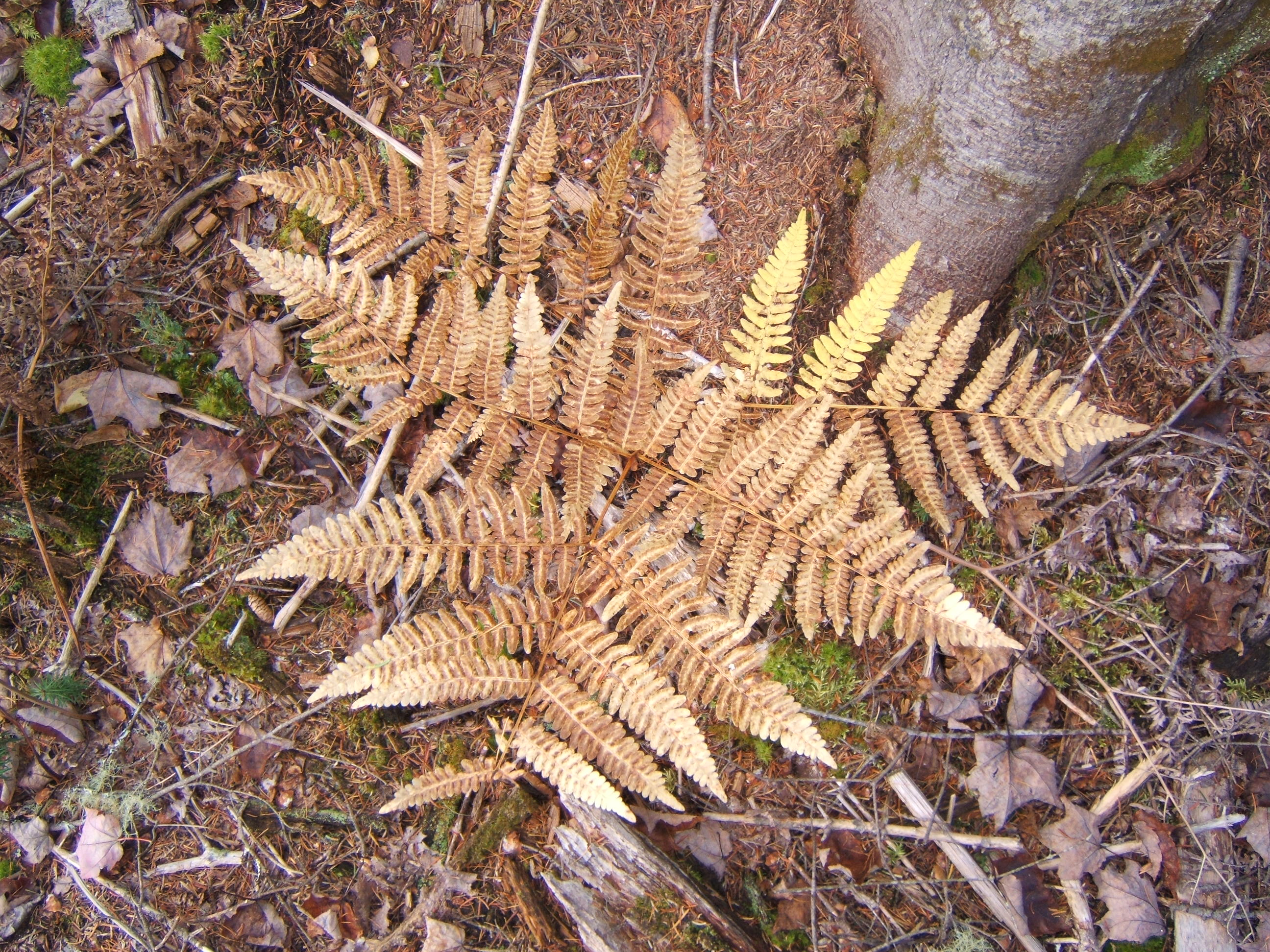
Bracken fern with fractal leaf patterns... the leaf is divided into leaflets... these are divided into sub-leaflets... and these are divided into lobes...
Benoit Mandelbrot is the mathematician credited with first describing fractal geometry.
Other fractals in nature include mountains, branching patterns of trees, the dendritic form of root systems, patterns of vessels in the body, frost crystals and snowflakes, even the clustering of galaxies. Just go on a walk outside to find lots of your own examples of fractals.
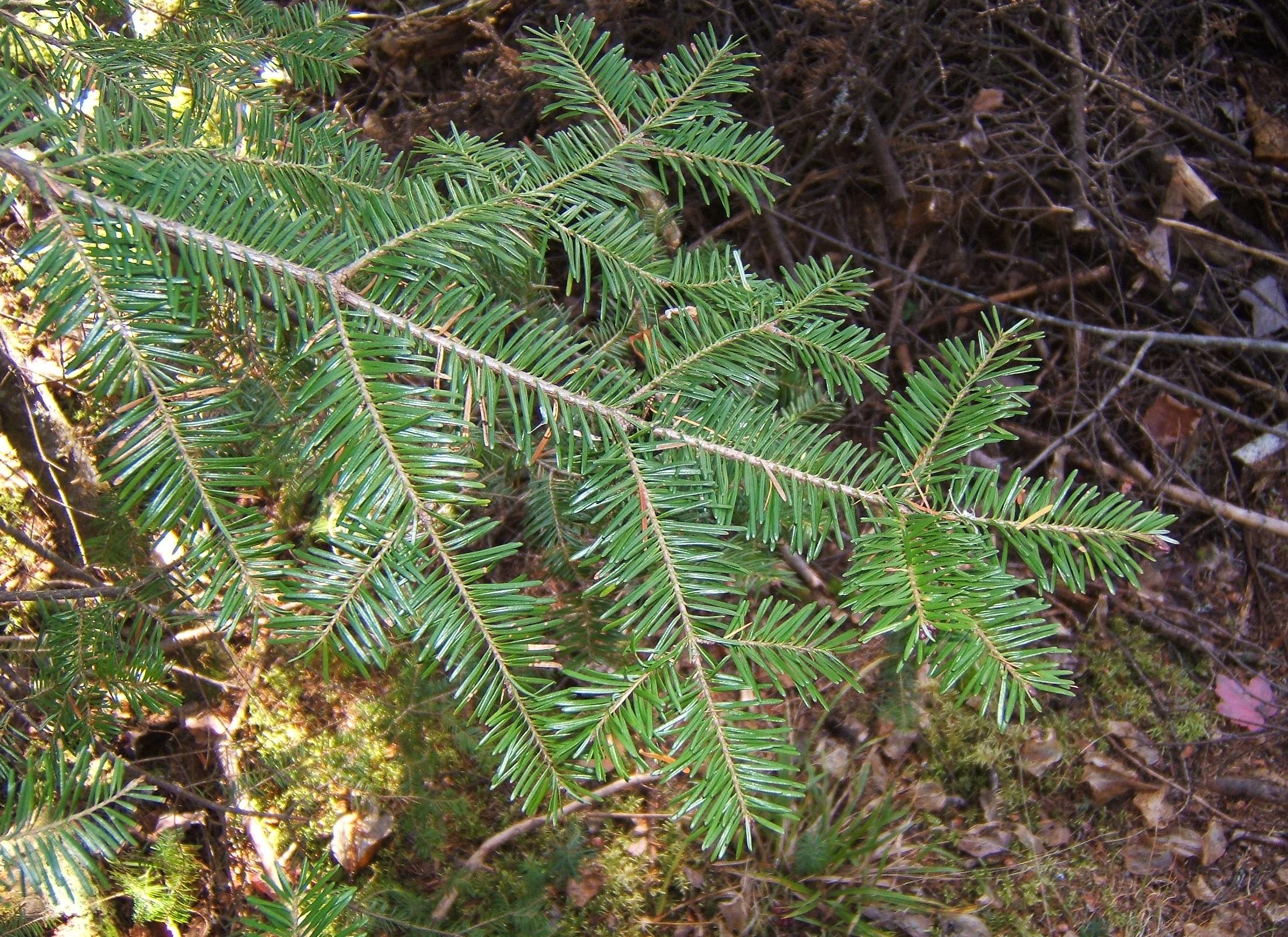
fractals in branches of Balsam Fir...
When we do not include nature in our lives, we miss these fractals. If experiencing fractals in nature is necessary for human wellness, as some suspect, this is yet another reason for getting out-of-doors, examining the patterns we see in trees and other wild plants, taking in the scenery of landforms and horizons, and catching snowflakes on mittens.
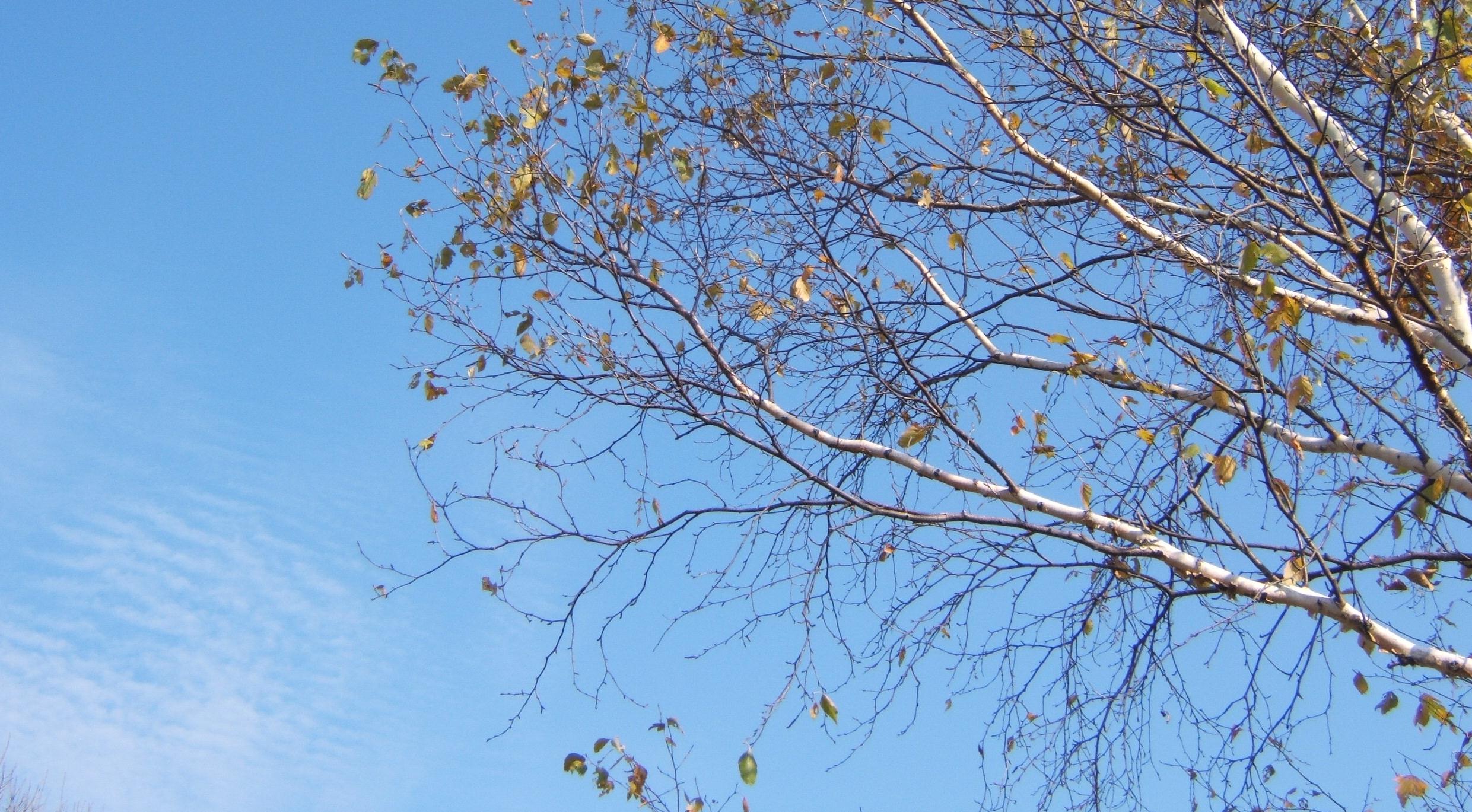
fractals in tree branches and fractals in clouds
fractals
~
winter trees on morning sky
each a watershed, dendritic weave
brooks and rivers
backwaters and waterfalls
~
the trunk a river
not flowing to the sea
but into earth toward
unsalted water, deep in the ground
~
the roots the mirror of river
knowledge gathered
drawn, divided
to fine corpuscular thread
~
© Jane Tims 2005

Northern White Violet (Viola pallens (Banks) Brainerd.)
Yesterday, we had our first dusting of snow and it persisted on the grass until the evening. It reminded me of some of those low white summer flowers whose petals look like snow when they bloom in masses on the lawn or in a field. In any season, the sight of ‘snow’ can be a charming, welcome sight.
The northern white violet, or small white violet (Viola pallens (Banks) Brainerd.) inhabits the moist ground of meadows, bogs and thickets, and it blooms profusely on our front lawn. Pallens means pale, referring to the color of the flowers. The leaves are somewhat heart-shaped.
The violets are a difficult group, taxonomically. Viola pallens is also known as Viola macloskeyi Lloyd.
Northern White Violet
Viola pallens (Banks) Brainerd.
~
stars in the northern meadow
scattered at the feet
of cattle grazing hay
violet sweet
~
hearts among the grasses
where the ground is wet
flowers pale and nodding
small white violet
~
Published as: ‘Northern White Violet’, April 2005, Refuge 14 (1)
© Jane Tims 2005

Twinflower (Linnaea borealis L.)
As we enter the winter months, I like to remember the woodland plants now waiting under the layers of fallen leaves to flower again next spring.
Twin-flower (Linnaea borealis L. var. americana (Forbes) Rehd.) is a low-growing, creeping evergreen, found blooming in late June in wooded swamps, coniferous bogs and clearings.
Each slender stalk bears a set of two delicate, nodding, fragrant flowers, white in color and tinged with pink. Other names for the plant are pink bells and, in French, linnée boréale. The specific name is from the Latin borealis, meaning northern.
The European variety was a special favorite of Linnaeus, the founder of the present system of naming flowers.
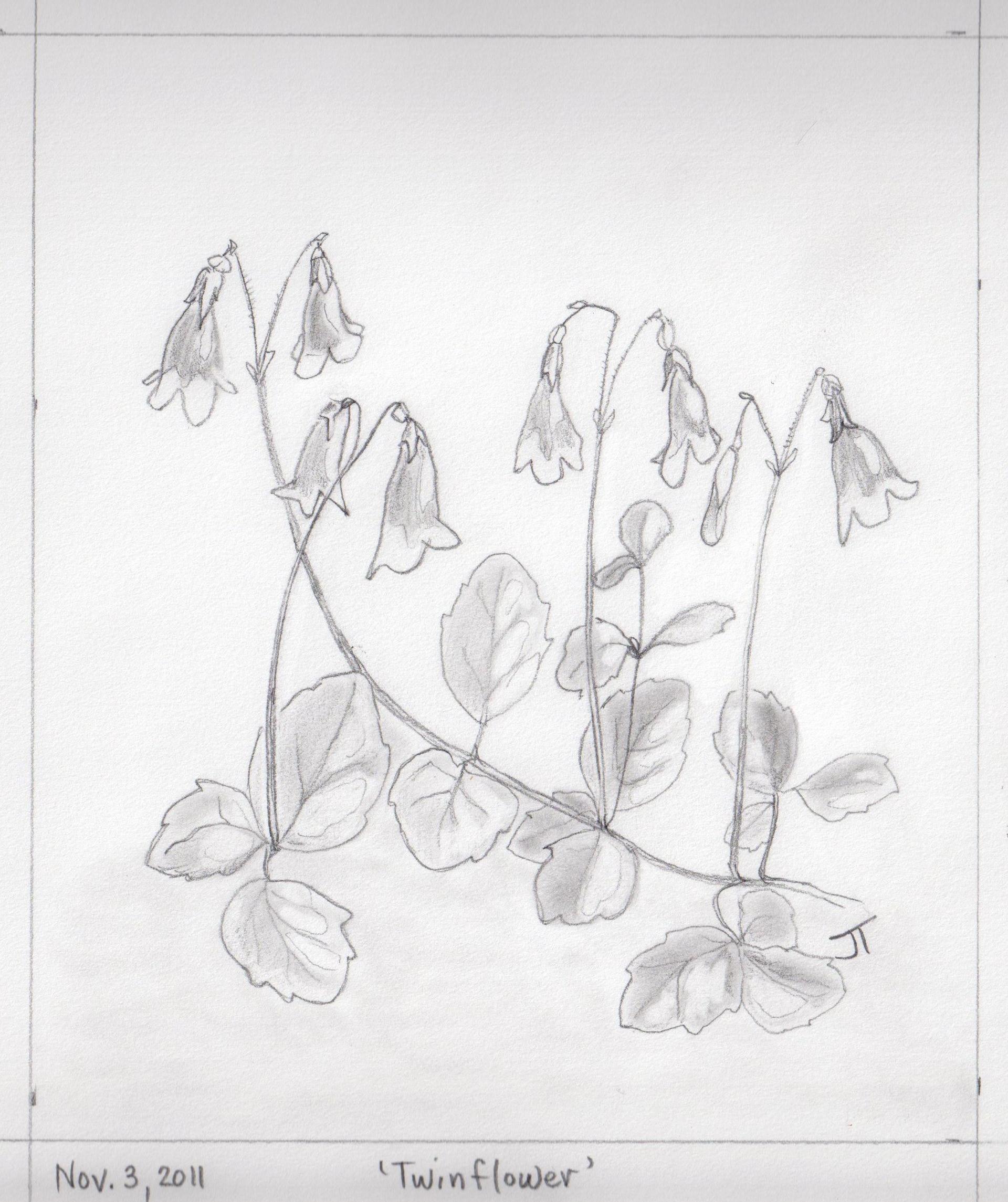
Twinflower
Linnaea borealis L.
~
conifer cathedral
slanting light
Linnaea carpets
stains the forest floor
to the edge
near the forest door
a woodland pool
~
on slender stem
mirrored
in the pool
and in the air
twinflower rings
pink boreal bells
at vespers
in whispers
a whisper
the rule
~
creeps under roots
and fallen leaves
Linnaea trails
over rude beams fallen
from fences built
when woods
were pasture
~
twin flowers
settle back to back
nodding heads
they cease to ring
and sleep
~
© Jane Tims 1992
making friends with the ferns #1
November is an odd time to think about identifying ferns, I admit. But identification of the evergreen ferns is still possible, as they hang on to their identity in the frosty air and even beneath the snow. Also, ferns are so beautiful, it is fun just to look over the field guides and reminisce about the days of summer.

a pressed Long Beech Fern in my copy of Boughton Cobb’s ‘Field Guide to the Ferns’
Ferns belong to the group of vascular plants known as the Pteridophytes. They have stems, roots and leaves but no seeds. Instead, they reproduce by spores and have complicated life cycles.
Ferns grow in many habitats. In our area they are found in moist and shaded woodlands. They are also inhabitants of fields, cliffs, wetlands and cityscapes. I have even seen ferns growing deep within the Howe Caverns of New York State where they have taken advantage of the scant habitat provided by artificial lighting.
The uniform ‘greenness’ of ferns and their highly patterned leaves make them popular as a motif, especially for home decorating and at Christmastime.
In New Brunswick, fiddleheads, the tightly coiled new leaves of the Ostrich fern (Matteuccia Struthiopteris (L.) Todaro), are collected for food every spring along the banks of rivers and their tributaries.
~
waking from a dream
Ostrich Fern (Matteuccia Struthiopteris(L.) Todaro)
~
bottom-land thicket
naked in spring
a rumpled bed
the throws of hibernation
~
new growth cocooned
in dry leaves, bent skeletons
of last summer’s fern
~
sun surge
an insult
between curtains
~
green fiddlehead
uncoils
head down
fist thrust
between pillows and down
fingers stretched
filigreed shadow
new blocking of sun
~
brown coverlet
kicked
~
new green bedspread
new green canopy
green shade
~
© Jane Tims 2011
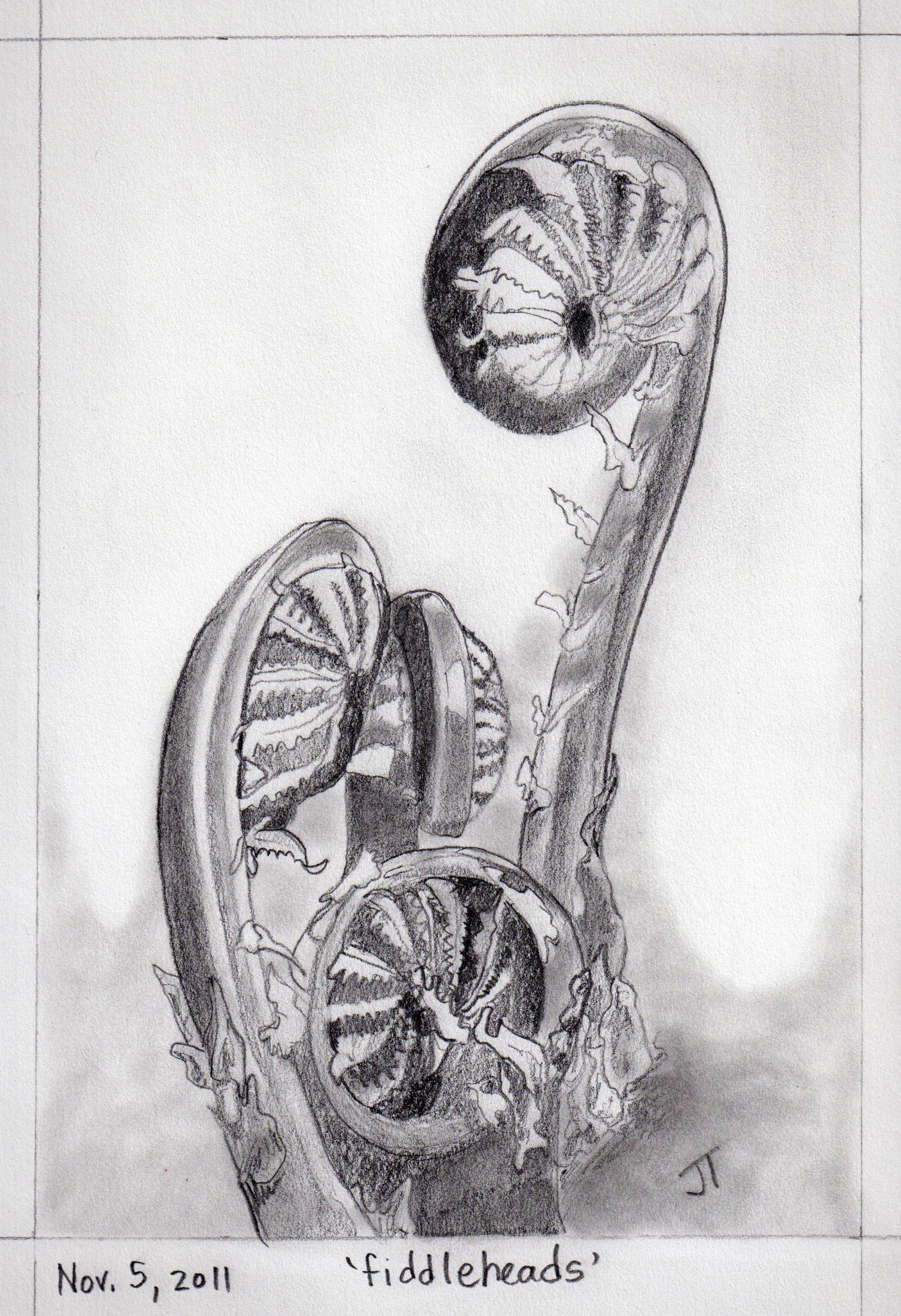
Winterberry Holly (Ilex verticillata (L.) Gray)
In contrast to October, November is a colorless month. The exception – November’s red berries.
They punctuate the roads and ditches – Highbush-cranberry, Staghorn Sumach, American Mountain-ash, Hawthhorn and Rose. Eventually the birds claim every one for food, but through most of early winter, the berries remain to cheer us.

Highbush Cranberry in November
Last November, my husband and I took a walk in the thicket of saplings above the lake. As we came around the edge of a clump of alder, we were surprised to see a sturdy bush of Winterberry Holly. It glowed with orange-red berries, set off by sprays of bronze-coloured leaves, not yet fallen. We are used to seeing Winterberry along the lake, but in the grey and white thicket, the little bush was a gift. We went there again this past Saturday, and there it was, glowing in the morning sun.

our bush of Winterberry Holly
Winterberry Holly (Ilex verticillata (L.) Gray) is also known as Canadian Holly, Swamp Holly, Inkberry, Black Alder and Feverbush. The shrub is usually found in wet areas, including wetlands, damp thickets, moist woods and along waterways. The leaves turn a brassy purple-brown before they fall. The fruit is a small, hard orange-red berry, remaining on the bush until January.

In my poem, the words ‘lexicon’ and ‘exile’ are included as imperfect anagrams for Ilex (ilex).
Canadian Holly
(Ilex verticillata (L.) Gray)
~
drab November
and lexicon
expires
umber leaves
grey verticals
dull stubble
~
winterberries
astound the wetland
red ink on page
and words explode
from exile
~
fever flush and holly
above December snow
icicles vermillion
~
© Jane Tims 2011
Round-leaved Sundew (Drosera rotundifolia L.)
Carnivorous plants are a bit frightening. They seem more thoughtful than other plants. They are slightly macabre, possessing special adaptations for acquiring their food. They take on shapes not typical of flowering plants. On most days, you can find their prey, in various stages of digestion.
The Round-leaved Sundew, Drosera rotundifolia L., is also called Daily-dew or, in French, Rossolis à feuilles rondes. The Sundew is a carnivorous plant of acid bogs, barrens, moist roadside ditches and peaty soils. The leaves are in a tuft at the base of the plant and each leaf is covered with numerous gland-bearing bristles. These exude a clear fluid that glitters in sunlight, hence the name, from the Greek droseros meaning dewy. The delicate white flowers are borne on a slender, nodding stalk, and only open in the sun.

Round-leaved Sundew
Drosera rotundifolia L.
~
daily, dew is falling
sits on bristled leaves
of the sundew;
in innocence, believe
~
in our ditch is treasure,
glittering jewels, set
out in the sunshine,
a lure for insect fools
~
brilliance and beetles caught
in sticky dew, bristles tight
clutch creatures
they slew
~
tiny flowers cling
to the curve of a nodding stem,
opening when sunlight
shines on them
~
© Jane Tims 1984






 nichepoetryandprose