Posts Tagged ‘nature’
at the bird feeder #7 – Pine Siskin
After our heavy snow last week, the birds were all looking for perches and easy feeding. A few Chickadees and Pine Siskins were at the feeders early. Pine Siskins (Carduelis pinus) are fidgety little birds, staying at the feeder to get their fill, but ever vigilant and looking over their shoulders. They are heavily striped, sometimes with yellow bars on their wing feathers. They also have sharp beaks.
Because the Pine Siskins are striped, I confused them at first with female Purple Finches. The female Purple Finch is also striped, but is a slightly bigger, chunkier bird. Its beak is large and wedge-shaped, and it has no yellow coloration.
~

Pine Siskin at the feeder
~

female Purple Finch - wedge-shaped beak and stripes around eye (a male Purple Finch at left)
~
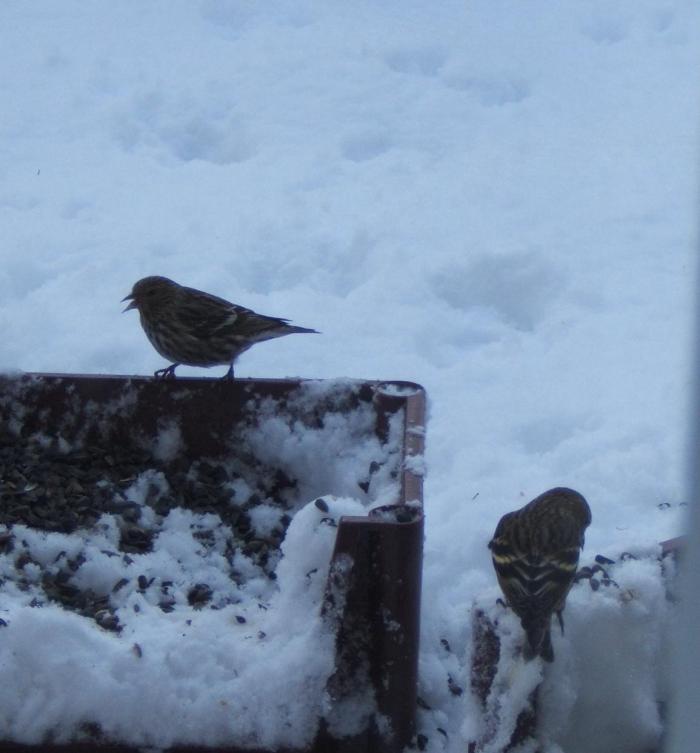
two Pine Siskins at feeder - sharp beaks and yellow wing bars

© Jane Tims 2012
snippets of landscape – the bogan
Along the St. John River are sluggish side-streams, flooded in spring to form full tributaries of the river, but isolated and stagnant in low-water conditions, sometimes completely cut off from the main river. These are known as bogans, a word of Algonquian origin. The words logan and pokelogan have a similar origin and meaning.
My favorite bogan is a strip of water next to the Trans-Canada Highway near Jemseg. The bogan creates an island, Thatch Island, in the St. John River. Old Silver Maple trees lean over the still water, creating reflections and shadows.

bogan along Thatch Island
On maps of the St. John River, a bogan on Sugar Island, just north of Fredericton, is called the Sugar Island Padou.

bogan (padou) on Sugar Island
~
~
bogan
~
appendage of river
footnote on water
predictable as the day we walked
the dead-end backroad
and retraced our steps to return
~
in spring, by canoe, at high water
or on ice skates in winter
in summer sluggish
stagnant, secluded
~
we lurk, eavesdrop on whispered
conversation
we are river folk
unwelcome
~
~
© Jane Tims 2012
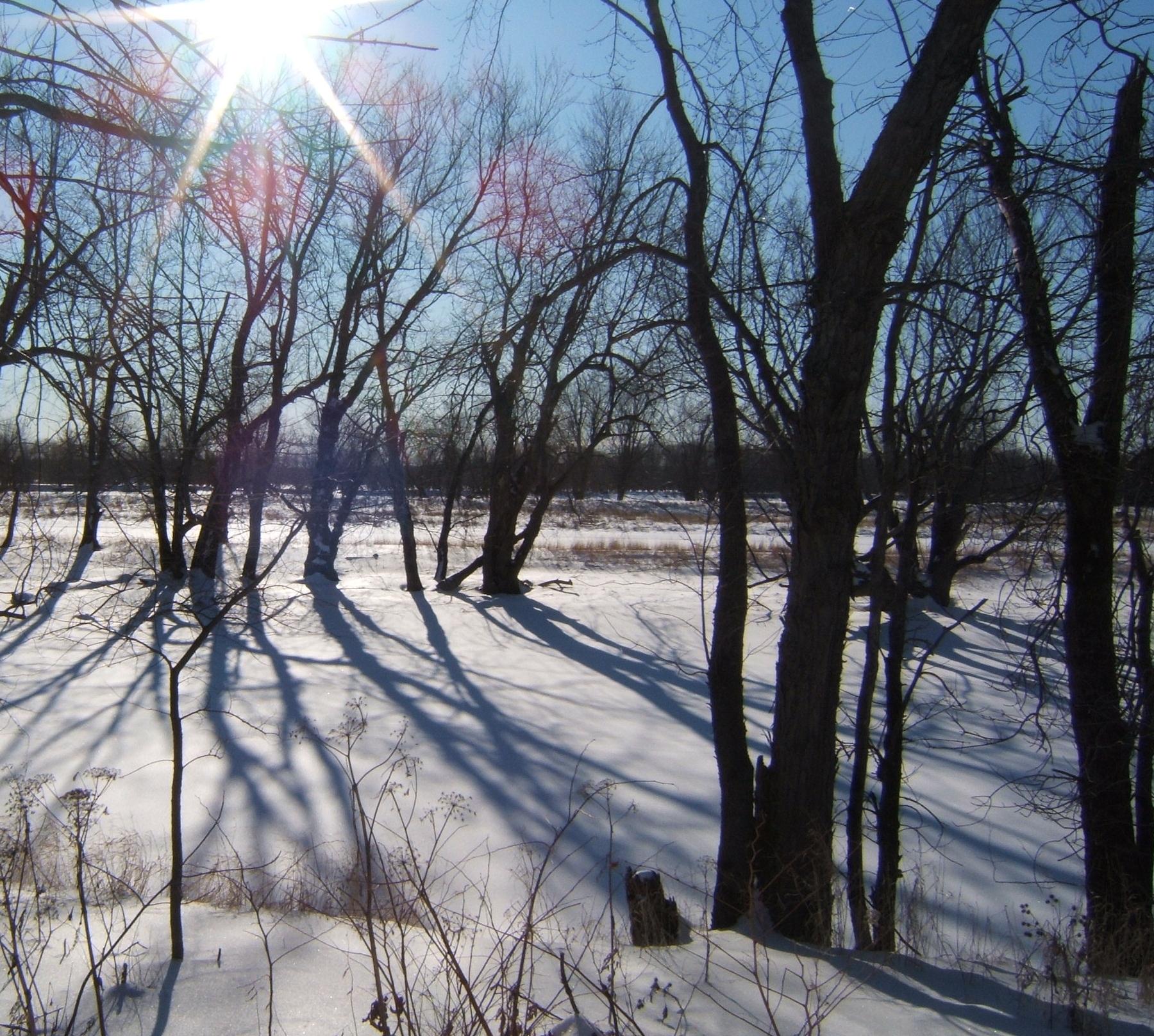
snow-bound bogan to the north of Thatch Island on the St. John River
a moment of beautiful – tracks in the snow
the space: new fallen snow
the beautiful: a Red Squirrel’s tracks
~
An expanse of new fallen snow is like an unwritten page. When you find something written there, it is a message of beauty.
In our driveway, after the last snow, a Red Squirrel was the first to write on the ‘page’. The prints were delicate, traced in blue shadows.
~

Our Red Squirrels are certainly not afraid of the snow.

digging for sunflower seeds

red squirrel with snow accumulating on his head
~
~
a love letter, unsigned
~
the meadow in winter
a sheet of paper
folded
where the stream
flows under the ice
~
the sky
an envelope
lined in blue
~
tracks on the snow
cautious
afraid
words
pressed to the page
~
erased
(erased)
by melting
or a dusting
of new snow
~
~
Published as: ‘a love letter, unsigned’, 1999, Green’s Magazine XXVII (2): 44.
Copyright Jane Tims 1999
warm room
We had another snow storm last night. In our winter climate, can anything compare with being settled in a warm room with a cup of tea, perhaps reading a good book, and listening to the storm throw handfuls of ice-pellets at the window glass?
As I write this, I know everyone is not so fortunate.

~
~
within
~
~
winter lays a cheek against the glass pecks at the window
rattles the door
~
the room is a yellow lattice on the snow a frail package
of warmth firelight a quilt the pages of a novel
kneading paws
~
field mice and ermine etch fleet trails in the thicket breathe
in the velvet space beneath the fir
~
kettle and cat are purring
~
~
© Jane Tims 2000
at the bird feeder #6 – Purple Finch
On Thursday, we had a Hairy Woodpecker and a large flock of male and female Purple Finches at the bird feeder. The Peterson Field Guide describes the Purple Finch (Carpodacus purpureus) as ‘… a Sparrow dipped in raspberry juice.’ I can’t improve on that description! The other particularly noticeable feature is its large sturdy beak. My husband took a few photos since I was not home, just enough to give me one to draw.
I miss most of the feeder birds since I leave in the early light and come home after dark. Nevertheless, the Chickadees and Goldfinches are usually there to see me off. We have one Chickadee who always has his ‘hair’ ruffed up, like a rock star with a ‘do’.

~
~
Purple Finch
(Carpodacus purpureus)
~
sunflower seed and millet
purple finch posed in the maple
sullen brow
blunt beak
metallic tick
~
he knows my eye
at the edge of the glass
my struggle for stamina
~
he is immobile as a post
a vermillion bird stuffed
with husks of sunflower seed
~
he sees me sidle to the chair
watches me settle
~
he is still
as a post card
~
seedless husks of sunflower
~
~
© Jane Tims 2012

© Jane Tims 2012
a moment of beautiful – trees and shadows
space: edge of the St. John River in winter
beautiful: mature silver maple trees and their shadows on the snow
~
We went for a drive last weekend, along the St. John River. Above the ice, the river is covered in snow, a broad white plain edged by very old and very rugged silver maple trees.
In spite of a harsh environment, these trees endure. Each spring and fall, they are flooded. They are scoured by ice and subject to the eroding forces of the river. They are always at risk from people searching for a supply of firewood. A friend tells me these huge trees are usually suckers, grown from the base after the original tree was harvested.
And yet they grow old, a part of the hardwood floodplain forest. On a sunny day, they lean over the snow-covered river and spread their shadows across its surface. They have the beauty of their symmetry, solidity, grace, and fortitude.
~
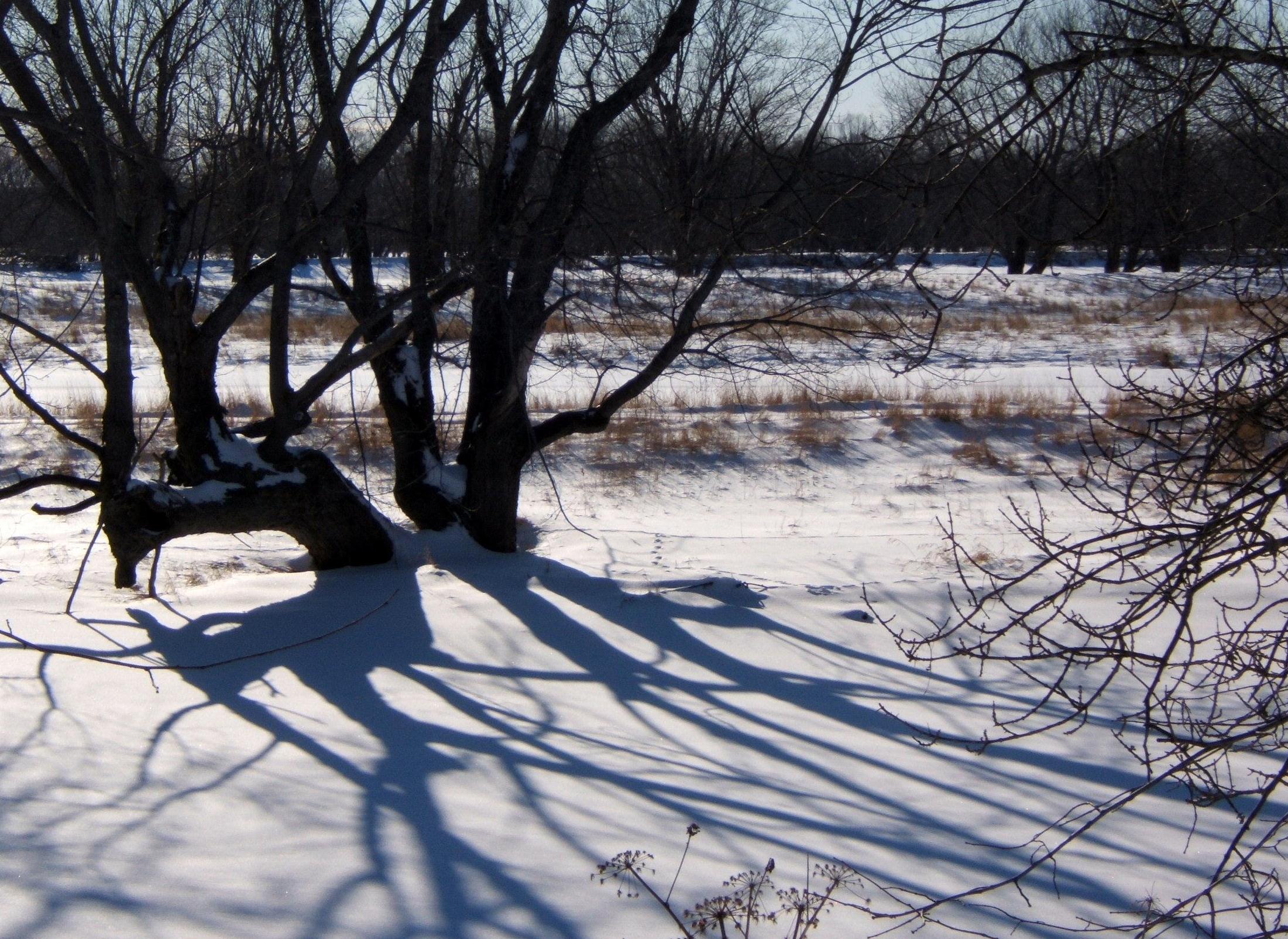

the line of animal tracks crossing the snow are probably from a Red Fox
Copyright Jane Tims 2012
eight days – antler
During my trip to Ontario, we spent lots of time, on cold days, enjoying the wood stove.
On the hearth was a deer antler, found on a walk in the woods. Usually they are hard to find since the mice chew them to nothing very quickly.
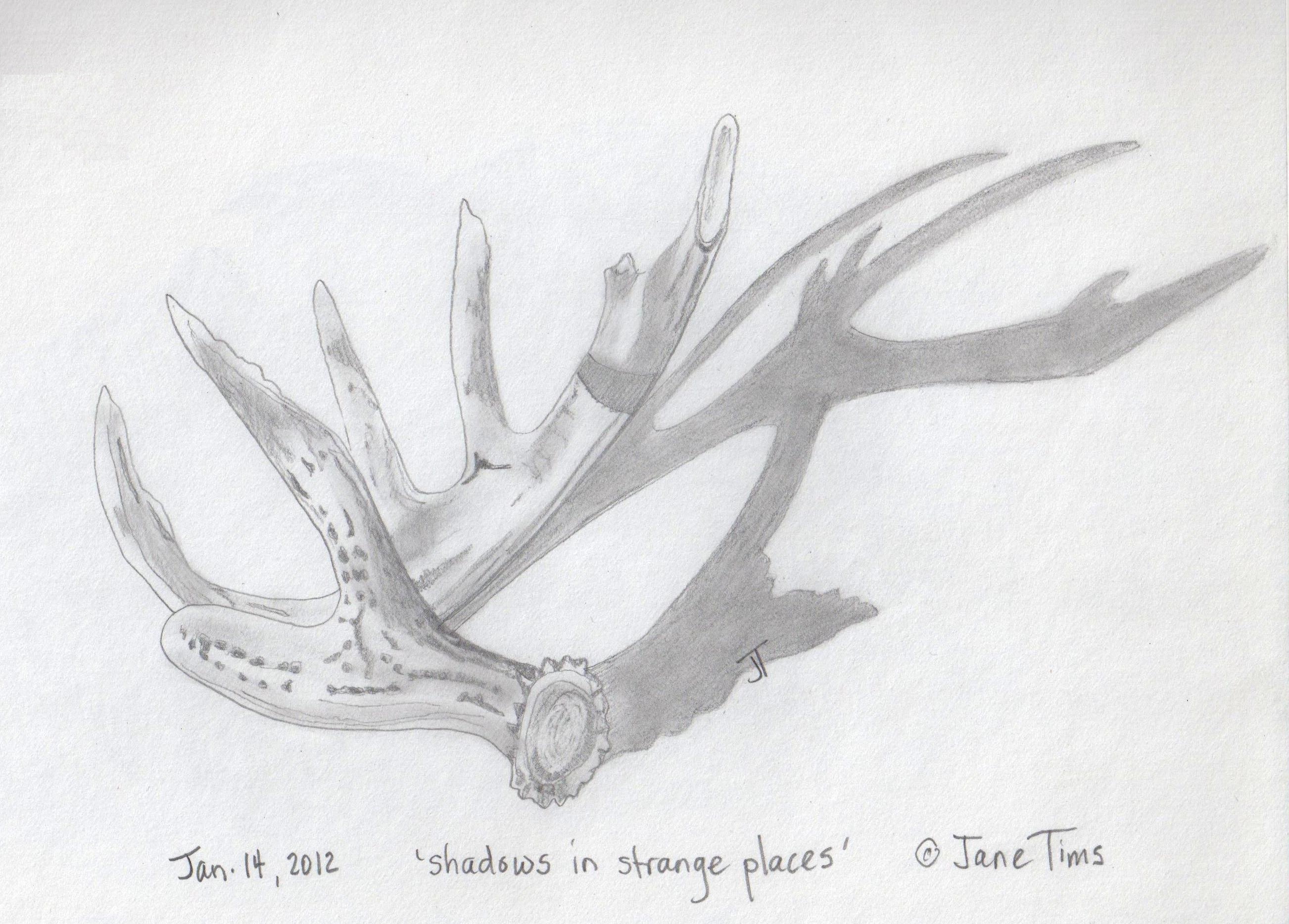
I was drawn to the antler because of its resemblance to a bony hand.

~
~
antler
~
ivory hand, posed
for incantation, shadows in unexpected places
relic of a woodland walk, artefact
enchanted, deer rub
cedar bark to summon
mist, acknowledge the passage
of days, manifest between
separation
and the gnawing of mice
~
~
© Jane Tims 2012
at the bird feeder #5 – Hairy Woodpecker
Our Hairy Woodpecker was back today. She was determined to get to the feeder, so we got a very good look at her in all her black and white splendor.
This time the identification was not a problem. This woodpecker is a noticably large bird, compared to the smaller Downy Woodpeckers we have seen at the feeder before. Also, the outer tail feathers are white, not marked in black as they are with the Downy Woodpecker.
I like to compare illustrations in the various bird books. Have a look at these two sets of Downy and Hairy Woodpeckers, both drawn by Roger Tory Peterson, first in his ‘A Field Guide to the Birds East of the Rockies’ (1980)…

Roger Tory Peterson, 1980, 'A Field Guide to the Birds East of the Rockies', Houghton Mifflin Company, Boston.
… and second, from his illustration in ‘The Birds of Nova Scotia’ by Robie W. Tufts (1973). In the ‘Field Guide’ , the markings on the white tail feathers of the Downy Woodpecker are clearer.
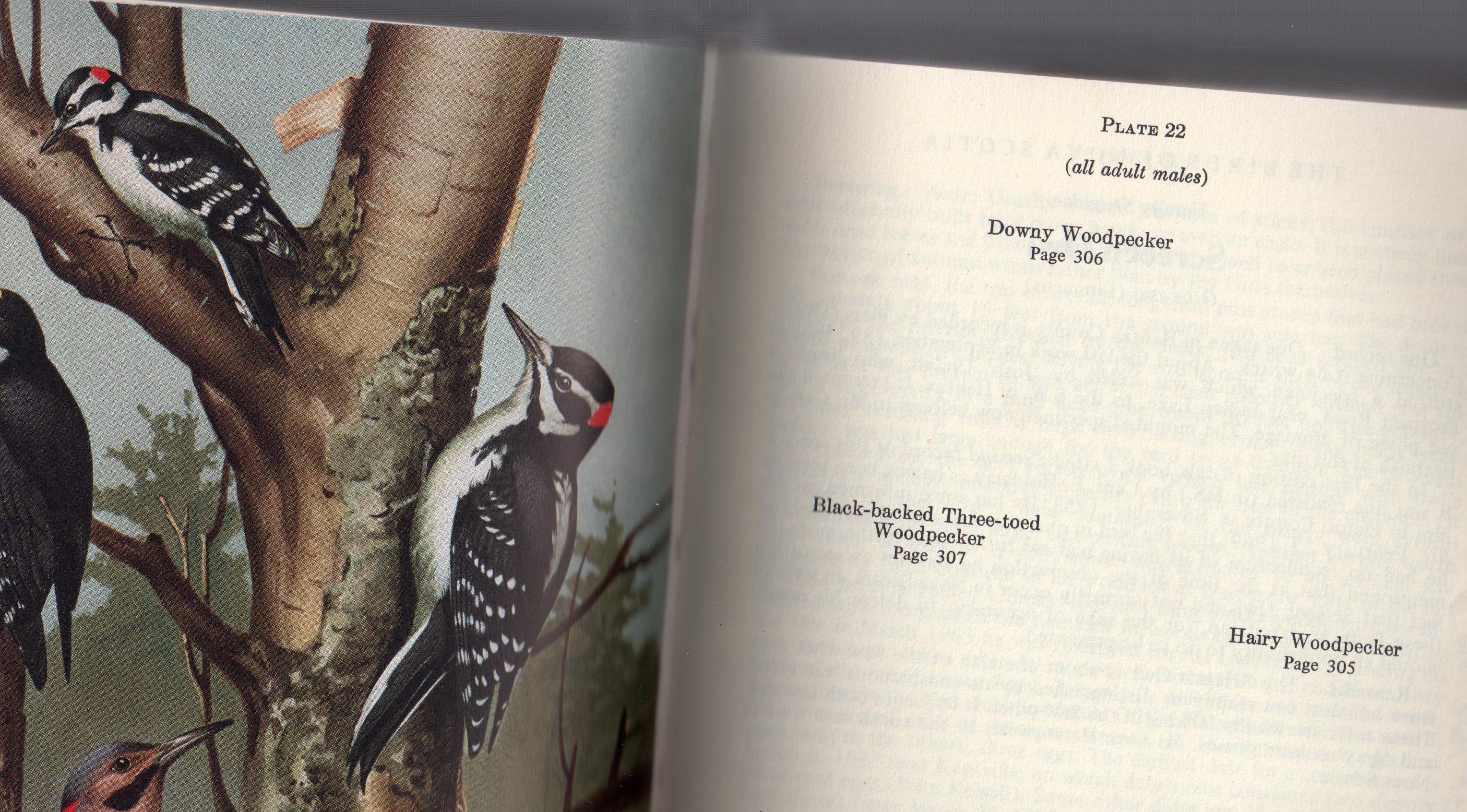
Robie W. Tufts, 'The Birds of Nova Scotia', 1973, Nova Scotia Museum, Halifax. Color illustrations in this book are by Roger Tory Peterson.
Both Downy and Hairy Woodpeckers are cavity nesters. They stay through the winter and are frequent visitors at feeding stations… they love suet and black sunflower seeds.

at the bird feeder #3
I am amazed at the volume of seeds these little visitors eat.
The deer, racoons and squirrels take their unfair share, of course. Last year, I watched a deer attack the feeder with its tongue, scooping up every bit of seed in a matter of minutes. Even without the deer and racoons and squirrels, the birds descend in a flock and the food is soon reduced to a scattering of seed-husks.
We have come to a conclusion – next year we will put up a mammal-proof feeder. My brother-in-law has it figured out. He has installed a large cedar post in an open area and encased it in aluminum pipe and flashing. Enough seed falls on the ground to give a treat to the squirrels and other marauders, and the birds are the focus of the money-drain.
~
~
feeding the birds
~
I wait, no patience to speak of
for the next bird to find
~
this food more delicious than seed offered
by my neighbour, swears
~
he had cardinals, mine the left-over
chickadees and nuthatches, flocks of redpoll
~
litter the feeder, red-dotted heads, their toes
grip courtesy branches, a perch
~
impossible to find, after the freezing rain, branches
encased in slip-and-slide, candy-coated nutrition
~
won by complication, every kernel harder than stone
seed in a casing of black, sunflower
~
and pencil draw the finches, grosbeaks smash seed-coats
with deliberate jaws, shards of sunflower husk and ice-coat
~
fall as rubble
~
~
© Jane Tims 2012
at the bird feeder #1
Today our bird feeders are a mess. Racoons and grey squirrels don’t keep neat houses. However, the seeds scattered across the deck are attracting a delightful array of birds. The last few mornings we have had:
a few chickadees (Black-capped Chickadee, Parus atricapillus)… they grab a seed and swoop to the nearest low branch to break the seed open… they seem to travel in small groups, but bicker with one another at the feeder…
a few nuthatches (Red-breasted Nuthatch, Sitta canadensis)… they are acrobats, grabbing to the feeder and then flipping inside to get the seed… they are solitary, sometimes in small groups of two or three… they leave one another alone, each taking their turn…
a flock of goldfinches (American Goldfinch, Carduelis tristis)… gregarious, they are all a-flutter and feed together side by side… they hang around to break open the seed and tolerate other species beside them…
~
~
goldfinches
~
bright feathers distil
yellow from atmosphere
essence of sunflower
tipple and sip champagne
make small talk at parties
gesture with hands
paint scallops on air, animated discussion
~
the gregarious obtain information
best feeder in the neighbourhood
best seed
least squirrel
~
~
© Jane Tims 2011