Posts Tagged ‘nature’
maple sap soda fountain
For the last two days, the maple sap has been running again. The nights have been below freezing and the days are sunny and warm. Yesterday, we had 12 liters of sap from our 10 trees. The day before, we collected about 5 liters.
Each tree has its own rhythm of drips. Our best producer today drips at a rate of about 9 drops every 5 seconds, or 108 drops per minute.
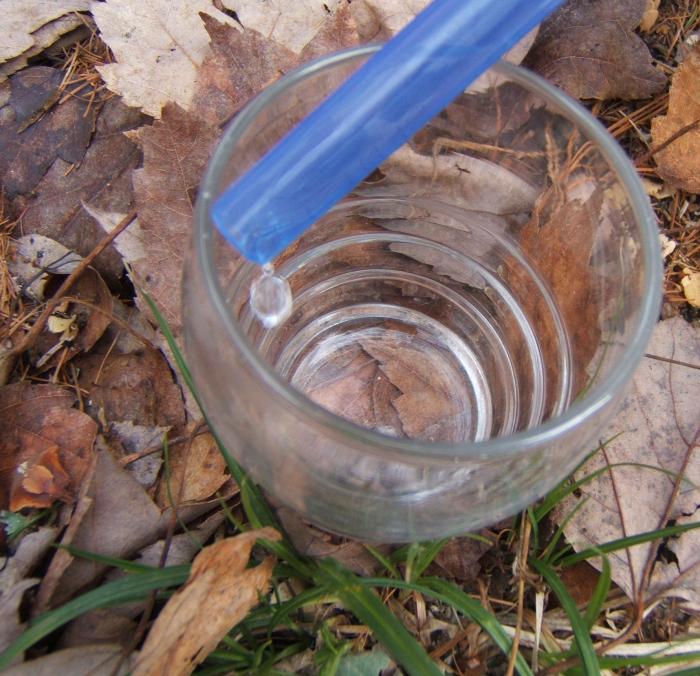
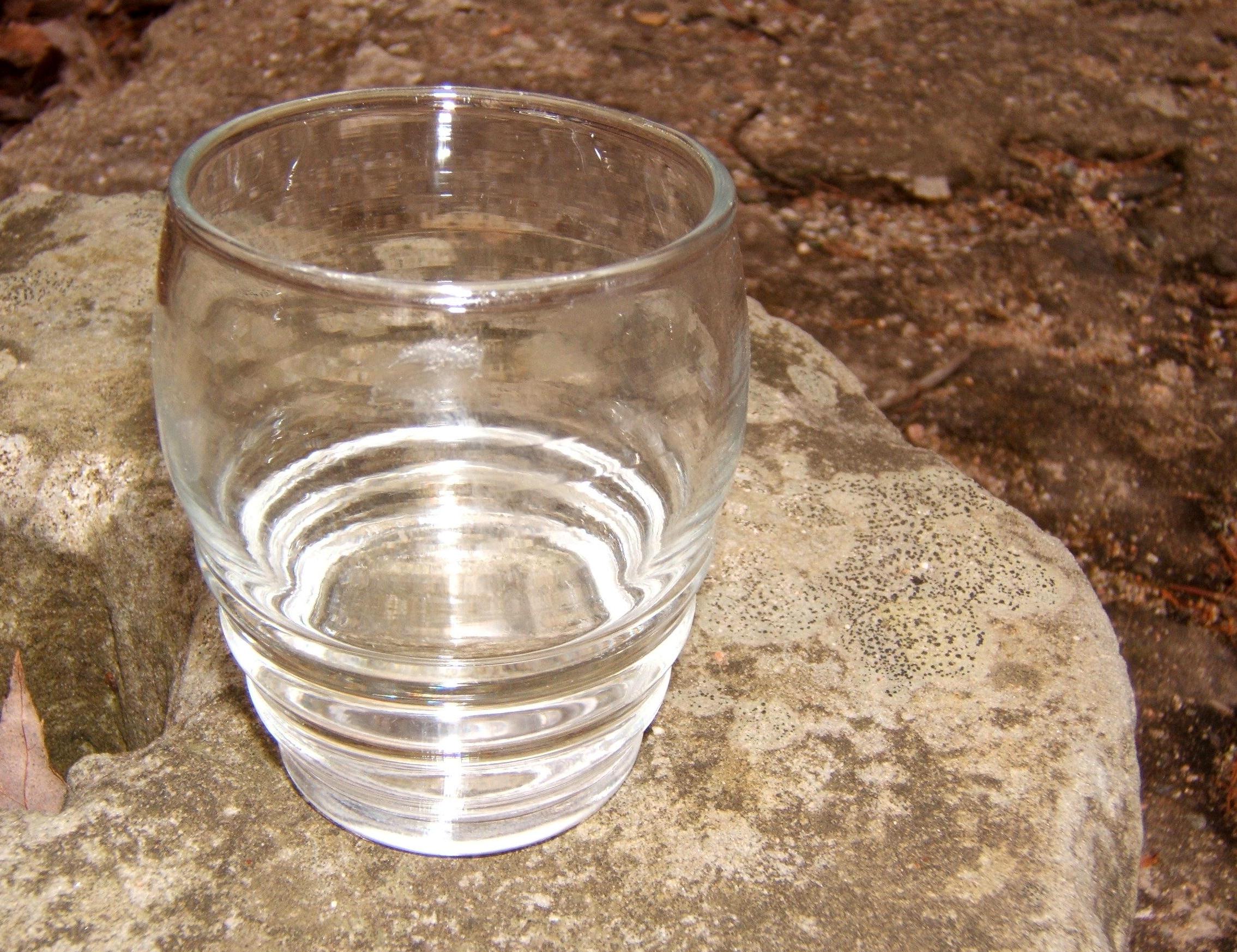
This evening, I had my ‘drink the sap from the tree’ experience. I took a small glass and caught the drips for a couple of ounces of the sweetest water ever. To me, the sap of each tree has its own taste. The sap from the big maple tree by our front door tastes a lot like cream soda without the fizz!
The maple sap is crystal clear, although it will turn dark amber (No. 2 Amber, according to our grading in Canada) once we boil it down to syrup.
~
~
droplet
~
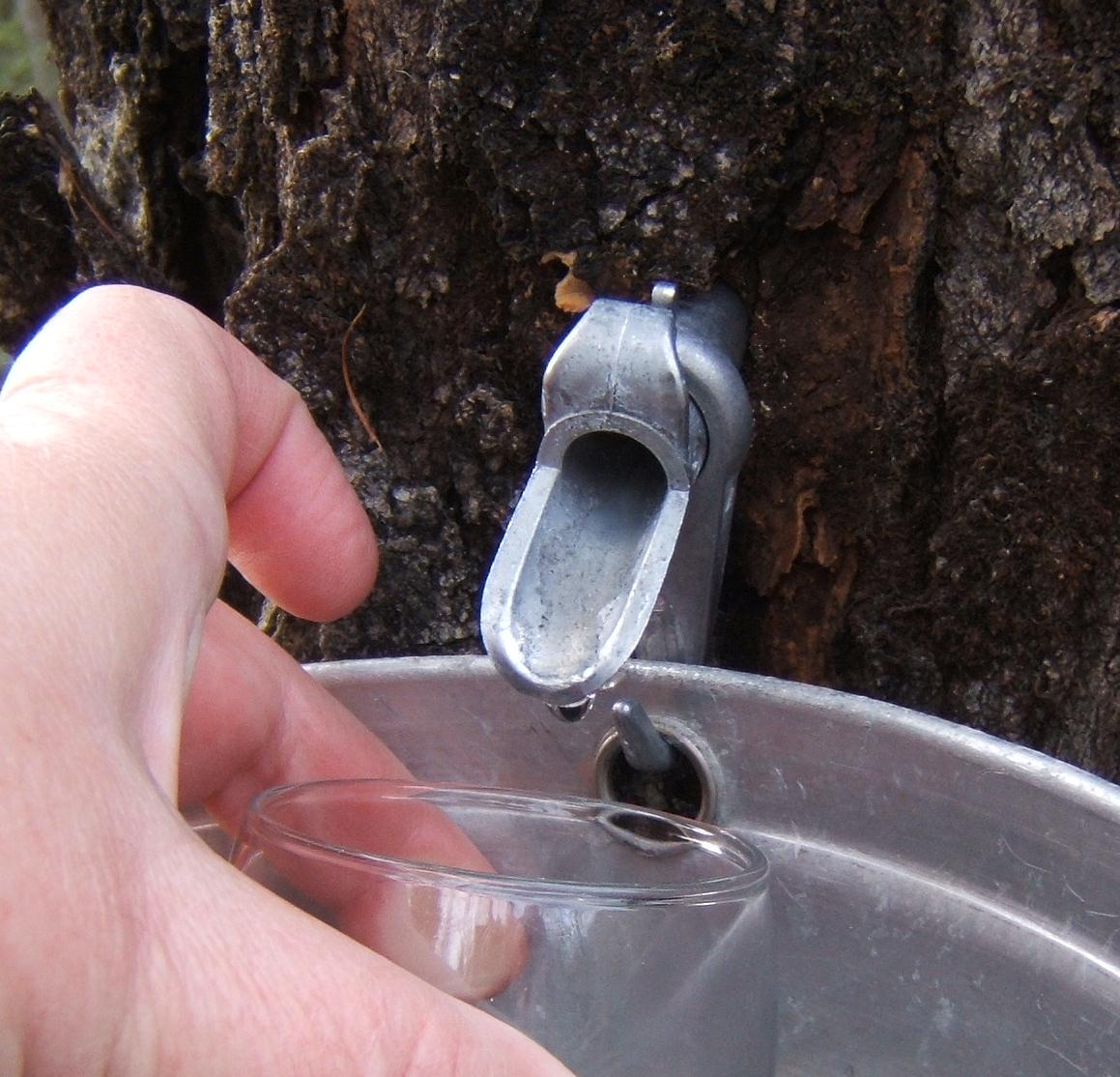
one drop of maple sap
from the spile
~
a seep from slate
at the waterfall edge
~
in rain, a tear
from the margin of a leaf
~
a pause in the envelope
between rough bark and aluminum
~
~
© Jane Tims 2012
keeping watch for dragons #4 – a dragon overhead
Have you ever had a raven fly directly over your head? If so, you have heard the rhythmic compression of air, too intense to have been made by feathers…

~
~
a dragon overhead
~
a raven flies over
thrashes the air
percussion of dragon wing
~
~
© Jane Tims 2012
maple syrup ups and downs
It may be a short maple syrup season this year. The weather has not been cooperative. In order for the sap to run, warm days are great, but the nights need to be cold. When the temperatures fall below zero, the sap in the tree runs from the crown to the roots. When the day is warm and sunny, the sap runs back up to the canopy. If there is no cold night, no sap.
So far we have collected about 40 liters of sap from our 10 trees and I have 3 bottles (each 500 ml or two cups) of lovely dark syrup! This compares to 136 liters of sap last year on the same date, from 12 trees.
~
~
Cold night, warm day
~
Icicles build
from the spile
sweet sickles of sap
~
~
© Jane Tims 2012

Coltsfoot (Tussilago Farfara L.)
Although it has been snowing sporadically this month, our recent days of very, very warm weather tell me spring has arrived. As a result, I am watching the roadsides for the first flowers of spring. Even before the snow is out of the woods, it begins to melt along the roadsides as they warm in the lengthening hours of sun. And the cycle of bloom begins again.
Coltsfoot (Tussilago Farfara L.) is one of the first plants seen in early spring. It forms large patches in waste areas, beside brooks and roads, and on damp hillsides. People often mistake Tussilago for Dandelion, but it is quite different. Its yellow flowers are borne on scaly, leafless stems. The large, woolly leaves don’t appear until later in the season. In spite of its early appearance in spring, Tussilago actually has late flowers. The flower buds are formed in autumn at the base of the plant, and pass winter underground, flowering in the first spring sunlight.
Other names for the plant are Son-before-the-Father, which refers to the appearance of flowers before the leaves, and pas-d’âne (literally donkey-steps). The scientific names are from the Latin tussis, meaning a cough, referring to the use of the plant as a remedy for such ailments, and the Latin word for coltsfoot, farfarus. The plant was named by Linnaeus, the Swedish botanist who established the present day system of naming plants.
Although the plant was used by pioneers for its medicinal effects, it is now known that Tussilago contains harmful alkaloids. Tea made from Coltsfoot has caused health problems in infants and pregnant women, so its use as a cough remedy is not recommended. In some States, Coltsfoot is considered a noxious weed.
~
~
Coltsfoot
Tussilago Farfara L.
~
Gold-
splashed beside the road
like prints
of a frisky colt’s feet
~
at first glance-
an early dandelion!
but-
too early
stem scaly
no leaves below the bloom
no perfume.
~
Coltsfoot,
Son-before-the-Father
(flowers before the leaves).
Introduced from
far, far away.
Old wives say
boiled greens
will ease
a cough.
~
Long ago
Tussilago
sprang from where
a burro trod
among the palms
(pas-d’ane)
~
~
Published as: ‘Coltsfoot’, Winter 1993, The Antigonish Review 92:76-77.
Revised
© Jane Tims 1993
~

maple syrup time
Well, the time has finally arrived. The nights are cold and the days this week are predicted to be sunny and warm. In our house the combination of cold days and warm nights means the sap is moving in our maple trees.
We tap Red Maple (Acer rubrum L.), although Sugar-maple (Acer saccharum Marsh) is preferred by commercial syrup producers. Last year we tapped 12 trees, about at the edge of our low-tech capability. This year we are tapping 10 trees.
We usually use the ‘old-fashioned’ spile and aluminum bucket method. This year, for the first time, my husband is trying a plastic spile and pipe system for 5 of our taps. It seems a little easier since the sap drips directly into a plastic reservoir and this eliminates one step in the endless pouring process.
For those of you unfamiliar with tapping trees for sap, the basic idea is to collect the sap and boil it down to make maple syrup. We select a tree, bore a hole, insert a spile and hang a bucket on the spile hook. The spile is a cleverly designed spigot which channels the sap from inside the tree into the bucket. The bucket is fitted with a cover to keep out rainwater or snow and reduce insect access.

So far this year, we have collected 25 liters of sap. This will boil down at about 40 to 1 to make a little more than 500 ml of syrup (about 2 cups). Last year, from a season total of 329 liters of sap, we made about 40 pint jars of syrup. If you try to calculate that at 40 to 1, it will never come out correctly since we don’t boil all of the sap to the same concentration and we drink some of the sap as a sweet drink.
Collecting maple sap is so much fun. It is good exercise and a great way to get your dose of warm spring sunshine. And, we have enough maple syrup to last for the year.
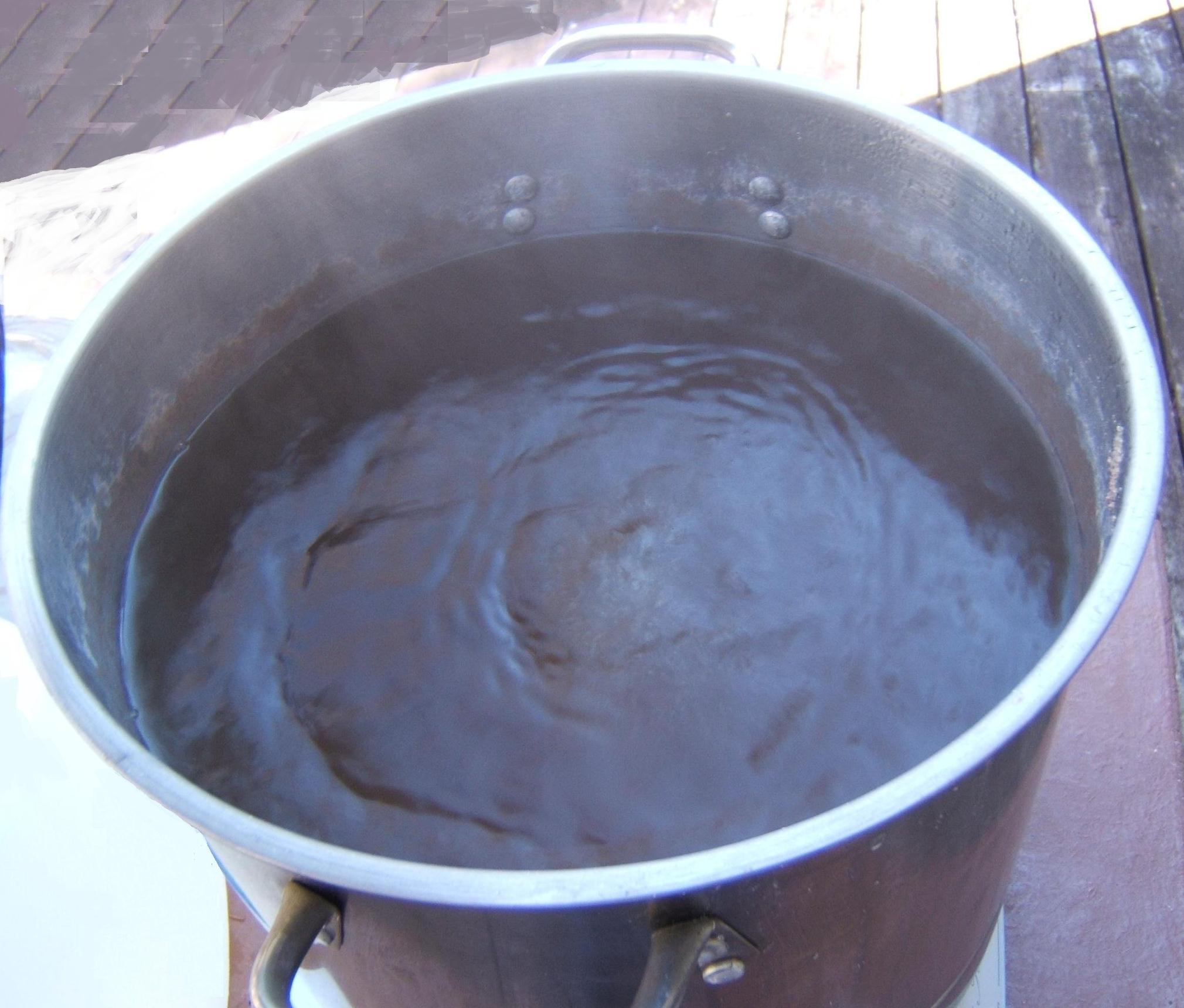
I’ll be keeping you up to date on our maple syrup adventures this year. Right now, the pot full of sap is boiling on the deck.
~
~
sugar song
~
cold nights
warm days
cold nights
~
sap plucks stainless steel
different rhythm, every tap
quick and dead slow
in sync
with the downy woodpecker
or the bird with the round warble in its throat
~
~
© Jane Tims 2012

snippets of landscape – ice falls on rock walls
When highways are built, they often cut through the bedrock, leaving rock walls along the margins of the road. If these intersect a brook or seep of water, the result is a waterfall on the face of the rock. In spring or summer, rains can create wild cataracts. In winter the water freezes, building frozen walls of blue-shadowed ice. In sunlight, especially when they begin to melt, these ice falls are dazzling.

~
~
one warm hand
~
icicles seep between
layers of rock frozen
curtains separate
inner room from winter storm
glass barrier between blue
light and sheltered eyes
memory of water flows
along the face of the rock
one warm hand melts ice
consolation, condensation
on the inward glass
~
~
© Jane Tims 2012

at the bird feeder #7 – Pine Siskin
After our heavy snow last week, the birds were all looking for perches and easy feeding. A few Chickadees and Pine Siskins were at the feeders early. Pine Siskins (Carduelis pinus) are fidgety little birds, staying at the feeder to get their fill, but ever vigilant and looking over their shoulders. They are heavily striped, sometimes with yellow bars on their wing feathers. They also have sharp beaks.
Because the Pine Siskins are striped, I confused them at first with female Purple Finches. The female Purple Finch is also striped, but is a slightly bigger, chunkier bird. Its beak is large and wedge-shaped, and it has no yellow coloration.
~

Pine Siskin at the feeder
~

female Purple Finch - wedge-shaped beak and stripes around eye (a male Purple Finch at left)
~
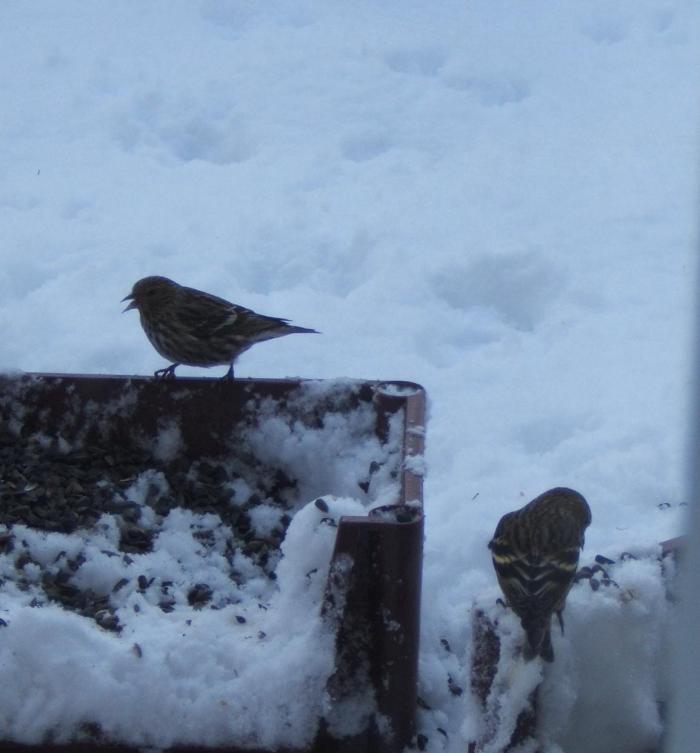
two Pine Siskins at feeder - sharp beaks and yellow wing bars

© Jane Tims 2012
snippets of landscape – the bogan
Along the St. John River are sluggish side-streams, flooded in spring to form full tributaries of the river, but isolated and stagnant in low-water conditions, sometimes completely cut off from the main river. These are known as bogans, a word of Algonquian origin. The words logan and pokelogan have a similar origin and meaning.
My favorite bogan is a strip of water next to the Trans-Canada Highway near Jemseg. The bogan creates an island, Thatch Island, in the St. John River. Old Silver Maple trees lean over the still water, creating reflections and shadows.

bogan along Thatch Island
On maps of the St. John River, a bogan on Sugar Island, just north of Fredericton, is called the Sugar Island Padou.

bogan (padou) on Sugar Island
~
~
bogan
~
appendage of river
footnote on water
predictable as the day we walked
the dead-end backroad
and retraced our steps to return
~
in spring, by canoe, at high water
or on ice skates in winter
in summer sluggish
stagnant, secluded
~
we lurk, eavesdrop on whispered
conversation
we are river folk
unwelcome
~
~
© Jane Tims 2012
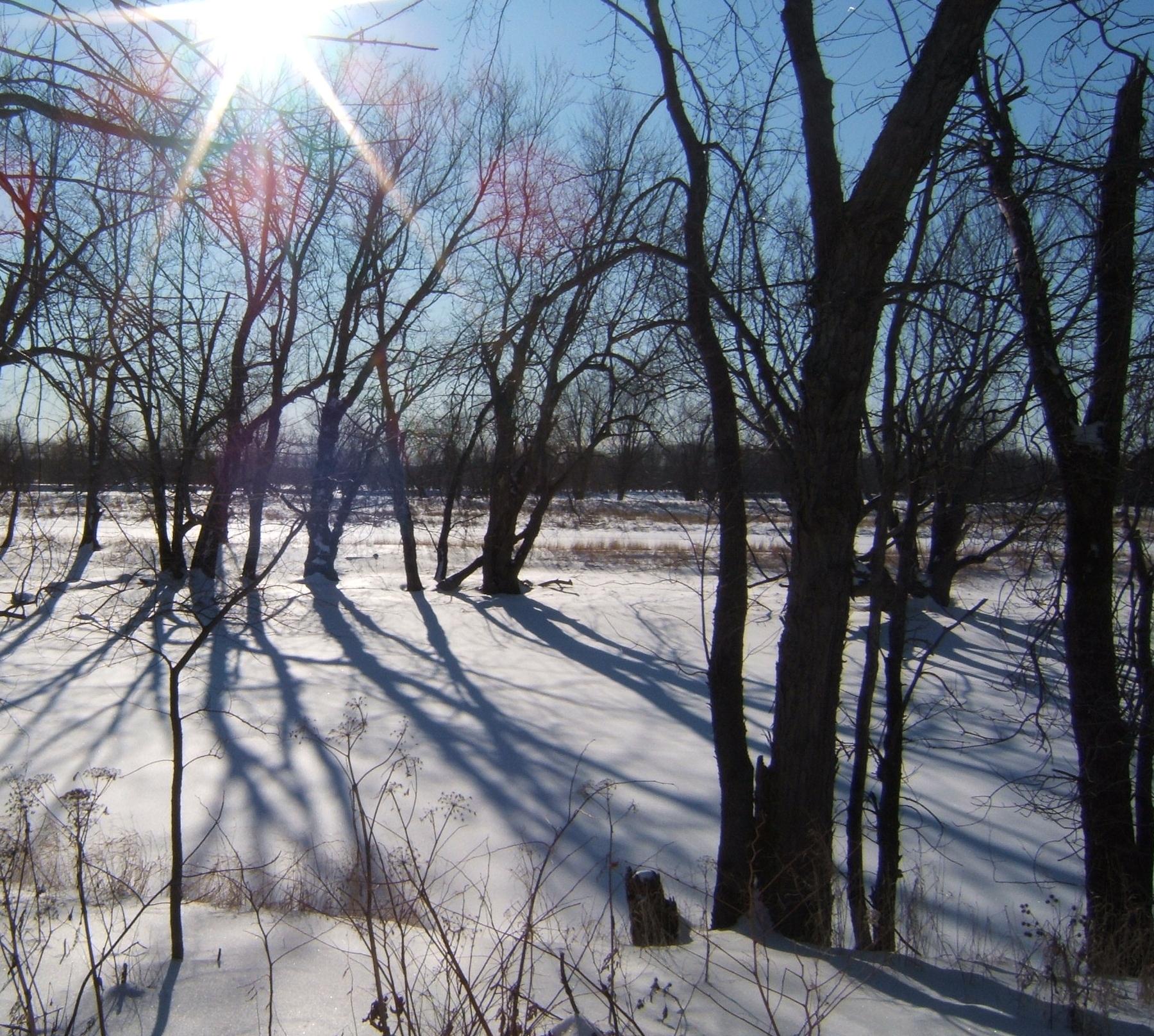
snow-bound bogan to the north of Thatch Island on the St. John River
a moment of beautiful – tracks in the snow
the space: new fallen snow
the beautiful: a Red Squirrel’s tracks
~
An expanse of new fallen snow is like an unwritten page. When you find something written there, it is a message of beauty.
In our driveway, after the last snow, a Red Squirrel was the first to write on the ‘page’. The prints were delicate, traced in blue shadows.
~

Our Red Squirrels are certainly not afraid of the snow.

digging for sunflower seeds

red squirrel with snow accumulating on his head
~
~
a love letter, unsigned
~
the meadow in winter
a sheet of paper
folded
where the stream
flows under the ice
~
the sky
an envelope
lined in blue
~
tracks on the snow
cautious
afraid
words
pressed to the page
~
erased
(erased)
by melting
or a dusting
of new snow
~
~
Published as: ‘a love letter, unsigned’, 1999, Green’s Magazine XXVII (2): 44.
Copyright Jane Tims 1999
warm room
We had another snow storm last night. In our winter climate, can anything compare with being settled in a warm room with a cup of tea, perhaps reading a good book, and listening to the storm throw handfuls of ice-pellets at the window glass?
As I write this, I know everyone is not so fortunate.

~
~
within
~
~
winter lays a cheek against the glass pecks at the window
rattles the door
~
the room is a yellow lattice on the snow a frail package
of warmth firelight a quilt the pages of a novel
kneading paws
~
field mice and ermine etch fleet trails in the thicket breathe
in the velvet space beneath the fir
~
kettle and cat are purring
~
~
© Jane Tims 2000








 nichepoetryandprose