Posts Tagged ‘nature’
heathland and heather (day 57)
~
~
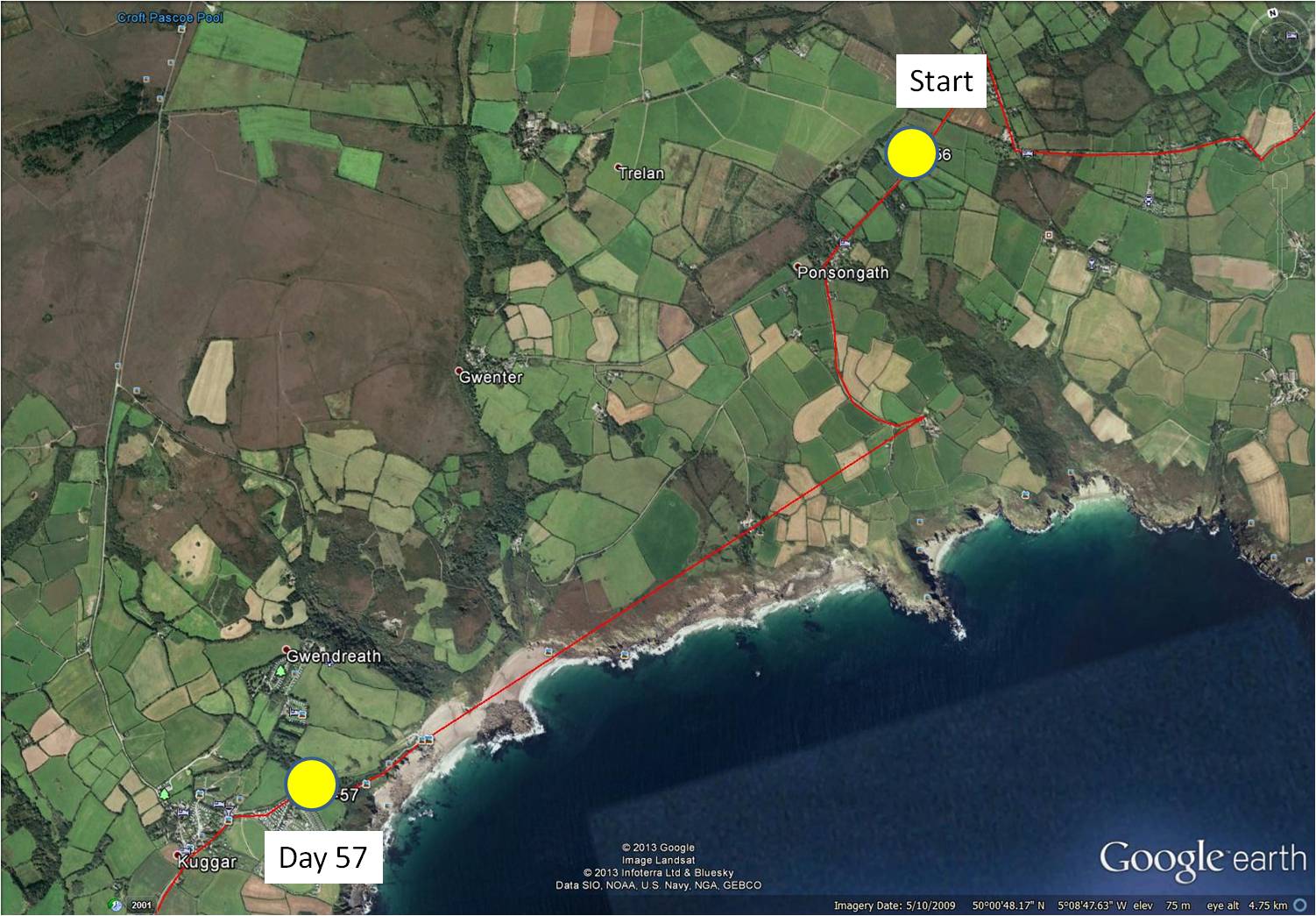
7-57 December 12, 2013 30 minutes 3.0 km (from Ponsongath to Kuggar)
~
Something different has appeared in the maps of the area where I am ‘travelling’. Today’s virtual bike trip took me just south of a large ‘brown’ area of topography (seen in the aerial photo above). To find out about this area, I turned my stationary cycle for a side trip in the direction of Gwenter, just to the north of my planned path.
~
The area I found is anything but brown (Street View images were done in July). These are the Goonhilly Downs, a raised plateau of heathlands above serpentinite rock. Besides being a Site of Special Scientific Interest and the home of many rare plants, the heathlands are the location of a large windfarm (I could just see the turbines in the distance) and the Goonhilly Satellite Earth Station (the largest in the world).
~

Goonhilly Downs … wind turbines and satellite dishes are just visible along the horizon (image from Street View)
~
From the road I could see expanses of grass, tufts of fern, and ericaceous shrubs. Patches of purple reminded me of the Rhodora that blooms here in spring. From my reading about the Cornwall heathlands, I am certain this plant must be Cornish heath (Erica vagans), a species of heather common in Cornwall. I have a small patch of heather growing in my own garden, so this plant has a spot in my heart. I first learned about heathers in our history club in high school – we took a field trip to see the heathers growing abundantly in Point Pleasant Park in Halifax. They grow there in a 3300 square meter patch, called the ‘Heather Patch’, south of the Cambridge Battery. The heathers are not native but grow there as an escape – from the stuffing in the bedrolls of British soldiers in the 1700s!
~
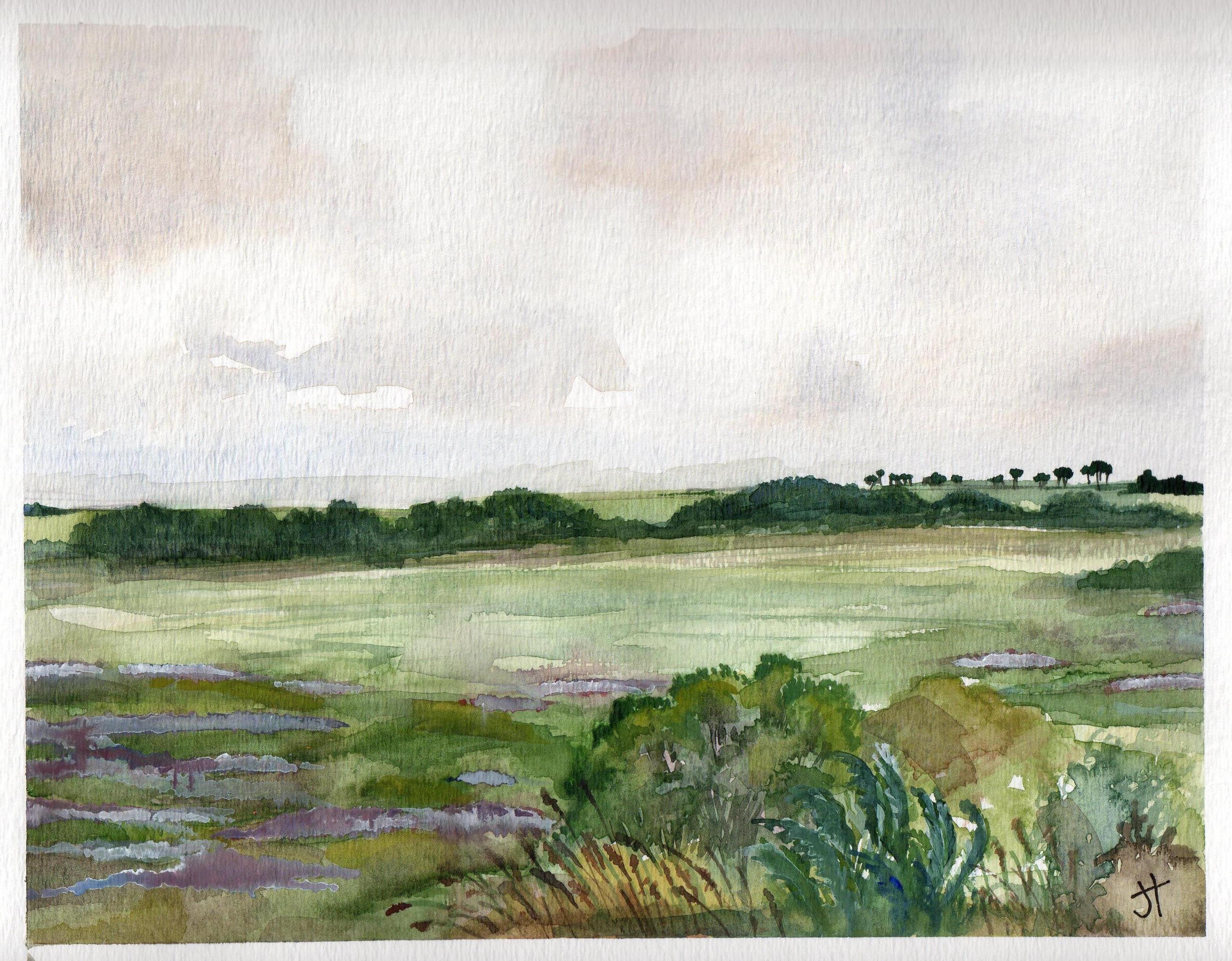
December 17, 2013 ‘Goonhilly Down’ Jane Tims
~
Copyright 2013 Jane Tims
a moment of beautiful – ice windows on woodland pools
the space: pools of water in the Grey Woods
the beautiful: patterns in the thin ice
~
While we wait for a lasting snow in New Brunswick, ice defines the season. On every pool of standing water, ice-windows have formed. I love the patterns these make against the amber-colored water! These are photos of ice windows taken last spring, after the snow had gone.


Copyright 2013 Jane Tims
a moment of beautiful – an ice lantern
the space: our living room on a winter evening
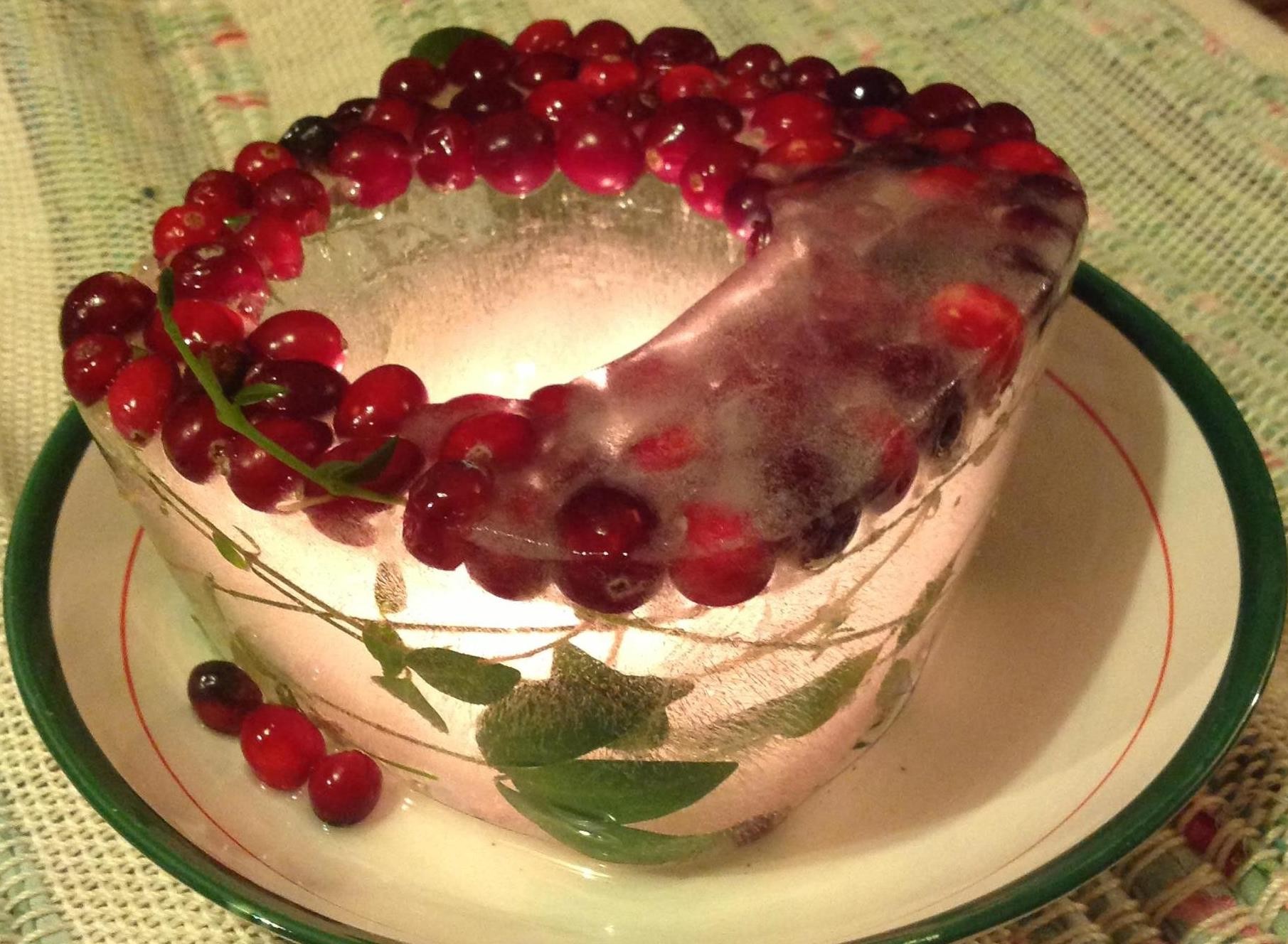
the beautiful: an ice lantern with cranberries and periwinkle vine
~
As Christmas approaches, candles are among my favorite decorations. For the past few years, I have made ice lanterns (also called ice candles).
I use a square plastic container that freezes well. In the center, I place a paper cup weighed down with rocks. Then I fill the outer ring with cranberries and greenery (this year I used the green vines of Periwinkle, Vinca minor, from our garden). Then I fill the ring with water.
This goes in the freezer, or in colder weather, out on the porch. Once the water has frozen, I put hot water in the paper cup, to free it from the ice. Then I run cold water over the outside of the bigger container to free the ice lantern. I light a tealight or flat candle and put it in the center space.
The shimmering ice lantern will last several hours. These lanterns will also last a long time outside in cold weather.
~
~
Jane Tims 2013
a closer look at trees (days 48, 49 and 50)
~
One of the natural history lessons learned during my trip to California concerned the oak. On a trip to ‘Safari West’ near Santa Rosa, our guide pointed out the scarred trunks of various trees. The bark was embedded with acorns! The Acorn Woodpecker places the acorns in holes in the bark of these trees, storing them for a later source of food. The storage trees or ‘granaries’ are used over and over through the years!
~
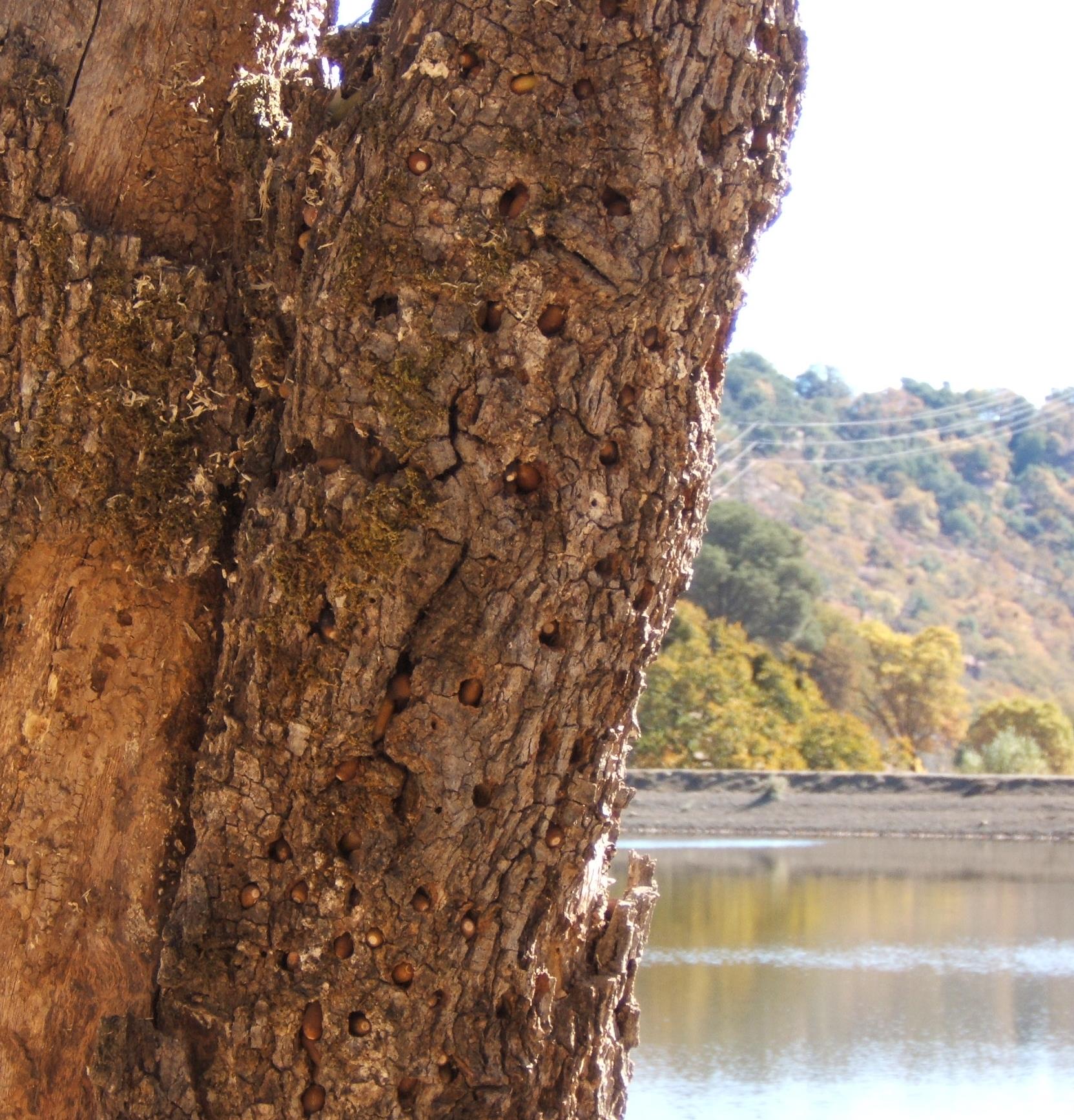
acorns planted in a ‘granary’ tree by the Acorn Woodpecker
~
Perhaps as a result of seeing so many new tree species in California, I have looked more closely at the trees I see in Street View as I cycle ‘virtually’ along the Cornwall coast. Identification is usually difficult since the images do not show details. However, occasionally a leafy branch is close enough to see the leaves clearly. So far, I have seen the Common Ash, the Field Maple, and the English Oak. In the image below, you can see the lobed leaves of the English Oak.
~
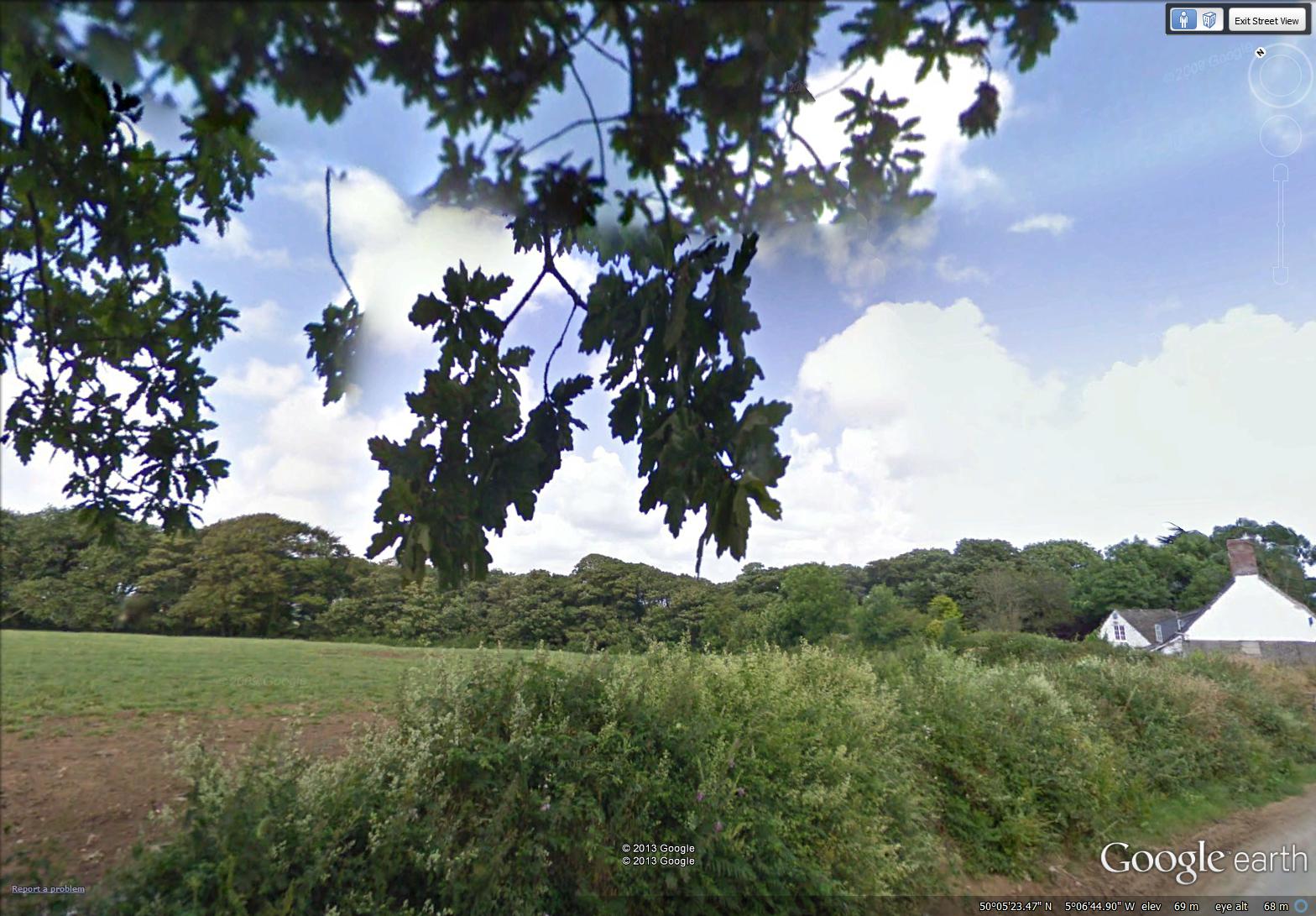
lobed leaves of an English Oak along the road to St. Anthony (image from Street View)
~

map showing distance travelled (map from Google Earth)
~
7-48 November 21, 2013 30 minutes 3.0 km (from Mawgan to St. Martin)
~

November 26, 2013 ‘oak on Fords Hill’ Jane Tims
~
7-49 November 23, 2013 35 minutes 3.0 km (from St. Martin to Helford)
~
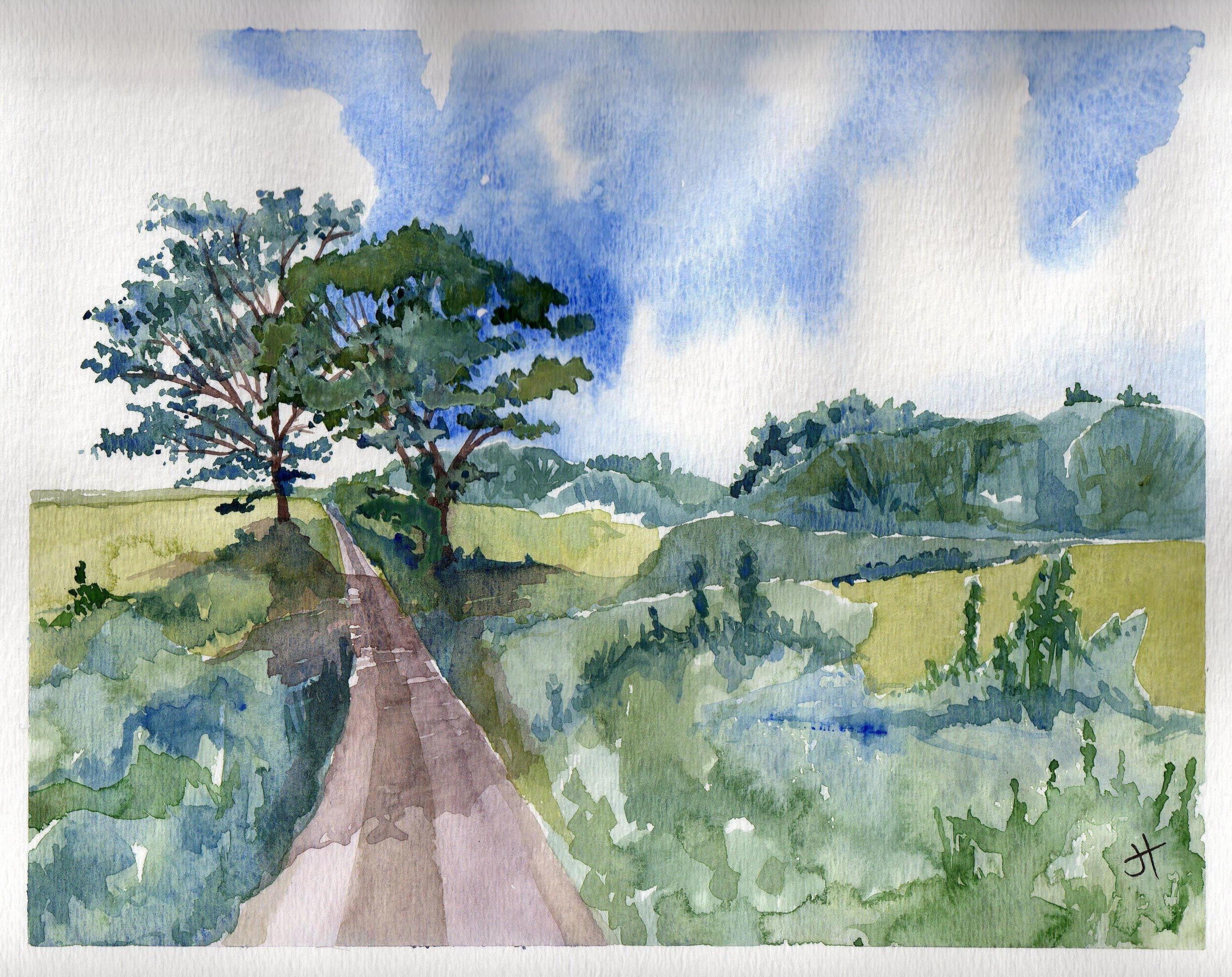
November 26, 2013 ‘maple and oak near Helford’ Jane Tims
~
7-50 November 25, 2013 30 minutes 3.0 km (from Helford to St. Anthony-in-Meneage)
~
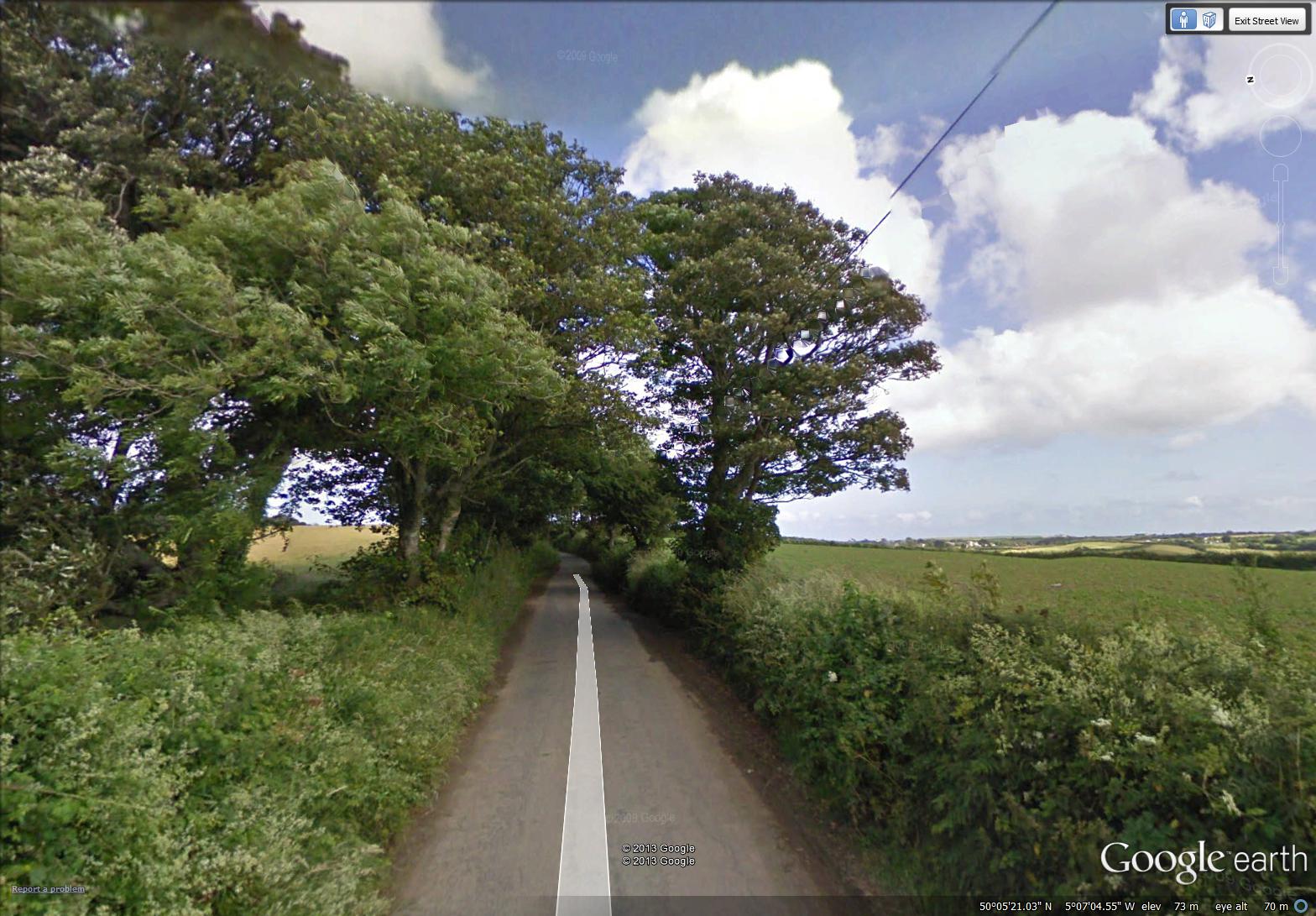
Oak and Ash along the road to St. Anthony (image from Street View)
~
Copyright 2013 Jane Tims
the colour of September #5 – red rose hips from pink roses
I have the funniest rose bush in my front yard.
~
It bore double yellow roses for the first few years of its life. Then, in recent years it has become a pink rose, with the frailest pink petals.
~
I know how this happened – not ‘alchemy’ at all, but an example of survival of the fittest. The original yellow rose must have been grafted to the root stock of a common rose. When the yellow rose stem died for some reason, the pink rose stock flourished. I love my frail pink roses , especially at this time of year when they produce bright red, elliptical rose hips.
~

September 22, 2013 ‘red rose hips from pink roses’ Jane Tims
~
Copyright 2013 Jane Tims
forested dunes 6-12
~
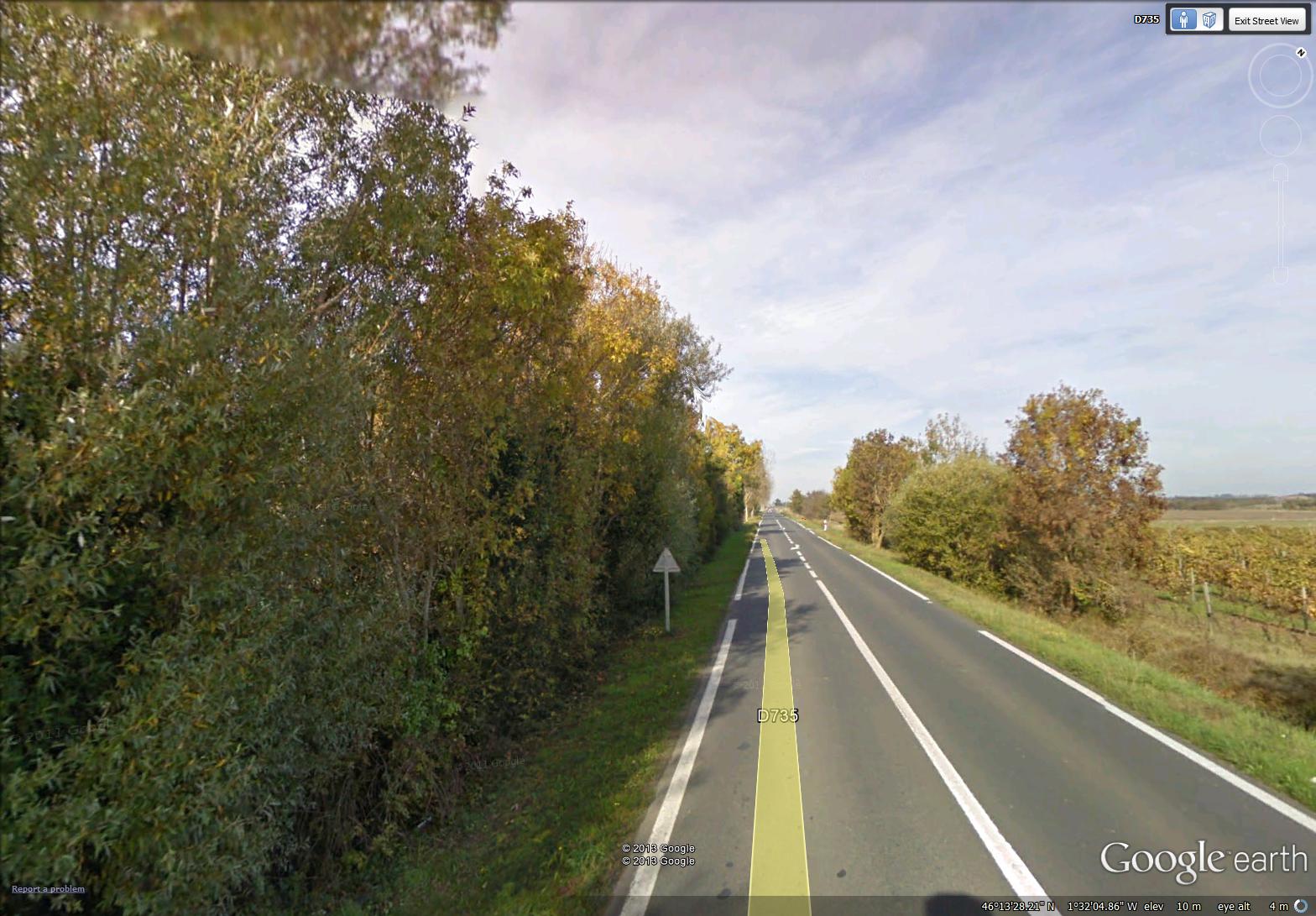
long empty roads (image from Street View)
~

~

~
My virtual bike trip on day 12 of Phase 6 took me along a very uninteresting length of highway. Other, more interesting roads showed on the map, but Street View just didn’t go there. The houses along the way were screened by long stretches of walls …
~

miles of walls (image from Street View)
~
Sometimes the walls were covered in graffiti …
~

miles of graffiti-covered walls (image from Street View)
~
When I turned to travel along the beach, the first house I saw was a charming cottage named ‘Solitude’ …
~
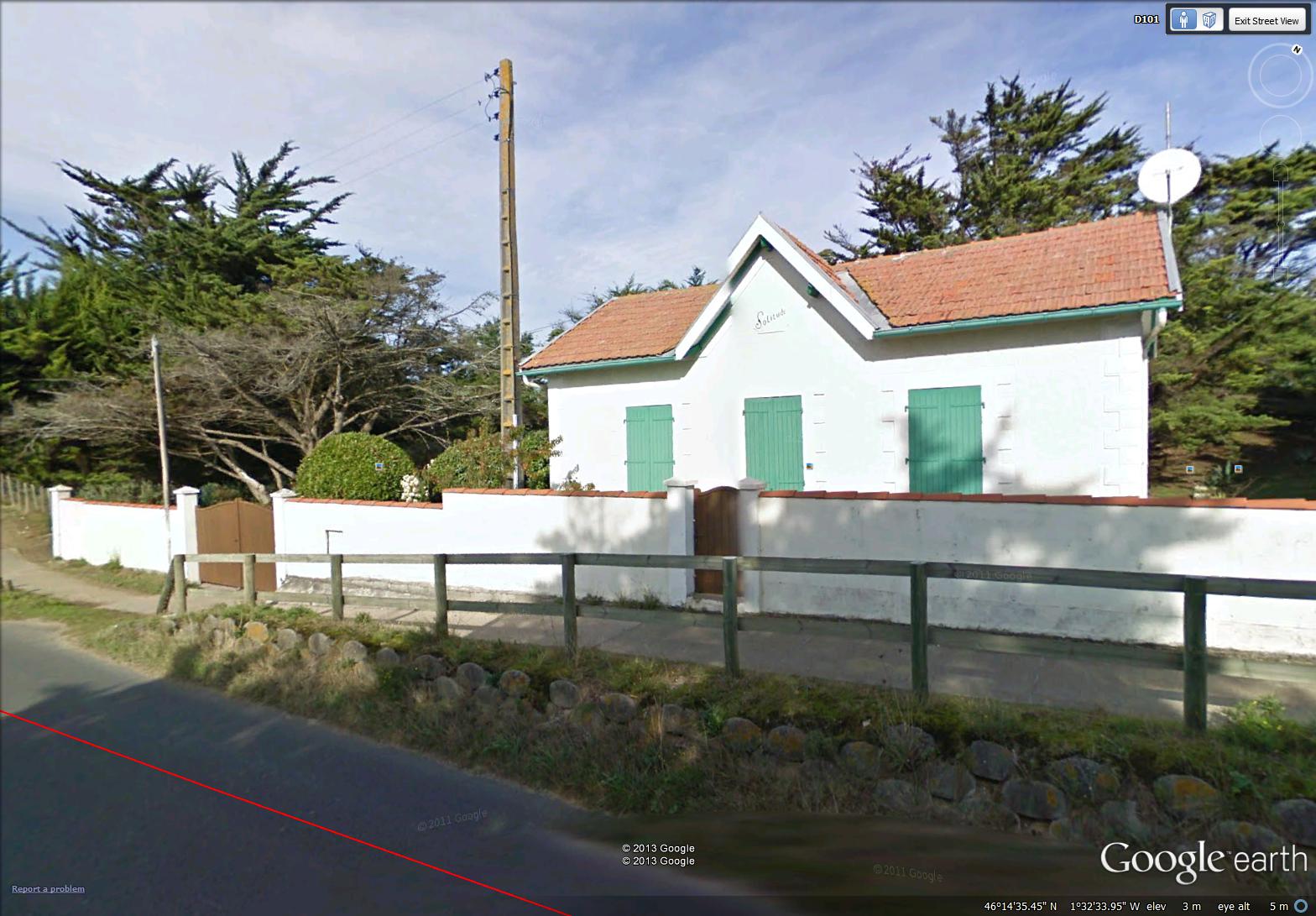
cozy cottage named Solitude (image from Street View)
~
The rest of the route along the beach was obscured by trees. Although it meant I couldn’t see the beach, a forested dune is actually an environmental goal. There is lots of evidence that the eventual natural state of a dune is forest. In New Brunswick, we have only three forested dunes. Usually erosion of the grassed dune occurs long before forest is able to establish itself …
~

forested dune along the north shore of Ile de Ré (image from Street View)
~
Best View: a view across the salt marsh ponds near Le Gillieux ….
~

June 25, 2013 ‘salt marsh on Ile de Re’ Jane Tims
~
Copyright Jane Tims 2013
seaweed for gardens and vines for trees 6-11
~
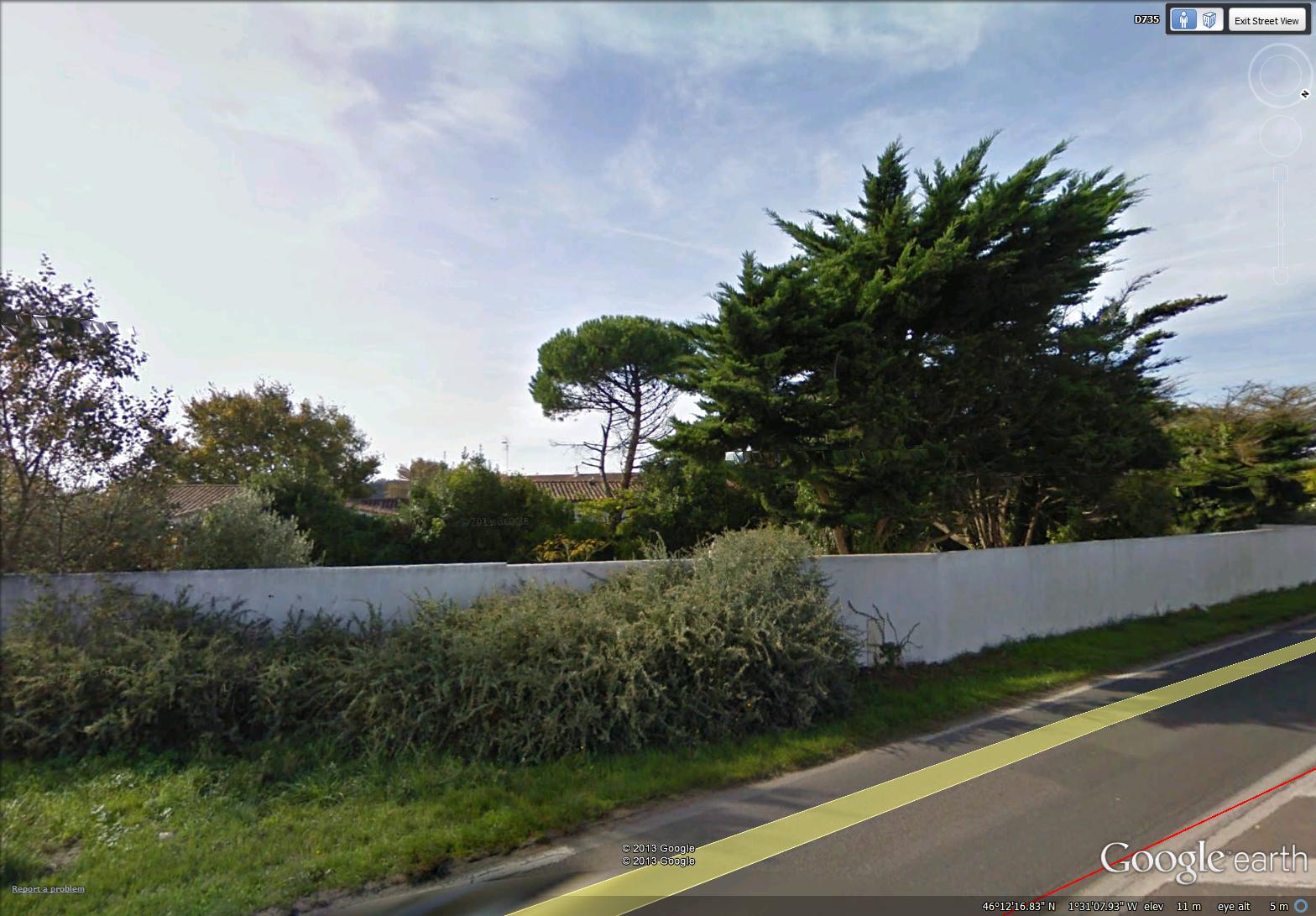
greenery in a walled yard (image from Street View)
~

~

map showing distance travelled (map from Google Earth)
~
I am nearing the end of Phase 6 of my virtual cycling trip through central France, but I am seeing so many interesting things, it is hard to look forward to the end. Today I saw a man digging seaweed into his garden. He had spread the seaweed uniformly across his garden and was slowly digging it into the soil …
~

man digging seaweed into the garden (image from Street View)
~
I am interested in gardening, so of course, I stopped to talk …
Jane: Bonjour. ‘Qu-est-ce que vous ajoutez au jardin???’ (‘Hello! What is it you are digging into your garden?’)
Gardener: ‘Bonjour. Ce sont des algues marines! Il sont très bon pour le sol.’ (‘Hello. I am adding seaweed. It is very good for the soil.’)
Jane: ‘Bon pour le sol? C’est vrai?’ (‘Good for the soil. Is that true?’)
Gardener: ‘Mais oui! Ils ajoutent la nourriture et les matières organiques aux sol!’ (‘Of course! They add nutrients and organic matter to the soil!’)
Jane: ‘D’où est-ce que vous avez obtainer ces algues marines?’ (‘Where did you get the seaweed?’)
Gardener: ‘Ah, juste à côté de l’ocean! Ils ne coûtent rien!’ (‘Ah, just by the ocean!’ It’s free!!!’)
~
Using seaweed on gardens is common on this side of the Atlantic Ocean also. For example, in his book Vineyard Chill (Scribner, New York, 2008), Phillip R. Craig opened his mystery novel with a family going to the beach to gather seaweed for their garden on Martha’s Vineyard.
~
There was lots of evidence of gardening and green thumbs on this part of my bike drive across Ile de Ré …

greenhouses on Ile de Ré (image from Street View)
~
Best View: old trees, their trunks covered with vines (I loved doing this watercolor so much, I tried three versions) …
~
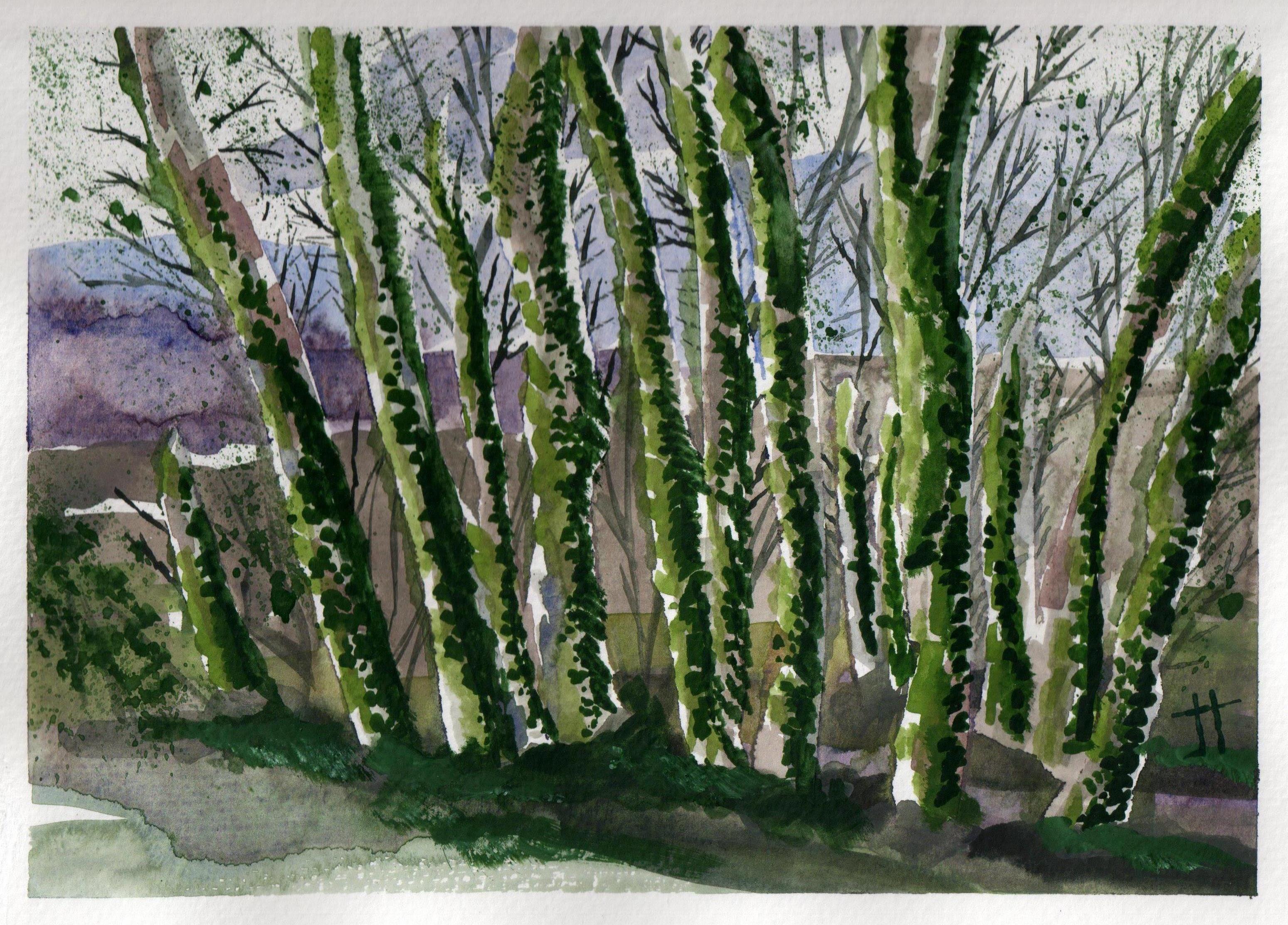
June 17, 2013 ‘vine-covered trees #1’ Jane Tims
~

June 17, 2013 ‘vine-covered trees #2’ Jane Tims
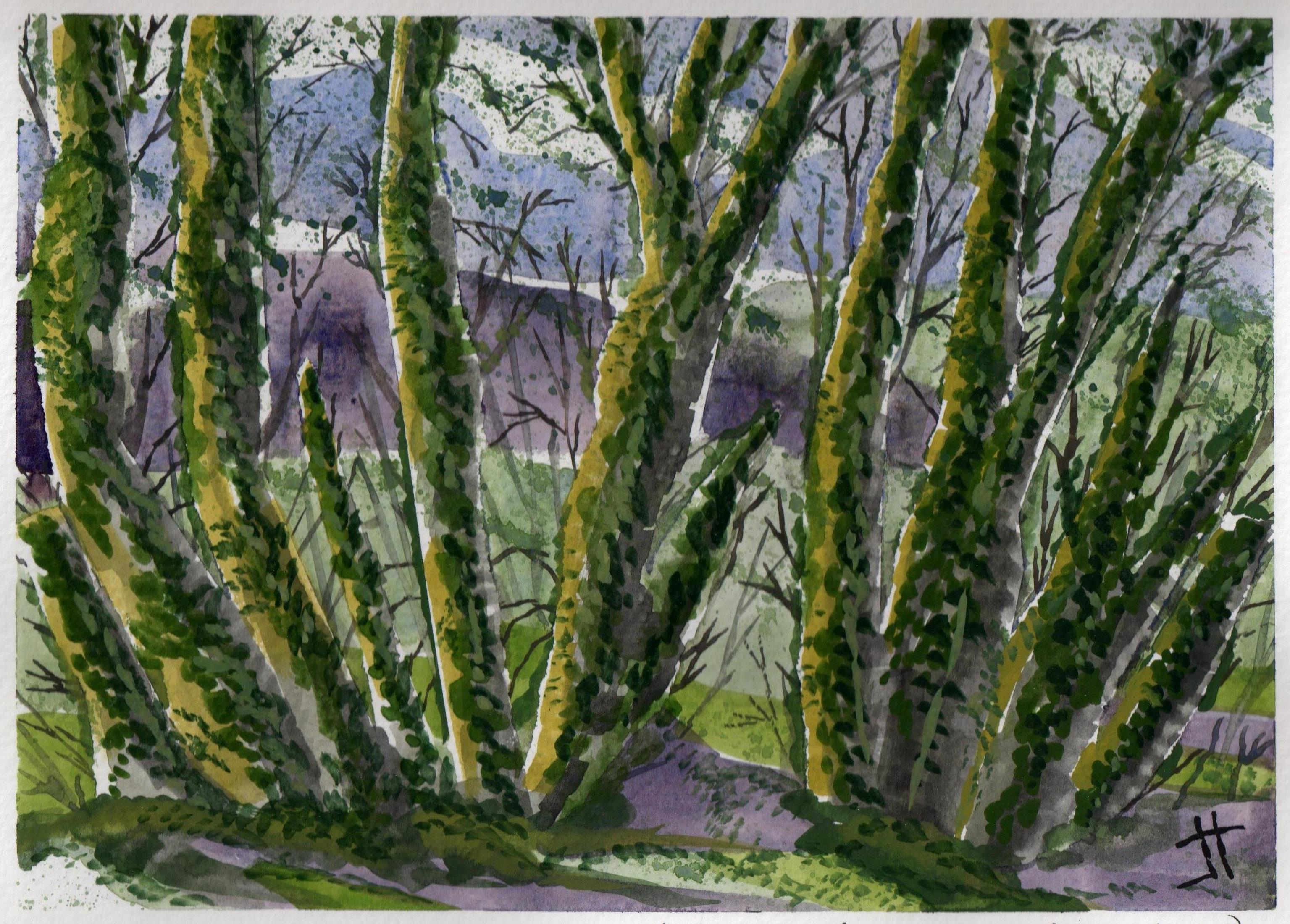
June 18, 2013 ‘vine-covered trees #3’ Jane Tims
~
This is the view that inspired the paintings …
~

vine-covered trees (image from Street View)
~
Copyright Jane Tims 2013
side roads 6-9
~
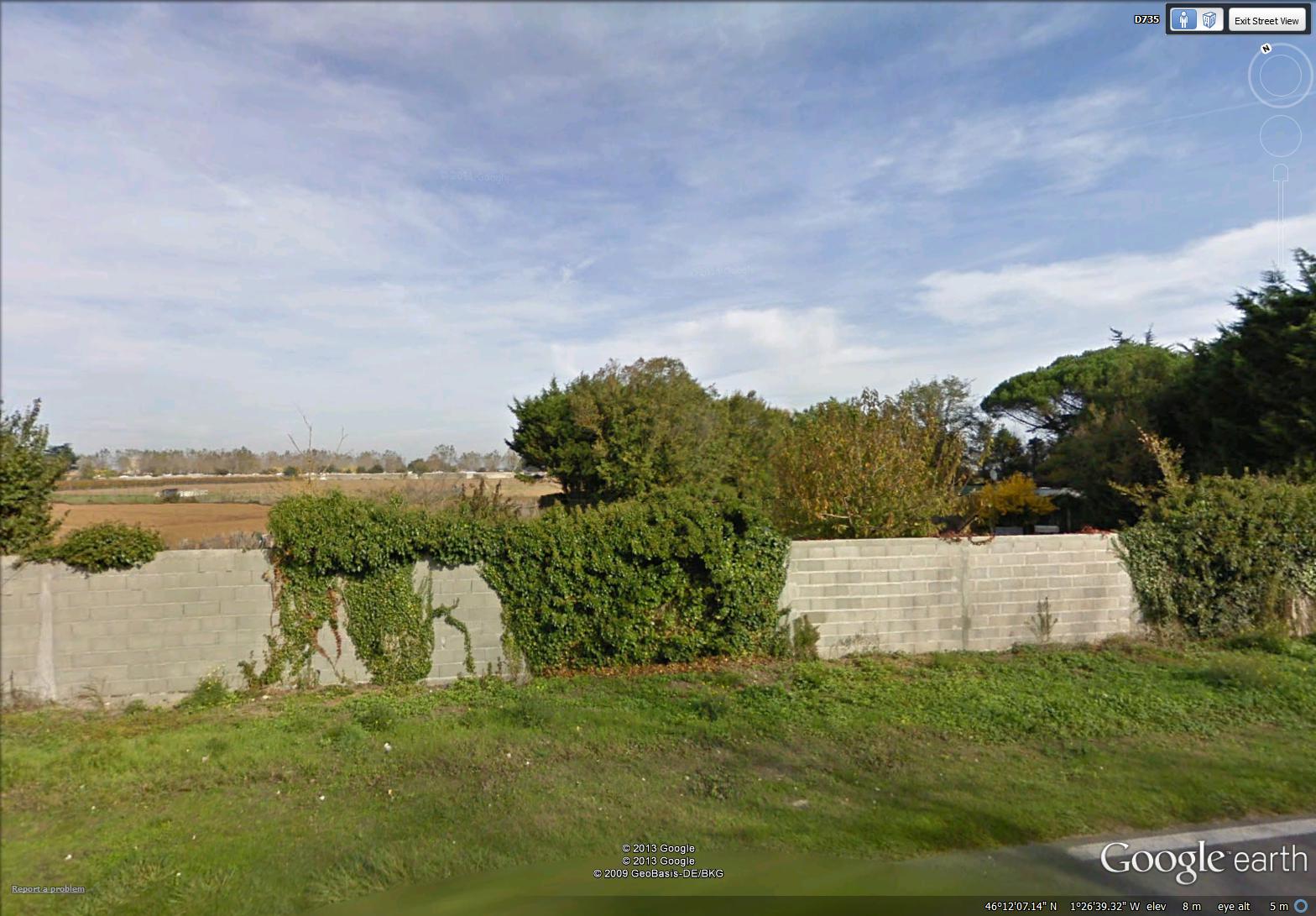
vines on a wall near La Prises (image from Street View)
~

~
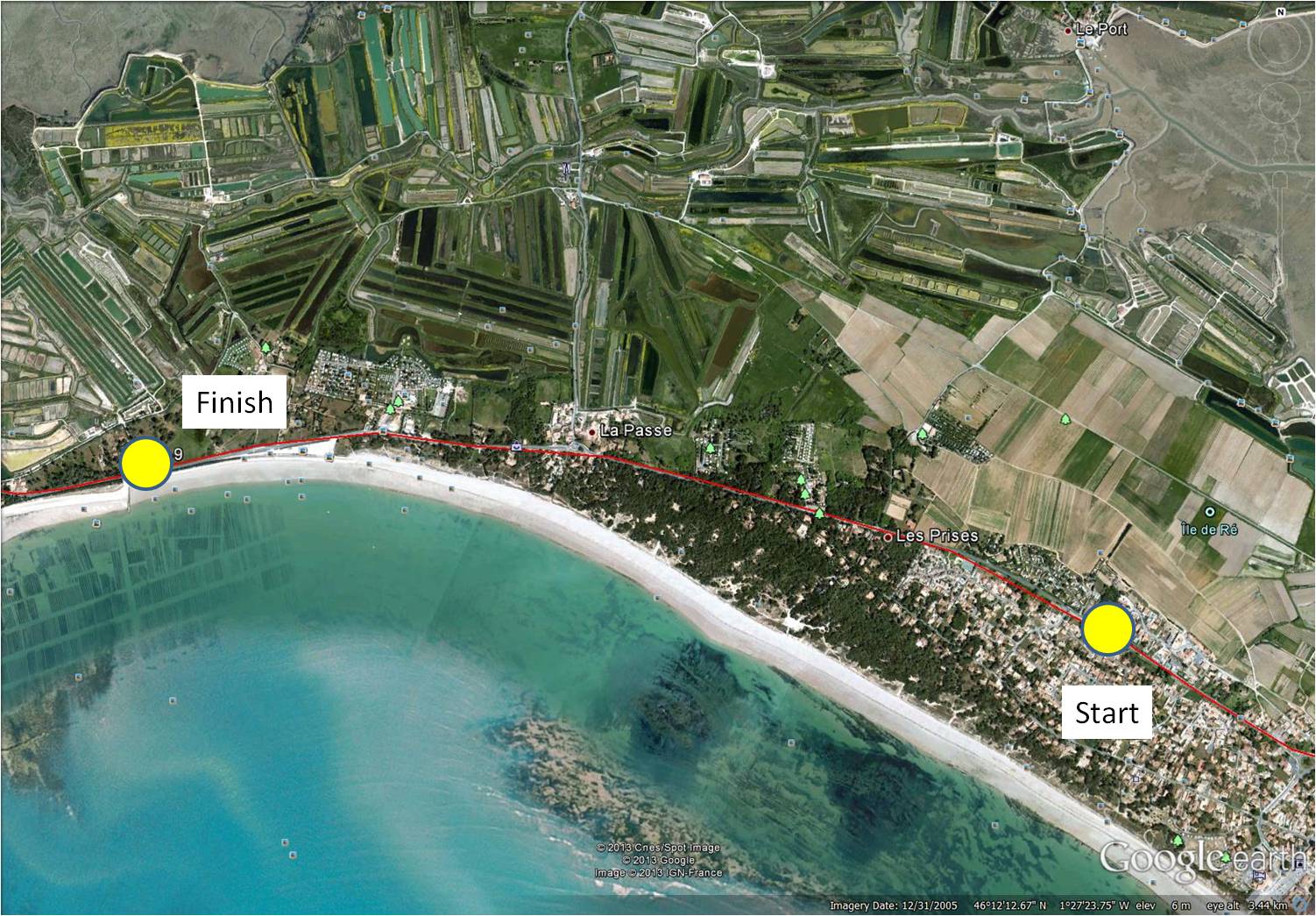
map showing distance travelled (map from Google Earth)
~
Any time we go for a drive in the countryside, I always wonder where the side roads lead. It is the same on my virtual bike trip in France. One of the limitations of virtual travel is that I cannot just get off my bike and walk down an interesting side road.
Sometimes Street View gives a very good idea of what I would find if I walked down one of those roads. Perhaps a mansion and beautifully kept grounds …
~

beautiful grounds (image from Street View)
~
Sometimes the way is mysterious and I can only imagine what must lie beyond the view …
~
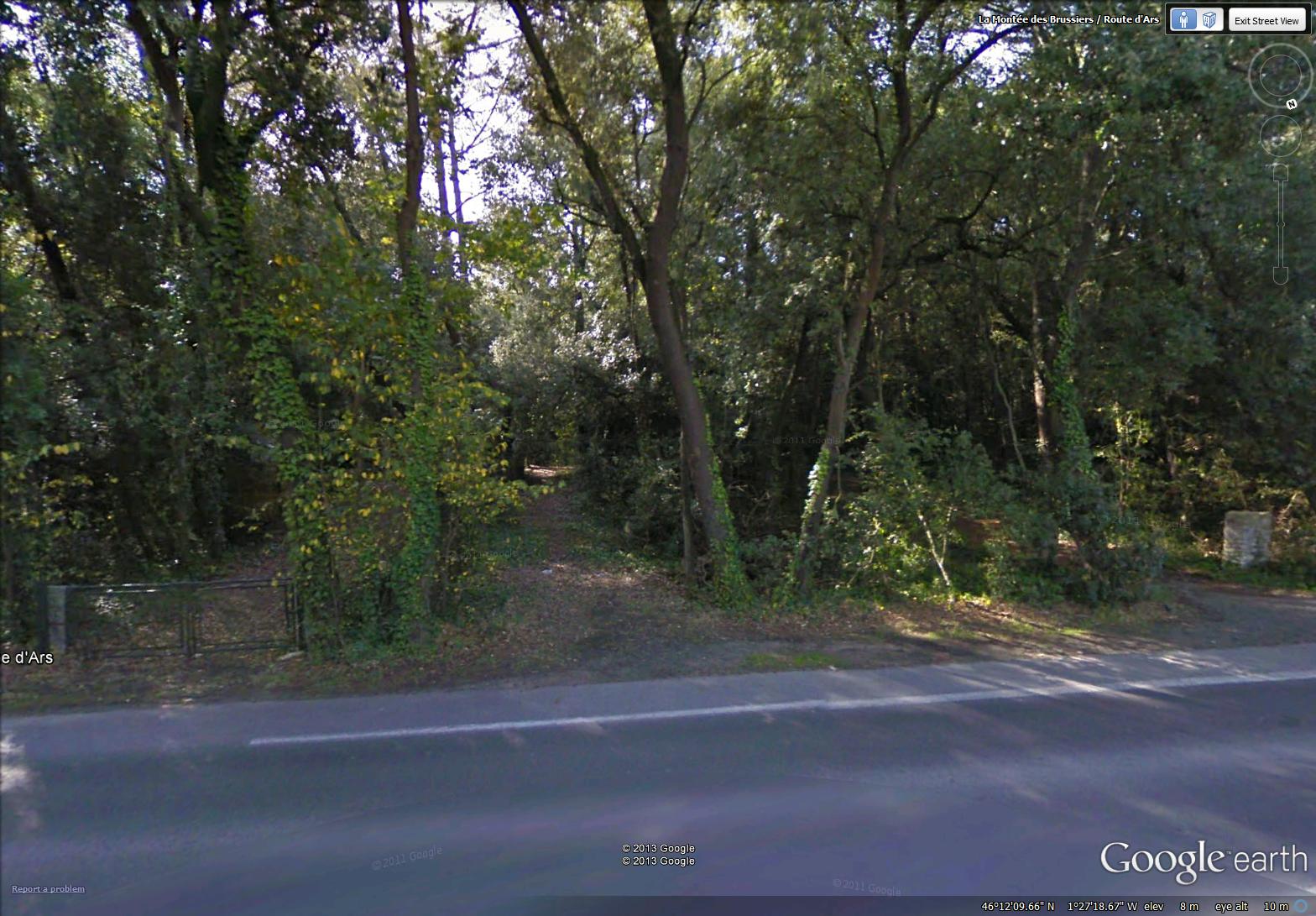
two side roads, side by side (image from Street View)
~
Sometimes there is just a glimpse of a yard or a house …
~

I wonder what lies beyond the white gate (image from Street View)
~
Sometimes I know that beyond my view is a broad beach of white sand and the sound of the ocean …
~
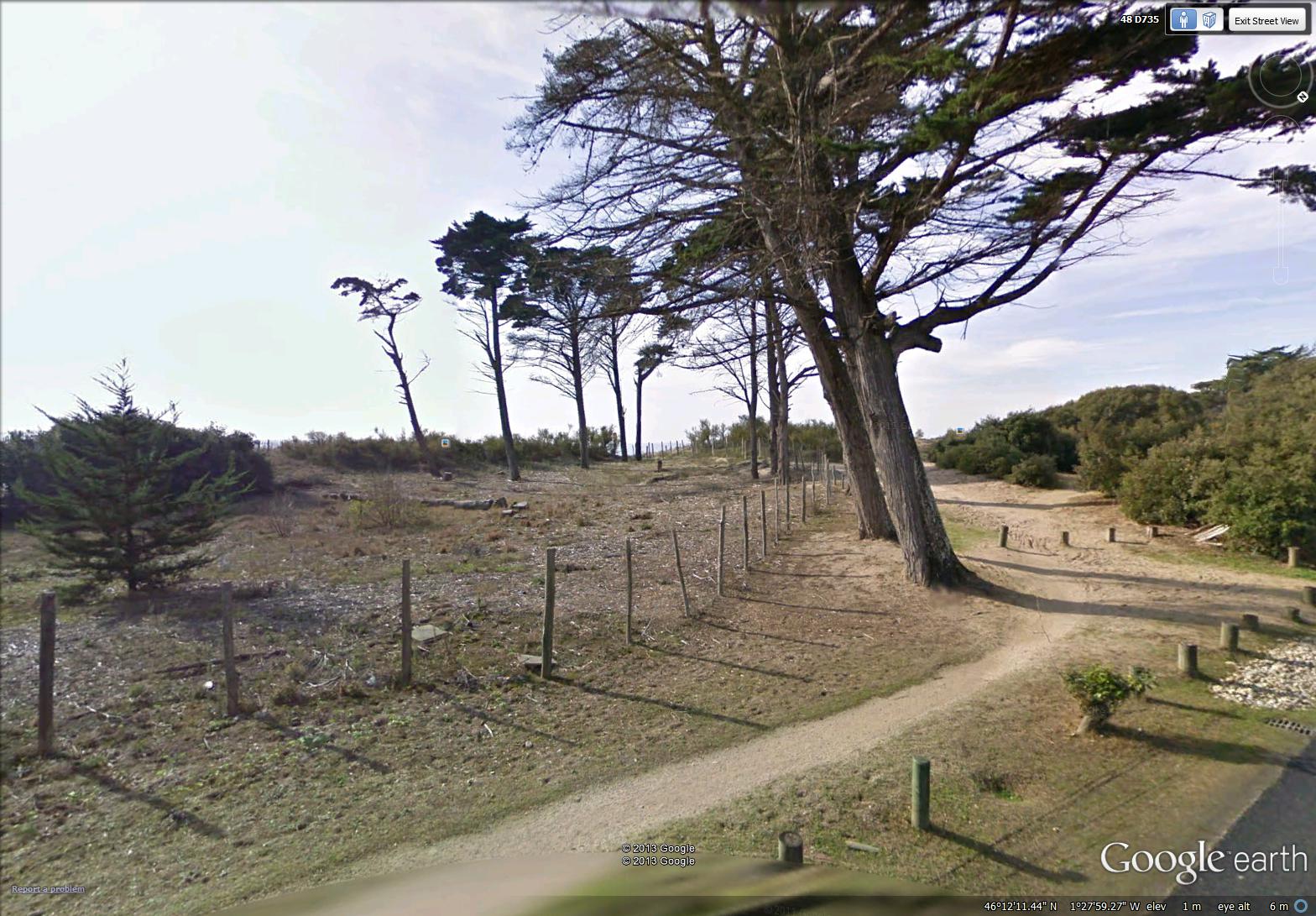
access to the sea near La Passe (image from Street View)
~
Best View: side road behind a white gate …
~

June 13, 2013 ‘road beyond the gate’ Jane Tims
~
Copyright Jane Tims 2013
a moment of beautiful – through a stained glass window
the space: the big maple outside our front door
the beautiful: seeing a squirrel in the tree through the stained glass window in our stairwell
~
As I was working at my desk, my husband called to me. Through our stained glass window, he could see a silhouette of our grey squirrel. I’m glad the squirrel waited long enough for me to snap his picture!

Can you see the squirrel through the stained glass?
© Jane Tims 2013
messages on a still winter day
 ~
~
intentions
~
snow, crystal-quiet
a sluggish breeze
riffles the woodland
sunrise lost in a rose sky
~
listen to the rustle
of paper on wood
the mutter of unwritten lines
birch-bark, deckle-edged
~
tatters and shreds
sorted by a sluggish wind
words I meant to write
letters ready for the mail
~
misplaced
behind parcels
wait for postage
brown paper and string
~
~
~

Copyright Jane Tims 2013







 nichepoetryandprose