along Looe Hill 7-7

stairs along Looe Hill (image from Street View)
~

~
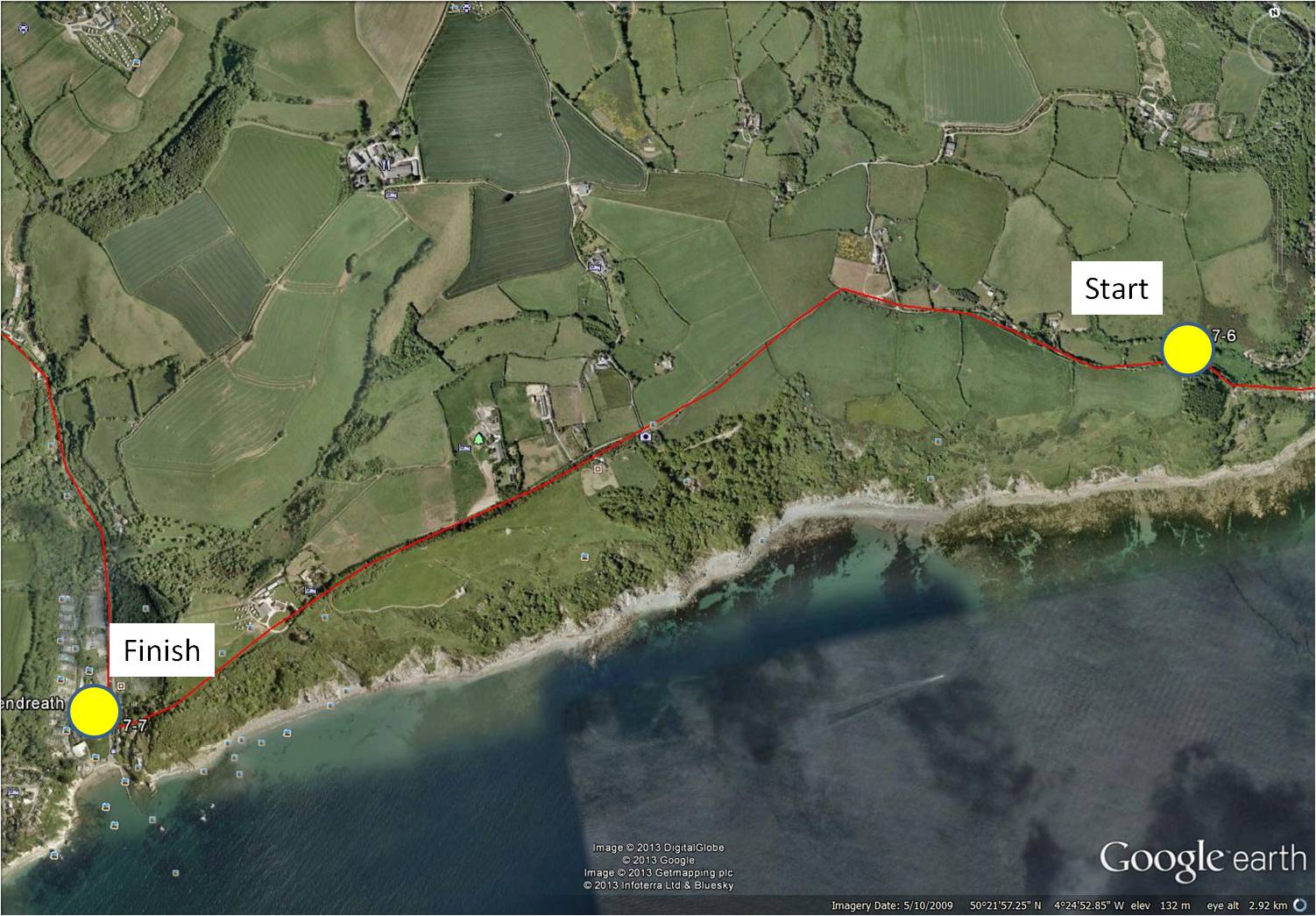
map showing distance travelled (map from Google Earth)
~
Looe Hill (pronounced to rhyme with ‘who’) is probably the most magical, interesting place I have discovered so far on my virtual journey. Much of the length of the road is a narrow path between high banks. The overhanging trees must create a microclimate where wildflowers and ferns thrive …
~

ferns and flowers on the road banks of Looe Hill (image from Street View)
~
More open sections of the road show the steep terrain …
~

Gorse on Looe Hill (image from Street View)
~
Best View: leafy tunnel on Looe Hill … I like this watercolor, especially the ferns, done using a dry brush to pull color from the fern shape, and the way the light varies across the painting …
~

July 10, 2013 ‘Looe Hill’ Jane Tims
~
This image provided the inspiration …
~

road on Looe Hill (image from Street View)
~
Another magical view was of ‘caves’ created by the overhanging vines. I made two attempts at this … the first was a disaster. I like the second attempt (below) but it fails to capture the ‘caveness’ of the view. I like the vines, done by dipping the head of a carved eraser in the paint !!!
~

~
This is the inspiration for the painting …
~
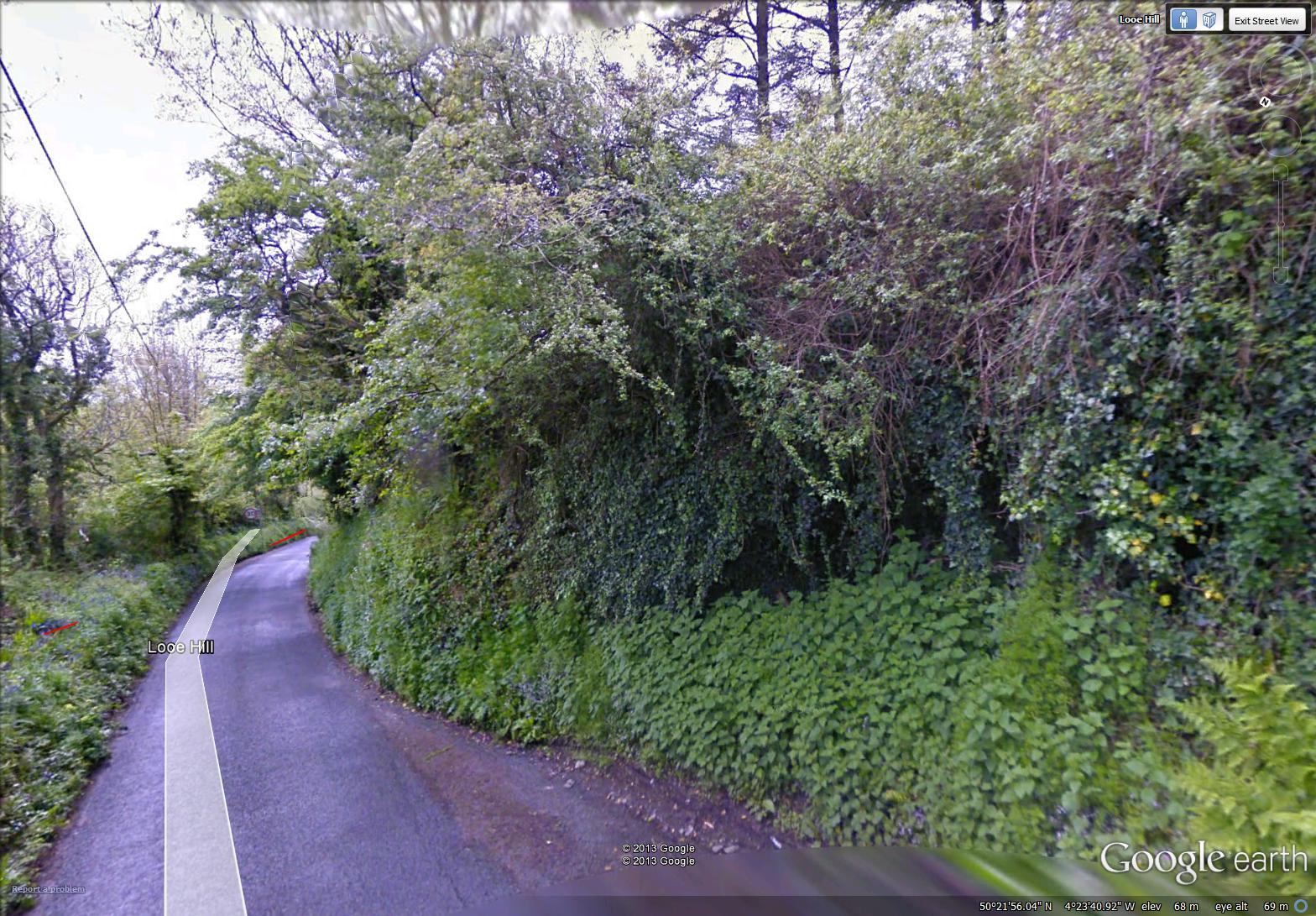
vine ‘caves’ on Looe Hill (image from Street View)
~
Copyright 2013 Jane Tims
writing a novel – objects and symbols
~
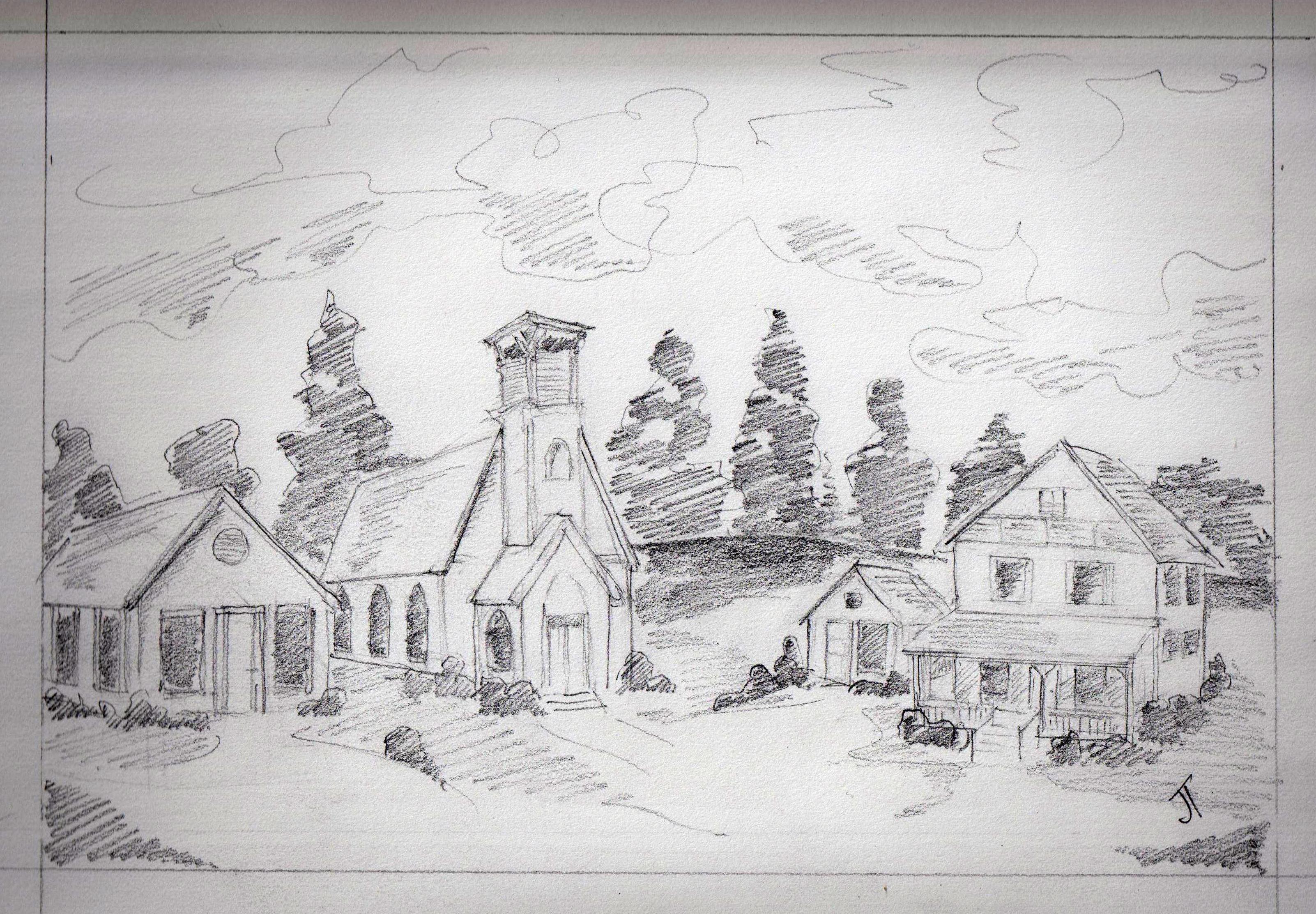
Title: unknown
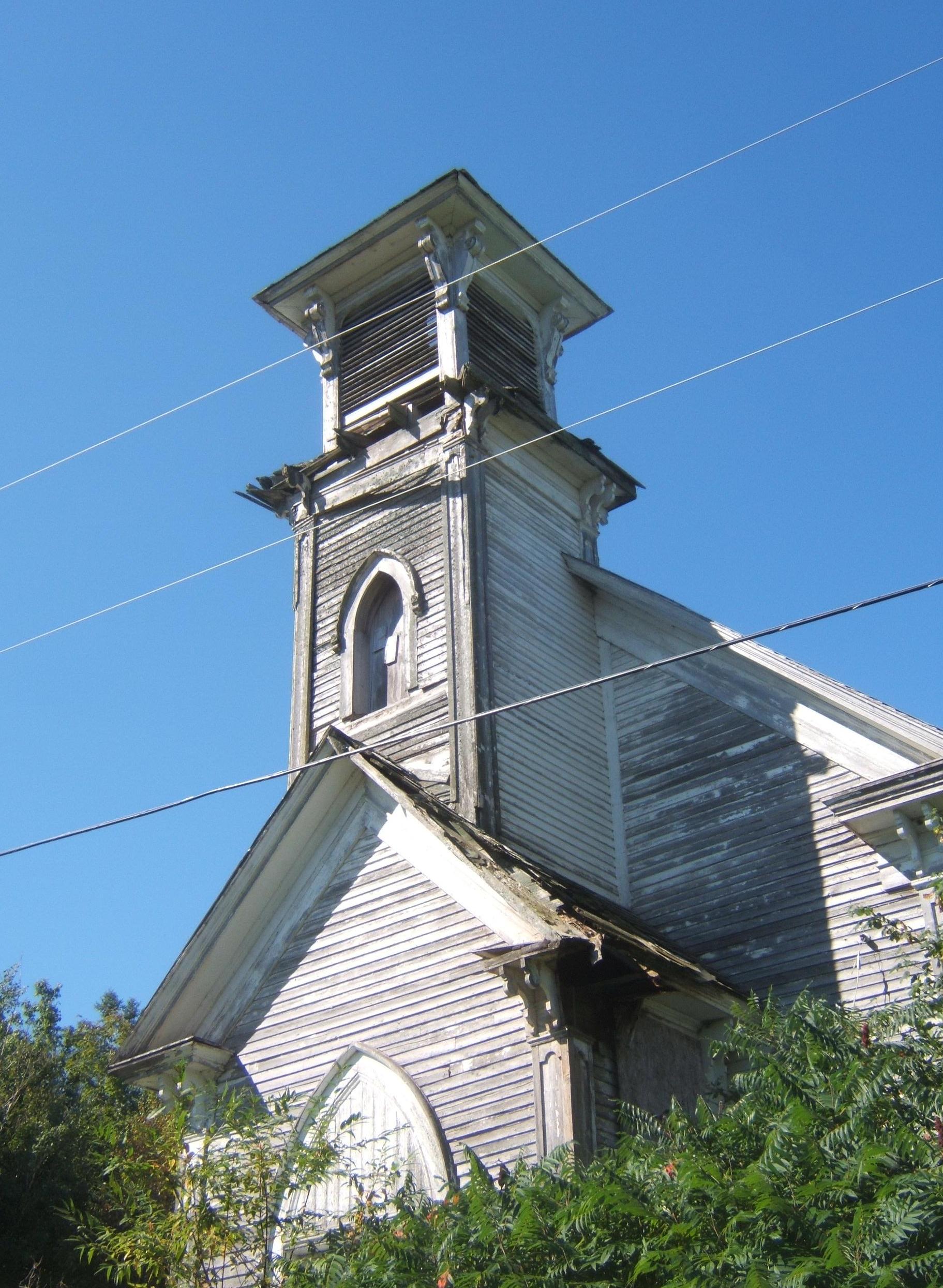
Working Title: Saving the Landing Church
Setting: a writers’ retreat, including an abandoned church
Characters: main character Sadie, a writer; her husband Tom; people from the community
Plot: the story of how Sadie tries to win over a community in order to preserve an abandoned church
~
If you are new to following my Blog, you may not know I have been writing a novel since last November. If you have followed my Blog for some time, you may be wondering if I have abandoned my novel for the world of watercolor painting – not so.
~
~
I am on Draft Six. I have taken the comments of my readers and members of my writing groups to heart, considered them carefully and made many revisions in the Fifth and Sixth Drafts. I have also paid careful attention to three workshops I attended on writing fiction.
~
One of these workshops was exceptionally thought provoking, teaching me to look at elements of my book in a new way.
~
Our instructor at this course suggested we pay particular attention to the objects mentioned in our writing. Mentioned once, an object, such as a table, is just a table. Mentioned twice, it becomes a symbol, and the reader remembers the first mention of the object and draws understanding from the symbolism. So a table may be remembered for the people siting at it and the subject of their conversation. Perhaps it becomes a symbol for family, for example. If, in the second mention, someone breaks the table by putting too much weight on it, this may make a comment on the idea of family in the story. By breaking the table, the family may be damaged or broken. The use of symbols deepens meanings and helps the plot reverberate throughout the writing.
~
The instructor also said that symbols operate like mini sub-plots throughout the story. These mini-plots echo the main plot, and the objects change in a way that illuminates the main plot. The mini-plots also tend to occur in three ‘beats’, providing a beginning, middle and end. For example, the table is bought at an auction, broken and finally mended.
~
In this round of edits, I have tried to examine the use of symbols in my novel. To do this, I built a list of the objects I have used as symbols. Then I looked for their occurrence in the novel to see if I could identify three ‘beats’ and a mini sub-plot. In some cases, I identified gaps – fixing these has helped me to solidify my overall plot and improve the understanding of my readers.
~

a lych gate is one of the objects I use as a symbol in my novel
~
This is a short version of my list of some of the objects/symbols in my book. When I assembled the list, the items in red were missing and I had to fill out the story accordingly. Perhaps you can use this method to help strengthen the narrative in your own fiction.
~
| Object | Symbolism | Occurrence (Chapter Numbers) | Mini-plot | ||
| long bench | togetherness | 11 | 21 | 23 | bench moves from private to communal space; people start working together |
| stained glass | relationship between sacred and secular | 1 | 9 | 23 | stained glass window breaks and is repurposed; the sacred becomes the secular |
| lych gate | death | 1 | 9 | 20 | lych gate falls into decay; fear of death is no longer the driving factor in a family |
| red shoes | respect | 1 | 9 | 21 | community’s view of main character is altered |
| minister’s collar | mentorship | 1 | 15 | 21 | although he leaves the church, a minister grows as mentor to a family and the community |
| blue plastic truck | secular within the sacred | 3 | 11 | 21 | a plastic toy becomes an object worthy of protection; the secular becomes the sacred |
| Jasper the dog | companionship | 8 | 16 | 19 | a new dog helps build a family |
| air fern in a swan vase | ability to change (a sea-creature poses as a fern) | 3 | 8 | 23 | something unwanted becomes valuable |
~
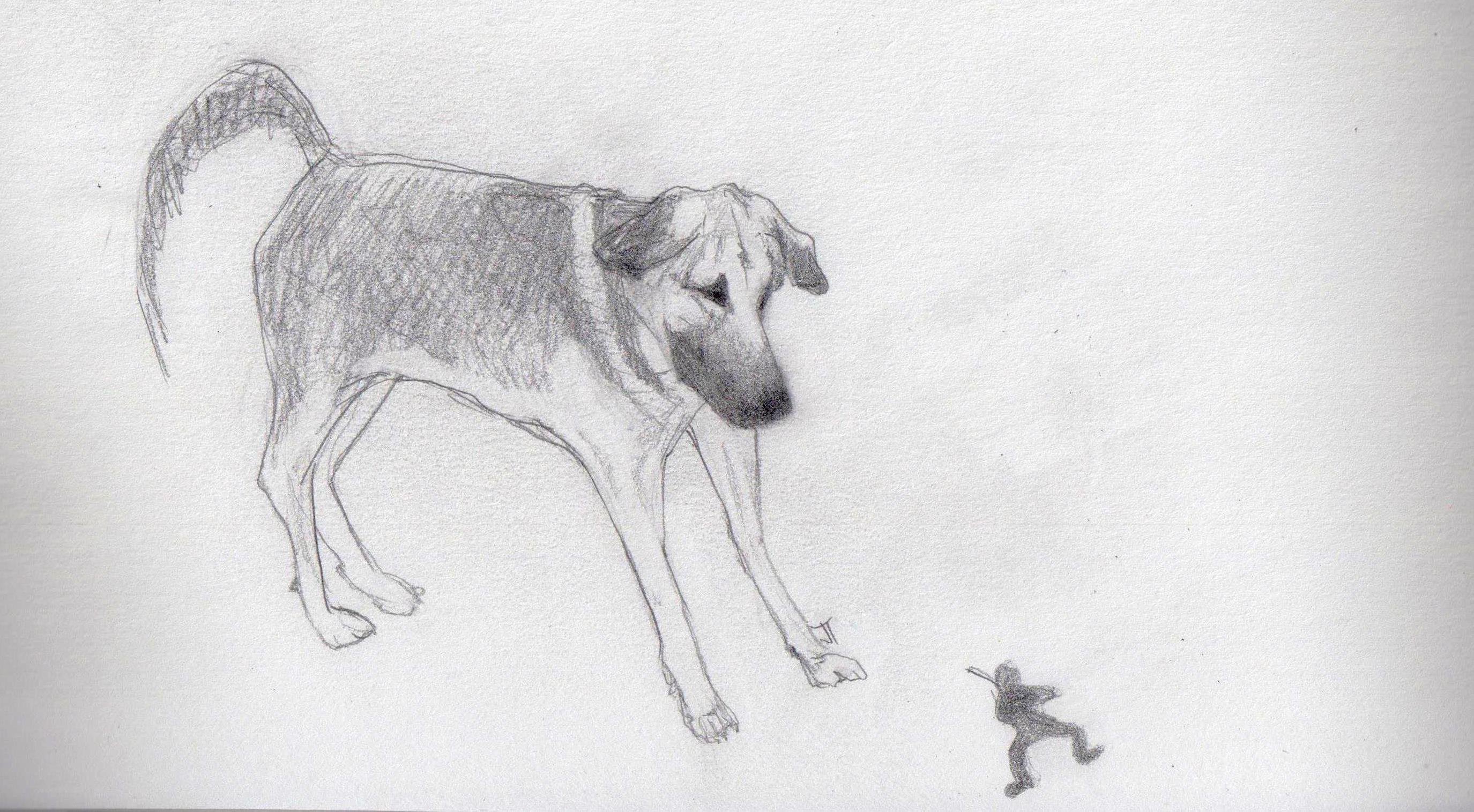
Jasper the dog was a late addition to my novel, but he opened up so many story possibilities, I’m glad he came to be one of the characters
~
Each time I add something new to the narrative, I have to make other edits in consequence. However, I find these changes are worth the effort since they contribute to building the story.
~
Have you considered the use of objects as symbols in your writing?
~
Copyright 2013 Jane Tims
Downderry by the sea 7-6

my first view of Downderry (image from Street View)
~

~
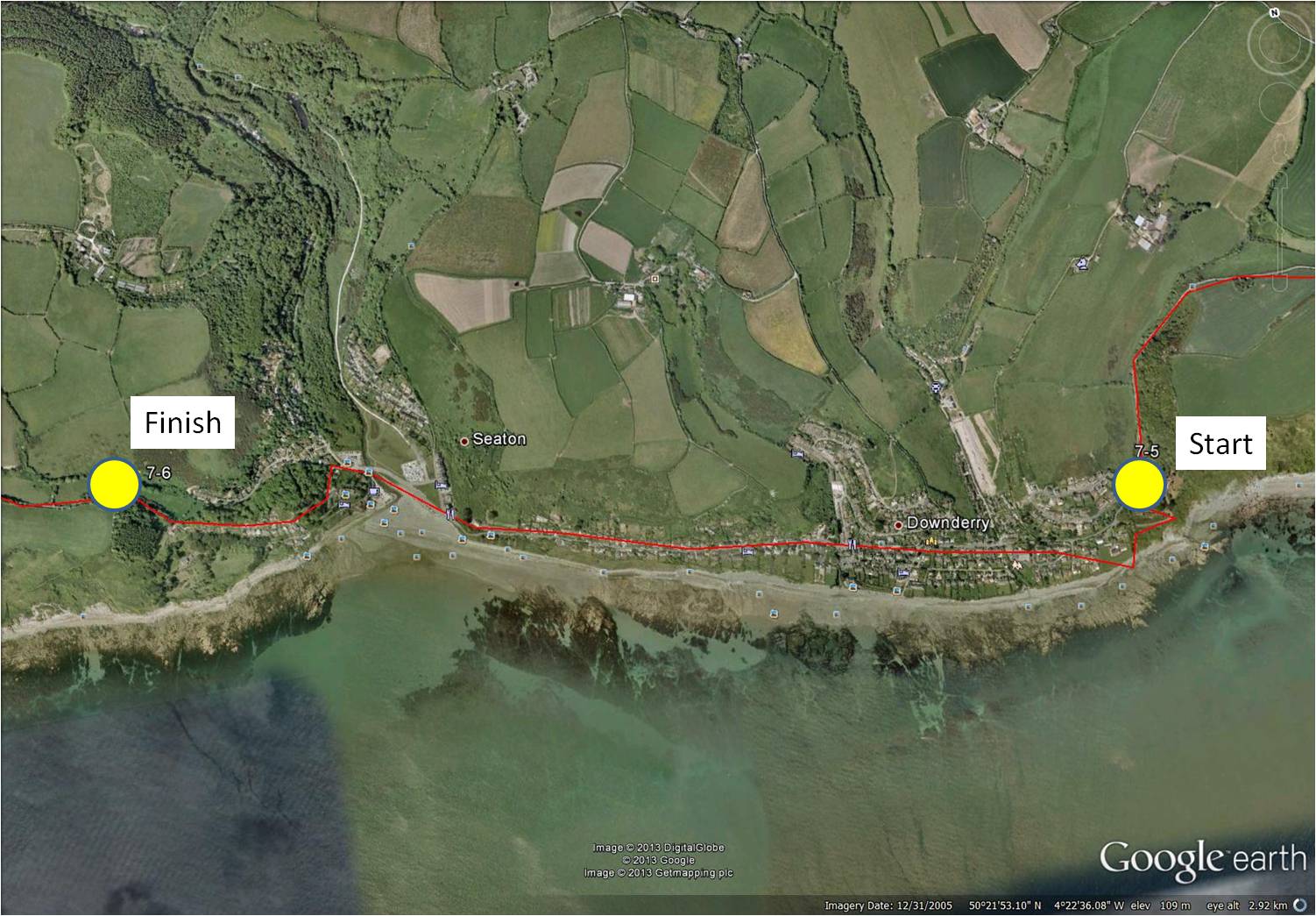
map showing distance travelled (map from Google Earth)
~
Downderry is a charming town, tucked beside the sea …
~

houses in Downderry (image from Street View)
~
My virtual memories of Downderry will be of stone walls …
~

gardens along Downderry street (image from Street View)
~
hillside gardens …
~
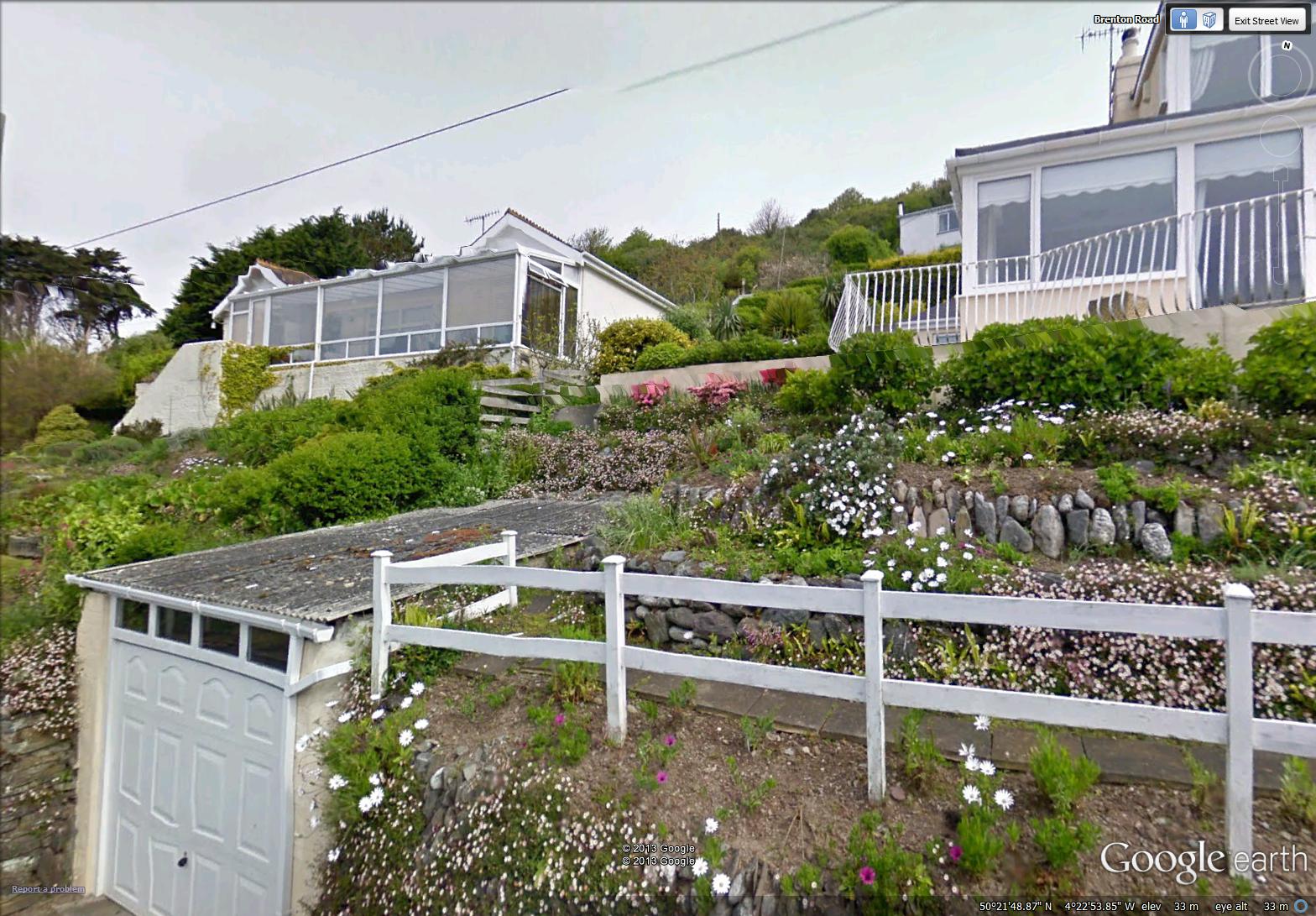
hillside gardens (image from Street View)
~
and a charming red brick church …
~

Downderry church (image from Street View)
~
Best View: a lilac in front of a white house …
~

July 4, 2013 ‘Lilacs, Downderry’ Jane Tims
~
and a Horse Chestnut tree beside Downderry Church …
~
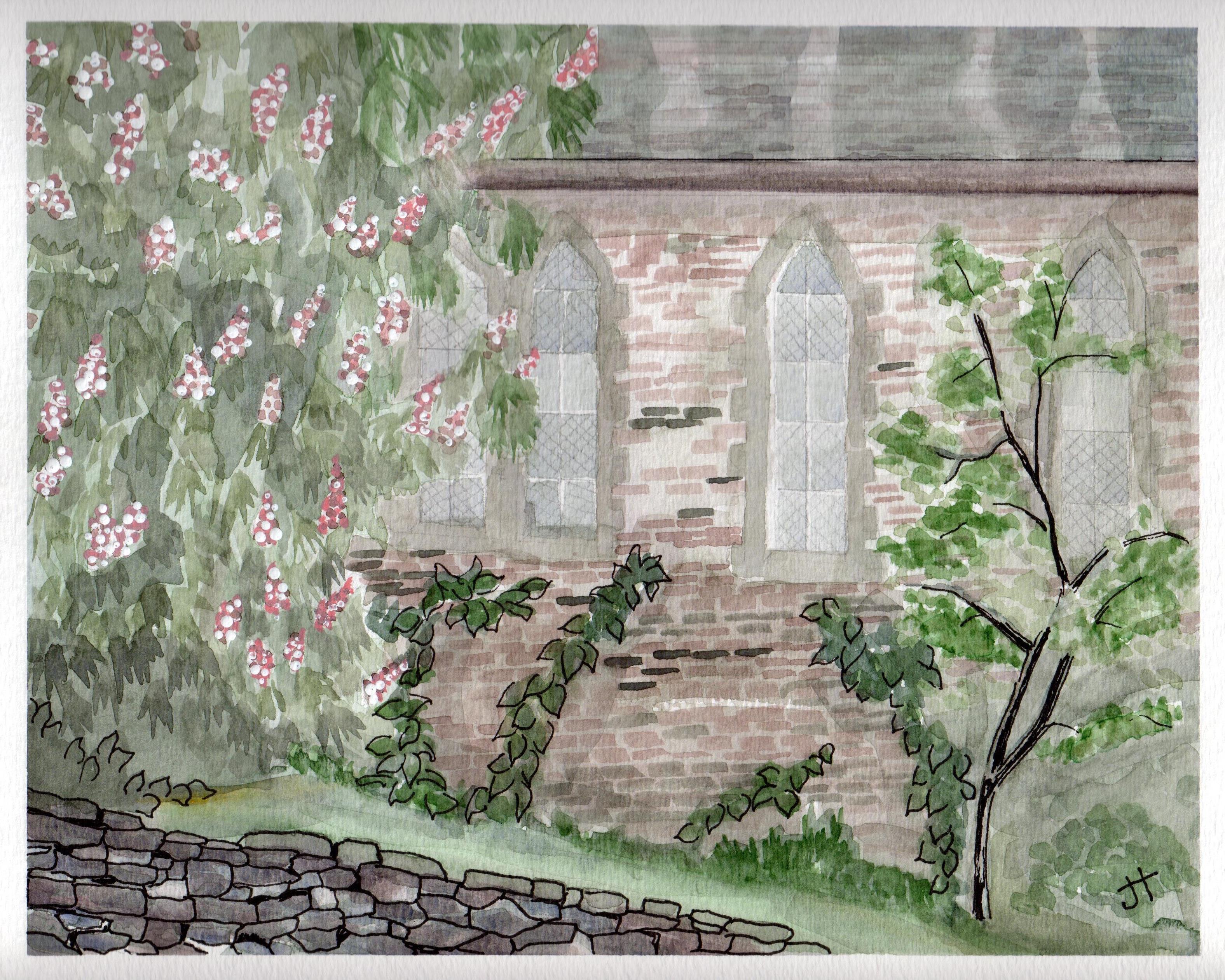
July 5, 2013 ‘Downderry Church’ Jane Tims
~
Then, onward to Seaton and a backward view at Seaton Beach from Looe Hill …
~

July 6, 2013 ‘Seaton Beach’ Jane Tims
~
Copyright 2013 Jane Tims
watching for dragons – on paper
As you will know if you follow this Blog, I have been learning to work with watercolors this summer. So far, I have painted from views associated with my virtual adventures in France and England. But today, almost against my will, two dragons popped out on the paper. They are also determined to appear in this post, so here they are, along with a dragon I did in soluble colored pencil back in May.
~

May 2013 ‘dragon #1’ Jane Tims
~

July 20, 2013 ‘dragon #2’ Jane Tims
~

July 20, 2013 ‘dragon #3’ Jane Tims
~
Copyright 2013 Jane Tims
along a Cornwall road 7-5
~
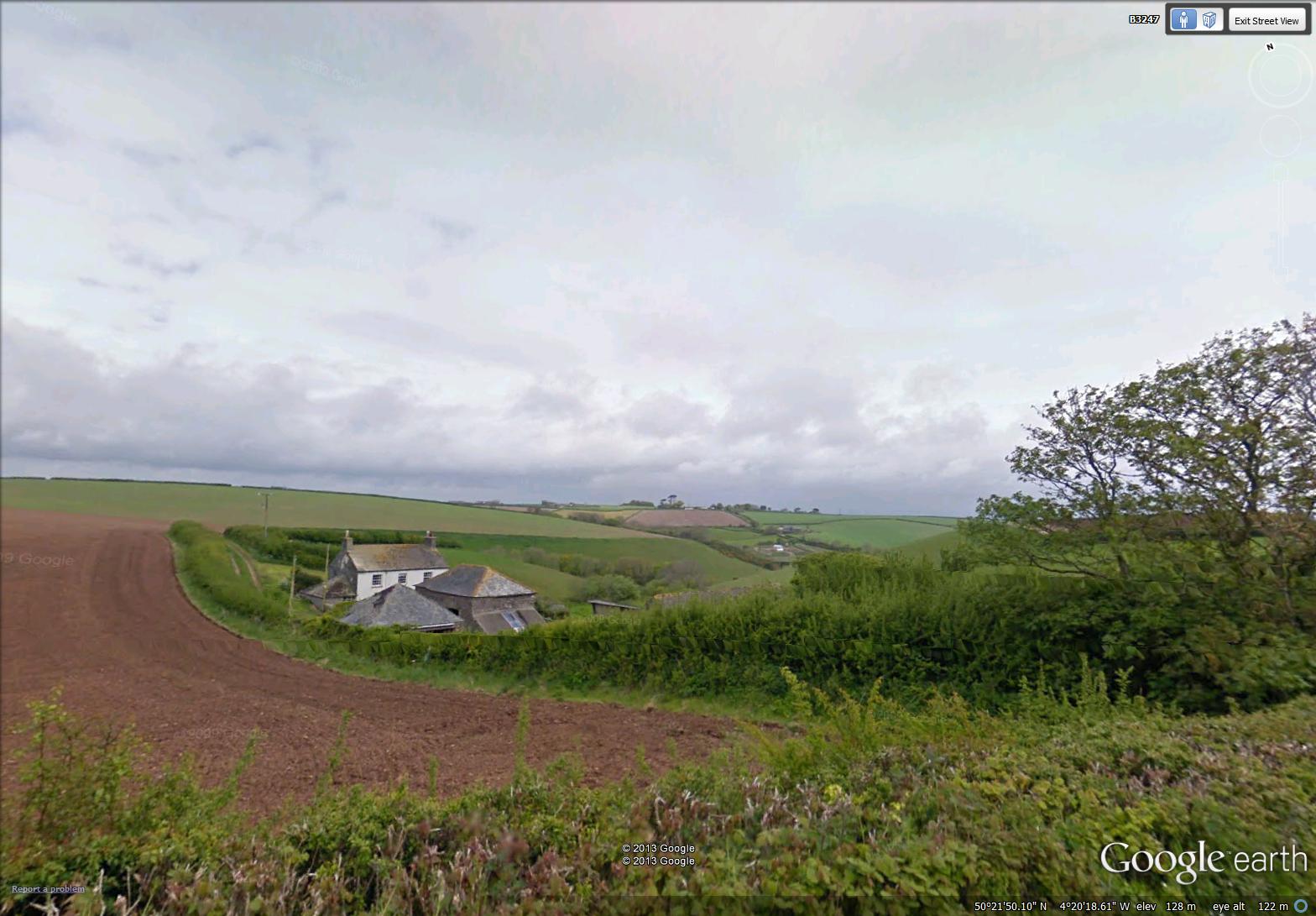
farm tucked into a valley (image from Street View)
~

~
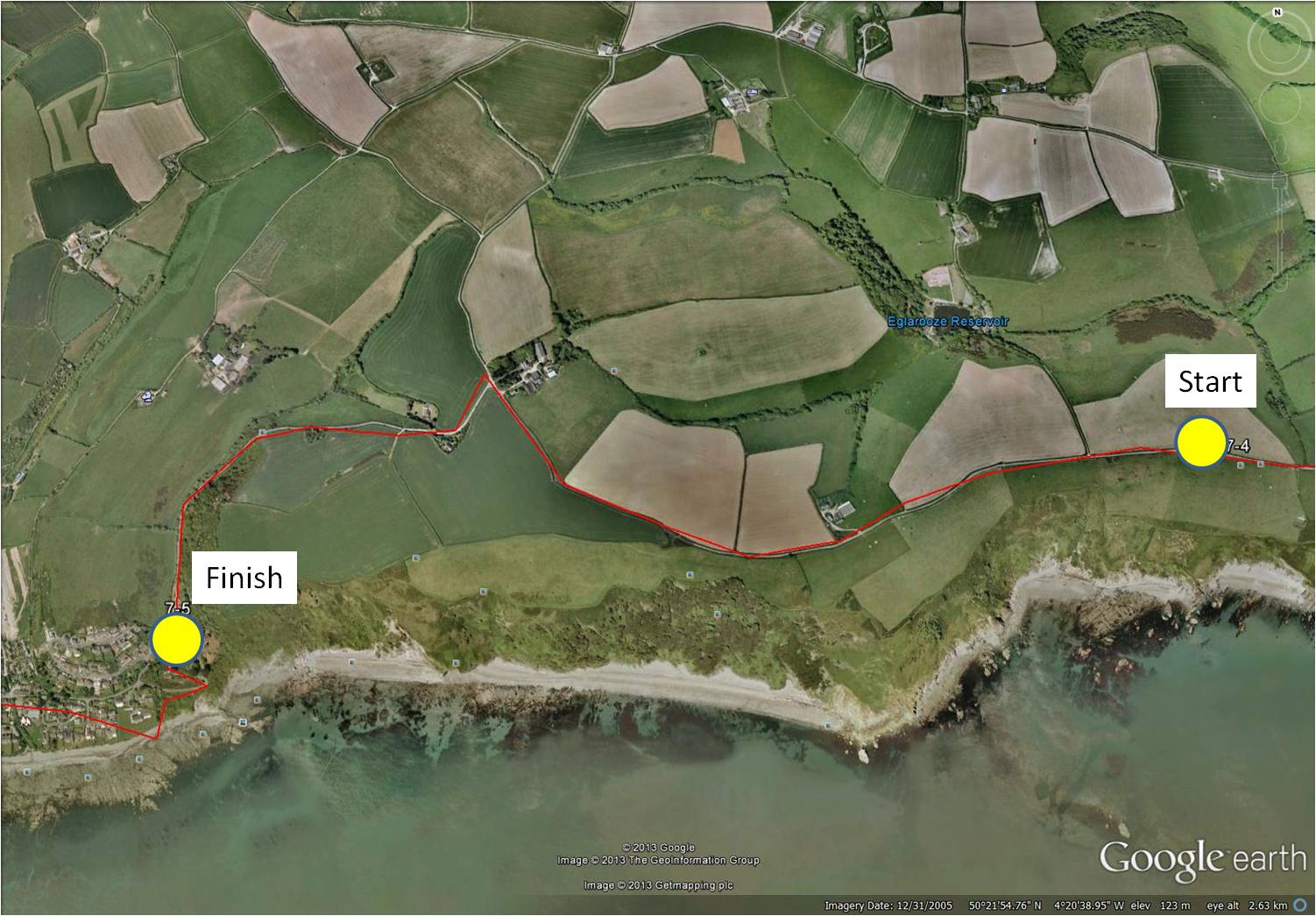
map showing distance travelled (map from Google Earth)
~
Today’s virtual biking trip took me toward the town of Downderry, along narrow roads lined with Western Gorse (Ulex gallii) in yellow bloom. Gorse grows on sunny sites with sandy soil and is common on the heathlands along Britain’s Atlantic coast. Before my virtual trips to France and England, I had heard of gorse but had never ‘seen’ it …
~
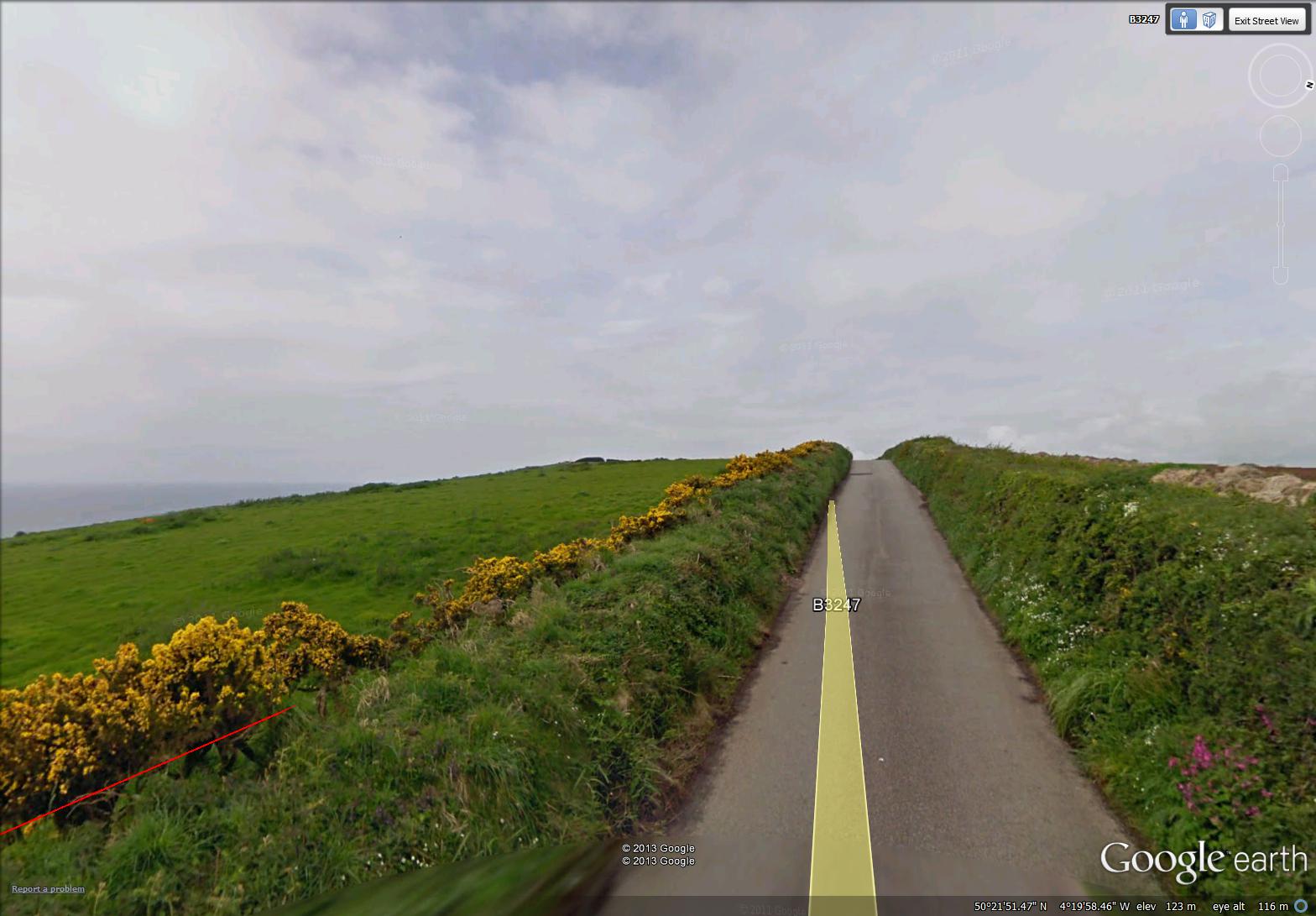
gorse in bloom (image from Street View)
~
I saw a few farms along the way …
~

a house and barn (image from Street View)
~
and horses in a green pasture …
~

horses (image from Street View)
~
Best View: farmstead not far from Downderry … my skies are improving, don’t you think???
~
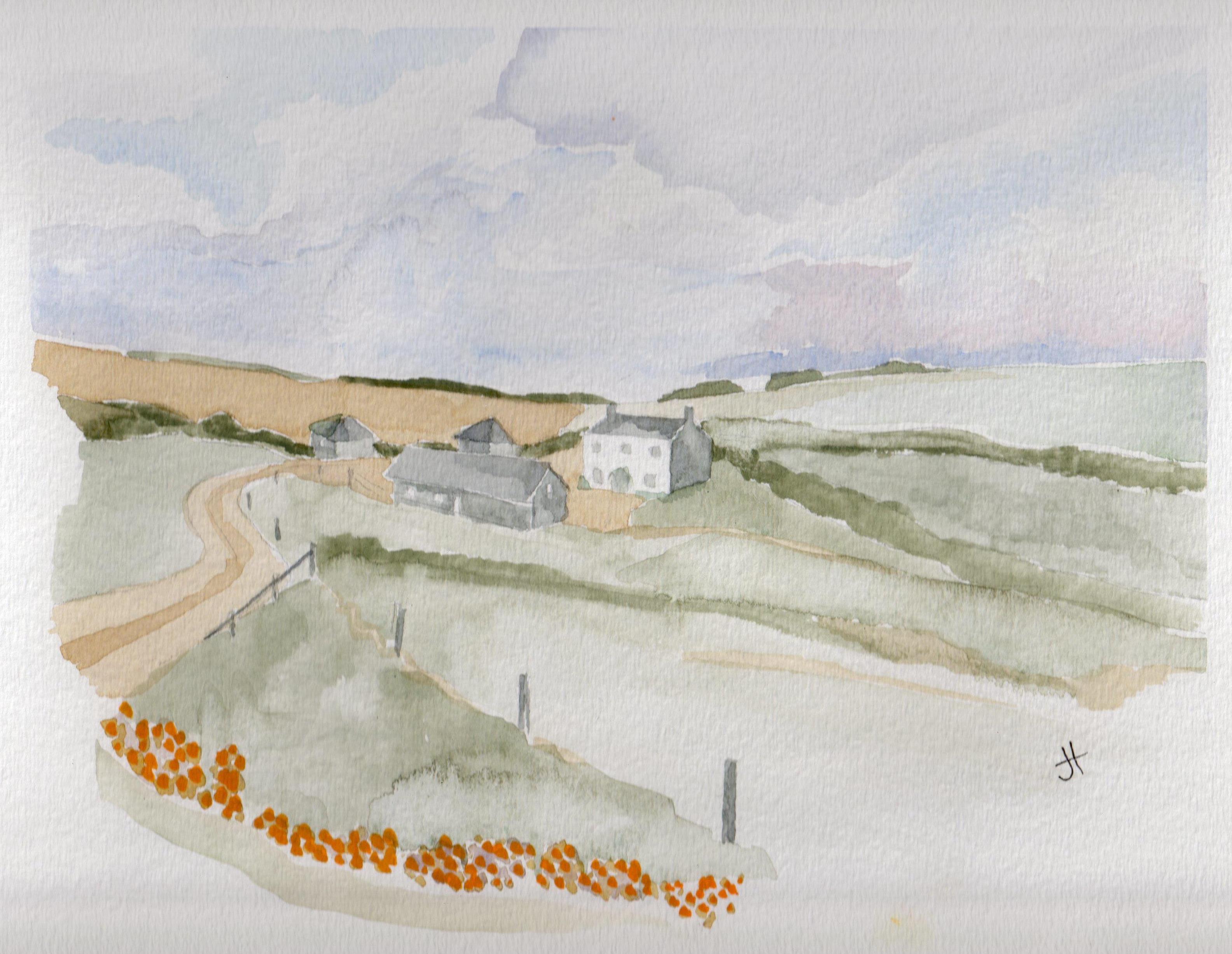
June 8, 2013 ‘farm near Downderry’ Jane Tims
~
Copyright 2013 Jane Tims
painting my way along the Cornwall coast 7-4
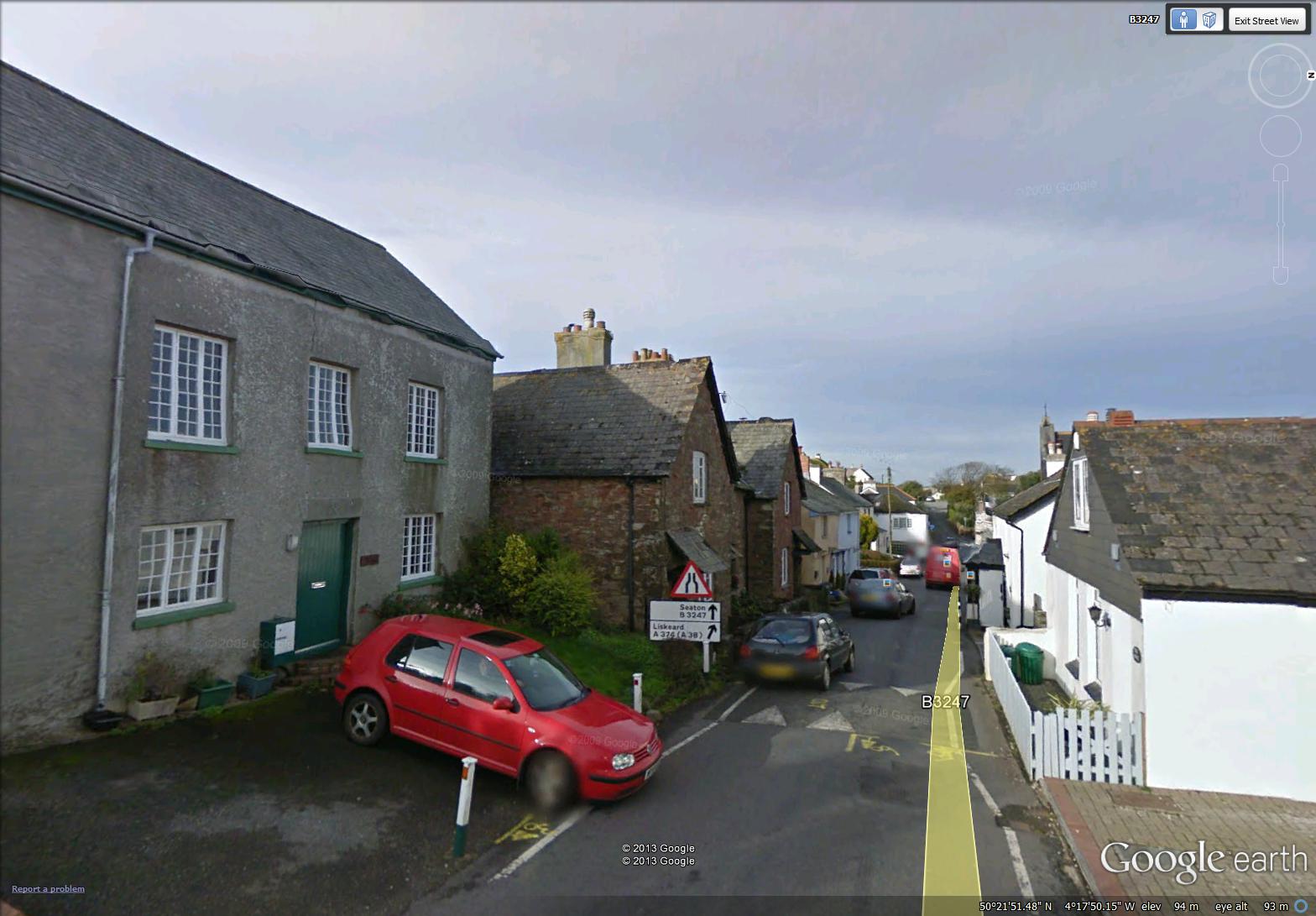
street in Crafthole (image from Street View)
~
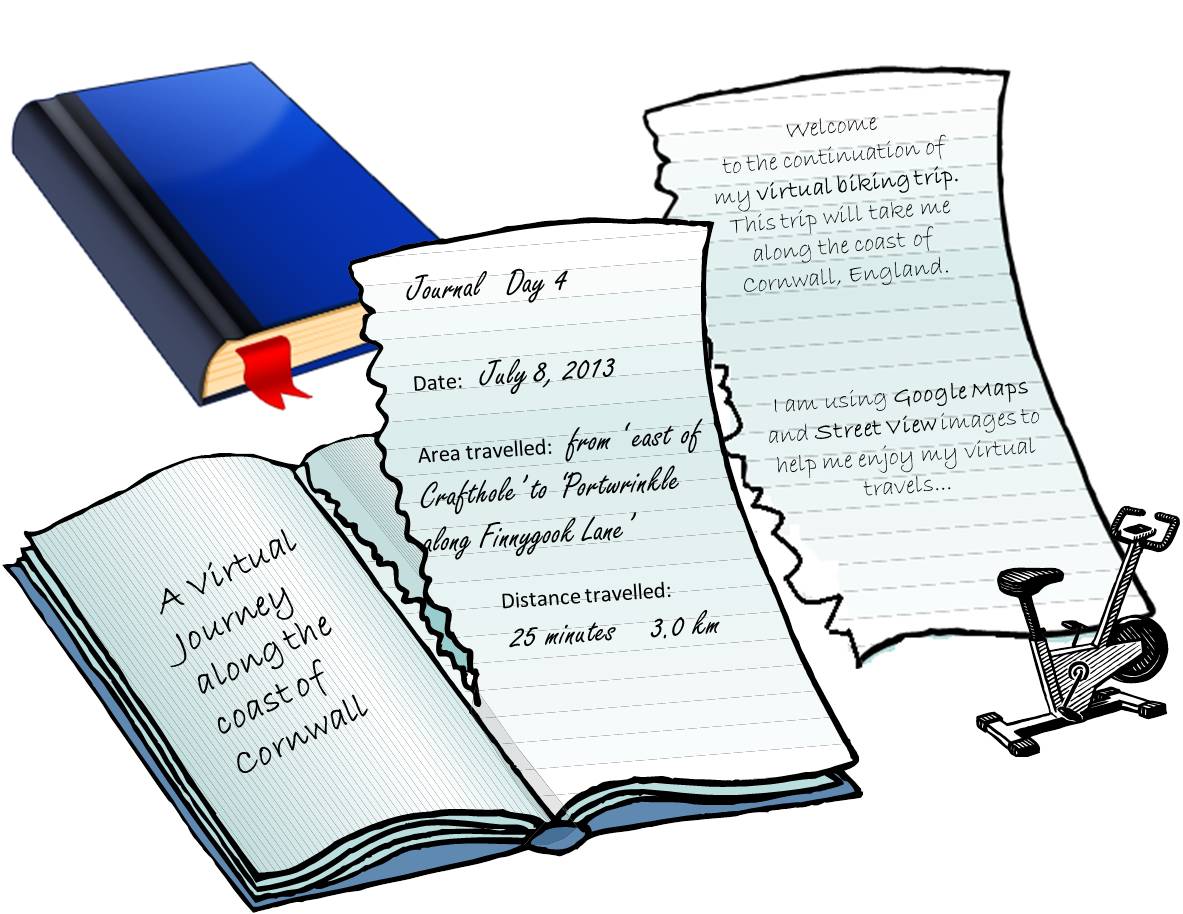
~

map showing distance travelled (map from Google Earth)
~
One of the things I like best about my virtual journey along the Cornwall coast – the names of the communities: Crafthole, Portwrinkle, Freathy !
~

a dog looks at me from the window of a house in Crafthole (image from Street View)
~
Today, I drove through Portwrinkle along Finnygook Lane.
~

July 3, 2013 ‘Portwrinkle’ Jane Tims
~
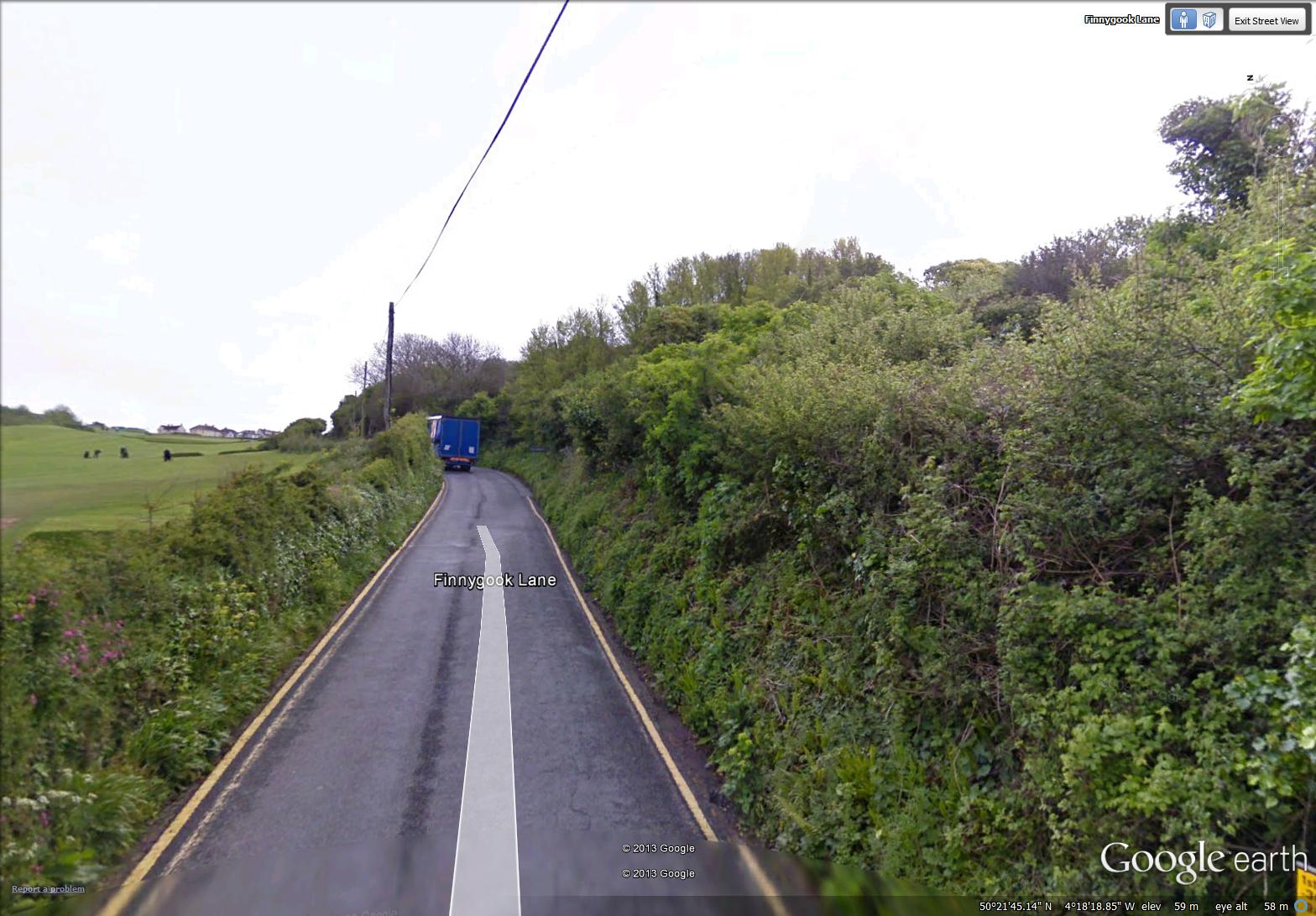
Here is an interesting sequence of photos and a visual commentary on the width of the roads. First, I see a truck coming toward the Street View car …
~
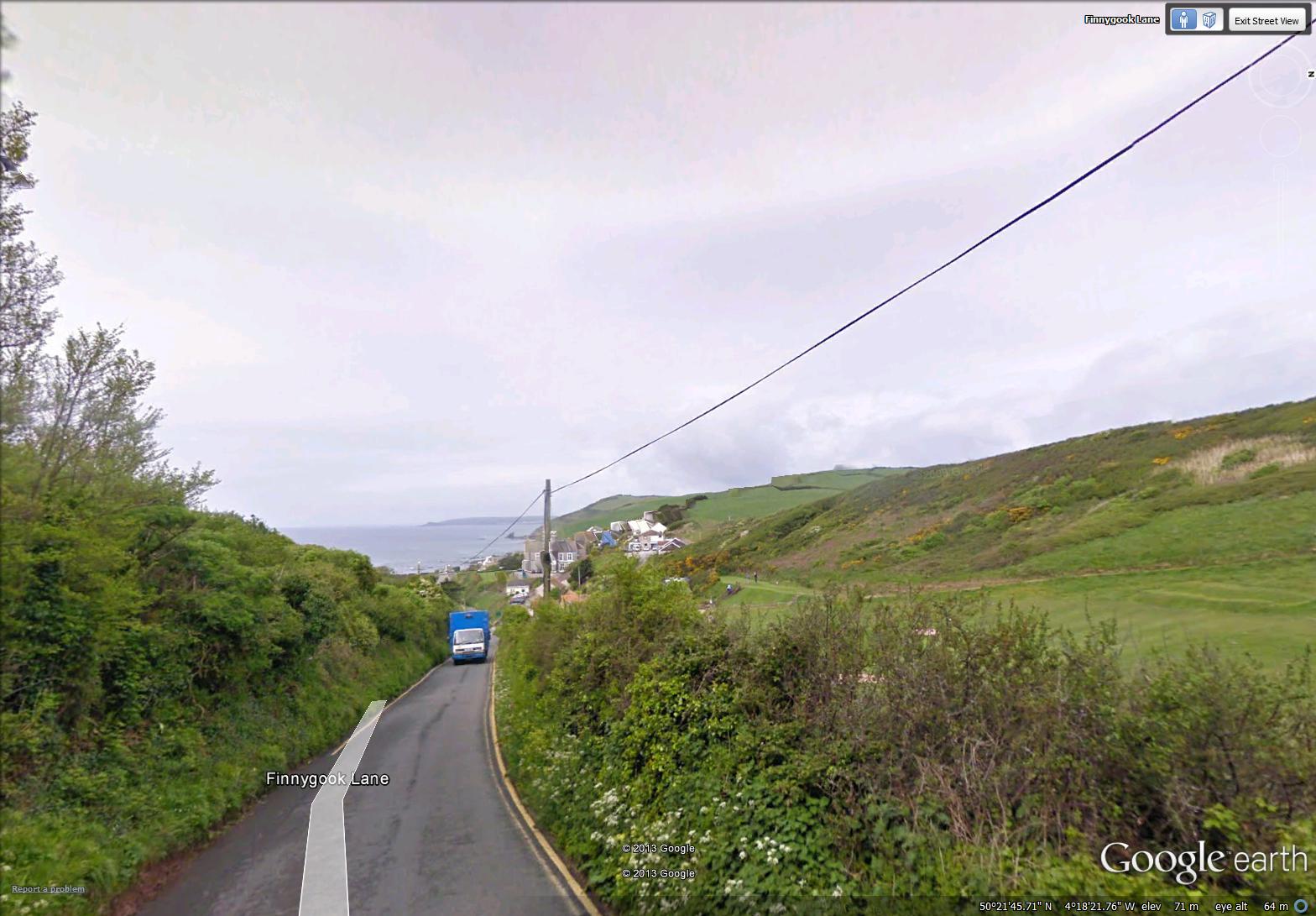
Help! I am sure there is no room to pass! (image from Street View)
~
Then we squeeeeeeeze past …
~
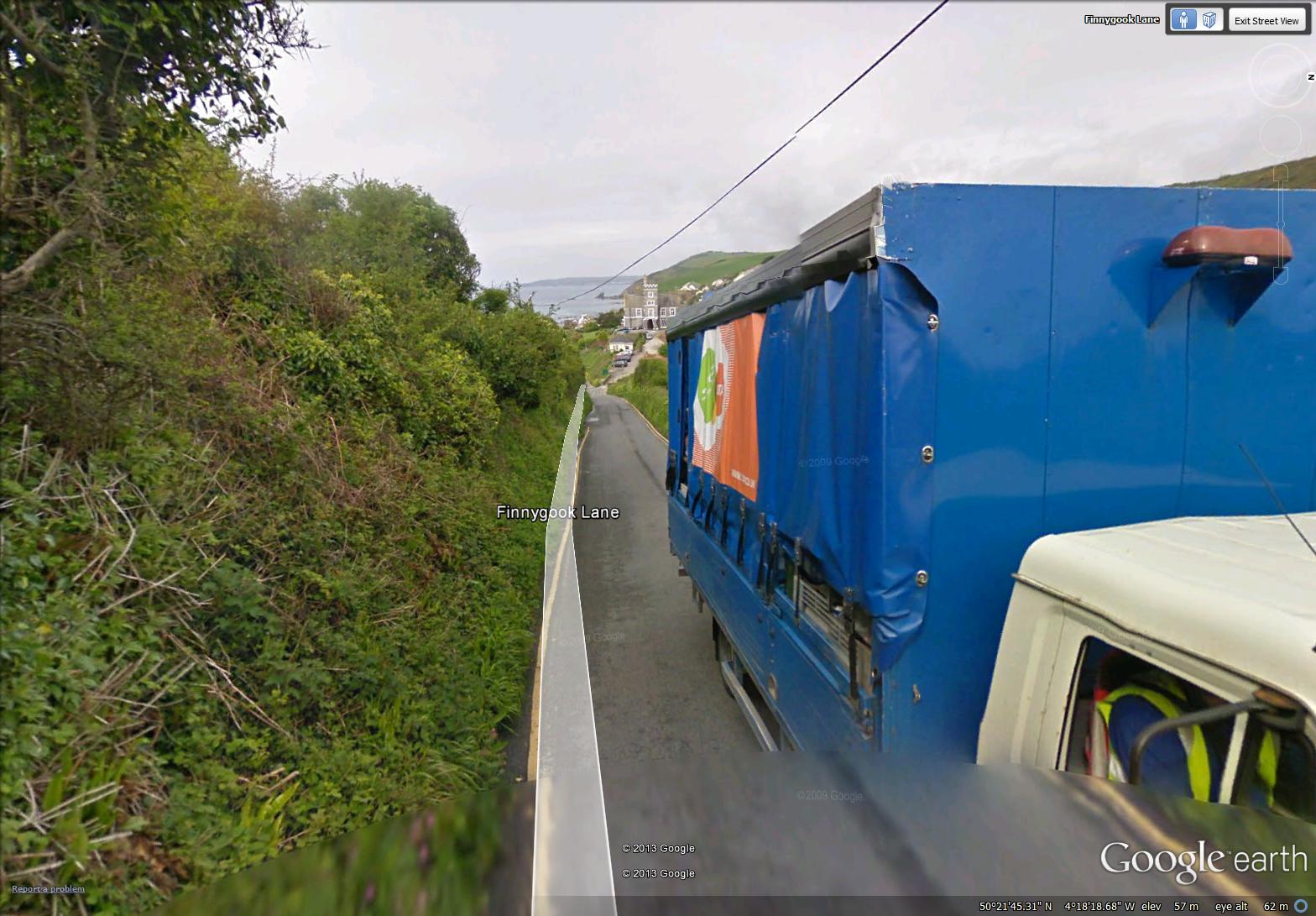
~
I look back and I don’t see any indication we did pass (no tracks in the shrubbery for example) …
~
~
And, I was so busy trembling over passing the truck, I almost didn’t see this door in the side of the hill …
~
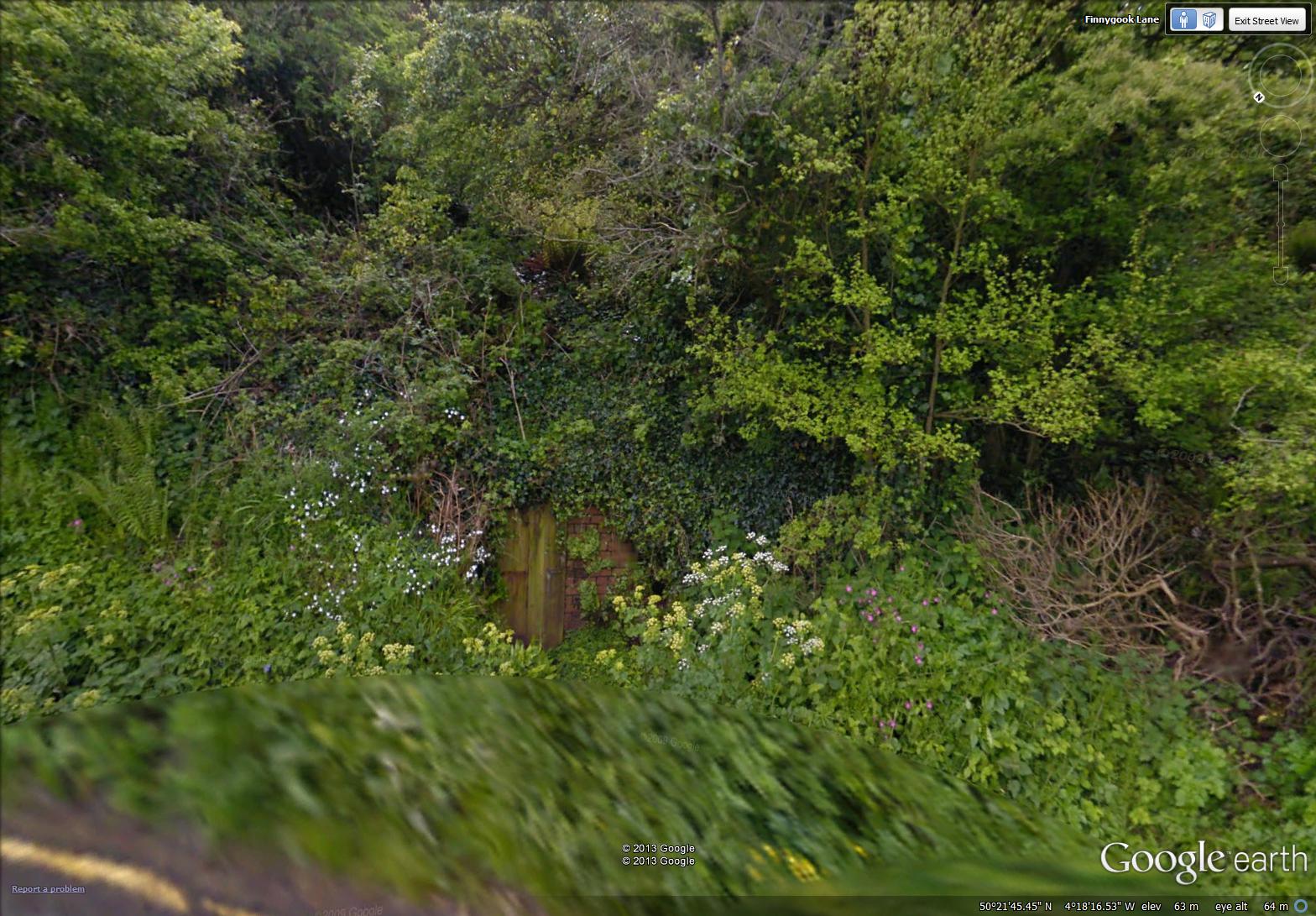
you’d miss it if you weren’t looking (image from Street View)
~
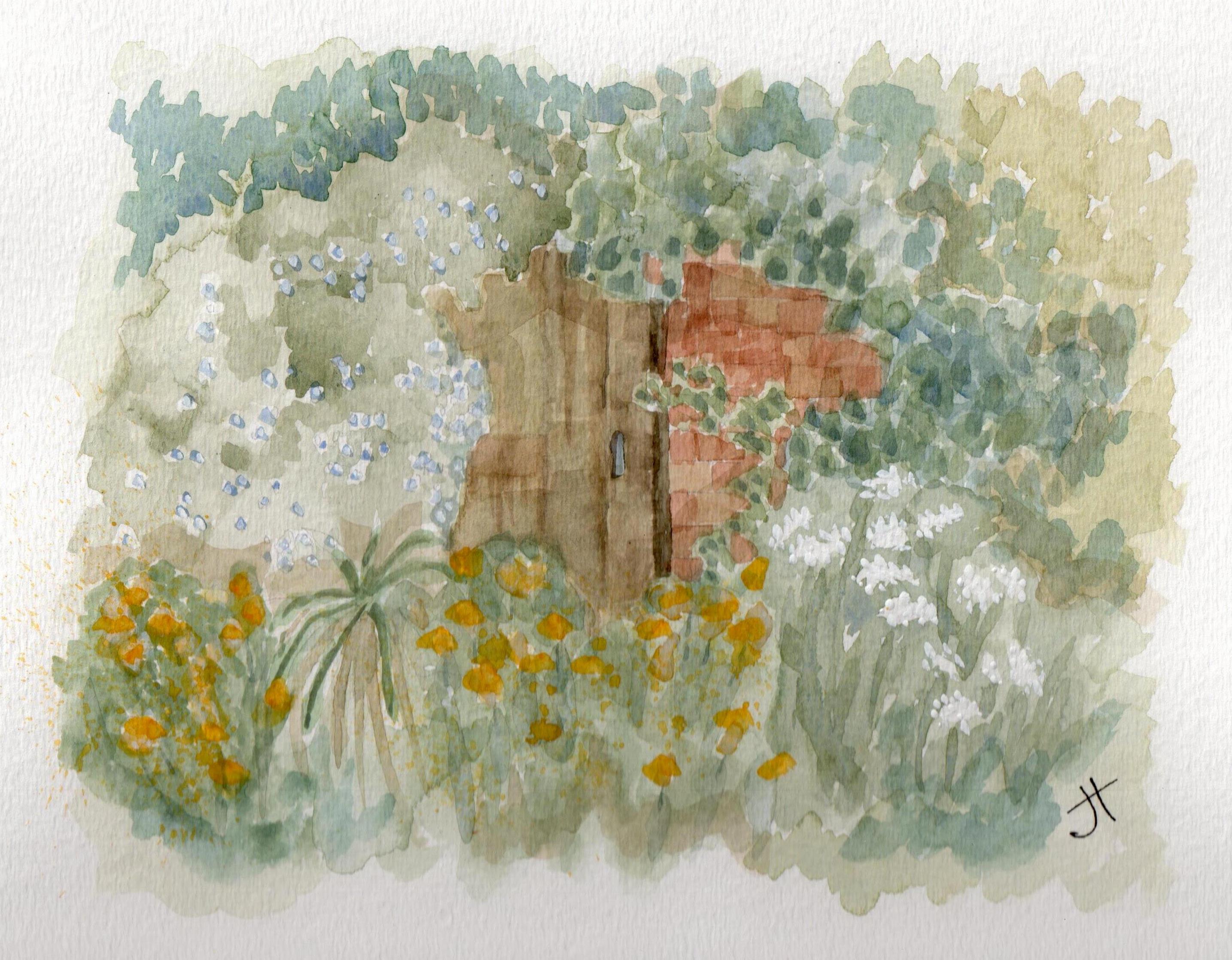
July 8, 2013 ‘hidden door on Finnygook Lane’ Jane Tims
~
Best View: houses in Crafthole …
~
I am having fun trying to understand painting with watercolors. I have always worked with oils or acrylic, but watercolors are quite different. I love that the colors have a mind of their own. If I allow the colors to go where they want to go, sometime the surprises are wonderful, sometimes, not.
I am trying to use less paint, more water. This improves transparency and gives a fragility to the painting.
I am trying to clean my brush well and to freshen the water more often. This prevents ‘muddiness’.
I am also trying to leave more white space. This provides white ‘color’ and space for adding color as the painting progresses.
Here are two attempts at painting houses in Crafthole. I include the original image so you can see my inspiration. As you can see, I used lots of artistic licence.
~
In #1, I like the scaling of the houses, the houses in the background, the gardens, the pinkness of the wall, and the grey house … I don’t like the windows …

July 3, 2013 ‘houses in Crafthole #1’ Jane Tims
~
In #2, I like the chimneys, the red door, and the background houses … I don’t like the windows however I think these houses have personality in their ‘lean’…
~

July 3, 2013 ‘houses in Crafthole #2’ Jane Tims
~

houses in Crafthole (image from Street View)
~
Now, what do you think of that door in the side of the hill ??????
~
Copyright 2013 Jane Tims
farms in hidden valleys 7-3

Tregantle Fort near Freathy (image from Street View)
~

~
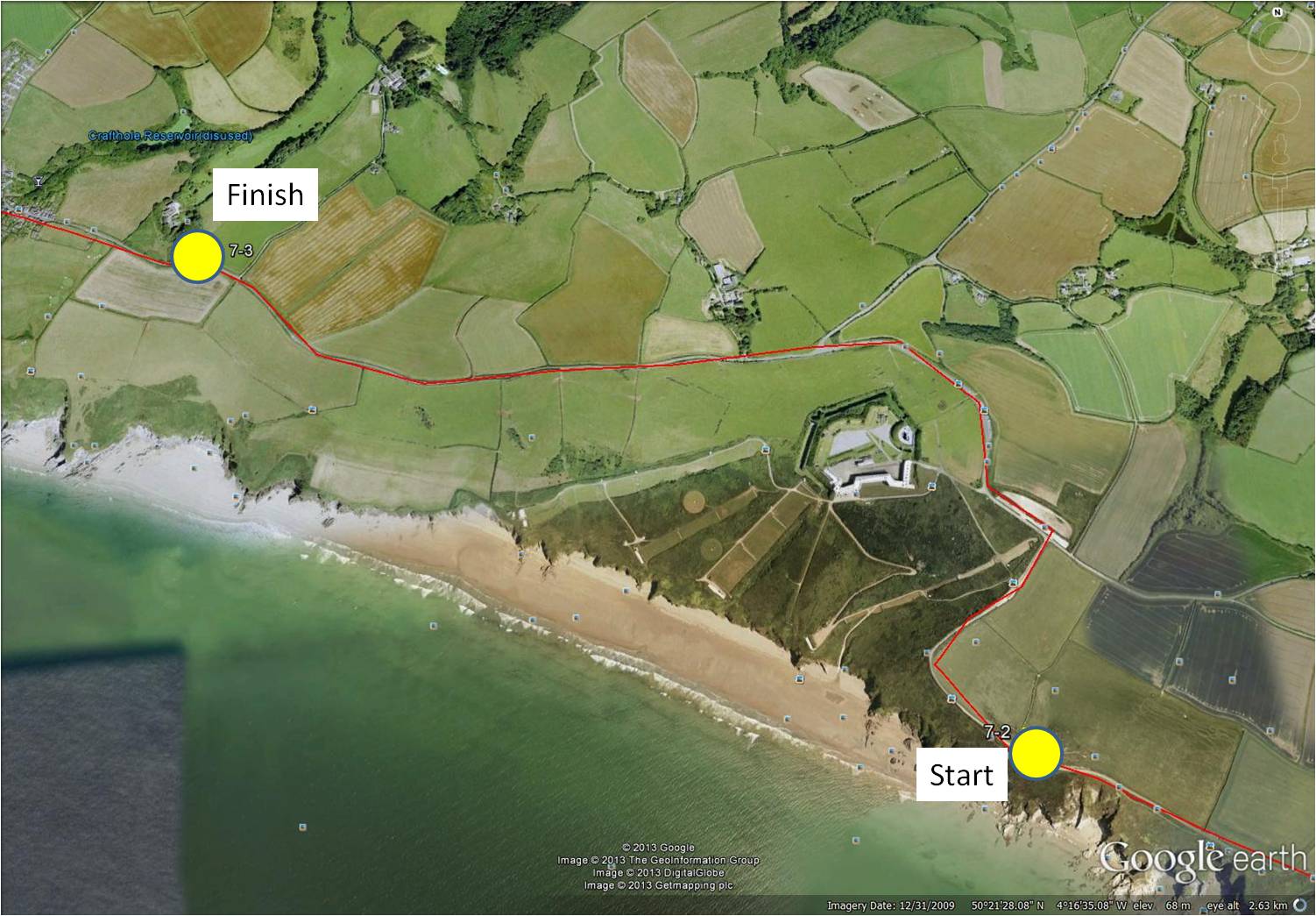
map showing distance travelled (map from Google Earth)
~
Gradually, I am learning the layout of this part of the Cornwall coast. The uplands are mostly devoted to wild land or agriculture (grazing or crops) …
~
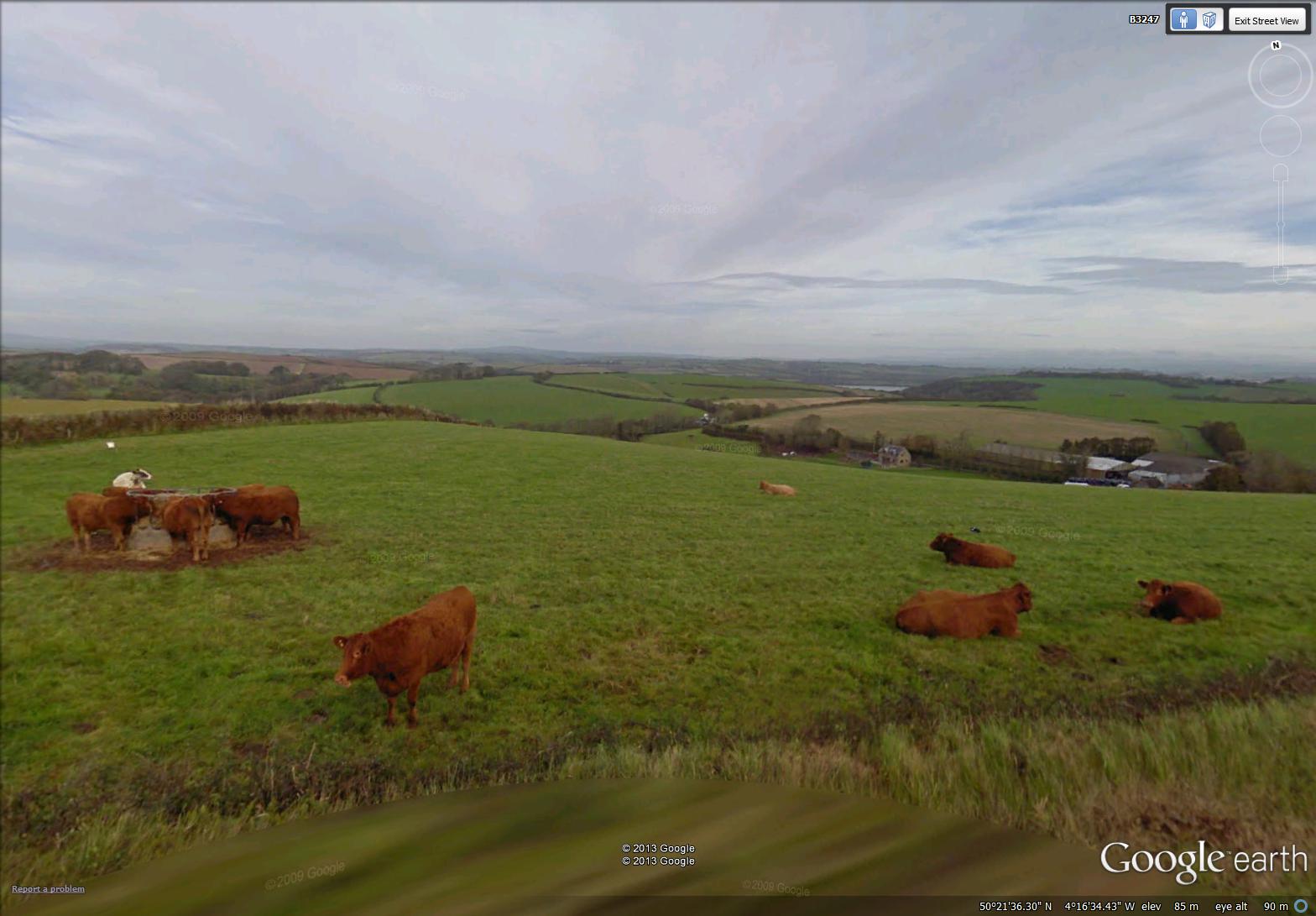
cattle in a field near Freathy (image from Street View)
~
The houses are either along the coast, at the very edge, or in the treed valleys that peek at intervals from the countryside …
~

fields and valleys … a reservoir in the distance (image from Street View)
~
Driving down into these valleys, I find farmsteads, made up of clusters of buildings and usually associated with water …
~

farmstead in a valley (image from Street View)
~
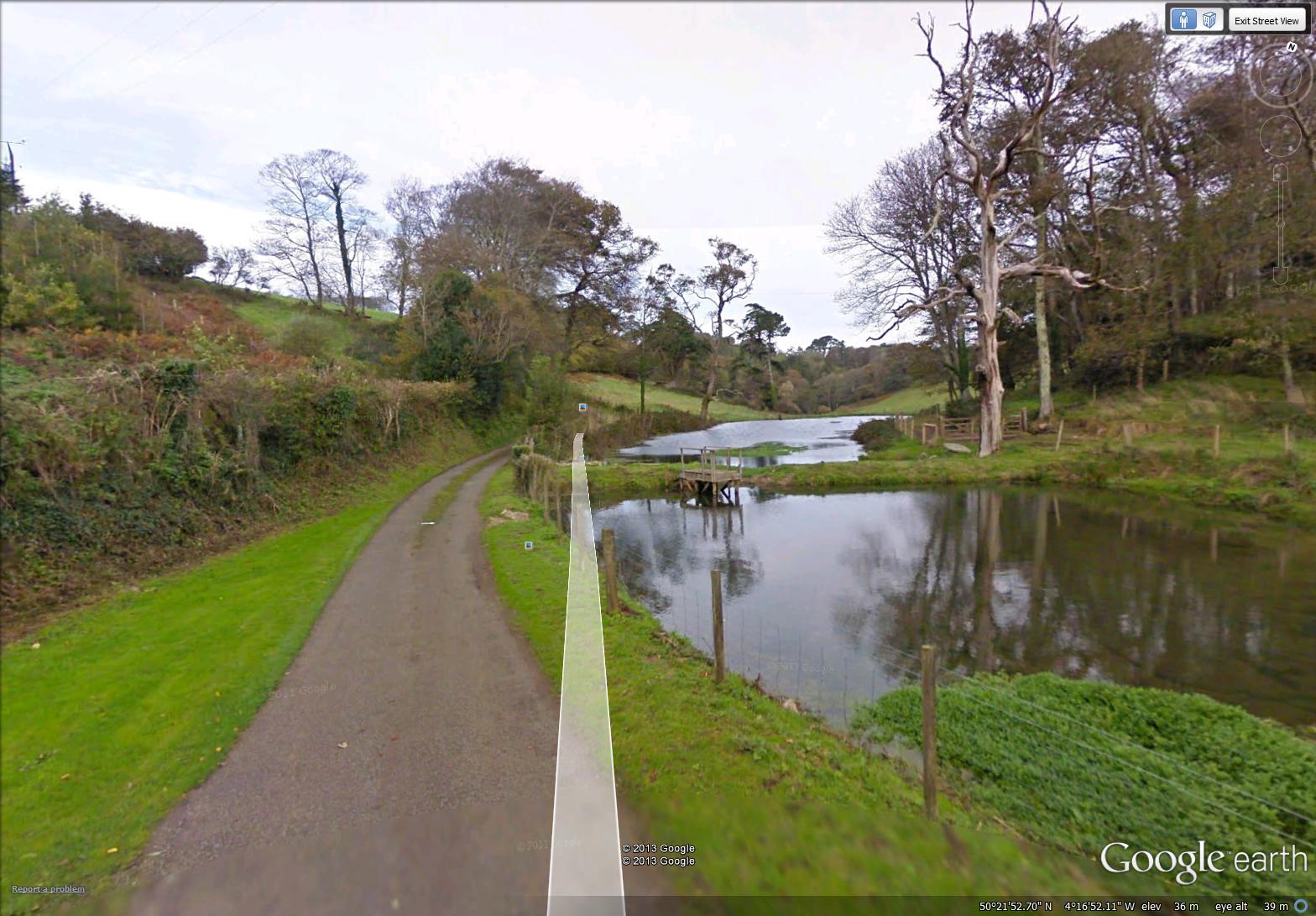
ponds at a valley farm (image from Street View)
~
Cattle must stray into the roads on occasion. The entryway of the house below is guarded by a ‘Texan Gate’ or ‘cattle stop’. I am familiar with these from my days in Alberta. Cattle will not cross these gates because of the spaces in the surface, but cars can cross quite easily …
~
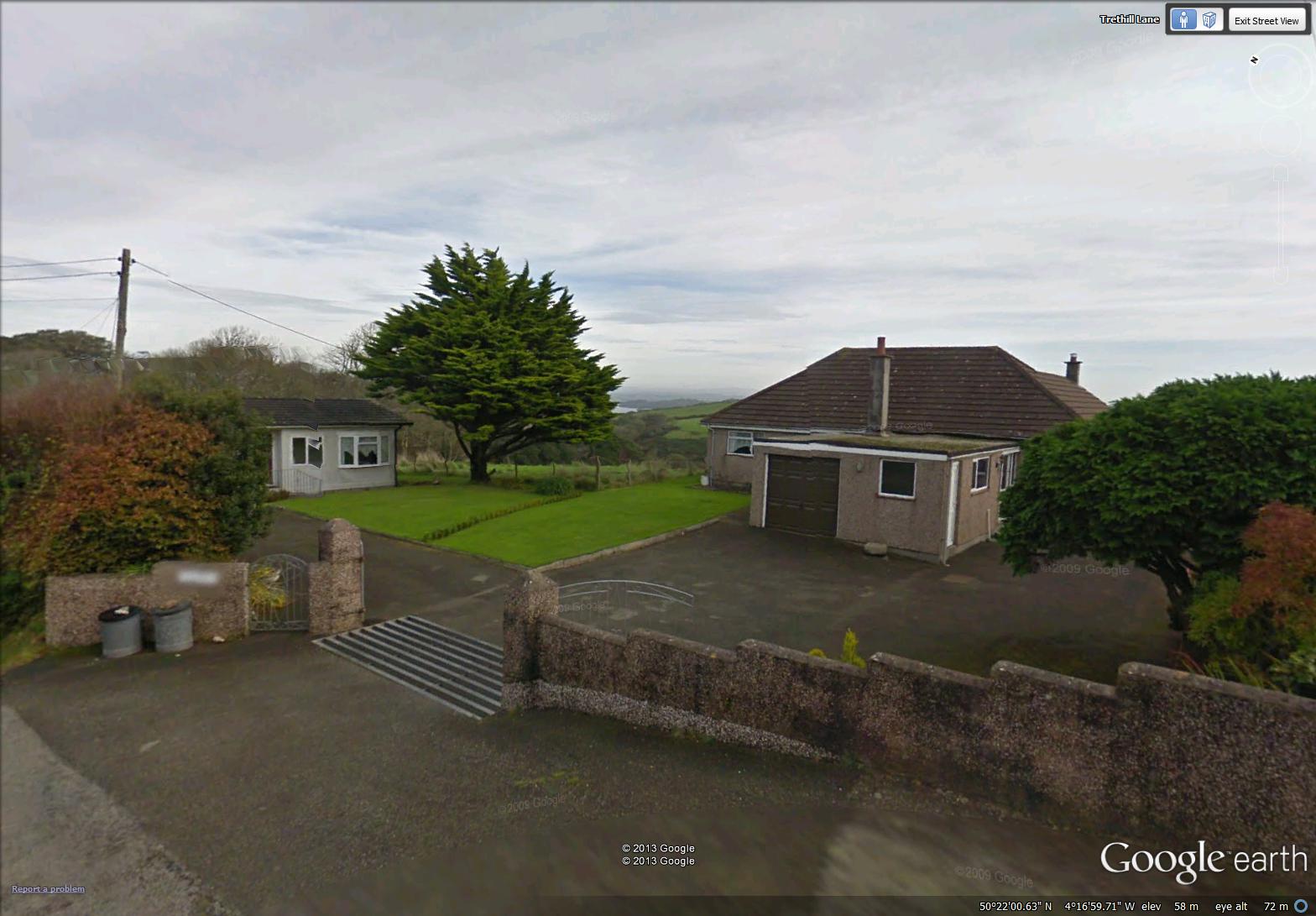
a Texan Gate (image from Street View)
~
Best View: the Cornwall coast stretching before me …
~

July 2, 2013 ‘Cornwall coast’ Jane Tims
~
Copyright 2013 Jane Tims
Paper Birch
In the last five months, I have been learning how to paint with watercolors. I’ve painted with acrylics for some time, and I love to draw with pencil, but watercolors always seemed daunting to me.
If you are a follower of my Blog, you will know my early attempts at watercolor have been of views from my virtual cycling trip in central France and on the Ile de Ré. I have also done some studies of New Brunswick wildflowers.
Among the subjects I found fun to paint on Ile de Ré were the vine-covered trees that grow along the road.
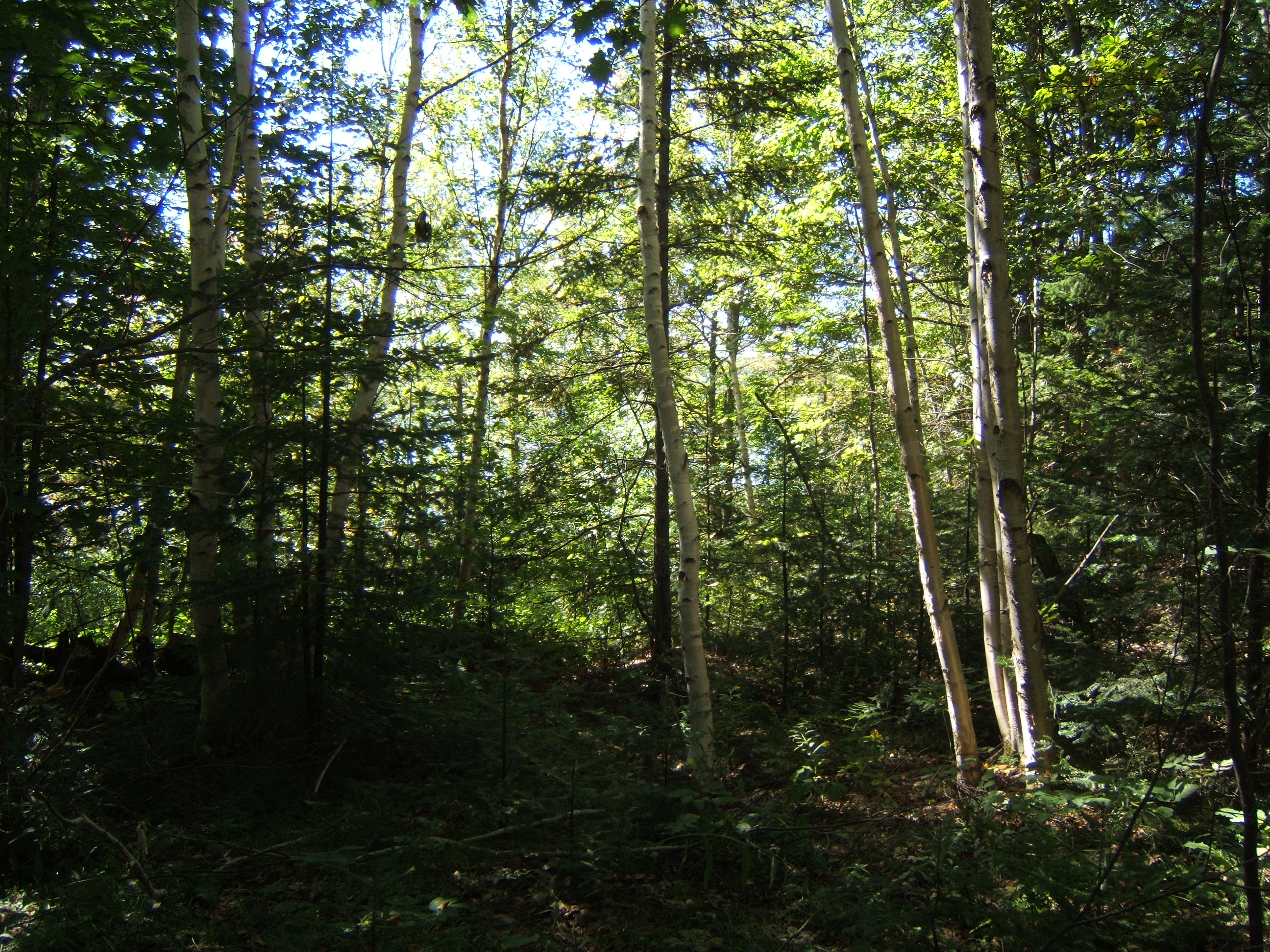
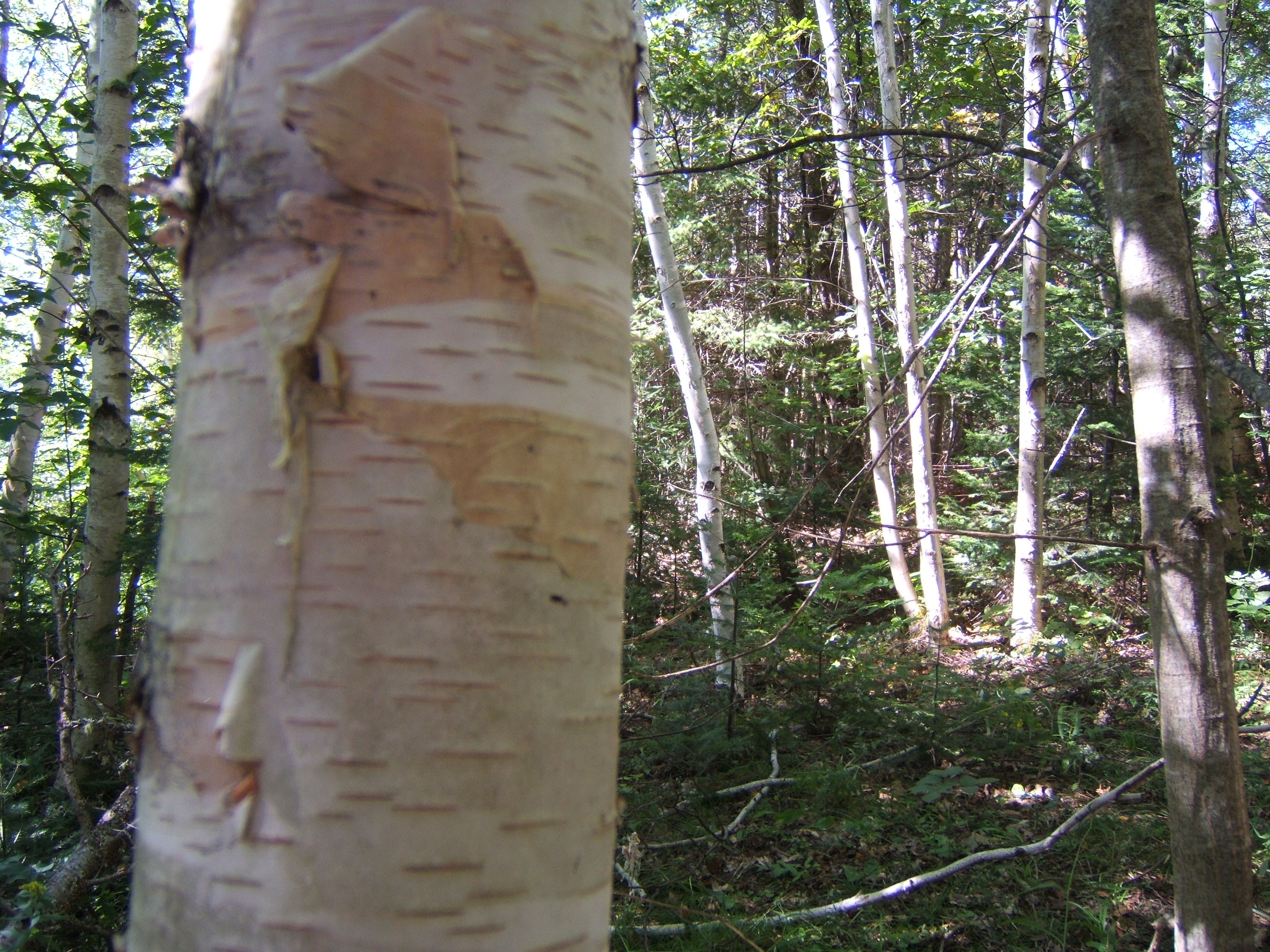
This week, on a trip to see our camp, I studied some of the characteristics of Paper Birch (Betula papyrifera Marsh.), a tree growing everywhere on our property by the lake …
~
~
Some of these trees are actually Mountain Birch (Betula papyrifera Marsh. var. cordifolia (Reg.) Reg.), a variety of the Paper Birch. This variety is quite common in eastern Canada. Its distinguishing characteristic is the heart-shape of its leaves, especially at the base of the leaf.
~
The bark of the Paper Birch and Mountain Birch is predominantly white, although parts of the tree can be yellowish or quite black. Its bark strips readily from the tree, in sheets, leaving a reddish-orange inner bark which turns black with age …
~
~
To paint the birch, I used Painter’s Tape to mask the trunks of the trees. Then I painted the background. Once the background was dry, I stripped the Painter’s Tape away and added the bark details in the white space left behind. Here are three paintings of Mountain Birch …
~
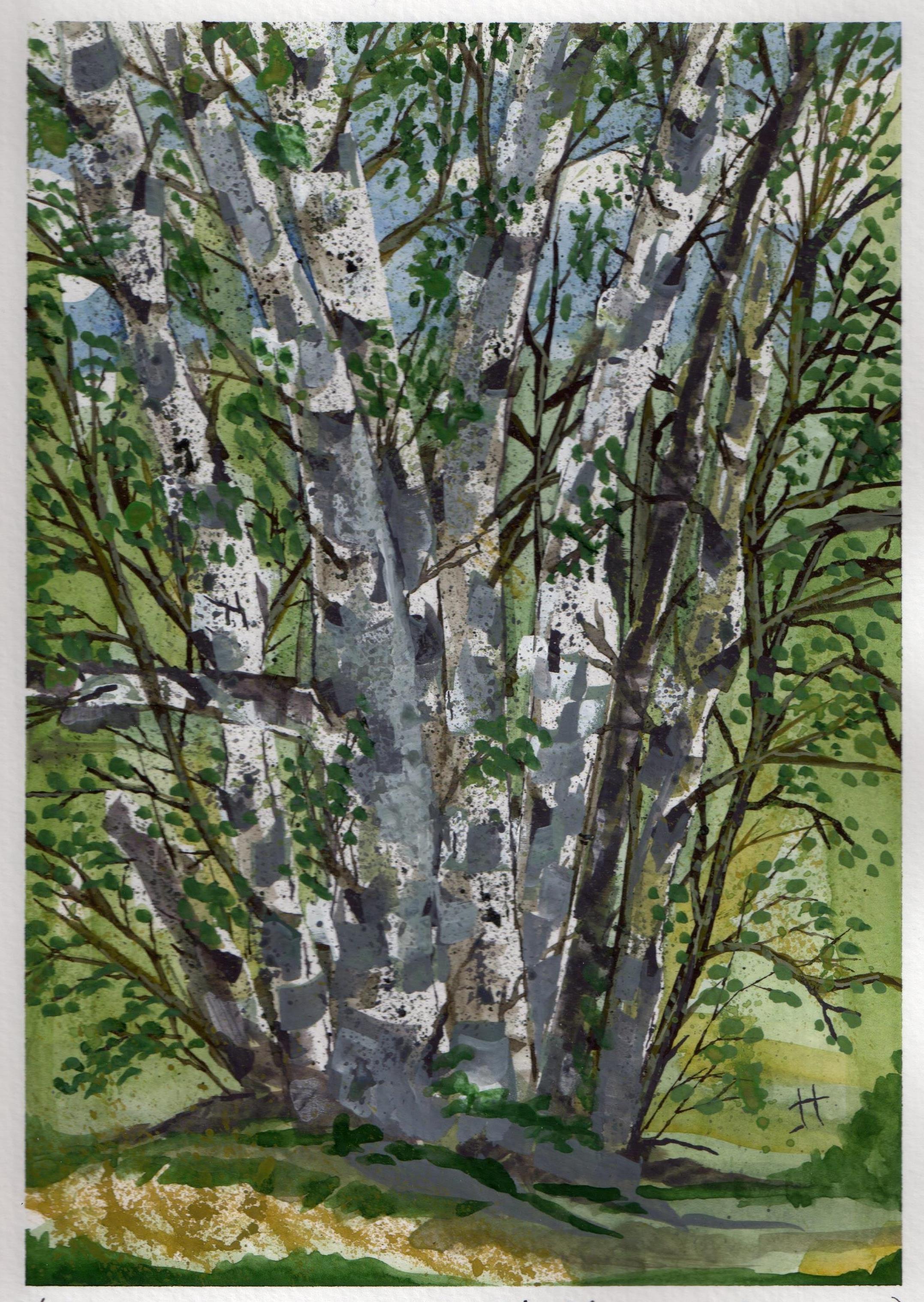
June 21, 2013 ‘Mountain Birch’ Jane Tims
~
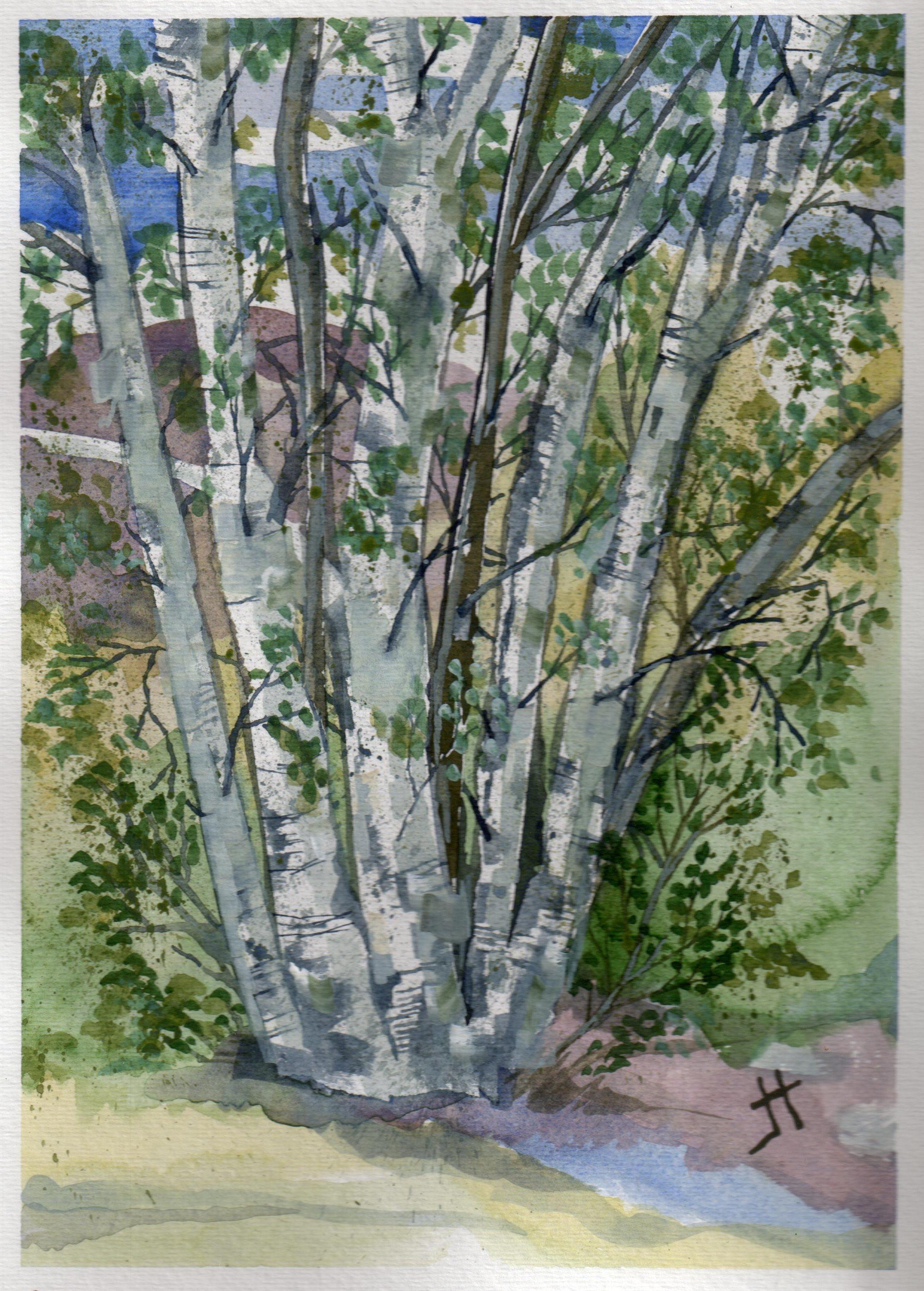
June 22, 2013 ‘Mountain Birch #2’ Jane Tims
~

June 23, 2013 ‘Mountain Birch #3’ Jane Tims
~
Copyright Jane Tims 2013
a holiday by the sea 7-2
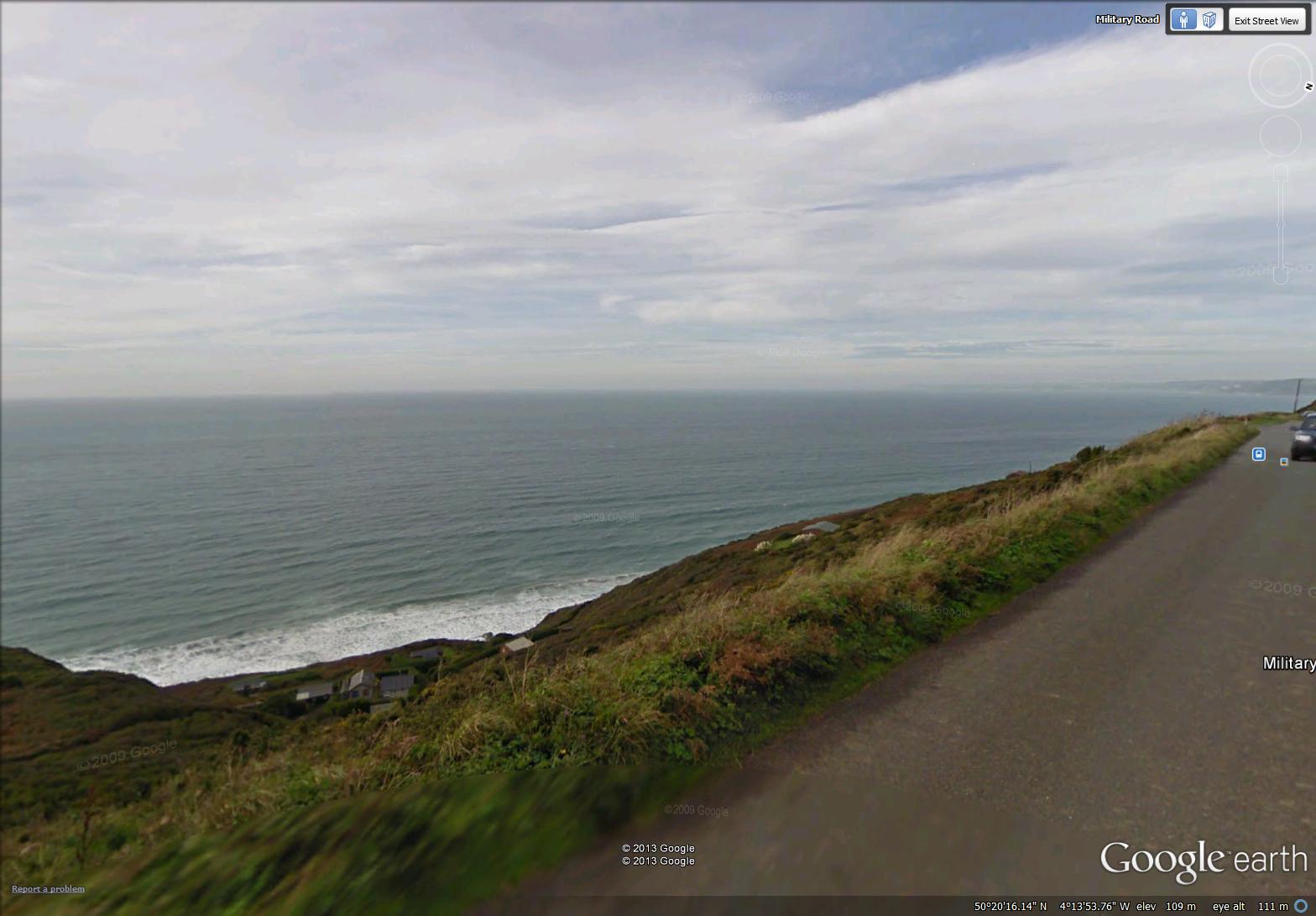
a view along the coast near Freathy … note the houses down the hill nearer the ocean (image from Street View)
~

~
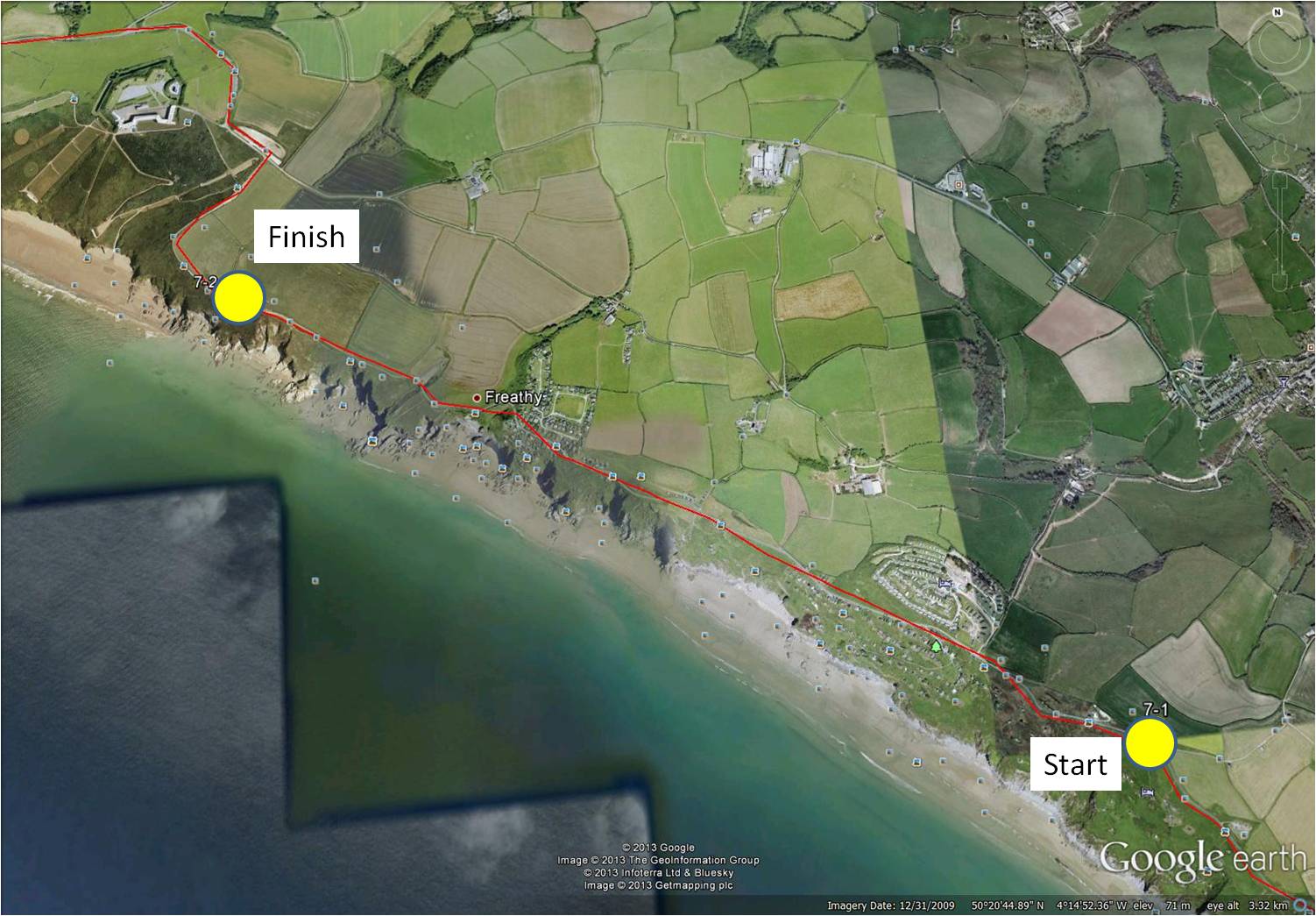
map showing distance travelled (map from Google Earth)
~
My virtual biking trip along the Cornwall coast has me totally enchanted. I love the rugged landscape, the hills (huff, puff), and the huge variety of wildflowers …
~

a view of the rugged coast and the yellow Gorse growing along the road (image from Street View)
~
Today’s drive along the Military Road showed me that the people love to spend recreational time along this coast. There are vacation communities …
~
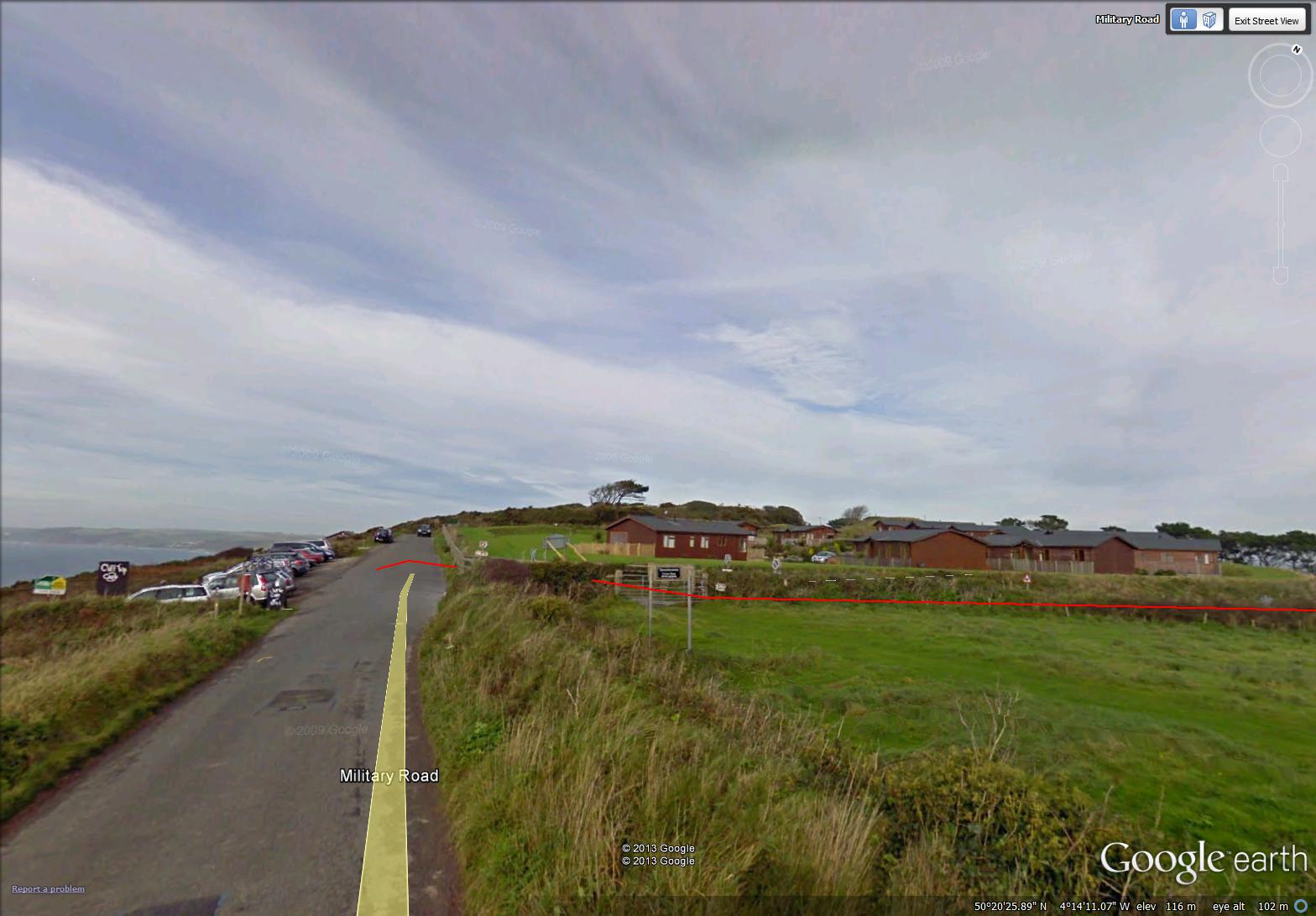
a vacation community (image from Street View)
~
Homes and cottages were downhill from the road. I am sure you could step from the road to one of these rooftops!
~
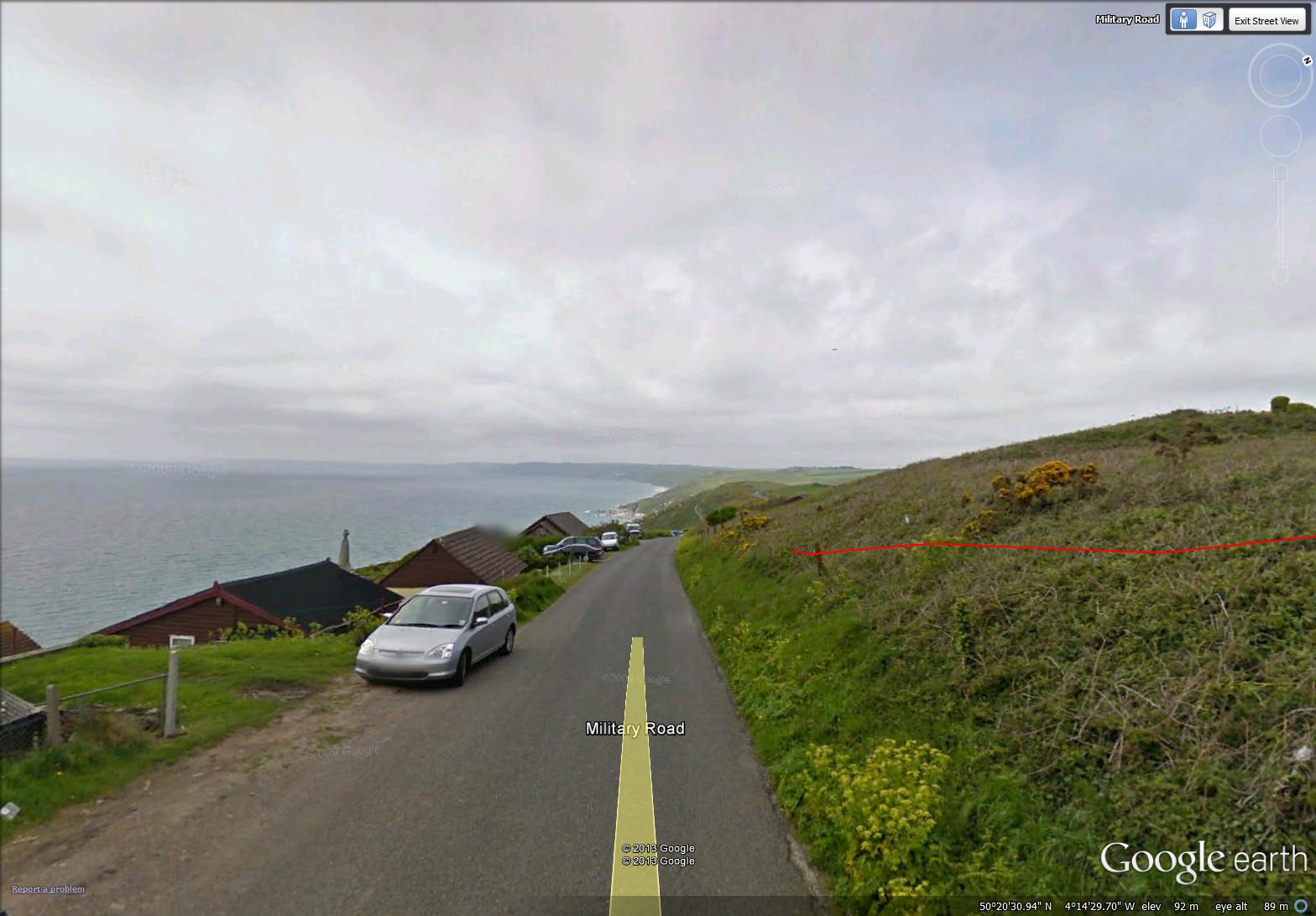
a view of houses along the road (image from Street View)
~
The cottages were small, not much bigger than our own cabin …
~

cabins overlooking the ocean (image from Street View)
~
Best View: acres of Gorse along the road …
~
a ‘learning-watercolor’ note: the first painting below was done on 140 lb paper made for watercolor. The second painting was done on sketch paper of much lighter weight. The second painting is wrinkled (see dark shadows in the left and right margins). This is called ‘cockling’ and can be prevented by stretching lighter papers before painting. I tape the edges of my paintings on a hard surface prior to painting.
~
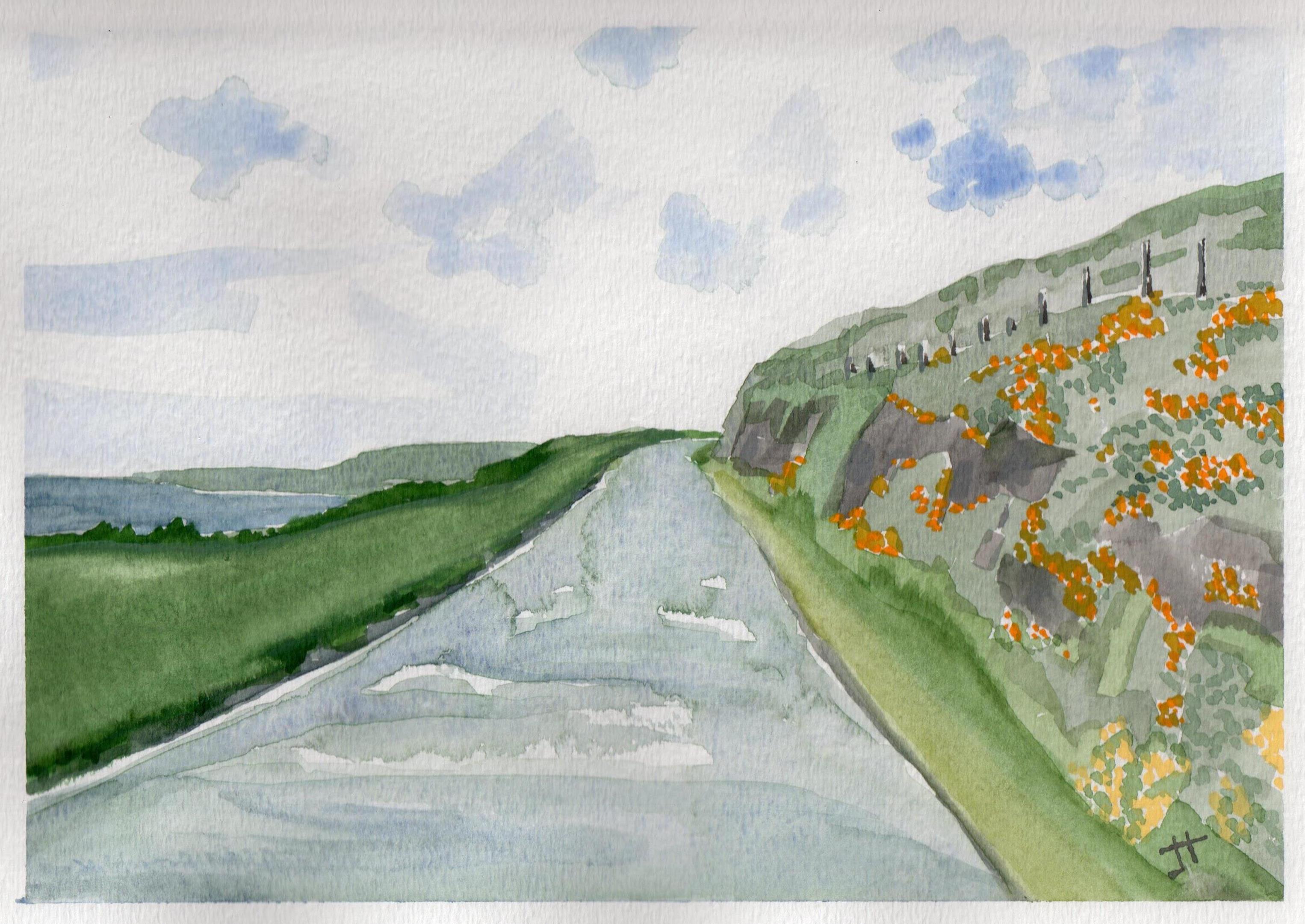
July 3, 2013 “Military Road, Cornwall coast’ Jane Tims
~
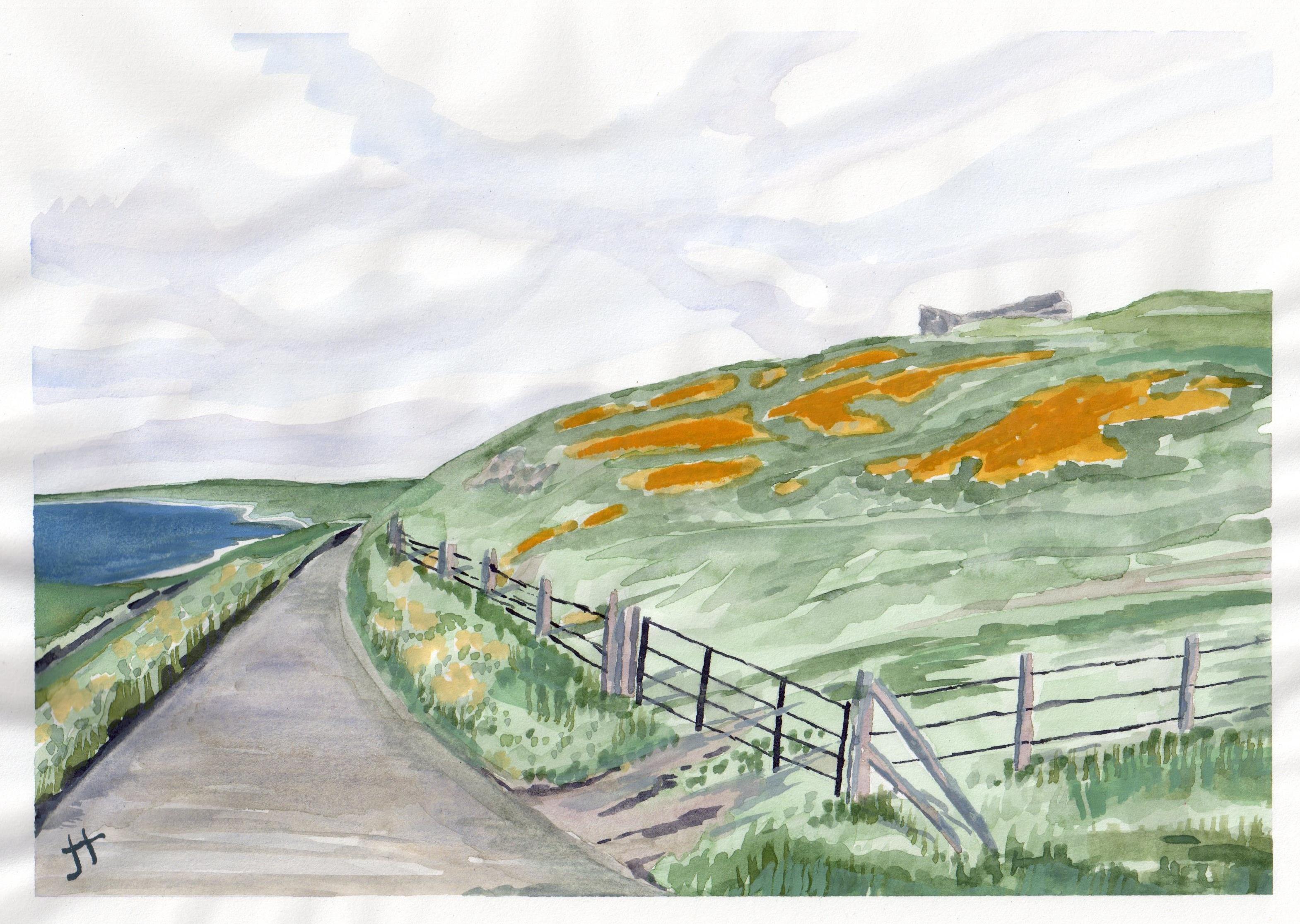
July 3, 2013 ‘Gorse’ Jane Tims
~
Copyright 2013 Jane Tims
along the Cornwall shore 7-1
After completing my virtual bike journey through central France, I was faced with a decision …. where to go next? I considered all sorts of places, but the winner has been the setting for some of my favorite literature … the Cornwall coast of England.
A few minutes with Street View convinced me. Along the Cornwall coast are the ocean views I love, the rugged shoreline of Daphne du Maurier fame, the hilly countryside of southern England, and numerous opportunities for side trips to see farmsteads, churchyards and ruins. It was hard to settle on the 26 images that would take me through my first 30 minute virtual bike excursion. So hard, in fact, I selected 39 images for the first trip!
I decided to begin just west of Plymouth, and I plotted ten, 3 km trips to begin. Beyond that is a more than 300-km-distance around the entire Cornwall coast.
~

~

~
Today’s trip took me through the hamlet of Rame, along the Whitsand Bay of the Atlantic Ocean. The Street View image of the parking lot at Rame’s Head provides a view of 14th century Saint Michael’s chapel on a cone-shaped headland. The chapel is now derelict and is thought to be the site of a Celtic hermitage …
~

St Michael’s chapel is the tiny building on the cone-shaped hill at about 5 o’clock (image from Street View)
~
The first part of the trip took me past the Saint Germanus churchyard …
~
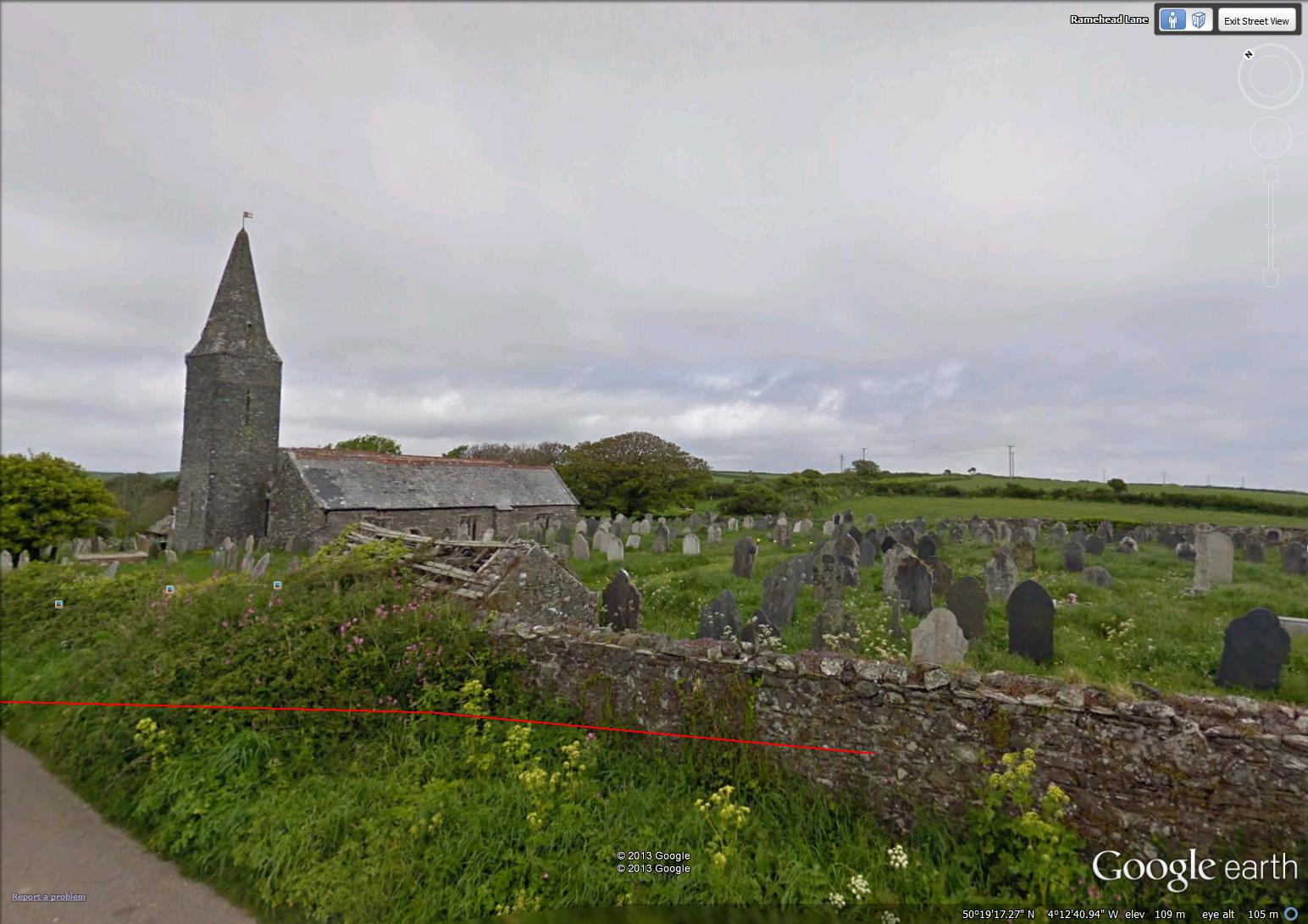
Saint Germanus churchyard (image from Street View)
~
The church was dedicated in 1259, on the site of an older building. In the church are pews surviving from the 16th century! Since there is no electricity or gas, services are by candlelight. I particularly like the lych gate in front of the church since my novel begins with my main character standing under a lych gate to keep dry from the rain. A lych gate is a covered gate – during a funeral, the body of the deceased person is carried through the lych gate on the way to the church …
~
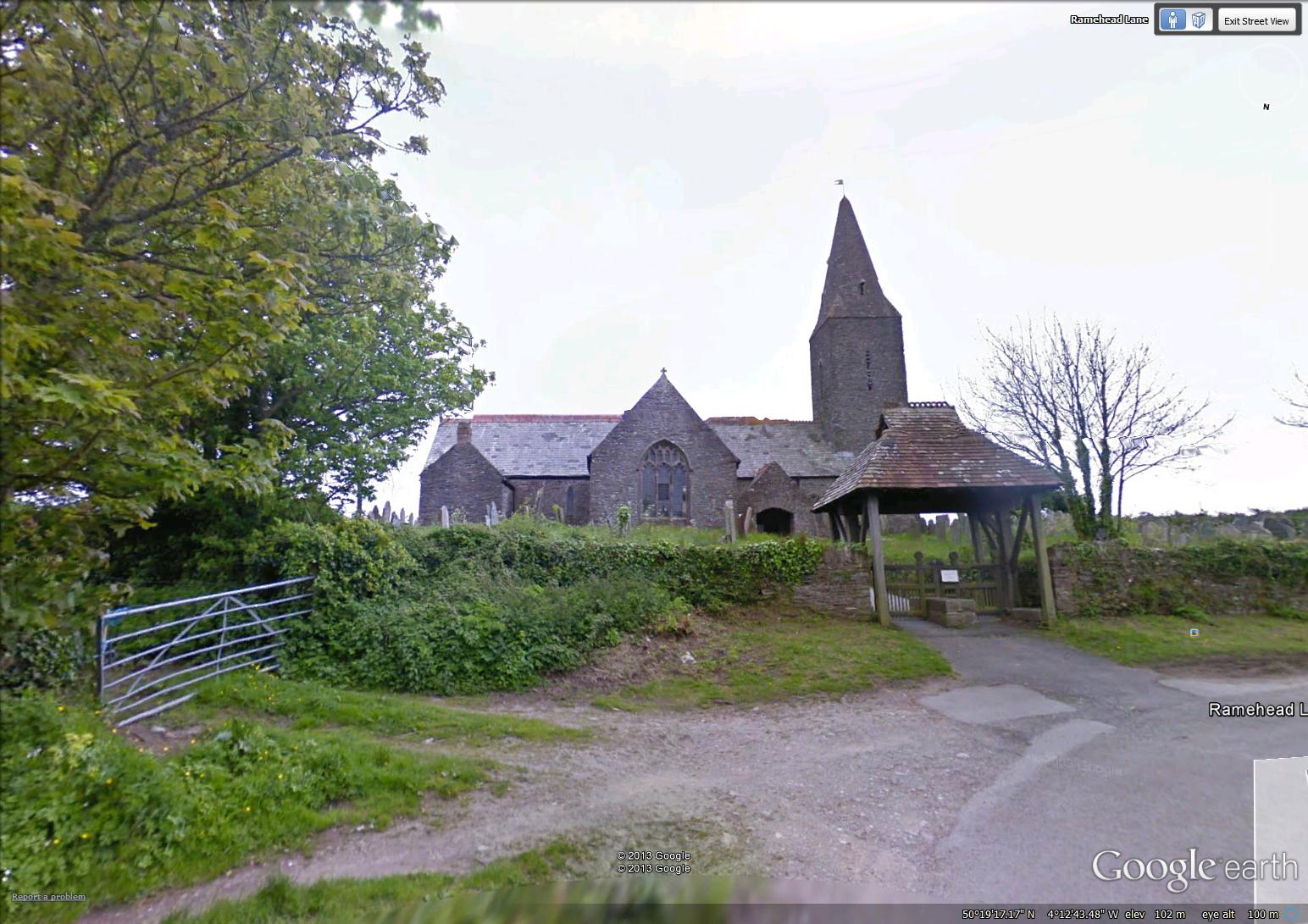
Saint Germanus church in Rame (image from Street View)
~
The next part of my trip was along the Military Road. This road runs along the coast on the high land. Other, narrower (!) roads run between the small communities closer to the coast. My guess is, this road was built as a way to patrol the coastline for military purposes …
~

Military Road near Rame – Gorse blooming along the road (image from Street View)
~
I enjoyed my visit with a herd of horses along the Military Road …
~

~
As I looked back along the road I’d just travelled (virtually), I was so glad I chose this as the next stage of my exercise scheme …
~
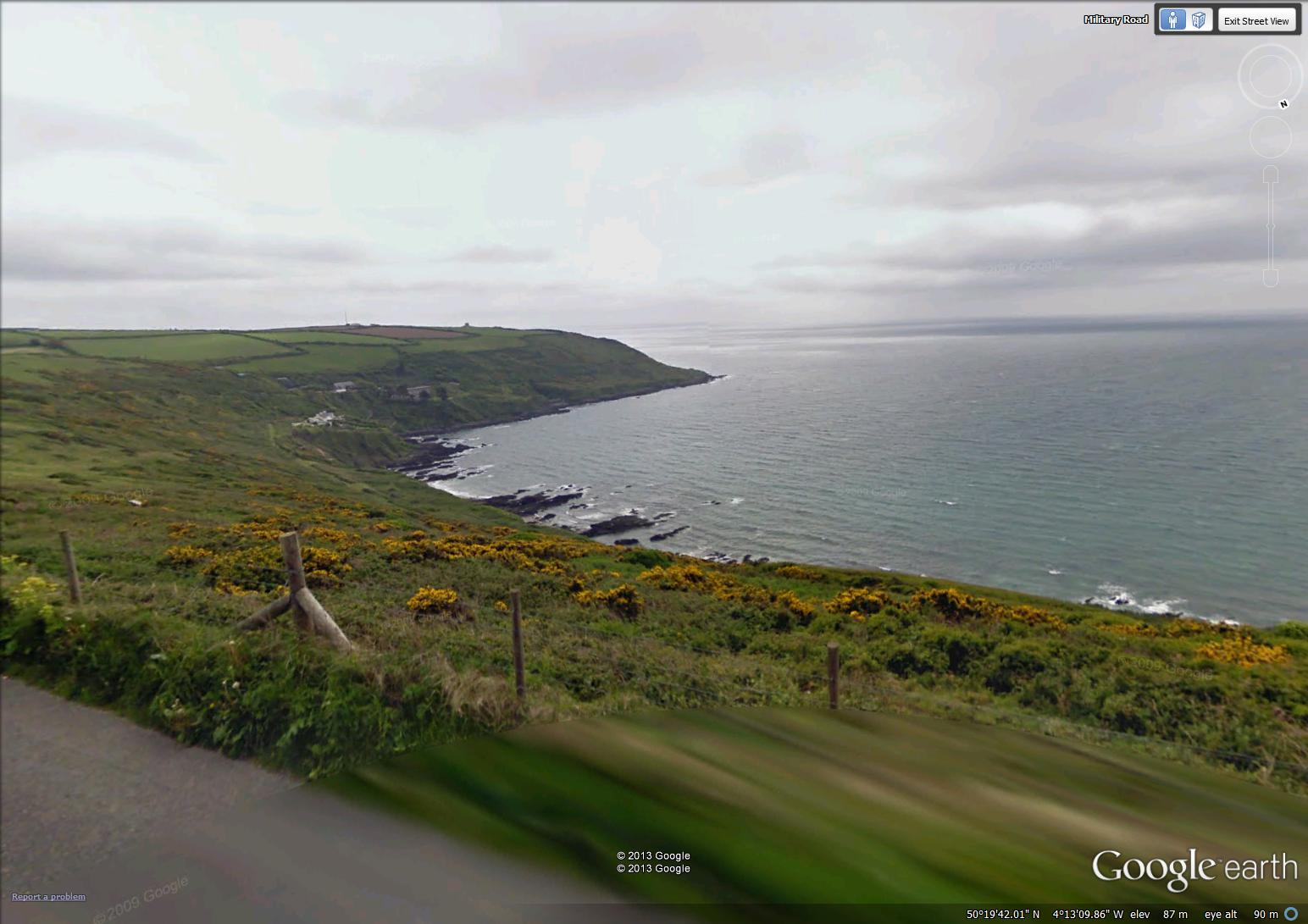
~
Best View: so many to choose from! I liked a view of lilacs in the yard of a house near Rame …
~

July 1, 2013 ‘Lilacs near Rame’ Jane Tims
~
Copyright Jane Tims 2013




 nichepoetryandprose