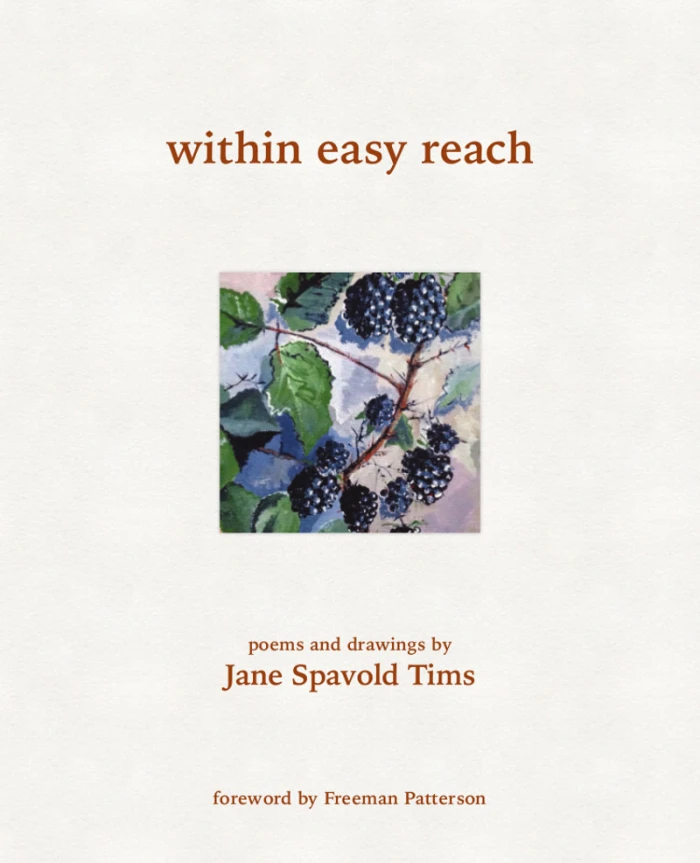
‘within easy reach’ – a painting for the front cover
As the release date for my book of poetry ‘within easy reach’ draws near, I have been doing some painting.
~
I began my project ‘growing and gathering’ and the poems for my book ‘within easy reach’ after my husband and I discovered blackberries on our new property at the lake. For this reason, blackberries seem a fitting subject for a cover painting.
~
I think blackberries are fun to paint:
- a basic berry-shape of Payne’s Grey
- a highlighting of each seed in the drupe with Payne’s Grey mixed with Titanium White
- a spot of white to highlight berries on one side of the drupe
- a background of blues and purples to simulate the shadow in the thicket
- leaves and a stem
~
This is my ‘practice painting’, in acrylics, 5″ by 10″.
~

~
I’ll be showing you the final cover painting soon – 10″ by 10″, a perfect shape for the cover of my book.
~
On a windy, wintery day, it is hard to be patient, waiting for blackberry season!!
~
Copyright Jane Tims 2016
in the shelter of the covered bridge – manuscript completed!!

~
Last year, in the competition of April 1, 2015, I was awarded a Creation Grant from artsnb (The New Brunswick Arts Board). The award was to create a manuscript of poems about plants and animals living in the shelter of covered bridges in New Brunswick.
I have now completed the manuscript and am ready to submit my final report. During the project I visited 28 covered bridges in the drainage basin of the Saint John River and 5 in Charlotte and Westmorland Counties. I was also able to use the notes and records from my visits to some covered bridges in 1992.
~
The final manuscript includes 81 pages, 8 new drawings, and 63 poems, organised into five themes:
liminal spaces – 8 poems about bridges as places of transition and change
notch of a lily pad – 10 poems about the covered bridge as habitat
grit of a blade – 9 poems about engravings and graffiti produced by human visitors to the covered bridge
a blade of grass between thumbs -10 poems about mysterious discoveries in covered bridges
heads of timothy – 6 poems about encounters at the bridge
gaps between boards – 10 poems about deterioration and loss due to vandalism, fire and flood
a loose board rattles – 10 poems about the sounds resonating in a covered bridge
~
Many thanks to artsnb for helping me in the making of the manuscript and for the chance to undertake such an enjoyable project!
~

Copyright 2016 Jane Tims
edible wild – spruce gum
In my part of North America, we have freezing temperatures and snow on the ground from December to March. With a few exceptions, most plants go into sleep mode during these months and foraging for edible plants is difficult. You can dig beneath the snow to find a few evergreens, but most of the edible wild is above ground.
~

~
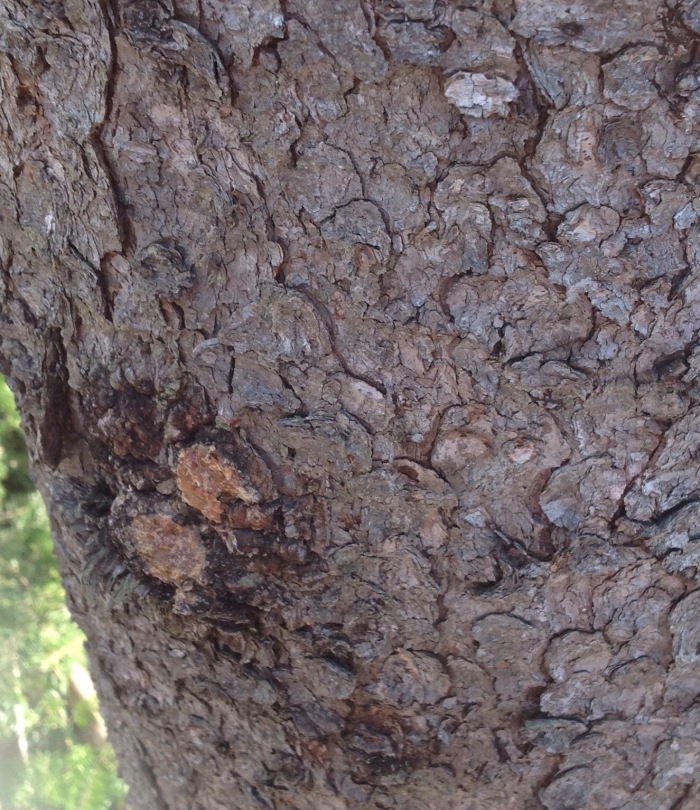
When I am in the woods, even in winter, I am always on the look-out for spruce gum, a natural sugar-free treat from the forest. Spruce gum is found, as the name suggests, on spruce tree bark. We have a large stand of spruce in our grey woods, but the tree below grows, conveniently, beside our driveway. For a map of our woods, see the right hand column ‘map of the grey woods’.
~

~
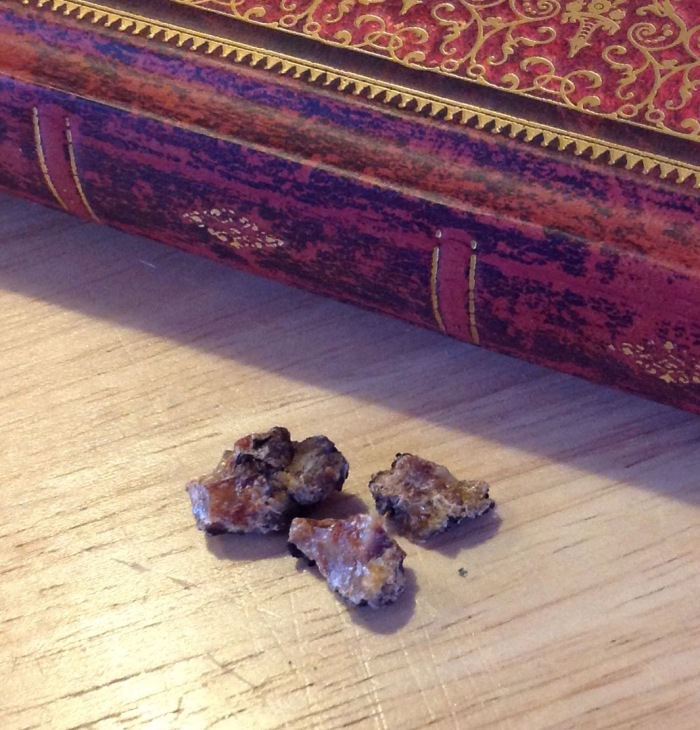
When a branch is broken or the bark is wounded in some way, the spruce oozes a sticky resin that eventually dries to a hard amber-coloured nodule. These nodules can be harvested and chewed like gum. My mom taught me about spruce gum, how to identify the spruce tree and to look for the sticky dark lumps where resin is hardening.
~

~
It is possible to collect a quantity of spruce resin, pulverize, melt and strain the substance, and solidify it, cracking it into bite-sized pieces. I chew the nodules right from the tree, with a little scraping to get rid of any rough bits. At first the gum is hard and crumbly, sticky and intensely aromatic, a little risky for dental work and made interesting by the accidental inclusion of bark bits. After a few minutes of chewing, the gum becomes pliable, woodsy-tasting and orange to pink in colour!
~
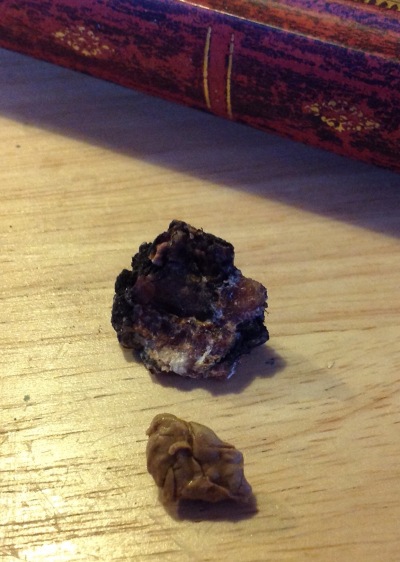
photos of chewed gum are a bit disgusting, but I want to show what normal-looking gum a two-minute chew produces. A rough nodule is shown above the chewed gum for comparison.
~
People of the First Nations have always known about this woodland edible and used it for medicinal purposes. In the nineteenth century, spruce gum was harvested with long handled spruce scrapers and sold commercially. Woods-workers made small carved boxes with sliding tops (gum books) to carry and store the resin nodules.
~
Robert Frost, wonderful poet of all things rural, wrote about spruce gum (‘The Gum Gatherer’. Mountain Interval. New York: Henry Holt and Company, 1916):
He showed me lumps of the scented stuff
Like uncut jewels, dull and rough …
~
You can find the rest of the poem at Project Gutenberg http://www.gutenberg.org/files/29345/29345-h/29345-h.htm
~
~
My upcoming book of poetry within easy reach includes a poem about spruce gum. The poem begins:
Black Spruce weeps if wounded
oozes to heal, embeds
pain in amber …
~
As I wait for spring, I intend to ration my small store of spruce gum and use it as a kind of countdown toward the end of our winter weather.
~

some very clean seeps of resin – these will harden eventually and make great spruce gum !
~
~
Copyright 2016 Jane Tims
‘within easy reach’ – why did I write these poems?
Later this spring I will have a book of poems and drawings in publication – ‘within easy reach’. The poems and art in the book are about gathering local, mostly wild, foods. I have been fortunate to work with a wonderful publisher, Chapel Street Editions, interested in books about the natural history, human history, and cultural life of the St. John River Region of New Brunswick, Canada. http://www.chapelstreeteditions.com/about_chapel_street_editions.html
~
As a botanist, I loved making this book. Identifying plants is a skill learned in university and during years of enjoying the out-of-doors. Many of the plants are found on my own property, but my husband and I travelled throughout the region to find some species. We found edible trout lily along the banks of the Dunbar Stream, salty orach on the beaches of Saint Andrews, and dangerous-to-eat water dragon in a wetland on the Renous highway. On our own property we tried to out-smart the squirrels for hazelnuts, tapped twelve trees for maple syrup and discovered partridge berries growing in the woods behind our house. As you can see, part of my enthusiasm for the subject is about spending time with my husband!
~

~
I also did a little time-travelling to write these poems. Although most of the plants I write about are found in the St. John River Region, I looked into my own past to remember some edible plants in other parts of Canada. This included eating cactus berries on the Alberta prairie, buying cloud berries from children along the Trans-Canada in Newfoundland, and picking blueberries with my Mom and Dad in Nova Scotia. I also looked to the diaries of my Great-Aunt to get a glimpse of the growing and gathering habits of an earlier generation.
~
I am sure many of my poems will echo memories of your own experiences with local foods.
~
Eating near to home has so many benefits – these foods are often free and have not travelled far to your table. Many wild foods go unharvested although they are ‘within easy reach’. Just think of those apples in the abandoned orchard at the edge of town, the dandelion greens on your brother’s lawn, or the choke-cherries growing along the fence down the road. Although you should use care when eating wild foods, many are easy to harvest and can add variety and taste to your meals.
~

~
In my next post, I’ll say more about why you might enjoy reading my book. And very soon, I’ll be starting a count-down on my blog to let you know how many days you have to wait until publication. I’ll have a contest and a give-away. Shameless self-promotion!
~
Copyright Jane Tims 2016
‘within easy reach’
This spring, I will celebrate the publication of my first book of poetry!
~
‘within easy reach’ is a result of my 2012 project ‘growing and gathering’ supported by artsnb (the New Brunswick Arts Board). The poems focus on harvesting and eating local foods, especially wild foods. My book will be published by Chapel Street Editions, Woodstock, New Brunswick.
~
The book will include about sixty poems as well as some of my black and white pencil drawings. These are poems about picking blackberries and blueberries, eating coastal favorites like goose tongue greens and samphire, buying smelts from a truck at the roadside and fishing for landlocked salmon. Every poem is based on a personal experience of harvesting and using local foods.
~
During the next few posts, I will tell you more about my book and its poems and drawings. I can’t wait to show it to you!
~

‘fiddleheads’ – a wild food eaten every spring in New Brunswick
~
Copyright 2016 Jane Tims
in the shelter of the covered bridge – a line of pigeons
~

~
keeping watch
~
Florenceville Bridge
~
~
pigeons swim through air
fill gaps on the ridge line
~
perch on the shingled roof
scrutinize the traffic
the squeeze of half-tons
on the bridge
the kissing of mirrors
~
pigeons quit the ridge, glide
to the shingled shore
~
river winds shiver
hawkweed and sumac, displace
blankets of wild cucumber, billow
the skirts and Tilley
hats of tourists
~
~
published previously in a post on September 11, 2015
~
Copyright Jane Tims 2016
in the shelter of the covered bridge – vantage point for planets
If there are clear pre-sunrise morning skies this week, we will be able to see a rare view of several planets in the morning sky – Mercury, Venus, Saturn, Mars and Jupiter. For a description of the event, see http://earthsky.org/astronomy-essentials/visible-planets-tonight-mars-jupiter-venus-saturn-mercury
~
Last year, on February 21st, we saw the conjunction of Mars, Venus and the Moon. On that evening, as my husband and I drove through our local covered bridge, we startled a hare. I will never forget its long-eared shadow as it fled the bridge. The conjunction of planets and moon, and snowshoe hare and truck, were inspiration for a drawing and poem …
~
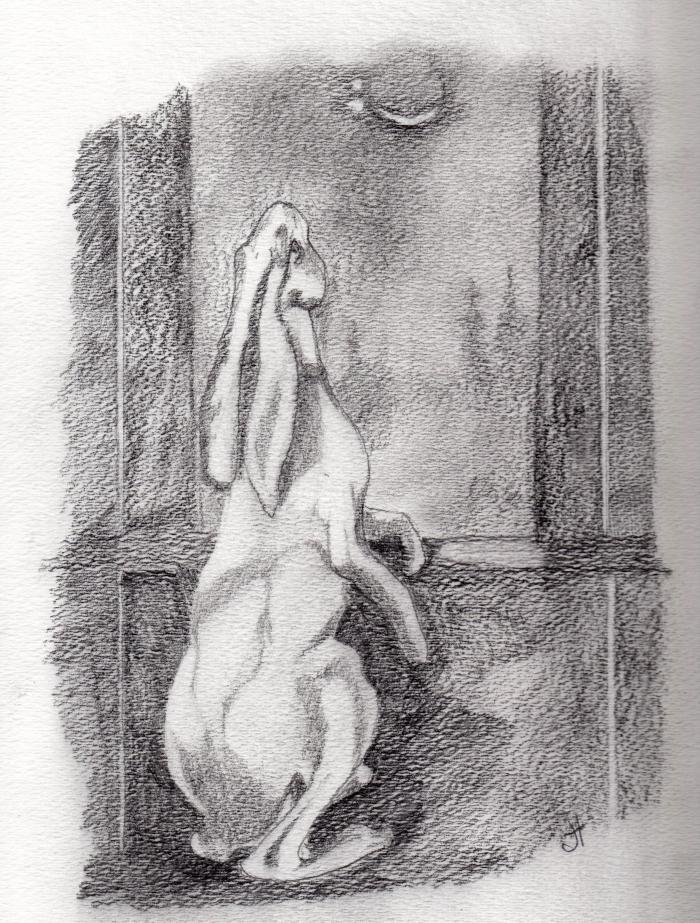
March 1, 2015 ‘conjunction’ Jane Tims
~
~
conjunction – February 21, 2015
~
Patrick Owens Covered Bridge
Rusagonis River #2
~
~
planet and moon light scamper
into crevasses in the covered bridge
Venus and Mars, chin velvet
and sickle of mid-winter moon
~
headlights of the half-ton enter
overwhelm planet shadow
startle a winter hare
erect on haunches, paw lifted
~
frosted by sky-gaze, worshiping
the sliver of moon, dismayed
at desecration, round glare
of the truck’s predatory eyes
~
fright to stop a heart
or flight to mobilize
hind- legs straighten
before fore-legs turn
~
and long ear shadows
quit the length of the bridge
ahead of whiskers, nose
and rabbit wisdom
~
~
previously published in a post March 2, 2015
~
Copyright Jane Tims 2016
in the shelter of the covered bridge – drawings
As I complete my manuscript of poems ‘in the shelter of the covered bridge’, I am also working on the drawings to accompany the text. I have made a list of the visuals presented in the poems, so I have a specific idea of what drawings I need. Many are completed since I have a large portfolio of bird drawings, for example …
~

~
Others are still to be done. This morning I completed a rather delicate drawing of the two kinds of roses growing beside the Darlings Island Covered Bridge and captured in my poem ‘tangle’.
~

~
I love to draw. For me, it is like watching a movie as I see my hand lay pencil marks on paper. It is not a calm activity. Perhaps because my hand and arm are moving, I get quite agitated when I draw and I imagine my blood pressure rising as the work progresses.
~
In order to have a body of work to choose from for the final manuscript, I aim to have more than forty drawings. I have completed nineteen. Lots to do !
~
Copyright Jane Tims 2016
gates and gateposts
Looking through my watercolours, I came across the painting below of a gatepost. I painted this during my virtual excursion through Cornwall, using Street View and Google Earth. The painting reminds me of how much fun I had, painting the scenes I discovered on my virtual journey.
~
I am still using Street View to motivate my exercise program – since last year, I have been following the Saint John River from its origins in Quebec and Maine. My goal is to ‘cycle’ the length of the Saint John River, all the way to where it empties into the Bay of Fundy.
~
Gateways mark change. They represent movement from one space to another. They can be entryways. They can also be barriers. The challenge is always to step through that gate and keep on going.
~

Oct. 4, 2013 ‘gate near Feock’ Jane Tims
~
through the gate
~
grey granite cold
black body to
absorb the sun
emit no warm
even lichens
rooted to stone
are barely alive
~
the stone invites
admiration
but curves disguise
the jagged edge
biotite and
muscovite honed
razor thin
~
step forward, through
the gate, ignore
the risk
the path behind
~
~
Copyright 2014 Jane Tims
local eating … sprout sandwich
Winter in New Brunswick – snow, frozen ground, temperatures far below zero. Not a time to be thinking about growing your own food? Not quite true!
~
Anyone can grow sprouts. I have a great sprouter, the 8 X 10 Sproutmaster from Sprout People.
https://sproutpeople.org/sproutmaster-8×10-tray-sprouter/
~
I have also used a one pint mason jar for growing sprouts. For me, a twice daily water rinse and careful draining is key to growing the best sprouts.
~
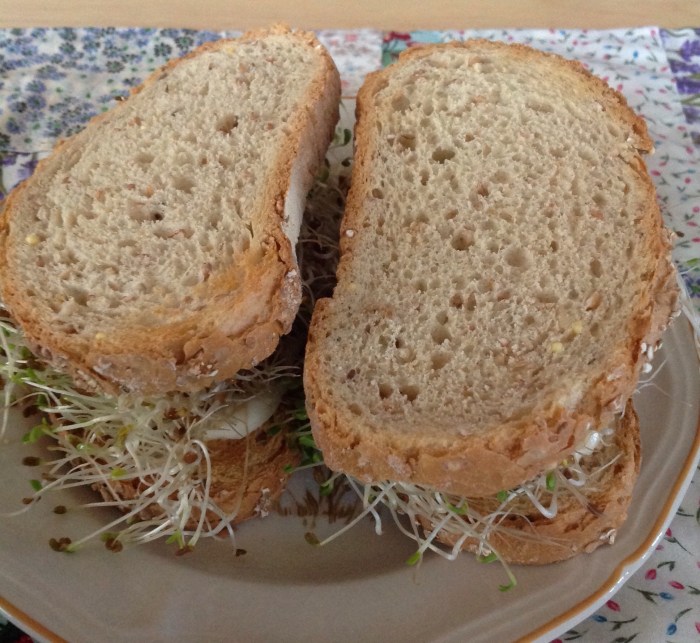
Today, I had a couple of sprout sandwiches for breakfast. Sprouted alfalfa, multi-grain bread from Real Food Connections in Fredericton, and mayo. Yum!
~
~
sprout sandwich
~
sprouts peek
between sheets
of whole wheat
green baby beaks
~
stems tickle lips
as though I kissed
a man with a mobile
mustache
~
satisfying crunch
crisp bunch
of alfalfa
delight
~
green and white
and mayo
daub of mustard
sprig of thyme
~
a sprinkle
from my stash of seed
a little time
sprouts did all the work
~
swell, burst seed coat, grow
rinse, dry , fluff
pluck and toss
and wow! what a kiss!
~
~
Copyright 2016 Jane Tims




 nichepoetryandprose