‘within easy reach’ – a chance to win the cover art
This is reminder that I am offering a chance to win the painting on the cover of my book ‘within easy reach’.
~

~
To win this painting, you have to do three things.
- Purchase my book through my publisher’s website (www.chapelstreeteditions.com)
- Leave a comment on any of my Blogs (www.nichepoetryandprose.wordpress.com or www.janetims.com or www.janetimsdotcom.wordpress.com) with the words ‘within easy reach’ somewhere in the comment
- Be prepared to send me, via email, a scan of your purchase receipt.
~
The cover painting ‘brambles’ is done in acrylics, size 10″ by 10″, with gallery edges.
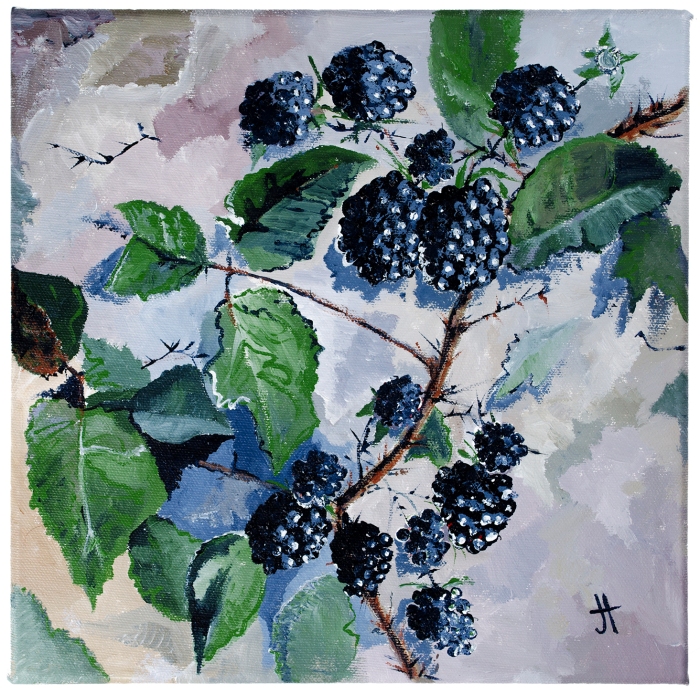
February 29, 2016 ‘brambles’ by Jane Tims
~
Your name will be entered once for each book purchased. The contest will run for the first five weeks following the publication date of within easy reach (until June 7, 2016). At the end of the contest, anyone who has purchased a book from the publisher and left the comment as described above will be entered for the draw. I will notify the winner and let the readers of the blog know who has won.
~
I hope you will enjoy my book. And some reader will be the winner of the painting ‘brambles’!
~
Copyright Jane Tims 2016
old schools in the landscape
In my last few posts, I have focussed on my research toward a new poetry project I will be beginning. I know there are interesting stories to be told about the ‘inside’ of the one room school. Because of my interests in botany and community history, I would like to reflect on the ‘outside’ of the one room school – its surroundings and geographic location.
~
I still have to do some thinking about this project. I know that people who attended one room schools will have stories to tell about how the local terrain and landscape influenced their schooling.
~
A school’s surroundings would have impacted learning in many ways. For example, the view of a lake from the school window may have caused many a pupil to settle into daydreams. Interesting fields, hills, and watercourses would provide the teacher with opportunities for nature study.
~
The location of the school would also influence recess and lunch-time activities. My Dad wrote about damming a local stream so they could skate in the winter months. The same stream meant fishing in May and June. A nearby hillside would be great for sledding in January and February. Trees in the school yard? – A place to climb or to hang a swing.
~
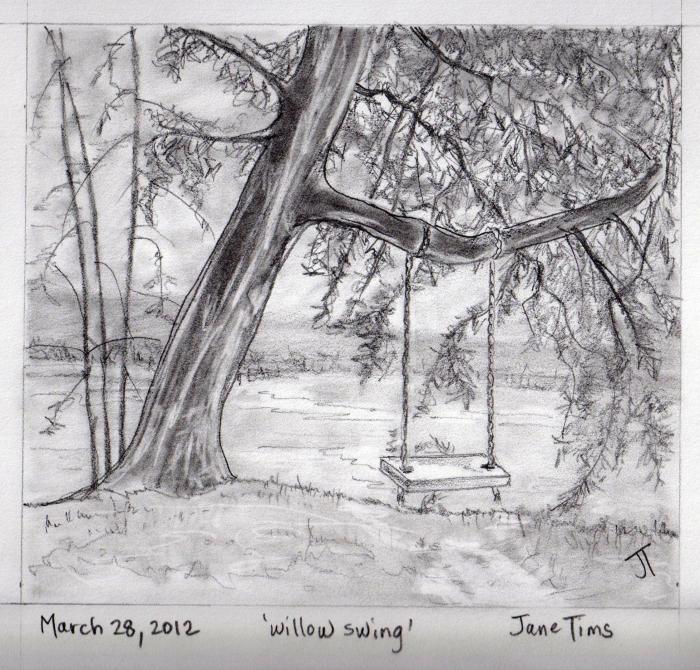
~
Students walked to school before the 1950s. The study I made of schools in Upham Parish, New Brunswick suggests that students walked as many as three miles to school in the late 1800s. Hills made the long walk to school more difficult. The winds by a lake or other shore land would be bitter on a winter day. Rivers, lakes and wetlands meant a place to hunt tadpoles. A spring by the road? – A cool drink. My Uncle, forced to wear a hat/scarf he hated, used the bridge on the way to school as a place to hide his headgear!
~
One room schools were located near clusters of houses and various community activities. The walk to school may have passed a church, a post office or a community store. Hardwood forests meant lumber mills and, in spring, maple syrup and the sugar shack. Good land meant farms; grazing land meant cows to outstare.
~
On a drive last weekend, we found an older building along the Saint John River that may have been a school. The Upper Queensbury Community Hall has all the characteristics of a one room school – the steep roof, rectangular footprint, and tall side windows.
~
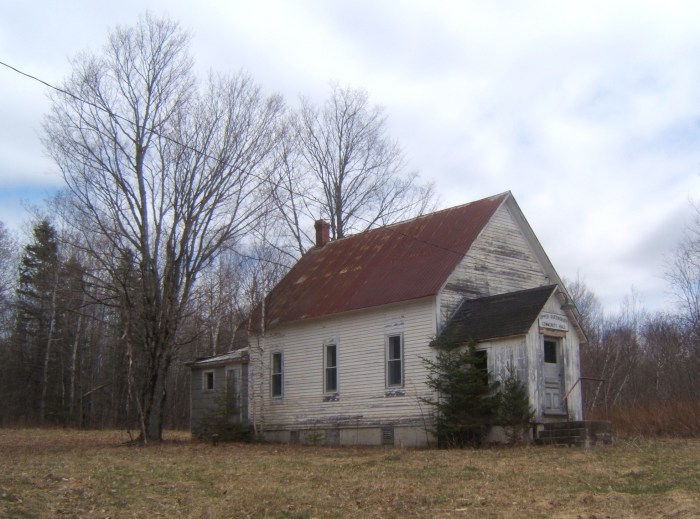
Upper Queensbury Community Hall near Nackawic, New Brunswick. I will have to make some inquiries to find out if it was a school house at one time.
~
A look at a map shows some of the landscape features in the area.
~

Map showing landscape features of part of Queensbury Parish, near Nackawic, New Brunswick. The yellow dot is the location of the Upper Queensbury Community Hall which may have been a one room school.
~
The Saint John River was nearby, although further than it is today since the Mactaquac Dam (built in 1968) has raised the level of the water. The river’s possibilities for fishing, skating and boating were only a downhill trek away. The terrain is gently undulating, as the names of nearby communities (Day Hill and Granite Hill) suggest. Local geographic points the community children may have known include the many-tiered Coac Falls and Coac Lake (an old road runs past the community hall back through the woods to the lake, about a mile away). The aerial photo (taken near the end of September) shows the red of the cranberry bog – picking cranberries may have been a well-known activity. Sugar maples are common in the area, as are old ‘sugar shacks’. When I interview people who went to the one room school I will have to remember to ask them about their memories of these places.
~
Writing poetry about these ideas will be so much fun!
~
~
Copyright 2016 Jane Tims
early schooling – the fate of older buildings
Since our first drive to the Grand Lake area to find old schools in the landscape, we have kept an eye out for others. I am realising these buildings have met one of three fates:
- demolition – lost forever to the landscape
- deterioration – left to decay and eventual collapse
- re-purposing – restoration and maintenance for use as camps, sheds or community use
~
For example, the Bunker Hill School in Rusagonis, New Brunswick has been well maintained and is used as a meeting place in the community. The old school has been recently painted and has a wheel-chair ramp.
~
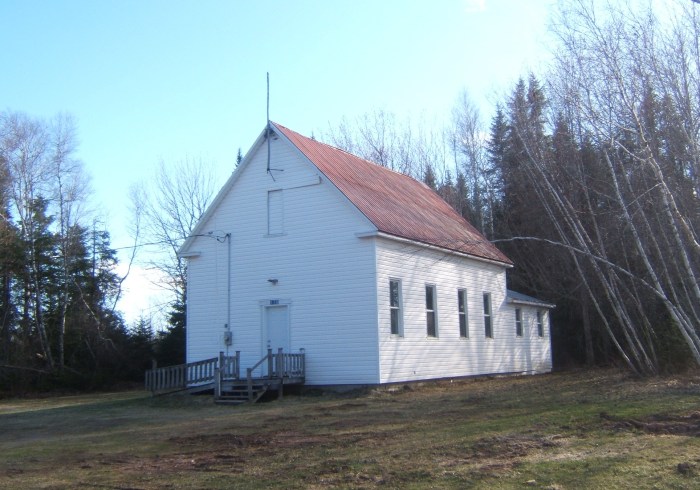
Bunker Hill School, Rusagonis Station, Sunbury County, New Brunswick
~
The conservation of older buildings in the landscape is problematic. They have historical value, create community character, and serve as a reminder of the past. On the other hand, for derelict buildings without purpose, liability soon exceeds value. We are at a time in our history when the buildings associated with growth in the late 19th and early 20th centuries are succumbing to the vagaries of time. Older designs, although often sturdy, are not energy-efficient and don’t always fit our modern ideas of efficiency and convenience, or our 21st century need for parking areas, central heating, and convenient washrooms. As a result many older buildings, including churches, schools, halls and stores are lost from the landscape.
~

old school at Mill Road, near Gagetown, Queens County, New Brunswick (Verified as Lawfield School, Gagetown #1)
~
Do you have older school buildings in your community and what has been/will be their fate?
~
Copyright 2016 Jane Tims
early schooling – what to do at recess
When I was young, recess was a big deal. You had to take a treat to eat and something for play. In Grade Three, tops were all the rage. My Dad made me a top from a wooden spool and we painted it in a rainbow of colours. I can still see it spinning on the concrete step. We also played hop-scotch, ball games like Ordinary Secretary, marbles, skipping and tag.
~

April 30, 2016 ‘top made from a wooden spool’ Jane Tims
~
I am lucky to have some of my Dad’s writing about his early years and his experiences in a one room school. He went to the Weaver Settlement School in Digby County in Nova Scotia in the late 1920s and early 1930s. He tells about some of the activities at the school, especially at recess. Fishing was popular, as well as playing ball and trading jack knives.
~
… There was a well out beside the school and it was a good appointment to take care of the water-cooler for a day of a week … Gave a student time off from books…
~
… There was a brook nearby … In fall we usually built a dam so the brook became a pond for winter … A place to skate or just play on the ice …every moment of recess and noon was spent there …
~
… The big contest was ‘who comes to school first in bare feet ’ … Our parents had control, not full control as there were hiding places for shoes and stockings along the way to school …
~
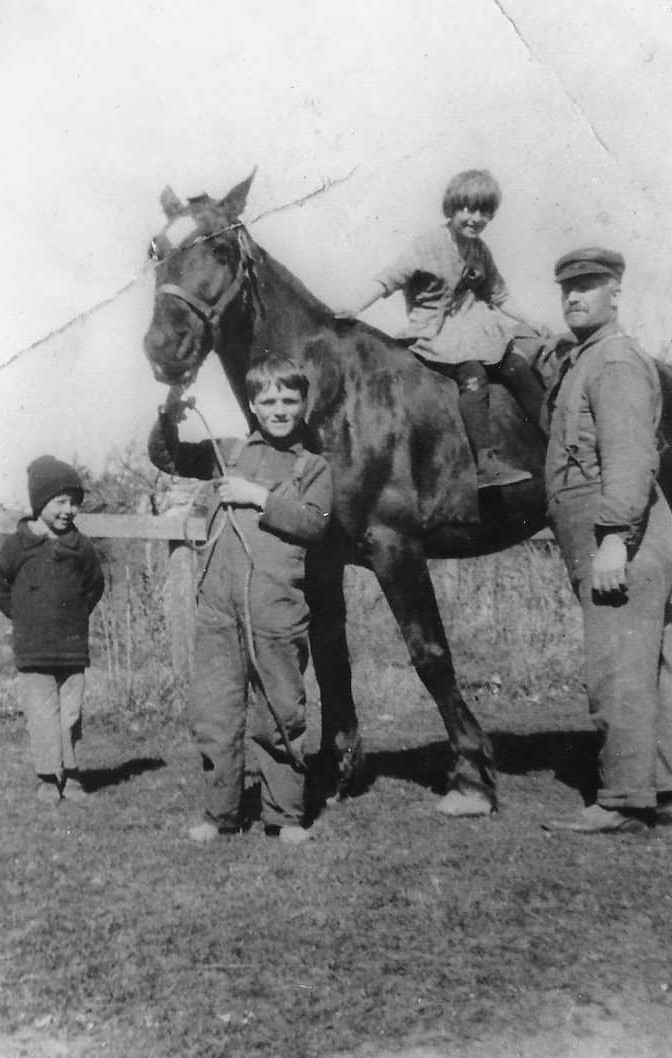
Dad with the family horse Goldie in about 1930
~
I am certain recess is still a favorite time for school kids – time to talk with friends, play games and get a little break from the classroom. I think we could all build a little ‘recess’ into our busy lives!
~
Copyright 2016 Jane Tims
my poetry book – within easy reach
My new book, within easy reach, is now available.
~
I would like to thank you, the readers of my blog (and my Facebook and Twitter friends), for all your interest and support since I began my blog in 2012! The blog has helped me along the way, developing ideas for my projects, giving me a place to try my poems on a reading audience and giving me a chance to read some beautiful poetry on the blogs I follow. I also love your ‘likes’ and comments.
~
I hope you will buy my book and enjoy reading my poems and seeing my drawings.
~
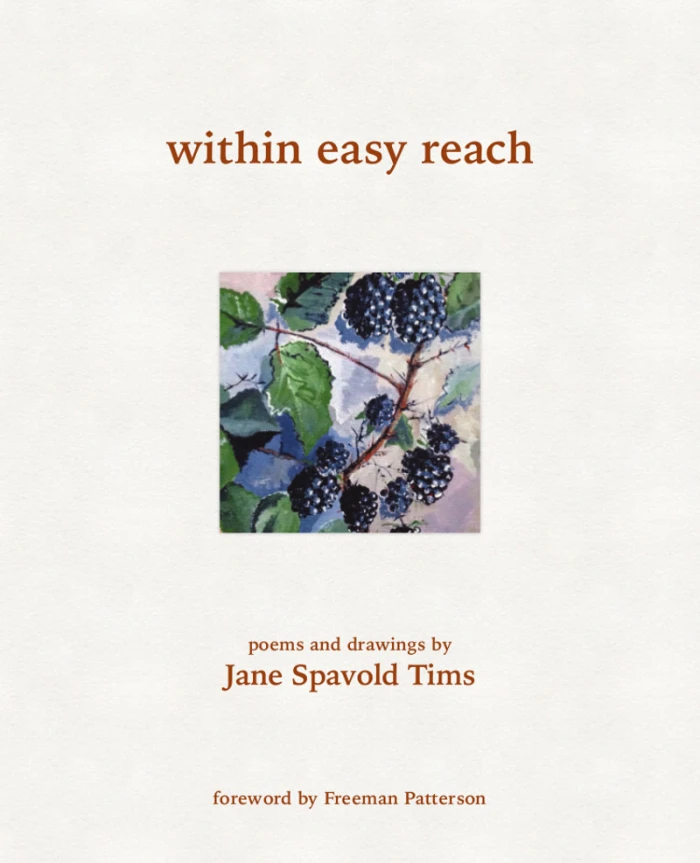
For the readers of my Blog, I am offering a chance to win the painting on the book’s cover! My painting ‘brambles’ is painted in acrylics, size 10″ by 10″, with gallery edges. The painting is from a photograph of the blackberries growing on our lake property, the berries featured in the poem ‘berries in brambles’, one of the poems in the book.
~
February 29, 2016 ‘brambles’ by Jane Tims
~
To win this painting, you have to do three things.
- Purchase my book through my publisher’s website (www.chapelstreeteditions.com)
- Leave a comment on any of my Blogs (www.nichepoetryandprose.wordpress.com or www.janetims.com or www.janetimsdotcom.wordpress.com) with the words ‘within easy reach’ somewhere in the comment
- Be prepared to send me, via email, a scan of your purchase receipt
~
Your name will be entered once for each book purchased. The contest will run for the first five weeks following the publication date of within easy reach (until June 7, 2016). At the end of the contest, anyone who has purchased a book from the publisher and left the comment as described above will be entered for the draw. I will notify the winner and let the readers of the blog know who has won.
~
I hope you will enjoy my book. And some reader will be the winner of the painting ‘brambles’!
~
Copyright Jane Tims 2016
early schooling in New Brunswick – teachers in 1888
In my family, teaching was a much-revered profession. Both Mom and Dad were teachers, as were my Aunt and Uncle. Mom, and my Aunt and Uncle, taught in one room schools. Mom began teaching in the early 1940s, when she was only 16, just after her graduation from Grade Twelve. At first, she taught with a temporary teaching licence issued during the Second World War. Later she went to Normal School to obtain a permanent licence.
~
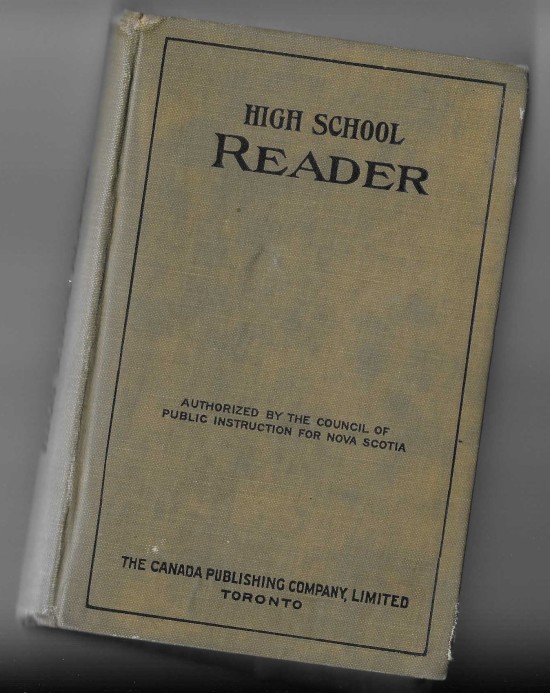
a copy of the reader my Dad used in High School in Nova Scotia, about 1933 (High School Reader, 1913)
~
To learn a little about teachers in one room schools in the late 1800s, I have continued to read the Annual Report of the Schools of New Brunswick, 1888 by the Chief Superintendent of Education. In 1888, teachers in New Brunswick were trained in the Provincial Normal School. Of the 1,582 teachers, 1,534 were trained and 48 were untrained. Teachers, depending on qualifications, were in three classes: I, II and III.
~
In 1888 in New Brunswick, there were many more female teachers than male:
| Class | #Male
Teachers |
# Female
Teachers |
| I | 114 | 141 |
| II | 157 | 644 |
| III | 108 | 404 |
~
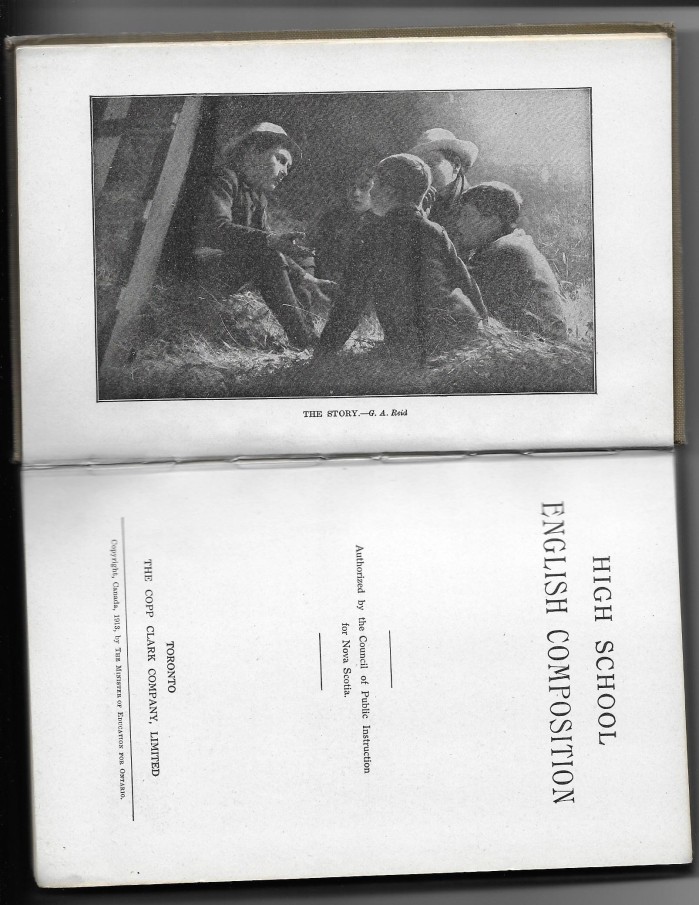
High School English Composition, 1913
~
The salary of a teacher in 1888 was certainly small compared to today! The average yearly salary for teachers in New Brunswick in 1888 was lower for female than for male teachers:
- male teachers $536.90 (First Class) (average salaries for the three Classes ranged from $231.00 to $536.90)
- female teachers $328.49 (First Class) (average salaries for the three Classes ranged from $187.47 to $328.49)
~
The Superintendent does not mention the inequity in pay for male and female teachers. He focuses on a decrease in pay from 1888 to 1889, criticizing the government for not being more generous to teachers. His worry was that teachers would not stay in the profession if salaries were too low.
… it is an ill-advised economy that seeks to maintain on the scantiest allowance a service which is essential to the preservation of order and the strength and progress of a country.
~
The budget for all schools in the Province in 1888-1889, from provincial, federal and district sources, was $404,145.00 (not including building and property costs).
~

two of the old school books in my collection: Nova Scotia Readers, 1911 (used in Nova Scotia) and The Canadian Readers, 1924 (used in Alberta)
~
Copyright 2016 Jane Tims
update: ‘within easy reach’
The date for the release of my poetry book ‘within easy reach’ is very soon! The book includes my poems and drawings about edible wild plants and other local foods. It will be available through my publisher Chapel Street Editions and through Amazon. I’ll be posting details of how and where to order the book and information on where I will be reading during the next weeks.
~
During the first month of ‘within easy reach’ book sales, I will be offering you an opportunity to win the painting on the front cover of the book. The painting, called ‘brambles’, measures 10″ by 10″. It is done in acrylics and has gallery edges.
~
I will post the details about how to get a chance to win the painting within the next few days.
~
February 29, 2016 ‘brambles’ Jane Tims
~
I hope you will love my book, as much as I loved creating the poems and drawings!
~
Copyright 2016 Jane Tims
early schooling in New Brunswick and Nova Scotia – including nature study
Of all the classes given in 1888 in New Brunswick, I would have liked ‘Useful Knowledge’ the best. This is where I might have learned about birds and plants and butterflies.
~
Bringing ‘Useful Knowledge’ into the classroom may have been a greater challenge than it appears. The focus was on the three R’s (reading,’riting, and ‘rithmetic) and scarce resources meant less time for ‘frivolous’ subjects. In the neighboring province of Nova Scotia, educators faced a challenge when they tried to bring studies about the out-of-doors into the classroom. The situation in New Brunswick would have been similar.
~
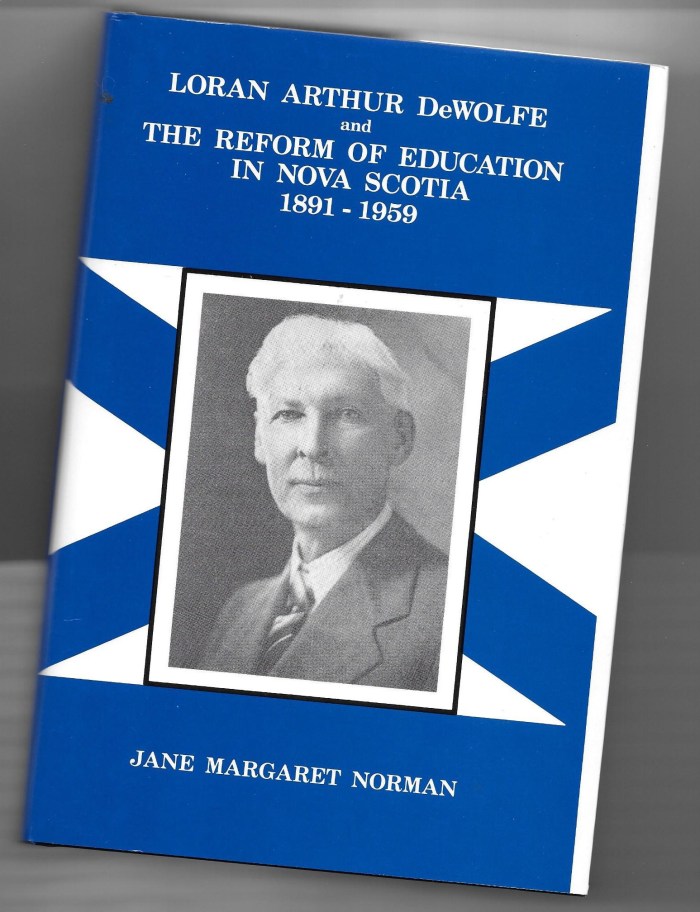
In her book Loran Arthur DeWolfe and The Reform of Education in Nova Scotia 1891-1959 (Truro, Nova Scotia: Atlantic Early Learning Productions, 1989), my aunt, Dr. Jane Margaret Norman described the situation in the late 1800s and early 1900s in Nova Scotia. Dr. DeWolfe, Director of Rural Science Schools in Nova Scotia from 1913 to 1924, focused on including studies of nature and in particular agriculture in the schools. These were times of rural out-migration – interest in staying and working on the family farm paled in comparison to the adventures promised by leaving for the west. Dr. DeWolfe was convinced that the only way to keep people in rural areas was to interest them, from the start of their education, in the world of nature.
~
~
His solution was to include in the curriculum ‘field days’, ‘spring gardens’, folk dancing, lessons in canning food, ‘Planting Days’, and school fairs. My dad, who would have attended elementary school in the late 1920s, remembered Dr. DeWolfe visiting his school in rural Digby County. He told my aunt that Dr. DeWolfe “… always had something to say about nature.”
~
My dad as a boy (holding the horse Goldie). Dad grew up in a rural area and attended a one room school. He remembered Dr. DeWolfe’s visits to that school and his emphasis on paying attention to the out-of-doors. Dad became a teacher and, as my teacher in Grade Six, taught me about the solar system and the cause of our seasons. He also taught me how to make a whistle from a willow twig.
~
In New Brunswick, by 1888, ‘Useful Knowledge’ would have introduced many students in New Brunswick to nature studies. In rural schools (Ungraded Schools in Country Districts), the classes in Standard I (Grade 1) included ‘oral lessons on animals’ and, in Standard II (Grade 2) ‘natural specimens where possible’. Standard III (Grade 3) included ‘lessons on agricultural products of the district’, and Standard IV (Grade 4) studied ‘agricultural topics’ from Tanner’s First Principles of Agriculture. In addition to Tanner’s First Principles of Agriculture, Standards V and VI (Grades 5 and 6) used Bailey’s Natural History. Liberty Hyde Bailey (1858-1954) was a horticulturist, naturalist and advocate of nature study.
~
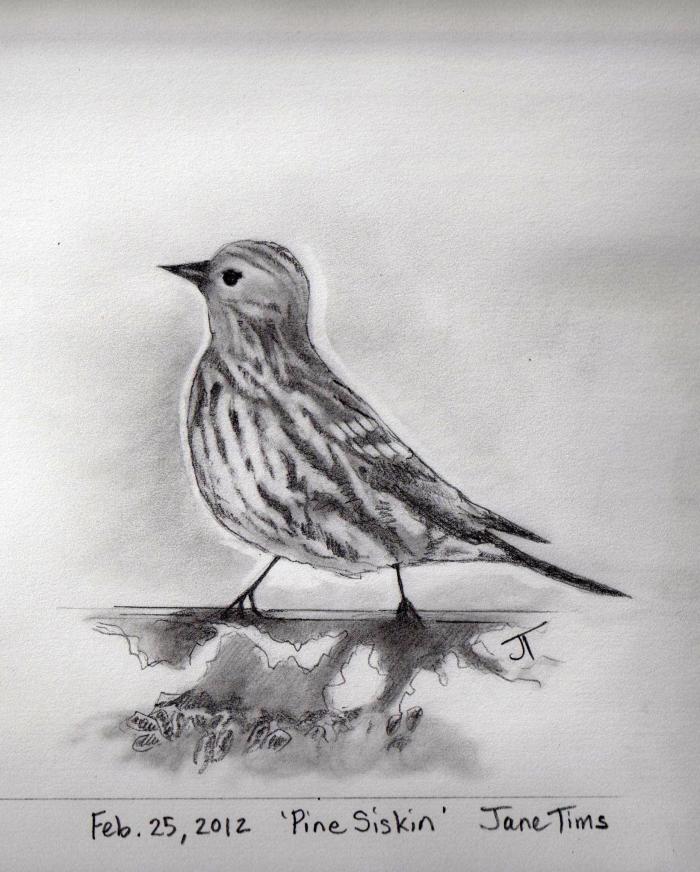
” … Stuffed birds do not sing and empty eggs do not hatch. Then let us go to the fields and watch the birds. Sit down on the soft grass and try to make out what the robin is doing on yonder fence or why the wren is bursting with song in the thicket. An opera-glass or spy-glass will bring them close to you. Try to find out not only what the colors and shapes and sizes are, but what their habits are … ” from the Birds and I , Liberty Hyde Bailey. http://libertyhydebaileyblog.blogspot.ca/
~
~
Copyright 2016 Jane Tims
in the shelter of the covered bridge – not a hummingbird

~
not a humming bird
~
Benton Covered Bridge
Eel River #3
~
wing blur in the lilac
threshold of the bridge
scent-thick and purple
invisible
~
hawkmoth
hummingbird clearwing
Hemaris thysbe
~
lilac thryse to lilac thryse
side-slip, hover
nectar thirst
fierce harvest
~
~
For more information on the hummingbird hawkmoth at the Benton Covered Bridge, see https://janetims.com/2015/06/10/in-the-shelter-of-the-covered-bridge-hummingbird-moths/
~
Copyright 2016 Jane Tims
passage of time
One of the poems in my new book within easy reach recalls a walk I took with my husband and our discovery of wild strawberries growing in profusion in a clearing in the forest.
~

~
~
Old Man’s Beard
~
Usnea subfloridana Stirt.
~
you and I
years ago
forced our ways
bent through the thicket
of lichen and spruce
~
Usnea
caught in your beard
and we laughed
absurd!
us with stooped backs
and grey hair?
~
found a game trail
a strawberry marsh
wild berries
crushed into sedge
stained shirts
lips
and fingers
strawberries
dusted with sugar
washed down with cold tea
warmed by rum
~
today
an old woman
alone
lost her way in the spruce
found beard
caught in the branches
and cried
~
~
Published as ‘Old Man’s Beard’, The Fiddlehead 180, Summer, 1994
Post also published at www.janetimsdotcom.wordpress.com
© Jane Tims 2016

Old Man’s Beard (Usnea) is a lichen found growing in coniferous woods. The common name comes from its matted, stringy appearance. Lichens are made up of two species, an alga and a fungus, living symbiotically.




 nichepoetryandprose