The Versatile Blogger
Hi. This will be a different kind of post.
I have been nominated for the Versatile Blogger Award.

I would like to thank the bloggers who nominated me:
www.clsostarich.com At ‘Its Real To Me’, C.L. features her poetry. She has a keen wit and her poems make me laugh and smile and nod my head. Her poem ‘Tree’ is worth a careful read … it speaks the truth at its core, as do all her poems. Awesome poet!
www.everedwater.wordpress.com At ‘Redwater Ramblings’, Eve Redwater features her poetry. Her poems are finely crafted, and get inside her subjects… her poem ‘Bird’ is one of the best I’ve ever read. She uses metaphor skillfully and has interesting ways with words and ideas to show us how her subjects move and feel and think. Awesome poet!
The Versatile Blogger Award nomination is a way to show others how much you appreciate their blogs and to make other bloggers aware of some really extrordinary work.
Rules for The Versatile Blogger Award.
1. In a post on your blog, nominate 15 fellow bloggers for The Versatile Blogger Award.
2. In the same post, add the Versatile Blogger Award logo.
3. In the same post, thank the blogger who nominated you with a link to their blog.
4. In the same post, share 7 completely random pieces of information about yourself.
5. In the same post, include this set of rules.
6. Inform each nominated blogger of their nomination by posting a comment on each of their blogs.
I would like to nominate the following 15 bloggers for The Versatile Blogger Award (in alphabetical order):
www.artboy68project.wordpress.com
www.carelesspigeon.wordpress.com
www.ellenolinger.wordpress.com
www.naturalsenseofwonder.wordpress.com
www.northpenninegallery.wordpress.com
www.portraitsofwildflowers.wordpress.com
www.rosannefreed.wordpress.com
www.sonyartchasey.wordpress.com
Here is a list of 7 random things to know about me:
- I am afraid of spiders, but I try to see things from their point of view.
- I have a collection of old litho prints of hunters at their campfires.
- My favorite film is ‘Fried Green Tomatos’.
- My favorite TV show ever was ‘LOST’ and I miss it so much.
- When I was a kid, I planted a pine cone under the outside water faucet and sat for an hour to see if it would grow.
- My very first poem at age six was about a brook near our cabin at Elkwater Lake, Alberta: “Down by our cabin/runs a little stream/and I love it better/than ice cream”
- I had both my Dad and my Mom as teachers in school, and they were both excellent.
Again, thank you to C.L. and Eve Redwater, as well as all those who read my Blog and who work so hard to make their Blogs enjoyable for others.
Jane
snow hollow at the base of a tree
Words are the tools of a writer’s craft. I literally wallow in words when I write a poem. Sometimes the right word comes immediately to mind. Sometimes I have to search for it, sometimes for days or weeks. When I do the final edits for a poem, I ‘press’ on every word, to make sure it is absolutely right.
Sometimes, I encounter an idea or image that seems to have no word. For example, I have searched for a word referring to the charming hollow that builds next to the base of a tree when the snow falls. Sometimes small animals use this hollow for a temporary den. Sometimes it’s a place where debris gathers, as it does in the corners of alleyways. Sometimes it is a calm, beckoning place where snow shadows rest in shades of olive green and blue.

I wonder if there is a name for these elusive places, perhaps in another language.
~
~
snow hollow
~
snow shuns the tree
manifest in the hollow
the empty gather of wind
at the base of the fir
~
where snow-shoe hares find
shelter or dry leaves skipping
across a crust of snow
assemble and rest
~
inside curve to fit
the spine of an animal
the heart of a man
curled against the cold
~
a place where shadows meet
select blue from the prism of all
indigo to illustrate the space
of no snow, no warmth, no light
~
~
© Jane Tims 2011

red berries red
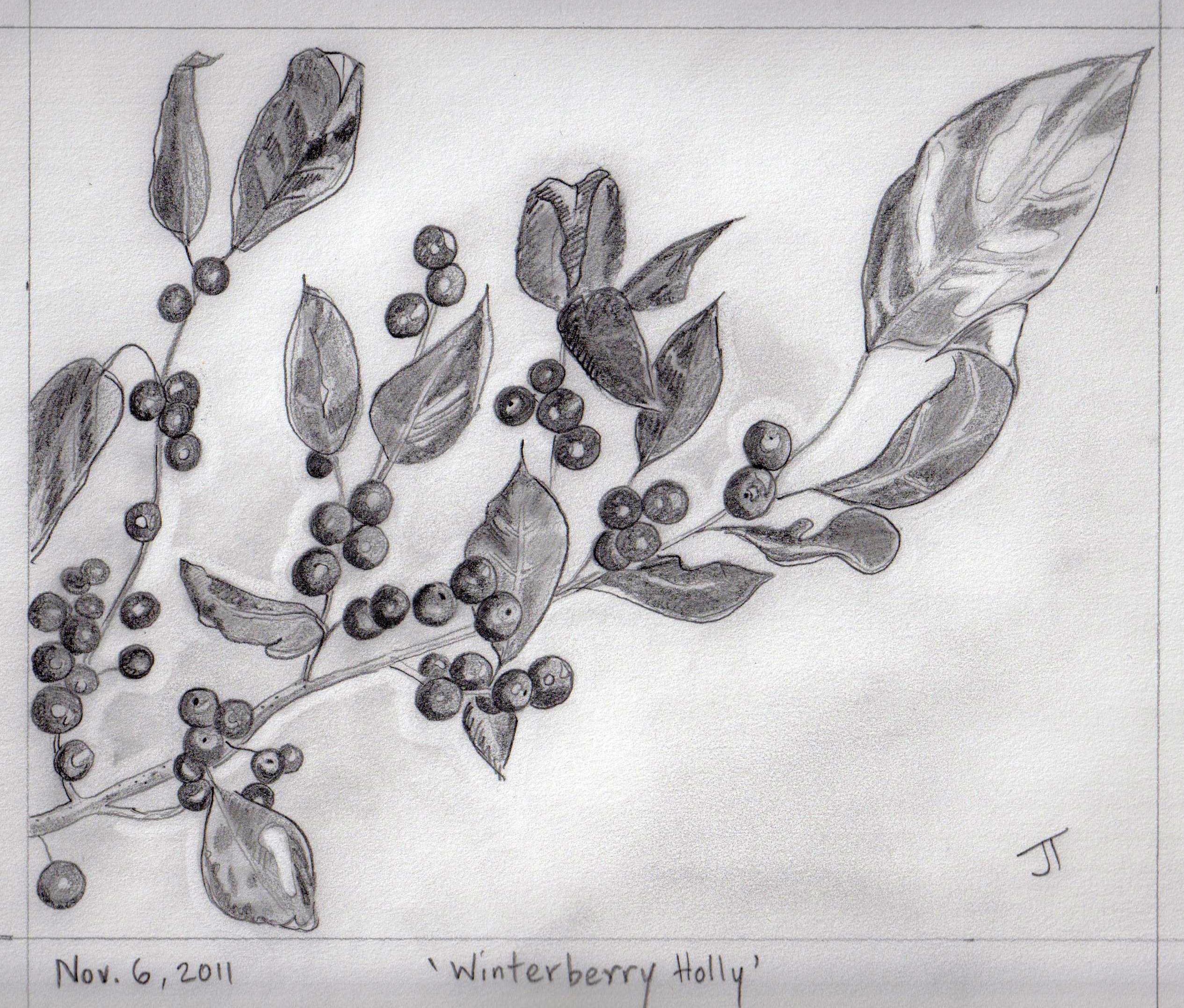
Red Berries Red
Jane Tims
2011
~~
~~
Hawthorn
(Crataegus)
~
between ruby glass
and hard wood floor
a slide of light and three
~
extinguished candles
smoke lifts from smoulder
each mote a particle
~
of spectral light, mosaic
shard, image
reassembled in three
~
dimensions
shepherd, hawthorn
pitiful lamb
~~
~~
Canadian Holly
(Ilex verticillata (L.) Gray)
~
drab November
and lexicon
expires
umber leaves
grey verticals
dull stubble
~
winterberries
astound the wetland
red ink on page
words explode
from exile
~
fever flush and holly
above December snow
icicles vermillion
~~
~~
© Jane Tims, 2011

'red berries' Bunchberry (Cornus canadensis L.)
villages and vignettes
I love to view bits of the world in miniature. Especially at Christmas, small replicas of human space make me feel comfortable. Perhaps seeing a world fit neatly into a small space is a version of the safety and calm an animal feels in its den. Perhaps looking over a diorama gives me powerful feelings of omniscience and omnipresence. Perhaps I like the impression of a story being told, from beginning to end, confined in space and time.
Our Christmas decorations are predominantly miniaturized vignettes:
our nativity scene, complete with a stable and its donkey, and a star-spangled hillside of angels and sheep…

my collection of Buyers Choice skaters, including a fellow roasting a marshmallow at a fire beside the frozen pond…

Rudolf and Bumbles from the Island of Misfit Toys…
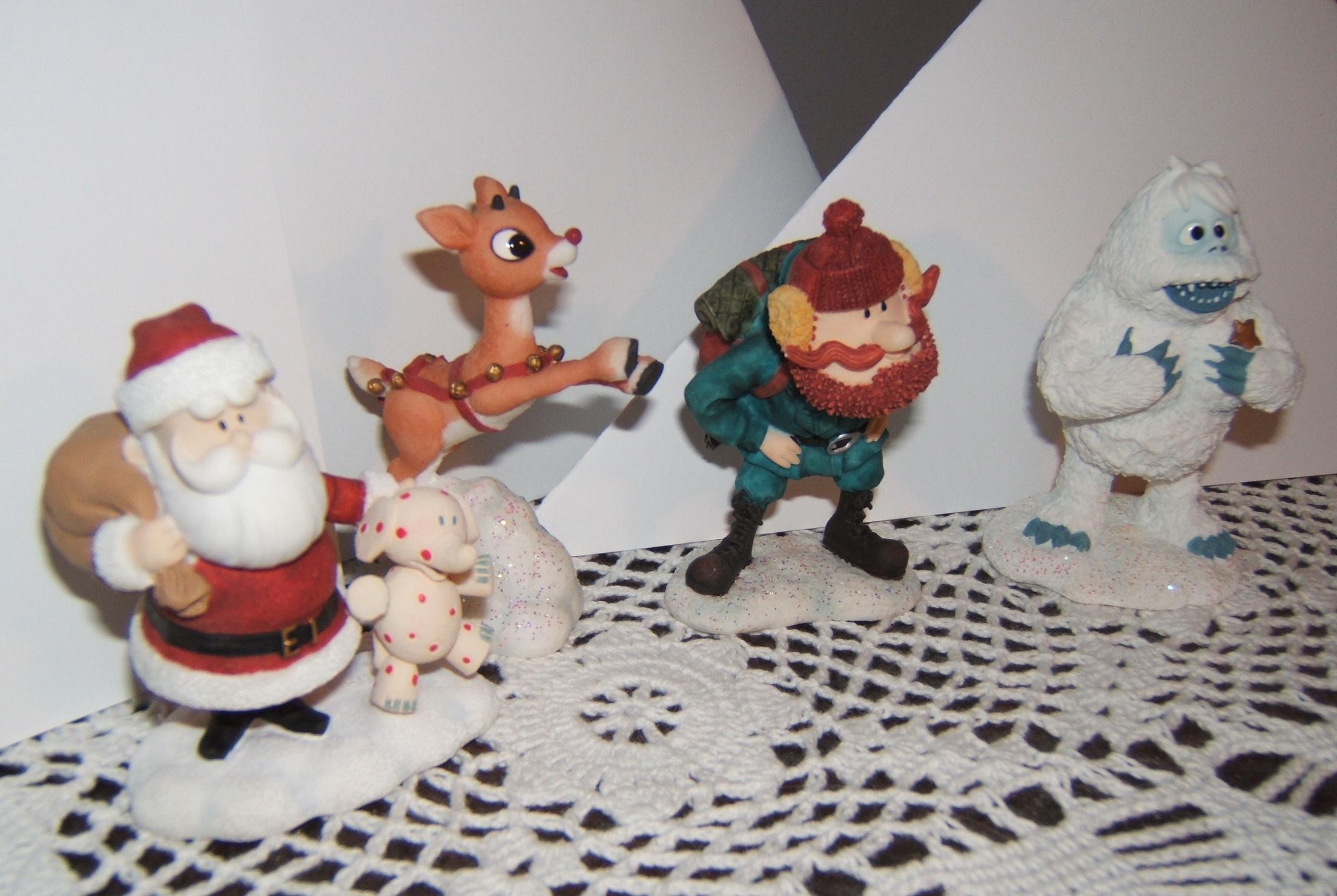
children gathering around a pitiful Charlie Brown Christmas tree…

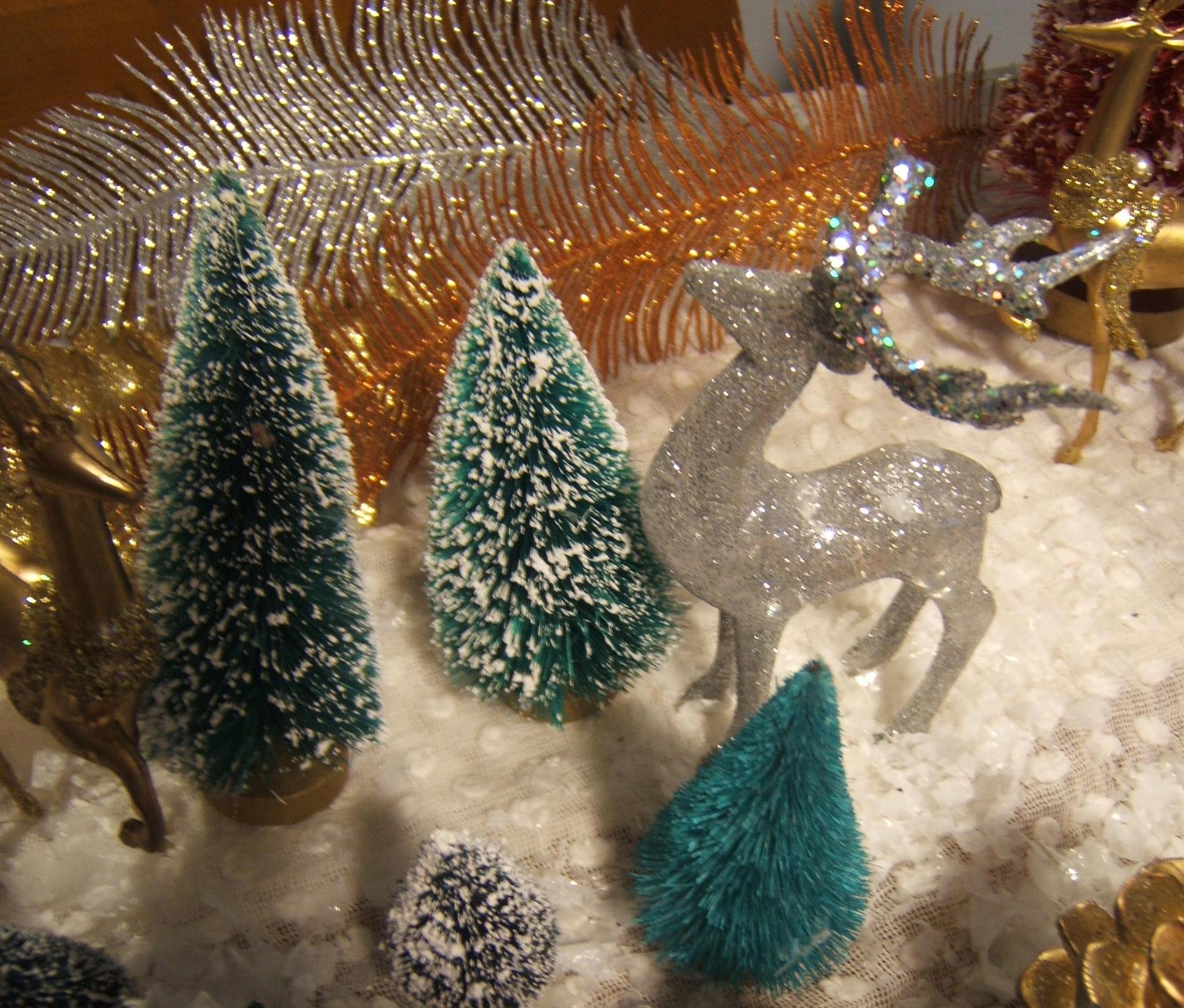
a frosty forest of bottle-brush trees and silver reindeer …
and a village with an inn, a church, and a park with a pond, a stone bridge and a park bench…
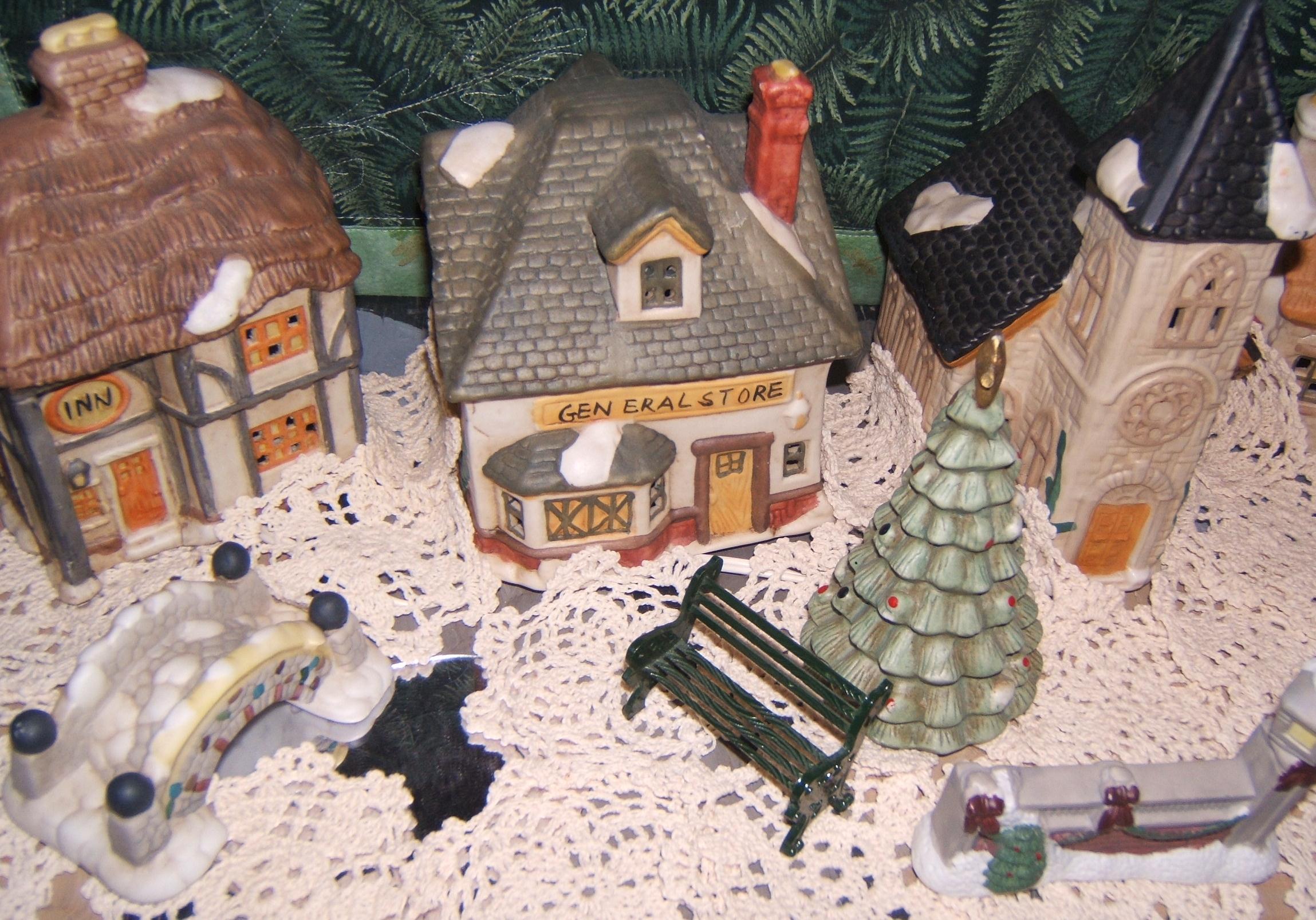
All very cute, but there is something missing.
The best scenes are those with real people. A scene of us sitting by our Christmas tree, talking and laughing. A scene of people in the bookstore, looking for a special book to give someone they love. The scene of a colleague at work, leaving a Christmas card on each desk. A scene of friends walking along a downtown street while the snow falls and the church bells mark the hour.
Merry Christmas everyone!
~
~
still street
~
the stillness of this street
its gentle curve
the steady glow of lamps
lighted windows, sturdy gates
a frozen pond, stone bridge reflected
soft snow, unmarked
and a park bench
where no one ever sits
~
~
© Jane Tims 2011

spacemen in our feeder
Our feeder has attracted some little space aliens!
In one of my recent posts, I talked about the Grey Squirrel and its marauding ways. Now I have two more mammals to add to my list of bird-feeder pirates.
During the weekend, we went to the Co-Op and puchased a new squirrel-proof feeder. It consists of a slim tube enclosed within a cage with the squares too small for the squirrels to squeeze through. Raccoons can’t fit through those small holes either, but they can take the new feeder off its hook and just toss it off the deck! Once they had cleaned out the spilled food, they began an assault on the older wooden feeder with its hoard of black sunflower seeds.

Just before I went to bed, I switched on the outer lights to see if the raccoons had returned and got a wild surprise. Two little spacemen were cleaning the rest of the sunflower seeds from the feeder! They looked like Red Squirrels, but were golden-brown in color, and had white undersides, a lot of extra folds of skin and big black ‘wombat’ eyes.
Flying Squirrels!!
We know the Northern Flying Squirrel (Glaucomys sabrinus) lives in our grey woods, but we haven’t seen them for a while. They not only look different, but move very differently from the Red Squirrels. They are very, very fast and sort of flow and fold themselves across the surfaces they are on, a little like those ‘parkour’ urban acrobats who move fluidly over obstacles.
The two Flying Squirrels argued and bickered with one another and paid no attention to me as I opened the door to snap their photo.
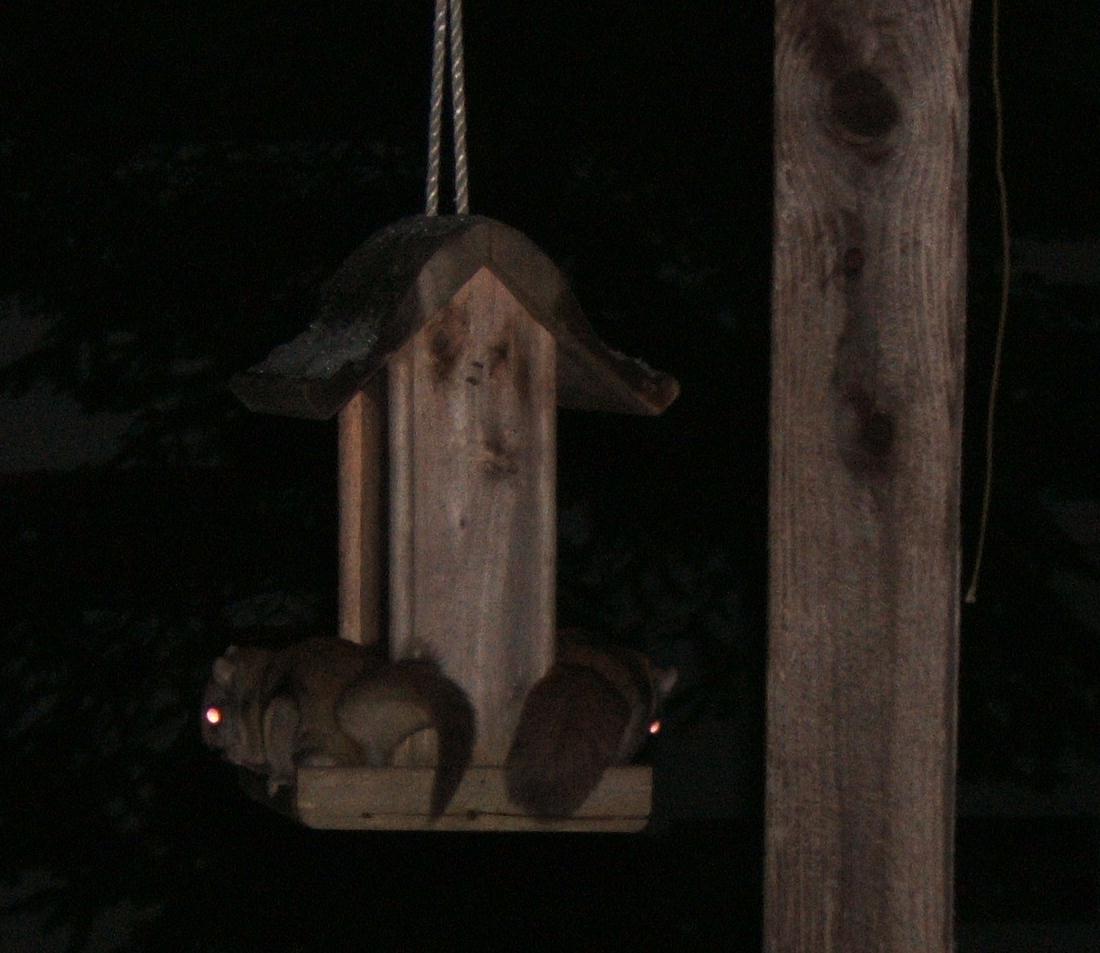
~
~
spacemen in the bird feeder
~
I missed the flash
the revolving light show
and high-pitched whine
just before the spacemen
(the Flying Squirrel Squadron)
set their coordinates on the feeder
~
bickered and folded over landscape
fired lasers from their eyes
took a moment for a black stare
at the earthling watching
and turned to complete the harvest
the sunflower seeds
craved by their planet
~
~
© Jane Tims 2011

one of the usual visitors to our feeder ... the Black-capped Chickadee (Parus atricapillus)
ice is nice
Our snow is slow in coming this year. We have had three snowfalls, but each, in its turn, has been rained or warmed away. If our ups and downs of temperature continue, the scant layer of snow on the ground this morning will be gone by Saturday.
However, winter is manifesting itself in other ways. I am wearing another sweater-layer this week. Our grey woods are muttering with chill cracking sounds. And ice is forming on the river and along the lake edge, gradually covering the surfaces with white and grey.
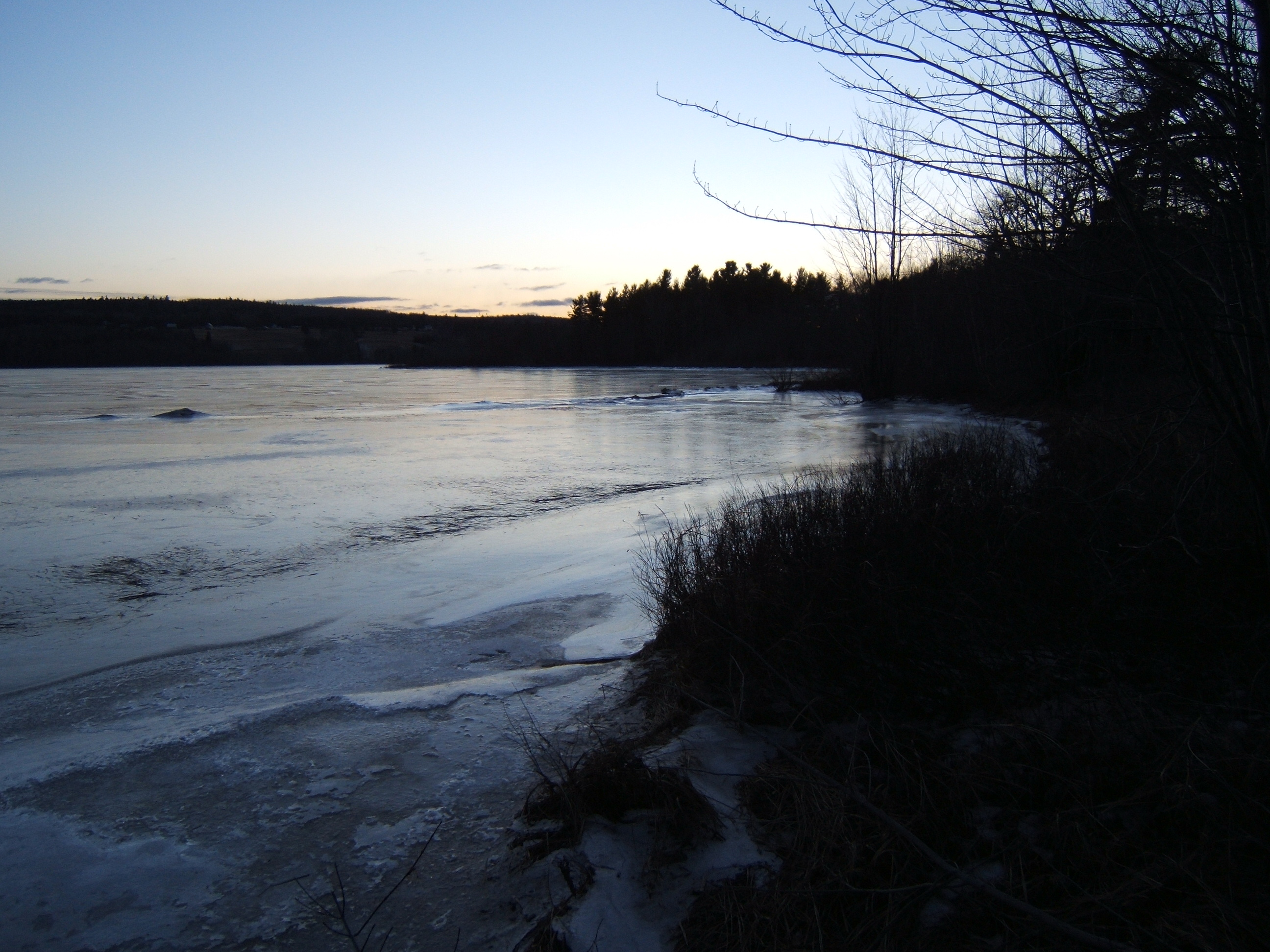
Ice – the frozen state of water… water is critical because it is a key component of our ecosystem and we need water to drink. Also, an unusual property of ice is responsible for keeping our ecosystem healthy.
Frozen water is about 8% less dense than liquid water. This means ice floats. As a result, bodies of water such as rivers, ponds and lakes, do not freeze from the bottom up. Instead, when water freezes at the surface, critical habitat is left under the ice for living things to survive and thrive. This is especially important for the bacterial and algal colonies at the base of the food chain.
Ice, therefore, is nice.
~
~
river ice
~
ice builds in shallows
at the rim of river, incremental
embellishment to glass, surrounds
willow stem and reed, thickness
increased as frost penetrates, sharp
edges cauterized by cold
~
© Jane Tims 2011

feeding the neighborhood
I have started up the bird feeder and already the mammals are nudging out the birds.
Our first visitor to the feeder was a fat grey squirrel who performed some amusing acrobatics to enjoy ‘his’ sunflower seeds.
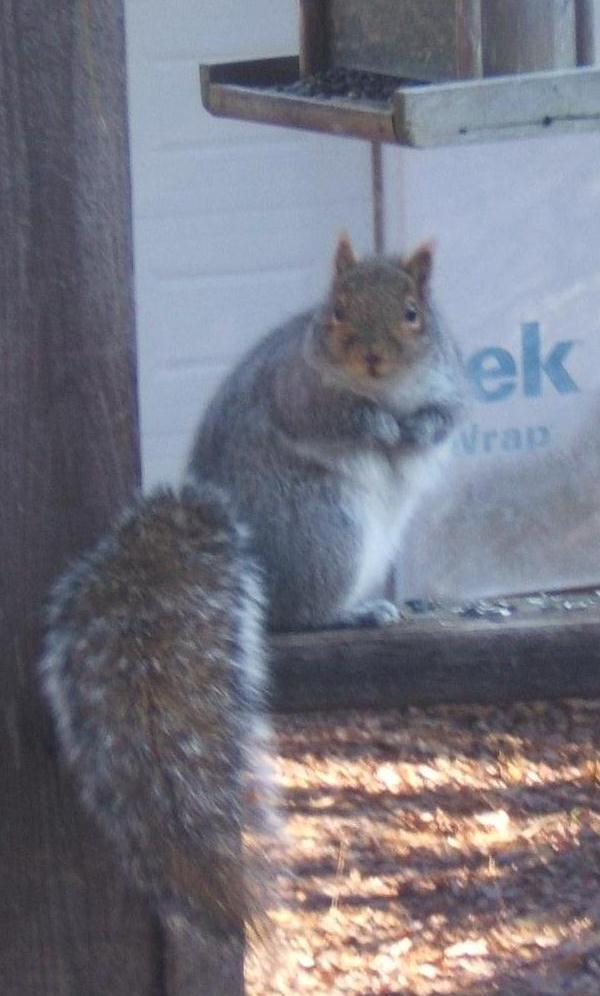

This year, I think I’ll keep a list of the marauders, who may outnumber the birds.
~
apples in the snow
~
she pauses, one foot poised
a lever beneath her, one hoof ready
to push off and fly
tail to flag her departure
tucked, ears up
~
everything still
the snow, the trees, the feeder
not caught in chickadee momentum, land
and shove away
~
three apples
at the edge of deep-freeze
draw her forward
~
© Jane Tims 2011

a conch shell doorstop
Do you have a conch shell for a doorstop in your home?
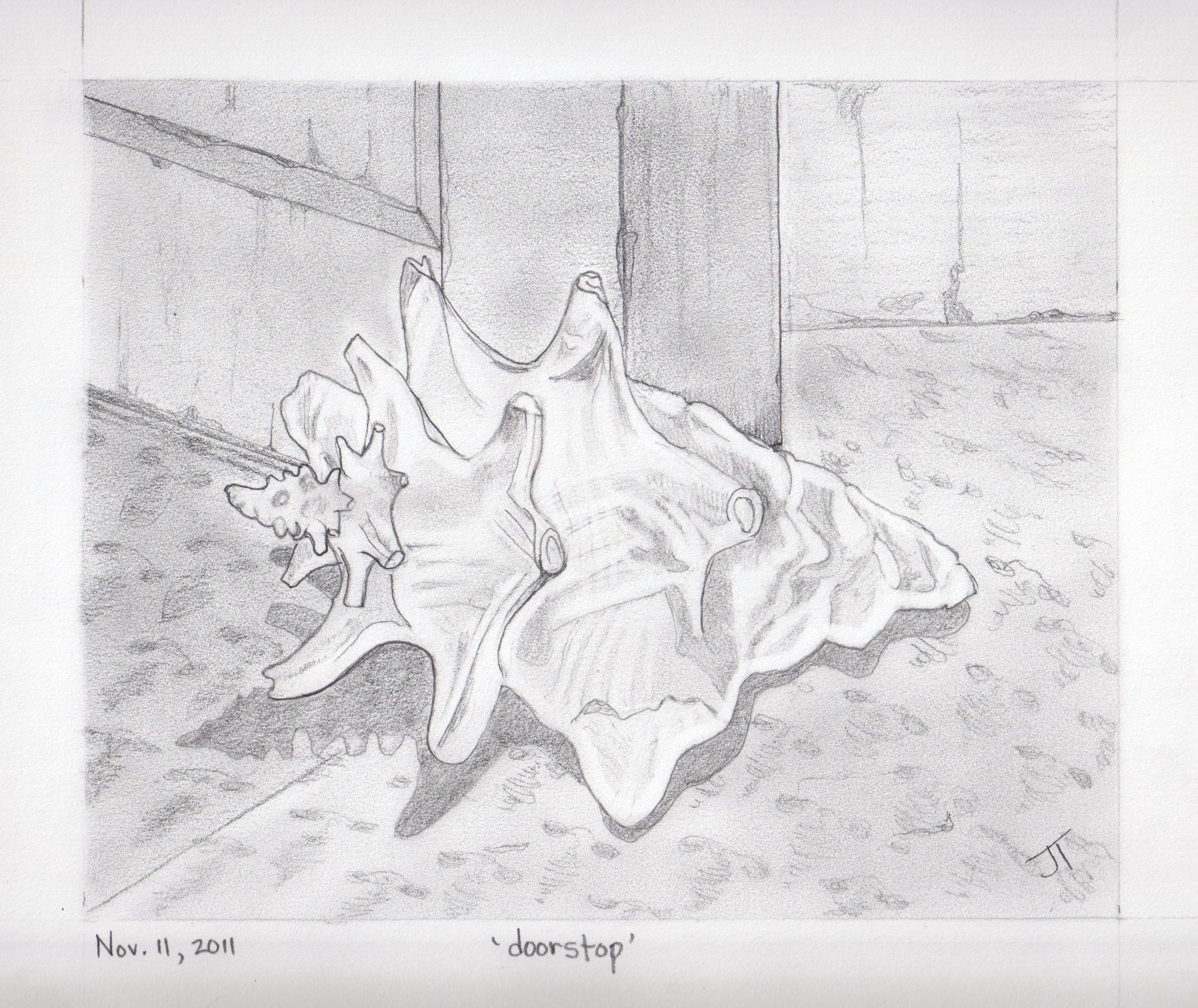
If you visit a farm or home museum in the Maritime Provinces (Nova Scotia, New Brunswick or Prince Edward Island), look down as you enter the house. You will often see a large sea shell used as a doorstop. These are usually a conch-type shell (the Queen Conch is a large Caribbean sea-snail). The shells were usually brought to maritime doorways by seafarers who collected them on their travels.
My grandfather’s house had one of these shells, a large white conch with a pearly pink interior and whorls of spines. Always on duty at the door of the glassed-in porch, it was an imported marvel of the exotic seas.
I remember my Dad holding it to my ear, saying, “listen”. From deep within the shell came the steady hum of the ocean, like the sound of waves advancing and pulling back from the shore.
This shell was part of my Dad’s life, growing up in the big farmhouse. As an adult, Dad gradually built his own collection of sea shells, large and small, usually buying them at auctions. A couple of the large shells are now in my own home. When I am far from the ocean, I can still lift one of those shells to my ear and hear its eternal roar.
~
doorstop
~
kitchen door kept
open with a conch shell
stop
~
spines cropped
by incoming and outgoing
careless cousins
~
ignore
complaining ocean
captured roar
~
© Jane Tims 2011
Copyright Jane Tims 2011
measuring my space
Niche space can actually be measured. Biologists and others apply a technique called ‘niche width analysis’ to determine the characteristics of a niche. This analysis defines aspects of ‘niche’ such as climate, food use, temperature, moisture, and so on.
One of the characteristics of my niche is – I love collections. My favorite collection is my handful of jointed rulers. I might not be able to measure every aspect of my ‘niche width’ with my collection of rulers, but I can measure any aspect of its linear distance!
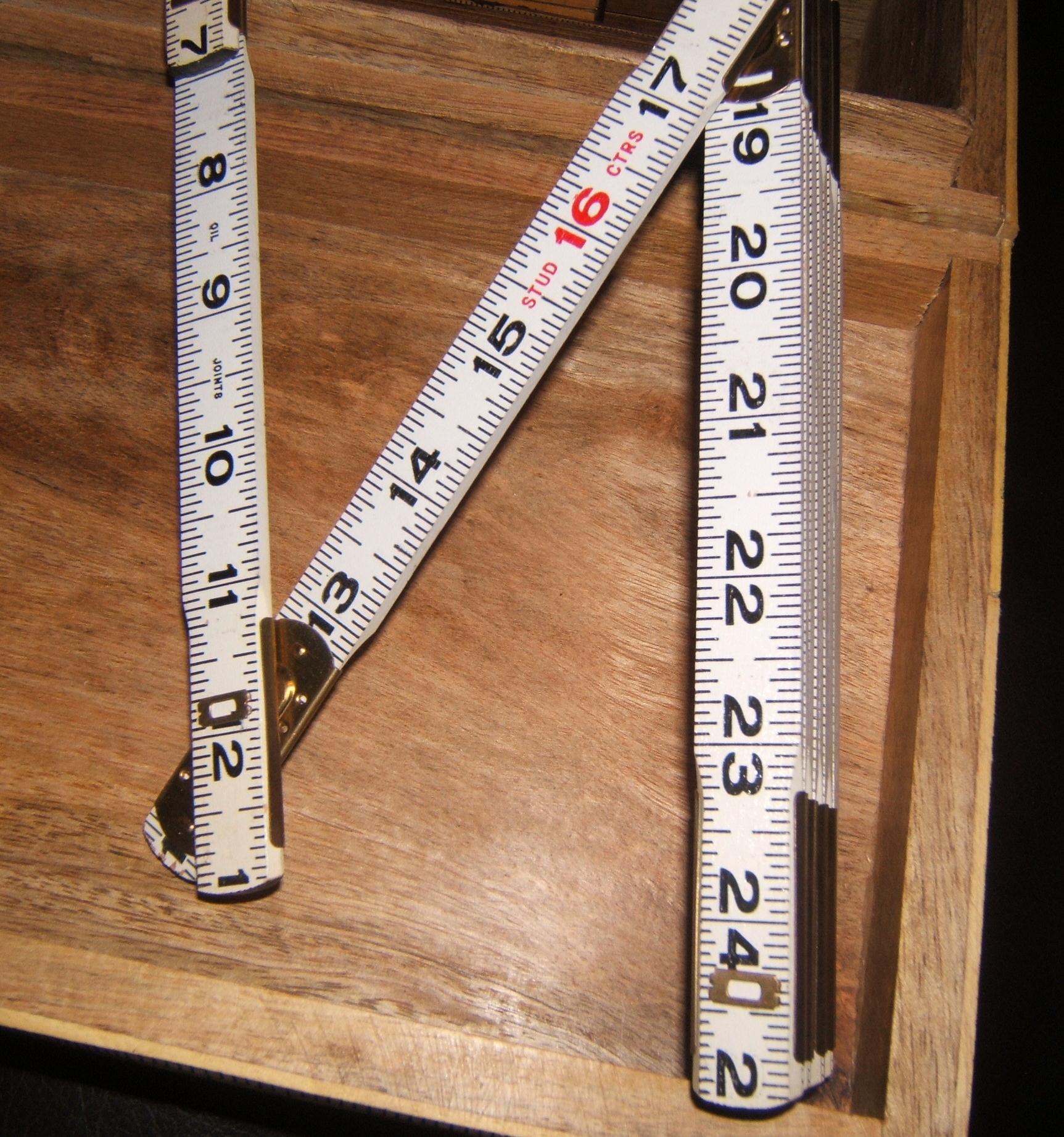
My collection of jointed rulers was given to me by my Dad. He and Mom loved to go to country auctions and they often bought items for me and my sister and brothers. Dad gave me my first jointed ruler for Christmas and then, over the years, added to my collection, one ruler at a time. The rulers were especially meaningful because my Dad was a wonderful carpenter and came from a long line of carpenters:
- my great-great-great grandfather, ‘killed-by-lightning’ William
- my great-great grandfather, ‘shipwrecked’ William (see my post ‘Briar Island Rock #1, #2 and #3′ of December 2, 2011 under the category ‘family history’)
- my great-grandfather, ‘kneeled-on-his-beard-and-couldn’t-rise’ Esau
- my grandfather Robert
- my Dad
- my brothers and sister and me (my husband and I built our own house).
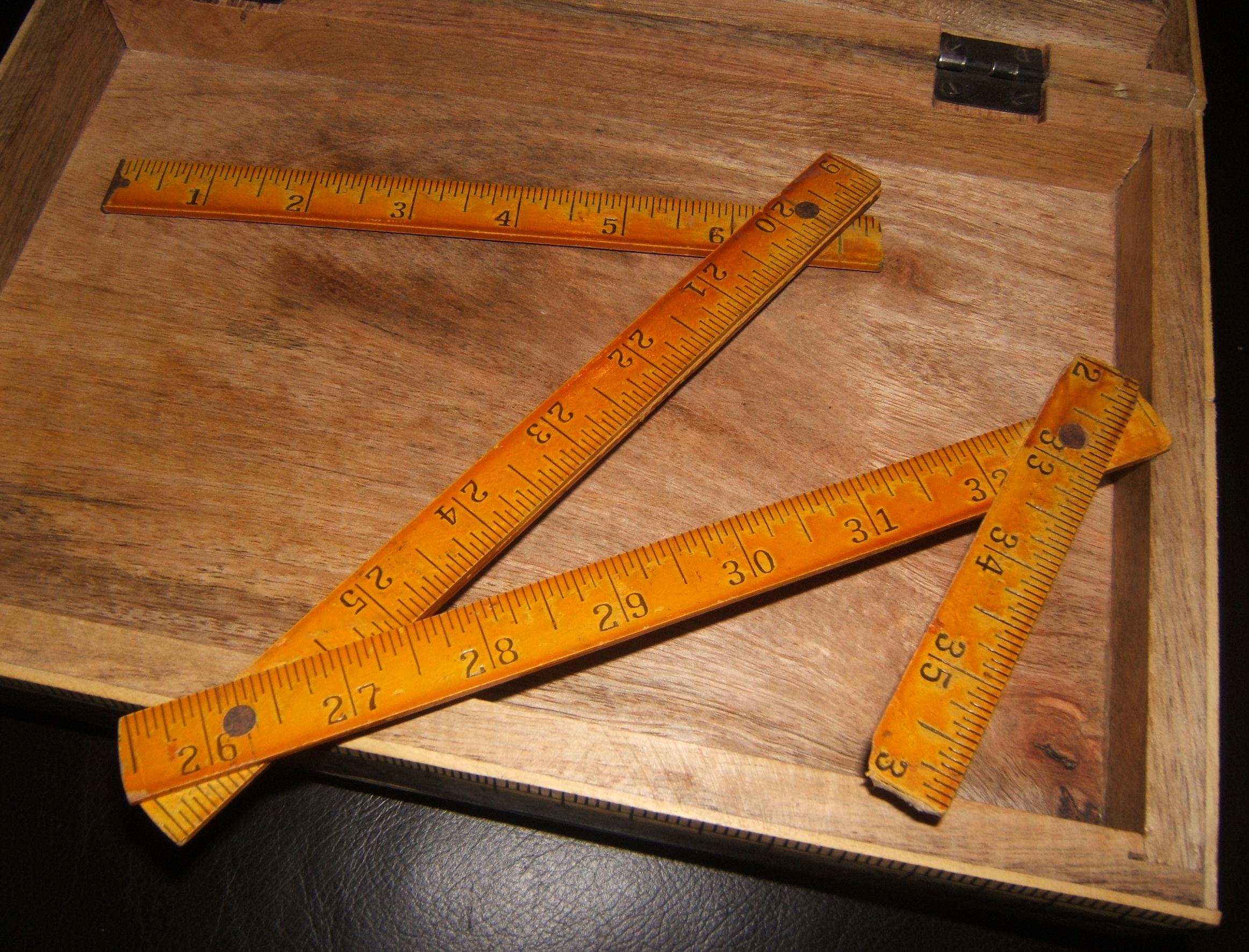
I keep my rulers in a box made of conventional rulers, and I love to take them out and look at them.

Jointed rulers have existed for a long time. They are listed in the 1813 book The Circle of the Mechanical Arts by Thomas Martin (London).

a Plate from Martin, 1813, showing a jointed 'rule' (item # 38)
Jointed rulers are not used very often by carpenters of today since the tape-measure is so much easier to store. However, plumbers still use folding rulers because they can measure twisting pipes.
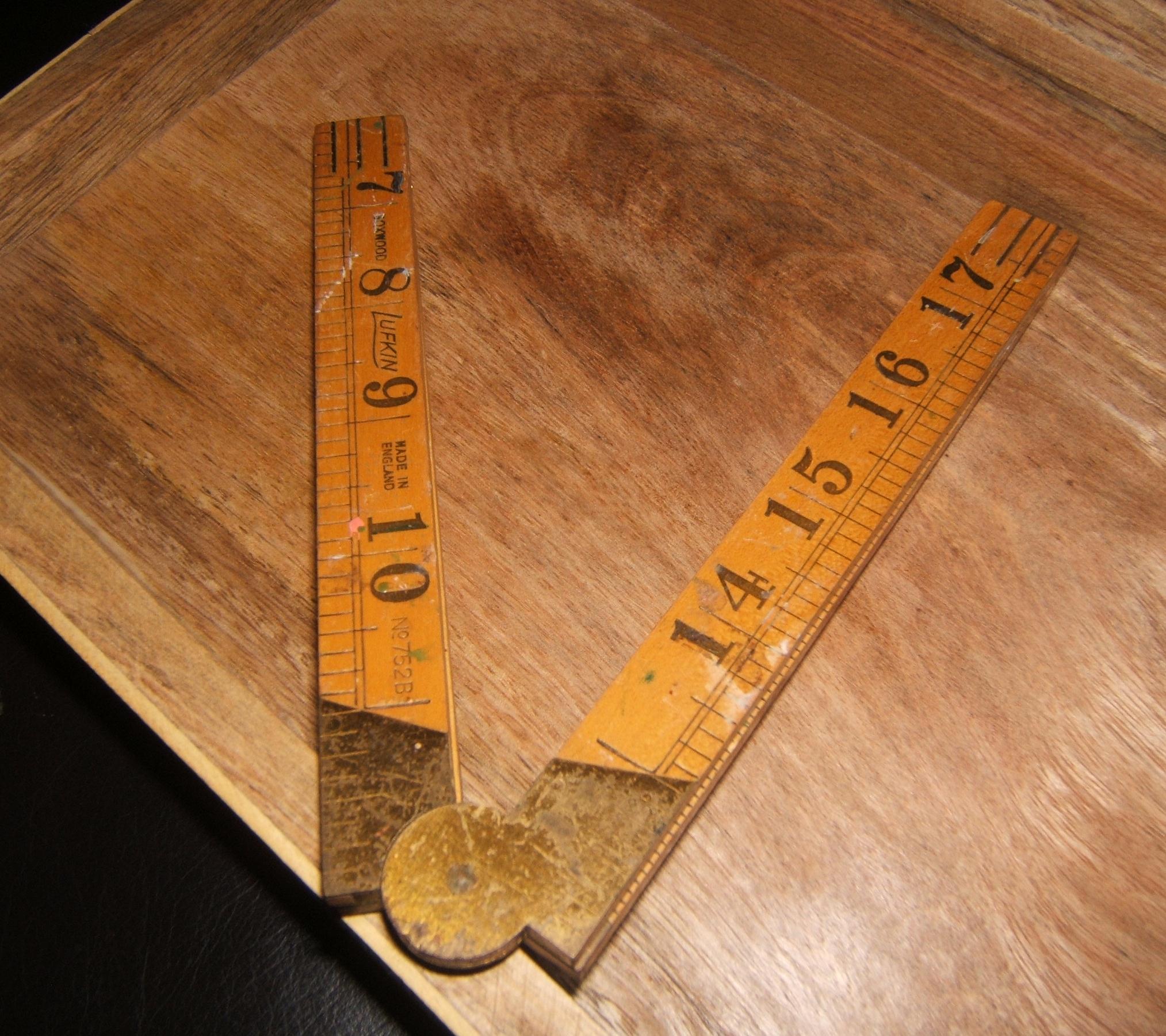
Most of my jointed rulers are made of wood with joints of brass. They can be folded away quite compactly when not in use, and unfolded when they are needed. Unfolded, they have a spidery quality. One of my favorites has a leveling glass built in…
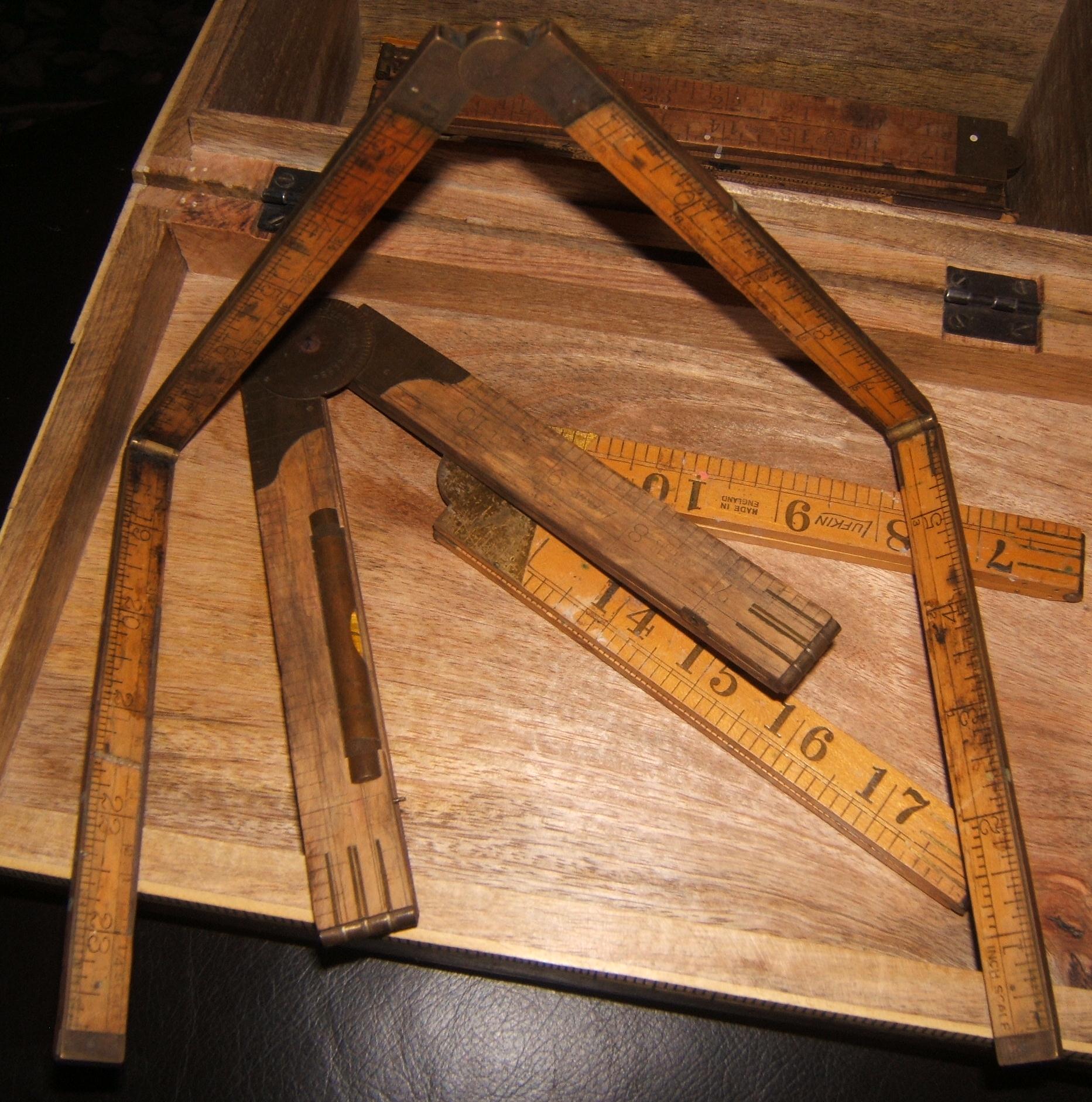
They are precisely made and have the combined beauty of varnished or painted wood, painted numbers, shiny metal and ‘mechanism’.

~
Great Blue Heron and reflection
~
on water, bent legs unite two images
of heron, brass connections
varnished wood
~
jointed rulers unfold, legs
disconnect, images detach
concentric circles swell
~
distance and diameter measured
between droplets
and trailing toes
~
© Jane Tims 2011

bringing the outside inside
Mindful of how busy I am at this time of year, my Mom always said to take Christmas where I found it. She meant to enjoy every moment of the season and glean Christmas from the smallest experience. So, on my drive home from Halifax, I was on the lookout for what I call “Christmassy things”.
One of these was a big truck, well-packed with Christmas trees, bound for markets in the United States. I thought of how these simple natural fir trees from New Brunswick would be the center of Christmas decorations far away.

We are lucky in New Brunswick to be able to buy a freshly-cut tree. In years past, we often went with my brother’s family to cut our own Balsam Fir at a U-Cut. It was fun, watching the kids running through the snow, so excited to choose a tree. Some years, we had a tree from my Dad’s property, one of the many he and my Mom planted and tended. I have also cut a Christmas tree from our own woods, although sometimes they are a bit lopsided. Today, we usually buy our tree from a local grower, in a lot where the trees lean against the fence, categorized by height.
It is so hard to decide on the perfect tree. We have high ceilings, so the taller the better. And I want a tree without a bird’s nest (some people think it is lucky to have a bird’s nest in the tree), so I check between every branch! I also usually want a relatively thin tree, to let the decorations hang easily.
Today or tomorrow, my husband and I will go out to get this year’s tree. We will wrap the tree in a red bedspread, set aside for this purpose, and tie the tree securely to the top of our car. We will take it home to settle for a day or so, and then bring it inside. And the fresh smell of cold air and balsam will expand from the tree into our living room. And, as in other years, it will be the best tree ever.
~
evergreen
~
*
under
snow prismatic
white distils to green
wintergreen and woodfern
clubmoss and conifer, chlorophyll
wedged into slim space between
earth
and
ice
~
© Jane Tims 2011




 nichepoetryandprose