a place in the marsh
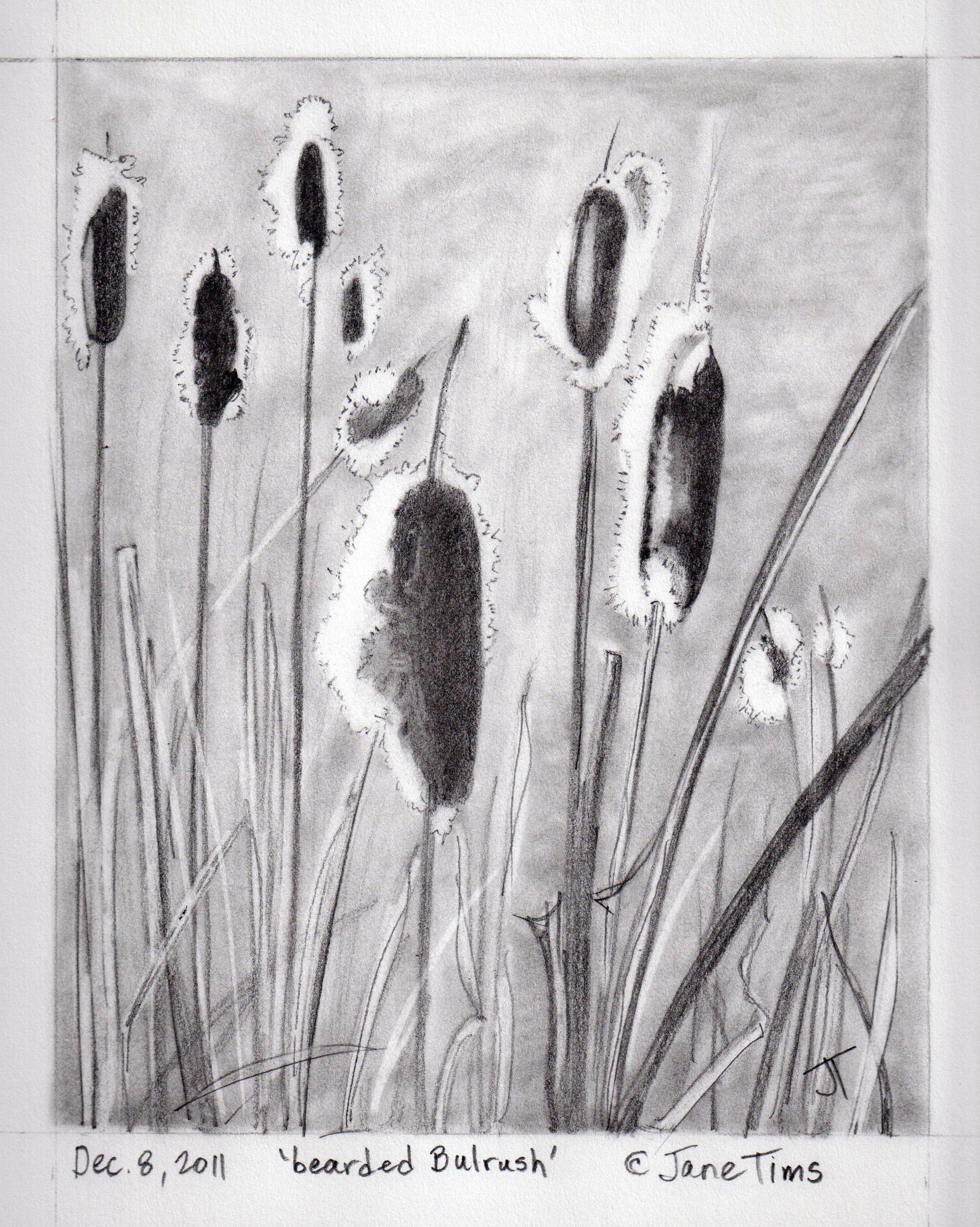
For the last few weeks, as I drive by the ditches and wetlands on my way home from work, I am charmed by the way the bulrushes have burst and made their bountiful seed available to the winds.
The heads of the bulrush (Typha latifolia L., also known as common cat-tail or masette in French) are usually neat and tidy cylinders of dark brown, held high on a sturdy stem. At this time of the year, the seeds emerge in a copious fluff clinging to the brown seed-head like a beard, a lion’s mane or a furry hat.
When I was a child, we always called these plants ‘busby rushes’, presumably after the tall bearskin hats worn by the Queen’s Foot Guards in front of Buckingham Palace. Actually a busby is not the correct name for the bearskin, but is a hat worn by Hungarian hussars, or the Royal Horse Artillary, a ceremonial unit of the British Army.
Our two usual species of Typha are distinguishable by their leaves. Typha latifolia (broad-leaved cat-tail) has flat leaves. Typha angustifolia (narrow-leaved cat-tail) has narrower leaves, convex on the back.
~
bulrush in December
(Typha latifolia L.)
~
4:45 PM rush, the Marshlands
bus expels tired folk to familiar sidewalks
exhausts them in diesel cloud
a bulrush pushing its seed
to the wind in cold December
bearded and wise, fur hats and
ear flaps against the cold
breath expressed as icicles and rime
~
© Jane Tims 2011
Fringed Loosestrife (Lysimachia ciliata L.)
In any season, I think it is important to slow down and look closely at the ground to catch a glimpse of the natural diversity occurring there. This time of year, in our snowy climate, there are tracks to find, evergreens to notice, and seeds and berries to discover.
Since I am trained as a botanist, looking down is the norm for me. Often, I fail to look up and see the landscape and horizon. When we first bought our lake property, it was quite a while before I looked across the lake and realised there were farms and a church on the opposite shore!
As a result, I identify strongly with Fringed Loosestrife (Lysimachia ciliata L.), a yellow flower we find growing along the lakeshore in early summer. It has a downward-facing flower and can only ‘see’ the ground. Its shy demeanour encourages close inspection, but you have to get your own eyes quite low to see a view of its ‘face’.
Fringed Loosestrife has five yellowish-green petals and a reddish center and blooms from May to July. The petals are fringed and each is tipped with a ‘tooth’.
The genus is called after King Lysimachus of Thrace who, in legend, used the plant to calm a maddened bull. Ciliata comes from the Latin word cilium meaning eyelash, referring to the hairs on the stem of each leaf.
Fringed Loosestrife grows in thickets and along shorelines like ours.
~
Fringed Loosestrife
(Lysimachia ciliata L.)
~
at the edge of lake are two perspectives:
distant and near
horizon and shore
~
horizon
low hills and orchard
a farm, a steepled church
the flat of the lake
three waterfowl
~
the shore
yellow Loosestrife
Fringed petals
look down
~
red eye studies
flat rock and sticky bedstraw
a wood frog, a feather fern
winterberry petals new-fallen
shoe leather, shoe laces
~
© Jane Tims 2011

a safe space in the bridge
This past week I have been in Halifax for a conference. A part of my morning commute was the slow moving traffic on the ‘old bridge’ across Halifax Harbour, the Angus L. Macdonald Bridge. The second day, I was more familiar with the traffic and the correct lane to be in, so I had a chance to experience the architecture and some of the wild life of the bridge (by this I do not mean that the commuters are holding wild parties).
The Angus L. Macdonald is an amazing structure, built the year I was born and opened in 1955. It is a long-span suspension bridge, supported by cables between two vertical towers. The bridge is 1.3 km long, with a supported length of 762.1 meters.
The bridge is usable by pedestrians and cyclists. Because of its reputation as a suicide bridge, it is equipped with various barriers to potential suicides, including high inward-facing bars on the pedway and nets suspended in the open area between the traffic deck and the pedway.
In these areas, hordes of starlings (Stumus vulgaris) gather, creating a din and an occasional cloud of startled starlings. Starlings are known for their synchronized group flights – the birds move as one in a shifting horde of birds. To hear the birds, I had my car windows open, but I quickly rolled them up since the birds were flowing very near to my car!
Starlings are an invasive species, introduced by Eugene Schieffelin to Central Park in 1890 as part of a project of the American Acclimatization Society. Their goal was to introduce all the birds mentioned in Shakespeare’s writings into North America. All of the birds I saw in the bridge are descendants of the 60 to 100 birds released in 1890!
A group of starlings is known as a ‘murmuration’.
For those of you familiar with the excellent series of made-for-TV Jesse Stone movies (starring Tom Selleck), The Angus L. Macdonald Bridge is the bridge featured in the movies (although the setting for the movie is a small town in Massachusetts).
~
morning, Angus L. Macdonald Bridge
~
traffic huddles and a thousand Shakespearian
starlings squabble one another
yellow beaks and feathers packed
soft slate bodies rolled into the safety
of the suicide net and pedway bars
porous barriers: a cyclist whips by
and starlings sift through wire
a mumuration between orange
cables and green girders
impossible way, red and blue
pulse of bridge security
weaves the path materialized
within three tangled
lanes of traffic
~
© Jane Tims 2011

roses of summer
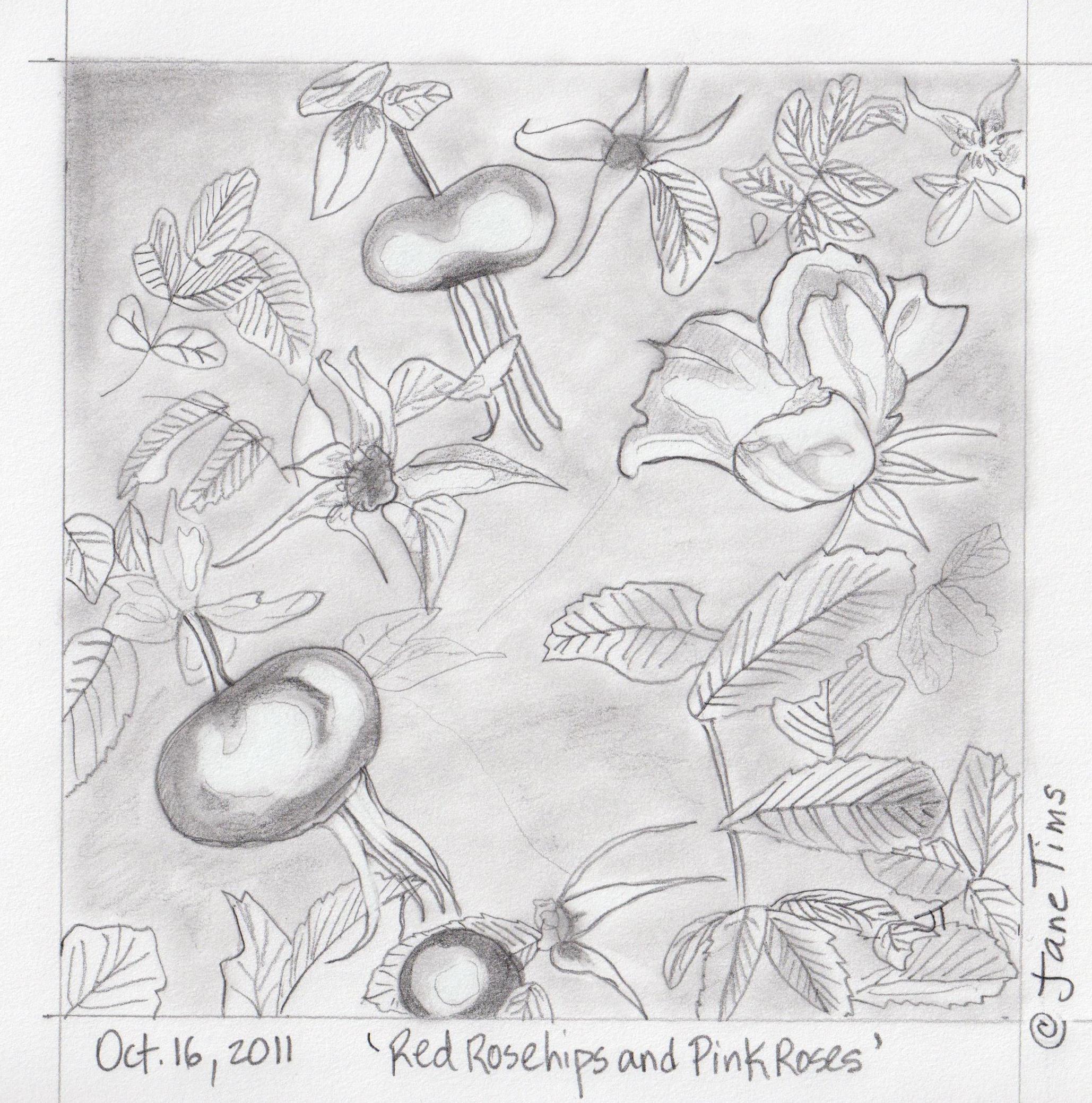
When I go for a walk this time of year, I visit our rosebush and I think of how rosebushes have been a part of my life:
- the little bush beside our road at the lake, delicate pink double roses and small rosehips… my husband loves this little bush and is always very careful not to cut it when he trims the lane…
- the huge rosehips on the rose bush (Rosa rugosa Thunb.) at Castalia Beach on Grand Manan Island, rigor in the harshest conditions; once I tried to bring a slip of the bush home in a banana peel (to keep the moisture) but, although it lived and grew, it only survived a few seasons…
- a tunnel of rosebushes and huge rosehips next to a parking lot where we stopped in Matane, Quebec on our trip to Gaspé a decade ago…
- a pair of long-gone rosebushes at my Mom’s old home place – when she and my Aunt were little girls, they called the rosebushes Mrs. Pears and Mrs. Rhodes and would visit them with their doll carriages to collect the red rosehips.
~
~
fragments from a walk
~
brambles and bedstraw
insect frass and dew
the petals of a wild rose
a rosehip
a red gall
swollen as a nose with crying
~
Nuphar and Nymphaea
lily leaves a plate
offering yellow to the sun
~
familiar trees
suddenly grown tall
~
© Jane Tims 2008
string for Zoë
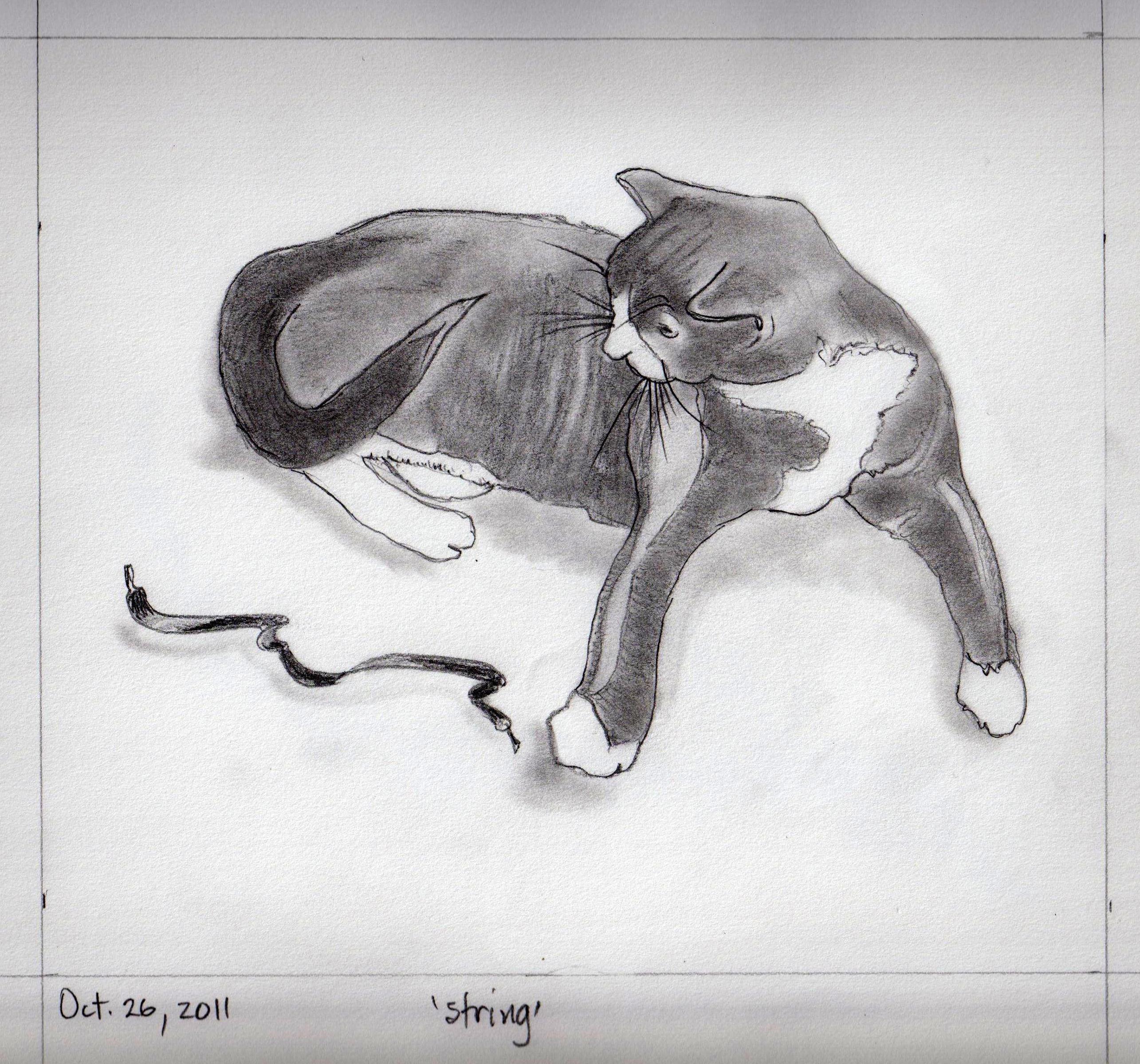
Our cat Zoë’s niche includes a ‘string’.
I often say our Zoë is ‘telepathetic‘. She will sit and stare me down until I understand what she wants. Sometimes she wants food. Sometimes she wants fresh water, or an ice cube (yes, an ice cube). Sometimes she wants to play, with her string. Her trust that we will figure out what she wants is pitiful.
The string is not a special toy. Any long thin peice of string will do. A shoelace or a length of thread are all the same to Zoë.

Zoë can be an acrobat when her string is part of the action. She will stalk the string and pounce on it. She will walk upright on her back legs to reach it. Sometimes she just wants to look at it.
~
~
telepathetic
~
Zoë thinks she is telepathic
sits intently, stares at me
narrow pupils on pale green eyes
~
I run the list
water, cat food, litter
such simple needs
but no thought resonates
with telepathic tremble
~
string
the word vibrates
as if plucked on a guitar
Zoë blinks her eyes
looks over her shoulder, utter longing
ten inch shoelace, knot at one end
pathetic on the hearth
~
black pupils open round
frank pathway to brain
~
© Jane Tims 2010
© Jane Tims 2011
in the branches of the White Pine

- the White Pine is the larger tree to the left of the road

The most frequent denizens of the pine are a pair of Bohemian Waxwings (Bombycilla garrulus). They prefer berries for food and so are in their ideal habitat. Our property must look like a big dinner plate to them, with its orderly presentation of wild strawberries, blueberries, blackberries, hawthorn and winterberry.
Another bird who stops to rest in the pine is the American Goldfinch (Carduelis tristis), also known as the Thistle bird. These are seed-eating birds who fly across the fields in a distinctive pattern of loops. They are also one of the most common birds at our winter bird feeder.

~
~
building homes
~
we fly kites
to learn the field and sky
set copper whirligigs to spin
~
yellow flirt crosses blue
per-chick-or-ree
potato-chip potato-chip potato-chip
~
we build our cabin
with 2 by 4s, boards and trusses
woodscrews and spiral nails
~
firm framework
woven grass and birch
bark rim and spider silk
~
you fill walls with fiberglass
I quilt curtains for windows
~
goldfinch waits while his female tucks
her nest with thistledown
tufts of cattail, puffs of dandelion
~
© Jane Tims 2011

Briar Island Rock #4

~
~
jointed ruler
(Wreck of the Trafalgar, 1817)
~
the ship is broken on rocks
and we leave in fog
I hold my brother’s hand
we stumble up the shore
in a yellow room of fog
it stumbles with us
they set the baggage down
together, folded
we wait
~
my step-father
pats my mother’s hand
leaves to talk with the Captain
the ship is lost
I look up at my mother
she watches him go, her lips move
she says we will lie in green pastures
~
I look for grass but only see
black rock and grinning fog
lanterns and men calling
my brother sniffs a little
in my pocket I clutch my father’s jointed ruler
he was a carpenter, would have fixed the hole
the mate says
there’s no going back to her now
we stay where we are
folded in a yellow room
luggage at our feet
~
the walls move
the ruler opens
I see the ship
black hull held high
on dark and pointed rock
against the early morning sky
white waves beyond
the ruler closes
~
pink and yellow mix, and the room
is the color of pumpkin
the ruler opens and I know
the black shore has bristles
I heard the mate call it
Briar Island
~
the rock I stand on tips a bit
I step down
the rock is wet and grey
five sides
a funny-looking stone
fits with other stones
strange puzzle
~
I take my ruler
help it to unfold
I measure the rock
I make it jiggle and my brother smiles
a little smile
the ruler folds, unfolds, the room expands
I see my step-father’s uneven walk
across uneven stones
~
~
Copyright 2011, Jane Tims
Briar Island Rock #3
In my garden there is a black pentagonal rock set into the ground. The rock is black basalt, and future people may wonder how such a rock ended up in a setting of glacial moraines, far from other volcanic surface formations.
The rock comes from the rocky shore of Briar Island in Nova Scotia. On this shore, in July, 1817, my great-great grandfather came to Canada by way of the wreck of the ship Trafalgar.
In August 1993, my Dad led our family on a pilgrimage to Briar Island, to see Gull Rock where the ship went aground. Our troupe included my Mom and Dad, my two brothers, my sister and me, with our respective families. There we could see the rugged rocks where William first set foot in Canada. Among those on the shore were four Williams of other generations, my Dad, my older brother, my younger brother (whose name, my Dad pointed out is the French version of William) and my nephew.
The pilgrimage had an amusing side. We all gazed out to sea and retold the story of the shipwreck. We all turned and had our photograph taken in the dazzling sun. And when we later talked about our trip, no one could agree on what we had seen. Some saw a black rock in the distance. Some saw a small island. Some saw a low rocky shoal of rocks extending into the sea. In any case, I know we saw more than seven year old William did in 1817 as he stumbled onto the shore in thick fog and in the small hours of the morning.
The shore there is a pavement of columnar basaltic rock, emerging from the earth in slim five-sided columns. This pattern develops when thick lava cools, resulting in a fracture network and the creation of perpendicular columns.
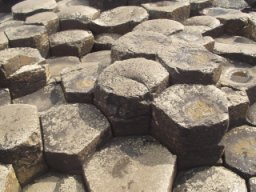
example of columnar basalt (from Wikipedia)
One of those rocks I pried loose and it now sits, embedded in my garden, a memorial to young William.
My next post will be a poem and drawing about the shipwreck.
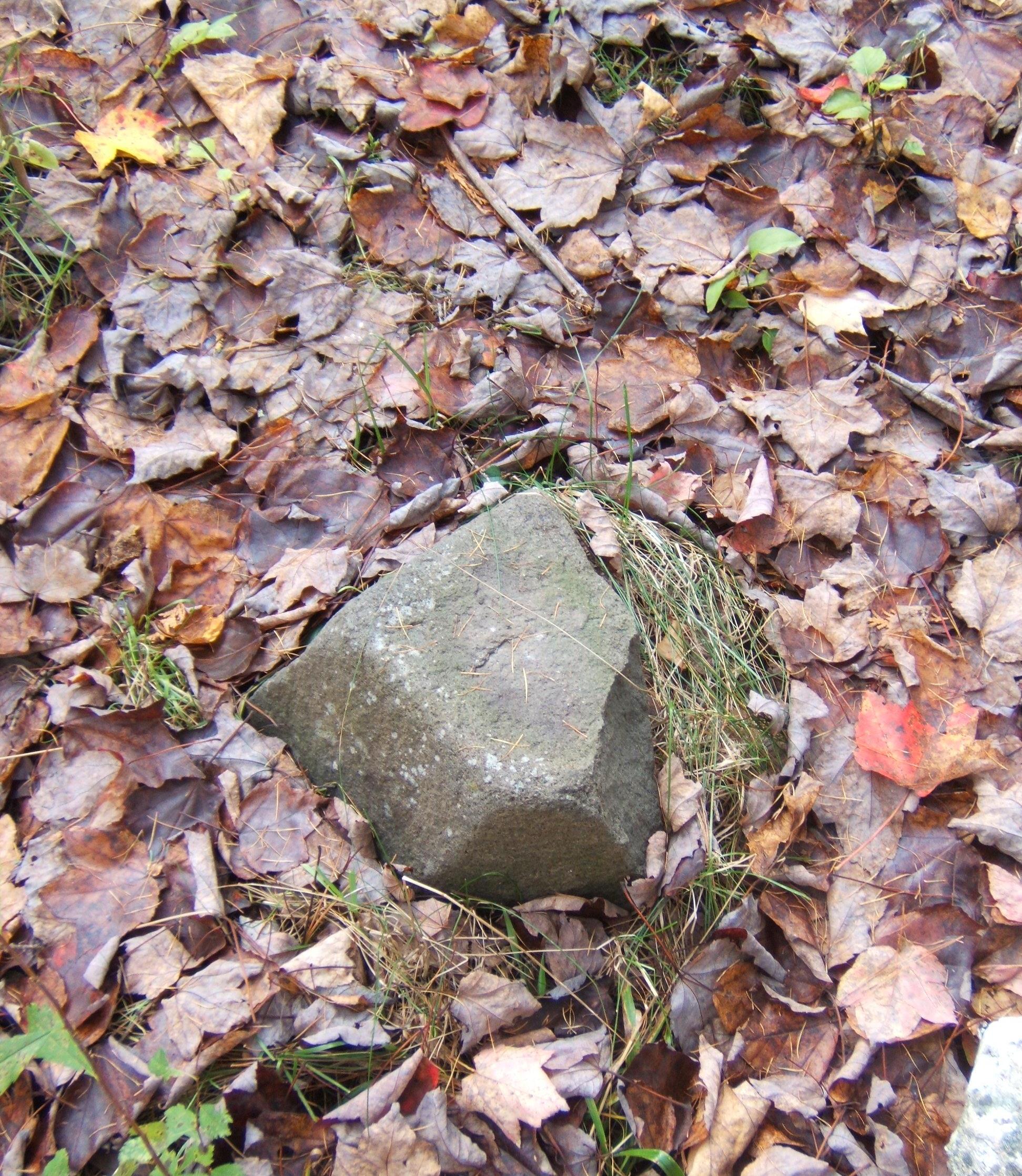
this rock has endured the decades since the shipwreck of the Trafalgar... it was there when the ship was stranded on the rocks...there when William and his brother came ashore... a witness to my family history
© Jane Tims 2011
Briar Island Rock #2 ‘the shipwreck’
How did your family first come to the country where you now live?
In my last post, I introduced the story of my great-great grandfather, William, who arrived in Canada, when he was about seven years old, by shipwreck.
William and his mother, brother and step-father took the schooner Trafalger. It was a 3-masted square-sterned ship with two decks, 96 feet long and 25 feet wide. The family embarked from Hull, England for Canada on May 31, 1817.
The ship was headed for Saint John in New Brunswick, but became lost in thick fog and was shipwrecked off Brier Island, on the Nova Scotia side of the Bay of Fundy. In a letter reported in the Hull Advertiser, the Captain of the Trafalgar gave a detailed account of what happened:
I am sorry to inform you of the loss of the Trafalgar, on the 25 July, about half-past eight o’clock in the evening, upon Brier’ s Island, in the Bay of Fundy, about 60 miles below St. John’ s [Saint John, New Brunswick]. I had been running up all the day, it being very thick could not see anything; at seven p.m. I hove the ship to, with her head to the Westward, thinking we were well over to the Westward, sounding in 40 fathoms; the tide running very strong, and before we could see the land, we heard the surf against the rocks; got sail upon the ship, but being too close the strong tide set us upon the rocks; it being high water when we got on, run out a kedge to heave her off, but all to no use. At low water, the ship was dry all round, amongst the rugged rocks, which went through her in different parts; the ship having as much water in the inside as there was on the outside at high water. The passengers were all safe landed that were brought out, and got all their baggage on shore. We are saving all the stores that we can, but they must be taken up to St John’ s to be sold, as there are no people on Briers Island to purchase anything.
– ‘Letter from Captain J. Welburn to H. Cochrane, July 30, 1817. Saint John, New Brunswick’, Hull Advertiser, September 27, 1817.
The shipwreck was also reported in the New Brunswick Courier:
Shipwreck! – On Friday evening last, about half-past eight o’clock, the ship Trafalgar, Capt. Welburn, went ashore on Briar Island in a very thick fog – the ship will be a total wreck; chief part of the materials saved – The Trafalgar was from Hull bound to this port, and from hence to Quebec, and had 159 passengers, which together with the crew were all saved.
– ‘Shipwreck’, Marine Journal, New Brunswick Courier, Volume 7, No. 325, Saint John, New Brunswick, August 2,1817.
The ship’s passenger list is available at The Ships List (http://www.theshipslist.com/ships/passengerlists/trafalgar1817.htm). It lists the heads of the various families on board.
One of the saved passengers was my great-great grandfather, William, a child of about seven years. William’s father, also named William, had been a carpenter and was killed by lightning while working on a building. His mother married for a second time, and sold her first husband’s tools to get her second husband out of the army.
It would have been hard for them after the shipwreck, but there was a small community of people living on Briar Island – it had been inhabited by fishermen since 1769, and by Loyalists after 1783. After the shipwreck, William’s family eventually settled in Digby County, Nova Scotia.
Tomorrow, I will tell the story of my own family’s pilgrimage to Briar Island in 1993.

'luggage, landed on the shore' (detail of a larger drawing by Jane Tims, 2011)
© Jane Tims 2011
Briar Island Rock #1
One of the rock features already along the path in our front yard is a pentagonal chunk of black basalt. Over the next three posts, I will tell you the story of what it represents and how it came to be in our yard.
The story begins with my study of our family history and genealogy. Of course, being interested in genealogy means you will always have something to do.
As you go back in time, more and more people become part of your life story. By the time you go back only three generations (your great-grandparents), you have 8 grandparents to research. If you include your great-great grandparents, you have 16, and so on. By the time you get to eight generations, you’ll have 256 people to call your own. At 14 generations you have 16,384 grandparents! Think of how many people had to meet and procreate just to make you!
The sad thing is, you will never know most of these people by name, let alone by their many stories.
One of my great-great grandparents would have quite a story to tell. My great-great grandfather, William, came to Canada from England when he was about seven years old, with his mother, step-father, and brother. The ship they travelled on, the Trafalgar, was shipwrecked off Briar Island, Nova Scotia on July 25, 1817.
In my next post, I will tell the story of the shipwreck.

© Jane Tims 2011




 nichepoetryandprose