Archive for the ‘growing and gathering’ Category
early schools – school gardens
It’s gardening time in New Brunswick. While I tend my little tomato plants, I wonder if one room schools in the early 1900s kept school gardens.
~

Was there once a school garden in the yard of this one room school near Gagetown, New Brunswick?
~
In the province of Nova Scotia, some schools had gardens. My aunt, Dr. Jane Norman, in her history of Nova Scotia’s schools, tells about the Travelling Teachers program and the ‘Garden Score Card’ (Jane Norman, Loran Arthur DeWolfe and The Reform of Education in Nova Scotia 1891-1959. Truro, Nova Scotia: Atlantic Early Learning Productions, 1989). The Travelling Teachers operated from 1918-1920, bringing knowledge and help to schools in their districts about rural science, including home-making, healthy living and gardening.
~
In 1918-19, to encourage gardening as part of the school program, the Rural Science Department of the Nova Scotia Normal College (where teachers were trained) donated $10.00 to each Travelling Teachers’ school district. School children and schools who obtained the highest scores on the ‘Garden Score Card’ shared the money as follows:
- three school children with the highest scores won prizes of $2.50, $1.50 and $1.00
- three schools with the highest scores won prizes of $2.50, $1.50 and $1.00
~
The ‘Garden Score Card’ rated the school gardens and the efforts of the children with the following criteria:
- Condition of Garden:
- Planting and arrangement of plants (5)
- Thinning, training, regularity in row (5)
- Cultivation and freedom from weeds (10)
- Freedom from diseases and insect pests (10)
- General neatness of paths, labels, stakes, etc. (5)
- Consideration of adverse conditions, if any (5)
- Range of variety in flowers and vegetables (10)
- Amount and quality of bloom (flowers) and crop (vegetables) (15)
- Amount and value of canning or sales (20)
- Showing made at exhibition (15) Total Points (100)
~
The school children in my drawing are working hard, but based on the ‘Garden Score Card’, they would not have received a prize for their gardening! No stakes, no labels, no regularity in the row.
~

~
How would your gardening efforts be scored??? I would not make good marks on any criterion!
~
Copyright Jane Tims 2016
Growing and gathering – Spring salad
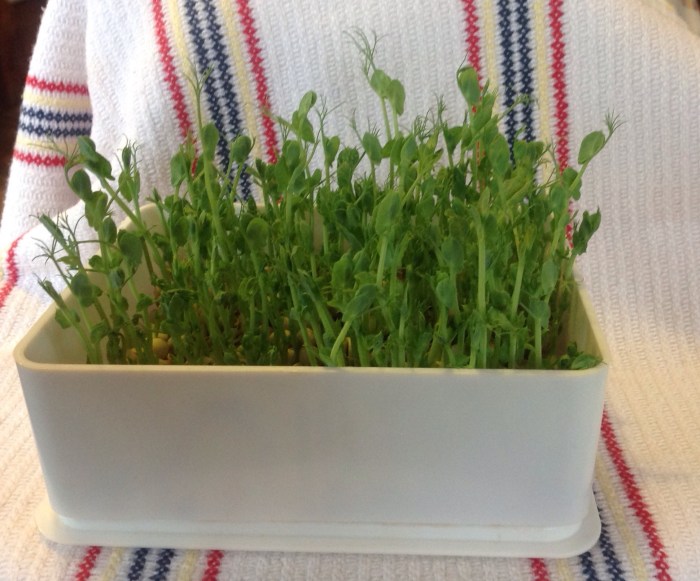
I make a new batch of sprouts weekly. This week’s crop was something I haven’t tried to grow before … pea shoots. I sprouted the peas in my 8 X 10 Sproutmaster from Sprout People.
https://sproutpeople.org/sproutmaster-8×10-tray-sprouter/
~
Pea shoots sprout sooner if they are soaked in water first. I let mine sprout with just the rinse water.
~
For me, a twice daily water rinse and careful draining is key to growing the best sprouts. I know pea shoots can grow quite tall with a vermiculite base and some propping at the sides but I was content to just let them peak above the sides of my sprouter.
~
~
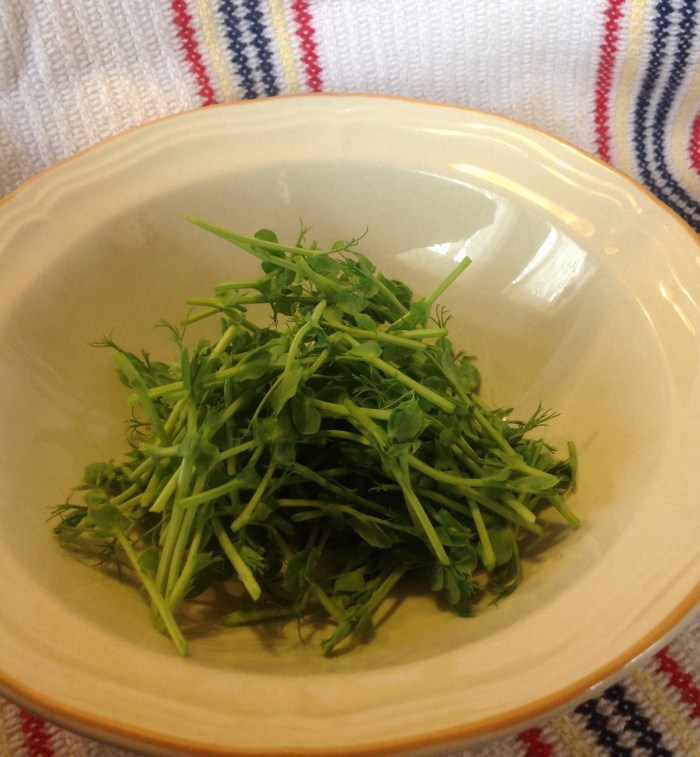
To prepare the pea shoots, I washed them well and harvested them with scissors.
~
~
Then I added a chopped onion, chopped celery, chives from the garden and a sprig of mint. Just plain mayonnaise for a dressing. Yum!
~

~
My husband shook his head and said (as a joke) I would have to survive the Apocalypse all by myself.
~
Copyright 2016 Jane Tims
update: my book ‘within easy reach’
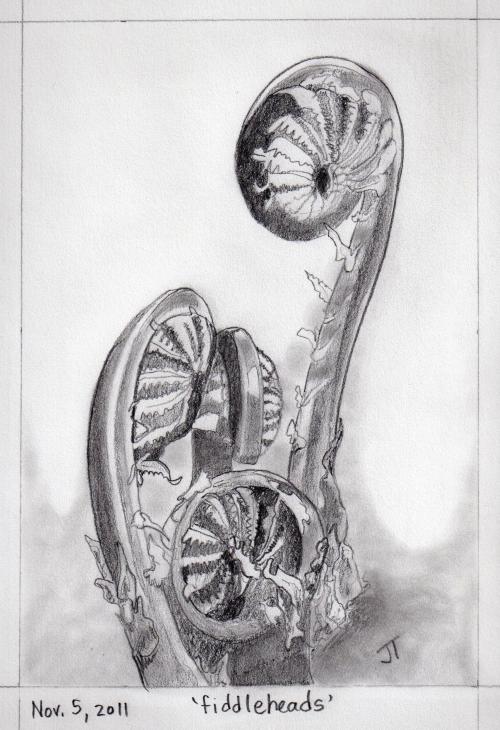
Now that my book is available, I am lined up for some readings. It’s the perfect time of year since people in New Brunswick are turning their attention to gathering fiddleheads, to gardening and to their preparations for strawberry season.
~
My book is available through my publisher Chapel Street Editions (www.chapelstreeteditions.com), at Westminster Books in Fredericton and at my readings.
Location, date and time of the readings:
- Miramichi, Rodd Miramichi Hotel, Writer’s Federation of New Brunswick, WordSpring, book sale and readings May 27, 2016 (Friday) at 7:30.
- Woodstock, L.P. Fisher Library, June 2, 2016 (Thursday) at 6:30.
- Fredericton, Westminster Books, book launch with fellow poet Edith Miller, June 9, 2016 (Thursday) at 7:00.
- Fredericton, York Regional Library, reading, last week in June, to be announced.
~
Remember, if you would like to be included in a draw for the painting on the cover of my book, you have until June 7, 2016 to enter.
To get your name in the draw, you have to do three things:
- Purchase my book through my publisher’s website (www.chapelstreeteditions.com)
- Leave a comment on any of my Blogs (www.nichepoetryandprose.wordpress.com or www.janetims.com or www.janetimsdotcom.wordpress.com) with the words ‘within easy reach’ somewhere in the comment
- Be ready to send me, via email, a scan of your purchase receipt.
~
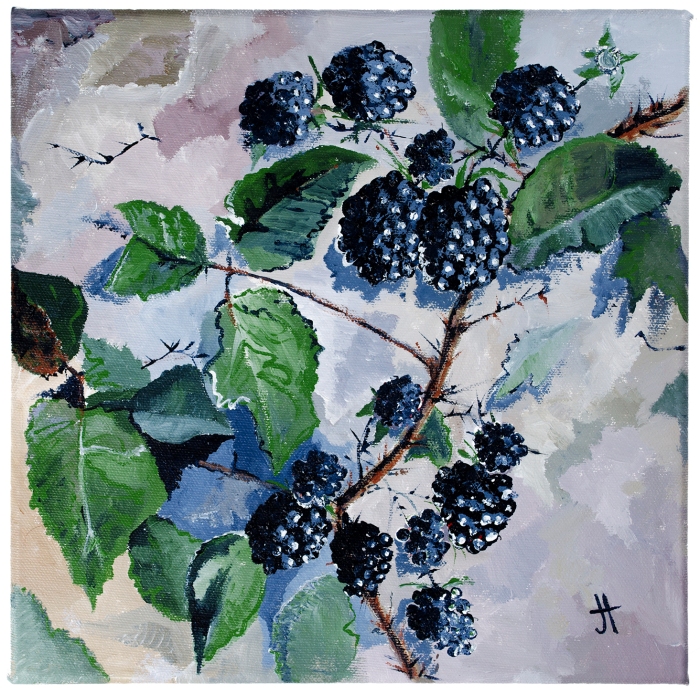
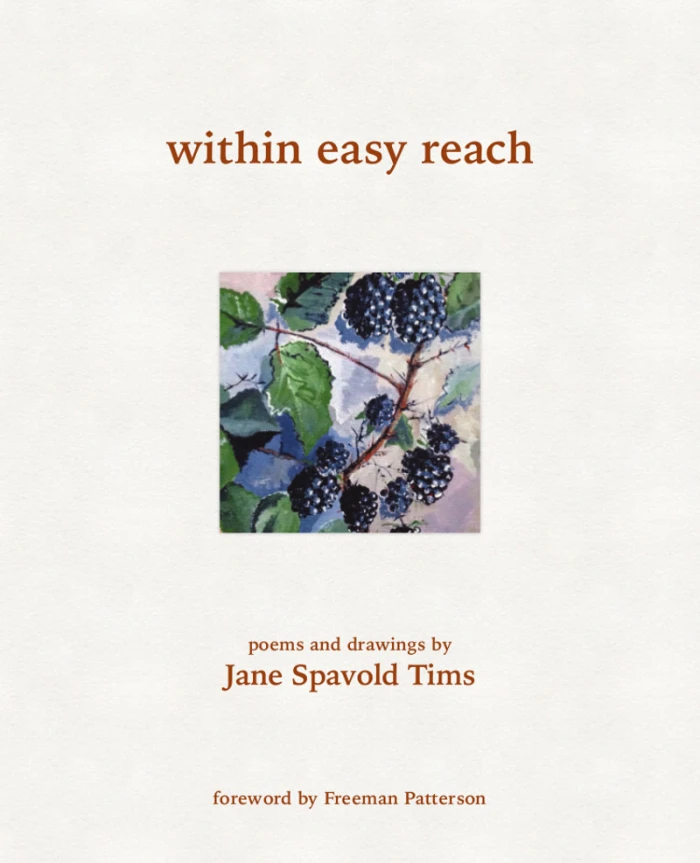
The cover painting ‘brambles’ is done in acrylics, size 10″ by 10″, with gallery edges.
February 29, 2016 ‘brambles’ Jane Tims
~
I hope you will love my book, as much as I loved creating the poems and drawings!
~
Copyright 2016 Jane Tims
fiddlehead season in New Brunswick
This time of year in New Brunswick, the fields and riversides are turning green. The leaves of the alders are the size of a mouse’s ear and that means fishing in the streams. The small leaves of the red maples are like green stars against a blue sky. And bouquets of fiddlehead ferns are unfolding in the wet meadows and along the shores.
~
Fiddleheads, the young coiled leaf fronds of the Ostrich fern (Matteuccia Struthiopteris (L.) Tod.), are a local delicacy in New Brunswick. Steamed, with a pat of butter, they are the perfect vegetable for a spring meal. Fiddleheads are one of the edible wild plants featured in my book ‘within easy reach’ (Chapel Street Editions). I will be launching my book at 7 pm on June 9, 2016 at Westminster Books in Fredericton. If you live in the Fredericton area, I would be so happy to see you there!
~
For more information on the fiddlehead, see https://janetims.com/2012/05/19/making-friends-with-the-ferns-2/

Fiddleheads along the Saint John River in the Grand Lake Meadows
‘within easy reach’ – a chance to win the cover art
This is reminder that I am offering a chance to win the painting on the cover of my book ‘within easy reach’.
~

~
To win this painting, you have to do three things.
- Purchase my book through my publisher’s website (www.chapelstreeteditions.com)
- Leave a comment on any of my Blogs (www.nichepoetryandprose.wordpress.com or www.janetims.com or www.janetimsdotcom.wordpress.com) with the words ‘within easy reach’ somewhere in the comment
- Be prepared to send me, via email, a scan of your purchase receipt.
~
The cover painting ‘brambles’ is done in acrylics, size 10″ by 10″, with gallery edges.
February 29, 2016 ‘brambles’ by Jane Tims
~
Your name will be entered once for each book purchased. The contest will run for the first five weeks following the publication date of within easy reach (until June 7, 2016). At the end of the contest, anyone who has purchased a book from the publisher and left the comment as described above will be entered for the draw. I will notify the winner and let the readers of the blog know who has won.
~
I hope you will enjoy my book. And some reader will be the winner of the painting ‘brambles’!
~
Copyright Jane Tims 2016
my poetry book – within easy reach
My new book, within easy reach, is now available.
~
I would like to thank you, the readers of my blog (and my Facebook and Twitter friends), for all your interest and support since I began my blog in 2012! The blog has helped me along the way, developing ideas for my projects, giving me a place to try my poems on a reading audience and giving me a chance to read some beautiful poetry on the blogs I follow. I also love your ‘likes’ and comments.
~
I hope you will buy my book and enjoy reading my poems and seeing my drawings.
~
For the readers of my Blog, I am offering a chance to win the painting on the book’s cover! My painting ‘brambles’ is painted in acrylics, size 10″ by 10″, with gallery edges. The painting is from a photograph of the blackberries growing on our lake property, the berries featured in the poem ‘berries in brambles’, one of the poems in the book.
~
February 29, 2016 ‘brambles’ by Jane Tims
~
To win this painting, you have to do three things.
- Purchase my book through my publisher’s website (www.chapelstreeteditions.com)
- Leave a comment on any of my Blogs (www.nichepoetryandprose.wordpress.com or www.janetims.com or www.janetimsdotcom.wordpress.com) with the words ‘within easy reach’ somewhere in the comment
- Be prepared to send me, via email, a scan of your purchase receipt
~
Your name will be entered once for each book purchased. The contest will run for the first five weeks following the publication date of within easy reach (until June 7, 2016). At the end of the contest, anyone who has purchased a book from the publisher and left the comment as described above will be entered for the draw. I will notify the winner and let the readers of the blog know who has won.
~
I hope you will enjoy my book. And some reader will be the winner of the painting ‘brambles’!
~
Copyright Jane Tims 2016
update: ‘within easy reach’
The date for the release of my poetry book ‘within easy reach’ is very soon! The book includes my poems and drawings about edible wild plants and other local foods. It will be available through my publisher Chapel Street Editions and through Amazon. I’ll be posting details of how and where to order the book and information on where I will be reading during the next weeks.
~
During the first month of ‘within easy reach’ book sales, I will be offering you an opportunity to win the painting on the front cover of the book. The painting, called ‘brambles’, measures 10″ by 10″. It is done in acrylics and has gallery edges.
~
I will post the details about how to get a chance to win the painting within the next few days.
~
February 29, 2016 ‘brambles’ Jane Tims
~
I hope you will love my book, as much as I loved creating the poems and drawings!
~
Copyright 2016 Jane Tims
‘within easy reach’ – the history of a writing project
As I prepare for the publication and launch of my poetry book within easy reach, I am thinking about how long it takes to see a writing project through from beginning to end.
~
Of course, the time depends on the writer, the project and many circumstances beyond the writer’s control. But the way to a book of poems can be long … for me it has not been days or months, but years.
~
2010
For my book, the first idea came in 2010 when my husband and I were exploring our new lake property. We knew so little about the property and were delighted to find blackberries, growing in profusion along the ridge above the lake. I can still taste those plump indigo berries and remember how quickly we filled my husband’s hat (the only container we had for picking). I wrote the first poem for the project (‘berries in brambles’) at the end of the summer. By then I was thinking about combining my interests in local food and botany to write a manuscript of poems about ‘growing and gathering’.
~

blackberries at our lake property
~
2011
The second step in the project came with an application to artsnb for a Creation Grant. Not every writer seeks funding, but I knew, after 35 years of work, that I would produce my best work with a clear purpose and deadlines. I applied to artsnb in March 2011, in time for their April 1st deadline. When I was not successful, I tried again for the October 1st deadline and in December, a few weeks before my retirement, I received the letter saying my project had been approved. I would be able to transition from work into an endeavor I knew I would love!
~
2012
The writing of ‘growing and gathering’ continued through the spring and summer of 2012. I was determined to base my poems on experience, so I spent lots of time hiking and driving to locate and pick the various plants I wanted to write about. That spring we tapped twelve of our red maple trees and planted a small garden. Many of the plants I harvested grow on our properties at home and at the lake, but for some of the plants, we drove the countryside, poking about in the right habitat to find the plants I sought. My best memory is of a spring day along the Dunbar Stream north of Fredericton, discovering mounds of trout lily leaves growing on the floodplains along the brook.
~
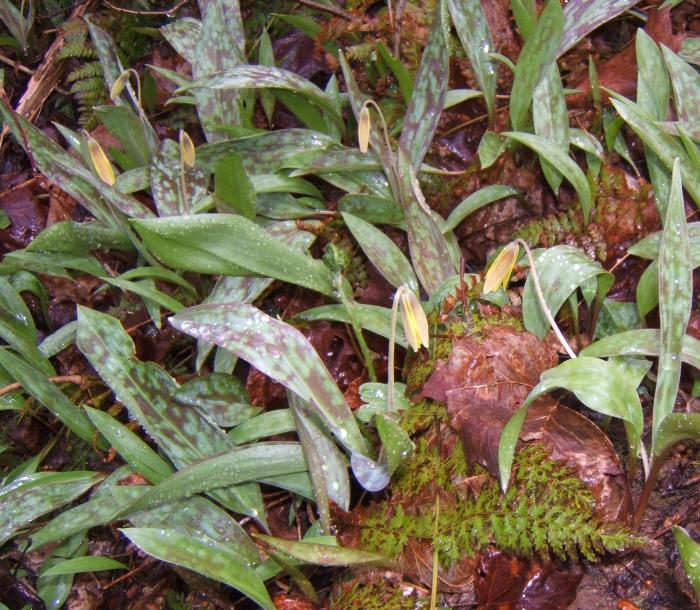
Trout Lily, also known as Dog’s Tooth Violet or Yellow Adder’s-tongue
~
For the next months, I harvested leaves and roots and nuts and berries. I chopped greens. I boiled, simmered and sautéed. I competed, unsuccessfully, with squirrels for hazelnuts. I scraped gum from spruce trees and peeled wild sarsaparilla roots. And, of course, I ate my fill of raspberries, blueberries, dandelion greens, fiddleheads, samphire greens, orach leaves and apples. From my own garden, I harvested rhubarb and herbs, onions and tomatoes. I visited Farmers Markets and roadside stands, sampling the best local produce in the world. I stirred memories from my own family history, recalling days when my dad kept bee hives and when my mom and I went blueberry picking. Really doesn’t sound like work, right?
~

salad ingredients from the garden and market
~
And then I wrote. And did research about the edibility of plants. And wrote some more. And did lots of pencil drawings. As I wrote, I consulted my Floras of New Brunswick and Nova Scotia. I completed my project with a manuscript of 135 poems and 29 pencil drawings. I submitted my manuscript to artsnb in October 2012.
~
2013
For me, the writing is only part of the process. I try to read my poems as often as possible, and I submit regularly for publication. For the ‘growing and gathering’ project, I read poems at eleven events and submitted poems to 12 literary journals. I had some success and, of the poems in the book, twelve have been previously published in seven literary journals. I also submitted the manuscript to the New Brunswick Writers’ Federation writing contest in 2013, winning Honorable Mention. Now that all sounds like work!
~

Orach growing among the rocks at the upper end of the Minister’s Island causeway
~
2014
From the beginning, I knew I wanted a published book of the ‘growing and gathering’ poems. So in 2014, after revisions and paring the poems to a reasonable book length, I began to submit to publishers. I submitted to three publishers and received three kind rejections. Then, in the fall of 2014, at the New Brunswick Writers’ Federation WordsFall, I met Keith Helmuth and Brendan Helmuth of Chapel Street Editions in Woodstock. They were interested in publishing books about the natural and human history of the Saint John River and I wondered if they might be interested in my book. I sent them my manuscript and soon began one of the best partnerships of my life.
~
2015 – 2016
During the last months, Keith and Brendan have worked to prepare my manuscript for publication. I have read every poem 20 times, revisited sources, squinted at Latin names to make certain they are spelled correctly and considered every comma and every line break.
~
Within a few weeks, my poetry book, within easy reach, will be a reality. When I first hold the finished book in my hands, I know I will be experiencing a milestone in my life. I will probably melt into a puddle. And the work will not yet be done! Ahead of me are readings and marketing and signing copies. I hope the rooms where I present my book are crowded with people eager to buy and read, but I know there may be places where I will be hoping a lone bystander will purchase a copy.
~
From beginning to end, my book has taken almost six years to complete. This may sound a bit daunting for a new writer reading this, but it is also encouraging. Your goal, like mine, may be publication. But it may also be to create a body of work representative of your life as a writer. My experience shows that every line, every paragraph, every poem you write, is part of a path towards your goal, whatever it may be. ‘A writer writes.’
~
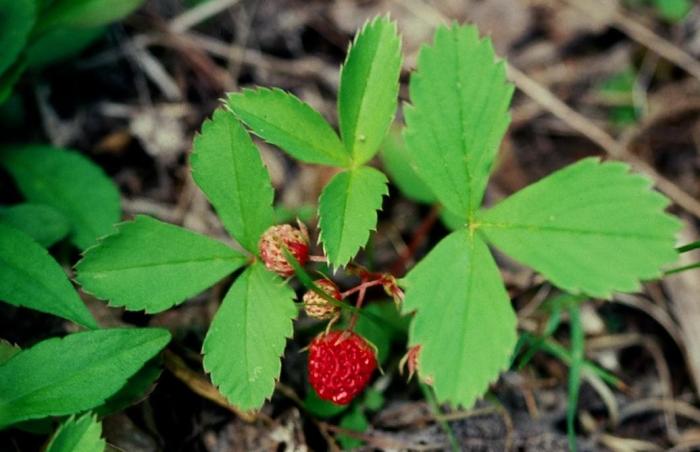
wild strawberries at our lake property
~
Copyright 2016 Jane Tims
‘within easy reach’ – a painting for the front cover
As the release date for my book of poetry ‘within easy reach’ draws near, I have been doing some painting.
~
I began my project ‘growing and gathering’ and the poems for my book ‘within easy reach’ after my husband and I discovered blackberries on our new property at the lake. For this reason, blackberries seem a fitting subject for a cover painting.
~
I think blackberries are fun to paint:
- a basic berry-shape of Payne’s Grey
- a highlighting of each seed in the drupe with Payne’s Grey mixed with Titanium White
- a spot of white to highlight berries on one side of the drupe
- a background of blues and purples to simulate the shadow in the thicket
- leaves and a stem
~
This is my ‘practice painting’, in acrylics, 5″ by 10″.
~

~
I’ll be showing you the final cover painting soon – 10″ by 10″, a perfect shape for the cover of my book.
~
On a windy, wintery day, it is hard to be patient, waiting for blackberry season!!
~
Copyright Jane Tims 2016
edible wild – spruce gum
In my part of North America, we have freezing temperatures and snow on the ground from December to March. With a few exceptions, most plants go into sleep mode during these months and foraging for edible plants is difficult. You can dig beneath the snow to find a few evergreens, but most of the edible wild is above ground.
~

~
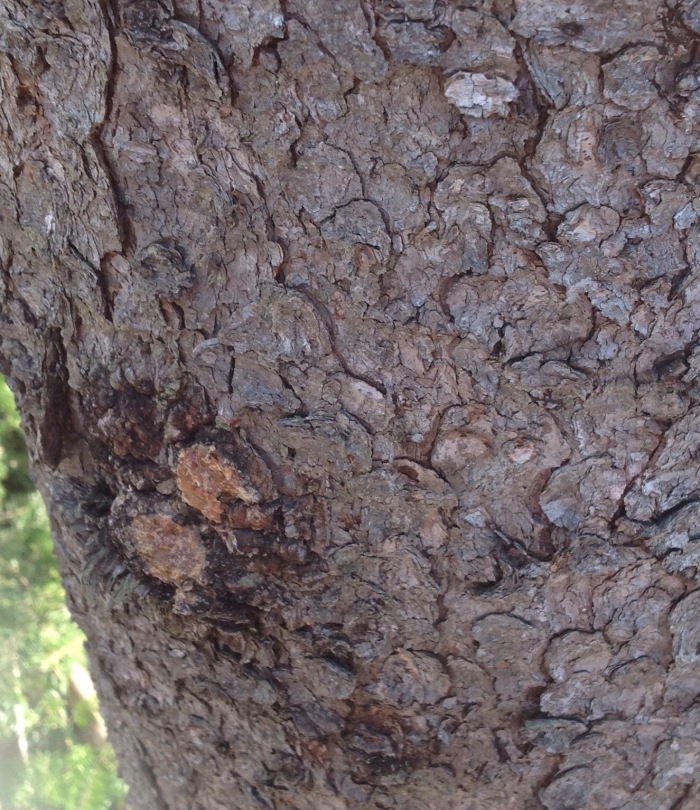
When I am in the woods, even in winter, I am always on the look-out for spruce gum, a natural sugar-free treat from the forest. Spruce gum is found, as the name suggests, on spruce tree bark. We have a large stand of spruce in our grey woods, but the tree below grows, conveniently, beside our driveway. For a map of our woods, see the right hand column ‘map of the grey woods’.
~

~
When a branch is broken or the bark is wounded in some way, the spruce oozes a sticky resin that eventually dries to a hard amber-coloured nodule. These nodules can be harvested and chewed like gum. My mom taught me about spruce gum, how to identify the spruce tree and to look for the sticky dark lumps where resin is hardening.
~

~
It is possible to collect a quantity of spruce resin, pulverize, melt and strain the substance, and solidify it, cracking it into bite-sized pieces. I chew the nodules right from the tree, with a little scraping to get rid of any rough bits. At first the gum is hard and crumbly, sticky and intensely aromatic, a little risky for dental work and made interesting by the accidental inclusion of bark bits. After a few minutes of chewing, the gum becomes pliable, woodsy-tasting and orange to pink in colour!
~
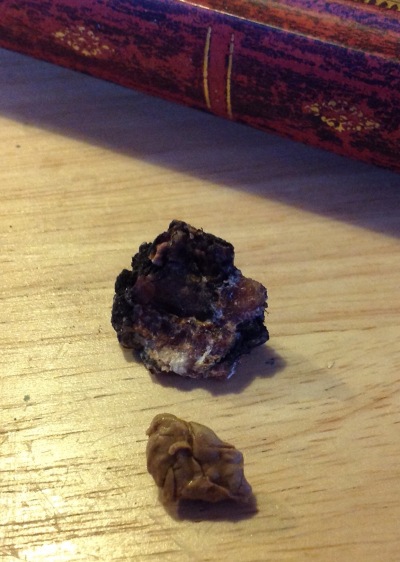
photos of chewed gum are a bit disgusting, but I want to show what normal-looking gum a two-minute chew produces. A rough nodule is shown above the chewed gum for comparison.
~
People of the First Nations have always known about this woodland edible and used it for medicinal purposes. In the nineteenth century, spruce gum was harvested with long handled spruce scrapers and sold commercially. Woods-workers made small carved boxes with sliding tops (gum books) to carry and store the resin nodules.
~
Robert Frost, wonderful poet of all things rural, wrote about spruce gum (‘The Gum Gatherer’. Mountain Interval. New York: Henry Holt and Company, 1916):
He showed me lumps of the scented stuff
Like uncut jewels, dull and rough …
~
You can find the rest of the poem at Project Gutenberg http://www.gutenberg.org/files/29345/29345-h/29345-h.htm
~
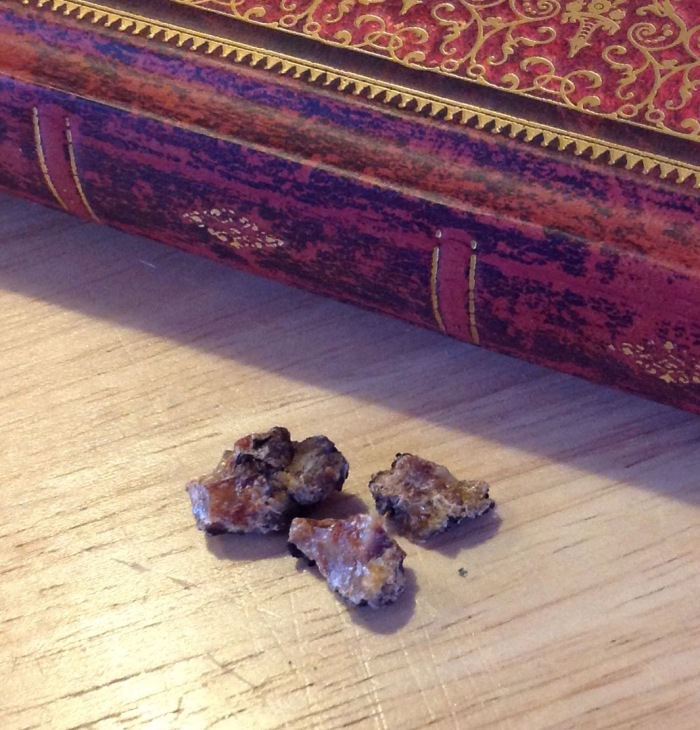
~
My upcoming book of poetry within easy reach includes a poem about spruce gum. The poem begins:
Black Spruce weeps if wounded
oozes to heal, embeds
pain in amber …
~
As I wait for spring, I intend to ration my small store of spruce gum and use it as a kind of countdown toward the end of our winter weather.
~

some very clean seeps of resin – these will harden eventually and make great spruce gum !
~
~
Copyright 2016 Jane Tims




 nichepoetryandprose