Posts Tagged ‘wildflowers’
a moment of beautiful – Blue-eyed Grass
the space: the meadow above the lake
the beautiful: a bright blue flower – Blue-eyed Grass
All grass is not grass. In spring, some of those green blades reveal their true identity. You look down, and a blue eye stares back at you. You have found Blue-eyed Grass, Sisyrinchium montanum Greene.
Blue-eyed grass is not a grass at all, but a member of the iris family. It inhabits moist, open ground in fields and meadows, and blooms in late spring and early summer. The plant is low and slender, with a deep blue flower and a bright yellow center, borne at the top of a straight, usually unbranched, stem. The stem is two-edged, flattened on the margins. The flowers are borne in the axil of a sharp, upheld bract called a spathe. In French, the plant is called Bermudienne. Montanum means ‘of the mountains’.

~
~
Blue-eyed Grass
Sisyrinchium montanum Greene
~
I walk in grass,
but it isn’t grass –
Sisyrinchium
it winks at me
with azure eyes,
and I blink brown at them
~
Blue-eyed Grass
stands straight and still,
staunch Bermudienne
simple maid
with a watchful eye,
and a sword above her head
~
~
© Jane Tims 2012
growing and gathering – names of edible wild plants
As I have worked on my poetry project about eating local foods, I have researched each wild plant, found it in its natural environment, and then written about it. With all this, I am exposed to the words and characteristics of a particular plant and it is never certain which way the ‘muse’ will take me when I write the poem. Sometimes, I end up creating a poem about eating local food, and sometimes, I get a poem about something else. Usually these stray poems are, in some way, about the name of the plant.
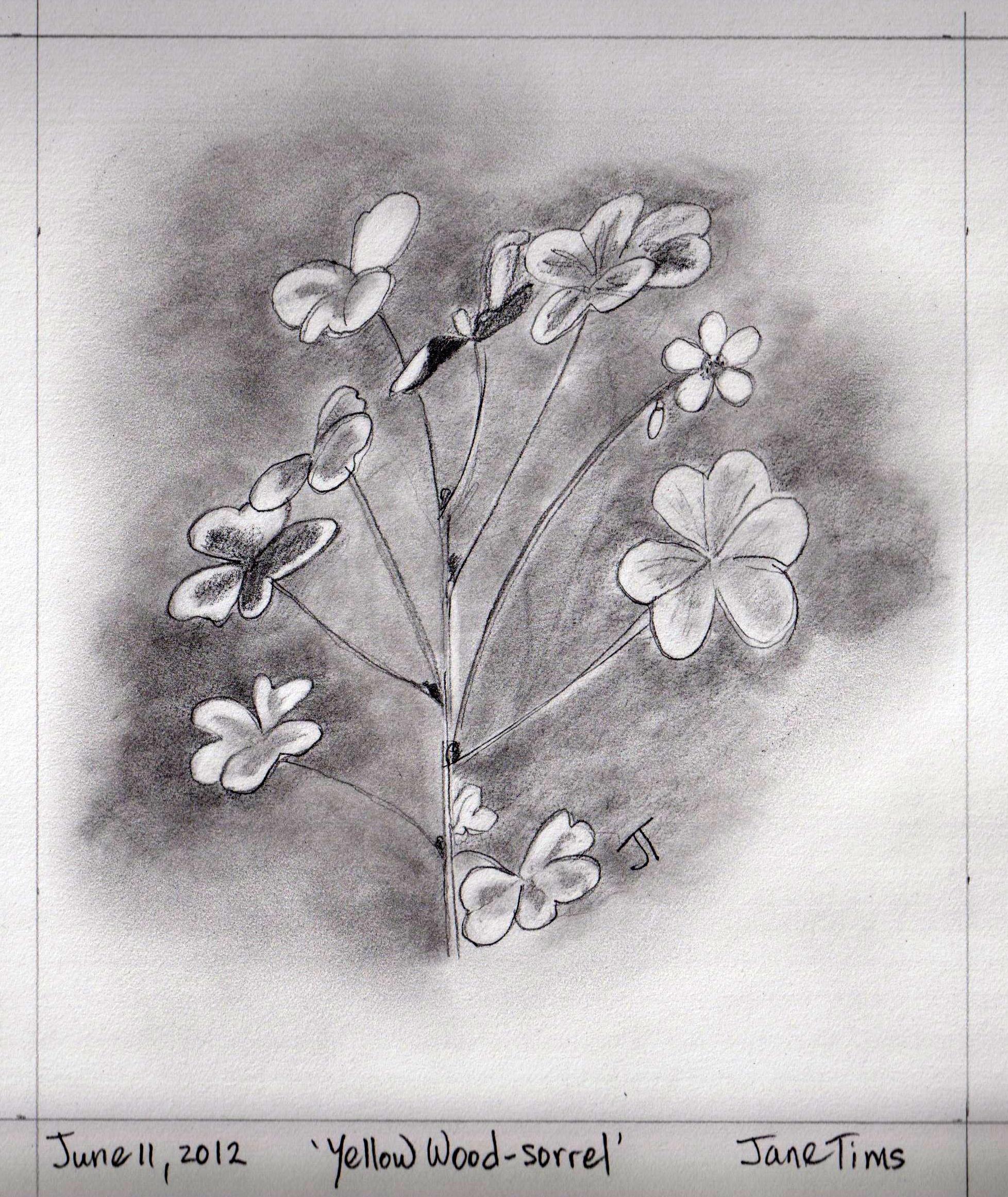
I find the names of plants are very inspiring. First is the Latin or scientific name, familiar to me after years of botanizing, but mysterious to most people. I love to find out about the origins of the name and I usually discover the name is descriptive of the plant. An example is the scientific name for Yellow Wood-sorrel (Oxalis stricta L.), a small yellow-flowered, three-leaved plant of waste areas. The name stricta means ‘erect’, referring to the way the plant grows when young or the way its seed pods are held. The word oxalis is from the Greek oxys meaning ‘sour’, a reference to the taste of the leaves.
The common names of plants are also intriguing. Sometimes these are different for each area where the plant is found. For example, the Cloudberry (Rubus Chamaemorus L.), a small relative of Blackberry with a peach-colored fruit, is known locally (and particularly in Newfoundland) as Bakeapple. Plant names may also refer to a characteristic of the plant. A good example is Heal-all (Prunella vulgaris L.), a small purple flower. It inhabits waste areas and lawns, becoming small and compact if mowed. One of its common names, ‘Carpenter Weed’, comes from this characteristic… Carpenter Weed mends holes in lawns! The name Heal-all comes from the old belief that the plant has medicinal properties.

‘heal-all’ Copyright Jane Tims 2011
So, among my collection of poems about edible plants, I have a group of poems about the plants and their names, but not about their use as local foods. I have to decide whether or not to include them in my collection, or to set them free!
~
~
Heal-all
(Prunella vulgaris L.)
~
snug Prunella, neat little weed
prim and proper, gone to seed
~
first called Brunella: gatherers found
Prunella purple fades to brown
~
a carpenter weed, busy, strong
mends bare patches on the lawn
~
heal-all, self-heal – your name suggests
an herbal secret you possess
~
~
© Jane Tims 2012
trial and error with mustard seed
On Saturday we took a side trip to see if the mustard is ripe for collecting seeds. We had selected a roadside area in early summer where lots of wild mustard was growing (for more information, see my earlier post about wild mustard –https://nichepoetryandprose.wordpress.com/2012/07/09/a-moment-of-beautiful-mustard-fields-in-bloom/
Although there are still some plants in bloom, the seeds have mostly been set in their long-beaked pods.

I would have been able to show you more, but I nibbled on the green pods the whole way home. They are delicious, crisp and tangy, with a hint of mustard.
There were a few dry seed pods but most need a couple of additional weeks to ripen. Each pod has three to seven well-formed seeds. The seeds take a little work to extract.
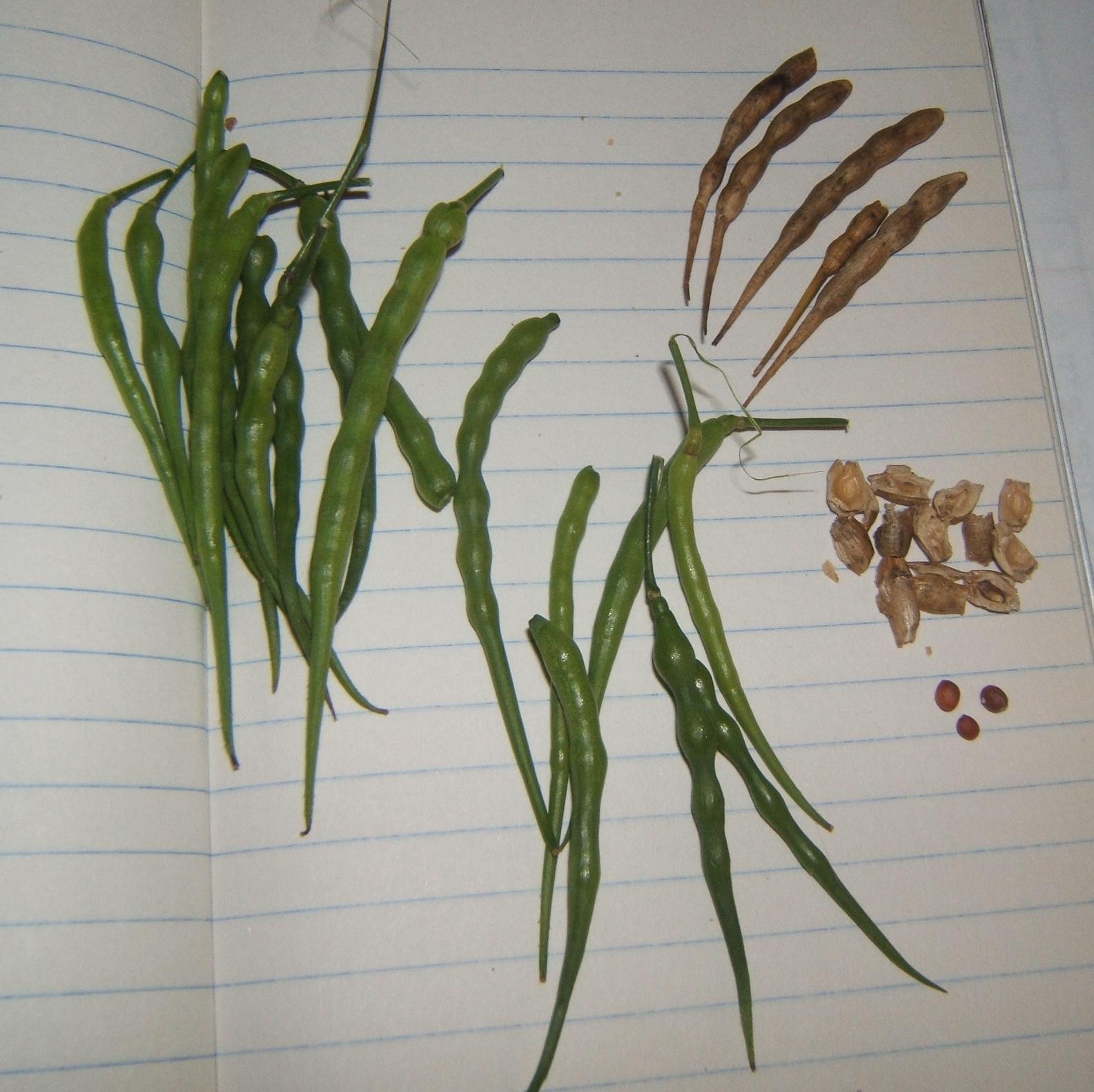
Mustard pods and seeds; green pods, dry brown pods, seed husks and three tiny seeds
I retrieved about 20 ripe mustard seeds from the pods, using a firm tap of the pestle to break the husk. Then I ground the seeds in a half teaspoon of olive oil. To make mustard, all my sources suggest using cold water, but I wanted to see if the seeds would flavour oil.
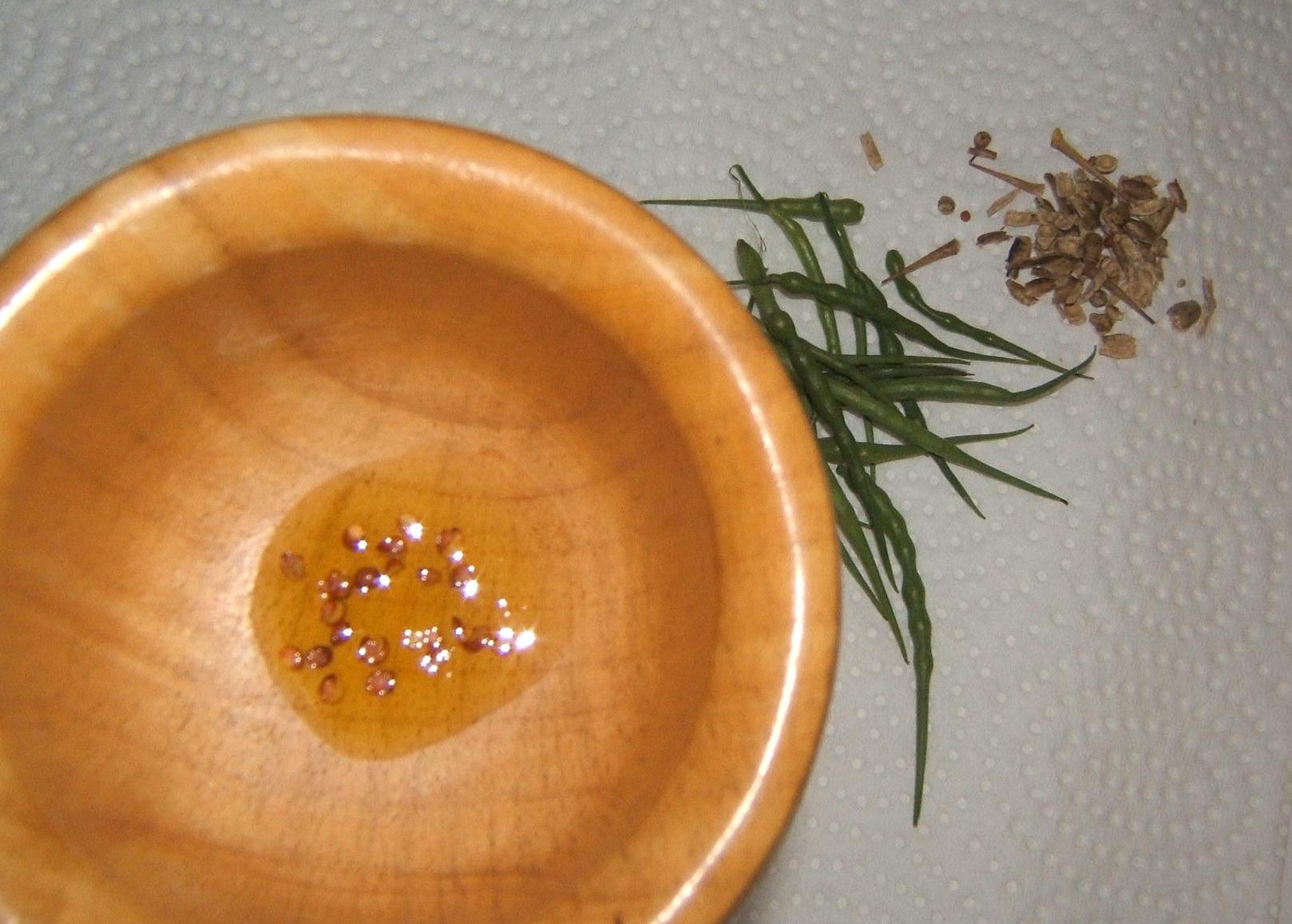
The ingredients almost vanished during the grinding with the pestle, but I got enough ‘mustard’ for a taste.

The verdict: a very mild mustard oil, easily overwhelmed by the salt on the crackers! When the pods ripen, I will pick enough for a few hundred seeds and I will use cold water to extract the flavour, just as the wise ones suggest!!!
~
~
© Jane Tims 2012
~
Warning:
1. never eat any plant if you are not absolutely certain of the identification;
2. never eat any plant if you have personal sensitivities, including allergies, to certain plants or their derivatives;
3. never eat any plant unless you have checked several sources to verify the edibility of the plant.
Sea-rocket (Cakile edentula Hook.)
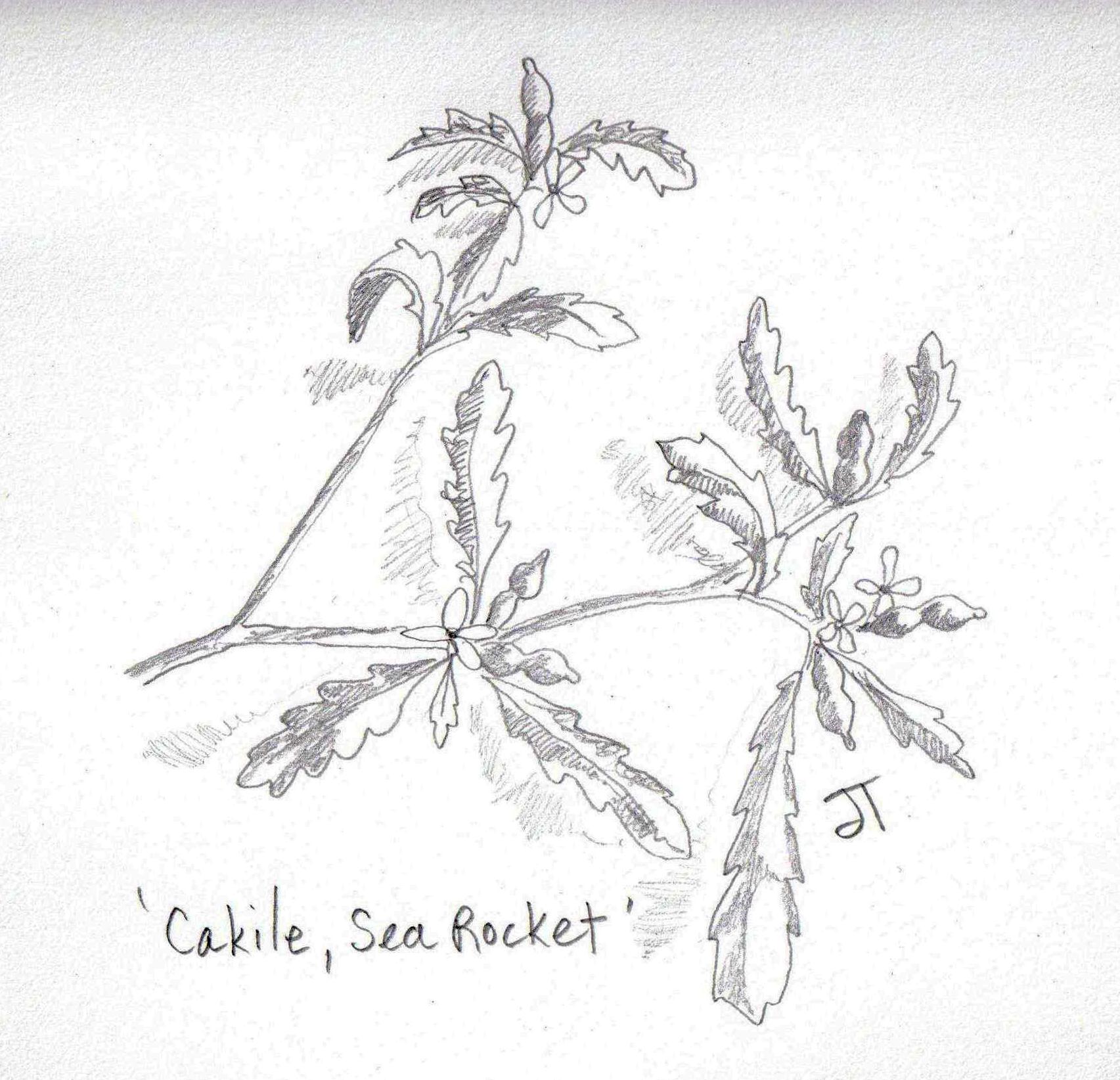
Sea-rocket, also known as Seaside Mustard and caquillier in French, is found on sandy or gravelly beaches along the coast.
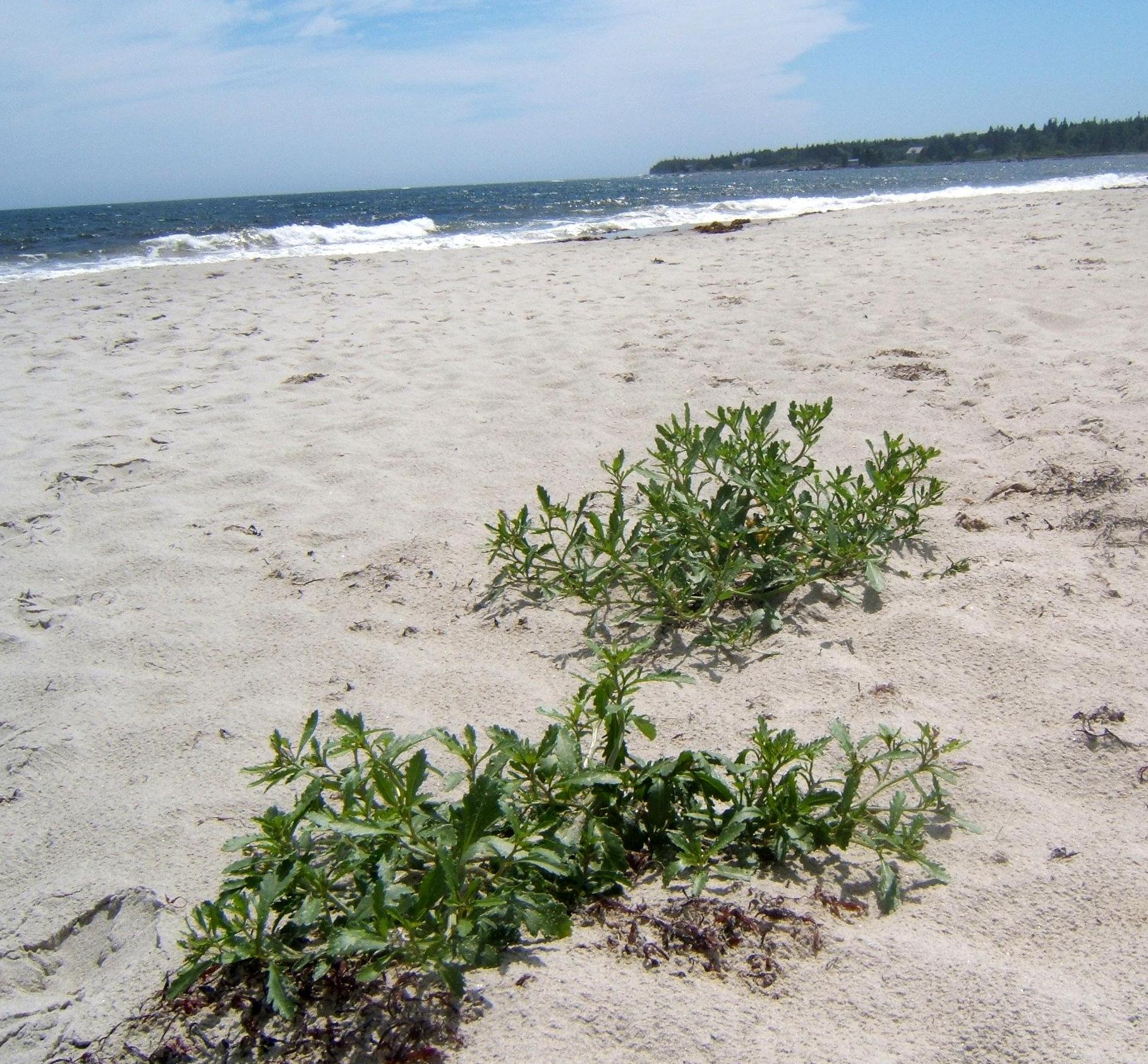
Cakile is a sprawling plant with succulent, branched stems. The leaves are thick and fleshy, with blunt-toothed margins. The four-petalled flowers are small, purple and located at the tip of the stem.
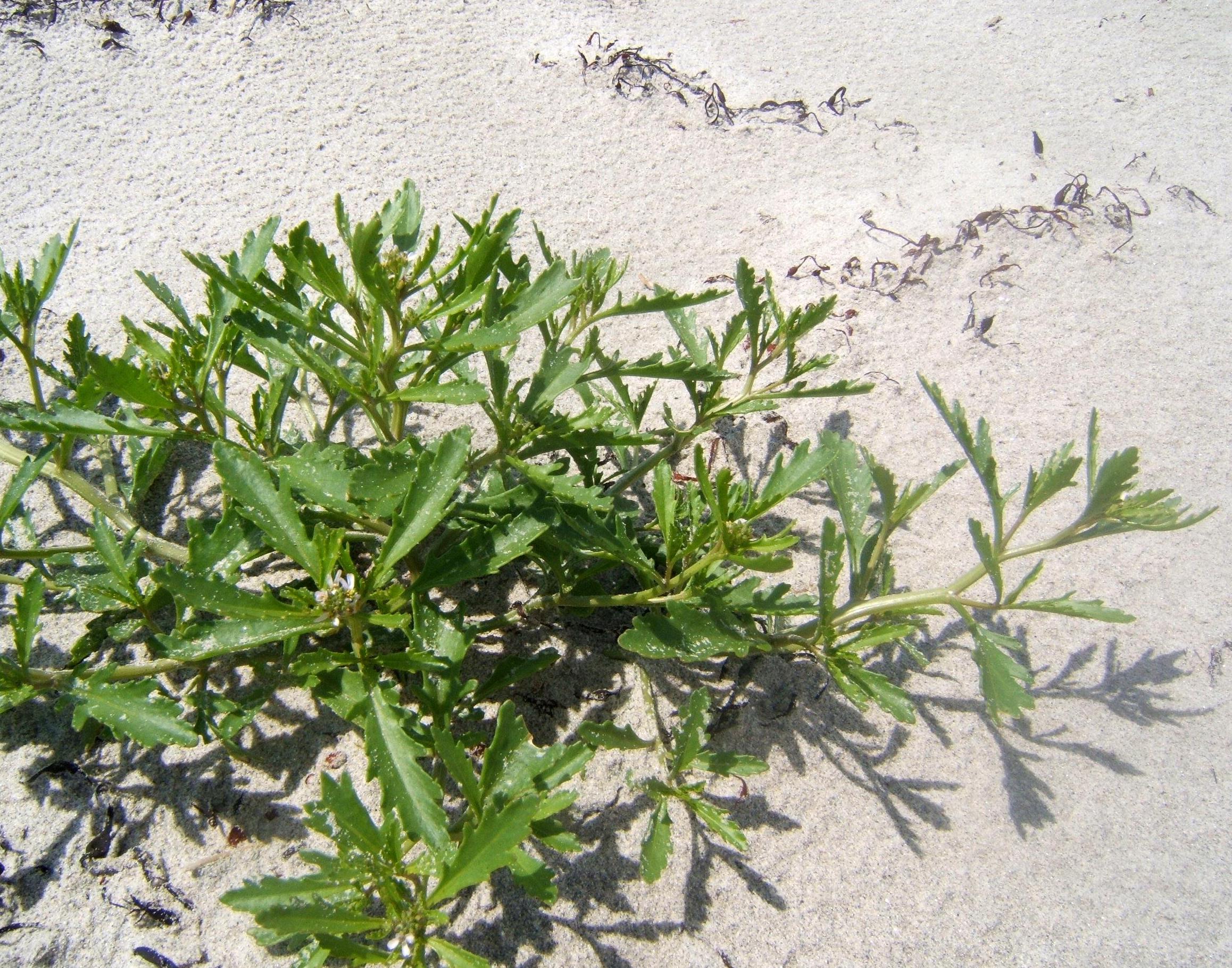
The name Sea-rocket comes from the distinctive shape of the seed pods. These have a narrow base and a pear-shaped tip, like a rocket. Cakile is an old Arabic name and edentula means ‘without teeth’.
Sea-rocket is edible. It has a hot, pungent taste, similar to radish. The stems, leaves and pods can be added to salads or boiled for 5 to 10 minutes to give a milder taste.
~
~
Cakile wind
~
the beach sizzles today
the breeze a peppered wind
the sand Cakile-hot
~
wind scours the shore-bands
of seaweed – rockweed, kelp
bleaches them, crisped and dry
~
sand dries, adheres to skin
brushes away, a rub
a sandpaper polish
~
the tongue too hot for words
the seas too salt for tears
tans ruined, scorched and red
~
~
© Jane Tims 2012
~
Warning:
1. never eat any plant if you are not absolutely certain of the identification; 2. never eat any plant if you have personal sensitivities, including allergies, to certain plants or their derivatives; 3. never eat any plant unless you have checked several sources to verify the edibility of the plant.a botany club excursion
Earlier this summer, we went on a hike with other members of a local botany club to the Cranberry Lake Protected Natural Area, an area protected for its extensive forest community of Red Oak and Red Maple.
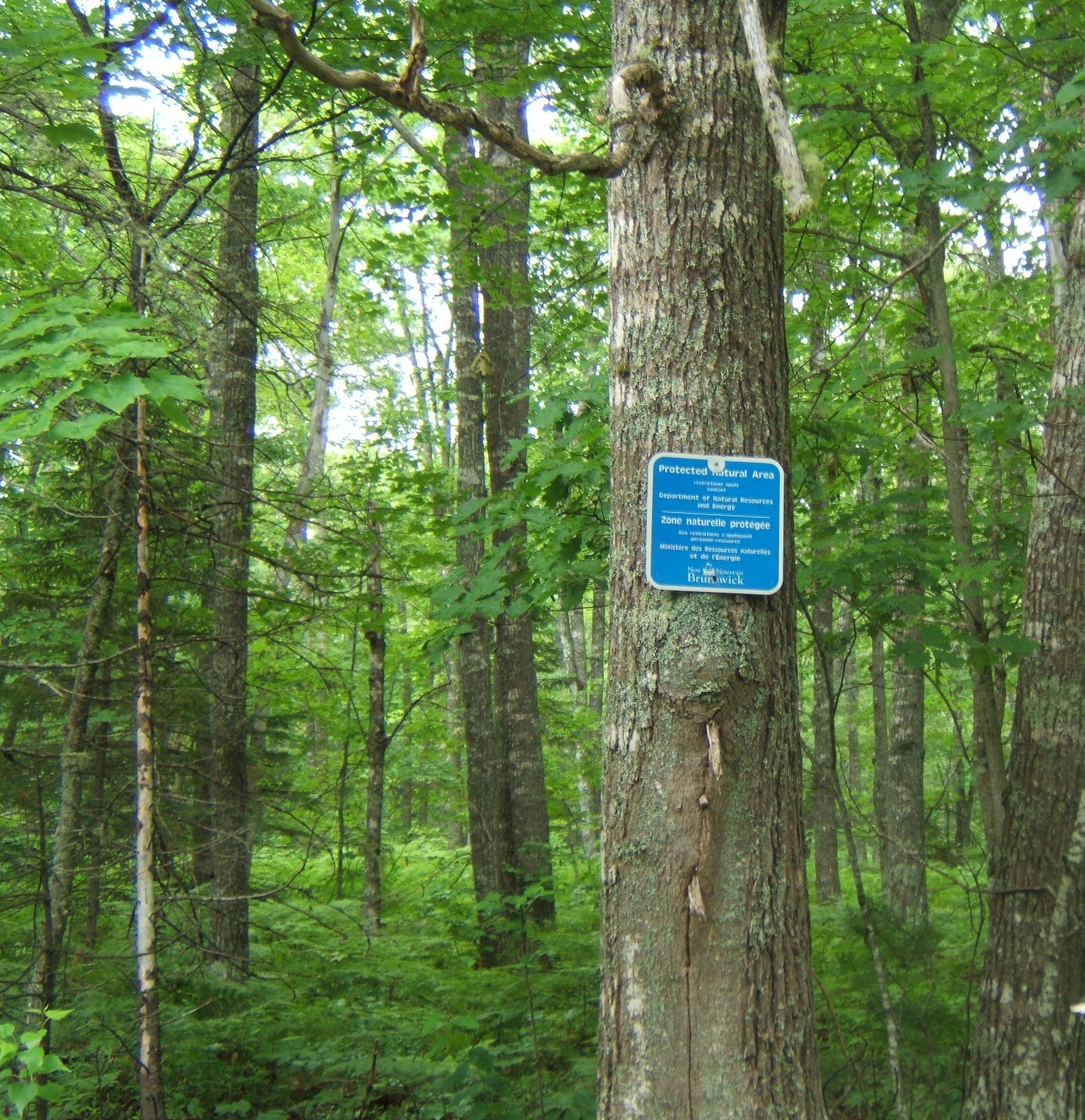
The New Brunswick Department of Natural Resources website describes the Cranberry Lake Protected Natural Area as follows:
An extensive Red Oak forest community. Predominantly Red Oak – Red Maple association. Red Oak make up a large percentage of the regeneration, most likely the Oak component will increase as the stand matures. The individual trees are impressive size.
This type of forest is rare in New Brunswick.
The woods were open with a thick understory of Bracken (Pteridium aquilinum (L.) Kuhn, var. latiusculum (Desv.) Underw. ex A. Heller), Blueberry (Vaccinium spp.), Common Lady’s Slipper (Cypripedium acaule Aiton) and some of the other species of the Canadian Element associated with woodlands in the Maritimes (see my post for April 30, 2012, Trailing Arbutus, https://nichepoetryandprose.wordpress.com/2012/04/30/trailing-arbutus-epigaea-repens-l-var-glabrifolia/ ).

My husband standing in the thick growth of Bracken… it was about waist-height… he says he was standing in a hole!
It was so much fun working with the other botanists and enthusiasts to identify the various species we encountered. The plant lists prepared during the day will be part of an effort by Nature New Brunswick to update a database of Environmentally Significant Areas in New Brunswick. During my years of work, I was privileged to work on the development and use of this database.
I saw many familiar species during the hike, but I was so excited to see three plants I have not seen in a while.
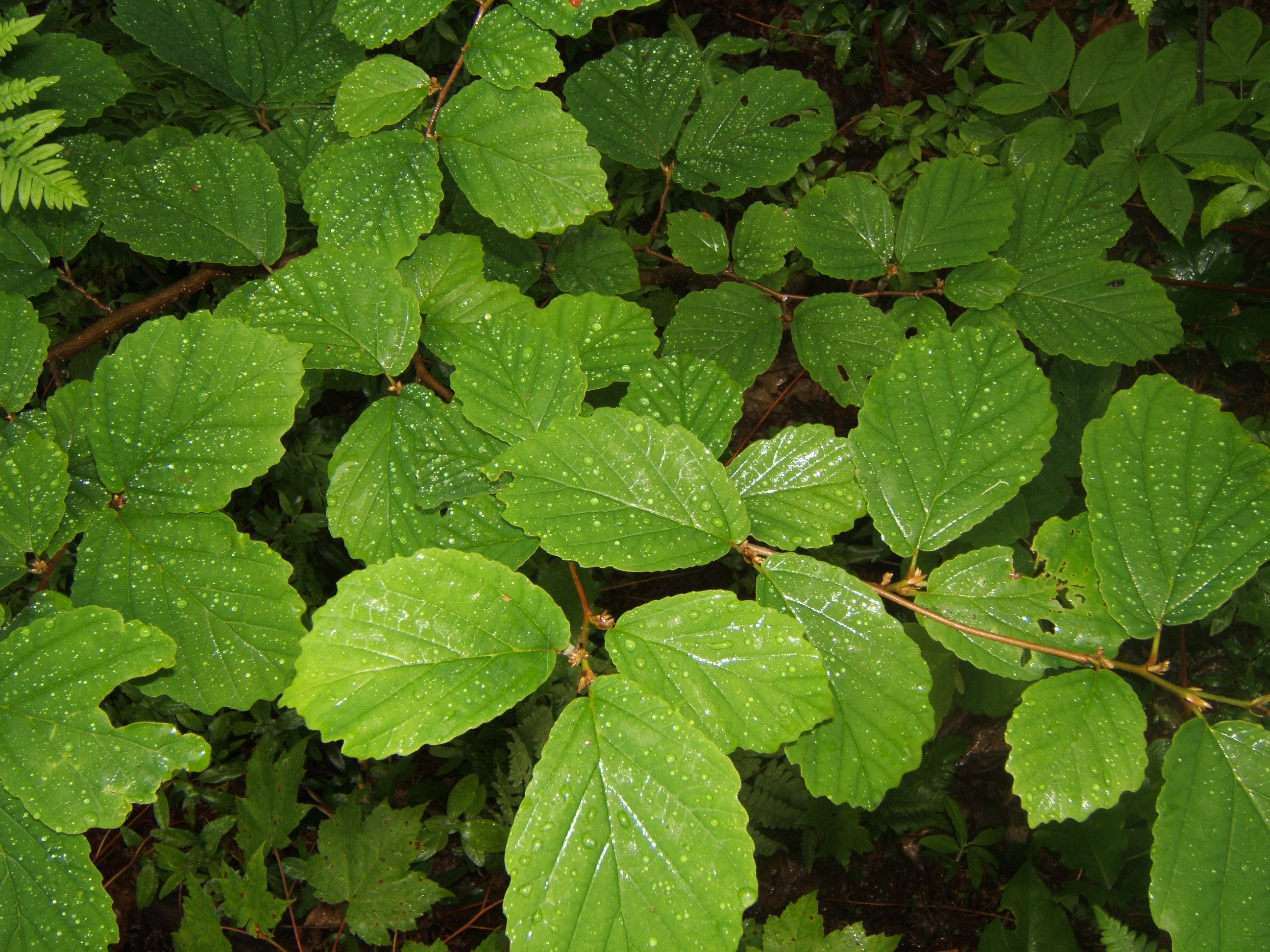
I renewed my acquaintance with Witch-hazel, Hamamelis virginiana L. (notice the asymmetrical shape of the leaves)…
and Shinleaf (Pyrola elliptica Nutt.), identifiable by its thick oval leaves, longer than the leaf-stalks or petioles…

a single plant of Shinleaf, with its straight stem of small creamy flowers, growing among Blueberry, and Red Maple and Red Oak seedlings
I also was introduced to a plant I thought I had never seen before, Cow-wheat (Melampyrum lineare Lam., a branchy variety found in dry woods). When I looked it up in my Flora, though, I found a notation to say I had seen this plant in the summer of 1984. It is always good to record the plants you see and identify!

While there, we saw a perfect example of the interaction of species. A bright orange fungus, known as Chicken of the Woods (Laetiporus sulphureus), growing on an aged Red Oak, was being consumed by a horde of slugs.

A hike with a group is a great way to expand your knowledge and boost your confidence. Everyone benefits from the knowledge of the various participants, and being with like-minded people is good for the soul!
© Jane Tims 2012
Warning: 1. never eat any plant if you are not absolutely certain of the identification; 2. never eat any plant if you have personal sensitivities, including allergies, to certain plants or their derivatives; 3. never eat any plant unless you have checked several sources to verify the edibility of the plant.Beach Pea (Lathyrus japonicus Willd.)
During our vacation to Nova Scotia, we stopped at several places along St. Margaret’s Bay. All along the beaches, tucked just out of reach of the highest tides, were crowds of Beach Pea. Beach Pea (Lathyrus japonicus Willd.) is a common plant of the coast, growing on sandy and gravelly shorelines and beaches.

This plant resembles the garden pea. It has vine-like, trailing, compound leaves, each composed of 6-8 leaflets. At the base of each leaf is a clasping stipule; at the leaf’s tip is a curling tendril. The flowers are showy, pink and blueish-purple, blooming from June to August.

The seeds of the Beach Pea are podded peas, from 1 to 2 inches long. They are greyish-green and ripen in August.
Some sources, including Peterson’s Field Guide to Edible Wild Plants (1977), say that Beach Peas can be collected, boiled and eaten when they are young and tender. Other sources, more up to date, say they are not edible because they contain a toxic substance that effects the nervous system. In my next post, I’ll talk a bit about being cautious before eating wild plants.
~
~
Beach Pea
Lathyrus japonicus Willd.
~
she feints on the rocks
sighs on the sand
beckons with the tendrils
of her feathery hand
~
ruffles her skirts
in the salted breeze
and squanders her love
on indifferent seas
~
~
© Jane Tims 2012
Warning: 1. never eat any plant if you are not absolutely certain of the identification; 2. never eat any plant if you have personal sensitivities, including allergies, to certain plants or their derivatives; 3. never eat any plant unless you have checked several sources to verify the edibility of the plant.Silvery Cinquefoil (Potentilla argentea L.)
Last month, whenever I went to get the mail, I was waylaid by a little plant sprawling next to the row of boxes. He was so charming, once I forgot to get my mail because I was examining his flowers and leaves! There should be a sign saying ‘No Loitering’.
The plant was Silvery Cinquefoil (Potentilla argentea L.). As its name suggests, Silvery Cinquefoil is covered with fine silver hairs, giving it a downy appearance. It has fine-toothed, five-fingered leaves, palmately compound, and five-petalled yellow flowers.
I have always liked the various species of Potentilla, interesting for the variety of their leaves. You can see how diverse these shapes are in a page from Roland and Smth’s Flora of Nova Scotia. The reddish pressed leaf in the scanned book, for example, is Silverweed (Potentilla Anserina L.). My post for July 13, 2012, ‘coastal barren, coastal bog’, shows the Three-toothed Cinquefoil (Potentilla tridentata Ait.) https://nichepoetryandprose.wordpress.com/2012/07/13/coastal-barren-coastal-bog/ .
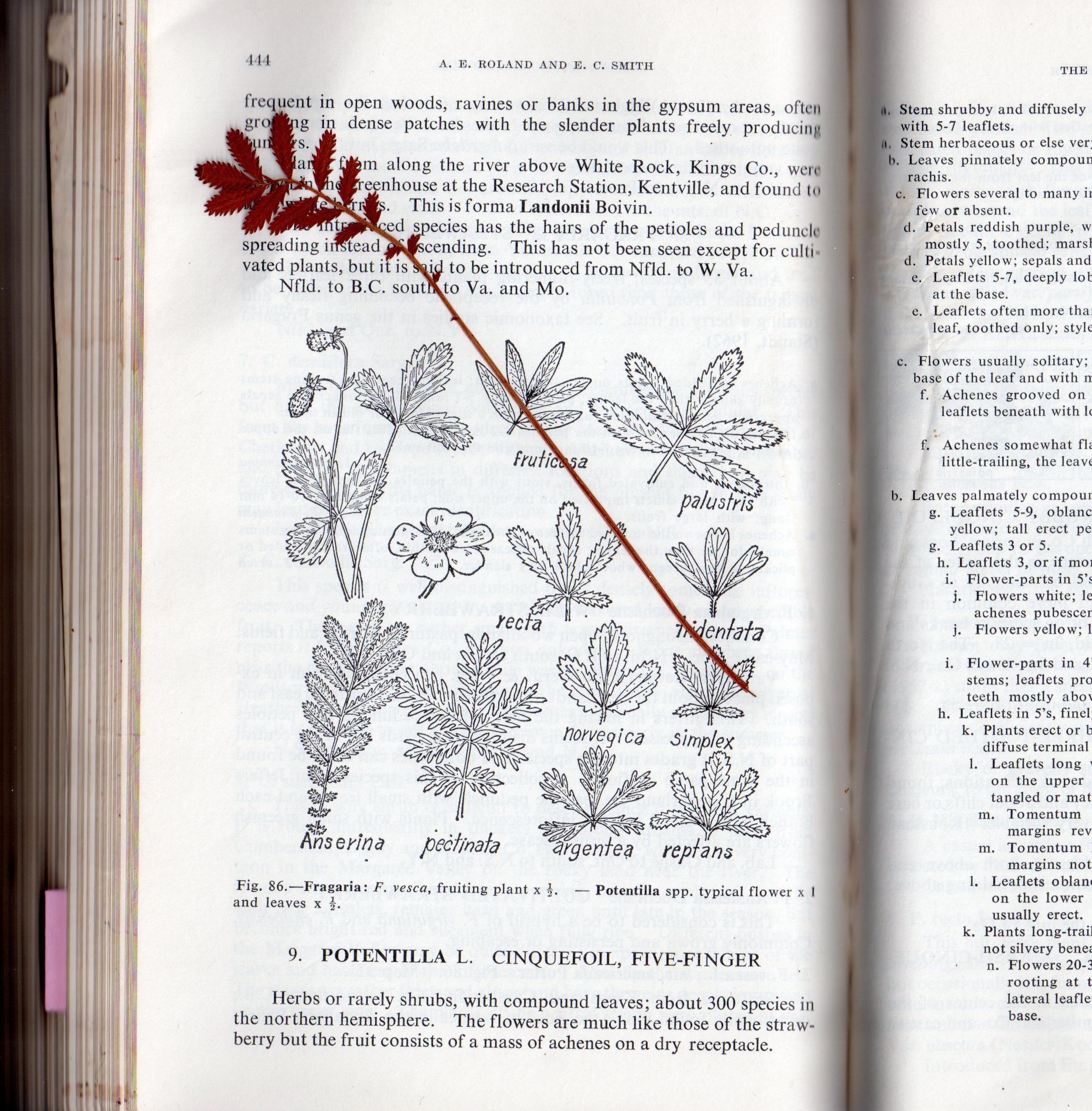
various leaf shapes of Potentilla in a page of The Flora of Nova Scotia (A.E. Roland and E.C. Smith, Nova Scotia Museum, Halifax, 1969) … the pressed leaf is from Potentilla Anserina or Silverweed, a coastal species of Potentilla.
~
~
Five-Finger
~
metal leaf and yellow,
he leans on the post-box
palms extended
potent, persuasive
a bit of a thug
want your mail?
pay me,
in silver
~
~
© Jane Tims 2012

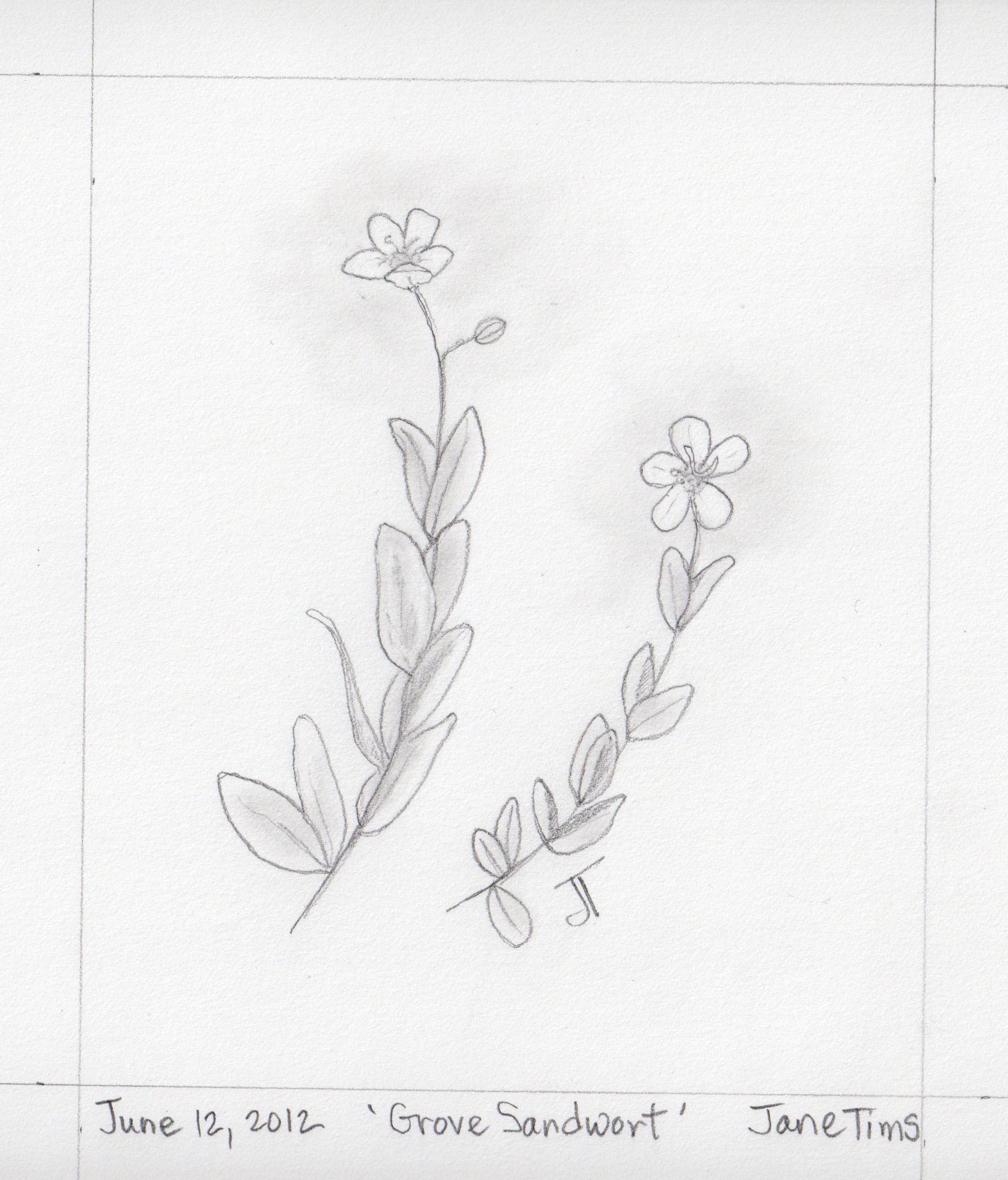
Grove-sandwort (Arenaria lateriflora L.)
Our summer property is a constant source of learning for me. Every year I seem to find at least one new plant. This year the plant is Grove-sandwort (Arenaria lateriflora L.).
Grove-sandwort is a common plant, found in meadows, along shorelines and at the borders of woods. It is a low-growing herb, first noticeable in June. The starry, white flowers each have five petals and grow near the top and along the sides of a simple stem. The leaves are elongated, elliptical, and in pairs.

Arenaria comes from the Latin arena meaning ‘sand’, where many of the members of the genus grow. The specific name lateriflora means ‘flowering on the side’.
Have you learned to identify any new plants this summer?
~
~
new neighbor
Grove-sandwort (Arenaria lateriflora L.)
~
met her in the meadow
by the split-rail fence
strewing the grove
with flowers
~
her leaves paired,
clapping hands,
delighted only ‘to be’
a bystander in the arena
~
~
© Jane Tims 2012
growing and gathering – ethics
Some of the poems in my collection will address the ethics of eating wild plants as food.
As a botanist, I know how many wild plants are edible. However, I also know there are ethical considerations to eating wild plants.
Plants differ greatly in their availability. Eating Dandelion greens puts no pressure on the survival of the Dandelion. Weedy species in general respond well to being harvested, by putting out copious seeds, by filling in the spaces with new rhizomes and shoots, and by growing in many habitats and conditions.
However some plants are very specific in their requirements. They need certain conditions of light, moisture and soil to thrive and reproduce. On our own property, I have watched the Painted Trillium (Trillium undulatum Willd.) struggle to maintain its presence. The Painted Trillium needs acidic, rich soils and lots of shade. Remove a single tree, cut a new trail, or let the Balsam Fir overtake the understory, and the place where a few Trilliums grew in previous years is suddenly vacant. The young leaves of the Painted Trillium can be used as a pot herb, but should I pick them to add to my knowledge about eating local foods?
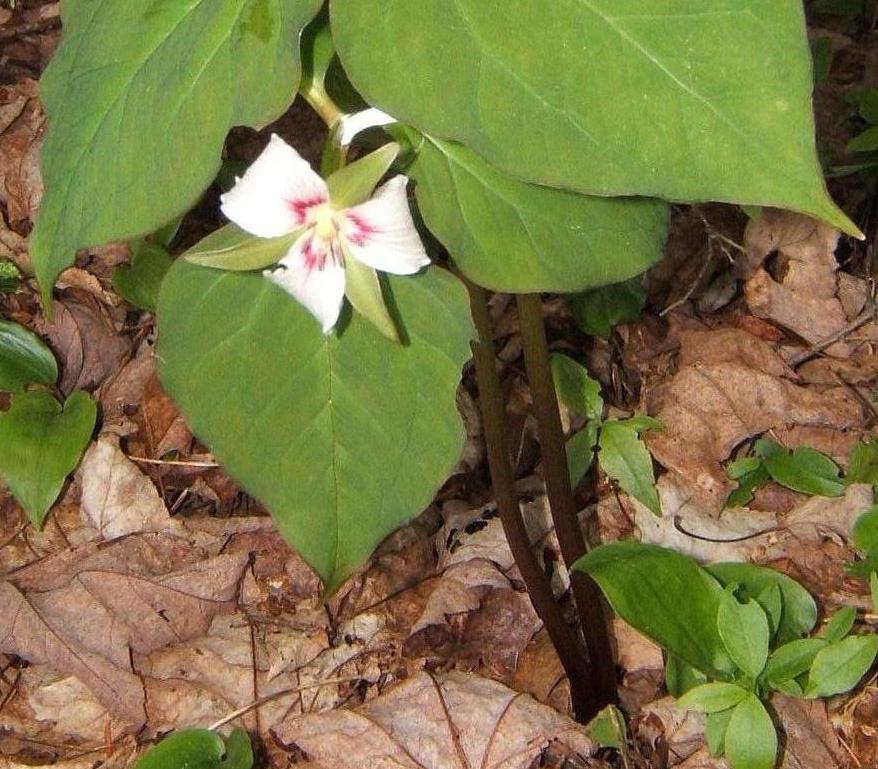
a Painted Trillium in our Grey Woods, near the end of its blooming
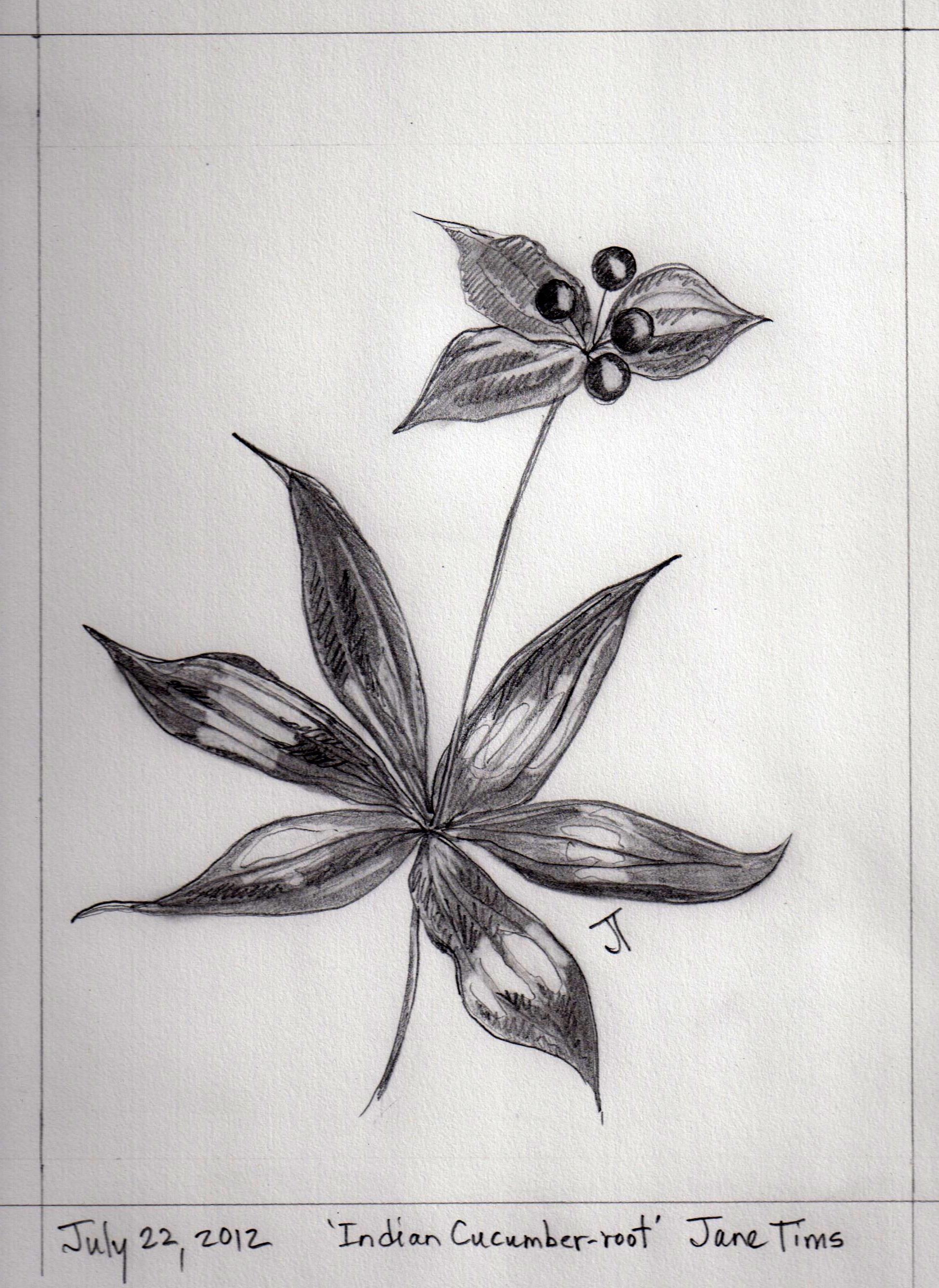
Many woodland plants deserve this special consideration. In his Flora of New Brunswick (2000), Hal Hinds wrote, of the Indian Cucumber-root (Medeola virginiana L.): “… Although this plant produces a deeply rooted, 2-3 cm edible white tuber with a bland cucumber taste and crisp watery texture, it is truly unfortunate to destroy the plant for such a tiny morsel…”
In some circumstances, harvesting and eating these rarer wildflowers would be acceptable. In the past, for example, people of the First Nations depended on wild plants for their existence. A lost hiker, needing sustenance or hope in an emergency situation, could be excused for eating any edible wild plant.
In other circumstances, rarity, the size of the population, and habitat health are probably the fundamental issues. Take the time to know a little about the plant you are thinking of picking. Is its habitat under stress or becoming hard to find? Is it rare, threatened or endangered? Local abundance may not be a deciding factor, since rare plants often grow abundantly where they are able to grow.
Eating local is an environmentally responsible life-style choice. It saves energy and supports local farmers. Eating local wild plants as food is a nutritious and thrifty way to supplement the larder. But these benefits must be weighed against the possible harm to plant populations.
Pick with some rules in mind. Understand the plant you harvest. Gather only what is sustainable. Sometimes this means gathering nothing at all.
~
~
Indian Cucumber-root
(Medeola virginiana L.)
~
step carefully
in your quest,
lured to the wood
by a sorceress
~
search carefully
among the shoots
for Indian
Cucumber-root
~
count carefully-
two layers of leaves
purple berries
stalk wool-sheathed
~
dig carefully-
below the stem
in dark, damp earth
awaits a gem
~
clean carefully
leave no trace
of the woodland soil
on the creamy face
~
taste carefully-
best to savour-
slightly celery
in flavour
~
think carefully
now you possess
one dead plant
and emptiness
~
~
© Jane Tims 2012
Chicory – (Cichorium intybus L.)
Along the Trans-Canada near Jemseg, one colony of Chicory has taken hold. Its bright sky-blue flowers catch the eye as the usual roadside vegetation rolls by.
~

~
Also known as Blue Sailors and, in French, chicoreé, Chicory (Cichorium intybus L.) is a tall plant, found along roadsides and in other waste places.
Chicory has basal leaves resembling those of the Dandelion. When broken, the stem exudes a white milky fluid.
The bright blue flowers of Chicory occur along the length of the almost leafless and somewhat zig-zag stem. Each flower is formed of a central involucre of tiny blue flowers and a disc of larger ray flowers. The rays are square-cut and fringed. The flowers follow the sun, closing by noon, or on overcast days.
~

~
Chicory is a useful plant. Its young leaves are edible as salad greens or as a pot-herb. The roots can be dried and ground to make a coffee substitute or supplement. The root of Chicory has soothing properties to balance the edginess caused by caffeine. The roots of Chicory are large and very deep. I tried to pull them by hand, but a shovel will be needed to harvest the roots in the compact soil of the roadside.
~ When I see these flowers, I am reminded of my grandfather, my mother’s father. I never knew him, but I have a couple of photographs of him as a young man. I have made a small study of his mother, my great-grandmother, so I know quite a lot about him. ~
~
The flowers of Chicory remind me of his eyes, since they were the same startling blue. He was also a tall man, another feature of the plant.
The other name for Chicory, Blue Sailors, also reminds me of my grandfather. He was a sailor, entering the navy when he was only fifteen. I know from various records that he served on at least two naval vessels, the USS Nebraska and the USS Pensacola. As so often happens when I see photographs of ancestors, there is a familiarity about his features.
~

~
Blue Sailors
Chicory (Cichorium intybus L.)
~
at the roadside
weeds surge as waves
~
on the sameness of ocean,
a buoy lifted,
a sudden swell of Chicory
~
tall, like my grandfather,
the blue ice of his eyes
its blunt petals, the square-cut of his jaw
~
joined the navy at fifteen
dressed as a sailor, headed for sea
USS Pensacola, USS Nebraska
~
his tie, a sapphire ribbon
toothed or frayed
~
~
© Jane Tims 2012
Warning: 1. never eat any plant if you are not absolutely certain of the identification; 2. never eat any plant if you have personal sensitivities, including allergies, to certain plants or their derivatives; 3. never eat any plant unless you have checked several sources to verify the edibility of the plant.





 nichepoetryandprose