Posts Tagged ‘poetry’
a glimpse of water fall
If you love the sound of water falling, the sparkle of water in sunshine, the feel of water beating at the back of your hand, you probably love waterfalls.
Most people know at least one waterfall. A place to go to cool off on a summer day, or to admire sculpted water in the midst of frozen winter. A place to drown the senses, to still … thoughts.
Waterfalls are musical, magical, calming and exciting at the same time. They are soothing yet, in their own way, are a violent interaction of land and water, water and land … sometimes a metaphor for a dramatic shift in the course of a life…
My seventh book of poetry honours the waterfall. It includes poetry written about various waterfalls in New Brunswick and drawings of several of these waterfalls. The manuscript won Honorable Mention in the Writers’ Federation of New Brunswick writing competition for the 2012 Alfred G. Bailey Prize for a poetry manuscript.
‘a glimpse of water fall’ is the first in a poetry series called ‘a glimpse of.’ Later this year, I will publish ‘a glimpse of dragons’ and ‘a glimpse of sickle moon.’ This latter manuscript won Third Place in the competition for the 2020 Alfred G. Bailey Prize.
‘a glimpse of water fall’ is available in paperback from Amazon. Just click here. It will soon be available from Westminster Books in Fredericton.
~
Here is a sample from the book:
crescendo
Little Sheephouse Falls
~
still
silence
partridge-berry vine
cascades over granite, padding
of feet on pine needles, whisper of wind
rustle in branches of conifer, music of riffle,
incessant patter of falling water on fractured slate
builds to din and rumble of rolling thunder confined
~
Little Sheephouse
on its way to Sevogle
~

~
All my best,
Jane
Gargoyles?
I am working on my poetry manuscript ‘a glimpse of waterfalls.’ As always, I workshop some of the poems with my writing group Wolf Tree Writers. Wolf Tree has been together over thirty years and has assisted me greatly in improving my poetry.
~
This past week I read a poem to Wolf Tree called ‘from a window on the 3rd floor.’ In the third stanza, a gargoyle is mentioned. We talked about how a gargoyle is an ‘Old World’ (European) reference. It made me curious about gargoyles in Canada.
~

~
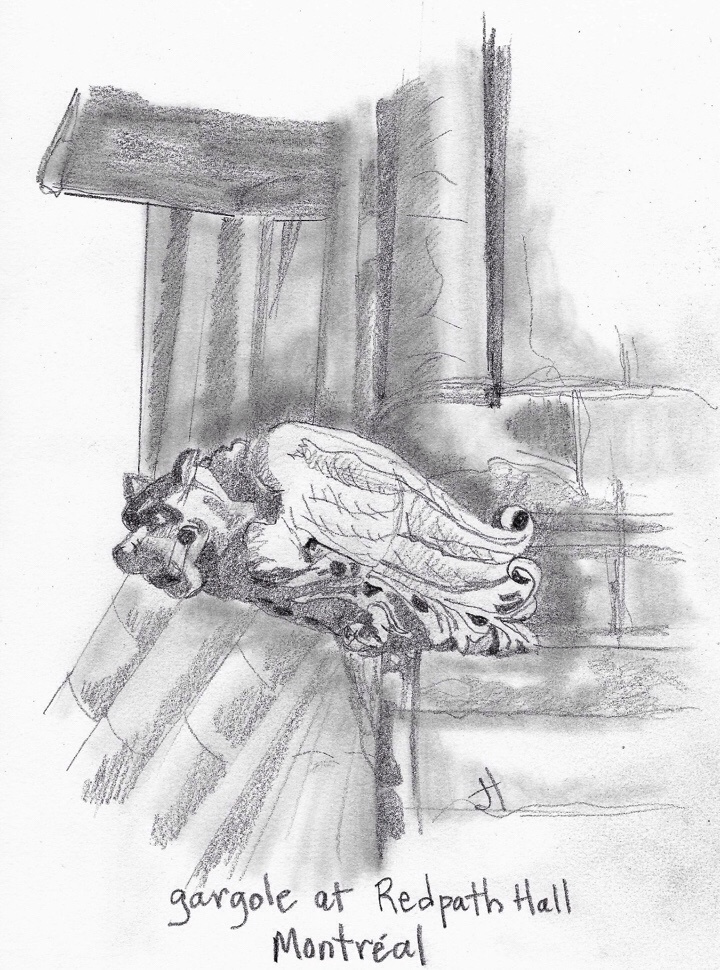
A gargoyle is a sculptural architectural feature used like a waterspout to transport rainwater away from the building. A gargoyle often depicts a grotesque other-world figure and also serves to frighten daemons away and remind people of the perils of doing harm. Sculptural features which look like gargoyles but which do not convey water are called grotesques.
~
~
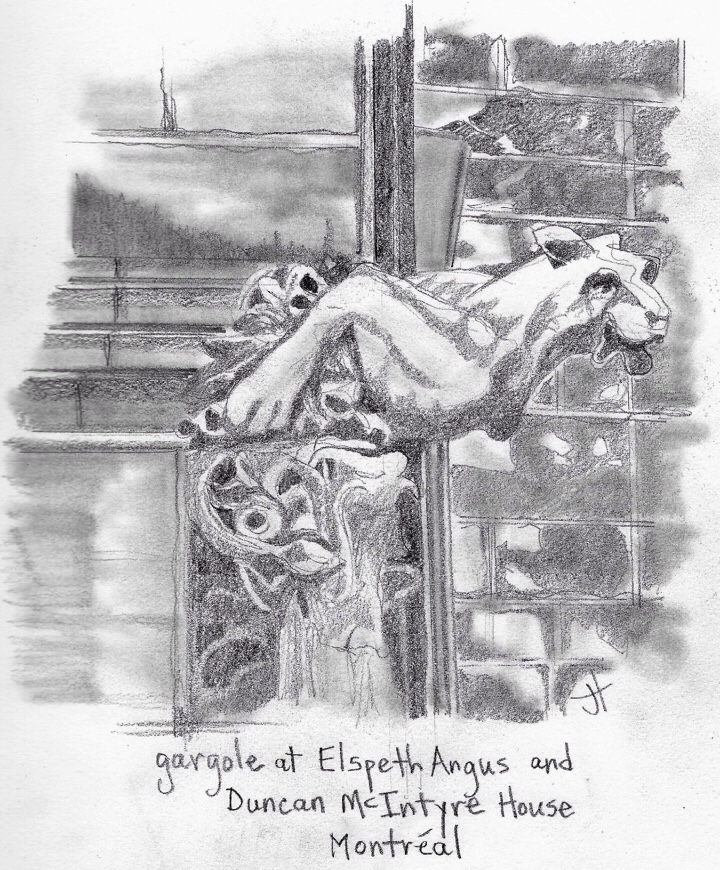
Canada has many examples of gargoyles, occurring wherever architecture is gothic in design. There are many examples in Montreal, including on the campus of McGill University (Redpath Hall and Library), on churches (Christ Church Cathedral) and on private buildings (the Elspeth Angus and Duncan McIntyre House). The Peace Tower (Parliament Building) in Ottawa has numerous gargoyles and grotesques. For more information see https://sencanada.ca/en/sencaplus/how-why/gargoyles-and-grotesques-parliament-hills-sinister-sentinels/
~
~
from a window on the 3rd floor
~
I nudge curtain, interpret
streetscape, sirens
stream down the glass
fractal paths where drops
meet and coalesce
meet and coalesce
~
the puddle on the cobbled street
a pool at the base of a waterfall
edged in rock and fern
candy wrappers, paper coffee cups
brick an escarpment, rain spills
from ledges of stone
edges of stone
~
above, a gargoyle gushes
glimpse of reckless sky
heartened, I consider
merits of solitude
building facade
pavement pulses
red and blue
red and blue
~

~
Are there any gargoyles in the architecture of your area?
~
All my best!!
Jane
2020 resolution realized!
In the early days of 2020 I designed a project for myself … to hunt down and organize my older poems. I set a goal to organize the poems into files and to create (and independently publish) three poetry books from three of the files. I had a good start on these books since I had already completed the poems and the illustrations. Some revision work and formatting was left to be done.
The three books are done! I have a new book of poetry published: blueberries and mink – summers on my grandfather’s farm. To order from Amazon, click here

~
A brief history and description of the three:
~

~
In early September, I published ghosts are lonely here, a book of 45 poems and 14 of my original illustrations about abandoned features of the human landscape. If you are fascinated by abandoned houses, bridges, vehicles, churches and so on, you will love these poems. To order a copy from Amazon, https://www.amazon.ca/dp/B08J5CQ4GC
~
In early December, I published niche, a book of 65 poems and 16 illustrations about the spaces plants and animals, including humans, occupy. With a foreword by my friend, award-winning poet Roger Moore, these are poems about plants and animals in the places where I have lived: Nova Scotia, New Brunswick and Alberta. To order a copy from Amazon, https://www.amazon.com/niche-Jane-Tims/dp/B08QRYXS9D
~
Yesturday, I completed my review of the proof of the third and final book in my 2020 series: blueberries and mink – summers on my grandfather’s farm. This book was begun as an exploration of the various buildings on my grandfather’s Nova Scotia farm and evolved to tell the story of change on the farm. It contains some very personal memories of my visits each summer to the farm and my ramblings in the surrounding countryside. The book has 45 poems and includes 26 illustrations. To order a copy from Amazon, https://www.amazon.com/dp/B08RH7MKJS
~
By the end of January, these three books will be available in Westminster Books in Fredericton, or from me directly.
~
Three new books on my author’s shelf! Hooray!
~
All my best!
Jane
scraps of paper
Occasionally I tackle a stack of stray papers. These are usually bits saved years ago, once thought important. Sometimes I find a scrap of poetry among receipts and old letters. Poetry scribbled when an idea occurs, on any scrap within reach.
~

~
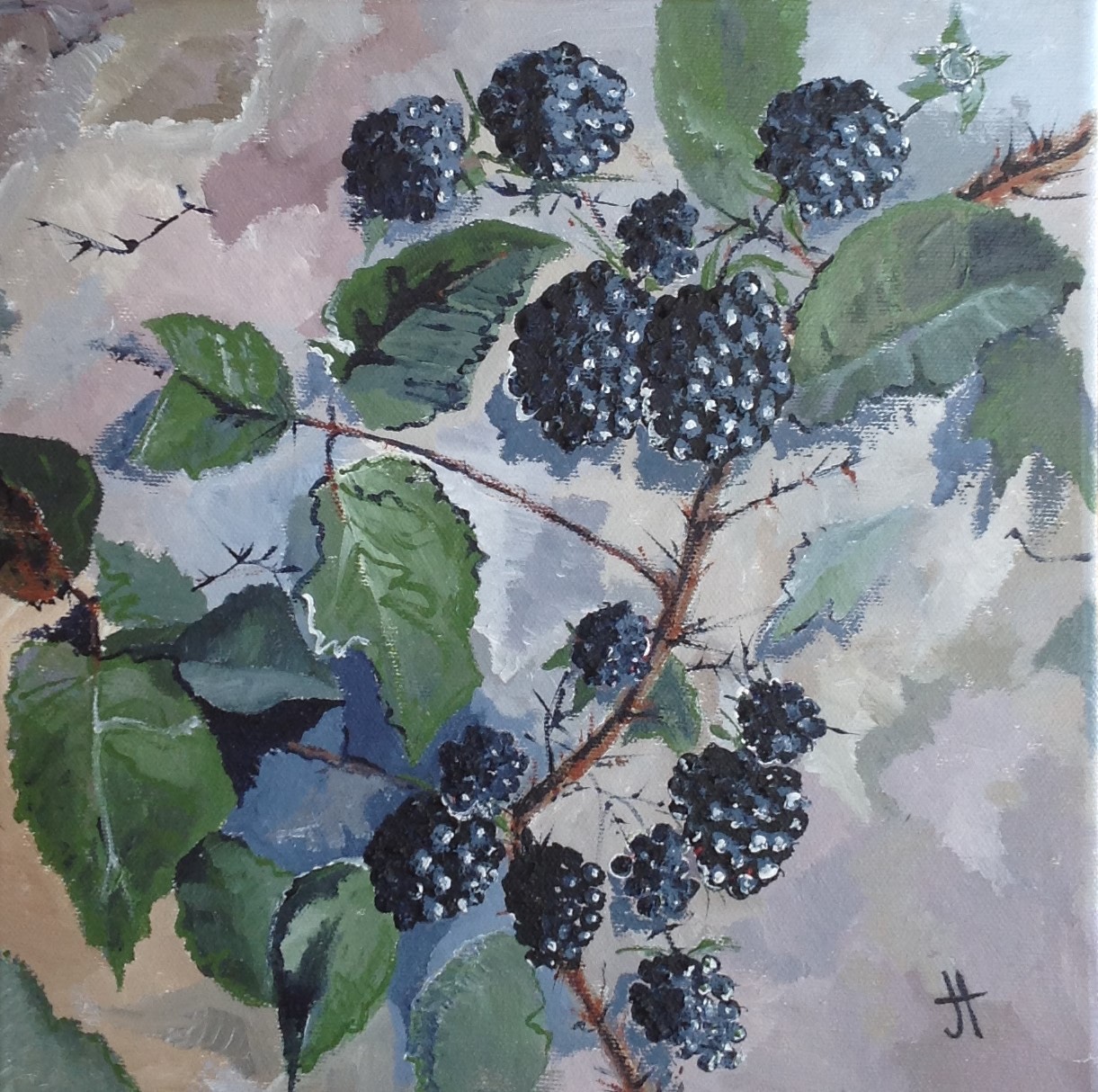
This week I found a draft poem about following rules and the evidence left behind by bad behavior. I have always loved picking blackberries, so it is no surprise to me that picking blackberries was used as a metaphor in the poem.
~

~
~
defiance
~
no denying
the evidence —
pulled threads
and stained fingers
~
one drupe
with all its packets
could never mark
so well, each finger
~
rolled across the page
indigo tongue
and purple lips, words
blackberry-spoken
~
the rule — never take
the path through woods
stick to the road, resist
blueberries, blackberries
~
avoid the risk
of bears and brambles
hints of danger
in faerie tales
~
~
~
Last spring I spent time pulling together some of my many poems into three upcoming books of poetry. This poem will fit well into my manuscript titled ‘niche,’ poems about the spaces plants, animals and people occupy.
~
All my best!
Follow the rules of social distancing!
Stay safe!
Jane
~
ghosts are lonely here ….. new poetry collection
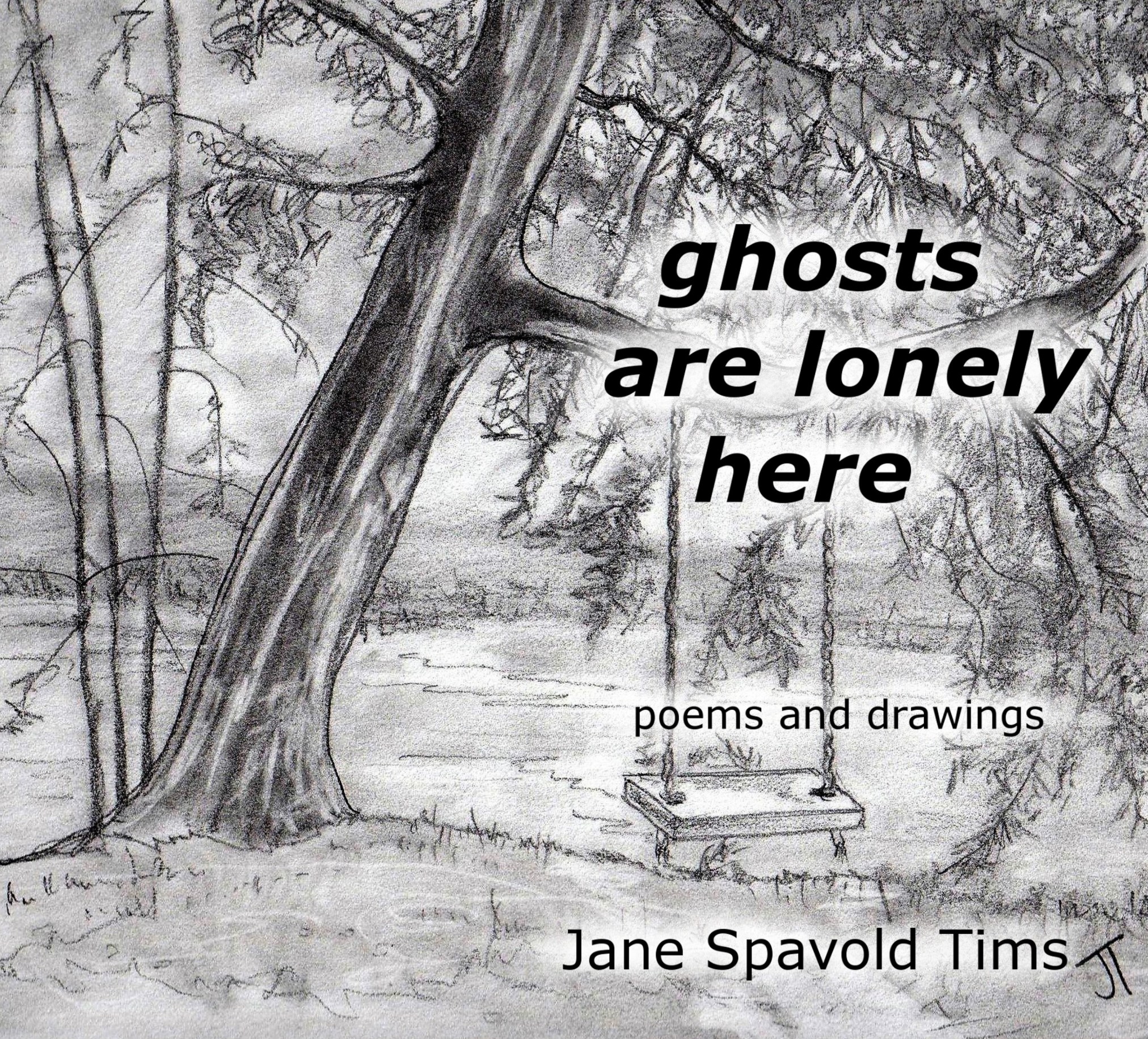
This spring, I began to gather together the various poems I have written over the years. One of my recurring interests has been abandoned buildings and other discarded human-built structures. And now, here is my book of poems about abandoned humanscape … ghosts are lonely here.
~
My book is available in paperback and includes 45 poems and 14 of my original pencil drawings. Most of the poems are about abandoned structures in New Brunswick, Canada.
~

~
We live in a time when built landscape is often in a state of abandonment: old churches, old bridges, old schools, old buildings. Add to this abandoned vehicles, abandoned boats and deteriorating stone walls, over-grown roads and decommissioned rail lines, and we exist in a landfill of nineteenth and twentieth century projects, abandoned to time. These poems listen to the histories and stories of the abandoned. The poems are sometimes sad, sometimes resentful, always wise.
~
~

~
To order ghosts are lonely here, click here.
~
Have a great day.
Jane
revising poetry
After a full month of working on my artsnb project ‘garden escapes,’ I am conscious of the passage of time. My deadline is November 1, 2020, and meeting this deadline requires completing the poems and other deliverables.
~
At this point (I began on July 1, 2020), I have completed my field work (visits to various abandoned communities), done drafts of 70 poems, placed these poems in seven tentative subject groups, and considered how I will approach revisions. I know I will also write a few more poems based on material collected.
~
The subject groups (not in order) are:
- all that remains
- my mother’s garden
- invaders and volunteers
- the gardener
- whispered stories
- a glimpse of history
- the shape of a garden
~

~
I meet regularly with a writing group known as Wolf Tree Writers. I have read a few of the poems at these meetings and received lots of suggestions. I think the most important suggestion has been: ‘ask yourself, where is the metaphor in this poem?‘ I have taken this idea seriously. I do want these to be poems about communities and garden plants. But each poem has to work harder – it has to comment on some social truth addressed (the metaphor).
~
When I began this work, I spent a full day on metaphor, considering how garden escapes would relate to issues or problems we face as humans. The fundamental requirement for a garden to escape is – it must be left alone to decide its own fate. In our lives this could be a metaphor for:
- accomplishment – you can write a song, but you have to let it go to see if it will flourish. This applies to the results of various endeavors: paintings, quilts, stories. Collections are a particular type of accomplishment; people often belittle ‘stuff,’ but I think particularly of things passed on from one generation to another (jewellery, books, souvenirs). Like the plants in a garden, accomplishments must make it into the right hands, the right conditions of soil and sun.
- influence – you can talk to people and try to nurture them, but only time will tell if influences take hold. Some of our influence is directed and purposeful; you can try to be a good teacher to your children but eventually they must leave home and only then will lessons take hold or wither. Gardeners will plant a scarlet runner bean and end up with a lupin; parents can plant a ‘carpenter’ and end up with a ‘financier.’ So much of influence is accidental, transferred by chance. Think of influencers like ‘kindnesses,’ ‘chance encounter,’ ‘place’ and ‘accident.’ Also, ‘influence’ must be abandoned for a while and then re-discovered and the value found.
- abandonment – the abandonment of children/family can occur in so many ways: adult children lose their parents, children are orphaned or abandoned, parents are left to fend for themselves as they age. Each of these situations can be examined using the metaphor of the abandoned garden.
~
~
So my first duty in revision will be to examine each poem for the embedding of metaphor. Sometimes the metaphor will already be there. Sometimes I will need to add a phrase or line for clarity. Sometimes the whole poem will have to be reconfigured to include a clear idea of metaphor.
~
When more substantive revisions are done, I have a revision checklist aimed at detailed revision.
~
revision checklist
- take out ‘which’ and ‘that’
- remove weak verbs (‘to be’)
- consider removing small words (‘the,’ ‘a,’ ‘so,’ ‘etc.’)
- try alternative words – words to contribute more
- exchange words used more than once with synonyms
- remove adverbs (many are ‘ly’ words) and gerunds (‘ing’ words)
- read aloud – watch for phrases or ideas that ring bells – may make it better/worse
- be truthful – when it isn’t right, return to truth
- check if singular or plural is correct
- consider passive voice – does it drag it down?
- check voice (child, scientist); don’t switch within poem
- consider end and embedded rhyme – select better words
- consider rhythm; count beats/syllables and read aloud to identify cadence errors
- for poems written in a particular form, check conformity to form
~

~
All of this is a continuing process. Even when I submit those ‘final’ poems with all their revisions, I may continue to work at poems for years!!!!
~
This work is accomplished as part of an artsnb Creations Grant.
~
All my best.
Stay Safe.
Don’t get COVID fatigue.
Jane
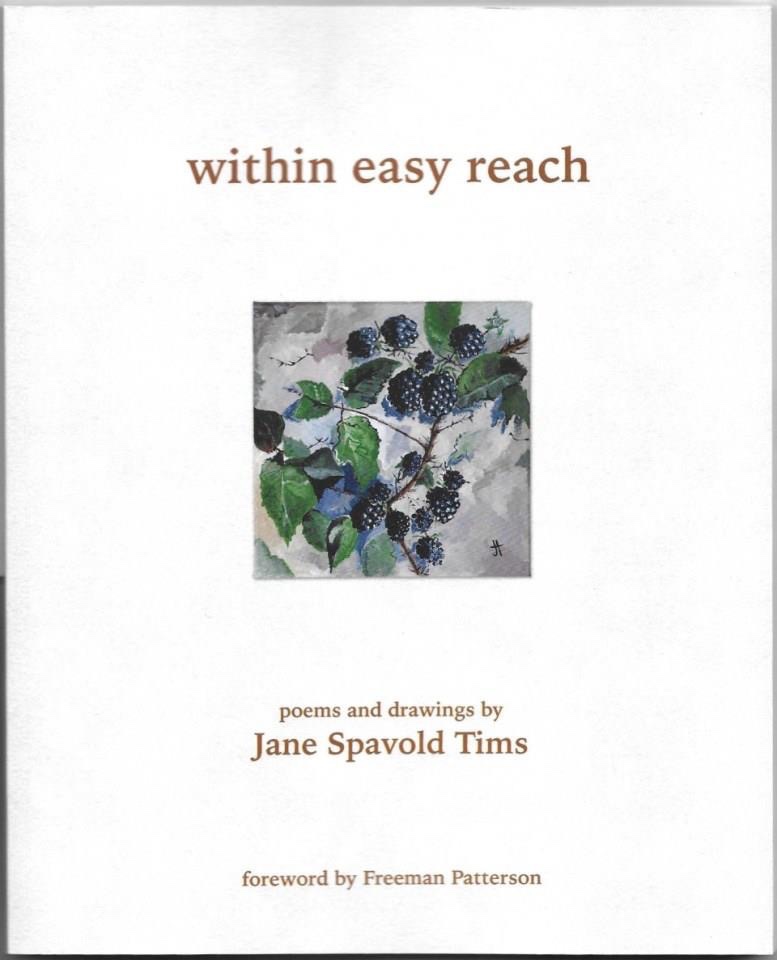
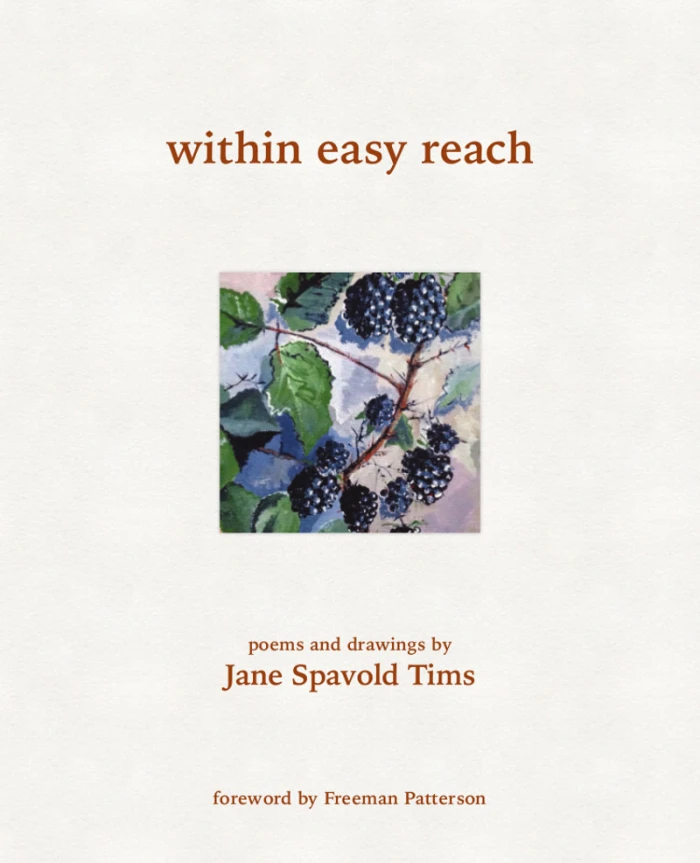
Do you love picking berries, herbs, other plants from the garden? I think you’d like my book of poetry ‘within easy reach’ (Chapel street Editions, 2016). It is illustrated with my drawings and contains notes on various example of the edible ‘wild.’ Order it here.
~
~
where we step
~
my brother and I explore
the old home place, overgrown
and unused, the house fallen
into the cellar, a sock
tossed into the dresser drawer
but, barefoot not an option
~
even shod, we are careful
of our feet – nails, glass, bricks
from the chimney, unease creeps
beneath the grass – we watch for
the water well, covered but
with rotted boards
~
hard not to love where we step –
the mint enfolds our ankles,
rose and rosemary, our minds
chives lace our sneakers, fold
flowers from purple papers
lavender leans on the walls
~
silver, graceful and wise,
the sage surveys our ruin,
thyme is bruised,
everywhere we step
~
~
Stay safe.
All my best!
Jane
garden escapes: where did they come from?
When I find a plant in a ditch or roadside where it has no business to be, I wonder how it got there. Of course, the mechanism is usually plain. Some plants have arrived by seed, others by horizontal roots. But how did they get into the garden if that is where they came from?
~
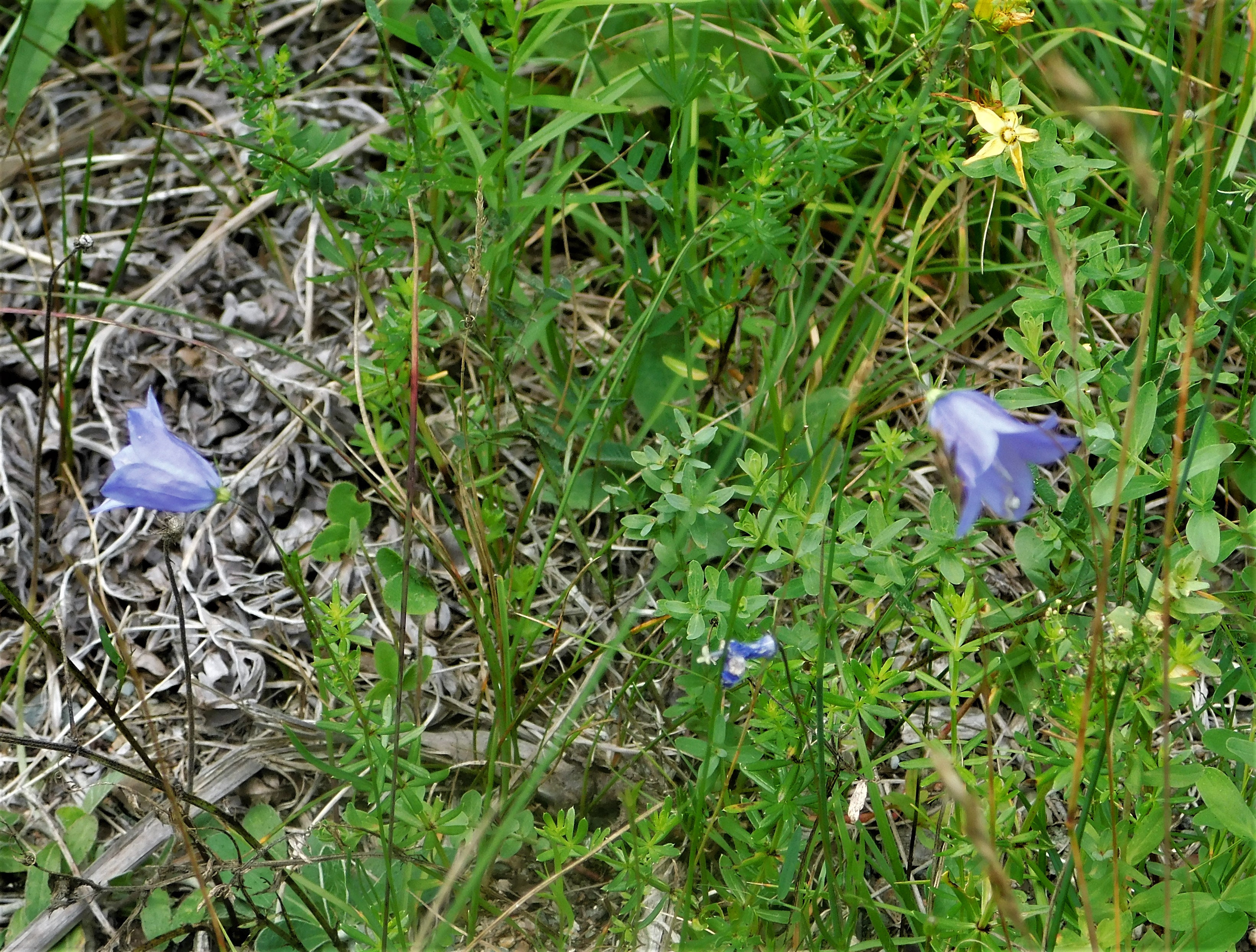
This weekend, we found three plants which made me wonder how they arrived in the community where they now grew: bouncing-Bett (Saponaria officinalis), white sage (Artemesia ludovinciana) and harebell (Campanula rotundifolia).
~

~
Where did they come from?
~

bouncing-Bett (Saponaria officinalis)
~
bouncing-Bett, common soapwort
Saponaria officinalis
~
pink blur along the road
fills the ditches
perhaps she loved colour
or needed mild soap
to wash delicates
gloves sullied in the garden
~

white sage (Artemesia ludovinciana)
~
white sage
Artemisia ludovinciana
~
hugs the edge of the road
a slash of silver
in a matrix of green
perhaps he sought
smoke and smoulder
sacred odour of the smudge
~
harebell (Campanula rotundifolia)
~
harebell
Campanula rotundifolia
~
in the margins of the road
harebell catches
found among the grasses
perhaps they wished to play
dress-up with lady’s thimbles
reminded them of home
~
~
Be safe, wear your mask.
All my best,
Jane
garden escapes: learning something new
The poems I am writing have two dimensions:
- consideration of the plant, its names and characteristics, and its tendency to die, persist or escape when a garden is abandoned
- consideration of the community or area where the plant occurs
~
For the botany, I have my floras: Hal Hinds ‘Flora of New Brunswick‘ (2002), Roland and Smith’s ‘Flora of Nova Scotia’ (1969) and others. During the project so far, I have learned about three new-to-me flowers: golden alexander (Zizia aurea), dropwort (Filipendula vulgaris) and narrow-leaved everlasting pea (Lathyrus sylvestris).
~


For the history, I have the New Brunswick Archives site ‘Where is Home?’ which tells when the community was first settled, what the population of the community was in certain years and so on. I also have the Canada Census for various decades and some excellent local histories lent to me by a very good friend.
~
For example, one of the abandoned communities we visited was Mavis Mills, north of Stanley. The community of Mavis Mills included a lumber mill and camp, post office and train stop. The community was named by a lumberman for his daughter, Mavis Mobbs. The community had a post office from 1922 to 1928. The 1921 Census shows a boarder and miller, John Mobbs, in Stanley Parish and below his name a mill camp with 31 men.
~
Something that puzzled me was the entry of ‘last lumberman’ under occupation, beside each of the 31 names. At first I thought it was a mis-spelling of ‘lath.’ Then I read more about the mill, in Velma Kelly’s book ‘The Village in the Valley: A History of Stanley and Vicinity‘ (1983). After World War I, metal was in short supply. So in 1919, the Mavis Timber Company was contracted to make ‘last blocks’ from rock maple.
~

a screen capture of part of the Canada Census for 1921 … under ‘Occupation’, the Census lists ‘Last lumber for each worker in the mill …
~
I had no idea what ‘last blocks’ were, so went on a Google hunt. ‘Last blocks’ were used to make the wooden shoe forms used by shoe makers. From 1919 to 1924, the Mavis Lumbering Company made five million ‘last blocks,’ to be shipped to England.
~

an empty lot in a place in the community where Mavis Mills once stood … the lot is filled with golden alexanders
~
Such is the learning from a project such as mine. The phrase ‘never stop learning’ comes to mind.
~
Have you ever heard of a ‘last block?’ My great-grandfather, Josiah Hawk, who was a shoemaker in Pennsylvania, would be puzzled about the lack of knowledge of his great-granddaughter!
~

shoemaker’s lasts (Source: Wikipedia)
~
Note that this project ‘garden escapes’ is funded under a Creations Grant from artsnb (the New Brunswick Arts Board).
~
All my best,
staying in as much as possible and staying safe,
Jane
garden escapes: having fun
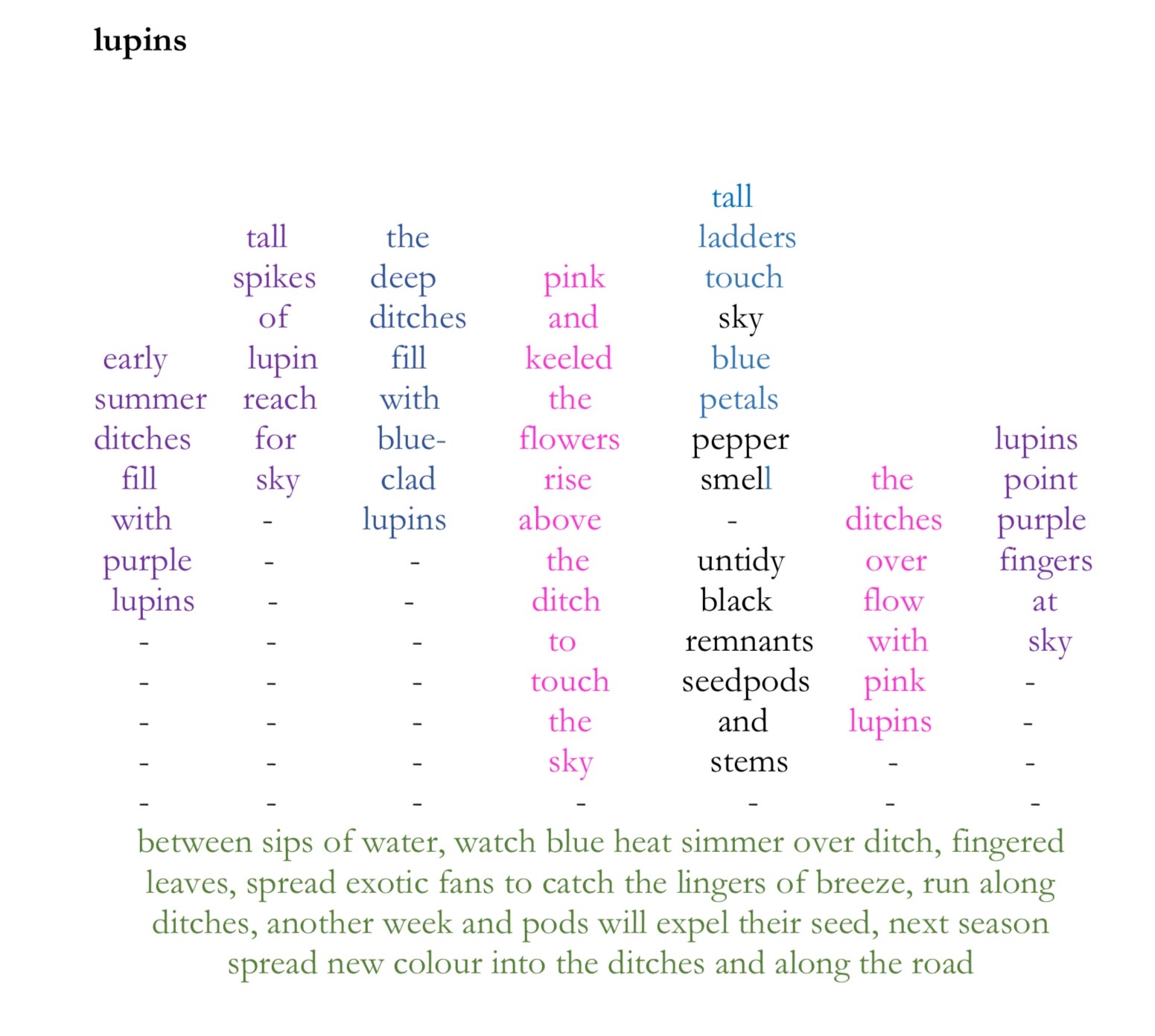
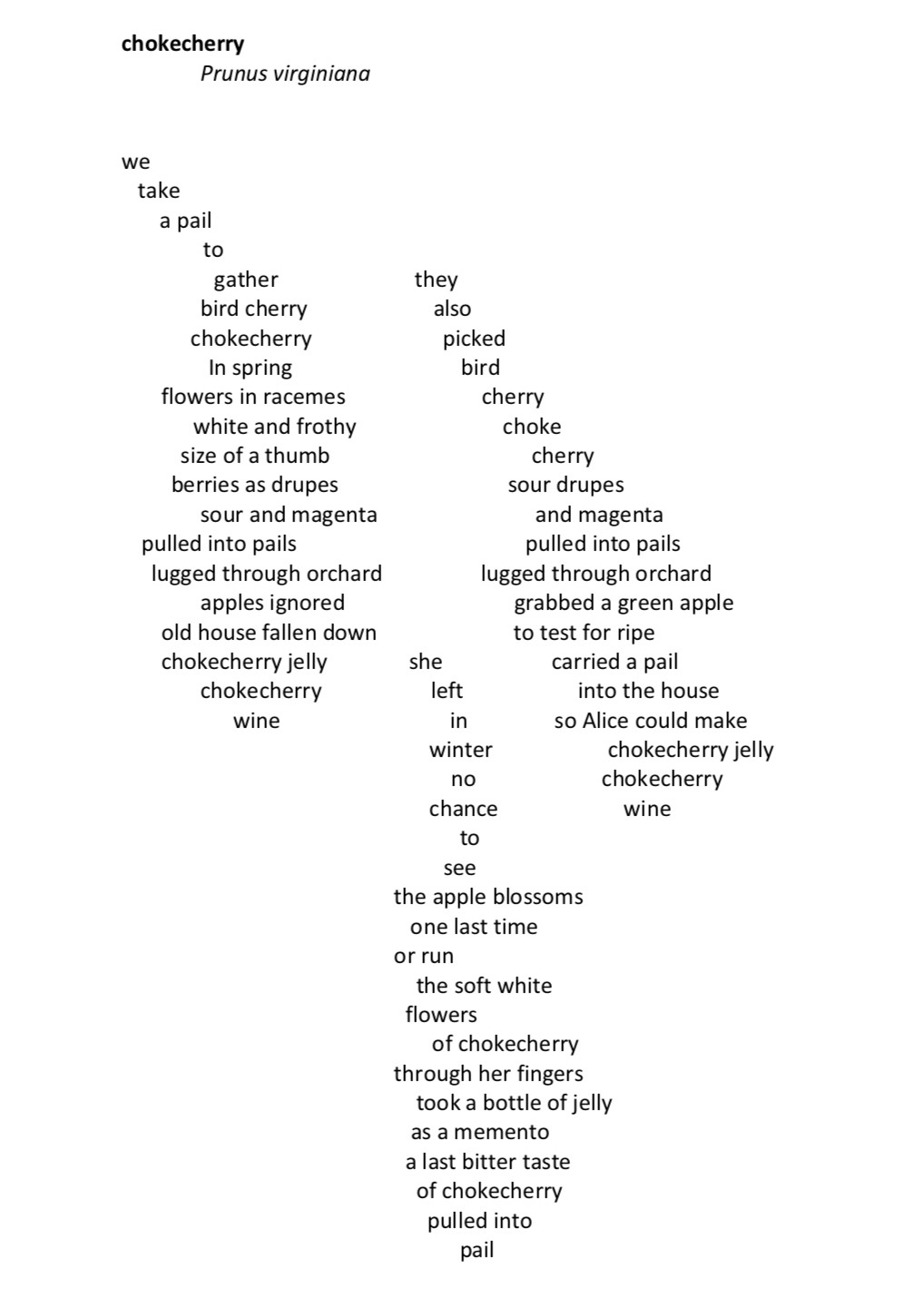
I have been working at my garden escapes project for almost a month now. Many of the poems are simple free verse, usually evenly divided in stanzas of four to seven lines, often consisting of regular numbers of syllables. I have also tried some other forms, the pantoum and the ghazal. And most fun of all, for a few poems, I have tried shape poems, using the lines of the poem to create shapes reflective of the subject matter.
~
~

~
Here is a poem that goes a step further. The shape shows the shape of lupins growing in the ditch; the colours are the colours of the flowers.
~

~
~
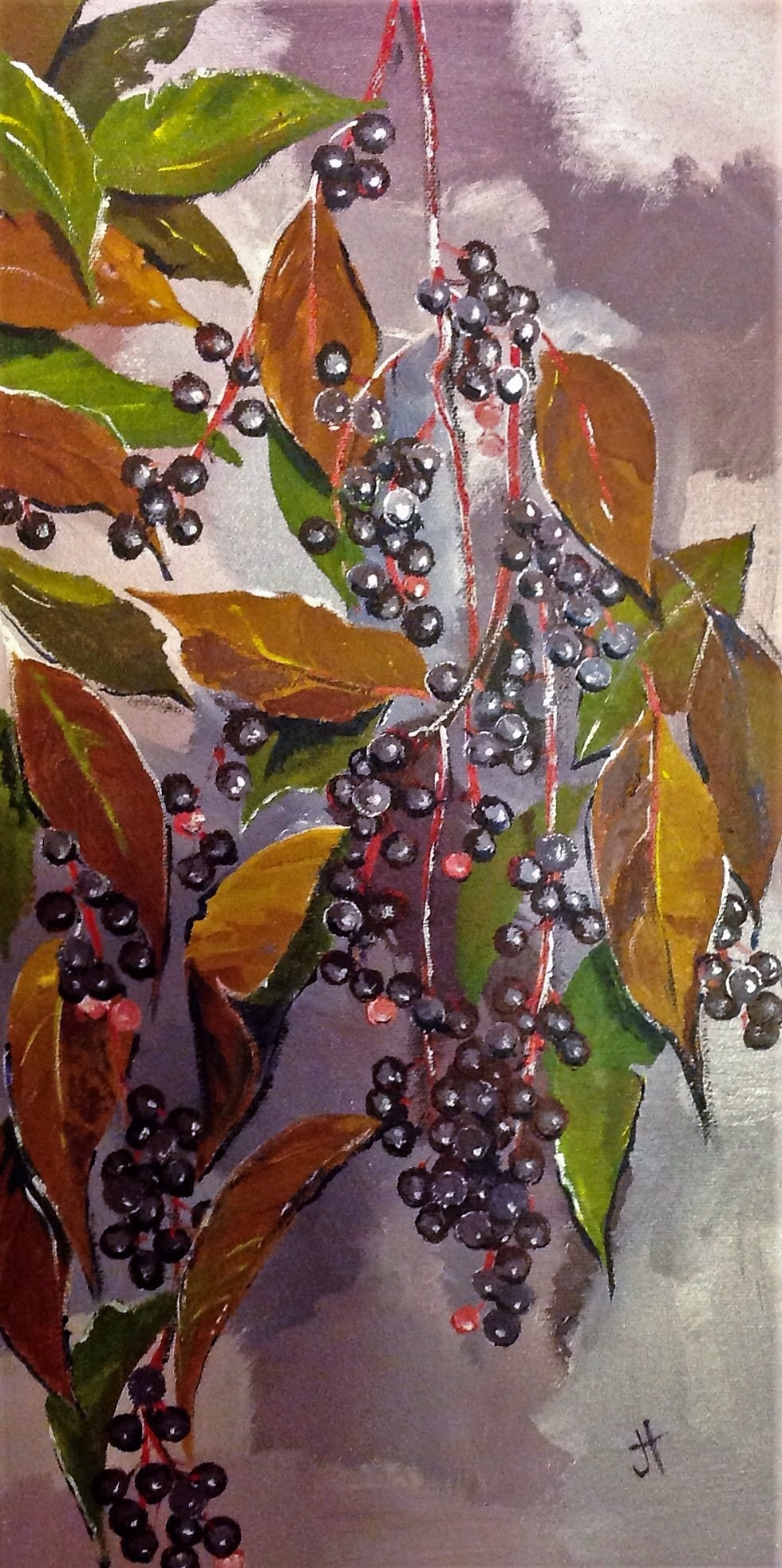
And, a poem about chokecherries, in the shape of the hanging blossoms or berries.
~
~
~
I will continue to work with these, perhaps aiming to make the poem read sensibly no matter which way you approach it.
I’d appreciate any comments, positive or negative!
~
This work was made possible by a Creations Grant from artsnb!
~
All my best,
doing my best to stay in my shape,
Jane




 nichepoetryandprose