Posts Tagged ‘poetry’
Staghorn Sumac (Rhus typhina L.)
One of the berry bushes common in our area is Staghorn Sumac (Rhus typhina L.). Its leaves and berries turn brilliant red in autumn, and its berries are displayed in distinctive red ‘horns’.
Staghorn Sumac is a small tree or shrub found at forest edges and in wastelands. The shrub has a flat crown and an umbrella-like canopy. It has pinnately compound leaves and toothed leaflets.
Staghorn Sumac is a ‘pioneer’ species, often one of the first plants to invade an area after the soil is disturbed. Although it reproduces by seed, it also grows from its vigorous underground root system, and forms dense colonies with the oldest trees at the centre. In this way, it causes dense shade to out-compete other plants.
The flowers of Staghorn Sumac are greenish-yellow and occur in spiked panicles from May to July. The berries are velvety, hairy red drupes, and ripen in June to September, often persisting through winter. The berries are held in dense clusters or spikes at the ends of tree branches.

Staghorn Sumac is also called Velvet Sumac, or Vinegar-tree, and Vinaigrier in Quebec.
The common name of Staghorn sumac is derived from the velvet feel of its bark, reminiscent of the texture of deer antlers. The word sumac comes from the words for red in Latin (sumach) and Arabic (summāq). The specific name ‘typhina’ means ‘like Typha’ (cat-tail), a reference to its velvety branches.
The Staghorn Sumac provides food for birds including Evening Grosbeaks and Mourning Doves, and its twigs are eaten by White-tailed Deer.
It has many human uses, including for medicine, decoration, tanning and dyes. Staghorn Sumac berries are used to make a lemon-flavored ‘sumac-ade’ or ‘rhus juice’. Remember, before you consume any wild plant, be certain of your identification.
Sumac lemonade
Pick and clean the berries (removing them from the stem)
Soak berries in cool water
Rub the berries to extract the juice
Strain
Add sugar to taste
~
~
Staghorn Sumac
Rhus typhina L.
~
from a single stem
and subterranean creep
a crowd of sumac
~
umbrellas unfurl
roof by roof
shield the hillside
from ministrations of sky
~
shadowed ways beneath
to shelter and imitate
a gathering of deer
with velvet antlers lift
~
an occidental village
red spires like minarets
insist on sky
~
~
Warning: 1. never eat any plant if you are not absolutely certain of the identification; 2. never eat any plant if you have personal sensitivities, including allergies, to certain plants or their derivatives; 3. never eat any plant unless you have checked several sources to verify the edibility of the plant. © Jane Tims 2012Common Dandelion (Taraxacum officinale Weber)
For a week, I have looked forward to a small celebration of the beginning of my new efforts as full-time writer. Since the title of my writing project is ‘growing and gathering’, I wanted to mark this celebration with the gathering, preparation and eating of an ‘edible wild’. I cannot think of a more accessible yet neglected food than dandelion greens.

Dandelion greens in spring… fallen Red Maple blossoms among the Dandelion leaves
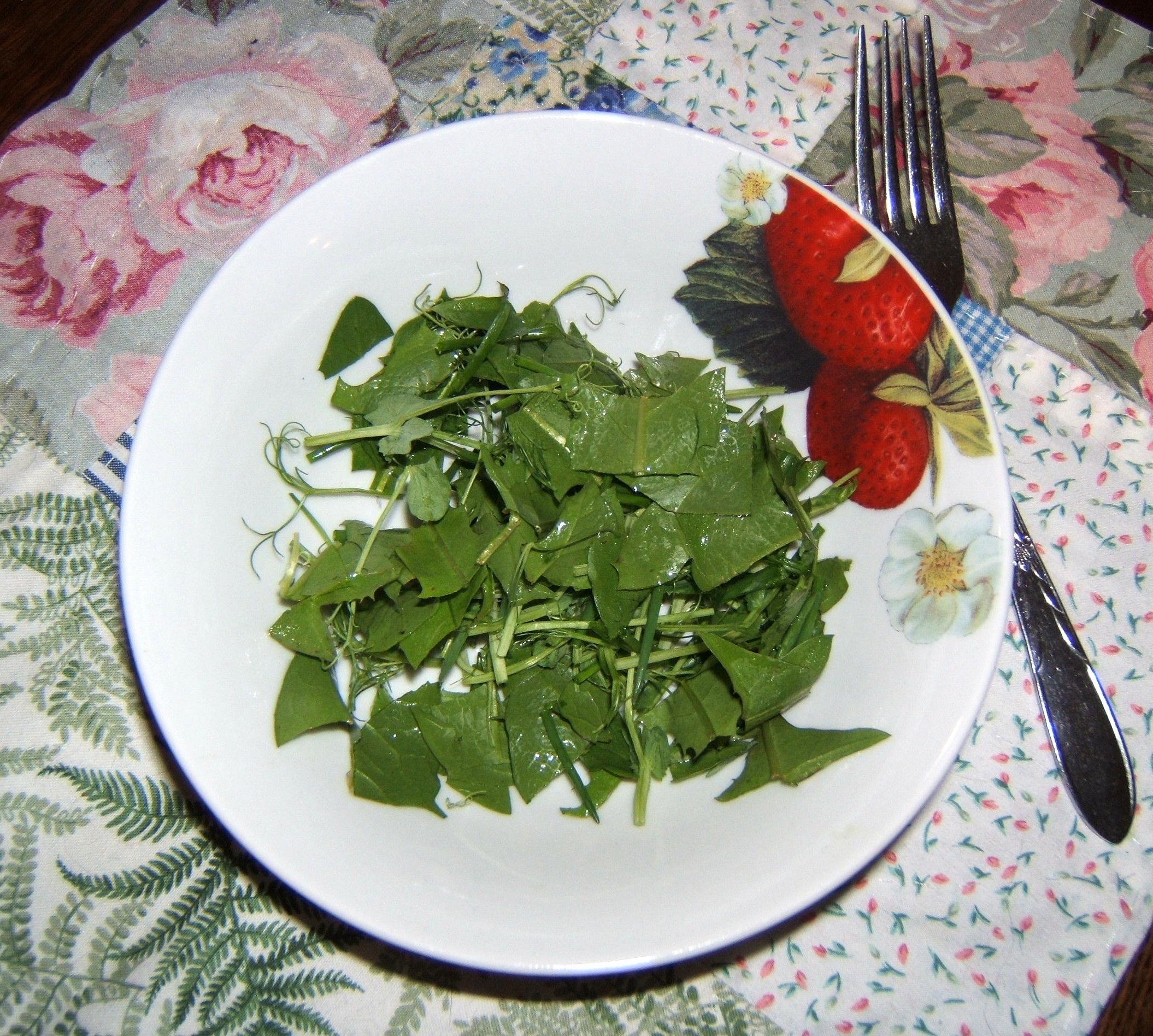
I made my salad of freshly picked dandelion greens, garden chives and pea sprouts. The pea sprouts are a gift from a friend in Cocagne, New Brunswick, given to me a couple of weeks ago when I did my first poetry reading and presentation on the topic of ‘growing and gathering’ at an evening gathering of Le Groupe de développement durable du Pays de Cocagne . The chives are from my garden, started years ago by my son when he planted his own little garden.
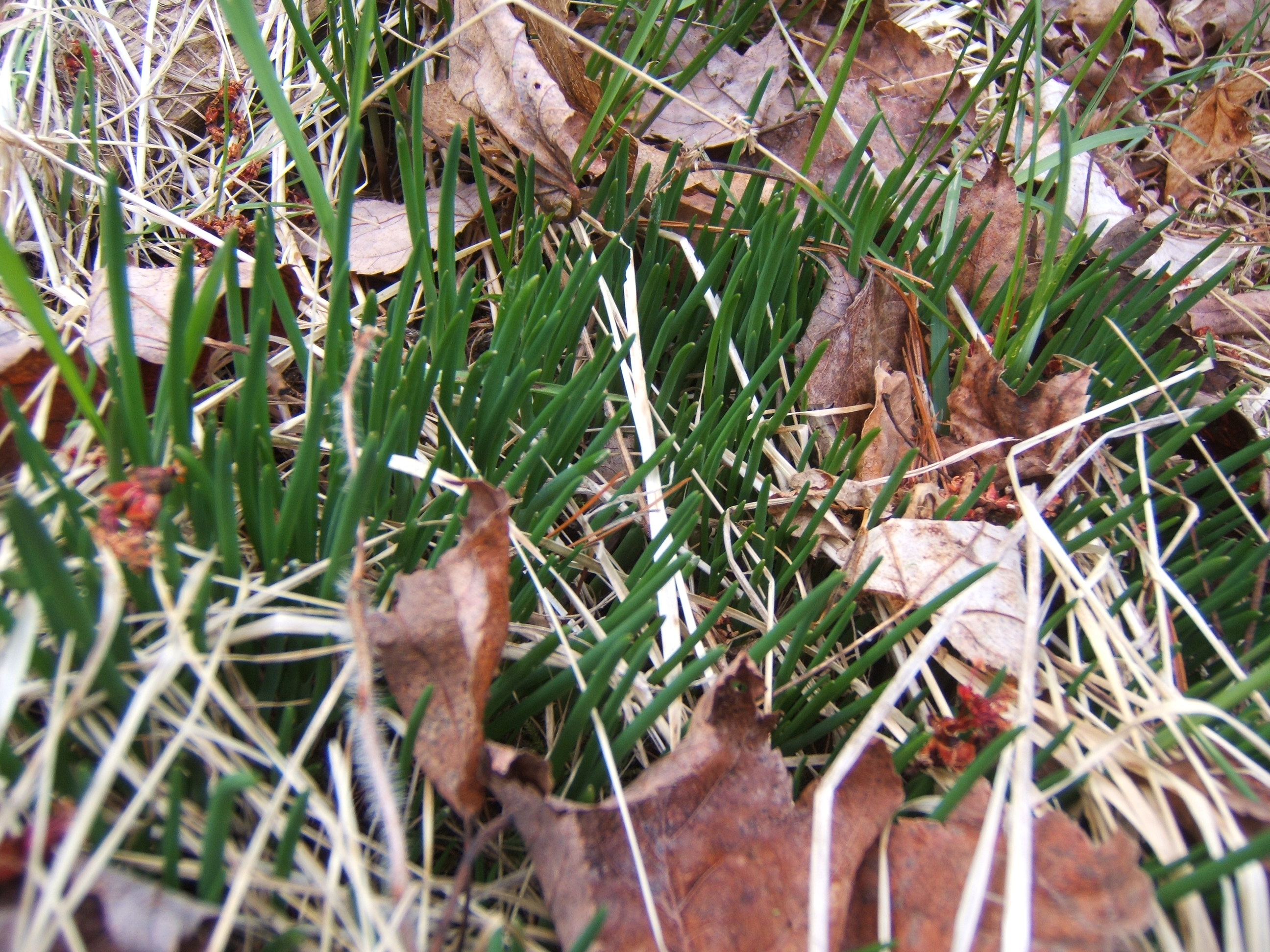
I picked the dandelion greens from around our front steps. This time of year they are fresh and generally untouched by bugs. I picked the best leaves and cleaned them in fresh water, removing any blemished bits and the stems which contain a bitter sap.
My salad was delightful. I had it without any dressing because I wanted to taste the flavour of the greens. The green leaves were delicious, crisp and tender at the same time. The flavour was very pleasant with none of the bitterness you may get from older dandelion leaves. The flavors also blended well, none overwhelming the others. My celebratory salad is declared an unconditional success!
My Mom often used dandelion greens for food. She always cooked hers, the way you would prepare Spinach or Swiss Chard. I know she ate dandelion greens regularly as a child, growing up in the lean years of the 1930s.
The Common Dandelion (Taraxacum officinale Weber) is easy to identify. In summer it has a bright yellow flower with a hollow stem. After flowering, Dandelion seeds are dispersed by wind from fluffy, spherical heads. The leaves grow from a basal rosette and are lobed and toothy.

drawing from Franz Eugen Kohler, Koehler’s Medicinal-Plants, 1887. Source: Wikimedia Commons
~
~
Salad greens
~
Chives poke slim fingers
between dry leaves,
pea sprouts sway
on slender stems,
wrists and tendrils
follow sun,
a burst of dandelion leaves,
an offering
~
hands prepare a salad
a simple meal
~
~
Warning: 1. never eat any plant if you are not absolutely certain of the identification; 2. never eat any plant if you have personal sensitivities, including allergies, to certain plants or their derivatives; 3. never eat any plant unless you have checked several sources to verify the edibility of the plant. © Jane Tims 2012Trailing Arbutus (Epigaea repens L. var glabrifolia)
One of the common flowers of early spring is the Mayflower (Epigaea repens L. var. glabrifolia), or Trailing Arbutus, also called Epigee rampante in French. It belongs to the heath or heather family (Ericaceae). It grows in open woods, or pastures, and along hillsides, in acidic soil.

Mayflower in bloom, photo taken in 1978 in Nova Scotia
The Mayflower is part of what Roland and Smith (The Flora of Nova Scotia, The Nova Scotia Museum, 1969) called the ‘Canadian Element’, woodland plants native to Northeastern North America and including common plants of the coniferous woods: Maianthemum canadense Desf. (Wild Lily-of-the- Valley), Mitchella repens L. (Partridge-berry), Gaultheria procumbens L. (Wintergreen) and Trientalis borealis Raf. (Star-flower), among others. When I worked on my M. Sc. thesis project, years ago, these were in the community of plants I encountered in the woods I was studying, and they are still my favorite plants.

two members of the ‘Canadian Element’ community – leaves of Wild Lily-of-the-Valley (left) and Wintergreen (right)
The name epigaea means ‘on the earth’, and perfectly describes the way the Mayflower grows. The specific name is from the Latin repens meaning ‘creeping’. The plant spreads across the ground, its oval, leathery leaves lying flat and overlapping. The leaves persist all winter and sometimes look a little weather-worn. The variety we have is glabrous on the lower leaf surface, meaning without hairs. The leaves grow on hairy, woody twigs.

leaves of Mayflower in the Grey Woods, April 2012
The flowers grow in clusters tucked beneath the leaves. They are creamy white, and are in the form of a short tube ending in five flaring lobes. They bloom mid-April to mid-May. The flowers along our woods have just completed their blooming. For a nostalgic look at the tradition of picking Mayflowers in spring, have a look at http://ahundredyearsago.com/2012/04/28/gathering-arbutus/
A delight of spring is to manoeuvre close to the ground so you can smell the Epigaea flowers. The perfume is very sweet, gently stirring. The only edible part of the plant is the flower and it tastes as sweet and fragrant as it smells. It is a shame to eat such a delicate creature as a Mayflower, but once a year I allow myself the privilege, just one tiny bloom (always be absolutely certain of the identification before you eat any plant in the wild). The plant is protected in some areas since it rarely sets seed and is almost impossible to transplant.
The Mayflower is the floral emblem of Nova Scotia and Massachusetts.
~
~
Trailing Arbutus
(Epigaea repens L.)
~
on the slope, new leaves
Trientalis, Gaultheria
Star-flower, Wintergreen,
vines of Partridge-berry creep,
Maianthemum unfurls
~
beneath the din, a melody
weeps Epigaea, evergreen
pressed to the hillside
leather armour, thickened leaves
weather-beaten, worn
~
waxy bloom resists
subtle shadow
predator
unrelenting rain
~
~

Warning: 1. never eat any plant if you are not absolutely certain of the identification; 2. never eat any plant if you have personal sensitivities, including allergies, to certain plants or their derivatives; 3. never eat any plant unless you have checked several sources to verify the edibility of the plant.
© Jane Tims 2012
Sweet-fern (Comptonia peregrina (L.) Coult.)
Last weekend, we went on a short hike to the lake to collect some dried Sweet-fern, with the goal of making Sweet-fern sun tea. To make the tea, fresh or dry leaves of Sweet-fern are steeped in a jar in the sun for three hours.
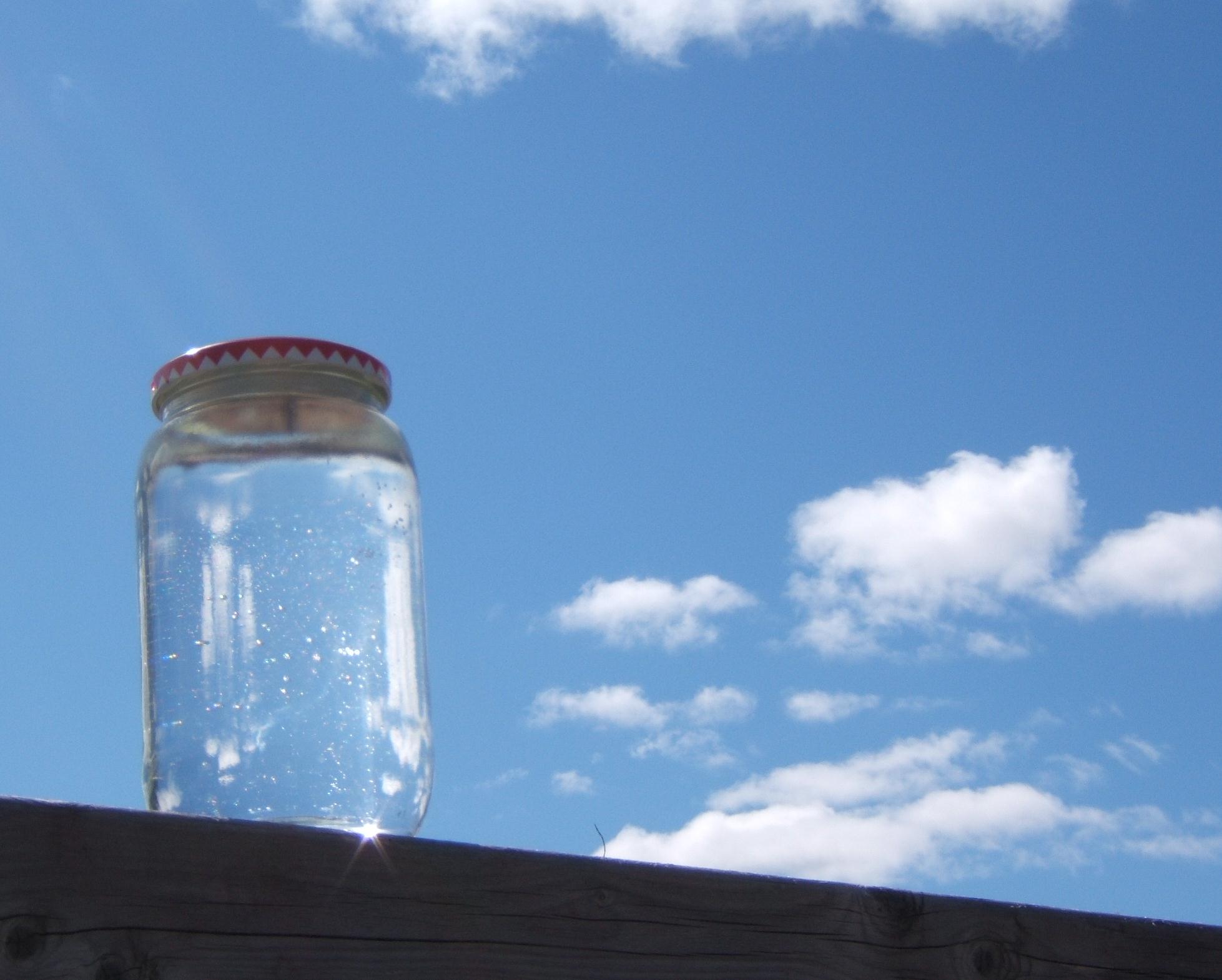
Unfortunately, the wind was too cold to allow the spring sun to warm the jar. So I collected the dry leaves and, on Sunday afternoon, I enjoyed a cup of fragrant Sweet-fern tea, made the usual way, steeped in boiling water.

Later in the spring or summer, I’ll be trying the sun tea method again.
Sweet-fern(Comptonia peregrina (L.) Coult.) is a small rounded shrub with fernlike green leaves found in dry rocky waste areas, clearings or pastures. The leaves are simple and alternate, long, narrow and deeply lobed. The shrub sometimes grows as a weed in blueberry fields.
Sweet-fern is called Comptonie voyageus in French, since peregrina means traveller. The generic name is after Henry Compton, a 17th century Bishop of London who was a patron of botany.
The fruit is a green burr enclosing 1-4 nutlets. These can be harvested in June or July while still tender.
Sweet-fern is a member of the Sweet Gale family. The plant is very fragrant, particularly when crushed, due to glands on the leaves and twigs. The tea made from the leaves is also fragrant. To make the tea, use 1 tsp dried or 2 tsp fresh leaves per cup of water. Remember, to always be absolutely certain of the identification before you try eating or drinking anything in the wild.
~
Directions for Sweet-fern sun tea
8 tsp of fresh chopped leaves
1 quart of clean fresh cold water in a jar
cap and place in sun three hours until water is dark
strain and serve
~
~
Sweet-fern sun tea
Comptonia peregrina (L.) Coult.
~
to quench the thirst of a traveller
and reward a hike too far
~
steep sweet-fern
in the solar flare
~
gives up fragrance to air
and to water in a sun-drenched jar
~
~
Warning: 1. never eat any plant if you are not absolutely certain of the identification; 2. never eat any plant if you have personal sensitivities, including allergies, to certain plants or their derivatives; 3. never eat any plant unless you have checked several sources to verify the edibility of the plant. © Jane Tims 2012places off-planet #1 – watching the stars
For me, star-gazing is a warm-weather activity. The winter, although dazzling in its displays of stars, is too cold for my arthritic joints and the immobility of prolonged star study.
So, as May approaches, I am looking forward to spending some time outside, to locate some old friends in the sky and to meet some new sky-folk!
I am lucky to live in an area not overly polluted with night light. At our home, although trees make viewing sporadic, stray light from street and yard lights is not a problem. At our lake property, the surroundings are utterly dark and the sky is stunning, studded with stars.
If you want to do some stargazing, you need three things to get a good start:
- a star chart or a planisphere (a combination of a star chart and a viewer). My favourite planisphere is downloadable and printable, from the National Research Council at
http://www.nrc-cnrc.gc.ca/eng/education/astronomy/constellations/html.html
- a reclining lawn chair (so you can relax and your neck will not ache)
- a flashlight with a clear red cover (this is to prevent your eyes from becoming light-adapted as you check the star-chart).
Another helpful item, to see groupings of stars more clearly, or to see details of the moon:
- a pair of binoculars
Are you a stargazer? What are your favorite ‘tools-of-the-trade’?
~
~
the search for wind
and stars
`
these are not the winds I sought to stand in
I wanted a zephyr to ruffle the bluets in spring
a breeze to whip the silver wind chime to frenzy
~
instead I cower from night moans
the rattle at the window
the street where a dust daemon lurks
near every wall, lifts the leaves
grinds them to powder
~
I gaze at the skies
watch for Altair and Orion
the never- random pulse to signal man
~
but all the lights in the night sky
are not stars
the moon who solemn watches
as his face is peeled away
the comet drawing scant thoughts across darkness
its tears a storm of falling stars
~
I walk with sorrow
it rests behind the eyes
and cannot swell to tears
~
the truth so simple
yet impossible to know-
you need only stand
and the hill will form beneath your feet
and the roaring shrink
to the breath of love across your face
~
© Jane Tims 2012

maple blossoms
This week, as Red Maple (Acer rubrum) flowers bloom, the woodland blushes scarlet. In the driveway, a tree-shadow of blossoms has begun to form, as the flower clusters reach their peak and then drop to the ground.
Each flower is a puff of reddish-pink bracts surrounding the male and female flower parts. The stamens (the male part of the flower) consist of a thin filament topped by a dark anther where the pollen is formed. The pistil (the female part) is made of a style topped by a stigma; once fertilised by pollen, the maple seeds will form here. Red maple flowers may have both stamens and pistils, or may be only male or only female. The flower looks like a tiny fireworks, the burst-effect created by a bundle of stamens or stigmas.
When I went to Dalhousie University in Halifax, I always loved the flowering of the Norway Maples (Acer platanoides) in spring. Their flowers are green and most people mistake them for new leaves. I used to wonder what the ecosystem consequences might be if the flowers were bright orange or purple instead of green.
~
~
red maple blossoms
~
across brown sky
strontium bursts of bright
sparks bloom
against dark
~
~
© Jane Tims 2012

keeping watch for dragons #5– river dragon
It’s like getting an old song stuck in your head… I am now seeing dragons… everywhere.
Yesturday, as I crossed the bridge on the way to my work, I saw the piers of the old bridge and their reflections in the water. To me they were the protruding plates along the spine of a river dragon, resting in the water.


Have you seen any dragons lately?
~
~
river dragon
~
eight bevelled piers
(only remains of the old bridge)
idle in still water, reflections rigid
plates along the spine of a spent dragon
lolling on his side
taking a break in the river
~
~
© Jane Tims 2012
snippets of landscape – vernal pools and the spring migration
At the edges of our Grey Woods are several places where ‘vernal pools’ form. As a result, these spring evenings are alive with the peeping and croaking of various frogs and toads.
‘Vernal pools’ are temporary accumulations of water in depressions. This water may originate from snow accumulations or from rising water tables. The word ‘vernal’ comes from the Latin ver meaning spring.
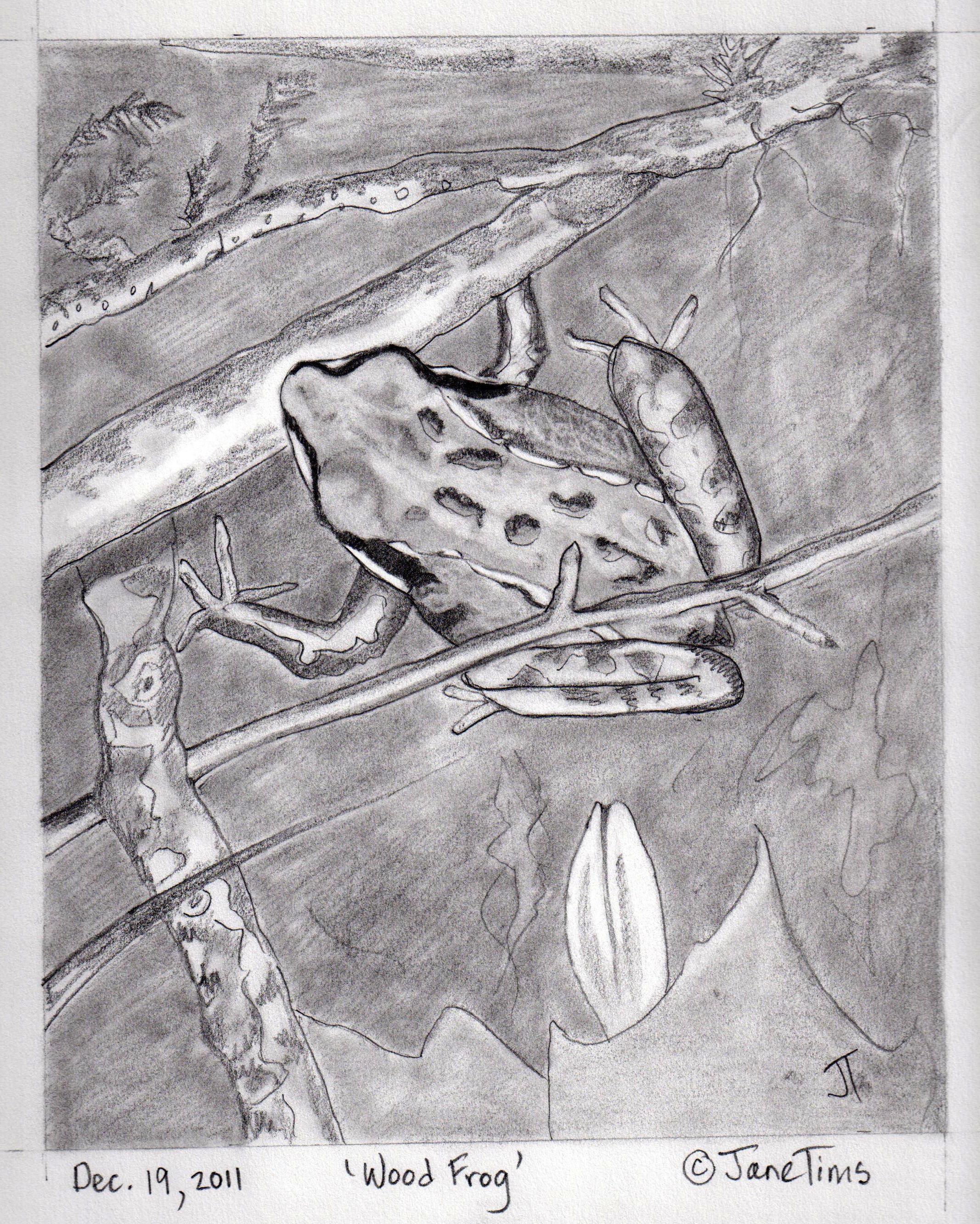
Although vernal pools are ephemeral, they create habitat for many animals, including insects and amphibians, often at critical life stages. Amphibians such as Wood Frogs (Rana sylvatica), Spotted Salamanders (Ambystoma maculatum), and Blue Spotted Salamanders (Ambystoma laterale) depend on vernal pools for laying their eggs and development of tadpoles. Other amphibians you may encounter in a vernal pool include Spring Peepers, Grey Tree Frogs and Bull Frogs.
During a rainy night in late April or early May, you may be fortunate enough to observe the early spring migration of Wood Frogs and other species as they make their way to breeding locations. These frogs have remained all winter in hibernation and have unthawed in the early spring rains. Unfortunately, many must cross roads to get to the ponds and vernal pools where they will lay their eggs, and many become casualties of their attempts to cross the road.

~
~
an uncertain spring migration
~
if it rains
the night road
leads home
to lowlands
and hollows
vernal pools
north of the highway
swollen with rain
~
mists crawl
towards me
vignettes
sweep the windshield
frogs cross the roadway
follow ancestral memory
blurred by rain
~
some nights
the tail-lights ahead
are my only family
red streamers on wet pavement
tadpoles from the eggmass
grow legs
absorb their tails
follow the road
~
I watch
the phone poles
the potholes
the hidden driveways
the headlight echo on trees
frog legs
crushed on the pavement
mailboxes with uncertain names
~
the centre line is a zipper
seals the left side
to the right
the coming home
with the leaving
frogs plead
from the wetlands
never saying goodbye
~
Published as: ‘an uncertain spring migration’, Spring 1997, Green’s Magazine XXV (3).
revised
© Jane Tims 2011
~
from the pages of an old diary – blueberries and other local foods
My new writing project, ‘growing and gathering’, focuses on local foods and finding food close to home.
A source of information and inspiration for me is the set of my great-aunt’s diaries, written from 1943 to 1972. From her diaries, I have a very good idea of how they obtained their food, and how they used local foods to supplement their needs.
Most of their food was obtained from the grocery store – in 1957, there was at least one grocery store in the community, and by 1967, they had an IGA. There is no doubt some goods came from ‘away’. For example, my great-aunt wrote about making coconut and pineapple squares for a Women’s Missionary Society meeting (Sept. 30, 1957).
Local goods, however. were used whenever possible. For example, my great-aunt bought eggs from her sister, and chickens from her brother. She also obtained vegetables and raspberries from her brother’s farm, apples from friends and relatives, deer meat from friends and relatives, and lobsters from Wallace, a near-by community. By 1967, my great-aunt and great-uncle also kept a garden at her brother’s farm, a few miles away.
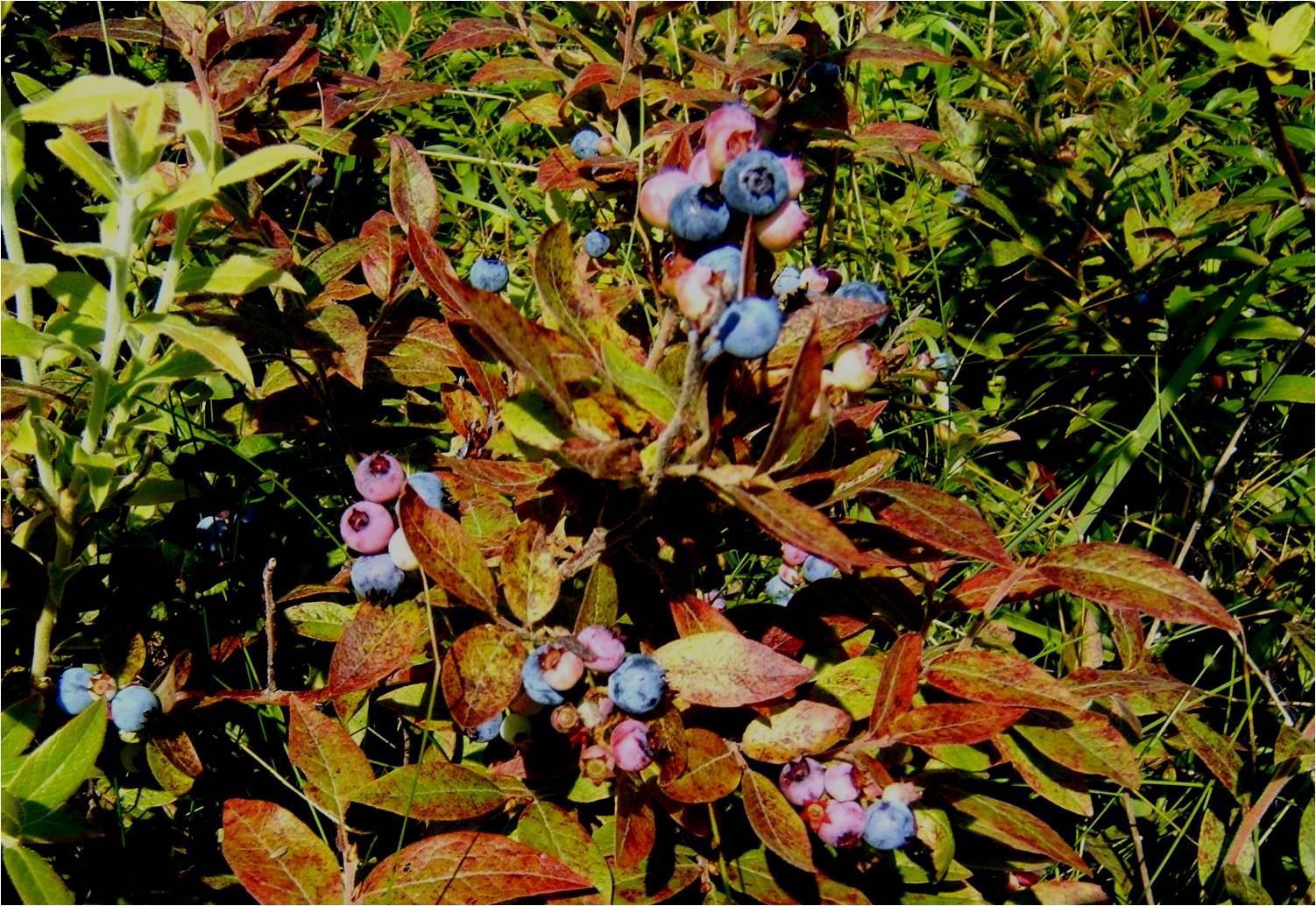
Obtaining local foods included picking local berries. In July and August of 1957, my great-aunt went four times for wild blueberries. Her gratitude and pleasure at getting these berries comes through in her words: ‘ got quite a few’ (July 31, 1957) and ‘got a nice lot.’ (Aug. 21, 1957). She also wrote about picking grapes and currants.

Some of the berries were eaten right away – for example, my great-aunt made a blueberry pie on August 1, 1957. The rest was preserved for the winter. On August 16, 1957 my great-aunt put up 5 quarts of blueberries, to supplement the applesauce, pears, peaches, sweet cucumber pickles, and tomato chow she mentions preparing on other days. Others in the family also made preserves and shared them with her – in 1967, her nephew (my uncle) brought her three bottles of peach, apple and choke cherry jelly he had made.
~
~
an offering of berries
~
she stands on the stoop
offers a box
a brimming pint
of berries
~
I take her hand, we ripple
through the pasture, strew
blue ribbons over bushes, stir
a blueberry jelly sky, dance
with dragonflies
~
she waits on the stoop
her brow a riddle, please
take this gift, blueberries
in a simple
wooden
basket
~
~
Warning: 1. never eat any plant if you are not absolutely certain of the identification; 2. never eat any plant if you have personal sensitivities, including allergies, to certain plants or their derivatives; 3. never eat any plant unless you have checked several sources to verify the edibility of the plant.
© Jane Tims 2012

accents in red
We are still in the greys and browns of spring.
There are a few wildflowers blooming. The Coltsfoot is spreading carpets of yellow along the roadside. And flowers in the deep hardwoods have begun to display their delicate beauty. But most places are drab and colorless.
I watch for red this time of year. There are a few red berries, still clinging to their branches after winter.
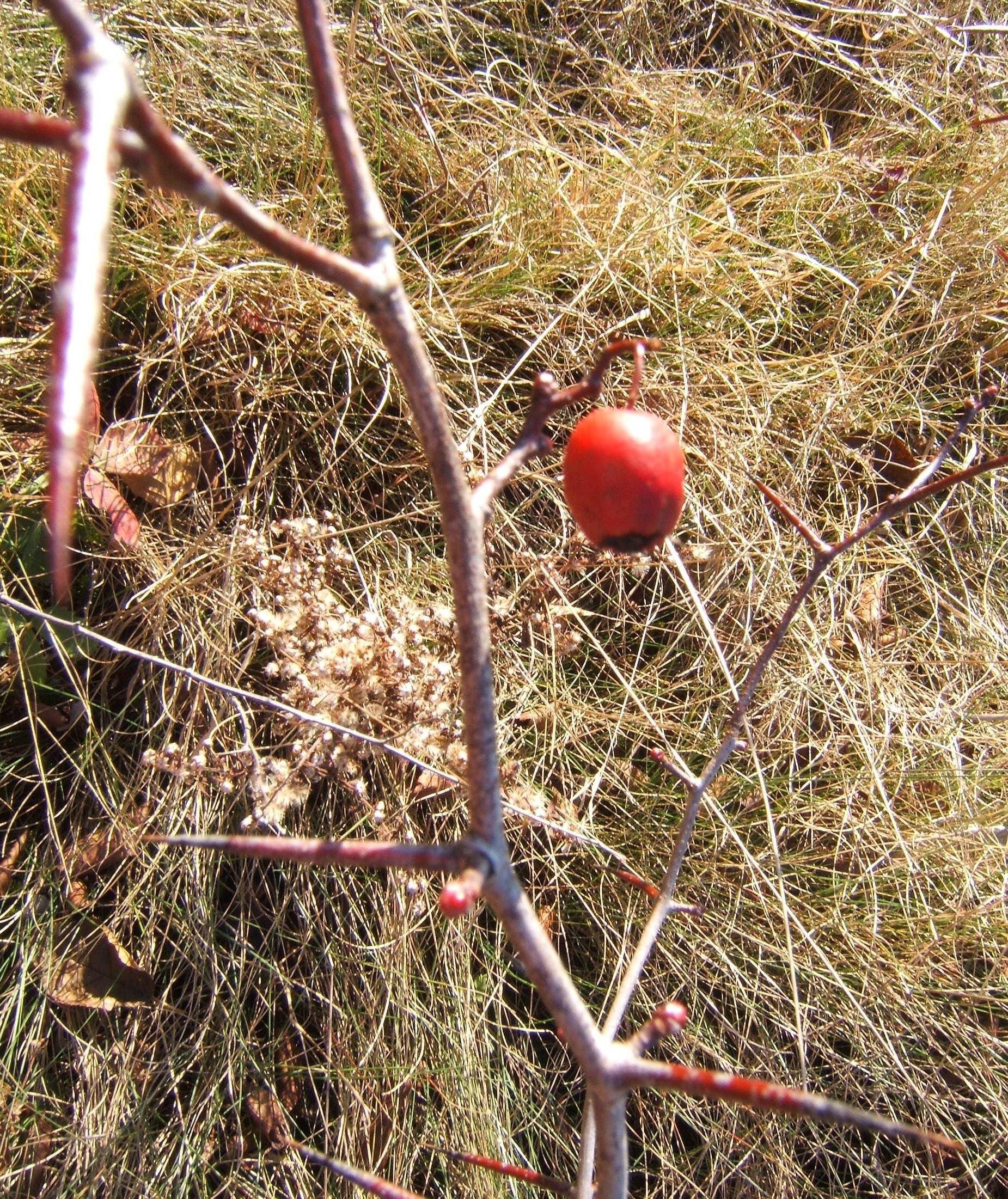

And the stems of Red Osier Dogwood (Cornus stolonifera Michx.) are brilliant in the fields and ditches.

My favorite ‘red’ of spring is the muted red of the blueberry fields.

~
~
fancy
~
the blueberry barren
is faded scarlet
red osier in ditches
rosebush and hawthorn
a single berry, a single haw
Earth in brown
toenails red
~
© Jane Tims 2012





 nichepoetryandprose