Posts Tagged ‘poetry’
Silvery Cinquefoil (Potentilla argentea L.)
Last month, whenever I went to get the mail, I was waylaid by a little plant sprawling next to the row of boxes. He was so charming, once I forgot to get my mail because I was examining his flowers and leaves! There should be a sign saying ‘No Loitering’.
The plant was Silvery Cinquefoil (Potentilla argentea L.). As its name suggests, Silvery Cinquefoil is covered with fine silver hairs, giving it a downy appearance. It has fine-toothed, five-fingered leaves, palmately compound, and five-petalled yellow flowers.
I have always liked the various species of Potentilla, interesting for the variety of their leaves. You can see how diverse these shapes are in a page from Roland and Smth’s Flora of Nova Scotia. The reddish pressed leaf in the scanned book, for example, is Silverweed (Potentilla Anserina L.). My post for July 13, 2012, ‘coastal barren, coastal bog’, shows the Three-toothed Cinquefoil (Potentilla tridentata Ait.) https://nichepoetryandprose.wordpress.com/2012/07/13/coastal-barren-coastal-bog/ .
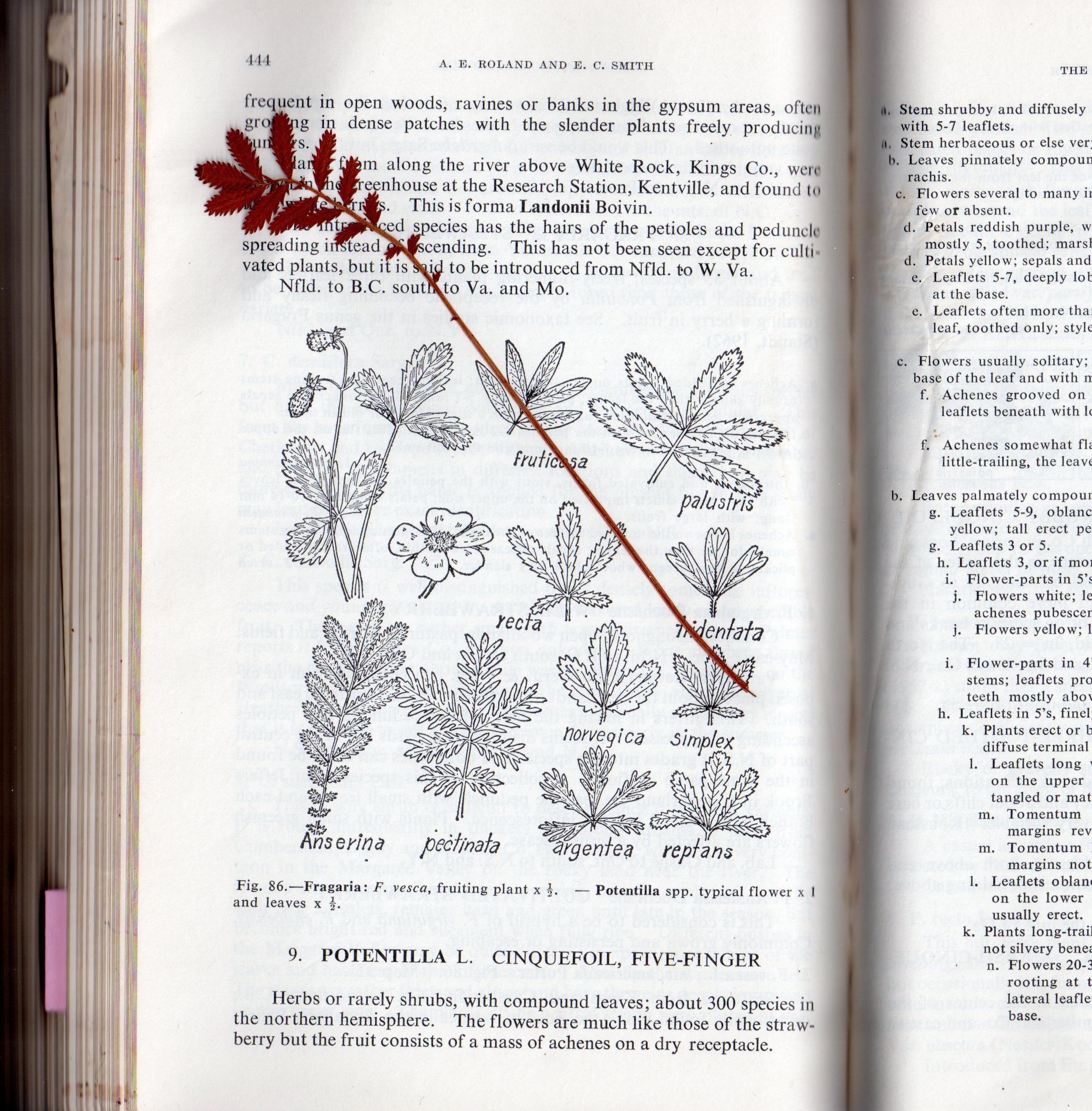
various leaf shapes of Potentilla in a page of The Flora of Nova Scotia (A.E. Roland and E.C. Smith, Nova Scotia Museum, Halifax, 1969) … the pressed leaf is from Potentilla Anserina or Silverweed, a coastal species of Potentilla.
~
~
Five-Finger
~
metal leaf and yellow,
he leans on the post-box
palms extended
potent, persuasive
a bit of a thug
want your mail?
pay me,
in silver
~
~
© Jane Tims 2012

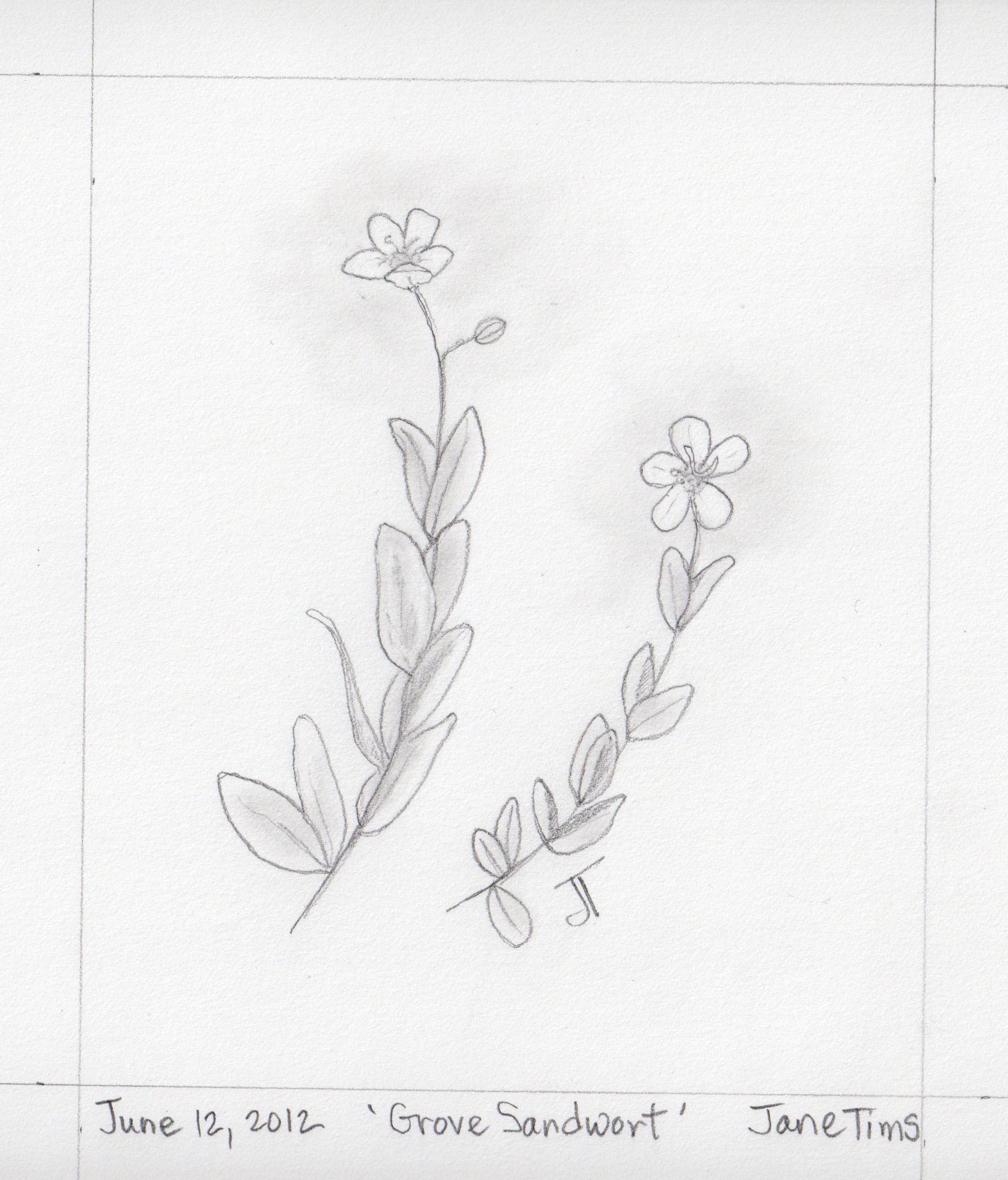
Grove-sandwort (Arenaria lateriflora L.)
Our summer property is a constant source of learning for me. Every year I seem to find at least one new plant. This year the plant is Grove-sandwort (Arenaria lateriflora L.).
Grove-sandwort is a common plant, found in meadows, along shorelines and at the borders of woods. It is a low-growing herb, first noticeable in June. The starry, white flowers each have five petals and grow near the top and along the sides of a simple stem. The leaves are elongated, elliptical, and in pairs.

Arenaria comes from the Latin arena meaning ‘sand’, where many of the members of the genus grow. The specific name lateriflora means ‘flowering on the side’.
Have you learned to identify any new plants this summer?
~
~
new neighbor
Grove-sandwort (Arenaria lateriflora L.)
~
met her in the meadow
by the split-rail fence
strewing the grove
with flowers
~
her leaves paired,
clapping hands,
delighted only ‘to be’
a bystander in the arena
~
~
© Jane Tims 2012
growing and gathering – ethics
Some of the poems in my collection will address the ethics of eating wild plants as food.
As a botanist, I know how many wild plants are edible. However, I also know there are ethical considerations to eating wild plants.
Plants differ greatly in their availability. Eating Dandelion greens puts no pressure on the survival of the Dandelion. Weedy species in general respond well to being harvested, by putting out copious seeds, by filling in the spaces with new rhizomes and shoots, and by growing in many habitats and conditions.
However some plants are very specific in their requirements. They need certain conditions of light, moisture and soil to thrive and reproduce. On our own property, I have watched the Painted Trillium (Trillium undulatum Willd.) struggle to maintain its presence. The Painted Trillium needs acidic, rich soils and lots of shade. Remove a single tree, cut a new trail, or let the Balsam Fir overtake the understory, and the place where a few Trilliums grew in previous years is suddenly vacant. The young leaves of the Painted Trillium can be used as a pot herb, but should I pick them to add to my knowledge about eating local foods?
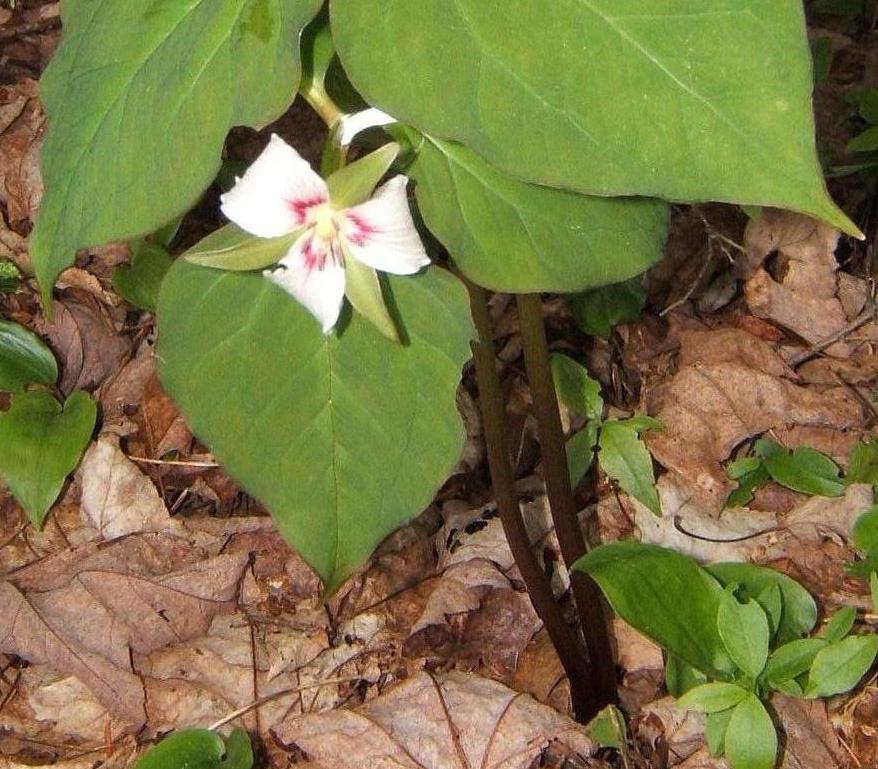
a Painted Trillium in our Grey Woods, near the end of its blooming
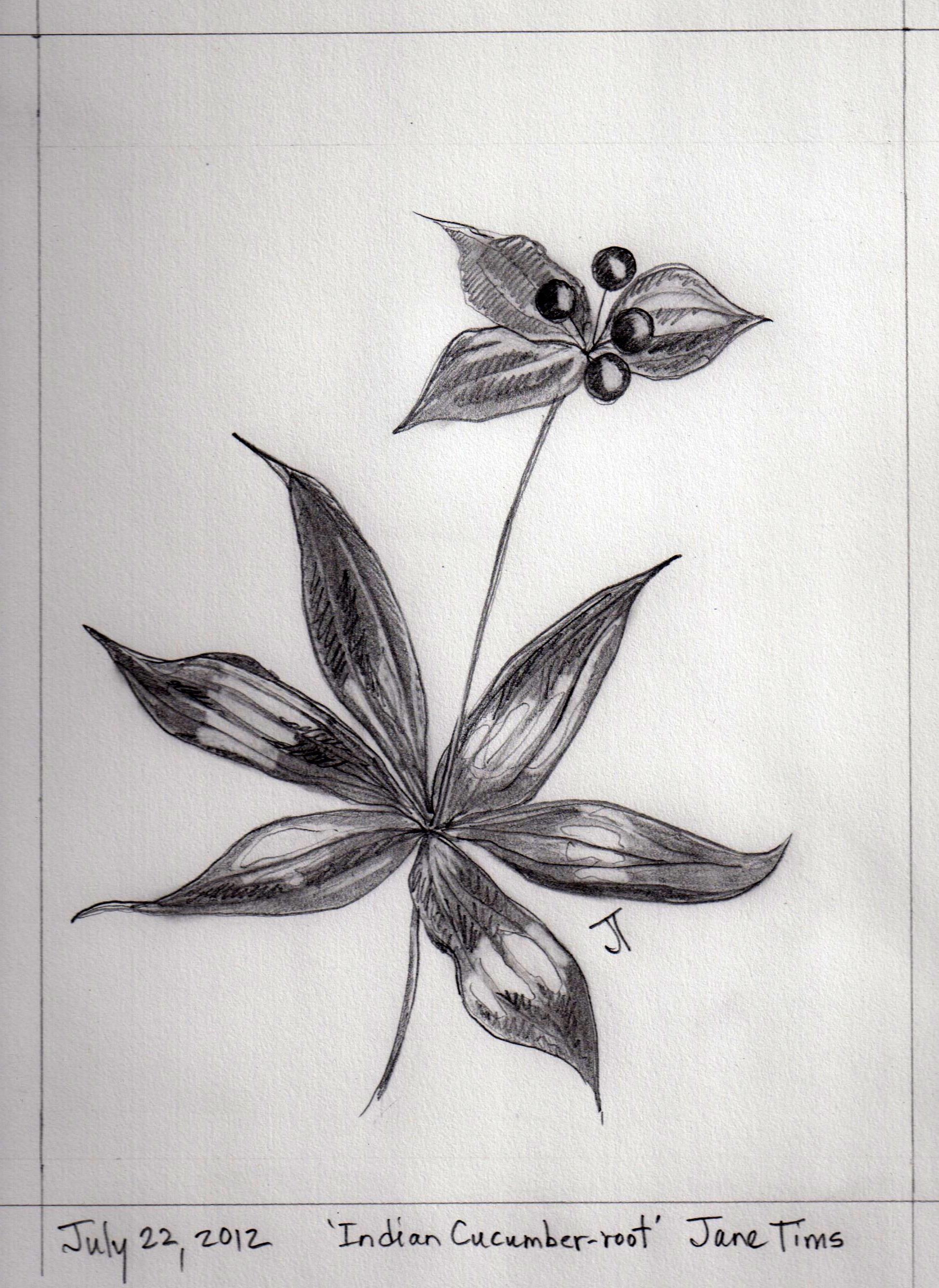
Many woodland plants deserve this special consideration. In his Flora of New Brunswick (2000), Hal Hinds wrote, of the Indian Cucumber-root (Medeola virginiana L.): “… Although this plant produces a deeply rooted, 2-3 cm edible white tuber with a bland cucumber taste and crisp watery texture, it is truly unfortunate to destroy the plant for such a tiny morsel…”
In some circumstances, harvesting and eating these rarer wildflowers would be acceptable. In the past, for example, people of the First Nations depended on wild plants for their existence. A lost hiker, needing sustenance or hope in an emergency situation, could be excused for eating any edible wild plant.
In other circumstances, rarity, the size of the population, and habitat health are probably the fundamental issues. Take the time to know a little about the plant you are thinking of picking. Is its habitat under stress or becoming hard to find? Is it rare, threatened or endangered? Local abundance may not be a deciding factor, since rare plants often grow abundantly where they are able to grow.
Eating local is an environmentally responsible life-style choice. It saves energy and supports local farmers. Eating local wild plants as food is a nutritious and thrifty way to supplement the larder. But these benefits must be weighed against the possible harm to plant populations.
Pick with some rules in mind. Understand the plant you harvest. Gather only what is sustainable. Sometimes this means gathering nothing at all.
~
~
Indian Cucumber-root
(Medeola virginiana L.)
~
step carefully
in your quest,
lured to the wood
by a sorceress
~
search carefully
among the shoots
for Indian
Cucumber-root
~
count carefully-
two layers of leaves
purple berries
stalk wool-sheathed
~
dig carefully-
below the stem
in dark, damp earth
awaits a gem
~
clean carefully
leave no trace
of the woodland soil
on the creamy face
~
taste carefully-
best to savour-
slightly celery
in flavour
~
think carefully
now you possess
one dead plant
and emptiness
~
~
© Jane Tims 2012
Chicory – (Cichorium intybus L.)
Along the Trans-Canada near Jemseg, one colony of Chicory has taken hold. Its bright sky-blue flowers catch the eye as the usual roadside vegetation rolls by.
~

~
Also known as Blue Sailors and, in French, chicoreé, Chicory (Cichorium intybus L.) is a tall plant, found along roadsides and in other waste places.
Chicory has basal leaves resembling those of the Dandelion. When broken, the stem exudes a white milky fluid.
The bright blue flowers of Chicory occur along the length of the almost leafless and somewhat zig-zag stem. Each flower is formed of a central involucre of tiny blue flowers and a disc of larger ray flowers. The rays are square-cut and fringed. The flowers follow the sun, closing by noon, or on overcast days.
~

~
Chicory is a useful plant. Its young leaves are edible as salad greens or as a pot-herb. The roots can be dried and ground to make a coffee substitute or supplement. The root of Chicory has soothing properties to balance the edginess caused by caffeine. The roots of Chicory are large and very deep. I tried to pull them by hand, but a shovel will be needed to harvest the roots in the compact soil of the roadside.
~ When I see these flowers, I am reminded of my grandfather, my mother’s father. I never knew him, but I have a couple of photographs of him as a young man. I have made a small study of his mother, my great-grandmother, so I know quite a lot about him. ~
~
The flowers of Chicory remind me of his eyes, since they were the same startling blue. He was also a tall man, another feature of the plant.
The other name for Chicory, Blue Sailors, also reminds me of my grandfather. He was a sailor, entering the navy when he was only fifteen. I know from various records that he served on at least two naval vessels, the USS Nebraska and the USS Pensacola. As so often happens when I see photographs of ancestors, there is a familiarity about his features.
~

~
Blue Sailors
Chicory (Cichorium intybus L.)
~
at the roadside
weeds surge as waves
~
on the sameness of ocean,
a buoy lifted,
a sudden swell of Chicory
~
tall, like my grandfather,
the blue ice of his eyes
its blunt petals, the square-cut of his jaw
~
joined the navy at fifteen
dressed as a sailor, headed for sea
USS Pensacola, USS Nebraska
~
his tie, a sapphire ribbon
toothed or frayed
~
~
© Jane Tims 2012
Warning: 1. never eat any plant if you are not absolutely certain of the identification; 2. never eat any plant if you have personal sensitivities, including allergies, to certain plants or their derivatives; 3. never eat any plant unless you have checked several sources to verify the edibility of the plant.Partridge-berry (Mitchella repens L.)
One of the evergreen plants in the spring woodland is a little vine called Partridge-berry. It trails, low to the ground, in shady, mossy woods, sometimes covering moist banks and hummocks with its shiny greenery.
Partridge-berry (Mitchella repens L.) is also known as Twinberry, Snakevine, Running Fox and Two-eyed Berry. The word repens is from the Latin for ‘creeping’.
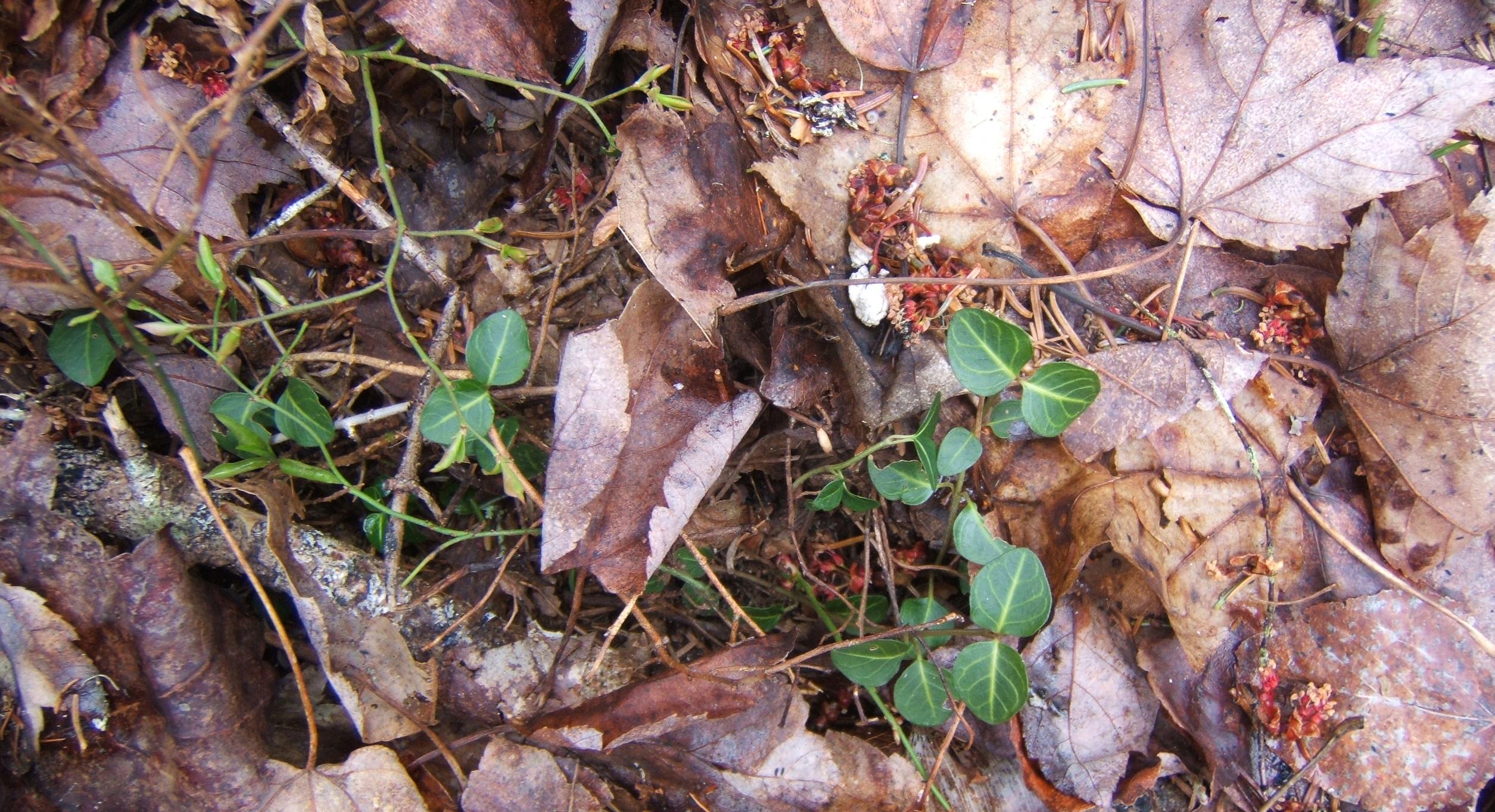
The leaves of Partridge-berry are small, ovoid and opposite on a vine-like stem. The leaves have a bright yellow midrib and veins, giving them a clear outline against the background of dry leaves.
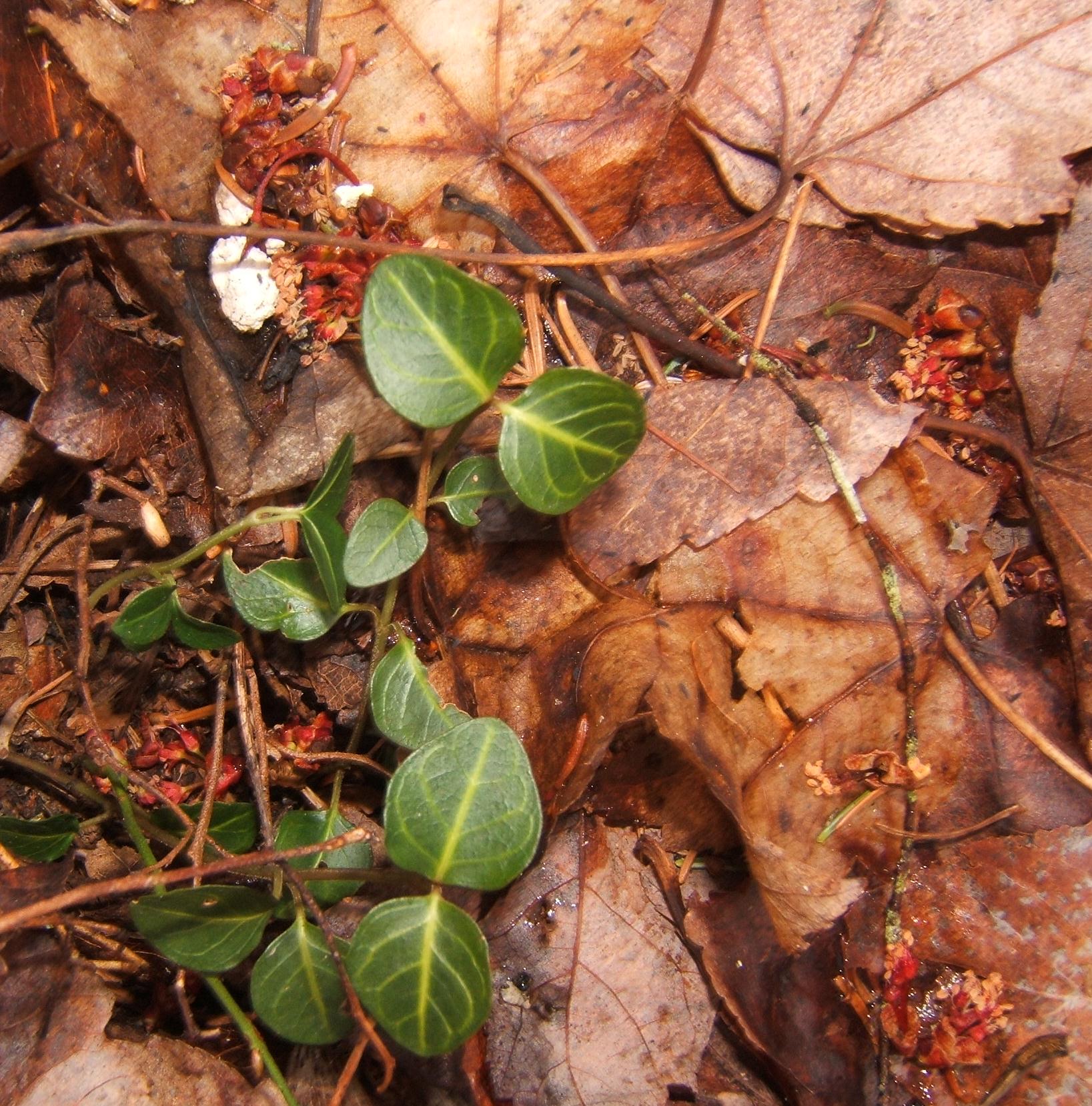
The flowers are white or pinkish, and bell-shaped. They occur in pairs – the two flowers are closely united at the base, sharing a single calyx. As a result, the bright red berries are two-eyed, each showing two blossom scars.
This time of year, in July, Partridge-berry has flowered and set its berries. The berries are dry and seedy but edible, with a slightly aromatic flavour. They are a good nibble along the trail or can be used as emergency food. The berries are ordinarily eaten by birds, such as the Ruffed Grouse.
Warning: 1. never eat any plant if you are not absolutely certain of the identification; 2. never eat any plant if you have personal sensitivities, including allergies, to certain plants or their derivatives; 3. never eat any plant unless you have checked several sources to verify the edibility of the plant.~
~
common names
( Mitchella repens L.)
~
1.
Running Fox
~
a glimpse of red
between hairmoss and hummock
the fox slips into shrewd spaces
seeks the vacant way
~
2.
Snakevine
~
a twist and a Twin-berry
trail woven and worn
mottled and mid-ribbed
Mitchella meanders
over feathermoss, under fern
~
3.
Partridge-berry
~
Ruffed Grouse pokes and pecks
tucks a Two-eyed Berry in his crop
lurches on
~
~
© Jane Tims 2012

keeping watch for dragons #7 – Bog Dragon
Some dragons like to live in bogs.
When we were in Nova Scotia, near Peggy’s Cove, imagine my delight when I found, among the Pitcher-plants, a species of the orchid family, Arethusa (Arethusa bulbosa L.), also known as the Dragon’s Mouth Orchid.
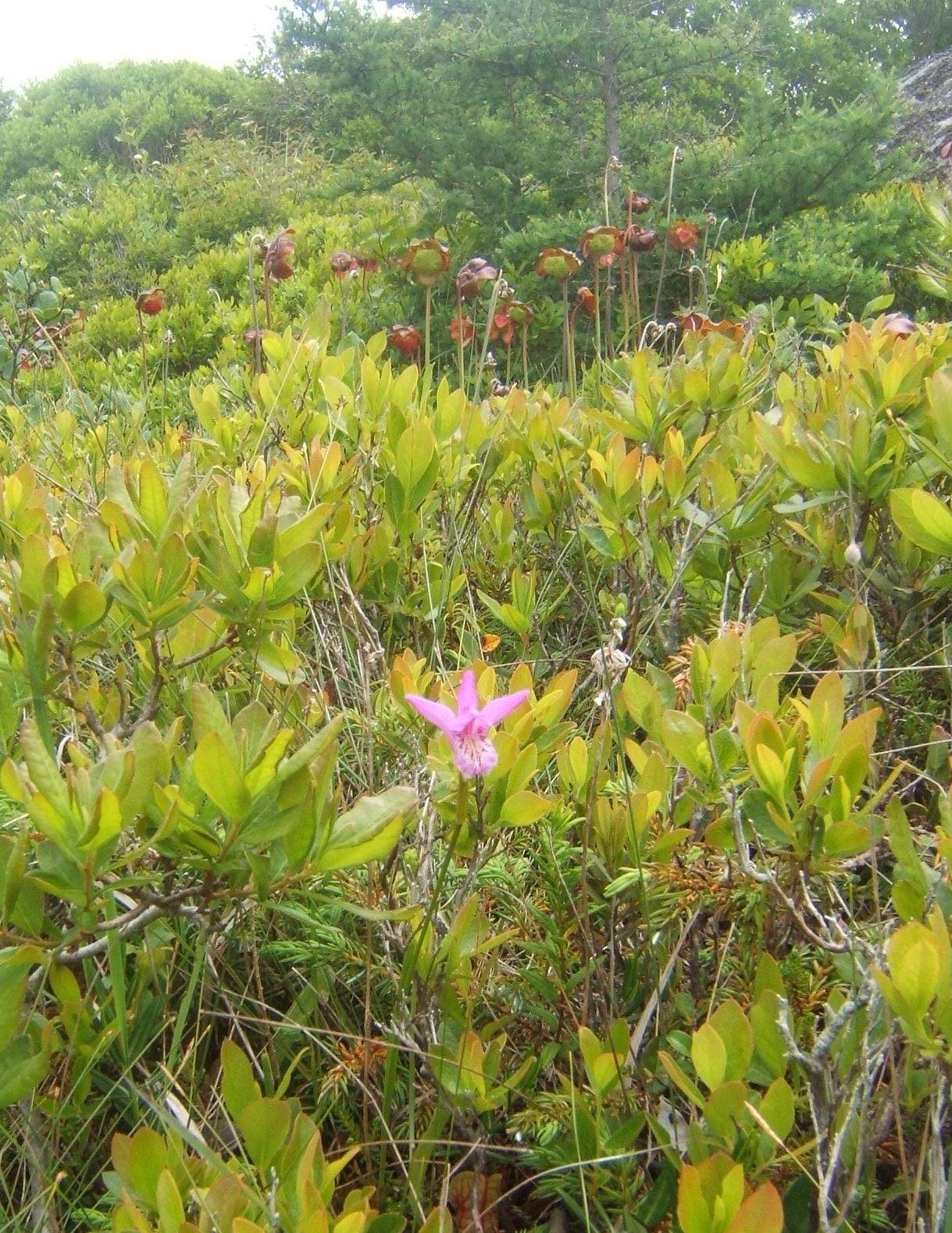
Arethusa loves wet, boggy conditions. Among the greens and reds of the low-lying bog, it surprises a visitor with its splash of pink. Even the Pitcher-plants in the photo above look a little over-come with the beauty of the Dragon’s Mouth!
This orchid has a complex flower, with three thin flaring upper petals, two in-turned petals guarding its ‘mouth’ and a lower lip with yellow and white fringed crests.

Arethusa is named after a Naiad in Greek mythology. The Naiads were nymphs associated with fresh water features such as springs, wells, fountains and brooks. Nymphs, like plants, were dependant on their habitat… if the water where they lived dried up, they perished.
Perhaps a Bog Dragon is also absolutely dependant on the water held within the bog!!!
~
~
Bog Dragon
Arethusa bulbosa L.
~
naiad
masquerades as dragon,
claps her hands across her mouth,
sorry to have spoken –
her voice, her pink, her petals
lure them,
their large feet and tugging hands
too near
~
~
© Jane Tims 2012
a moment of beautiful – mustard fields in bloom
the space: a field along the St. John River
the beautiful: mustard in bloom
In some of the cultivated fields along the St. John River, acres of mustard are in bloom. Mustard is common here, in both coastal and inland areas, along roads and in fields. In the last weeks, I have found two species, Black Mustard (Brassica nigra (L.) Koch) and Field Mustard (Brassica rapa L.) also known as Rape, or Bird’s Rape.
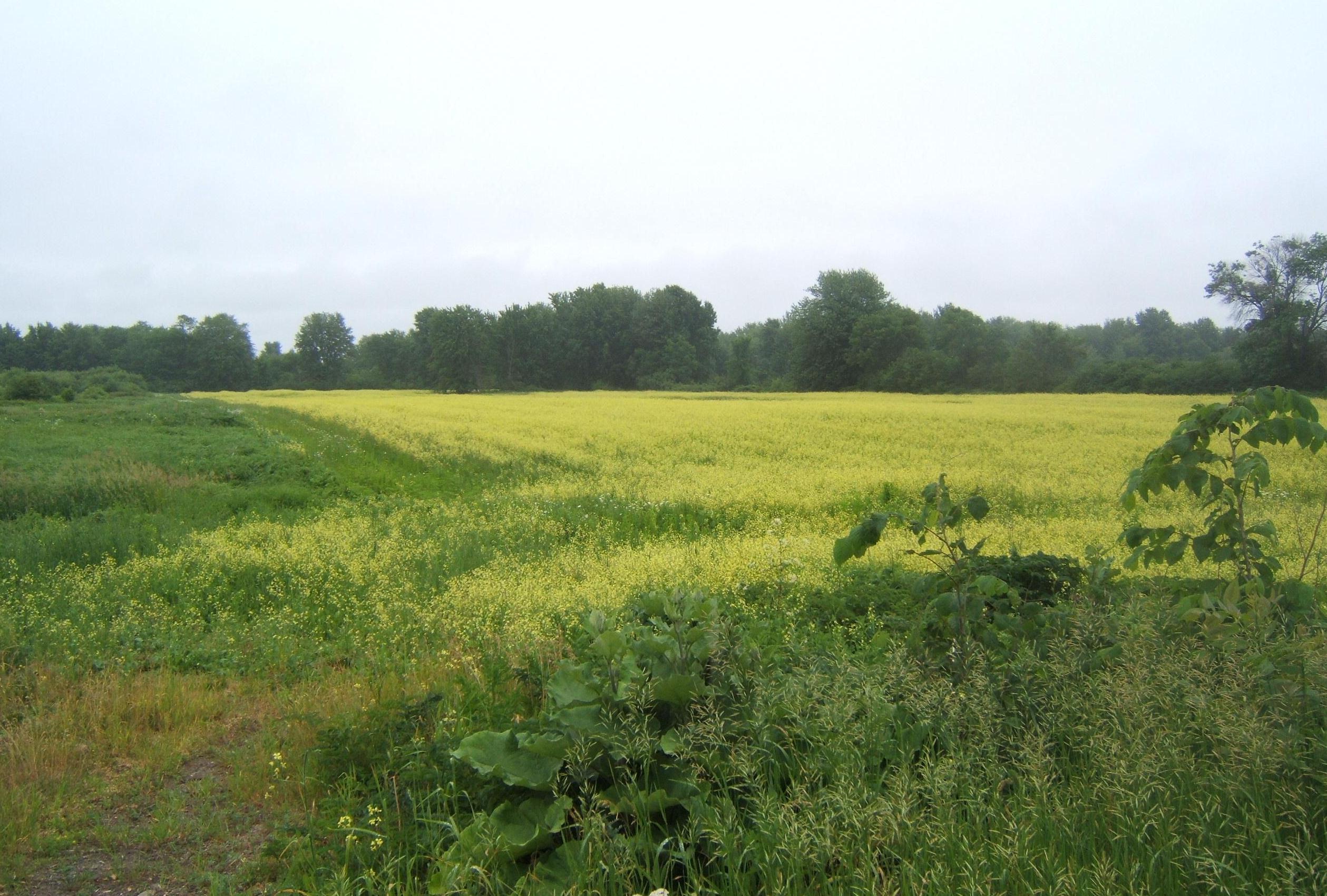
Mustard is an herb of medium size, with pale yellow, four-petalled flowers in terminal clusters, and large lobed leaves. The seeds are contained in pods; each pod ends in an elongated beak.

Mustard is well-known for its uses. The young, basal leaves may be cooked as greens or used in salads. Clusters of unopened flower buds can be cooked like brocolli. The tender seed pods are pickled, or used in salads.
Mustard’s best-known use is as a spice – the seeds are collected, dried and ground to make hot yellow mustard. I have a spot staked out to collect the seeds as they ripen in August, since I want to dry and grind some seeds for my own mustard.
~
~
sandwich
~
green leaves
between brown earth
and summer sky,
finished with
a generous smear
of mustard
~
~
© Jane Tims 2012
Warning: 1. never eat any plant if you are not absolutely certain of the identification; 2. never eat any plant if you have personal sensitivities, including allergies, to certain plants or their derivatives; 3. never eat any plant unless you have checked several sources to verify the edibility of the plant.a moment of beautiful – the sound of the sea
the space: a park bench by the edge of the sea
the beautiful: the sound of the breakers, sorting over cobbles on the shore
On a recent vacation to Nova Scotia, we had the time to sit and watch the breakers roll into a cove along St. Margaret’s Bay. The sight of the crashing waves was inspiring, but the sounds were unforgettable… first, the sweep and crash of the incoming waves…

then the clatter as the outgoing wave dragged at the cobbles along the shore…

My husband suffered through my recitation of a few lines of Matthew Arnold’s poignant ‘Dover Beach’, but mostly we were quiet, overwhelmed by the sound of the sea.
~
~
greed
~
jealous of its pretty
shaped and rounded stones,
the ocean mutters,
claws them back
clatters its dinner forks
over biscuits and gravy
hoards jellybeans
by the handful
~
~
© Jane Tims 2012

growing and gathering – picking berries with friends
As I am deciding how to organise my poetry manuscript on ‘growing and gathering’ local foods, I am considering the themes of the various poems. I think these themes will become the sections in my manuscript.
One of the first themes to emerge, perhaps the easiest to examine, is about ‘relationships’.
Although I have often picked berries alone, my best memories are of picking berries with members of my family. Both my Mom and Dad loved to pick berries. My Dad was a fast picker and I was always in silent competition with him to pick the most berries… I never won. My Mom picked berries quickly, but took the time to enjoy the fresh air, the blue sky and the expanse of the berry field. When I think of picking berries with her, I feel calm and a little lazy. My relationship with my mother-in-law was also shaped by our many berry-picking experiences; when I pick raspberries, I hear her quiet laughter in the breeze.
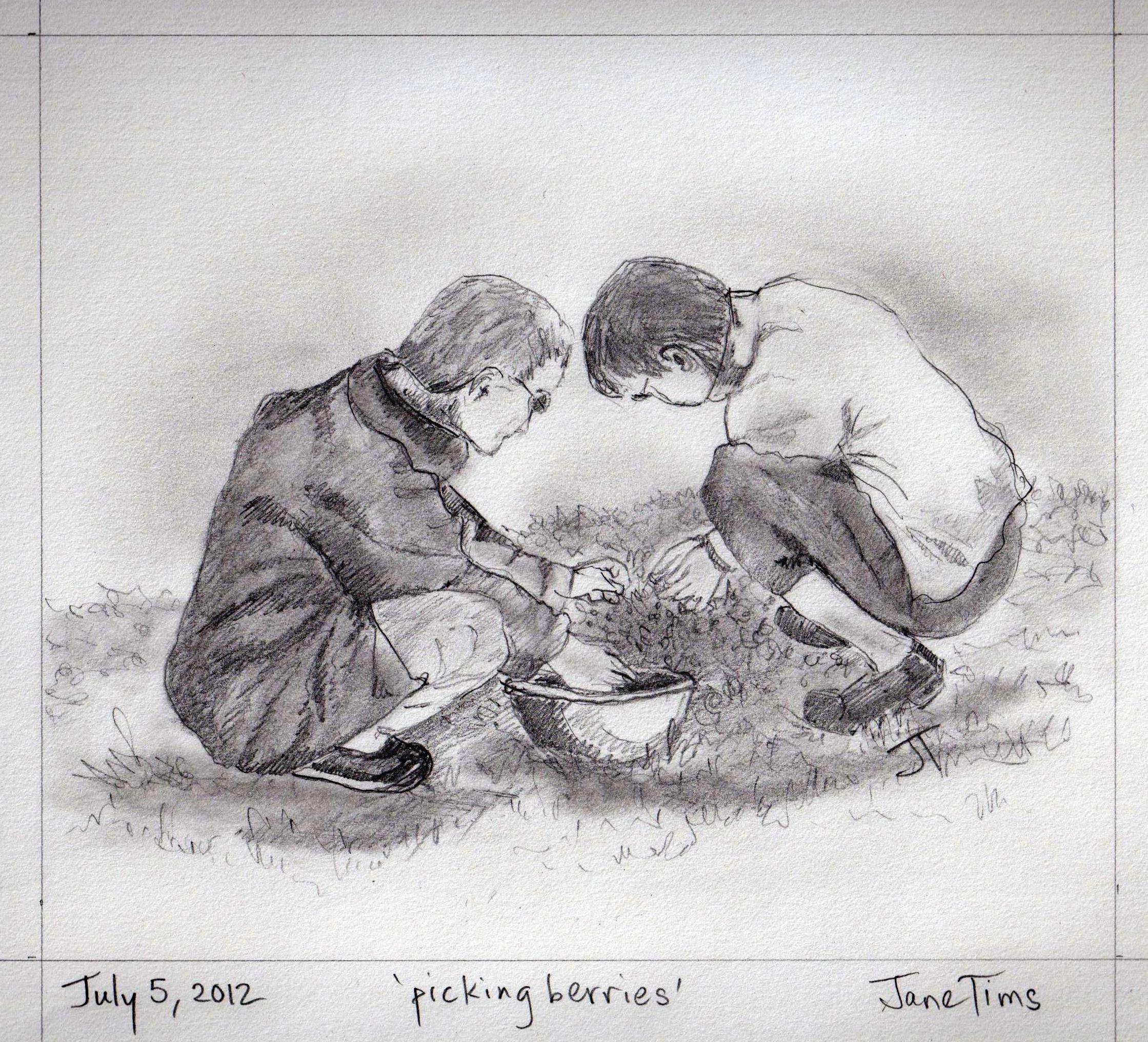
As I write poetry for my ‘growing and gathering’ manuscript, I have explored my relationships with the various people in my life.
Some of these are based on real experiences I have had picking berries or gathering greens. Examples include poems about trying to find an old berry field, now grown over, or how changes in a relationship can be observed over the years in the annual picking of berries. Although most of the poems are about plants, I have included production of other local foods – so a poem about beekeeping, for example, explores how two people interact during a small emergency.
In other cases, the gathering of local foods is a metaphor for some aspect of a relationship, whether good and bad. At least some of these metaphors are related to the characteristics of plants or animals – for example, the serrated edges of leaves, the slipperiness of a trout, the gentle feel and fragrance of Bedstraw, or the bitterness of taste common to so many ‘salad’ greens.
Some of the metaphor is based on the place where plants grow. Examples include the seclusion of many berry-picking spots, or the physical spaces created by rows of corn plants.
As I look over the Table of Contents for my manuscript, I realise some poems will be stronger if placed within another theme. So I have moved, for example, a poem about picking berries over a three-week period from the theme on ‘relationships’ to a theme about ‘change’.
This consideration of the themes in my poetry has given me a good start to organising the poems, and identifying gaps I have to fill. I know now there are lots of gaps, and many poems yet to write!
~
~
Bitter Blue
~
of all the silvery summer days we spent none so warm sun on
granite boulders round blue berry field miles across hazy miles
away from hearing anything but bees
and berries
plopping in the pail
~
beside you I draped my lazy bones on bushes crushed berries and
thick red leaves over moss dark animal trails nudged between rocks
baking berries brown musk rising to meet blue heat
or the still fleet scent
of a waxy berry bell
~
melting in my mouth crammed with fruit sometimes pulled from
laden stems more often scooped from your pail full ripe blue pulp
and the bitter shock of a hard green berry never ripe
or a shield bug
with frantic legs
and an edge to her shell
~
~
Published as: ‘Bitter Blue’, Summer 1993, The Amethyst Review 1 (2)
Published on www.nichepoetryandprose.wordpress.com on July 31, 2011
© Jane Tims 2012
Warning: 1. never eat any plant if you are not absolutely certain of the identification; 2. never eat any plant if you have personal sensitivities, including allergies, to certain plants or their derivatives; 3. never eat any plant unless you have checked several sources to verify the edibility of the plant.Pineapple Weed (Matricaria matricarioides (Less.) Porter.)
I bear weeds no ill-will. When I pull them in my garden, I am just helping my vegetables to get an edge in the great competition. Also, as you now know, I consider many ‘weeds’ to be edible and delicious. But, in one case, I cheerfully stomp on the weeds and consider the benefits to outweigh the sorrow.
When I went to meetings at our provincial Department of Agriculture, Aquaculture and Fisheries, I had to follow a wide path of concrete slabs to get to the door of the building. In the cracks between the slabs grew a small, rather pretty weed. I loved to step on this weed, or pick it, to smell its fragrance. The weed is Pineapple Weed and, crushed, it smells just like pineapple. Its scent is also reminiscent of Garden-camomile, or Hay-scented Fern.
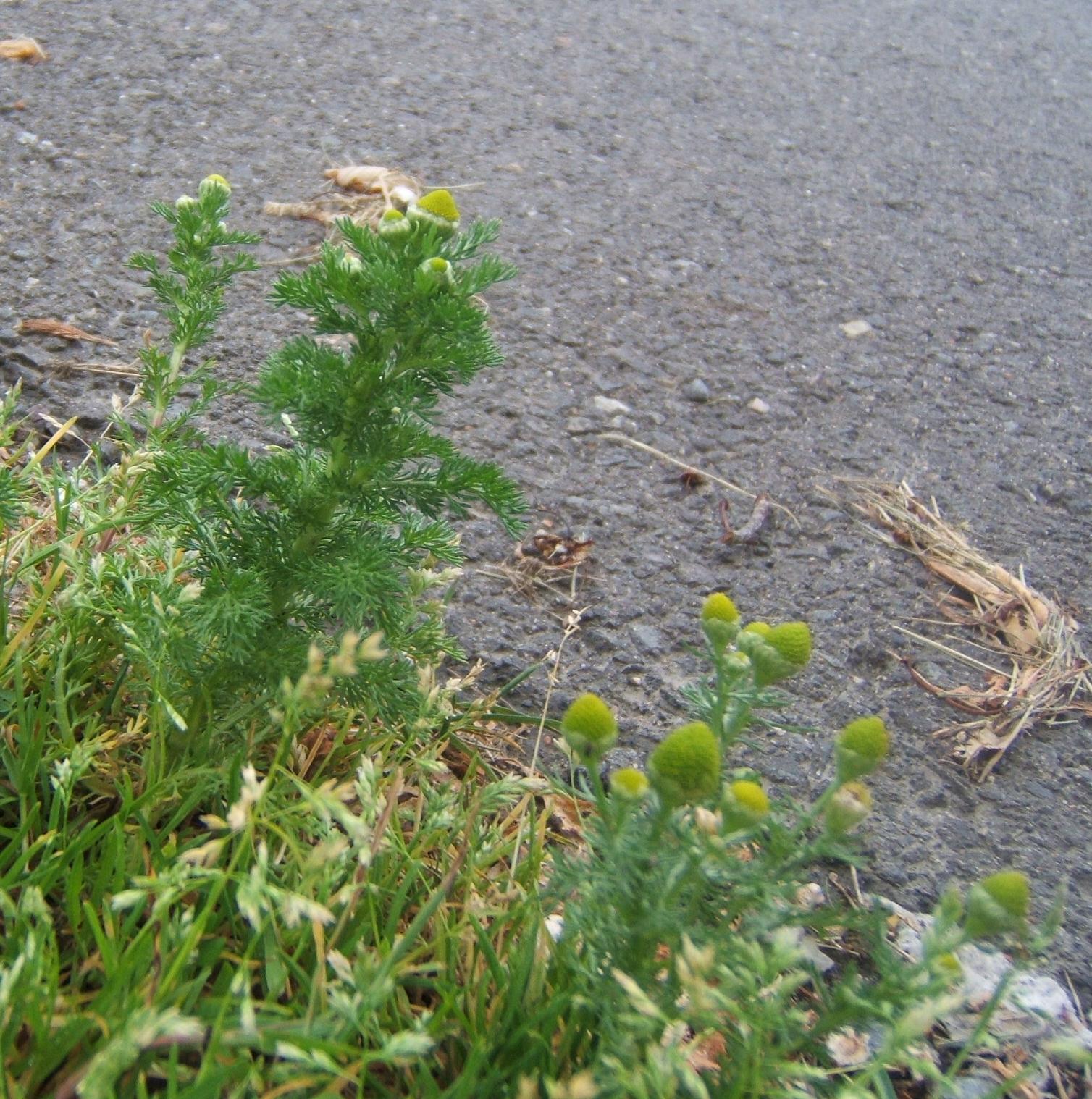
Pineapple Weed grows along roadsides and in waste places, wherever the soil is disturbed and competition from other plants is low. It is an inconspicuous cousin of Garden-camomile (Anthemis nobilis L.) and looks a little like Camomile except the flowers have no white ray-florets. The leaves of Pineapple Weed are very finely divided and feather-like.
The generic name Matricaria comes from the Latin word matrix, meaning ‘womb’, a tribute to its reputed medicinal properties. The specific name matricarioides means ‘like Matricaria’ since it was originally considered to be another species.
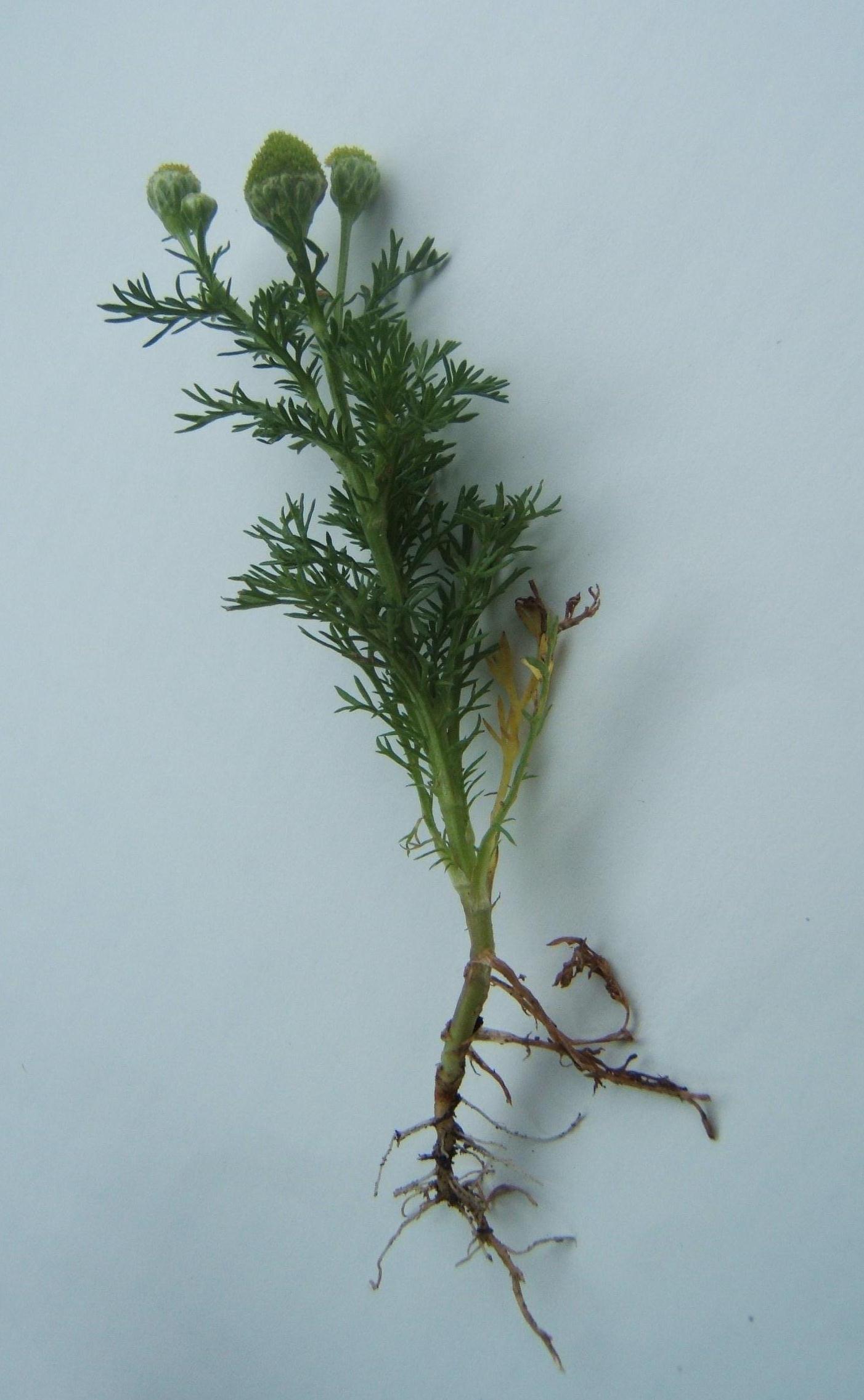
My husband tells me, as a child, he used plants of Pineapple Weed as miniature trees when he played with his Dinky cars!
To make a pale yellow, pineapple-scented tea, steep the fresh or dried flowers of Pineapple Weed in hot water.
Warning: 1. never eat any plant if you are not absolutely certain of the identification; 2. never eat any plant if you have personal sensitivities, including allergies, to certain plants or their derivatives; 3. never eat any plant unless you have checked several sources to verify the edibility of the plant.
~
~
Matricaria
~
two in the morning
and the canister of Camomile
yawns empty
~
crush Matricaria
steep a sprinkle of flowers
in water, tea the color
of straw
~
surround of pineapple
hay-scented fern
sleep
~
~
© Jane Tims 2012




 nichepoetryandprose