Posts Tagged ‘pencil drawing’
how much for a trip to space?
Yesterday, October 13, 2021, will be part of Star Trek history since William Shatner (a.k.a. Captain James T. Kirk) took a real journey into space, on board the space tourism ship, Blue Origin’s New Shepard. The cost of a ticket is variable, but in the range of hundreds of thousands into the millions. I said to my husband, “I’ll pass. I’ll just let the Dock-winders come and get me, and ‘take’ me to Meniscus.”
~
So, if you are a reader of the Meniscus Science Fiction Series, you will know that the Dock-winders of Meniscus have visited (or will visit Earth) seven times: 1982, 1988, 1995, 2008, 2013, 2020 and 2023 (two years from now). Each time, they harvest Humans for transport to their planet. In every Meniscus book, there is a list of characters and the years they were taken. Next year, I will be publishing three novellas, short urban mysteries, in the Meniscus Peripherals Series. In each book, set on Earth, there will be a mention of a Dock-winder abduction and a connection to a Meniscus Science Fiction Series story.
~

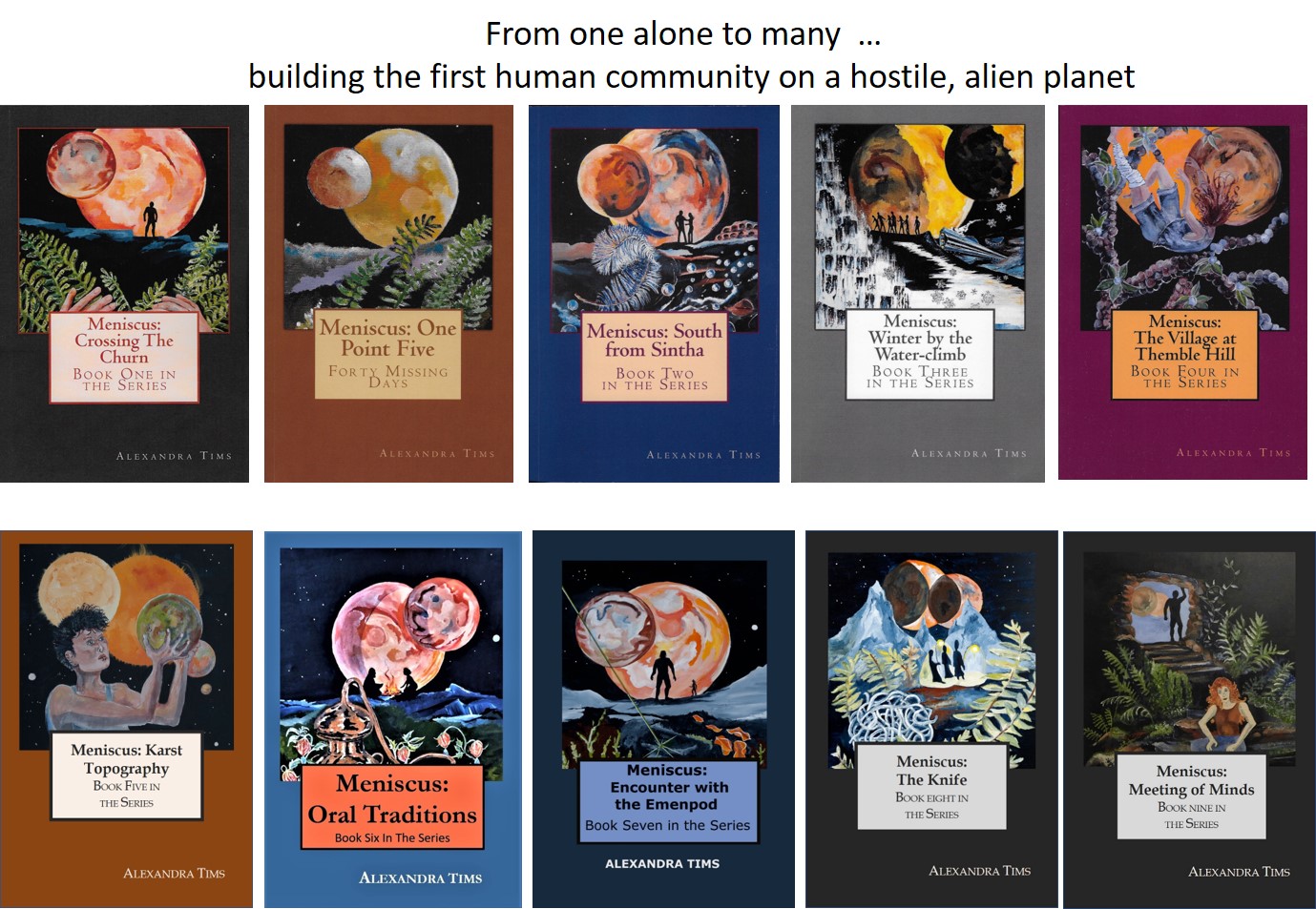
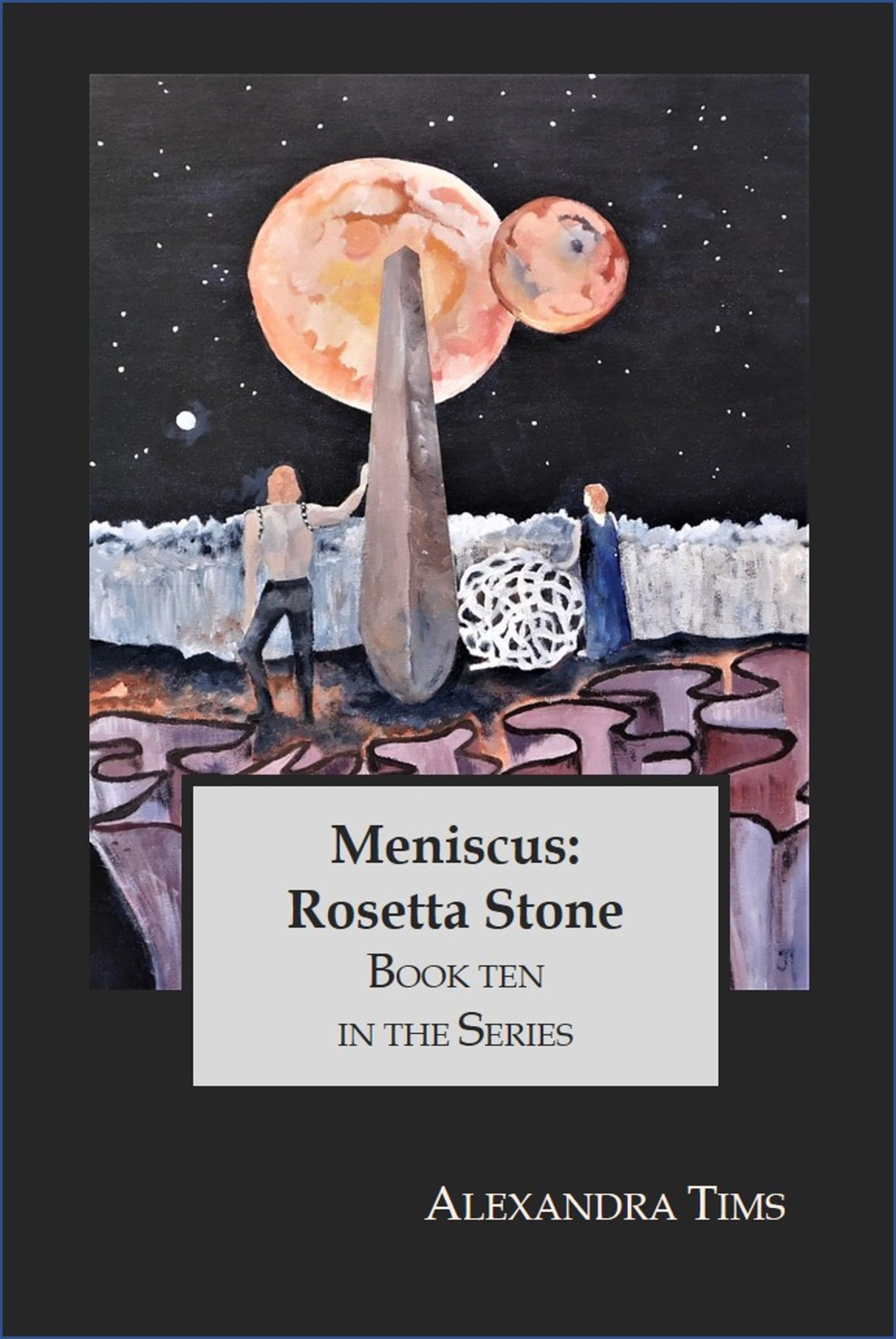
If you are not fussy about being ‘taken’ to Meniscus, for free, you can still be transported to the Meniscus world, for the small price of a paperback or e-book. There are now nine Meniscus adventures (ten if you include 1.5), and the tenth in the series, Meniscus: Rosetta Stone, will be released tomorrow, Friday!
~

~
The books in the series are:
Book One – Meniscus: Crossing The Churn
Book 1.5 – Meniscus: One Point FiveBook One – Meniscus: Crossing The Churn
Book 1.5 – Meniscus: One Point Five
Book Two – Meniscus: South from Sintha
Book Three – Meniscus: Winter by the Water-climb
Book Four – Meniscus: The Village at Themble Hill
Book Five – Meniscus: Karst Topography
Book Six – Meniscus: Oral Traditions
Book Seven – Meniscus: Encounter with the Emenpod
Book Eight – Meniscus: The Knife
Book Nine – Meniscus: Meeting of Minds
Book Ten – Meniscus: Rosetta Stone
~

~
Reading will transport you to Meniscus, second planet in the solar system of Tathlet-Amblyn, a double sun. Meniscus is a world of woodlands, deserts and mountains and the cities of Prell District, North and South. The plants and animals are peculiar and sometimes dangerous. And water moves upward, not down. Rivers do not flow and water is hard to swallow. The Humans who find themselves on Meniscus are the slaves of the Dock-winder system. But sometimes they are able to escape and, with other Humans, build relationships and communities and have exciting adventures.
~
~
Meniscus: Rosetta Stone will introduce two new characters, Abra and Trath. Abra, an historian, finds a manuscript written in both Dock-winder and Gel-speak. Abra believes translation of the document may reveal a secret to overthrow the Dock-winders. She sets out for Hath-men, a village where The Resistance is centred. But traveling alone on Meniscus can be very dangerous.
~
Meniscus: Rosetta Stone will be available on Friday, October 15, in both paperback and e-book versions. Once I get copies, it will be available from me or at Westminster Books in Fredericton.
~
All my best.
(The Dock-winders are fictional.
You don’t have to worry about them!)
Jane
(a.k.a. Alexandra)
An Upcoming Trilogy in the Meniscus Series
To the right of the post, you will see, in a column, a list of the nine existing books in the Meniscus Science Fiction Series. This summer, I am working on books 10, 11 and 12, a trilogy in that the books are connected in theme and story. The three books are (provisionally) entitled:
Meniscus: Rosetta Stone
Meniscus: The Struggle
Meniscus: Return to Sintha
~
The books tell the story of how Abra, historian and transcription expert, works to solve the mystery of the Dock-winder language, hoping an ancient manuscript written in Dock-winder will contain a clue to the downfall of these oppressive overlords.
~
The books contain many old friends from previous books in the Meniscus Series, including the people of Themble Hill. They also introduce two new characters: Abra and her husband Trath, a Slain.
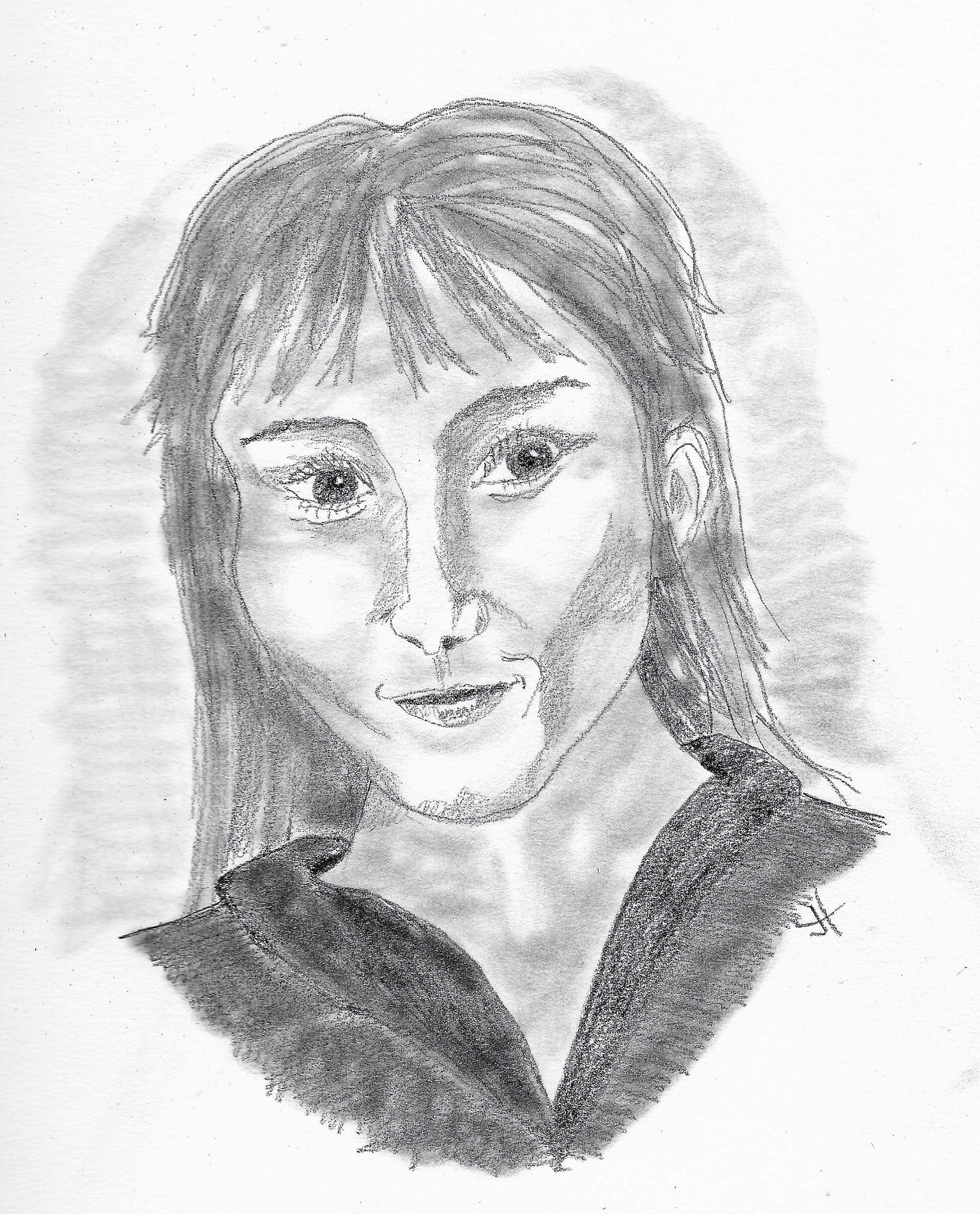
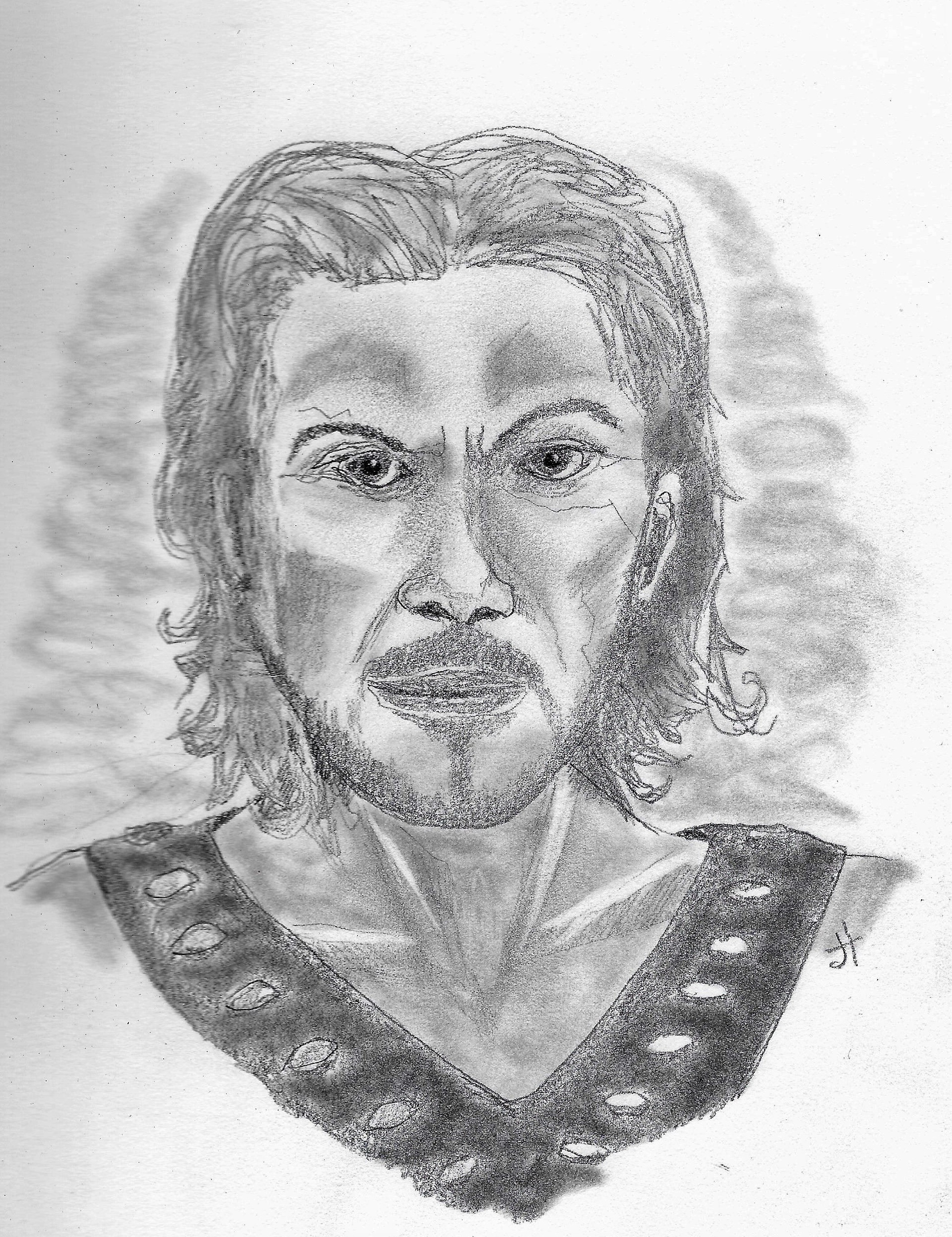
From the list of characters at the end of each book:
Abra– an historian; transcribes, transliterates and translates Museum manuscripts from Gel-speak to English; brought to Meniscus in the 2013 harvest; taken as she worked in the library of the Peabody Museum of Natural History in New Haven, Connecticut, translating a codex of Maya glyphs into English; used as a processor of the beelwort drug by the Dock-winders of the Prell-nan Ogle-hath syndicate; met her husband Trath when he brought raw beelwort to be processed; lives with Trath in the Museum of Dock-winder Legacy, Prell; as she works in the Museum library, she sometimes forgets she is no longer on Earth.
Trath – a trader; gathers wild beelwort for sale to the city syndicates and hospitals; brought to Meniscus as a baby by the Dock-winders in the 1988 harvest and genetically altered to be a Slain; makes his home in the Museum of Dock-winder Legacy, in Prell; addicted to beelwort; married to Abra.
~
Here is an excerpt from Rosetta Stone:
“Why did you leave me?”
says Trath.
Abra lifts her head.
Stares at Garnock,
the Wandering Star.
Careful of her words.
“You are never home.
Never tell me
where you have been.
Hardly speak to me
when you are there.”
“You are always
in the archives,”
says Trath,
“with your books and papers.
Never seem to care if I come or go.”
~
All my books are illustrated and include maps, a character list, a glossary and a Gel-speak dictionary.
~
Meniscus: Rosetta Stone will be out this fall.
~
All my best,
Jane (a.k.a. Alexandra)
taking an art course
I trying to add some diversity to my day, so I am taking a course from Domestika: A Meditative Approach to Botanical Illustration. I have been through the introductory videos and last evening, I began the drawing exercises. Where I am, I have no scanner or camera, but I will use some photos and drawings from past excursions to illustrate what I have to say.
_

_
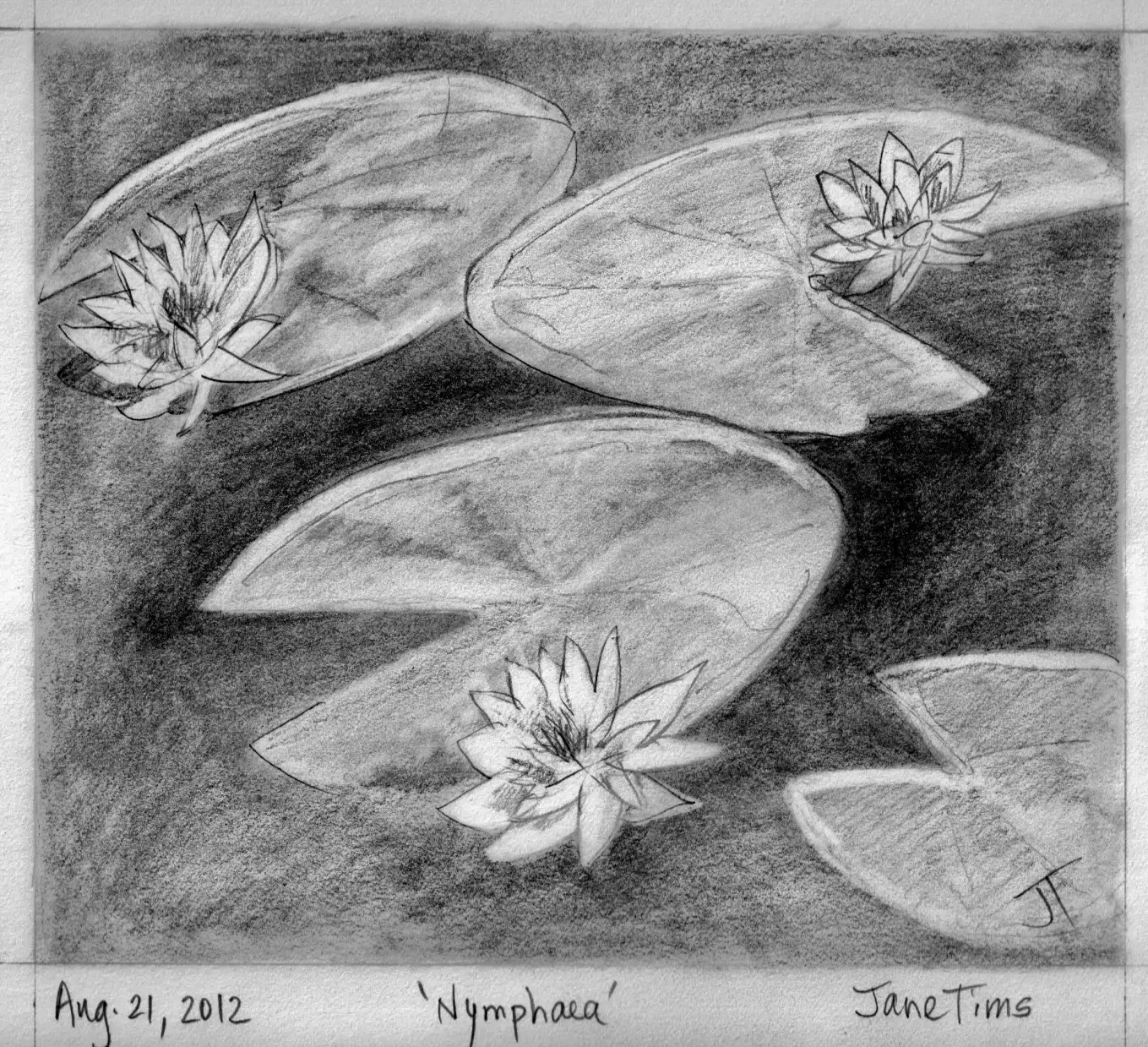
The first lesson is to observe simple shapes in the plant you want to draw. The instructor uses cacti for his subject matter. I am using water lilies of various types. I usually draw with pencil, so this is the first time I have used pen. I am a ‘maker of mistakes,’ so the eraser does a lot of work when I sit down to draw. Using pen sounds a bit intimidating, but I will prevail.
~
~
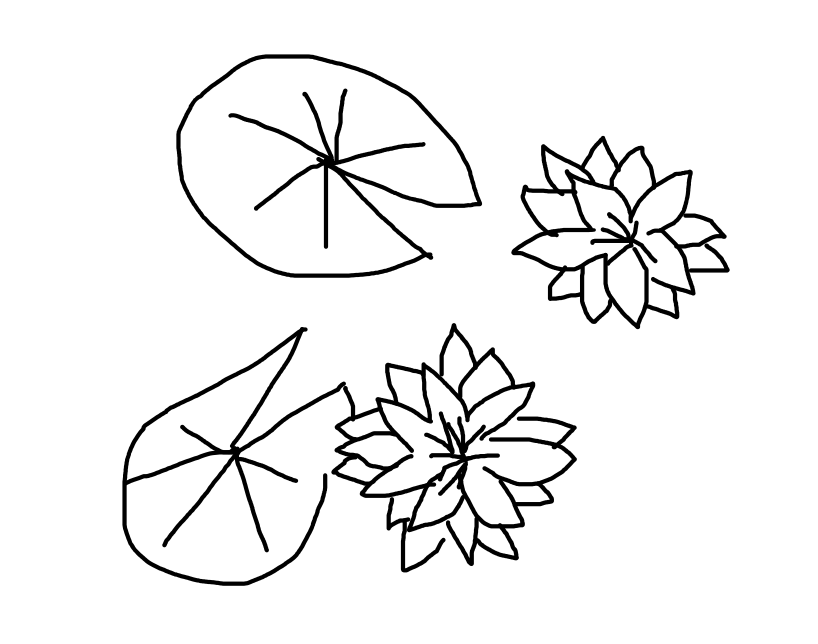
The simple shapes associated with the water lily are the elongated outlines of flower petals, and the deeply-notched spherical outlines of the various leaves. For my drawings I chose Nuphar lutea, Nymphaea odorata, and Nuphar microphylla, all species found in New Brunswick.
~
~
The above is a crude copy ‘by finger’ of one of the drawings I did, this one of Nymphaea odorata, showing the basic shapes.
The next lesson is a more accurate representation of the plant.
I am feeling that you have to go backwards to move forwards. We will see.
~
All my best
Jane
drawings of waterfalls
For me, a waterfall is the most beautiful expression of water on the landscape. The feeling of water droplets on your face, the sound of splashing water, the sight of sunlight on fast-moving water. I have tried to capture these in my collection of waterfall poems a glimpse of water fall. The book includes forty-four poems and twenty-three pencil drawings of waterfalls and other water scenes.
~

~
We have many beautiful waterfalls here in New Brunswick. Over the years I have visited quite a few. In New Brunswick, we are lucky to have two great resources for lovers of waterfalls: a great guide by Nicholas Guitard (Waterfalls of New Brunswick: A Guide, now in its Second Edition, Goose Lane Publications), and a very active Facebook Group – Waterfalls of New Brunswick.
~

~
My poetry book about waterfalls, ‘a glimpse of water fall,’ is now available from Westminster Books in Fredericton and from Amazon (click here). Enjoy!
~

~
All my best,
Jane
a glimpse of water fall
If you love the sound of water falling, the sparkle of water in sunshine, the feel of water beating at the back of your hand, you probably love waterfalls.
Most people know at least one waterfall. A place to go to cool off on a summer day, or to admire sculpted water in the midst of frozen winter. A place to drown the senses, to still … thoughts.
Waterfalls are musical, magical, calming and exciting at the same time. They are soothing yet, in their own way, are a violent interaction of land and water, water and land … sometimes a metaphor for a dramatic shift in the course of a life…
My seventh book of poetry honours the waterfall. It includes poetry written about various waterfalls in New Brunswick and drawings of several of these waterfalls. The manuscript won Honorable Mention in the Writers’ Federation of New Brunswick writing competition for the 2012 Alfred G. Bailey Prize for a poetry manuscript.
‘a glimpse of water fall’ is the first in a poetry series called ‘a glimpse of.’ Later this year, I will publish ‘a glimpse of dragons’ and ‘a glimpse of sickle moon.’ This latter manuscript won Third Place in the competition for the 2020 Alfred G. Bailey Prize.
‘a glimpse of water fall’ is available in paperback from Amazon. Just click here. It will soon be available from Westminster Books in Fredericton.
~
Here is a sample from the book:
crescendo
Little Sheephouse Falls
~
still
silence
partridge-berry vine
cascades over granite, padding
of feet on pine needles, whisper of wind
rustle in branches of conifer, music of riffle,
incessant patter of falling water on fractured slate
builds to din and rumble of rolling thunder confined
~
Little Sheephouse
on its way to Sevogle
~

~
All my best,
Jane
a storm of birds
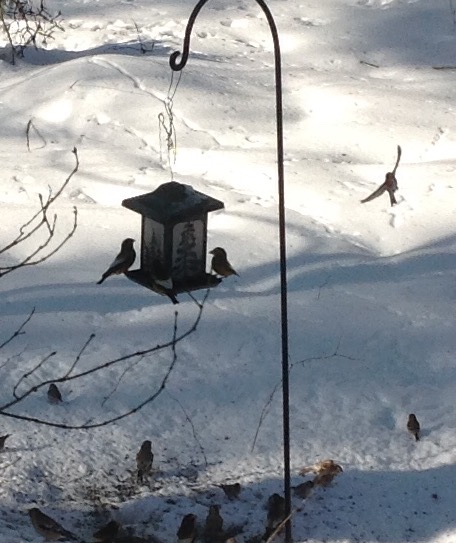
We are expecting major snowfall/freezing rain in the next couple of days. I think the birds must sense this because there is a veritable storm of birds at the feeders this morning.
~
~
We have evening grosbeaks, a downy woodpecker, chickadees, nuthatches and mourning doves. By far the largest numbers are the redpolls and goldfinches. We also have red and grey squirrels, but they didn’t show up this morning.
~

~
The birds fly in from our surrounding trees and feed for a while, coming and going. Then a dog barks or a car goes by and the whole flock leaves at once. Only a few brave grosbeaks cling to the feeder. Eventually, all the birds return and begin to feed.
~

~
We keep the feeders full during the cold weather and feed with nyjer (thistle) seed and black-oil sunflower seeds.
~

~
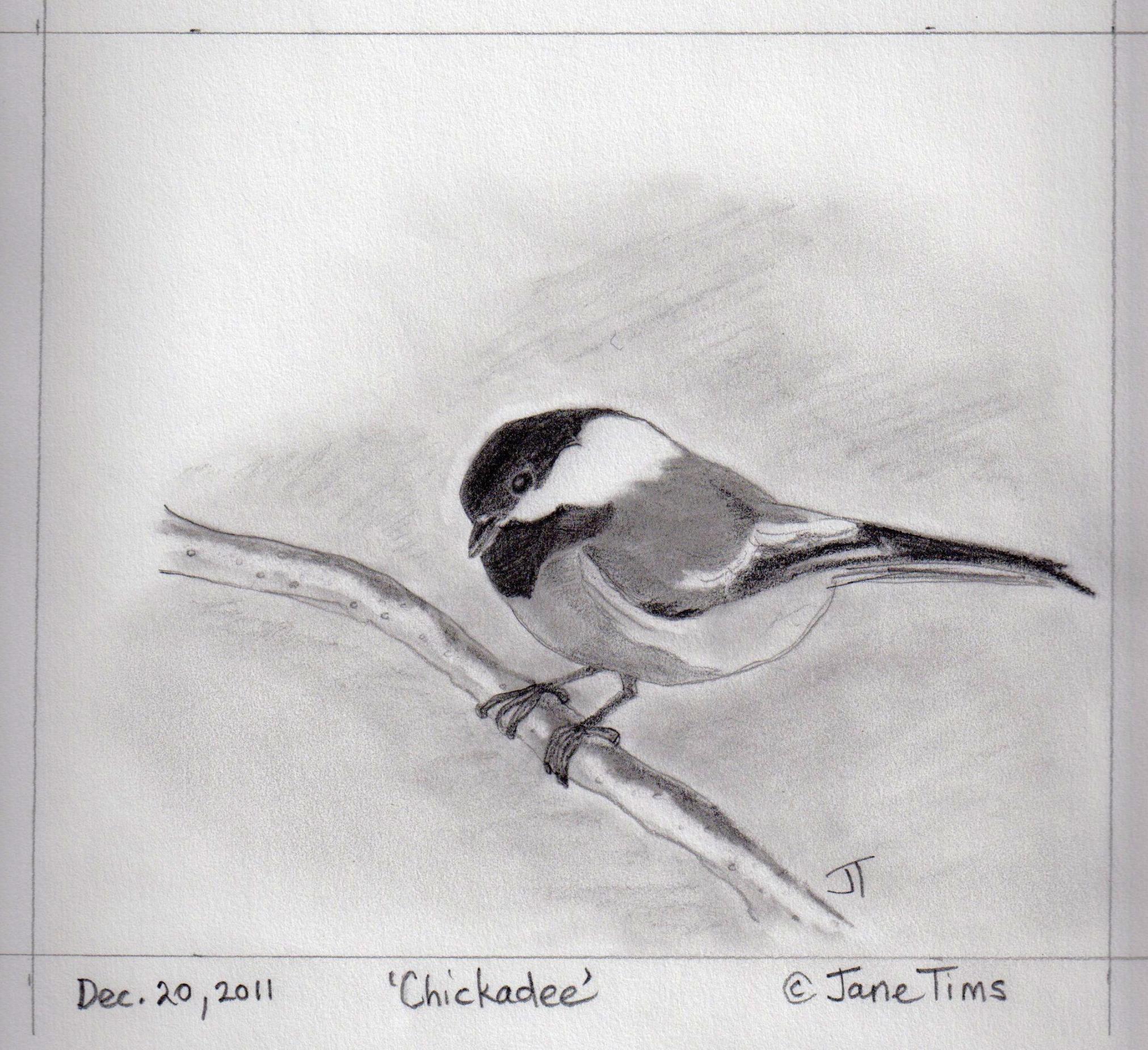
Watching the birds is lots of fun. Each species seems to have its own feeding-personality:
- the chickadees land, grab and leave as quickly as possible;
- the woodpeckers cling to the feeder and only leave when they’ve had their fill;
- the finches (redpolls and goldfinches) arrive as a flock and stay, to feed mostly on the fallen seed under the feeders;
- the grosbeaks, much bigger than the finches, mingle with them and hang on to the feeders even after other birds have been frightened away.
~
~
Bird watching is a great way to spend time during these days of pandemic lockdown. Still haven’t seen my first cardinal! And this year I haven’t yet seen a purple finch, so common in previous years.
~

~
All my best,
Jane
Gargoyles?
I am working on my poetry manuscript ‘a glimpse of waterfalls.’ As always, I workshop some of the poems with my writing group Wolf Tree Writers. Wolf Tree has been together over thirty years and has assisted me greatly in improving my poetry.
~
This past week I read a poem to Wolf Tree called ‘from a window on the 3rd floor.’ In the third stanza, a gargoyle is mentioned. We talked about how a gargoyle is an ‘Old World’ (European) reference. It made me curious about gargoyles in Canada.
~

~
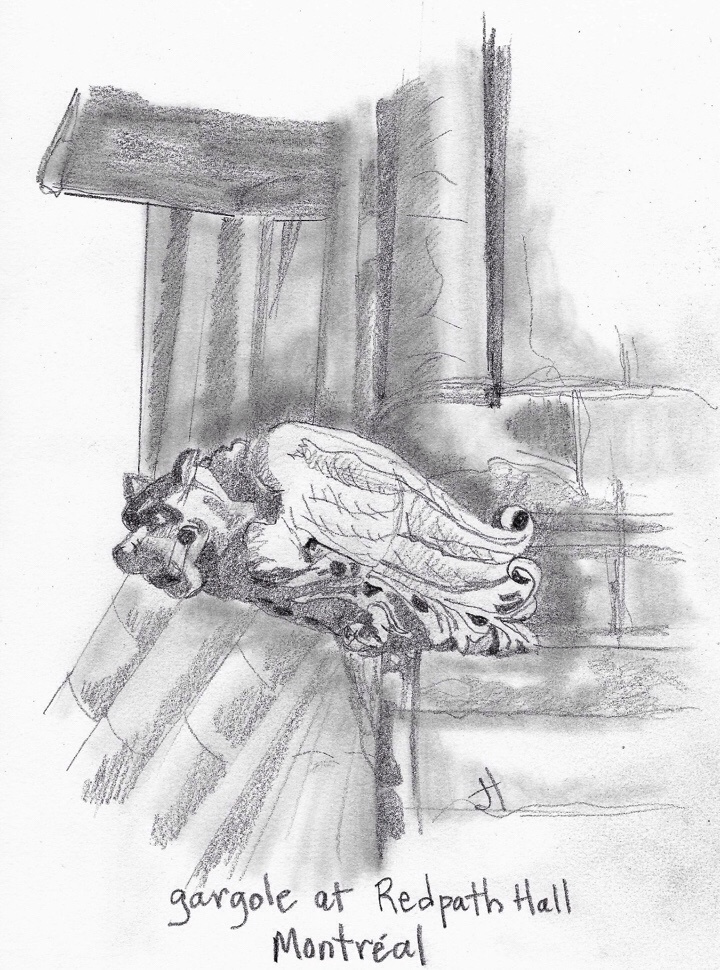
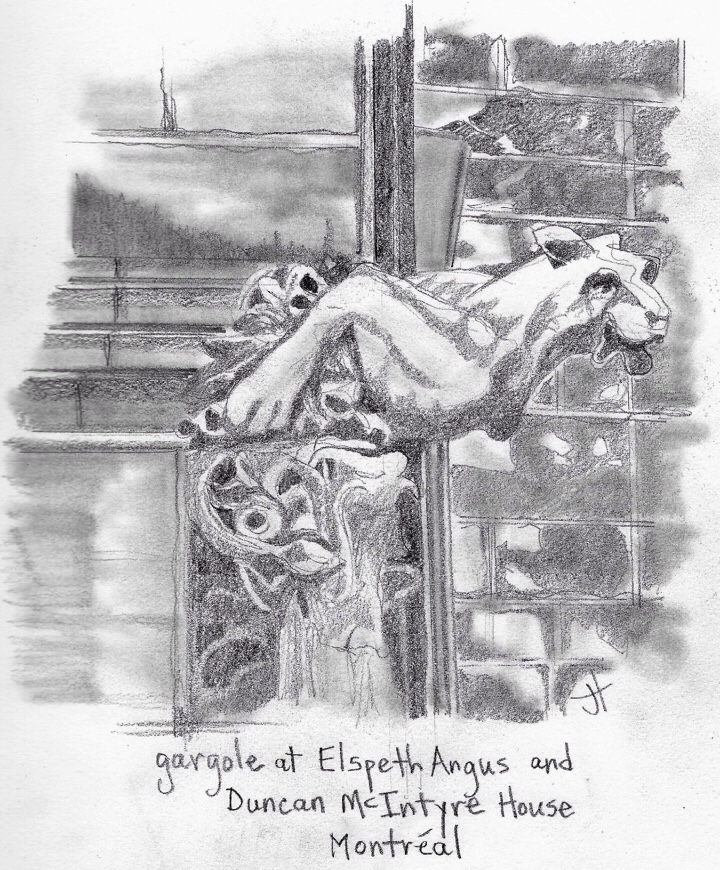
A gargoyle is a sculptural architectural feature used like a waterspout to transport rainwater away from the building. A gargoyle often depicts a grotesque other-world figure and also serves to frighten daemons away and remind people of the perils of doing harm. Sculptural features which look like gargoyles but which do not convey water are called grotesques.
~
~
Canada has many examples of gargoyles, occurring wherever architecture is gothic in design. There are many examples in Montreal, including on the campus of McGill University (Redpath Hall and Library), on churches (Christ Church Cathedral) and on private buildings (the Elspeth Angus and Duncan McIntyre House). The Peace Tower (Parliament Building) in Ottawa has numerous gargoyles and grotesques. For more information see https://sencanada.ca/en/sencaplus/how-why/gargoyles-and-grotesques-parliament-hills-sinister-sentinels/
~
~
from a window on the 3rd floor
~
I nudge curtain, interpret
streetscape, sirens
stream down the glass
fractal paths where drops
meet and coalesce
meet and coalesce
~
the puddle on the cobbled street
a pool at the base of a waterfall
edged in rock and fern
candy wrappers, paper coffee cups
brick an escarpment, rain spills
from ledges of stone
edges of stone
~
above, a gargoyle gushes
glimpse of reckless sky
heartened, I consider
merits of solitude
building facade
pavement pulses
red and blue
red and blue
~

~
Are there any gargoyles in the architecture of your area?
~
All my best!!
Jane
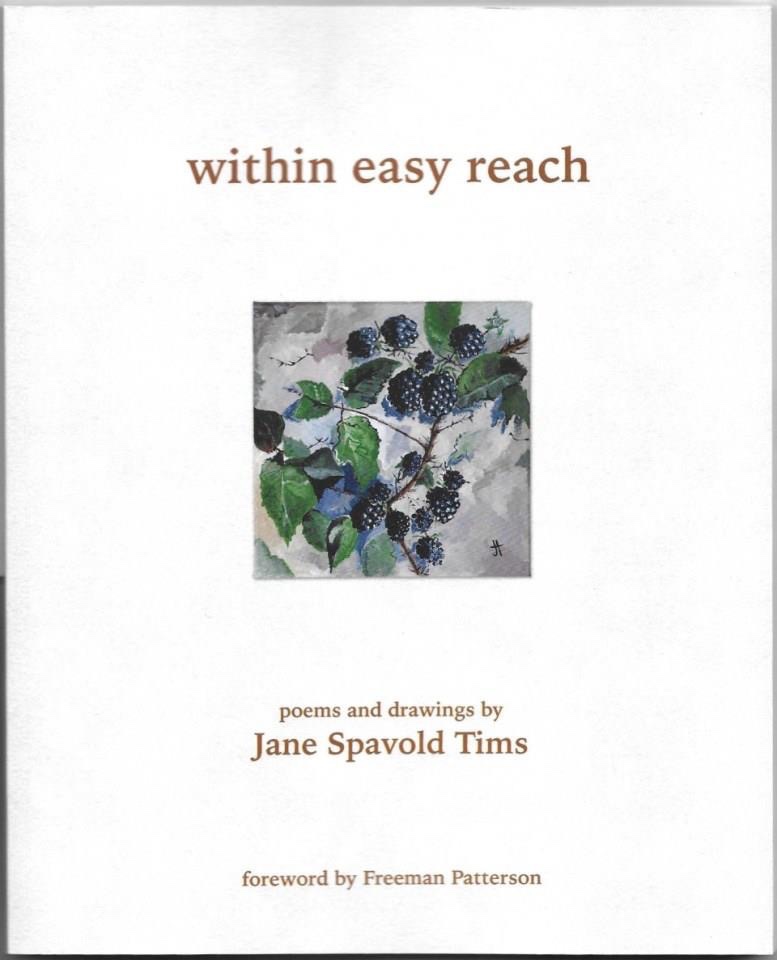
Do you love picking berries, herbs, other plants from the garden? I think you’d like my book of poetry ‘within easy reach’ (Chapel street Editions, 2016). It is illustrated with my drawings and contains notes on various example of the edible ‘wild.’ Order it here.
~
~
where we step
~
my brother and I explore
the old home place, overgrown
and unused, the house fallen
into the cellar, a sock
tossed into the dresser drawer
but, barefoot not an option
~
even shod, we are careful
of our feet – nails, glass, bricks
from the chimney, unease creeps
beneath the grass – we watch for
the water well, covered but
with rotted boards
~
hard not to love where we step –
the mint enfolds our ankles,
rose and rosemary, our minds
chives lace our sneakers, fold
flowers from purple papers
lavender leans on the walls
~
silver, graceful and wise,
the sage surveys our ruin,
thyme is bruised,
everywhere we step
~
~
Stay safe.
All my best!
Jane
creating my niche
create: 1: to bring into existence;
2a: to invest with a new form, office or rank;
2b: to produce or bring about by a course of action or behavior;
3: cause or occasion;
4a: to produce through imaginative skill;
4b: design.
– Webster’s Dictionary
I am very interested in creative endeavors and I like being creative. I am happiest when I am writing, painting, drawing, sewing, weaving, knitting, and so on.
Although I best like to write, I find creative activities substitute for one another. For example, when I am not writing for an extended period of time, I am often embedded in some other activity, such as painting.

Weaving exemplifies the lure of my various creative undertakings. The producing requires knowledge and skill, and builds confidence. The process is enjoyable and time is made available for thought and concentration. The threads and fabrics are luxurious to the touch and the colors are bright and joyful. When I am finished a project, I am so proud of the resulting textile, I want to show the world.
My loom is a simple floor loom, 24 inch wide. I bought it at a country auction, about 20 years ago. My sister and I were among the stragglers at the auction, trying to outlast a heavy rain. In the corner we saw a bundle of varnished wood and some metal parts. “I think that’s a loom”, whispered my savvy sister. When the item came up for auction, there were few bidders remaining, and no one know just what ‘it’ was. At $25, it was a huge bargain.

My loom and I have not been steady company. It takes forever to install the warp threads, and sometimes weaving is hard on my back. But the fabrics we make together, my loom and I, are beautiful and comfortable and good for the soul.
What creative endeavors shape your niche space? What materials do you use and what do you love about them?
~
~
yellow line
~
the road is fabric
weave of asphalt
ditch and yellow line
warp of guard rail
fence and heddle
~
trees in plantations
lines on the hayfield
shadows on road
hip and curve of the earth
weft as she turns in her sleep
~
shuttle piloted
through landscape
and watershed
textile in folds
texture the yearn of the loom
~
faults in the granite
potholes in pavement
rifts in the fabric
where weavers might falter
revisit work of earlier times
~
learning the lesson
taught by the loom
~
choose your weft wisely
balance color and texture
maintain your tension
fix mistakes as you go
~
rest when your back hurts
~
listen
to the whisper
of weave
of yellow line
~
~
All my best,
staying at home, staying safe,
Jane Tims

the yellow line
Strawberry Kool-Aid Hair with Ribbons
~

~
Strawberry Kool-Aid Hair
with Ribbons
~
strawberry Kool-Aid hair
with ribbons
she pushes the button
to cross Dundonald
serious with her boyfriend
her backpack heavy
~
she is like
the student on roller blades
skilled with traffic
not slowing near the top of Regent
reckless to the river
~
or the man
a block from here
a man with a briefcase
leaning across the fence
making a bouquet
of pussy-willows
~
~
All my best.
Stay safe.
Jane




 nichepoetryandprose