Posts Tagged ‘pencil drawing’
writing a novel – the community as a character
One of the first things I did as I was beginning my novel is create character sketches for the people in my book. By knowing as much as possible about the characters, I knew how they would react in any circumstance.
As I wrote, I began to wonder of the community itself could be a character in my book. Communities certainly have characteristics… they may be tolerant or intolerant, modern or traditional, rural or urban and so on. Sometimes a community has a mixture of these characteristics.
Famous examples of books where the community has character include Harper Lee’s To Kill a Mockingbird (J. B. Lippincott & Co., 1960) and Peyton Place by Grace Metalious (Julian Messner, Inc., 1956).
People in the community in my book will respond to the abandonment and disposal of a church both as individuals and as members of the community. In any community, places of worship are important. Churches are important to the community for their religious significance, but also for their historical connections.
Communities in rural New Brunswick, as elsewhere, are not homogeneous. In my own community, there are people whose families have lived here for generations. Other families have just moved here, attracted by the community’s rural character and by its nearness for commuting to work. Sometimes this heterogeneity is a source of divisiveness in a community. More often people from these different parts of community live together in harmony, coming together for school events, community sports or just neighborliness.
The community in my novel will also be heterogeneous, composed of people of different backgrounds and interests. For simplicity’s sake, I am thinking of them in three categories.
1. Many of the characters in the community will be part of the ’embedded community’, people whose families have lived in the community for generations. These will include most of the members of the church congregation.
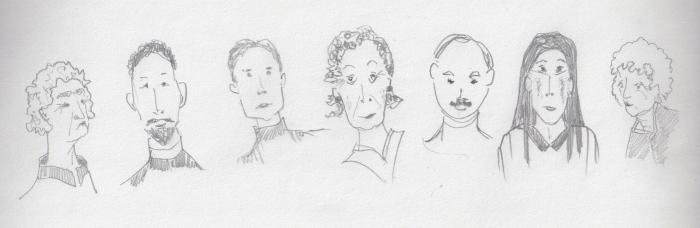
folks who were born and raised in the community
they all have good eyesight or wear contacts
second from the left is the Minister, Oliver Johnston
2. Other characters will belong to the ‘commuter community’. These will be people who have moved into the community from away. They love its rural qualities. The community is also near enough to the city for them to be able to work there.
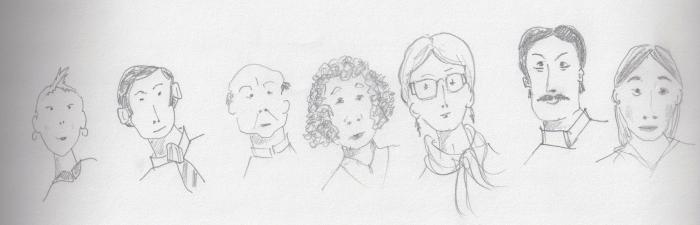
the one on the right is my main character
the man to the left of my main character is her husband… looks a little like a movie star from the 50s
I went to university with the lady on the far left
Of course, within these groups will be people who have their own interests and loyalties. For example, there may be members of the commuter community who fit very well with the embedded community. There will be those who are part of the congregation of the Landing Church and those who are not, those who will be interested in the church because of its historic importance and those who are not that interested in preserving its history.
3. There will also be a negative element in the community in my book. This element will behave very badly and I think of this as the ‘aberrant community’.

Ed Blake, the ‘bad guy’ in my novel
my sister will say he looks like Spock from Star Trek
~
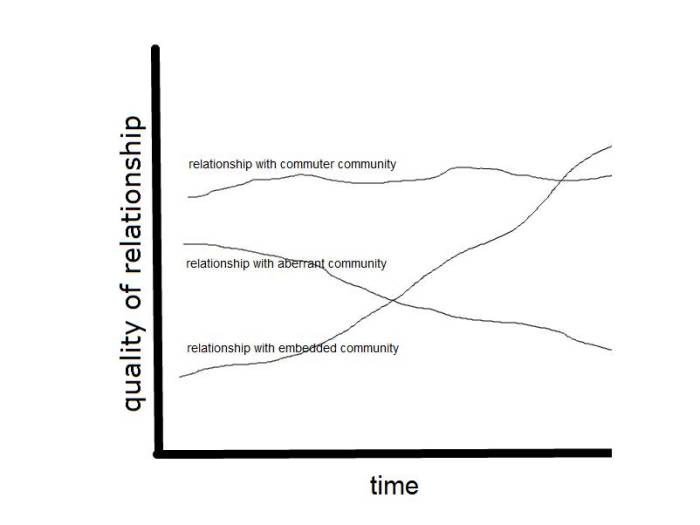
To help me plan the interactions between these three community components and the main character, I made a graph to guide my main character’s relationships through the book.
~
I want the protagonist’s relationship with the aberrant component of the community to begin on a neutral note and deteriorate with time.
Her relationship with the commuter component of community will begin high and remain that way throughout the book.
A main source of tension in the book will be her relationship with the embedded component of community. At first, she is an outsider who thinks she can solve everything by moving and re-purposing the church, and her relationship with the embedded community is very poor. However, during the book, she learns to be more understanding about the community and they learn she is not really so bad after all. This relationship will grow in a positive direction during the book.
As I write, I will check with my time-line to see if the relationships I am writing about are staying true to my graph.
~
Copyright Jane Tims 2012
writing a novel – selecting a setting #2
~
So the poet has decided to write a novel…
~
Title: unknown
Working Title: Saving the Landing Church
Setting: a writers’ retreat including an abandoned church
Characters: main character a writer
Plot: unknown
~
From the first thought I had about my novel, I knew I wanted to include a re-purposed church in my setting. I thought it would be an ideal location to tell stories about writers in search of contemplative and quiet spaces to do their work. As I thought about equipping a writers’ retreat, I realized more spaces would be needed, for eating and sleeping for example, and I thought about bringing two other buildings to the location, a house (the church manse) and a sleeping quarters (the church hall). I mentally set them on the site of our (real) property by the lake and … taa-daa! … I had the setting for my book.

Selecting a setting like this meant thinking about how these buildings could have been brought to the site. In our area we have lots of experience with moving buildings, including churches. For example, there is the fascinating story of how churches were moved to a new site along the Saint John River to allow for the flooding by the Mactaquac Dam. For a wonderful novel about the flooding and the displacement of the homes and families, Riel Nason’s book The Town That Drowned (Gooselane, 2011) is an engaging, humorous and award-winning read! http://www.rielnason.com/
To write my novel, my first step was to write a short story about moving the church to its new location at the imaginary writers’ retreat. As I wrote, I realised the move was only a small part of the story. I began to ask myself questions about how the community might react to the move, how the re-purposing of the church might change its character, and how the stress of acquiring and moving the church, and interacting with the community, might change my protagonist.
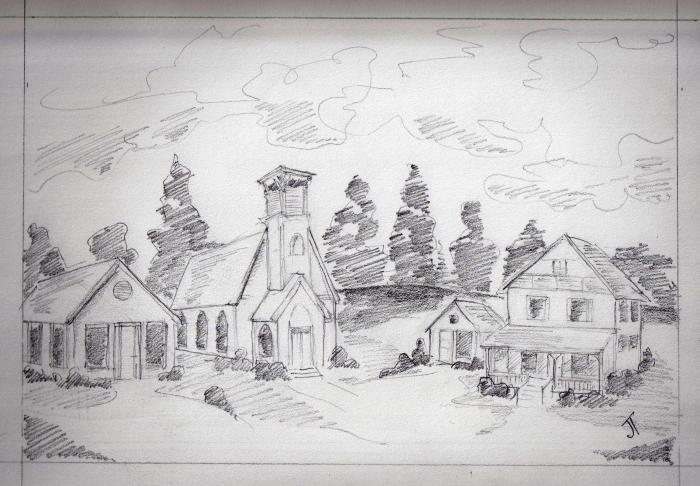
an imagined writers’ retreat
Designing the setting for the novel has been a lot of fun. I have had to think about how the buildings might be arranged at the new location. I’ve thought about what would have to be done to prepare the new site for receiving the buildings (digging a well, installing a septic system, pouring foundations, and creating access).
~
Other aspects of setting I’ve had to consider include:
- the community and landscape where the writers’ retreat would be situated,
- how the property would be embellished to make it ideal for writers seeking variety, solitude and places to write (benches, paths, and so on),
- design changes to the inside of the house, church and hall in order to make them ideal for a writers’ retreat.
~
I’ll write more these aspects of setting in a later post.
~
So, what do you think of my imagined writers’ retreat? Do you have any suggestions for how to make writers flourish in the setting?
~
Copyright Jane Tims 2012
writing a novel – re-purposing a church
~
So the poet has decided to write a novel…
~
Title: unknown
Working Title: Saving the Landing Church
Setting: a writers’ retreat and an abandoned church
Characters: main character – a writer who operates a writers’ retreat
Plot: moving a church? (in part)
~
Since the main character in my novel is a writer, it makes some sense that she would like to earn her living as a writer. However, she has not yet published her first book, so there are no book deals or royalty cheques. She turns to an occupation pursued by many talented writers, the education of other writers.
In my book, I want to establish a situation that could eventually lead to other books. So, I have given my protagonist the dream of establishing a writer’s retreat. Her idea is to hold writing workshops at this retreat, perhaps every weekend once she establishes herself. She will be able to teach writing techniques at the retreat, or hire other writers to carry out workshops. She wants to sponsor reading events for the community, to encourage interest in local writers. Now, all she needs is a place to carry out her plan. She does a little research, selects a community where the artistic sentiment has established itself, and purchases a piece of land nearby.
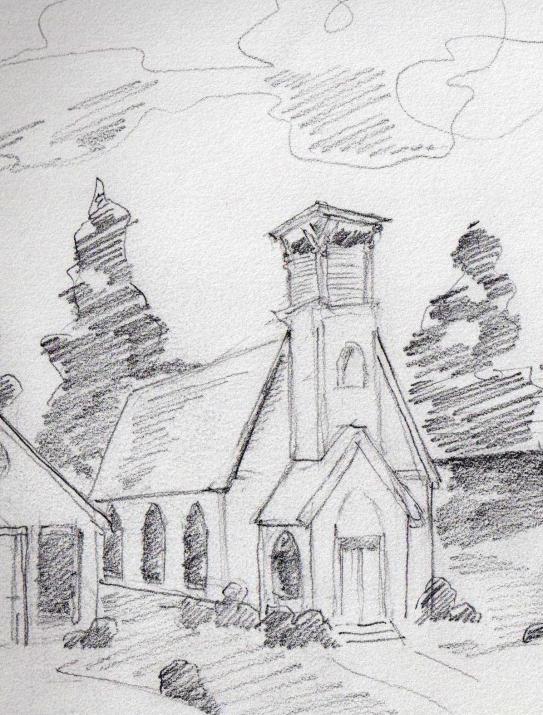
detail of a larger drawing Jane Tims November 29, 2012
And then she sees the Landing Church, about to be abandoned by its congregation. She falls in love with the church. She re-imagines it as a perfect place to hold her writing retreat. A serene, tranquil place for writers to think and write. A place with good acoustics for readings. A place 10 kilometers away.
Now, how is she going to get that lovely little church to her own property???
~
Copyright Jane Tims 2012
apple tree shadow
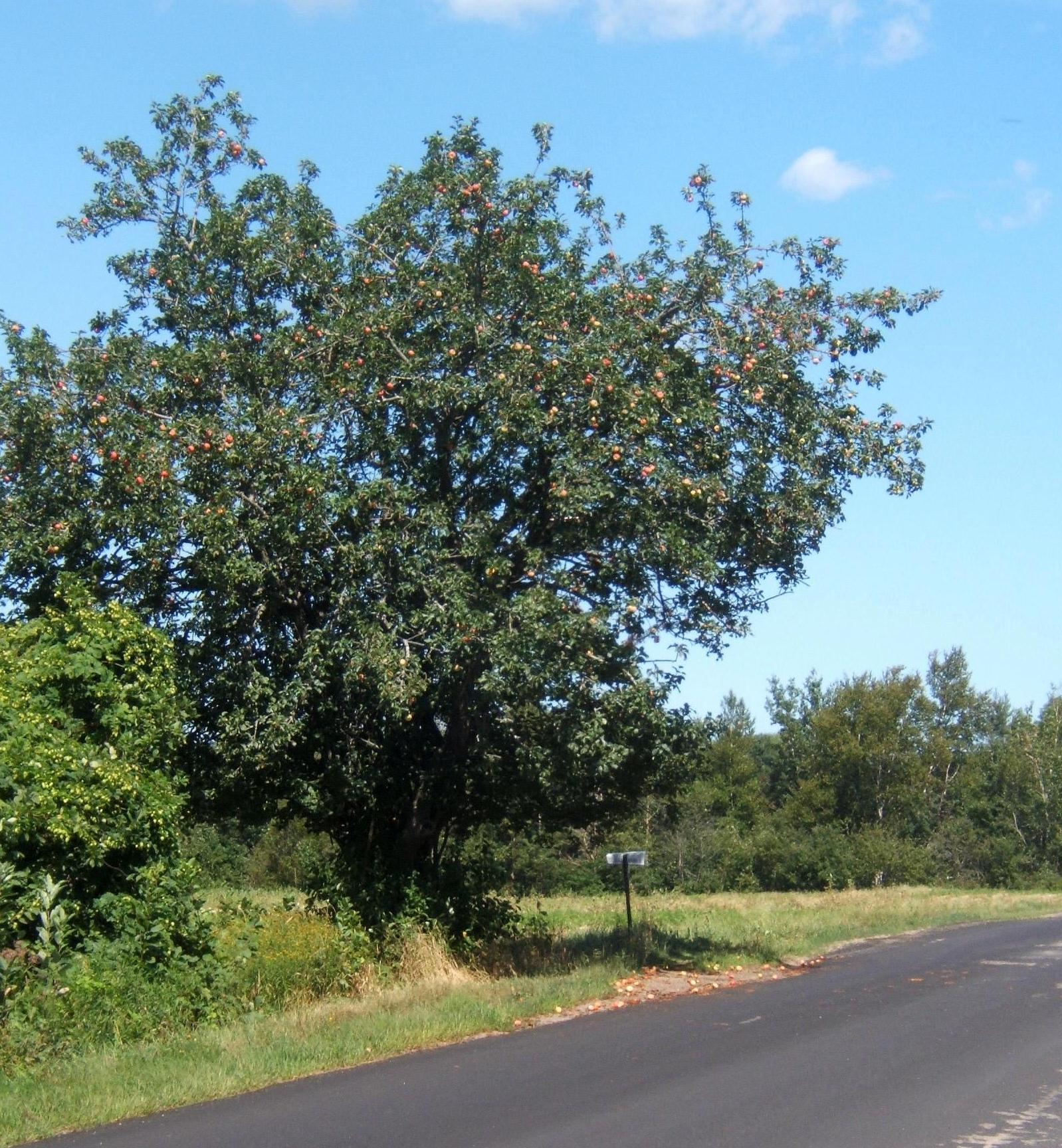
This time of year, I watch for the old apple trees along the road. Most are neglected, and the fruit remains unpicked, even for cider. When the apples fall, they lie beneath the tree in a circle of red or yellow, mimicking the shadow of the tree at noon.
~
~
apple shadow
~
days follow days
and the apples
fall to the ditch,
claim the gravel
edge the asphalt
~
ripe shadow space
at the base of
the leaning tree
~
passing cars play
polo and wasps
worry in the
rotting remains
~
~
Copyright Jane Tims 2012
Highbush Cranberry (Viburnum trilobum Marsh.)
Like miniature fireworks, bright bunches of the berries of Highbush Cranberry (Viburnum trilobum Marsh.) burst along our roadsides in late summer. Highbush Cranberry is also called Cranberry, Pimbina, and in Quebec, quatres-saisons des bois.
The Highbush Cranberry is a large deciduous shrub, found in cool woods, thickets, shores and slopes. It has grey bark and dense reddish-brown twigs. The large lobed leaves are very similar to red maple.

In spring and summer, the white flowers bloom in a cyme or corymb (a flat-topped or convex open flower-cluster). Most flowers in the cluster are small, but the outermost flowers are large and showy, making the plant attractive for insect pollinators.
The fruit is a drupe, ellipsoid and brightly colored red or orange. The juicy, acidic fruit has a very similar flavour to cranberry (Vaccinium spp. L.) and is used for jams and jellies. The preserves are rich in Vitamin C.

~
~
fireworks, quatres-saisons
(Viburnum trilobum Marsh.)
~
~
against a drawing paper sky
some liberated hand
has sketched fireworks
~
remember precursors in spring?
blowsy cymes, white sputter
of a Catherine wheel
~
now these berries, ready to pick
bold, spherical outburst
of vermillion sparks
~
a pyrotechnic flash of red
strontium detonates
in receptive dark
~
a four-season celebration
spring confetti, berries,
fireworks in fall
~
cranberry preserves – acidic,
tart blaze of summer sky
winter ignition
~
~
© Jane Tims 2012

© Jane Tims 2012
growing and gathering – names of edible wild plants
As I have worked on my poetry project about eating local foods, I have researched each wild plant, found it in its natural environment, and then written about it. With all this, I am exposed to the words and characteristics of a particular plant and it is never certain which way the ‘muse’ will take me when I write the poem. Sometimes, I end up creating a poem about eating local food, and sometimes, I get a poem about something else. Usually these stray poems are, in some way, about the name of the plant.
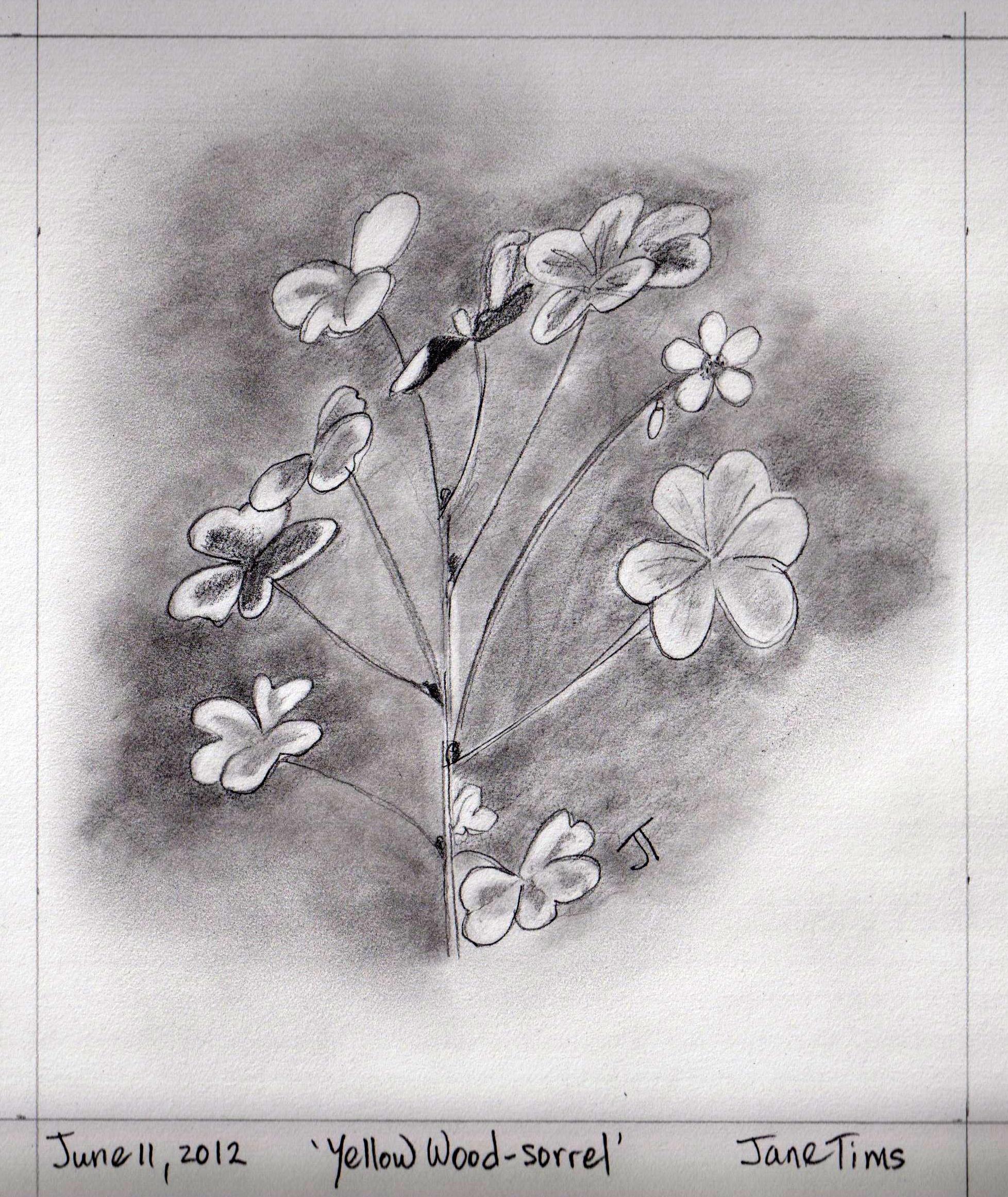
I find the names of plants are very inspiring. First is the Latin or scientific name, familiar to me after years of botanizing, but mysterious to most people. I love to find out about the origins of the name and I usually discover the name is descriptive of the plant. An example is the scientific name for Yellow Wood-sorrel (Oxalis stricta L.), a small yellow-flowered, three-leaved plant of waste areas. The name stricta means ‘erect’, referring to the way the plant grows when young or the way its seed pods are held. The word oxalis is from the Greek oxys meaning ‘sour’, a reference to the taste of the leaves.
The common names of plants are also intriguing. Sometimes these are different for each area where the plant is found. For example, the Cloudberry (Rubus Chamaemorus L.), a small relative of Blackberry with a peach-colored fruit, is known locally (and particularly in Newfoundland) as Bakeapple. Plant names may also refer to a characteristic of the plant. A good example is Heal-all (Prunella vulgaris L.), a small purple flower. It inhabits waste areas and lawns, becoming small and compact if mowed. One of its common names, ‘Carpenter Weed’, comes from this characteristic… Carpenter Weed mends holes in lawns! The name Heal-all comes from the old belief that the plant has medicinal properties.

‘heal-all’ Copyright Jane Tims 2011
So, among my collection of poems about edible plants, I have a group of poems about the plants and their names, but not about their use as local foods. I have to decide whether or not to include them in my collection, or to set them free!
~
~
Heal-all
(Prunella vulgaris L.)
~
snug Prunella, neat little weed
prim and proper, gone to seed
~
first called Brunella: gatherers found
Prunella purple fades to brown
~
a carpenter weed, busy, strong
mends bare patches on the lawn
~
heal-all, self-heal – your name suggests
an herbal secret you possess
~
~
© Jane Tims 2012
growing and gathering – years and seasons
As I work on my collection of poems about growing and gathering, I am aware of the passage of time. I am in the revision stage. This means my manuscript will soon be ‘complete’. I will worry over it and list the last things to be done. I will prepare my final report to artsnb (the New Brunswick Arts Board), the source of my Creations Grant, and send it away to them for approval.
The project will be over, but there will still be work to do. I will have to decide what poems should go in the final manuscript, re-order them a few times, do some more revisions and them send them away, to a publisher, hoping I will be able to get a book from all this work.
Then I will be at the end and facing a new beginning, a new project. I have a few to choose from, so I won’t be relaxing for long.
In all this is the dimension of time, with its deadlines and unforgiving rush forward. Even in a project about growing and gathering local foods, there are poems about time.
A number of my poems are about the ephemeral nature of local foods. Another way to think of this is ‘eating local foods in season’. In spring, everything is plentiful – new plants arrive in a rush, so fast, you can hardly keep up. Then there is the patient waiting for berries to ripen and, again, a rush… blueberries are quickly followed by blackberries and raspberries and so on. But everything has its season, so leaves become too old to harvest, and berries shrivel and fall to the ground.

This seasonal aspect of local foods can be thought of as as a metaphor for aging, and some of my poems work with this comparison. I have poems about resisting aging, and about the ailments of age including arthritis, lethargy, forgetfulness, and aging memory.
Many of my poems on the theme of ‘time’ overlap with other themes, about ‘companionship’, or changes to ‘place’. For this reason, I find myself shifting poems around in my manuscript. I ask myself if the poems flow well, one to another.
I also find I don’t seem to have many poems about the differences between our historical use of local foods and our present day use. I have lots of source material, particularly among my great-aunt’s diaries… she loved to pick berries. So away I go, to write a few more poems about time!
~
~
Old Man’s Beard
~
Usnea subfloridana Stirt.
~
you and I
years ago
forced our ways
bent through the thicket
of lichen and spruce
~
Usnea
caught in your beard
and we laughed
absurd!
us with stooped backs
and grey hair?
~
found a game trail
a strawberry marsh
wild berries
crushed into sedge
stained shirts
lips
and fingers
strawberries
dusted with sugar
washed down with cold tea
warmed by rum
~
today
an old woman
alone
lost her way in the spruce
found beard
caught in the branches
and cried
~
~
Published as ‘Old Man’s Beard’, The Fiddlehead 180, Summer, 1994
© Jane Tims 2012

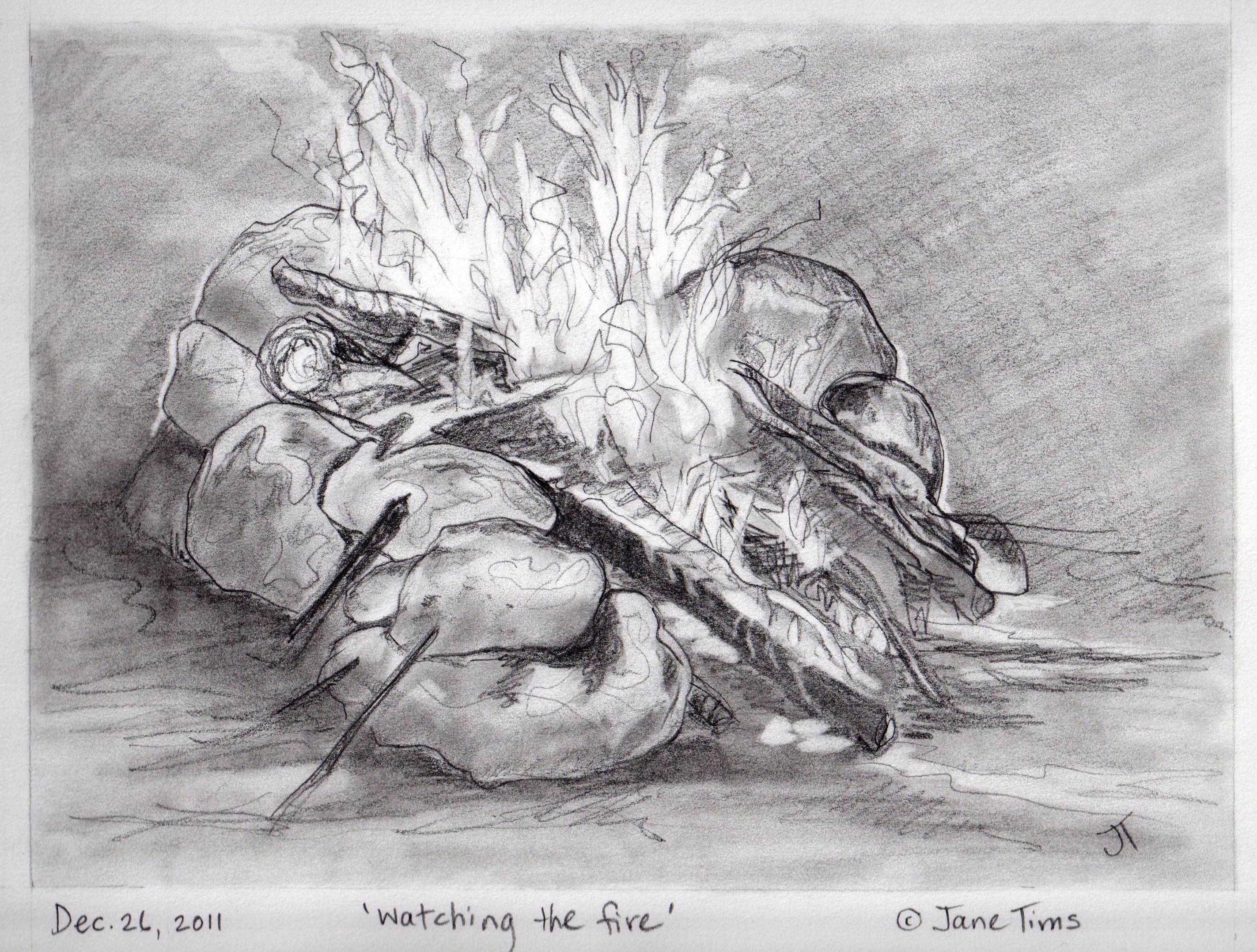
keeping watch for dragons #8 – campfire dragon
Late summer is the time for campfires. We have to be careful, of course, to make sure there is no risk of forest fire and campfires are permitted. But on an evening when the fire index hotline says OK, and we have a small stack of wood beside the fire pit and a bench for sitting, there is no better way to pass an evening.
Campfires are great places for telling stories. They are also good places to dream and remember. A campfire means getting smoke in your eyes, so the images can be a little blurry. You can watch the sparks lift from the fire and ascend into the dark night. The question is, are they also watching you … ?
~
~
campfire dragons
~
dragons prowl
in balsam
back crawl in amber
blisters of pitch
~
dragons lurk
under mantles of smoke
blacken the stones
spurt throatfuls of fire
~
dragons leap
to the Drago sky
watch us grow small
with sparking eyes
~
close their lids
and sleep in flight
~
~
© Jane Tims 1998
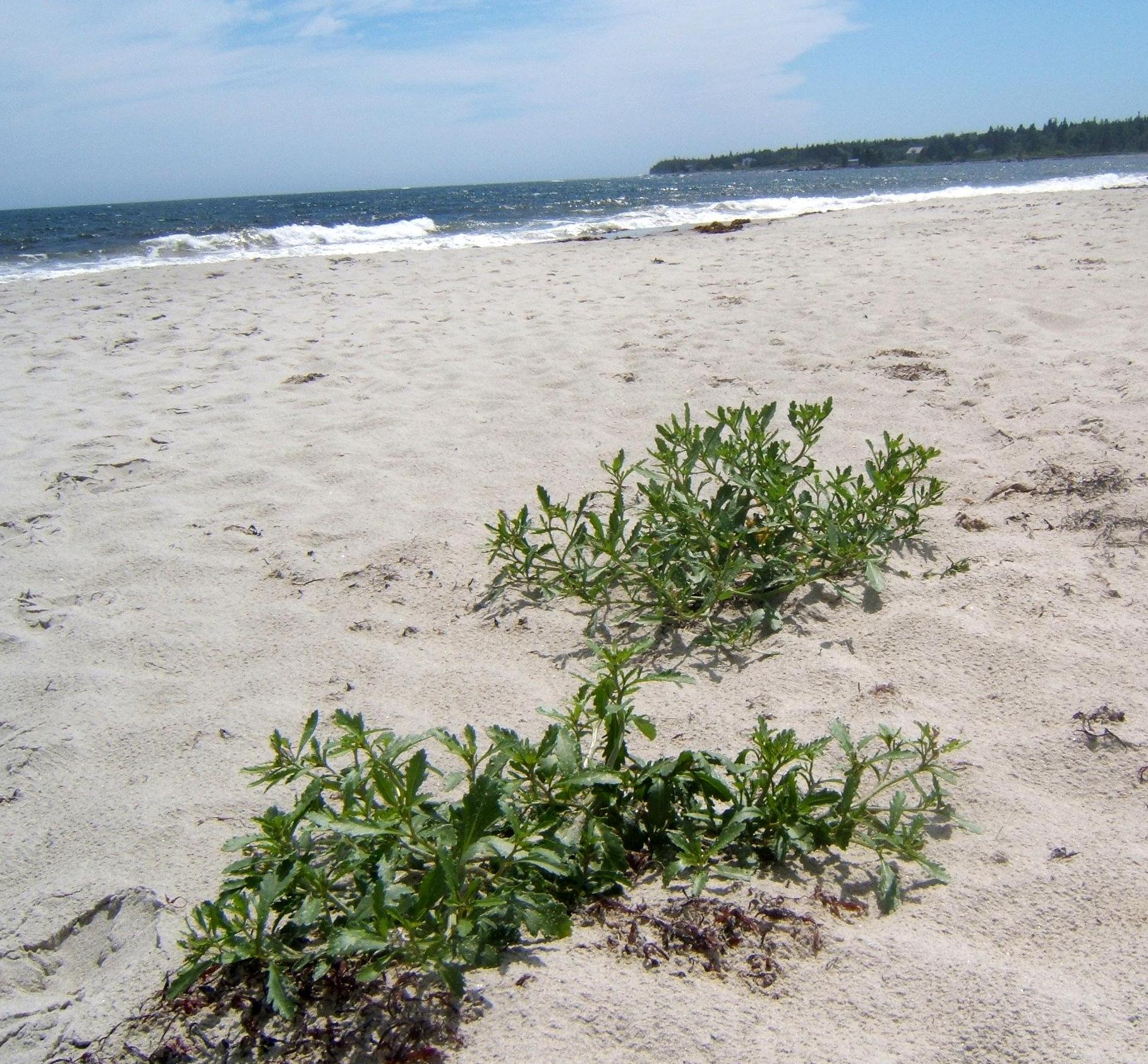
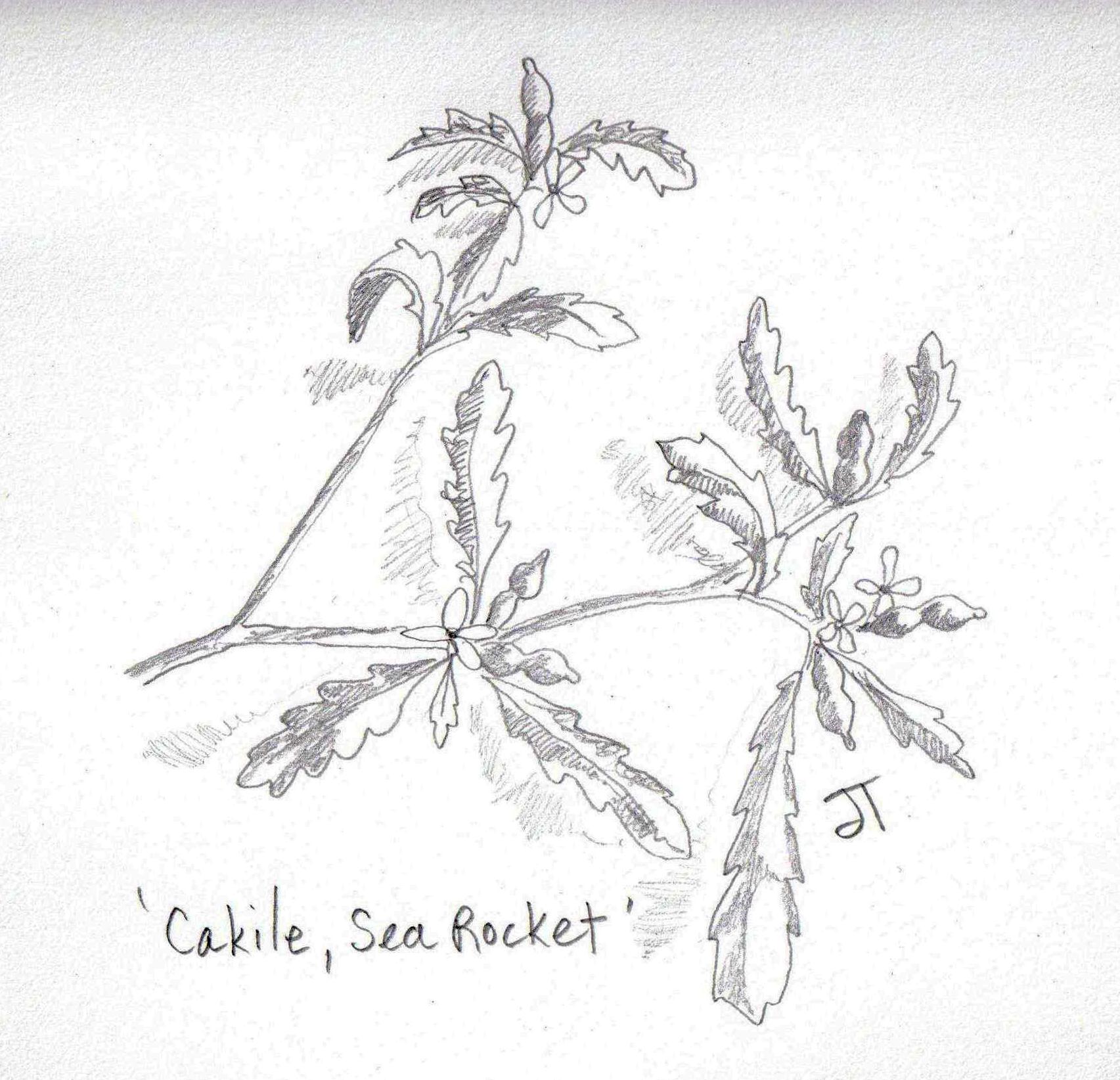
Sea-rocket (Cakile edentula Hook.)
Sea-rocket, also known as Seaside Mustard and caquillier in French, is found on sandy or gravelly beaches along the coast.
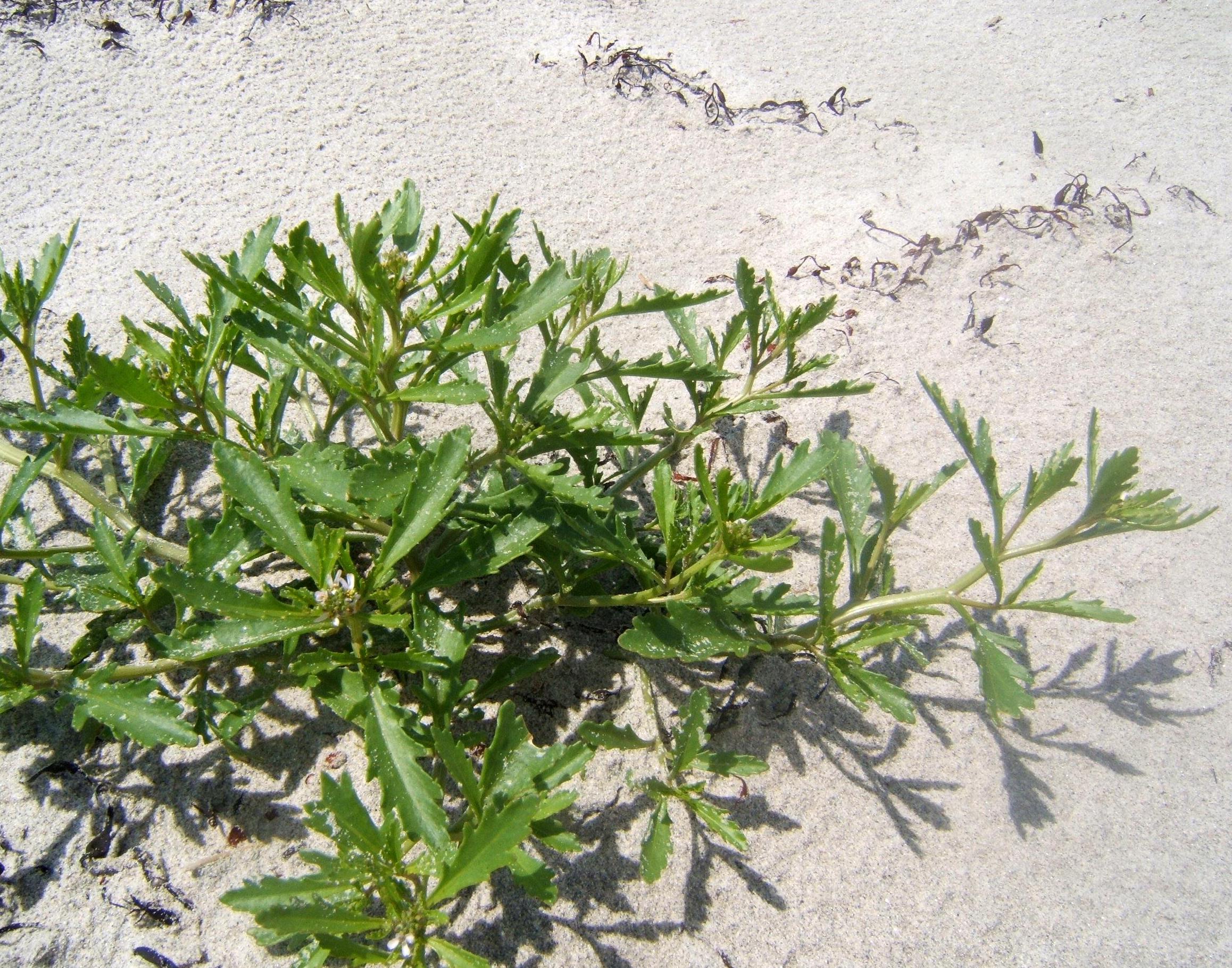
Cakile is a sprawling plant with succulent, branched stems. The leaves are thick and fleshy, with blunt-toothed margins. The four-petalled flowers are small, purple and located at the tip of the stem.
The name Sea-rocket comes from the distinctive shape of the seed pods. These have a narrow base and a pear-shaped tip, like a rocket. Cakile is an old Arabic name and edentula means ‘without teeth’.
Sea-rocket is edible. It has a hot, pungent taste, similar to radish. The stems, leaves and pods can be added to salads or boiled for 5 to 10 minutes to give a milder taste.
~
~
Cakile wind
~
the beach sizzles today
the breeze a peppered wind
the sand Cakile-hot
~
wind scours the shore-bands
of seaweed – rockweed, kelp
bleaches them, crisped and dry
~
sand dries, adheres to skin
brushes away, a rub
a sandpaper polish
~
the tongue too hot for words
the seas too salt for tears
tans ruined, scorched and red
~
~
© Jane Tims 2012
~
Warning:
1. never eat any plant if you are not absolutely certain of the identification; 2. never eat any plant if you have personal sensitivities, including allergies, to certain plants or their derivatives; 3. never eat any plant unless you have checked several sources to verify the edibility of the plant.Silvery Cinquefoil (Potentilla argentea L.)
Last month, whenever I went to get the mail, I was waylaid by a little plant sprawling next to the row of boxes. He was so charming, once I forgot to get my mail because I was examining his flowers and leaves! There should be a sign saying ‘No Loitering’.
The plant was Silvery Cinquefoil (Potentilla argentea L.). As its name suggests, Silvery Cinquefoil is covered with fine silver hairs, giving it a downy appearance. It has fine-toothed, five-fingered leaves, palmately compound, and five-petalled yellow flowers.
I have always liked the various species of Potentilla, interesting for the variety of their leaves. You can see how diverse these shapes are in a page from Roland and Smth’s Flora of Nova Scotia. The reddish pressed leaf in the scanned book, for example, is Silverweed (Potentilla Anserina L.). My post for July 13, 2012, ‘coastal barren, coastal bog’, shows the Three-toothed Cinquefoil (Potentilla tridentata Ait.) https://nichepoetryandprose.wordpress.com/2012/07/13/coastal-barren-coastal-bog/ .
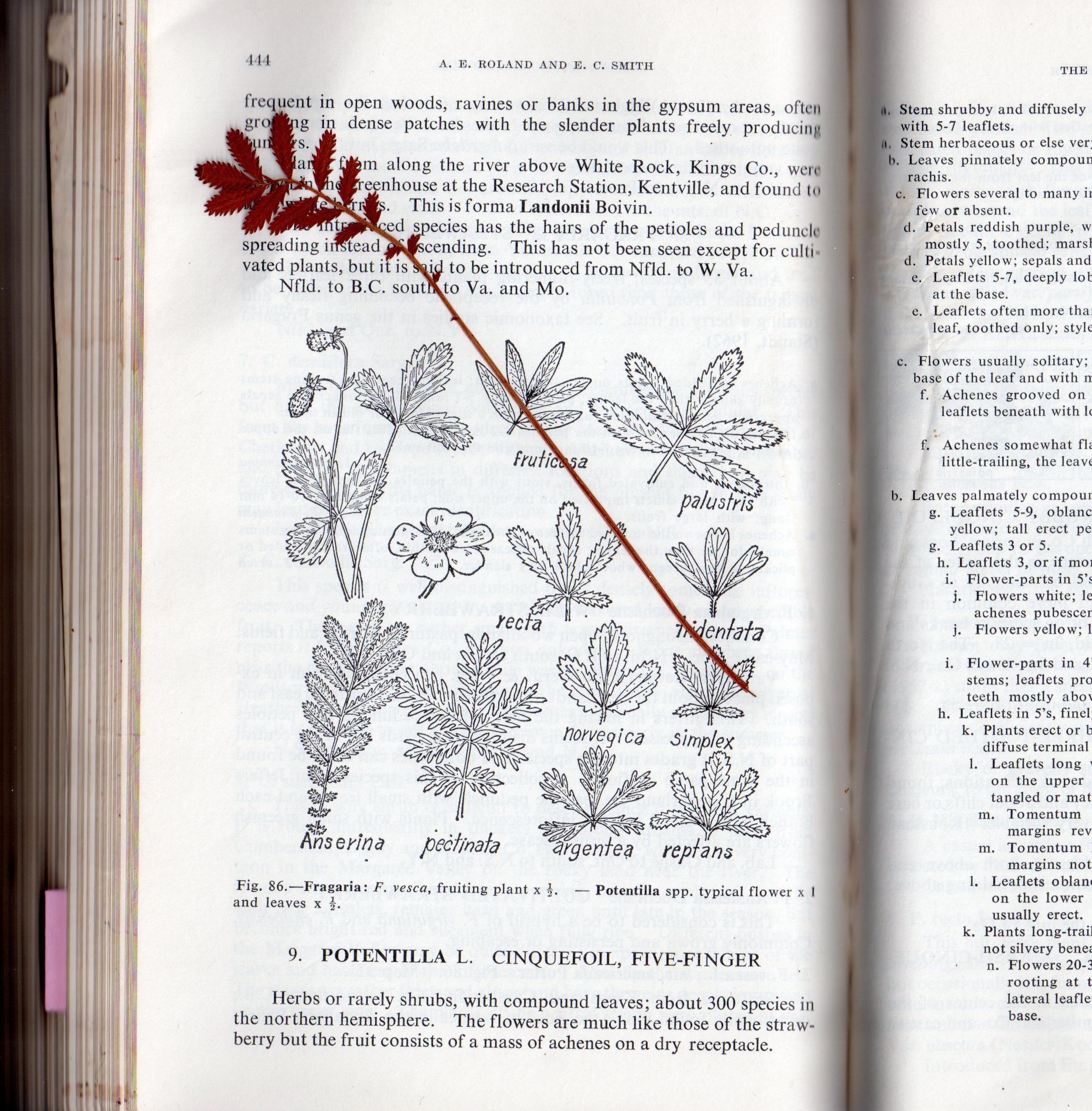
various leaf shapes of Potentilla in a page of The Flora of Nova Scotia (A.E. Roland and E.C. Smith, Nova Scotia Museum, Halifax, 1969) … the pressed leaf is from Potentilla Anserina or Silverweed, a coastal species of Potentilla.
~
~
Five-Finger
~
metal leaf and yellow,
he leans on the post-box
palms extended
potent, persuasive
a bit of a thug
want your mail?
pay me,
in silver
~
~
© Jane Tims 2012




 nichepoetryandprose