Posts Tagged ‘pencil drawing’
early schools – school gardens
It’s gardening time in New Brunswick. While I tend my little tomato plants, I wonder if one room schools in the early 1900s kept school gardens.
~

Was there once a school garden in the yard of this one room school near Gagetown, New Brunswick?
~
In the province of Nova Scotia, some schools had gardens. My aunt, Dr. Jane Norman, in her history of Nova Scotia’s schools, tells about the Travelling Teachers program and the ‘Garden Score Card’ (Jane Norman, Loran Arthur DeWolfe and The Reform of Education in Nova Scotia 1891-1959. Truro, Nova Scotia: Atlantic Early Learning Productions, 1989). The Travelling Teachers operated from 1918-1920, bringing knowledge and help to schools in their districts about rural science, including home-making, healthy living and gardening.
~
In 1918-19, to encourage gardening as part of the school program, the Rural Science Department of the Nova Scotia Normal College (where teachers were trained) donated $10.00 to each Travelling Teachers’ school district. School children and schools who obtained the highest scores on the ‘Garden Score Card’ shared the money as follows:
- three school children with the highest scores won prizes of $2.50, $1.50 and $1.00
- three schools with the highest scores won prizes of $2.50, $1.50 and $1.00
~
The ‘Garden Score Card’ rated the school gardens and the efforts of the children with the following criteria:
- Condition of Garden:
- Planting and arrangement of plants (5)
- Thinning, training, regularity in row (5)
- Cultivation and freedom from weeds (10)
- Freedom from diseases and insect pests (10)
- General neatness of paths, labels, stakes, etc. (5)
- Consideration of adverse conditions, if any (5)
- Range of variety in flowers and vegetables (10)
- Amount and quality of bloom (flowers) and crop (vegetables) (15)
- Amount and value of canning or sales (20)
- Showing made at exhibition (15) Total Points (100)
~
The school children in my drawing are working hard, but based on the ‘Garden Score Card’, they would not have received a prize for their gardening! No stakes, no labels, no regularity in the row.
~

~
How would your gardening efforts be scored??? I would not make good marks on any criterion!
~
Copyright Jane Tims 2016
early schooling – apple trees for climbing

~
When I find an old one room school still standing, there are often apple trees in the yard. I realise these trees may not have existed a century ago, but it makes me think how important trees are to kids. I can imagine, if there was an apple tree or an orchard near the school yard, it would have been a favorite place for the students to play at recess and lunch-time.
~
Apple trees were made for climbing. And for hanging swings. Perhaps for carving initials. Or shaking loose blossom petals on friends standing beneath the tree.
~
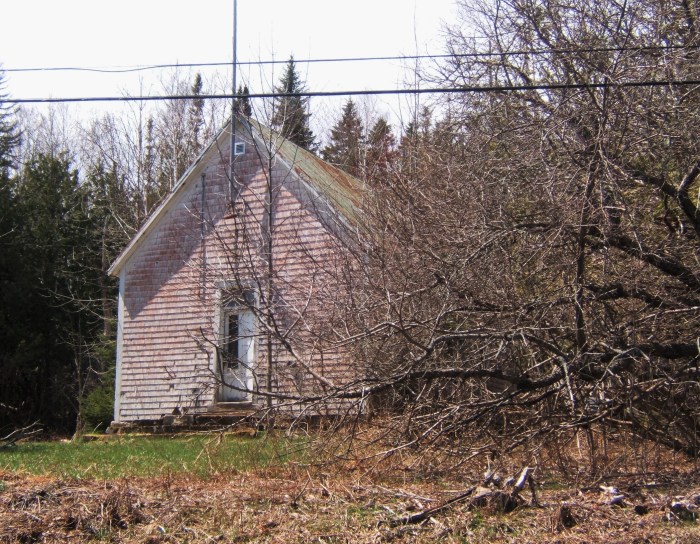
Lower Queensbury School, York County, New Brunswick
~
I grew up in a city in the 1960s when authorities considered concrete the best play surface for a school yard. Run and risk a skinned knee. There were monkey bars for climbing, but I find myself wishing my school yard memories included an apple tree with a big horizontal limb.
~

~
Did you have trees to play on where you went to school?
~
Copyright Jane Tims 2016
early schooling – finding the one room schools
I am continuing to find interesting information in the Annual Report of the Schools of New Brunswick 1888 (Fredericton, 1889). This report includes information on the number of one room school houses in the late 1800s. Although the numbers are for all schools, you can see, by comparing the numbers of teachers to the numbers of schools, most schools had only one room.
~
Statistics on Schools in Four Counties of New Brunswick as of December 31, 1887
| County | Number of Schools | Number of Teachers | Number of Students | Number of Boys | Number of Girls |
| York | 167 | 178 | 5558 | 2811 | 2746 |
| Sunbury | 46 | 48 | 1050 | 553 | 497 |
| Queens | 85 | 87 | 2196 | 1088 | 1108 |
| Kings | 155 | 161 | 4552 | 2303 | 2249 |
| All Counties | 1542 | 1613 | 55492 | 27888 | 27604 |
~
One of the things I want to do in my new project is visit a number of the schools still standing in four counties in the lower Saint John River watershed (Kings, Queens, Sunbury and York Counties). I’ll also visit some locations where schools once stood but are now gone.
~
Finding these schools by driving the roads is a rather inefficient approach. So how do I find the whereabouts of over 400 one room schools? To start, the location of every school in Kings County in 1862 is known from the Walling Map. For more information on this map, see http://www.rubycusack.com/issue34.html
~
I have also found a valuable resource in a book I found for sale at Amazon.com : Diana Moore and Andrea Schwenke. New Brunswick Schools: A Guide to Archival Sources. Acadiensis Press: Fredericton, 1992. The Guide provides information on where to find various sources for early schooling in New Brunswick. I will be consulting some of these:
- a scrapbook by Marion Johnston Dunphy who photographed 150 schools from 1974 to 1984 (The One Room Schools of New Brunswick and What Became of Them).
- a list of one room schools in Kings County in 1983 prepared by The Kings County Retired Teachers Association
- old school records in the Provincial Archives and the Archives of the Saint John Museum
- diaries of people who taught school, for example C. Gordon Lawrence (Tracy School, Sunbury County, 1903 – 1962)
- various exercise books, workbooks and school registers from the 1800s
~
~
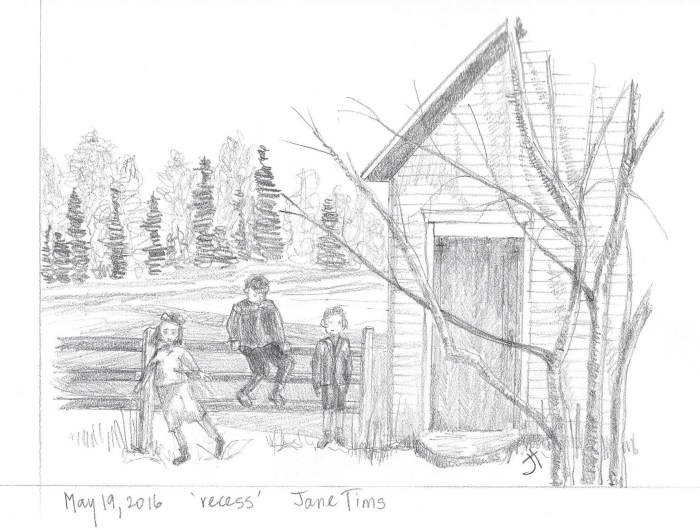
The first of many drawings about days at the one room school. I think I should take a course on drawing people. They look a little bored.
~
Copyright Jane Tims 2016
‘within easy reach’ … a poetry book about wild edibles and local foods
all about my new book:
within easy reach by Jane Spavold Tims
(with a foreword by Freeman Patterson)
Chapel Street Editions, Woodstock
May 2016
~

~
includes poems and pencil drawings about
eating local foods and gathering wild edible plants
~
~
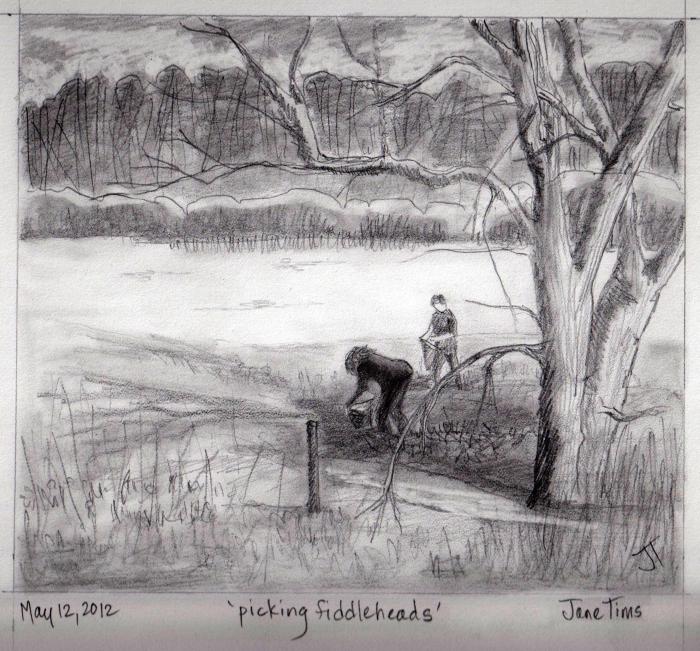
poetry about picking berries, gathering herbs and roots, gardening, fishing
local markets, beekeeping and salad greens
explores how easy it is to bring local foods into your diet
and
considers the barriers to eating local and gathering wild foods
explores abandoned gardens
poisonous berries and berries in bottles
includes poems about our history of eating wild foods
and about New Brunswick’s special local foods:
maple syrup and fiddleheads
coastal plants like goosetongue greens and samphire
land-locked salmon
notes on each plant – characteristics and uses
seventeen pencil drawings
~
~
this book will remind you of your own experiences picking berries
a tribute to every age of our lives – dancing in the school gym and picking berries with arthritic hands
it will recall the habits of your ancestors
a beautiful book – rests open in your hands as you read
a font so easy on the eyes
I hope you will love within easy reach
~
Jane Tims
2016
~
songs in the grey woods – ovenbird
He can be a bit monotonous. A bit of a scold. He reminds me of a rusty hinge. He says teacher-teacher-teacher, repeating his song through the woodland. He is the Ovenbird.
~
His scientific name is Seiurus aurocapilla. Seiurus (which I remember as ‘serious’) is from the Greek meaning ‘tail shake’, a reference to the characteristic upward flip of his tail. The name aurocapilla means golden-haired referring to his crest of orangy feathers. The Ovenbird is olive-brown, with a streaked white breast. He has a white ring around his eye, a white throat and a dark line below his cheek. He looks a bit like a thrush, but is a large warbler.
~
His serious nature and his call of ‘teacher, teacher, teacher’ make me think I’ll include a poem about his ways in my project about one room school houses in New Brunswick. This is how my poems usually begin, with a whisper from nature.
~

~
Copyright 2016 Jane Tims
songs in the grey woods – black-throated green
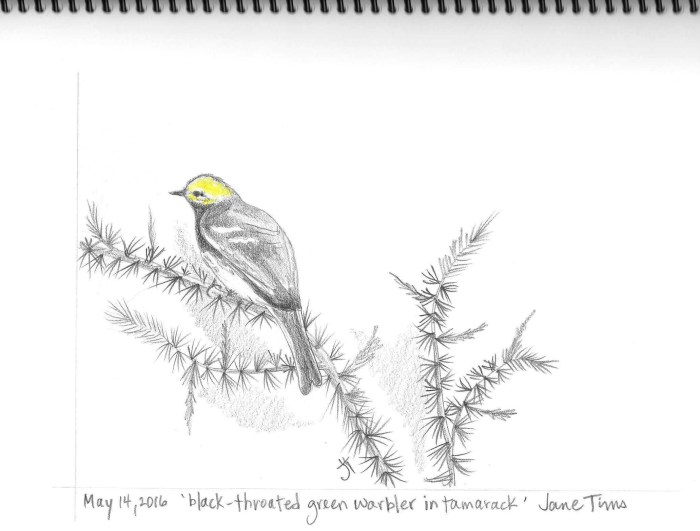
Our grey woods are noisy this week. White-throated sparrows, nuthatches, ovenbirds and chickadees. Loudest of all is a black-throated green warbler. He says, in his raspy voice, at intervals of about ten seconds: zee-zee-zee-zee- whee-zee, also a more musical dee-dee, dee-dee, doo-dee (the doo a note lower than the dee). He perches near the tops of the tamarack and red maple trees.
~
~
I sat on our deck a long while, and finally caught him as he paused in a red maple. He had a bright yellow head and looked back at me over his white wing stripe before he flew away. I also get an occasional glimpse of him as he flies from tree to tree. His best features are his yellow head, the two white stripes on each wing, and his black throat.
~

~
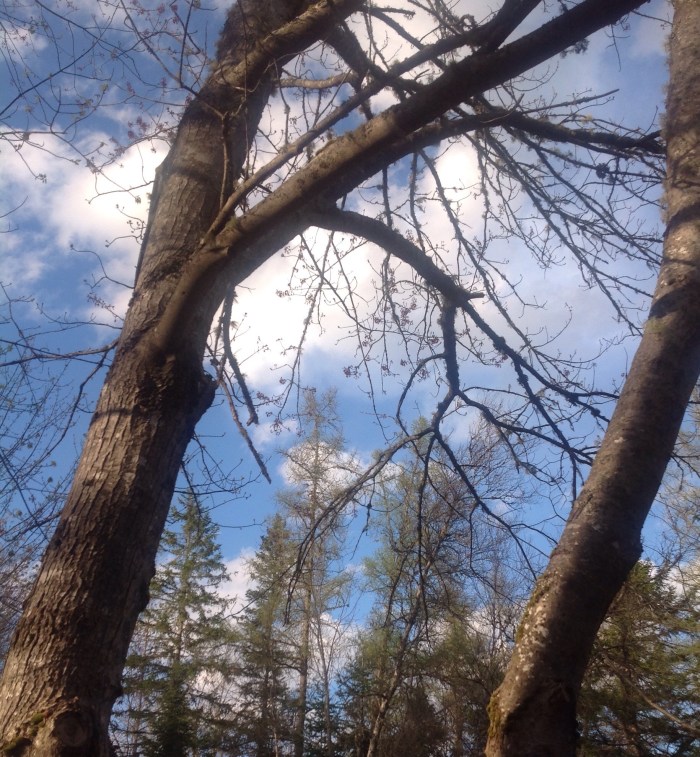
a view of the tamarack trees and spruce where the black-throated green warbler is singing – the red maple is just starting to leaf-out
~
Copyright Jane Tims 2016
a drawing of a covered bridge
Another drawing for my manuscript ‘in the shelter of the covered bridge’: Hammond River #2 French Village Covered Bridge

~
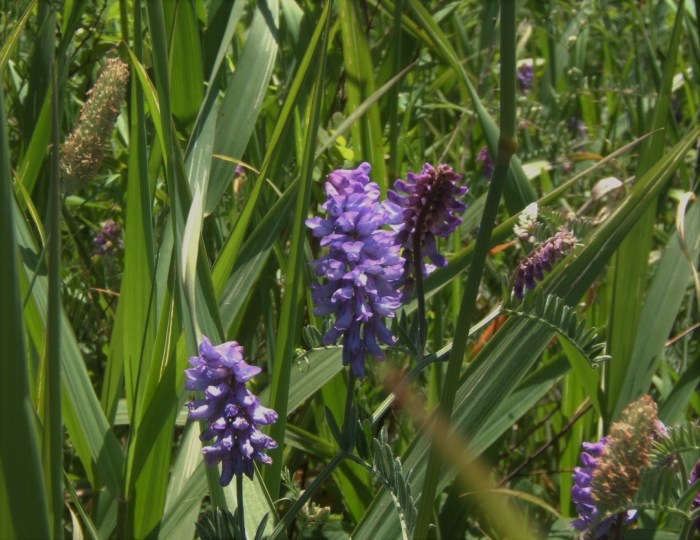
Cow vetch and Timothy at the entry to the covered bridge:
~
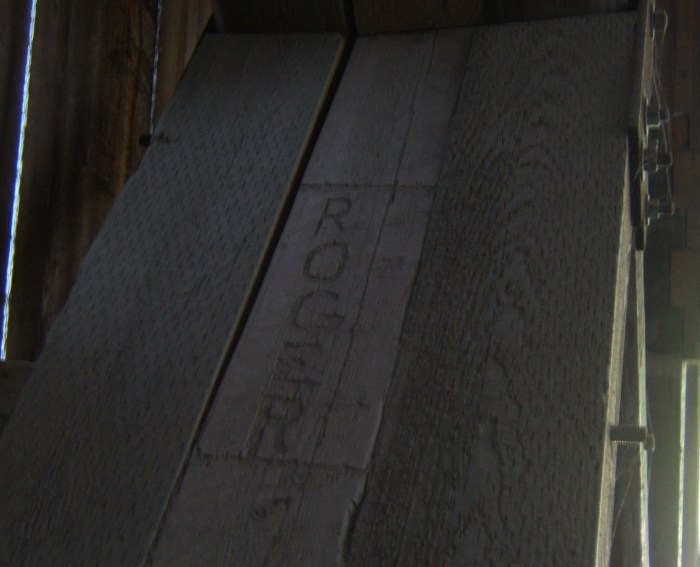
Who were ‘B’ and ‘E’? Who was ‘Roger’?

~
~

Hammond River #2 – packed in green
~
Copyright 2016 Jane Tims
old schools in the landscape
In my last few posts, I have focussed on my research toward a new poetry project I will be beginning. I know there are interesting stories to be told about the ‘inside’ of the one room school. Because of my interests in botany and community history, I would like to reflect on the ‘outside’ of the one room school – its surroundings and geographic location.
~
I still have to do some thinking about this project. I know that people who attended one room schools will have stories to tell about how the local terrain and landscape influenced their schooling.
~
A school’s surroundings would have impacted learning in many ways. For example, the view of a lake from the school window may have caused many a pupil to settle into daydreams. Interesting fields, hills, and watercourses would provide the teacher with opportunities for nature study.
~
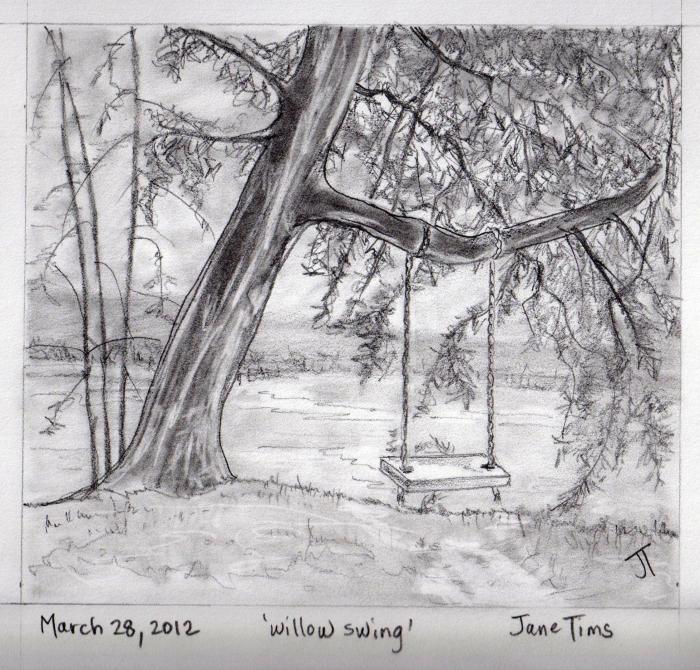
The location of the school would also influence recess and lunch-time activities. My Dad wrote about damming a local stream so they could skate in the winter months. The same stream meant fishing in May and June. A nearby hillside would be great for sledding in January and February. Trees in the school yard? – A place to climb or to hang a swing.
~
~
Students walked to school before the 1950s. The study I made of schools in Upham Parish, New Brunswick suggests that students walked as many as three miles to school in the late 1800s. Hills made the long walk to school more difficult. The winds by a lake or other shore land would be bitter on a winter day. Rivers, lakes and wetlands meant a place to hunt tadpoles. A spring by the road? – A cool drink. My Uncle, forced to wear a hat/scarf he hated, used the bridge on the way to school as a place to hide his headgear!
~
One room schools were located near clusters of houses and various community activities. The walk to school may have passed a church, a post office or a community store. Hardwood forests meant lumber mills and, in spring, maple syrup and the sugar shack. Good land meant farms; grazing land meant cows to outstare.
~
On a drive last weekend, we found an older building along the Saint John River that may have been a school. The Upper Queensbury Community Hall has all the characteristics of a one room school – the steep roof, rectangular footprint, and tall side windows.
~
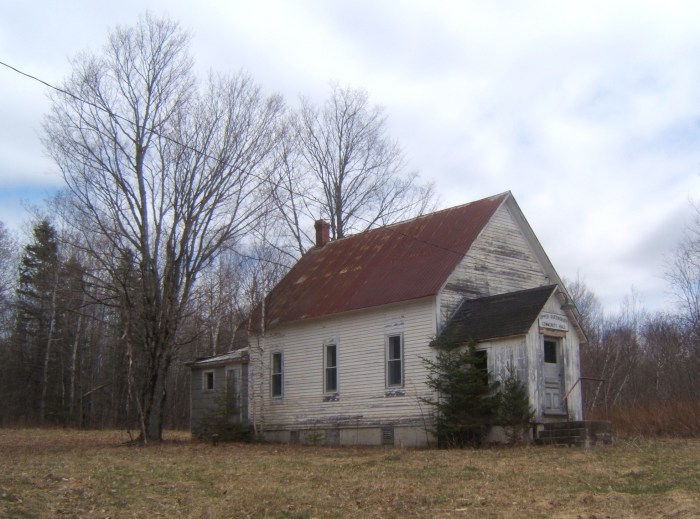
Upper Queensbury Community Hall near Nackawic, New Brunswick. I will have to make some inquiries to find out if it was a school house at one time.
~
A look at a map shows some of the landscape features in the area.
~

Map showing landscape features of part of Queensbury Parish, near Nackawic, New Brunswick. The yellow dot is the location of the Upper Queensbury Community Hall which may have been a one room school.
~
The Saint John River was nearby, although further than it is today since the Mactaquac Dam (built in 1968) has raised the level of the water. The river’s possibilities for fishing, skating and boating were only a downhill trek away. The terrain is gently undulating, as the names of nearby communities (Day Hill and Granite Hill) suggest. Local geographic points the community children may have known include the many-tiered Coac Falls and Coac Lake (an old road runs past the community hall back through the woods to the lake, about a mile away). The aerial photo (taken near the end of September) shows the red of the cranberry bog – picking cranberries may have been a well-known activity. Sugar maples are common in the area, as are old ‘sugar shacks’. When I interview people who went to the one room school I will have to remember to ask them about their memories of these places.
~
Writing poetry about these ideas will be so much fun!
~
~
Copyright 2016 Jane Tims
my poetry book – within easy reach
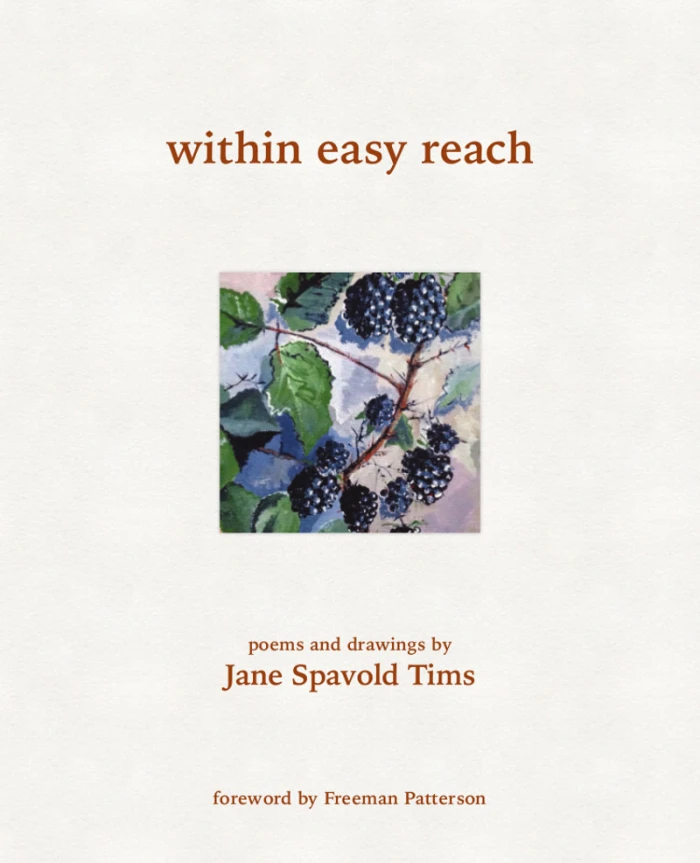
My new book, within easy reach, is now available.
~
I would like to thank you, the readers of my blog (and my Facebook and Twitter friends), for all your interest and support since I began my blog in 2012! The blog has helped me along the way, developing ideas for my projects, giving me a place to try my poems on a reading audience and giving me a chance to read some beautiful poetry on the blogs I follow. I also love your ‘likes’ and comments.
~
I hope you will buy my book and enjoy reading my poems and seeing my drawings.
~
For the readers of my Blog, I am offering a chance to win the painting on the book’s cover! My painting ‘brambles’ is painted in acrylics, size 10″ by 10″, with gallery edges. The painting is from a photograph of the blackberries growing on our lake property, the berries featured in the poem ‘berries in brambles’, one of the poems in the book.
~
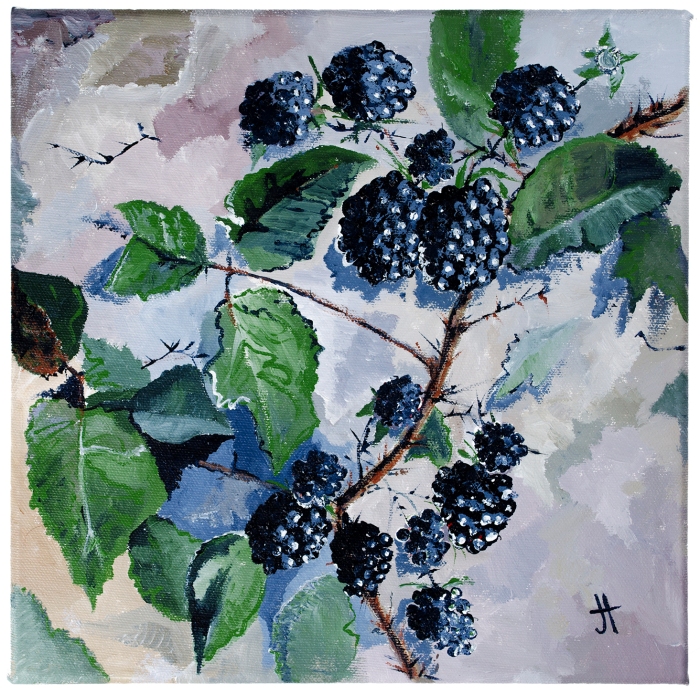
February 29, 2016 ‘brambles’ by Jane Tims
~
To win this painting, you have to do three things.
- Purchase my book through my publisher’s website (www.chapelstreeteditions.com)
- Leave a comment on any of my Blogs (www.nichepoetryandprose.wordpress.com or www.janetims.com or www.janetimsdotcom.wordpress.com) with the words ‘within easy reach’ somewhere in the comment
- Be prepared to send me, via email, a scan of your purchase receipt
~
Your name will be entered once for each book purchased. The contest will run for the first five weeks following the publication date of within easy reach (until June 7, 2016). At the end of the contest, anyone who has purchased a book from the publisher and left the comment as described above will be entered for the draw. I will notify the winner and let the readers of the blog know who has won.
~
I hope you will enjoy my book. And some reader will be the winner of the painting ‘brambles’!
~
Copyright Jane Tims 2016
early schooling in New Brunswick and Nova Scotia – including nature study
Of all the classes given in 1888 in New Brunswick, I would have liked ‘Useful Knowledge’ the best. This is where I might have learned about birds and plants and butterflies.
~
Bringing ‘Useful Knowledge’ into the classroom may have been a greater challenge than it appears. The focus was on the three R’s (reading,’riting, and ‘rithmetic) and scarce resources meant less time for ‘frivolous’ subjects. In the neighboring province of Nova Scotia, educators faced a challenge when they tried to bring studies about the out-of-doors into the classroom. The situation in New Brunswick would have been similar.
~
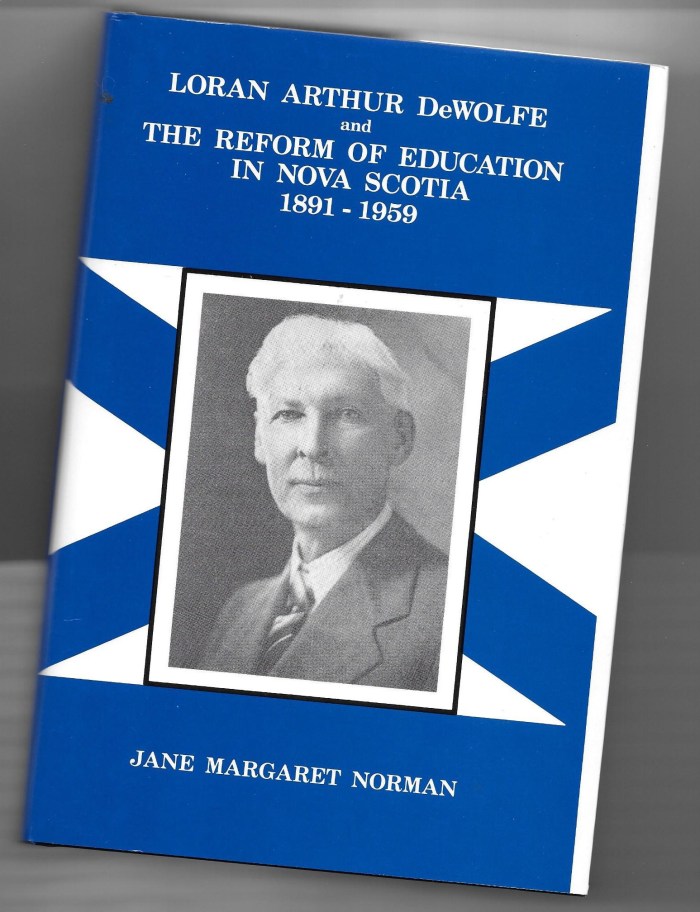
In her book Loran Arthur DeWolfe and The Reform of Education in Nova Scotia 1891-1959 (Truro, Nova Scotia: Atlantic Early Learning Productions, 1989), my aunt, Dr. Jane Margaret Norman described the situation in the late 1800s and early 1900s in Nova Scotia. Dr. DeWolfe, Director of Rural Science Schools in Nova Scotia from 1913 to 1924, focused on including studies of nature and in particular agriculture in the schools. These were times of rural out-migration – interest in staying and working on the family farm paled in comparison to the adventures promised by leaving for the west. Dr. DeWolfe was convinced that the only way to keep people in rural areas was to interest them, from the start of their education, in the world of nature.
~
~
His solution was to include in the curriculum ‘field days’, ‘spring gardens’, folk dancing, lessons in canning food, ‘Planting Days’, and school fairs. My dad, who would have attended elementary school in the late 1920s, remembered Dr. DeWolfe visiting his school in rural Digby County. He told my aunt that Dr. DeWolfe “… always had something to say about nature.”
~
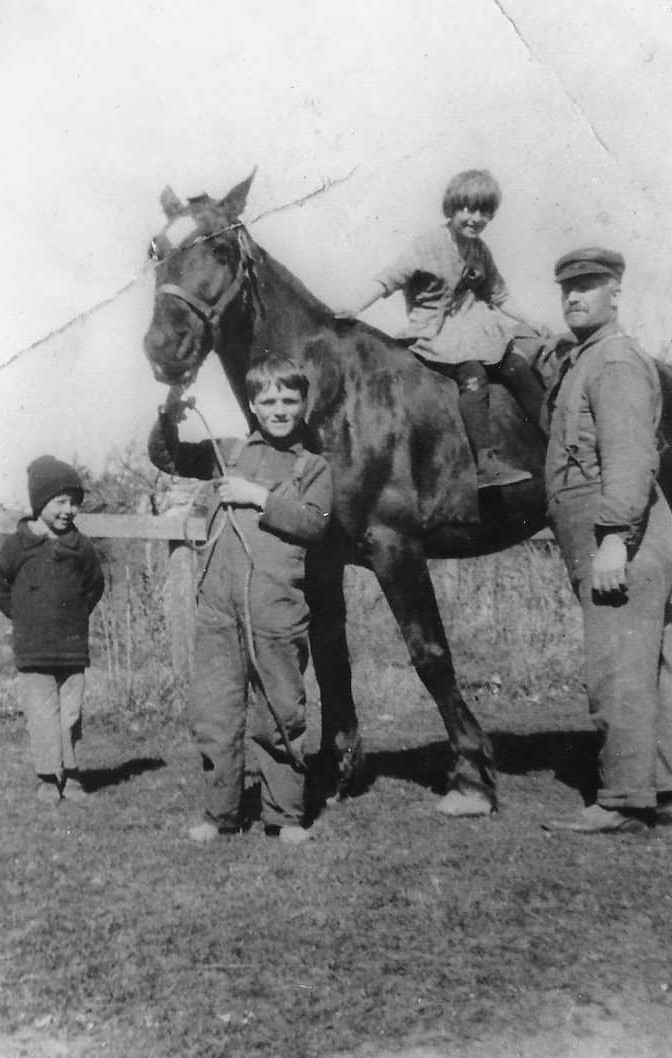
My dad as a boy (holding the horse Goldie). Dad grew up in a rural area and attended a one room school. He remembered Dr. DeWolfe’s visits to that school and his emphasis on paying attention to the out-of-doors. Dad became a teacher and, as my teacher in Grade Six, taught me about the solar system and the cause of our seasons. He also taught me how to make a whistle from a willow twig.
~
In New Brunswick, by 1888, ‘Useful Knowledge’ would have introduced many students in New Brunswick to nature studies. In rural schools (Ungraded Schools in Country Districts), the classes in Standard I (Grade 1) included ‘oral lessons on animals’ and, in Standard II (Grade 2) ‘natural specimens where possible’. Standard III (Grade 3) included ‘lessons on agricultural products of the district’, and Standard IV (Grade 4) studied ‘agricultural topics’ from Tanner’s First Principles of Agriculture. In addition to Tanner’s First Principles of Agriculture, Standards V and VI (Grades 5 and 6) used Bailey’s Natural History. Liberty Hyde Bailey (1858-1954) was a horticulturist, naturalist and advocate of nature study.
~
” … Stuffed birds do not sing and empty eggs do not hatch. Then let us go to the fields and watch the birds. Sit down on the soft grass and try to make out what the robin is doing on yonder fence or why the wren is bursting with song in the thicket. An opera-glass or spy-glass will bring them close to you. Try to find out not only what the colors and shapes and sizes are, but what their habits are … ” from the Birds and I , Liberty Hyde Bailey. http://libertyhydebaileyblog.blogspot.ca/
~
~
Copyright 2016 Jane Tims




 nichepoetryandprose