Posts Tagged ‘nature’
Mourning dove
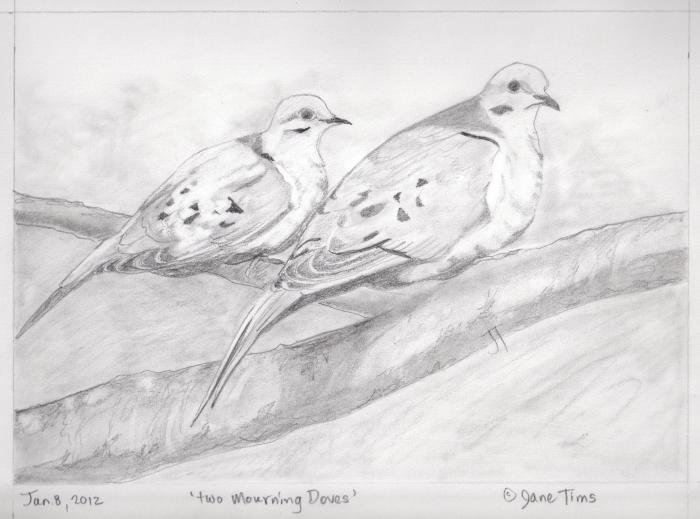
I woke this morning to another new bird in the mix of the morning bird chorus — a Mourning dove. In this area, the Mourning dove is a common bird, seen pecking at seeds beneath feeders or hanging out on the telephone lines. But I haven’t heard one in our grey woods for a while.
~
~
The call of the Mourning dove gives it its name. It begins with a low question and continues in a descending series of coos.
Oh no, no, no, no, no
Dear me, me, me, me, me, me
I decided to try and capture this sound in words.
~
Mourning
Melancholy
Monotonous
Sad
Solemn
Hollow, mellow
A reed, the inside walls of a bottle
An emerald bottle, buried to its neck in the sand
Breath across the mouth of a bottle
A child’s feeble attempt at a whistle
Light and shadow inside a vessel of glass
~
If the call of a mourning dove were a colour it would be amethyst
If the call of a mourning dove were a sound it would be wind blowing down the stairway of a tower
If the call of a mourning dove were a taste it would be chowder, thick and left too long on the fire
If the call of a mourning dove were a touch it would be a wooden shawl, wrapped round and round until it was no longer warm but strangling
If the call of a mourning dove were a song it would be hesitant, riff-driven, repeated over and over
If the call of a mourning dove were a smell it would be the cloying perfume of lilac
~
If it was a vowel, it would be ‘o’ or ‘u’ and sometimes ‘y’
If it was a consonant, it would be ‘m’, ‘n’, ‘r’, or ‘w’
~
Heavy or light
Loud or soft
Tall or short
Sad or happy
Bright or dull
Sharp or dull
Nearby or distant
Solemn or joyous
Spacious or confined
~
So, from all this, a poem. This is the second draft of a poem about the mourning dove which never mentions the bird except in the title.
~
Mourning dove
~
Zenaida macroura
~
wind wakens, descends the stair
notices shadow, gaps in cladding
the hollow of the tower, breath
across the mouth of a bottle
amethyst, buried in sand
~
the reed widened, a solemn song
the riff, the echo, a distant train
expands across the valley
and a child hollows her hand
shapes her lips for a kiss
~
tries to whistle, her breath
a sigh, a puff to cool
the chowder, still simmers
on the fire, thick
and needing stirring
~
potatoes, corn and onions
curdled cream, a woollen shawl wrapped
round and round, warmth tightened
to struggle, viscous as lilac
unable to breathe
~
~
For other posts and poems about the Mourning dove, see https://janetims.com/2012/01/16/keeping-warm/ and https://janetims.com/2015/01/30/for-the-birds/
~
Copyright 2016 Jane Tims
Arbour Day in New Brunswick – 1888
In a previous post, I wrote about the importance of trees in the school yard and the celebration of Arbour Day in schools in Nova Scotia during the early 1900s. One room schools in New Brunswick also celebrated Arbour Day.
~
The 1888 Annual Report of the Schools of New Brunswick, by the Chief Superintendent of Education, reports on 1888 Arbour Day celebrations in New Brunswick, years before the first official Arbour Day in Ontario, Canada (1906). The purpose of Arbour Day celebrations in the school was:
~
to encourage the improvement and ornamentation of school grounds and thereby of cultivating on the part of pupils habits of neatness and order, and a taste for the beautiful in nature …
~
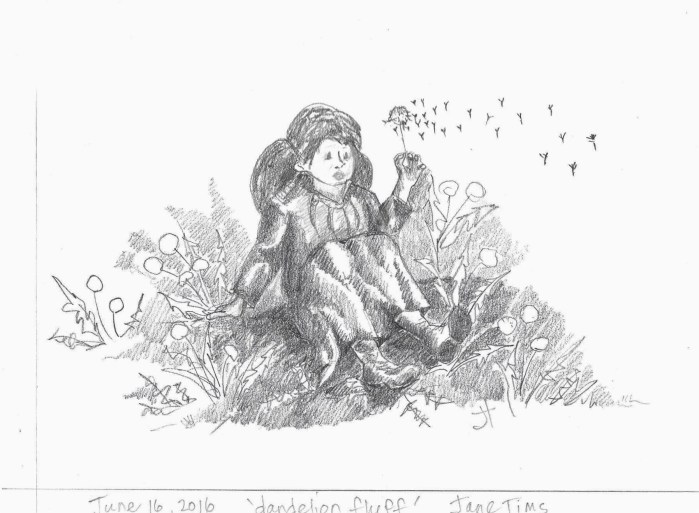
In 1888 New Brunswick schools celebrated Arbour Day on May 18. In the whole province, students planted 6,571 trees, 650 shrubs and 393 flower beds!
~
~
Copyright Jane Tims 2016
early schools – Arbour Day
Trees in the school yard, especially big trees suitable for climbing and swinging, would have been an appreciated feature of the school landscape. On a hot June day, students would have enjoyed the shade under a big tree.
~
In the 1940s and 50s, some of these trees may have been planted sixty years before by students learning about abouriculture. By the early 1900s, there were Arbour Day celebrations in Canada when students planted trees at school and elsewhere in the community. The first official Arbour Day in Canada was established in 1906 by Don Clark of Schomberg, Ontario to remember his wife Margaret.
~
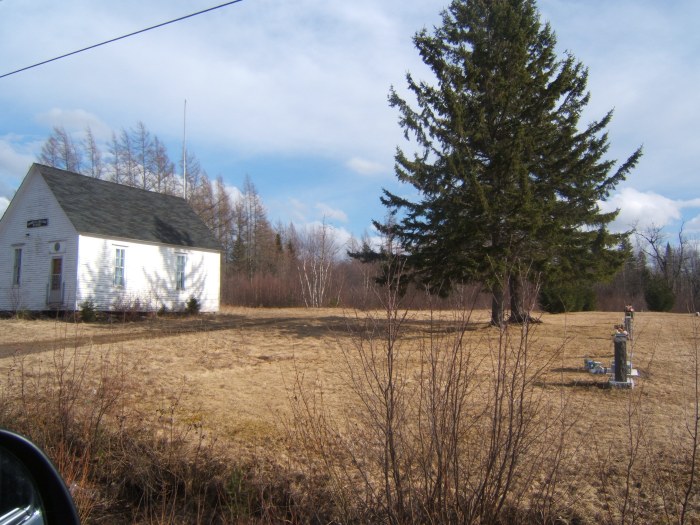
big spruce trees in the yard of the Cumberland Bay School, New Brunswick
~
In Nova Scotia, schools celebrated Arbour Day by 1929 and perhaps before. In May and June that year, officials organized the planting of trees and shrubs in the school yard and involved community members and local dignitaries in the events to encourage their interest in the school system. In 1928, the newspaper Halifax Harald offered, province-wide, a $700 prize for school beautification, which would have included the planting of trees (Jane Norman, Loran Arthur DeWolfe and The Reform of Education in Nova Scotia 1891-1959. Truro, Nova Scotia: Atlantic Early Learning Productions, 1989).
~
The idea of planting trees in school yards continues to this day. Trees are important because they:
- clean our air of pollutants
- remove carbon dioxide, to reduce the contribution to global warming
- prevent soil erosion
- trap water pollutants by directing flow downward
- provide habitat for birds, bees and squirrels
- raise property values
- provide the oxygen we breathe
- provide shade
- make great places for climbing and swinging
~

~
~
Copyright Jane Tims 2016
early schools – the rope swing
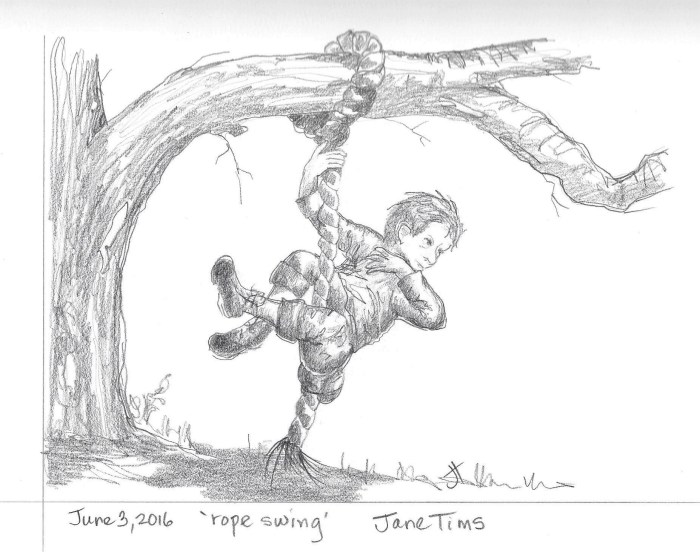
Students in the one room school may have appreciated apple trees growing in the school yard. But there would have been other trees too. A hefty old red maple would have been a good place for a swing. Perhaps a simple rope swing, with a loop over a horizontal tree branch and a big old knot at the end for sitting.
~
~
rope swing
~
lunch hour
best spent
upside down
~
legs wrapped
tight as twist
of hemp
~
splayed ends
of the big knot
trail on the ground
follow hair and
dragging fingers
~
world tipsy-turned
maple branch – a bridge across the sky
other kids stand on their heads
school house and outhouse
hang from the hill
~
~
Copyright 2016 Jane Tims
songs in the grey woods – northern parula
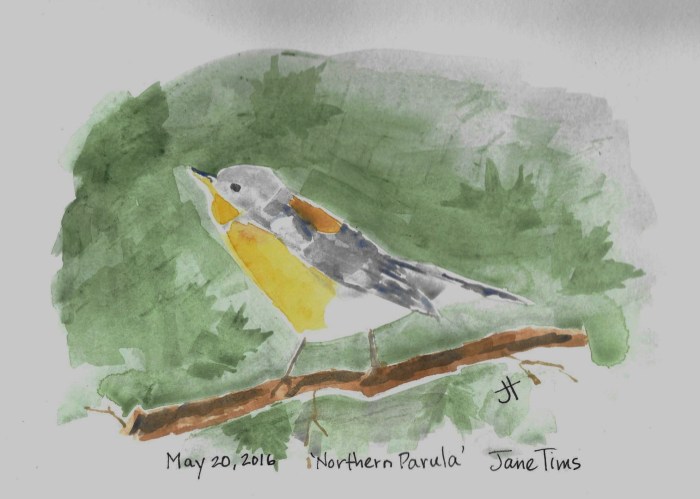
A friend, a knowledgeable wetland biologist, has been helping me learn some new bird songs. Last week, I identified the song of the Northern Parula. This is a bird I have never seen, though I scan those tree tops with the binoculars until my arms ache. I have heard its song so many times and always wondered what it was. The song is a long whirrrrr, flowed by a short, upward flip. Whirrrr -flip. Whirrrr- flip. This morning it was the first song of the morning bird chorus!
~
~
It drives me crazy to hear him sing, be able to find the tree he is perched in, but not see him. My painting is how I think he must look, based on descriptions on the net.
The Parula is a blue-grey bird with a yellow throat, and a yellow and white breast. He has a white crescent above and below his eye and two white wing bars. A bright and beautiful bird! He has an association with a lichen I love, Usnea subfloridana, Old Man’s Beard. He uses the lichen to build his hanging nest.
~

Usnea subfloridana on the snow – usually found hanging in our maple, spruce and fir trees
~
Copyright 2016 Jane Tims
songs in the grey woods – black-throated green
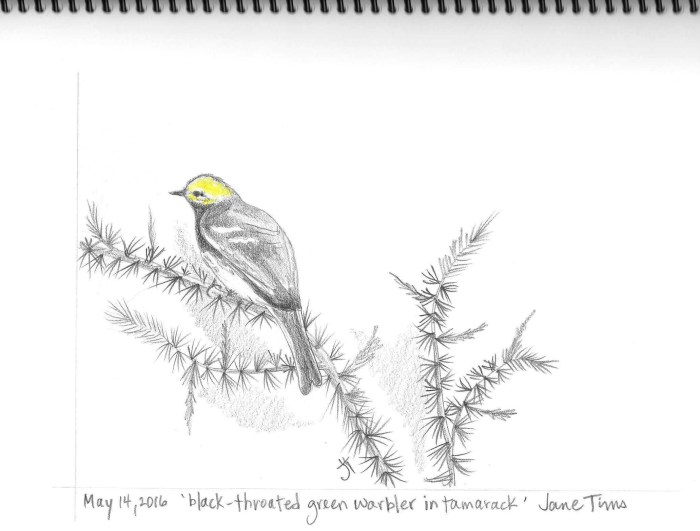
Our grey woods are noisy this week. White-throated sparrows, nuthatches, ovenbirds and chickadees. Loudest of all is a black-throated green warbler. He says, in his raspy voice, at intervals of about ten seconds: zee-zee-zee-zee- whee-zee, also a more musical dee-dee, dee-dee, doo-dee (the doo a note lower than the dee). He perches near the tops of the tamarack and red maple trees.
~
~
I sat on our deck a long while, and finally caught him as he paused in a red maple. He had a bright yellow head and looked back at me over his white wing stripe before he flew away. I also get an occasional glimpse of him as he flies from tree to tree. His best features are his yellow head, the two white stripes on each wing, and his black throat.
~

~
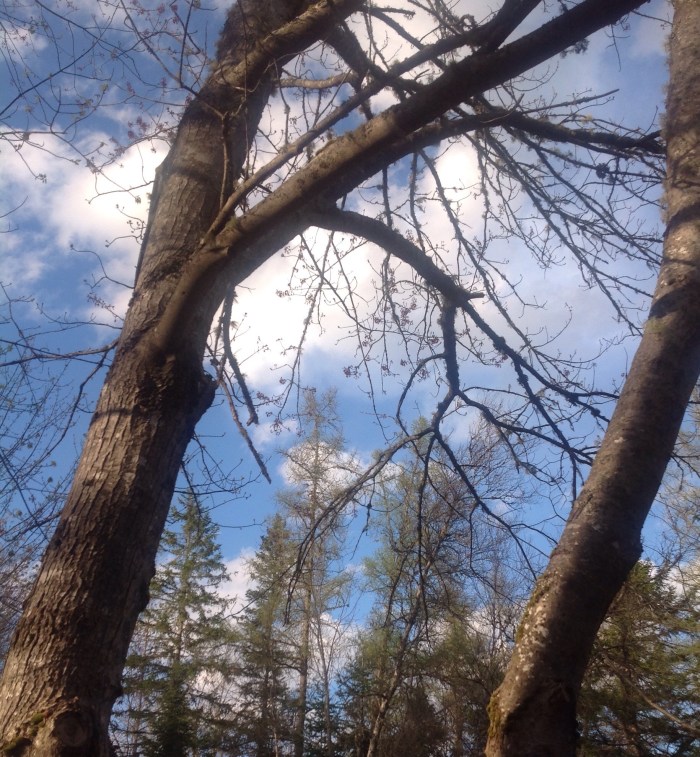
a view of the tamarack trees and spruce where the black-throated green warbler is singing – the red maple is just starting to leaf-out
~
Copyright Jane Tims 2016
fiddlehead season in New Brunswick
This time of year in New Brunswick, the fields and riversides are turning green. The leaves of the alders are the size of a mouse’s ear and that means fishing in the streams. The small leaves of the red maples are like green stars against a blue sky. And bouquets of fiddlehead ferns are unfolding in the wet meadows and along the shores.
~
Fiddleheads, the young coiled leaf fronds of the Ostrich fern (Matteuccia Struthiopteris (L.) Tod.), are a local delicacy in New Brunswick. Steamed, with a pat of butter, they are the perfect vegetable for a spring meal. Fiddleheads are one of the edible wild plants featured in my book ‘within easy reach’ (Chapel Street Editions). I will be launching my book at 7 pm on June 9, 2016 at Westminster Books in Fredericton. If you live in the Fredericton area, I would be so happy to see you there!
~
For more information on the fiddlehead, see https://janetims.com/2012/05/19/making-friends-with-the-ferns-2/

Fiddleheads along the Saint John River in the Grand Lake Meadows
a drawing of a covered bridge
Another drawing for my manuscript ‘in the shelter of the covered bridge’: Hammond River #2 French Village Covered Bridge

~
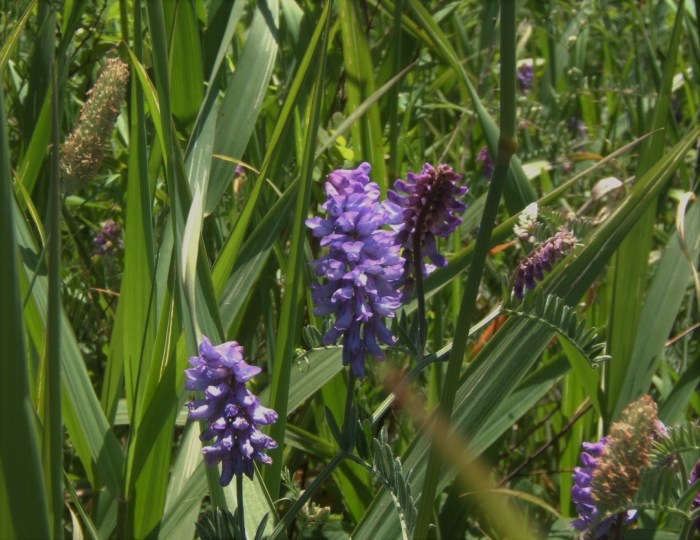
Cow vetch and Timothy at the entry to the covered bridge:
~
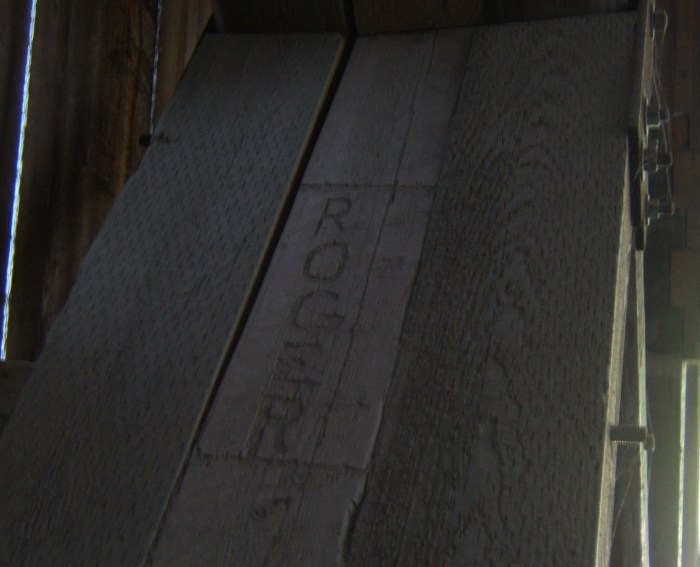
Who were ‘B’ and ‘E’? Who was ‘Roger’?

~
~

Hammond River #2 – packed in green
~
Copyright 2016 Jane Tims
old schools in the landscape
In my last few posts, I have focussed on my research toward a new poetry project I will be beginning. I know there are interesting stories to be told about the ‘inside’ of the one room school. Because of my interests in botany and community history, I would like to reflect on the ‘outside’ of the one room school – its surroundings and geographic location.
~
I still have to do some thinking about this project. I know that people who attended one room schools will have stories to tell about how the local terrain and landscape influenced their schooling.
~
A school’s surroundings would have impacted learning in many ways. For example, the view of a lake from the school window may have caused many a pupil to settle into daydreams. Interesting fields, hills, and watercourses would provide the teacher with opportunities for nature study.
~
The location of the school would also influence recess and lunch-time activities. My Dad wrote about damming a local stream so they could skate in the winter months. The same stream meant fishing in May and June. A nearby hillside would be great for sledding in January and February. Trees in the school yard? – A place to climb or to hang a swing.
~
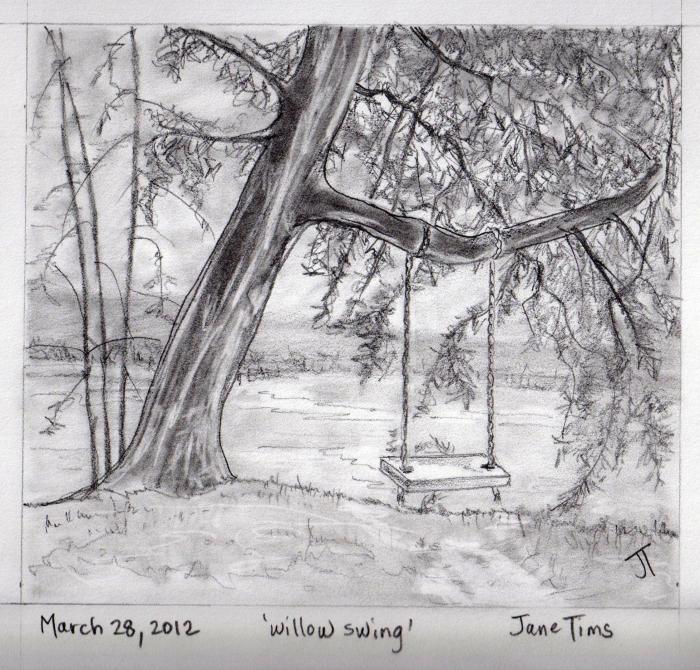
~
Students walked to school before the 1950s. The study I made of schools in Upham Parish, New Brunswick suggests that students walked as many as three miles to school in the late 1800s. Hills made the long walk to school more difficult. The winds by a lake or other shore land would be bitter on a winter day. Rivers, lakes and wetlands meant a place to hunt tadpoles. A spring by the road? – A cool drink. My Uncle, forced to wear a hat/scarf he hated, used the bridge on the way to school as a place to hide his headgear!
~
One room schools were located near clusters of houses and various community activities. The walk to school may have passed a church, a post office or a community store. Hardwood forests meant lumber mills and, in spring, maple syrup and the sugar shack. Good land meant farms; grazing land meant cows to outstare.
~
On a drive last weekend, we found an older building along the Saint John River that may have been a school. The Upper Queensbury Community Hall has all the characteristics of a one room school – the steep roof, rectangular footprint, and tall side windows.
~
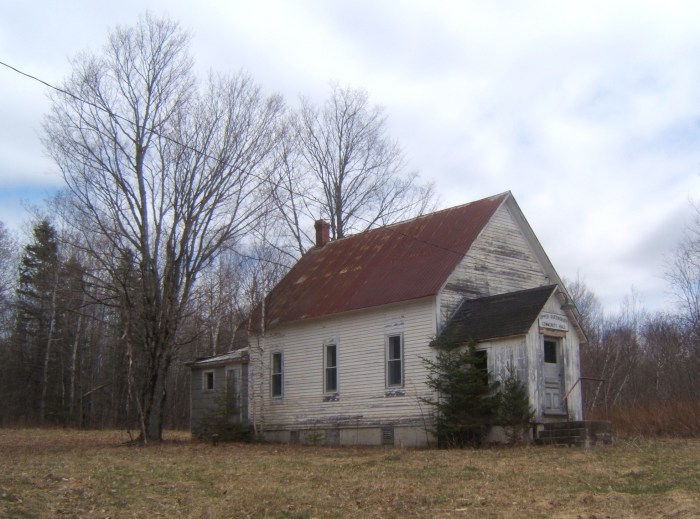
Upper Queensbury Community Hall near Nackawic, New Brunswick. I will have to make some inquiries to find out if it was a school house at one time.
~
A look at a map shows some of the landscape features in the area.
~

Map showing landscape features of part of Queensbury Parish, near Nackawic, New Brunswick. The yellow dot is the location of the Upper Queensbury Community Hall which may have been a one room school.
~
The Saint John River was nearby, although further than it is today since the Mactaquac Dam (built in 1968) has raised the level of the water. The river’s possibilities for fishing, skating and boating were only a downhill trek away. The terrain is gently undulating, as the names of nearby communities (Day Hill and Granite Hill) suggest. Local geographic points the community children may have known include the many-tiered Coac Falls and Coac Lake (an old road runs past the community hall back through the woods to the lake, about a mile away). The aerial photo (taken near the end of September) shows the red of the cranberry bog – picking cranberries may have been a well-known activity. Sugar maples are common in the area, as are old ‘sugar shacks’. When I interview people who went to the one room school I will have to remember to ask them about their memories of these places.
~
Writing poetry about these ideas will be so much fun!
~
~
Copyright 2016 Jane Tims
my poetry book – within easy reach
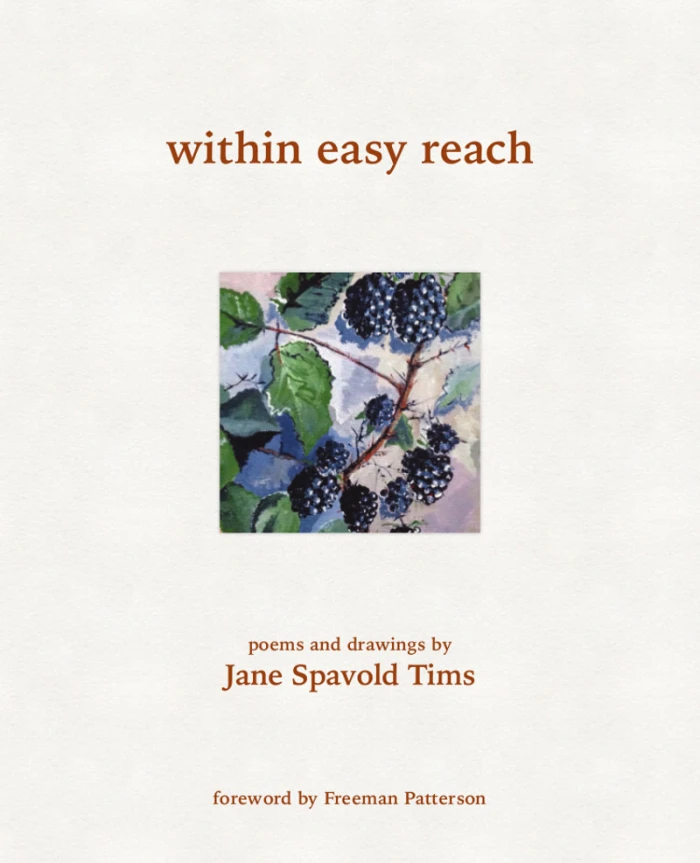
My new book, within easy reach, is now available.
~
I would like to thank you, the readers of my blog (and my Facebook and Twitter friends), for all your interest and support since I began my blog in 2012! The blog has helped me along the way, developing ideas for my projects, giving me a place to try my poems on a reading audience and giving me a chance to read some beautiful poetry on the blogs I follow. I also love your ‘likes’ and comments.
~
I hope you will buy my book and enjoy reading my poems and seeing my drawings.
~
For the readers of my Blog, I am offering a chance to win the painting on the book’s cover! My painting ‘brambles’ is painted in acrylics, size 10″ by 10″, with gallery edges. The painting is from a photograph of the blackberries growing on our lake property, the berries featured in the poem ‘berries in brambles’, one of the poems in the book.
~
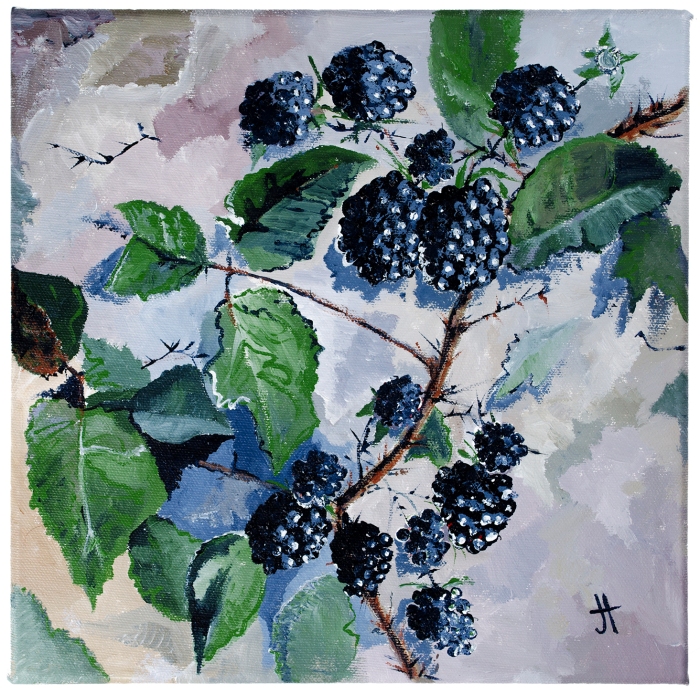
February 29, 2016 ‘brambles’ by Jane Tims
~
To win this painting, you have to do three things.
- Purchase my book through my publisher’s website (www.chapelstreeteditions.com)
- Leave a comment on any of my Blogs (www.nichepoetryandprose.wordpress.com or www.janetims.com or www.janetimsdotcom.wordpress.com) with the words ‘within easy reach’ somewhere in the comment
- Be prepared to send me, via email, a scan of your purchase receipt
~
Your name will be entered once for each book purchased. The contest will run for the first five weeks following the publication date of within easy reach (until June 7, 2016). At the end of the contest, anyone who has purchased a book from the publisher and left the comment as described above will be entered for the draw. I will notify the winner and let the readers of the blog know who has won.
~
I hope you will enjoy my book. And some reader will be the winner of the painting ‘brambles’!
~
Copyright Jane Tims 2016




 nichepoetryandprose