Posts Tagged ‘nature’
growing and gathering – a sense of place
The theme of eating local foods has its essence in the idea of ‘place’. The book ‘The 100 Mile Diet – A Year of Local Eating’ by Alisa Smith and J.B. MacKinnon (2007), introduced many to the idea of eating foods grown within a certain radius of home. Eating local is also place-based in terms of the settings we associate with local foods – the woods, the blueberry field, the home garden, the local farm, the roadside stand, and, of course, the farmers market are all places associated with obtaining food from local sources.
‘Place’ is a complex topic. Most of my poems about ‘growing and gathering’ include at least a little information about the ‘place’ where foods are found. Some poems, however, are specifically about ‘place’, and I want to group these together in my manuscript.
The poems I will include under the theme of ‘place’ will be focused on habitat, landscape, local food traditions, and the people-based concept of ‘home’.
~
1. the ‘place’ where plants grow
Plants, of course, depend on their habitat to live. The ideal ‘place’ for a plant is determined by the availability of moisture, light and nutrients. These factors are, in part, the result of climate, soil type, slope, exposure, and interactions with other plants and animals. In my collection, I have poems about the habitat of seaside plants, the need for water in landscapes where water is scarce, and why woodland plants often bloom in the early spring, when light is most available.
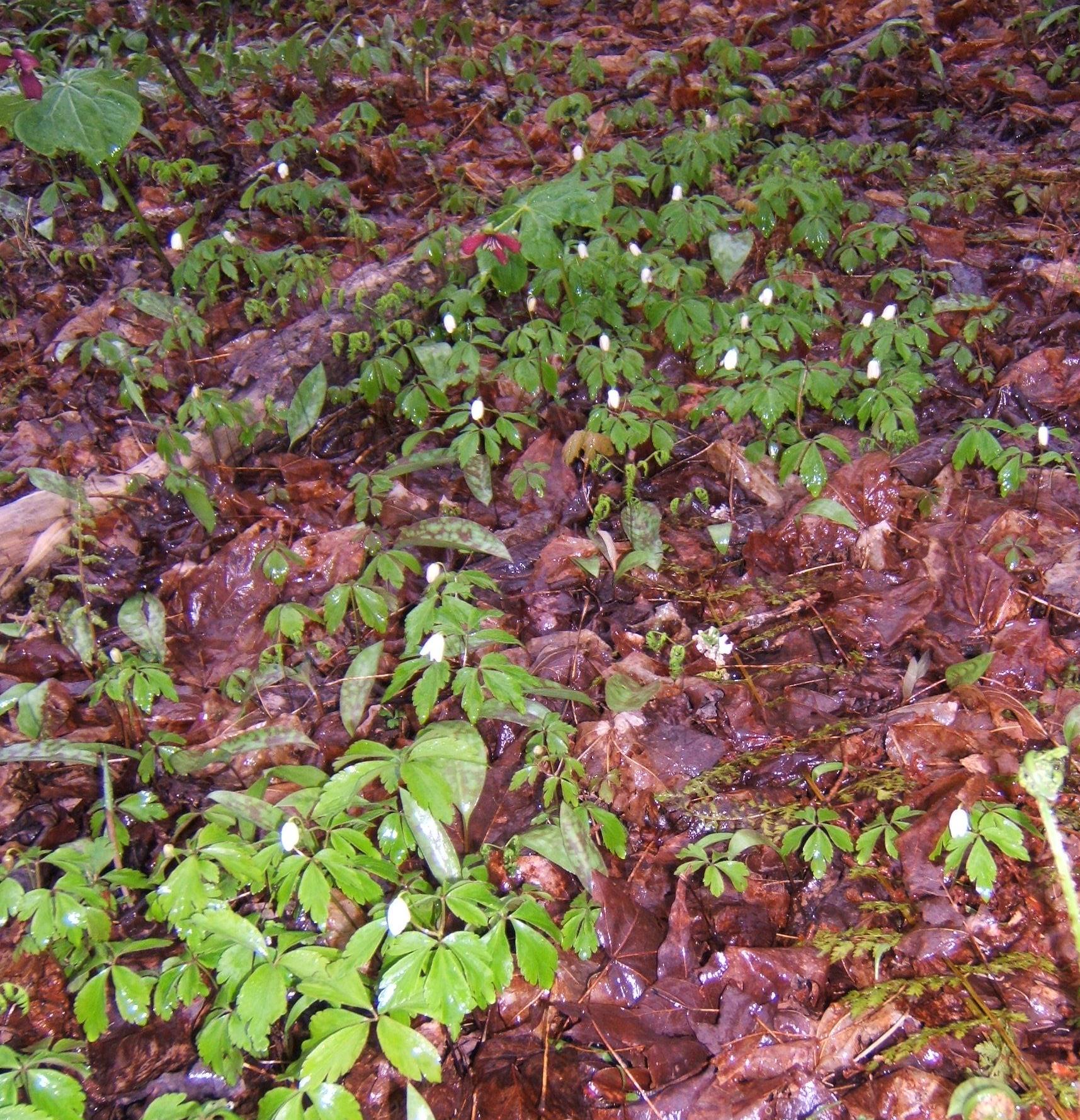
2. plants shape their surroundings and their landscape
Plants create habitat, modifying the regimes of moisture, light and nutrients in a local space. Plants also help to create the broader landscape. I have poems about how ripening apples change the space under an apple tree, how large and small-scale characteristics affect the value of a property, and how plants contribute to the way landscape appears.
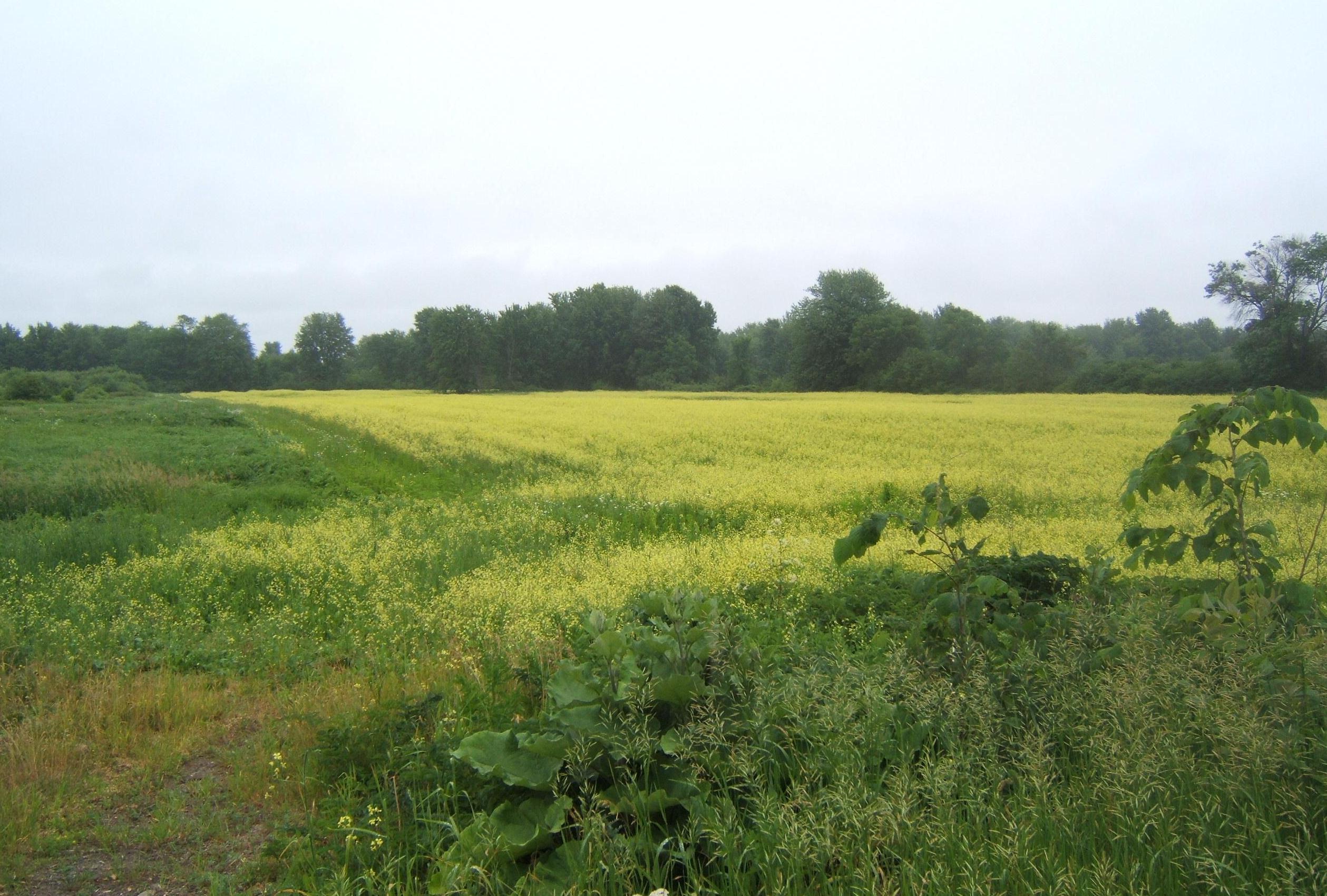
3. ‘place-based’ food traditions
As a result of the interaction between wild life and the landscape, people have access to different kinds of foods and develop area-specific wild food traditions. In New Brunswick, fiddleheads of the Ostrich Fern (Matteuccia Struthiopteris (L.) Todaro) are abundant in the spring, along the banks of rivers and wetlands, and many New Brunswickers consider a feed of cooked fiddleheads to be a rite of spring. In Newfoundland, a relative of the blackberry, the Bakeapple (Rubus Chamaemorus L.), is common in the bogs and barrens. Children often stand beside the road, their arms out-stretched, to sell their bottles of yellow Bakeapples packed in water. I have poems about these two local foods as well as others about traditional local foods.

4. ‘place’ as a metaphor for home
Plants and their ‘place’ can be a metaphor for the relationships between humans and the spaces where they are raised, or where they live. ‘Place’ may imply ‘home’ and ideas of belonging or familiarity. Several of my poems are about this aspect of ‘place’.

As I am working on the theme of ‘place’, a song by the 1990’s band Toad the Wet Sprocket is going around in my head:
‘…show me your home
Not the place where you live
But the place where you belong…’
Toad the Wet Sprocket, ‘Something to Say’, Fear, 1991
Exploring the theme of ‘place’ with you has helped me to organise my poems, to revise them, and to understand that I still have a few poems to write toward my manuscript. I am so grateful for this blog and for all my readers!
~
~
landscape
~
a veil draped across bones of the earth
pointed tents supported by forest
settles in pockets, lichens and moss
~
beneath the cloth is texture, the way
I know life on the land, fast or slow,
near or far, through clear eyes or through tears
~
to know form follows function – practice
repeated, detailed observation
see the sweep of a field of brambles
also the berries, also the thorns
~
Published as ‘landscape’ on www.nichepoetryandprose.wordpress.com September 3, 2011
Revised
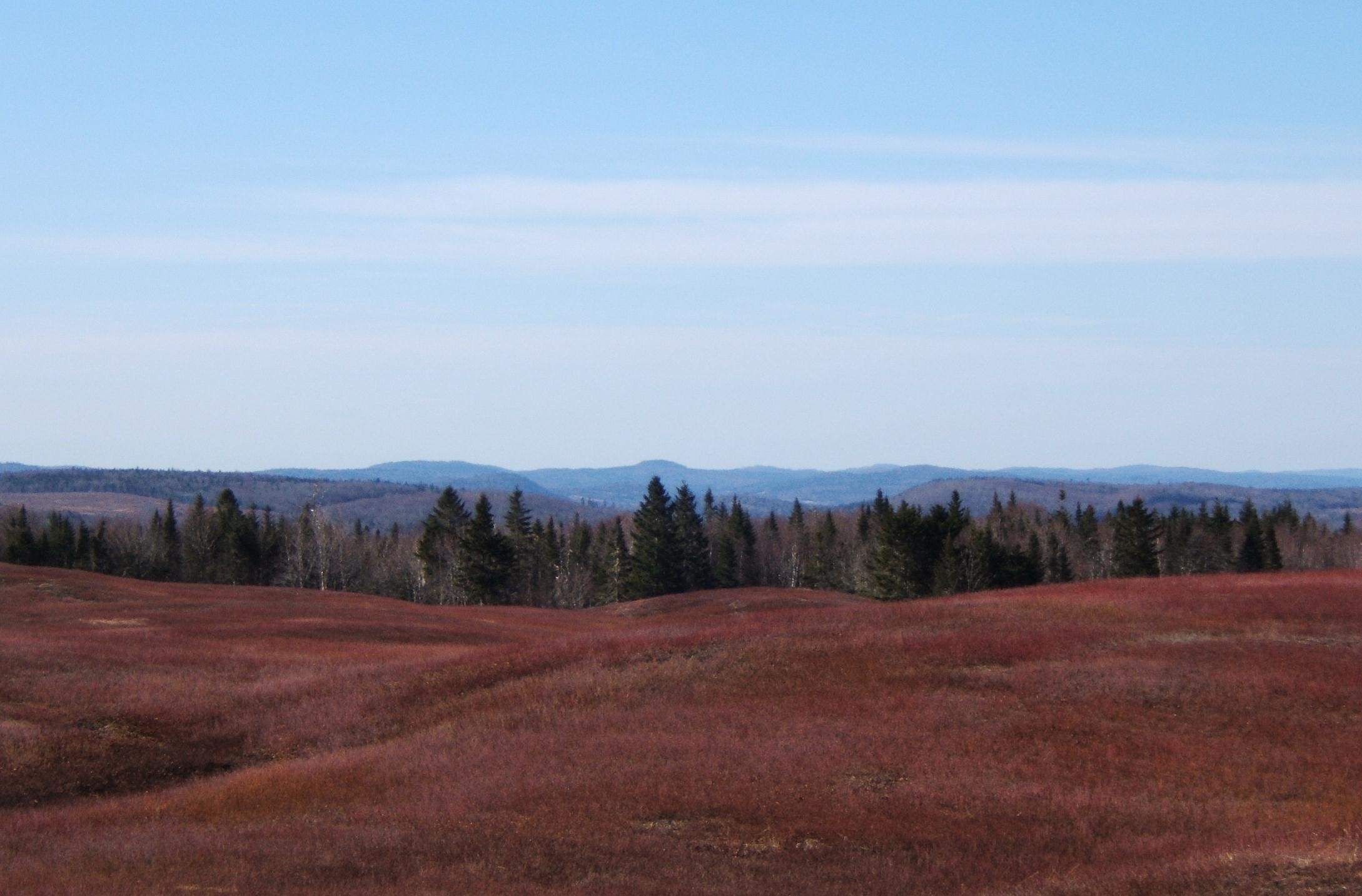
© Jane Tims 2012
a botany club excursion
Earlier this summer, we went on a hike with other members of a local botany club to the Cranberry Lake Protected Natural Area, an area protected for its extensive forest community of Red Oak and Red Maple.
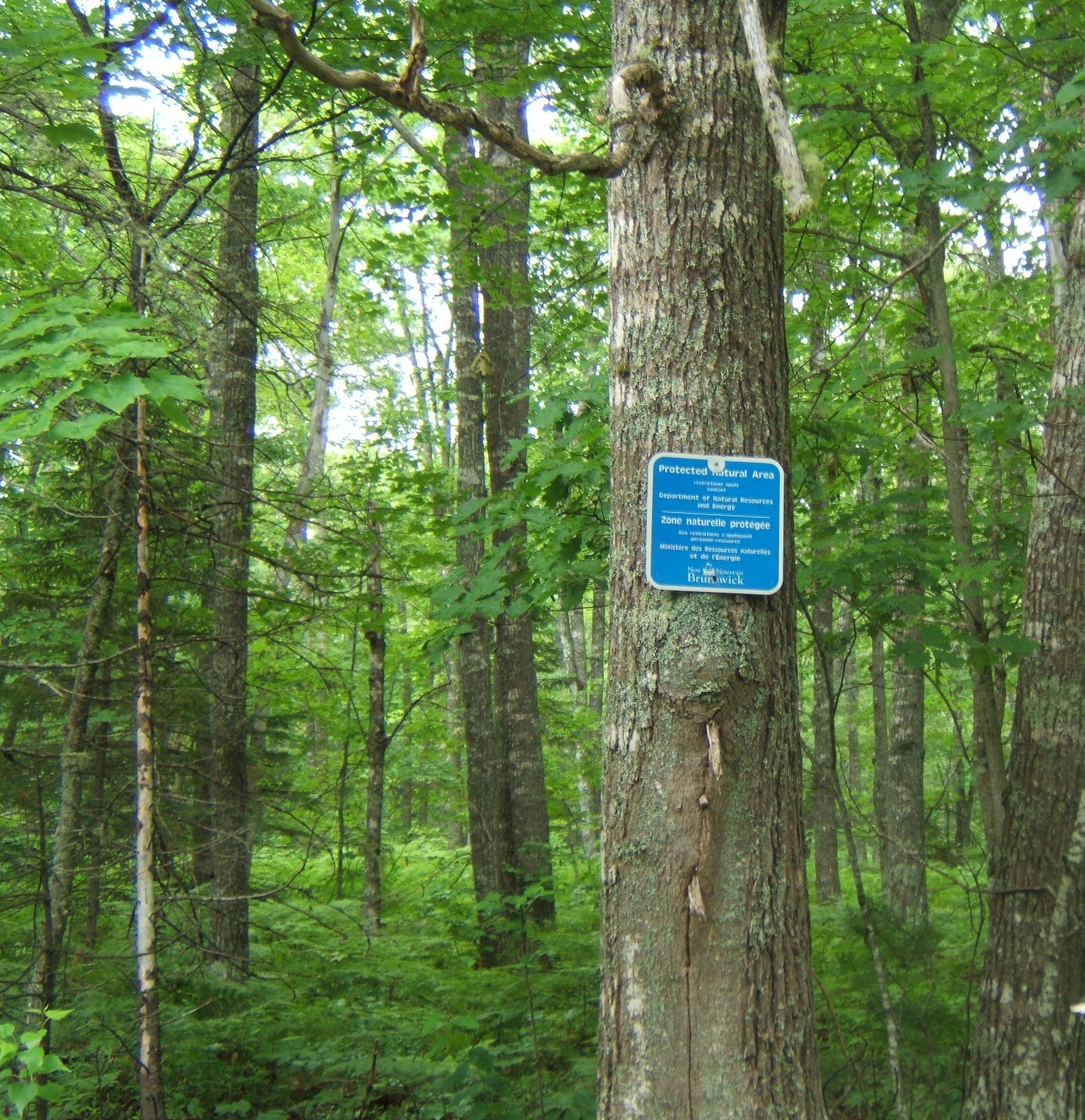
The New Brunswick Department of Natural Resources website describes the Cranberry Lake Protected Natural Area as follows:
An extensive Red Oak forest community. Predominantly Red Oak – Red Maple association. Red Oak make up a large percentage of the regeneration, most likely the Oak component will increase as the stand matures. The individual trees are impressive size.
This type of forest is rare in New Brunswick.
The woods were open with a thick understory of Bracken (Pteridium aquilinum (L.) Kuhn, var. latiusculum (Desv.) Underw. ex A. Heller), Blueberry (Vaccinium spp.), Common Lady’s Slipper (Cypripedium acaule Aiton) and some of the other species of the Canadian Element associated with woodlands in the Maritimes (see my post for April 30, 2012, Trailing Arbutus, https://nichepoetryandprose.wordpress.com/2012/04/30/trailing-arbutus-epigaea-repens-l-var-glabrifolia/ ).

My husband standing in the thick growth of Bracken… it was about waist-height… he says he was standing in a hole!
It was so much fun working with the other botanists and enthusiasts to identify the various species we encountered. The plant lists prepared during the day will be part of an effort by Nature New Brunswick to update a database of Environmentally Significant Areas in New Brunswick. During my years of work, I was privileged to work on the development and use of this database.
I saw many familiar species during the hike, but I was so excited to see three plants I have not seen in a while.
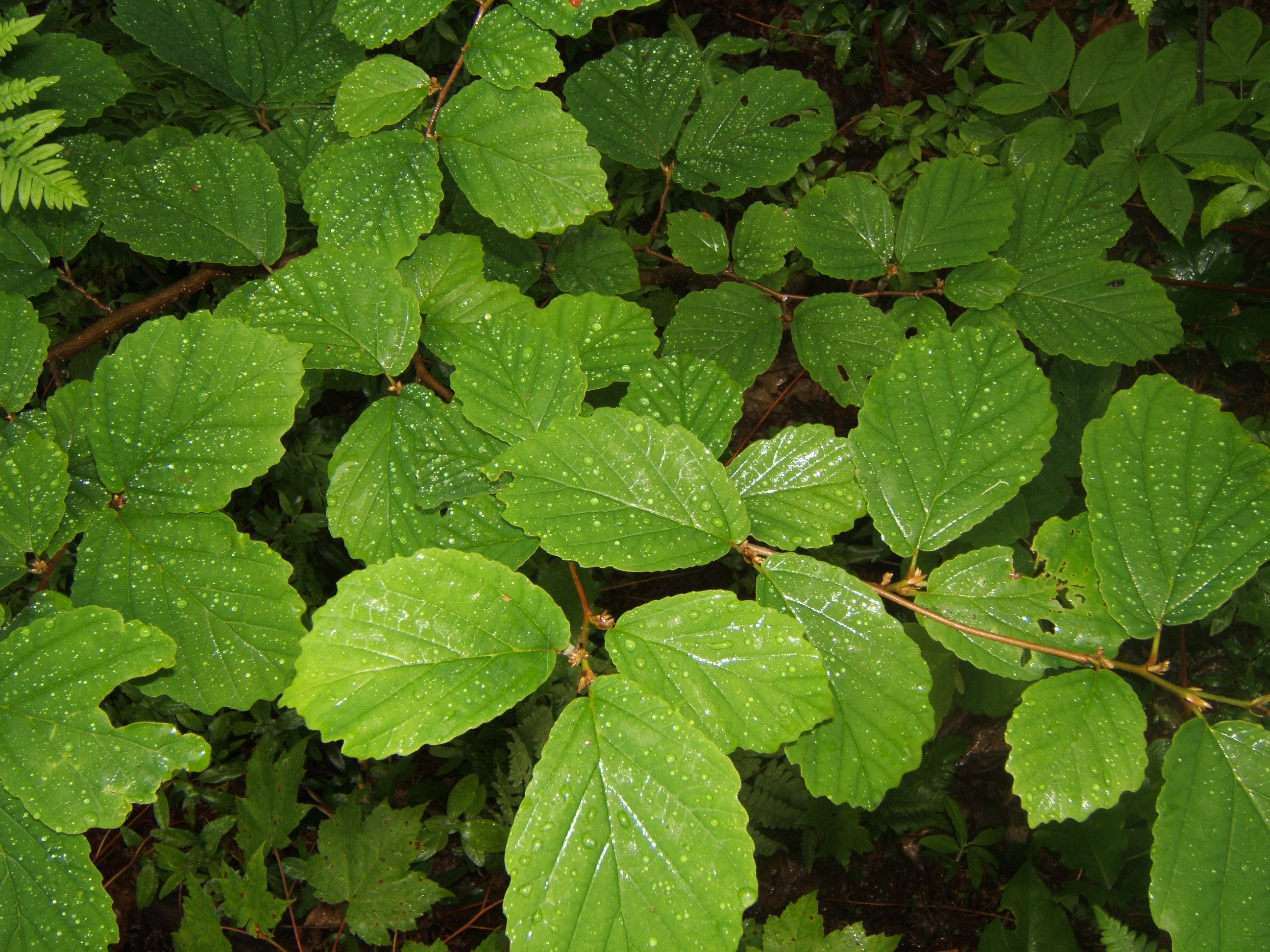
I renewed my acquaintance with Witch-hazel, Hamamelis virginiana L. (notice the asymmetrical shape of the leaves)…
and Shinleaf (Pyrola elliptica Nutt.), identifiable by its thick oval leaves, longer than the leaf-stalks or petioles…

a single plant of Shinleaf, with its straight stem of small creamy flowers, growing among Blueberry, and Red Maple and Red Oak seedlings
I also was introduced to a plant I thought I had never seen before, Cow-wheat (Melampyrum lineare Lam., a branchy variety found in dry woods). When I looked it up in my Flora, though, I found a notation to say I had seen this plant in the summer of 1984. It is always good to record the plants you see and identify!

While there, we saw a perfect example of the interaction of species. A bright orange fungus, known as Chicken of the Woods (Laetiporus sulphureus), growing on an aged Red Oak, was being consumed by a horde of slugs.

A hike with a group is a great way to expand your knowledge and boost your confidence. Everyone benefits from the knowledge of the various participants, and being with like-minded people is good for the soul!
© Jane Tims 2012
Warning: 1. never eat any plant if you are not absolutely certain of the identification; 2. never eat any plant if you have personal sensitivities, including allergies, to certain plants or their derivatives; 3. never eat any plant unless you have checked several sources to verify the edibility of the plant.growing and gathering – learning
When I embarked on my project to write poetry about ‘growing and gathering’, I wanted to learn as much as I could about the subject. It is not surprising, then, to find I have written quite a few poems on the theme of ‘learning’.
Some of these poems are in the spirit of ‘how to’. I have poems about collecting maple syrup, making jelly, harvesting and preparing wild sarsaparilla, stringing peas in the garden, gathering eggs and picking fiddleheads, among others. As poems can be a little obtuse, sometimes these directions are not very helpful in a practical way. However, I try to capture the essence of the growing and gathering of local foods.

I have also written poems about learning itself. I have a poem about my childhood experience of running free on the prairie, picking thorny cactus berries and bottles of scorpions (yes, scorpions… they were interesting and pretty, and I didn’t know they were dangerous!). I also have a poem to remind busy young mothers to learn from the rhythms of nature – the calm conspiring of bees and clovers to make honey, or the way a bird collects the makings of a nest, a little at a time. Another poem is about learning how to negotiate the traditions of the farmers market (if you buy fresh carrots, keep the green tops for your compost bin!!!).

I also have two poems about imitating nature. In the 1960s, my Mom used to make a few substitutions in her cooking to make up for a lack of ingredients. You have probably seen these recipes before: Apple Pie, No Apples and Mock Cherry Pie.
One of the reasons Mom made these recipes was to have some fun and make us laugh. But fake food is no laughing matter. My goal, in part, has been to show that we are now a little distanced from our food and its sources. By considering what wild foods might still be available, I have tried to get others to think about the source of our food and the greater simplicity of eating local.
~
~
Apple Pie, No Apples
Prepare pastry for a double pie
Break 15 salted soda crackers into wedge-shaped pieces and place in the unbaked pie shell
Bring to a boil:
1 1/2 cups water 1 1/4 cups white sugar 4 tbsp. margarine 3/4 tsp. cinnamon 1 tsp. cream of tartar 1 tsp lemon flavoringPour mixture over crackers
Cover with pastry
Bake as for apple pie
~
Mock Cherry Pie
Prepare pastry for a double pie
Fill pie shell with:
2 cups fresh cranberries 1 cup raisins 1 1/2 cups sugar 2 tbsp. flour 1 cup cold water 1 1/2 tsp. vanillaCover with a lattice of pastry.
Bake as for cherry pie
~
~
Mock Cherry Pie
~
I am not easy to fool –
embellished covers, empty pages
‘baby’ carrots, shapened like pencils
knock-off purses, no money inside
diet soda and servings of fries
~
who else would look
under the lattice crust
to discover cranberries and raisins?
~
cherries in the orchard
never picked
~
~
© Jane Tims 2012
~
~
Warning: 1. never eat any plant if you are not absolutely certain of the identification; 2. never eat any plant if you have personal sensitivities, including allergies, to certain plants or their derivatives; 3. never eat any plant unless you have checked several sources to verify the edibility of the plant.~
Blueberries!
I love blueberries and so I am very happy – our blueberries are blue and ready for the picking at our summer property.

There are two ways to pick blueberries, with your hands…

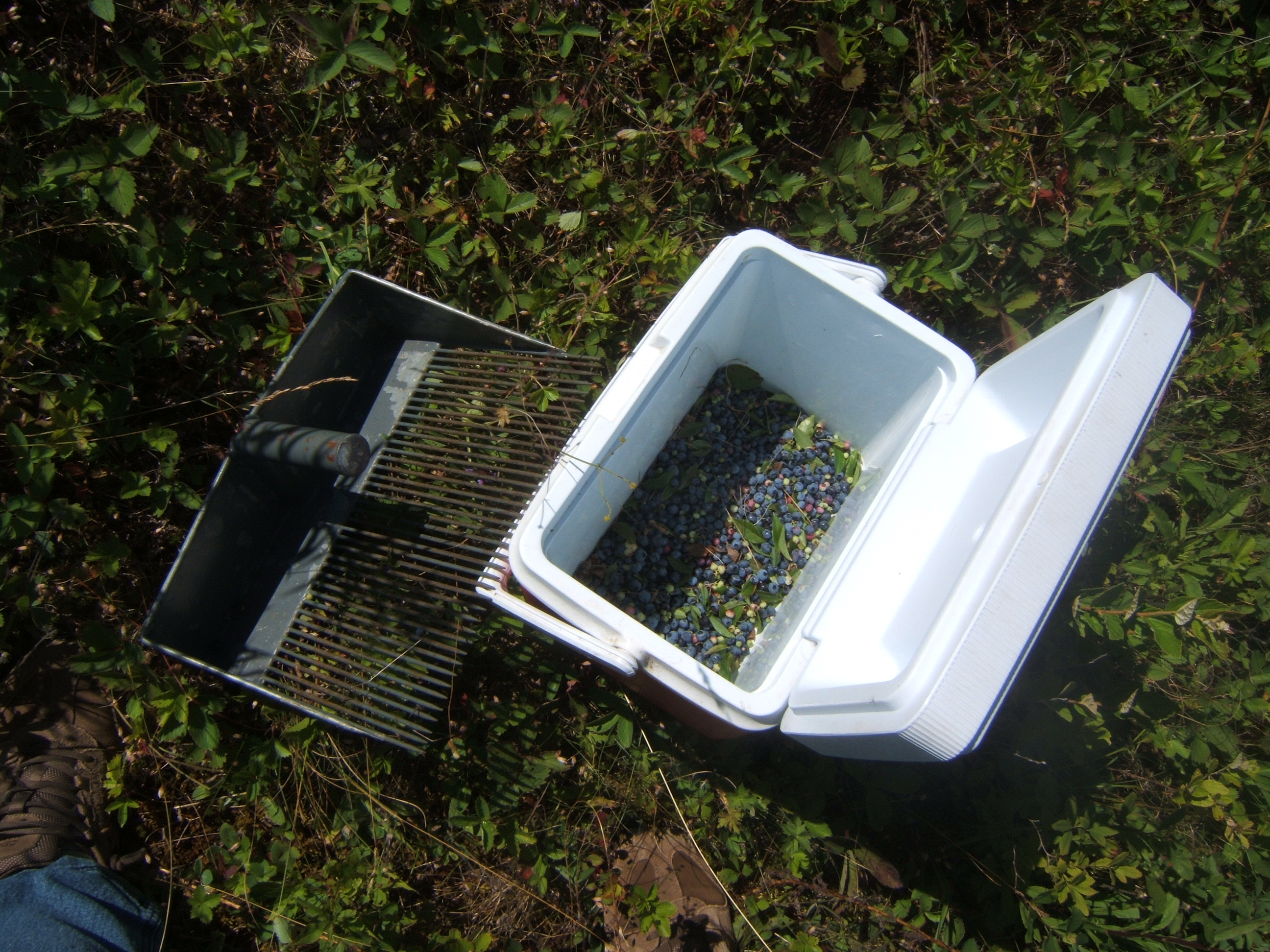
or with a rake…

My husband bought me my rake years ago, so I use it when there are lots of berries and most are ripe. There is a bit of a knack to harvesting with a rake. The ripe blueberries are loosened and captured with the tines of the rake. The basic technique is to sweep the surface of the bushes, tipping the rake upward as you sweep, since the ripe berries fall into a tine-less part of the pan. The experience of raking berries is very different from picking. The process is less calm, although you do get into a rhythm. Also, the tines of the rake vibrate as you sweep, making a lovely musical sound!
We compared the yields between picking and raking, and we get about five times as many berries per unit effort with the rake (I am sure professional rakers do much better than this). The rake gets lots of leaves and debris along with the berries, so the time saved in raking instead of picking is lost in the cleaning (in a professional operation, the debris is removed with fans or another sorting method).
Although we have lots of berries on the property, they are getting fewer each year because the growth of other vegetation crowds the blueberry bushes. But we have a backup plan!
We also travel to the southern part of the province where the berries are in full production this time of year. Our preferred place to get blueberries by the box or by the pie is in Pennfield, at McKay’s Wild Blueberry Farm Stand.

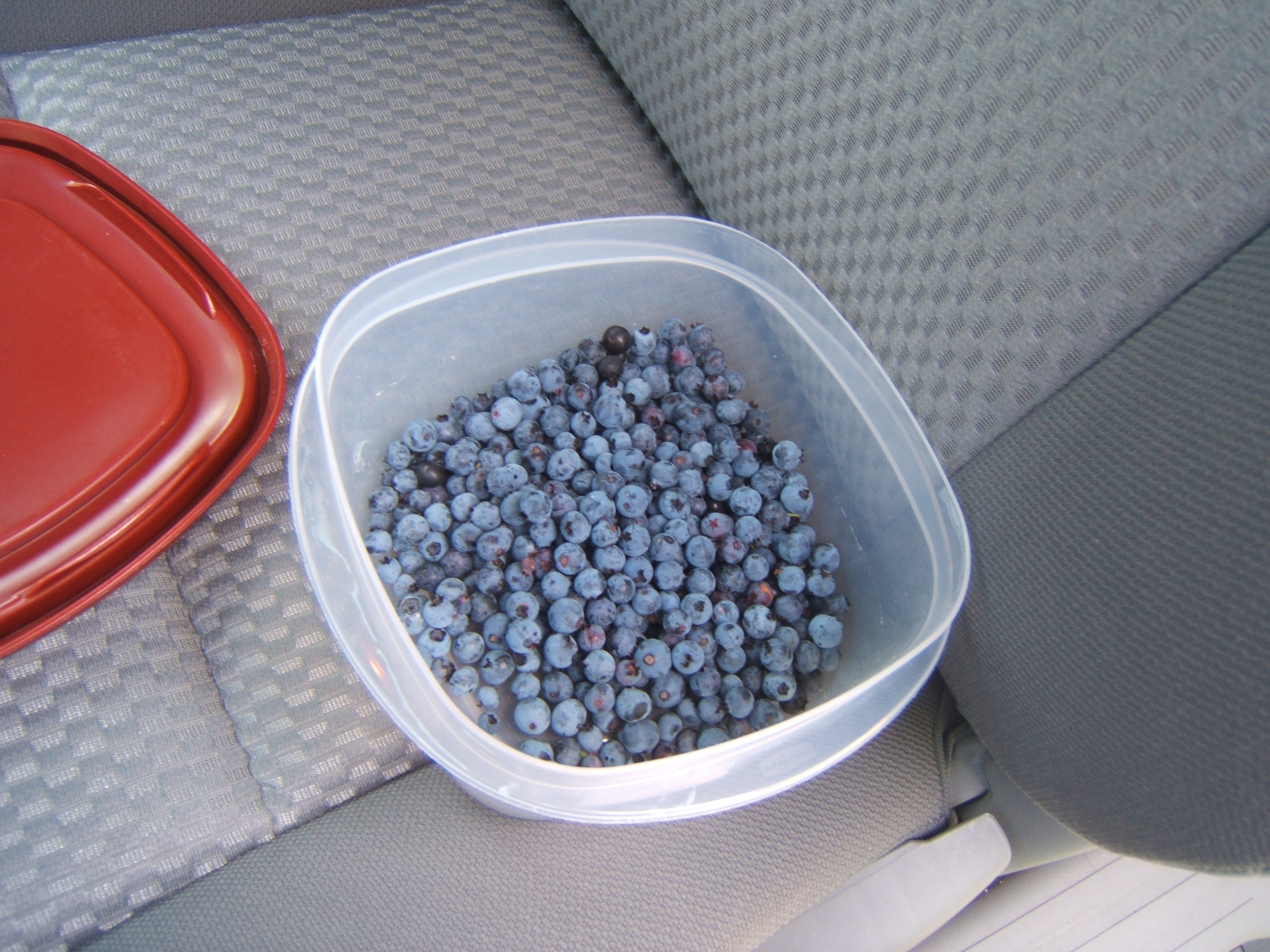
We eat most of our own blueberries almost immediately. They also freeze very well. Our favorite way to use the berries is by making Blueberry Dumplings.
~
Blueberry Dumplings
two to three cups of fresh blueberries 1/2 cup of water 2 tbsp. of sugar (more if you prefer a sweeter dish) ~Bring the berries, sugar and water to a boil.
When the mixture is bubbling, turn down the heat.
Dumplings:
1 cup flour 2 tsp. baking powder 1 tbsp. of shortening, cut into the flour/baking powder mixture 1 tsp. sugar 1/2 cup milk ~Mix well and add by spoonfuls to the top of the cooking blueberries.
Cover the pan tightly with a lid (otherwise, you will have a blue-spattered stove).
Cook at low for about 12-15 minutes or until dumplings are fluffy and done in the middle.
Enjoy!
~
~
raking blueberries
~
the sweep of the rake, the berry
touch, the ring of the tines
vibrato in blue, duet with the wind
in the whispering pines
~
~
© Jane Tims 2012
Warning: 1. never eat any plant if you are not absolutely certain of the identification; 2. never eat any plant if you have personal sensitivities, including allergies, to certain plants or their derivatives; 3. never eat any plant unless you have checked several sources to verify the edibility of the plant. ~Beach Pea (Lathyrus japonicus Willd.)
During our vacation to Nova Scotia, we stopped at several places along St. Margaret’s Bay. All along the beaches, tucked just out of reach of the highest tides, were crowds of Beach Pea. Beach Pea (Lathyrus japonicus Willd.) is a common plant of the coast, growing on sandy and gravelly shorelines and beaches.

This plant resembles the garden pea. It has vine-like, trailing, compound leaves, each composed of 6-8 leaflets. At the base of each leaf is a clasping stipule; at the leaf’s tip is a curling tendril. The flowers are showy, pink and blueish-purple, blooming from June to August.

The seeds of the Beach Pea are podded peas, from 1 to 2 inches long. They are greyish-green and ripen in August.
Some sources, including Peterson’s Field Guide to Edible Wild Plants (1977), say that Beach Peas can be collected, boiled and eaten when they are young and tender. Other sources, more up to date, say they are not edible because they contain a toxic substance that effects the nervous system. In my next post, I’ll talk a bit about being cautious before eating wild plants.
~
~
Beach Pea
Lathyrus japonicus Willd.
~
she feints on the rocks
sighs on the sand
beckons with the tendrils
of her feathery hand
~
ruffles her skirts
in the salted breeze
and squanders her love
on indifferent seas
~
~
© Jane Tims 2012
Warning: 1. never eat any plant if you are not absolutely certain of the identification; 2. never eat any plant if you have personal sensitivities, including allergies, to certain plants or their derivatives; 3. never eat any plant unless you have checked several sources to verify the edibility of the plant.a moment of beautiful – bug-shot shadows
the space: the surface of the power pole in front of our house
the beautiful: the pattern of shadow through bug-eaten leaves
The power pole in front of our house is habitat for a vine of Virginia Creeper (Parthenocissus quinquefolia (L.) Planch.). also known as Woodbine. I brought the vine home about thirty years ago, as a slip collected from a plant in the park beside the St. John River. Over the years, it has struggle against the winds, determined to blow it from its perch, the power company, unhappy with its use of the pole, and the lawn mower as it snips away at the horizontal tendrils.
This year, it has a new challenge to overcome. An insect has chewed the vine full of holes… probably not a severe problem for the plant.
On Friday, I caught the shadow pattern created by the bug-eaten leaves as the sun shone at the right angle for a moment… a new way to see the consequence of belonging to the food chain!

© Jane Tims 2012
limits of the tide #5 – Samphire (Salicornia europaea L.)
A beach-comber this time of year may easily over-look plants of Samphire (Salicornia europaea L.), also called Glasswort, Pigeon-foot, and Chicken-claws. Unless it is plentiful, it becomes lost ‘in the green’ of other sea-shore plants. The genus name, Salicornia, comes from the words sal meaning salt and cornu meaning horn. These plants consist of a branched, succulent stem, apparently without leaves or flowers. The leaves and tiny flowers are embedded in the stem.

Although Salicornia is typically a plant of coastal areas, like Sea-blite, it is also found far from the coast, in the vicinity of inland salt springs.
Samphire greens are salty, delicious as a salad ingredient, a pickle, or a pot-herb.
~
~
salt of the sea
Samphire ( Salicornia europaea L.)
~
Salicornia smoulders
on a silica shore,
flute and fire
~
Glass pipes,
mainstem and branches,
pickle green
~
Light glimpsed
through crystalline,
transparent walls
~
Seawater, rarefied,
decanted
to a Samphire phial
~
Flask of salt-sap,
brine on the tongue
Always wanting more
~
~
© Jane Tims 2012
Warning: 1. never eat any plant if you are not absolutely certain of the identification; 2. never eat any plant if you have personal sensitivities, including allergies, to certain plants or their derivatives; 3. never eat any plant unless you have checked several sources to verify the edibility of the plant.Silvery Cinquefoil (Potentilla argentea L.)
Last month, whenever I went to get the mail, I was waylaid by a little plant sprawling next to the row of boxes. He was so charming, once I forgot to get my mail because I was examining his flowers and leaves! There should be a sign saying ‘No Loitering’.
The plant was Silvery Cinquefoil (Potentilla argentea L.). As its name suggests, Silvery Cinquefoil is covered with fine silver hairs, giving it a downy appearance. It has fine-toothed, five-fingered leaves, palmately compound, and five-petalled yellow flowers.
I have always liked the various species of Potentilla, interesting for the variety of their leaves. You can see how diverse these shapes are in a page from Roland and Smth’s Flora of Nova Scotia. The reddish pressed leaf in the scanned book, for example, is Silverweed (Potentilla Anserina L.). My post for July 13, 2012, ‘coastal barren, coastal bog’, shows the Three-toothed Cinquefoil (Potentilla tridentata Ait.) https://nichepoetryandprose.wordpress.com/2012/07/13/coastal-barren-coastal-bog/ .
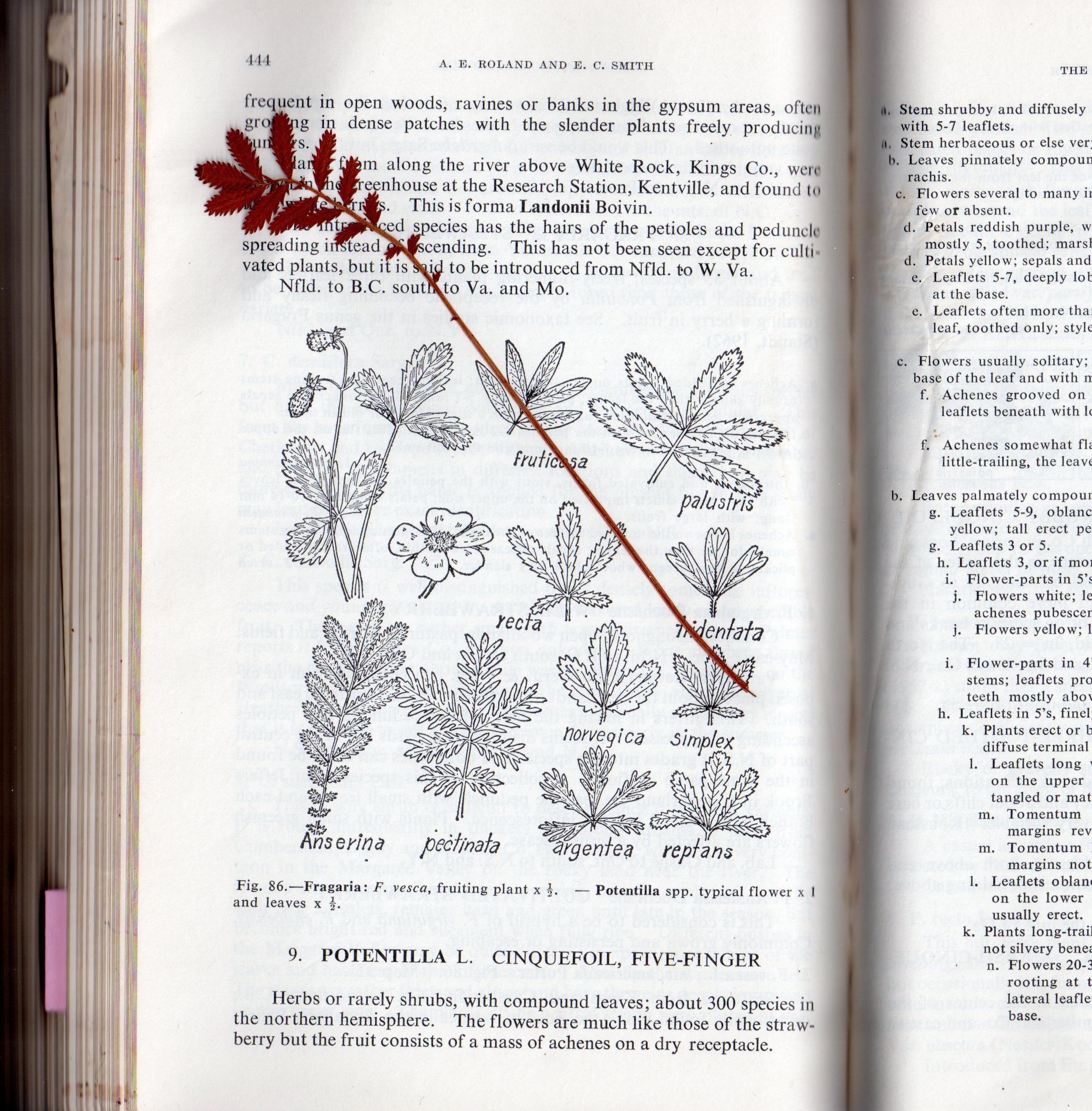
various leaf shapes of Potentilla in a page of The Flora of Nova Scotia (A.E. Roland and E.C. Smith, Nova Scotia Museum, Halifax, 1969) … the pressed leaf is from Potentilla Anserina or Silverweed, a coastal species of Potentilla.
~
~
Five-Finger
~
metal leaf and yellow,
he leans on the post-box
palms extended
potent, persuasive
a bit of a thug
want your mail?
pay me,
in silver
~
~
© Jane Tims 2012

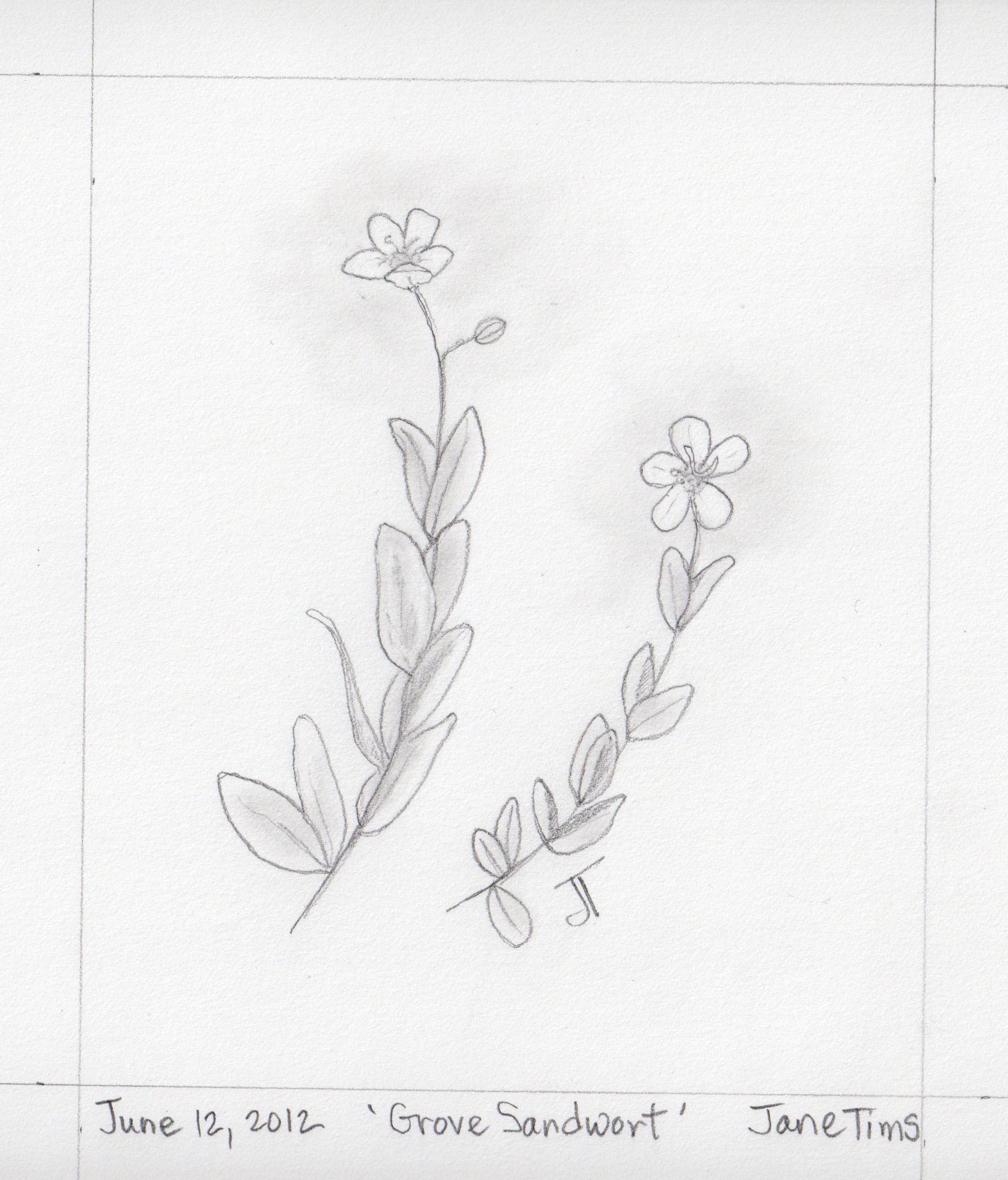
Grove-sandwort (Arenaria lateriflora L.)
Our summer property is a constant source of learning for me. Every year I seem to find at least one new plant. This year the plant is Grove-sandwort (Arenaria lateriflora L.).
Grove-sandwort is a common plant, found in meadows, along shorelines and at the borders of woods. It is a low-growing herb, first noticeable in June. The starry, white flowers each have five petals and grow near the top and along the sides of a simple stem. The leaves are elongated, elliptical, and in pairs.

Arenaria comes from the Latin arena meaning ‘sand’, where many of the members of the genus grow. The specific name lateriflora means ‘flowering on the side’.
Have you learned to identify any new plants this summer?
~
~
new neighbor
Grove-sandwort (Arenaria lateriflora L.)
~
met her in the meadow
by the split-rail fence
strewing the grove
with flowers
~
her leaves paired,
clapping hands,
delighted only ‘to be’
a bystander in the arena
~
~
© Jane Tims 2012
Chicory – (Cichorium intybus L.)
Along the Trans-Canada near Jemseg, one colony of Chicory has taken hold. Its bright sky-blue flowers catch the eye as the usual roadside vegetation rolls by.
~

~
Also known as Blue Sailors and, in French, chicoreé, Chicory (Cichorium intybus L.) is a tall plant, found along roadsides and in other waste places.
Chicory has basal leaves resembling those of the Dandelion. When broken, the stem exudes a white milky fluid.
The bright blue flowers of Chicory occur along the length of the almost leafless and somewhat zig-zag stem. Each flower is formed of a central involucre of tiny blue flowers and a disc of larger ray flowers. The rays are square-cut and fringed. The flowers follow the sun, closing by noon, or on overcast days.
~

~
Chicory is a useful plant. Its young leaves are edible as salad greens or as a pot-herb. The roots can be dried and ground to make a coffee substitute or supplement. The root of Chicory has soothing properties to balance the edginess caused by caffeine. The roots of Chicory are large and very deep. I tried to pull them by hand, but a shovel will be needed to harvest the roots in the compact soil of the roadside.
~ When I see these flowers, I am reminded of my grandfather, my mother’s father. I never knew him, but I have a couple of photographs of him as a young man. I have made a small study of his mother, my great-grandmother, so I know quite a lot about him. ~
~
The flowers of Chicory remind me of his eyes, since they were the same startling blue. He was also a tall man, another feature of the plant.
The other name for Chicory, Blue Sailors, also reminds me of my grandfather. He was a sailor, entering the navy when he was only fifteen. I know from various records that he served on at least two naval vessels, the USS Nebraska and the USS Pensacola. As so often happens when I see photographs of ancestors, there is a familiarity about his features.
~

~
Blue Sailors
Chicory (Cichorium intybus L.)
~
at the roadside
weeds surge as waves
~
on the sameness of ocean,
a buoy lifted,
a sudden swell of Chicory
~
tall, like my grandfather,
the blue ice of his eyes
its blunt petals, the square-cut of his jaw
~
joined the navy at fifteen
dressed as a sailor, headed for sea
USS Pensacola, USS Nebraska
~
his tie, a sapphire ribbon
toothed or frayed
~
~
© Jane Tims 2012
Warning: 1. never eat any plant if you are not absolutely certain of the identification; 2. never eat any plant if you have personal sensitivities, including allergies, to certain plants or their derivatives; 3. never eat any plant unless you have checked several sources to verify the edibility of the plant.






 nichepoetryandprose