Posts Tagged ‘nature’
summer spaces
Occasionally in these posts, I talk about our cabin. When I was a child, weekends were always spent at the cottage. It was a special place, partly because my Dad involved me in its creation. I still remember how proud I was to fill one of the foundation boxes with stones. It was a place where we could play in the woods and dabble in a brook. So it is no surprise that as an adult, having a cabin get-away has always been a priority.
~

a view of the lake at our cabin property
~
Our cabin today is built on a hill overlooking a lake. Originally, the property was a field overflowing with blueberry bushes.
~

our lake property in 2005
~
Today, it is a young woods, mostly of mountain birch and red maple. We keep the paths mowed with a bush hog pulled behind our ATV. The treed lane I once hoped for is now a reality. I still have a few patches of blueberries and lots of blackberry bushes.
~
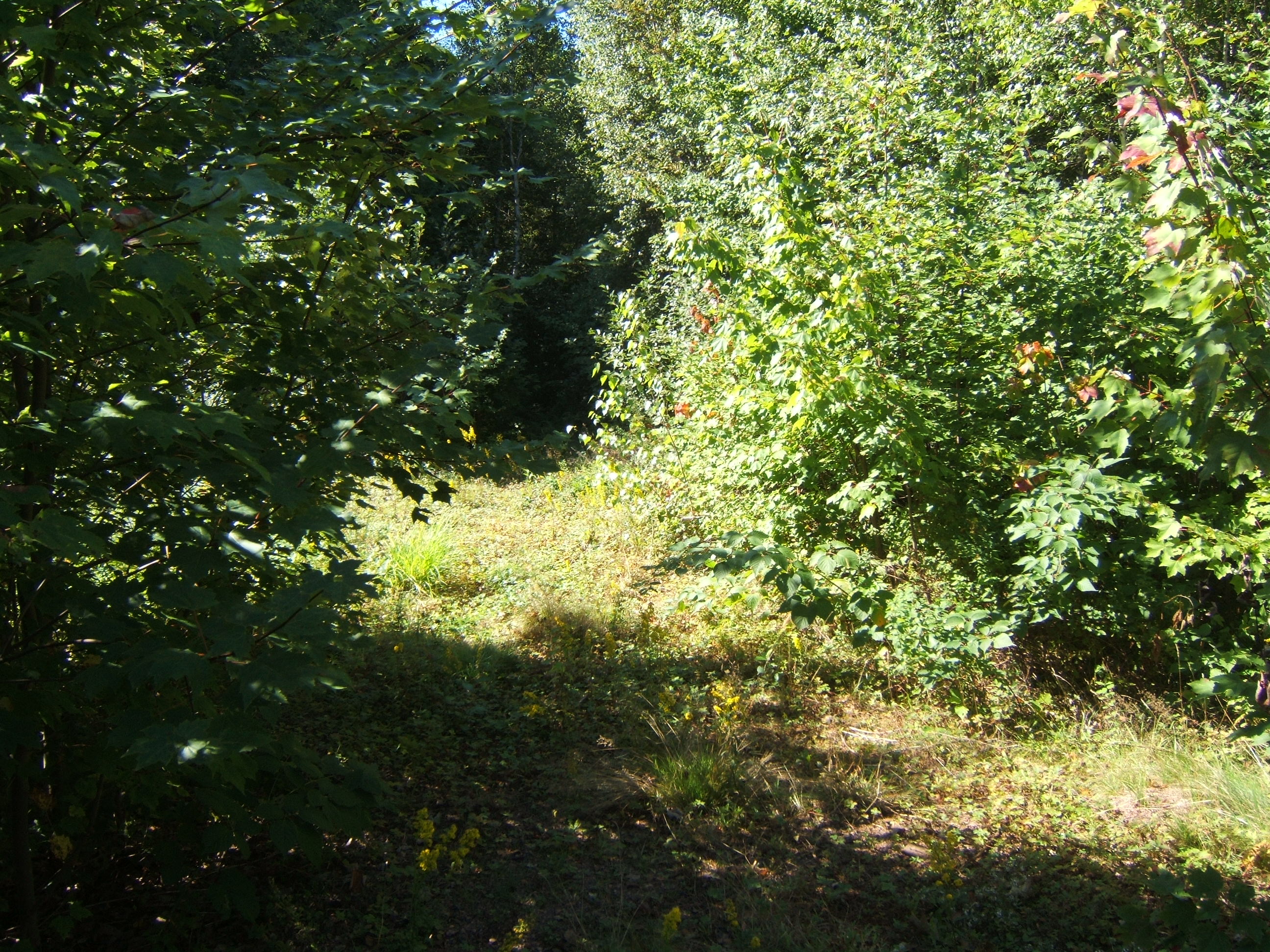
one of our many paths through the birch and maple wood
~
Originally, we intended to build a much bigger cottage – we even chose the plans. But through the years the shed we built as a sort of garage has become our cabin. It is small, only 19 feet long by 15 feet wide. But it is big enough for my husband and I.
~

building the cabin in 2010
~
Earlier this summer, we hired a local company to finish the outside of the cabin. We still have work to do inside, but having the exterior finished takes us a long way towards the time when our cabin will be a home away from home.
~

our cabin, all the windows in and siding complete, 2014
~
We spent yesterday at the cabin. We did some work on our entry gate, sat in the cabin and talked, and watched the dragonflies and blue jays. Usually we also read, aloud, a couple of chapters of a book and have a picnic lunch. Life is fun!
~
Do you have a cabin or a place to ‘get-away’?
~
Copyright 2014 Jane Tims
Arthur – after the storm
Over a week after Tropical Storm Arthur, I am thinking about the new pattern of life we adopted during our six days without electricity. Without our usual electric lights, stove, refrigerator, computer and television, we adjusted our days.
~
First there were candles. I have lots of candles, but three pillars in the living room sent enough light into the main part of the house for navigation. We also had our small flashlights. They lit the darker rooms and made us safe on the stairs.
~
The next ‘necessity’ was gasoline for the truck and for our small generator (2000 watt). Although we began the storm with very little gasoline (we were not well prepared), we waited a couple of days to fill up, to avoid the long lineups for gas at the few stations open after the storm. Since most all of Fredericton was without power for the first two days, so open gas stations, fast food places and grocery stores were hard to find!
~
Once we had our generator working, we had a hot meal at supper time each evening, on our small electric hotplate. By the end of the six days, we were using our generator for fans to keep the house cool and to watch DVDs on our television.
~
Water, of course, is always a concern. We had lots of water on hand, about 22 4-liter jugs I keep for emergencies. We were able to buy drinking water and ice for our cooler, although these items were flying from the shelves!!! By the end of our adventure, we had filled our jugs a couple of times, once at my son’s home (in the city, they had no power, but they did have water), and once from the Oromocto Fire Department who were so kind to us.
~
On Day 6, workers from NB Power and Hydro-Quebec, and a tree trimming crew from Maine arrived to remove the trees from the downed lines on our road. They worked all day to re-establish power to about 500 customers who depended on this particular line. We were so grateful to them, knowing they had worked since the storm hit. We were just one group among many waiting for power. On Sunday, July 13, there were still 5000 customers without power in Fredericton. By the time of this post, NB Power says most power will be restored. It is certainly the longest power outage we have ever experienced in this province.
~

three candles
~
three candles
~
between ruby glass
and hard wood floor
a slide of light and three
~
extinguished candles
smoke lifts from smoulder
each mote a particle
~
of spectral light, mosaic
shard, image
reassembled in three
~
dimensions
shepherd, hawthorn
lamb
~
© Jane Tims 2011
Arthur – during the storm

front yard during Arthur
~
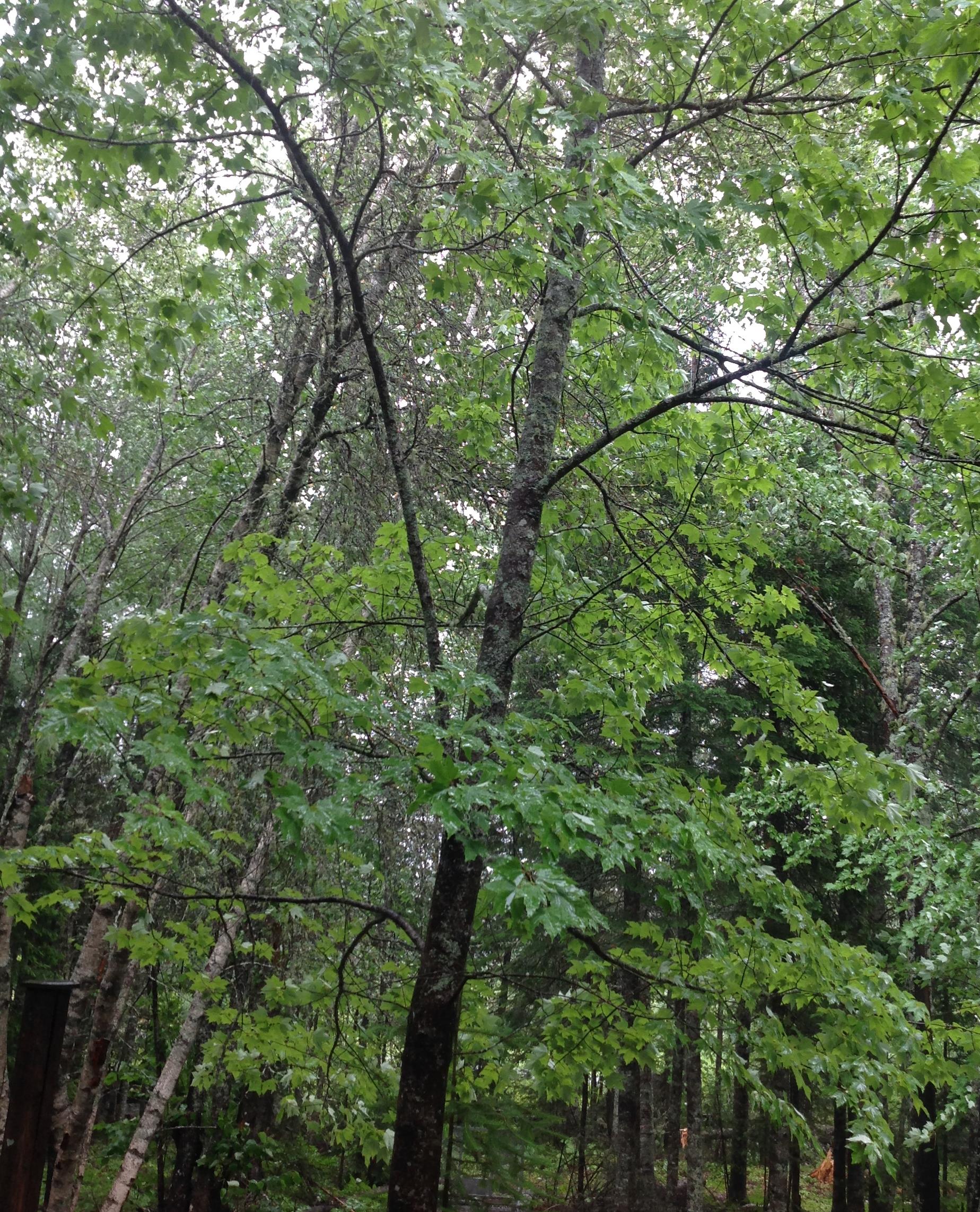
trees in hurricane rain
~
Arthur
~
woods are a green ocean
swell, each oak a breaker, and pines
crash on the shore, withdraw, branches
lift and fall, lift and settle
maples gyrate, invert their leaves, backlit
waves, spray from every
blade, winds tug at petiole, green
debris on the deck, fallen stars
on the lawn, the wind a rumble, every
branch a knife, each trunk a bow, bent
beyond the stretch of fibre, trees heave
branches lash, in the woods a crack
pummels the growl of a chainsaw in
the neighbor’s yard
~
~
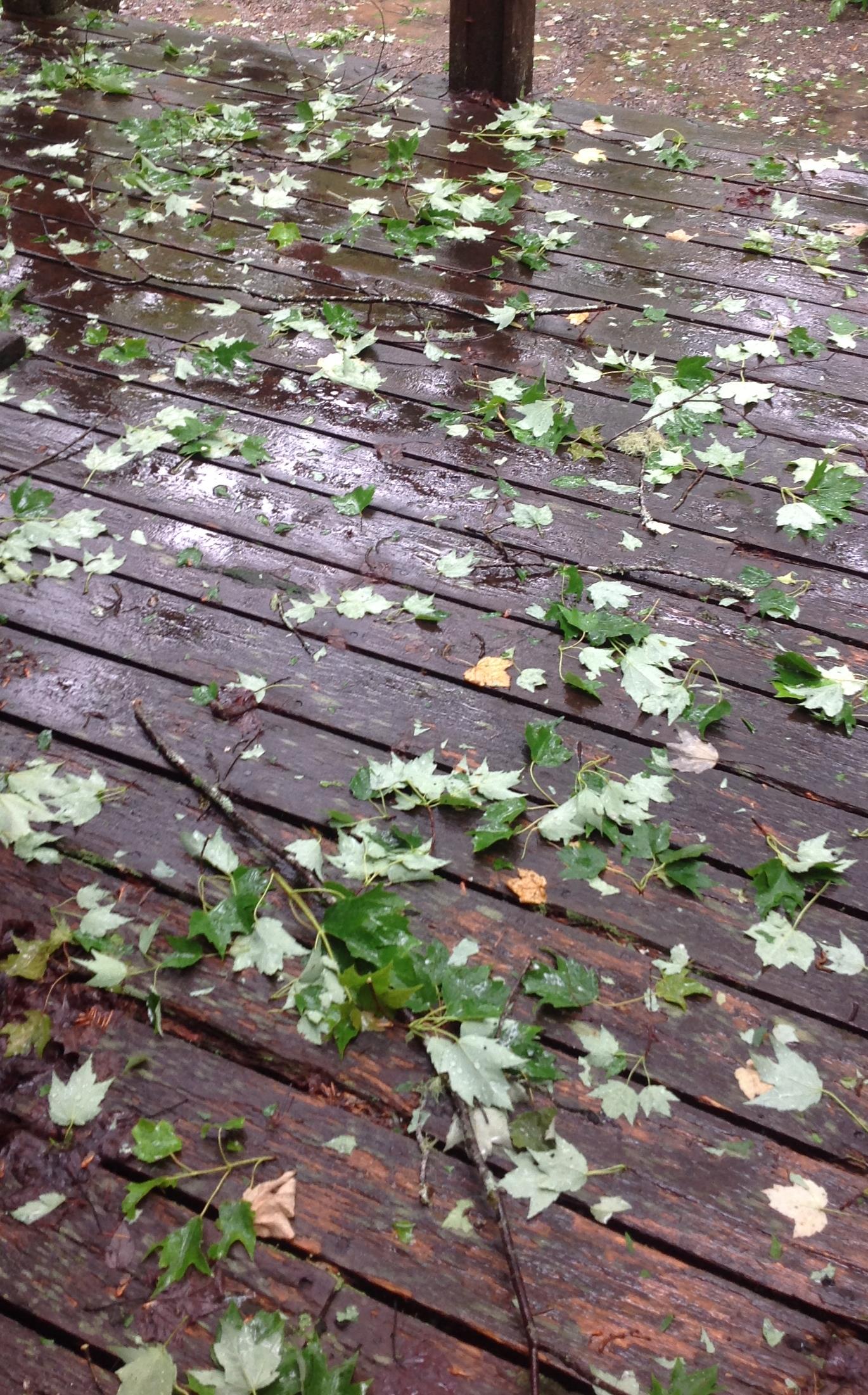
bunches of leaves on the deck
~

a crack in the branch of our maple
~
Copyright 2014 Jane Tims
abandoned railroad siding
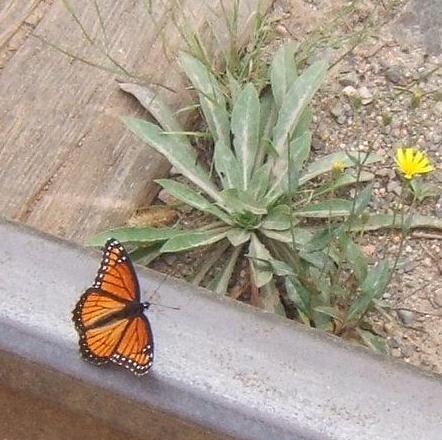
Viceroy on rail
~
abandoned railroad siding
~
a viceroy butterfly, orange
leaded glass
and rows of wary eyes
naturally suspicious
settles on the slate-grey rail
flexes its wings, nonchalant
~
as the black bear who
ambled the track
left a dump
of blackberry seed
undigested pulp
or the enthusiastic jumble of clovers
blooming between the ties
~
rails are held between the trill
of insect and the quaver
of goldenrod, caught in the crossfire of sun
light focused through
signal lenses
and glass insulators
on unstrung
telephone poles
~
turn toward horizon
rails merge and vanish
altered stride of railroad
walking made confident
by the absence of train
~
~
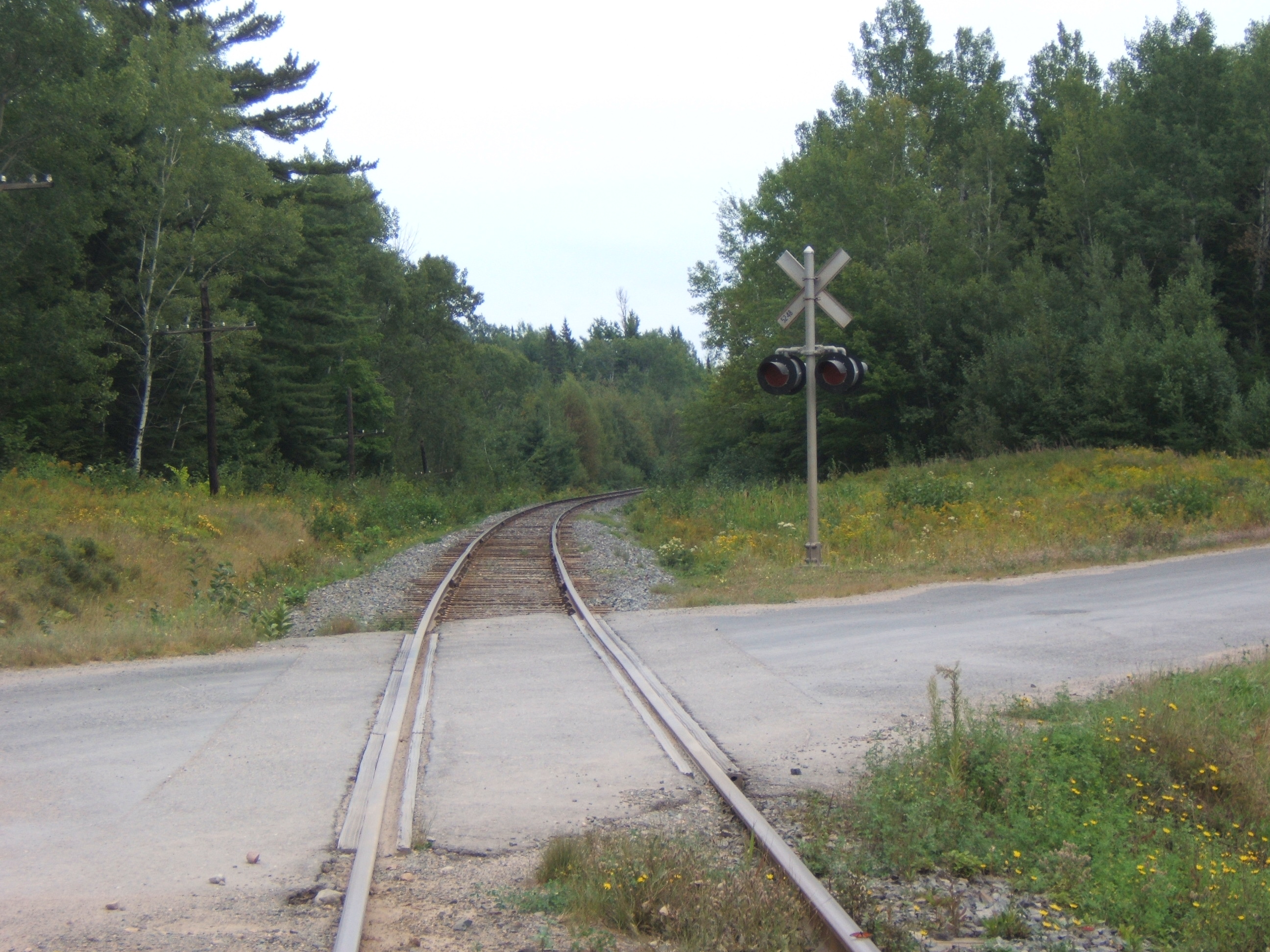
railway crossing
~
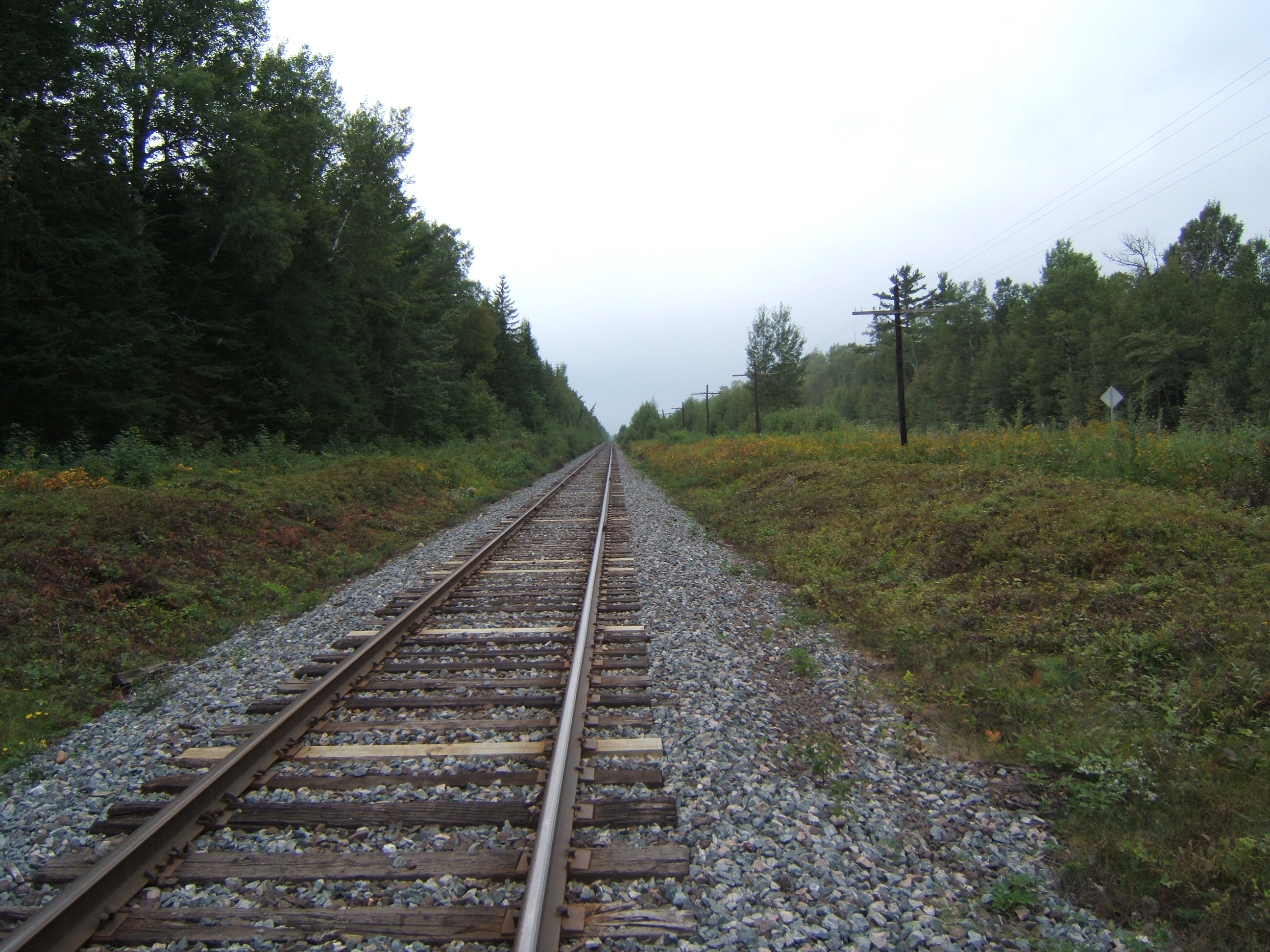
railway near Rooth, New Brunswick
~
Copyright 2014 Jane Tims
harvesting colour … colour of the harvest
On our weekend drive from Canterbury to McAdam, I saw another aspect of the ‘harvesting colour’ theme. Anywhere you travel in New Brunswick, you usually come across wood harvesting activity and Highway 630 was no exception. About half way along, a turn in the road brought us to a large forest harvest.
~

forest harvesting operation
~
The wood from the cut was stacked into gigantic walls.
~
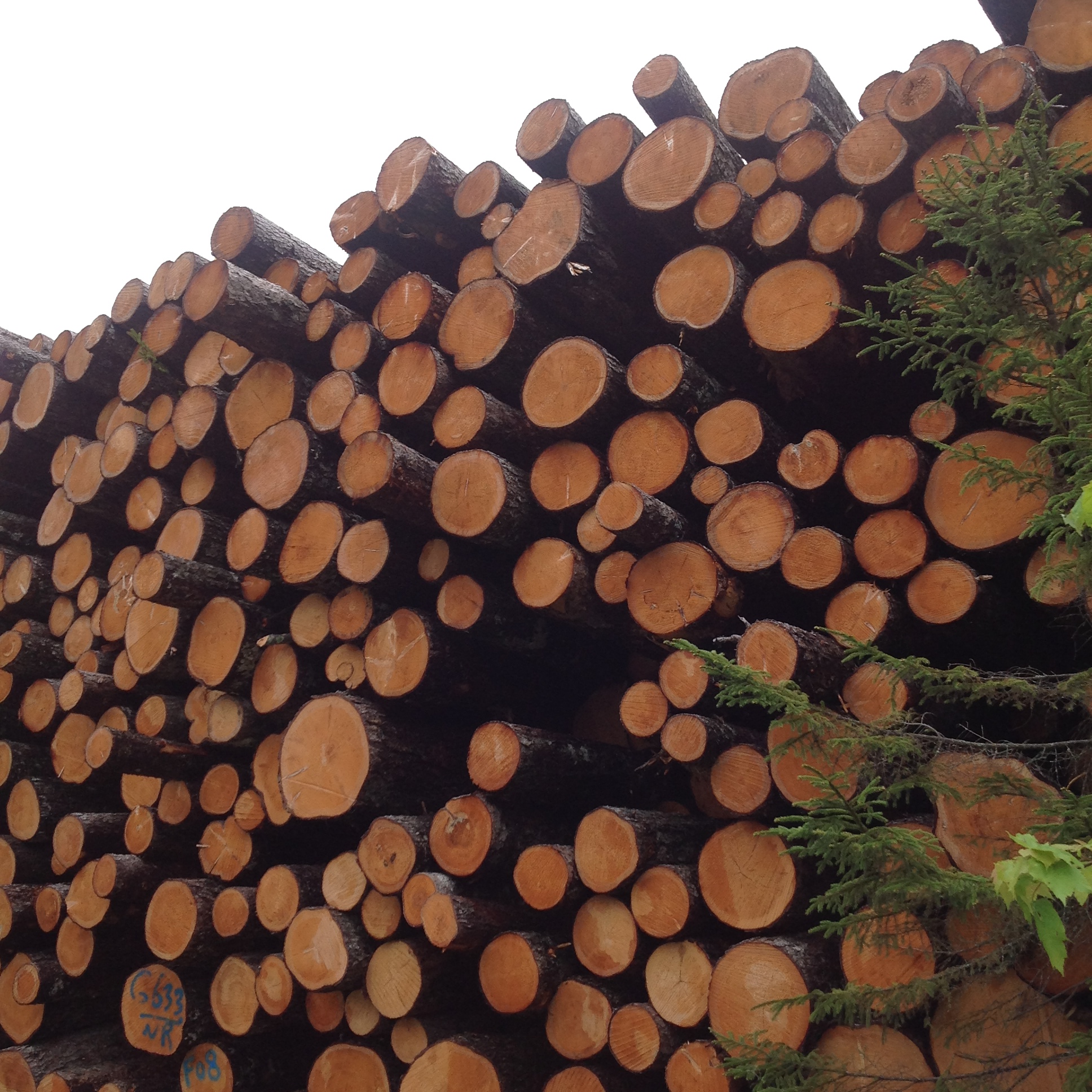
wall of cut wood
~
The clearcut laid the land quite bare. It will be many years before this area returns to the hardwood habitat typical of the area, if at all.
~

spruce and fir
~
The wood from the cutting had been piled according to species. The colours of the cut wood were quite distinctive. The largest colour contrast was between the pale almost white, ash …
~
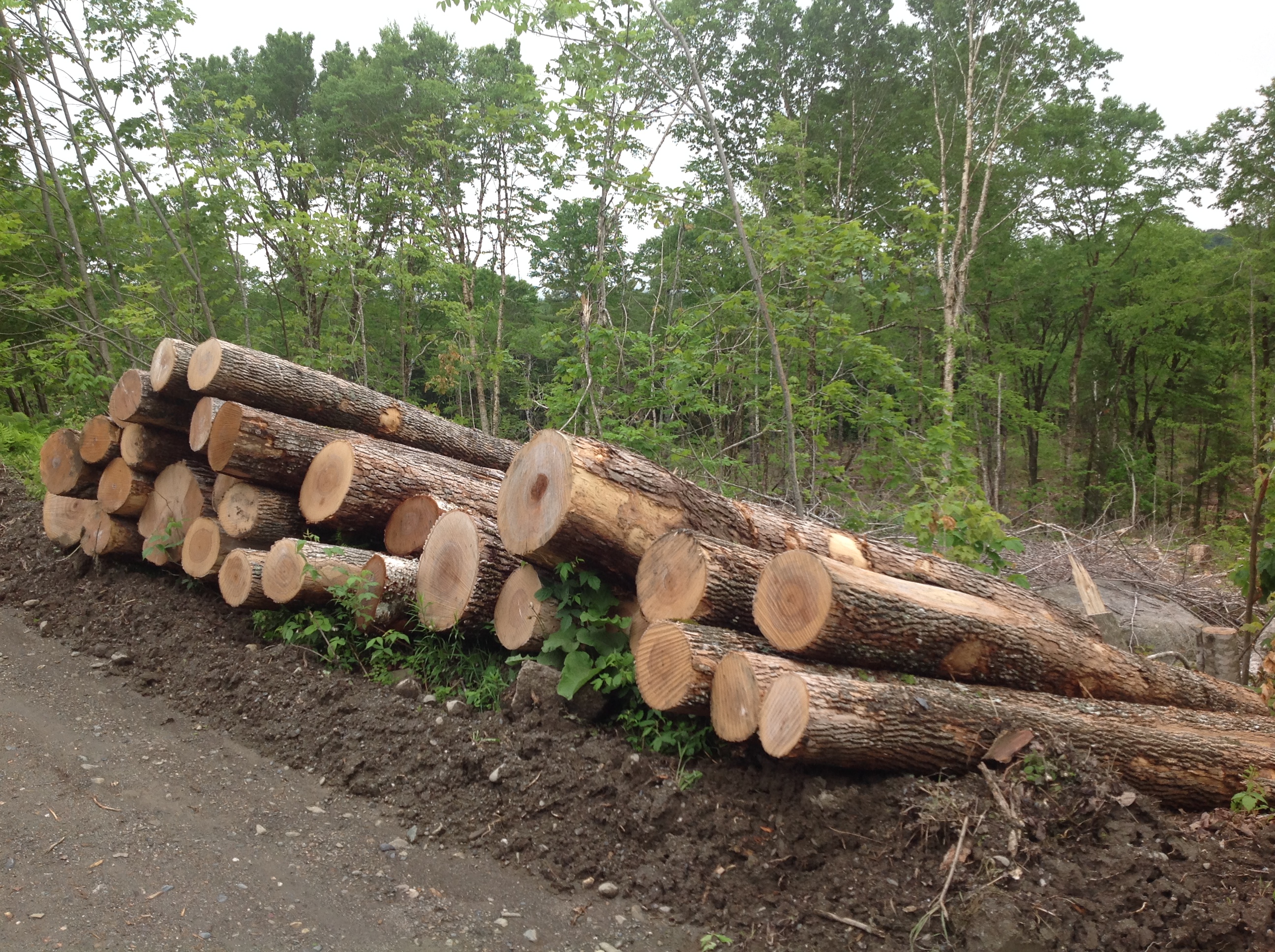
ash
~

ash
~
and the very orange wood of the spruce and fir …
~

spruce and fir
~
I have no particular point to make, except to honour the very individual characteristics of these trees.
~
Copyright 2014 Jane Tims
an attempt at ecoprinting
After our drive to Canterbury over the weekend, I was anxious to capture some of the roadside flower colour in my ‘harvesting colour’ experiments. I decided to try a technique described by India Flint in her book Eco Colour: Botanical Dyes for Beautiful Textiles (Interweave Press, 2010). ‘Ecoprinting’ involves bringing a plant into close contact with a fabric in order to transfer the colour to the cloth. I am very impressed with the effects shown in Eco Colour – prints of leaves, flowers and berries.
~
For my experiment I tried a handful of the Forget-me-nots I collected on our weekend drive …
~
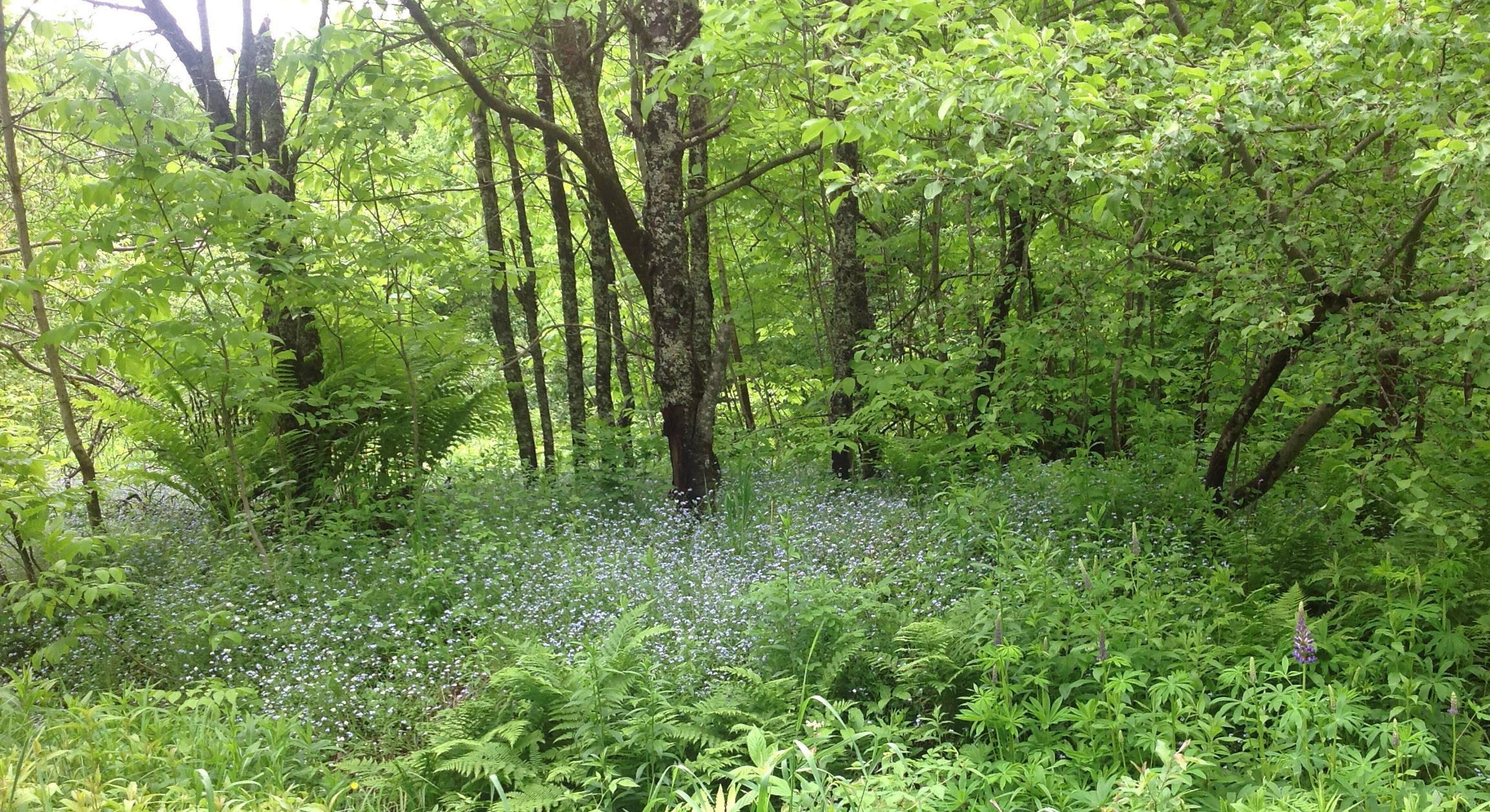
Forget-me-nots in the woods
~
a bundle of the purple Lupins growing along the road in my community …
~

Lupins along the road
~
and a bunch of a ground cover plant growing in my yard, Bugleweed (Ajuga reptans) …
~
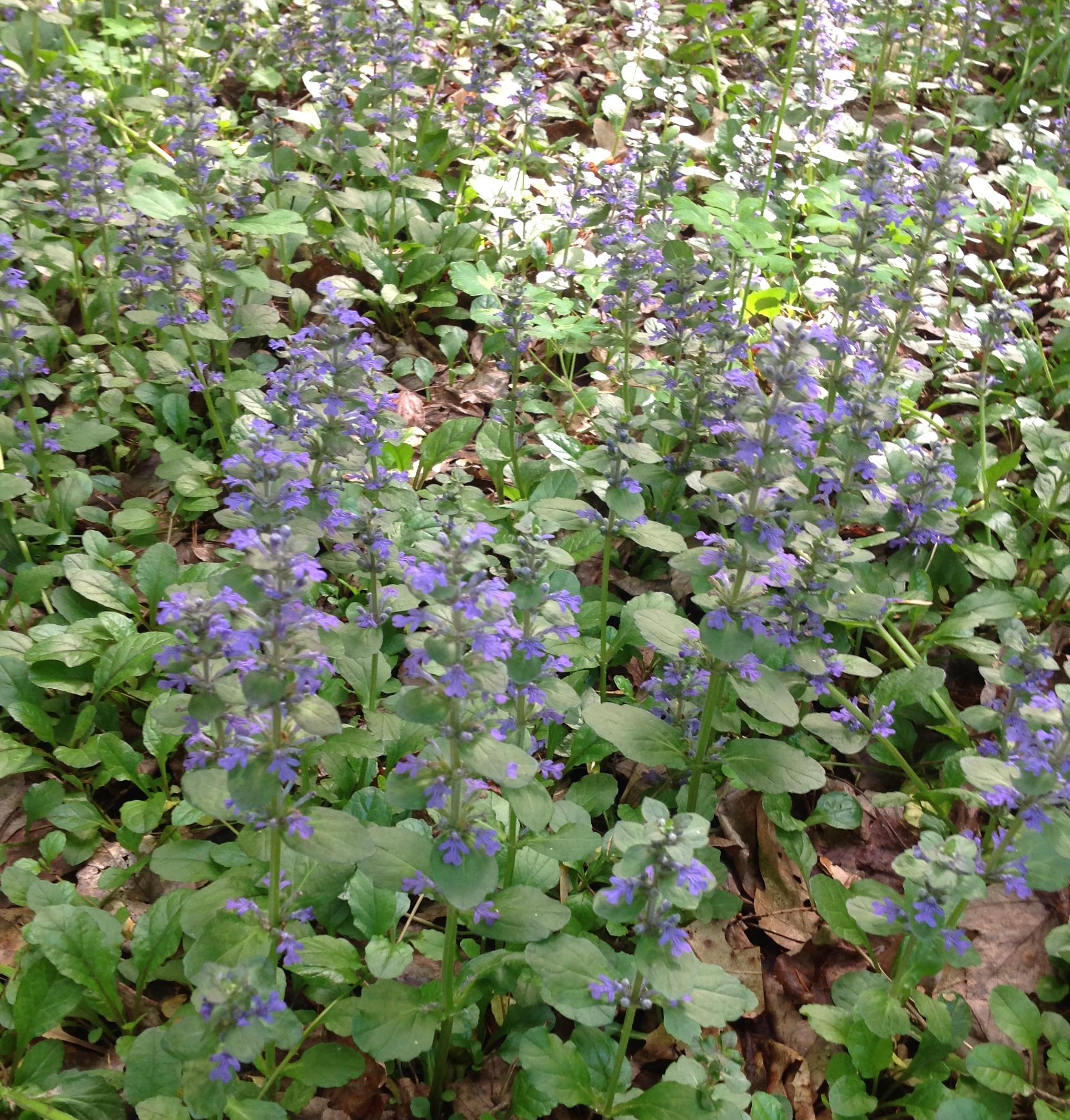
Bugleweed in the orchard
~
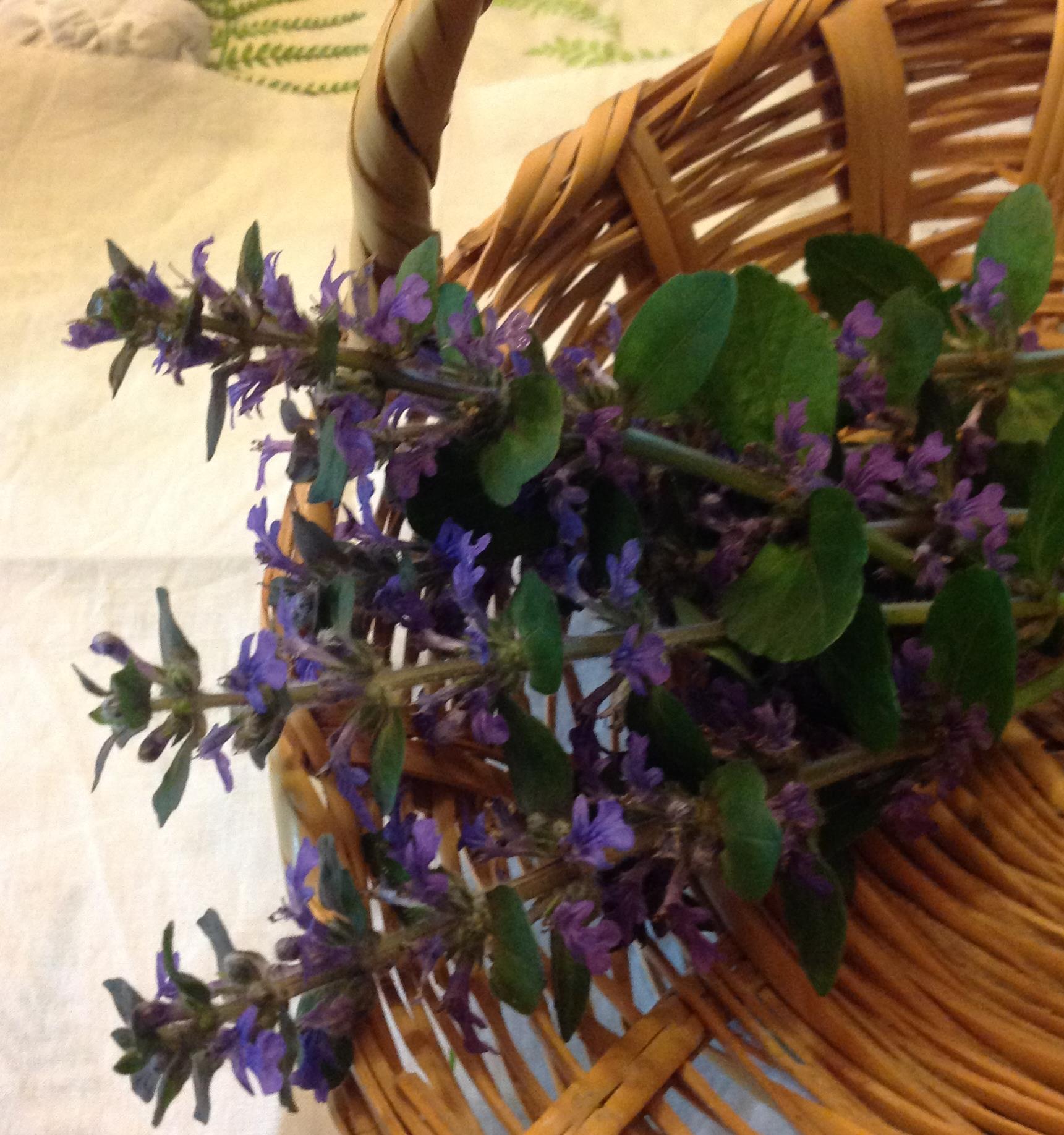
basket of Bugleweed
~
I only used small samples of cloth … my idea is to use these ‘patches’ to make a little quilt to show the results of my ‘colour harvest’. I arranged a few of the flowers, both petals and leaves, inside the cloth …
~

Forget-me-nots on cotton
~

Lupin petals and leaves on cotton
~
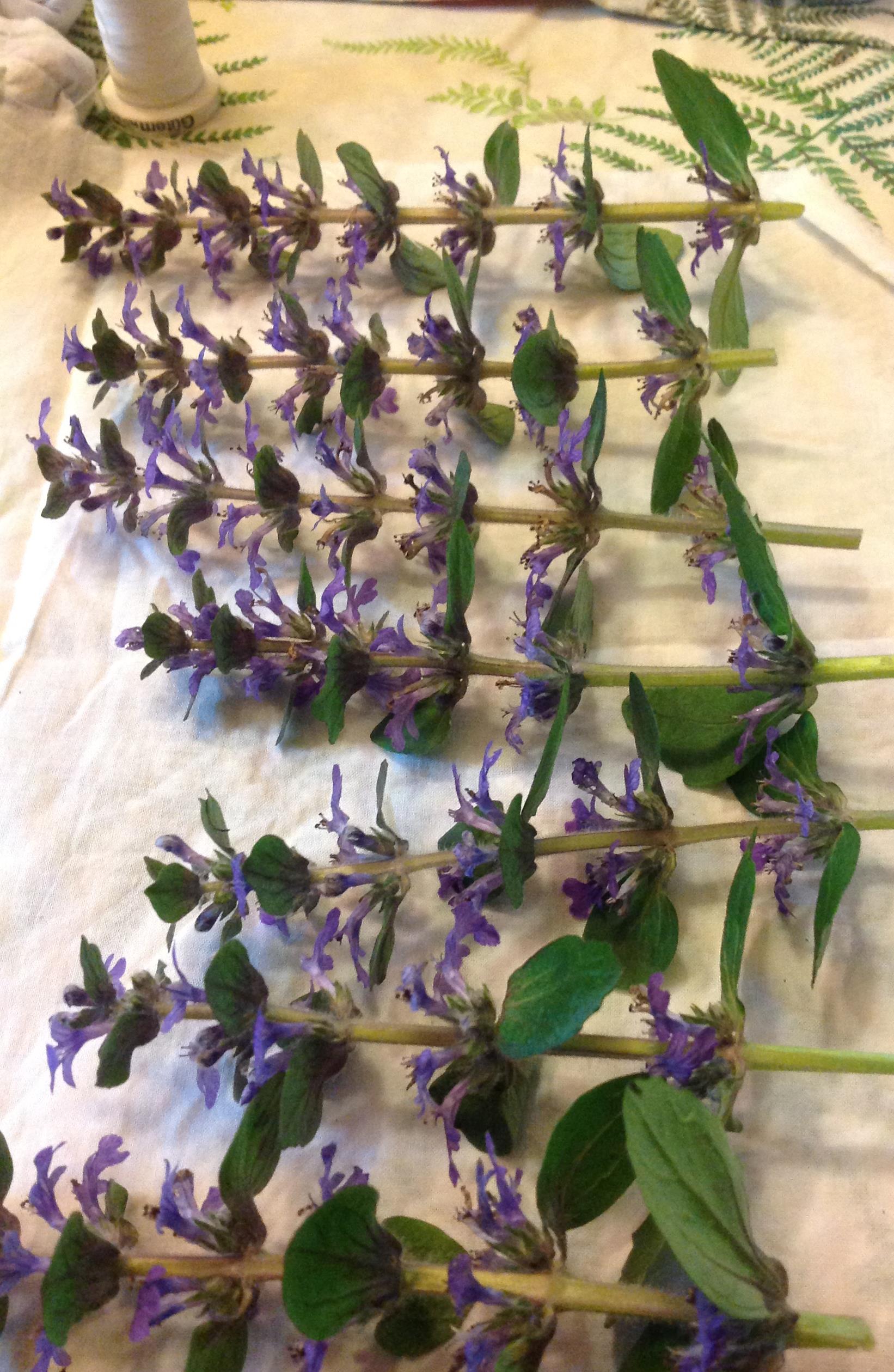
Bugleweed on cotton
~
Then I folded the cloth in half, enclosing the flowers like a sandwich …
~

flowers folded in cotton
~
and rolled the cloth up tightly …
~

rolling the bundle tightly
~
and tied it with cotton thread …
~

flower and cotton bundles
~
I put my bundles in a wire basket and steamed them for an hour …
~
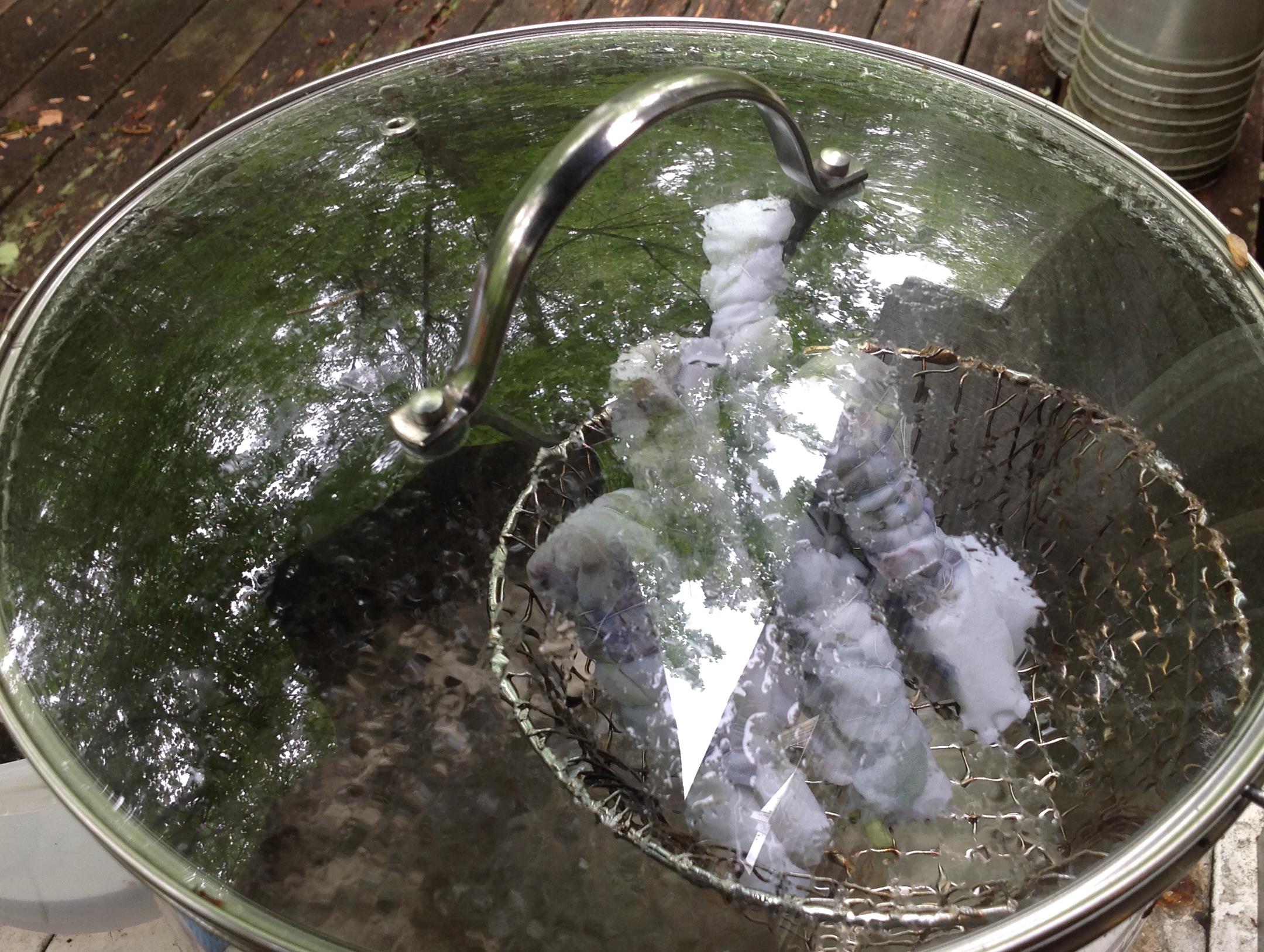
flower and cotton bundles steaming (as usual I have thrown in a bit of woods and sky)
~
After cooling, I opened the bundles, discarded the leaves and flowers, and rinsed the cloth. I was quite pleased with the results. After ironing, I have a pale array of colour. The Bugleweed left a definite lime green. The Lupin a more indefinite green and pale violet. The Forget-me-nots left a faint violet-grey.
~

pale colour
~
I did not get the flower and leaf impressions I expected, but I will keep trying. There are so many variables, steaming time and ‘unbundling’ time among them. I do hope to see that lovely lime green again!!!
~
Copyright 2014 Jane Tims
blue in the woodland
About a decade ago, we took a drive from Canterbury to McAdam on a gravel road. The memory I have carried with me for years is of a section of woodland absolutely blue with flowers. I often wondered what the flowers were and if I’d be able to find the spot again. This weekend we tried to find the place and the sea of blue in the woodland.
~

Highway 630 from Canterbury to McAdam in New Brunswick (map from Google Maps)
~
Canterbury, like many rural communities of New Brunswick, has faced a shrinking population over the years. Settled by Loyalists, it was a center for logging and railroad traffic and, in the late 1800s, had a population of over 1000. Today it has only about 340 residents. Nevertheless, it is a charming village and has a newly renovated school, housing all 12 grades.
~
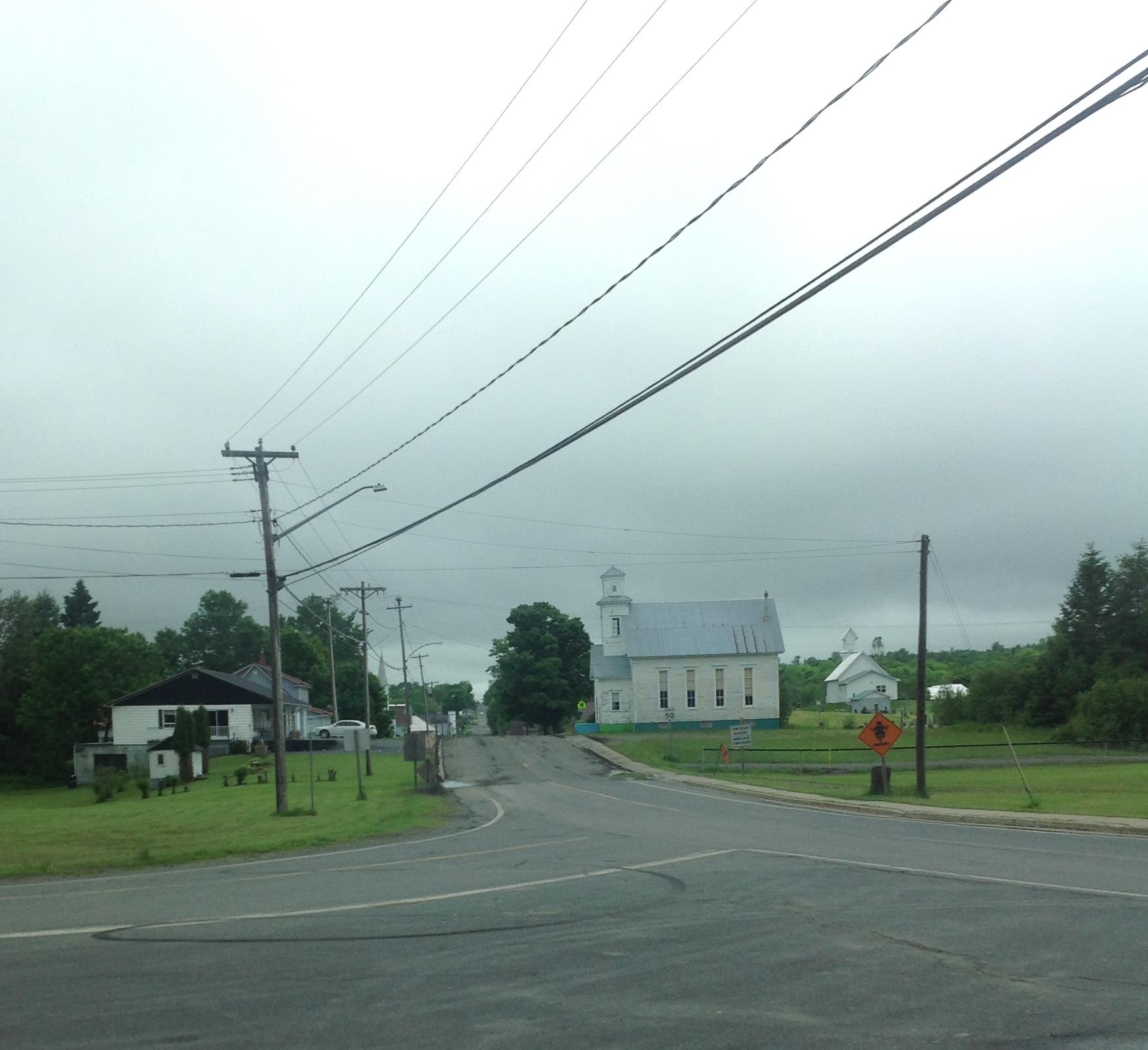
Village of Canterbury at the turn to Highway 630
~
The route from Canterbury toward the south is a numbered road. But Highway 630 is not paved and quite rutted in some sections. In one place we had to ask some ATVers if we were on the right road!
~

Highway 630
~
As we drove, I watched the woods for those blue flowers. Wildflowers were certainly a theme of our drive. By the road we saw Pink Lady’s Slipper (Cypripedium acaule), Bluebead Lily (Clintonia borealis), Bunchberry (Cornus canadensis) and Quaker Ladies (Houstonia caerulea).
~
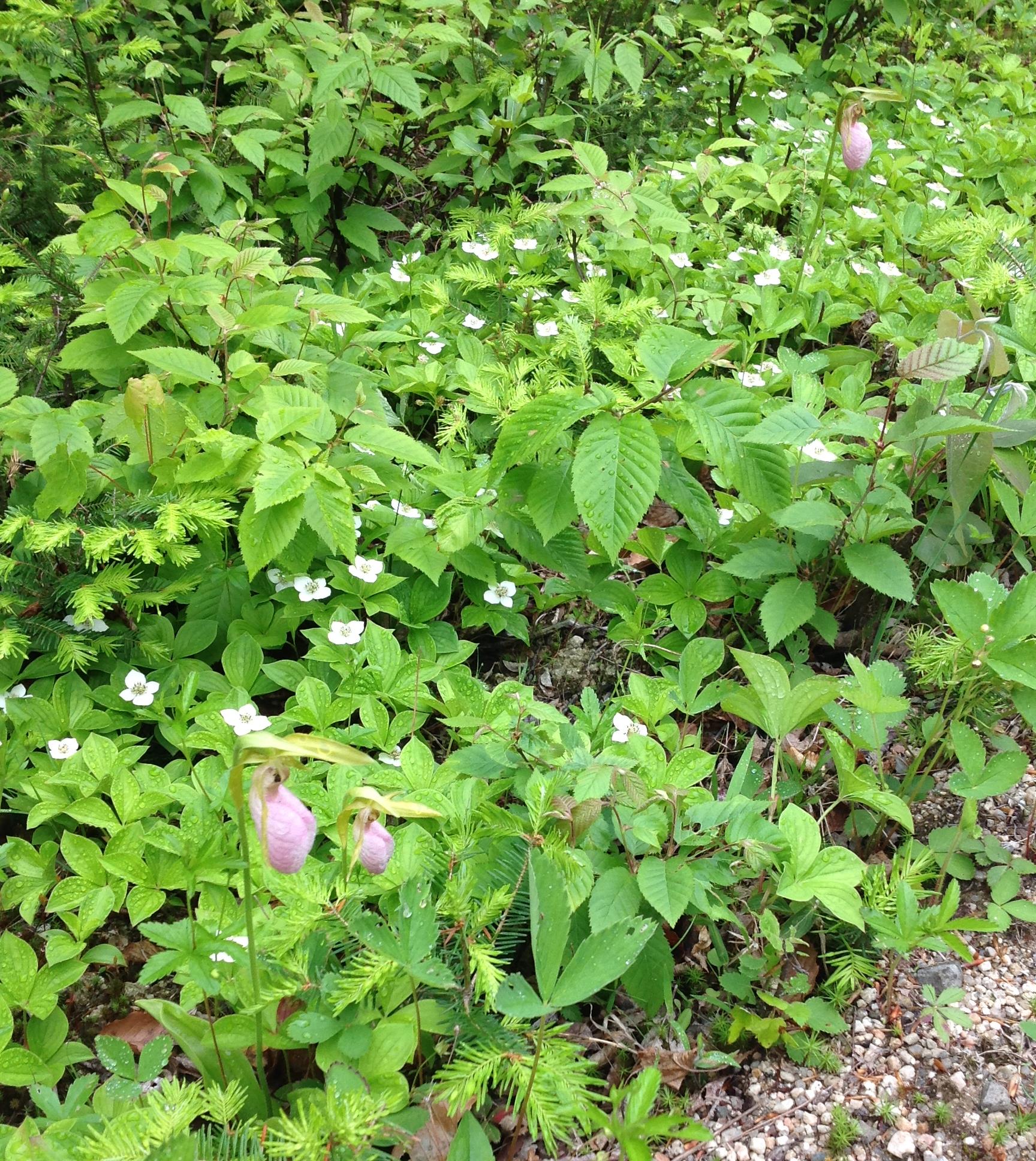
Lady’s Slipper and Bunchberry along the road
~
The map shows a community named Carroll’s Ridge just south of Canterbury. When we reached the location marked on the map, there were no homes or buildings, only a few old roads and cleared areas. But there in the woods was evidence people had once lived there. I found my sea of blue! Forget-me-nots, escaped from some forgotten garden to thrive in the near by woods.
~

Forget-me-nots escaped from an old garden
~
In my memory, the ‘blue’ of the flowers was more intense a decade ago. But we noticed many of the Forget-me-nots there now are a white variety. Who knows if flower colour or memory really changed during those ten years.
~

blue flowers in the woodland
~
Forget-me-nots in the woods
~
I picked a few of the Forget-me-nots, to try an ‘eco-print’ dyeing experiment in coming days. But what I really took away was another image of a sea of blue flowers in the woods.
~
Copyright 2014 Jane Tims
aromatic spring
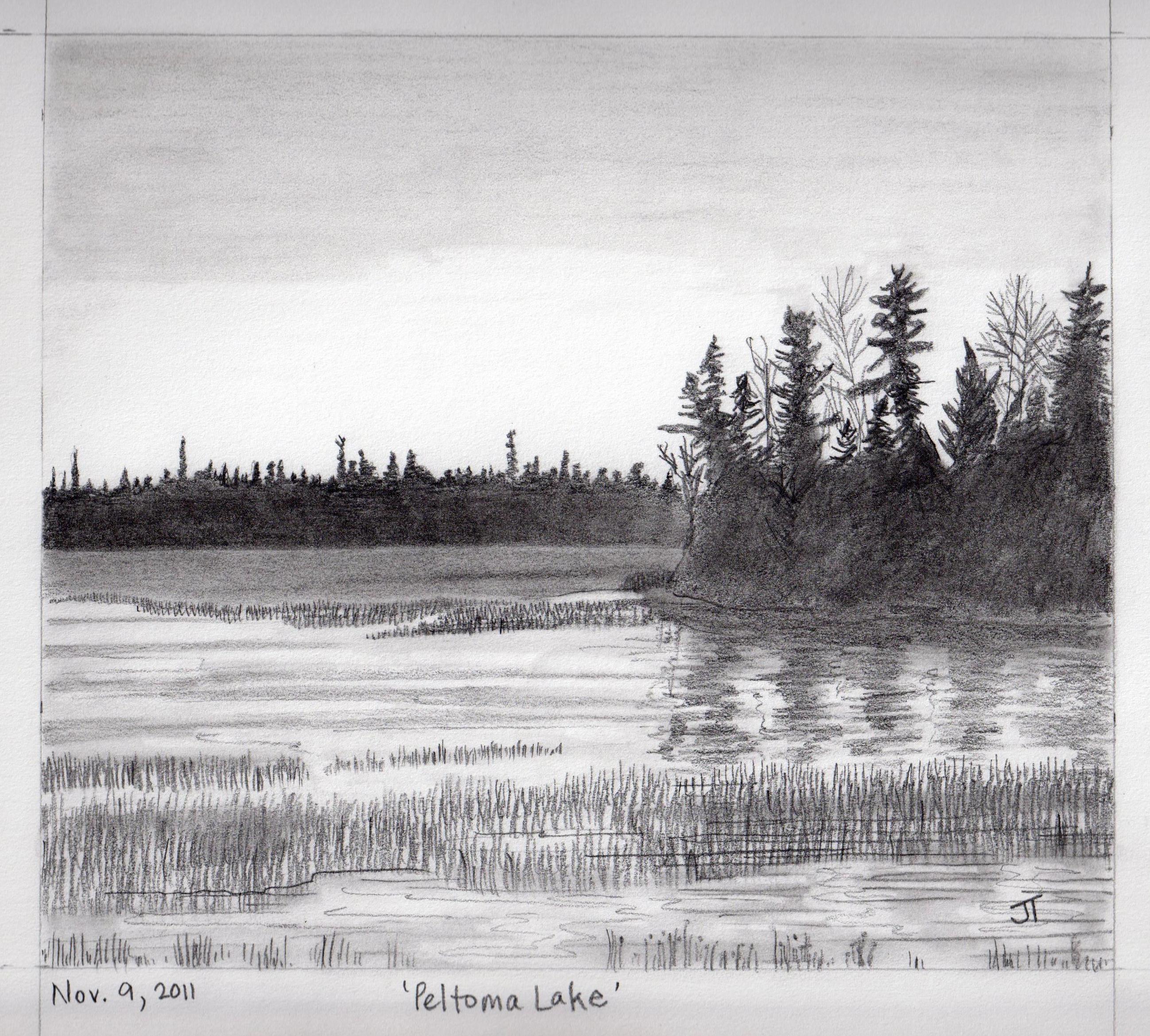
November 9, 2011 ‘Peltoma Lake’ Jane Tims
~
meadow aromatic
~
ozone lightning, late
waters cede, shoots
of cattail merge
end of day, end of June
fireflies, mosquito nights
~
lake-land meadow seeps
wetland meets nostril
marsh musk percolates
half sour, half sweet
methane ooze, decay
~
damp fiddleheads unfurl
bird beaks simmer
in duckweed soup
skin of salamander, frog
steeplebush, meadowsweet
~
angels crave human years, allow
their pores release, scent imitates
reek of sweat, of work
tears mingle with perfume
aftershave and powder
~
~
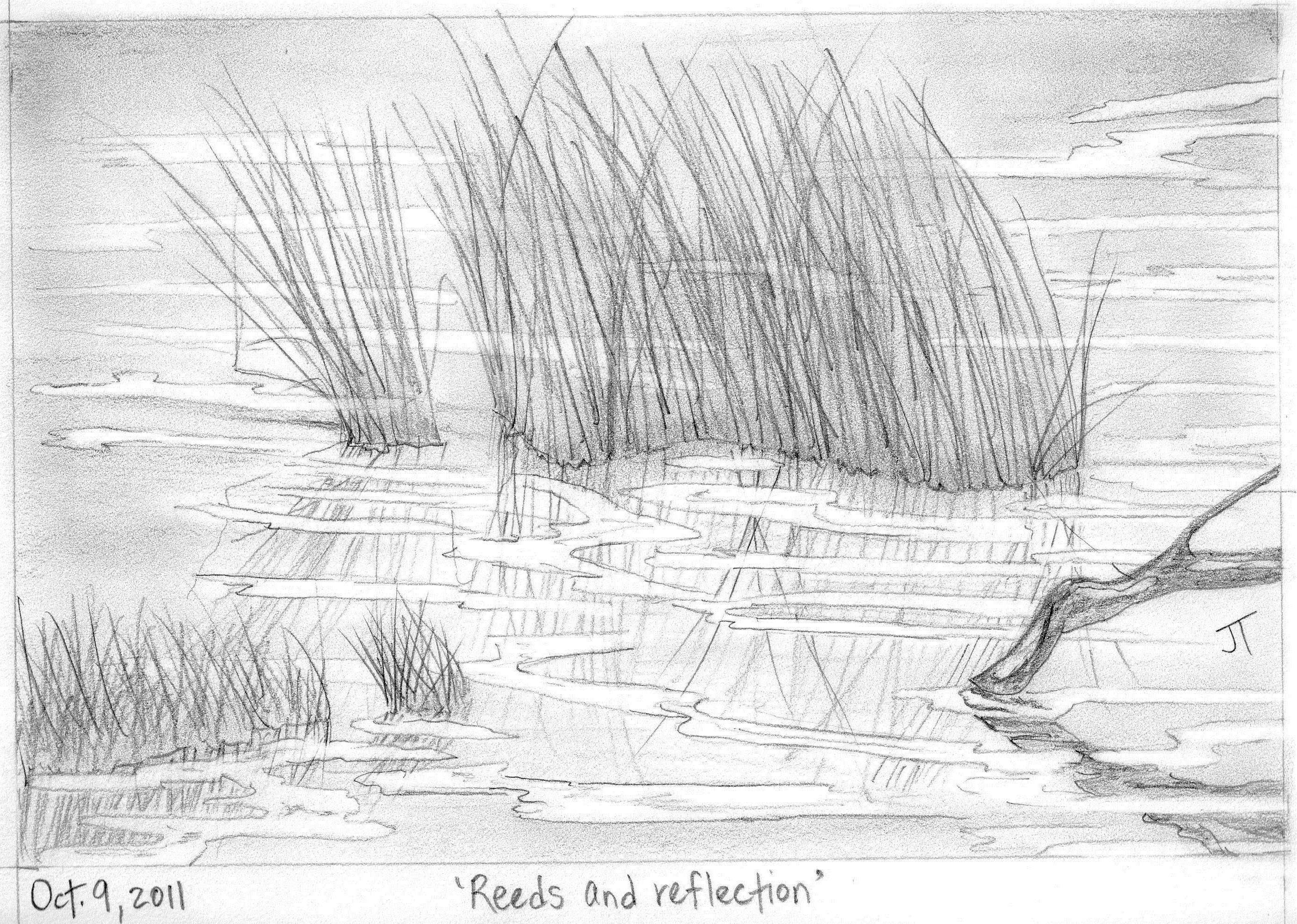
Oct. 9, 2011 ‘Reeds and reflection’ Jane Tims
~
Copyright 2014 Jane Tims
comforting Comfrey brown
As I try using various plants as a source of dye, I am realising how many shades of brown there are !!!
~
Over the weekend, I did a dye vat of Comfrey. Comfrey (Symphytum officinale) is a flowering plant often found in older gardens. It is a useful plant for gardeners … as a fertilizer, it contributes impressive amounts of nitrogen and potassium. As a compost component, it adds heat and moisture, and helps to speed up the composting process. In the past, Comfrey was recommended as a tea and a medicinal. However, the plant contains alkaloids. Taken internally, these can cause severe damage to the liver and, in Canada, the sale of products containing Comfrey is prohibited.
~
Comfrey grows in large clumps of linear leaves, up to a meter tall. Its stately foliage provides a great backdrop for smaller plants. Later in the season, it will produce curved clusters of bluish-purple flowers.
~
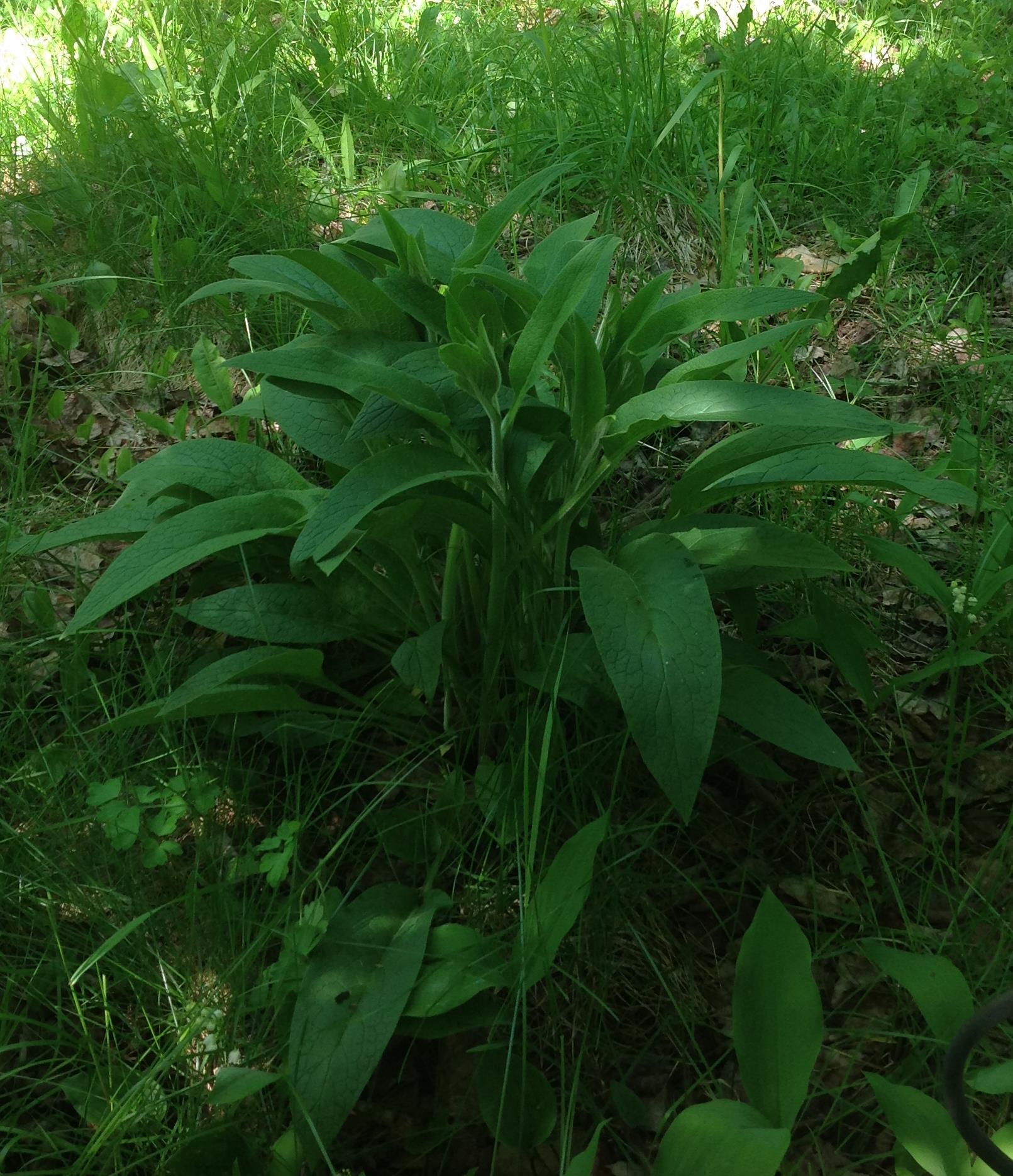
Comfrey in my garden
~
The underside of each Comfrey leaf is a maze of raised veins …
~
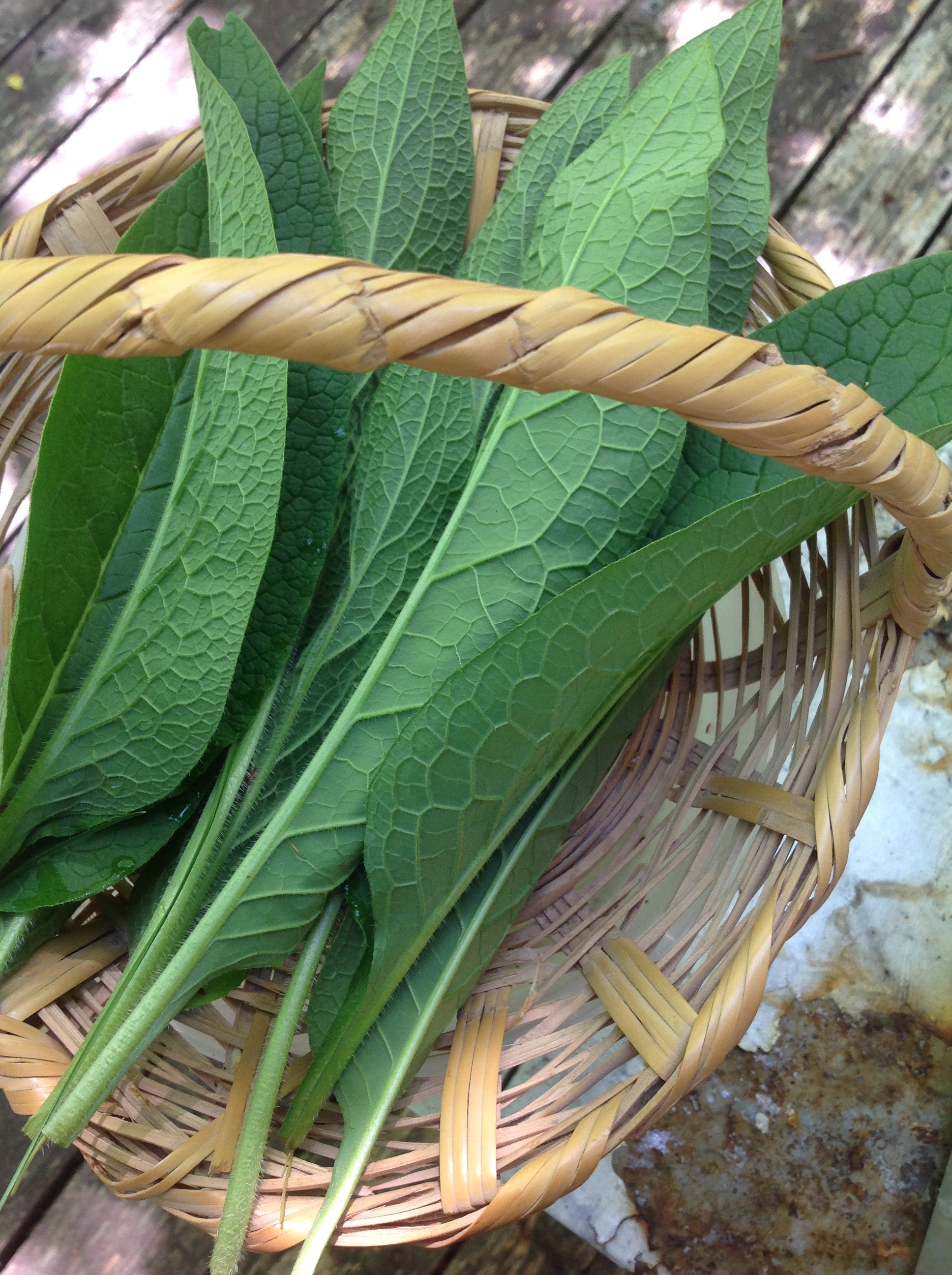
leaves of Comfrey, showing the veins on the underside of each leaf
~
To make the dye, I added the leaves, coarsely chopped, to 6 liters of water. I couldn’t resist throwing in my rusty square nail, to add a touch of iron to the mix …
~

Comfrey leaves in water, cut up and ready for the boil
~
After boiling for an hour, I had a pale apricot-coloured liquid …
~

pale apricot colour of the Comfrey dye
~
I strained and discarded the leaves (in my compost of course) and allowed the liquid to cool. Then I added some of my wool roving, pre-treated with alum, and simmered the wool for about an hour.
~
The result was yet another shade of brown, so similar, yet so different from the browns I obtained from Alder, Old Man’s Beard lichen and Tansy …
~

various dyes on wool roving (left to right): Alder bark, Old Man’s Beard lichen, Comfrey, Tansy and a glimpse of Beet
~
The Comfrey brown is a brown of the forest, without the orange or yellow undertones of the other browns I have made. This is the brown of the wild rabbit I saw in our driveway last week. It is the buff brown of the heads of Pine Siskins visiting our bird feeders in winter. This brown reminds me of soft mitten wool and caterpillar cocoons. From Comfrey comes a very comforting brown.
~
Although I could use my wool roving ‘as is’ in my weaving, I have decided to spin the wool. First, of course, I have to learn to spin. A maple drop spindle should be waiting in my mailbox later in the week. So many projects … good thing the days are getting longer !!!
~
Copyright 2014 Jane Tims
writing weekend
This weekend, I will be attending WordSpring. WordSpring is the annual spring meeting and workshop of the New Brunswick Writers’ Federation. I will be reading some of the poetry from my ‘harvesting colour’ manuscript and I will get another eye on part of my novel at a Blue Pencil Café.
~
Preparations for the weekend made me think of a poem I wrote after the workshop in Saint Andrews a few years ago …
~
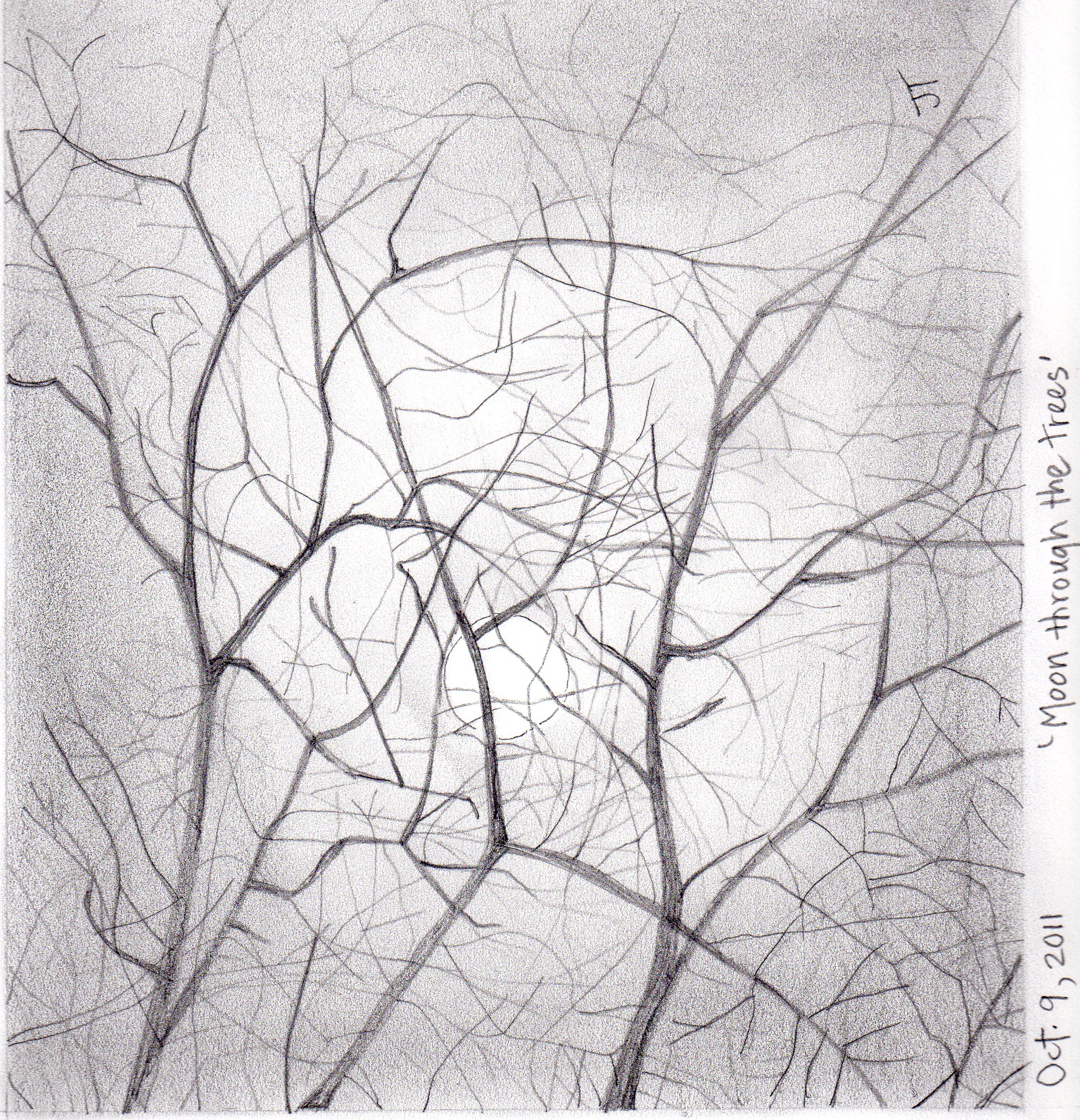
October 9, 2011 ‘Moon through the trees’ Jane Tims
encounters
~
on a windy night
in Saint Andrews, a toad
hop-toddies across the road,
bewildered
~
and on Prince of Wales, a deer
pauses on the sidewalk, stares
up the hill, and I hesitate
before driving on
~
in the Algonquin, a light
switches on, in the room I know is mine
and a couple huddles on the open porch,
and leaves, mottled, skid
along the street
~
~
Copyright 2014 Jane Tims







 nichepoetryandprose