Posts Tagged ‘Mayflower’
bookmarks and dog ears: new poetry
Hi everyone. I have been working on a new project, honouring bookmarks, such an important part of our reading life. I will be exploring the humble bookmark in poetry and drawings.
~
In Oromocto in New Brunswick, we have a wonderful second-hand bookstore, Dog Eared Books. When used books are brought to the store, staff save the bookmarks they find. My project is to capture some of these in a book-length manuscript. To learn more about this project, click here.
~

~
I am about five weeks into the project and I am having a very rewarding time. The bookmarks are diverse in character and I have had to learn a lot about subjects quite new to me. Just an idea of the variety I have encountered:
- class notes on ways of presenting arguments in the field of logic;
- a hockey card of one of the Soviet players in the 1970’s;
- a chart showing the Queens and Kings of England;
- a local teacher’s permit from 1959;
- a bookmark from Owl’s Nest Bookstore in Fredericton (now closed);
- a stack of small cards made for a game of charades;
- a card with the number ‘150’ — from an Irish dance feis competition.
~
These are only a few of the collection.
~
Because I love bookstores, the bookmark from the Owl’s Nest Bookstore was of interest. The word ‘bibliosma’ refers to the smell or aroma of books. The books I mention in the poem were in the bookshelves of the store in the weeks before it closed, evidenced by their Facebook posts and photos.
~

~
bibliosma
‘… went all the way to Fredericton to buy this old book’
-saying on a bookmark
~
Owl’s Nest Bookstore
grey cat purrs in the window
prowls between stacks
while I search for wildflowers
careful steps between hardwoods
lifting of leaves, counting of petals
rummage for botany among
overflowing shelves of books
~
first find, hardcover, dark green, old
1919 Botany of the Living Plant
Frederick Orphen Bower, botanist,
lover of ferns
~
and here, The Wildflowers of Canada—1895
a reprint classic, on the cover, scant
specimen of golden chain tree ‘Laburnum,’
scentless but inside—heady smell
of mayflower, lily of the valley, lilac—
colour plates of wildflowers
~
and a hardcover, The Blossom on the Bough: A Book of Trees
Diane Ophelia Dowden, 1826
delicate apple blossom overcomes
almond and vanilla smell of books
three bees buzz, overpower
rumble of traffic on Queen Street
~
copies of The Fiddlehead
my poems in some of them
‘Old Man’s Beard’ The Fiddlehead 180, 1994‘
‘The Gazing Ball’ The Fiddlehead 196, 1998
~
find the book
you didn’t know you wanted
at the bottom of a pile
glimpse of indigo shimmer of water
No Faster Than a Walk
Gillis and Gillis
love covered bridges
~
book on the top shelf
always
a
stretch
Gavin Maxwell
Ring of Bright Water
‘it is no will-o’-the-wisp
that I have followed here’
~
book store closed in 2018
blue and white bookmark
left between pages
sketch of an owl
memory of a grey cat
a forest of books
bibliosma
~

~
I hope if you are from the Fredericton area, you remember the Owl’s Nest Bookstore. And I hope you enjoy my poem.
All my best!
Jane
mayflowers
In spring it is always fun to put all your senses together and search out the elusive mayflower, also known as trailing arbutus. Epigaea repens grows in the open woods where I live. You usually have to search for the trailing leaves and lift them to find the flowers.
~

~
touch: the leaves are furry on the underside and smooth above; the petals of the flower are waxy.
~
smell: the flowers are fragrant with a sweet, almost heady perfume.
~
sight: the flowers are white to faintly pink; leaves are green with coppery brown surfaces and edges.
~

~
Trailing Arbutus
(Epigaea repens L.)
~
on the slope, new leaves
Trientalis, Gaultheria
Star-flower, Wintergreen,
vines of Partridge-berry creep
Maianthemum unfurls
~
beneath the din, a melody
weeps Epigaea, evergreen
pressed to the hillside
leather armour, thickened leaves
weather-beaten, worn
~
waxy bloom resists
subtle shadow
predator
unrelenting rain
~
~

~
all my best,
staying at home,
Jane
I’m from Canada …
As I have been building my family tree, I am discovering how many ‘places’ my ancestors have called home.
~
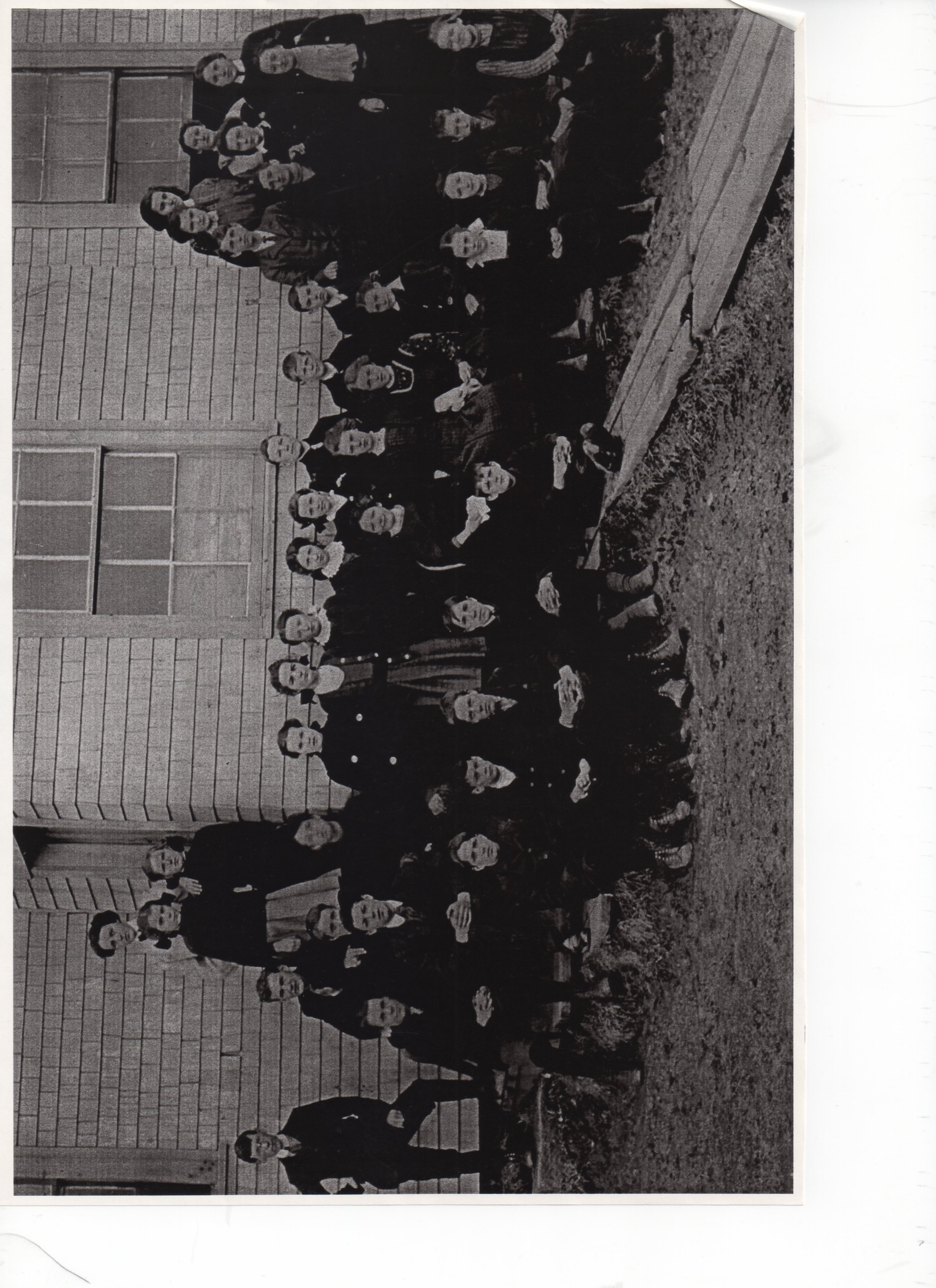
my grandmother and her brother and four of her sisters appear in this photo at a school in Nova Scotia in the early 1900s
~
The people I would call grandfather or grandmother (with greats added) include people who came to Canada or to the United States from England, Scotland, France, and Germany. Some of their parents came originally from the Netherlands.
- John Winslow (b. 1597) Droltwich, Worcestershore, England (1620)
- Mary Chilton (b. 1607) St. Peter, Sandwich, Kent, England (Mayflower 1620)
- Patrick McMullen (b. 1704) Scotland
- Peter LeValley (b. 1675) France
- William Spavold (b. 1810) England (Trafalgar 1817)
- Eliza Greenfield (b. 1790) England (Trafalgar 1817)
- Stephen Hopkins (b. 1581) Upper Clatford, Hampshire, England (Mayflower 1620)
- Elizabeth Fisher (b. unknown) England (Mayflower 1620)
- Francis Cook (b. 1583) Gides Hall, Essex, England (Mayflower 1620)
- Hester Mahieu (b. 1585) Canterbury, Kent, England (1623)
- William Latham (b. 1608) Chorley, Lancashire, England (Mayflower 1620)
- Conrad Hawk (Sr.) (b. 1744) Germany
- Conrad Kresge (b. 1730) Amberg-Sulzbach, Bayern, Germany
- Johan Ulrick Kohl (b. 1702) Pallatine, Germany
- Solmey Cooll (b. 1702) Germany
- Johann Nicholas Borger (b. 1720) Nassig, Baden-Württemberg, Germany
- John Clark (b. 1793) Straiton, Ayrshire, Scotland
- Jane Cooper (b. 1799) Greenock, Scotland
- Margaret Miller (b. 1798) Hoddam, Dumfriesshire, Scotland
- William Aitcheson (b. 1794) Annan, Dumfriesshire, Scotland (1832)
- — Wayborne (b. 1836) Rockbeare, Devon, England
- John Johnson (b. 1780) England
~
To make me, how many different people from so many different places had to get together!!! As my aunt used to say, just being here, we have already won the greatest lottery of all …
~
One of my next genealogy / virtual cycling project will be to track down when they came to Canada or the United States. Immigration records and passenger lists of ships will help me in this endeavor.
~
Copyright 2014 Jane Tims
Trailing Arbutus (Epigaea repens L. var glabrifolia)
One of the common flowers of early spring is the Mayflower (Epigaea repens L. var. glabrifolia), or Trailing Arbutus, also called Epigee rampante in French. It belongs to the heath or heather family (Ericaceae). It grows in open woods, or pastures, and along hillsides, in acidic soil.

Mayflower in bloom, photo taken in 1978 in Nova Scotia
The Mayflower is part of what Roland and Smith (The Flora of Nova Scotia, The Nova Scotia Museum, 1969) called the ‘Canadian Element’, woodland plants native to Northeastern North America and including common plants of the coniferous woods: Maianthemum canadense Desf. (Wild Lily-of-the- Valley), Mitchella repens L. (Partridge-berry), Gaultheria procumbens L. (Wintergreen) and Trientalis borealis Raf. (Star-flower), among others. When I worked on my M. Sc. thesis project, years ago, these were in the community of plants I encountered in the woods I was studying, and they are still my favorite plants.

two members of the ‘Canadian Element’ community – leaves of Wild Lily-of-the-Valley (left) and Wintergreen (right)
The name epigaea means ‘on the earth’, and perfectly describes the way the Mayflower grows. The specific name is from the Latin repens meaning ‘creeping’. The plant spreads across the ground, its oval, leathery leaves lying flat and overlapping. The leaves persist all winter and sometimes look a little weather-worn. The variety we have is glabrous on the lower leaf surface, meaning without hairs. The leaves grow on hairy, woody twigs.

leaves of Mayflower in the Grey Woods, April 2012
The flowers grow in clusters tucked beneath the leaves. They are creamy white, and are in the form of a short tube ending in five flaring lobes. They bloom mid-April to mid-May. The flowers along our woods have just completed their blooming. For a nostalgic look at the tradition of picking Mayflowers in spring, have a look at http://ahundredyearsago.com/2012/04/28/gathering-arbutus/
A delight of spring is to manoeuvre close to the ground so you can smell the Epigaea flowers. The perfume is very sweet, gently stirring. The only edible part of the plant is the flower and it tastes as sweet and fragrant as it smells. It is a shame to eat such a delicate creature as a Mayflower, but once a year I allow myself the privilege, just one tiny bloom (always be absolutely certain of the identification before you eat any plant in the wild). The plant is protected in some areas since it rarely sets seed and is almost impossible to transplant.
The Mayflower is the floral emblem of Nova Scotia and Massachusetts.
~
~
Trailing Arbutus
(Epigaea repens L.)
~
on the slope, new leaves
Trientalis, Gaultheria
Star-flower, Wintergreen,
vines of Partridge-berry creep,
Maianthemum unfurls
~
beneath the din, a melody
weeps Epigaea, evergreen
pressed to the hillside
leather armour, thickened leaves
weather-beaten, worn
~
waxy bloom resists
subtle shadow
predator
unrelenting rain
~
~

Warning: 1. never eat any plant if you are not absolutely certain of the identification; 2. never eat any plant if you have personal sensitivities, including allergies, to certain plants or their derivatives; 3. never eat any plant unless you have checked several sources to verify the edibility of the plant.
© Jane Tims 2012




 nichepoetryandprose