Posts Tagged ‘landscape’
aromatic spring
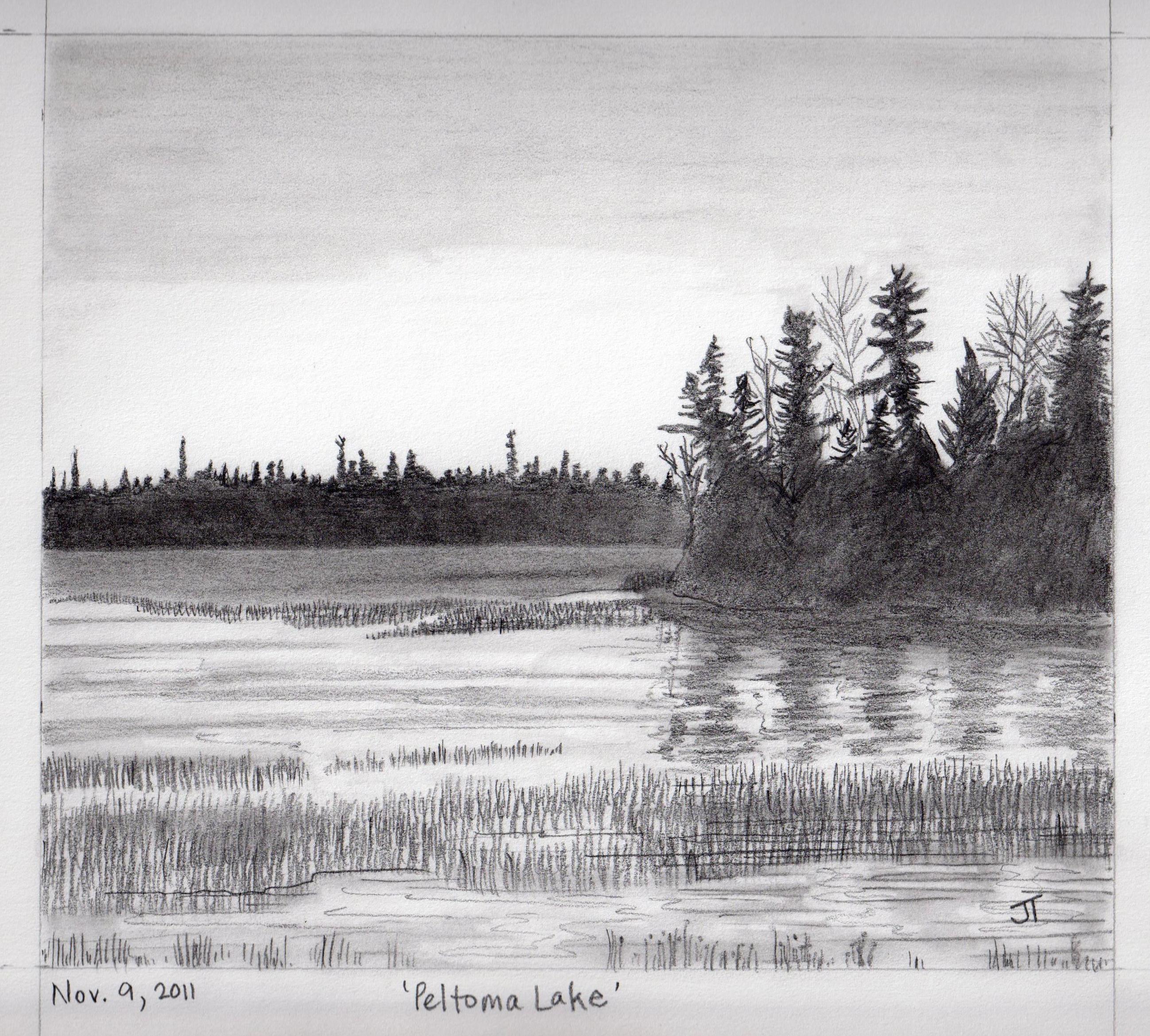
November 9, 2011 ‘Peltoma Lake’ Jane Tims
~
meadow aromatic
~
ozone lightning, late
waters cede, shoots
of cattail merge
end of day, end of June
fireflies, mosquito nights
~
lake-land meadow seeps
wetland meets nostril
marsh musk percolates
half sour, half sweet
methane ooze, decay
~
damp fiddleheads unfurl
bird beaks simmer
in duckweed soup
skin of salamander, frog
steeplebush, meadowsweet
~
angels crave human years, allow
their pores release, scent imitates
reek of sweat, of work
tears mingle with perfume
aftershave and powder
~
~
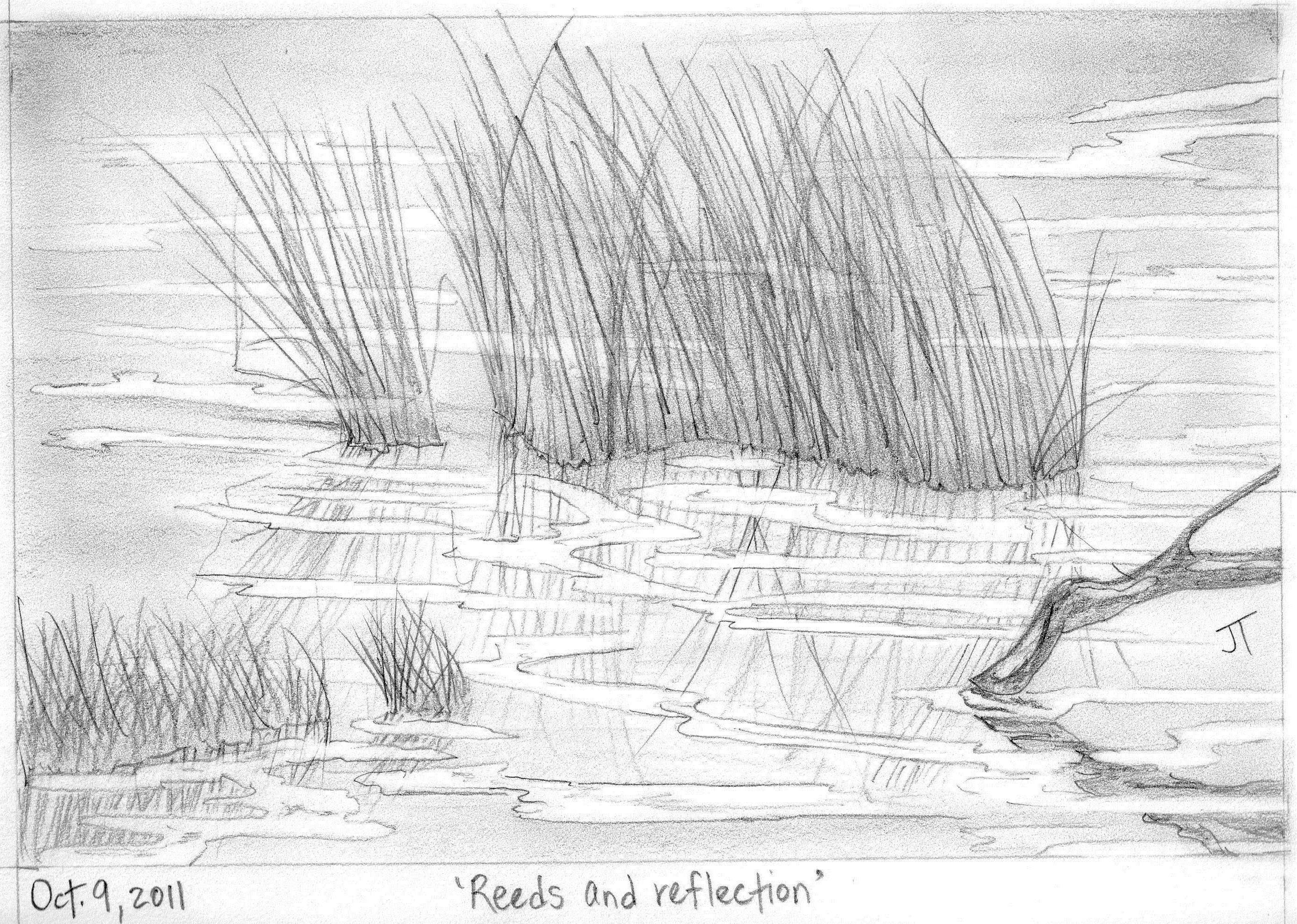
Oct. 9, 2011 ‘Reeds and reflection’ Jane Tims
~
Copyright 2014 Jane Tims
The Light Never Lies – A Guest Post from Francis Guenette
I am so pleased to welcome a guest in this post. Francis Guenette is a Canadian writer, the author of two books, ‘Disappearing in Plain Sight’ ( FriesenPress, 2013) and ‘The Light Never Lies’ (Huckleberry Haven Publishing, 2014). When I read ‘Disappearing in Plain Sight’, I was drawn to the setting – Crater Lake, the cabins and the garden. In this post, Frances writes about the setting, its origins and how the setting influences the story. Welcome Frances! And thank you so much for your Crater Lake Series of books!
~
 To begin – a synopsis of The Light Never Lies:
As circumstances spiral out of control, Lisa-Marie is desperate to return to Crater Lake. The young girl’s resolve is strengthened when she learns that Justin Roberts is headed there for a summer job at the local sawmill. Her sudden appearance causes turmoil. The mere sight of Lisa-Marie upsets the relationship Liam Collins has with trauma counsellor, Izzy Montgomery. All he wants to do is love Izzy, putter in the garden and mind the chickens. Bethany struggles with her own issues as Beulah hits a brick wall in her efforts to keep the organic bakery and her own life running smoothly. A native elder and a young boy who possesses a rare gift show up seeking family. A mystery writer arrives to rent the guest cabin and a former client returns looking for Izzy’s help. Life is never dull for those who live on the secluded shores of Crater Lake. Set against the backdrop of Northern Vancouver Island, The Light Never Lies is a story of heartbreaking need and desperate measures. People grapple with the loss of cherished ideals to discover that love comes through the unique family ties they create as they go.
~
My first order of business is to extend many thanks to Jane for inviting me over to her blog. Jane thought it would be interesting to hear how architectural and garden elements of the setting for Disappearing in Plain Sight and The Light Never Lies contributed to the story.
~
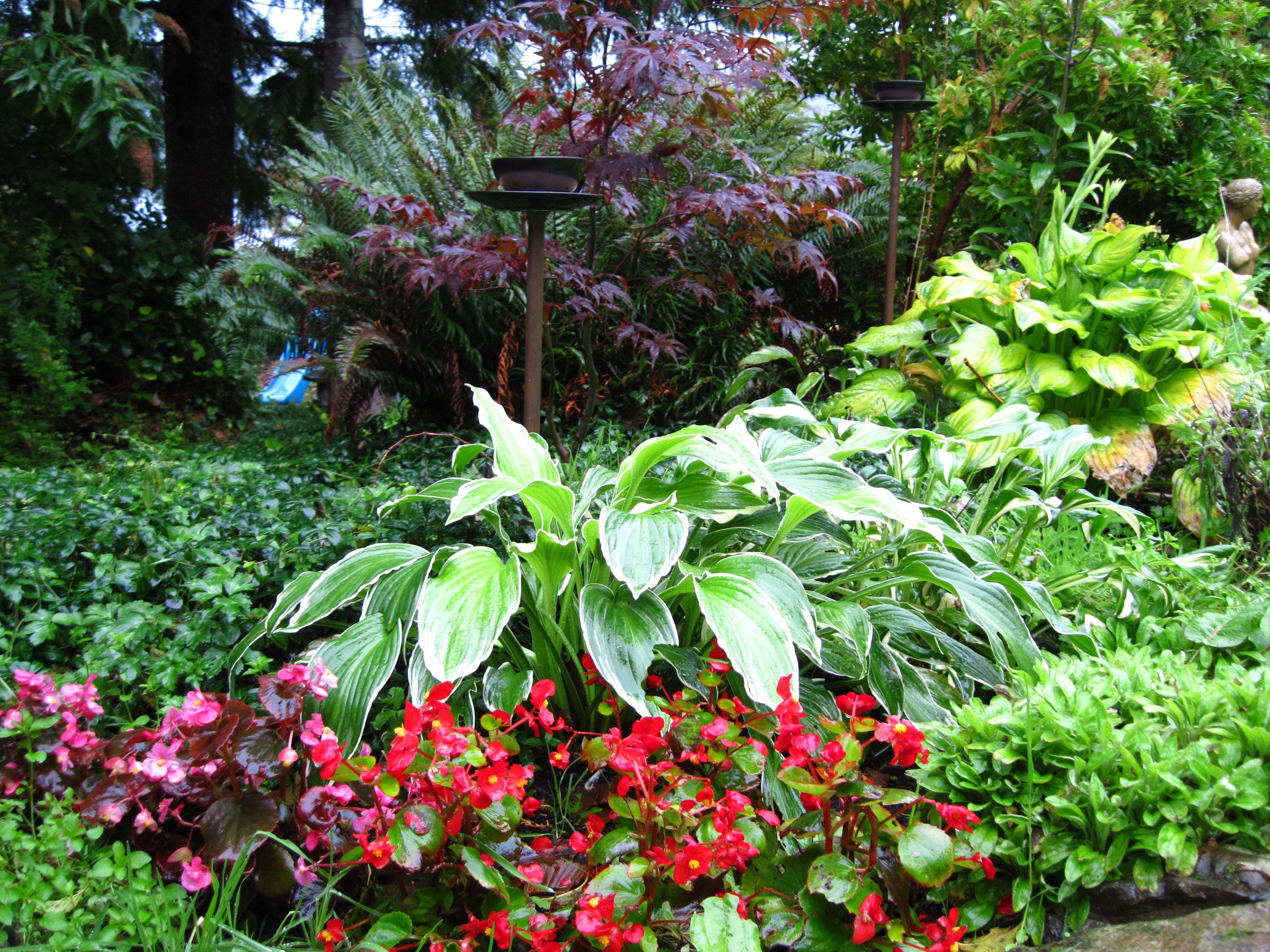
Write what you know. It’s a common sense piece of advice. After all, fiction writers have enough work in the making-things-up department. When I first envisioned writing a novel, it was because a group of characters had made a sudden appearance in my imagination. I always knew they would live in a rural setting, on the shores of a lake, some in elaborate cabins with expansive gardens and some in more rustic dwellings. Fiction mirroring reality – where I live is somewhere in the grandiose middle.
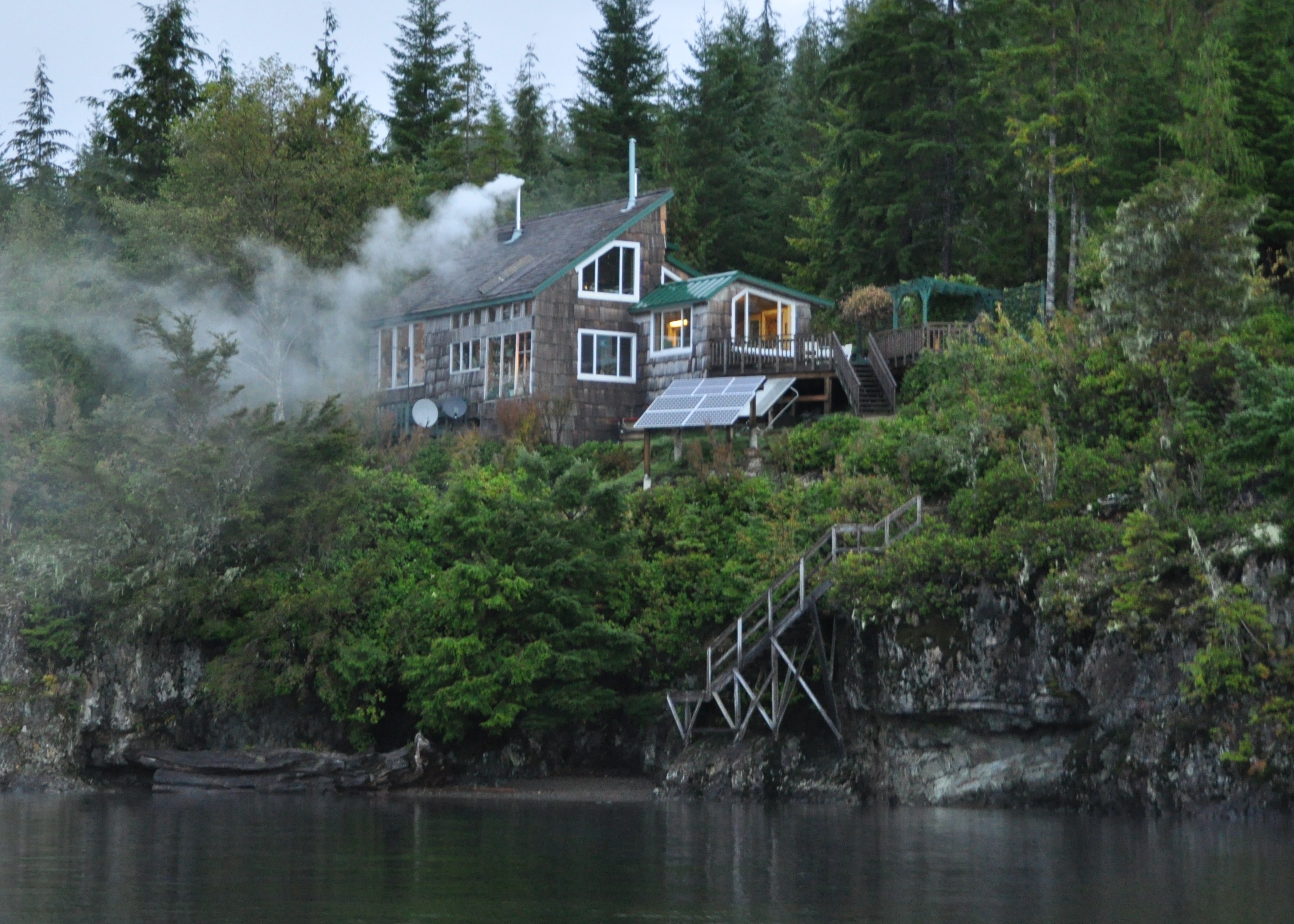
I thought about my own home and a few cabins in the vicinity and from there I embellished, stretched and massaged the reality of these settings into a small community on the shores of a fictional place called Crater Lake.
I have lived on the shores of a lake, in a cabin, with a garden in the wilderness for over twenty years. I’ve walked the trails around this place so many times my feet have worn smooth my route. In many ways, it’s hard for me to separate my own environment from that of the books – except to stress that Crater Lake is fictional, Micah Camp is a product of my imagination, the characters likewise. The cabins and gardens described are all altered, sometimes to a grander scale, sometimes to include elements not present anywhere but in my imagination. I suspect many writers have gone through a similar process.

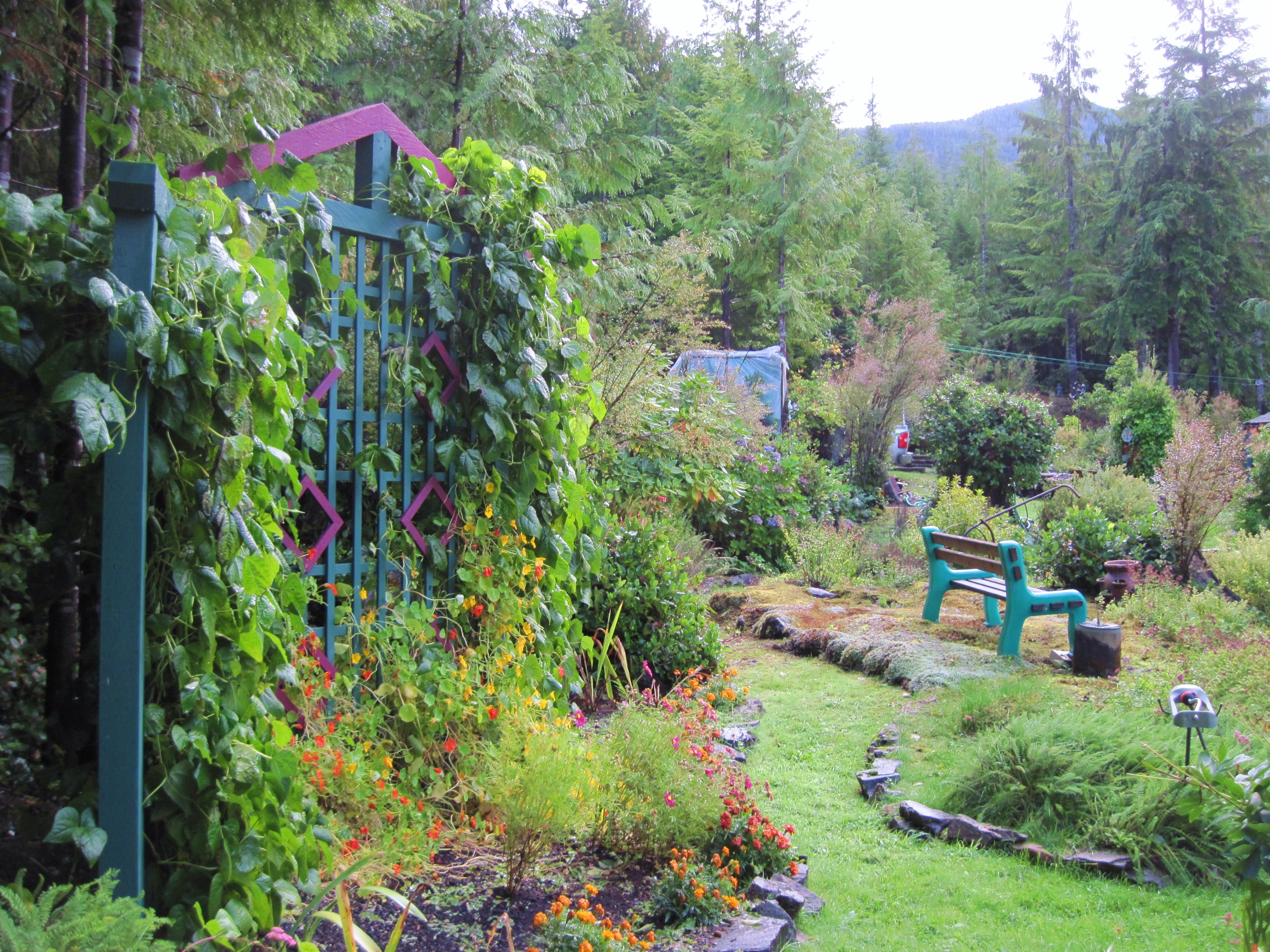
Living in a particular place shapes people. A rural, semi-isolated setting, homes that reflect local materials open to multiple views of lake, mountains and trees, gardens and small businesses carved out of wild landscapes – all of these factors make the characters in my books the people they are and dictate (to a degree) the situations they find themselves in.
I have a couple of anecdotes that illustrate well a juxtaposition of fiction and reality. A close friend who has never visited our lakeside home, read Disappearing in Plain Sight and she loved it. When her husband managed a quick visit last summer, he told me he would tell his wife that our cabin and the view were just like walking into the book. The view perhaps – the cabin not so close, but close enough to resonate.
I recently ran into a woman who borrowed one of my books from her daughter. She and her husband had bought some land out in the wild and were getting ready to build. She asked me it the architect Caleb used to design his cabin in Disappearing in Plain Sight was based on a real person. She shrugged and said, “Oh, I suppose that would be too much to ask, but I want a place like the one you described in that book.”

Here is a dichotomy, for sure. If you come and visit me, at first glance you will recognize, in broad brush strokes, the setting of Disappearing in Plain Sight and The Light Never Lies. But don’t go looking for more. You’ll only end up disappointed. It is in the fine details that fiction has taken off to soar away from the landing strip of reality.
~
~

Francis Guenette has spent most of her life on the west coast of British Columbia. She lives with her husband and finds inspiration for writing in the beauty and drama of their lakeshore cabin and garden. She has a graduate degree in Counselling Psychology from the University of Victoria, British Columbia, Canada. She has worked as an educator, trauma counsellor and researcher. The Light Never Lies is her second novel. Francis blogs over at http://disappearinginplainsight.com and maintains a Facebook author page. Please stop by and say hello.

http://www.amazon.com/dp/B00I8XKIDK
heathland and heather (day 57)
~
~
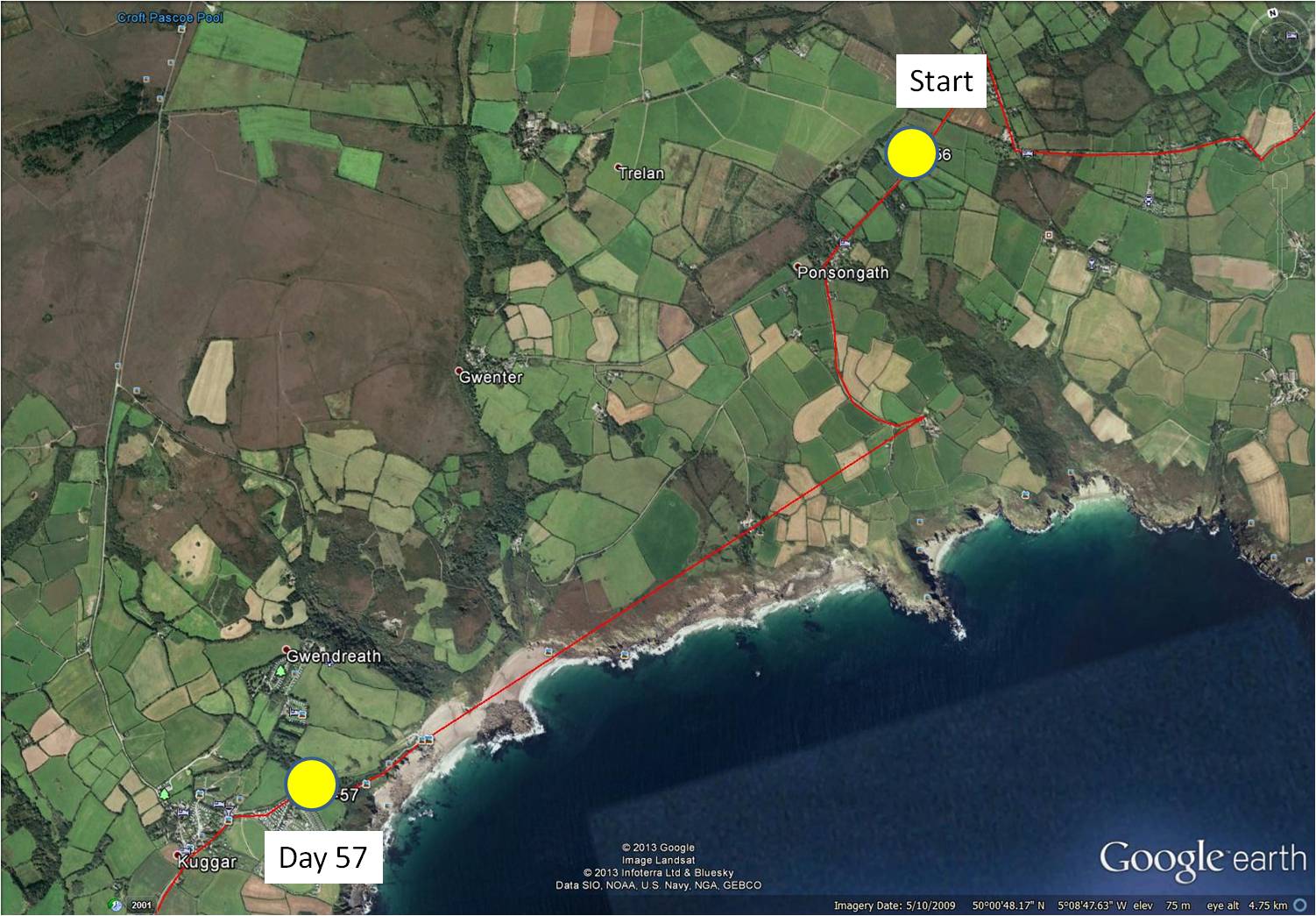
7-57 December 12, 2013 30 minutes 3.0 km (from Ponsongath to Kuggar)
~
Something different has appeared in the maps of the area where I am ‘travelling’. Today’s virtual bike trip took me just south of a large ‘brown’ area of topography (seen in the aerial photo above). To find out about this area, I turned my stationary cycle for a side trip in the direction of Gwenter, just to the north of my planned path.
~
The area I found is anything but brown (Street View images were done in July). These are the Goonhilly Downs, a raised plateau of heathlands above serpentinite rock. Besides being a Site of Special Scientific Interest and the home of many rare plants, the heathlands are the location of a large windfarm (I could just see the turbines in the distance) and the Goonhilly Satellite Earth Station (the largest in the world).
~

Goonhilly Downs … wind turbines and satellite dishes are just visible along the horizon (image from Street View)
~
From the road I could see expanses of grass, tufts of fern, and ericaceous shrubs. Patches of purple reminded me of the Rhodora that blooms here in spring. From my reading about the Cornwall heathlands, I am certain this plant must be Cornish heath (Erica vagans), a species of heather common in Cornwall. I have a small patch of heather growing in my own garden, so this plant has a spot in my heart. I first learned about heathers in our history club in high school – we took a field trip to see the heathers growing abundantly in Point Pleasant Park in Halifax. They grow there in a 3300 square meter patch, called the ‘Heather Patch’, south of the Cambridge Battery. The heathers are not native but grow there as an escape – from the stuffing in the bedrolls of British soldiers in the 1700s!
~
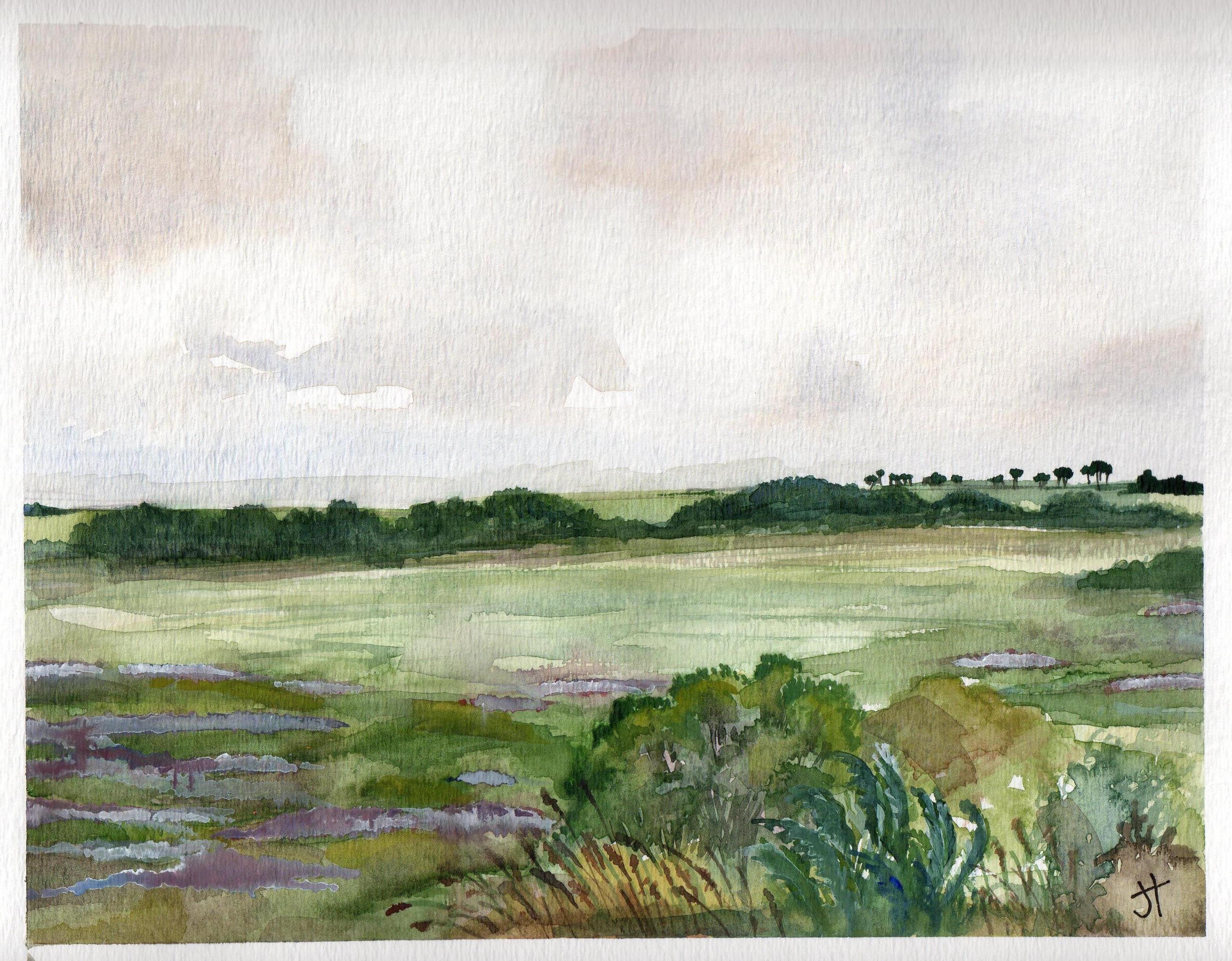
December 17, 2013 ‘Goonhilly Down’ Jane Tims
~
Copyright 2013 Jane Tims
a closer look at trees (days 48, 49 and 50)
~
One of the natural history lessons learned during my trip to California concerned the oak. On a trip to ‘Safari West’ near Santa Rosa, our guide pointed out the scarred trunks of various trees. The bark was embedded with acorns! The Acorn Woodpecker places the acorns in holes in the bark of these trees, storing them for a later source of food. The storage trees or ‘granaries’ are used over and over through the years!
~
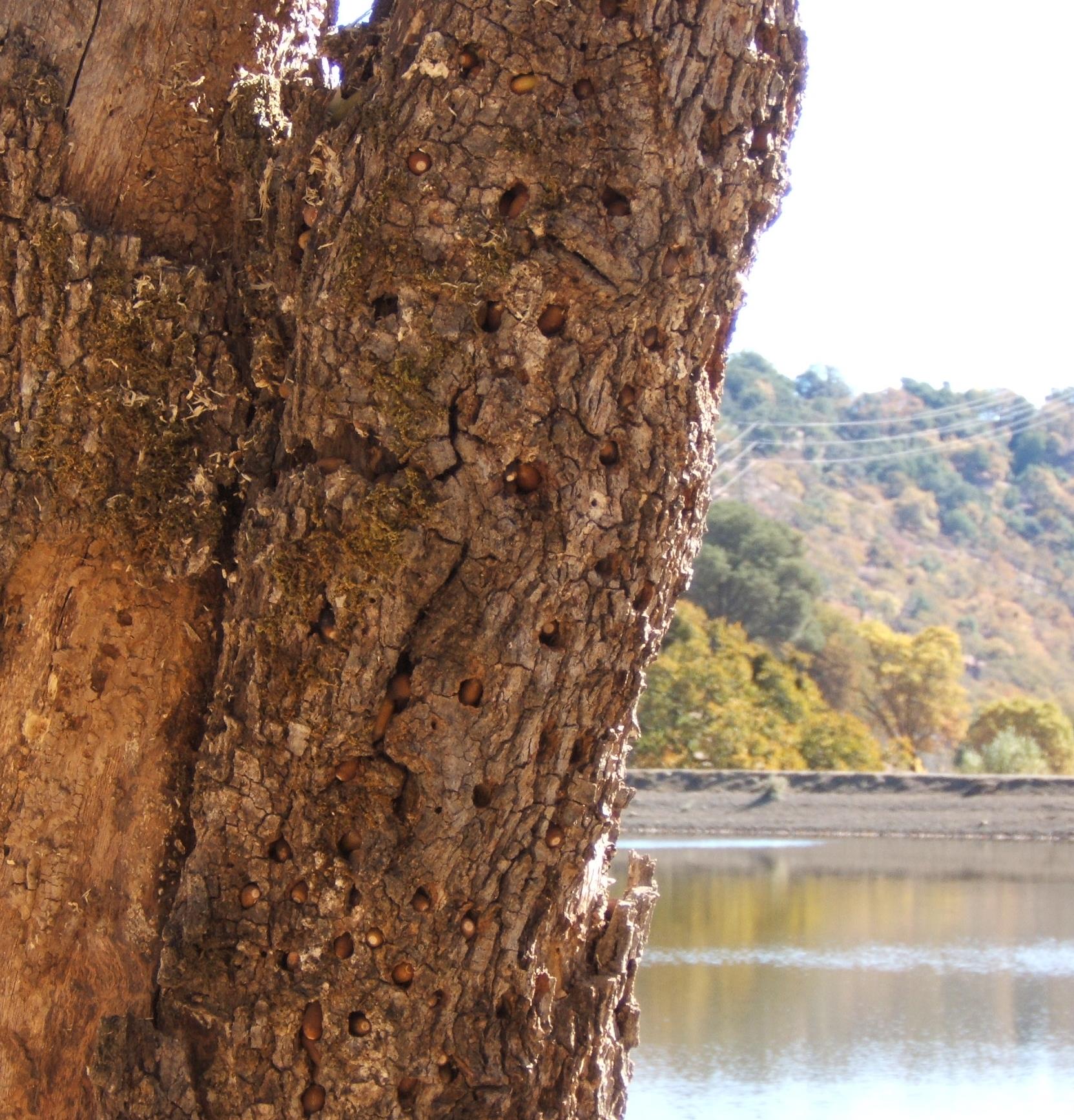
acorns planted in a ‘granary’ tree by the Acorn Woodpecker
~
Perhaps as a result of seeing so many new tree species in California, I have looked more closely at the trees I see in Street View as I cycle ‘virtually’ along the Cornwall coast. Identification is usually difficult since the images do not show details. However, occasionally a leafy branch is close enough to see the leaves clearly. So far, I have seen the Common Ash, the Field Maple, and the English Oak. In the image below, you can see the lobed leaves of the English Oak.
~
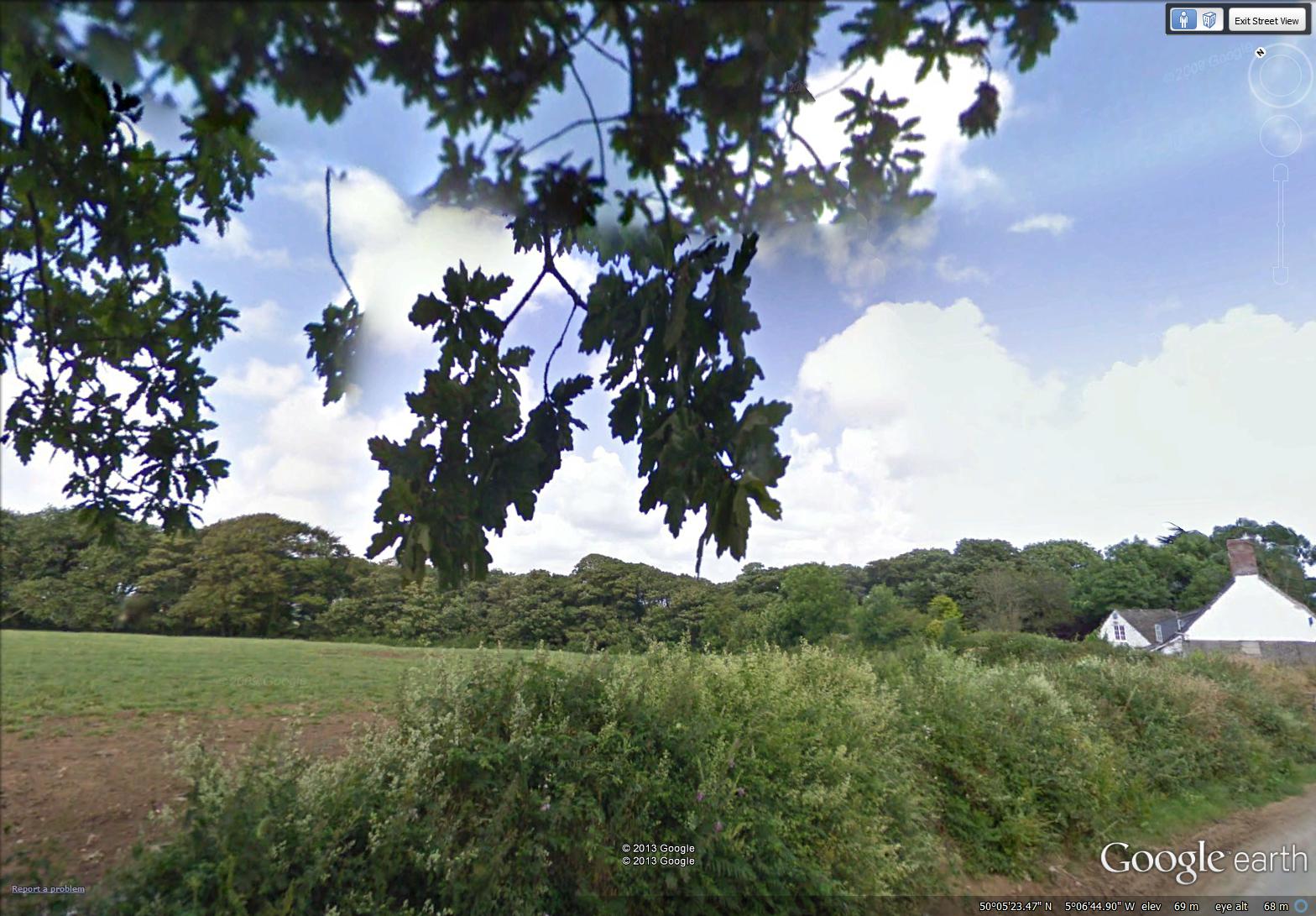
lobed leaves of an English Oak along the road to St. Anthony (image from Street View)
~

map showing distance travelled (map from Google Earth)
~
7-48 November 21, 2013 30 minutes 3.0 km (from Mawgan to St. Martin)
~

November 26, 2013 ‘oak on Fords Hill’ Jane Tims
~
7-49 November 23, 2013 35 minutes 3.0 km (from St. Martin to Helford)
~
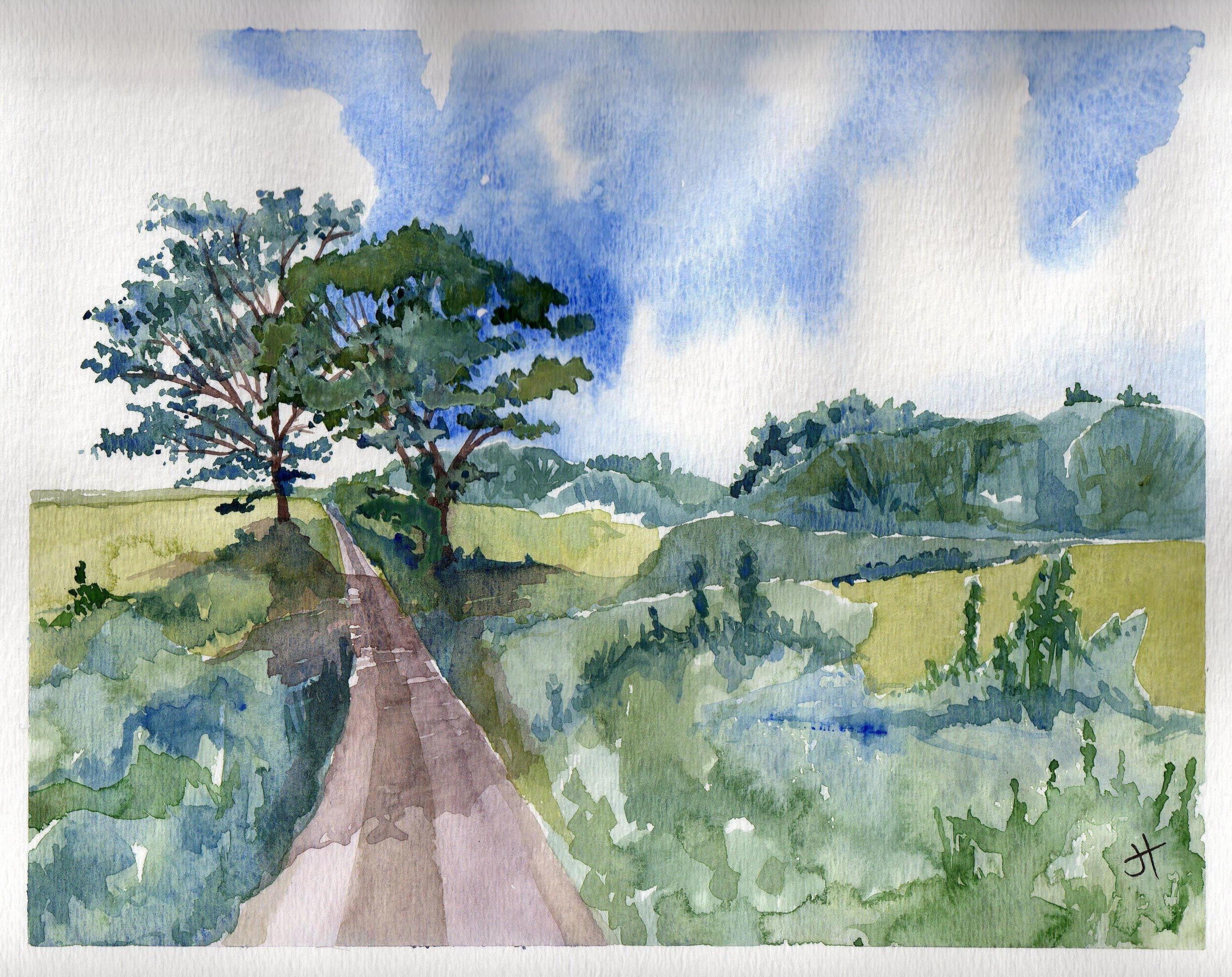
November 26, 2013 ‘maple and oak near Helford’ Jane Tims
~
7-50 November 25, 2013 30 minutes 3.0 km (from Helford to St. Anthony-in-Meneage)
~
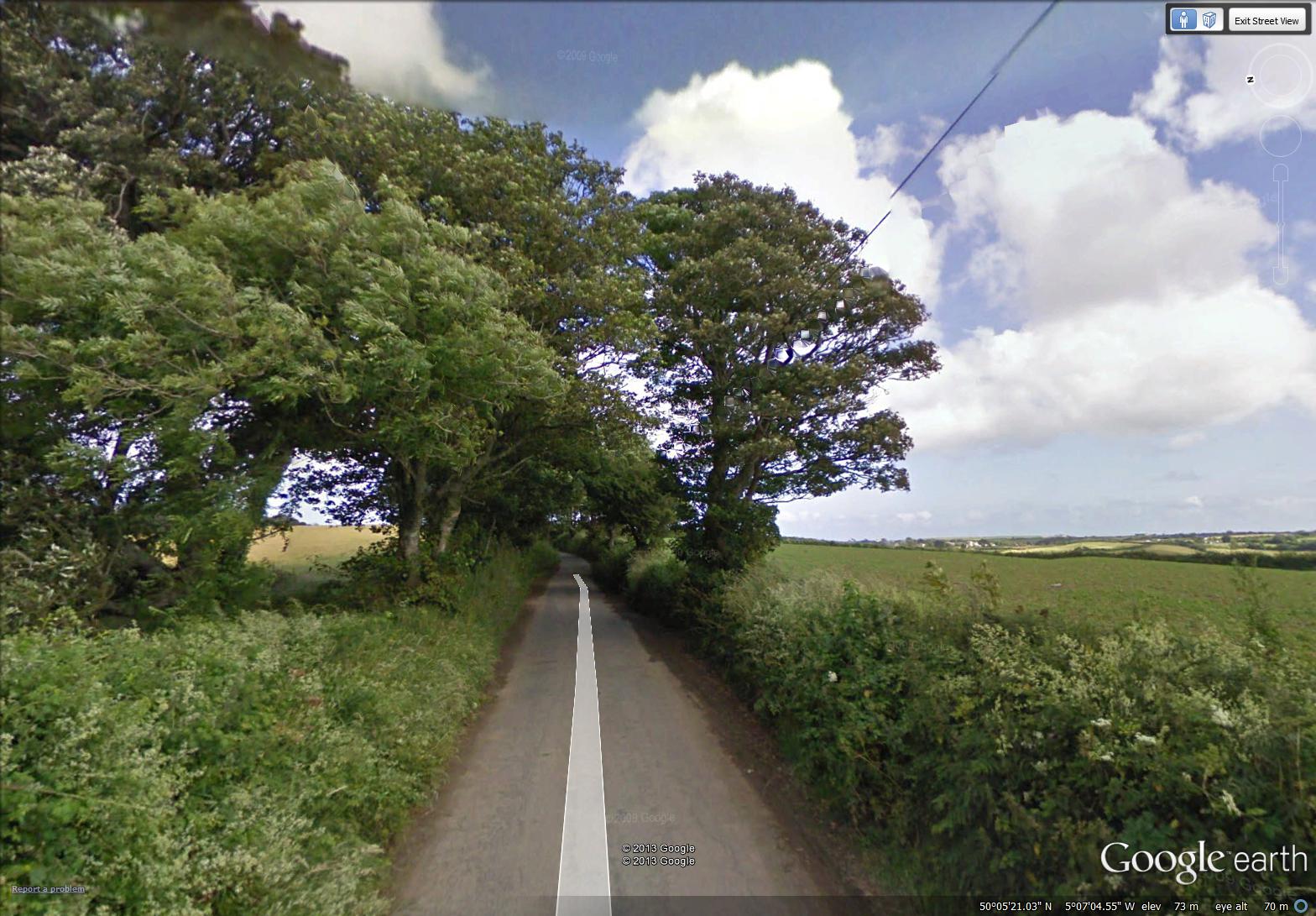
Oak and Ash along the road to St. Anthony (image from Street View)
~
Copyright 2013 Jane Tims
narrow streets and wide-open countryside 7-11
~
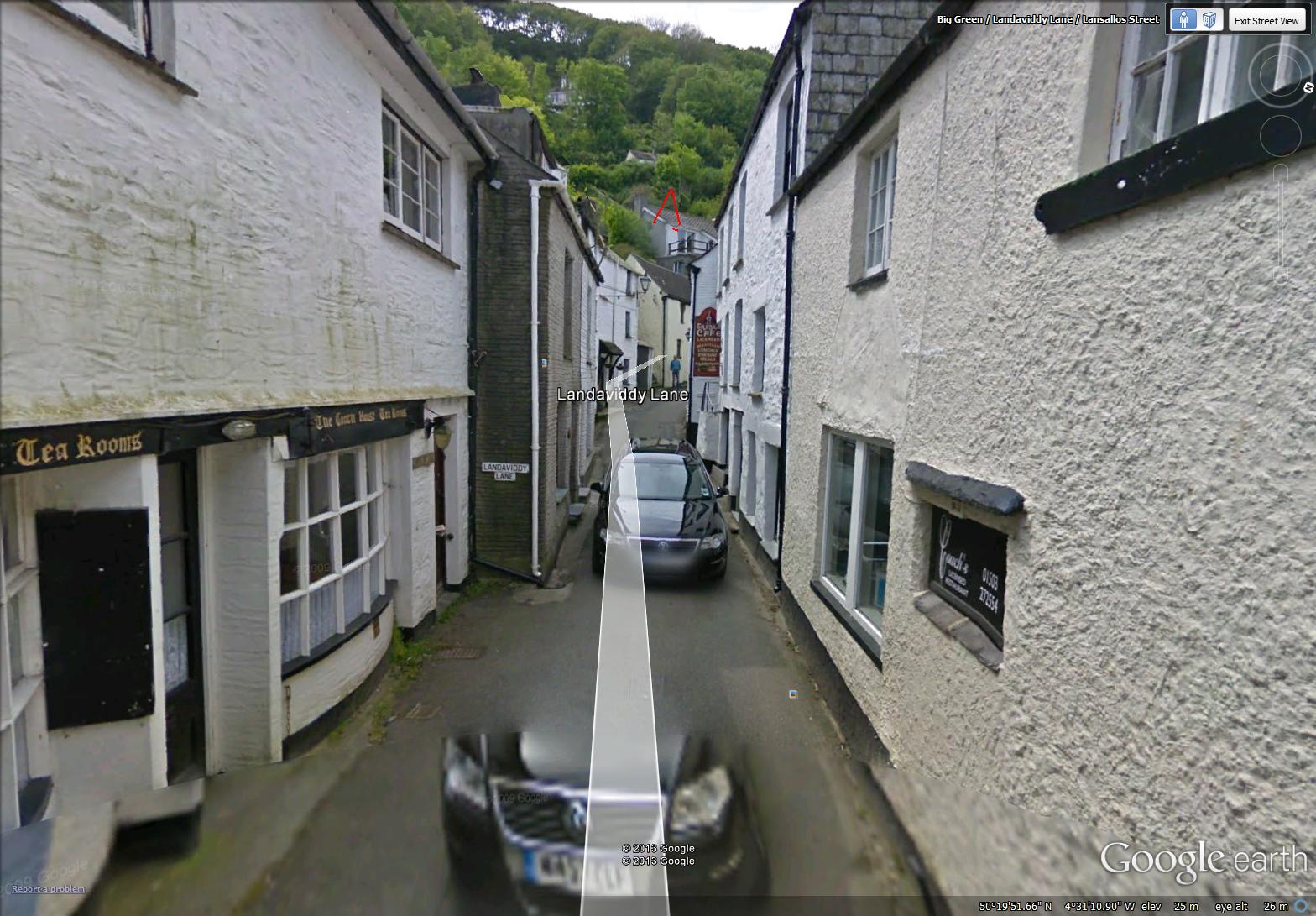
Landaviddy Lane in Polperro (image from Street View)
~

~

map showing distance travelled (map from Google Earth)
~
I have never encountered such narrow streets as in Polperro. In this charming little town, the streets bulge with sightseers. The narrow streets can be confusing, so it’s a good thing the roads are labelled to show the ‘Way Out’ …
~

July 21, 2013 ‘way out in Polperro’ Jane Tims
~
Best View: countryside near Polperro … yellows are a little bright in the scanned version compared to the original painting …
~
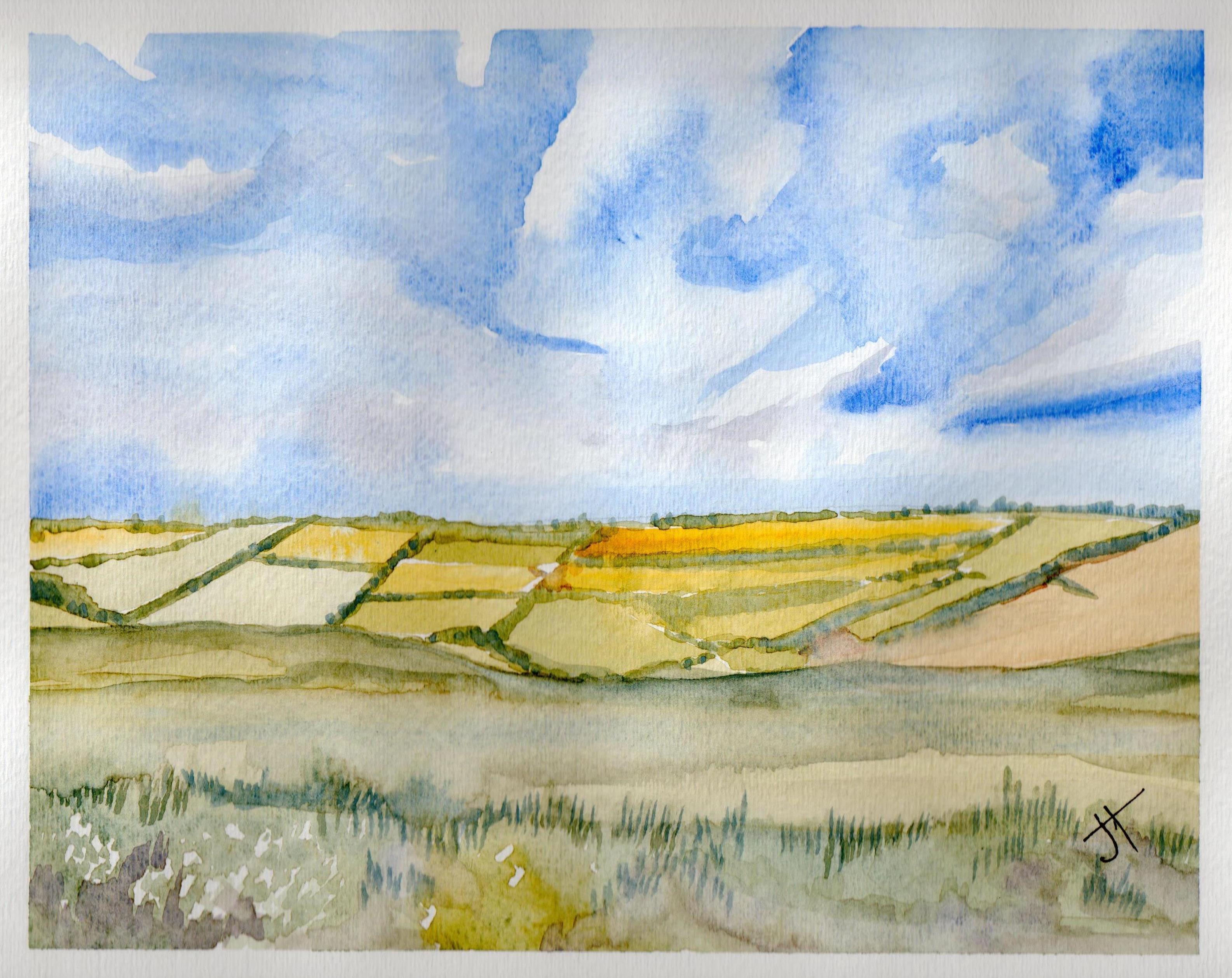
July 19, 2013 ‘countryside near Polperro’ Jane Tims
~
Copyright 2013 Jane Tims
farms in hidden valleys 7-3

Tregantle Fort near Freathy (image from Street View)
~

~
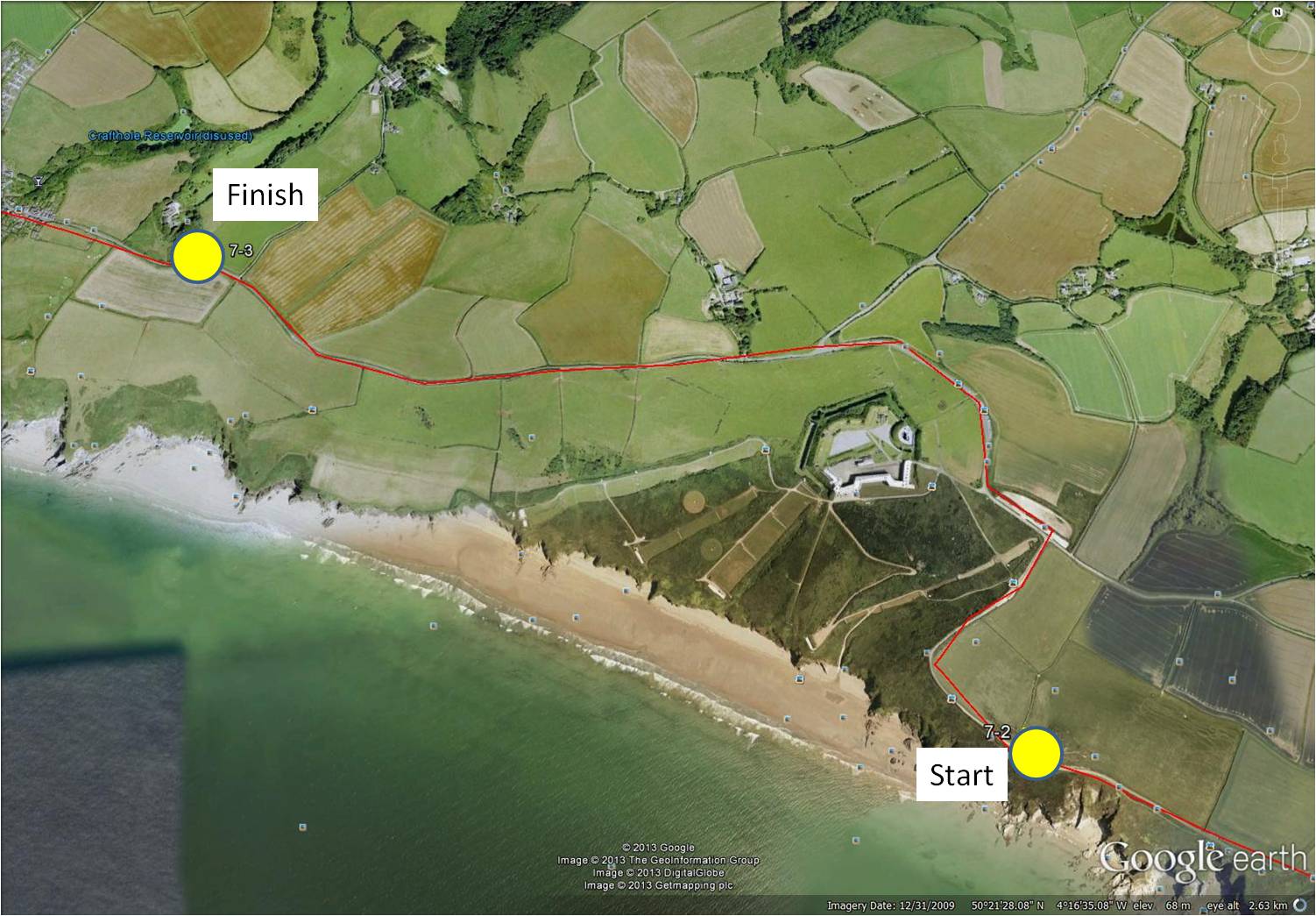
map showing distance travelled (map from Google Earth)
~
Gradually, I am learning the layout of this part of the Cornwall coast. The uplands are mostly devoted to wild land or agriculture (grazing or crops) …
~
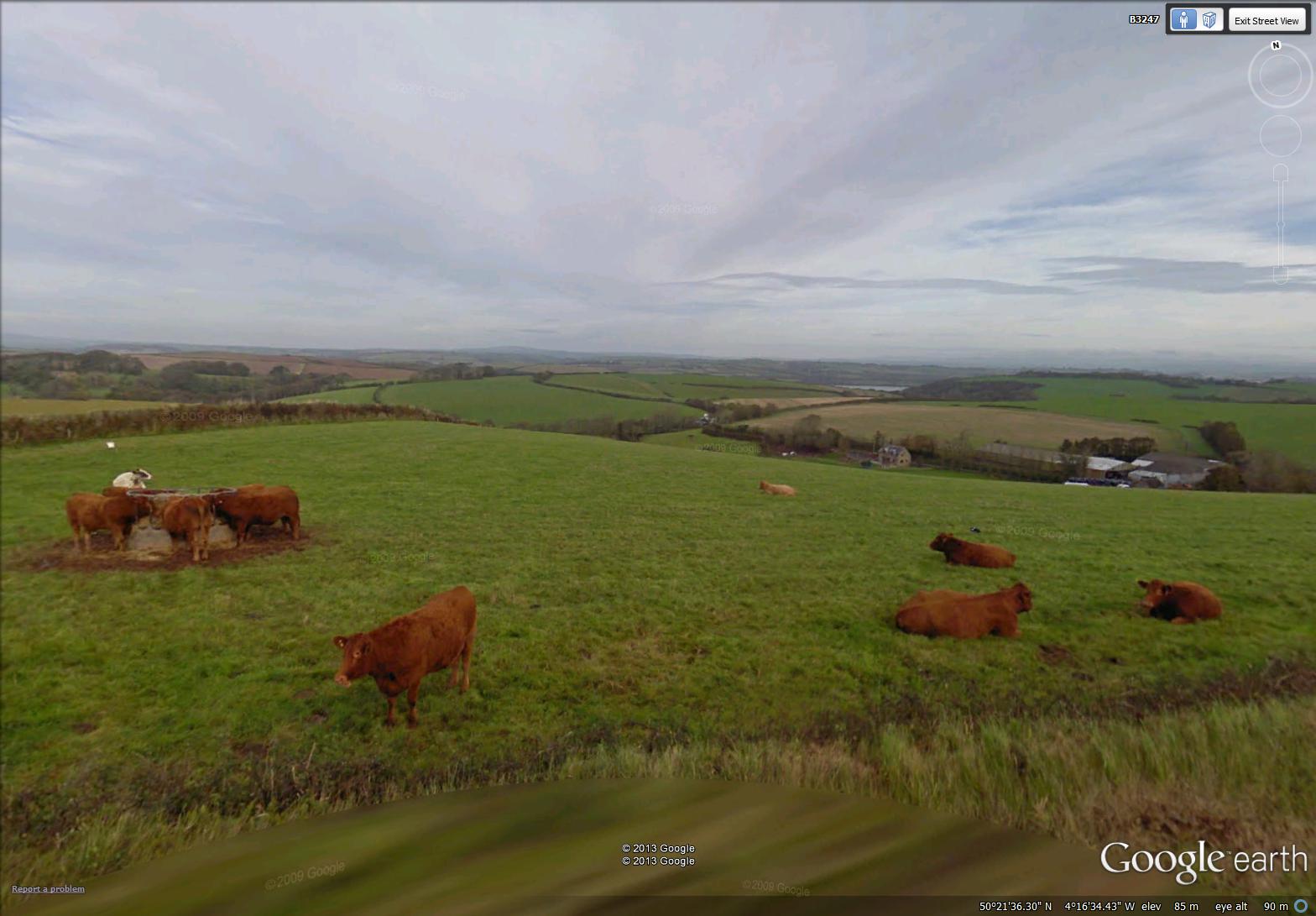
cattle in a field near Freathy (image from Street View)
~
The houses are either along the coast, at the very edge, or in the treed valleys that peek at intervals from the countryside …
~

fields and valleys … a reservoir in the distance (image from Street View)
~
Driving down into these valleys, I find farmsteads, made up of clusters of buildings and usually associated with water …
~

farmstead in a valley (image from Street View)
~
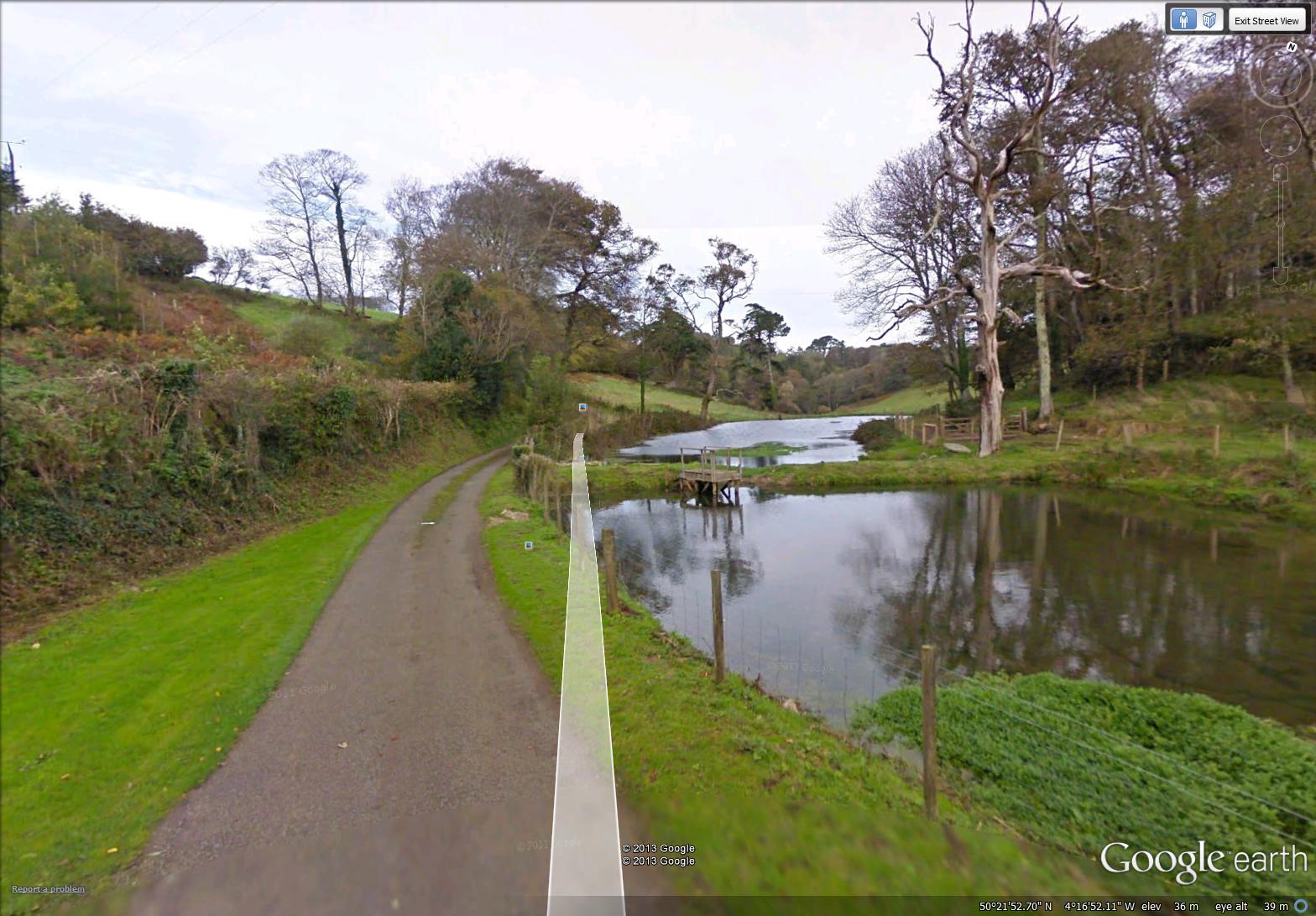
ponds at a valley farm (image from Street View)
~
Cattle must stray into the roads on occasion. The entryway of the house below is guarded by a ‘Texan Gate’ or ‘cattle stop’. I am familiar with these from my days in Alberta. Cattle will not cross these gates because of the spaces in the surface, but cars can cross quite easily …
~
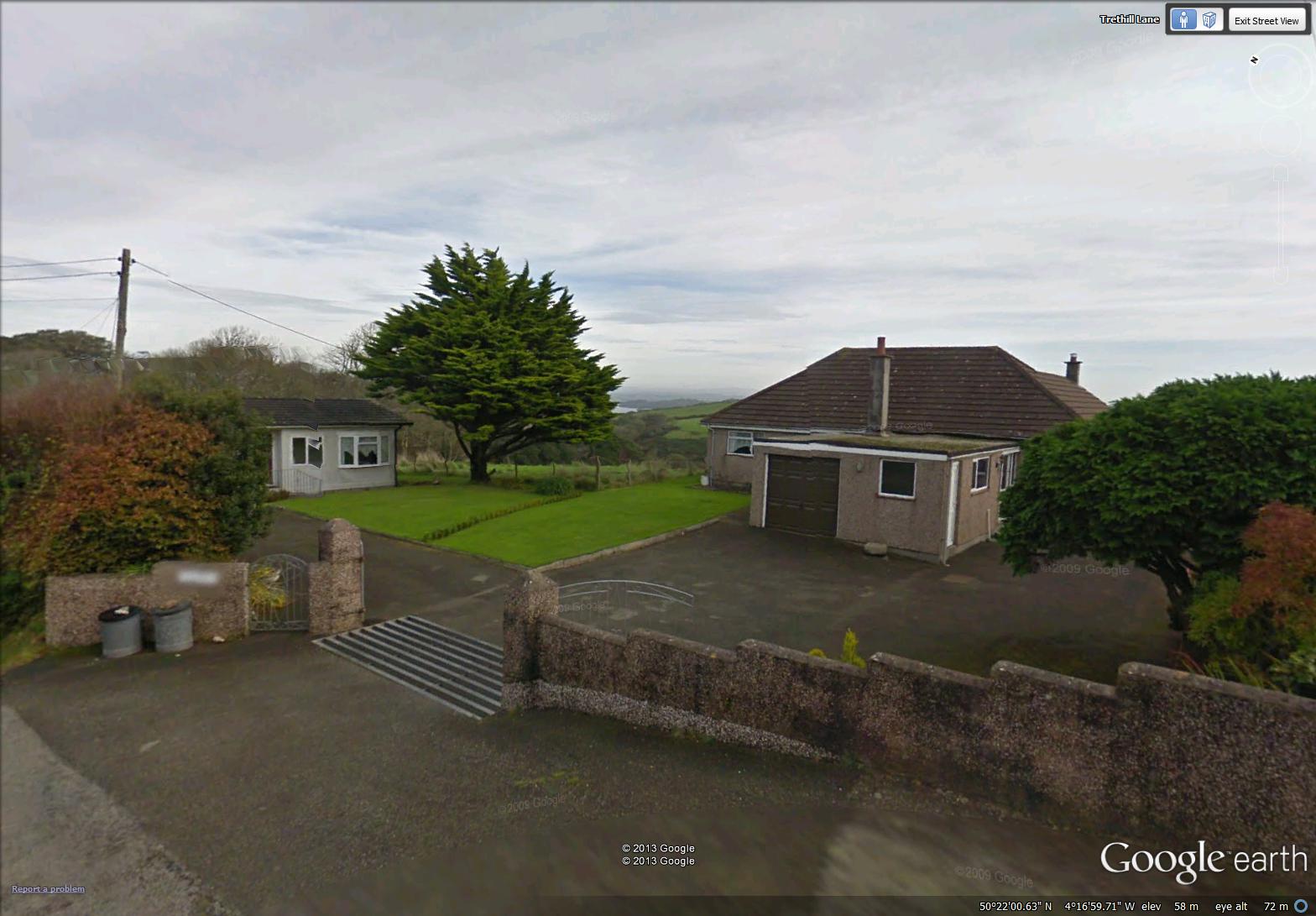
a Texan Gate (image from Street View)
~
Best View: the Cornwall coast stretching before me …
~

July 2, 2013 ‘Cornwall coast’ Jane Tims
~
Copyright 2013 Jane Tims
Paper Birch
In the last five months, I have been learning how to paint with watercolors. I’ve painted with acrylics for some time, and I love to draw with pencil, but watercolors always seemed daunting to me.
If you are a follower of my Blog, you will know my early attempts at watercolor have been of views from my virtual cycling trip in central France and on the Ile de Ré. I have also done some studies of New Brunswick wildflowers.
Among the subjects I found fun to paint on Ile de Ré were the vine-covered trees that grow along the road.
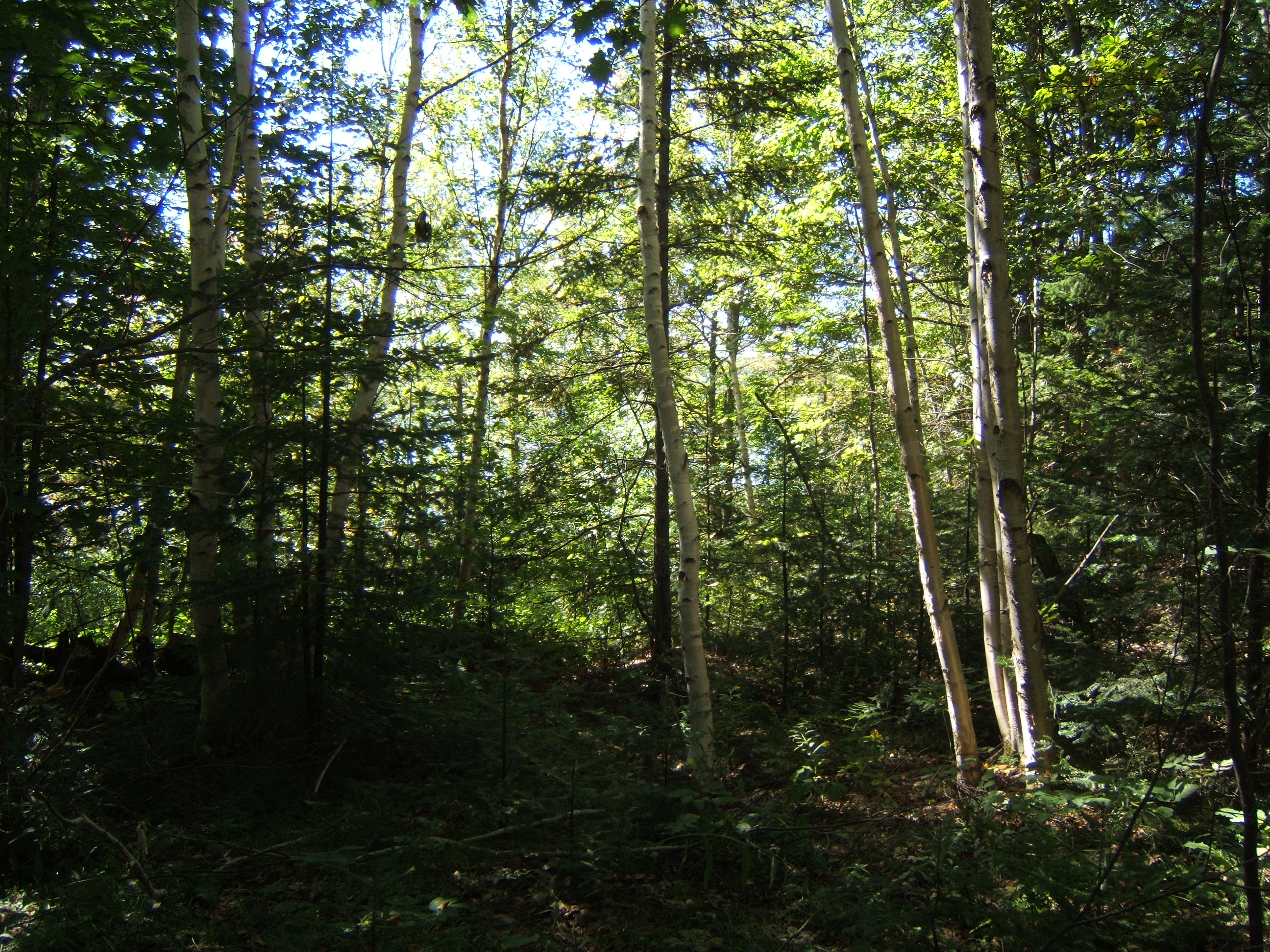
This week, on a trip to see our camp, I studied some of the characteristics of Paper Birch (Betula papyrifera Marsh.), a tree growing everywhere on our property by the lake …
~
~
Some of these trees are actually Mountain Birch (Betula papyrifera Marsh. var. cordifolia (Reg.) Reg.), a variety of the Paper Birch. This variety is quite common in eastern Canada. Its distinguishing characteristic is the heart-shape of its leaves, especially at the base of the leaf.
~
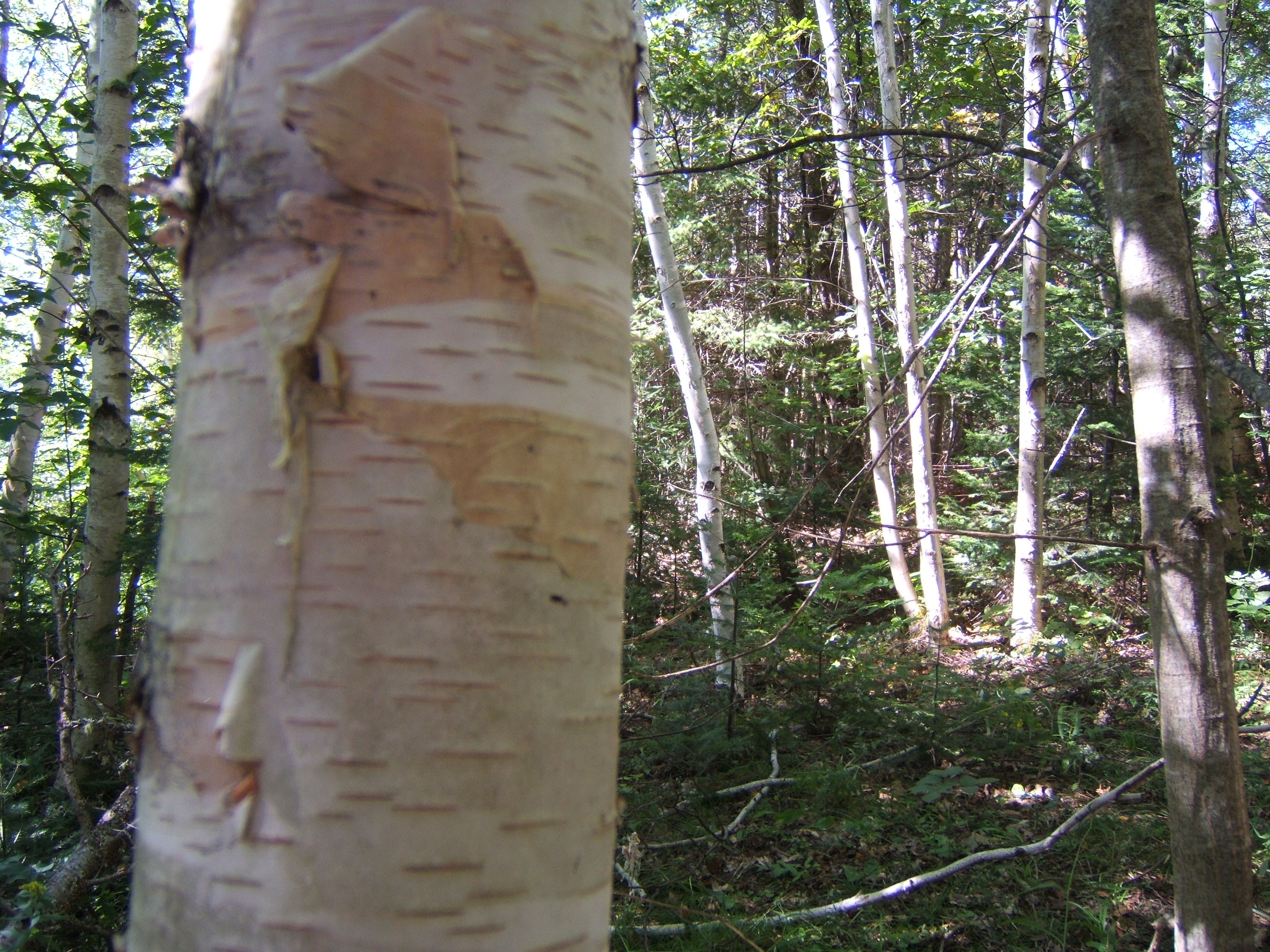
The bark of the Paper Birch and Mountain Birch is predominantly white, although parts of the tree can be yellowish or quite black. Its bark strips readily from the tree, in sheets, leaving a reddish-orange inner bark which turns black with age …
~
~
To paint the birch, I used Painter’s Tape to mask the trunks of the trees. Then I painted the background. Once the background was dry, I stripped the Painter’s Tape away and added the bark details in the white space left behind. Here are three paintings of Mountain Birch …
~
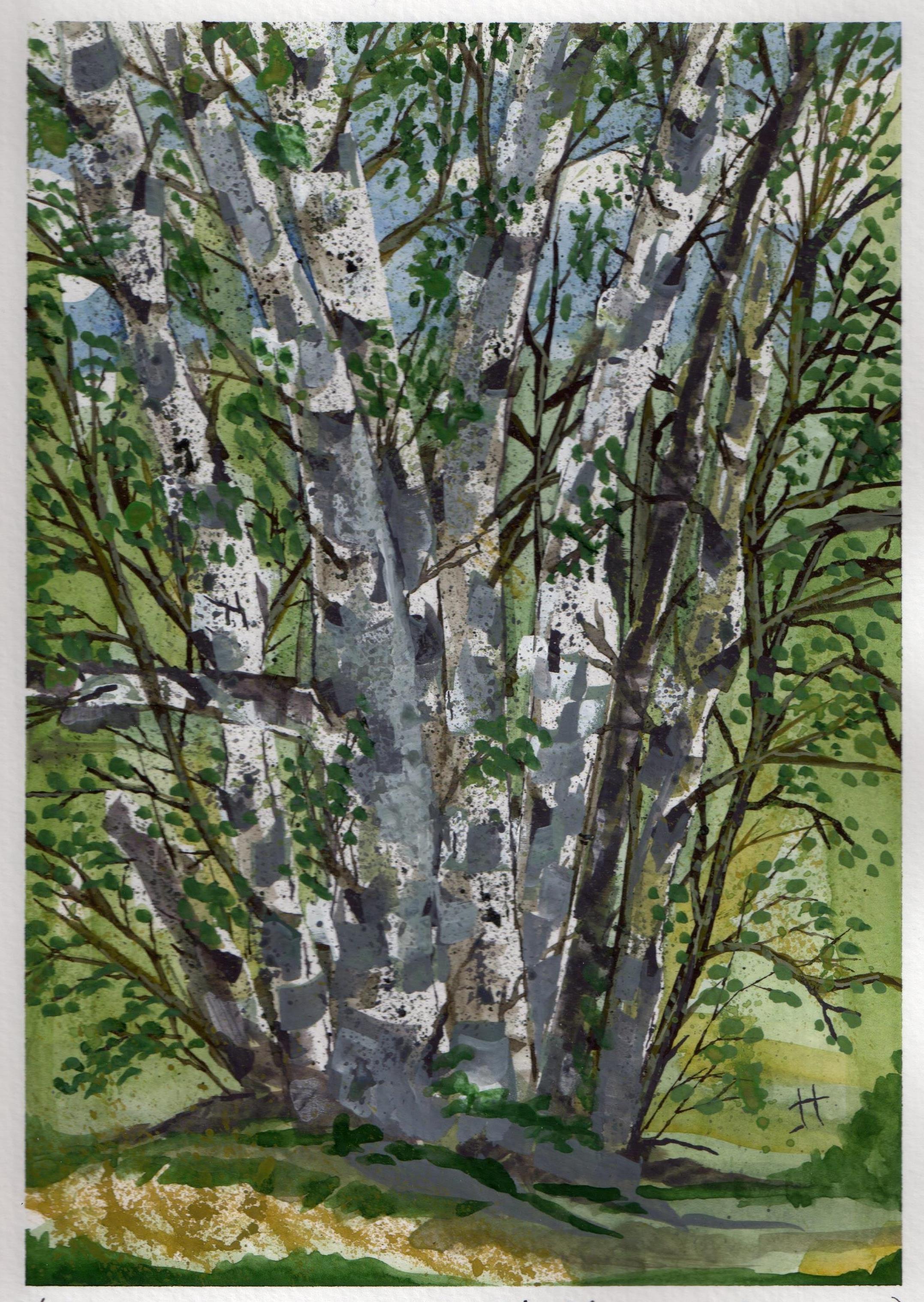
June 21, 2013 ‘Mountain Birch’ Jane Tims
~
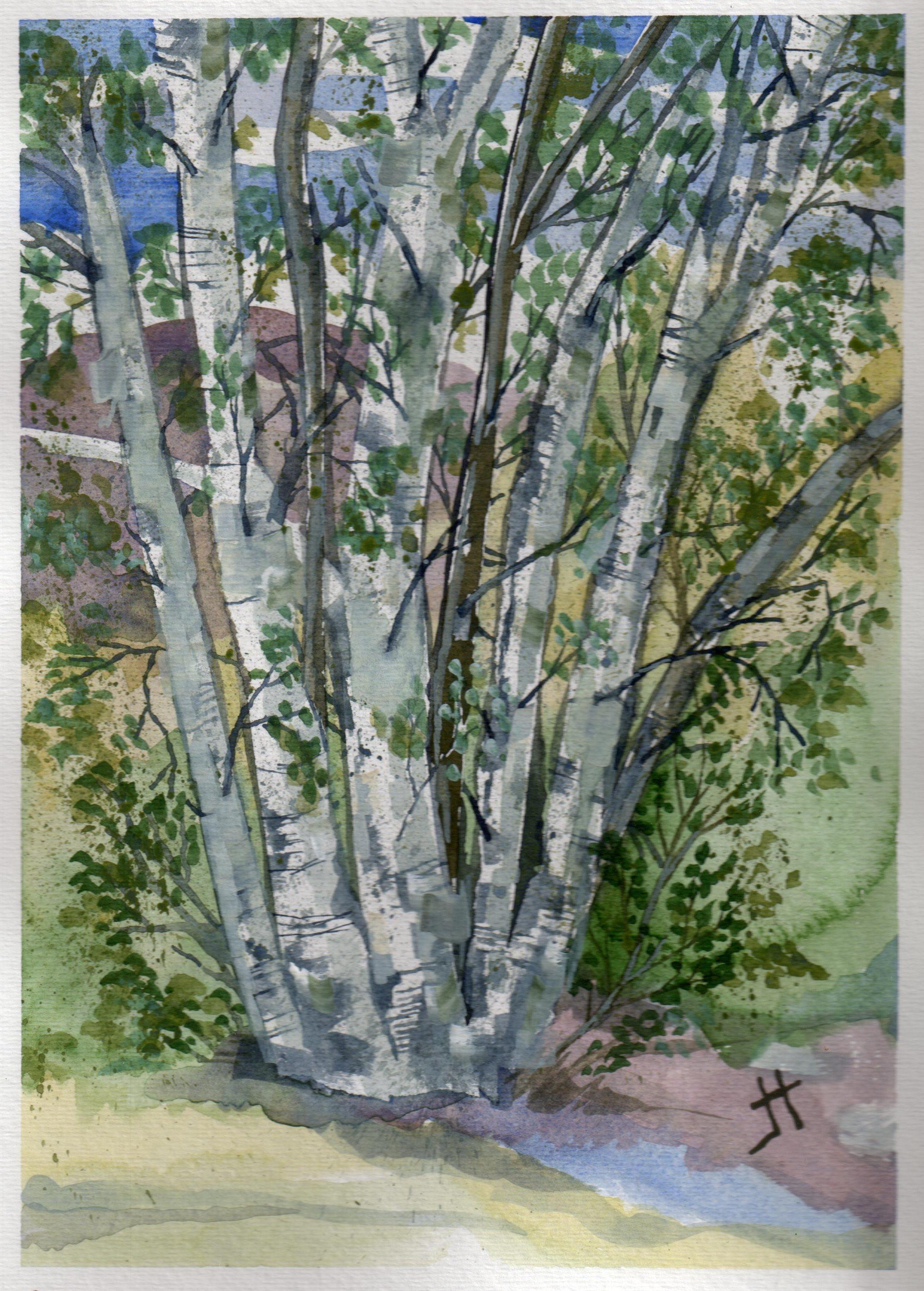
June 22, 2013 ‘Mountain Birch #2’ Jane Tims
~

June 23, 2013 ‘Mountain Birch #3’ Jane Tims
~
Copyright Jane Tims 2013
winter water-scape
On our drive to Black’s Harbour this past Monday, we took the cross-country highway #785. It travels directly to the southern part of the province through the woods.
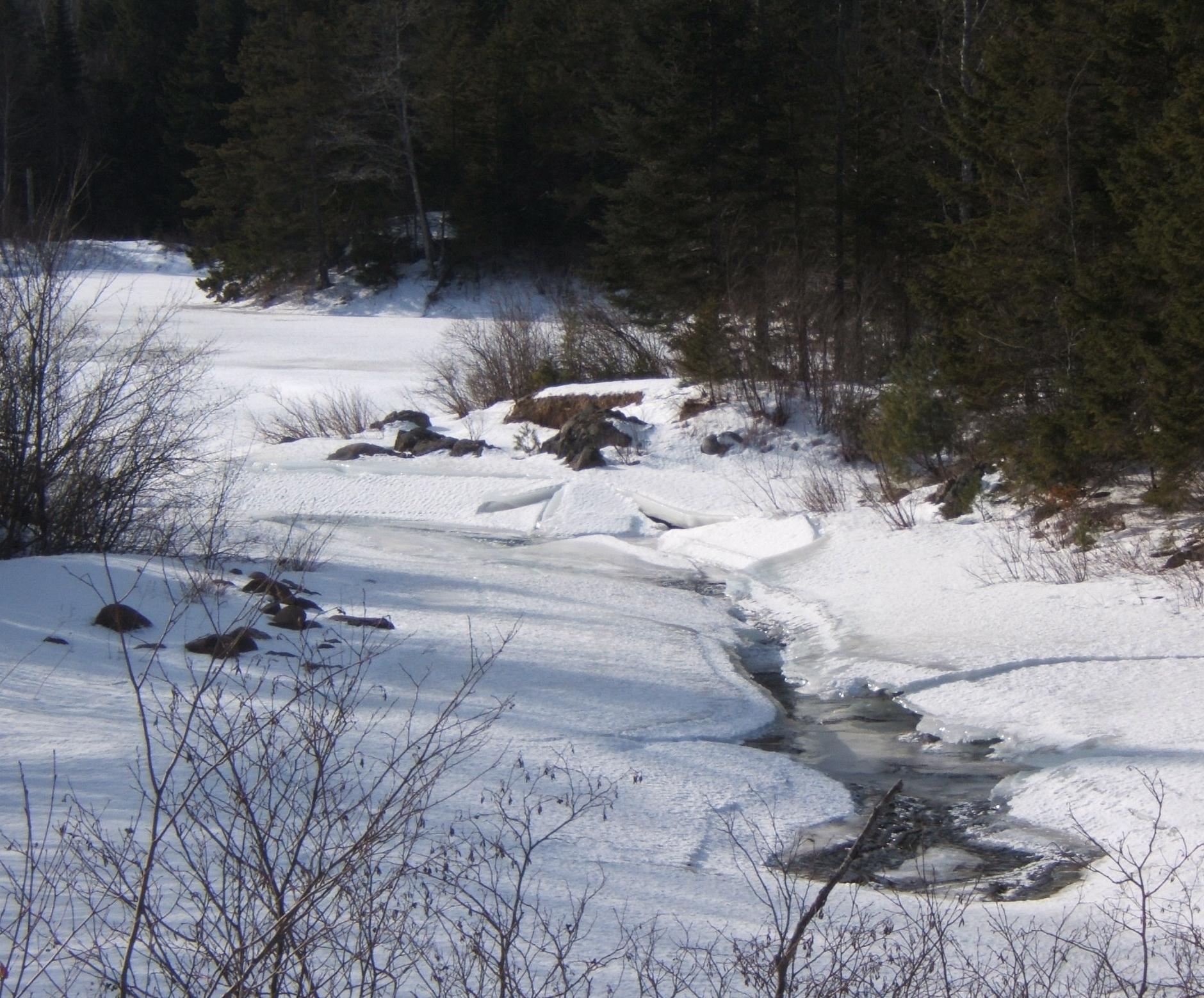
Many streams cross the roadway. All are lined in snow, but the center channel is just a sheet of ice away in most streams and rivers. In some cases, the water is moving so swiftly, the ice has been breached by the flow. The result is a carved ice-world of frozen water. At these openings in the frozen river, you can catch a glimpse of the winter water-scape: the layers of ice, the icicles and frosted caverns beneath the smooth upper layer of ice and snow.
~
winter water-scape
~
under the ice
the river registers
its sinew
~
carves a crystal path
between layers
of frost
~
transparent panes
of polished glass,
lofted by pillars of ice
~
ice caverns, edged by froth
a mingling of winter breath
and river tears
~
Copyright Jane Tims 2013
ponds and pond lilies
Water is a favorite feature of the landscape for many people. On our drives we encounter streams and rivers, lakes and ponds. Thoreau, writing about his Walden Pond, said that water features are the eyes of the landscape. Reflected in those eyes are sky and clouds and the dazzle of the sunlight.
‘A lake is the landscape’s most beautiful and expressive feature. It is earth’s eye; looking into which the beholder measures the depth of his own nature. The fluviatile trees next the shore are the slender eyelashes which fringe it, and the wooded hills and cliffs around are its overhanging brows.’ Henry David Thoreau, Walden, 1854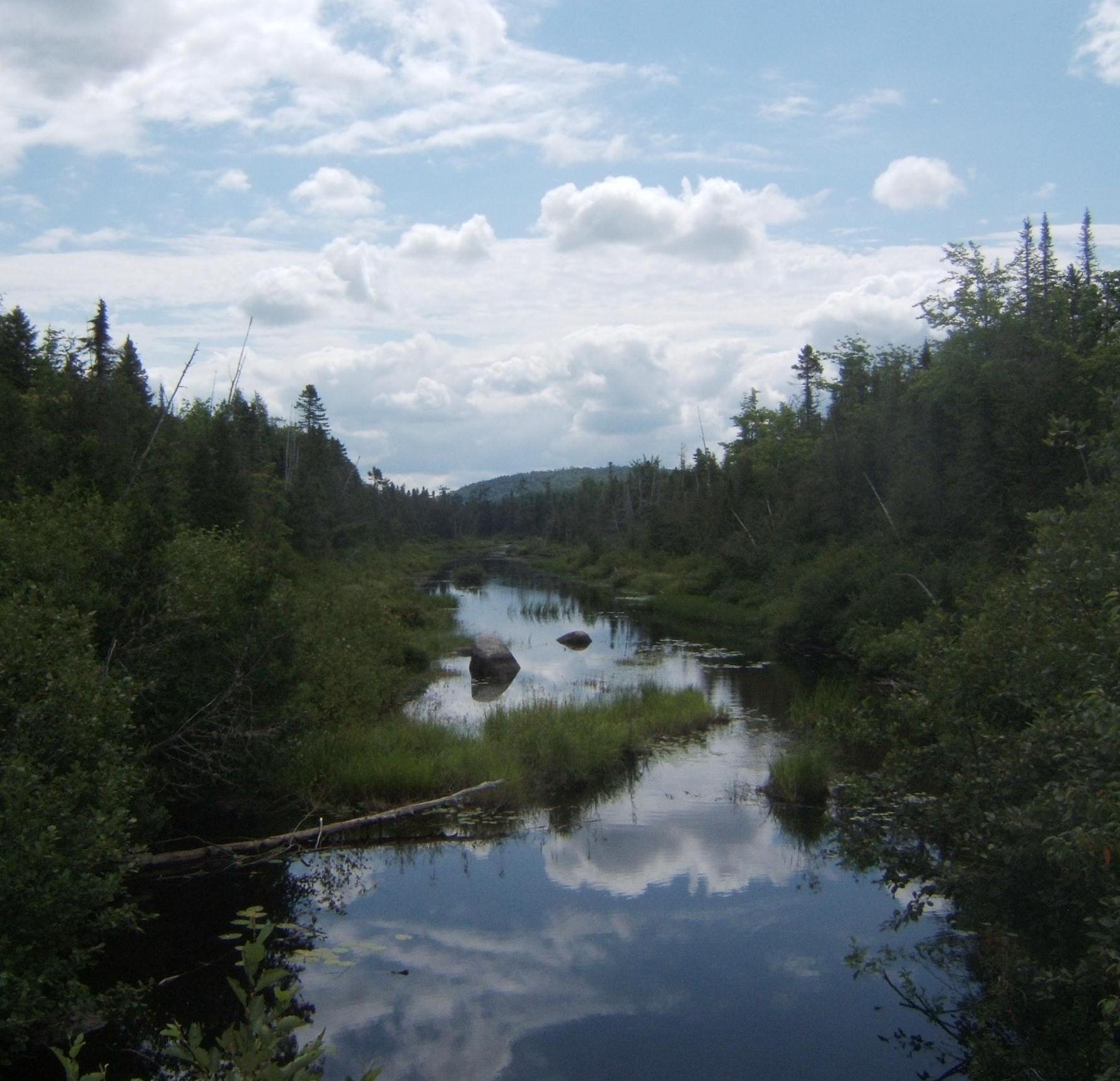
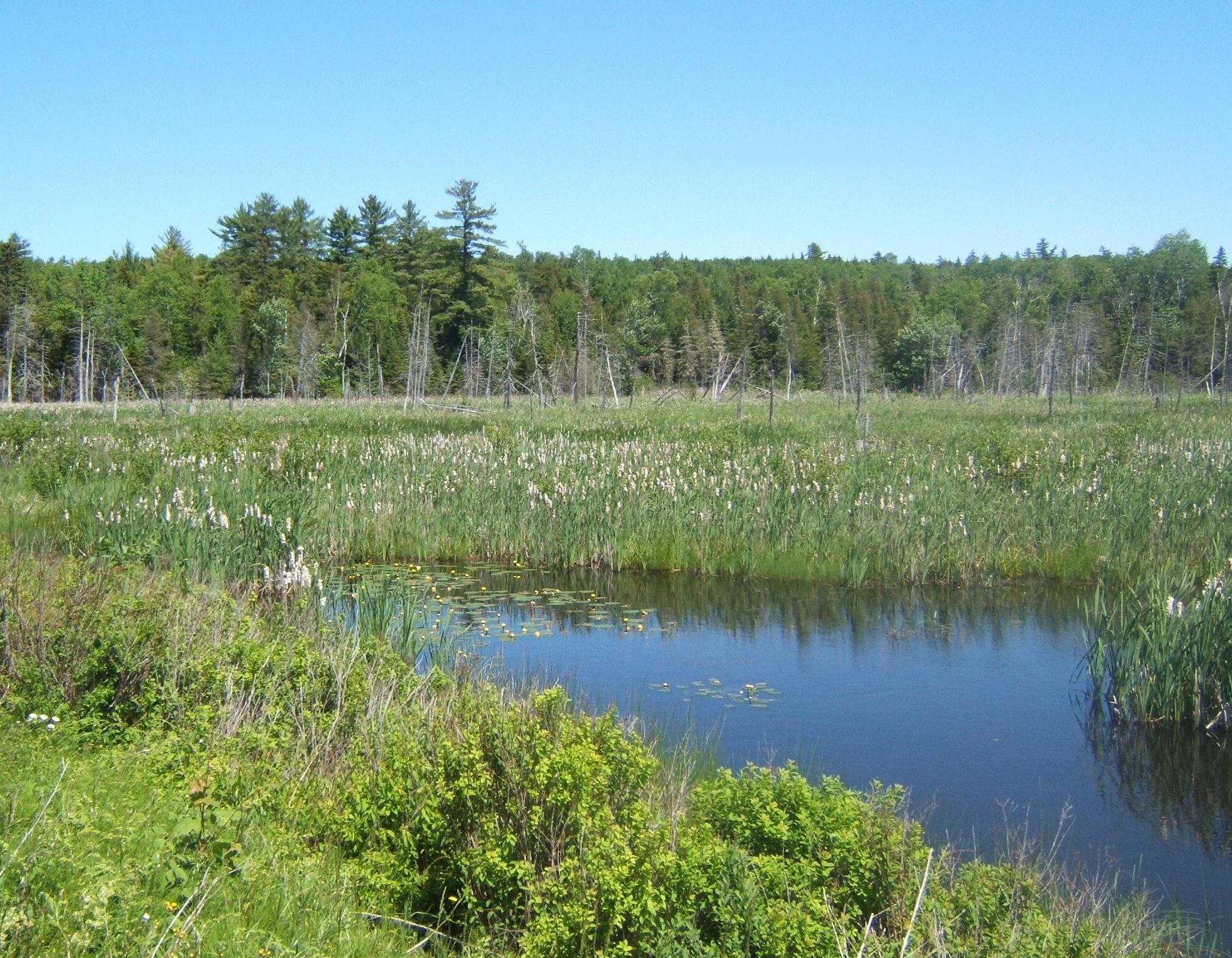
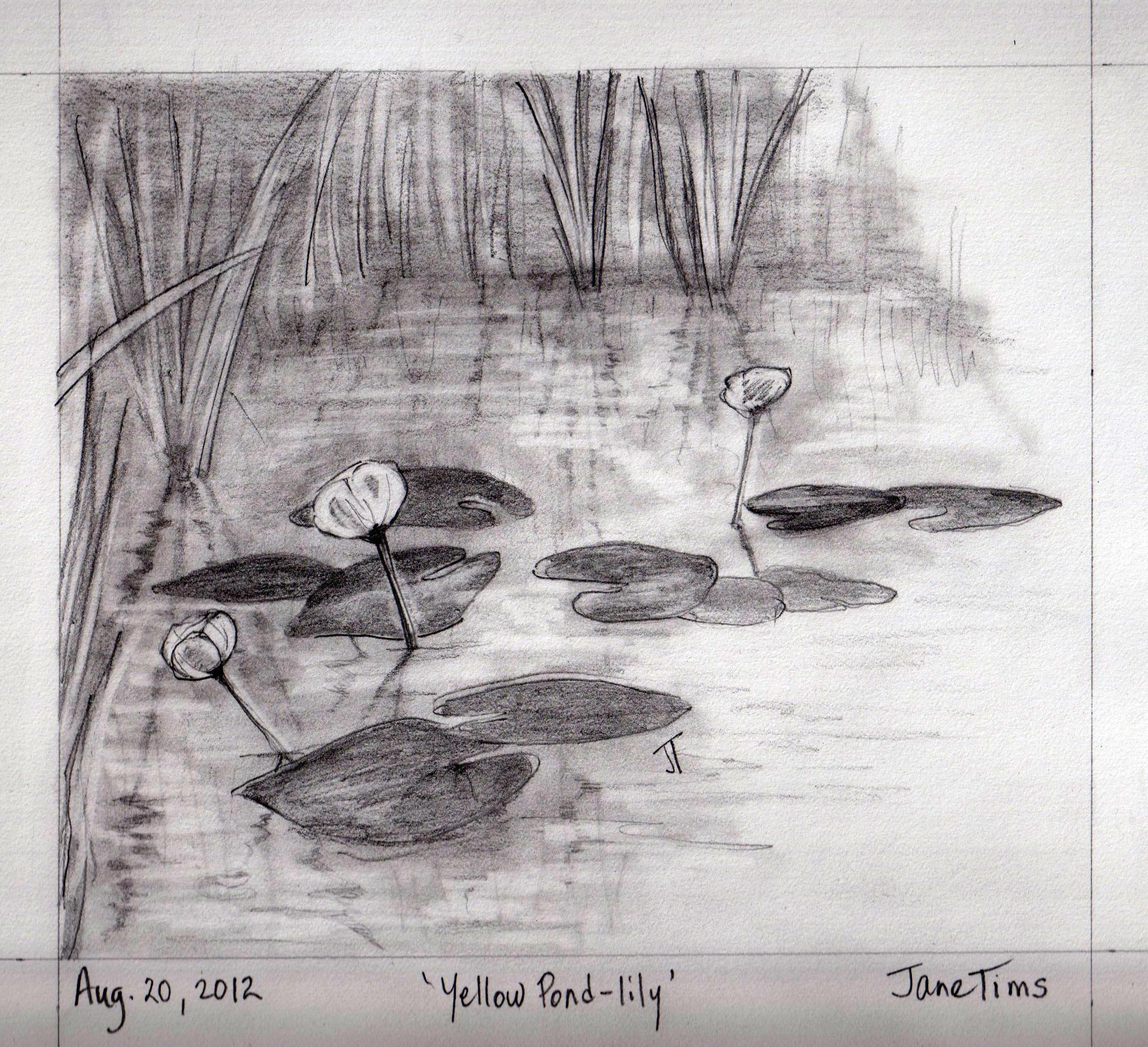
This time of year, pond vegetation is lush and in bloom. Some ponds and wetland waters are alwost covered by Duckweed (Lemna minor L.), Pickerel-weed (Pontederia cordata L.) and Pond-lilies.

Pond lilies are in bloom and their flat pad-like leaves cover the water like pieces of a puzzle. White Water-lilies, Nymphaea odorata Ait., speckle the edge of almost every pond…


and the yellow cup-like blooms of Cow-lily (Nuphar variegatum Engelm.) brighten the sluggish waters of meandering brooks and wetland ponds…
Last week we drove to South Oromocto Lake in Charlotte County and stopped beside the lake outlet where there is a dam, including a water control structure and a fish ladder. The long, red stems of up-rooted Water-shield (Brasenia Schreberi Gmel.) were gathered in tangles at the control structure.
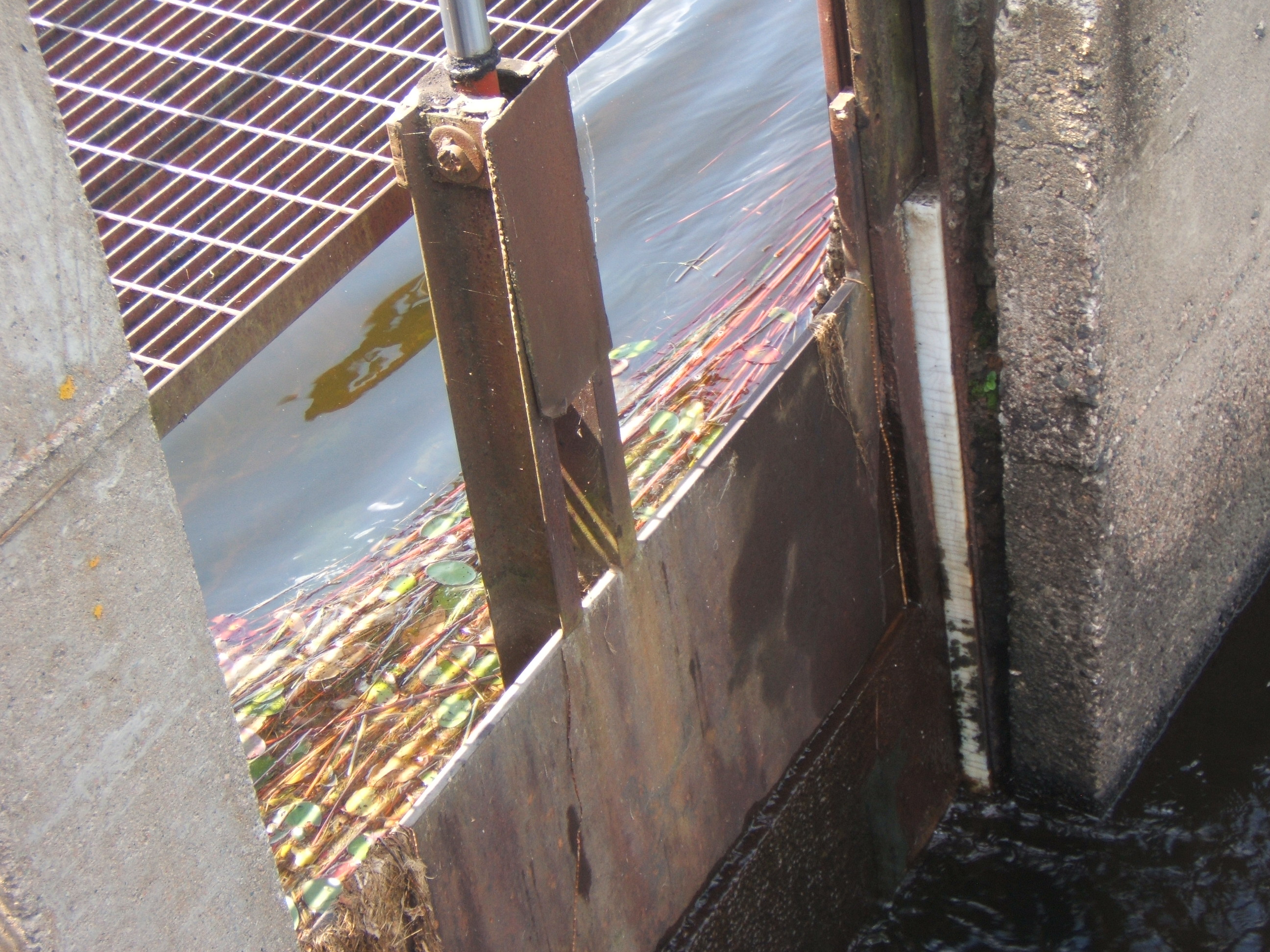
the red stems and green leaves of up-rooted Water-shield, gathered in the dam at the outlet of South Oromocto Lake

Do you have Pond-lilies and Water-shield where you are?
~
Copyright Jane Tims 2012
a snippet of landscape – glacial erratics and boulder fields
Last week we went for a drive to explore some of the back roads in Sunbury County. As we drove, we encountered large boulders everywhere along the road. I know from my reading and a course years ago, these are a remnant of the glaciers that once covered this area. Large boulders were carried along by the ice and deposited on the landscape far from their place of origin.

In one place, a clear-cut lay the landscape bare and we were able to see how frequently these glacial erratics occurred in the area. In the photo, you can see the boulders scattered in a ‘boulder field’. These boulders would have been deposited here by a glacier, thousands of years ago, perhaps during the Wisconsinan glaciation when almost all of Canada was covered by ice.

It is strange to drive along the road today and know that thousands of years ago, a sheet of ice, perhaps a few kilometers thick, would have covered us.
~
~
gravel pit
~
ten thousand years it took
a glacial stream to set
the sinew of the esker –
cobbles sorted to layers,
screened by a giant hand
~
ten scant years to sever
esker snake from his tail –
the excavator bucket
reaching, fingers lifting sand,
pit-run, ready for road
~
~
Copyright Jane Tims 2012




 nichepoetryandprose