Posts Tagged ‘family’
Christmas post cards – greetings from the past
I’ve sent almost all of my Christmas cards. They are pretty to send, and I love to receive them in return.
But I also love the examples of greetings from Christmas past, my small collection of Christmas post cards.
So, no matter who they were originally intended for, here are some Christmas wishes for you, from years gone by…
From little Rose Marie…

From cousin Virginia…
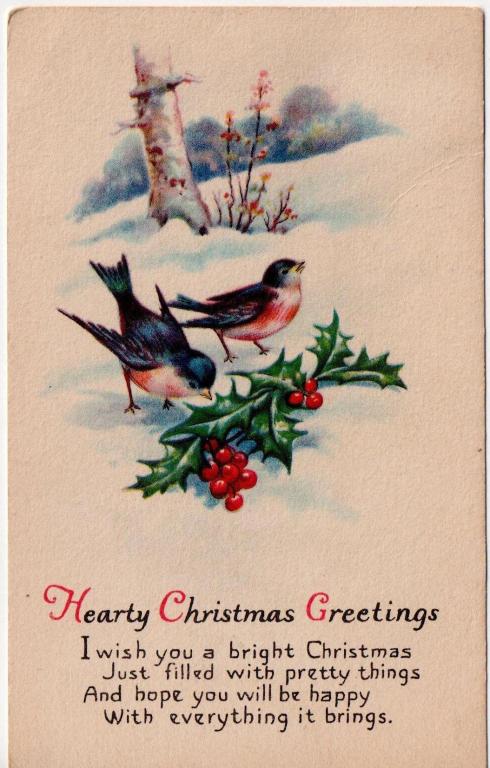
From 1913… (the back of this one says, in part… ‘don’t forget that rabbit stew we are all to have when one of you chaps snares one.’)

In 1912…

And from Uncle and Auntie…
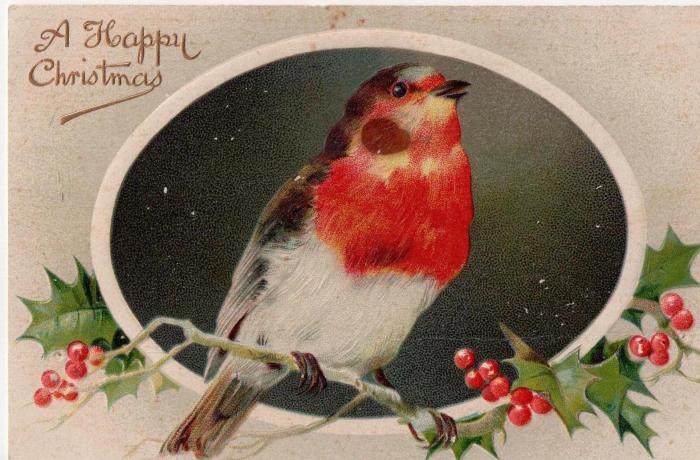
Merry Christmas, everyone!
Copyright Jane Tims 2012
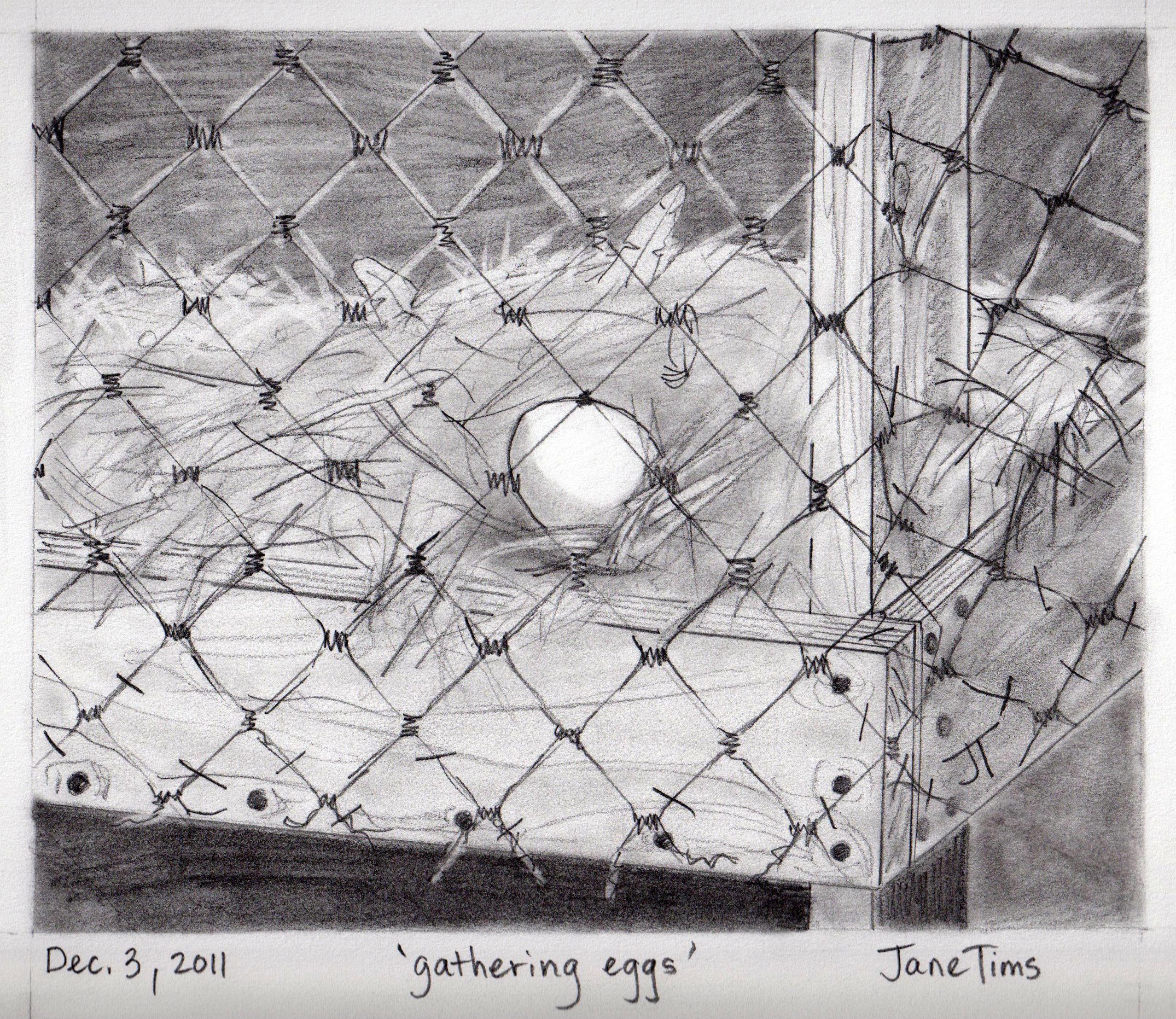
gathering eggs
When we visited my grandfather’s farm in the 1960s, boredom was never a problem. Every day brought a new discovery or learning. One of the best activities was to help in the gathering of eggs.
~
gathering eggs
~
first breath after rooster presses
crowbar under sun catches
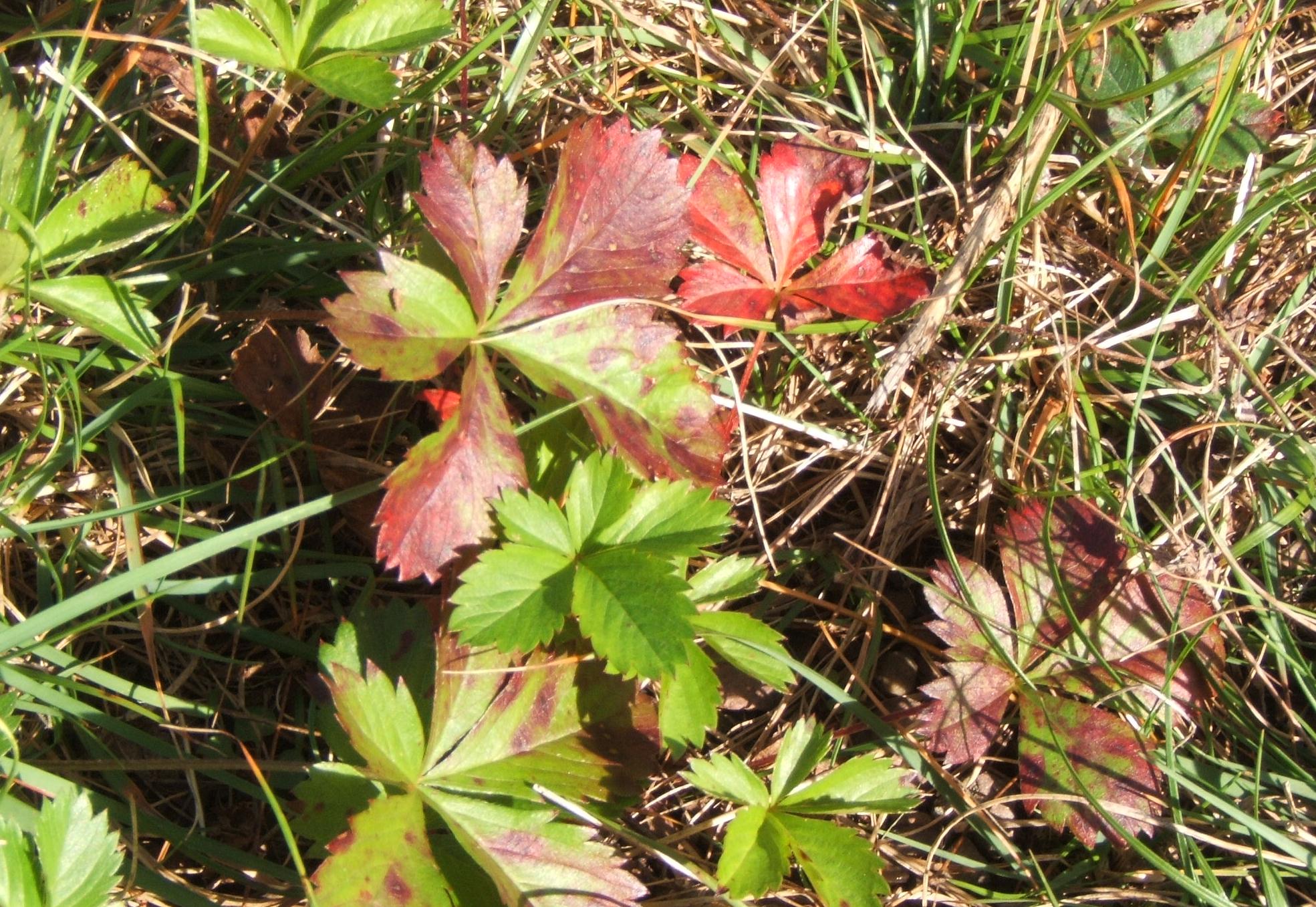
dew in the three-angled strawberry leaves
and light pings sapphire,
red, amber, emerald to opening eyes
I see Dandy waiting
black and white counterpoint to rainbow
~
he greets me, ignores
the chickens scratching
along random lines, we trek
to the barn together
push the man-door, open the pen
~
Diane has promised a gather
of eggs, shows me how
to shoo the hen, part the straw,
roll the egg into my hand,
build the stack in the basket
set each in a three-angled
cradle of eggs
~
Dandy watches the rooster
red comb and wattles,
amber neck, iridescent tail
ignores white eggs and chickens
~
~
Previously published as ‘gathering eggs’, Canadian Stories 15 (84), April 2012
Copyright Jane Tims 2012
log cabins and humble beginnings
In a recent post (October 17, 2012), I wrote about my shoemaker great-great-grandfather, Josiah Hawk, and his daughter, my great-grandmother, Ella Hawk.
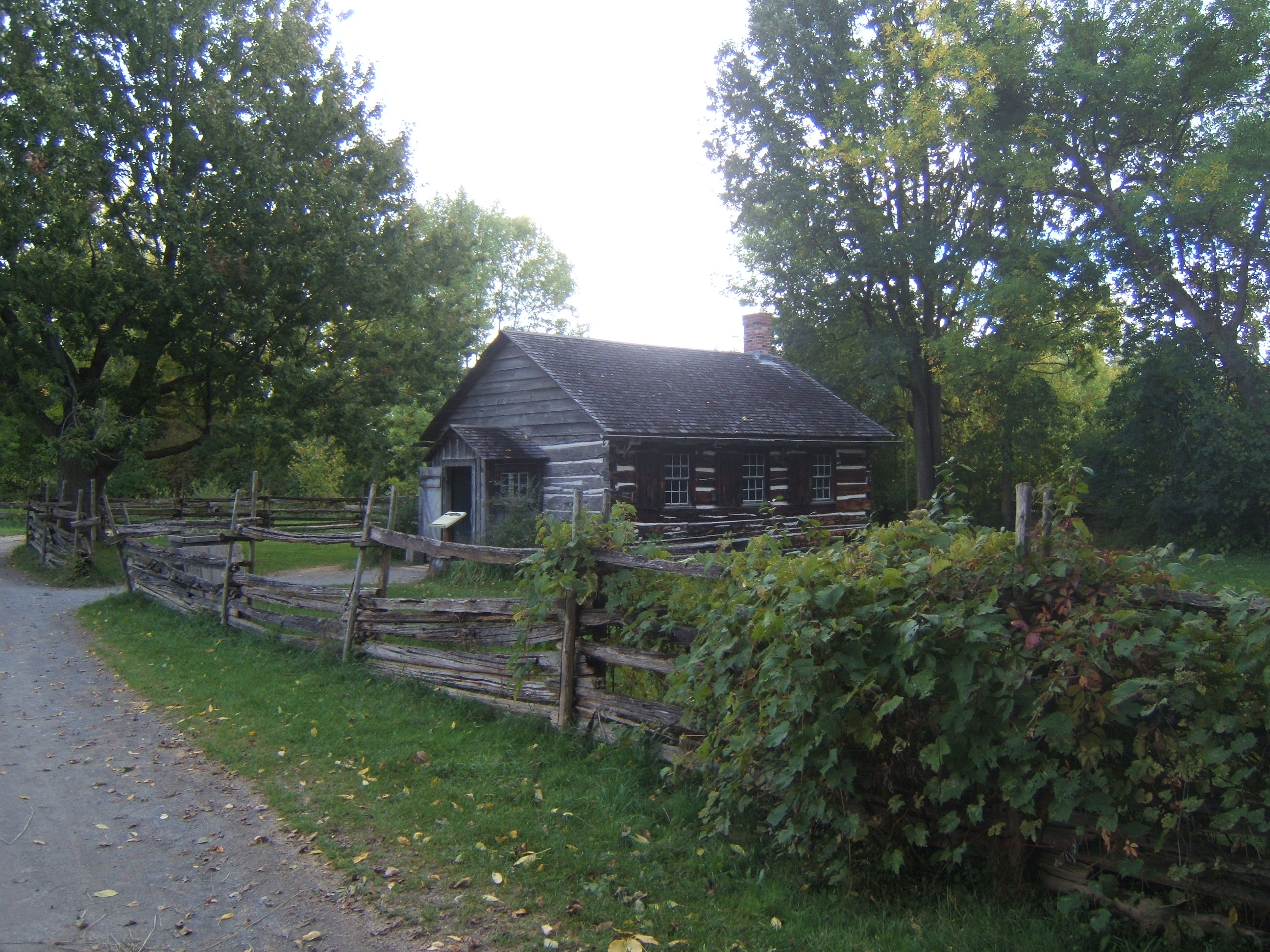
schoolhouse in Upper Canada Village, Ontario
When I was in Upper Canada Village in Ontario in September, I saw many houses and a way of life that reminded me of Ella’s family history.
Ella’s story begins before she was born, with the Hawk and Kresge families of Monroe County, Pennsylvania. I know a lot about these families, since both families have relatively complete genealogies.
Both the Kresges and Hawks were part of a large community of German immigrants who lived in the vicinity of Gilbert, Monroe County, from the late 1700s onward. In 2004, my husband, son and I visited the area and I went to church in the community. The congregation welcomed me warmly and I was told many of the people in the church shared my ancestry!

pioneer home in Upper Canada Village, Ontario
The Census of 1790 lists both of Ella’s great-grandfathers, Coonrod Crase (Conrad Kresge) and Conrad Hawke. Conrad Kresge had a son Johannes whose daughter Sarah Ann, was Ella’s mother. Conrad Hawke had a son Michael Hawk, whose son Josiah (the shoemaker) was Ella’s father.
The Kresges and Hawks were true pioneers and life for them was difficult. In about 1777, while clearing land, Conrad Kresge lost one of his sons at the hands of a band of Native Americans, who carried out raids on the community. This story is depicted in a memorial to Conrad Kresge in the Gilbert cemetary.

Memorial in Gilbert cemetary, depicting story of Conrad Kresge clearing land, and his son who was killed by an arrow
Although no other stories have survived the years, I have been able to learn quite a bit about these people from the genealogies. For example, I can piece together something of my great-great-great grandfather Michael Hawk’s life in Middle Creek, Pennsylvania. For example, for the year 1807, when he was 13 years old, he was the youngest of nine children. Of his five brothers and three sisters, only his older brothers John (19 years old) and Peter (16) remained at home. Siblings Nicholas (25) and Suzanna (23) had been married the year before, and on October 29, 1807, Suzanna gave birth to a set of twins, no doubt an exciting family event. His much older brother John George (37), living in the community of Effort, and his sister Anne Margaret (33), in Chestnut Hill, must have seemed a generation away, since John George’s daughter Elizabeth, Michael’s niece, was only four years his junior.
~
~
Michael, alone
(Middle Creek, 1807)
~
November has worked its way
into the wood pile, I use Papa’s axe
to split kindling, I blow rings into
the cold air, everyone is away, gone to
Chestnut Hill to see
Suzanna’s twins
~
everyone leaves –
they become like strangers
Catherine, run off to Seneca Lakes,
Nicholas married last year,
John and Peter, itching to go
~
Mama calls me her baby
well, I’m the same age as the Kresge boy,
killed by an arrow thirty years ago –
but that’s an old story
~
I look across the cornfield
to the oak woods where leaves still cling,
they glow like copper
noone lurks there now
~
Copyright Jane Tims 2012
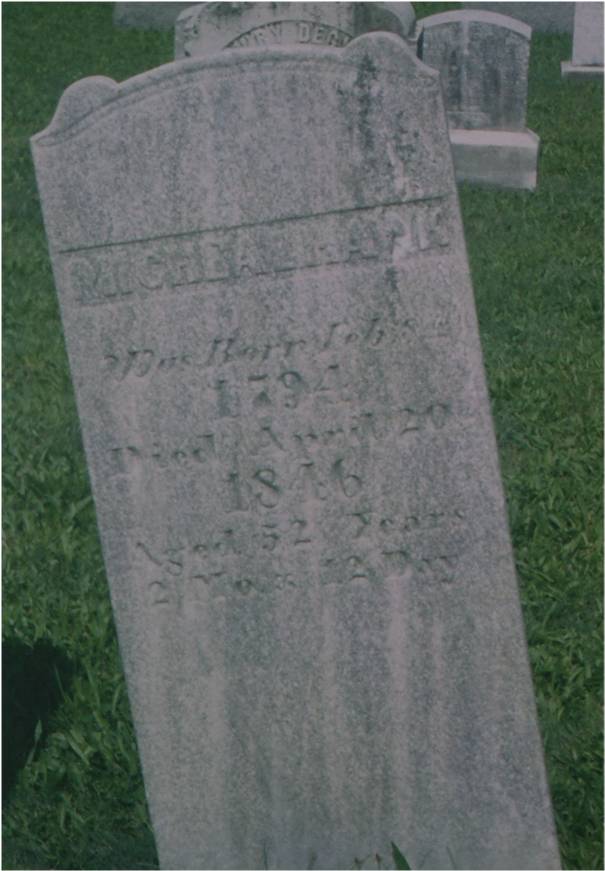
gravestone reads: Michael Hawk – was born Feb 8th 1794 – died April 20 1846 – Aged 52 years 2 months 12 day
revisions
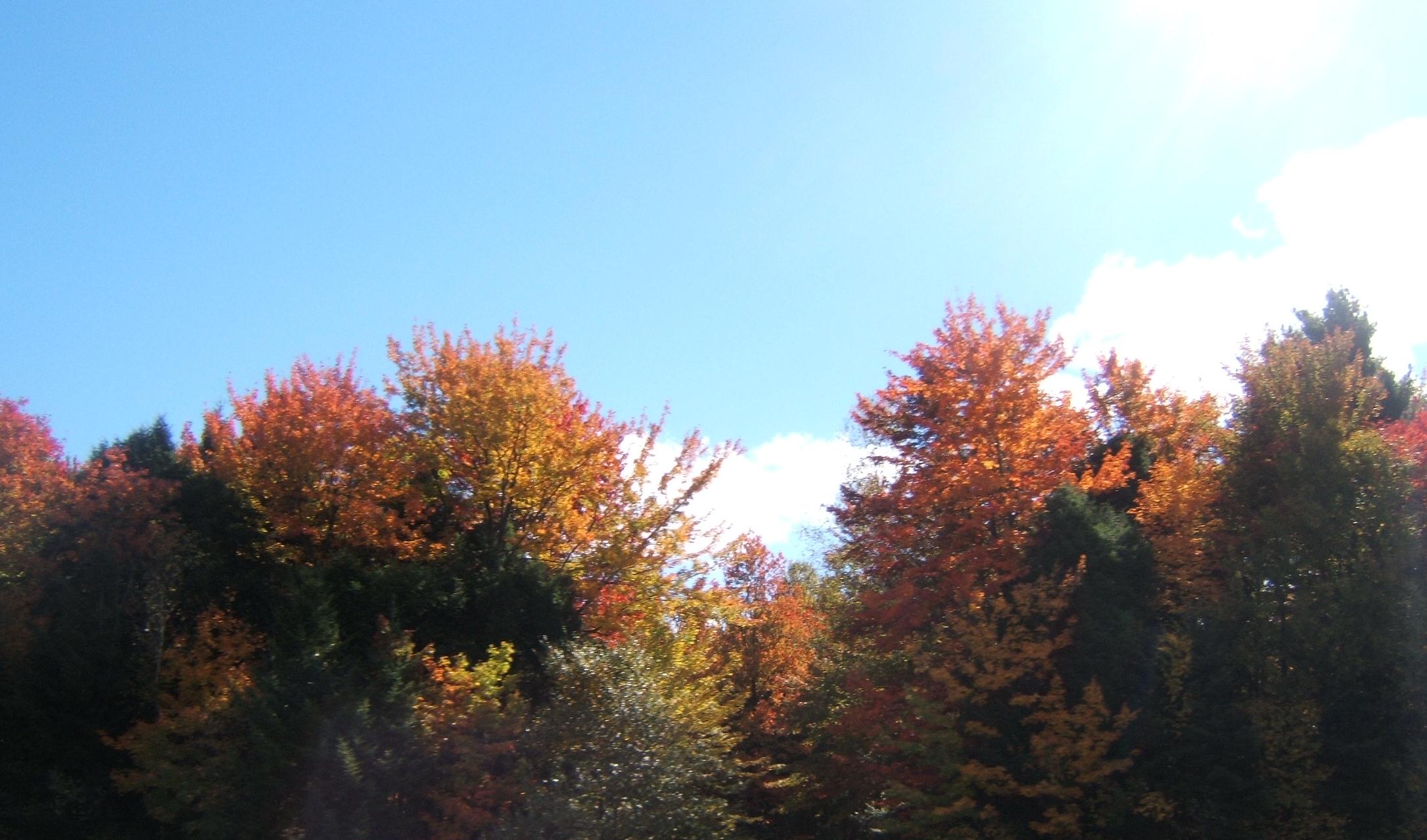
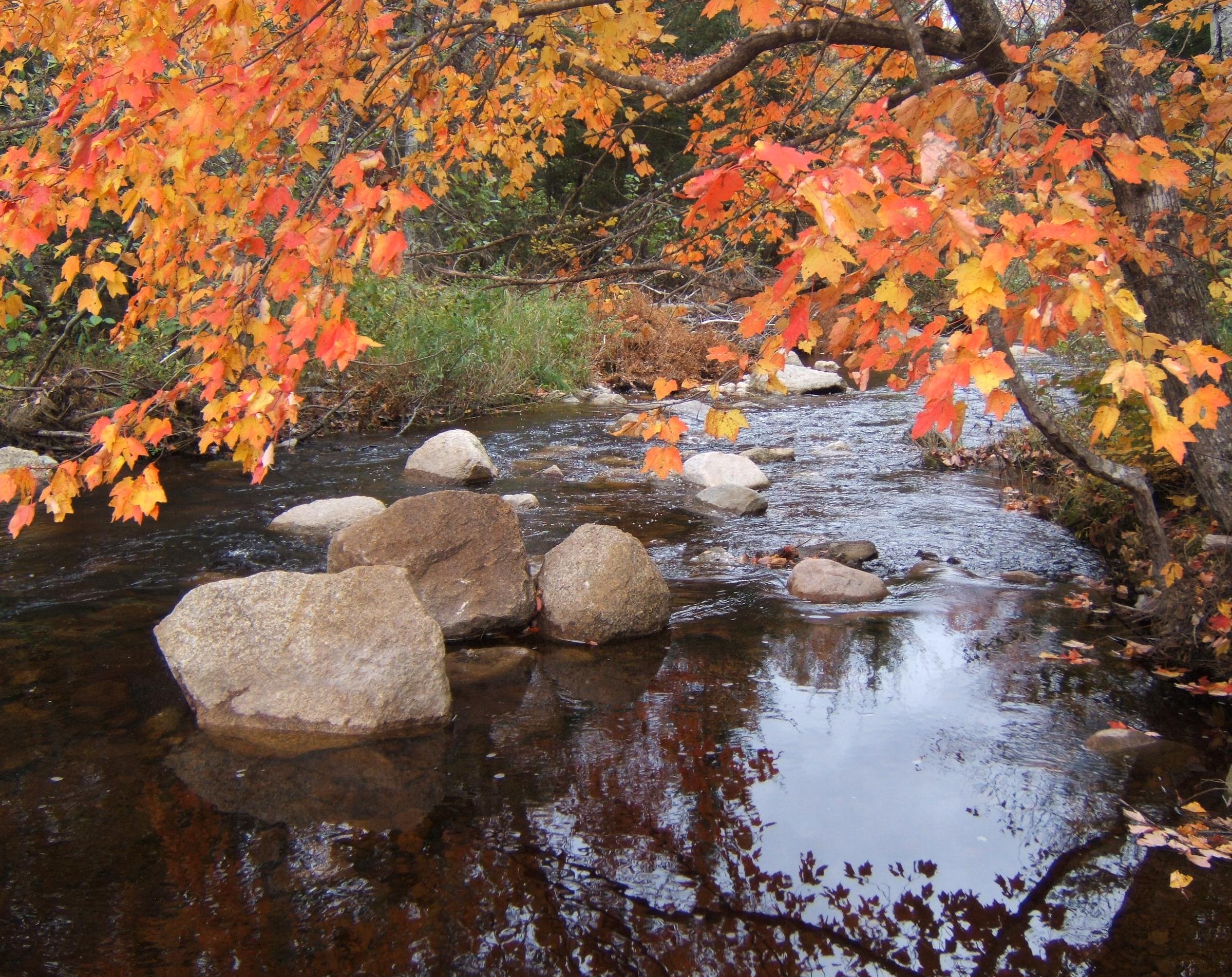
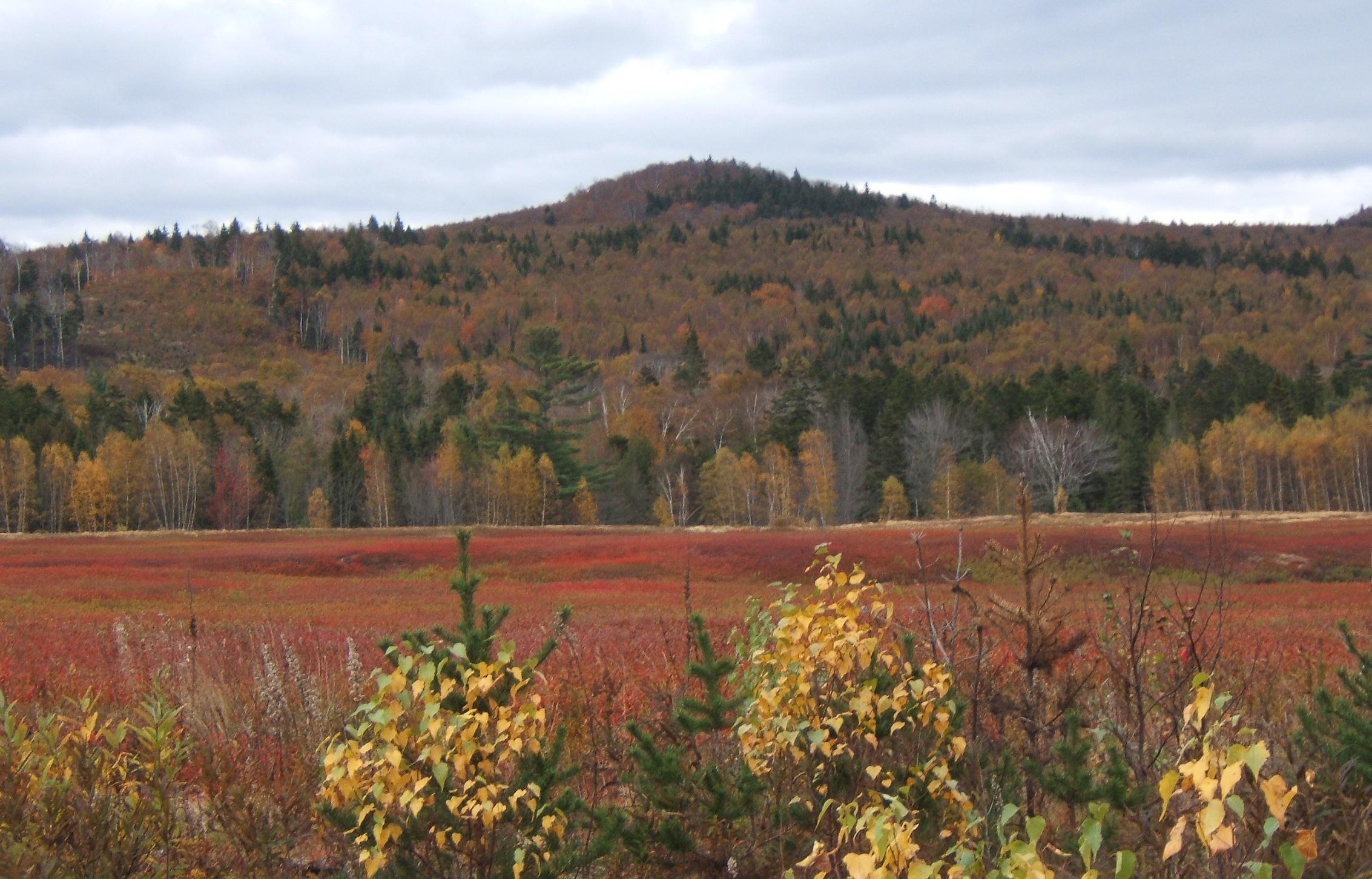
Yesterday was a very windy day. Some leaves have survived the gusts of wind, but not many. It has been a short drama of color this year, with only a few acts remaining. The maples still have some leaves, the poplars are just turning yellow, and the oak is only now losing its green.
While the wind was blowing, I was at my desk, revising some of my poems. It is my least favorite phase of writing poetry. I love the beginning, the first ideas fluttering around in my head, and put to paper. The page at this point is a confused mass of words and phrases, squiggles and arrows. I like these ‘pen and paper’ revisions. There is something about the hand-brain connection, so I write and rewrite quite liberally. By the time I commit the poem to the computer screen, it has already had five or six revisions. Once on the screen, I move things around a bit, but I print the page to do the finishing touches.

I am quite orderly about final revisions.
First, I work on what the poem is saying. This is so difficult for me, because I tend to write descriptive poetry. I have to challenge myself to add narrative, or clarify deeper meaning. Sometimes the poem gets a new title at this stage. Unfortunately, I am rarely happy with the results of this step in the revision process.
Next, I do the detailed revisions and for this, I have a checklist to follow (see ‘revision checklist for poetry’ under about)… I know my own work very well and I am prone to repeating words, using passive rather than active verbs, and using the singular when I should use the plural. I ‘press’ on each word in the poem, to see if another word will add additional meaning, improve internal rhyme, or covey a more accurate image. I count syllables … sometimes small changes will accentuate or create structure … sometimes there is little if any pattern to the poem. Lately, I am paying a lot of attention to the ends of the lines, trying to decide why I end each line where I do.
Finally, I read the poem aloud. This helps me to hear the words, and discover where the rhythm is off, and to know when to include smaller words like articles and when to let them go. Reading aloud also helps me with ‘voice’. I often shift from a child’s point of view to the technical and I have to be wary of leaving my audience in a state of confusion.
The next step in the revision process is more enjoyable. To do some final polishing, I read my poems to an audience. Sometimes this audience is a member of my family and I listen carefully to their suggestions. I especially think about bits they may not like. I also read my poems to the members of my two writing groups. They offer excellent critique and usually I make some revisions afterward.

When is a poem complete? Perhaps never. I still work on poems published years ago. I guess I agree with Oscar Wilde who said, “This morning I took out a comma and this afternoon I put it back in again.”
If you write poetry, how much time do you spend on revision? What process do you follow?
~
~
revisions
~
a violent October wind –
every tree bleeds red,
bends northward
~
my books also lean
and the pencils in their holder
the colors in the hand-blown drinking glass
~
purple lavender, scent of summer
the flowers now dry
braided with ribbon
~
~

Copyright Jane Tims 2012
apple picking time
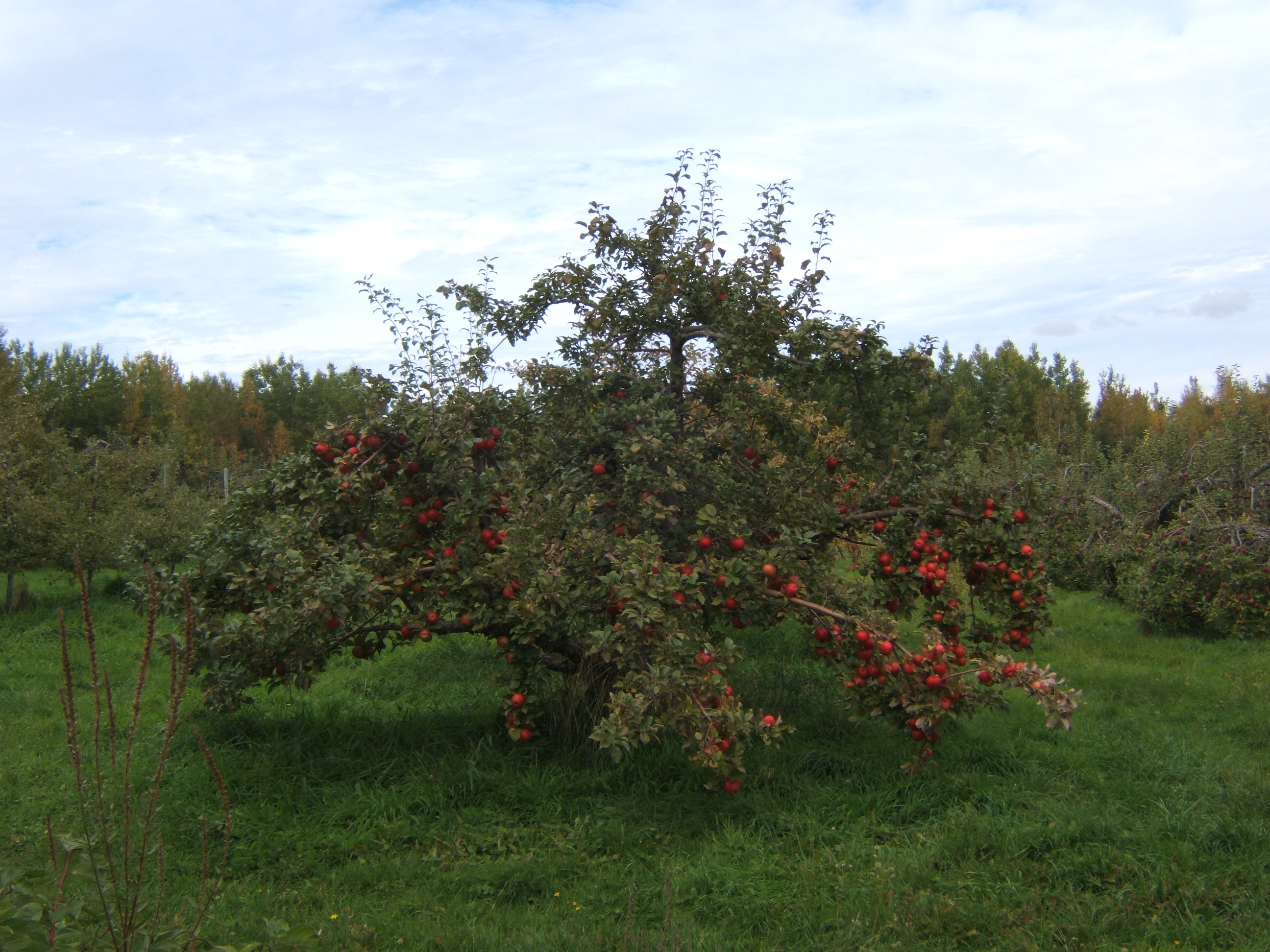
October has taken hold and now signs of autumn are everywhere. Color seems to be the theme… the orange of pumpkins and gourds, the yellows and reds of the maple leaves, and the red of ripe apples.
On our way to the lake, we drive past orchards of apples. Most of the apples have been picked, but some trees are still laden with fruit. For me, the orchards are full of memories, of picking apples with my family when we were younger. I remember how much fun we had, my son and niece and nephew excited to be able to run free and pick the apples, and the adults thinking about the apple pie possibilities from those loaded trees.
~
~
orchard outing
~
wooden bushel baskets
of laughter, the delirious tumble
down the avenue of trees, shadows ripple
among the dapples, Cortlands tied
with scarlet ribbons and boughs burdened
to reach for us, my son grown tall
on his father’s shoulders,
stretches to pick the McIntosh
with the reddest shine,
small hand barely able
to grip the apple
~
~
Copyright Jane Tims 2012
a moment of beautiful – old-fashioned flowers
the space: the side of a cottage in the late summer sun
the beautiful: a riot of Golden Glow, leaning against the wall
~
Last week, on a drive along the South Branch of the Oromocto River, I noticed the fall flowers have taken over from the summer species. The fields are filled with Goldenrod (Solidago spp.) and the ditches with Pearly Everlasting (Anaphalis margaritacea (L.) C.B. Clarke). In some of the yards were three flowers I think of as ‘old fashioned’ – French Marigolds (Tagetes patula L.), Hollyhock (Alcea spp.), and Golden Glow (Rudbeckia laciniata (L.) var. Hortensia). I love the orange of the Marigolds, the papery pinks and purples of the Hollyhock, and how the Golden Glow leans!

These plants were my first introduction to the concepts of ‘annual’, ‘biennial’ and ‘perennial’. The French Marigold was an annual, and grew only for a single year. The Hollyhock was a biennial (although some are weak perennials), living a year without flowers and then blooming in the second year. The Golden Glow came up year after year without benefit of seeds or fuss, a perennial.
I remember helping my Mom collect seeds so she would always have the Hollyhocks and French Marigolds. If I close my eyes, I can see my hand holding the pointy black French Marigold seeds and the flat Hollyhock seeds with their furry edges.
When we first built our house, I was anxious to have these plants in my garden, but after blooming for a few years at the edge of the house, the Golden Glow died out, and I could never get Hollyhocks to flower. Both need lots of sun and we have only shade to offer. I often grow French Marigolds. I still have the seeds I collected from our first garden here, stuffed in an old metal seed box. I doubt they are still viable, but when I open the box, I see the seeds of the Marigolds that bloomed here 32 years ago!
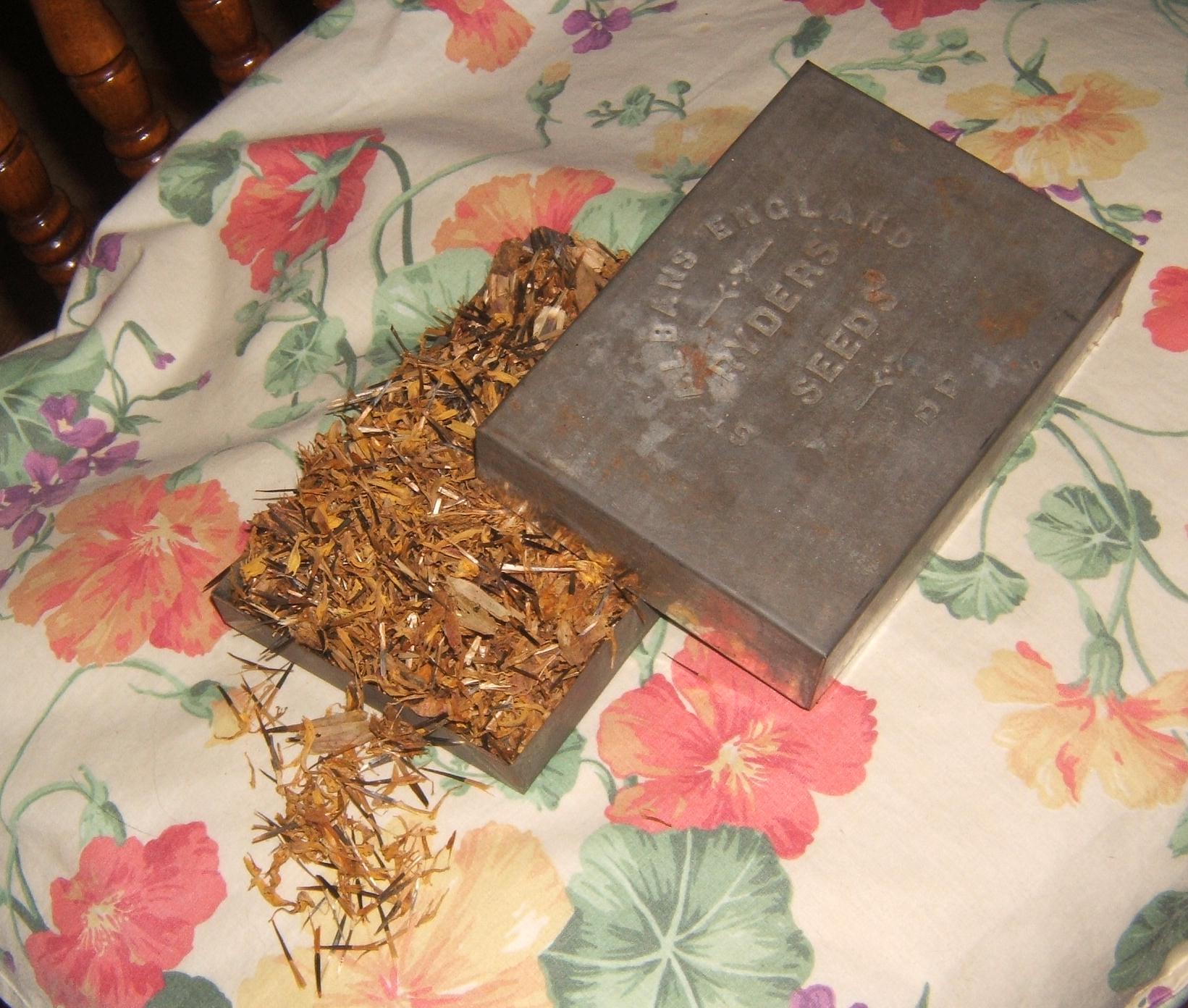
The seeds I collected from our first garden of Marigolds in 1980… they are kept in an antique box marked ‘St. Albans England – Ryders Seed – D.P.’ Ryders was a seed company operated in England beginning in the 1890s. It sold seed in ‘penny packets’ to be affordable for everyone.
What are your favorite ‘old-fashioned’ flowers and do you see them much anymore?
~
~
Pearly Everlasting
Anaphalis margaritacea L.
~
Pearly Everlasting
sign of summer’s passing
yet – immortelle
picked by the road
by the armload
hung from rafters
children’s laughter
runs beneath
~
downy leaf, wooly stem
white diadem
perfectly matched flowers
thatched in gold
dry and old
~
Linnaeus named
for Marguarite
memory sweet
paper petals keep
pale perfume
summer grace
in a winter room
~
~
Published as: ‘Pearly Everlasting’, The Antingonish Review 92, 1993
Copyright Jane Tims 2012
Chicory – (Cichorium intybus L.)
Along the Trans-Canada near Jemseg, one colony of Chicory has taken hold. Its bright sky-blue flowers catch the eye as the usual roadside vegetation rolls by.
~

~
Also known as Blue Sailors and, in French, chicoreé, Chicory (Cichorium intybus L.) is a tall plant, found along roadsides and in other waste places.
Chicory has basal leaves resembling those of the Dandelion. When broken, the stem exudes a white milky fluid.
The bright blue flowers of Chicory occur along the length of the almost leafless and somewhat zig-zag stem. Each flower is formed of a central involucre of tiny blue flowers and a disc of larger ray flowers. The rays are square-cut and fringed. The flowers follow the sun, closing by noon, or on overcast days.
~

~
Chicory is a useful plant. Its young leaves are edible as salad greens or as a pot-herb. The roots can be dried and ground to make a coffee substitute or supplement. The root of Chicory has soothing properties to balance the edginess caused by caffeine. The roots of Chicory are large and very deep. I tried to pull them by hand, but a shovel will be needed to harvest the roots in the compact soil of the roadside.
~ When I see these flowers, I am reminded of my grandfather, my mother’s father. I never knew him, but I have a couple of photographs of him as a young man. I have made a small study of his mother, my great-grandmother, so I know quite a lot about him. ~
~
The flowers of Chicory remind me of his eyes, since they were the same startling blue. He was also a tall man, another feature of the plant.
The other name for Chicory, Blue Sailors, also reminds me of my grandfather. He was a sailor, entering the navy when he was only fifteen. I know from various records that he served on at least two naval vessels, the USS Nebraska and the USS Pensacola. As so often happens when I see photographs of ancestors, there is a familiarity about his features.
~

~
Blue Sailors
Chicory (Cichorium intybus L.)
~
at the roadside
weeds surge as waves
~
on the sameness of ocean,
a buoy lifted,
a sudden swell of Chicory
~
tall, like my grandfather,
the blue ice of his eyes
its blunt petals, the square-cut of his jaw
~
joined the navy at fifteen
dressed as a sailor, headed for sea
USS Pensacola, USS Nebraska
~
his tie, a sapphire ribbon
toothed or frayed
~
~
© Jane Tims 2012
Warning: 1. never eat any plant if you are not absolutely certain of the identification; 2. never eat any plant if you have personal sensitivities, including allergies, to certain plants or their derivatives; 3. never eat any plant unless you have checked several sources to verify the edibility of the plant.growing and gathering – picking berries with friends
As I am deciding how to organise my poetry manuscript on ‘growing and gathering’ local foods, I am considering the themes of the various poems. I think these themes will become the sections in my manuscript.
One of the first themes to emerge, perhaps the easiest to examine, is about ‘relationships’.
Although I have often picked berries alone, my best memories are of picking berries with members of my family. Both my Mom and Dad loved to pick berries. My Dad was a fast picker and I was always in silent competition with him to pick the most berries… I never won. My Mom picked berries quickly, but took the time to enjoy the fresh air, the blue sky and the expanse of the berry field. When I think of picking berries with her, I feel calm and a little lazy. My relationship with my mother-in-law was also shaped by our many berry-picking experiences; when I pick raspberries, I hear her quiet laughter in the breeze.
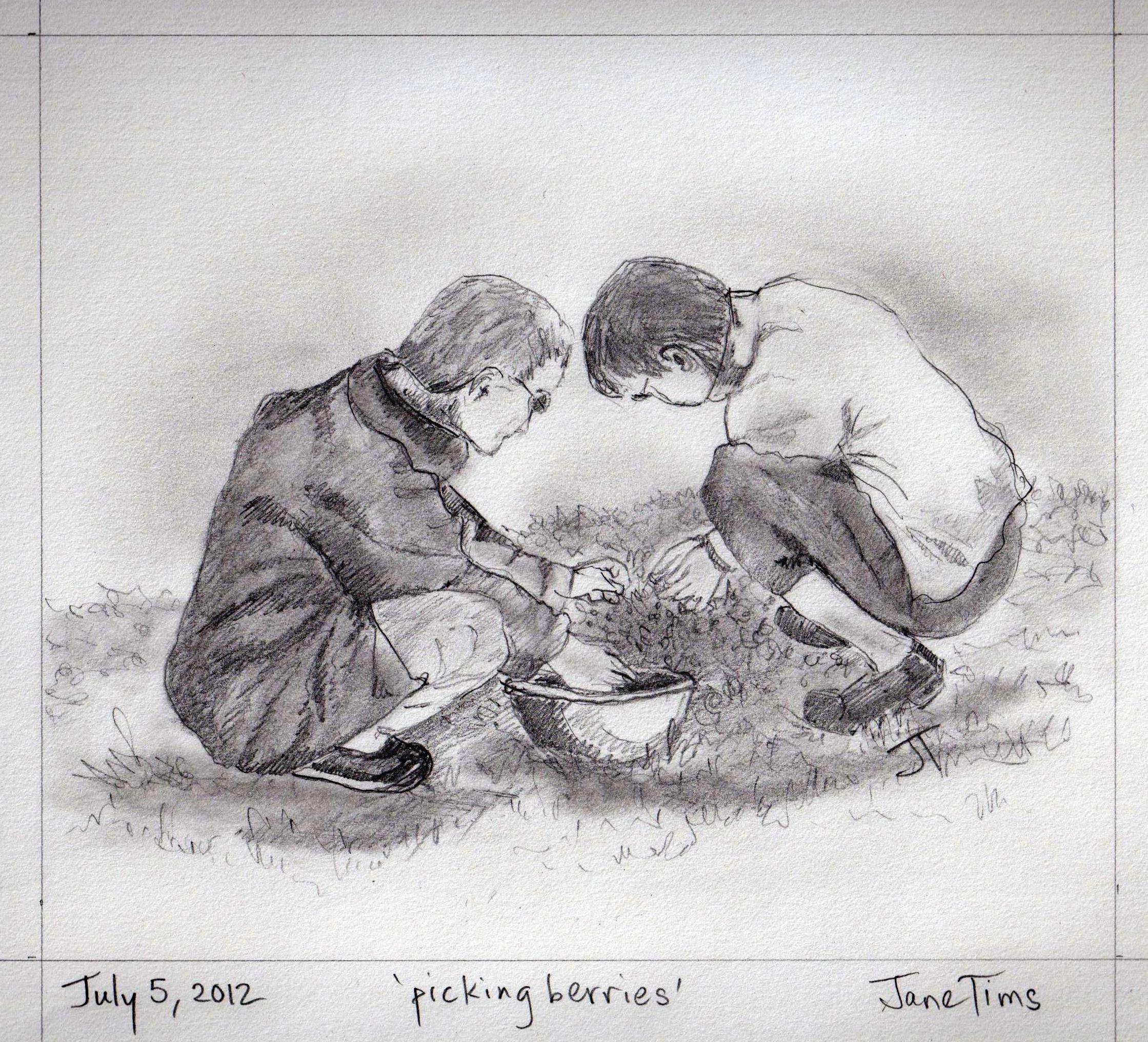
As I write poetry for my ‘growing and gathering’ manuscript, I have explored my relationships with the various people in my life.
Some of these are based on real experiences I have had picking berries or gathering greens. Examples include poems about trying to find an old berry field, now grown over, or how changes in a relationship can be observed over the years in the annual picking of berries. Although most of the poems are about plants, I have included production of other local foods – so a poem about beekeeping, for example, explores how two people interact during a small emergency.
In other cases, the gathering of local foods is a metaphor for some aspect of a relationship, whether good and bad. At least some of these metaphors are related to the characteristics of plants or animals – for example, the serrated edges of leaves, the slipperiness of a trout, the gentle feel and fragrance of Bedstraw, or the bitterness of taste common to so many ‘salad’ greens.
Some of the metaphor is based on the place where plants grow. Examples include the seclusion of many berry-picking spots, or the physical spaces created by rows of corn plants.
As I look over the Table of Contents for my manuscript, I realise some poems will be stronger if placed within another theme. So I have moved, for example, a poem about picking berries over a three-week period from the theme on ‘relationships’ to a theme about ‘change’.
This consideration of the themes in my poetry has given me a good start to organising the poems, and identifying gaps I have to fill. I know now there are lots of gaps, and many poems yet to write!
~
~
Bitter Blue
~
of all the silvery summer days we spent none so warm sun on
granite boulders round blue berry field miles across hazy miles
away from hearing anything but bees
and berries
plopping in the pail
~
beside you I draped my lazy bones on bushes crushed berries and
thick red leaves over moss dark animal trails nudged between rocks
baking berries brown musk rising to meet blue heat
or the still fleet scent
of a waxy berry bell
~
melting in my mouth crammed with fruit sometimes pulled from
laden stems more often scooped from your pail full ripe blue pulp
and the bitter shock of a hard green berry never ripe
or a shield bug
with frantic legs
and an edge to her shell
~
~
Published as: ‘Bitter Blue’, Summer 1993, The Amethyst Review 1 (2)
Published on www.nichepoetryandprose.wordpress.com on July 31, 2011
© Jane Tims 2012
Warning: 1. never eat any plant if you are not absolutely certain of the identification; 2. never eat any plant if you have personal sensitivities, including allergies, to certain plants or their derivatives; 3. never eat any plant unless you have checked several sources to verify the edibility of the plant.growing and gathering – the benefits of eating ‘very local’ foods
In 2007, Alisa Smith and J.B. MacKinnon embarked on a year-long experiment in eating local. Their book, The 100 Mile Diet – A Year of Local Eating, introduced many to the idea of obtaining their food from nearby sources. It reminded people about the thousands of kilometers our food has to travel to make it to our tables. It pointed out some of the barriers to ‘eating local’ and showed how, with a little ingenuity and effort, our diets could be more environmentally conscious and sustainable.

Eating local foods is a sound choice in our illogical world. It supports local farmers and producers. It mitigates some of the energy costs associated with moving food hundreds of miles to the consumer. It honors our origins and connects us to our ancestors who lived their lives more simply and locally.
Into this concept of eating local, I include the idea of eating wild foods whenever possible. My mother grew up in a time when bulging grocery carts were unheard-of. Without subscribing to any particular theory of eating local, she supplemented her food with wild edibles as a matter of habit. In addition to using rhubarb and currents from her garden, she picked berries when they were in season, tried to convince her family to join her in eating dandelion greens and sour dock, and showed us how to pick spruce gum from spruce trees as a chewy treat.
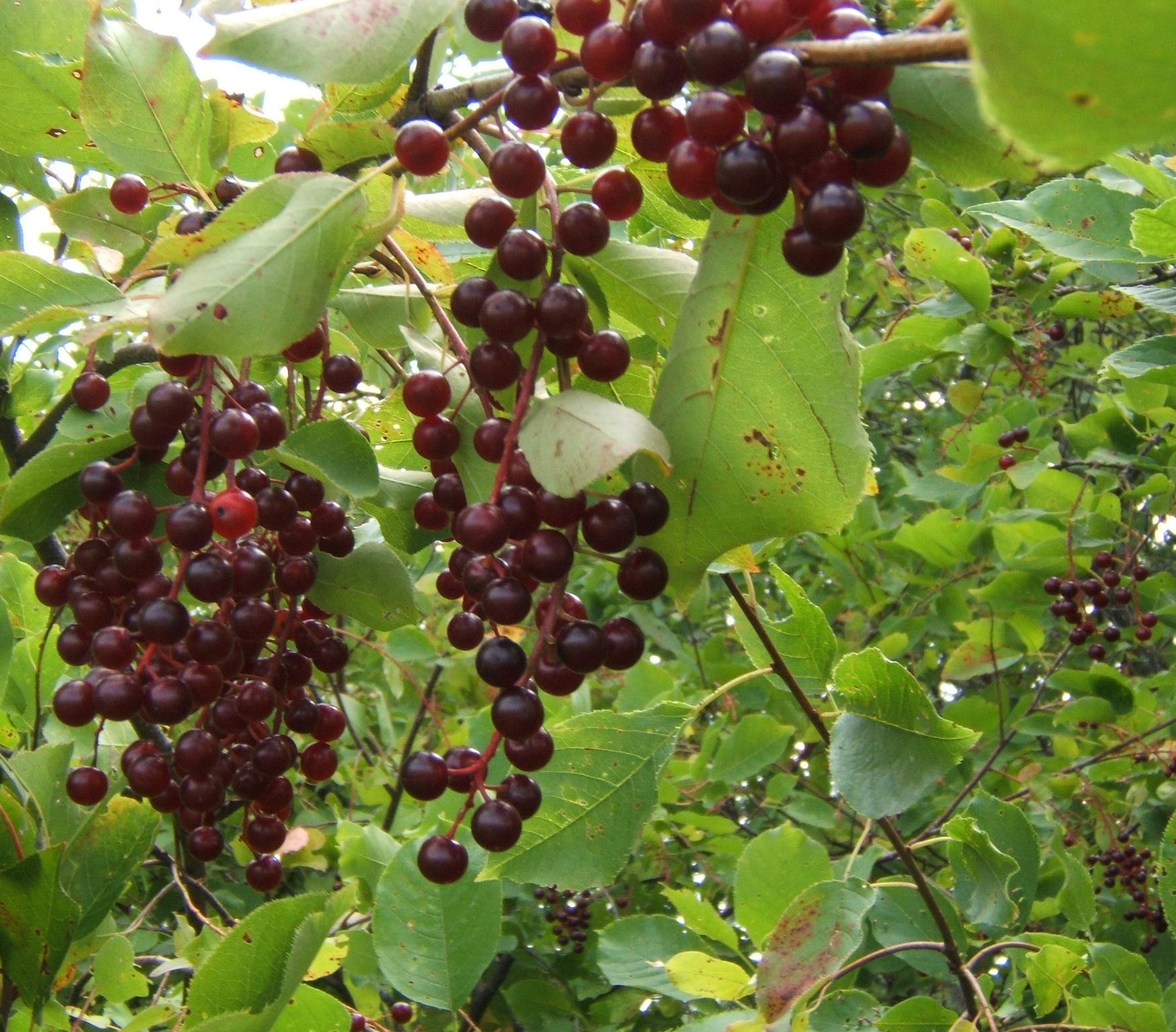
Eating ‘very local’ has many benefits. The edible plants growing right outside our doors are filled with nutrients, many are very palatable, even delicious, and they are present in great variety, and in all seasons. They are free and are easy to harvest and prepare. Picking berries or chewing spruce gum puts us in touch with nature and helps us to understand our role as a member of the ecosystem. It honors the people who came before us and helps us connect with the way our parents and grand-parents lived their lives. Identifying and picking wild plants for food is an enjoyable activity and a way to show your children how to be thrifty, engaged members of the ecosystem.
In an upcoming post, I will look at some of the ethical issues around using wild plants as food.
~
~
six bottles of jam
~
I reach up, for a cluster of pin cherries
and stop –
above me, my grand-mother’s hand
dry as a page from her recipes,
age-spotted, worried at the edges
her ankles are swollen, but she is determined –
enough berries for a half-dozen
bottles of pin cherry jam
~
~
© Jane Tims 2012
Warning: 1. never eat any plant if you are not absolutely certain of the identification; 2. never eat any plant if you have personal sensitivities, including allergies, to certain plants or their derivatives; 3. never eat any plant unless you have checked several sources to verify the edibility of the plant.a moment of beautiful – a swing in the orchard
the space: in the shade of a tree
the beautiful: an old wooden swing
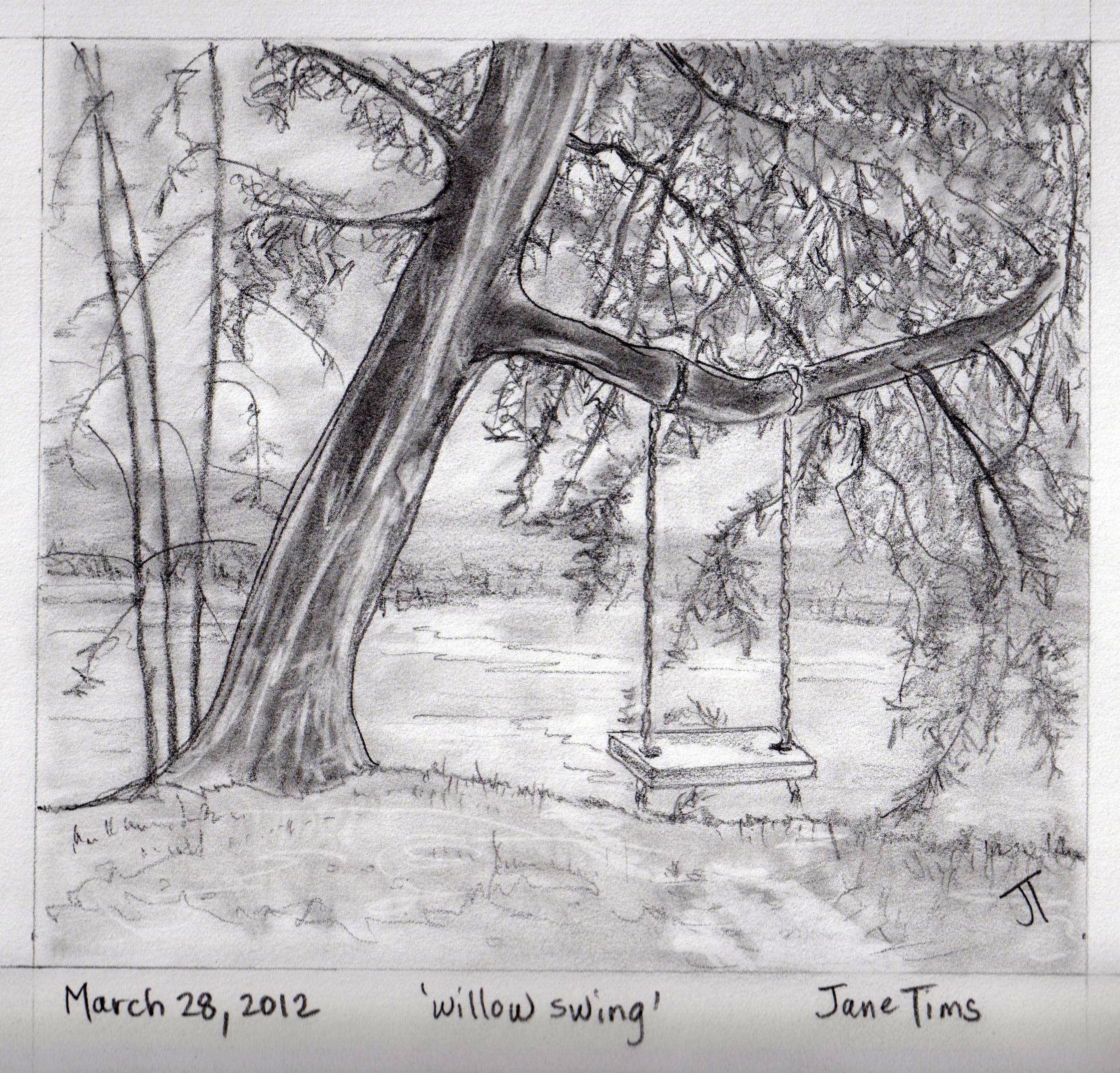
The sight of a swing hanging from the solid limb of an old tree recalls happy hours of swinging when I was a child.
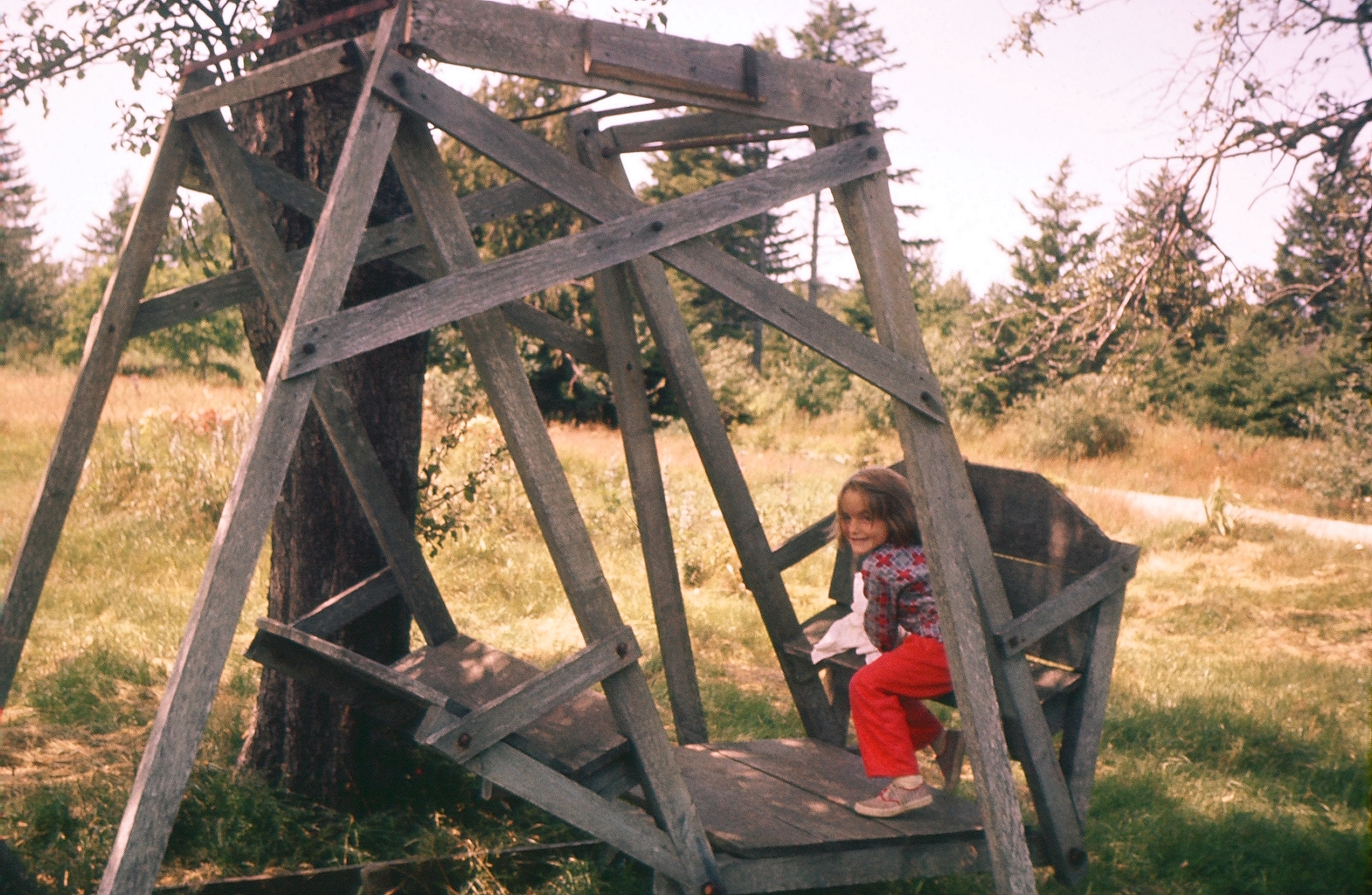
On my grandfather’s farm, the swing was a swing-chair, and I spent hours pushing the old swing to its limits (see ‘in the apple orchard’ the post for August 9, 2011, under the category ‘my grandfather’s farm’). At home in Ralston, Alberta, the community playground had an adult-sized swing set, strong enough to withstand our approach of ‘stand on the seat and pump’. And, when my son was little, we had an old-fashioned board and rope swing – it was a little off-kilter and seemed to go side-to-side rather than forward-and-backward but I remember he and I had lots of fun.
My own childhood story about board and rope swings is bitter-sweet. My Dad built me a swing and hung it from the rafters in the basement of our house in Medicine Hat. I loved it, but … one day I let go of the ropes and fell backwards, hitting my head on the concrete floor. I can still remember the intense pain and the big black star that dominated my vision for a moment. People who know me will say this explains a lot.
~
~
swing sway
~
the old swing
hangs frayed from a limb
of the apple tree
sways
hips as she waits
for the downtown bus
rocking learned
in baby years
when rhythm brought peace
and a quiet evening
~
~
© Jane Tims 2012




 nichepoetryandprose