Posts Tagged ‘coast’
Beach Pea (Lathyrus japonicus Willd.)
During our vacation to Nova Scotia, we stopped at several places along St. Margaret’s Bay. All along the beaches, tucked just out of reach of the highest tides, were crowds of Beach Pea. Beach Pea (Lathyrus japonicus Willd.) is a common plant of the coast, growing on sandy and gravelly shorelines and beaches.

This plant resembles the garden pea. It has vine-like, trailing, compound leaves, each composed of 6-8 leaflets. At the base of each leaf is a clasping stipule; at the leaf’s tip is a curling tendril. The flowers are showy, pink and blueish-purple, blooming from June to August.

The seeds of the Beach Pea are podded peas, from 1 to 2 inches long. They are greyish-green and ripen in August.
Some sources, including Peterson’s Field Guide to Edible Wild Plants (1977), say that Beach Peas can be collected, boiled and eaten when they are young and tender. Other sources, more up to date, say they are not edible because they contain a toxic substance that effects the nervous system. In my next post, I’ll talk a bit about being cautious before eating wild plants.
~
~
Beach Pea
Lathyrus japonicus Willd.
~
she feints on the rocks
sighs on the sand
beckons with the tendrils
of her feathery hand
~
ruffles her skirts
in the salted breeze
and squanders her love
on indifferent seas
~
~
© Jane Tims 2012
Warning: 1. never eat any plant if you are not absolutely certain of the identification; 2. never eat any plant if you have personal sensitivities, including allergies, to certain plants or their derivatives; 3. never eat any plant unless you have checked several sources to verify the edibility of the plant.limits of the tide #5 – Samphire (Salicornia europaea L.)
A beach-comber this time of year may easily over-look plants of Samphire (Salicornia europaea L.), also called Glasswort, Pigeon-foot, and Chicken-claws. Unless it is plentiful, it becomes lost ‘in the green’ of other sea-shore plants. The genus name, Salicornia, comes from the words sal meaning salt and cornu meaning horn. These plants consist of a branched, succulent stem, apparently without leaves or flowers. The leaves and tiny flowers are embedded in the stem.

Although Salicornia is typically a plant of coastal areas, like Sea-blite, it is also found far from the coast, in the vicinity of inland salt springs.
Samphire greens are salty, delicious as a salad ingredient, a pickle, or a pot-herb.
~
~
salt of the sea
Samphire ( Salicornia europaea L.)
~
Salicornia smoulders
on a silica shore,
flute and fire
~
Glass pipes,
mainstem and branches,
pickle green
~
Light glimpsed
through crystalline,
transparent walls
~
Seawater, rarefied,
decanted
to a Samphire phial
~
Flask of salt-sap,
brine on the tongue
Always wanting more
~
~
© Jane Tims 2012
Warning: 1. never eat any plant if you are not absolutely certain of the identification; 2. never eat any plant if you have personal sensitivities, including allergies, to certain plants or their derivatives; 3. never eat any plant unless you have checked several sources to verify the edibility of the plant.coastal barren, coastal bog
On our vacation to Nova Scotia last month, we revisited the Peggy’s Cove area near Halifax. I spent a lot of time along this coast years ago, but I had forgotten the unique wildness and beauty of this landscape.

We explored two habitat types, the dry and rocky barrens, and the wet coastal bog. As we found each new plant, I felt like I was greeting old and well-loved friends.
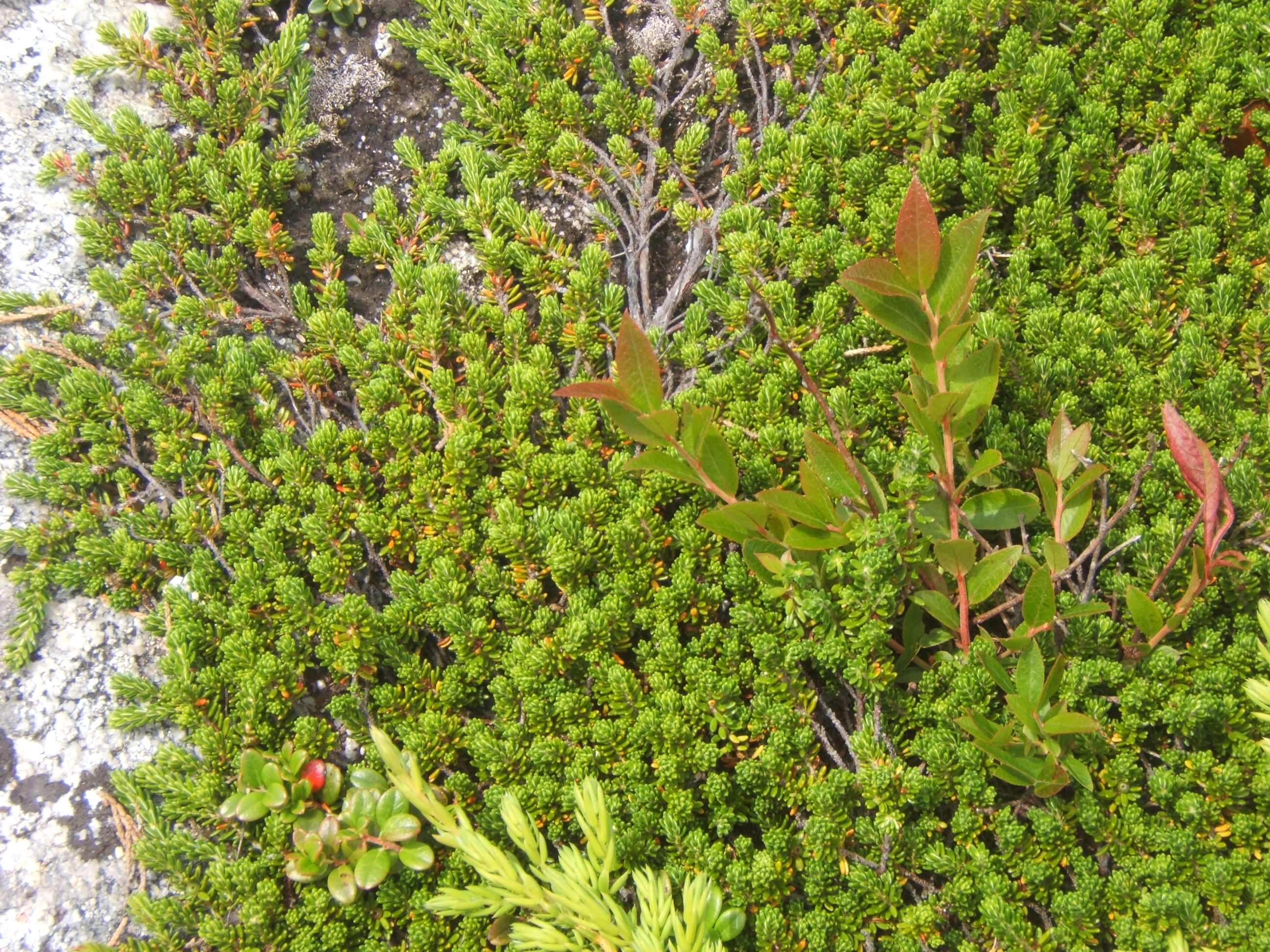
On the higher areas, growing in the thin soil on the bedrock were several species. One of these included Crowberry (Empetrum nigrum L.), a small moss-like plant with spiky leaves and small pink flowers. Later in the season, these will bear edible back berries.
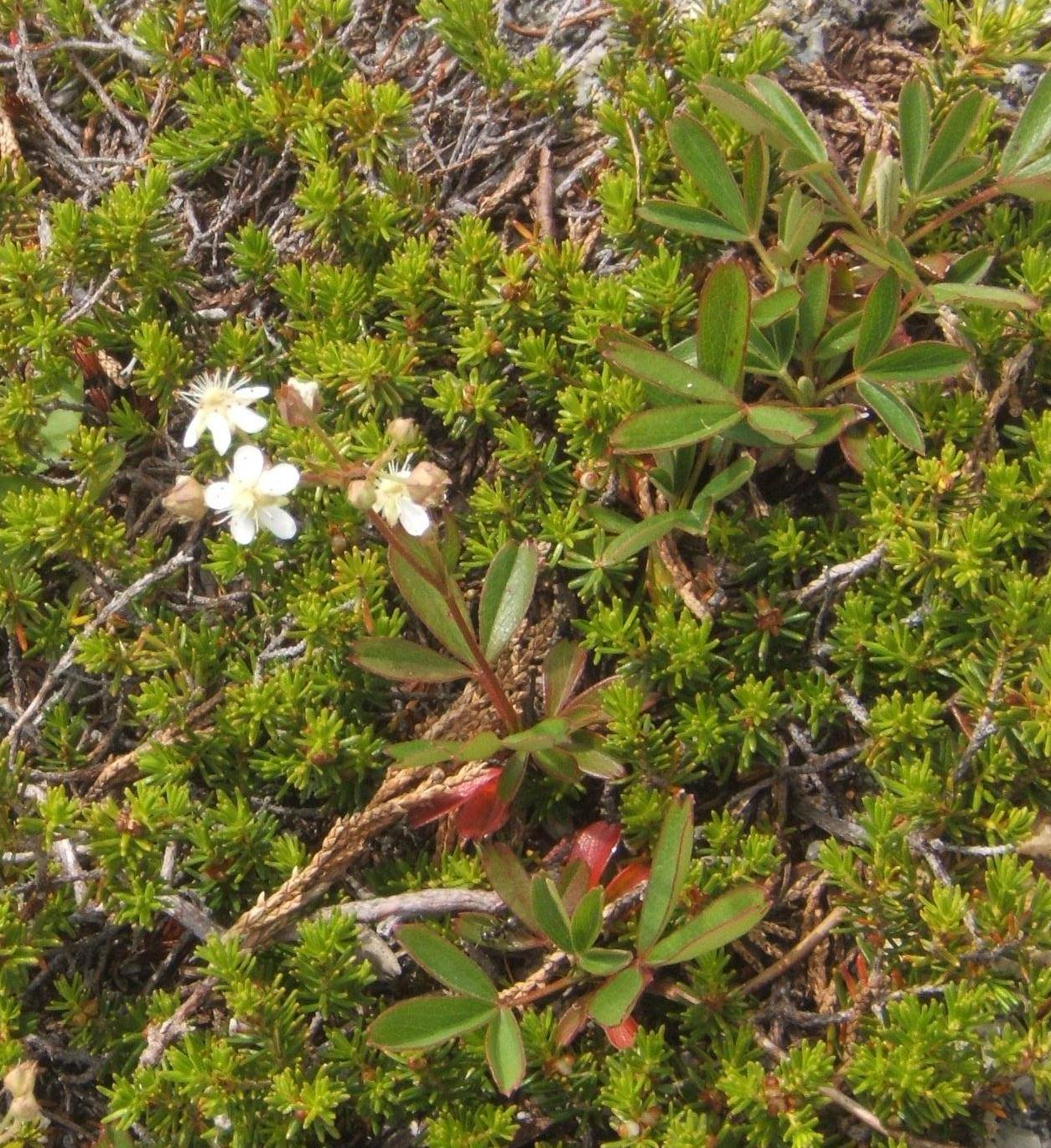
We also found Three-toothed Cinquefoil (Sibbaldia tridentata (Aiton) Paule & Soják) with its three leaflets and the characteristic three teeth at the tip of each leaf. The leaves are thick and outlined in red at this time of year. Later in the year the leaves turn bright red. The white flowers each have five petals, and are starry with stamens.
In the low-lying, boggy areas, we found a ‘merriment’ (my word) of Pitcher-plants (Sarracenia purpurea L.).

The leaves of these insectivorous plants are shaped like vessels. Insects climbing into the leaves encounter downward pointing hairs. They are trapped! Eventually they drown and are digested in the water at the base of the ‘pitcher’.
We also found another carnivorous plant, the Round-leaved Sundew (Drosera rotundifolia L.). The leaves of these plants are covered with tiny hairs… these exude a sticky liquid and trapped insects are slowly digested. For more information on the Sundew, please visit my post for October 31, 2011, ‘Round-leaved Sundew’. https://nichepoetryandprose.wordpress.com/2011/10/
All was not gruesome. We also found Arethusa (Arethusa bulbosa L.), a member of the orchid family. This beautiful pink orchid is also known as the Dragon’s Mouth.

Overall, our trip to Peggy’s Cove was a wonderful adventure. We plan to return in the early fall, when the Crowberry and the other edible plants we saw have set their berries.
Have you ever been to Peggy’s Cove and what did you think of the coastal landscape and the plants growing there?
~

© Jane Tims 2012
Warning: 1. never eat any plant if you are not absolutely certain of the identification; 2. never eat any plant if you have personal sensitivities, including allergies, to certain plants or their derivatives; 3. never eat any plant unless you have checked several sources to verify the edibility of the plant.a moment of beautiful – mustard fields in bloom
the space: a field along the St. John River
the beautiful: mustard in bloom
In some of the cultivated fields along the St. John River, acres of mustard are in bloom. Mustard is common here, in both coastal and inland areas, along roads and in fields. In the last weeks, I have found two species, Black Mustard (Brassica nigra (L.) Koch) and Field Mustard (Brassica rapa L.) also known as Rape, or Bird’s Rape.
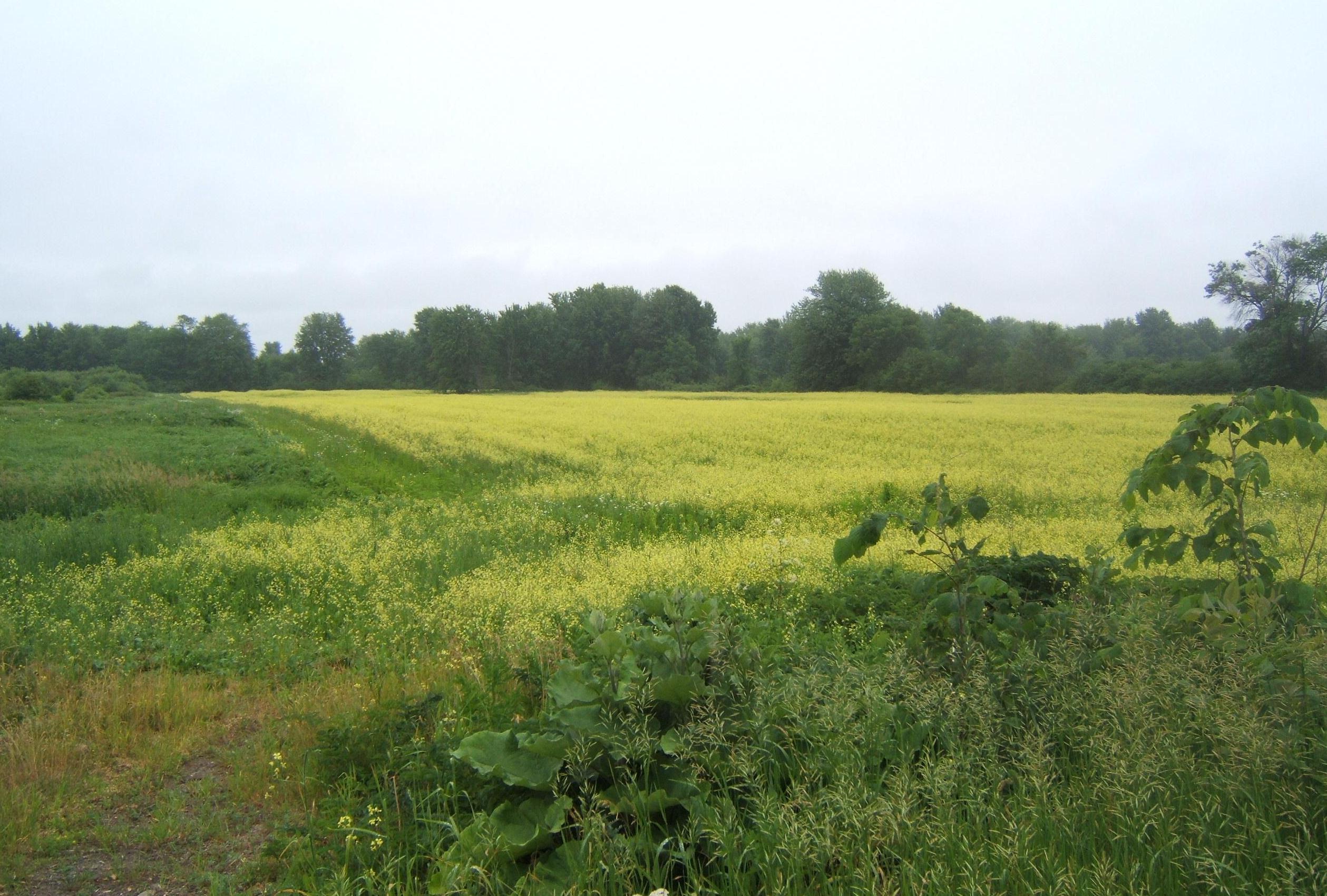
Mustard is an herb of medium size, with pale yellow, four-petalled flowers in terminal clusters, and large lobed leaves. The seeds are contained in pods; each pod ends in an elongated beak.

Mustard is well-known for its uses. The young, basal leaves may be cooked as greens or used in salads. Clusters of unopened flower buds can be cooked like brocolli. The tender seed pods are pickled, or used in salads.
Mustard’s best-known use is as a spice – the seeds are collected, dried and ground to make hot yellow mustard. I have a spot staked out to collect the seeds as they ripen in August, since I want to dry and grind some seeds for my own mustard.
~
~
sandwich
~
green leaves
between brown earth
and summer sky,
finished with
a generous smear
of mustard
~
~
© Jane Tims 2012
Warning: 1. never eat any plant if you are not absolutely certain of the identification; 2. never eat any plant if you have personal sensitivities, including allergies, to certain plants or their derivatives; 3. never eat any plant unless you have checked several sources to verify the edibility of the plant.a moment of beautiful – the sound of the sea
the space: a park bench by the edge of the sea
the beautiful: the sound of the breakers, sorting over cobbles on the shore
On a recent vacation to Nova Scotia, we had the time to sit and watch the breakers roll into a cove along St. Margaret’s Bay. The sight of the crashing waves was inspiring, but the sounds were unforgettable… first, the sweep and crash of the incoming waves…

then the clatter as the outgoing wave dragged at the cobbles along the shore…

My husband suffered through my recitation of a few lines of Matthew Arnold’s poignant ‘Dover Beach’, but mostly we were quiet, overwhelmed by the sound of the sea.
~
~
greed
~
jealous of its pretty
shaped and rounded stones,
the ocean mutters,
claws them back
clatters its dinner forks
over biscuits and gravy
hoards jellybeans
by the handful
~
~
© Jane Tims 2012

limits of the tide #4 – Orach (Atriplex patula L.)
Orach (Atriplex patula L.) is a common inhabitant of coastal areas in New Brunswick. It lives in sheltered locations on the upper shore, out of reach of the highest tides.
The leaves of Orach are fleshy and arrow-shaped. The margins of the leaves are variously toothed and the lowest teeth point outward (‘hastate’, similar to the leaves of Sheep Sorrel in the June 8, 2012 post under the category ‘growing and gathering’). The leaves are grey to bright green and lighter on the underside of the leaf. Orach is a highly variable and poorly known species with respect to taxonomy.

Orach flowers from July to August. The flowers are like many seaside plants, inconspicuous and small, in the axils of the leaves.
Orach is tasty and salty. It can be used in salads, or cooked in boiling water for 15 minutes and served like spinach.
Warning: 1. never eat any plant if you are not absolutely certain of the identification; 2. never eat any plant if you have personal sensitivities, including allergies, to certain plants or their derivatives; 3. never eat any plant unless you have checked several sources to verify the edibility of the plant.
~
~
hunting the orach
~
I know the place where the orach hides –
out of the way of the rising tides
between the rocks and deep in the sand,
with his halberd drawn, he makes his stand
~
~
© Jane Tims 2012
limits of the tide #3 – Sea-blite (Sueda maritima (L.) Dumort.)
Another edible coastal plant is Sea-blite (Sueda maritima (L.) Dumort.). Sea-blite is a low-growing plant, often forming mats on the shore. Sea-blite can also be found at inland locations, near salt springs.
Sea-blite has thick, linear leaves. The flowers are small and fleshy, and grow in the axils of the stem. At this time of year, Sea-blite is still a small, inconspicuous plant. Later it will grow to between 3 and 5 dm.

The leaves of Sea-blite are very salty, and can be used as a source of salt in soup or stew, or an ingredient in salads. Used as a pot-herb, they should be cooked for 10 to 12 minutes in two to three changes of boiling water, to reduce the salt content.
Warning: 1. never eat any plant if you are not absolutely certain of the identification; 2. never eat any plant if you have personal sensitivities, including allergies, to certain plants or their derivatives; 3. never eat any plant unless you have checked several sources to verify the edibility of the plant.~
~
persuasion
Sea-blite (Sueda maritima (L.) Dumort.)
~
fingers of Sea-blite
poke the salt air,
rebuke the salt sea
crave attention –
pick me! pick me!!
~
fingers of Sea-blite
point politely at the pot
propose, diplomatically,
add a little more salt
~
~
© Jane Tims 2012

limits of the tide #2 – Seaside Plantain (Plantago juncoides Lam.) – Goosetongue greens
One of the edible plants we found at Oak Bay (near St. Stephen, New Brunswick) was Seaside Plantain, also known locally as Goosetongue.

Seaside Plantain, also known as Goosetongue, ready to pick… they have to be rinsed well since the outgoing tide has left a thick layer of sediment behind…
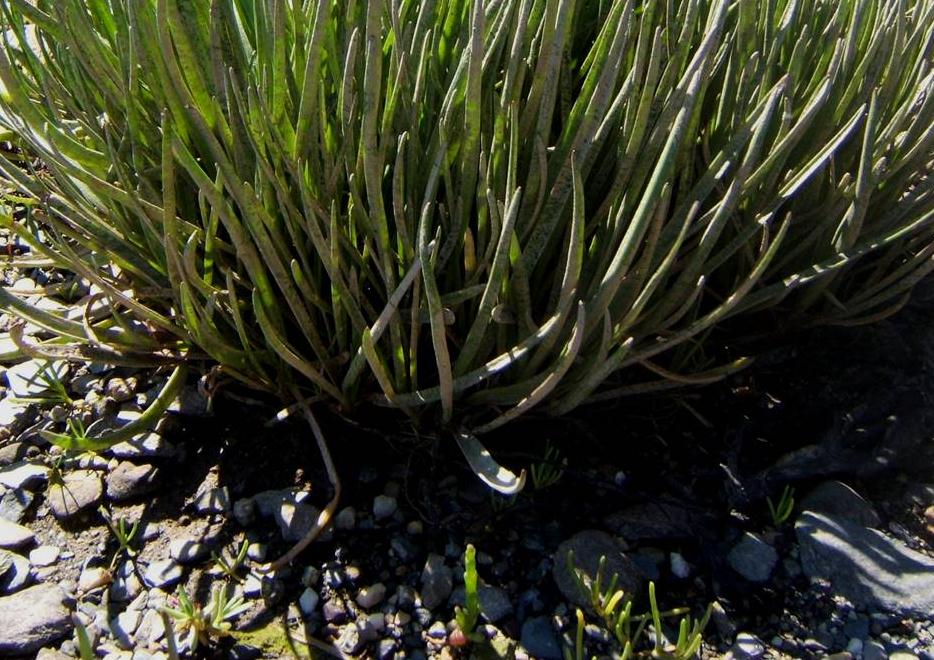
Seaside Plantain (Plantago juncoides Lam.) grows in thick clumps, forming an intermittent carpet across the shore. The succulent, linear leaves of Seaside Plantain are grey-green in color. Inconspicuous green flowers, not present until later in June, rise from the rosette of leaves in a terminal spike. Seaside Plantain is in the same genus as Common Plantain (see the post for June 13, 2012, ‘Common Plantain’ under the category ‘growing and gathering’). Plantago is from the Latin for ‘footprint’ and juncoides means ‘rush-like’.
Goosetongue greens are pleasantly salty and are a local delicacy, eaten as a salad or pickle, or cooked like green beans and served with butter. For a vivid description of the experience of gathering and preparing Goosetongue greens, see Nature of Words (www.natureofwords.com/2011/07/goosetongue-greens/) by Deborah Carr, and the post for July 14, 2011, entitled ‘Goosetongue greens’.
Warning: 1. never eat any plant if you are not absolutely certain of the identification; 2. never eat any plant if you have personal sensitivities, including allergies, to certain plants or their derivatives; 3. never eat any plant unless you have checked several sources to verify the edibility of the plant.~
~
Sunday Dinner at Maces Bay
Seaside Plantain (Pantago juncoides Lam.)
~
dig right in
says your father
and nudges the pitcher of water
in my direction
~
I study the ‘goosetongue greens’ –
mound of green spaghetti
between spuds and chicken,
green eels diving
for the bottom of the plate
~
two things not in their favour –
they’re green,
they look a little like
the tongues of geese
~
I watch your Dad –
he adds a dollop of butter,
he weaves his fork to catch a little of each,
potato, greens and chicken,
chews with his eyes closed,
reaches for his glass of water
~
I sigh
and taste –
salt air and butter-cream,
crisp, the perfect crush,
mouth-feel, amazing
please pass the water
~
~
© Jane Tims 2012
Warning: 1. never eat any plant if you are not absolutely certain of the identification; 2. never eat any plant if you have personal sensitivities, including allergies, to certain plants or their derivatives; 3. never eat any plant unless you have checked several sources to verify the edibility of the plant.limits of the tide #1 – edible plants
Last week, our travels took us to the edge of the sea, where I looked for more edible wild plants. I found what I was looking for at Oak Bay, near St. Stephen. At the end of a little-used road, we came out on a gravelly spit of land jutting into the Bay.

mid-tide at Oak Bay… at high tide, most of the foreshore will be covered by salt water… at low tide, the clam-flats will be exposed
There, on the shoreline, were four plants to add to my larder of edible wild.
Three of the species formed a small community near the upper reaches of the shore: Seaside Plantain, Sea-blite and Samphire. All three are in the photo below… can you find them?

The Seaside Plantain (also known as Goosetongue) is the dense clump of long, thick, linear leaves in the photo above…
The Sea-blite is just starting to grow. Later in the season it will be as large or larger than the Seaside Plantain. In the enlargement below, Sea-blite is the small green plant to the right of the clump of Seaside Plantain…

The Samphire is also very small this time of year. Later it will be as large as the Sea-blite or Seaside Plantain. In the photo enlargement below, it is at the base of the clump of Seaside Plantain, at exactly 6 o’clock.
The fourth edible plant at Oak Bay is Orach. It grows on the upper shore, above the Seaside Plantain and beyond the limit of the tide. These plants often grow together along the coast, on salt marshes, tidal flats, dykelands and beaches.

Since the plants were not plentiful and not yet ready to pick, I took only one plant of each, for my drawings. I also took a bite of each type of leaf. Although there are subtle differences, all four were crisp and salty in flavour, a delightful nibble of the salty sea.
These are just a few of the edible plants living in coastal areas of New Brunswick. Over the next posts, I will explore these four species and a few others.
© Jane Tims 2012
Warning: 1. never eat any plant if you are not absolutely certain of the identification; 2. never eat any plant if you have personal sensitivities, including allergies, to certain plants or their derivatives; 3. never eat any plant unless you have checked several sources to verify the edibility of the plant.burrballs, weedballs and manganese concretions
As I slowly clean out my office in preparation for my retirement, I am encountering the collected mementoes of 33 years of work. One of the oddest items I kept through the years is a plastic case filled with six hard black gobs, about 4 to 6 centimetres in diameter. They look like burnt chocolate chip cookies, but I assure you, even my baking is not that bad!
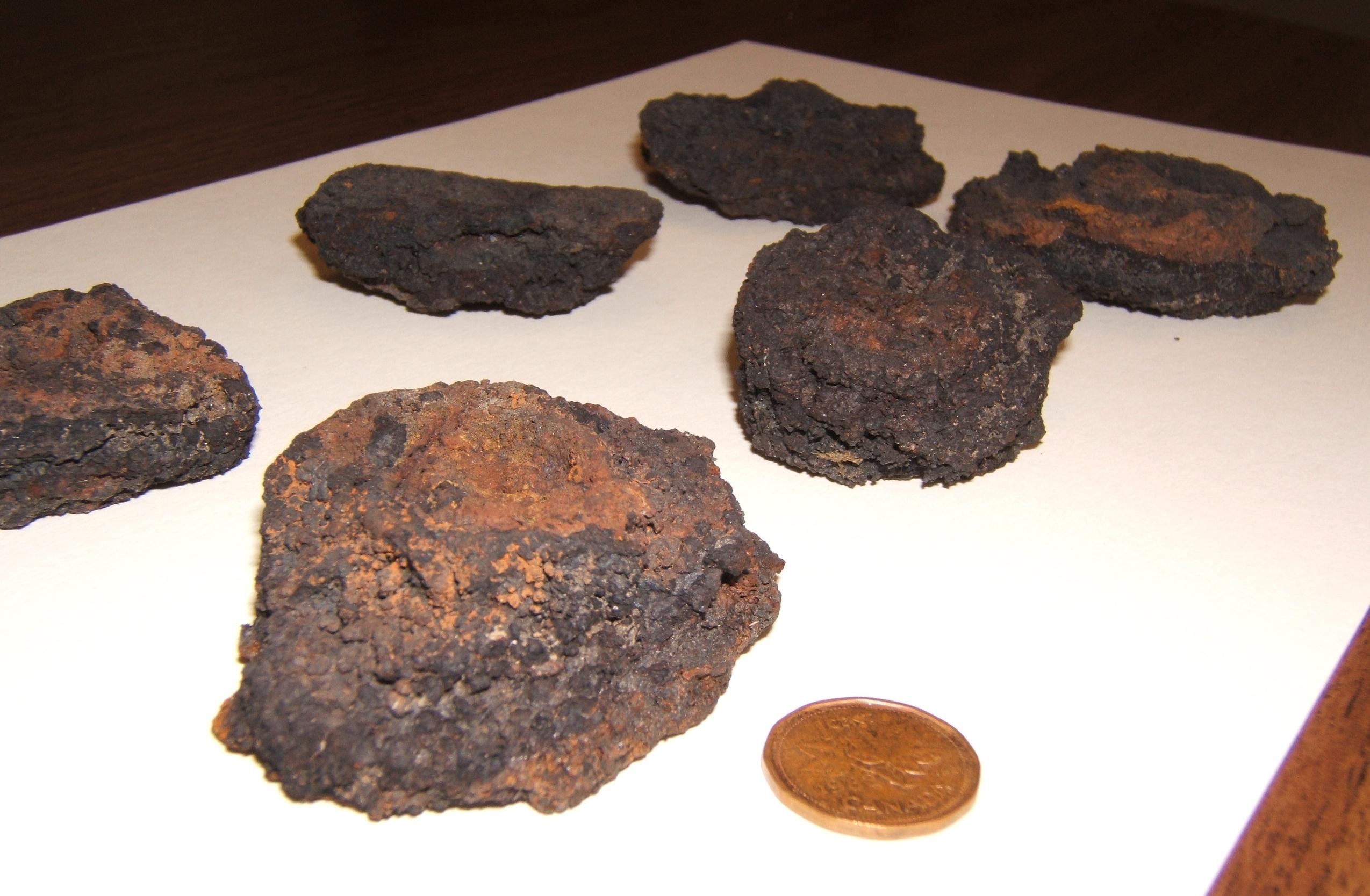
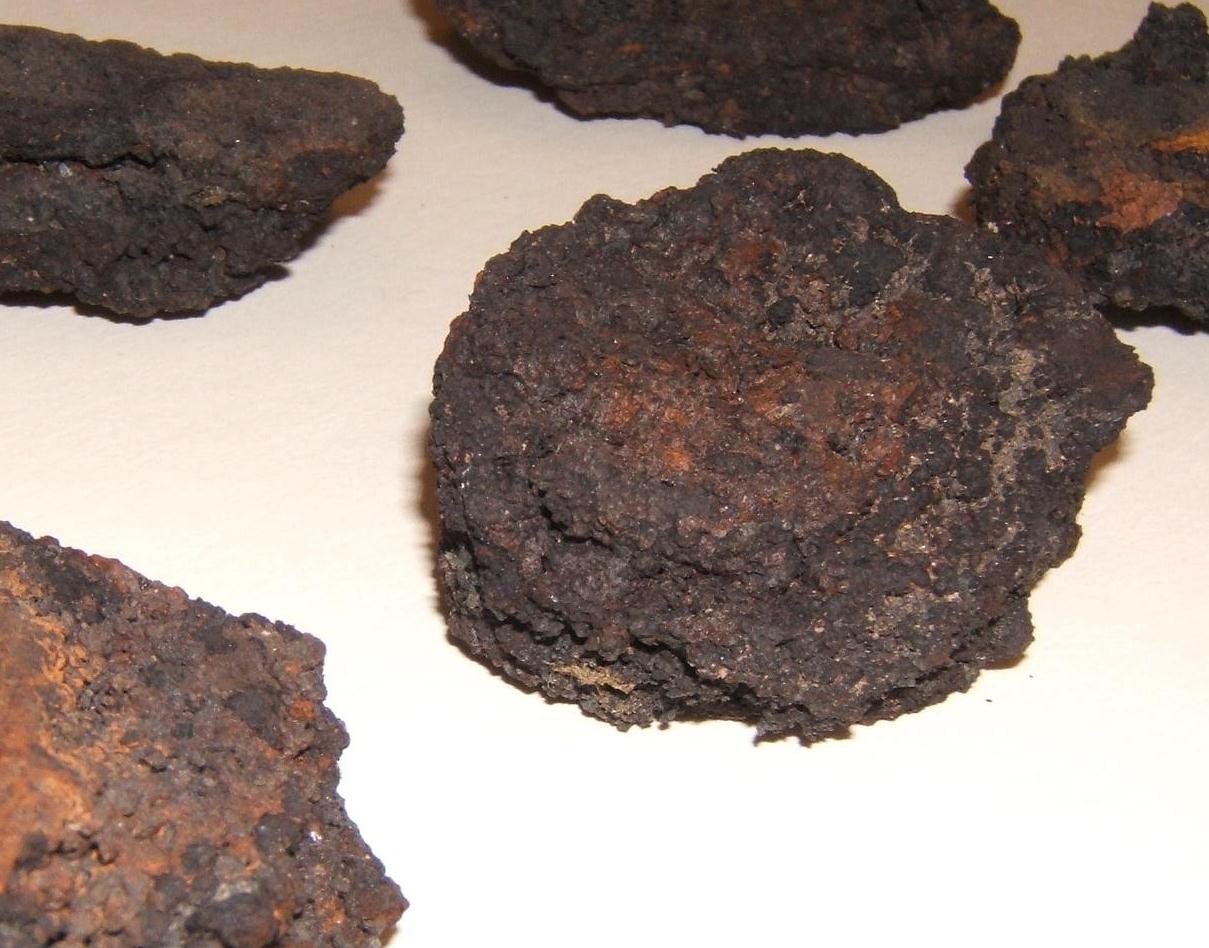
These are called iron-manganese concretions. They were found in the late 1990’s on the bottom of a lake in New Brunswick.
The occurrence of ‘balls’ in lakes and other bodies of water has been an interest of mine. In my experience, and in the reading I have done, I have encountered three different natural spherical formations in the Maritime Provinces. One of these is found along the ocean shore. The other two are found on the bottoms of lakes.
These are:
Water-rolled Weed Balls:
This was A.H. MacKay’s suggested name for ‘sea-balls’, compact balls of seaweeds and other materials found on a beach near Lunenburg, Nova Scotia. MacKay wrote a paper about these balls for the Transactions of the Nova Scotia Institute of Science in 1906. These strange formations were first reported by a teacher, Mary Bowers, who wrote to MacKay about their occurrence on a beach at Upper Kingsburg, along the mouth of the LaHave River. She wrote: “I have seen up to 200 balls on a short strip of beach…” MacKay described them as 1 ½ to 5 inches in diameter, composed of rolled-up remains of brown algae. The balls also incorporated red seaweeds, sea sponges, and small sea shells. MacKay wrote: “…Their structure in the different forms examined suggest their formation from light ridges of algae left by the retreating tide on flat sandy shallows. Under the sun, the weeds curl and lock into masses which, when moved over the sand by alternate tides and winds, occasionally produce very round balls.”
Kedron Balls:
These spherical balls of organic matter, a natural formation on the bottom of Little Kedron Lake, near Oromocto Lake in York County, New Brunswick, were described in 1904 by the naturalist William Ganong. Needles of fir and spruce from the forest surrounding the lake roll together with twigs, sandy silt and other vegetable matter on the lake bottom, gradually forming these soft compact spheres.
In his book Walden, Thoreau describes similar balls of organic matter from Sandy Pond in Lincoln, Massachusetts: “… I have found, in considerable quantities, curious balls, composed apparently of fine grass or roots, of pipewort, perhaps, from half an inch to four inches in diameter, and perfectly spherical. These wash back and forth in shallow water on a sandy bottom, and are sometimes cast on the shore.”
Iron-Manganese Concretions:
The examples I have were given to me by a friend who collected them at Balls Lake, a small lake near Cape Spencer in Saint John County, New Brunswick. These are natural formations, known as polymetallic or manganese nodules, built in successive layers of iron and manganese hydroxides around a core. The result is a spherical formation, rough and knobby on the surface. The concretions range in size, but most, like the specimens I have, are the size of a small potato. Manganese concretions form in both lakes and salt-water.
~
~
~
water-rolled weeds
~
begin with
a pinch of sand
a thread
a gesture, word
a fir leans
over the lake edge
drops a single leaf
~
layers spool
from chemistry of water
sediment
or a fluff of needles
quilting, quilting
soft balls wind
forward and back
~
gather, gather
while sunreels
ravel scene by scene
a bobbin
accepts the thread
and first line
builds to story
~
~
© Jane Tims 2012
~
~
Some reading about burrballs and weedballs:
W.F. Ganong. 1904. ‘On Vegetable-, or Burr-, Balls from Little Kedron Lake, New Brunswick’. Bulletin of the Natural History Society of New Brunswick v: 304.
A.H. MacKay. 1906. ‘Water-Rolled Weed Balls’. Transactions of the Nova Scotia Institute of Science XI: 667-670. Available on-line at: http://dalspace.library.dal.ca/bitstream/handle/10222/12593/v11_p4_a8_MacKay_water-rolled_weed-balls.pdf?sequence=1 Accessed February 28, 2012.
Henry David Thoreau. 1954. ‘Ponds’, Walden or Life in the Woods. Pennsylvania State University, 154.




 nichepoetryandprose