How high can I climb?
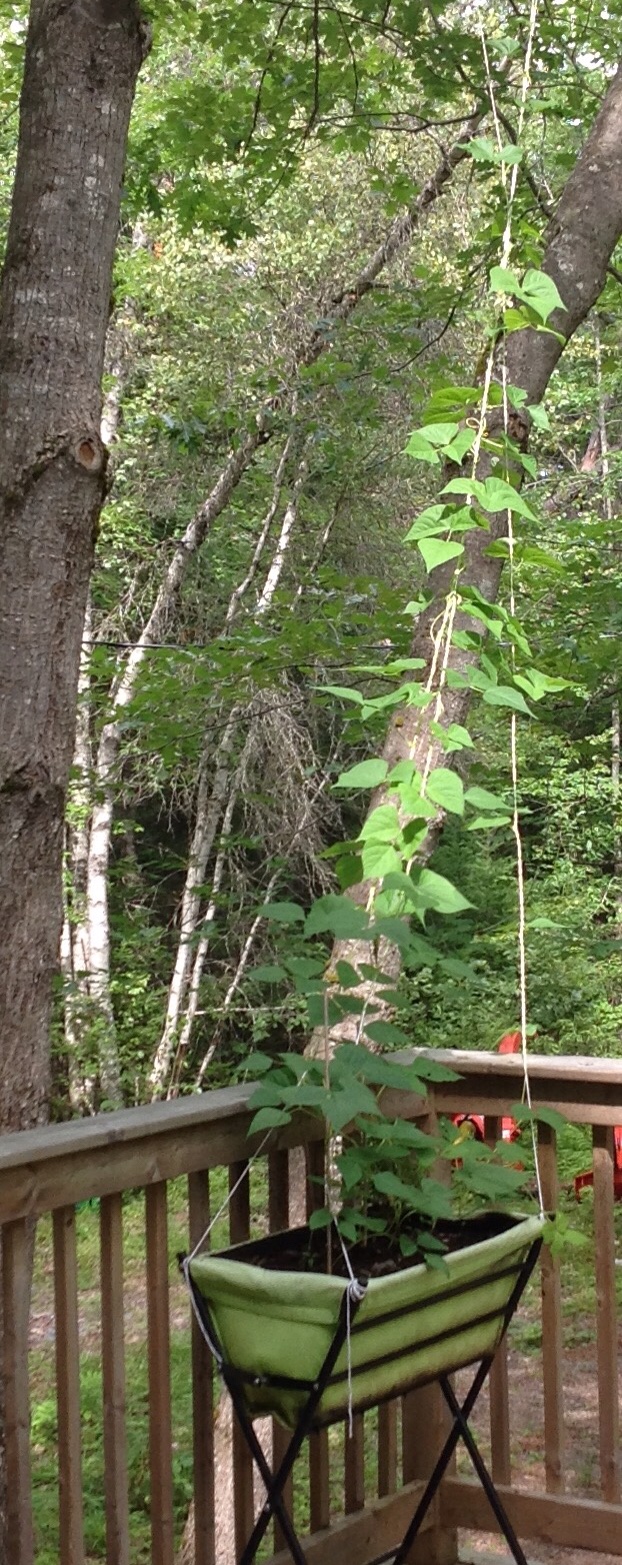
Not that high. But I will have to figure out how to get those beans. I planted what I thought were yellow-wax beans on my deck. And they turned out to be yellow pole beans. I threw a couple of weighted strings into the maple and of course the beans climbed.
~
~

~
All my best, Jane
Indoor garden
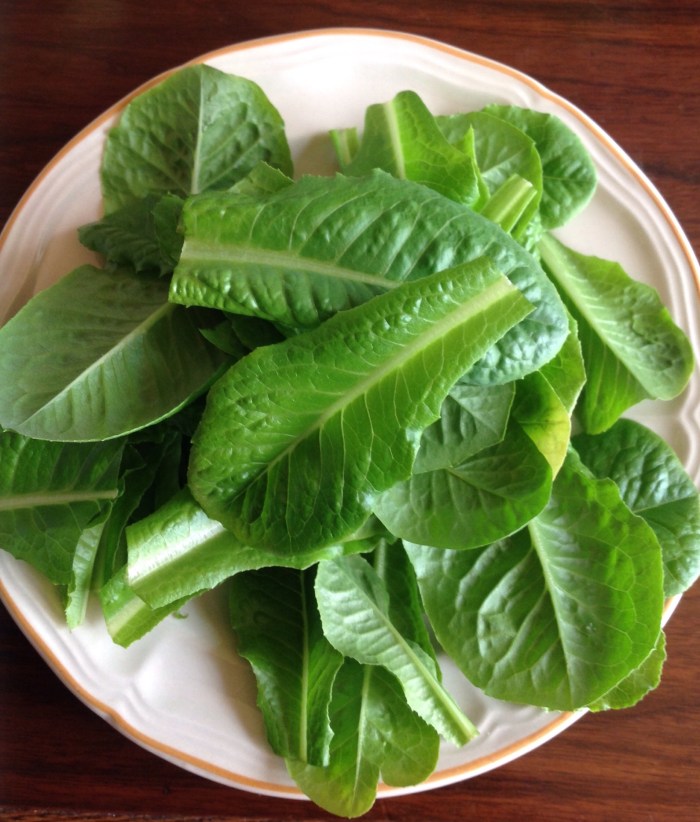
My harvest of romaine lettuce from my AeroGarden today. Poppy seed dressing and lunch is served!
~
~
All my best
Jane
escapes: Virginia creeper
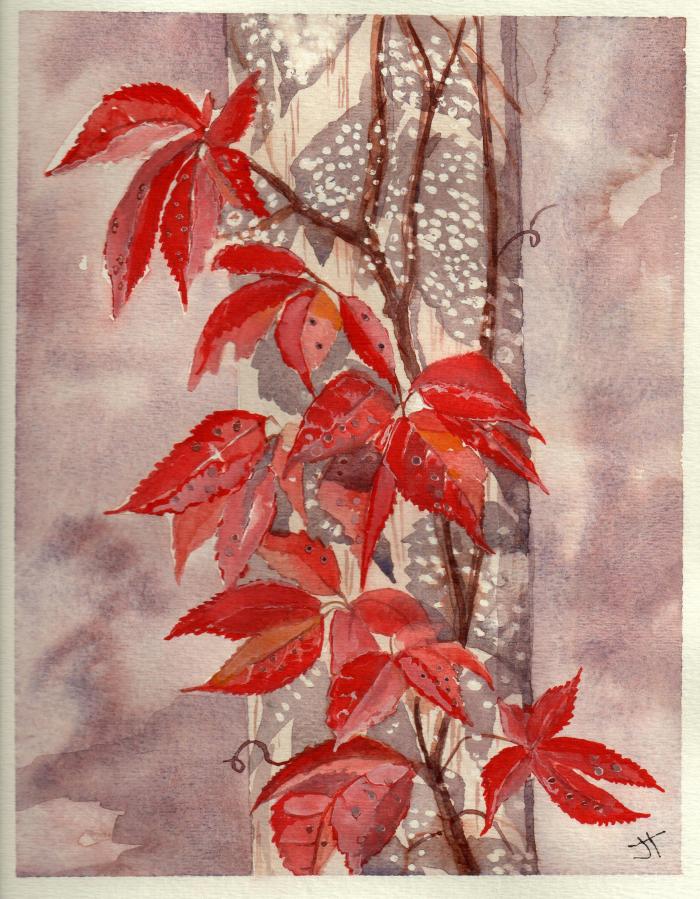
Virginia creeper, also call woodbine, thicket creeper and, in French vinge vierge, is a climbing vine with adhesive discs. Its leaves are palmately five-fingered and turn bright red in autumn. The plant has small purple fruit, poisonous to eat. The vine is common around abandoned homesteads where it persists or escapes to local woodlands.
~

~
Virginia creeper
Parthenocissus quinquefolia (L.) Planch.
~
In woods
on Whites Mountain
woodbine
climbs the ash.
Persistent escape
~
from homesteads
long-gone.
Thicket creeper
navigates itself
to better ground,
~
higher trees.
Thick rhizomes,
adhesive discs.
Five-fingered leaves
spread to cover
~
every inch of bark.
Maximize
exposure to sun.
Ancestral creepers
once draped
~
zig-zag cedar fences
in autumn scarlet.
Caught the attention
of farmers’ wives
on community rounds.
~
~
All my best,
Jane
abandoned spaces: remnant plants
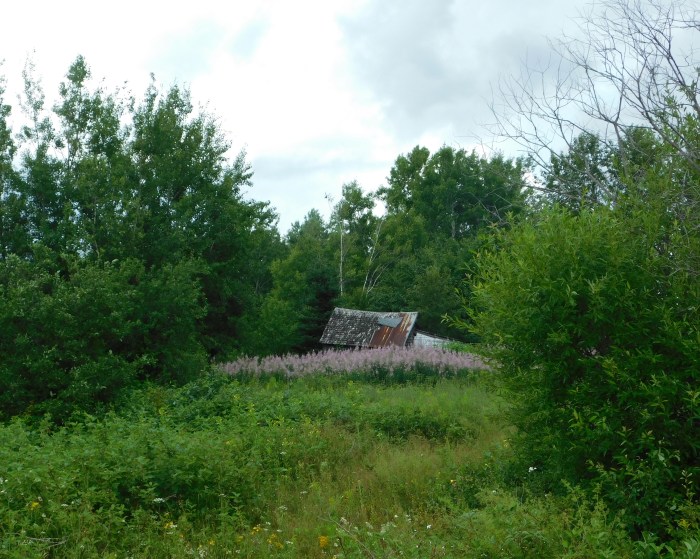
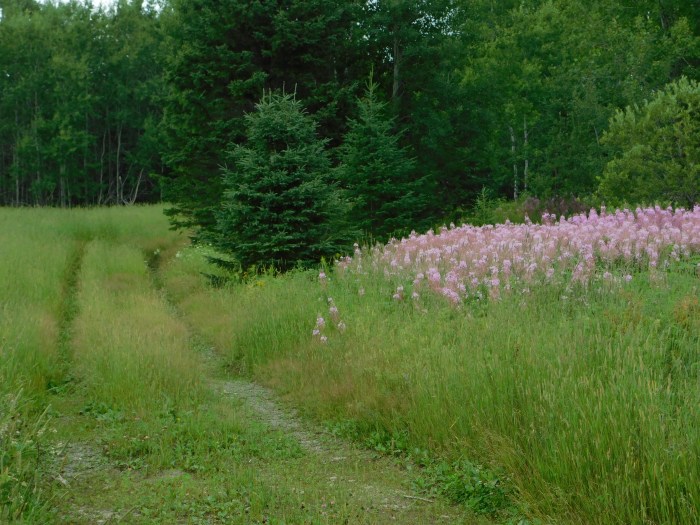
On a drive towards the centre of the province, we found the property below to exemplify what happens to the surrounding vegetation when home sites are abandoned.
~
~
~
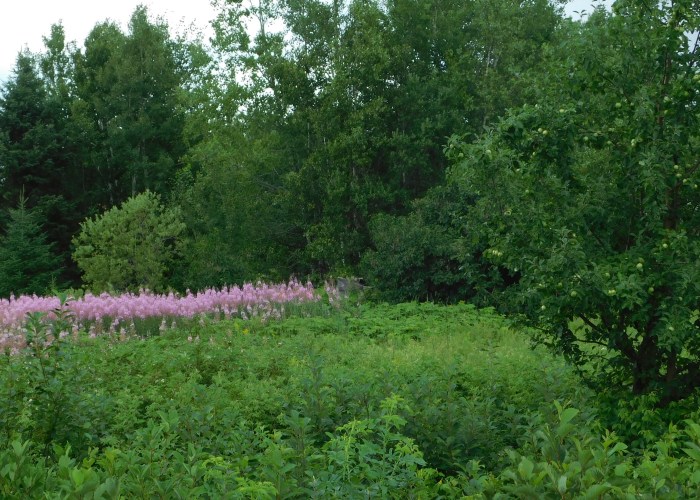
On the property, I could see the old home, the roof fallen in, the tin roof rusted on the half that was not shingled. All around were wildflowers, most noticeable, the fireweed. There were also remnants of cultivated plants:
- lilac
- rose bushes
- hops
- orange day-lilies
~
~
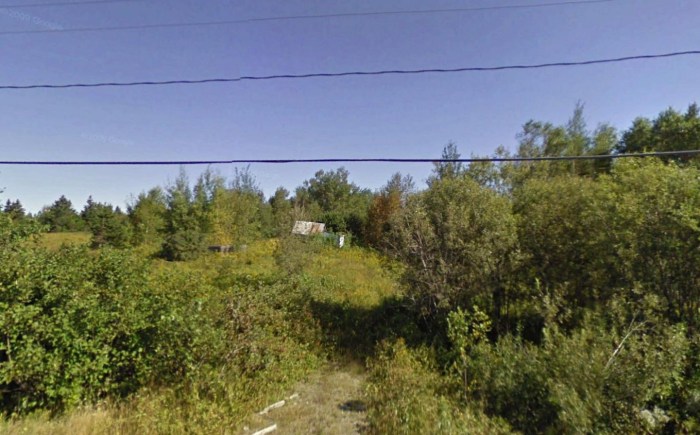
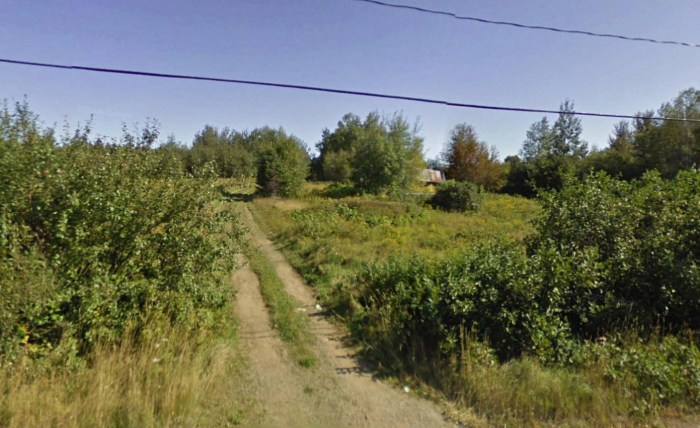
Street View, Google Earth gives a glimpse of the property back in 2009.
~
~
~
remnants
~
Not meant to sprawl but climb, hops
crouch between grass, fireweed.
~
Recline, each five-fingered leaf
with spaces between digits.
~
Remnants of pink rose bushes
and an apple tree, apples
~
green but plentiful. Lilac
lifts spent and skeletal blooms.
~
The two-track road still leads to
back pasture, woodlot beyond.
~
Orange day-lilies echo
the rusty reds of tin roof,
the house fallen to decay.
~
~
All my best,
Jane
abandoned spaces: fireweed
Lately, I have been thinking a lot about abandoned rural areas and the remnants of gardens left behind. Although these properties are still owned, the homes that once stood there are gone or left to deteriorate. The gardens, once loved and cared for, are left to survive on their own.
~
When these home-sites are abandoned, the garden plants:
- disappear (most annuals),
- persist (perennials like day-lilies or roses), or
- escape (lupins, mallow or other easily-spreading plants).
Native plants, those liking disturbed or cleared areas, may move into these sites.
~
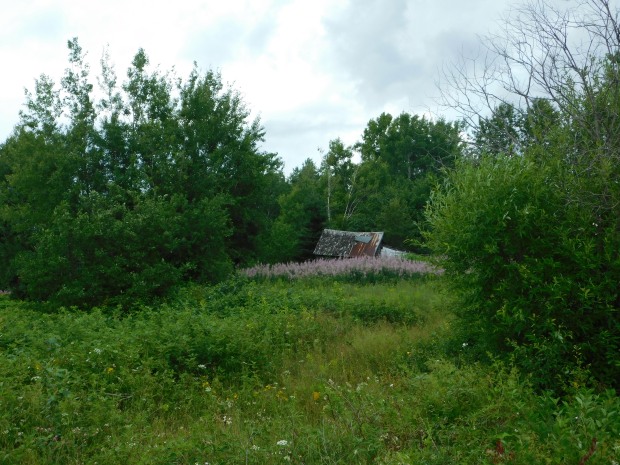
an abandoned site in Williamsburg, New Brunswick where fireweed has colonized
~
As I find abandoned properties, the pink or pale purple flowers of fireweed are often present. Fireweed, an indigenous plant not usually grown in gardens, is often a first indicator a house may once have stood on a plot of land. Often fireweed stands side by side with orange day-lilies and other garden escapes.
~

on this abandoned site in the Williamsburg area, the fireweed stands side-by-side with orange day-lilies (Hemerocallis fulva), rose bushes and other cultivated plants
~
Fireweed (Epilobium angustifolium L.), also known as great willowherb, gets the ‘fire’ in its name since it is one of the first plants to colonize after fire. As a pioneer species, partial to open areas with lots of light, it also moves in to any cleared or disturbed area. After a few years, other plants will move in, out-competing the fireweed. However, the seeds of fireweed stay viable for a long time and may re-colonize the area if it is again disturbed or burned.
~
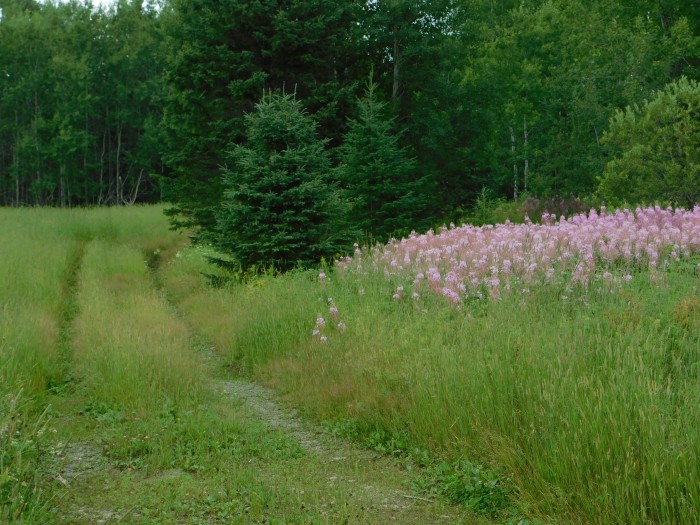
Fireweed is one of many tall pinkish flowers growing in our ditches and wild areas. It is distinguished by its rather loose inflorescence, the flower’s four roundish petals and its seed pods which angle upwards.
~
~
Fireweed spreads by the roots or by seed. In the later part of the season, the seeds are spread by the wind, aided by long silky hairs. Before dispersal the hairy seeds burst out along the seed pods making the plant look unkempt and hairy.
~
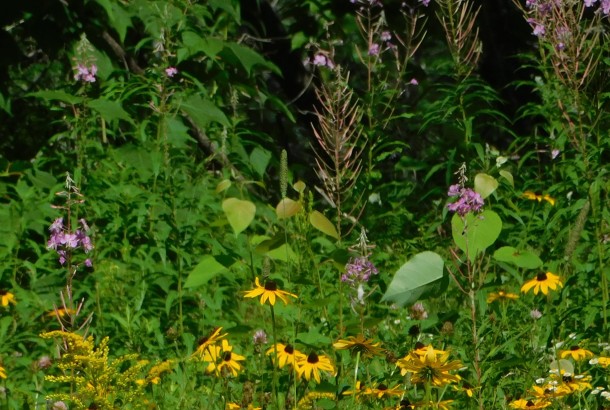
Fireweed (pink) among brown-eyed Susans; the stiff, many-podded plants in the upper right-hand corner are the seedpods of fireweed, finished with their blooming
~
In New Brunswick we are facing a demographic trend of movement from rural communities to cities in the southern part of the province and elsewhere. This means many small communities that thrived a century ago are now abandoned. For example, in 1866 the community of Fredericksburg, New Brunswick was a farming community with 12 families (Source: https://archives.gnb.ca/Exhibits/Communities/Details.aspx?culture=en-CA&community=1367 ). Today only a couple of homes or camps are found in the area but foxglove flowers, that once bloomed in the gardens, thrive in the ditches. For more on the demographics of small New Brunswick communities see:
Lauren Beck and Christina Ionescu. ‘Challenges and Opportunities Faced by Small Communities in New Brunswick: An Introduction’, Journal of New Brunswick Studies Issue 6, No. 1 (2015).
https://journals.lib.unb.ca/index.php/JNBS/article/view/23057
~
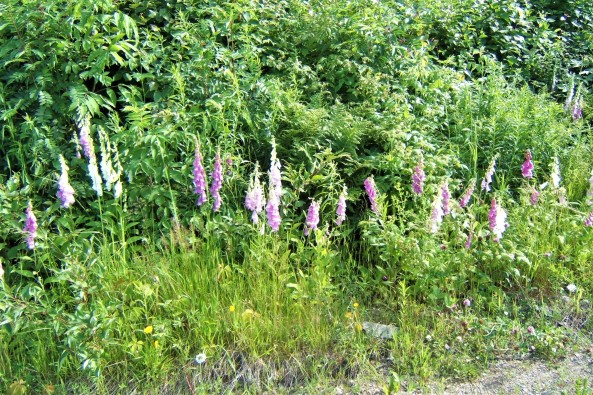
foxglove (Digitalis purpurea) flowers thriving in the ditch in the Fredericksburg area
~
All my best,
Jane
moose in a wetland
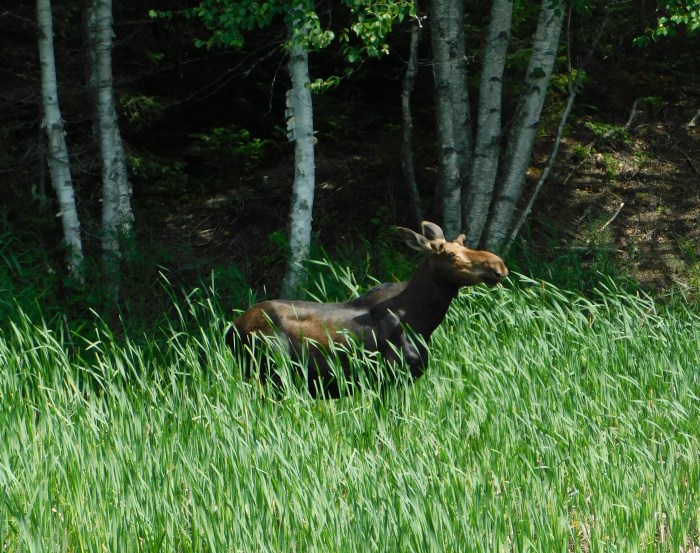
On one of our many drives, we found ourselves in the community of Juniper, New Brunswick. In a small bog, in the midst of the community, was this fellow, a bull moose (known in scientific and other circles as Alces alces). He paid no attention to people or cars and went about his business, chewing at the vegetation in the wetland.
~

~
The moose is a fairly common sight in New Brunswick. They are so common and dangerous along roadways, fences have been constructed along sections of the various major highways to separate moose and car.
~

~
The first time I ever saw a moose was on my very first field excursion with my new position with the New Brunswick Department of Environment (back in 1978). I said to the federal biologist who was with me, “Look, a forest ranger is riding a horse through that bog!” The biologist replied, “That’s no horse, that’s a moose!” To this day, it is the ugliest animal I have ever seen, but there is something beautiful in its efficient ungainliness!
~
~
Moose are big animals, up to two metres in height and up to 700 kg; my husband (my authority) says New Brunswick moose do not grow quite this big. Moose are solitary (not herding) members of the deer family. They inhabit boreal or mixed forest and love wetlands and open waters. They are herbivores and eat aquatic vegetation, grasses, and twigs, branches and leaves of shrubs and trees.
If you see a moose, back up slowly. They can become aggressive if startled or annoyed. My husband saws, “No four inch stick is going to stop a moose!”
~
This is the second moose we have seen this summer.
~
All my best,
Jane
little libraries
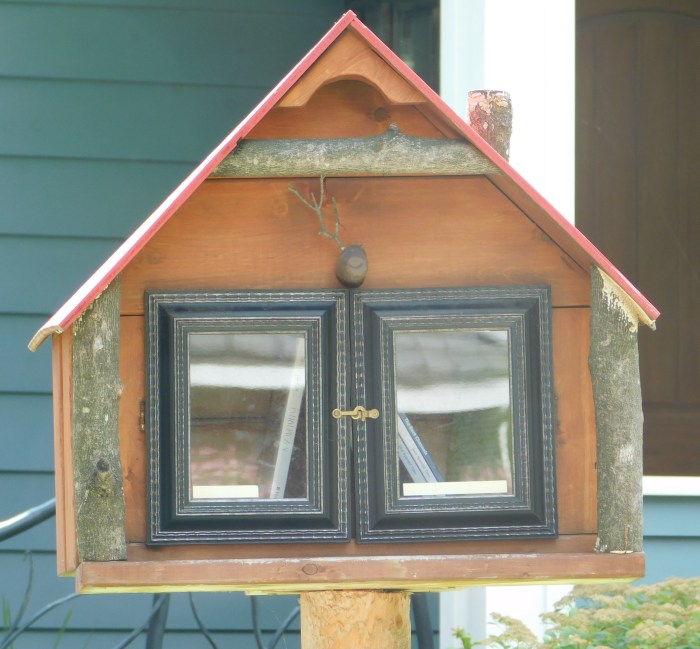
Do you have a ‘little library’ in your neighborhood? We have a few in the Fredericton area. A community-based book-sharing system, these places encourage reading and neighbourhood spirit. The little library is usually small, a dry place for books on a post. Sometimes there is a stone or stump in front so children can access the books.
~
~
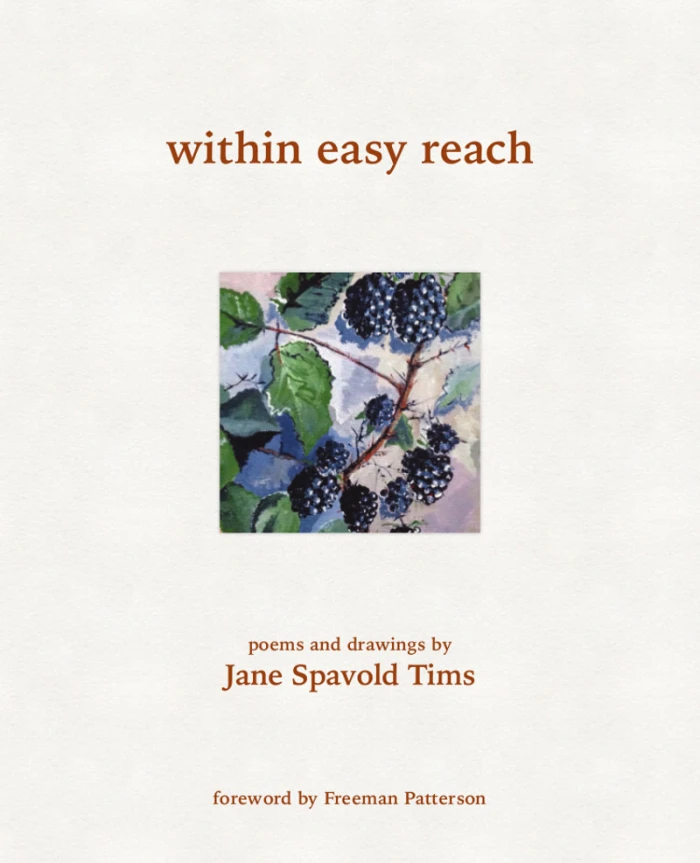
On Sunday, I placed a signed new copy of three books in the little library on University Avenue in Fredericton: ‘within easy reach’ (Jane Spavold Tims, Chapel Street Editions, 2016), ‘in the shelter of the covered bridge’ (Jane Spavold Tims, Chapel Street Editions, 2017) and ‘The Back Channels’ (Jennifer Houle, Signature Editions, 2016).
~

If these books have already been claimed at the little library, they are available at the Fredericton Public Library. They are also available at Westminster Books in Fredericton. Books make great gifts!!!!!!!
~
For more about little free libraries, see https://janetims.com/2016/07/06/little-free-library/
~
All my best,
Jane
yard work
I am trying to restore some sanity to our yard. Lots to do and I lack balance in my life, so I never seem to get around to the yard work!
~
We live in woods and cutting a tree or a blade of grass just isn’t on my wish list (see a Facebook group I belong to “Hell no, I won’t mow.“). If you look on an aerial photo of our lot, you just see green trees, although we have a house, and a shed, garage and greenhouse. When we first “cleared” the lot 40 years ago, I told the poor man on the bulldozer that if he touched one of my ribboned trees, he wouldn’t get paid. I can still see him maneuvering, ever so carefully, around a little Witherod bush that accidentally got a bit of ribbon tied to it.
~
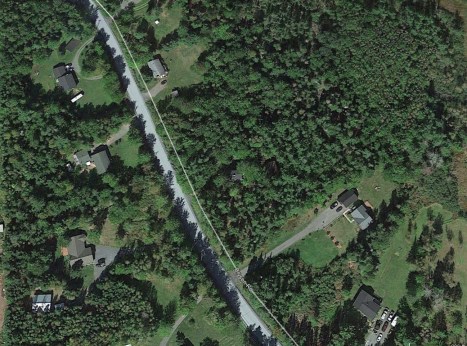
an aerial of our neighbourhood … that square of trees where a house should be, that’s us … you can just see our house roof and chimney if you look hard
~
If you allow nature to take over, it will. Right now, the bane of my life is grapevines and Bracken. The ‘not cut’ rule is abandoned for the delight of toppling yet another Bracken stem. Good thing I can’t climb trees or I’d be up there, after the stray grapevines.
~
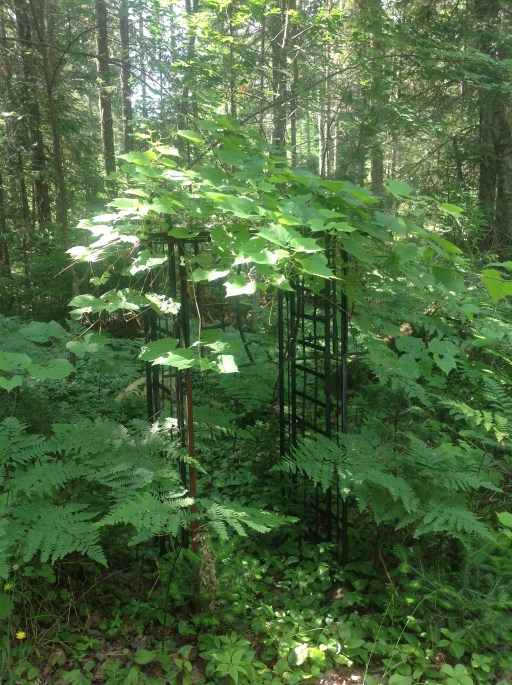
a photo of our arbour … Bracken and grapevines
~
This is a list of the small projects I will try to tackle over the next couple of weeks. Not one would take 20 minutes if I could convince myself to get off planet Meniscus (current writing project), grab the pruning shears and go outside:
- remove grape vines and Bracken from the Currant bushes and see if I can locate my Gooseberry bush
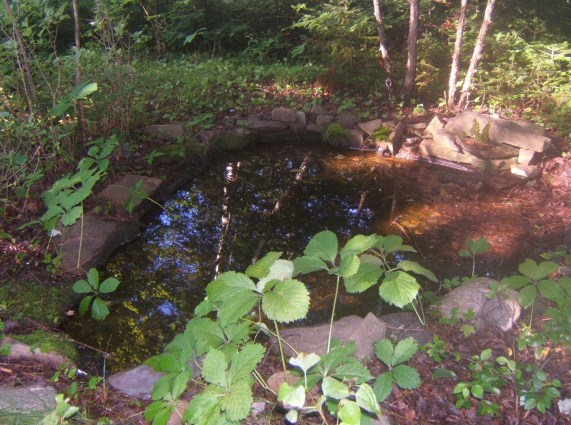
- remove the Bracken from the former pool area, now home to a young cherry tree and an eight-year-old Balm-of-Gilead, as well as grapevines and Bracken
- trim the small firs trees around the power pole … we have seven years of Christmas Trees there, just wishing they could be pruned (yes, I do cut Christmas trees)
- saw a couple of lower branches off the apple tree (the tree is full of apples this year)
- clear the little path from the big deck to the main driveway
- organize the pile of rocks I have been collecting into a short wall (I have a beauty from our drive to New Ireland a couple of weeks ago)
- drag sticks and leaves out of the pond
~
~
Wish me luck. I will report here on anything I do. Prepare for seven days of silence.
All my best,
Jane
writing life,
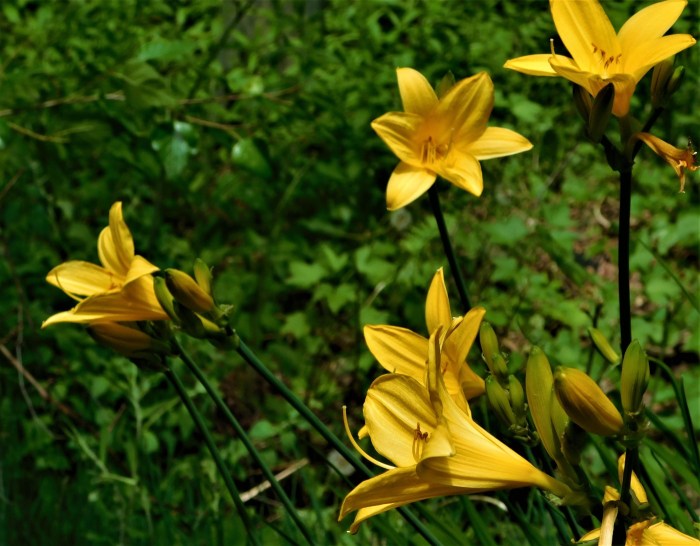
This summer I have been taking a break from writing science fiction. I have my next science-fiction book Meniscus: Karst Topography ready to publish so I can take some time to think about other writing projects.
~
~
In 1997, I wrote a long mystery novel. I thought it would be interesting to read it through and see how much my writing style has changed. It has changed a lot, as you will see below. But the story was good and I had spent a decent amount of time on characters, story arcs, and point of view, so I decided to work on the draft.
~
The story is titled HHGG (big reveal later in the year) and was 162,500 words. Yikes.
~
This is my first draft of an eventual cover blurb …
Kaye Eliot comes to Acadia Creek to spend a quiet summer with her two children. But instead of passing stress-free days of swimming and hiking, she finds herself embedded in mystery after mystery. A missing vagrant and a gang of thieves have the community worried. Neighbours seem determined to occupy all of Kaye’s time and energy in restoration of an old flower garden. Meanwhile, she and her kids have stumbled on a century-old legend of a treasure buried on the property, a packet of old letters and an old map of the garden. And they dig up a sinister sea shell. A sea shell who looks like a grinning skull and who will not stay where he is put. Can Kaye recover her calm or will she be victim of neighbors, vagrants, thieves and a shell called the Grinning Tun?
~


the Grinning Tun (about 25 cm or 10 inches across)
~
My work on the book has been on several fronts. I have ‘tweeted’ daily about my process since May 28, 2018 (@TimsJane):
- Reduce the number of words. I lost a lot of words through editing and style changes. I took out the dream sequences, all the ‘ly’ adverbs, a lot of thinking and feeling, and a raft of ‘that’s. I went from 162,561 words on April 13, 2018 to 148,999 words today on July 15, 2018. It is still a little long but a good read (in my opinion).
- I did a lot of thinking about whether to keep the setting in 1994 or modernize it to 2018. With some advice, I have decided to keep it in 1994. In fact, the story would not unfold as it does with cell phones and computers at hand. So my characters drive down to the community phone booth almost every day and look for clues in whirring reels of microfiche.
- Leaving the action in 1994 provided an opportunity to explore the culture of the 1990s. Besides the missing cell phones and computers, people collected Canadian Tire Money, waitresses smoked in restaurants and POGs were a fad among kids. In the summer of 1994, the song ‘I Swear‘ held the Canadian single charts for three weeks and the American charts for seven weeks. Six degrees of Kevin Bacon was a thing. The slang interjection ‘like’ punctuated speaking (still does).
- Part of the text is in Spanish so I asked my friend Roger Moore to help me proof-read the Spanish text.
- I spent a lot of time with my Grinning Tun … I bought him on line in 2010. The more you look at it, the more it looks like a skull.
- I spent a stupid amount of time designing a curlicue for announcing a change in sections. I am glad I did, because this new novel will include ‘Drop caps’ at the beginning of every chapter and said curlicue.
~

~
It will take me a few more weeks to proof the draft. To do this, I order a Proof from CreateSpace and do my edits as a way of passing the time effectively on my stationary cycle. Once I have the Proof, I’ll be able to concentrate on painting the cover for HHGG. This is the rough outlay for the cover, tacked together from various photos …
~

~
Now you know everything about HHGG except its title!
~
All my best,
Jane
wildlife weekend
The rule is: if you forget the camera, you’ll see something to photograph. Yesterday, we broke the rule. On a quick trip to the camp we saw these two. The moose cow was all legs; looks like she was put together by a committee. The bear was a big one, too busy eating wild strawberries to be very worried about us. This makes the forth bear we have seen this year. And we heard the loon down on the lake. Great weekend.
~

~

~
~
All the best!
Jane




 nichepoetryandprose