writing life,
This summer I have been taking a break from writing science fiction. I have my next science-fiction book Meniscus: Karst Topography ready to publish so I can take some time to think about other writing projects.
~
~
In 1997, I wrote a long mystery novel. I thought it would be interesting to read it through and see how much my writing style has changed. It has changed a lot, as you will see below. But the story was good and I had spent a decent amount of time on characters, story arcs, and point of view, so I decided to work on the draft.
~
The story is titled HHGG (big reveal later in the year) and was 162,500 words. Yikes.
~
This is my first draft of an eventual cover blurb …
Kaye Eliot comes to Acadia Creek to spend a quiet summer with her two children. But instead of passing stress-free days of swimming and hiking, she finds herself embedded in mystery after mystery. A missing vagrant and a gang of thieves have the community worried. Neighbours seem determined to occupy all of Kaye’s time and energy in restoration of an old flower garden. Meanwhile, she and her kids have stumbled on a century-old legend of a treasure buried on the property, a packet of old letters and an old map of the garden. And they dig up a sinister sea shell. A sea shell who looks like a grinning skull and who will not stay where he is put. Can Kaye recover her calm or will she be victim of neighbors, vagrants, thieves and a shell called the Grinning Tun?
~


the Grinning Tun (about 25 cm or 10 inches across)
~
My work on the book has been on several fronts. I have ‘tweeted’ daily about my process since May 28, 2018 (@TimsJane):
- Reduce the number of words. I lost a lot of words through editing and style changes. I took out the dream sequences, all the ‘ly’ adverbs, a lot of thinking and feeling, and a raft of ‘that’s. I went from 162,561 words on April 13, 2018 to 148,999 words today on July 15, 2018. It is still a little long but a good read (in my opinion).
- I did a lot of thinking about whether to keep the setting in 1994 or modernize it to 2018. With some advice, I have decided to keep it in 1994. In fact, the story would not unfold as it does with cell phones and computers at hand. So my characters drive down to the community phone booth almost every day and look for clues in whirring reels of microfiche.
- Leaving the action in 1994 provided an opportunity to explore the culture of the 1990s. Besides the missing cell phones and computers, people collected Canadian Tire Money, waitresses smoked in restaurants and POGs were a fad among kids. In the summer of 1994, the song ‘I Swear‘ held the Canadian single charts for three weeks and the American charts for seven weeks. Six degrees of Kevin Bacon was a thing. The slang interjection ‘like’ punctuated speaking (still does).
- Part of the text is in Spanish so I asked my friend Roger Moore to help me proof-read the Spanish text.
- I spent a lot of time with my Grinning Tun … I bought him on line in 2010. The more you look at it, the more it looks like a skull.
- I spent a stupid amount of time designing a curlicue for announcing a change in sections. I am glad I did, because this new novel will include ‘Drop caps’ at the beginning of every chapter and said curlicue.
~

~
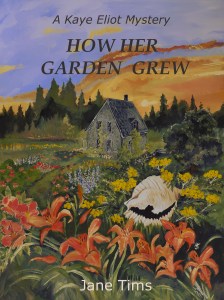
It will take me a few more weeks to proof the draft. To do this, I order a Proof from CreateSpace and do my edits as a way of passing the time effectively on my stationary cycle. Once I have the Proof, I’ll be able to concentrate on painting the cover for HHGG. This is the rough outlay for the cover, tacked together from various photos …
~

~
Now you know everything about HHGG except its title!
~
All my best,
Jane
wildlife weekend
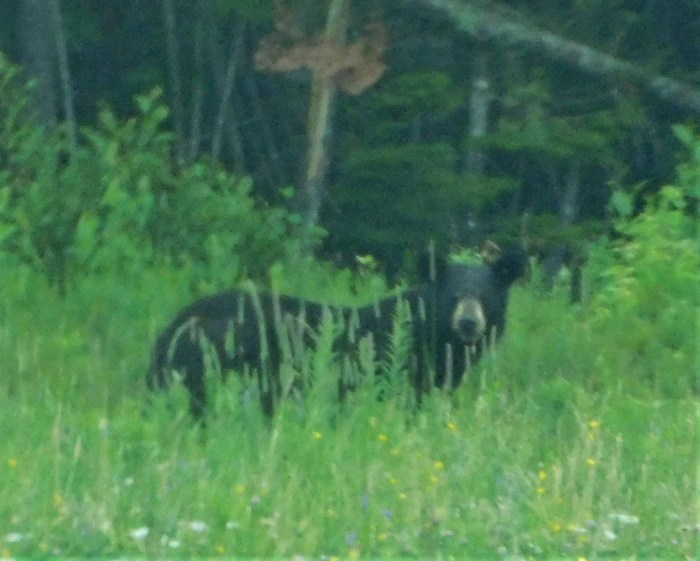
The rule is: if you forget the camera, you’ll see something to photograph. Yesterday, we broke the rule. On a quick trip to the camp we saw these two. The moose cow was all legs; looks like she was put together by a committee. The bear was a big one, too busy eating wild strawberries to be very worried about us. This makes the forth bear we have seen this year. And we heard the loon down on the lake. Great weekend.
~

~

~
~
All the best!
Jane
Forty Five River Covered Bridge
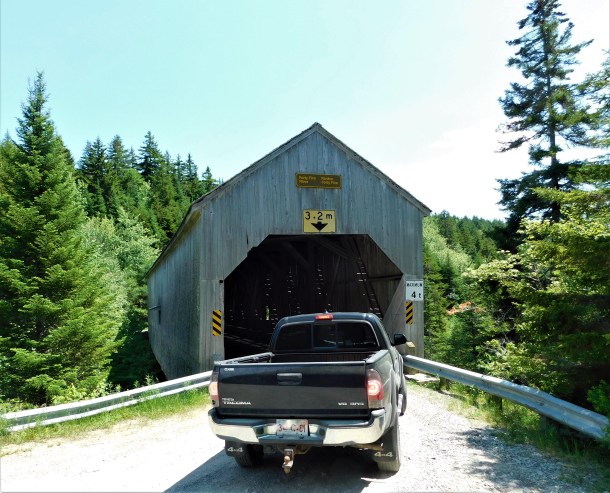
On our drive to see New Ireland (Albert County), we took the Collier Mountain Road to the south at Teahan’s Corner to see the Forty Five River Covered Bridge. Exciting to see a covered bridge I had never seen before!
~
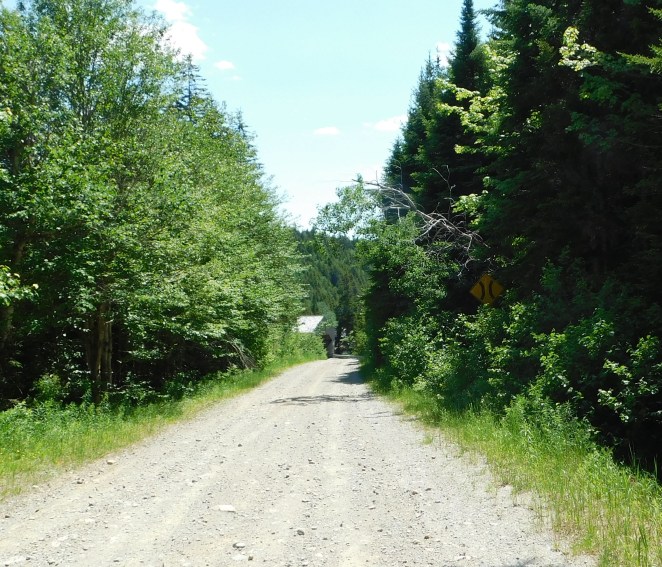
approach to the Forty Five River Bridge
~
Forty Five River is so-named because it took 45 minutes to raft logs from New Ireland down to Alma (Source: http://newirelandnb.ca/communities-the-irish-of-albert-co/ ).
~
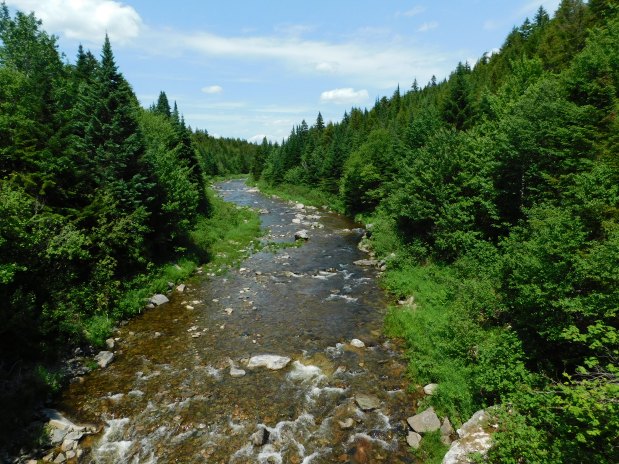
the Forty Five River, looking south
~
Where the covered bridge crosses Forty Mile River there is a steep gorge and the winds were howling when we visited the bridge.
~
~
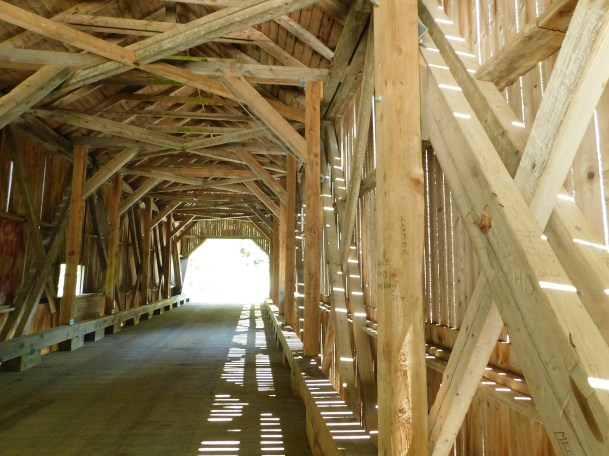
Although the road is rough traveling, the Forty Five River Bridge is in excellent shape, showing new timbers throughout. It was pleasant to sit on the bench-like side timbers and listen to the wind.
~
~
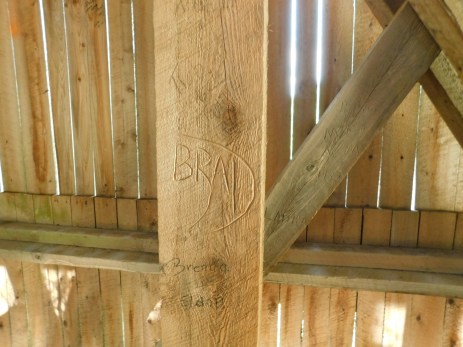
As with most bridges in New Brunswick, the bridge has a social history, partly engraved in its beams.
~
~
For more information on covered bridges in New Brunswick, click on the Categories tab at the right, under ‘covered bridges‘.
~
All my best,
Jane
showy wildflowers along New Ireland Road, Albert County, NB
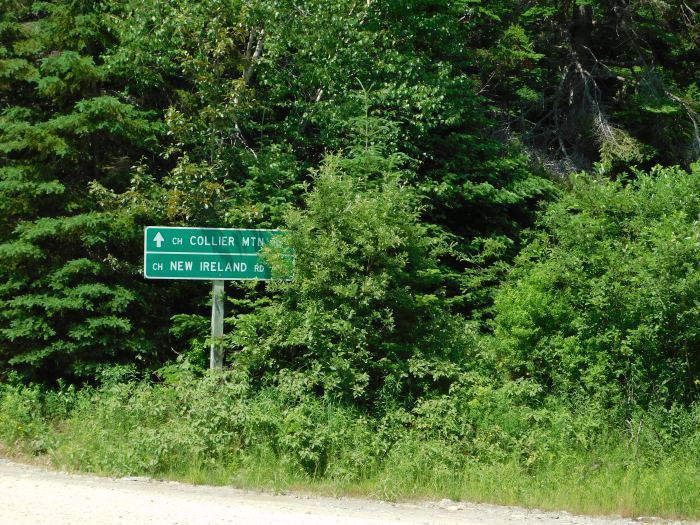
Last week we went for a drive on the New Ireland Road in Albert County, New Brunswick. Our purpose was to visit the graveyard and to see if we could spot any persisting or escaping flower species from flower gardens associated with the now abandoned settlement.
~
~
New Ireland was once a community along the eastern section of the Shepody Road (now called the New Ireland Road).
~
settled in 1816: PO 1857-1892: in 1866 New Ireland was a farming community with 68 families: in 1871 it had a population of 150: in 1898 New Ireland had 1 post office, 1 church and a population of 100: included the community of New Ireland Road: PO 1864-1903: in 1866 New Ireland Road was a farming settlement with approximately 25 families: in 1871 it had a population of 150: in 1898 New Ireland Road had 1 post office and a population of 30: included the community of Kerry which was named for County Kerry in Ireland: PO 1876-1931: in 1898 Kerry was a farming settlement with 1 post office, 1 church and a population of 75: New Ireland was abandoned about 1920 (Source: N.B. Archives, https://archives.gnb.ca/Exhibits/Communities/Home.aspx?culture=en-CA ).
~
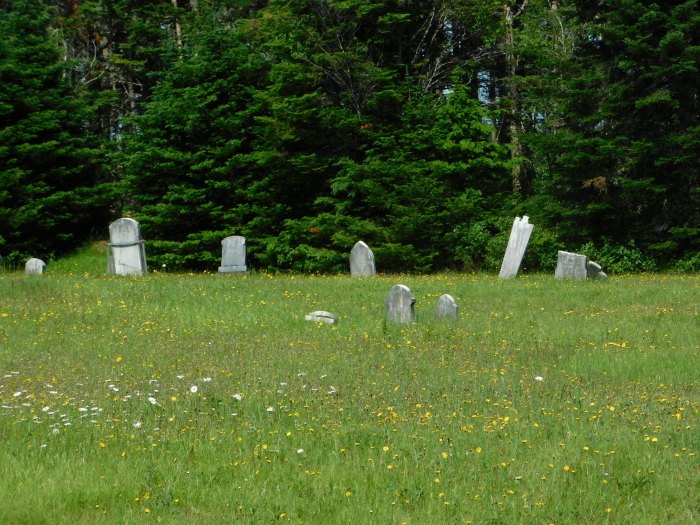
Today, only the graveyard (St. Agatha’s Catholic Cemetery) remains.
~
~
… Farmland has sadly returned to forest. Occasionally you can see a culvert that once led into a farmer’s home or field, and there is the occasional rose bush or wild apple tree struggling to survive amid reforested lands. (Source: http://newirelandnb.ca/irish-migration/ )
~
Although the rose bush did not show itself, we saw old apple trees and two showy species, viper’s bugloss and golden ragwort. These could be garden escapes but perhaps are just wild volunteers on abandoned ground.
~
Viper’s bugloss
~

Viper’s bugloss growing at the Fortymile Brook crossing, not far from the former New Ireland settlement
~
Viper’s bugloss (Echium vulgare) is also known as blueweed, blue thistle, blue devil, snake flower. It is an introduced plant (from Eurasia) and is often cultivated as an ornamental. It is invasive and lives on calcareous or poor soils. At first glance the plant is like a scrawny lupin. Up to a metre in height, it is very bristly-looking. The tall stem has a number of arching lateral floral stalks where one flower blooms at a time. Flowers are briefly pink as they bloom, changing to blue. The stem and sepals are hairy and the long red stamens add to the bristly appearance. Viper’s bugloss is melliferous (honey producing) since it produces nectar and blue pollen loved by bees, bumblebees and butterflies.
~

~
Golden ragwort
~
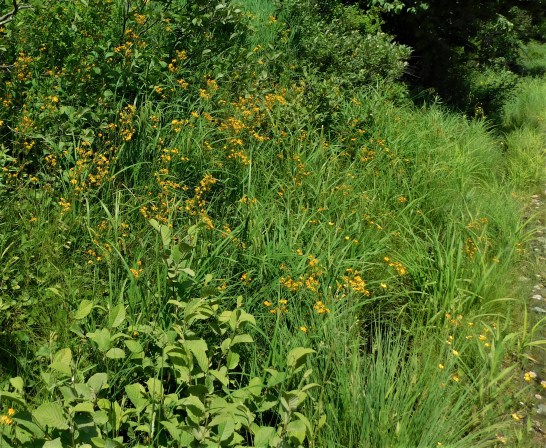
Golden ragwort growing along the New Ireland Road
~
Golden ragwort (Senecio aureus) is a tall composite with flat-topped flower clusters. The flowers are golden with sparse rays. The basal leaves are long-stemmed and heart-shaped; the leaves on the flower stalk are elongated and finely divided. The plant is native, and grows on wet ground, in low woods and in meadows.
~
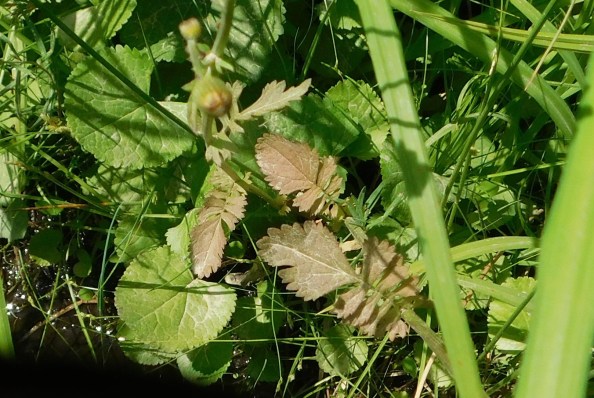
leaf shapes of Senecio aureus – heart-shaped (green leaves) and divided (reddish leaves)
~
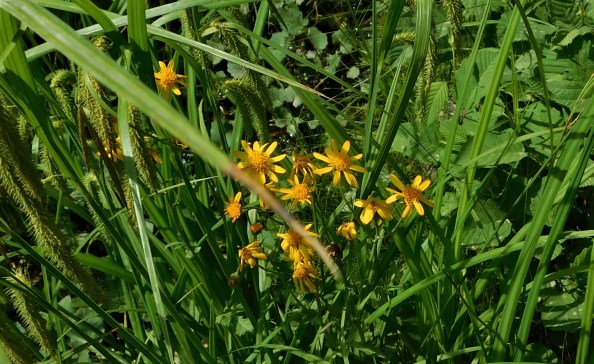
flowers of Senecio aureus
~
These two plants will star in a poem about long-gone flower gardens along the New Ireland Road. Wandering along the road, taking photos and researching the flowers are the first steps to building the poem.
~
I will be sharing the poem once I have a draft!
~
All my best,
Jane
Partridge and Grouse – which are you???
In New Brunswick, we have three birds which I confuse and name ‘Partridge‘. Remember I am a botanist and come by my bird knowledge through secondary sources.
~

a ruffed grouse or a grey partridge? the first clue is habitat (the mainly hardwood woodlands)
~
The Ruffed Grouse (Bonasa umbellus) is a bird of the woodlands (mostly hardwood) and is the bird heard ‘drumming’ in our woods in spring. Its plumage varies from pale brown to bright mahogany. It has a fanning tail and head feathers which stand up like a crown. The feathers around the neck ruff up too. Since these birds are locally referred to as ‘partridge’, there can be confusion between the Ruffed Grouse, the Spruce Grouse and the Grey Partridge.
~
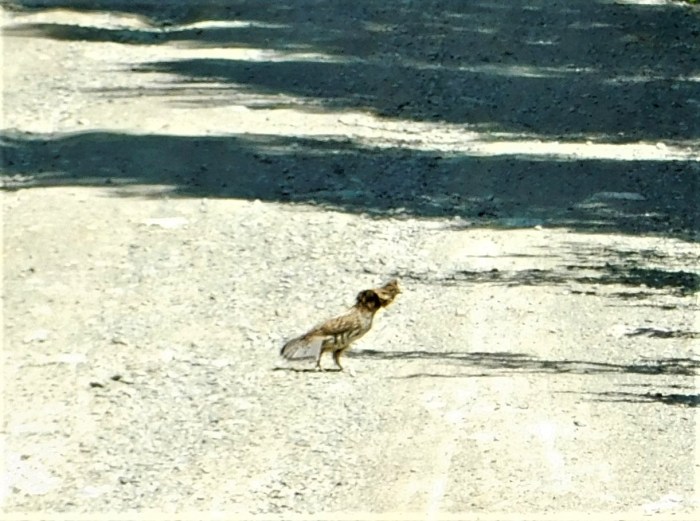
Ruffed Grouse crossing the Old Shepody Road in eastern New Brunswick
~

Ruffed Grouse in our grey woods
~
The Spruce Grouse (Falcipennis canadensis) is a bird of mainly coniferous woodlands. It eats spruce and pine needles. It is a chicken-like bird with variable plumage, mostly grey and black in the male and grey-brown in the female. The bird has a fanning tail, but does not raise its head feathers the way the Ruffed Grouse does. For a good photo of the Spruce Grouse see https://www.allaboutbirds.org/guide/Spruce_Grouse/id
The Grey Partridge (Perdix perdix) is a bird of open areas and grass lands. It is a roundish bird with a brown back and grey sides and neck. The chest-area has a darker brown mark. When startled, the bird flies upwards on rounded wings. For a good photo of a Grey Partridge see https://www.allaboutbirds.org/guide/Gray_Partridge/id
~
All my best,
Jane
bracket fungi
On a drive last weekend, we saw this great example of bracket fungi growing on an old maple.
~

~
Bracket fungi belong to a group of fungi called polypores. These produce the characteristic spore-producing bodies called conks. The shelf-shaped or bracket-shaped conks are a reproductive outgrowth of the main fungal body called the mycelium. As with all fungi, the mycelium is mostly unseen since it resides in wood or soil.
~
Polypores are a significant part of the forest ecosystem because they are agents of wood decay. These fungi are efficient decomposers of lignin and cellulose.
~

~
On a more fanciful note, the brackets of these fungi always remind me of ‘faerie stairs’, a way to ascend an ancient tree.
~
bracket fungi
~
in this forest
(staid
practical
grey)
could any form
construe to magic?
~
fairy rings
moths in spectral flight
spider webs, witches brooms
burrows and subterranean
rooms, hollows in wizened
logs, red toadstools
white-spotted, mottled
frogs
~
bracket fungi
steps ascending
a branchless tree
~
(Previously published October 28, 2011 http://www.nichepoetryandprose.wordpress.com )
~

~
All my best,
Jane
scribble bird
~
~
~
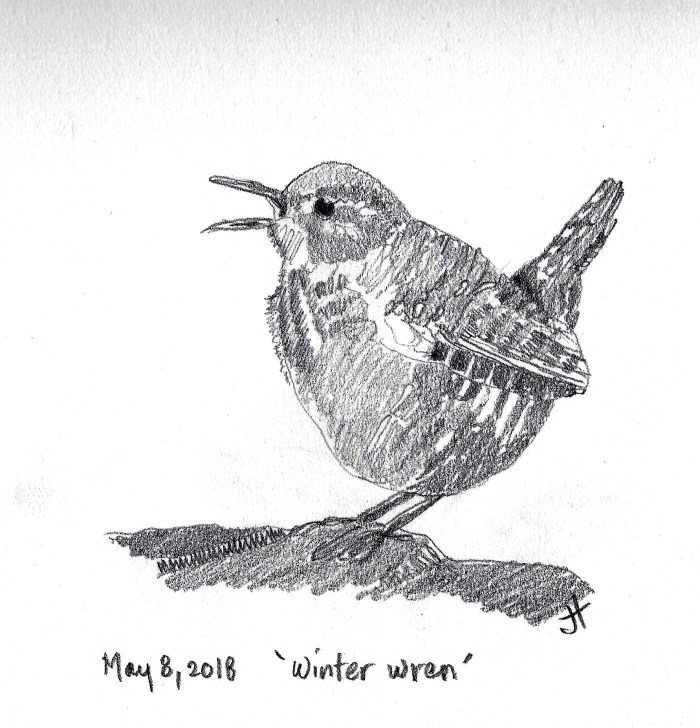
Winter Wren
Troglodytes hiemalis
~
How to find
centre of forest.
Joy the objective.
~
Tiny tail
shivers as he sings.
Delirious trill.
~
Troglodyte
darts into thickets,
creeps into crevasses.
~
Lifts an eyebrow,
joins a chime of wrens.
Elusive ripple,
~
varied trill,
incoherent whir,
tremble to warble.
~
Distinguish
the note, the half-note,
the tone, the tangle.
~
Forget where
you once were going,
indecisive
scribble bird.
~
~
All my best,
Jane
saving the bees
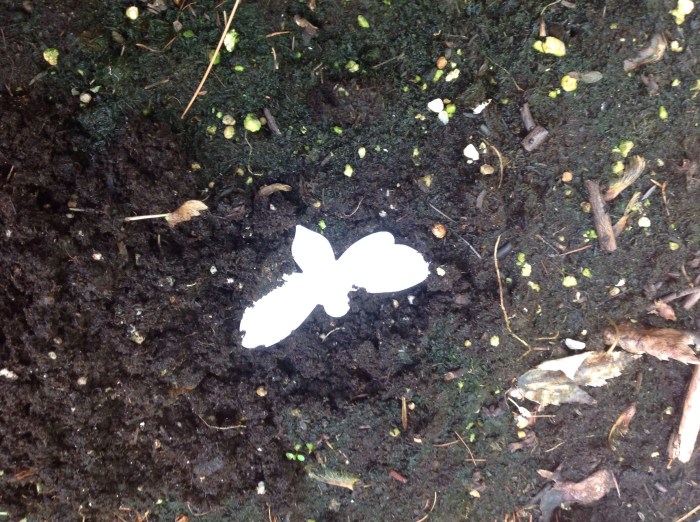
A while ago a friend of mine gave me an interesting ‘save the bees’ planting card. The white bee-shaped card is embedded with seeds. These seeds, if planted, will grow into wildflower species the bees like.
~

~
As you may know, bee populations are struggling. Since bees pollinate plants, they are responsible for the continued success of all the plant species we rely on. The ecosystem is like a tangle of connected threads and the loss of any one connection is a loss to the system.
~
Yesterday I planted my seed card in my deck box. I will let you know what grows!!! I am also a believer in leaving wild flowers to flourish on my property. I only mow once a year, I never use pesticides and dandelions are my friends.
~
~
The Save the Bees card is from www.beebythesea.com a source of natural products . For more information about helping the bees, see Buzz About Bees at
https://www.buzzaboutbees.net/save-the-bees.html
~
All my best!
Jane
a feast of wild strawberries
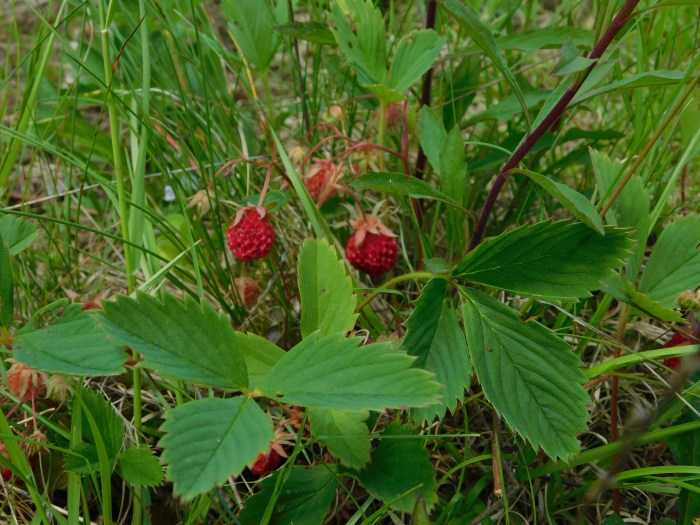
This week at our cabin the wild strawberries are hanging from their stems. When I see them I think of the sweet wild strawberry jam my mom used to make. And, after this weekend, I will think of cedar waxwings.
~
~
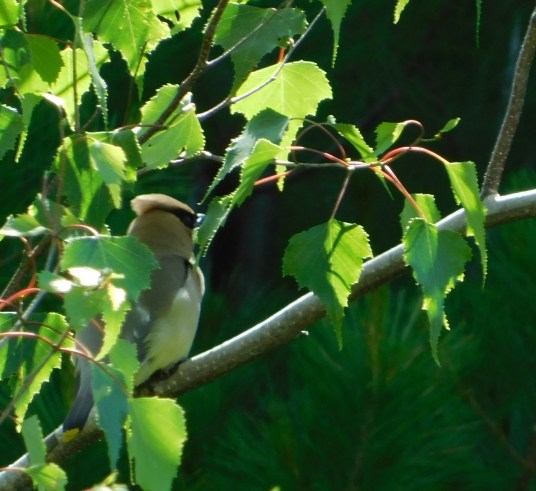
As we sat in the cabin, eating our dinner, we saw a bird making trips between the birch tree in front of the cabin and the grassy field to the side, where the wild strawberries grow.
~

~
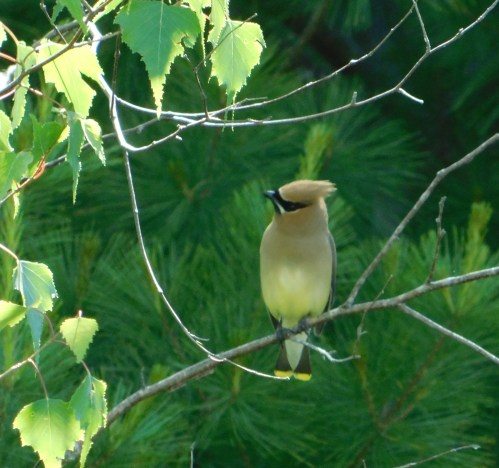
My husband identified the bird and spotted where it perched in the tree. The cedar waxwing is one of the common birds at the cabin. They love to eat fruit and we have wild strawberries, raspberries, blackberries, and blueberries on the property.
~
There were two cedar waxwings on the branch, sharing a meal of wild strawberries. Sharing fruit is a ritual behavior between male and female cedar waxwings.
~

~
~
The cedar waxwings nest in our big white pines and sing in the top branches of other nearby trees. I will never see them without thinking of their little feast of berries.
~
All my best,
Jane
~
swallowtails and Alexanders
Last week we did the first of our forays to get material for a new set of poems I am working on. Our drive took us to the area north of Stanley, and some two-track roads where settlements and home-sites have been abandoned.
~

the road to Mavis Mills, an abandoned community
~
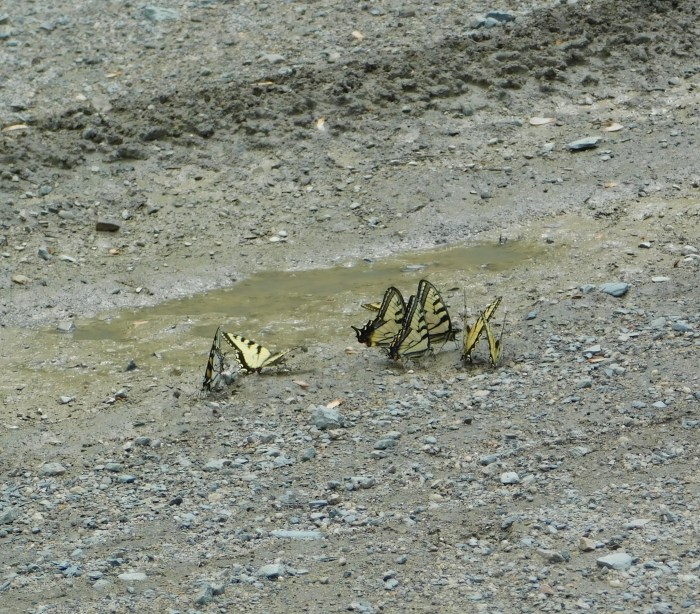
The main road was busy with butterflies: Papilio canadensis, Canadian tiger swallowtail. These are familiar butterflies, very similar to the eastern swallowtail, and once considered the same species. The males are yellow with black-rimmed wings (with a dotted yellow stripe in the margin) and four black tiger-stripes on the upper part of each fore-wing.
~
~
The butterflies were congregating on the road near water puddles. They were interested in the muddy areas rather than the water. This behavior is called “puddling” and is a way for the butterfly to get sodium ions and amino acids.
~

~
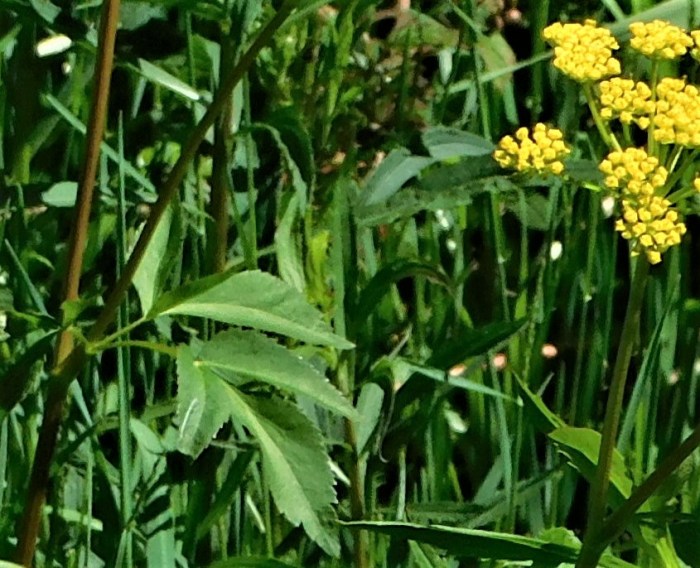
We took an old, two-track road to the abandoned hamlet of Mavis Mills and found the old settlement house sites. The once-cleared areas were populated by a pretty yellow composite flower, a member of the parsley family: Zizia aurea, golden Alexanders. These plants are usually under 30 inches high, with three serrated leaves (or three leaflets divided further into three’s) and a flat umbel of yellow flowers. The stems are red and the whole plant appears red in the fall. It is a host plant for the caterpillars of species of swallowtail butterflies. The plants grow in wet meadows and abandoned fields.
~

field of golden Alexanders in an abandoned settlement
~

~
~
We had an enjoyable drive, looking at abandoned homesteads and settlements. Since I am a botanist, I am interested in what has happened to the plants that once grew in the gardens of these homes. Some of the plants have vanished, but a few persist at the home-site and a few escape to cover ditches and countryside in bloom.
~

an old lilac bush continuing to thrive near an abandoned house
~
All my best!
Jane