How Her Garden Grew
Mid-summer and my little garden is doing well. The plants are growing in planters on my deck: three parsley plants, three climbing beans, three snow peas and one cucumber. I have to ‘weed’ every day as the maple keys keep sprouting!
~
With a small garden, I have lots of time to read. Right now I am reading the forth in the Lane Winslow Mysteries, set in Canada in British Columbia after WW II here. I love mysteries and now I have one of my own. ‘How Her Garden Grew’ tells the story of a mom and her kids who find a packet of old letters and follow a trail of mayhem and murder to summer’s end. This is the first in a series of three Kaye Eliot Mysteries, set in Nova Scotia in 1995.
~
‘How Her Garden Grew‘ is available on-line here. Or at Westminster Books in Fredericton (you should see their new store at 88 York Street!)
~

~
I am spending my summer (when I am not pulling maple sprouts) writing the sequel to ‘How Her Garden Grew’. It will be called ‘Something the Sundial Said’ and take readers on another cozy mystery adventure.
~
Enjoy your summer reading!
~
All my best,
Jane
Canada lilies by the highway
On a drive to Chipman today we came back via the old Trans Canada (now Highway 105) through Grand Lake Meadows. The Canada lily (also called meadow lily), Lilium canadense, is in bloom. Each plant holds its lily chandelier above the other field vegetation. They are bright orange with dark spots and hang downward.
~

~

~
This seems to be the time of year for lilies. I have three varieties of day-lily in my garden and when one finishes its blooming, another begins.
~
All my best,
Jane
checking out the berries
As I have often written, our cabin is an enjoyable place to be. We read; we go for walks; we watch the birds; we occasionally do a little work (keeping the trails clear, working on the cabin).
This past weekend we identified the trees surrounding the cabin and we were pleased to find we had 13 different trees:
- horse chestnut
- red maple
- mountain birch
- white birch
- trembling aspen
- green ash
- apple
- red oak
- willow
- white pine
- black spruce
- balsam fir
- shad bush
~
The berries on the shad bush are just beginning to form. At this stage they are about as big as a small pea.
~

~
We weren’t the only ones interested in the progress of the shad bush fruit. While we watched, a cedar waxwing landed and stayed for a while.
~

~
Last year we had fun watching the cedar waxwings feeding wild strawberries to one another! If you’d like to see those photos, click here.
Al my best!
Jane
a reading and signing of my new book ‘How Her Garden Grew’
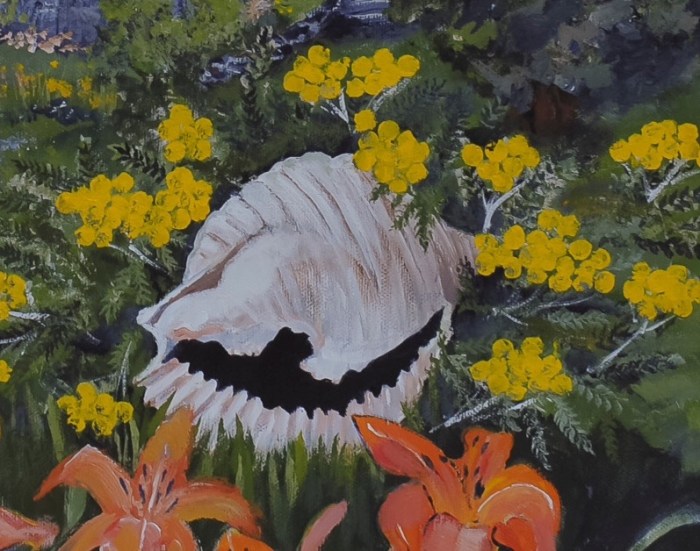
Have you ever seen a Grinning Tun? He is the villain of my new mystery story How Her Garden Grew.
~

~
I will be reading and signing books at our Authors Coffee House on Thursday, May 30 at 7 PM at the Holy Trinity Anglican Church in Nasonworth (1224, Highway 101). A portion of book sales will be donated to the Fredericton Hospice. There will be refreshments!
~

~
How Her Garden Grew is available in e-book and paperback formats here and will soon be available at Westminster Books in Fredericton.
Hope to see you at the Authors Coffee House!
Jane
three yellows
On Sunday, we went for a drive along New Brunswick Route 615, eventually travelling from Mactaquac to Nackawic. A pleasant drive, climbing into the hills of this part of New Brunswick.
~
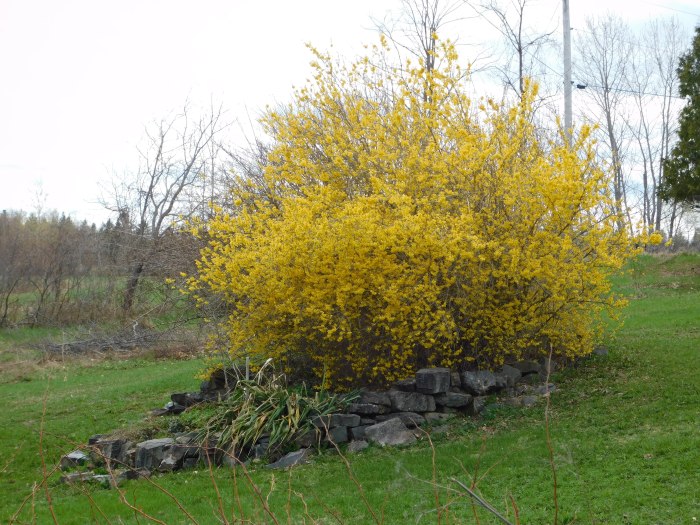
Early into our drive, a theme suggested itself … the yellow flowers of spring. These included the daffodil and the blazing Forsythia (Forsythia sp.) … a deciduous shrub with copious yellow blooms.
~
~
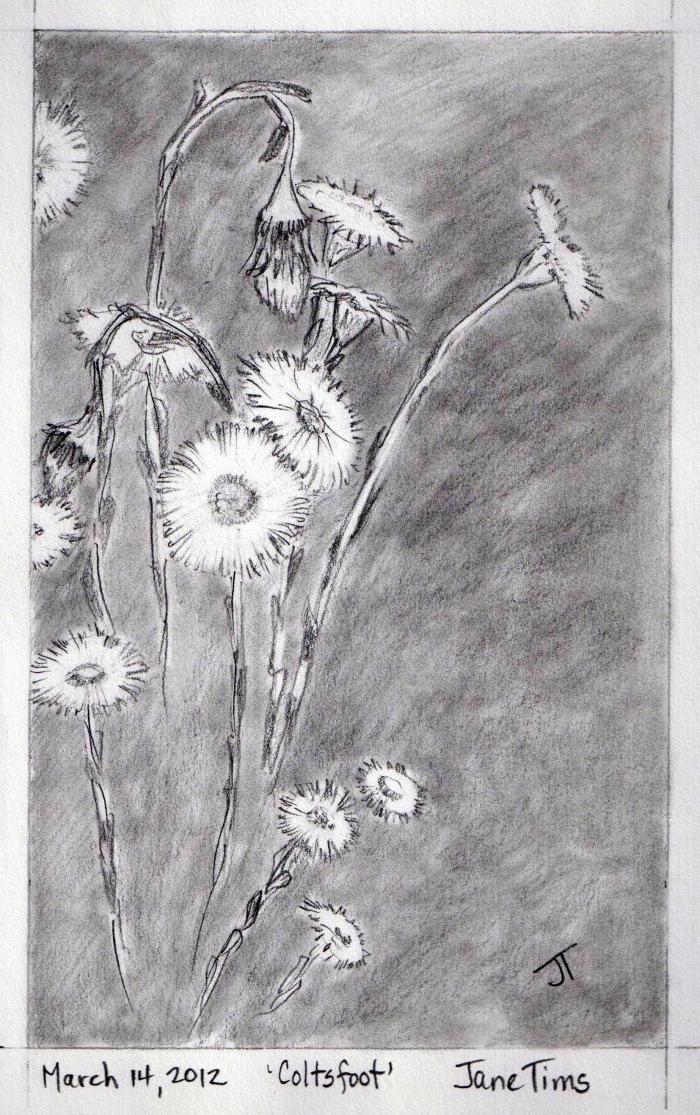
Another yellow flower crowding the edges of almost every ditch, was Tussilago farfara or Coltsfoot. The flowers have been in bloom a couple of weeks and will soon set their white fluffy seed. After the flowers have faded, the leaves will appear, big green ears seemingly unrelated to the yellow flowers of spring.
~

~
~
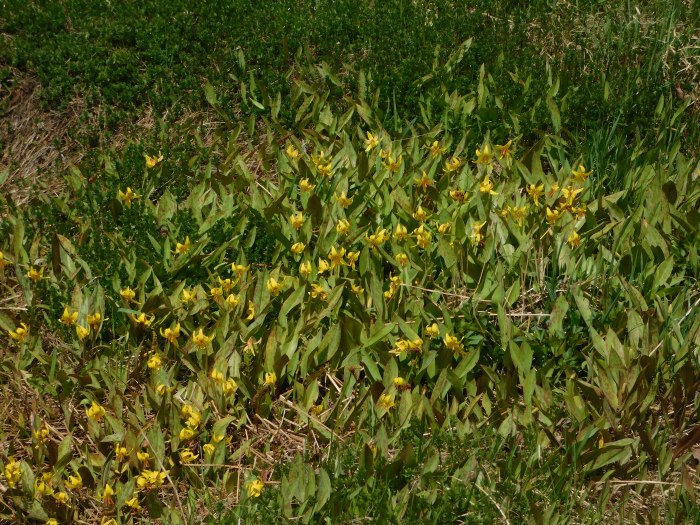
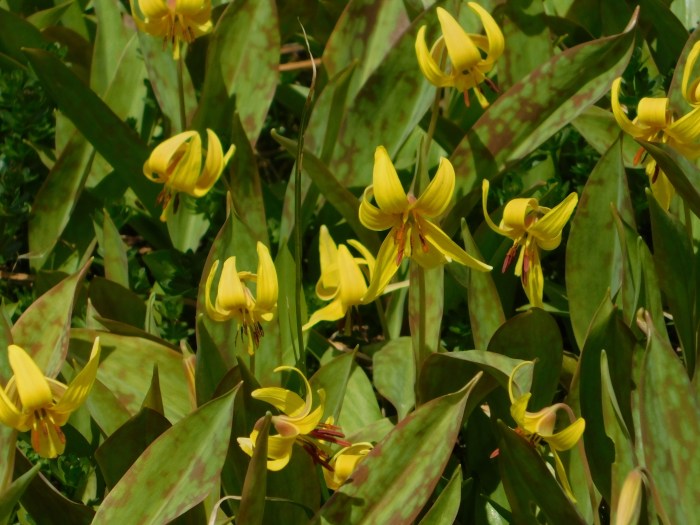
At the foot of a farmer’s field, we saw another yellow flower, usually found in wooded wet areas or in hardwoods. The mottled green and purple leaves are the first identifying feature. Close-up, the nodding yellow flower with its recurved petals and drooping stamens show this is the Dog’s Tooth Violet, or Yellow Trout-lily (Erythronium americanum).
~
~
~
Today, my yellow tulips are blooming, yet another addition to the yellow flowers of this season.
~
All my best,
Jane
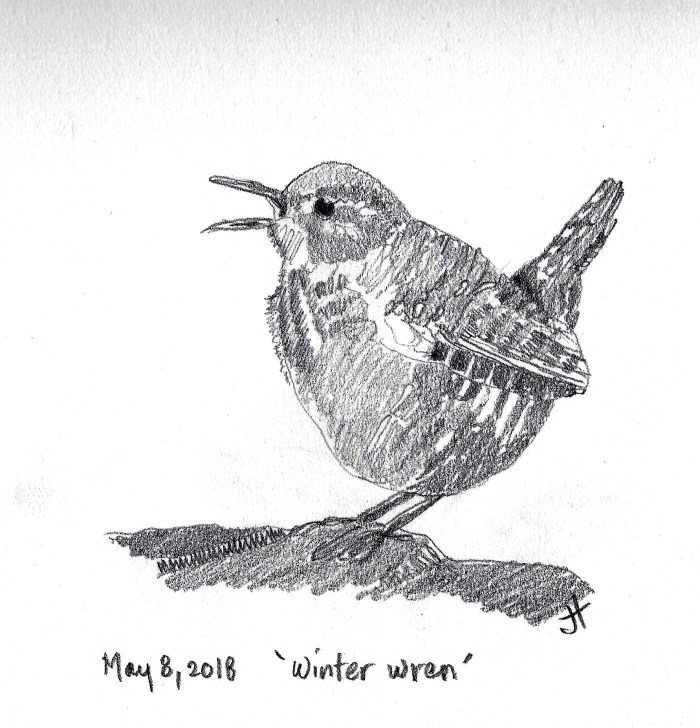
more of the winter wren
 ~
~
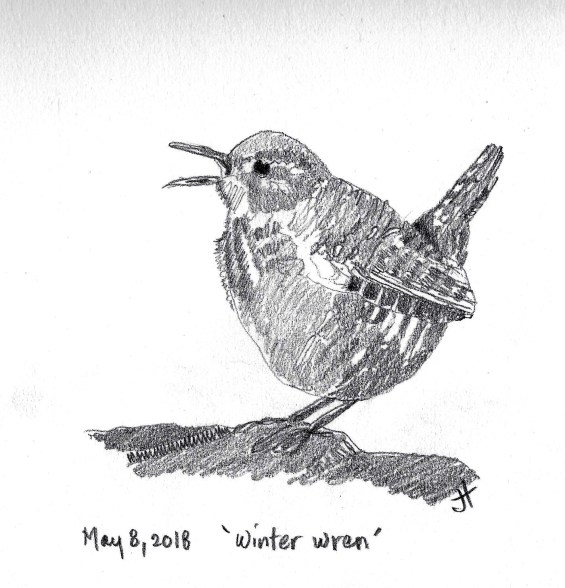
winter wren – scribble bird
~
up-turned tail
bright eye
tiny, he occupies
the mossy stage, attends
to all his audience
~
earnest performer
beak and feathered
throat
maneuver air
orchestral synchrony
~
bright burble
trills and runs
mimic
interplay
of pebble and brook
~
~
spring chorus – winter wren
This morning I added a new bird to our spring chorus singers – the winter wren.
~
It is the first I have heard of him this year. At 6:45, just after dawn, he began his amazing song. His tweets and runs and burbling sound so joyful and each song lasts about seven seconds, very long for any bird song. He may be a winter wren but to me he is always the ‘scribble bird’.
~
To hear the winter wren sing, click here .
~
He joins my growing list of morning singers:
- black and white warbler – ‘sweet, sweet, sweet, sweet, sweet’
- American robin – ‘cherry up cheery-eee’
- nuthatch – ‘yank, yank, yank, yank’
- phoebe – nasal ‘fee-bee’
- snipe – winnowing
- our neighbour’s rooster
~
I often include elements of the morning bird chorus in my poetry. This poem, written about the Salmon River Covered Bridge, is in my poetry book in the shelter of the covered bridge (Chapel Street Editions, 2017). To obtain a copy of the book, go to Chapel Street Editions or contact me through the comments.
~
The Salmon River Bridge, near Sussex, Kings County, was built across the Kennebecasis River in 1908. Today it is used as a rest area. In the absence of traffic, wild life occupies the bridge. Virginia creeper covers one corner of the roof and rose bushes crowd the edges of the road.
~
scribble
Salmon Bridge
Kennebecasis #7.5
~
The robin, chary. Her beak drips
with wet meadow grass and chickweed.
She clucks, longs to add another strand
to her nest in the rafters,
~
woven with the trill of a scribble bird,
a winter wren delirious. And downy
woodpeckers, wing-flare and scrabble,
flirt in the willows, weeping.
~
A warbler (yellow blur-bird)
and a red-wing, toweeeee.
Pink roses, meadowsweet
chip, chip, chip, so-wary-we
~
and beneath the bridge
in soft mud beside pulled grass
the bleary track of a black bear
claws and pads
~
~
Published, in the shelter of the covered bridge, Chapel Street Editions, 2017
~
~
All my best,
Jane
New mystery novel – How Her Garden Grew
Merry, Merry
Quite contrary
How does your garden grow?
~
Announcement: My new mystery novel ‘How Her Garden Grew‘ is now available on Amazon in paperback. The Kindle version will be available in a few days.
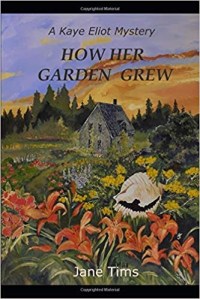
‘How Her Garden Grew’ is the first in my series of Kaye Eliot mysteries. Kaye is a busy mother with a business to run, two active children and an accountant husband who can’t seem to get free of tax time! The books will take us back to the 1990’s, to a time before cell phones and computers were a key ingredient of family life.
‘How Her Garden Grew’ is a novel about coping with stress, the strength of family, the problems of community, a century-old garden and a strange character called the Grinning Tun.
~
~
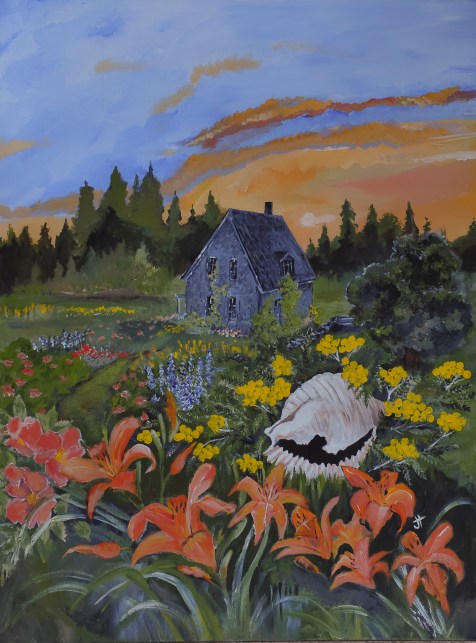
In the 1990s, Kaye Eliot comes to Acadia Creek to spend a quiet summer with her two children. But instead of passing stress-free days of swimming and hiking, she finds herself embedded in mystery after mystery. A missing vagrant and a gang of thieves have the community worried. Neighbours seem determined to occupy all of Kaye’s time and energy in restoration of an old flower garden. To add to the mayhem, Kaye and her kids have stumbled on a century-old legend of a treasure buried on the property, a packet of forgotten letters from a woman named Maria Merriweather and an old map of the garden. And they dig up a sinister sea shell. A sea shell who looks like a grinning skull and will not stay where he is put. Can Kaye recover her calm or will she be the victim of neighbors, vagrants, thieves and a shell called the Grinning Tun? Restoring Maria’s garden seems a great idea, until Kaye discovers how Maria’s garden grew.
~
So what or who is the Grinning Tun? The Grinning Tun is a sea shell, plucked from the sands of a faraway tropical shore. But this is a sea shell with a difference. It will not stay put! Shove it in the warming oven and, next morning, it sits on top of the stove. Bury it in the ground and it is found in the root cellar. And it grins. It thinks of the possibilities. And it links a mystery in the 1990’s with one in the 1870’s.
~
 ~
~
To get your copy of ‘How Her Garden Grew’, go to Amazon here. If you are in the Fredericton area, I will be reading from the book and signing copies at the Authors Coffee House in Nasonworth later in May (more details soon)!
Hope you enjoy the story as much as I enjoyed writing it!
All my best,
Jane
spring chorus – snipe
For the last two mornings, about 9:00, about one and a half hours after sunrise, I hear a song that is not a song. A winnowing ‘hoo, hoo, hoo, hoo, hoo, hoo,’ like a repeated, trailing set of high pitched notes, echoes in the grey woods. This is the mating display and call of a snipe. The amazing thing is, the call is not coming from the snipe’s throat, but from its feathers. As it flies, the air moving through the tail feathers makes the ‘call.’ To hear this sound, visit here.
The snipe is a bird of wetlands and marshes. It has a long bill and black, white and brown feathers. There is still lots of snow on the ground but this bird seems anxious to get on with the season.
The only other birds singing this morning were the crows and our neighbour’s rooster!
~

next Authors Coffee House
Interested in history? The next reader in the Authors Coffee House series will be Dr Ross Hebb who will read from his books about Maritimers in World War I, ‘In Their Own Words’! Reading is next week on Thursday March 21st at noon and a hot lunch will be served. Hope to see you there!





 nichepoetryandprose