Stay Home
~

~
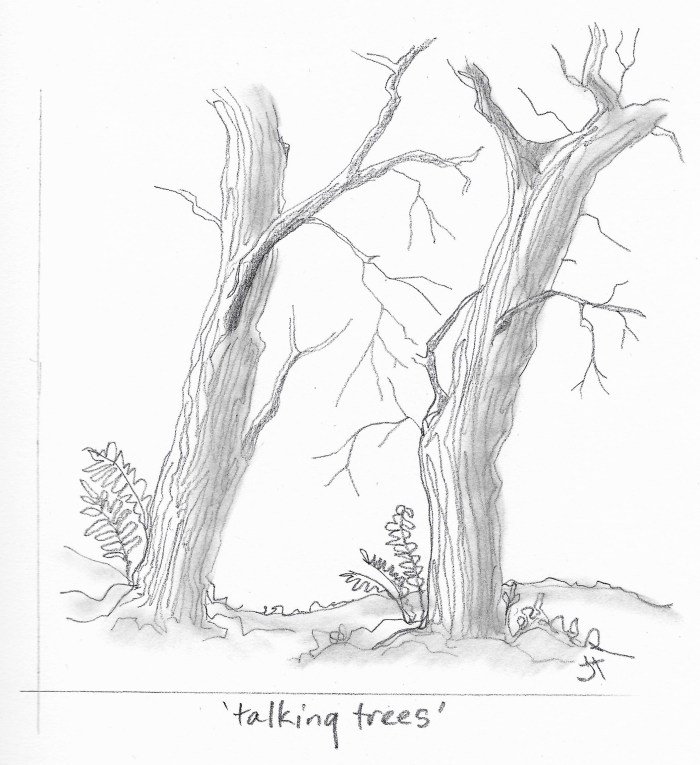
Don’t know how many times
I can say it.
Stay home!”
~
“Stay home?
What are you talking about?
I am rooted to the ground.
All I can do is
Stay Home.”
~
“You can’t fool me.
I know you’ve been sneaking around.
Letting your roots grow
into all kinds of places.
Communicating with other trees.”
~
“What are you talking about?
My tap root grows deep.
All I can do is
Stay Home.”
~
“You can’t fool me.
I know you’ve been sneaking around.
Letting your leaves drop,
blow all over the woods.
Mixing with those of other trees.”
~
“What are you talking about?
Can’t help it if my leaves are dry.
All I can do is
Stay Home.”
~
“You can’t fool me.
I know you’ve been
conspiring with squirrels.
Spreading your acorns
all over the woods.
Mingling with other trees.”
~
“What are you talking about?
I can’t be responsible
for what my children do.
All I can do is
Stay Home.”
~
“All I can do
is repeat myself.
Stay Home.”
~
~
All my best,
Jane
Staying Home!
raddit
Rabbits have always been a part of my life. When I was young, in Alberta, rabbits (the white-tailed jackrabbit) overran the prairie and almost every evening, you could look out on the lawn and see them grazing. In New Brunswick, we often see rabbits (the snowshoe hare) along the roadside.
~
When I was in Grade One, I was asked to submit my scribbler for a contest. The teacher, Mrs. MacDonald, said two things about my scribbler. First, I should look at my spelling of ‘rabbit.’ It occurred many times in the scribbler and everywhere I had spelled it ‘raddit.’ Second, she said to use an eraser to make the corrections. “Do not wet your finger and try to take out the two ds. It will leave a hole in your paper.”
~
I had no eraser. And I wanted to win the scribbler contest. The teacher had mentioned the use of a wet finger as an eraser. Perhaps it would work. So I wet my finger and rubbed at the ds. You guessed it, I ended up with a hole in the scribbler page. I did not win the contest.
~

~
twitch
~
grass, bent after rain
underside in dark, topside
rinsed in moonlight where
eight brown rabbits lope
from perimeter of prairie
eager for a nibble of green,
nip of delirium, dancing
in moonlight, whiskers
liberated to brush
cheeks in mobile
shadow, to make
transparent, long
ears, vein-lined
twitch, stand
erect, ear
hairs scan
for two-
or four-
legged
danger
~
~
All my best,
staying home,
Jane
ice
As I go over the many poems I have written over the years, I find a lot of poems about ice. Ice is very poem-worthy. It glitters and drips. It is cold and changes form. Icicles make great popsicles (if they are dripping from a clean surface). Ice can be a metaphor for emotion, life experience, change, danger, and so on.
~
Today we had a high of 7 degrees C and all the snow and ice are melting. Not really sad to see them go this year.
~
river ice
~
builds in shallows
at the rim of river, incremental
embellishment to transparent sheets
of glass, ice envelopes winter
remnants, reeds and willows
thickness increased as frost
penetrates, sharp edges
cauterized by cold
~
~
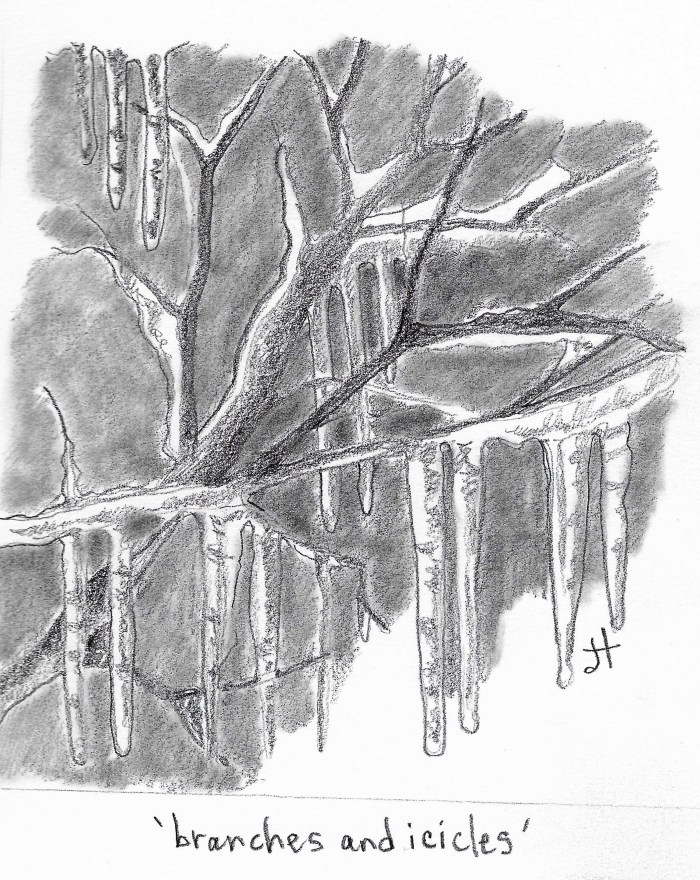
freezing rain
~
trees, bare branches, wait
wood snaps in the stove
budgies peck at cuttle bone
pellets of rain, tossed
at the skylight
a second transparency
~
bare twigs turn in wind
distribute their coating
in these last moments
before temperature turns
the snowpack on the picnic table
shrinks at the edges
shoves over, makes room
~
branches gloss so gradually
candles dipped in a vat of wax
over and over, acquiring thickness
the sky, through the skylight
dimpled tile, rumpled mosaic
~
rain stipples bark as narrative
appends to memory, pane here,
light there, layers of glass
cedar twigs turn downward
as fingers, ice builds
layers of skin
~
~
All my best
(staying home!)
Jane
berries and pears and plums
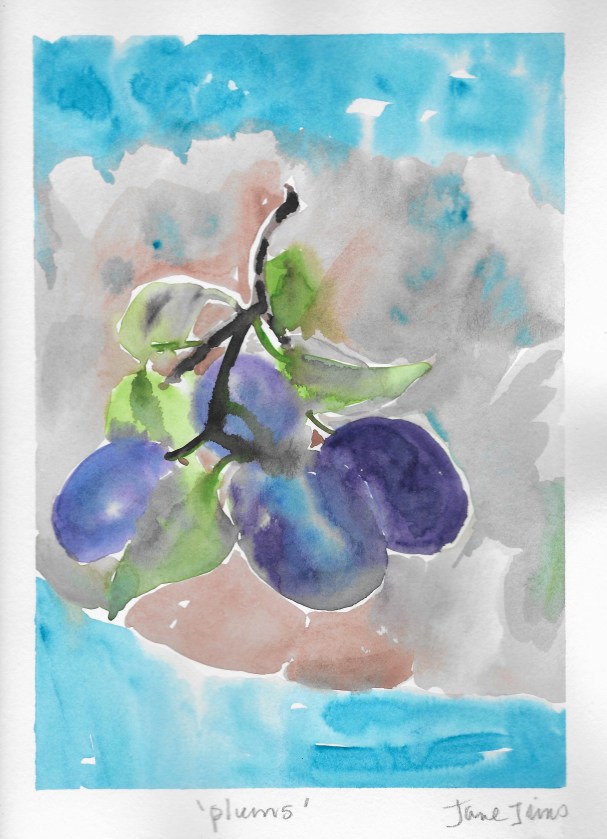
I am a multi-tasker. I find it hard to do just one thing. So when I watch TV in the evenings, I read posts on Facebook, knit, sew or draw. Lately, I am practicing with my watercolours. I love working with the ‘wet on wet’ technique. I just touch the brush to the paper and watch the colour flow. So relaxing!
~

~
~

~

~
All my best,
staying home,
Jane
organizing writing files – ordering a manuscript of poems
Last month I started a big project – to find and organize all the poems I have written during the last forty years. For a glimpse of my approach see here.
~
After four weeks of effort, I now have a file of poems I would like to assemble into a book. The title will be ‘niche’ and the book will include poems about the ecological spaces plants and animals (including humans) occupy.
~
niche \ ‘nich\ n (F, fr. MF, fr. nicher to nest, fr. (assumed) VL nidicare, from L nidus nest) 1 a : a recess in a wall, especially for a statue. b : something that resembles a niche. 2 a : a place, employment, or activity for which a person is best fitted. b : a habitat supplying the factors necessary for the existence of an organism or species. c : the ecological role of an organism in a community especially in regard to food consumption.
– Webster’s New Collegiate Dictionary, 1979
~
I have identified 66 poems for ‘niche,’ taking up about 110 pages. Although I could just toss the poems into the book in random order, I like to think about how I want the reader to encounter the poems. I organize the poems in the book following these steps.
~
1. List the ideas in the poems:
After I find all the poems to fit the ‘niche’ category, I arrange them roughly into a manuscript. Then I print the Table of Contents and write a list of ideas associated with each poem. Examples for ‘niche’ include: needs, predation, reproduction, invasion of other spaces, seasons, nutrition, competition, and so on. I also start to get a feel for poems that do not fit.
~

~
2. Develop a progression of ideas:
Once I have identified these ideas, I decide how I want to group them and how I want them to progress for the reader. In the case of ‘niche,’ I want the poems to first define niche, then consider the strategies plants and animals use to stay in their niche, then explore the discomfort or danger created when a niche is occupied, consider the spaces I have occupied in my own life, consider the problems you have to overcome to occupy your own niche, and conclude with an idea of the ideal space. Then, I reorder the poems so they fit the progression of ideas.
~
3. Sort the poems roughly into groups:
Once I have decided on a progression of ideas, I put poems into sections to portray those ideas. I choose the title for the section from a poem in the section. It is at this point that I decide which poems do not belong in the collection and remove them. For ‘niche’ the following are the sections (for now):
occupation of space – needs of an organism for food, water, air, physical space, and so on.
strategy – ways plants and animals protect their niche and solidify their position
praying for rain – dangers and discomforts of occupying a niche
mapping the labyrinth – places I have occupied, a bit of memoir
not touching the land – ways a niche is changed when it is occupied
forgetting to move – getting comfortable in your own niche
~
4. Order and fine tune:
Now the fine-tuning. To create a readable book of poetry, I think poems should not only be consistent in theme, but also segue from one to the other. This may be as simple as grouping poems of one season together, or grouping poems about plant species. It also means allowing the language and rhythm to flow from one poem to another.
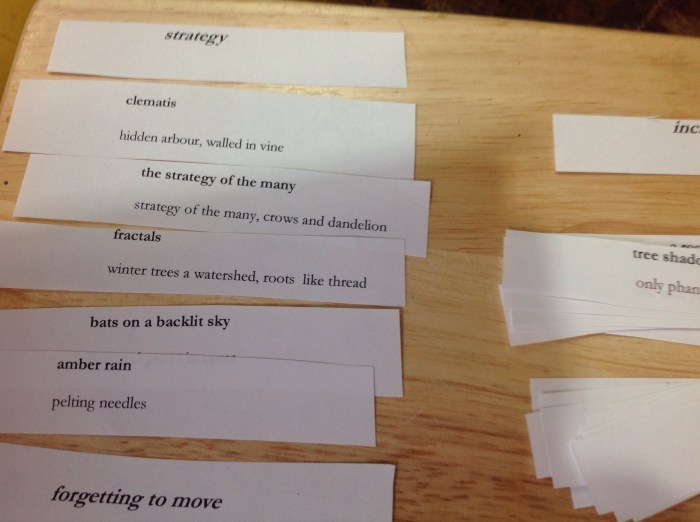
The intensive way to do this is to print all the poems and lay them out on a surface, ordering and reordering until they feel ‘right.’
I hate to waste the paper, and I like to have all materials within one view, so I use an abbreviated method. I prepare pages showing just the section titles, the poem titles and a line about the poem. I cut these out so they can easily be moved around on a table. If I want to check detailed poem content structure, I have my i-pad near at hand.
~

~
The process is sometimes tedious. Taking a break helps since after a while the poems you know so well begin to blur in meaning and the relationships between poems become nebulous. However, like many editorial-type tasks, the end product is worth the effort.
~
All my best,
staying at home,
Jane
organizing writing files – what to do with scores of poems
Lately I have been doing a lot of thinking about the poetry I have written over the years. I have two traditionally published books of poetry and will publish, independently, a small volume later this month. But scattered in the memory of my computer are hundreds of other poems, written over the course of forty years. Quality varies, but they are all mine, an expression of what it is like to be ‘me.’ Someday, when I am dust on the wind, someone is going to scan my computer and push delete. My son would not do this, but if I leave them in this state, they will become part of the clutter of his life.
~
So, if I have had success at publishing my own work, and have the skills, why shouldn’t I ‘save’ the poems it took four decades to write.
~
My approach has been to find the poems and assign them to one of five files. Each of the files will be the contents of a book of poetry, independently published and produced in a few copies. I have no intention of marketing these books. I may give them to family or friends, perhaps submit them to a few contests and just enjoy them myself.
~
The five files will be:
1. ‘niche’ – poems about the spaces occupied by plants and animals
2. ‘myth and mystery’ – poems about strange occurrences in life
3. ‘lakes’ – poems about lakes and rivers in New Brunswick
4. ‘my grandfather’s farm’ – poems about my memories of the farm
5. ‘journal poems’ – poems about specific times in my life
~
This is a slow process. First, there are multiple copies of some poems. Second, I have not been consistent with the naming of files. One outcome of this project will be a tidier computer.
~
When I have the files in folders, then I will work to organize the poems, revise them, format the manuscript and produce a book. A huge task, but as with all things, I will see the project through in stages, working on one part at a time.
~

~
UPDATE: I now have the files organized! It has taken about a month of work, off and on. I am now working on the poems for ‘niche.’ There are 66 poems, taking about 110 pages. Next post, I will write about organizing the poems into a readable manuscript.
~
All my best,
and staying home,
Jane
talking trees

~
~
trees in conversation
~
they say
if trees communicate
they do so
beneath the ground
communication network
of rootlets
and mycelia
~
I still listen
above ground
to the friction squeal
of trunks
rubbing together
flutter of birch bark
whisper of leaves
~
I think they try
to learn my language
speak to me
of longevity, the cycle
of the story in layers
added year to year
bilingual trees
~

~
~
All my best,
Jane
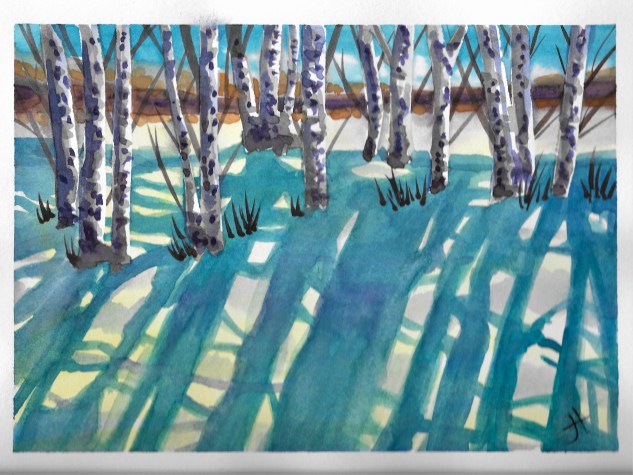
blue shadows
~
blue shadows
~
crawl across the snow
reflect trunks and branches
tufts of lichen
curves of bracket fungi
curls of bark
~
blue shadows
nuanced in ultramarine
and pthalo
a dab of violet
but never grey
~
sinuous, diagonal
gaps of light
slow alteration
with angle of sun
no flicker of foliage
~

~
~
All my best,
Jane
writing the next mystery
Although I am working to assemble a new book of poetry this week, my mind is straying to my next novel, mostly unwritten. This book will be the third in the Kaye Eliot Mystery Series. The title, ‘No Stone Unturned.’ It may seem odd to already know the title but I usually start with a title in my head. I also know the general progress of the story.
~

~
Kaye Eliot, my main character, is on the track of another mystery, this time the whereabouts of a lost gemstone. She and her kids have found the ruins of an old stone house on their property, Daniel the stonemason is romancing Kaye’s friend Kelly, and a visitor from Ireland is asking a lot of questions about the community.
~
This is the point in a new book I most love to be as a writer: filling out the story, imagining the dialogue and building in a few twists and turns.
~
The story and its title began, for me, 40 years ago when a colleague and I were doing a study of hardwood growth in the Poplar Grove area of Nova Scotia. At that time there were the remains of an old stone house in the community and my love of story started the wheels turning. The stone house in Poplar Grove has since been restored by a well-known photographer and has been in the news. To read about the real stone house, check here: https://www.thechronicleherald.ca/news/provincial/the-mystery-of-the-hants-stone-house-255258/
~
If you haven’t read any of the Kaye Eliot Mysteries, there is still time to catch up!
~
 ~
~
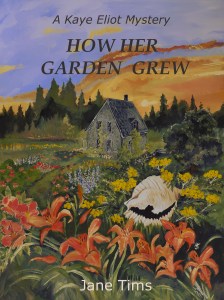
How Her Garden Grew takes place on the north shore of Nova Scotia, and explores the mystery of a sea captain who once lived in Kaye’s old home place, keeping a garden and a lost collection of seashells. Kaye and her kids try to solve the mystery, thwarted at every turn by nosy neighbours and a local gang of thieves.
https://www.amazon.ca/dp/B07RTMN6WD
~
~
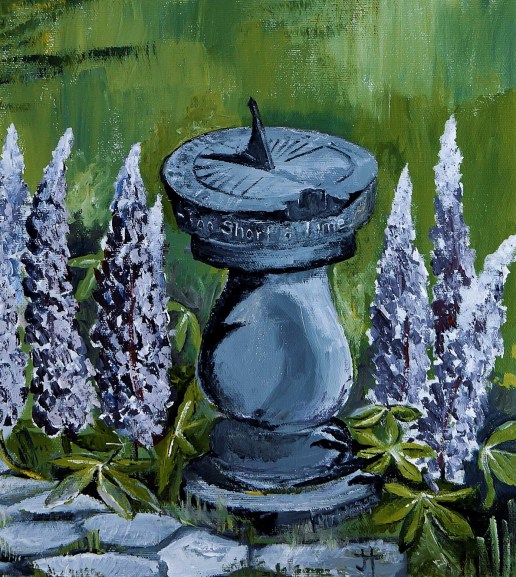
Something the Sundial Said takes place on Nova Scotia’s west coast. When Kaye’s family buys an old estate, they also gain a mystery. They find an old diary describing a century-old murder beside a missing sundial. When Kaye and her kids try to solve the mystery they encounter a local genealogist who will do anything to protect her great-uncle’s good name.
https://www.amazon.ca/dp/B085QQ3RGF
I’ll keep you up to date on the progress I make writing the new story!
~
All my best,
Jane
crystal ball
During these incredible days of isolation, our writing group has begun a series of prompts to help stimulate writing. One of our members suggested ‘weird phrases’ as the prompt category. So far we have had ‘ear hair,’ ‘under the fridge,’ ‘spider web’ and ‘crystal ball.’
~
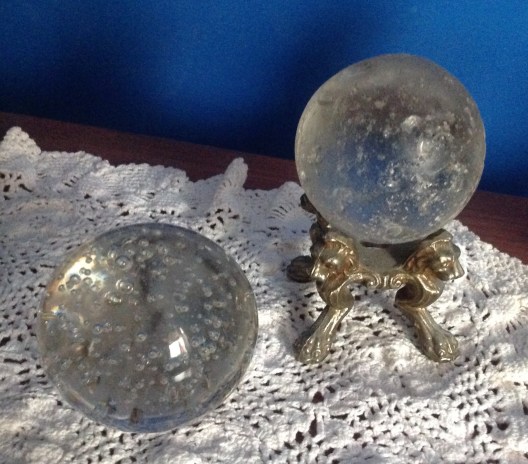
I have two ‘crystal balls,’ both small and both more properly called ‘glass spheres.’ But they are as close to a crystal ball as I will ever have. I am certain neither sees the ‘future’ but both show an interesting ‘present’ and both remind me of the ‘past.’
~

~

~
clairvoyance
~
my crystal ball
is a glass sphere
from a claw-footed
piano stool I sat on
to practice my scales
~
chipped, it never
snags the sun
will not scry or clarify
occludes
forecasting fog
~
it has a past
Chopin’s Butterfly Étude
in half-time
and a furry
Für Elise
~
but gaze
though I may
it never resonates
with a note
about tomorrow
~
although it has
guessed, after
damaging percussion,
I will never play
Carnegie Hall
~
~
All my best,
Jane





 nichepoetryandprose