snippets of landscape – ice falls on rock walls
When highways are built, they often cut through the bedrock, leaving rock walls along the margins of the road. If these intersect a brook or seep of water, the result is a waterfall on the face of the rock. In spring or summer, rains can create wild cataracts. In winter the water freezes, building frozen walls of blue-shadowed ice. In sunlight, especially when they begin to melt, these ice falls are dazzling.

~
~
one warm hand
~
icicles seep between
layers of rock frozen
curtains separate
inner room from winter storm
glass barrier between blue
light and sheltered eyes
memory of water flows
along the face of the rock
one warm hand melts ice
consolation, condensation
on the inward glass
~
~
© Jane Tims 2012

at the bird feeder #7 – Pine Siskin
After our heavy snow last week, the birds were all looking for perches and easy feeding. A few Chickadees and Pine Siskins were at the feeders early. Pine Siskins (Carduelis pinus) are fidgety little birds, staying at the feeder to get their fill, but ever vigilant and looking over their shoulders. They are heavily striped, sometimes with yellow bars on their wing feathers. They also have sharp beaks.
Because the Pine Siskins are striped, I confused them at first with female Purple Finches. The female Purple Finch is also striped, but is a slightly bigger, chunkier bird. Its beak is large and wedge-shaped, and it has no yellow coloration.
~

Pine Siskin at the feeder
~

female Purple Finch - wedge-shaped beak and stripes around eye (a male Purple Finch at left)
~
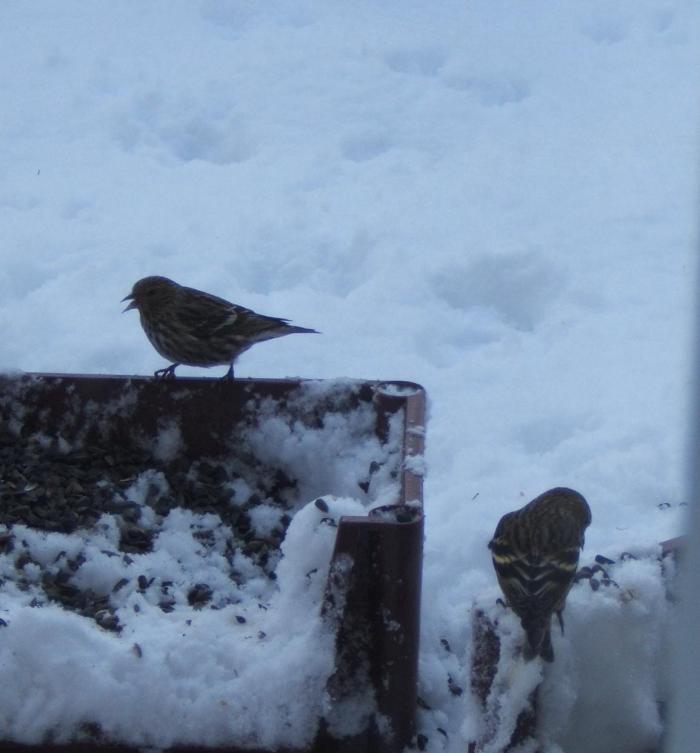
two Pine Siskins at feeder - sharp beaks and yellow wing bars

© Jane Tims 2012
snippets of landscape – the bogan
Along the St. John River are sluggish side-streams, flooded in spring to form full tributaries of the river, but isolated and stagnant in low-water conditions, sometimes completely cut off from the main river. These are known as bogans, a word of Algonquian origin. The words logan and pokelogan have a similar origin and meaning.
My favorite bogan is a strip of water next to the Trans-Canada Highway near Jemseg. The bogan creates an island, Thatch Island, in the St. John River. Old Silver Maple trees lean over the still water, creating reflections and shadows.

bogan along Thatch Island
On maps of the St. John River, a bogan on Sugar Island, just north of Fredericton, is called the Sugar Island Padou.

bogan (padou) on Sugar Island
~
~
bogan
~
appendage of river
footnote on water
predictable as the day we walked
the dead-end backroad
and retraced our steps to return
~
in spring, by canoe, at high water
or on ice skates in winter
in summer sluggish
stagnant, secluded
~
we lurk, eavesdrop on whispered
conversation
we are river folk
unwelcome
~
~
© Jane Tims 2012
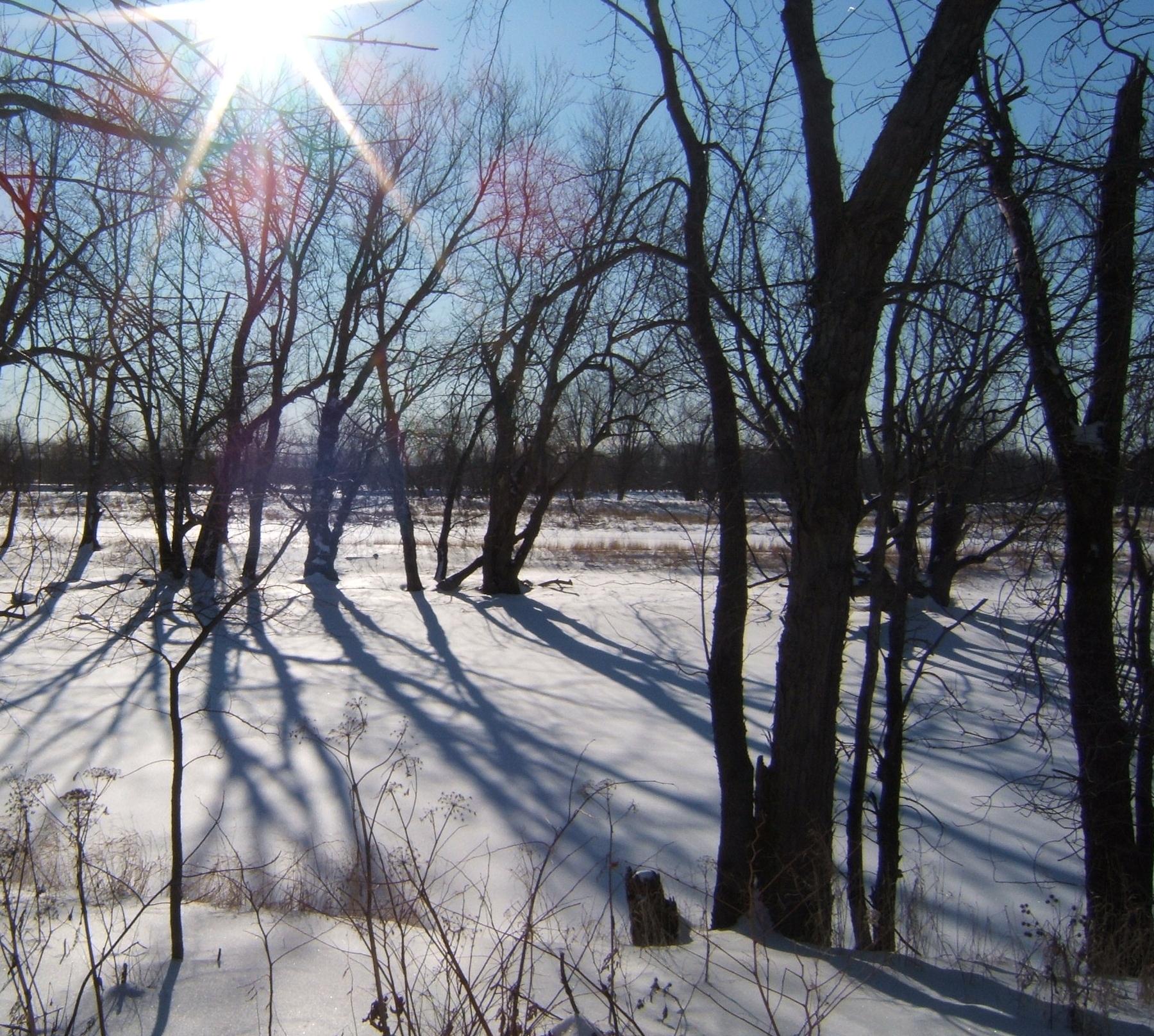
snow-bound bogan to the north of Thatch Island on the St. John River
a moment of beautiful – tracks in the snow
the space: new fallen snow
the beautiful: a Red Squirrel’s tracks
~
An expanse of new fallen snow is like an unwritten page. When you find something written there, it is a message of beauty.
In our driveway, after the last snow, a Red Squirrel was the first to write on the ‘page’. The prints were delicate, traced in blue shadows.
~

Our Red Squirrels are certainly not afraid of the snow.

digging for sunflower seeds

red squirrel with snow accumulating on his head
~
~
a love letter, unsigned
~
the meadow in winter
a sheet of paper
folded
where the stream
flows under the ice
~
the sky
an envelope
lined in blue
~
tracks on the snow
cautious
afraid
words
pressed to the page
~
erased
(erased)
by melting
or a dusting
of new snow
~
~
Published as: ‘a love letter, unsigned’, 1999, Green’s Magazine XXVII (2): 44.
Copyright Jane Tims 1999
warm room
We had another snow storm last night. In our winter climate, can anything compare with being settled in a warm room with a cup of tea, perhaps reading a good book, and listening to the storm throw handfuls of ice-pellets at the window glass?
As I write this, I know everyone is not so fortunate.

~
~
within
~
~
winter lays a cheek against the glass pecks at the window
rattles the door
~
the room is a yellow lattice on the snow a frail package
of warmth firelight a quilt the pages of a novel
kneading paws
~
field mice and ermine etch fleet trails in the thicket breathe
in the velvet space beneath the fir
~
kettle and cat are purring
~
~
© Jane Tims 2000
at the bird feeder #6 – Purple Finch
On Thursday, we had a Hairy Woodpecker and a large flock of male and female Purple Finches at the bird feeder. The Peterson Field Guide describes the Purple Finch (Carpodacus purpureus) as ‘… a Sparrow dipped in raspberry juice.’ I can’t improve on that description! The other particularly noticeable feature is its large sturdy beak. My husband took a few photos since I was not home, just enough to give me one to draw.
I miss most of the feeder birds since I leave in the early light and come home after dark. Nevertheless, the Chickadees and Goldfinches are usually there to see me off. We have one Chickadee who always has his ‘hair’ ruffed up, like a rock star with a ‘do’.

~
~
Purple Finch
(Carpodacus purpureus)
~
sunflower seed and millet
purple finch posed in the maple
sullen brow
blunt beak
metallic tick
~
he knows my eye
at the edge of the glass
my struggle for stamina
~
he is immobile as a post
a vermillion bird stuffed
with husks of sunflower seed
~
he sees me sidle to the chair
watches me settle
~
he is still
as a post card
~
seedless husks of sunflower
~
~
© Jane Tims 2012

© Jane Tims 2012
from the pages of an old diary – illness in the community
In her diaries, my great-aunt wrote about her own health, as well as the health of others. She was a nurse, trained at McLean Hospital in Boston, so her interest in health is not surprising. Her diary entries are filled with her visits to the sick. She often brought either ginger ale or ice cream with her when she visited, and these must have soothed many a sore throat and helped to get needed fluids into the ill person.
In May of 1955, a flu went through the community. Through the diary entries, you can follow as different people become ill. On May 6, 1955, my great-aunt came down with the flu, probably contracted as she visted the sick. She was in bed for eleven days. In those days, the doctor made house calls and he came twice to see her.
~
~
flu in the community – 1955
-response to a diary entry for May 16, 1955 and entries for the previous two weeks
~
Mon cloudy cold. Katie M.
came in P.M. brought ice-cream [and] gin [ginger] ale.
I am feeling better. I cleaned up-stairs
some. R.C. called too at noon.
– A.M.W.
~
1.
Sunday
visited Jesse
Tuesday
took Madge ginger ale
Wednesday
took Mrs. B. ice-cream
combed her hair, made her bed
~
should stay away
but ginger is good for what ails you
and ice-cream soothes the throat
~
I’m a trained nurse
it’s expected
~
2.
Saturday
chills, fever 103
Doctor saw me twice
~
3.
nine days, in bed
I hear comings and goings downstairs
most won’t come up, or stay
afraid of flu
~
4.
Monday
better today, out of bed
puttered around upstairs
Katie came
brought me ice-cream and ginger ale
a little gossip
~
remedies for the flu
~
~
© Jane Tims 2012

from the pages of an old diary – holidays
Among the events recorded in my great-aunt’s diaries were holidays.
Here are some of the activities she recorded for those special days in 1957:
New Year’s Day (Jan. 1, 1957) – they had her brother’s family to dinner.
Valentine’s Day (Feb. 14, 1957) – she sent her grand-daughter in Saint John a Valentine.
Easter (April 21, 1957) – they went to the Presbyterian Church in New Glasgow to see the ‘3000 Easter lilies’ on display. She also sent a box of gifts to her grand-daughter.
Canada Day (called Dominion Day before 1982) July 1, 1957 – not mentioned in her diaries.
Halloween (Oct. 31, 1957) – ‘seven children for Halloween’ Interesting … our modern conversations about Halloween are often to compare the numbers of children who came trick-or-treating!
Thanksgiving – the day before, she ‘did some cooking for Thanksgiving’ (Oct. 12, 1957) and on Sunday, she had her sister (my grandmother) and my uncle for a chicken dinner.
Christmas – my great-aunt belonged to an ‘Xmas Club’. They had their Christmas Dinner together (Dec. 2 , 1957) and exchanged gifts. My great-aunt’s gifts in 1957 were a pair of pillow cases and a pair of gloves.
Part of Christmas meant sending parcels to family and friends. In 1957, my great-aunt mailed Christmas parcels to her son’s family in Saint John on December 14, 1957 and to others on December 11 and 16.
On Christmas Day, they went to her brother’s house for Christmas Dinner.
On December 29, 1957, they went to see the Christmas pageant. There were also other community events, since on December 24, 1954, they went to see the community Christmas tree.
She makes no mention of Christmas decorations in her own home, but I still have a few of the ornaments from her tree.
~
~
New Year’s Day 1957
-response to a diary entry for January 1, 1957
~
Tues nice day, quite cold. C.
D. D. also K. J. here to
N. Years dinner. had a chicken sponge
cake for dessert. strawberry vanilla ice cream
we went for a drive after C.s left.
– A.M.W.
~
new year, basket in the hall closet
empty, mending and darning
done, seven to dinner, everyone
satisfied, sponge cake and ice-cream
~
no worries about tomorrow, predicted
storms, the need to stay well,
catches in clothing and worn
heels, arm sore from beating eggs
~
my New Year’s resolutions:
a beater that runs on electricity
no more blue socks darned with red
the chicken was tasty
colourful with carrots
~
~
© Jane Tims 2012
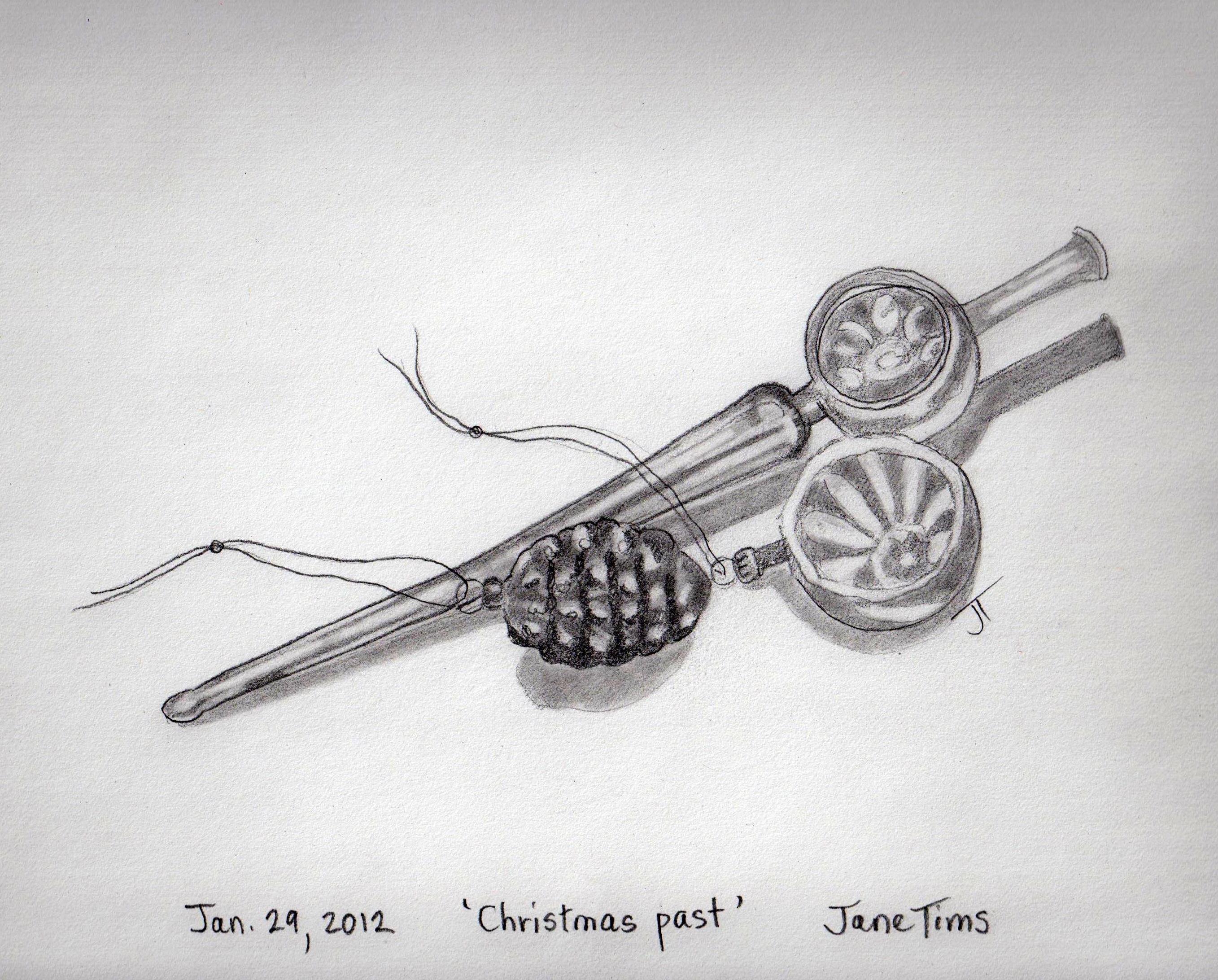
a moment of beautiful – trees and shadows
space: edge of the St. John River in winter
beautiful: mature silver maple trees and their shadows on the snow
~
We went for a drive last weekend, along the St. John River. Above the ice, the river is covered in snow, a broad white plain edged by very old and very rugged silver maple trees.
In spite of a harsh environment, these trees endure. Each spring and fall, they are flooded. They are scoured by ice and subject to the eroding forces of the river. They are always at risk from people searching for a supply of firewood. A friend tells me these huge trees are usually suckers, grown from the base after the original tree was harvested.
And yet they grow old, a part of the hardwood floodplain forest. On a sunny day, they lean over the snow-covered river and spread their shadows across its surface. They have the beauty of their symmetry, solidity, grace, and fortitude.
~
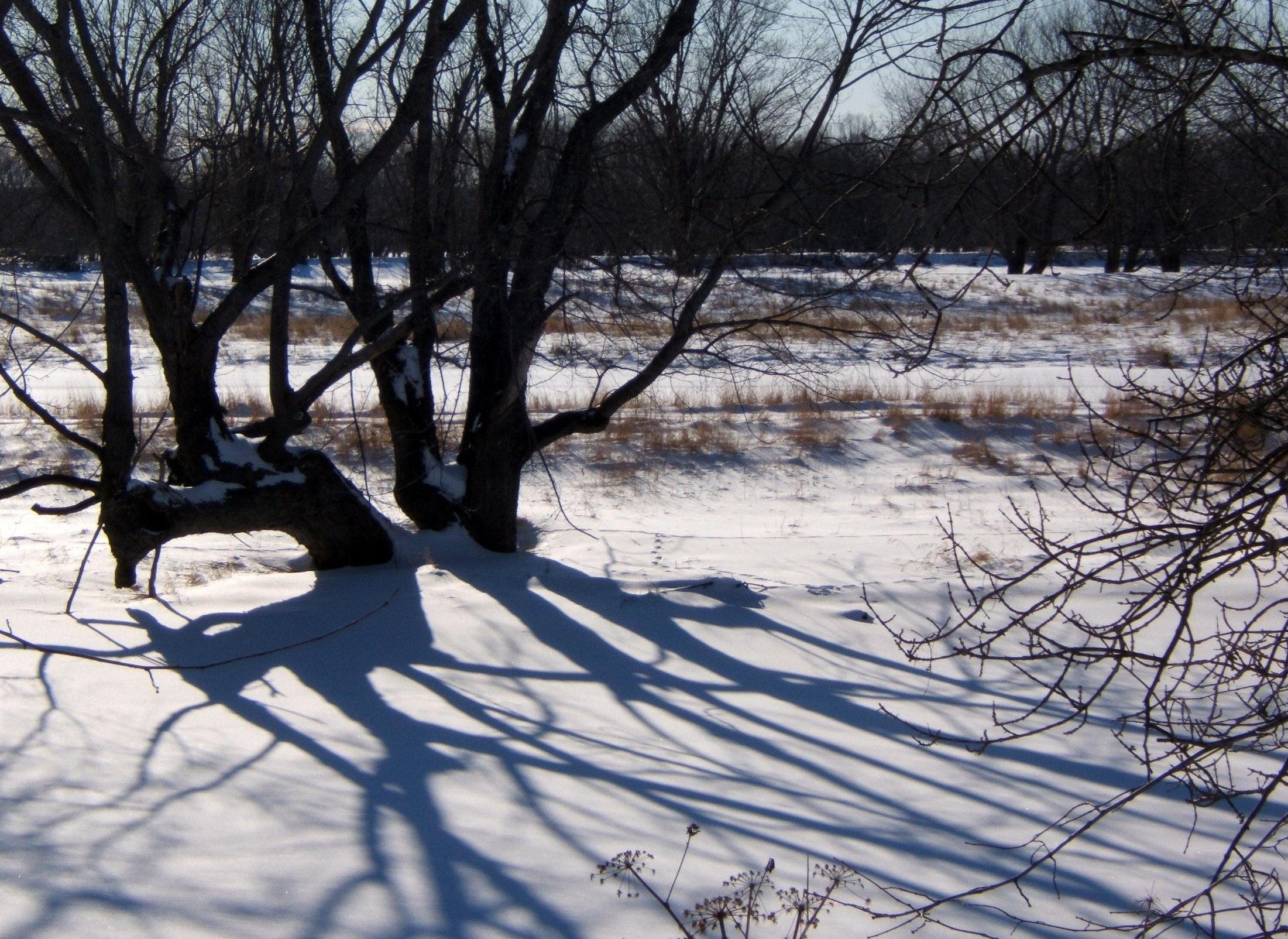

the line of animal tracks crossing the snow are probably from a Red Fox
Copyright Jane Tims 2012
from the pages of an old diary – making a quilt
My great-aunt’s diary often records her activities as part of her Red Cross group. In the years from 1954 to 1957, and beyond, this group of 4 to 9 women met every Friday to work together on a community project. They worked quickly. On September 17, 1957 they put on two crib quilts and finished them by October 1, 1957 (three meetings).
Sometimes they worked on a layette for a new mother and her baby (February 8, 1957). Most often, they worked on a quilt (for example, March 22, 1957), doing the piecing and quilting as a group. In addition, my great-aunt often took a quilt home ‘to bind’ (for example, March 29, 1957).
Sometimes the group made money for a local cause by selling quilt ‘squares’. On April 12, 1957, my great-aunt wrote: ‘…we took a quilt out. we are going to make one to sell. money for hosp [hospital]. to work on its 10¢ a name.’ The next evening, she called at a neighbour’s house and sold 5 squares. On May 3, 1957, she wrote, ‘…we worked on our quilt blocks – working the names. I took three blocks home.’
More often they made a quilt for someone in the community. On February 8, 1957, she wrote, ‘I took a quilt up to Mrs. C. from R. Cross.’
In 1954, the group worked on a ‘flower garden quilt’, and the story of the quilt can be followed in the diary.
The first step was to piece the quilt. My great-aunt worked on this stage at home, from March 15, 1954 to March 23, 1954, sometimes with a friend. On March 19, she even missed the Red Cross meeting to work on the quilt. On March 23, she wrote, ‘I worked on R.C. flower garden quilt all day. J.B. here in eve. we finished it. ready to be quilted. very pretty quilt…’

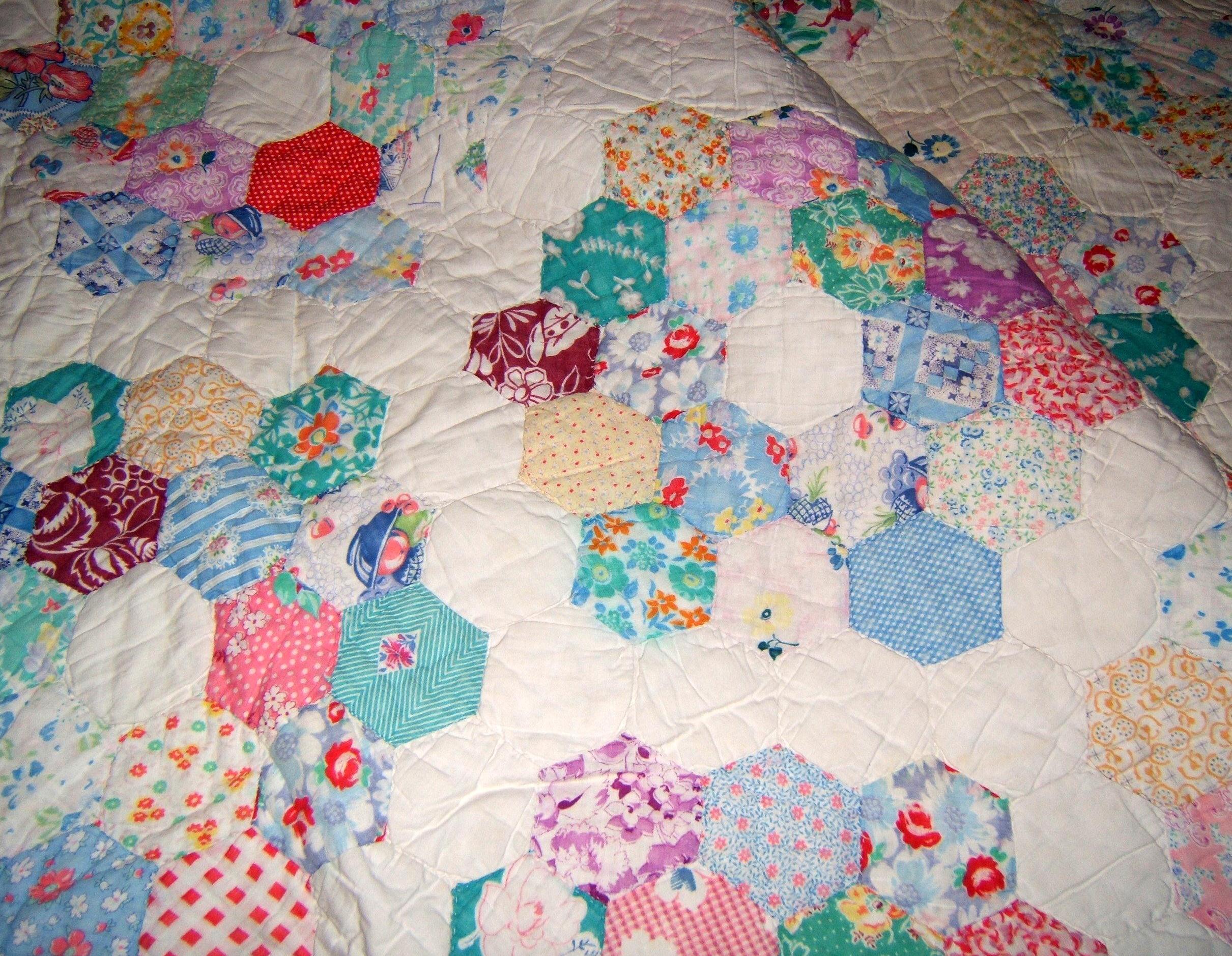
'flower garden quilt' made by my grandmother, my great-aunt's sister
The group began quilting the flower garden quilt on June 4, and finished it at a meeting three weeks later (June 25, 1954). My great-aunt brought the quilted quilt home to bind and had help with the binding from another woman (June 28, 1954). On July 12, 1954, she wrote, ‘J. [and] M.D. called to see the flower garden quilt.’ Unfortunately, there is no record of who received the finished quilt.
The ‘flower garden’ is a well-known heritage quilt pattern. It is made up of many hexagonal pieces, laid out in a pattern of concentric circles. I have two quilts made by my grandmother (my great-aunt’s sister) and one of these is a flower garden quilt. The quilt is well-named since the final pattern resembles a garden full of bright and colourful flowers. The individual pieces in my grandmother’s quilt are from diverse fabrics, likely recycled from remnants and old clothes.
In 1957, the women made another flower garden quilt. My great-aunt must have loved working on it, since on March 27, she records going down to the Red Cross rooms after a funeral and working on the quilt by herself. On March 29, 1957, she wrote, ‘…I went to R.C. brought home the hosp. [hospital] flower garden quilt to bind.’ She finished the binding on April 3.
Women still make quilts today, of course, either alone or as a group. I have made lots of lap-sized quilts, best for me due to my short interest span!
Have you ever made a quilt and did you work alone or with others?
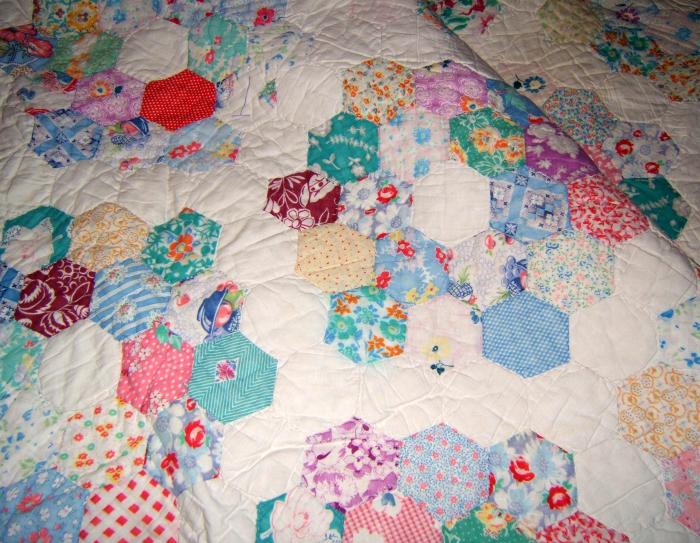
- my grandmother’s flower garden quilt – I love the variety of fabrics used
© Jane Tims 2012