apple picking time
October has taken hold and now signs of autumn are everywhere. Color seems to be the theme… the orange of pumpkins and gourds, the yellows and reds of the maple leaves, and the red of ripe apples.
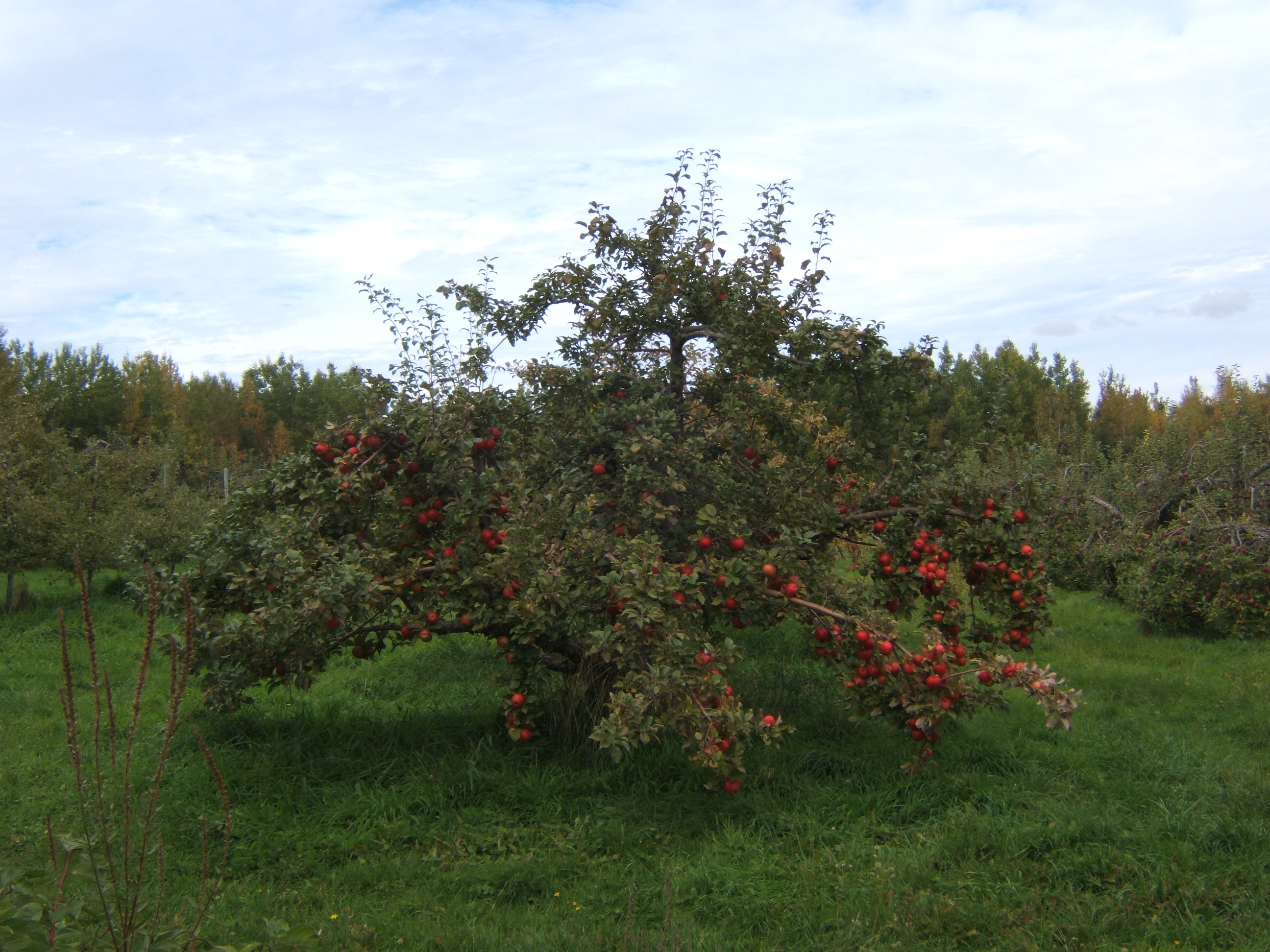
On our way to the lake, we drive past orchards of apples. Most of the apples have been picked, but some trees are still laden with fruit. For me, the orchards are full of memories, of picking apples with my family when we were younger. I remember how much fun we had, my son and niece and nephew excited to be able to run free and pick the apples, and the adults thinking about the apple pie possibilities from those loaded trees.
~
~
orchard outing
~
wooden bushel baskets
of laughter, the delirious tumble
down the avenue of trees, shadows ripple
among the dapples, Cortlands tied
with scarlet ribbons and boughs burdened
to reach for us, my son grown tall
on his father’s shoulders,
stretches to pick the McIntosh
with the reddest shine,
small hand barely able
to grip the apple
~
~
Copyright Jane Tims 2012
Happy Thanksgiving!!!!

This Thanksgiving, I am grateful for:
water, clear fresh water (we just got our well back after 7 days!)…

my family and the chance to share Thanksgiving dinner with at least some of them…

the glow surrounding our house this time of year (from all the maple leaves, changing color)…
the wind that blows on the hills above the lake…

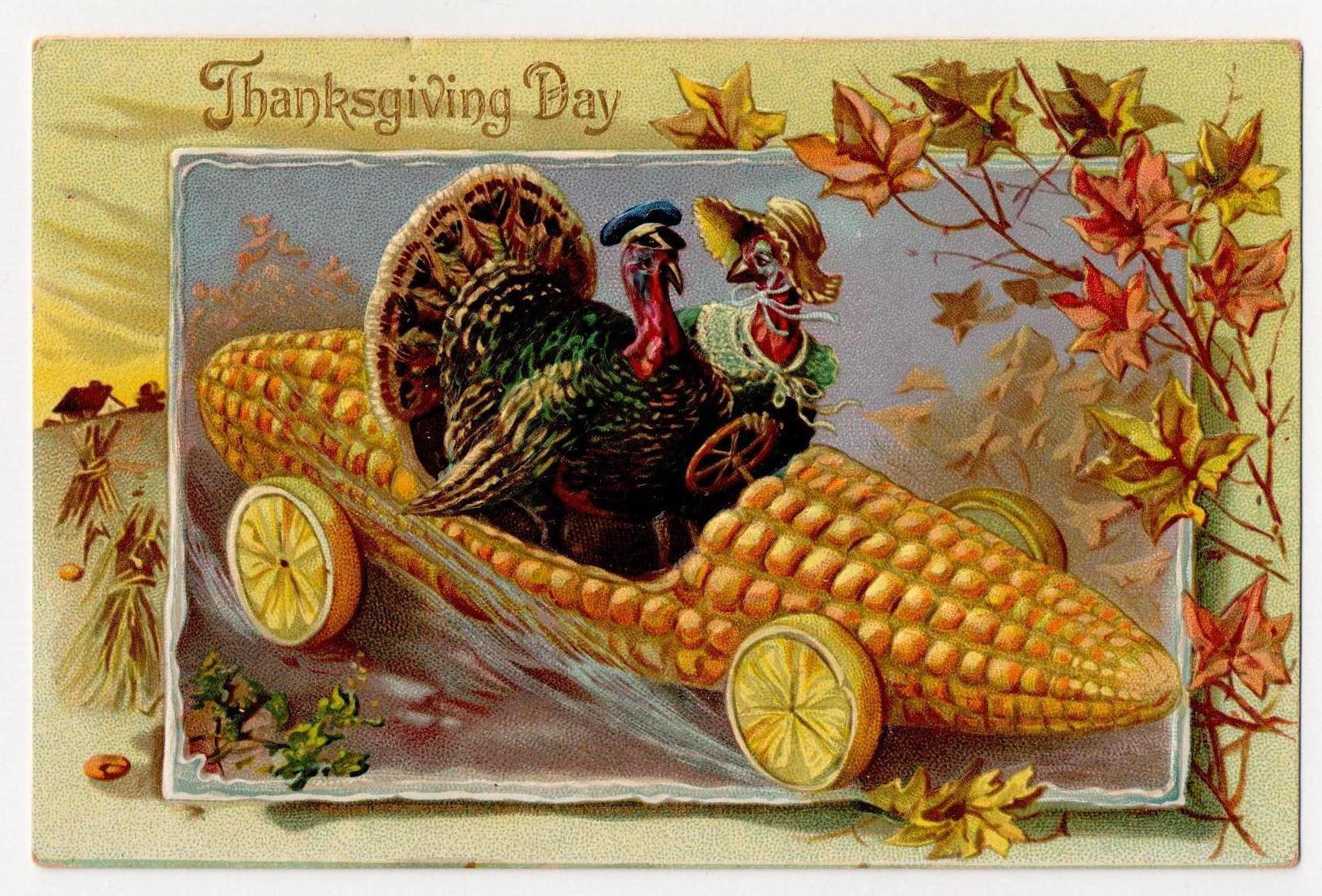
and my collection of Thanksgiving post cards….

Happy Thanksgiving Day to everyone!!!
Copyright Jane Tims 2012
a pair of eagles
When we spend time at our lake property, we often see Bald Eagles. They nest in the large White Pines along the edge of the lake and I sometimes find their feathers near our arbour, suggesting they visit our place when we are not at home.
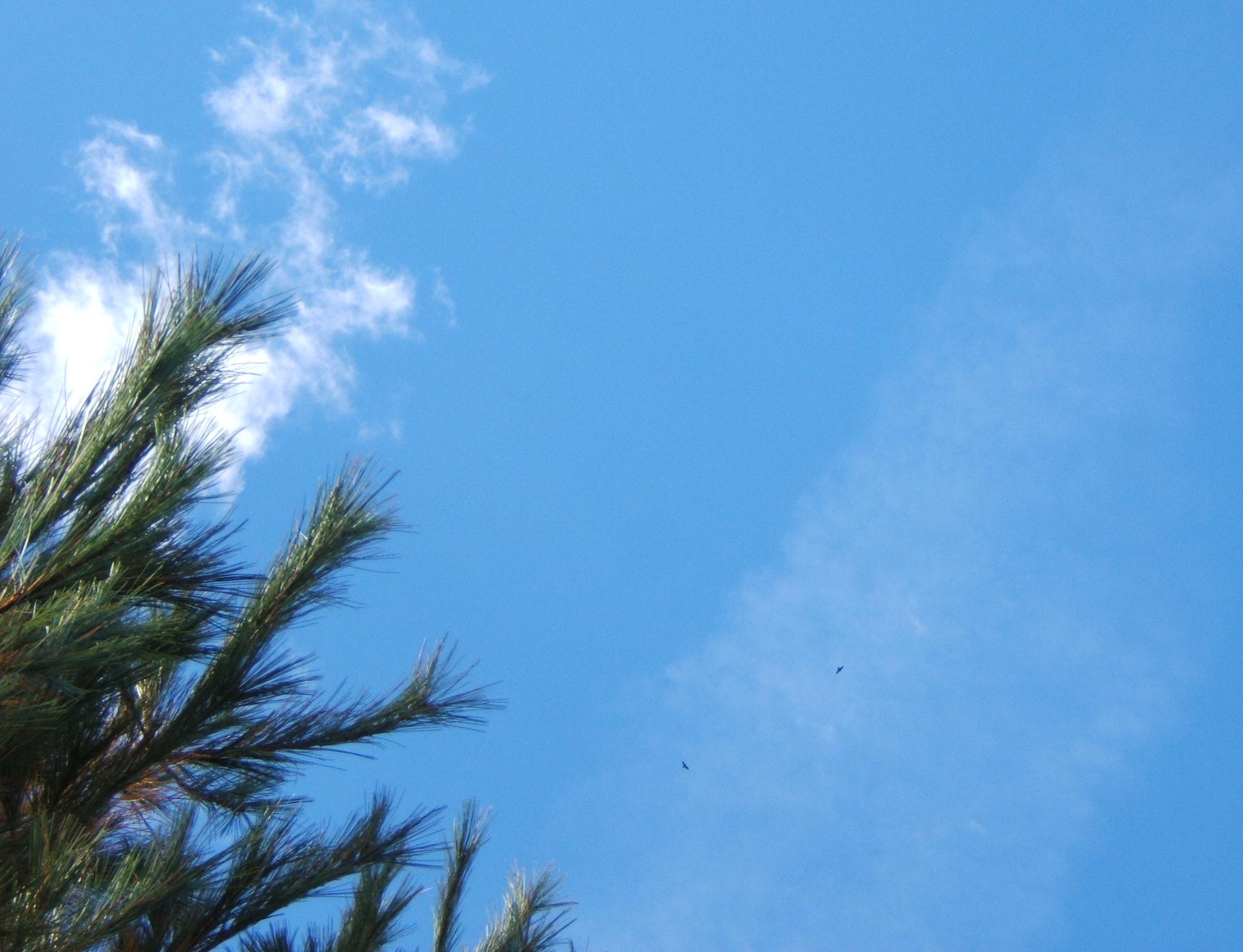
Today we watched a pair of them circle high in the sky, soaring effortlessly on the updrafts. They flew in sync with one another, so coordinated in their movements, they could have been dancing.
~
~
fragments about wind
~
the trees move as though branches flow from a bottle
~
this morning I found
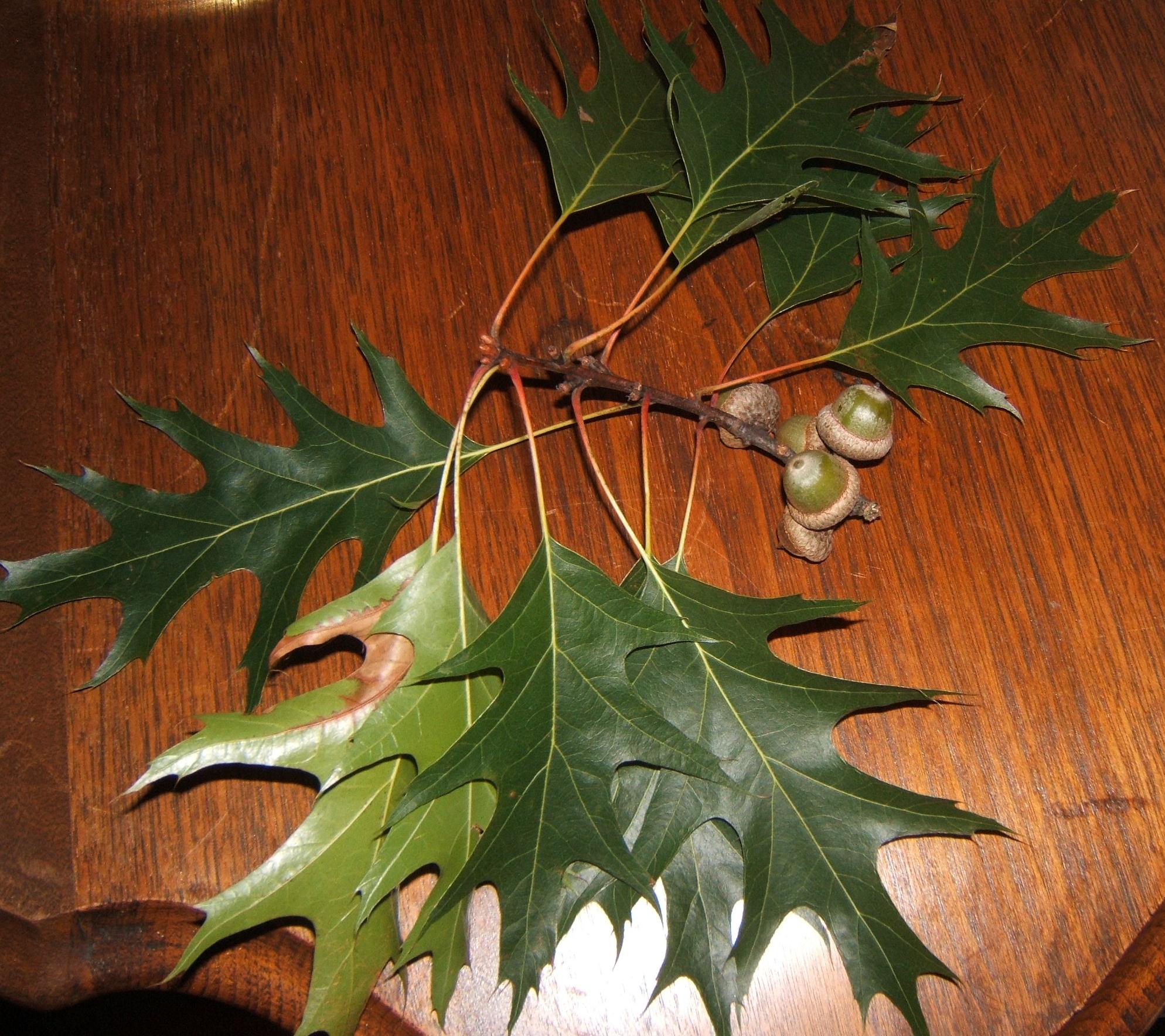
oak leaves on the sidewalk
and a young acorn with the nut missing
~
a pair of eagles soars
wings lifted on
scant molecules of air
~
~
Copyright Jane Tims 2012
water, water
In the middle of the night, five days ago, I woke to the sound of our water pump laboring. The pump never comes on if no one is using the water, so I guessed something could be wrong. I counted the seconds and after a count of sixty, I knew we had trouble. The pump usually shuts off after about a minute. While I ran off a bit of water, my husband went down and shut off the pump. Our little saga of renewed water appreciation had begun!
We are on a private well, and so we tend to take our water for granted. It has a delicious earthy taste, and our well supplies water at a rate of about 20 gallons per minute, so we never have quantity problems. I am always grateful for our well water when I taste the chlorinated city water, which I have never been able to get used to. For 20 years, our jet pump has done its work faithfully, so we are never without good, clean water, except during the occasional power outage. Just in case, I always keep about 40 liters of water available in jugs, as a supply for these situations (the Emergency Measures Organisation suggests an emergency supply of at least 2 liters of water per person per day for the first 72 hours).
The next morning, we called the plumbing company and they came right away, replacing our old pump. But after using all my emergency supply of water to try to prime the new pump, it became obvious that we have a clogged foot-valve… the pump would not prime.
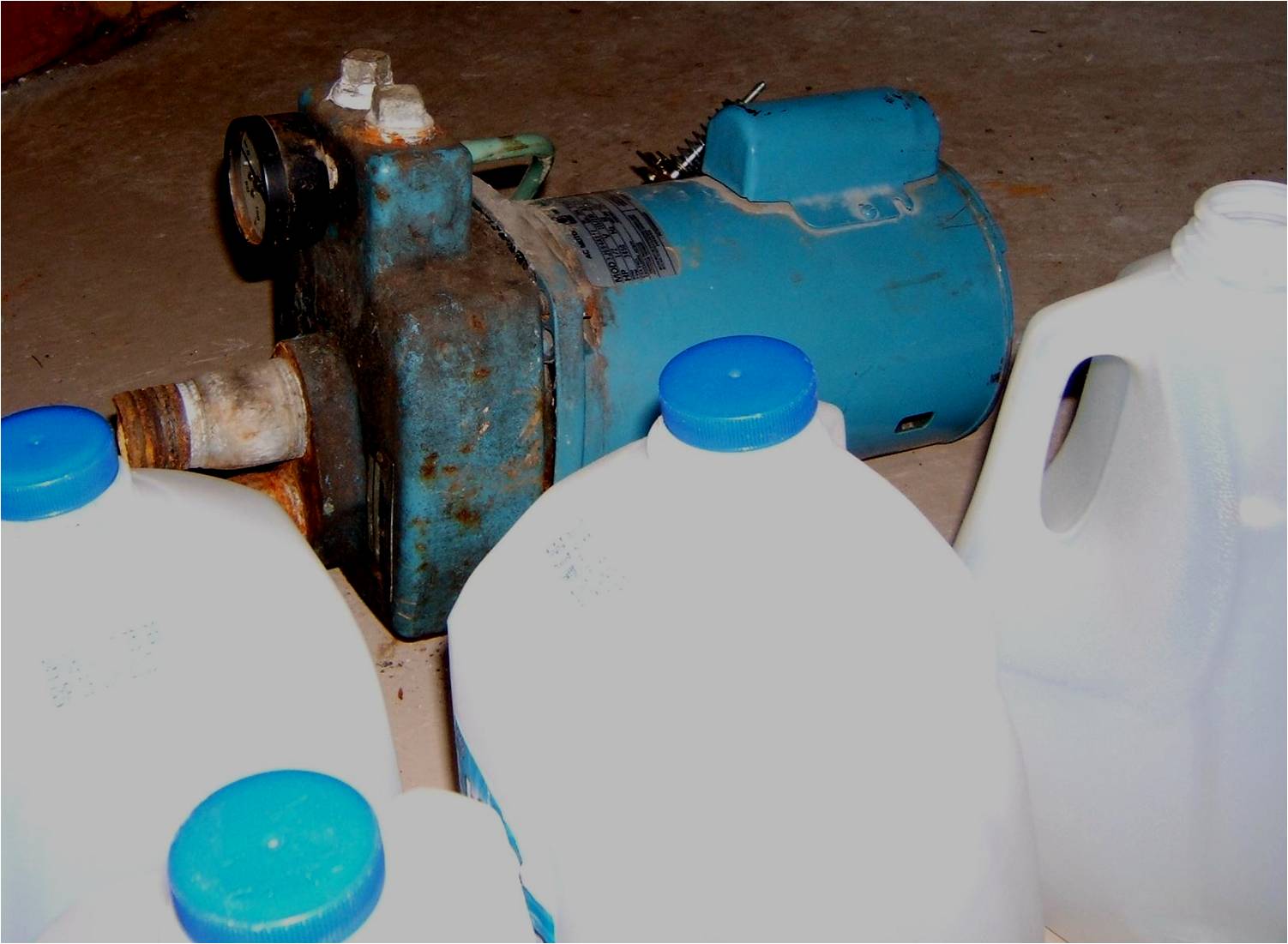
We now have to wait until Friday for another service to come, pull up the well pipe and replace the foot-valve. In the meanwhile, we are getting a lesson in water use and conservation.
Our main uses of water are for drinking and cooking, washing ourselves, rinsing vegetables, cleaning our dishes, and flushing toilets. Fortunately, I had a done a big laundry after returning from our recent vacation, so laundry will not be a problem for a while.
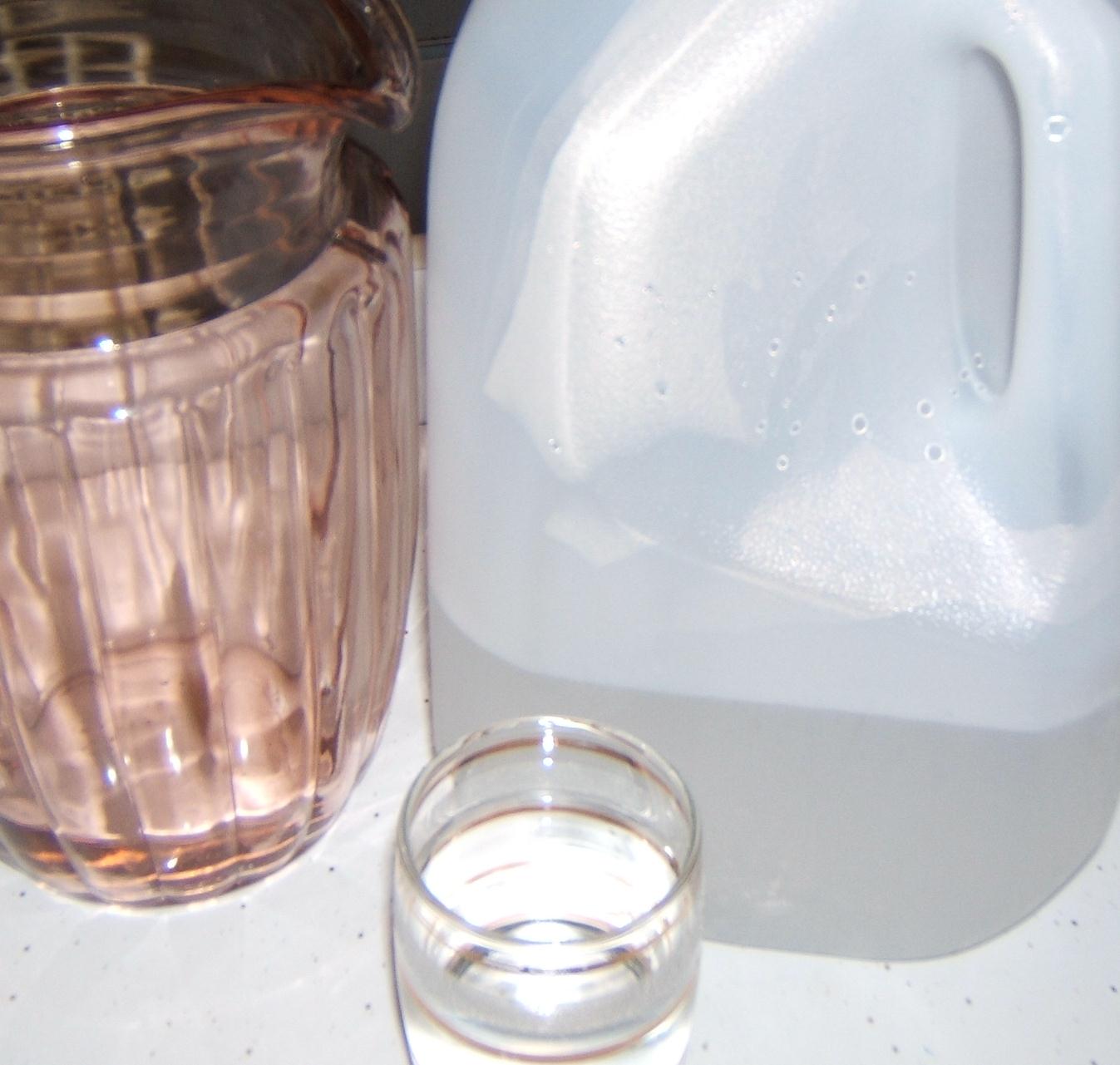
Meanwhile, we have adopted a hierarchy for water use, saving the remnants of each use … the grey water from bathing and doing dishes gets reused for toilets.
It also rained for the first two days of our water shortage, so I collected enough water to keep ahead of our bathroom needs for the first couple of days.
Our other source of water for the bathrooms is our dehumidifier. It puts out about a half-bucket of water a day. In ordinary times, this water goes down the drain without a thought, but now it is an important source for flushing the toilet.
For our other uses, we are lucky to be able to buy water from the grocery shelves. I can’t remember when water became a commodity, but I know my parents bought water occasionally in the 1980s.
Of course, we can also get our water from relatives and neighbors, or drive to a nearby lake, but our ‘crisis’ should be over by Friday.
This experience has been a good reminder for me, not to take water for granted. I used to repeat this message when I worked in the field of water conservation during my years with government. How easily I have forgotten my own advice!!!

Copyright Jane Tims 2012
a moment of beautiful – sunset over the St. John River
the space: the St. John River at dusk
the beautiful: sunset over the river
Last evening as we drove home after a visit to my sister’s home, orange was on my mind. I was thinking of the bright orange pumpkins in the gardens, the orange of Japanese Lanterns, the orange of the turning leaves, and the orange of the running lights on the trucks on the highway. Then, as the sun went down, we were treated to the most beautiful orange, the color of the sunset over the St. John River.

A lovely introduction to the month of October……………..

~
~
hauling sun
~
eighteen-wheeled tractor pulls,
hauls the loaded b-train
~
gears down for the grade, snags
light from the sunset, wanes
~
and leaks from the headlamps
pushed forward into night
~
ahead, on the dark road,
a cone of borrowed light
~
~
Copyright Jane Tims 2012
two last pages to write
Once the poems are written, and the footnotes are proofread, and the poems are snug in their sections, there are still two pages to write.
The first is the Acknowledgements page. I have so many people to thank. They include all the people who have helped me along the way. These will include the members of my two writing groups, who listened to me read from my work, month after month, and who offered lots of comments and suggestions. I will also thank my writing coaches who have given me specific criticism on particular poems and have improved my writing immensely with their mentoring. I will also thank the readers of my Blog, you, who have read my writing, given me huge encouragement and a way to work through my ideas. I will also be thanking the members of my family, particularly my son… they have listened to my poems and read them and suffered through the long story of my project from beginning to end. And, of course, I have to extend a huge thank you to the New Brunswick Arts Board, artsnb, for the Creations Grant that supported me during the project.
The second page to write is the Dedication. There is no contest for this one. This manuscript will be dedicated to my husband. In spite of self-proclaimed disinterest in the world of the arts, he has listened to every poem, often in multiple versions, helped me find words when they eluded me, and suffered my elation, moping and bad moods. He has also driven me all over the country-side to find edible plants, sat through an orchid identification course, and mingled with the botanists on a couple of field excursions. He has been there in the audience at public poetry readings and never complained about the hours I spend at courses and meetings and writing workshops. He flatly refused to eat any of my gatherings and concoctions, but I believe this was so he could call the paramedics if any of my plant identifications ever proved incorrect!
For his endless love and support, this manuscript is dedicated to my husband.

Copyright Jane Tims 2012
transitions
Now, as I am finishing my manuscript of poetry on local foods, I am aware of the change this means for me. I know there will be a new project but I am not yet certain what it will be. I have many things to choose from… perhaps I’ll begin a new series of poems… perhaps I’ll write some non-fiction on an environmental theme… perhaps I’ll finish some of the paintings I have begun.
Although I like best to write, I find creative activities substitute for one another. For example, when I am not writing for an extended period of time, I am often embedded in some other creative work such as painting or sewing. Now, as I finish my manuscript, I have begun to weave on my loom. It gives me thinking time as I approach the end of my writing project, to work through the final steps in my mind. It also creates some certainty for me and provides a transition to my next project.
To me, weaving exemplifies the lure of creative endeavor. The producing requires knowledge and skill, and builds confidence. The process is relaxing and time is made available for thought and concentration. The threads and fabrics are luxurious to touch and the colors are bright and joyful. When I am finished a project, I am so proud of the resulting textile, I want to show the world.

My loom is a simple floor loom, 24 inches wide. I bought it at a country auction, about 15 years ago. My sister and I were among the stragglers at the auction, trying to outlast a heavy rain. In the corner, we saw a bundle of varnished wood and some metal parts. “I think that’s a loom,” whispered my savvy sister. When the item came up for bid, there were few left in the audience, and no one knew just what ‘it’ was. I can’t remember what I paid for it, but I know it was a bargain.
My loom and I have not been steady company. It takes forever to install the warp (I began to install my current warp in May!), and weaving is hard on my back. But the fabrics we have made together, my loom and I, are beautiful and comfortable and good for the soul.

~
~
yellow line
~
the road is fabric
weave of asphalt
ditch and yellow line
warp of guard rail
fence and heddle
~
trees in plantations
lines on the hayfield
hip and curve of the earth
weft as she turns in her sleep
~
shuttle, piloted
through landscape
and watershed
textile in folds
texture the yearn of the loom
~
faults in the granite
potholes in pavement
rifts in the fabric
where weavers might falter
revisit the work
of earlier times
~
learn the lessons
taught by the loom –
choose the weft wisely
balance the color, the texture
maintain the tension
fix mistakes as you go
~
when your back hurts,
rest
~
listen to the whisper
of weave
of yellow line
~
~
Copyright Jane Tims 2012

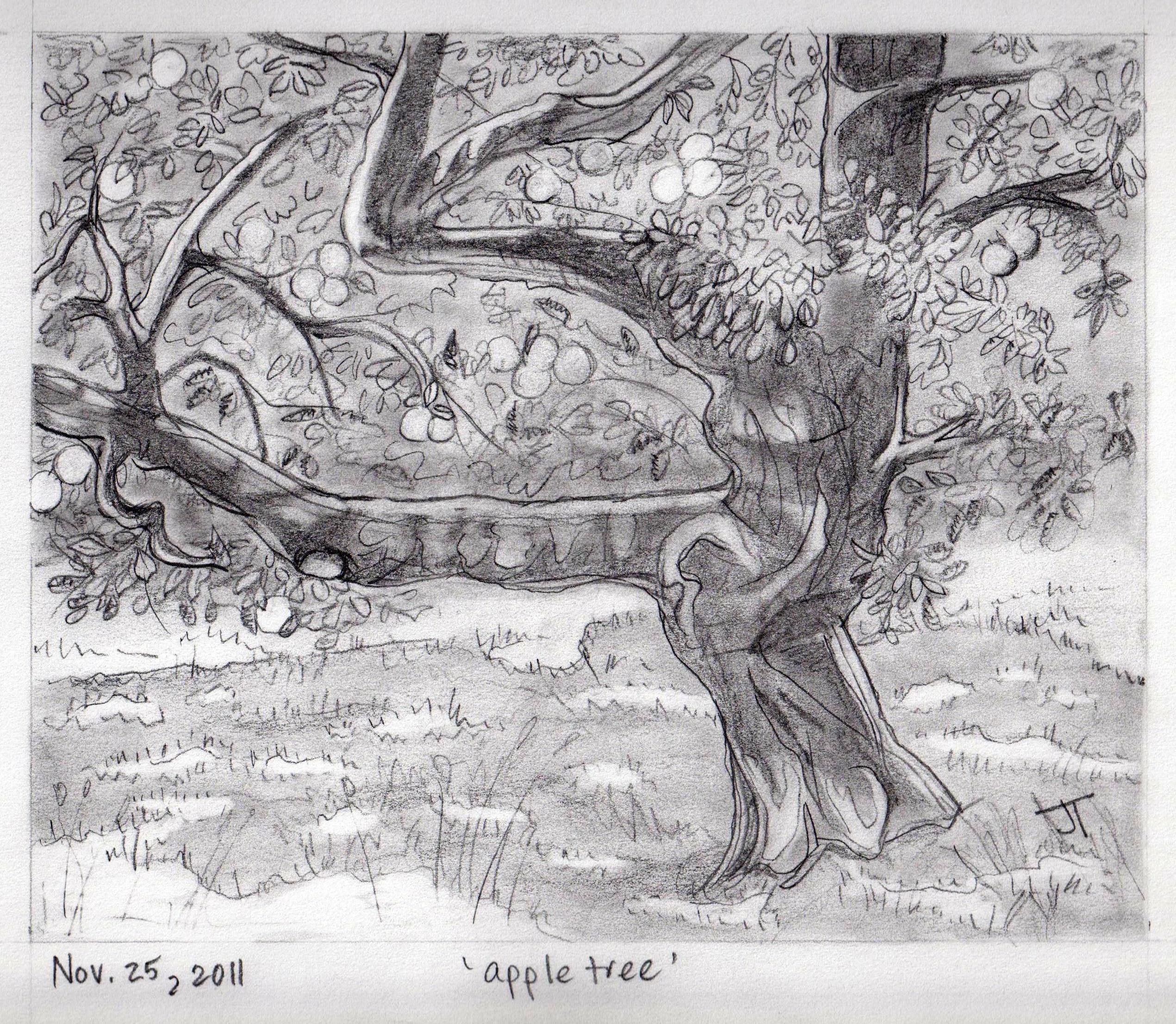
apple tree shadow
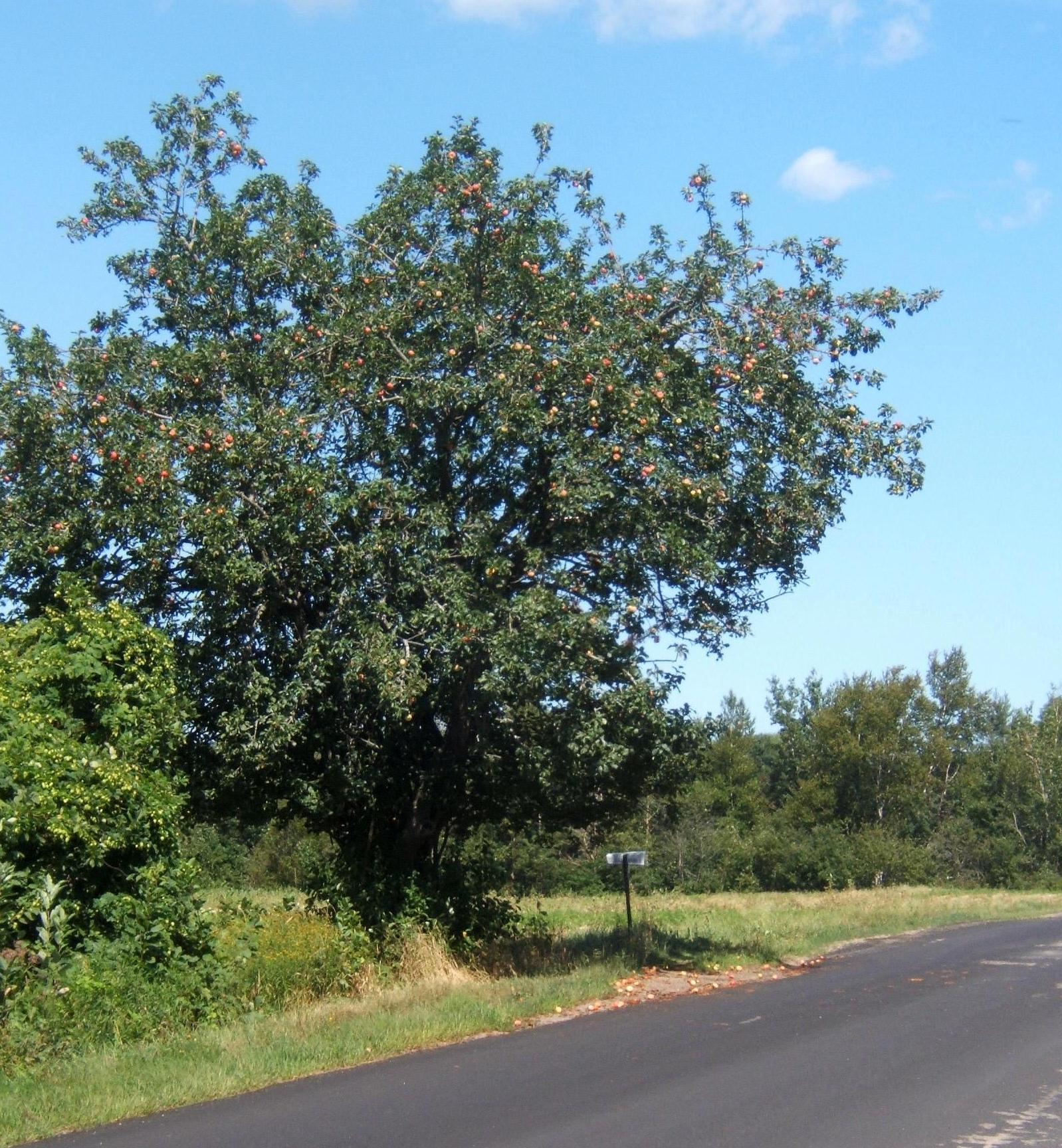
This time of year, I watch for the old apple trees along the road. Most are neglected, and the fruit remains unpicked, even for cider. When the apples fall, they lie beneath the tree in a circle of red or yellow, mimicking the shadow of the tree at noon.
~
~
apple shadow
~
days follow days
and the apples
fall to the ditch,
claim the gravel
edge the asphalt
~
ripe shadow space
at the base of
the leaning tree
~
passing cars play
polo and wasps
worry in the
rotting remains
~
~
Copyright Jane Tims 2012
a walk through the covered bridge – disappearing covered bridges
Last week we took a drive to re-visit some of the covered bridges we saw in 1992 as part of a special project to celebrate Canada’s 125th birthday. One of these was the Stone Ridge Covered Bridge (formally known as Keswick River #6), crossing the Keswick River at Upper Stone Ridge in York County. I was looking forward to seeing the bridge because we had recorded some interesting carvings in 1992. Among the usual initials, someone had craved the images of three houses, one with steps and two chimneys, and one, a cottage, on the sill of the bridge window.
A short drive on a pretty country road along the Keswick River brought us to the bridge… a metal Bailey bridge, constructed to cross the river at the point where the covered bridge had once stood. The new bridge was sturdy and had its own charm, but it was so disappointing to know the old covered bridge was gone forever. The Stone Ridge Covered Bridge was lost to fire on October 10, 2008.
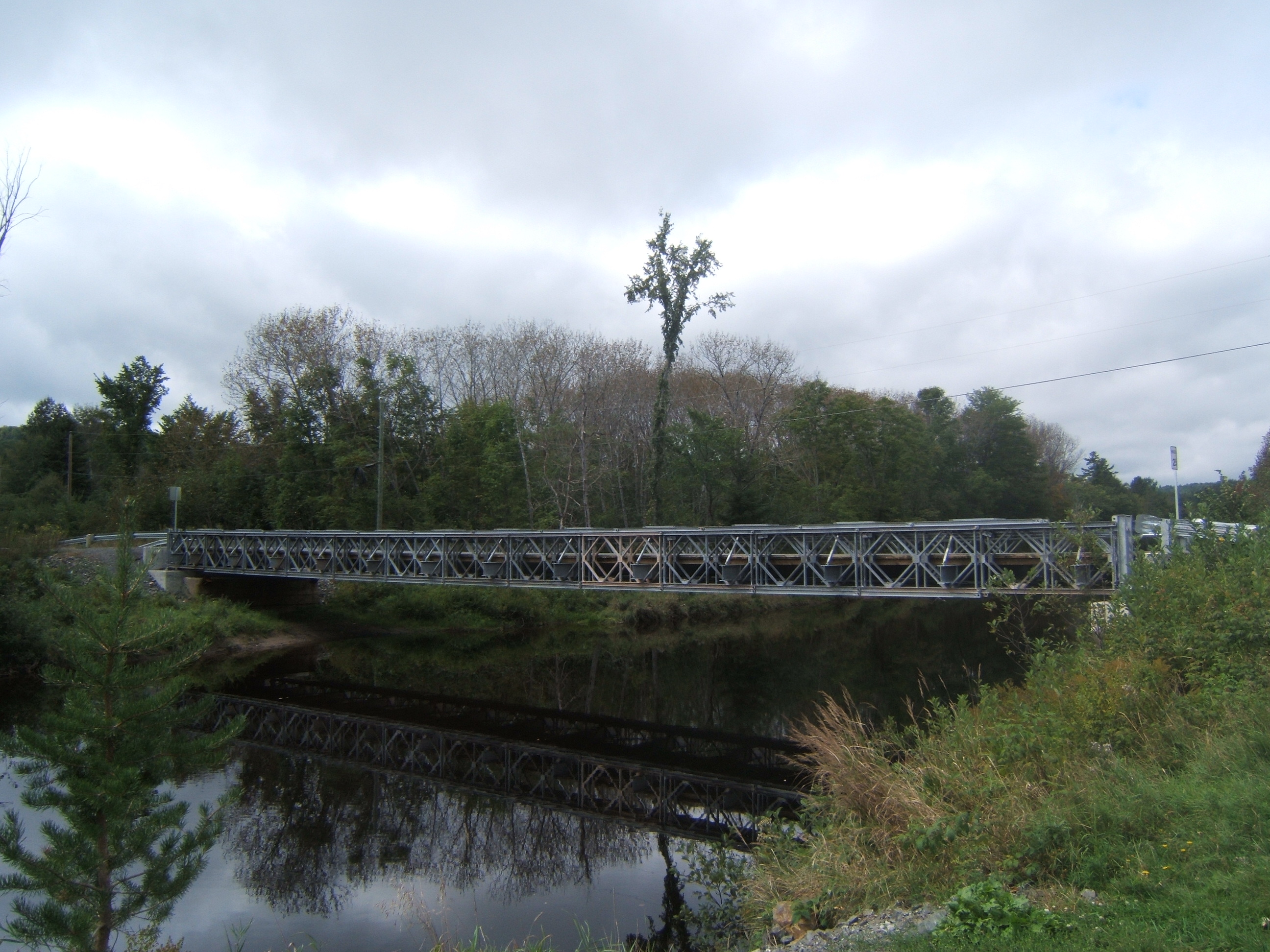
The Stone Ridge Covered Bridge was built in 1914 and had a span of 123′ 4″ and a total length of 126′ 4″. It had a roadway width of 14′ 10″ and a capacity of 10 T.
I wrote in our journal, on May 1, 1992: “most carvings were on the flat of the horizontal plate that formed the window sill and ran the length of the bridge”.’ I also wrote: “lots of hacking and hewing done on the window part of the sill”. The oldest date we recorded was ‘May 9, 1951 VHA’.
Some of the other carvings on the bridge in 1992 were: ‘LA + LB’, ‘WLR 54’, ‘VHA MARCH 7, 1952’, ‘1951 [or 1957] MAY 7 WLB [and a small heart]’, ‘KM 1952’, ‘KMB 9/55’, and ‘BB 1951’. There was also a separate carving of an upward arrow beside a ‘B’ and on the next line, ‘KM A4 54’.
I wonder who was VHA and how often did he or she return to the bridge over the years? Who was KM in 1952, and did she return, married, in 1955 with her new last name beginning with ‘B’? Was she married on April 4, 1954 to ‘B’? A mystery, perhaps solvable by looking into some local marriage records?!
It is sad to see the covered bridges in New Brunswick disappear, one at a time. Some are lost due to the dramatic power of the spring freshet. Others are lost to vandalism (fire) – every Hallowe’en residents keep a careful watch on the covered bridge in our community. In 1992 when we did the covered bridge project, our list had 71 covered bridges. The New Brunswick Department of Transportation website http://www.gnb.ca/0113/coveredbridges/coveredbridges-e.asp says there are presently 61 covered bridges in New Brunswick.
~
Copyright Jane Tims 2012
Highbush Cranberry (Viburnum trilobum Marsh.)
Like miniature fireworks, bright bunches of the berries of Highbush Cranberry (Viburnum trilobum Marsh.) burst along our roadsides in late summer. Highbush Cranberry is also called Cranberry, Pimbina, and in Quebec, quatres-saisons des bois.
The Highbush Cranberry is a large deciduous shrub, found in cool woods, thickets, shores and slopes. It has grey bark and dense reddish-brown twigs. The large lobed leaves are very similar to red maple.

In spring and summer, the white flowers bloom in a cyme or corymb (a flat-topped or convex open flower-cluster). Most flowers in the cluster are small, but the outermost flowers are large and showy, making the plant attractive for insect pollinators.
The fruit is a drupe, ellipsoid and brightly colored red or orange. The juicy, acidic fruit has a very similar flavour to cranberry (Vaccinium spp. L.) and is used for jams and jellies. The preserves are rich in Vitamin C.

~
~
fireworks, quatres-saisons
(Viburnum trilobum Marsh.)
~
~
against a drawing paper sky
some liberated hand
has sketched fireworks
~
remember precursors in spring?
blowsy cymes, white sputter
of a Catherine wheel
~
now these berries, ready to pick
bold, spherical outburst
of vermillion sparks
~
a pyrotechnic flash of red
strontium detonates
in receptive dark
~
a four-season celebration
spring confetti, berries,
fireworks in fall
~
cranberry preserves – acidic,
tart blaze of summer sky
winter ignition
~
~
© Jane Tims 2012

© Jane Tims 2012




 nichepoetryandprose