Archive for the ‘writing’ Category
writing a novel – still editing
~
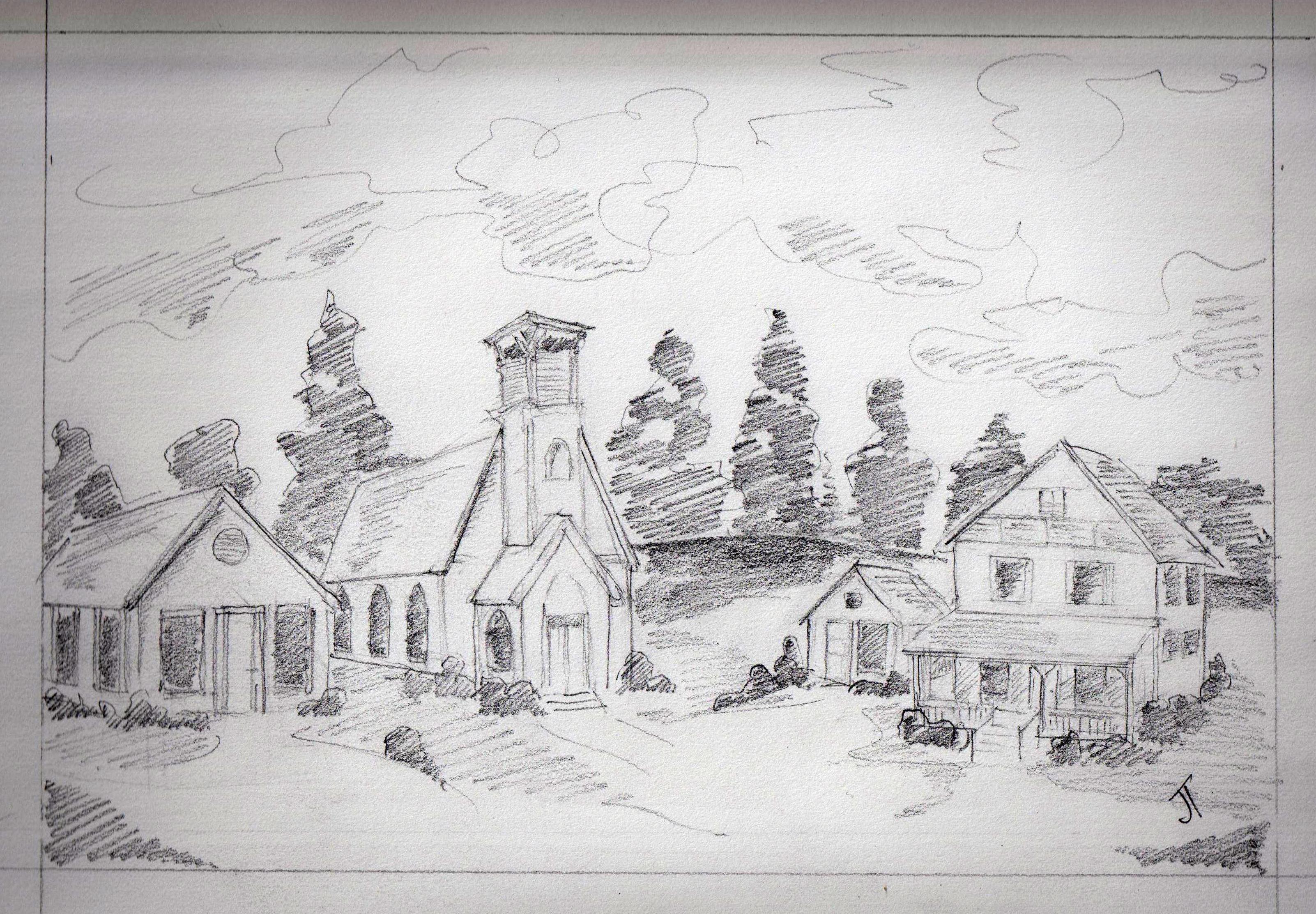
Title: unknown
Working Title: Saving the Landing Church
Setting: a writers’ retreat, including an abandoned church
Characters: main character Sadie, a writer; her husband Tom; people from the community
Plot: the story of how Sadie tries to win over a community in order to preserve an abandoned church
~
~
Still editing.
~
I am on Draft #7 of my novel. In this draft I am going chapter by chapter through the whole novel to look for opportunities for improvement:
- I need to make sure I am showing, not telling. Instead of telling the reader that Sadie is afraid, I try to show the reader her fear, by writing about her accelerated heart rate, her dry throat, how her shoes seem stuck to the floor, and so on.
- I need to be sure I not only describe how the scene looks, but also include the smells, the sounds and the tactile experiences.
- I am still looking for words I repeat in consecutive lines, a hard-to-break habit of mine …
One of the tools I have constructed to help me with fine edits is a chart about the characters. I have character sketches (in both words and drawings) for each person in my novel, but it is tedious to refer to these over and over. So, I constructed a table with the important details – how old the person is, what they look like, and so on.
~

~
Especially helpful is a list of the words he or she uses. For example, Sadie says ‘dinner’ for the six o’clock meal. Her husband says ‘supper’. Sadie uses the word ‘graveyard’, while most of the local people say ‘cemetery’.
~
I have 44 characters in my book, including both major, minor and dead characters. This is probably too many, but it is a book about a community. Here is my table for a few of my characters:
~
| Character | Occupation | Nickname | Characteristics | Age in 2005 | Words they use |
| Sarah Hatheway | writer | Sadie | Plain, thin, oval face, short brown hair | 42 | Bed and Breakfast; silly; retreaters; dinner; graveyard |
| Tom Hatheway | welder | Sadie’s husband; strong, short grey hair, pale | 48 | B & B; hey girl; clients; supper; graveyard | |
| Oliver Johnston | minister | 42 | graveyard; supper | ||
| Emma Southkind | homemaker | Keeps a journal; solid; yellow purse; curly grey hair, gentle | 59 | cemetery; supper | |
| Mark Southkind | retired train conductor | 60 | cemetery | ||
| Katherine Birch | writing coach | Kitty | Language a bit coarse | 62 | graveyard; dinner |
| Alexandra Connelly | student | Tall; long brown hair | 16 | supper | |
| Joe Connelly | accountant | Alexandra’s dad; widowed; tall | 45 | graveyard |
writing a novel – plotting the change
~
Title: unknown
Working Title: Saving the Landing Church
Setting: a writers’ retreat, including an abandoned church
Characters: main character Sadie, a writer; her husband Tom; people from the community
Plot: the story of how Sadie tries to win over a community in order to preserve an abandoned church
~

~
In writing and editing my novel, I have had to turn my attention to the plot, again and again.
~
Last November, when I started to write my novel, I learned quickly – stories usually are built on the concept of change.
- the main character wants something (a need)
- The character sets about trying to fill the need and is thwarted at every turn
- In the end, they either fill the need or they don’t
~
During the story, the main character must be altered in some way.
~

this is my main character, Sadie … how will she be changed during the novel? She does look like she could use a hair salon …
~
As my novel has progressed, I have realised that Sadie not only wants the church, she wants the church with the blessing of the community
How does Sadie change? Her understanding of the community and her attitude towards the community changes. She realises that ‘community’ is a necessary component of the church she wants so badly … without the community, the church is just a hollow building …
~
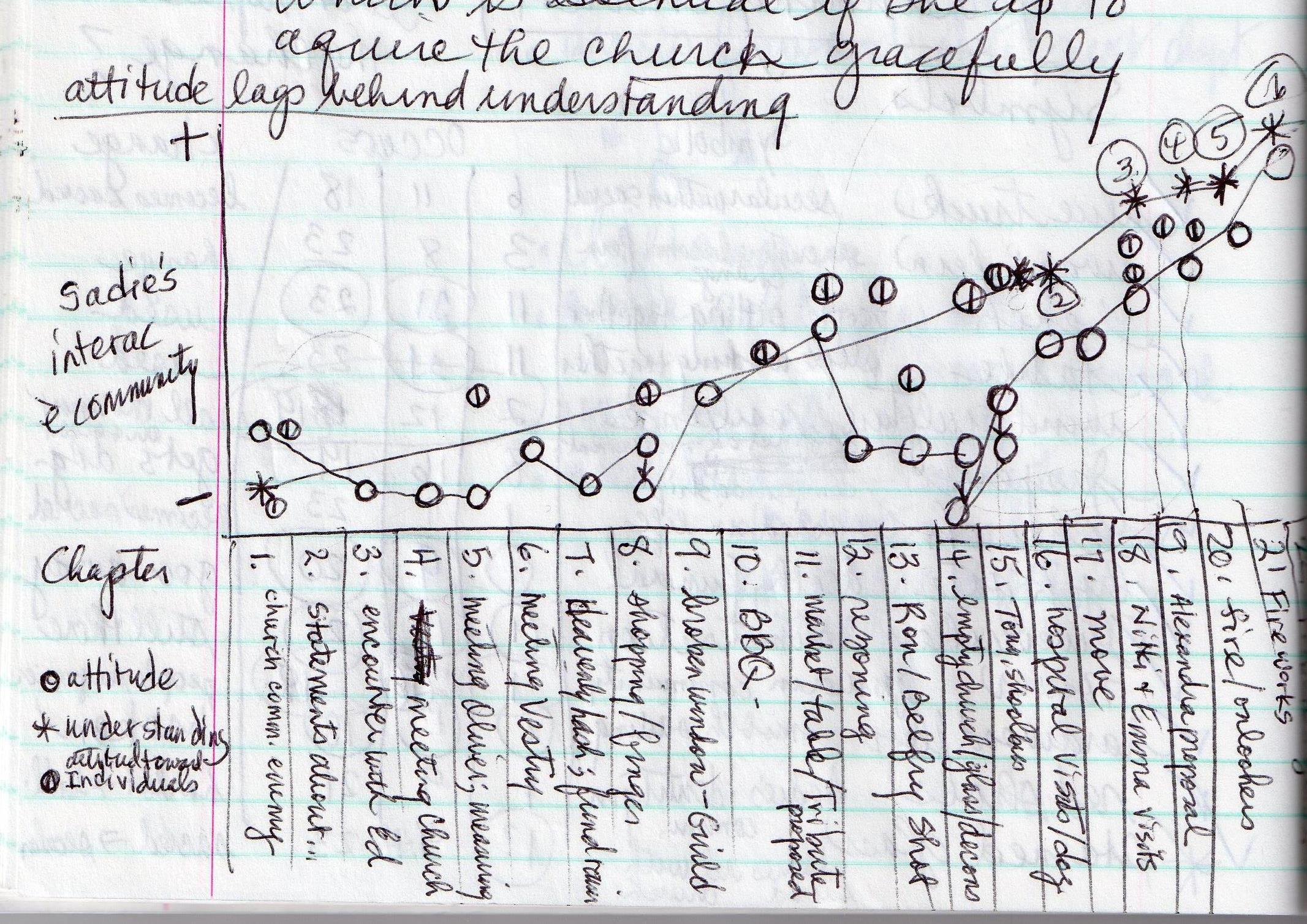
To make certain my main character is changing and growing in the right direction, I’ve plotted out her understanding, her attitude and her progress with respect to the community …
~
~
This excerpt from my writing journal will make no sense to you, but it shows that I write to make the novel and the characters progress towards an end. If I encounter something in the plot (or the subplots) that does not fit, I look at it again and rewrite or reorder events …
~
If you write short or long fiction, how do you make sure the plot is always moving in the direction you intend?
~
Copyright 2013 Jane Tims
encounters with literature 7-14
~

coast near Fowey (image from Street View)
~

~

map showing distance travelled … Daphne du Maurier’s house is near the yellow dot at about eight o’clock … Pont Pill is the stream at about one o’clock (map from Google Earth)
~
On today’s virtual bike trip, I happened upon two locations famous for their literary connections. Near the end of my trip, I saw Readymoney (from the word for pebbly), the house Daphne du Maurier lived in during 1942. She lived here while writing her book Hungry Hill ( Doubleday-Doran, 1943) …
~

~
Across the road is the beach at Readymoney Cove. I imagine Daphne du Maurier looking out on this view as she wrote or thought about her writing …
~

Readymoney Cove in Fowey, across from du Maurier house (image from Street View)
~
The house was originally the coach house for the mansion at Point Neptune …
~

~
I also took a side road to Pont Pill. Pont Pill or Pont Creek is thought to have been the inspiration for Kenneth Grahame’s Wind in the Willows …
~

Pont Creek beside a nicely landscaped house at Pont Pill (image from Street View)
~
Best Views: Little Lantic Beach and the old water mill on Pont Pill …
~

July 23, 2013 ‘Little Lantic Beach’ Jane Tims
~

July 29, 2013 ‘old water mill at Pont Pill’ Jane Tims
~
Copyright 2013 Jane Tims
writing a novel – objects and symbols
~
Title: unknown
Working Title: Saving the Landing Church
Setting: a writers’ retreat, including an abandoned church
Characters: main character Sadie, a writer; her husband Tom; people from the community
Plot: the story of how Sadie tries to win over a community in order to preserve an abandoned church
~
If you are new to following my Blog, you may not know I have been writing a novel since last November. If you have followed my Blog for some time, you may be wondering if I have abandoned my novel for the world of watercolor painting – not so.
~
~
I am on Draft Six. I have taken the comments of my readers and members of my writing groups to heart, considered them carefully and made many revisions in the Fifth and Sixth Drafts. I have also paid careful attention to three workshops I attended on writing fiction.
~
One of these workshops was exceptionally thought provoking, teaching me to look at elements of my book in a new way.
~
Our instructor at this course suggested we pay particular attention to the objects mentioned in our writing. Mentioned once, an object, such as a table, is just a table. Mentioned twice, it becomes a symbol, and the reader remembers the first mention of the object and draws understanding from the symbolism. So a table may be remembered for the people siting at it and the subject of their conversation. Perhaps it becomes a symbol for family, for example. If, in the second mention, someone breaks the table by putting too much weight on it, this may make a comment on the idea of family in the story. By breaking the table, the family may be damaged or broken. The use of symbols deepens meanings and helps the plot reverberate throughout the writing.
~
The instructor also said that symbols operate like mini sub-plots throughout the story. These mini-plots echo the main plot, and the objects change in a way that illuminates the main plot. The mini-plots also tend to occur in three ‘beats’, providing a beginning, middle and end. For example, the table is bought at an auction, broken and finally mended.
~
In this round of edits, I have tried to examine the use of symbols in my novel. To do this, I built a list of the objects I have used as symbols. Then I looked for their occurrence in the novel to see if I could identify three ‘beats’ and a mini sub-plot. In some cases, I identified gaps – fixing these has helped me to solidify my overall plot and improve the understanding of my readers.
~

a lych gate is one of the objects I use as a symbol in my novel
~
This is a short version of my list of some of the objects/symbols in my book. When I assembled the list, the items in red were missing and I had to fill out the story accordingly. Perhaps you can use this method to help strengthen the narrative in your own fiction.
~
| Object | Symbolism | Occurrence (Chapter Numbers) | Mini-plot | ||
| long bench | togetherness | 11 | 21 | 23 | bench moves from private to communal space; people start working together |
| stained glass | relationship between sacred and secular | 1 | 9 | 23 | stained glass window breaks and is repurposed; the sacred becomes the secular |
| lych gate | death | 1 | 9 | 20 | lych gate falls into decay; fear of death is no longer the driving factor in a family |
| red shoes | respect | 1 | 9 | 21 | community’s view of main character is altered |
| minister’s collar | mentorship | 1 | 15 | 21 | although he leaves the church, a minister grows as mentor to a family and the community |
| blue plastic truck | secular within the sacred | 3 | 11 | 21 | a plastic toy becomes an object worthy of protection; the secular becomes the sacred |
| Jasper the dog | companionship | 8 | 16 | 19 | a new dog helps build a family |
| air fern in a swan vase | ability to change (a sea-creature poses as a fern) | 3 | 8 | 23 | something unwanted becomes valuable |
~
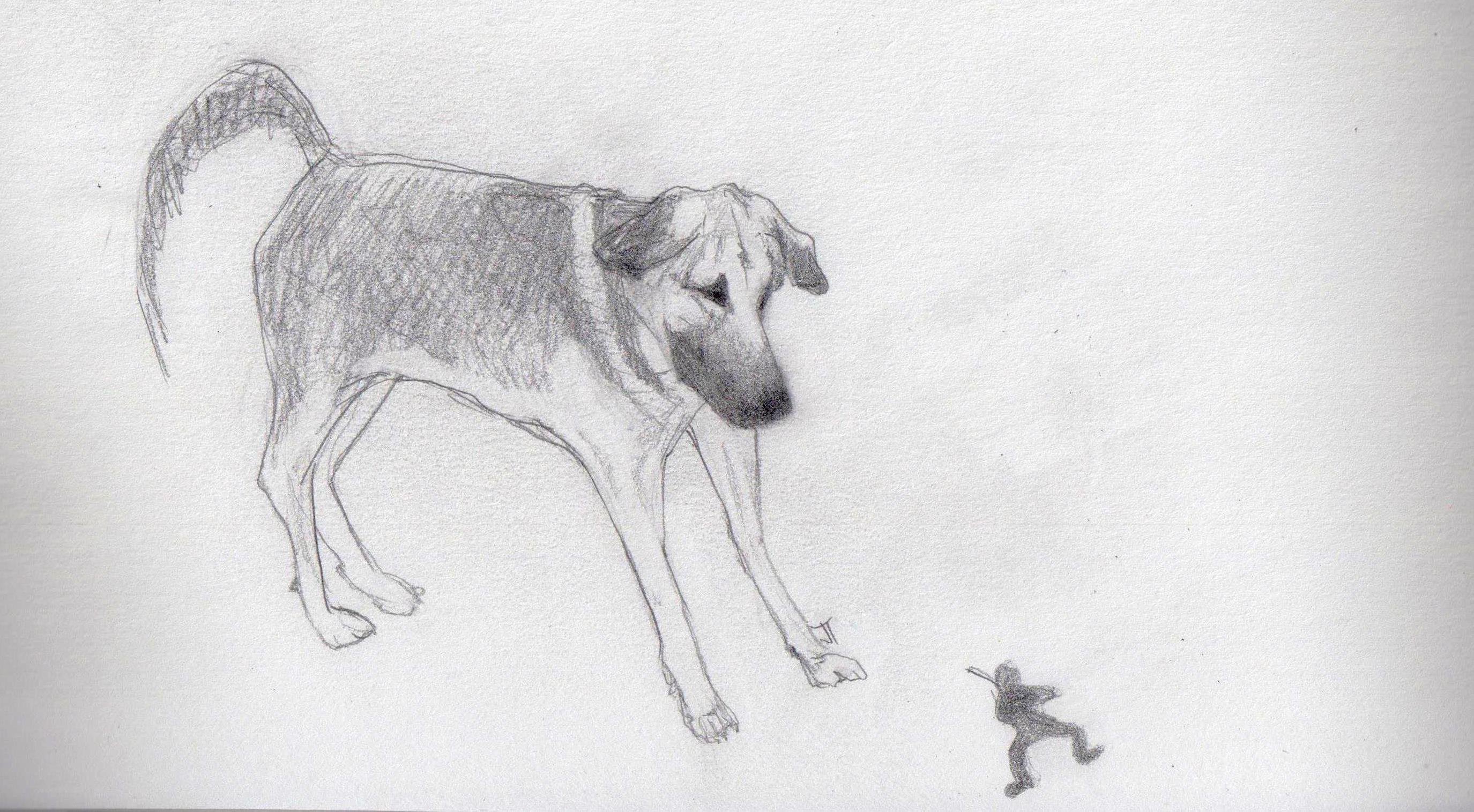
Jasper the dog was a late addition to my novel, but he opened up so many story possibilities, I’m glad he came to be one of the characters
~
Each time I add something new to the narrative, I have to make other edits in consequence. However, I find these changes are worth the effort since they contribute to building the story.
~
Have you considered the use of objects as symbols in your writing?
~
Copyright 2013 Jane Tims
writing a novel – characters with a point of view
As some of you will know, I have been working on a novel since November of last year. Although I have been quiet about it in my Blog, I work on my manuscript almost every day and the plot is getting tighter with every edit. I now have 83,000 words, 23 chapters and 273 pages.
~
The novel has the working title ‘Saving the Landing Church’ and is about a woman, Sadie, who decides to buy an abandoned church as a learning center for her new writers’ retreat. People in the community where Sadie lives have mixed opinions about her undertaking and Sadie meets a lot of opposition as she sets about acquiring and moving the church to its new location.
~
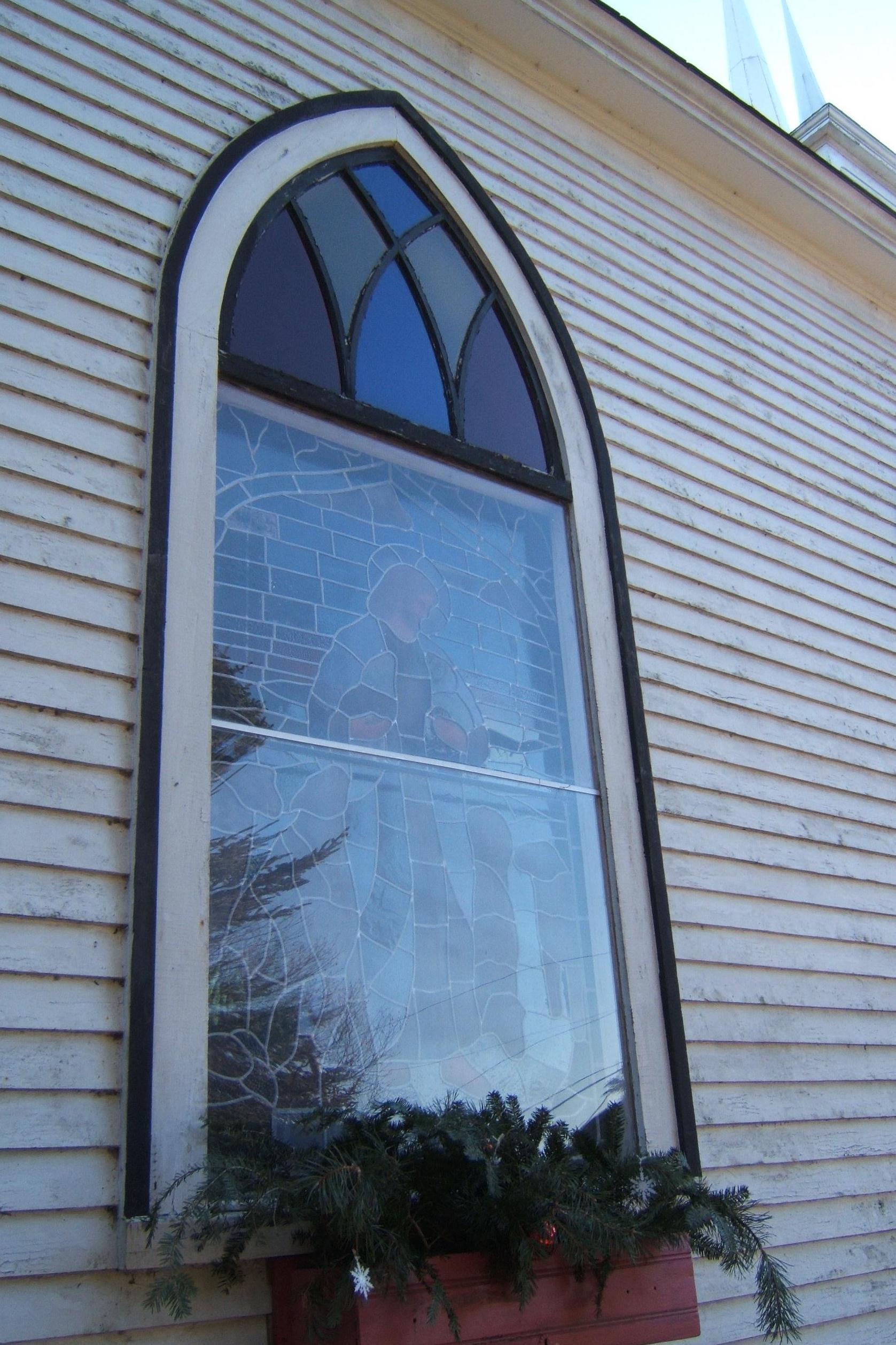
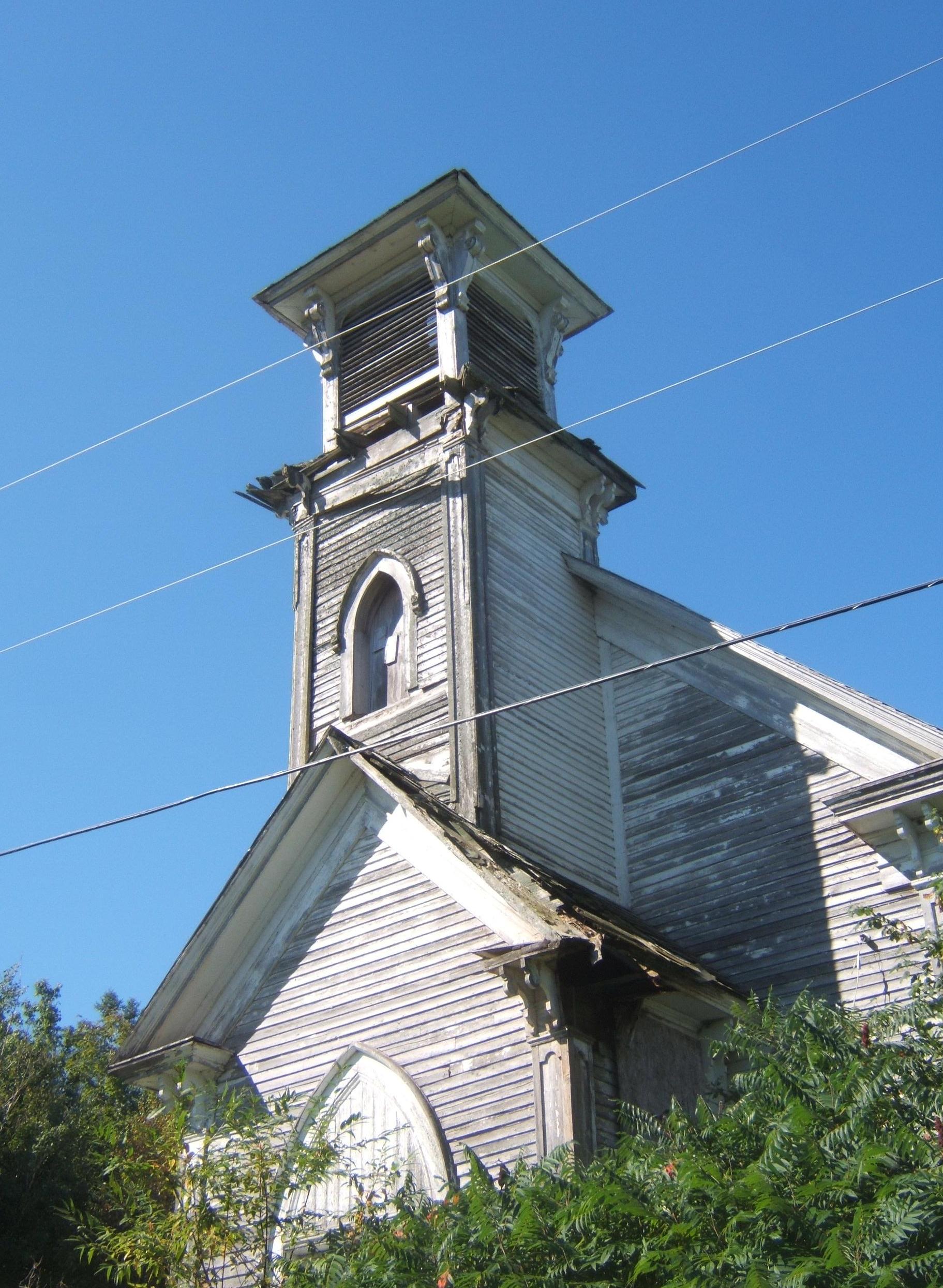
abandoned church near Knowlesville, New Brunswick
~
The book is written in the first person, past, from Sadie’s point of view.
~
Sadie … she looks a little timid, but she is determined to own the abandoned church
~
When I completed the second draft of the novel in January, I asked a few people in my family and my writing group to read it and tell me what they thought. I also workshoped Chapter Twenty at the Maritime Writers’ Workshop Winter Retreat in February and received many helpful comments from the workshop participants. I have obtained useful analyses from several people, most especially my niece who has read the draft carefully and given me many useful insights and edits. Various members of my two writers’ groups have also listened to parts of the novel and provided ideas for improving the writing.
~
One of the most consistent comments I have received is about one of my main characters, Sadie’s husband, Tom. Tom is not well. He has an advanced condition called Welder’s Lung and his doctors have given him less than a year to live. This situation is one of the main drivers behind setting up the writers’ retreat – it will give Sadie a livelihood after Tom is gone.
~
The criticism about Tom has been that his only role in the book seems to be to die. Readers have consistently told me they want to find out more about him. One of my writing group friends suggested I try writing the book from Tom’s point of view. She said she knew I would resist this idea, and, sure enough, my first response was ‘No way!!!’ … my book was almost done, my book was perfect! And write from a man’s point of view? … squiggle!
~

Tom, Sadie’s husband … he is looking a bit battered by his illness, but he is willing to do anything to help his wife
~
However, I thought about the possibilities and decided it might be interesting to write a small part of the book in Tom’s voice. I looked at each chapter and extracted a bit of the conversation or action that I thought might be better seen from Tom’s point of view. In some cases, Tom’s viewpoint immediately solved the problem of segments where there was no action, only Sadie’s thoughts about where she was in her quest for ownership of the church.
~
The new parts of each chapter were surprisingly easy to write and it took me less than three weeks to develop Tom’s ‘words’. As Tom’s voice began to emerge, I realised that Sadie has some things wrong … an example is her analysis of Tom’s response to his illness. To her, he has given up all hope. Tom sees his response not as despondent, but resolute. Also, Sadie has a consistently passive response to some quite violent behavior in the community. Tom takes nothing passively. Confronted by opposition, he responds in kind. And he has a couple of pals from his days on the construction site who will help him in any endeavor.
~
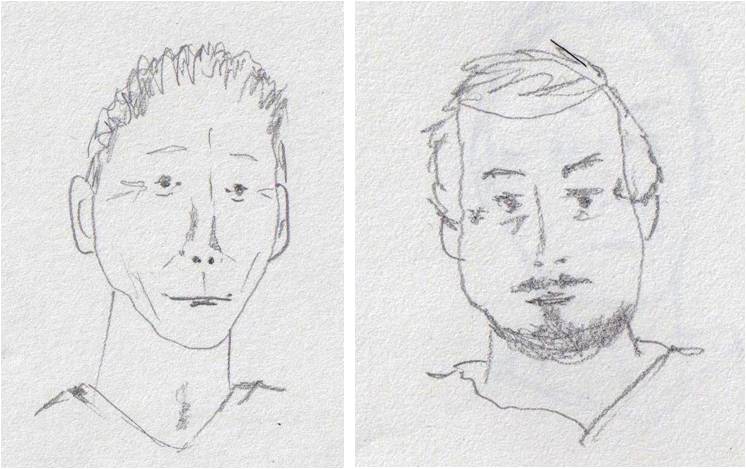
Tom’s friends Paul (left) and Rigger (right)
~
Tom also wants a dog and the introduction of Jasper, a German Shepherd mix puppy, to the action has been so much fun to write. Try adding a dog to your own novel or plan for a novel. At the height of the action, who is taking care of the puppy???
~
Jasper responds to a crawling military toy
~
Responding to people’s editorial comments is difficult. First, your ego has to be tamed. Then, you have to decide if the edit will really improve the draft. I try to look at every comment objectively but this is so hard. I give extra weight to a comment made by more than one person since this suggests the reading public may have a similar response. I know, however, that when all is said and done, it is my book and I have to make the decision to edit or not to edit.
~
My experience with the ‘Tom re-writes’ shows me that sometimes a seemingly radical comment can lead to an improved draft. Writing from another character’s point of view can suggest new ways of working out plot problems, add dimension to the story and background, and take the narrative in new and interesting directions. I strongly suggest looking carefully at each character in your story, writing a good character sketch for each and considering every bit of action from their point of view. As your characters find their way through the story, they will reveal unique ways of responding to the action.
~
As for my squirming about writing as if from a man’s point of view, this was easier to do than I first thought. Tom’s character was embedded in my head, so I had a good idea of how he would respond to a given circumstance. His ‘voice’ and reactions are unlike Sadie’s, so there is a significant difference in the words they use and the way they express their ideas. Tom also speaks in the present or immediate past tense, so his ideas are more visceral and lack the reflection brought by time. As for thinking like a man, I think Tom is likely from Saturn, rather than either Mars or Venus! And he likes quiche.
~
Lots of fun …
~
~
Copyright Jane Tims 2013
a name for a novel – biking log book Day #8
Biking, biking, biking!!! I am still working on Phase 3 of my virtual bike trip through central France. For Phase 3 of my trip, I am biking in 12 days from Exireuil to Magné just west of Niort.
~
On March 4, for the second biking day in a row, my bike trip was along a railroad track!

~
I had lots of time to think, so I thought about the title of the novel I have been working on. For those of you who do not know about my novel, it is about a woman who sets out to save an abandoned church.
~
On Day #6 of my virtual bike trip, in Chavagné on the Route de la Mothe, I saw an old church…
~

~
At first, I thought the roof had been removed from this church, leaving it open to the elements. On closer look, there is a low-pitch roof in place (note the rafters and clay tiles)…
~

old church on the Route de la Mothe
~
However, the image reminded me of another abandoned church I had read about in my research for my book:
‘The Old Church of St. Nidan, in Llanidan, North Wales, is a ruin. All that is left of this medieval church are the four stone walls of the western wing and its central arcade. The nineteenth century clergyman Harry Longueville Jones wrote that the church had succumbed to a ‘melancholy fate’. In 1850, church historian Sir Stephen Glynne wrote that most of the church is ‘open to the skies.’ (partly quoted from Wikipedia, ‘Old Church of St Nidan, Llanidan’, January, 2013).
I think I will use the phrase ‘Open to the Skies’ as the title for my novel. It refers to the fate of an abandoned church, but also to the ability of people to open themselves up to possibilities. I think it is perfect for my book.
~
Log Book: March 4, 2013
Area travelled: from ‘field south of Trévins-le-Bas’ to ‘outskirts of Niort’
Distance: 30 minutes 3.0 km
Best view: no best views today; biking on the railroad is not inspiring
Notes: after this, I will be careful to plot my bike trip on roads rather than rails!!!!
~
Distance Travelled Feb 21 to Mar 4: 24.0 km (240 minutes of stationary biking)
Total Distance Travelled Jan 30 to Mar 4 : 55.8 km (565 minutes of stationary biking)
~
What do you think of the title ‘Open to the Skies’ for my book?
~
Copyright Jane Tims 2013
writing a novel – results of a weekend workshop
This weekend, I participated in a weekend writing workshop organised by the University of New Brunswick’s College of Extended Learning as part of the Maritime Writers’ Workshop. I worked with 11 other writers, the workshop coordinator, and the group leader. We read one another’s work, making suggestions for revisions and generally learning about editing both prose and poetry. As I looked around our work table, there were water glasses, pens and pencils, i-pads and laptops, piles of paper, and notebooks for writing. I loved the beautiful journals some of the writers were using to record their thoughts.

beautiful notebooks
Our leader was Joan Clark. Joan has published several novels and she read to us from her published work. I especially appreciated her reading from some of her work-in-progress. Her book The Victory of Geraldine Gull (1988) was a finalist for the Governor General’s Award and the Books in Canada First Novel Award. She has also written Swimming Towards the Light (1990) and Latitudes of Melt (2000), among others.
For my own work, I had some very encouraging comments. I think I most appreciated a comment from Roger Moore, a well-known poet and educator in Fredericton. He told me about the work of Wolfgang Kayser – his writing puts novels in three types: ‘action’, ‘character’ and ‘place’. Roger thinks the focus of my novel is ‘place’. He also said the creation of place was central to my story and, in the excerpt he read, I was doing this well. Since I consider all my work to be about place (hence the focus of my Blog), I was very happy about his comment.

writing about place
Another writer told me that the story I was telling in my book seemed an allegory for the shifting loyalties of community. Since I set out to write a book where the community is like a character in its complexity, I was very encouraged by this observation.

glimpses into the character of a community
Another well-know New Brunswick writer pointed out to me that while I write excellent, detailed descriptions of the out-of-doors, I tend to neglect other descriptions …. I appreciate that I need to provide some balance by providing more detailed descriptions of inside spaces and action.
Another knowledgeable writer at the workshop talked to me about the decision-making process toward a church’s deconsecration. These are details I will have to get right since I want to build credibility with my readers.
A couple of editorial comments stood out for me. I wish there was a ‘checker’ in the computer for locating words that are repeated in proximity to one another (for example, when I use the phrase ‘across the field’ in two adjacent lines). Also, in some cases, I should use shorter sentences to increase tension.
~
Overall, the weekend was hard work, but also a lot of fun. I now have material to use toward the fourth draft of my novel. Also, looking at the work of other writers shows me what to look for when editing my own writing.
~
Over the next couple of days, I’ll make some new revisions. Afterwards, I’ll put my manuscript away for three weeks. Then, on March 4, I’ll take a fresh look at my draft and see where I think the story-line and writing need more work.
~
I would recommend a similar workshop for anyone in the midst of writing a novel, especially if you want to see your own work from other points of view.
Have you ever attended a writers’ workshop and what was your experience?
~
Copyright Jane Tims 2013
writing a novel – taking a break from the draft
On Friday of this week, I begin a weekend Maritime Writer’s Workshop with the University of New Brunswick’s College of Extended Learning. I will work with a dozen other writers at revision of our written work under the leadership of Joan Clark. Joan is an award-winning novelist of both adult and children’s fiction, and I am anxious to find out what she thinks of my work.
I have chosen to submit ten pages of my novel ‘Saving the Landing Church’ to be examined during the weekend. I will get some good insight into how other writers respond to my writing. No doubt, I will also discover some aspects of my writing that need improvement. I hope the other writers will find my work interesting and help me discover some strengths as well as weaknesses.
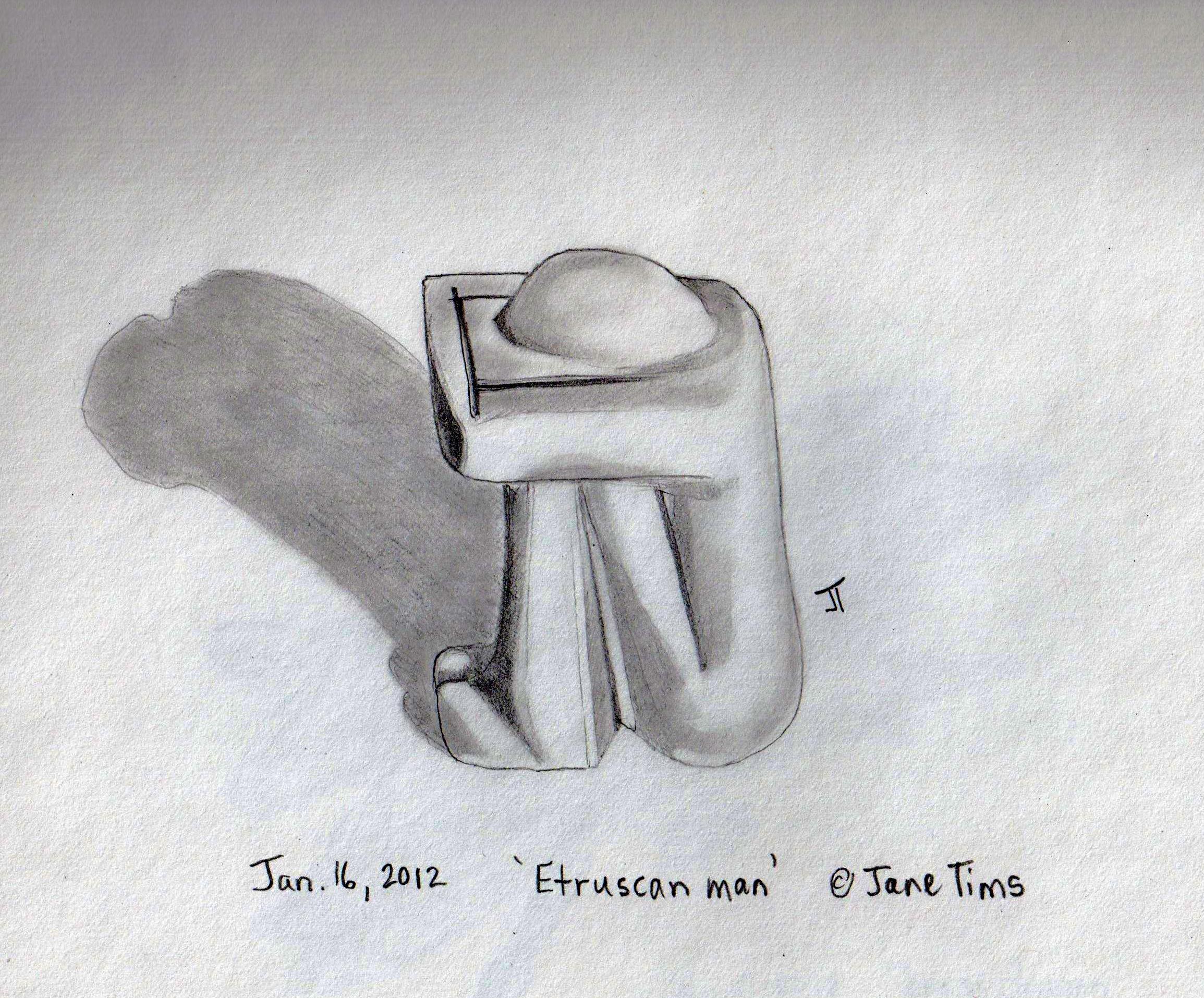
Sometimes it is difficult for me to hear criticism about my writing, but I have to listen carefully and keep an open mind …
I will also read and comment on the work of the other writers. This will help me to hone my own editing skills and discover more about what readers like in written work.
Once I have done the workshop and incorporated various comments into the draft, I will take a three-week break from my novel. I will put the current (third) draft away. During that time, I will not read the draft and I will try not to think about it. Then, after March 4, I will spend a couple of days reading a paper-printout of my novel. The theory is, it will be new to my brain after the break and I will see, with great clarity, what I certainly should have seen before.
~
I expect to find:
simple edits (Sadie takes a drive on the car, rather than in the car)
discontinuities in the action (Sadie goes for a hike a week after cracking her ribs)
slip-ups in characterization (Nicola suddenly has blue eyes instead of green)
cases of inverted time (July cames before June)
~

I may discover that Tom and Sadie are going for a walk and listening to the rustle of the leaves in the birch trees in the dead of winter….
~
From these observations, I will make some changes and then will come a series of decisions about how to get my novel published.
~
on the road to novel publication
~
Copyright Jane Tims 2013
messages on a still winter day
 ~
~
intentions
~
snow, crystal-quiet
a sluggish breeze
riffles the woodland
sunrise lost in a rose sky
~
listen to the rustle
of paper on wood
the mutter of unwritten lines
birch-bark, deckle-edged
~
tatters and shreds
sorted by a sluggish wind
words I meant to write
letters ready for the mail
~
misplaced
behind parcels
wait for postage
brown paper and string
~
~
~

Copyright Jane Tims 2013
featuring a 1941 International truck
I have had a few poems accepted for publication recently. These include ‘abandoned resort hotel, Devil’s Head’; ‘Berries in Cellophane’; and ‘1941 International K-4’. They appear in Issue 10 (Spring, 2013) of The Lion’s Head Magazine (online). You can have a look at these three poems at http://lionsheadpress.blogspot.ca/
~
‘Berries in Cellophane’ is from my manuscript on growing and gathering local foods.
The poems ‘abandoned resort hotel, Devil’s Head’ and ‘ ‘1941 International K-4’ are both part of a series, not yet completed, on abandonment. This series began my interest in abandoned churches, and lead to the novel I am now working on – ‘Saving the Landing Church’.
~
The poem ‘1941 International K-4’ was inspired by an old International truck, seen in a wood lot in southern New Brunswick in the fall of 2011. It was set up on steel drums and looked like it was no longer used. Rusted and out-of-commission, she was still elegant to behold. The poem came easily, written in the ‘voice’ of the truck, recalling its various adventures.
Have a look at the poem in Lion’s Head Magazine and let me know what you think.

~

Copyright Jane Tims 2013




 nichepoetryandprose