Archive for the ‘waterways’ Category
cave beneath the waterfall
In the cold weather, I think about the waterfalls we saw this summer. As the temperature gets lower, they succumb. First the water freezes at the edges, building up on the rocks and ledges. Then, gradually icicles build and the surface water freezes. By mid-winter, the waterfall will be a frozen cataract, a glass house of ice. Within the frozen falls are ice caverns and icicles, places where water runs and where water stands still, and places where the ice traps sunlight to shimmer and sparkle.
One of the waterfalls we visited this summer was Smith Falls (see ‘niche beneath waterfall’ under the category ‘waterways’, published October 21, 2011). At the base of the waterfall was a small cave. In winter, the entrance to this cave must be a crystalline curtain of icicles and glass.
Below, in my poem and drawing, I remember the cave and waterfall in summer.
~
shelter
‘a small cave is hidden beneath the falls’
– trail guide
~
sip of tea
candles lit in evening
a lap quilt tucked
relief from freshet
~
cave, respite
beneath two newly reconciled
slabs of bedrock
or where vulnerable sediments finally fail
succumb to the reach of water
~
spurt and shard
the brawl subsides
and damp recedes
pollen settles
~
concentric rings
and space is made
to occupy
~
© Jane Tims 2011

© Jane Tims 2011
mood of the lake
One of the very enjoyable experiences of having a property near the lake is listening to the loons. There is a least one pair of loons on our lake and we see them often. Usually they call a few times at mid-day or in the evening. Their cries are varied, ranging from a laughing tremolo to distinctive and melancholy wails, hoots, and yodels.
We have always been interested in loons and the protection of their habitat. Loons are especially vulnerable to quickly changing water levels and wave action because they build their nests just at water level. `Watch Your Wake` programs help boaters protect loon habitat.
In 1994, we participated briefly in the North American Loon Project. Today there is a similar program, the Canadian Lakes Loon Survey, sponsored by Bird Studies Canada. This is a long term study, using data from volunteers, to assess the health of Canada’s loon population.
We had little time in those days to participate fully, but we did visit Peltoma Lake in southern New Brunswick, to look at the loons living there. My journal entry for our visit to Peltoma Lake reads:
May 1, 1994 Sunday
Trip to Peltoma Lake to see if there are any loons. We are preparing to canoe the lake
about three times this year to make observations. Disappointed at first
as the lake is lined with cottages and we could see no loons.
Then we stopped near a small bay and there they were
– nine black and white beauties! They left the cove as soon as they saw us.

I also wrote a poem about the lake – the mood of the poem suggests it must have been a damp and miserable day.
Last Sunday, we drove out to Peltoma Lake to take some photographs. The loons and most of the people are gone this time of year. Although it was cold, the lake sparkled in the sunlight and was anything but dreary.
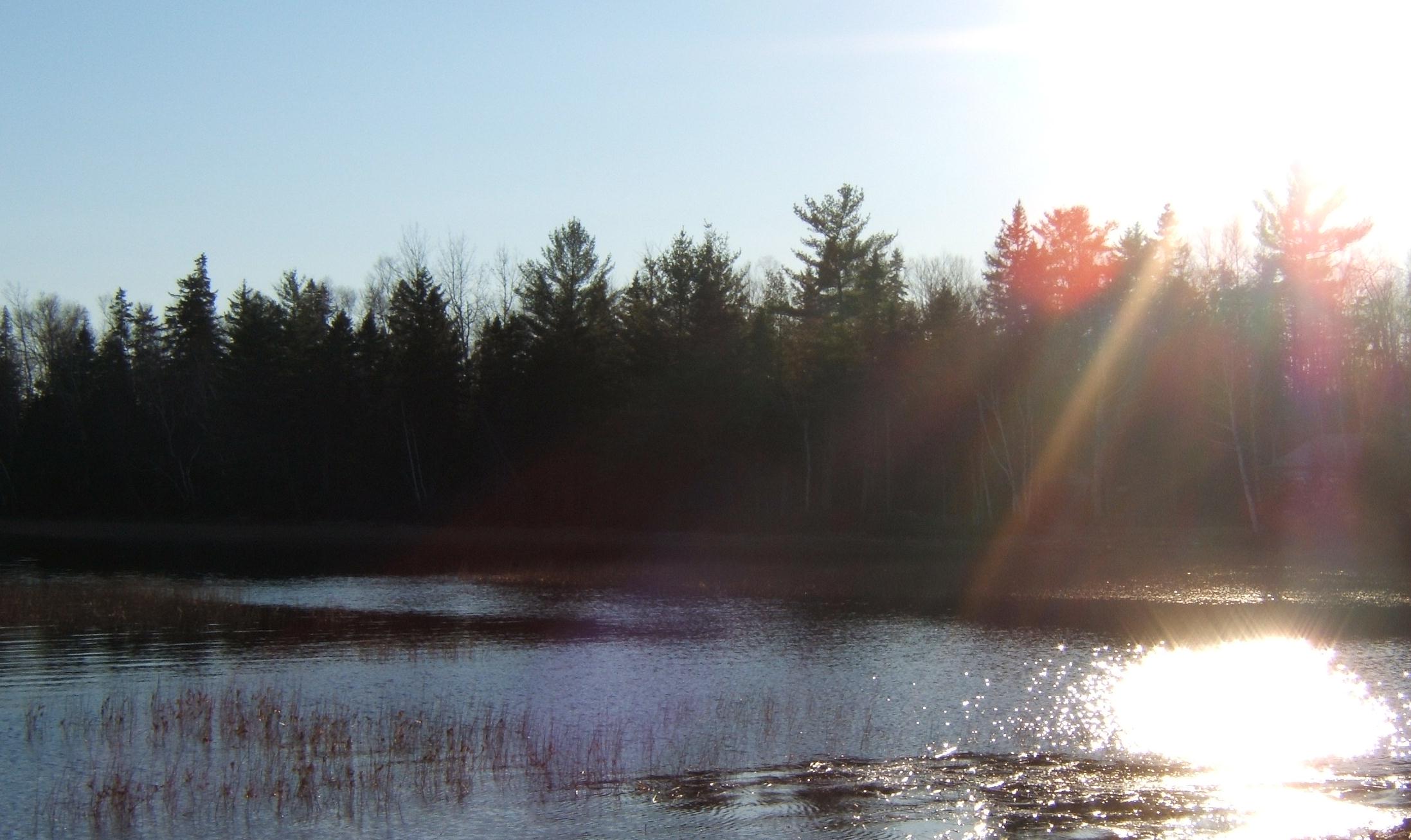
Peltoma Lake– Sunbury County
~
Peltoma in rain
is a faded black and white photo
layers of misery, thick and still
the lake, the shore, the mist
the thin chill drizzle
~
in the coves
the cedar and birch swoon above the water
moved to tears at reflection
the lake broods
over her loons
and the cell-thick pall of algae
smoothed to the shore
~
cottages hug the lake
like campers huddle a fire
cheerless and smoky
pines on the esker reach
blank windows keep watch
for sparkle on waves
back flips from the dock
paddles flashing sun
the day is bleak without answer
~
a muskrat tows a line on the shallows
loons quit the cove
diminish to mist
~
Peltoma is scowling
~
© Jane Tims 1994

preface to fire
I always associate November with bonfires and the smell of smoke and burning leaves. I love sitting in front of a fire, with friends and family, sharing stories and talking about days ahead. But even in the midst of having fun, I am reminded – fire is not always a friendly force.
In 2002, we encountered the negative side of fire when we took an extended car trip to the west. In Quebec, Ontario and Alberta, we saw evidence of the destruction of recent forest fires.
One of the places we visited on our trip was Portal Lake, near Mount Robson, in British Columbia. We were at Portal Lake for about an hour. We hiked along the east side of the lake, and sat on the mountain rocks to dangle our feet along the rock face. The berries were brilliant, glowing like embers. Although there was no burnt land at Portal Lake, the paths were like tinder, the lichens dry and brittle. The lakeside had the thickened scent of drying vegetation.
The smell of smoke was in the air, as well as the faint smell of sulphur. We had just visited the hot spring at Miette. I had dangled my hands in the warm water and the sulphurous odor still lingered.
It was a kind of foreshadowing. Later in the week, the Rockies would be hazy with smoke as we made our way south of Banff. Two weeks later, we were back home, watching the reports on the Weather Channel. The Parks, Jasper, Banff and Kootenay, were all closed due to forest fire.
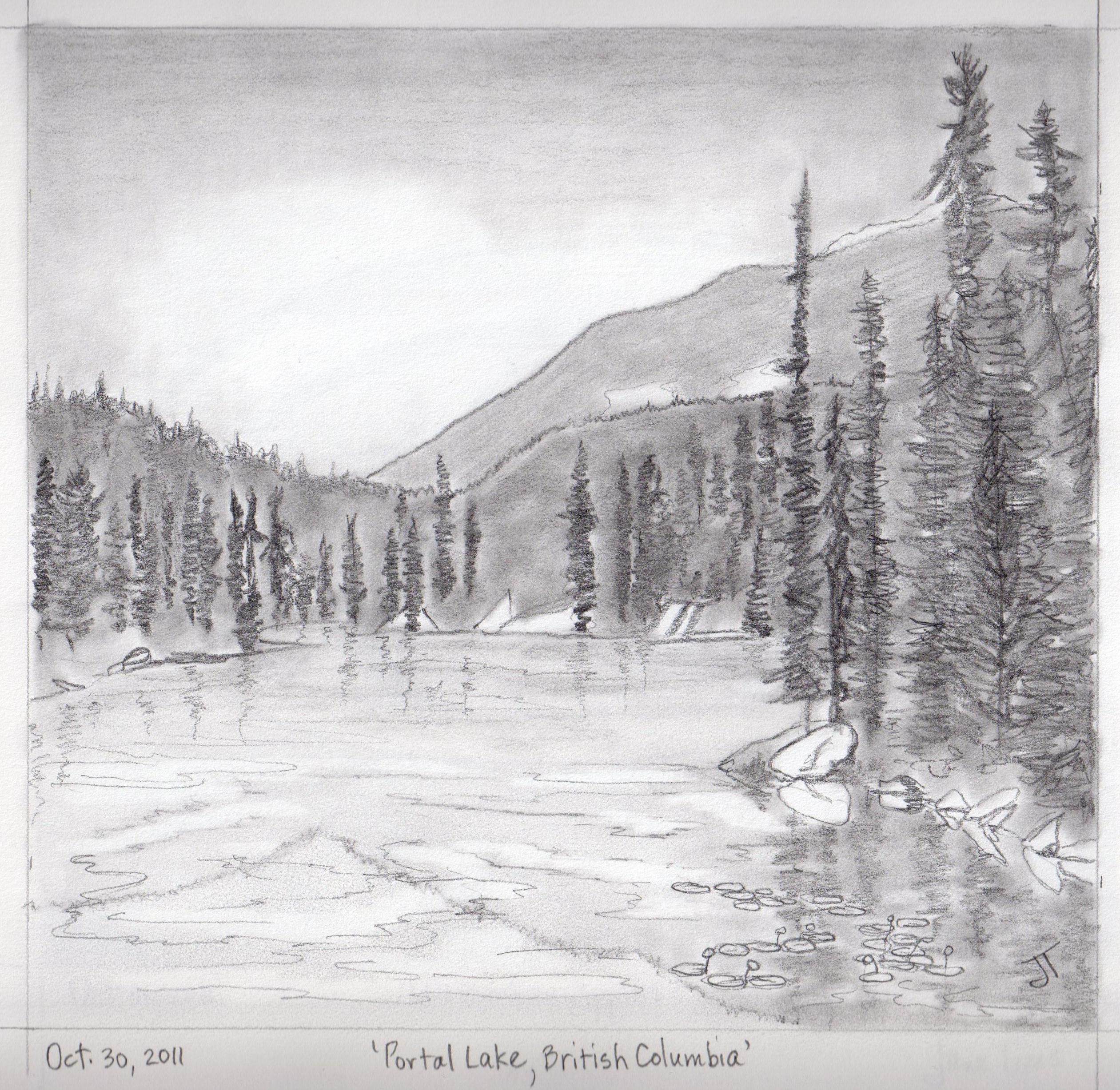
Portal Lake – British Columbia
~
1.
gateway to wildfire
preface to cinder
smoke and ember
~
2.
Xanthoria ochre, pale juniper
mountain titanium and grey
rose hip and raspberry
smilacina and cranberry
~
3.
granite transfers the burn
to the calves of my legs
hot as the sulphur spring
the air pine scale
and mosses
~
winds arrange the shallow lake
the surface in lines
on the bottom, sun shadows cast
sun shadow sun shadow sun
lily pads are lifted and settle
are lifted and settle
~
succession of fire, ashes and green
~
© Jane Tims 2002
refections on the water
I have realised there is a sequence to the vanishing of the autumn colour.
First the maples lose their leaves in the early autumn winds. The next will be the poplars, now glowing with banana colours. The oak leaves, ruddy and slick with reds and oranges, will succumb by late October. Tamarack, a deciduous conifer, will lose its amber needles in early November. The beech trees will keep their ochre, papery leaves all through the winter, finally losing them in spring when the new leaves emerge.
This past weekend, we found some maples still in autumn garb. At Watty Brook, flowing into McDougall Lake in south-west New Brunswick, at least one maple has taken longer than most to lose its leaves. At its sheltered location in the low valley of the brook, the tree has eluded the winds. It was reflected clearly in the brook, and its orange and gold were captured in the rocks showing through the tea-coloured water.

In spite of the movement of the water, the tree was reflected in all its splender.
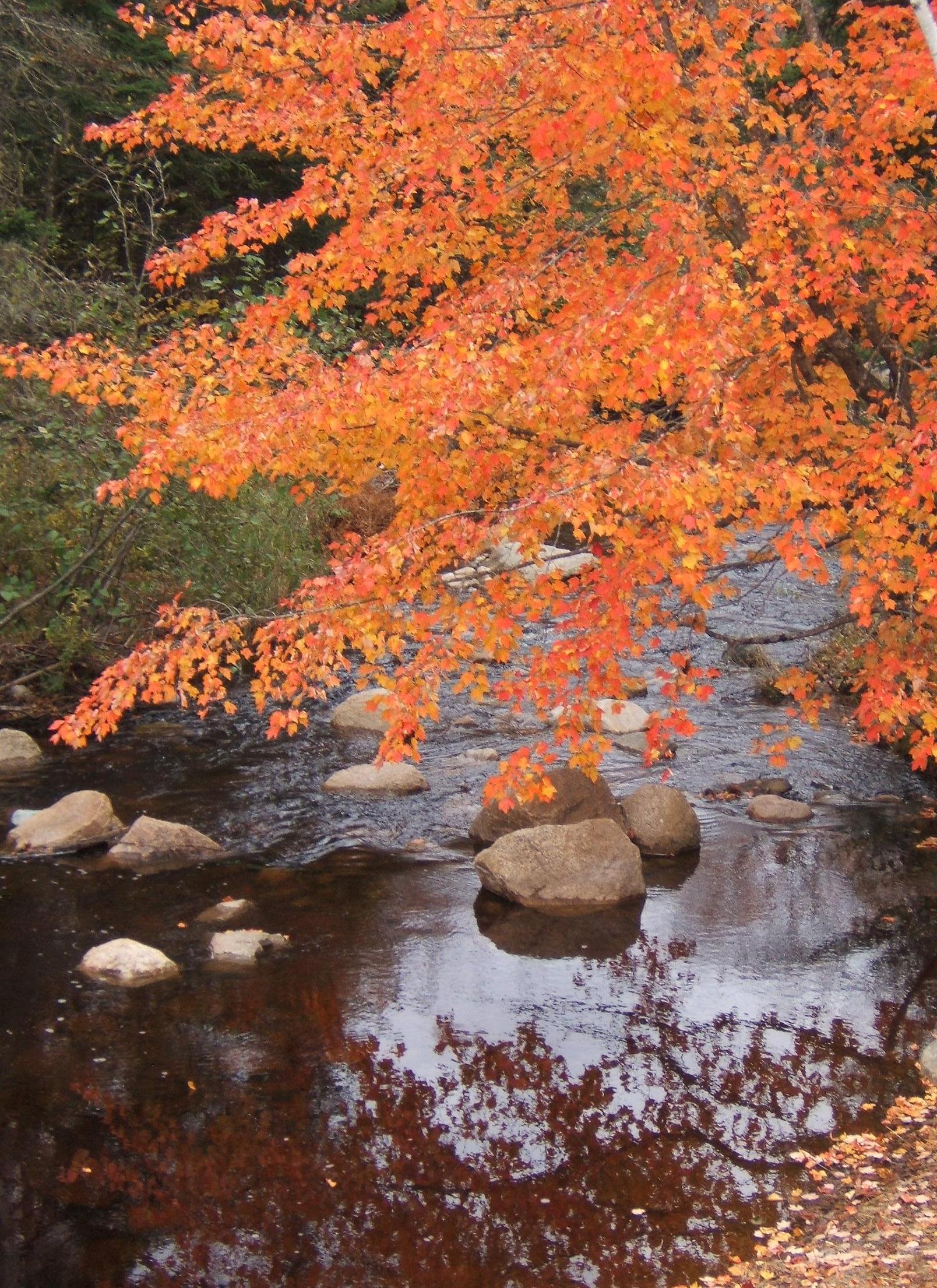
in the millstream
~
upstream
deer are drinking
and the raindrops
swell the running
this I know
from bubbles
rising
~
I am a rock
in the millstream
seasons and freshets
have smoothed
my edges
~
once I met the water
a cleaver
divisive
now I ask the water
to flow
around me
~
© Jane Tims 2003

fords across the river
During a week of vacation last month in south-eastern Ontario, I was able to get to know some of its rivers.
The water is low this time of year and the rivers run still and quiet. Pond lilies and duckweed cover the surface, joined by early falling leaves. The country roads cross and re-cross the rivers, giving a view of each river at several points along the way.
I was also reminded of another means of crossing a shallow river or stream – the ford. This is a place where the water is shallow enough to cross on foot or by vehicle, without a bridge. Sometimes the ford depends on the natural stones or solid bottom for its footing; sometimes the bottom is built up by adding stone.
The fords on the South Branch of the Raisin River in South Glengarry County were built to last, of stone. They make a charming pause in the run of the river, allowing passage of the water and a safe way to cross.

A local person familiar with the river told me this: in spring, when the river runs deep enough to allow canoes to paddle, the fords can still be seen, white stones shining up through the water.

~
crossing the South Branch Raisin River, South Glengarry County
~
weedy South Branch Raisin River water-dry
stream-bed wizened wild grapes purple-weighted
sun-dried field rock
fords and fences
rain and rising
leaf-spun river
surface winds reflected
elm, nymphaea
ash, nuphar
~
© Jane Tims 2011
pool at the base of the waterfall
Have you ever had trout nibble at your toes?
When I was a teenager, my family was fortunate to own a woods property with a brook and a substantial waterfall. We had a cabin there, built by my Dad.
The brook was wide and shallow, running through mixed woods. It was a torrent in the spring, but in summer it ran gently through the trees, bordered by mossy hummocks, accented with small pools and riffles.
I remember the first time I saw the waterfall. We were looking for a woods property and a farmer offered to show us some of his land. I was exploring a particular area, following the bank of the stream, when I first heard the roar of the falls and saw the bright froth of water through the trees. I couldn’t believe it when the owner said, without hesitation, we could have that lot for our cabin.
The falls were substantial, spilling about 15 feet over a dip in the shale substrate. They spread outward from the lip of the falls, creating a broad triangle of white, laid across the rock like a veil. The roar of the water falling was constant and intense.

'waterfall and pool'
At the base of the waterfall was a pool, waist deep. The water was headache cold, but once we became used to it, we could swim and cool off on a summer day. The pool was transparent as glass, and we could look down and watch the trout nibbling at our toes. In spite of the dramatic turn of my poem below, the trout were not voracious and their nibbles were butterfly kisses.
Meniscus
~
1.
~
mist and mosses
colour the air
where the waterfall leaps
green in the mumble of water
~
I stand waist deep
in the fall-fed pool
bubbles cling to my legs
to the hairs on the back of my knee
~
droplets of air above water are nothing
~
2.
~
the soles of my feet
slide on the slate
search for softer
pockets of sand
~
trout kiss my ankles
~
I try to see
but the surface is silver
a dome reflected
of maple and sky
~
3.
~
a green leaf settles
a pine needle spins
striders press dents on the water
~
4.
~
I need to see the trout
I bend my face to the water
press on the skin
push through the meniscus
~
my nose is severed from my face
~
5.
~
I am the pond
~
I cannot move
I cannot breathe
my hands are numb
my heart squeezes within me
~
I cannot believe
the trout have taken
great gashes of leg
my toes are slashed by the slate
~
I look up through the water
its surface a circle of silver
~
6.
~
fish gnaw at my toes
bubbles grate at the back of my knee
tears under water are nothing
~
© Jane Tims 1992
autumn along the brook
Behind our house, in the grey woods, is a narrow little brook. It is not much to look at but I like its simplicity. This brook has steep sides (a cross-section like a ‘U’) and grassy banks, and it creates charming little riffles over fallen logs. Until this moment, I have never realised … we have not given this brook a name!

I walked to the brook last Monday evening, to see how high the water was and to look for signs of the changing season.
Autumn is showing its color everywhere. Some of the ferns have turned yellow with the first frost…
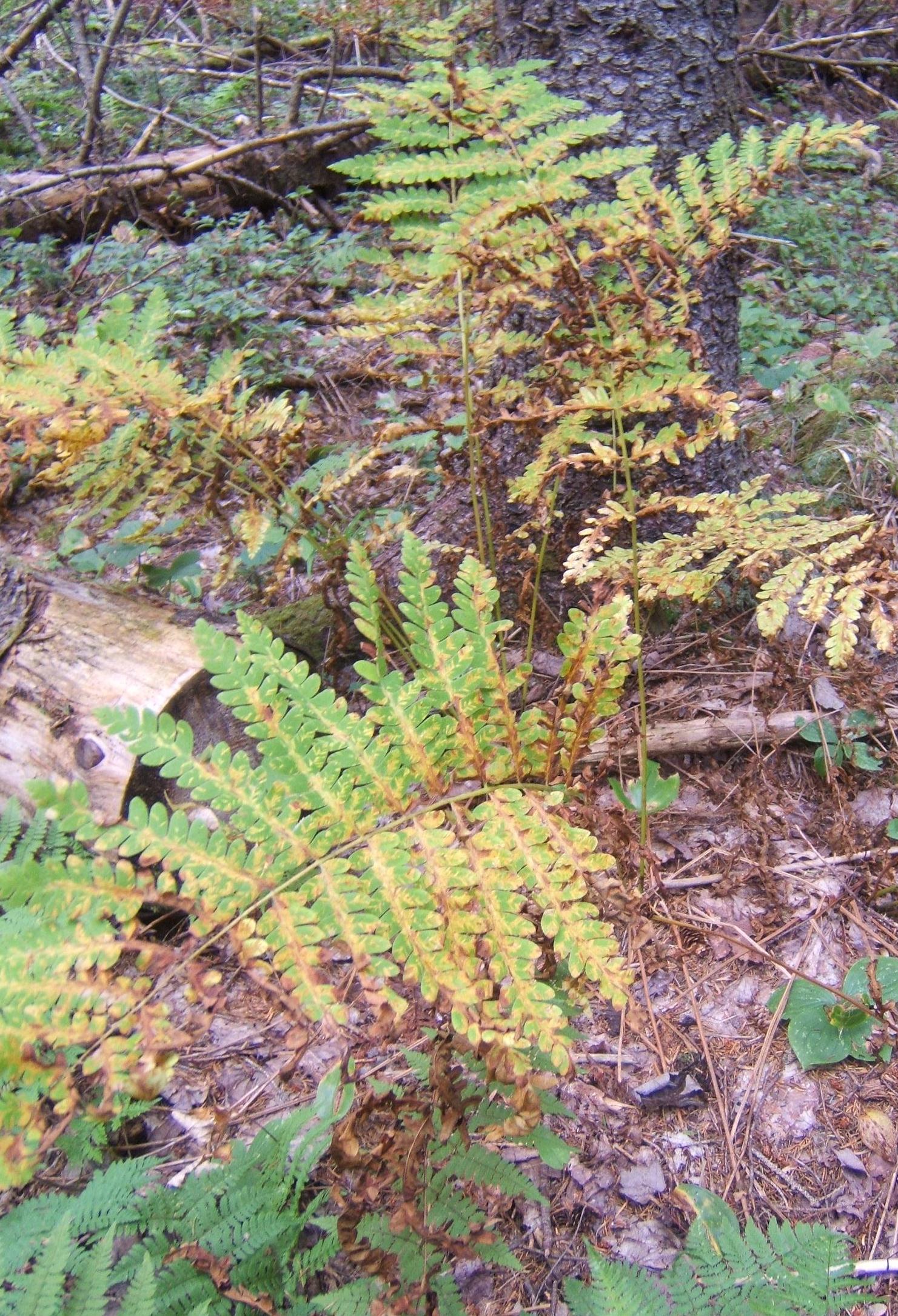
There are fallen red maple leaves on the trail and in the brook…

And the berries of Bunchberry (Cornus canadensis L.) are brilliant red…

- ‘red berries’

end of summer
~
on the path along the brook
one leaf bleeds into water
in town the walks are stony
chaff of linden, seeds
dry ditches overflow with flowers
~
I shrug
(no matter
summer is ended)
~
yellow rattle
pods and grasses
rehearse an incantation
wind sulks in corners of the shed
warmth and sun
paint the orange of pumpkins
knit winter mittens
~
I gather signs of autumn
asters, windfalls, flocks of red wings
frantic in the alders
acorns, hollow galls from oak
~
Orion peeks above the trees
time forgotten, found
and summer with rain never ends
~
I ask for rain
(arms loaded with everlasting)
~
© Jane Tims 2010

'oak leaves and acorns'
course of the creek
Our small cabin is near a lake, an offshoot of the Saint John River. We have what some would consider poor access to the lake, since there is a marsh between us and the lake shore edge. But that marsh is a very special place, ever changing and always interesting.
One way it changes, almost daily and certainly seasonally, is with respect to water level. You could say we are downstream of the entire Saint John River, meaning we are receiver of every fluctuation of the water level in the system. The situation is made complex by the influence of a major hydroelectric dam at Mactaquac.
In spring, the river floods, and the marsh is covered by water…
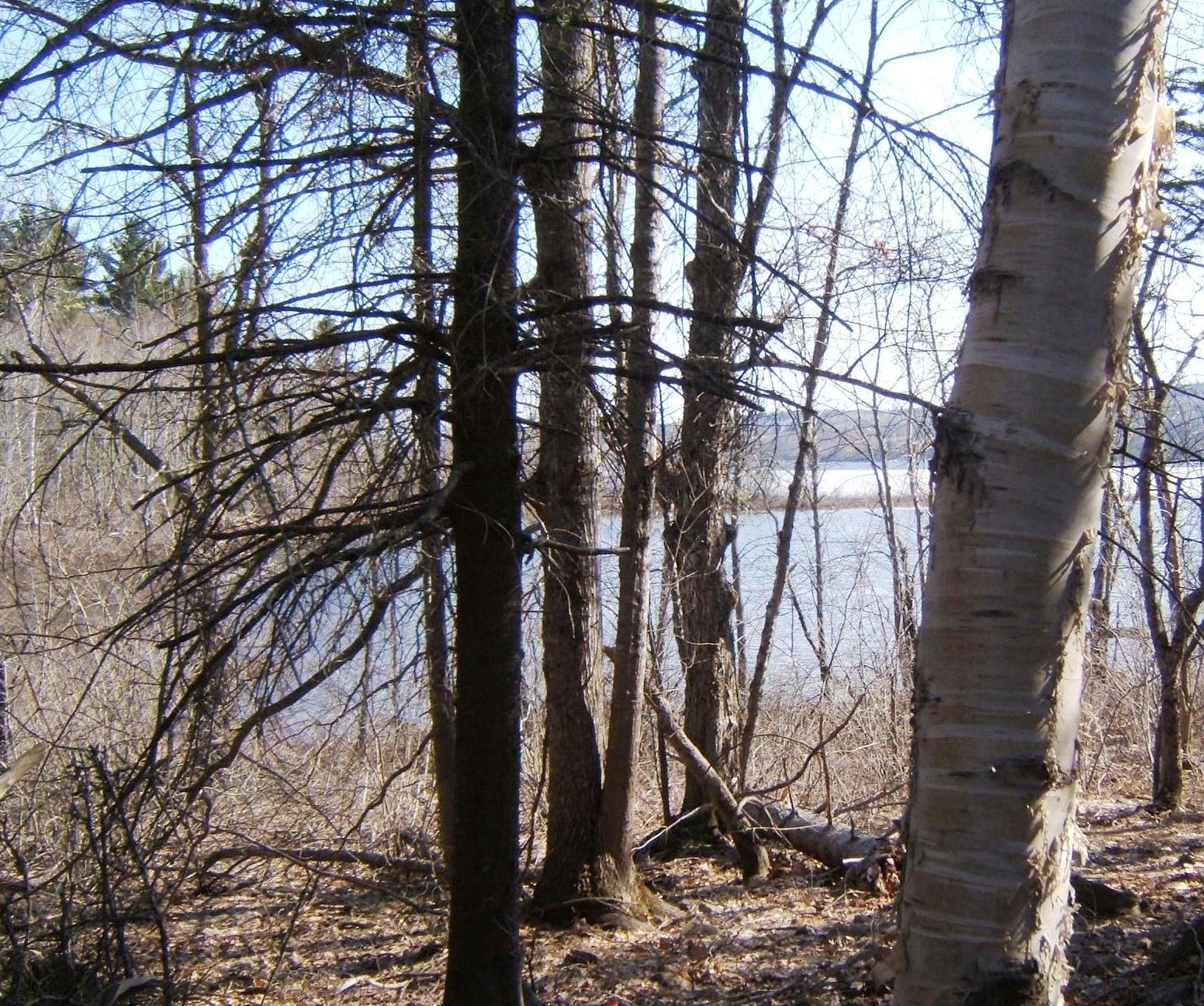
In normal years, the water levels become quite low, and our marsh is high and dry. We can walk on it, to reach the outer shore of the lake…

the green in the foreground is the marsh
In wet years, like this has been, the water stays high and there is a pond between us and the main lake…
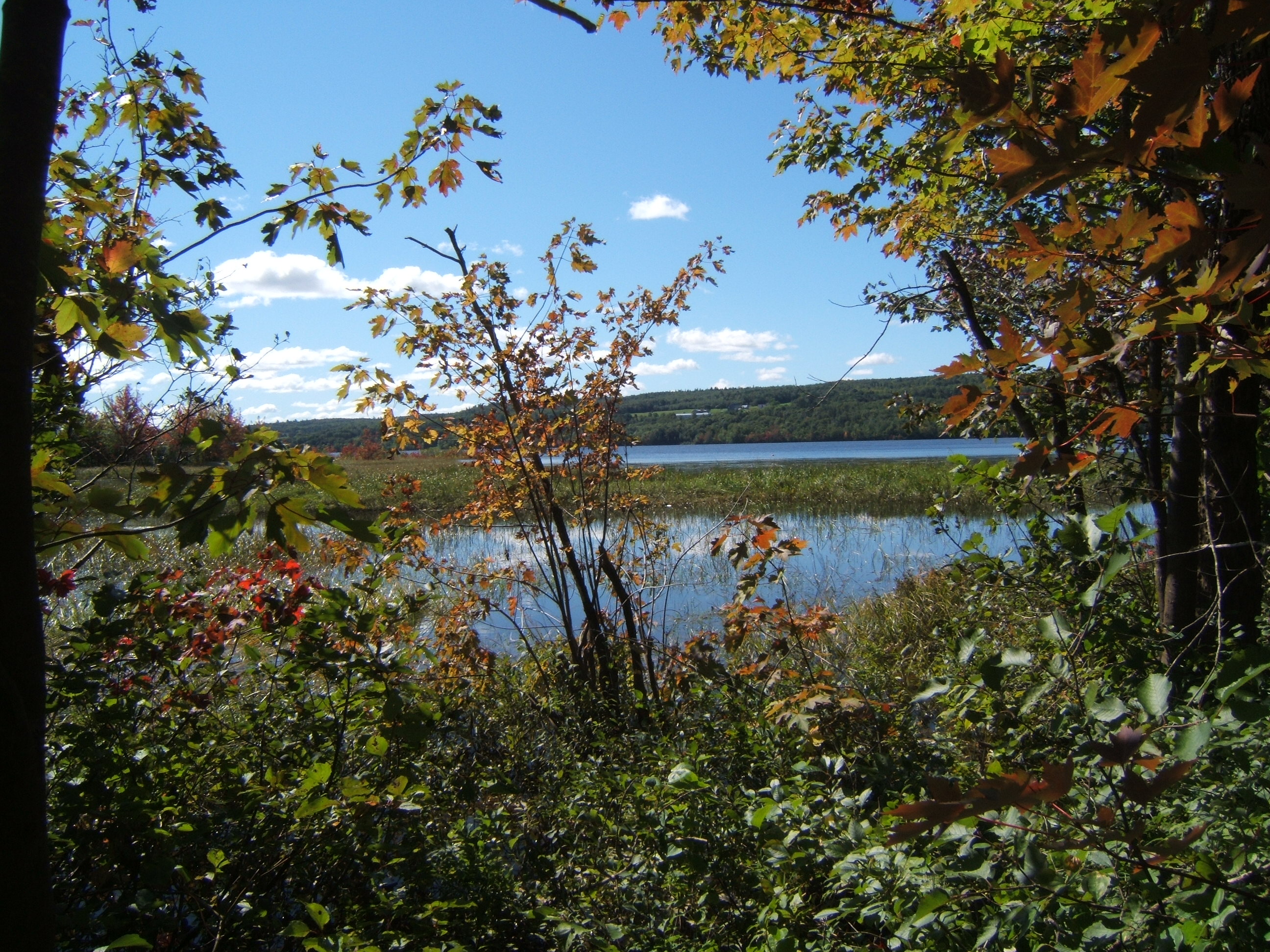
On Saturday, I went rowing on the pond in my small red rowboat. I rowed out to the edge of the lake and then followed the deeper waters of the small winding creek back into the marsh as far as I could go without grounding the boat. Last year I could see pumpkinseed sunfish in the creek water, but not this time.
Most of the grasses in the marsh are Spartina pectinata Link., broad-leaf cord-grass, ordinarily associated with salt marshes. Actually, salt water is characteristic of the lower parts of the Saint John River – the salt water wedge extends as high as Washademoak Lake, and the tidal influence is measurable to above Fredericton!
At the outer shore of the pond, where the creek enters the lake, I was surprised and delighted to find a few stems of wild rice (Zizania aquatica L.). This is not native to New Brunswick, but is often planted along shores to attract waterfowl and is now found all along the Saint John River and in many lakes. The grass is distinctive because the pistillate (female) flowers are in a group near the top of the plant while the staminate (male) flowers are on horizontal banches below.
I am an awkward rower. Usually, to improve my control and reduce my speed, I row the boat backward, stern first! In spite of my lack of speed, it is an adventure to be on the water, to become a bit of an explorer. My need to know the ways of the pond reminds me of my attempts to understand the path my life has taken.
characteristics of creek
~
clumsy row in the marsh pond
to seek the course of the creek
the strand of water’s flow
to nourish pond define
its shape conduit
to the lake
~
a slender S through grass emergent
pondweed and cord-grass vague
deviation from clarity hyaline the interface
of freshwater and salt and pumpkinseed
turn their flat bodies to intercept
the flow find the break in the mat of sedge
narrow simplicity of weed-free bottom
~
search
and find
the inevitable
thread in flow of
story the theme to bind
the words and water into one
~
© Jane Tims 2011
crossing the river
In New Brunswick, the Saint John River watershed accounts for more than one-third of the province. It is a majestic river, almost 700 kilometers long, beginning in Maine and Quebec as small tributaries and gradually gaining in width and volume as it flows towards the Bay of Fundy.
One of the best things about living near the Saint John River is its cable ferries.

There are several bridges, of course, but no means of transport across the Saint John River can compare with the mini-voyage experience of crossing the river on a summer day with the wind in your hair and the dazzle of water in your eyes. It is always interesting watching the ferryman packing the cars in like sardines on the busy days. There is usually some interesting local event posted on the bulletin board. And New Brunswick’s river ferries are free to ride!
In 1978, I made several trips on a ferry that was only in operation for a short time. This was the car ferry at Cambridge-Narrows on Washademoak Lake, part of Washademoak River, one of the large tributaries to the Saint John River. It operated for a few months after the covered bridge there was flattened in the Groundhog Gale of February 2, 1976. The new bridge was built shortly afterward in 1978 and only local people remember the ferry.
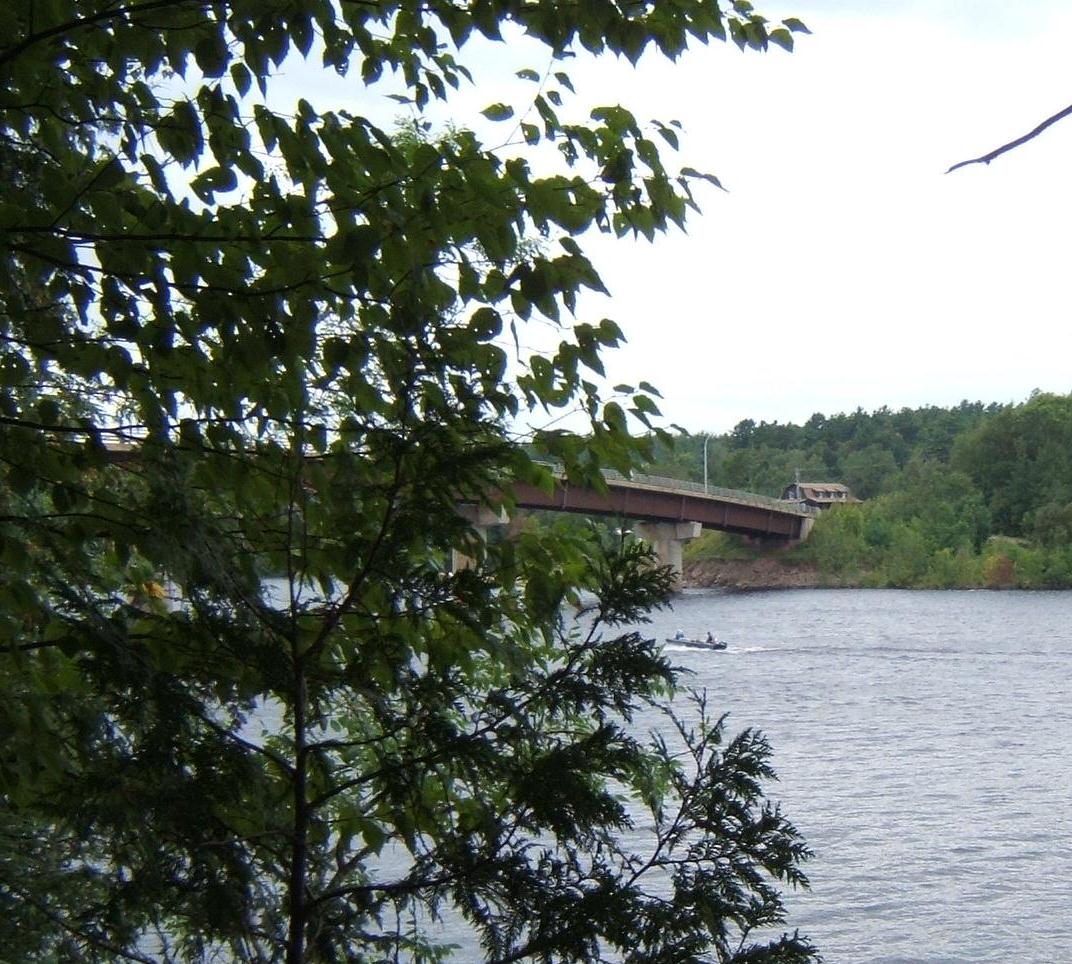
However, I remember the ferry at Cambridge-Narrows very well. I wrote the poem ‘Lights on the Lake’ one evening as I took the ferry across the Narrows and felt the peacefulness of the small community winding down from the summer season.
For a short history of Cambridge-Narrows and a photograph of the covered bridge after it was destroyed by the Groundhog Gale, see
http://www.imagine-action.ca/IAAppContent/274/BookletVII_Legacy%20of%20HistoryFinal.pdf
Lights on the Lake
~
1.
~
twilight
fairy bulbs on masts
sunset on sail
amber to trace
the ferry’s quiet crossing
~
dusk
leaded porch lights
propane glow
twin headlights
joust along the cottage road
~
darkness
strings of lantern
patio voices, clinking and laughter
fires on the beach
sparks stirred toward the sky
~
moonlight
waves flirt with stars
Aurora Borealis leaps
fireflies blink
brief messages of love
~
2.
~
comes an evening at summer’s end crowd and fireflies are gone night storms shuttered windows
darkened doors the charred remains of fires
on the shore
~
and through the trees a ruby gleam
a choir practices its song
~
© Jane Tims 1978
cascade across the rock
Earlier this summer, in July, we visited Little Sheephouse Falls, northwest of Miramichi. The Falls are part of the watershed of the South Branch of the Big Sevogle River.
To see Little Sheephouse Falls requires a short hike through mixed woods. The trail to the Falls is very well maintained by the forest company who manages the area and was an easy walk in spite of my arthritic knees.
The woods were green with ferns and other woodland plants. My favourite of these was a little vine of Mitchella repens L. cascading across a lichened rock. Commonly known as Partidge-berry, Mitchella is a small vine with roundish opposite leaves, often found growing in shady, mossy woods. It has pinkish flowers and small red berries. The Flora I consulted says it is found where it can be free from the competition of more vigorous plants.

Mitchella repens growing across a rock in the woods
We did not go to the base of the falls, but kept to the trails navigating the escarpment. The falls are about 20 meters high, with a large pool and a cave at the base. They were a white torrent on the day we visited, making a rumbling thunder in striking contrast to the quiet woods.

Little Sheephouse Falls
Directions to Little Sheephouse Falls, and other waterfalls in New Brunswick, are contained at Nicholas Guitard’s website http://www.waterfallsnewbrunswick.ca and in his 2009 book Waterfalls of New Brunswick (see ‘books about natural spaces’).
Waterfalls are spaces to soothe the soul and inspire love for natural areas. They engage the senses… the sounds of the gurgling stream and the roar of the waterfall, the feel of cool, clean water, and the sight of water bubbling and boiling, following the contours of the landscape.
the three fates, spinning
~
1.
wound on the rock
mended by waterfall thread
~
2.
at last I touch
the water
real, wet water
(not a report or diagram
but the flavor feel and smell
of water)
~
it pours through my fingers
delivers to me
the mosses
the lichens
(the moth on the pin where she has always
wanted to be)
~
3.
the doe must feel this
as she crosses
the road-to-nowhere
when the birch and aspen enfold her
~
or the ant
as she maps the labyrinth
on the rotting morel
when she touches the ground
(blessed ground)
~
or the needles of white pine
when they find the note
split the wind into song
~
4.
the three fates
spinning
~
the waterfall
diverted by the rock
~
Published as: “the three fates, spinning”, The Antigonish Review 165, Spring 2011.
(revised)
© Jane Tims

needles of white pine...split the wind into song





 nichepoetryandprose