Archive for the ‘in the grey woods’ Category
songs in the grey woods – black-throated green
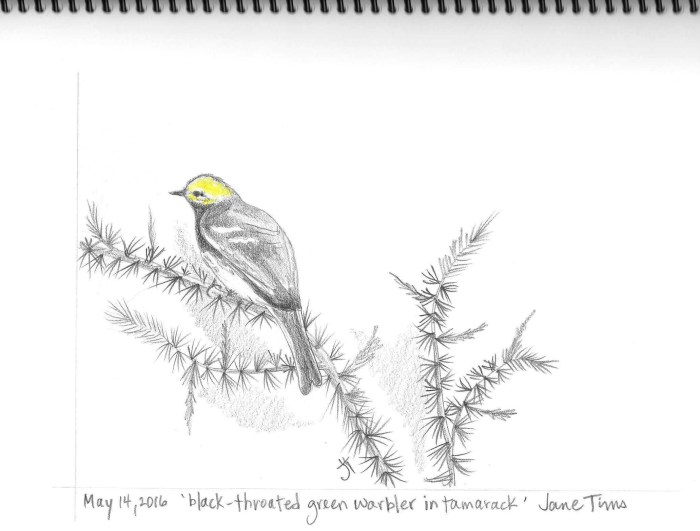
Our grey woods are noisy this week. White-throated sparrows, nuthatches, ovenbirds and chickadees. Loudest of all is a black-throated green warbler. He says, in his raspy voice, at intervals of about ten seconds: zee-zee-zee-zee- whee-zee, also a more musical dee-dee, dee-dee, doo-dee (the doo a note lower than the dee). He perches near the tops of the tamarack and red maple trees.
~
~
I sat on our deck a long while, and finally caught him as he paused in a red maple. He had a bright yellow head and looked back at me over his white wing stripe before he flew away. I also get an occasional glimpse of him as he flies from tree to tree. His best features are his yellow head, the two white stripes on each wing, and his black throat.
~

~
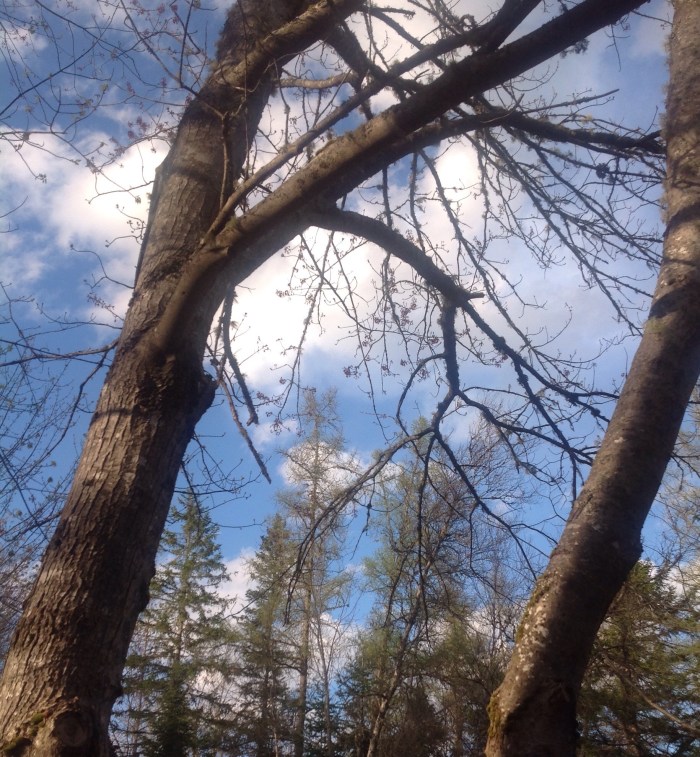
a view of the tamarack trees and spruce where the black-throated green warbler is singing – the red maple is just starting to leaf-out
~
Copyright Jane Tims 2016
edible wild – spruce gum
In my part of North America, we have freezing temperatures and snow on the ground from December to March. With a few exceptions, most plants go into sleep mode during these months and foraging for edible plants is difficult. You can dig beneath the snow to find a few evergreens, but most of the edible wild is above ground.
~

~
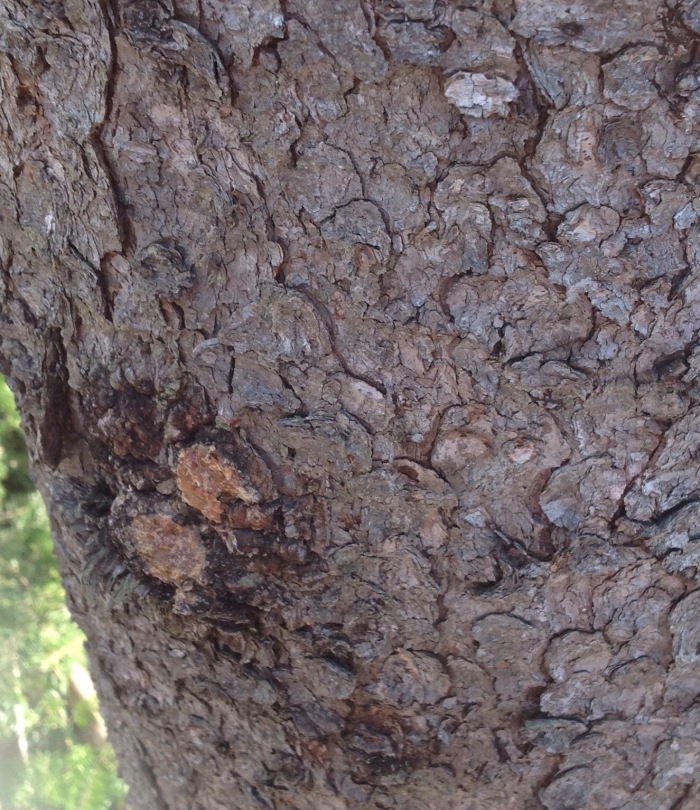
When I am in the woods, even in winter, I am always on the look-out for spruce gum, a natural sugar-free treat from the forest. Spruce gum is found, as the name suggests, on spruce tree bark. We have a large stand of spruce in our grey woods, but the tree below grows, conveniently, beside our driveway. For a map of our woods, see the right hand column ‘map of the grey woods’.
~

~
When a branch is broken or the bark is wounded in some way, the spruce oozes a sticky resin that eventually dries to a hard amber-coloured nodule. These nodules can be harvested and chewed like gum. My mom taught me about spruce gum, how to identify the spruce tree and to look for the sticky dark lumps where resin is hardening.
~

~
It is possible to collect a quantity of spruce resin, pulverize, melt and strain the substance, and solidify it, cracking it into bite-sized pieces. I chew the nodules right from the tree, with a little scraping to get rid of any rough bits. At first the gum is hard and crumbly, sticky and intensely aromatic, a little risky for dental work and made interesting by the accidental inclusion of bark bits. After a few minutes of chewing, the gum becomes pliable, woodsy-tasting and orange to pink in colour!
~
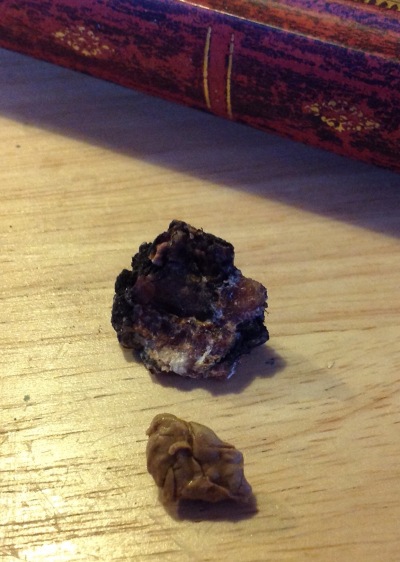
photos of chewed gum are a bit disgusting, but I want to show what normal-looking gum a two-minute chew produces. A rough nodule is shown above the chewed gum for comparison.
~
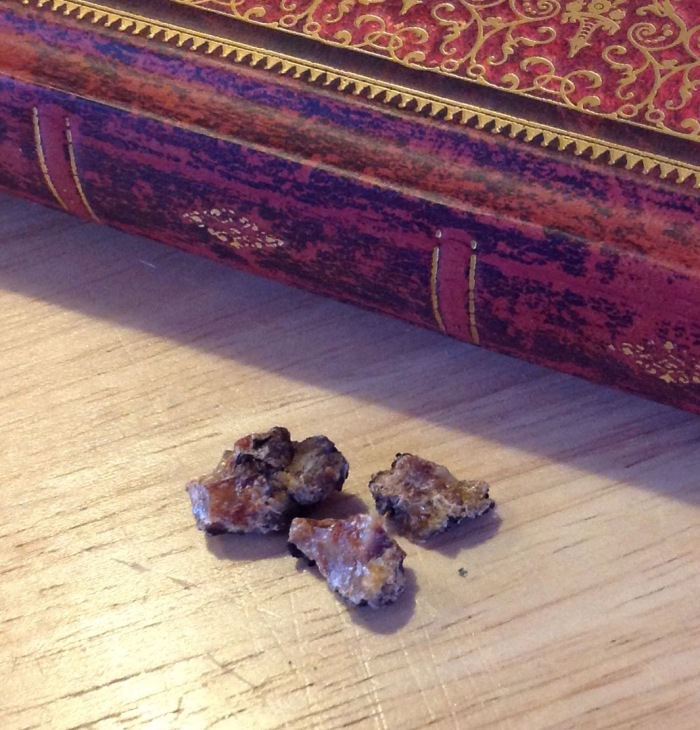
People of the First Nations have always known about this woodland edible and used it for medicinal purposes. In the nineteenth century, spruce gum was harvested with long handled spruce scrapers and sold commercially. Woods-workers made small carved boxes with sliding tops (gum books) to carry and store the resin nodules.
~
Robert Frost, wonderful poet of all things rural, wrote about spruce gum (‘The Gum Gatherer’. Mountain Interval. New York: Henry Holt and Company, 1916):
He showed me lumps of the scented stuff
Like uncut jewels, dull and rough …
~
You can find the rest of the poem at Project Gutenberg http://www.gutenberg.org/files/29345/29345-h/29345-h.htm
~
~
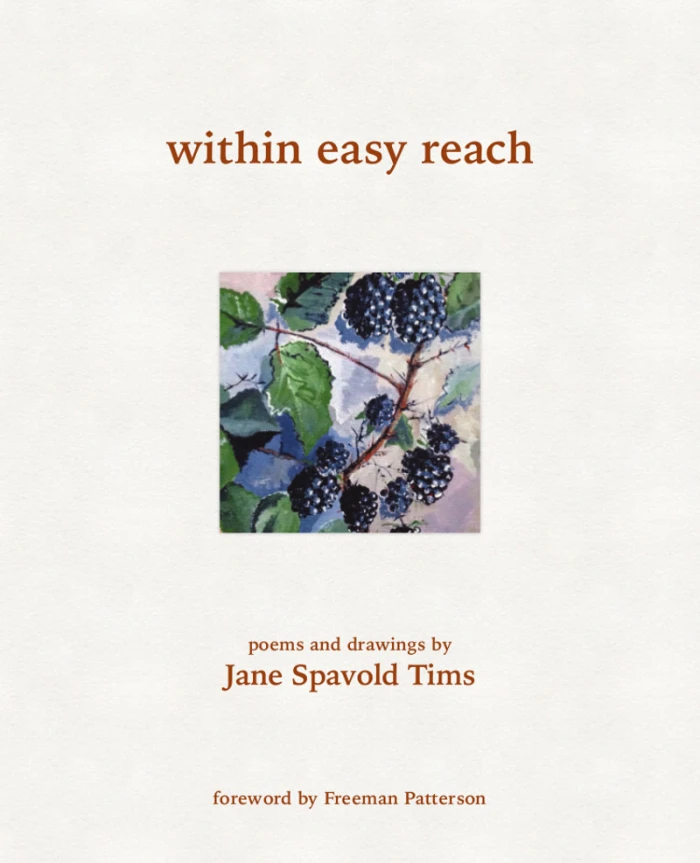
My upcoming book of poetry within easy reach includes a poem about spruce gum. The poem begins:
Black Spruce weeps if wounded
oozes to heal, embeds
pain in amber …
~
As I wait for spring, I intend to ration my small store of spruce gum and use it as a kind of countdown toward the end of our winter weather.
~

some very clean seeps of resin – these will harden eventually and make great spruce gum !
~
~
Copyright 2016 Jane Tims
morning chorus
Each morning I have a short quiet time after rising. I spend this time in my guest bedroom. I do some stretching. I watch the sun rise among the trees. And I try to sort out the morning bird chorus.
~

~
The morning bird chorus is known to be a complex social interaction among birds of various species – a communication we humans can listen to with wonder, but little understanding.
~
We have lots of birds in our area and the woods are thick with birdsong. Although ours is a residential area, we have many hundred acres of woodland behind us and no houses between us and the river. Our back woods are mixed conifer and hardwood, mostly balsalm fir, spruce, red maple and white birch. We have nearby wetlands and, of course, the river.
~

~
I now regret not learning to identify the birds from their songs earlier in my life. Although I can name many birds by sight, I have a feeling I know many more by their sounds. This summer I have tuned up my ears and spent lots of hours trying to learn to recognise the birds by their songs. Perhaps because of their variety and complexity, learning the songs is more difficult than just listening and comparing. Once I have heard a few birds, my memory becomes jumbled trying to distinguish between them.
~
I use three main tools to help me identify and remember bird sounds.
- mnemonics – short phrases to describe and remember various bird songs. These phrases help narrow down the possibilities when I hear a bird sing. Many lists of bird song mnemonics exist, but I like the simple listing from the Fernbank Science Center in Georgia http://www.fernbank.edu/Birding/mnemonics.htm
- recorded songs – although there are many sites with bird song recordings, the one I like the best is Dendroica- NatureInstruct http://www.natureinstruct.org/dendroica/spec.php/Dendroica+Canada#sp_select . Once you select a bird, you can hear calls recorded by birders in various parts of the range.
- a list of the calls I know and new songs I hear, described in my own words and with a diagram of the way the song progresses, in a shorthand of my own. I use words like: trill, flute, scratch, liquid, repetitive, bored, delirious …
~
The Cornell Lab of Ornithology has some excellent tips for those who would like to learn the songs of local birds.
http://www.allaboutbirds.org/Page.aspx?pid=1189#_ga=1.202457239.768663648.1437046200
They suggest listening for rhythm, tone, pitch and repetition of a bird song. By listening for these qualities, one at a time, you can start to make sense of the variability and help your memory.
~
Here is a list of the participants in this morning’s bird chorus outside my window:
- odd high-pitched sound at the first grey light of morning, probably not a bird
- immediately, an American Robin – ‘chirrup, cheerup, cheery cheer-up’ – we have a nest of robins at the start of our woods road
- a Mourning Dove, intermittent – ‘oo-oo-hoooo’ – very sad sound – a pair perches on the wires along our main road
- a White-throated Sparrow – ‘I love dear Canada-Canada-Canada’
- a Hermit Thrush – an ethereal, flute-like phrase, repeated over and over, each time at a new pitch – close at first and then gradually moving further away
- an Eastern Phoebe – a nasal ‘fee-bee’, repeated – a nest in the eaves of our shed
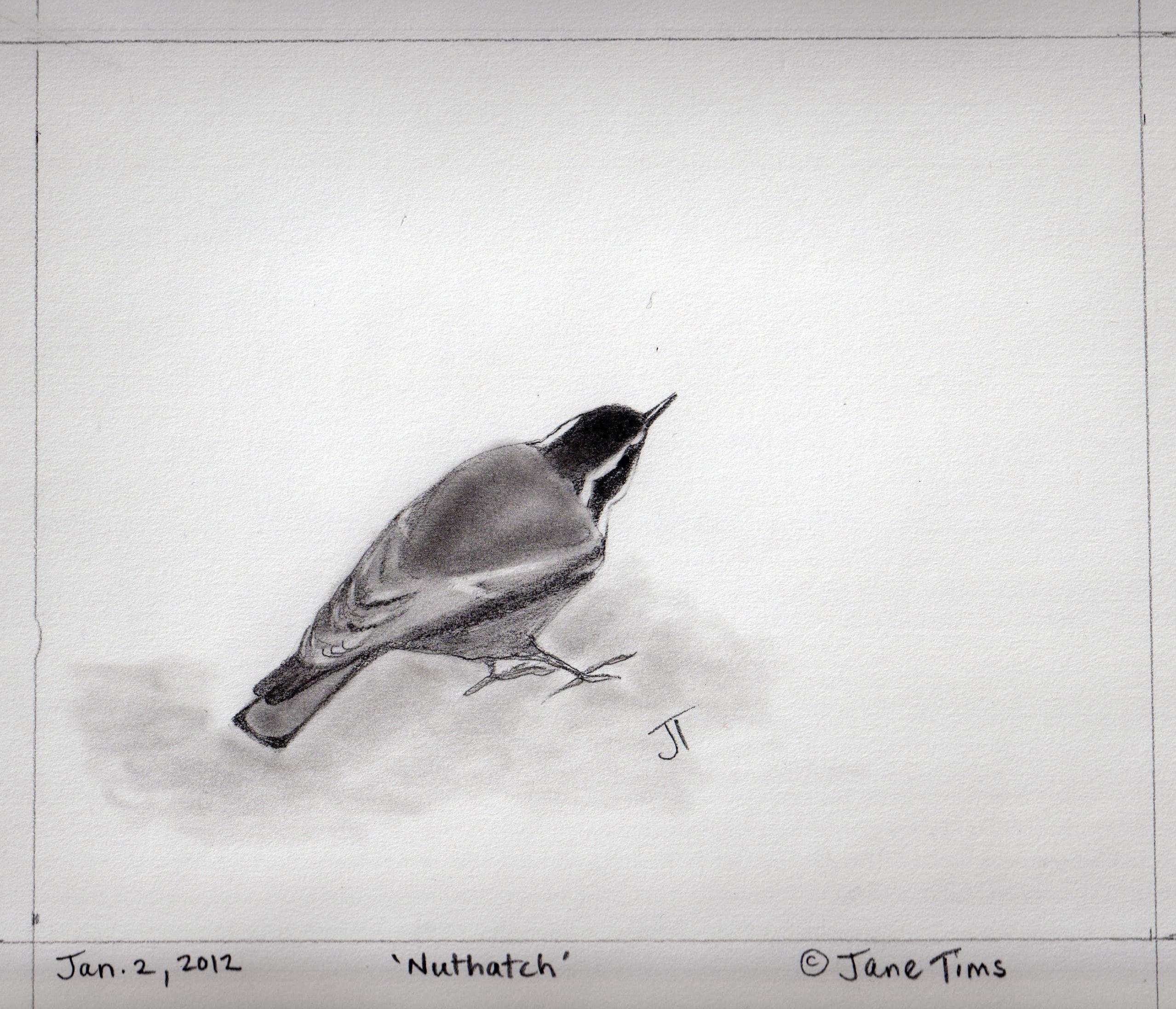
- a Red-breasted Nuthatch – a monotonous low-key ‘yank yank yank yank’, like a cross between a bored duck and a bullfrog
- the ‘caw caw caw’ of a Crow
~
I wonder if you ever listen to the morning bird chorus. What birds do you hear?
~
~
Copyright 2015 Jane Tims
take flight, metal wings, take flight
A fellow blogger recently suggested a different way to present poetry in a post – to give a little background on the poem’s origins and perhaps show the evolution of the poem from draft to ‘final’ stage.
~
Sounds like fun!
~
The poem below began with a watchful eye. I am always on the lookout for an image to inspire a poem. Walking the path to the door of our house, my mind was on the rain, the warmish day and the forecast, an expected return to freezing temperatures.
~
I spotted the bird bath, full of leaves and melted water. And perched on the edge of the bird bath, a moulded metal bird. This bird is bolted to the edge of the bird bath’s copper rim. Presumably he is there to attract the real birds. But since no real birds use the bath, he is the only one ever there. My relationship with this metal bird is mixed. I like its quiet perching on the edge of the bath. I like its rusty patina. I don’t like its occasional disappearance when its metal bolt lets go. Then, I have a struggle to find its little metal body in the thick layer of leaves under the bird bath.
~
So this is the set-up for the poem – a day of January thaw, melt water everywhere and knowledge the metal bird will not stay put.
~
First, a photo of the metal bird. The words ‘take flight’ were bumping around in my brain and I knew I would have a poem from this. I want this poem to be about opportunity, about taking change and turning it into possibilities for an altered future.
~

I’m a poet, not a photographer …
~
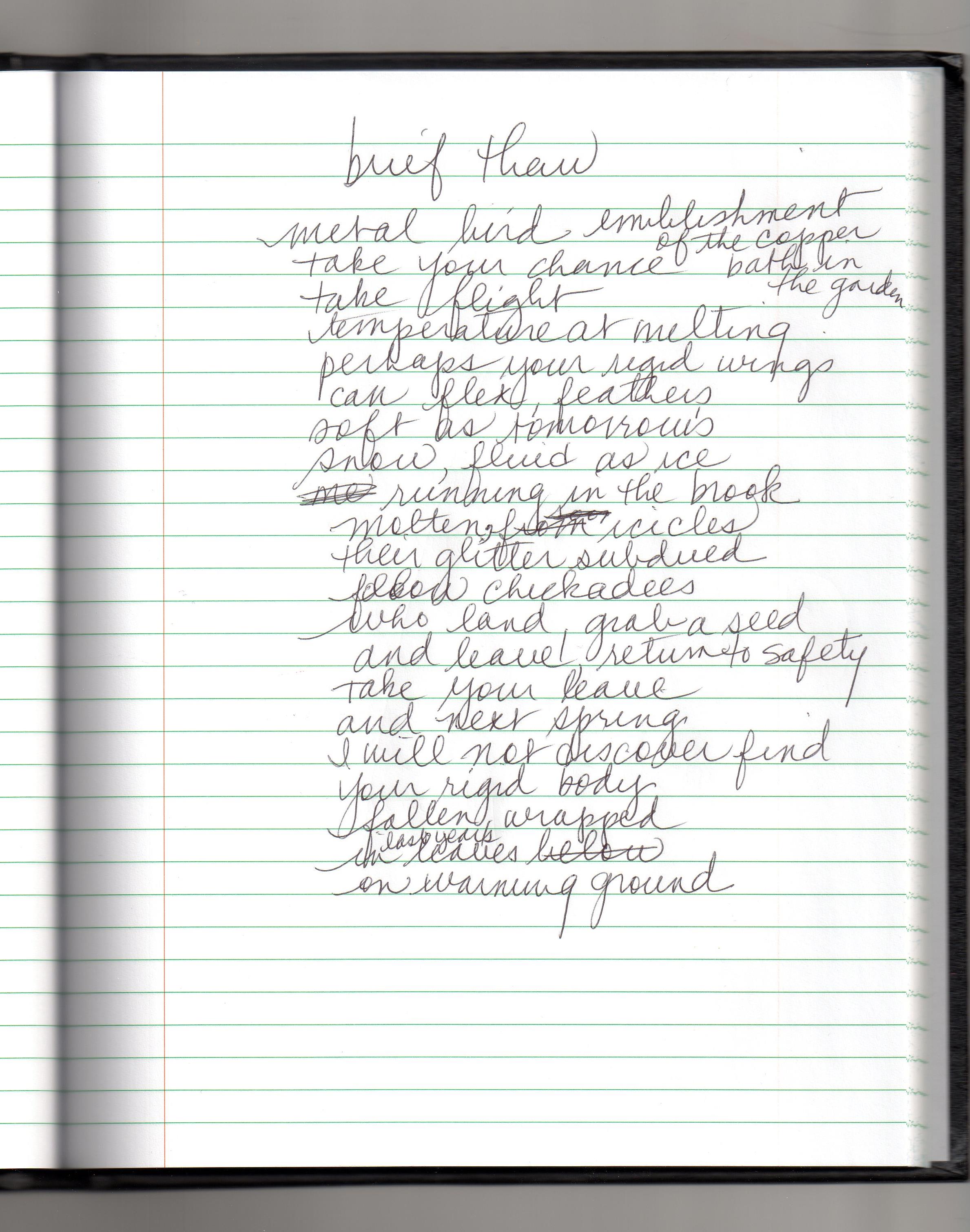
Then, I grabbed my ‘rough book’, the place where every poem I ever write begins. Sometimes, I hand-write several drafts, but in this instance, I felt like typing, so I copied the rough draft into the computer, almost word for word, but not quite.
~
~
brief thaw
2nd draft
~
metal bird, embellishment
of the copper bird bath in the garden
take your chance, your flight
temperature at melting
perhaps your rigid wings
can flex, find feathers soft
as tomorrow’s snow
fluid as ice now running
in the brook, molten icicles
their glitter subdued
follow chickadees who land
grab a seed and return to the
woods for safety, take your leave
and next spring I will not
find your rigid body fallen
wrapped in last year’s rotting
leaves on warming ground
~
So that is the rough poem. I like it. It flows, it contains some interesting metaphors, and it captures the possible flight and altered future of the metal bird. It needs editing.
~
For the next draft, I ‘press’ on words, getting rid of some, replacing others. I annotate the earlier draft, finding places where I like the flow, where I find internal rhyme or alliteration. In this poem, there are lots of words about metal, and I hope to include others. I change ‘ing’ words and the past tense to verbs in the present when possible.
~
brief thaw
3rd draft
~
metal (iron) bird, (silver-plated ?) embellishment
of the copper bird bath in the garden (doesn’t matter if it is in the garden)
take your chance, your (take ?) flight
temperature at melt (title says this)
perhaps your (rusted?) rigid wings
can flex, find feathers soft (fine?)
as tomorrow’s snow (when, last week ? next week ?)
fluid as ice, now running runs
in the brook, molten icicles
their glitter subdued
(take flight ?)
follow chickadees, who land
grab a seed (from the bird bath ????) and return fly to the
woods for (woods for ?) safety (of the trees ?) , take your leave (take flight ?)
and (and or/ore) next spring I will not (not ?)
find your rigid (rigid ?) body fallen (fallen ?), wrapped
in last year’s rotting muck rot of
leaves on warming (new-warmed?) ground
~
Well, I made a complete mess. Perhaps the fourth draft will be an improvement.
~
In the fourth draft, I incorporated the above ideas, and made a lot of changes. For example, I tried some different approaches to stanza … some of my poems are very irregular in their stanza breaks. I think this poem needs stanza breaks to help the reader. I also wanted to repeat ‘take flight‘ at intervals in the poem. Although I considered stanzas of three and five lines, my final decision, four stanzas of four lines, was based on the syllable counts of the lines and the sloping shape of each stanza. I am a rabid syllable-counter. I find it helps me decide what words are not needed at all and makes me consider alternatives.
~
brief thaw
4th and (for now) final draft
~
iron bird, embellishment
of the copper bird bath
take your chance
take flight
~
perhaps your rusted wings can
flex, find feathers, fine as
next week’s snow
take flight
~
molten as icicles from
the feeder where chickadees
seize a seed
take flight
~
or next spring find your metal
body rigid, wrapped in
last year’s rot
of leaves
~
take flight
~
~
Before I make further changes to the poem, I will read it aloud several times. The repetition of ‘take flight’ may have to go. Notice, I have not changed the title of the poem … that could change, although I like not mentioning the actual thaw in the poem. The title is a great place to add other information for the reader and I often forget this opportunity.
Do you have suggestions for other changes I could make to the poem? I welcome your comments!
~
Copyright 2015 Jane Tims
new layer of snow

~
Snow is gradually building on every horizontal surface. I love the contrast between umber bark and bright snow. If this layer of snow will only stay, the temperatures will seem warmer and the walking less slippery. And the movements of small creatures in our woods will be less ephemeral, better understood.
~

tracks in the snow
~
Copyright 2014 Jane Tims
sharing the grey woods

a poor photo of a ruffed grouse in one of the trees behind our house
~
We share our grey woods with so many plants and animals. Sadly, our interactions do not always benefit the wild life.
The big panes of glass in our picture windows have brought disaster to so many birds. If the sun shines just right, the glass is like a mirror. When a bird sees the reflection of trees and sky, it must think it is flying deeper into the woods. I find keeping the window curtains closed removes the mirror illusion and prevents some collisions.
Sometimes, we will hear a thump and by the time we investigate, the bird will have recovered. Sometimes the bird is not so lucky.
~
~
Heartbeat
~
alive in morning birdsong thud thud thudding in my ears
slow as a pulse then faster final beats too quick to count
a spruce grouse in the thicket on a mound of leaves
drumming for a mate
~
all day
I thought of him
and smiled
~
buried in evening birdsong a thud on the window
the partridge sighing in the grass
tail narrowed feathers ruffled at his neck oddly bent
fingers on his throat
faint flutter
blood from his beak
~
I smoothed him into a mound of dead leaves
inspected the window
a feather stuck to the glass
moved as though nostrils drew faint breath
~
nothing broken
~
~
Copyright 2014 Jane Tims
Arthur – caution: men working in trees
A milestone of our 2014 summer was certainly Hurricane Arthur (July 5). For an account of our encounter with Hurricane Arthur, see: https://nichepoetryandprose.wordpress.com/2014/07/14/arthur-during-the-storm/ and https://nichepoetryandprose.wordpress.com/2014/07/16/arthur-after-the-storm/ .
For six days after the storm we were without electricity and learned to live a different life, deciding how to allocate the power from our small generator and bringing water in from diverse places. The biggest long-term result of the storm, however, was the damage done to our big red maple.
~

~
The maple is at our front entry way. It has grown from a small sapling – my husband could circle it with thumb and forefinger when we built the house 35 years ago – to a huge tree. It is our best producer at maple syrup time and spreads a carpet of red leaves in a perfect circle in our driveway. Best of all, it has a ‘voice’. When I arrive home or leave, it ‘squeaks’ to me, the result of two branches rubbing together in the slightest breeze.
~

~
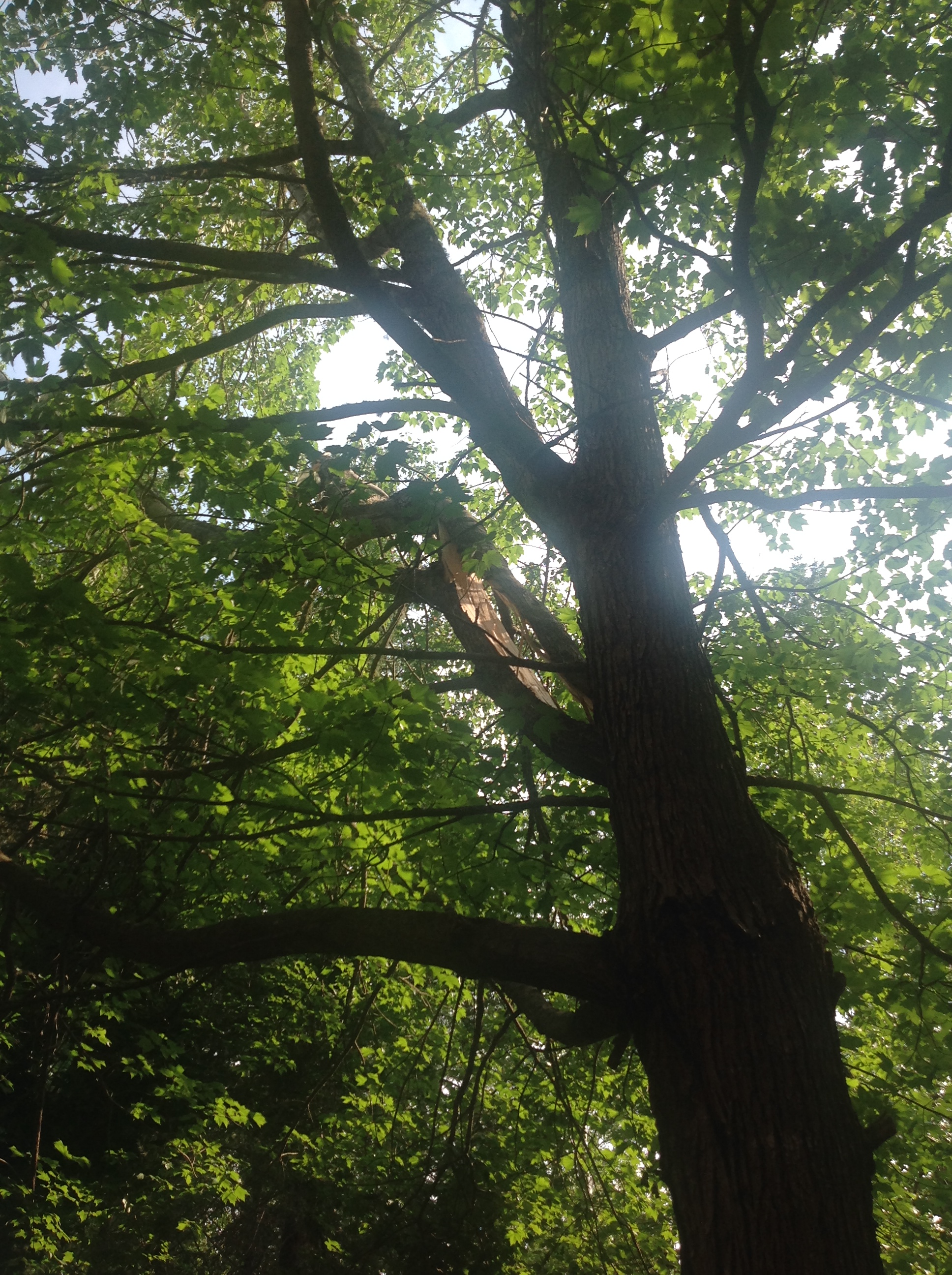
After the storm, we congratulated ourselves on how few of our trees were damaged. Then I looked out of the den window and saw – the winds had not spared the red maple – one of the big branches had a wide split in the wood.
~
~
At first, my husband thought he could take the big limb down himself. But after removing some of the smaller branches, it was obvious that trying to cut the branch ourselves would be dangerous. The tree is close to the house and power lines and there was no easy way to safely control the fall of the branch.
~

~
We decided to turn to the experts and called Treecologic, since they are fully insured. They also have a trained arborist and an excellent reputation. Their Vision statement is ‘promoting a safe & healthy urban forest’, so they were the tree removal company for me! For more information on the company, see http://www.treecologic.ca/.
Since there have been so many people in the Fredericton area with downed trees because of Arthur, we knew it might be some time before Treecologic could help us. We spent August through October keeping vehicles away from the risk zone under the tree. On Halloween night, we put up ‘Caution’ tape to keep the spooks from danger. And every day I tiptoed to our front door, convinced I would hear a crack as the branch came down on my head!
Then, as promised, Treecologic arrived, ladder, chain saws, climbing ropes and all. They worked for almost three hours, taking down a big white pine tree planted too close to the house and trimming branches from some of our other maples.
~
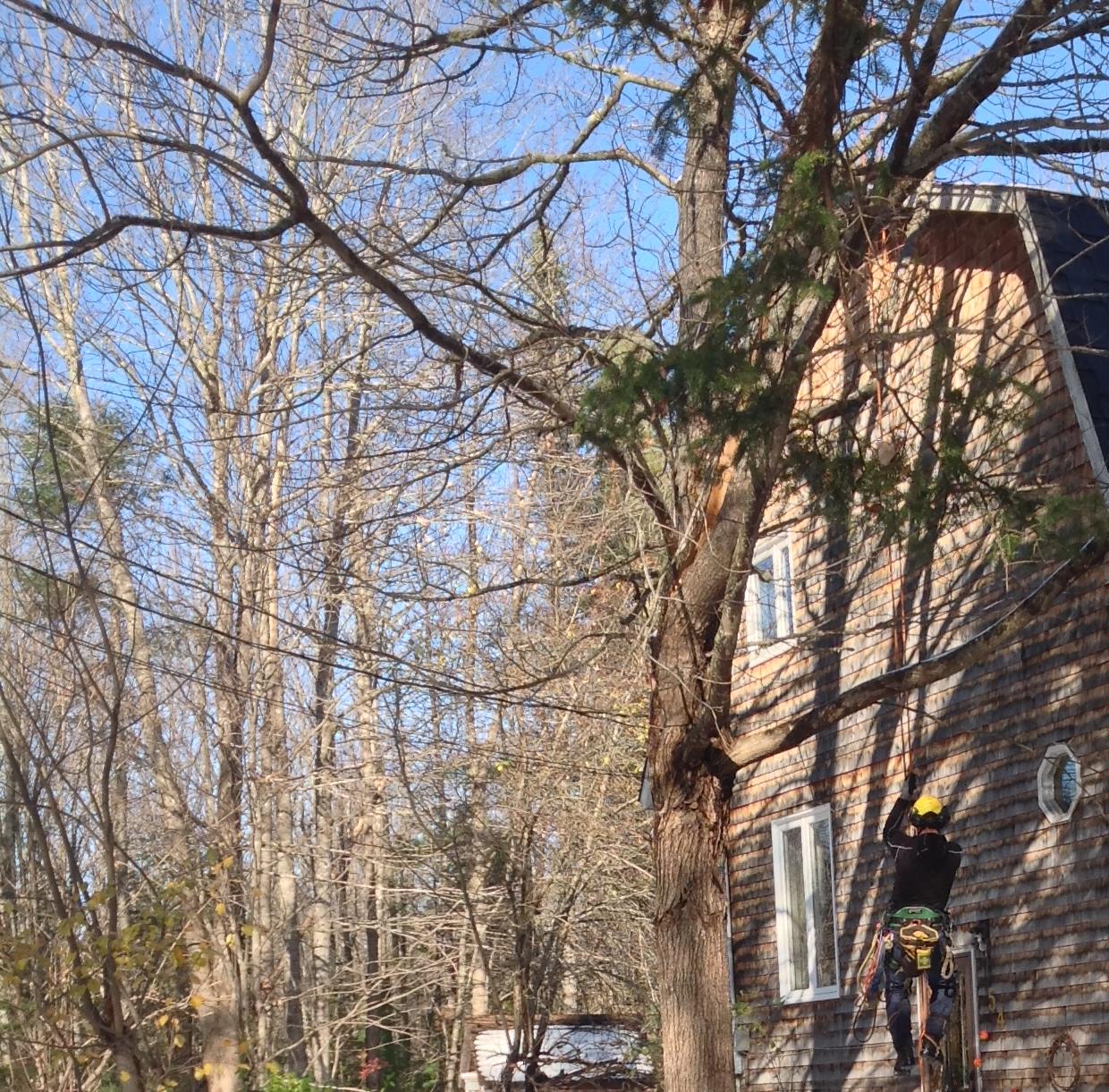
Then the arborist fixed a line in the highest branches of the red maple, put on his climbing belt and hoisted himself into the tree.
~
~
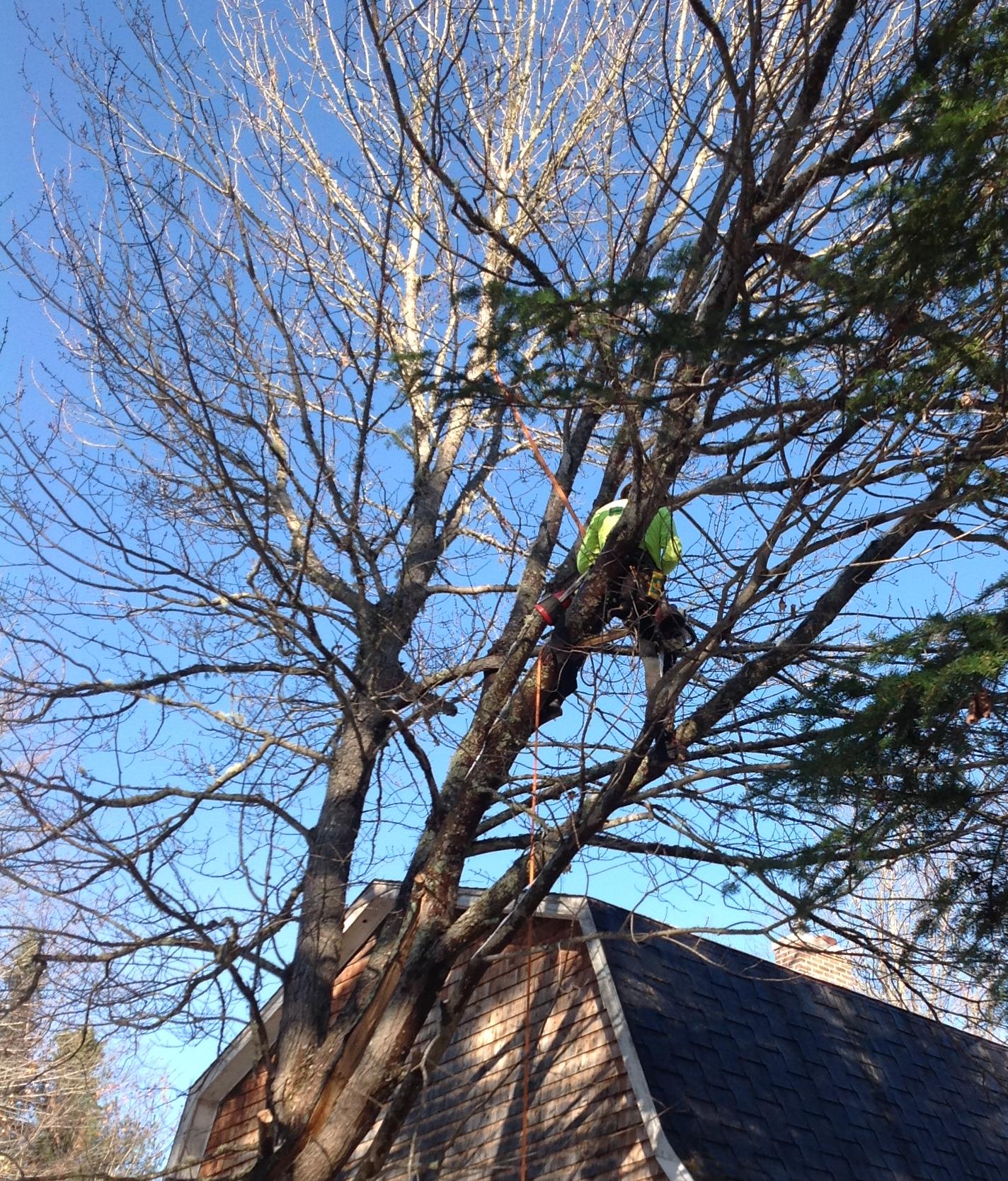
Every move he made was calculated for safety and for the health of the maple. Working his way through the tree, using a very sharp pruning saw, he gradually removed the smallest branches, including some which were scraping against our roof.
~
~
At first I felt alarmed to see a man in our very tall tree, but after realising how carefully he worked, I began to enjoy watching the process. To be an arborist, I now know, requires an understanding of the tree’s biology and health, but also dexterity, strength, flexibility and fearlessness.
~

~
At the last, he tackled the split branch, first removing remote branches, then finishing with the chainsaw from a ladder. Great work, Treecologic !
~

~
Our tree will take a while to recover from it’s adventure with the hurricane. Losing almost a third of its canopy will mean a couple of years of rest before another pruning. No tapping for maple sap for the next few springs! Meanwhile, the pruning has given us lots of hard wood for next year’s wood stove and, once they dry out, lots of kindling and twigs for my campfires! Some will go into our wood chipper to add to the soft surface for our trails.
And, in case you were wondering, the tree still has its ‘voice’ since the branches that rub together remain!
~
~
Copyright 2014 Jane Tims
a moment of beautiful – ice windows on woodland pools
the space: pools of water in the Grey Woods
the beautiful: patterns in the thin ice
~
While we wait for a lasting snow in New Brunswick, ice defines the season. On every pool of standing water, ice-windows have formed. I love the patterns these make against the amber-colored water! These are photos of ice windows taken last spring, after the snow had gone.


Copyright 2013 Jane Tims
a moment of beautiful – through a stained glass window
the space: the big maple outside our front door
the beautiful: seeing a squirrel in the tree through the stained glass window in our stairwell
~
As I was working at my desk, my husband called to me. Through our stained glass window, he could see a silhouette of our grey squirrel. I’m glad the squirrel waited long enough for me to snap his picture!

Can you see the squirrel through the stained glass?
© Jane Tims 2013
a moment of beautiful – a button of moss
the space: at ground level, in the grey woods
the beautiful: a little button of moss, emerald green
~
Mosses are a beautiful, enigmatic group of plants. Except for a few well-known species, they simply grow unnamed and unnoticed by most people. The beauty of the mosses, especially under the stereo-microscope, where you can see so much detail, was what attracted me to the study of botany in the first place.
We have many species of moss in our Grey Woods. I long to be able to take the time to identify every one. For now, though, I content myself with a few common names and some of my own ‘made-up’ names.
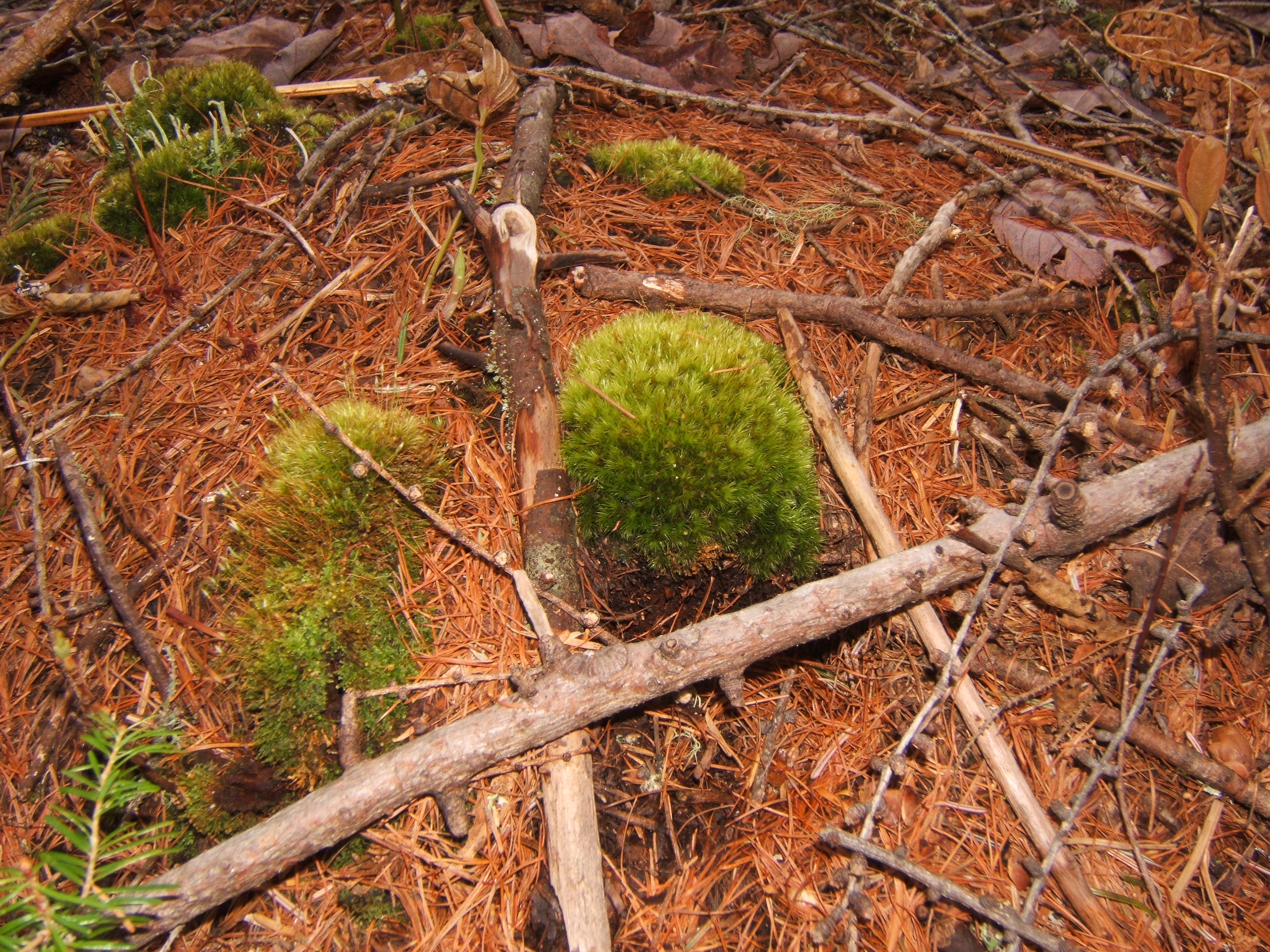
I call this little moss ‘The Button’. Wherever I find it, it seems to grow in a little cushion. Its surface is like velvet and its color is a lovely shade of lime green.
~
~
a button to press
~
resist the urge
to depress this plump of moss
firmly with a finger
~
will take you up
to the first floor
where the bunchberry blooms
or the second where bracken
planks an ephemeral floor
or the 67th where leaves align
precisely with sun
~
or down
to where the roots criss-cross
in confused abandon
~
~
© Jane Tims 2012




 nichepoetryandprose