Archive for the ‘crossing the river’ Category
a walk through the covered bridge – Smyth Bridge, South Branch of the Oromocto River
On our August drive along the South Branch of the Oromocto River, we crossed two covered bridges. I love these bridges… they are picturesque and so pleasant to walk through. They are also part of the local history of many communities in New Brunswick. I’ve talked a little about covered bridges before in my Blog – please have a look at https://nichepoetryandprose.wordpress.com/2011/09/05/inside-the-covered-bridge/
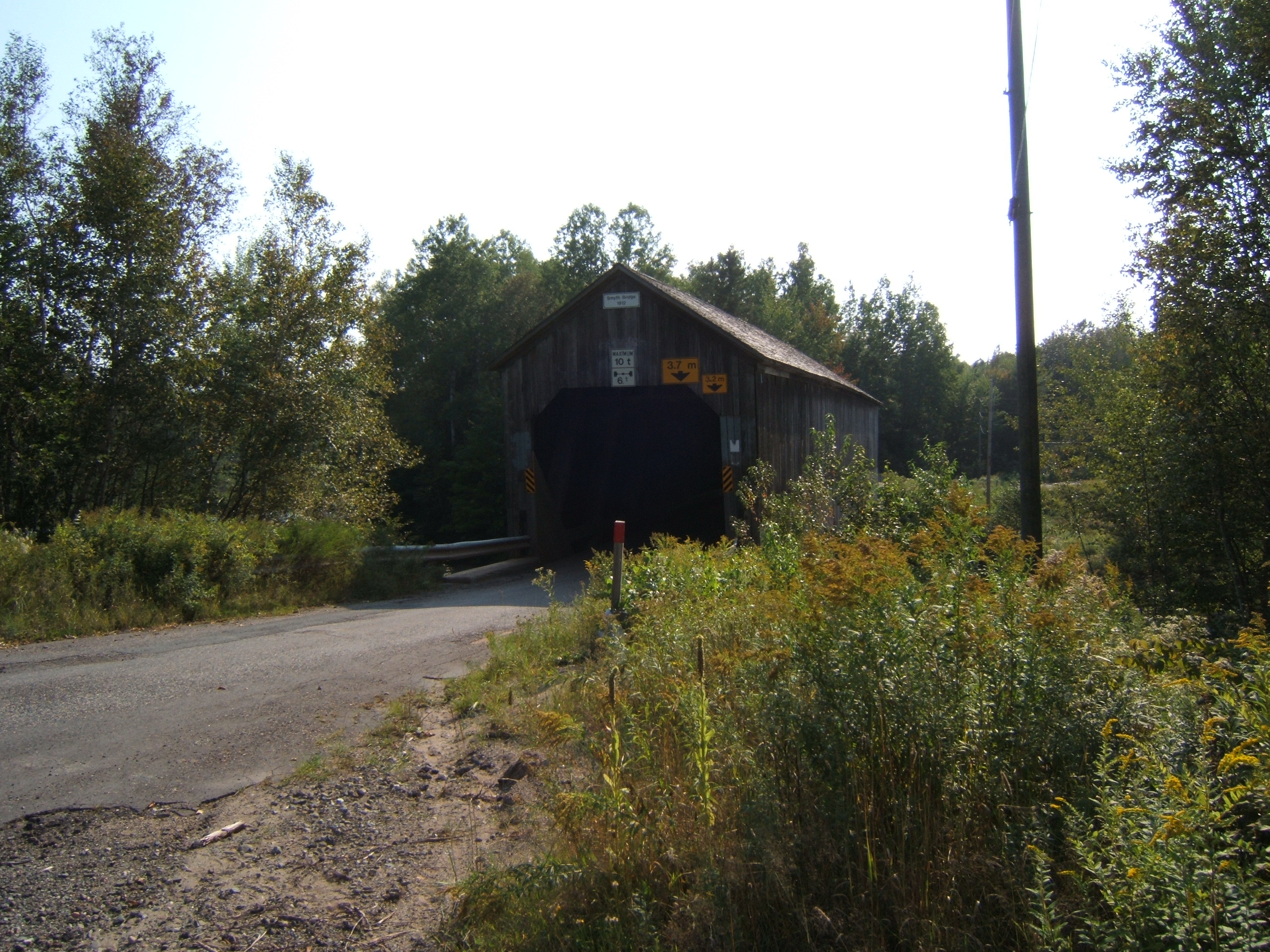
One of the bridges we saw on this drive was the Smyth Bridge. It crosses the South Branch of the Oromocto River, near Mill Settlement in Sunbury County (listed as South Oromocto Rover #2 in the April 1992 pamphlet ‘Covered Bridges in New Brunswick’, no author indicated).

Inside the bridge, it is cool and dark. When a car drives through, you hug the side, hoping the driver will see you and slow down. I love the sound of the tires on the timbers making up the floor of the bridge.

Down-river, the shallow water of the river glows in the sun. Most of our local rivers are the color of tea, a consequence of their origins in wetland areas.
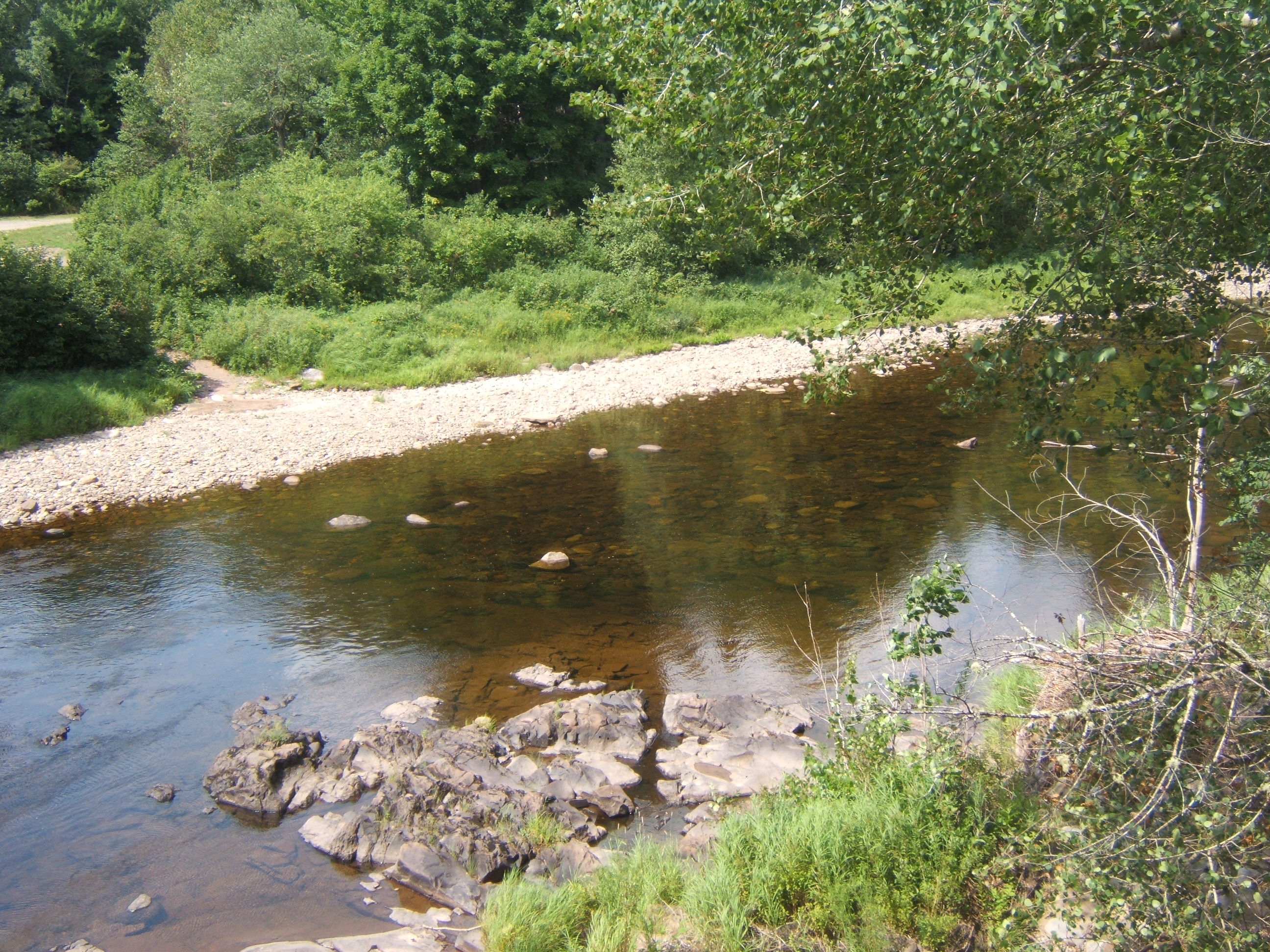
Up-river of the Smyth Bridge is a gravel beach and water for wading and swimming.
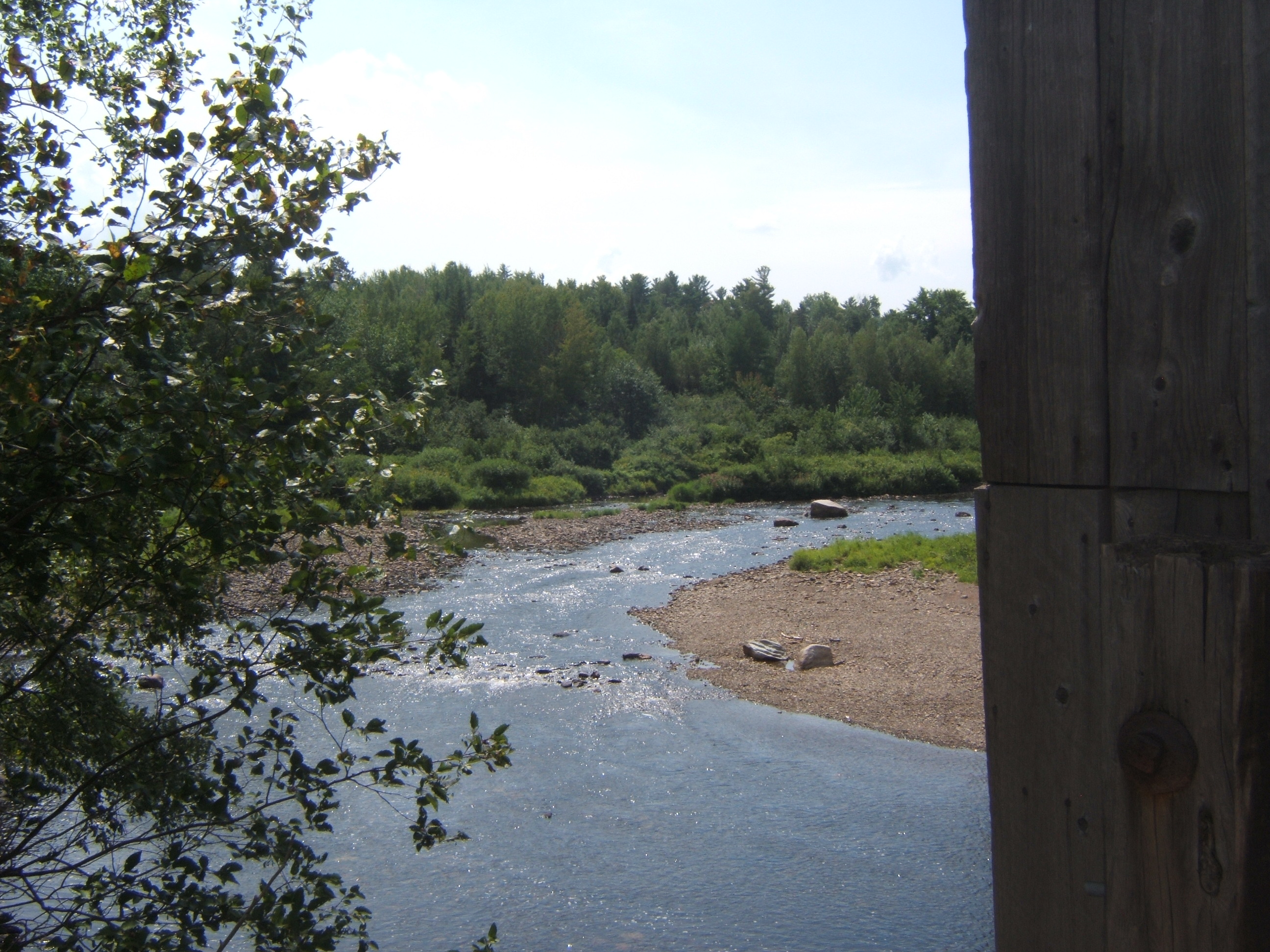
The Smyth Bridge was built in 1912 and has a total length of 139′ 1/2 “, and a span of 136′ 1/2 “. Its roadway width is 14′ 9”. Its Maximum Load is 10 t (6 t for double axle vehicles) and its center clearance height is 3.7 m.
During our Covered Bridge Project for Canada’s 125th anniversary, we visited the Smyth Bridge on April 16, 1992.
In 1992, the oldest dates we could find carved into the bridge were ‘Oct 3, 1915 Sunday’ under the initials ‘R K’ (in pen or pencil) and ‘Feb 1931’ beside the initials ‘LTF’ and ‘LEIK’ to the right of three simple crosses. There was also the totem of a face carved into the south side of the bridge, on the outside corner post. We also found a few other initials, deeply carved: ‘M B’, ‘R H’, ‘C B’, and ‘CED ER May 63’.
Finding these carvings requires patience, a good flashlight and about an hour per bridge, so I didn’t check to see if any of the carvings were still there on our recent visit. Sometimes they are lost when boards are replaced in the bridge during renovations.
I wonder if these people remember leaving their initials in the bridge so long ago?
~
~
‘LEIK’
– initials carved on the boards of the Smyth Covered Bridge, 1931
~
dark
silent
sequestered
~
light leaks between gable
boards, window squares cut high
river water below
sparkles in August sun
~
carved initials announce
the focused presence of
ghosts with knives
~
the clatter of tires
on timbers, as a car
rattles across the bridge
~
~
Copyright Jane Tims 2012
a safe space in the bridge
This past week I have been in Halifax for a conference. A part of my morning commute was the slow moving traffic on the ‘old bridge’ across Halifax Harbour, the Angus L. Macdonald Bridge. The second day, I was more familiar with the traffic and the correct lane to be in, so I had a chance to experience the architecture and some of the wild life of the bridge (by this I do not mean that the commuters are holding wild parties).
The Angus L. Macdonald is an amazing structure, built the year I was born and opened in 1955. It is a long-span suspension bridge, supported by cables between two vertical towers. The bridge is 1.3 km long, with a supported length of 762.1 meters.
The bridge is usable by pedestrians and cyclists. Because of its reputation as a suicide bridge, it is equipped with various barriers to potential suicides, including high inward-facing bars on the pedway and nets suspended in the open area between the traffic deck and the pedway.
In these areas, hordes of starlings (Stumus vulgaris) gather, creating a din and an occasional cloud of startled starlings. Starlings are known for their synchronized group flights – the birds move as one in a shifting horde of birds. To hear the birds, I had my car windows open, but I quickly rolled them up since the birds were flowing very near to my car!
Starlings are an invasive species, introduced by Eugene Schieffelin to Central Park in 1890 as part of a project of the American Acclimatization Society. Their goal was to introduce all the birds mentioned in Shakespeare’s writings into North America. All of the birds I saw in the bridge are descendants of the 60 to 100 birds released in 1890!
A group of starlings is known as a ‘murmuration’.
For those of you familiar with the excellent series of made-for-TV Jesse Stone movies (starring Tom Selleck), The Angus L. Macdonald Bridge is the bridge featured in the movies (although the setting for the movie is a small town in Massachusetts).
~
morning, Angus L. Macdonald Bridge
~
traffic huddles and a thousand Shakespearian
starlings squabble one another
yellow beaks and feathers packed
soft slate bodies rolled into the safety
of the suicide net and pedway bars
porous barriers: a cyclist whips by
and starlings sift through wire
a mumuration between orange
cables and green girders
impossible way, red and blue
pulse of bridge security
weaves the path materialized
within three tangled
lanes of traffic
~
© Jane Tims 2011

fords across the river
During a week of vacation last month in south-eastern Ontario, I was able to get to know some of its rivers.
The water is low this time of year and the rivers run still and quiet. Pond lilies and duckweed cover the surface, joined by early falling leaves. The country roads cross and re-cross the rivers, giving a view of each river at several points along the way.
I was also reminded of another means of crossing a shallow river or stream – the ford. This is a place where the water is shallow enough to cross on foot or by vehicle, without a bridge. Sometimes the ford depends on the natural stones or solid bottom for its footing; sometimes the bottom is built up by adding stone.
The fords on the South Branch of the Raisin River in South Glengarry County were built to last, of stone. They make a charming pause in the run of the river, allowing passage of the water and a safe way to cross.

A local person familiar with the river told me this: in spring, when the river runs deep enough to allow canoes to paddle, the fords can still be seen, white stones shining up through the water.

~
crossing the South Branch Raisin River, South Glengarry County
~
weedy South Branch Raisin River water-dry
stream-bed wizened wild grapes purple-weighted
sun-dried field rock
fords and fences
rain and rising
leaf-spun river
surface winds reflected
elm, nymphaea
ash, nuphar
~
© Jane Tims 2011
crossing the river #2
In the 1970s, when my husband and I had only known each other for about a month, we were stranded for three hours on a ferry that quit half way across the river. The ferryman just shrugged, said he’d be back, and rowed away in the lifeboat.
We were desperate. For an hour, we skipped stones across the water. I don’t believe there was a single stone or pebble or grain of sand left on the ferry deck! We talked, of course, and probably found out how much we had in common. We’ve been together for almost 33 years.
When the ferryman returned, he brought some sandwiches his wife had made for us and the news we would have to wait two more hours for the Coast Guard to come up the river from Saint John to tow us to the shore.
Needless to say, we were eventually rescued. And I have never experienced a ferry breakdown again.

some of these would be excellent for skipping
skipping stones
~
collect your stones
select for flat and smooth
stones with knowledge
embedded flight and float
pile your stones
~
hold your hand
like this, curl your finger
round the stone, flat curve against
your palm, coddled
cover of a book
you never want to end
~
swoop back
arm and index finger
parallel to shore, release
count
the
skips
the way
water
flirts
with edge
of skim
and
sinking
stone
~
concentric rings
connect and scatter
~
select another stone
~
© Jane Tims 2011
crossing the river
In New Brunswick, the Saint John River watershed accounts for more than one-third of the province. It is a majestic river, almost 700 kilometers long, beginning in Maine and Quebec as small tributaries and gradually gaining in width and volume as it flows towards the Bay of Fundy.
One of the best things about living near the Saint John River is its cable ferries.

There are several bridges, of course, but no means of transport across the Saint John River can compare with the mini-voyage experience of crossing the river on a summer day with the wind in your hair and the dazzle of water in your eyes. It is always interesting watching the ferryman packing the cars in like sardines on the busy days. There is usually some interesting local event posted on the bulletin board. And New Brunswick’s river ferries are free to ride!
In 1978, I made several trips on a ferry that was only in operation for a short time. This was the car ferry at Cambridge-Narrows on Washademoak Lake, part of Washademoak River, one of the large tributaries to the Saint John River. It operated for a few months after the covered bridge there was flattened in the Groundhog Gale of February 2, 1976. The new bridge was built shortly afterward in 1978 and only local people remember the ferry.
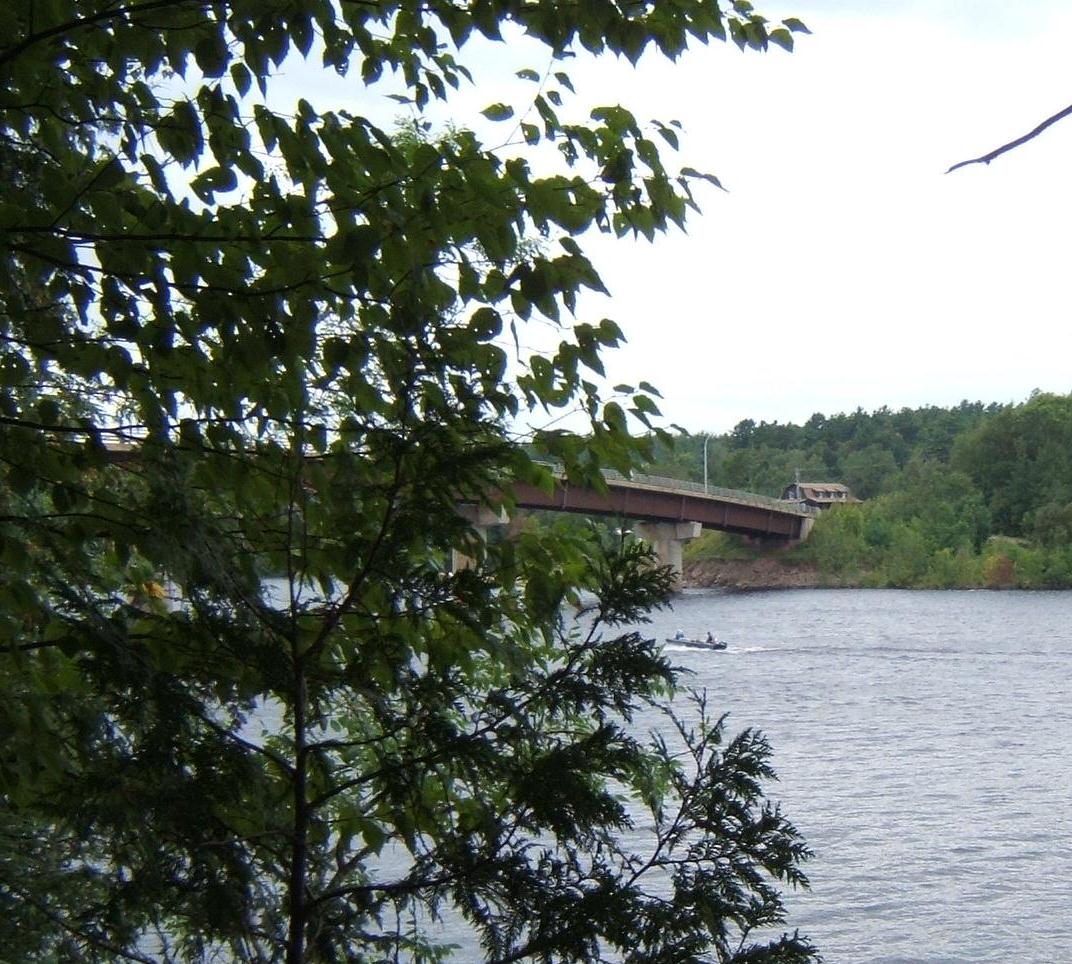
However, I remember the ferry at Cambridge-Narrows very well. I wrote the poem ‘Lights on the Lake’ one evening as I took the ferry across the Narrows and felt the peacefulness of the small community winding down from the summer season.
For a short history of Cambridge-Narrows and a photograph of the covered bridge after it was destroyed by the Groundhog Gale, see
http://www.imagine-action.ca/IAAppContent/274/BookletVII_Legacy%20of%20HistoryFinal.pdf
Lights on the Lake
~
1.
~
twilight
fairy bulbs on masts
sunset on sail
amber to trace
the ferry’s quiet crossing
~
dusk
leaded porch lights
propane glow
twin headlights
joust along the cottage road
~
darkness
strings of lantern
patio voices, clinking and laughter
fires on the beach
sparks stirred toward the sky
~
moonlight
waves flirt with stars
Aurora Borealis leaps
fireflies blink
brief messages of love
~
2.
~
comes an evening at summer’s end crowd and fireflies are gone night storms shuttered windows
darkened doors the charred remains of fires
on the shore
~
and through the trees a ruby gleam
a choir practices its song
~
© Jane Tims 1978
inside the covered bridge
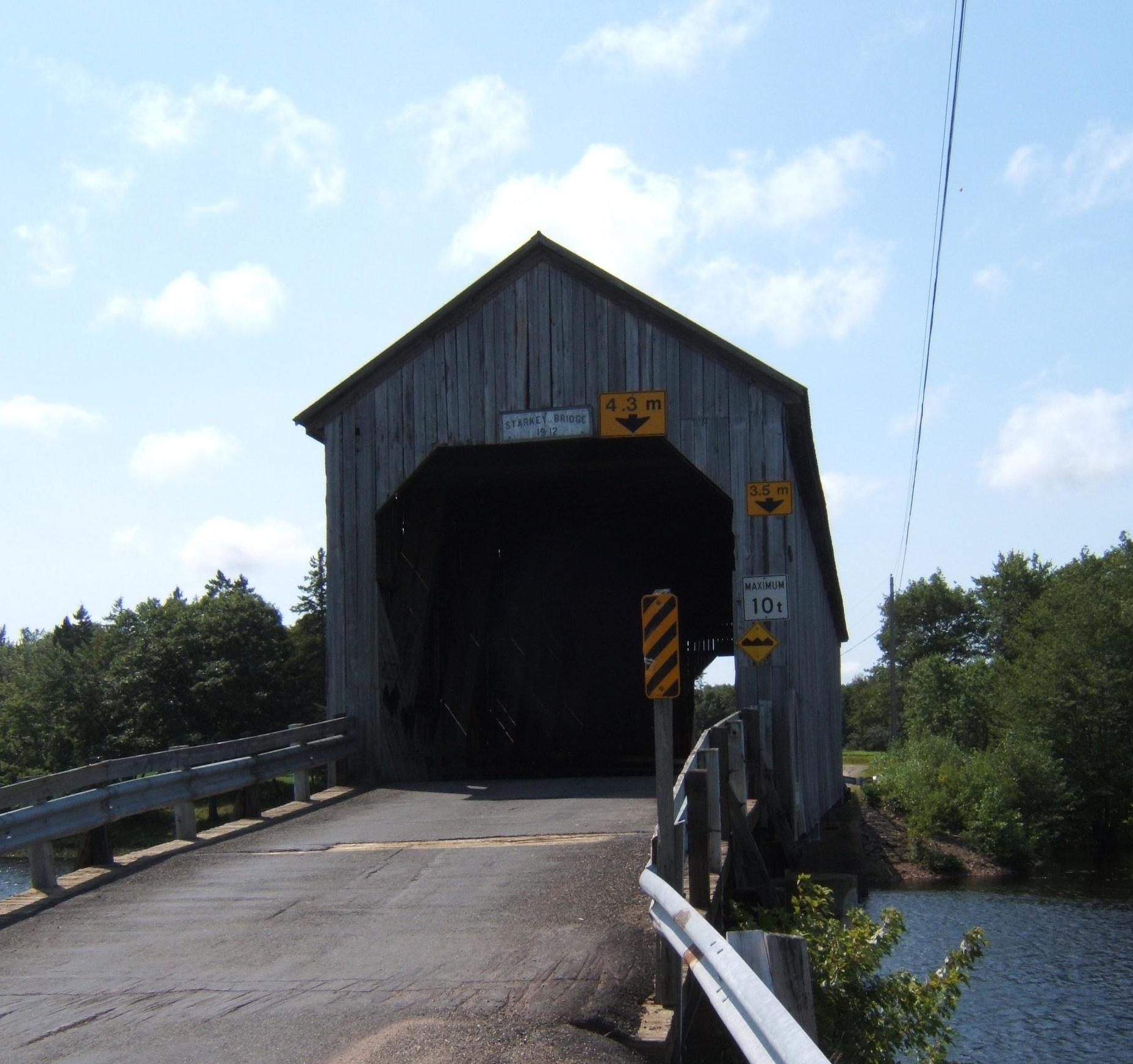
the Starkey Bridge over Long Creek
One of New Brunswick’s ‘claims to fame’ is its covered bridges. A covered bridge is a bridge constructed with high sides and a roof, made to cope with winter snow loads. The covered bridge was designed to be easier to cross in winter. Also, these bridges don’t have to be shovelled free of snow after storms.
There are 60 covered bridges in New Brunswick, one less after the Mangrum Bridge, crossing the Becaguimec River, was destroyed by vandals earlier this month. Communities really love their covered bridges and try to keep them safe by holding watches at Halloween and other times of the year. It is a huge disappointment to anticipate driving across a covered bridge you have visited in the past, only to find it has been burnt and replaced with a metal Bailey Bridge.
Visiting covered bridges is a favourite pastime for many New Brunswickers. On a hot day, the bridges are cool inside and there are usually open ‘windows’ to encourage breezes and allow a view of the river. When a car drives through the bridge, the whole structure vibrates and the car tires make a deep-toned rumble. The floor timbers in a covered bridge are pleasant to walk on and the rafters make interesting study for the carvings and writings people have left as mementos of their visits.
In 1992, my husband and son and I began a project to celebrate Canada’s 125thbirthday. We intended to visit all the covered bridges in the province and make a record of the carvings and graffiti inside each bridge.
we promised to include the ‘Canada 125’ logo whenever we reported on our project, so here it is!
We explored many of the bridges, and made pencil rubbings of some of the more memorable carvings. I particularly remember the girl’s name ‘Phoebe’ carved in elegant lettering in the Wheaton Bridge (bridge installed 1916) over the Tantramar River, and a carving of an old car and the date 1910 in the Maxwell Crossing Bridge over the Dennis Stream (bridge installed 1910).

some of the notations in our record for the Maxwell Crossing Bridge over the Dennis Stream
Other markings were also noteworthy. Inside the Falls Brook Bridge at Nortondale over the Nackawic River were the following words in India ink: ‘Ptarmigan Hunter Ray Brown May 12th 1896 Horse had bad leg”. An expert birder in the area told me Ptarmigan have never been recorded in New Brunswick and this could be a valid record.
Another bit of graffiti I particularly liked were the words I AM THE WIND, printed in yellow in at least three of the bridges in Charlotte County, including the covered bridge on Stillwater Road over the Digedeguash River. This bridge is now gone and a Bailey Bridge was in its place the last time we visited.
I am the wind
~
I am the wind
of the Digedeguash
shaped by valley walls
~
I race trout
lift ferns
blow quick kisses
under the wings of butterflies
~
I am the wind
spoken in the beams
of the covered bridge
slipped into space
between
boards
I rattle the roof, the reeds
vibrate with my breath
~
I am the wind
from the County line
to the Passamaquoddy Bay
I race
~
refreshed by the waterfall, salted
by the rising tide
~
carve my name
on the boards, block
my name in yellow
chalk
~
I am the wind
~
Published as: ‘I am the Wind’, Spring 1995, The Cormorant XI (2)
(revised)
© Jane Tims
Smyth Bridge, crossing a small tributary of the South Oromocto River




 nichepoetryandprose