Archive for the ‘competing for niche space’ Category
tough to follow
In high school, in Nova Scotia, I belonged to a history club. We did an interesting project in about 1971, tracing the route of an old stagecoach trail through the woods between Lower Sackville and Fall River. We were able to follow the road since it had been raised above wet ground. We also found old culverts still intact. One of the things we made was a relief map of the area, with the hills built up in plaster and the old road marked in red. The project created, for me, a lifelong interest in old roads.

old trail obscured by a Bracken understory
~
tough to follow
~
the old road at the edge
of the hill is tough to follow
no clues, no footprints, no bent twigs
~
eventually all familiar ways
grow over
~
a layer of bracken
covers the track
like a cloth over biscuits
at the dinner table
~
primo-canes of bramble
claw you back
your mother reminding you
to wear your sweater
~
better to look up
follow the ribbon of sky
marked by the absence of branches
~
~
Published as ‘tough to follow’, Canadian Stories 15 (85), June 2012
Copyright Jane Tims 2012
competition for space
One of the discouraging aspects of our lake property is how fast everything grows. In 2005, we bought 7 1/2 acres of field…
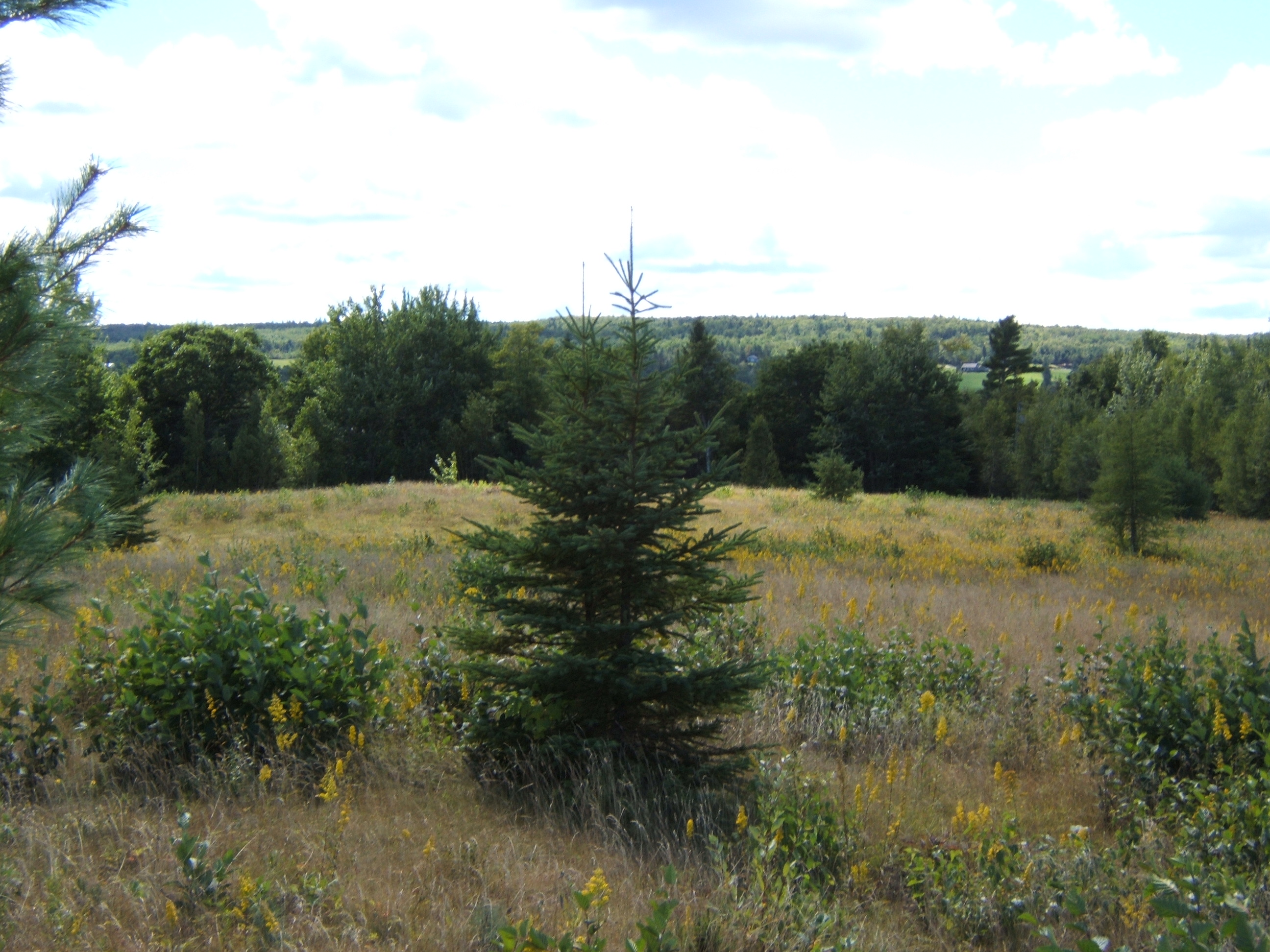
in 2012, we have 7 1/2 acres of alders and young trees…
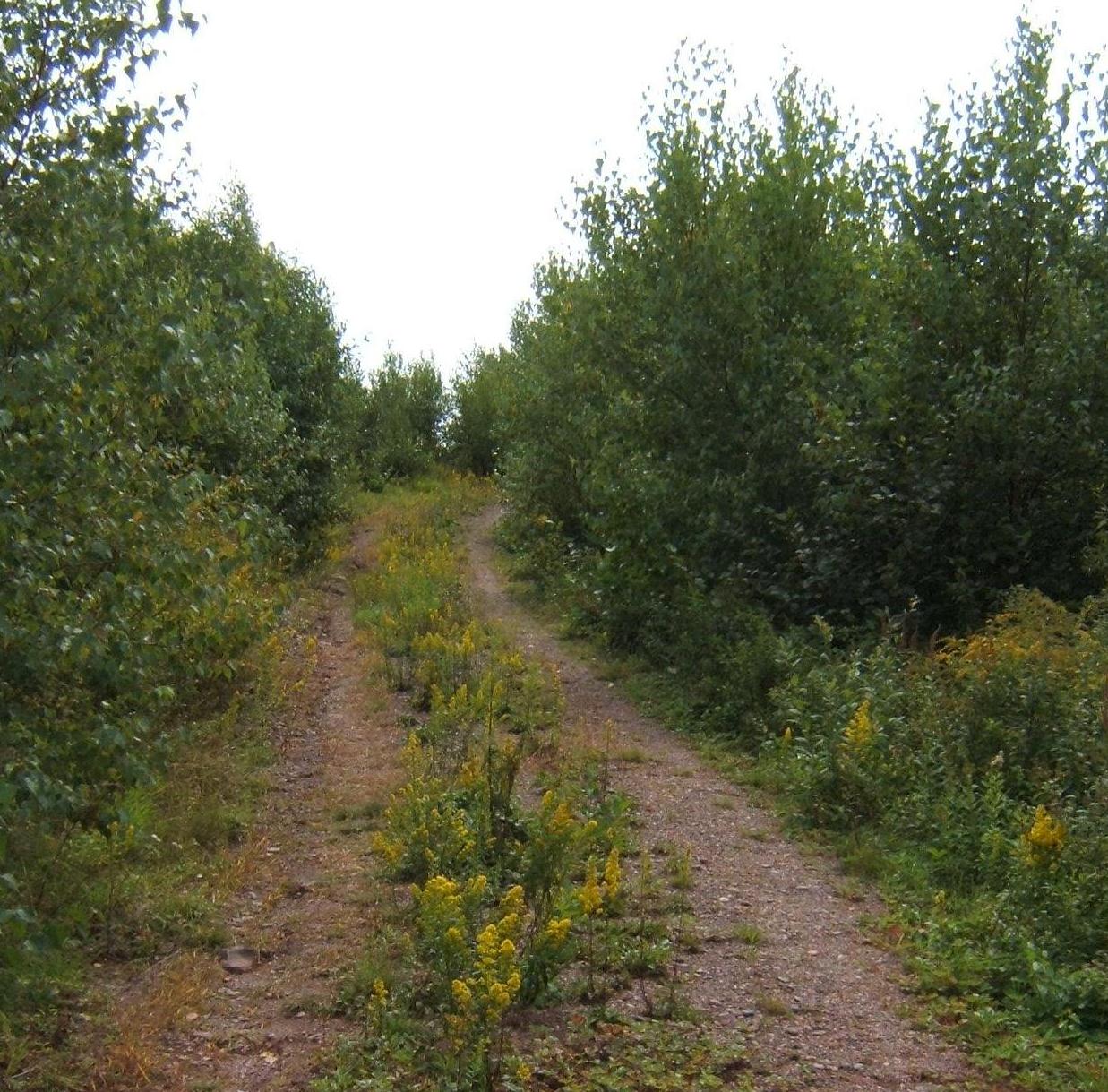
I actually like the lush vegetation and we intend to always keep the forest of trees down by the lake, to help protect the lake environment. But we humans need a little room to move!!! Although we knew we would eventually have more trees than field, we always thought we’d be able to:
- keep the road and turning area at the lake end of the property clear of weeds and wide enough for a vehicle
- keep the area around the camp clear
- have some trails for walking and access to the various parts of the property
- keep our blueberries – they have trouble competing with the taller vegetation
- begin to groom some specific groves of maple and birch
- keep a small area of field so I can watch the grasses blowing in the wind.
The farmer next door was willing, for a price, to continue bush-hogging the area, just as he had done for years. But there were trees and various herbaceous species we wanted to keep, so we bravely set out to manage things on our own.
For me, that means snipping away with my shears. I get tired/bored very easily, so I am not much help. I mostly spend my time discovering new plants to protect and putting wooden stakes up to mark their position!
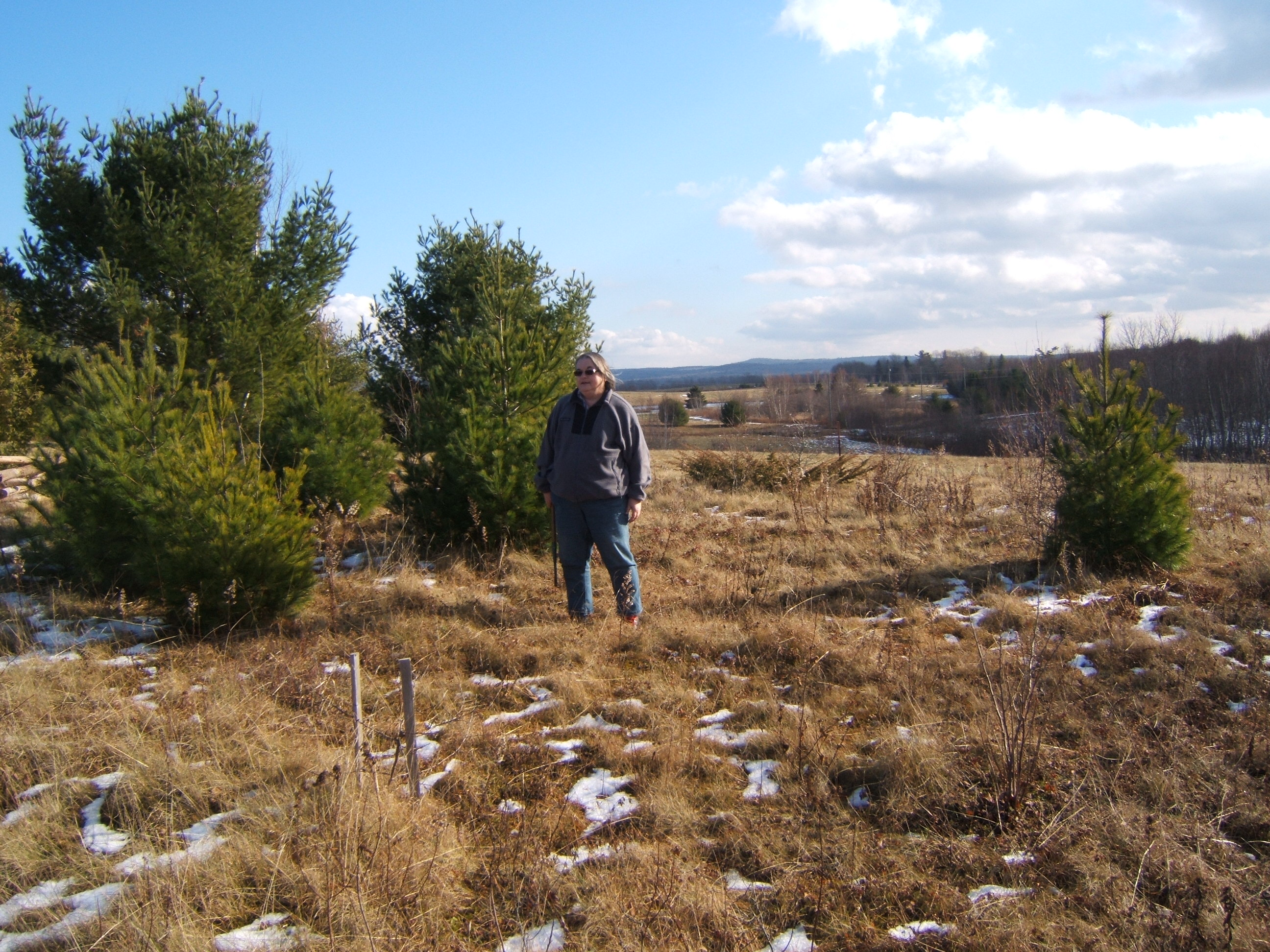
me with trimmers and marking plants with stakes
My husband has tried to keep back the growth with his bush-saw, and last year he was able to keep the road clear and even cut a new trail to access our blackberries. But progress is slow and within a few weeks, the alders, saplings and weeds have all grown back!

Finally, we became so discouraged, we began to think of alternatives. In the last two years, we have tried pulling the alders and I planted beans in the holes left all over the place. The deer really enjoyed my bean plants!
Now, we have the solution. We bought a rough mower that pulls behind the ATV. It is awesome! My husband has fun and is able to make huge progress. In just a couple of days, we have our road clear, there is a labyrinth of trails where we can walk, we have trimmed a selection of blueberry patches and we have our turning area restored at the lake end of the property. Notice the use of the word ‘we’, although my husband does all the work!
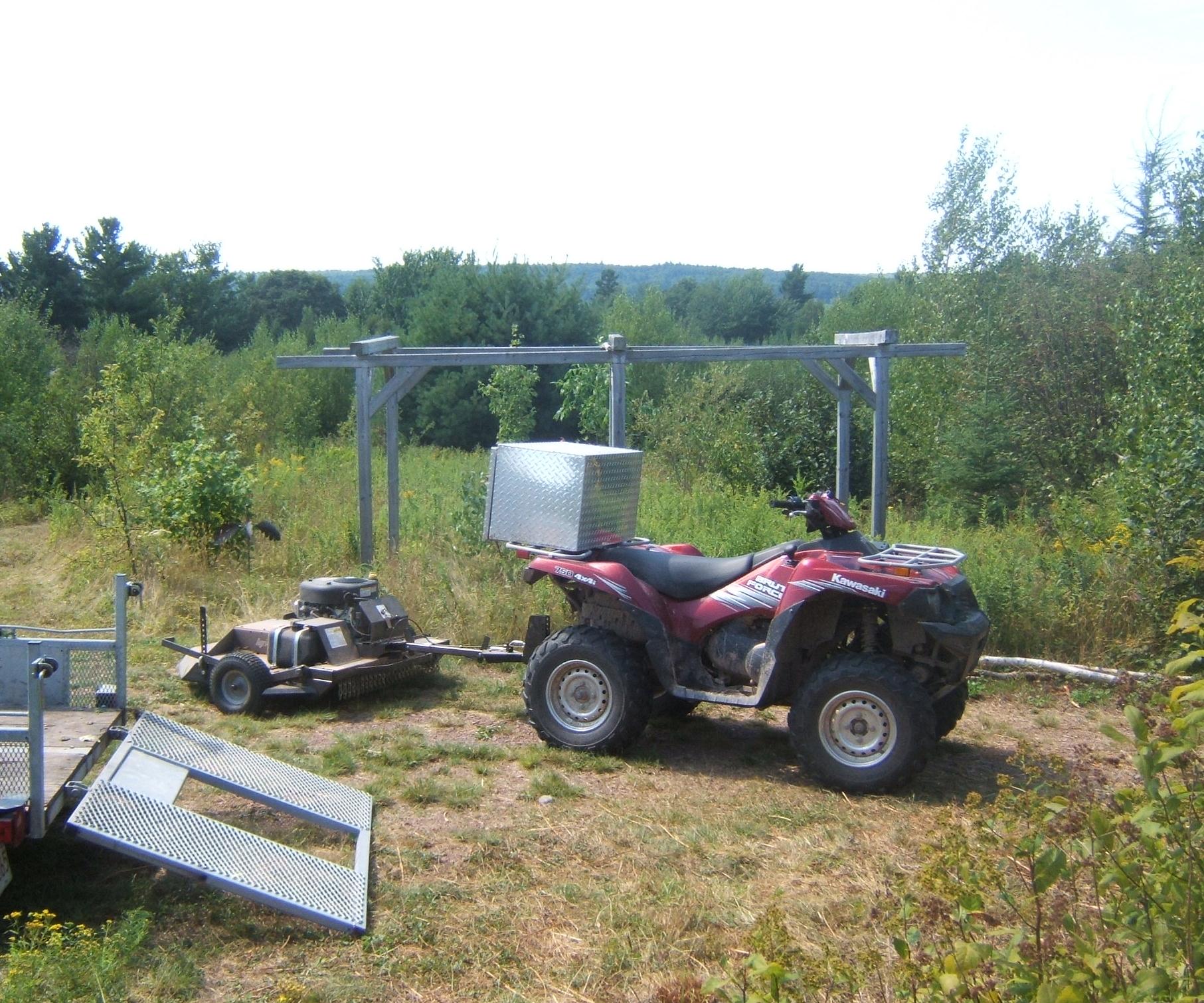
our new Agri-Fab Rough Cut Mower, designed for use behind an ATV
You can see the before and after shots of the road trimming in the three photos below. What you can’t see in the middle photo is the smile on my husband’s face as he mows! He was able to trim, in a few minutes, the trail it took him days to cut with the bush-saw last year.


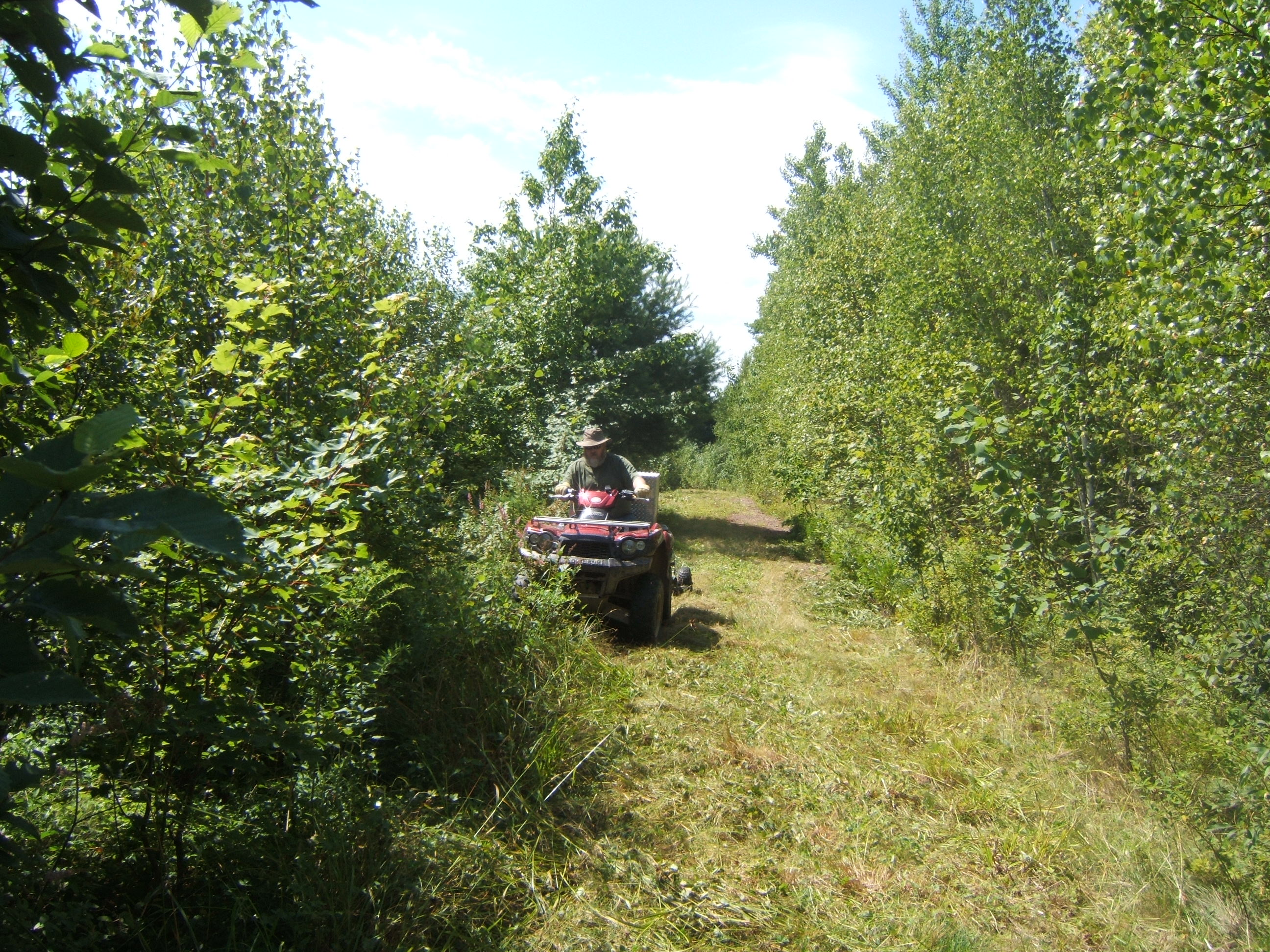
Now, my husband can use his bush-saw time to work on his groves of maple and birch.
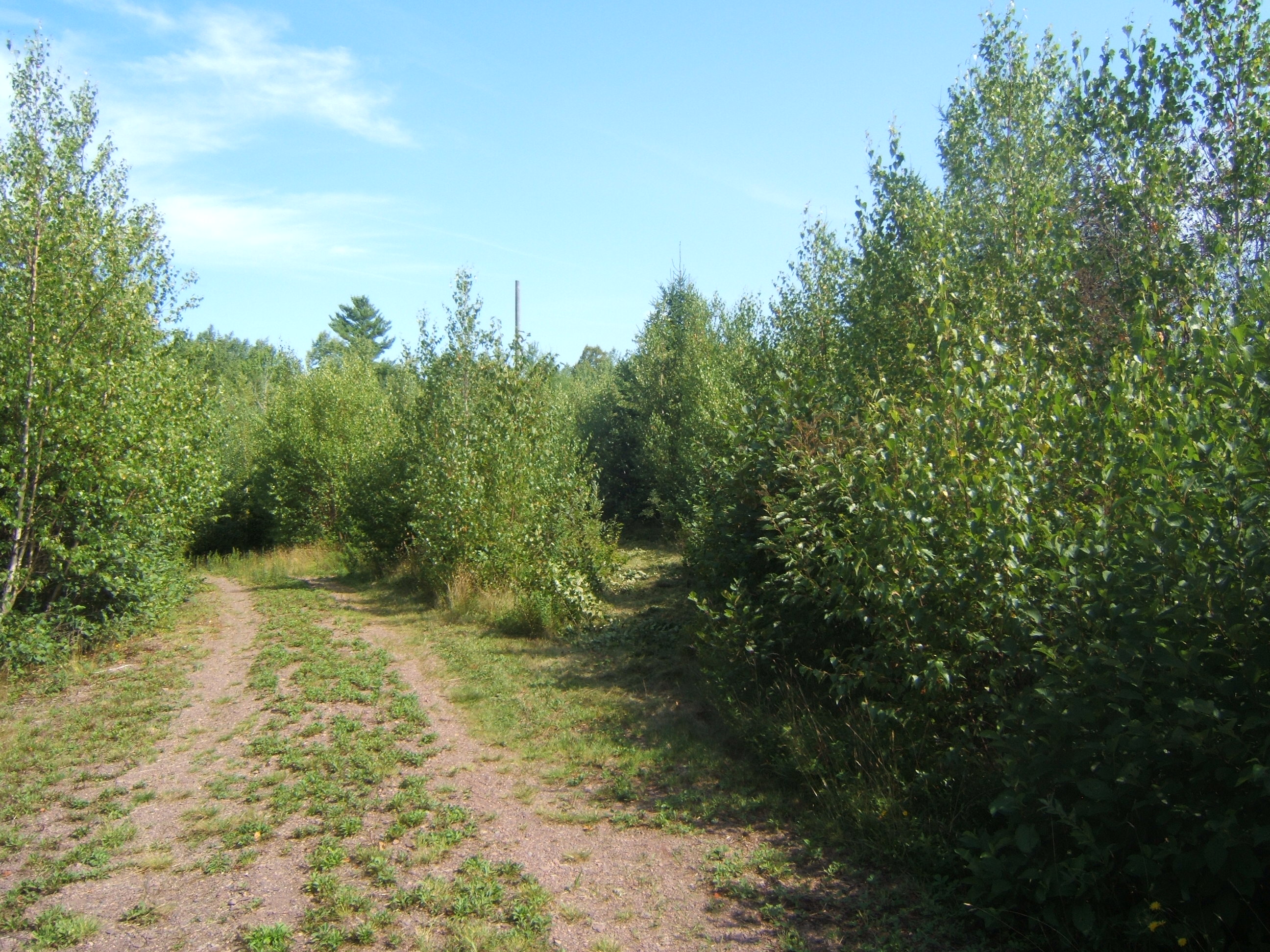
the first path cut by the new mower, to the right of the road
The only problem so far has been the hawthorns. We had a very flat tire on the mower after the first day. The man who fixed it said it looked like a porcupine on the inside, it had been punctured by so many thorns! Now, we are having each tire filled with foam!

5 cm thorns on the Hawthorn easily punctured the mower tires

© Jane Tims 2012
a botany club excursion
Earlier this summer, we went on a hike with other members of a local botany club to the Cranberry Lake Protected Natural Area, an area protected for its extensive forest community of Red Oak and Red Maple.
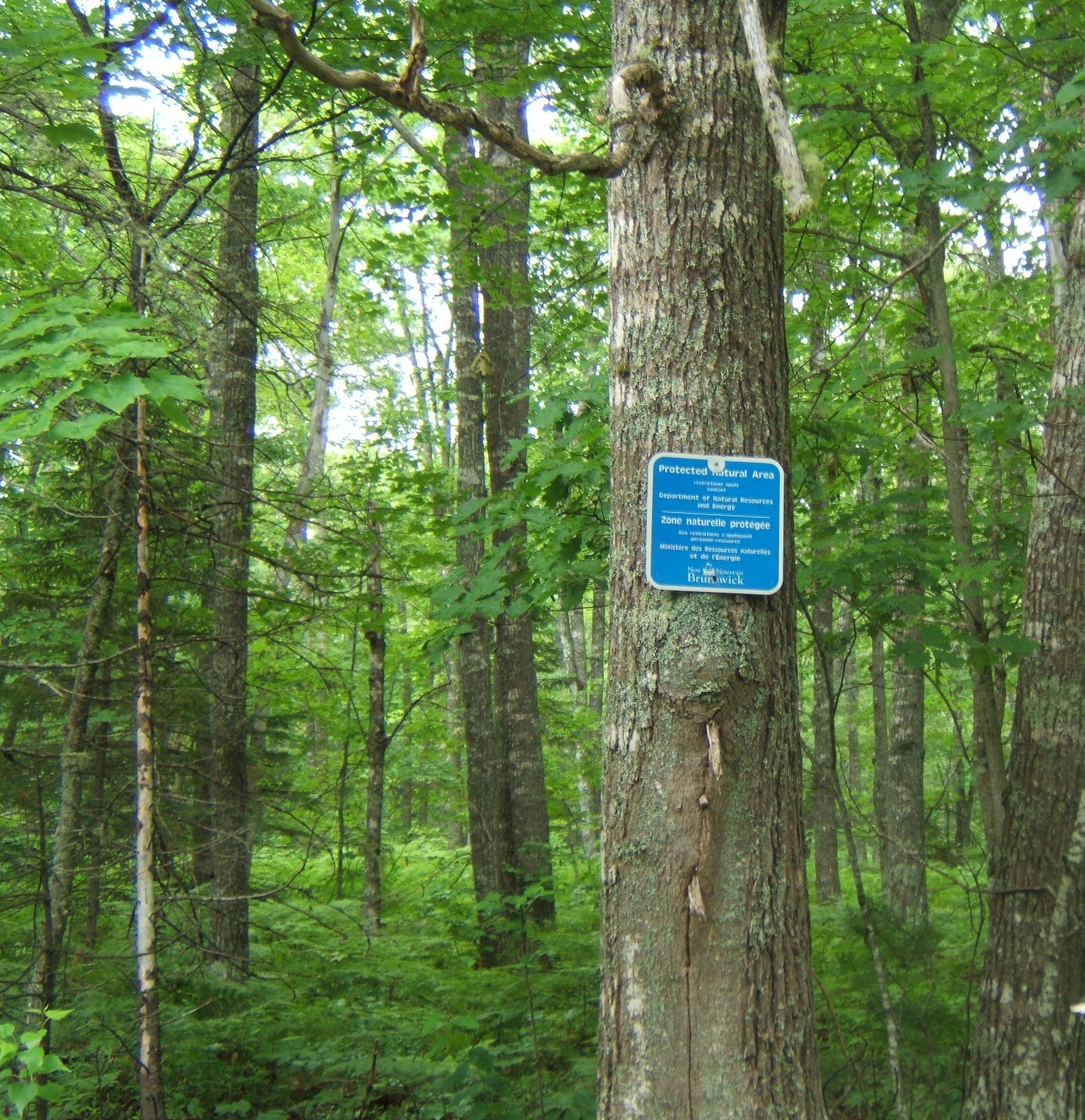
The New Brunswick Department of Natural Resources website describes the Cranberry Lake Protected Natural Area as follows:
An extensive Red Oak forest community. Predominantly Red Oak – Red Maple association. Red Oak make up a large percentage of the regeneration, most likely the Oak component will increase as the stand matures. The individual trees are impressive size.
This type of forest is rare in New Brunswick.
The woods were open with a thick understory of Bracken (Pteridium aquilinum (L.) Kuhn, var. latiusculum (Desv.) Underw. ex A. Heller), Blueberry (Vaccinium spp.), Common Lady’s Slipper (Cypripedium acaule Aiton) and some of the other species of the Canadian Element associated with woodlands in the Maritimes (see my post for April 30, 2012, Trailing Arbutus, https://nichepoetryandprose.wordpress.com/2012/04/30/trailing-arbutus-epigaea-repens-l-var-glabrifolia/ ).

My husband standing in the thick growth of Bracken… it was about waist-height… he says he was standing in a hole!
It was so much fun working with the other botanists and enthusiasts to identify the various species we encountered. The plant lists prepared during the day will be part of an effort by Nature New Brunswick to update a database of Environmentally Significant Areas in New Brunswick. During my years of work, I was privileged to work on the development and use of this database.
I saw many familiar species during the hike, but I was so excited to see three plants I have not seen in a while.
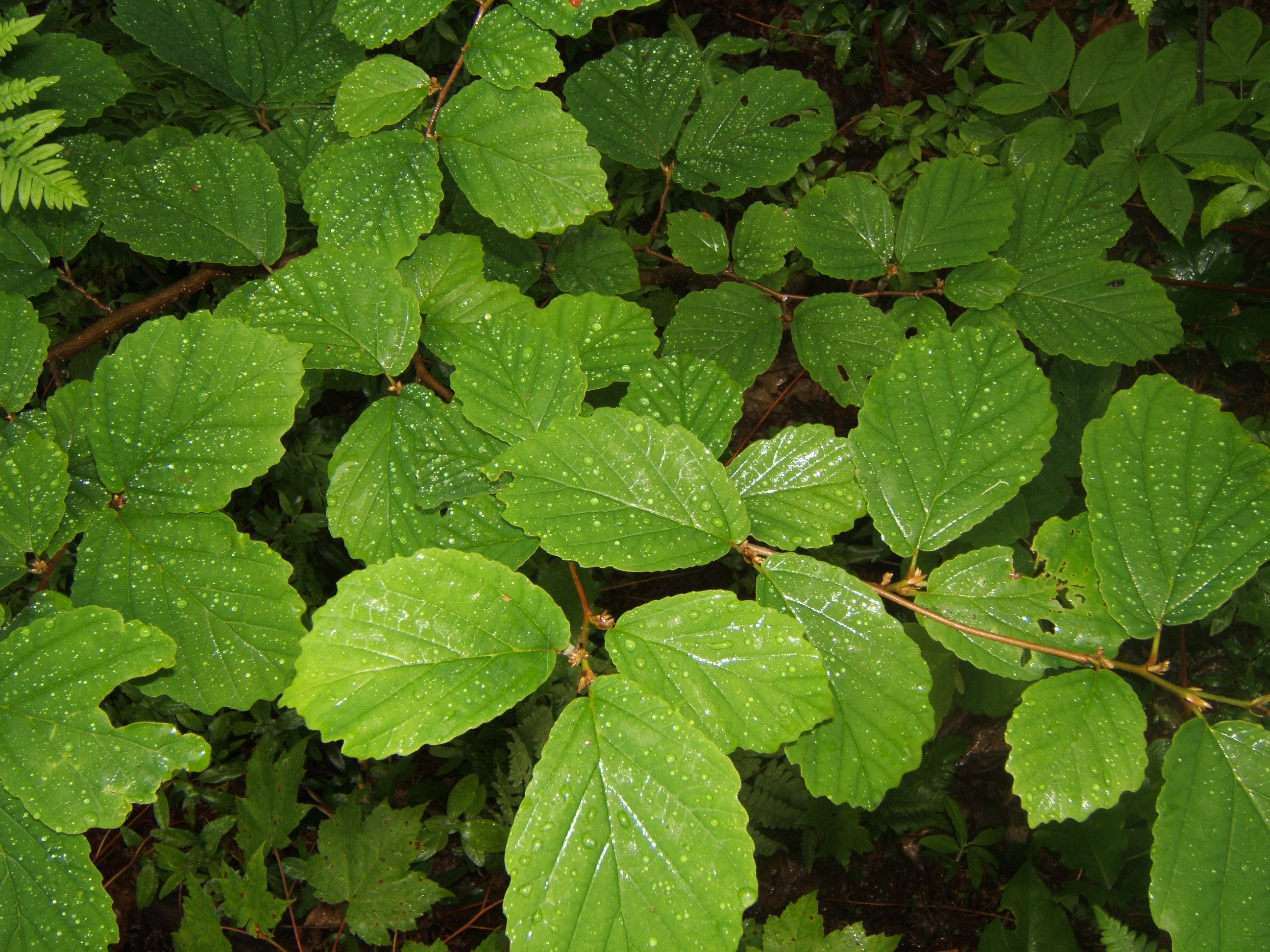
I renewed my acquaintance with Witch-hazel, Hamamelis virginiana L. (notice the asymmetrical shape of the leaves)…
and Shinleaf (Pyrola elliptica Nutt.), identifiable by its thick oval leaves, longer than the leaf-stalks or petioles…

a single plant of Shinleaf, with its straight stem of small creamy flowers, growing among Blueberry, and Red Maple and Red Oak seedlings
I also was introduced to a plant I thought I had never seen before, Cow-wheat (Melampyrum lineare Lam., a branchy variety found in dry woods). When I looked it up in my Flora, though, I found a notation to say I had seen this plant in the summer of 1984. It is always good to record the plants you see and identify!

While there, we saw a perfect example of the interaction of species. A bright orange fungus, known as Chicken of the Woods (Laetiporus sulphureus), growing on an aged Red Oak, was being consumed by a horde of slugs.

A hike with a group is a great way to expand your knowledge and boost your confidence. Everyone benefits from the knowledge of the various participants, and being with like-minded people is good for the soul!
© Jane Tims 2012
Warning: 1. never eat any plant if you are not absolutely certain of the identification; 2. never eat any plant if you have personal sensitivities, including allergies, to certain plants or their derivatives; 3. never eat any plant unless you have checked several sources to verify the edibility of the plant.a moment of beautiful – bug-shot shadows
the space: the surface of the power pole in front of our house
the beautiful: the pattern of shadow through bug-eaten leaves
The power pole in front of our house is habitat for a vine of Virginia Creeper (Parthenocissus quinquefolia (L.) Planch.). also known as Woodbine. I brought the vine home about thirty years ago, as a slip collected from a plant in the park beside the St. John River. Over the years, it has struggle against the winds, determined to blow it from its perch, the power company, unhappy with its use of the pole, and the lawn mower as it snips away at the horizontal tendrils.
This year, it has a new challenge to overcome. An insect has chewed the vine full of holes… probably not a severe problem for the plant.
On Friday, I caught the shadow pattern created by the bug-eaten leaves as the sun shone at the right angle for a moment… a new way to see the consequence of belonging to the food chain!

© Jane Tims 2012
Staghorn Sumac (Rhus typhina L.)
One of the berry bushes common in our area is Staghorn Sumac (Rhus typhina L.). Its leaves and berries turn brilliant red in autumn, and its berries are displayed in distinctive red ‘horns’.
Staghorn Sumac is a small tree or shrub found at forest edges and in wastelands. The shrub has a flat crown and an umbrella-like canopy. It has pinnately compound leaves and toothed leaflets.
Staghorn Sumac is a ‘pioneer’ species, often one of the first plants to invade an area after the soil is disturbed. Although it reproduces by seed, it also grows from its vigorous underground root system, and forms dense colonies with the oldest trees at the centre. In this way, it causes dense shade to out-compete other plants.
The flowers of Staghorn Sumac are greenish-yellow and occur in spiked panicles from May to July. The berries are velvety, hairy red drupes, and ripen in June to September, often persisting through winter. The berries are held in dense clusters or spikes at the ends of tree branches.

Staghorn Sumac is also called Velvet Sumac, or Vinegar-tree, and Vinaigrier in Quebec.
The common name of Staghorn sumac is derived from the velvet feel of its bark, reminiscent of the texture of deer antlers. The word sumac comes from the words for red in Latin (sumach) and Arabic (summāq). The specific name ‘typhina’ means ‘like Typha’ (cat-tail), a reference to its velvety branches.
The Staghorn Sumac provides food for birds including Evening Grosbeaks and Mourning Doves, and its twigs are eaten by White-tailed Deer.
It has many human uses, including for medicine, decoration, tanning and dyes. Staghorn Sumac berries are used to make a lemon-flavored ‘sumac-ade’ or ‘rhus juice’. Remember, before you consume any wild plant, be certain of your identification.
Sumac lemonade
Pick and clean the berries (removing them from the stem)
Soak berries in cool water
Rub the berries to extract the juice
Strain
Add sugar to taste
~
~
Staghorn Sumac
Rhus typhina L.
~
from a single stem
and subterranean creep
a crowd of sumac
~
umbrellas unfurl
roof by roof
shield the hillside
from ministrations of sky
~
shadowed ways beneath
to shelter and imitate
a gathering of deer
with velvet antlers lift
~
an occidental village
red spires like minarets
insist on sky
~
~
Warning: 1. never eat any plant if you are not absolutely certain of the identification; 2. never eat any plant if you have personal sensitivities, including allergies, to certain plants or their derivatives; 3. never eat any plant unless you have checked several sources to verify the edibility of the plant. © Jane Tims 2012snippets of landscape – beaver lodges and beaver dams
Everywhere along streams in New Brunswick there are dams and lodges the beaver have built. The North American Beaver (Castor canadensis) is a clever engineer, building dams to create ponds as habitat. The still, deep water provides safety from predators and enables the beaver to float branches and logs to be used as building materials and food.
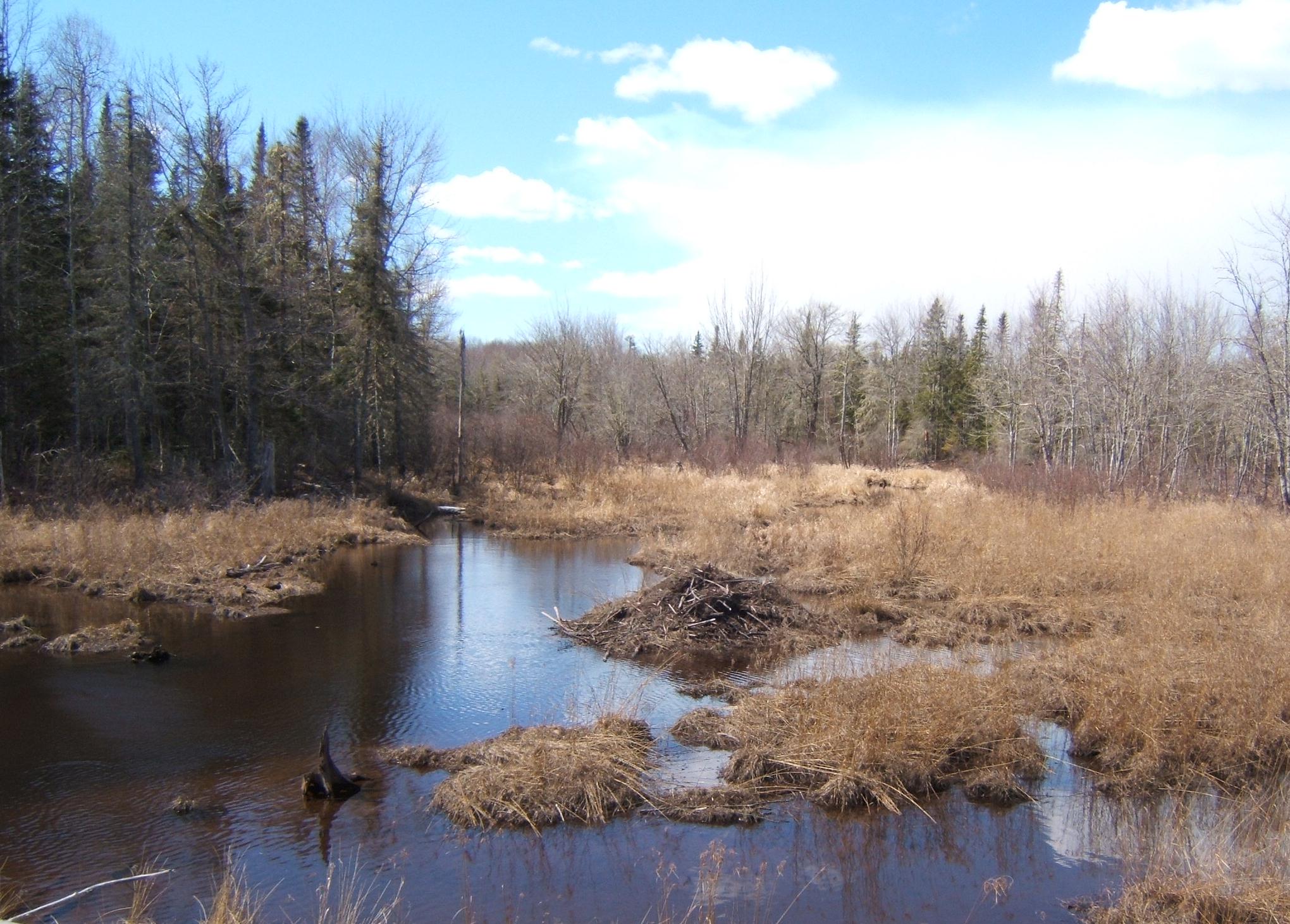
a beaver pond near our cabin ... notice the two ducks on the shore to the left...
Unfortunately, the subsequent flooding of roads and other land means the beaver’s talents are not always appreciated. However, beaver dams help create and maintain wetlands, important for providing habitat for other animals and storage areas for water.
~
~
Bear Creek Meadow by Canoe
~
from the river
we portage
across the beaverdam
over poles and patted mud
up
to the quiet pond
~
and the bow
scoured by rocks
parts green
~
and our paddles
pitted by snags
spoon soup
~
dignity quiets our paddles
hushed voices heed
the diminishing echo
~
pliant as stems of pickerel weed
we honour the whisper
of wild rice
the edgewise touching
of nymphaea and nuphar
amphibian eyes
in the harbour-notch of lily pads
~
we are threaded by dragonflies
drawn by water striders
gathered in a cloak of water shield
~
oval pads a puzzle
part in silence
return to their places
~
no trace of our passing
~
~
Published as ‘Bear Creek Meadow by Canoe’, Canadian Stories 14 (79), 2011.
© Jane Tims 2011
at the bird feeder #3
I am amazed at the volume of seeds these little visitors eat.
The deer, racoons and squirrels take their unfair share, of course. Last year, I watched a deer attack the feeder with its tongue, scooping up every bit of seed in a matter of minutes. Even without the deer and racoons and squirrels, the birds descend in a flock and the food is soon reduced to a scattering of seed-husks.
We have come to a conclusion – next year we will put up a mammal-proof feeder. My brother-in-law has it figured out. He has installed a large cedar post in an open area and encased it in aluminum pipe and flashing. Enough seed falls on the ground to give a treat to the squirrels and other marauders, and the birds are the focus of the money-drain.
~
~
feeding the birds
~
I wait, no patience to speak of
for the next bird to find
~
this food more delicious than seed offered
by my neighbour, swears
~
he had cardinals, mine the left-over
chickadees and nuthatches, flocks of redpoll
~
litter the feeder, red-dotted heads, their toes
grip courtesy branches, a perch
~
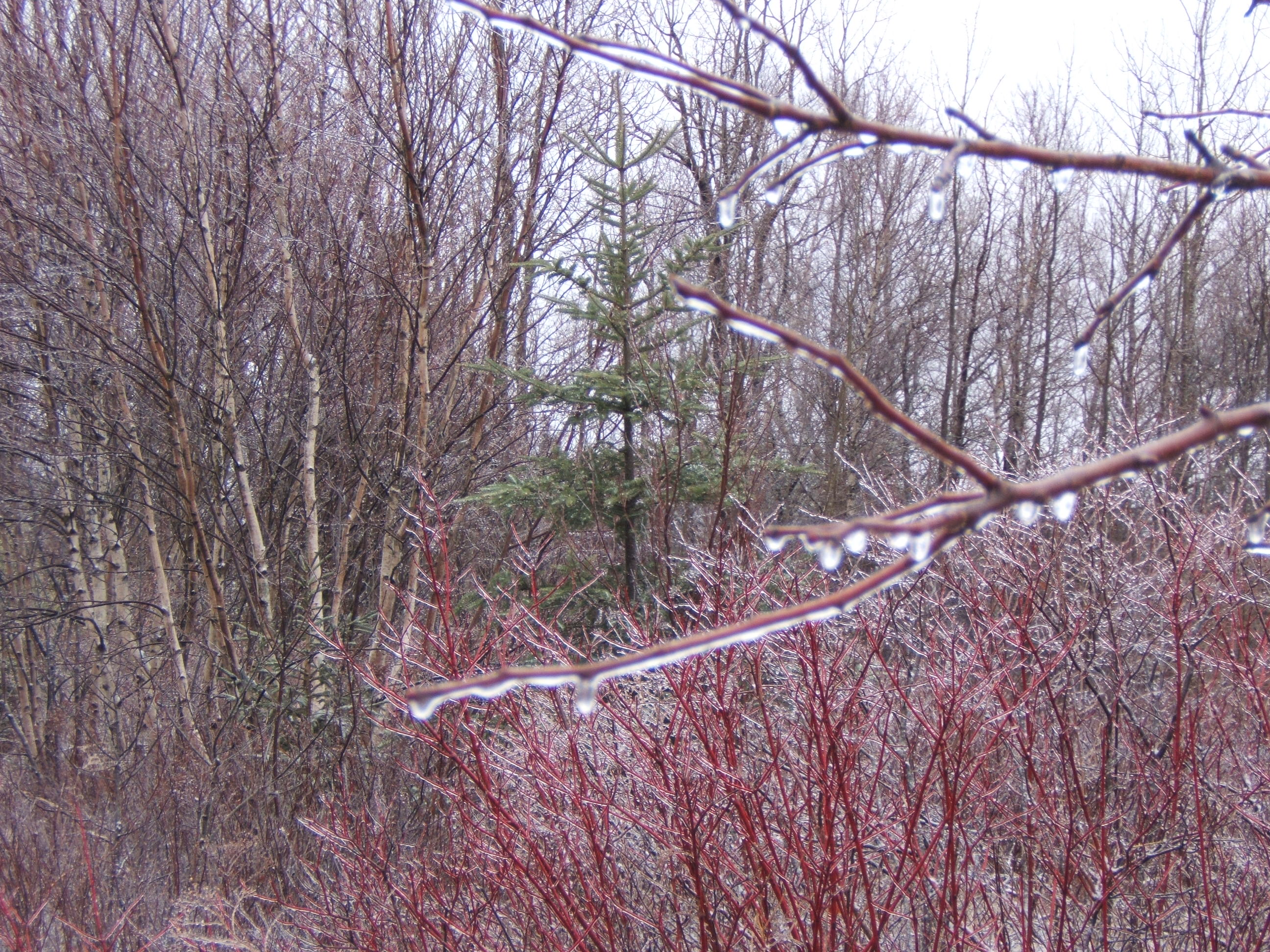
impossible to find, after the freezing rain, branches
encased in slip-and-slide, candy-coated nutrition
~
won by complication, every kernel harder than stone
seed in a casing of black, sunflower
~
and pencil draw the finches, grosbeaks smash seed-coats
with deliberate jaws, shards of sunflower husk and ice-coat
~
fall as rubble
~
~
© Jane Tims 2012
at the bird feeder #1
Today our bird feeders are a mess. Racoons and grey squirrels don’t keep neat houses. However, the seeds scattered across the deck are attracting a delightful array of birds. The last few mornings we have had:
a few chickadees (Black-capped Chickadee, Parus atricapillus)… they grab a seed and swoop to the nearest low branch to break the seed open… they seem to travel in small groups, but bicker with one another at the feeder…
a few nuthatches (Red-breasted Nuthatch, Sitta canadensis)… they are acrobats, grabbing to the feeder and then flipping inside to get the seed… they are solitary, sometimes in small groups of two or three… they leave one another alone, each taking their turn…
a flock of goldfinches (American Goldfinch, Carduelis tristis)… gregarious, they are all a-flutter and feed together side by side… they hang around to break open the seed and tolerate other species beside them…
~
~
goldfinches
~
bright feathers distil
yellow from atmosphere
essence of sunflower
tipple and sip champagne
make small talk at parties
gesture with hands
paint scallops on air, animated discussion
~
the gregarious obtain information
best feeder in the neighbourhood
best seed
least squirrel
~
~
© Jane Tims 2011

spacemen in our feeder
Our feeder has attracted some little space aliens!
In one of my recent posts, I talked about the Grey Squirrel and its marauding ways. Now I have two more mammals to add to my list of bird-feeder pirates.
During the weekend, we went to the Co-Op and puchased a new squirrel-proof feeder. It consists of a slim tube enclosed within a cage with the squares too small for the squirrels to squeeze through. Raccoons can’t fit through those small holes either, but they can take the new feeder off its hook and just toss it off the deck! Once they had cleaned out the spilled food, they began an assault on the older wooden feeder with its hoard of black sunflower seeds.

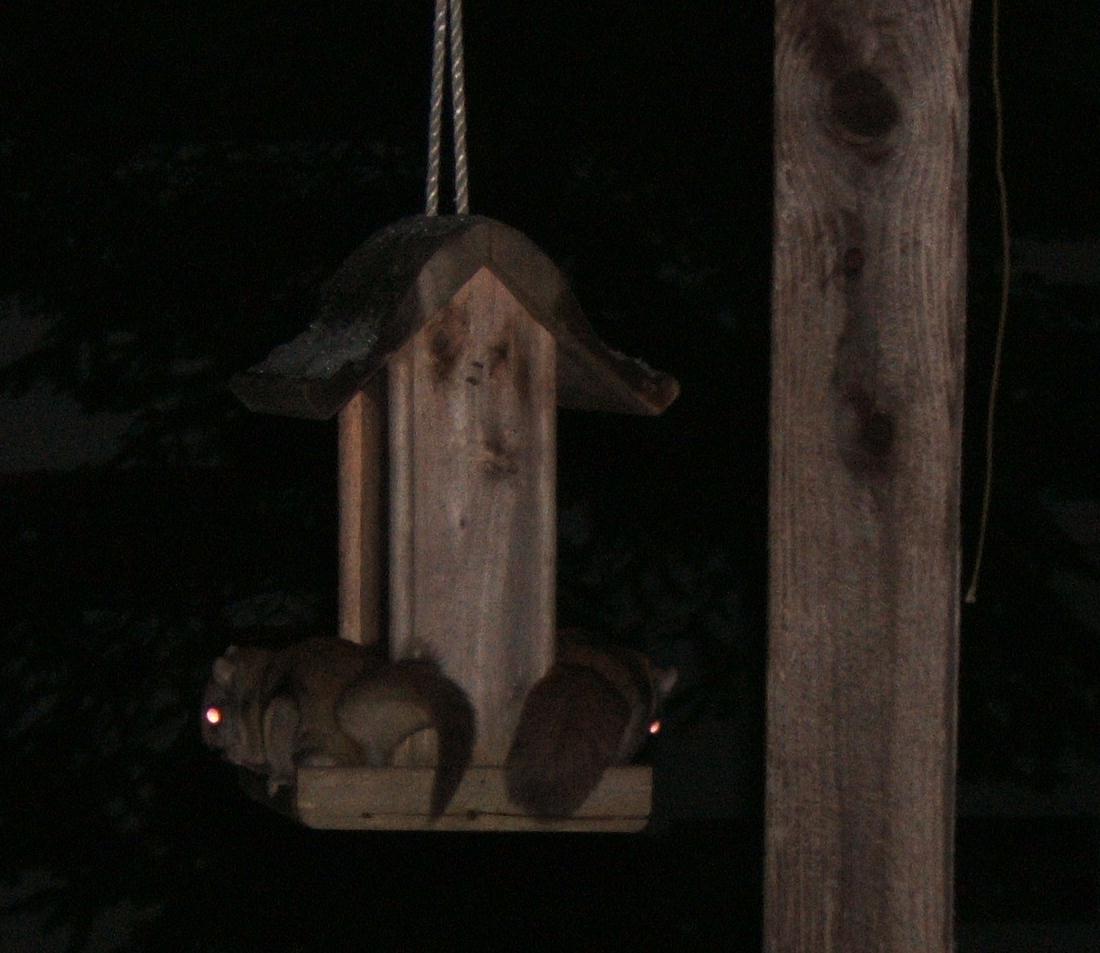
Just before I went to bed, I switched on the outer lights to see if the raccoons had returned and got a wild surprise. Two little spacemen were cleaning the rest of the sunflower seeds from the feeder! They looked like Red Squirrels, but were golden-brown in color, and had white undersides, a lot of extra folds of skin and big black ‘wombat’ eyes.
Flying Squirrels!!
We know the Northern Flying Squirrel (Glaucomys sabrinus) lives in our grey woods, but we haven’t seen them for a while. They not only look different, but move very differently from the Red Squirrels. They are very, very fast and sort of flow and fold themselves across the surfaces they are on, a little like those ‘parkour’ urban acrobats who move fluidly over obstacles.
The two Flying Squirrels argued and bickered with one another and paid no attention to me as I opened the door to snap their photo.
~
~
spacemen in the bird feeder
~
I missed the flash
the revolving light show
and high-pitched whine
just before the spacemen
(the Flying Squirrel Squadron)
set their coordinates on the feeder
~
bickered and folded over landscape
fired lasers from their eyes
took a moment for a black stare
at the earthling watching
and turned to complete the harvest
the sunflower seeds
craved by their planet
~
~
© Jane Tims 2011

one of the usual visitors to our feeder ... the Black-capped Chickadee (Parus atricapillus)
feeding the neighborhood
I have started up the bird feeder and already the mammals are nudging out the birds.
Our first visitor to the feeder was a fat grey squirrel who performed some amusing acrobatics to enjoy ‘his’ sunflower seeds.
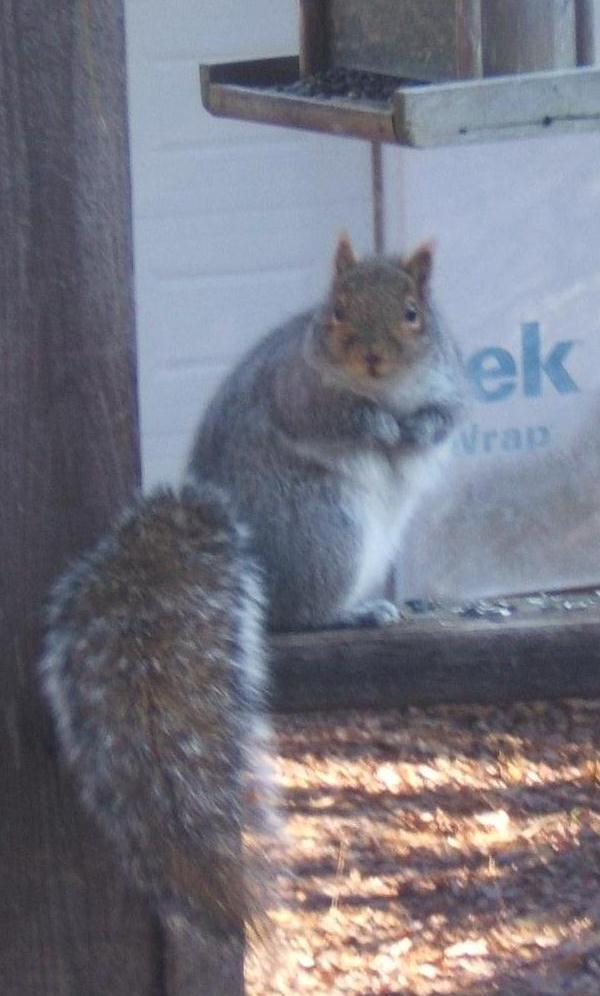

This year, I think I’ll keep a list of the marauders, who may outnumber the birds.
~
apples in the snow
~
she pauses, one foot poised
a lever beneath her, one hoof ready
to push off and fly
tail to flag her departure
tucked, ears up
~
everything still
the snow, the trees, the feeder
not caught in chickadee momentum, land
and shove away
~
three apples
at the edge of deep-freeze
draw her forward
~
© Jane Tims 2011




 nichepoetryandprose